Examining the links between attachment, perfectionism, and job motivation potential with job engagement and workaholism
Análisis de las relaciones entre apego, perfeccionismo, potencial de motivación laboral, compromiso en el trabajo y adicción al trabajo
Aharon Tziner and Miri Tanami1
Netanya Academic College, Israel
1The authors´ names are listed in a random order.
]]>
ABSTRACT
The purpose of this paper was to investigate the associations between attachment styles, perfectionism, and job motivational potential with job engagement and workaholism. A self-report questionnaire that included psychometrically-sound measures of the key constructs was completed by a sample of 139 employees. Correlation analyses, a hierarchical regression, and a structural equation model were conducted to test the proposed relations and mediating hypotheses. Adaptive perfectionism was found to be related to job engagement, whereas maladaptive perfectionism emerged associated to both safe- and non-safe attachment styles. Moreover, only one attachment style (non-safe) and one type of perfectionism (maladaptive) were found to be linked to workaholism. Managers should pay attention to employees characterized by a non-safe attachment style and perfectionist personalities. Efforts should be made to improve job engagement among employees and to enhance constructive workaholism.
Key words: Attachment. Perfectionism. Job motivation. Job engagement. Workaholism.
RESUMEN
El propósito de este artículo fue investigar las asociaciones entre los estilos de apego, el perfeccionismo y el potencial de motivación laboral con el compromiso con el trabajo y la adicción al trabajo. Una muestra de 139 empleados cumplimentó un cuestionario de autoinforme que incluía medidas psicométricamente sólidas de los constructos clave. Se realizó un análisis de correlaciones, una regresión múltiple jerárquica y un modelo de ecuaciones estructurales para poner a prueba las relaciones propuestas y las hipótesis de mediación. Se encontró que el perfeccionismo funcional se relacionaba con el compromiso con el trabajo, mientras que el perfeccionismo disfuncional emergía asociado a los estilos de apego seguros y no seguros. Además, sólo un estilo de apego (no seguro) y un tipo de perfeccionismo (disfuncional) estaban ligados a la adicción al trabajo. Los directivos deberían prestar atención a los empleados que se caractericen por un estilo de apego no seguro y por una personalidad perfeccionista. También se debería hacer un esfuerzo para mejorar el compromiso entre los empleados y facilitar la adicción constructiva al trabajo.
Palabras clave: Apego. Perfeccionismo. Motivación laboral. Compromiso con el trabajo. Adicción al trabajo.
In this day and age, when effective productivity in the workplace is the key to the success of companies and organizations, optimal utilization of human resources becomes a major factor in the achievement of the goals of these organizations. Clearly, as Tziner (1983) has pointed out, the more congruency exists between the needs of the organization and its employees, the more effective the organization will be. However, in order to achieve a high level of congruency the company´s personnel managers must, inter alia, first study the various personality characteristics of their employees and then capitalize on their findings in order to extract from the workers the most optimal work behaviors within a job description and work context that is most fitting for their employees.
]]> Workers in an organization demonstrate a variety of working patterns, some of which are advantageous to both the employee and the organization and some which, according to circumstances, may be both harmful to either the worker or the organization. If we could identify what propensities and personality characteristics tend to strengthen worker satisfaction and productivity, on the one hand, and which traits have negative effects, on the other hand, then we could begin to move in the direction of satisfactory congruency.However, there are compounding variables related to the work environment and the nature of the tasks that the worker has to fulfill that change the nature of the equation. That is to say that under various circumstances a worker may achieve very well but in a different social setting, or faced with alternate tasks, for example, the same worker may perform very poorly.
If we could but tease out these factors, then we may provide the conditions whereby we could better provide jobs that match the propensities of the workers and consequently empower them. We could then more effectively enhance their sense of self-esteem and work satisfaction, thus preventing unnecessary discrepancies between the standards of work required and the levels of work actually achieved. In short, the job analysis would effectively point workers´ personal characteristics in a direction that is right for both the organization and the employees. Ultimately, the job analysis will define and assign reasonable and realistic job requirements within the overall work environment of the organization for the benefit of the overall production effort.
It should be noted that there are particular employees who seem to display unusually intense or obsessive behaviors when it comes to performing their tasks. These excessive behaviors might be detrimental to both employees and their organizations though, if handled well, might yet be major assets to the work effort. Conversely, there are workers so attached to their jobs, so gainfully engaged in their tasks, that they appear to be major assets to their organizations. Yet, their very high expectations of themselves (and of others) may, in the end, lead to deleterious results for both themselves and their supervisors.
This study examines some of the attributes of workers of this nature with a view to facilitating efforts to achieve the best results from their intense behaviors.
We shall identify a number of parameters that are precursors of intense work behaviors, specific characteristics of those behaviors, and the consequences of those behaviors in the workplace. We shall review the associations between some of these factors based on research findings, attempt to identify constructs that mediate between cause and effect, and consequently arrive at a number of working hypotheses that serve as a basis of an attempted model that will provide a working tool for predicting behavior patterns and outcomes of those who are particularly, if not excessively, involved in their work. The goal, ultimately, is to enable managers to achieve optimal working conditions and productivity from such individuals.
Based on the literature in this field, we have identified a number of parameters as potentially relevant to this discussion. They are, respectively, (1) perfectionism (adaptive and maladaptive), (2) attachment styles (safe and non-safe), (3) workaholism, (4) job engagement, and (5) job motivation potential (MPS). The paper was designed to investigate the associations between attachment styles, perfectionism, and job motivational potential with job engagement and workaholism.
A. Perfectionism
Perfectionism is construed as a constant striving for perfection. Burns (1980, 1983) conceptualize it as a compulsive urge to achieve perfection. It is possible, however, to distinguish between what Grzegorek, Slaney, Franze, and Rice (2004) label adaptive and maladaptive perfectionism. Adaptive perfectionism is composed of personal standards and organizational skills and maladaptive perfectionism of doubts about oneself, focus on failures, and parental expectations. The adaptive perfectionists elicit low- to mid-levels of the phenomenon that are more likely to result in positive performance outcomes, whereas non-adaptive perfectionists exhibit behaviors with many negative outcomes such as compulsive urges and feelings of discomfort.
Maladaptive perfectionists lead a constant struggle with themselves in fear of making or revealing mistakes, primarily because their self-perception is distorted (Horney, 1950). They perceive themselves as having mediocre abilities and ignore past success; past success is not an indication of present performance. Indeed, other aspects of their cognitive functioning are also significantly distorted and include manifestations such as "all or nothing" thoughts, dichotomous (black-white) thinking, and the tendency to generalize.
]]> The fear of making mistakes and of criticism prompts the maladaptive perfectionist to seek inner flaws constantly and to conceal them before they are detected. Perfectionism is included in Horney´s (1950) categories of neurotic needs and is placed in the model under the category of ´moving away´ that characterizes individuals who chooses to disengage from anything that poses a threat, as a way of dealing with their conflicts. Neurotic needs are the product of basic childhood anxiety. These people have a strong desire for independence and privacy, and often seem distant and uncomfortable in social situations. They only trust themselves and seek glory in order to idealize their self-image. They do not compromise on demands of themselves and constantly seek unrelenting perfection.Furthermore, Sullivan (1953) suggested that perfectionism is a compulsion that was formed in childhood as a result of hostile and hypocritical parent-child relationships. These parents treated their children with contempt, control, and humiliation and did not keep their word. The children were exposed to exaggerated demands and were punished for failing to meet them. In adulthood, these children experience difficulties in interpersonal relationships because they seek to control others. They have low self-esteem and try to prove themselves by means of their intellect and perfectionism.
More recently, Burns (1980) contended that perfectionism was acquired through the interaction of a child with perfectionist parents. The child is rewarded with love and acceptance for excellent performance and is negatively rewarded for poor performance. Parents express anxiety and disappointment and the child interprets it as punishment and rejection; he learns that mistakes lead to non-acceptance and thus tries desperately to avoid failure. It is highly likely that such a child would become a perfectionist adult.
Especially because they experience rejection when they judge themselves as imperfect, maladaptive perfectionists need positive feedback from others and even to evoke affection and acceptance. They react defensively to criticism and this reaction alienates others and invokes the very rejection that they fear. Hence, their irrational thinking is reinforced -one must be perfect in order to be accepted. They are also reluctant to open up to others in fear that they might be perceived as stupid. They therefore avoid intimate relationships.
Lastly, we may note that perfectionists tend to project their high standards onto others and become angry and disappointed when their high expectations are not met. The distinction made between standards expected of oneself and the high expectations the perfectionist has of others has become a recent source of study that throws a new perspective on this phenomenon (Childs & Stoeber, 2010; Shimazu & Schufeli, 2009).
In an attempt to unearth empirical evidence, Grzegorek et al. (2004) conducted a study that compared adaptive and maladaptive perfectionists in the context of academic studies. The results showed that although there were no significant differences between the grades of the two groups, the maladaptive perfectionists expressed frustration with their achievements. That is to say, although maladaptive perfectionists are able to meet the same goals as adaptive perfectionists and to maintain high standards, they still experience a severe sense of failure.
A1. Perfectionism and attachment
As mentioned, Sullivan (1953) viewed perfectionism as a result of inappropriate relationships between parents and children. However, Bowlby (1979), discussing two types of attachment styles -safe (independent) and non-safe (anxious and dependent)- considered these inappropriate relationships as emanating from non-safe attachment styles. More recently, Harms (2011) demonstrated that individuals with non-safe avoidance attachment tend to discourage social interactions, claiming that they have to work. They do not take vacations and prefer to work alone, tending to avoid asking for help or helping others. In contrast, Hazan and Shaver (1994) described safe-attachment individuals as people who enjoy social and intimate interactions and who value ties with family and friends outside of work. They do set great store by work but they do not allow work to affect their interpersonal relationships, which are more highly valued.
Several studies support a connection between perfectionism and attachment styles. Relating specifically to parental attitudes, Rice, Lopez, and Vergara, (2005) demonstrated that parental criticism leads to both non-safe attachment and maladaptive perfectionism. In particular, a high level of parental criticism and a low level of parental expectation were associated with anxiety (non-safe attachment style), while a high level of parents´ expectations was found to be connected to adaptive perfectionism. Additionally, Tziner, Ben-David, Oren, and Sharoni (in press) substantiate the supposition that inappropriate parental behavior with respect to their children produces both non-safe attachment and maladaptive perfectionism in adulthood with consequent problematic interpersonal relationships in adulthood.
Rice and Mirzadeh (2000) reported that safe attachment was connected with adaptive perfectionism (adopting independent personal standards while setting realistic task objectives) while, correspondingly, non-safe attachment was found tied to maladaptive perfectionism (as exemplified by unrealistic standards, over-fixation with mistakes, feelings that others expect them to be perfect, and erroneous perception of personal standards and actual performance). More recently, Wei, Heppner, Russell, and Young (2006) also found a positive relationship between ´anxiety and avoidance´ attachment behavior and maladaptive perfectionism.
]]> B. WorkaholismScholars disagree as to the conceptualization and measurement of workaholism. Workaholism is viewed as an addiction, a behavior pattern, a set of attitudes to work, or a syndrome. Some of the disagreement stems from the facts that workaholism is a multidimensional structure and that scholars differ about its basic measures. Most definitions of workaholism include the following components: working to the degree of ignoring any other activities, obsessive thoughts and feelings about work, and doing over and beyond job requirements due to internal factors. People become workaholics because these behaviors are constantly reinforced (Clark, Lelchook, & Taylor, 2010).
There are several conceptual definitions of workaholism that include, "A compulsion or uncontrollable need to work intensively" and the more simplistic, "Working over 50 hours a week". Workaholism has also been defined as a situation in which a person becomes compulsively addicted to work and develops an exaggerated, inappropriate dependency on work, way beyond what is required or accepted (Schwartz, 1982). It appears that addiction is a symptom of the need for control and repression of feelings. Indeed, workaholics´ control needs can be so excessive that they affect their environment with excessive demands. Indeed, these internal compulsions can be so destructive that they are also likely to cause depression if and when workaholics do not meet their own standards.
Inflexibility and stubbornness are prominent traits of workaholics; they refuse to acknowledge problems, they are convinced that they are right, and they refuse to compromise. This inflexibility, possibly stemming from low self-image and self-esteem, manifests itself in the tendency to adhere to precise definitions, policies, facts, and analytic measures. Correspondingly workaholics are generally uncomfortable with feelings, imagination, and spontaneity. The tendency to be inflexible in employment situations not only makes life difficult for the workaholic´s co-workers but often makes the workaholic´s job inefficient. The tendency to cling rigidly to one way of thinking does not enable open, flexible, and efficient thinking, so often required in a work environment.
Workaholics´ control needs also prevent them from trusting others to get things done; they consequently take on more than they can manage, expect others to tow their line, and they work in a totally centralized manner. They devote disproportionate time to work-related activities, continue to obsess about work even when they are not at the workplace, and tend to neglect other areas of life. Workaholics do so because of an internal urge rather than for the benefits of external rewards such as incentives and promotion or because of the need to cope with a perceived negative organizational culture or a failed marriage, and the like.
In order to sort out this myriad of descriptive elements, Scott, Moore, and Miceli (1997) classified workaholics into three categories:
]]> Capitalizing on this categorization, in a study to examine the connection between personal traits and workaholism, Burke, Matthiesen, and Pallesen (2006) studied the relationship between self-efficacy and the "Big Five" (neuroticism, extraversion, conscientiousness, openness to experience and pleasantness) and measures of workaholism (compulsion to work, enjoyment of work, involvement in work). They found that neuroticism is related to the compulsion to work, extraversion is associated with involvement and enjoyment in work, and self-efficacy to the three measures of workaholism.1. Obsessive-compulsive - characterized by an incontrollable urge for hard work and anxiety when not working and by mental stress and lack of joy in life.
2. Perfectionist - characterized by inflexibility, involvement with details, and rules and behavior aimed at gaining control, as well as both psychological and physiological problems, including hostility toward self and others.
3. Achievement-oriented - characterized by high motivation to achieve and to be promoted and signs of high levels of physical and mental health, enjoyment of work and life, and social behavior.
In addition to the short-term effects of workaholism, there are also long-term extended deleterious effects such as decreased functioning, increased health-related expenses, work accidents, and turnover, consequences to which organizations would do well to give serious attention.
B1. Workaholism and perfectionism
Studies concerning perfectionism in the workplace have shown that perfectionism and workaholism incorporate similar characteristics. Indeed, it has been argued that workaholics have the same tendencies as perfectionists (Burke, 2000; Burke et al., 2006). Perhaps it is more correct to argue that perfectionism is one of the characteristics of workaholism (see Burke et al., 2006; Porter, 2001; Scott et al., 1997). The perfectionist´s excessive preoccupation with details, often marginal and unimportant, is time consuming and reduces effectiveness; the work is examined over and over again for mistakes. Other tasks, perhaps of higher priority, are thus neglected. For the workaholic, the undue tendency for perfectionism not only reduces functional efficiency but also contributes to mental stress. The disproportionate investment in work and its centrality prevent workaholics from seeing "the light at the end of the tunnel". They are unable to achieve a state of relaxation or enjoy leisure; any leisure activity is considered a luxury and a waste of time. Indeed, these behavioral phenomena are not dissimilar to the negative consequences of workaholism discussed above.
Many studies point toward the relationship between perfectionism and workaholism. When reviewing the welfare systems in modern companies, it seems that these workplaces push the perfectionist to be a workaholic. Moreover, to ease matters for these intense and obsessive employees, the companies even serve most of the needs that were traditionally supplied by family members and friends, so that the employees do not have to leave the workplace for too long a time
More specifically, Clark et al. (2010) substantiated the postulated relationship between workaholism and perfectionism. Using three measures of perfectionism -high standards, incompatibility and order- and three measures of workaholism -impatience, a compulsive need to work and polychronic control- they found that the high standards measure of perfectionism was associated with general workaholism, and the incompatibility measure of perfectionism was related with general workaholism and with all its measures. Moreover, the findings indicate that workaholics´ perceived incompatibility between expectations and evaluation of performance might be the key driving force of workaholic behavior.
C. Job engagement
As with the construct "workaholism", job engagement has also given rise to several interpretations. In one of the earlier studies of the concept, job engagement was conceptualized as "a positive, fulfilling, work-related state of mind that is characterized by vigor, dedication, and absorption" (see Schaufeli, 2011; Schaufeli & Bakker, 2004, pp. 295). These traits are exemplified as follows:
Vigor - by high levels of energy and mental resilience while working, the willingness to invest effort in work, and persistence in spite of difficulties;
]]> Dedication - by a sense of significance, enthusiasm, inspiration, pride, and challenge; andAbsorption - by concentration and engrossment in one´s work.
"Engaged employees" tend to demonstrate pro-activity and high personal initiative and high levels of motivation to acquire knowledge. In general, this engagement is likely to enhance employees´ output and the ultimate success of the organization.
While many recent studies presented job involvement as a high degree of personal investment in job-related tasks (Christian, Garza, & Slaughter, 2011; Kahn, 1990), other investigations described job engagement in terms of its consistency; thus job engagement is a relatively stable trait, a dynamic temporary state, or a relatively stable state of mind that can change over time (Christian et al., 2011). Kahn (1990) claims that job engagement is a condition in which the employee is involved in work on all three levels of consciousness: emotional -characterized by satisfaction and a need to maintain happiness; physical -characterized by internal motivation, autonomy and control; and cognitive -characterized by identification and involvement in work.
From the most recent research, job engagement has been found to link positively to high levels of task performance and OCB (Organizational Citizenship Behavior). Engaged employees are characterized as people who believe in themselves, are active, provide positive feedback, and are tired but satisfied. Job engagement grows from autonomy, social support, opportunities for learning and growth, responsibility, formative leadership, and organizational justice. In addition, job engagement was found to be related with variables such as emotional stability, extraversion, conscientiousness, optimism, self-esteem, goal achievement, self-efficacy, adaptability, adaptive perfectionism, positive emotions, and mental and physical health.
Of interest, job engagement differences were found for various professions: a high level was found among teachers, managers, artisans, nurses, salespeople, and farmers while a low level was discerned among assembly line workers, retailers, typists, household workers, and policemen (Schaufeli, 2011). A most recent study found that job engagement is also positively correlated with narcissism, managerial jobs, and with enjoyment of work (Andreassen, Ursin, Eriksen, & Pallesen, 2012).
In a summary study of the concept, related to differences regarding terminology, both in academic papers and in management consulting, Macey and Schneider (2008) view job engagement as a multi-dimensional notion that includes the terminology of all three categories: characteristic, psychological state, and behavior.
• Characteristic - a positive perception of life and work; a proactive and autotelic (an individual who generally does things for their own sake, rather than for external rewards) personality; positive and conscientious emotional tendency.
• Psychological state - emotions stemming from positive energy: satisfaction, involvement in work, self-efficacy, commitment, and mental empowerment.
]]> • Behavior - beyond the call of "duty": organizational citizenship behavior (OCB), personal initiative, responsibility, adaptation, expanding the boundaries of the job, and good performance.
They collimate the three measures of job engagement with three psychological states: vigor, with a positive emotional state; dedication, with commitment; and absorption, with involvement. Ultimately, Macey and Schneider (2008) suggest combining these three measures into one comprehensive measure.
Common to all these definitions is that job engagement signifies a positive situation for managers and, consequently, the phenomenon should fit in well with the organization´s goals. It should be noted in this respect that job engagement is a construct that incorporates much more than just employees´ satisfaction with work conditions and their basic loyalty to the organization, factors which are frequently researched. For job engagement also reflects workers´ commitment and willingness to devote a great deal of effort to help the employer succeed. Indeed, engaged employees are not only loyal to their organization; they also contribute significantly to their workplace and are less likely to leave the organization of their own volition (Macey & Schneider, 2008).
C1. Job engagement and perfectionism
As indicated, job engagement incorporates the variables vigor, dedication, absorption, and efficiency. Adaptive perfectionism is composed of personal standards and organizational skills and maladaptive perfectionism of doubts, focus on failures, and parental expectations. Studies indicate that there is a positive correlation between adaptive perfectionism and job engagement and a negative correlation of adaptive perfectionism with both maladaptive perfectionism and burnout (Zhang, Gan, & Cham, 2007).
Building on the distinction between standards expected of oneself and of others, Childs and Stoeber (2010) found a negative correlation between non-adaptive perfectionism and job engagement. Perfectionism towards others is positively correlated with vigor, which is a measurement of job engagement, whereas perfectionism concerning oneself is positively associated with the three measures of job engagement and negatively with all signifiers of burnout.
C2. Job engagement and workaholism
In a comprehensive study conducted in Japan, Shimazu and Schufeli (2009) examined differences between workaholism (measures: drive and intensive work) and job engagement (measures: vigor, dedication, and absorption) by means of five variables: 1) number of work hours (overtime in and outside the workplace), 2) nature of job (demands and control, and support from colleagues and managers), 3) implications of job (satisfaction and organizational commitment), 4) quality of social contacts (negative responses and inadequate social functioning), and 5) health condition (distress, depression, anxiety, and psychosomatic complaints).
Their study revealed that workaholism and job engagement both related positively to excessive work hours. In this context, they noted, as indicated above, that workaholics tend to act on a deep inner compulsion rather than for material rewards. However, the major findings of the study revealed the distinction between these two constructs. Shimazu and Schufeli (2009) illustrated the destructive potential of workaholism, the positive impact of job engagement, and their relationship to perfectionism, primarily the kind directed at oneself. They found a negative correlation between workaholism and mental wellbeing, expressed in psychological stress and physical symptoms, dissatisfaction with both work and family life, and low performance at work. In contrast, a positive correlation was found between job engagement and mental wellbeing and work performance. As a result of these findings, the researchers concluded that job engagement and workaholism are two diverse phenomena, with a weak negative correlation between them.
C3. Job engagement and job characteristics
]]> According to Hackman and Oldham (1975), skill variety, task identity, task significance, autonomy, and feedback are five core job characteristics that may be positively related to motivation, job satisfaction and, eventually, job performance. These five core job characteristics can be combined to form a motivating potential score (MPS) for a job, which can be used as an index of how likely a job is to affect an employee´s attitudes and behaviors. Indeed, research has demonstrated that employees are likely to experience positive attitudes toward jobs characterized by a high MPS score (see Fried & Ferris, 1987 for a review). Hackman and Oldham´s (1975) five job characteristics have also been recognized as job resources.In a study that examined the relationship between job demands and resources (MPS) and job engagement, the researchers used the JDR test, which examines various job aspects. A low grade on the JDR test indicates job demands that are comprised of physical, psychological, social, and organizational features that bring about negative responses such as overload, speed, burnout, stress, effort, routines, and illness. A high grade on the test indicates job resources that are comprised of achieving goals, decreasing physiological, and psychological demands of the job, personal growth, learning, and development, resources that result in positive outcomes such as good relationships with co-workers, clarity, autonomy, feedback, trust, and promotion opportunities. Positive correlation was found between job resources and job engagement (Schaufeli & Bakker, 2004; Taris, Beek, & Schauffeli, 2010), and between job demands and workaholism (Metin, 2010).
Christian et al. (2011) also investigated the relationship between job descriptions (Job Diagnostic Survey, JDS) and job engagement. However, in contrast to the findings above, they found that only the variables "variety of skills to perform job requirements" and "role significance" were positively correlated with job engagement, and that job engagement mediated between "variety of skills" and "role significance", and performance at work. Their assertion is that workers´ subjective evaluations of the significance of both these characteristics are insights that affect them in the context of the job´s significance. On the other hand, two other variables studied, namely, "autonomy" and "feedback", are perceptions of responsibility and knowledge about the outcome of functioning, and as such they are seemingly less significant to the development of job engagement.
Relating to perceptions, we are reminded that Kahn (1990) based his model of job engagement on the previous work of Hackman and Oldham (1975), who discussed critical psychological states. Kahn claimed that both personal and organizational factors could affect the psychological experience of the job, which drives work behavior. However, other studies maintain that while job engagement should relate to employees´ internal psychological connections with the performance of work tasks, this association is not necessarily true concerning the links between job engagement and the characteristics of either the job or the organization. Thus, from this latter perspective, it would be wrong to examine job engagement in connection with rewards, feedback, task significance, growth opportunities, or clarity of demands. However, in their review of the literature, Macey and Schneider (2008) determined that the research clearly indicates that ´autonomy´ and ´a variety of skills´ are Hackman and Oldham´s (1975) job characteristics, which directly affect job engagement if that construct is defined as a psychological state.
Hypotheses
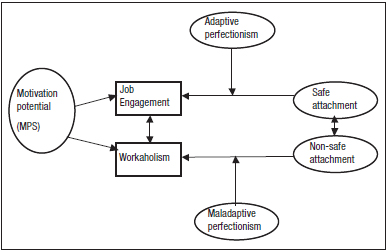
Hypothesis 1. A safe attachment style will relate positively with job engagement.
We have discussed that safe attachment (adopting independent personal standards while setting realistic task objectives) is connected with adaptive perfectionism while non-safe attachment ("anxiety and avoidance") was found tied to maladaptive perfectionism (Rice & Mizadeh, 2000; Wei et al., 2006). Moreover, we established that there is a positive correlation between adaptive perfectionism and job engagement and a negative correlation between adaptive perfectionism and burnout, especially with respect to perfectionism concerning oneself (Childs & Stoeber, 2010; Zhang et al., 2007). It thus follows that "a safe attachment style will relate positively with job engagement".
Hypothesis 2. A non-safe attachment style will relate positively with workaholism.
Insofar as job engagement and workaholism were found to be two independent factors with a slight negative correlation between them (Shimazu & Schufeli, 2009), it thus follows from Hypothesis 1 that "a non-safe attachment style will relate positively with workaholism".
Hypothesis 3. Motivational potential (an average of job characteristics; in this study, five) will associate positively with job engagement.
]]> We established that a positive correlation was found between job resources and job engagement (Schaufeli & Bakker, 2004; Taris et al., 2010). We also noted that, employing the JDS test, Christian et al. (2011) found that the variables "variety of skills to perform job requirements" and "role significance" were positively correlated with job engagement and that job engagement mediated between "variety of skills" and "role significance" and performance at work. Based on these findings, it follows that "motivational potential (an average of job characteristics; in this study, five) will associate positively with job engagement".Hypothesis 4. Motivational potential (an average of job characteristics; in this study, five) will associate negatively with job workaholism.
Insofar as job engagement and workaholism were found to be two independent factors with a slight negative correlation between them (Shimazu & Schufeli, 2009), it thus follows from Hypothesis 3 that "motivational potential (an average of job characteristics; in this study, five) will associate negatively with job workaholism".
Hypothesis 5. There is a negative relationship between job engagement and workaholism.
As indicated above -notwithstanding that workaholism and job engagement were found to be related positively to excessive work hours- based on the comprehensive study conducted by Shimazu & Schufeli (2009), we have hypothesized that, "there is a negative relationship between job engagement and workaholism".
Hypothesis 6. Adaptive perfectionism moderates the relationship between safe attachment and job engagement.
We have discussed that safe attachment (adopting independent personal standards while setting realistic task objectives) is connected with adaptive perfectionism while non-safe attachment ("anxiety and avoidance") was found tied to maladaptive perfectionism (Rice & Mizadeh, 2000; Wei et al., 2006). Moreover, we established that there is a positive correlation between adaptive perfectionism and job engagement and a negative correlation between adaptive perfectionism and burnout, especially with respect to perfectionism concerning oneself (Childs & Stoeber, 2010; Zhang et al., 2007). It thus follows that "adaptive perfectionism moderates the relationship between safe attachment and job engagement".
Hypothesis 7. Maladaptive perfectionism moderates the relationship between non-safe attachment and workaholism.
Based on the findings discussed above (Hypothesis 6) and insofar as non-safe attachment and high levels of workaholism both have negative consequences for the worker and the organization, it is safe to hypothesize that "maladaptive perfectionism moderates the relationship between non-safe attachment and workaholism".
Research Model
]]>
Method
Participants
The data were collected from 139 employees in a public organization, of whom 70 were men and 69 women. The respondents were employed in various jobs; 26.1% were single, 68.8% married, and 5.1% divorced. Their age ranged between 19 and 62. With respect to income, 30.8% reported earnings below the average market salary, 31.5% the average salary, and 37.7% above average; 19.4% possessed a high school diploma, 52.5% held an undergraduate degree, 8.6% a sub-engineer degree, and 19.4% held a Master´s degree.
Measures
Attachment. The 15-item questionnaire developed by Mikulincher, Florian, and Tolmacz (1990) was used to measure the two styles of attachment: safe (5 items, M = 4.99, SD = 0.90, alpha = .56) and non-safe (10 items, M = 3.02, SD = 0.86, alpha = .76). Responses were marked on a 7-point Likert scale ranging from 1 (strongly disagree) to 7 (strongly agree). A high score on the former factor indicates a high level of safe-attachment and a high score on the latter factor indicates a high level of non-safe attachment.
Job characteristics. Job characteristics were measured with Hackman and Oldham´s (1975) 23-item instrument, the Job Diagnostic Survey (JDS). The responses were marked on a 5-point Likert scale ranging from 1 (very non-characteristic) to 5 (very characteristic) in regard to the extent the content of each item was characteristic of the respondent´s job. Five characteristic measures were derived from the responses to this tool: skill variety (5 items, M = 3.82, SD = 0.81, alpha = .80), task identity (4 items, M = 3.71, SD = 0.74, alpha = .57), task significance (4 items, M = 3.9, SD = 0.69, alpha = .55), autonomy (4 items, M = 3.62, SD = 1.36, alpha = .62), feedback (6 items, M = 3.37, SD = 0.62, alpha = .77). Additionally, the Motivation Potential (MPS) of the job was calculated using Hackman and Oldham´s (1975) formula (M = 47.25, SD = 20.19).
Job engagement. Job engagement was measured with a 16-item version of the Utrecht Work Engagement Scale (UWES-17; Demerouti, Bakker, de Jonge, Janssen, & Schaufeli, 2001). The scale comprises three subscales measuring vigor (e.g., "At my work, I feel bursting with energy"), dedication (e.g., "I am enthusiastic about my job"), and absorption (e.g., "I get carried away when I am working"). The first subscale comprised five items; the second subscale consisted of 5 items, and the third one of 6 items. Respondents rated their responses on a scale ranging from 1 (strongly disagree) to 6 (strongly agree) with regard to the extent to which they agree with the content of each statement. However, an overall measure of job engagement was calculated as an average of the responses to the 16 items, because the present investigation focused on this construct as a whole (M = 4.35, SD = 0.78, alpha = .83).
]]> Workaholism. Workaholism was tapped using a 17-item version of the WART inventory. For illustration, one of the items included in this measure was "I find it difficult to relax when I do not work". The respondents were requested to mark to what degree the content of each item was true and descriptive of them, using a 4-point Likert scale with 1 (never true) to 4 (always true) as end points. A high score indicates a high level of workaholism and a low score reflects a low level of workaholism (M = 2.51, SD = 0.45, alpha = .815).Perfectionism. Perfectionism was gauged employing Slaney, Rice, Mobley, Tripi and Ashby´s (2001) instrument (ASP-R) incorporating 23 items. Two subscales were derived: maladaptive (12 items, M = 3.34, SD = 1.27, alpha = .93) and adaptive (11 items, M = 3.15, SD = 0.44, alpha = .84). The respondents indicated on a 7-point Likert scale from 1 (do not agree at all) to 7 (completely agree) the extent to which they agreed that the item was descriptive of them. For instance, one statement was: "I am never satisfied with my accomplishments" (maladaptive), while another was: "At work or studies, I set myself high standards" (adaptive.).
Results
At the first stage, a Pearson correlation matrix was produced to examine the correlations between the study´s variables -safe/non-safe attachment, workaholism, adaptive/maladaptive perfectionism, job engagement, and motivational potential.
The findings of Table 1 indicate that (1) there is no correlation between safe attachment and job engagement; thus, Hypothesis 1 was not substantiated. This also implies that there would be no significance in examining adaptive perfectionism as a moderator of this relationship, and consequently Hypothesis 6 was not confirmed; (2) non-safe attachment is positively correlated to workaholism. The implication is that the less safe the attachment, the more likely the individual exhibits a higher level of workaholism. Hypothesis 2 was substantiated; (3) a positive correlation was found between job engagement and general motivational potential. The more individuals display job engagement, the higher is their motivational potential. Conversely, the greater the motivational potential of employees, the more likely they are to be engrossed in job engagement. Hypothesis 3 was confirmed; (4) no correlation was found between workaholism and motivational potential. Thus, Hypothesis 4 was not confirmed; (5) job engagement and workaholism unfolded a significant correlation, thereby leading to the conclusion that Hypothesis 5 was not corroborated.
A stepwise regression was performed in order to examine the hypothesis that maladaptive perfectionism moderates the relationship between non-safe attachment and workaholism, with the variables "positive feelings" and "negative feelings" as controls, non-safe attachment as an independent variable, workaholism as a dependent variable, and maladaptive perfectionism as a moderator. As mentioned, maladaptive perfectionism includes high grades on three measures: order, standards, and incompatibility. It is a categorical variable, and can thus serve to moderate the relationship of non-safe attachment and workaholism. Table 2 presents the results of the regression analysis.
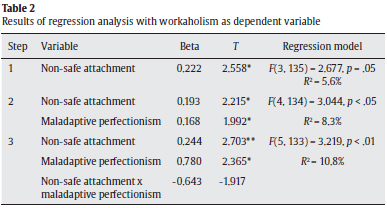
]]> As stated, these findings indicate a significant positive correlation between non-safe attachment and workaholism. The interaction between maladaptive perfectionism and non-safe attachment is not significant, which indicates that maladaptive perfectionism does not moderate the relationship of non-safe attachment and workaholism. Thus, Hypothesis 7 was not confirmed.
Structural equations´ testing (with AMOS software), using only hypothesized direct effects, was performed to examine the validity of the research model as a whole. Perfectionism as a moderating (indirect) variable was not used, because it includes more than two groups and the sample was too small (adaptive, n = 36; maladaptive, n = 11).
The findings present a CMIN value of 3.571 with one degree of freedom and significance at .168. The relative CMIN value divided by degrees of freedom was 1.786 (less than 2). This indicates that there is good statistical fit of the research data and theory. Additional fit measures show that there is reasonable statistical fit between the theoretical model and the empirical model: RMSEA = .75, slightly higher than the maximum desirable level (.6), NFI = .954, and CFI = .977 -both measures are higher than .95, which indicates good fit.
Figure 1 reveals that non-safe attachment affects workaholism positively (β = 0.217, p = .01), motivational potential affects job engagement positively (β = 0.475, p < .01), job engagement affects workaholism positively (β = 0.373, p < .01), and safe-attachment relates negatively with non-safe attachment (β = -0.235, p = .01).
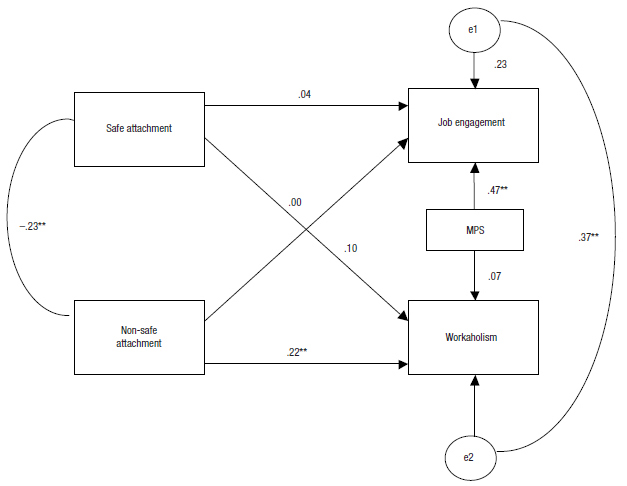
Figure 1. Structural equations model
**p < .01
Discussion and Conclusions
In this section we first discuss the research findings in relation to previous studies and our proposed hypotheses, beginning with those hypotheses corroborated and followed by those not confirmed. Subsequently, we shall discuss the limitations of this study, recommendations for future studies, and practical implications.
]]> The second hypothesis, namely, a positive correlation between non-safe attachment and workaholism, was substantiated. The reason presumably lies in the common negative implications of both phenomena, as discussed above. We recall that Harms´ (2011) description of non-safe attachment individuals is similar in many ways to that of workaholics who work to the point of obliterating other activities in life, including interactions with others. Both non-safe attachment individuals and workaholics appear to experience anxiety, fatigue from intense work, and inability to ask for help or to delegate responsibilities.The third hypothesis, namely, a positive correlation between job engagement and motivational potential, was also substantiated. This result is in line with the results of previous studies (Christian et al., 2011; Macey & Schneider, 2008; Metin, 2010). In this context, the important aspect is that the positive correlation found between job engagement and motivational potential supports the theory that if employees have jobs that challenge them and develop their abilities, then their motivation to work hard increases. This consequence affects critical psychological states such as satisfaction and self-esteem that in turn impinge on the quality of performance, effectiveness, and productivity which, for their part, are factors conducive to job engagement. Additionally, this finding supports Kahn´s (1990) contention that not only personal factors but also organizational factors affect the psychological experience of the job and, consequently, behavior at work.
The first hypothesis, namely, that a positive correlation exists between safe attachment and job engagement, was not upheld by the findings, for which there could be three reasons. First, recalling Hazan and Shaver´s (1994) comments regarding safe-attachment individuals as people who value social interactions outside of work more than they value their work, per se, it is possible to argue they are not inclined to either the positive (job engagement) or the negative (workaholism) extreme. They perform what is required of them properly and on time.
Our research results show that there is a positive correlation between job engagement and workaholism, and a negative correlation between safe attachment and workaholism, which indicates that safe attachment is not likely to correlate with job engagement. That is to say that because job engagement and workaholism include some identical characteristics, an individual with a safer attachment pattern is less likely to be either a workaholic or job-engaged. Nevertheless, the literature attests that both safe-attachment and job-engaged individuals share high self esteem (Hazan & Shaver, 1994; Mikulincer & Shaver, 2007; Schaufeli, 2011), and experience pleasure and satisfaction from work (Andreassen et al., 2012; Wijhe, Peters, & Schauffeli, 2010), but this is seemingly not sufficient communality for finding a significant association between the two variables.
A possible explanation relates to the continuing debate among scholars as to the definition and nature of job engagement. It is inconclusive whether job engagement is a character trait, a psychological state, or organizational behavior. In contrast, both attachment patterns and workaholism are expressions of facets of an individual´s personality in adulthood. However, as noted, the term job engagement might better be defined as an employee´s behavior in an organization, which is affected by external factors; it changes from job to job and is affected by the job description and the employee´s current attitude towards the organization, according to circumstances prevailing in the workplace at any given time.
The fourth hypothesis, namely, that there exists a negative correlation between motivational potential and workaholism, was unsubstantiated. No previous literature was identified which implied a relationship between job characteristics and workaholism, but this study was expected to reveal a negative correlation between the two variables because of the extensive negative attributes of workaholism, which are described above.
Returning to the debate concerning whether job attachment is more closely related to inner psychological perceptions of job performance or to external factors such as the organizational culture or job characteristics, we recall that there is a strong opinion that job engagement should not be examined in the context of rewards, feedback, job significance, growth opportunities, or clarity of expectations. However, in this study, and in previous studies, job engagement and job descriptions were found to be associated. We consequently take the stand that the phenomenon of job engagement probably incorporates both internal and external elements while, in contradistinction, workaholism includes only internal components that are unrelated to the job or the organization.
The fifth hypothesis, namely, that a negative correlation exists between job engagement and workaholism, was not corroborated; in actuality, the correlation between these two variables was significantly positive. This finding lends support to the studies of Machlowitz (1980) and Metin (2010) who argued that workaholics are simply people who love to work. In addition, these two attributes share a common basis that probably contributes to their positive correlation, namely, that work is intense and for multiple hours. This specific notion is borne out by Shimazu and Schufeli (2009) in their comprehensive study which, for the most part, led the researchers to view job engagement and workaholism as separate entities.
The sixth hypothesis, namely, that adaptive perfectionism moderates the relationship between safe attachment and job engagement, was not confirmed. It would be unnecessary to examine such a relationship if there is no correlation between safe attachment and job engagement because a moderator affects the strength of the relationship between variables -and in this case there is none. As mentioned, a correlation was found between safe attachment and adaptive perfectionism (Rice & Mirzadeh, 2000), and between adaptive perfectionism and job engagement (Zhang et al., 2007), so future research could investigate a direct link between these variables. Perfectionism is a categorical variable, meaning that correlations between perfectionism and other variables cannot be examined in this study. The "standards" measure (part of perfectionism) was found to be related with job engagement and the ´incompatibility´ measure was not found to be related with job engagement. This implies the possibility that job engagement is more associated with adaptive perfectionism.
The seventh hypothesis, namely, that maladaptive perfectionism moderates the relationship between non-safe attachment and workaholism, was also refuted. That is to say, perfectionism does not affect the relationship between non-safe attachment and workaholism. Nevertheless, the results were close to significance, and we believe that had this study included more than eleven maladaptive perfectionists, the results would have been significant.
]]> Limitations and Suggestions for Future ResearchA common limitation, which is also present in this study, concerns the method of data collection -the self-report method. This is a non-objective measure, in which respondents are often apprehensive regarding reporting the truth about non-normative behaviors, their attitudes to their workplace, personal traits, and thoughts. Thus, social desirability bias could occur; specifically the responding individual might present himself in a more positive light than is true. People with high social desirability tend to respond in a manner that they perceive as socially acceptable. Furthermore, it is advisable to combine the self-report method with an indirect method of data collection, such as data collected from managers, subordinates, coworkers, or family members.
Also, the sample was relatively small, which might have affected the results. For instance, merely eleven maladaptive perfectionists were identified, and the results on a mediating effect are only almost significant. It is important to increase the sample size, or perhaps conduct a two-stage study. For instance, in the first stage it would be beneficial to identify maladaptive perfectionists or non-safe attachment individuals and in the second stage to examine relationships with the other variables within the bigger group.
A further limitation of this research is that since the study is correlational rather than experimental, causal conclusions could not be made. For example, following our discussion, it could be important to conduct a study that examines whether job characteristics do or do not produce job engagement. In addition, this study is cross-sectional, conducted at a specific point in time; a longitudinal study would help establish over a more significant period of time whether the tendencies established were both stable and constant.
A final limitation concerns the research tools, and has two aspects. One is the length of the questionnaires (number of questions) and their complexity. Most participants complained that the questionnaire was too long and exhausting. Twenty-nine respondents did not complete the questions or marked identical answers with no regard to the content, and were excluded from the study. Another factor concerns the environment and context in which the survey is conducted such that respondents are able to concentrate on the questions in a relaxed setting. The questions should be phrased in a way that compels the respondent to consider each question in and of itself and the questionnaire should incorporate enough reverse questions in order to minimize respondent bias. The data collection of this study used shortened versions of the questionnaires and, notwithstanding questions of length, future researchers would be advised to use a more comprehensive version. Perhaps follow-up research could focus on the relationship of only two-three variables in order to reduce the number of questions.
In summary, the more we investigate the effect of attachment patterns and other personality characteristics, specifically concerning individuals who display intense, if not obsessive, behaviors in the workplace, the better we will be able to understand their consequences for both employees and employers in the workplace. Such studies could supply important theoretical implications while concurrently contributing significantly to our understanding of organizational behavior.
Practical implications
Tziner (1983) drew attention to the notion of congruency in organizations that is expressed in an efficient and balanced harmony between the needs of an organization and those of its employees. Productivity and the promotion of a company´s goals are best achieved when there is congruency and the organization is utilizing its human resource to the maximum. Of course, the major initial step is to tap into those needs, those of the employees no less than those of the directors and managers. The organization must learn its employees´ personality characteristics.
We have noted, specifically, that childhood attachment patterns form the individual´s adult personality and that these patterns affect all important areas of life, including the workplace where many hours a day are spent. Perfectionism is one significant personality trait expressed at work, which, according to the literature, is highly affected by attachment patterns. Hence, it is germane to identify employees´ attachment patterns and levels of perfectionism and to channel them correctly. For instance, organizations could find a way to provide maladaptive perfectionists with feedback in a way that would not further harm their self-esteem with devastating results, but rather to empower them, show them their achievements, and prevent discrepancies between their standards and the actual results. We believe that adaptive perfectionism is a blessing to the organization and that maladaptive perfectionism can be made adaptive by means of proper personal treatment.
Organizations, in which the human resource is central, would be wise to aim their efforts at directing personal expressions in a direction that is right for them and the worker. The goal is not to recruit or to keep only safe-attachment employees (which was, incidentally, not found to correlate with job engagement or motivational potential), but to try to direct non-safe-attachment workers towards effective organizational behavior. Bowlby (1988) contended that positive experiences in adulthood can change specific behaviors that owe their style of manifestation to an individual´s attachment pattern. The workplace could be a safe haven for such a person in the long run, whereby the employee becomes more effective and the company also gains.
]]> Job analysis should define reasonable and realistic job requirements that suit both the employees and the organization. In some jobs, social ties and self-confidence are not necessary in order to perform professional tasks in the best possible way. Obviously, the organization would like to recruit outgoing personalities; but does the job really require it? Not every job requires social networks or teamwork, which means that non-safe attachment individuals can also fit in. Could the organization recruit the best people for the job even though they are introverted and less socially adept? The answer is yes, although the managers would do well, nevertheless, to take steps to improve their anxious employees´ performance.Job-engaged individuals and workaholics can be an asset to the organization. They both are heavily committed to working long, tedious hours even if their urge to do so stems from different sources, internal or external. In general, it is advisable to invoke job engagement rather than workaholism, but it is also possible to obtain superior performance from workaholics, if the right way is found. Although workaholism was found to relate with non-safe attachment and with maladaptive perfectionism, it does not necessarily associate with negative feelings, and some scholars (see Machlowitz, 1980) even perceive this obsessive trait as an advantage over other employees who are less intense in the workplace.
Regarding job characteristics and motivational potential, it is not clear whether job engagement increases or not when the overall job characteristics grade rises. As causality between the variables is not known, an effect cannot be deduced. It is our stance that a worker should be given the job definition in which he can best excel and in the right dosage that fits his personality and capabilities. For instance, while autonomy suits one specific worker, team work and social interaction is more suitable for another; while one employee has the motivation and stamina to work long hours, another may best perform in short but effective bursts. In this way workers are motivated to reach their best potential.
Although this study did not find that improved job characteristics would help workaholics, nevertheless, it appears germane to suggest a consolidated research effort to find what would motivate them. One direction seems to be to address the workaholic´s positive traits -high standards and job engagement, rather than the negative traits-, non-safe attachment, and incompatibility.
Conflicts of interest
The authors of this article declare no conflicts of interest.
References
1. Andreassen, C. S., Ursin, H., Eriksen, H. R., & Pallesen, S. (2012). The relationship of narcissism, work engagement, and professional position. Social Behavior and Personality, 40, 881-890. [ Links ]
2. Bowlby, J. (1979). The making and breaking of affectional bonds. London: Tavistock. [ Links ]
3. Bowlby, J. (1988). A secure base: Clinical applications of attachment theory. London: Routledge. [ Links ]
4. Burke, R. J. (2000). Workaholism in organizations: Psychological and physical well-being consequences. Stress and Medicine, 16, 11-16. [ Links ]
5. Burke, R. J., Matthiesen, S. B., & Pallesen, S. (2006). Workaholism, organizational life and well-being of Norwegian nursing staff. Career Development International, 11, 463-477. [ Links ]
6. Burns, D. D. (1980). Feeling good: The new mood therapy. New York: New American Library. [ Links ]
7. Burns, D. D. (1983). The spouse who is a perfectionist. Medical Aspects of Human Sexuality, 17, 219-230. [ Links ]
8. Childs, J. H., & Stoeber, J. (2010). Self-oriented, other-oriented, and socially prescribed perfectionism in employees: Relationships with burnout and engagement. Journal of Workplace Behavioral Health, 25, 269-281. [ Links ]
9. Christian, M. S., Garza, A. S., & Slaughter, J. E. (2011). Work engagement: A qualitative review and test of its relationship with task and contextual performance. Personnel Psychology, 64, 89-136. [ Links ]
10. Clark, M. A., Lelchook, A. M., & Taylor, M. L. (2010). Beyond the Big Five: How narcissism, perfectionism, and dispositional affect relate to workaholism. Personality and Individual Differences, 48, 786-791. [ Links ]
11. Demerouti, E., Bakker, A. B., de Jonge, J., Janssen, P. P. M., & Schaufeli, W.B. (2001). Burnout and engagement at work as a function of demands and control. Scandinavian Journal of Work Environment and Health, 27, 279-286. [ Links ]
12. Fried,Y., & Ferris, G. R.(1987). The validity of the job characteristics model: A review and meta-analysis. Personnel Psychology, 40, 287-322. [ Links ]
13. Grzegorek, J. L., Slaney, R. B., Franze, S., & Rice, K. R. (2004). Self-criticism, dependency, self-esteem, and grade-point average satisfaction among clusters of perfectionists and non-perfectionists. Journal of Counseling Psychology, 51, 192-200. [ Links ]
14. Hackman, J. R., & Oldham, G. R. (1975). Development of the Job Diagnostic Survey. Journal of Applied Psychology, 60, 159-170. [ Links ]
15. Harms, P. D. (2011). Adult attachment styles in the workplace. Human Resource Management Review, 21, 285-296. [ Links ]
16. Hazan, C., & Shaver, P. R. (1994). Attachment as an organizational framework for research on close relationship. Psychological Inquiry, 5, 1-22. [ Links ]
17. Horney, K. (1950). Neurosis and human growth. New York: Norton. [ Links ]
18. Kahn, W. A. (1990). Psychological conditions of personnel engagement and disengagement at work. Academy of Management Journal, 33, 692-724. [ Links ]
19. Macey, W. H., & Schneider, B. (2008). The meaning of employee engagement. Industrial and Organizational Psychology, 1, 3-30. [ Links ]
20. Machlowitz, M. (1980). Workaholics: Living with them. New York: Simon & Schuster. [ Links ]
21. Metin, U. B. (2010). The antecedents and consequences of burnout, work engagement and workaholism (MA unpublished thesis). Middle East Technical University, Dept. of I/O Psychology. [ Links ]
22. Mikulincer, M., & Shaver, P. R. (2007). Attachment in adulthood: Structure, dynamics, and change. New York, NY: Guilford. [ Links ]
23. Mikulincher, M., Florian, V., & Tolmacz, R. (1990). Attachment styles and fear of personal death: A case study of affect regulation. Journal of Personality and Social Psychology, 58, 273-283. [ Links ]
24. Porter, G. (2001). Workaholic tendencies and the high potential for stress among coworkers. International Journal of Stress Management, 8, 147-164. [ Links ]
25. Rice, K. G., & Mirzadeh, S. A. (2000). Perfectionism, attachment, and adjustment. Journal of Counseling Psychology, 47, 238-250. [ Links ]
26. Rice, K. G., Lopez, F. G., & Vergara, D. (2005). Parental/social influences on perfectionism and adult attachment orientations. Journal of Social and Clinical Psychology, 24, 580-605 [ Links ]
27. Schaufeli, W. B., & Bakker, A. B. (2004). Job demands, job resources and their relationship with burnout and engagement: A multi-sample study. Journal of Organizational Behavior, 25, 293-315. [ Links ]
28. Schaufeli, W. B. (2011). Work engagement: A key concept of a positive occupational health psychology? Retrieved from http://suportservices.usf.ac.za/dl/userfiles/Documents/00001/608eng.pdf [ Links ]
29. Schwartz, H. S. (1982). Job involvement as obsession-compulsion. Academy of Management Review, 7, 429-432. [ Links ]
30. Scott, K. S., Moore, K. S., & Miceli, M. P. (1997). An exploration of the meaning and consequences of workaholism. Human Relations, 50, 287-314. [ Links ]
31. Shimazu, A., & Schufeli, W. B. (2009). Is workaholism good or bad for employee well-being? The distinctiveness of workaholism and work engagement among Japanese employees. Industrial Health, 47, 495-502. [ Links ]
32. Slaney, R. B., Rice, K. G., Mobley, M., Tripi, J., & Ashby, J. S. (2001). The revised almost perfect scale. Measurement and Evaluation in Counseling and Development, 34, 130-145. [ Links ]
33. Sullivan, H. S. (1953). The interpersonal theory of psychiatry. New York: Norton. [ Links ]
34. Taris, T. W., Beek, I., & Schaufeli, W. B. (2010). Why do perfectionists have a higher burnout risk than others? The meditational effect of workaholism. Romanian Journal of Applied Psychology, 12, 1-7. [ Links ]
35. Tziner, A. (1983). Correspondence between occupational rewards and occupational needs and work satisfaction: A canonical redundancy analysis. Journal of Occupational Psychology, 56, 49-56. [ Links ]
36. Tziner, A., Ben-David, A., Oren, L. & Sharoni, G. (in press). Attachment to work, job satisfaction and work centrality: Do turnover intentions relate to them, and how? Leadership & Organization Development Journal. [ Links ]
37. Wei, M., Heppner, P. P., Russell, D. W., & Young, S. K. (2006). Maladaptive perfectionism and ineffective coping as mediators between attachment and future depression: A prospective analysis. Journal of Counseling Psychology, 53, 67-79. [ Links ]
38. Wijhe, C. I., Peters, M. C., & Schaufeli, W. B. (2010). To stop or not to stop, that´s the question: About persistence and mood of workaholism and work engaged employees. International Journal of Behavioral Medicine, 18, 361-372. [ Links ]
39. Zhang, Y., Gan, Y., & Cham, H. (2007). Perfectionism, academic burnout and engagement among Chinese college students: A structural equation modeling analysis. Personality and Individual Differences, 43, 1529-1540. [ Links ]
 Correspondence:
Aharon Tziner or to Miri Tanami.
Schools of Behavioral Sciences and Business Administration. ]]>
Netanya Academic College, Israel.
E-mail: atziner@netanya.ac.il
miribk@gmail.com
Manuscript received: 08/04/2013
Revision received: 30/06/2013
Accepted: 30/06/2013