<?xml version="1.0" encoding="ISO-8859-1"?><article xmlns:mml="http://www.w3.org/1998/Math/MathML" xmlns:xlink="http://www.w3.org/1999/xlink" xmlns:xsi="http://www.w3.org/2001/XMLSchema-instance">
<front>
<journal-meta>
<journal-id>1578-8423</journal-id>
<journal-title><![CDATA[Cuadernos de Psicología del Deporte]]></journal-title>
<abbrev-journal-title><![CDATA[CPD]]></abbrev-journal-title>
<issn>1578-8423</issn>
<publisher>
<publisher-name><![CDATA[Universidad de Murcia]]></publisher-name>
</publisher>
</journal-meta>
<article-meta>
<article-id>S1578-84232017000200008</article-id>
<title-group>
<article-title xml:lang="en"><![CDATA[Resilience and recovery-stress in competitive athletes]]></article-title>
<article-title xml:lang="es"><![CDATA[Resiliencia y recuperación-estrés en deportistas de competición]]></article-title>
<article-title xml:lang="pt"><![CDATA[Resiliência e recuperação-estresse em atletas de competição]]></article-title>
</title-group>
<contrib-group>
<contrib contrib-type="author">
<name>
<surname><![CDATA[García Secades]]></surname>
<given-names><![CDATA[X.]]></given-names>
</name>
<xref ref-type="aff" rid="A01"/>
<xref ref-type="aff" rid="A02"/>
</contrib>
<contrib contrib-type="author">
<name>
<surname><![CDATA[Molinero]]></surname>
<given-names><![CDATA[O.]]></given-names>
</name>
<xref ref-type="aff" rid="A01"/>
<xref ref-type="aff" rid="A02"/>
</contrib>
<contrib contrib-type="author">
<name>
<surname><![CDATA[Ruíz Barquín]]></surname>
<given-names><![CDATA[R.]]></given-names>
</name>
<xref ref-type="aff" rid="A03"/>
</contrib>
<contrib contrib-type="author">
<name>
<surname><![CDATA[Salguero]]></surname>
<given-names><![CDATA[A.]]></given-names>
</name>
</contrib>
<contrib contrib-type="author">
<name>
<surname><![CDATA[De La Vega]]></surname>
<given-names><![CDATA[R.]]></given-names>
</name>
<xref ref-type="aff" rid="A04"/>
</contrib>
<contrib contrib-type="author">
<name>
<surname><![CDATA[Márquez]]></surname>
<given-names><![CDATA[S.]]></given-names>
</name>
<xref ref-type="aff" rid="A01"/>
<xref ref-type="aff" rid="A02"/>
</contrib>
</contrib-group>
<aff id="A01">
<institution><![CDATA[,Institute of Biomedicine (IBIOMED)  ]]></institution>
<addr-line><![CDATA[ ]]></addr-line>
</aff>
<aff id="A02">
<institution><![CDATA[,University of León Department of Physical Education and Sports ]]></institution>
<addr-line><![CDATA[León ]]></addr-line>
<country>Spain</country>
</aff>
<aff id="A03">
<institution><![CDATA[,Autonomous University of Madrid Department of Developmental and Educational Psychology ]]></institution>
<addr-line><![CDATA[Madrid ]]></addr-line>
<country>Spain</country>
</aff>
<aff id="A04">
<institution><![CDATA[,Autonomous University of Madrid Department of Physical Education, Sports and Human Movement ]]></institution>
<addr-line><![CDATA[Madrid ]]></addr-line>
<country>Spain</country>
</aff>
<pub-date pub-type="pub">
<day>00</day>
<month>05</month>
<year>2017</year>
</pub-date>
<pub-date pub-type="epub">
<day>00</day>
<month>05</month>
<year>2017</year>
</pub-date>
<volume>17</volume>
<numero>2</numero>
<fpage>73</fpage>
<lpage>80</lpage>
<copyright-statement/>
<copyright-year/>
<self-uri xlink:href="http://scielo.isciii.es/scielo.php?script=sci_arttext&amp;pid=S1578-84232017000200008&amp;lng=en&amp;nrm=iso"></self-uri><self-uri xlink:href="http://scielo.isciii.es/scielo.php?script=sci_abstract&amp;pid=S1578-84232017000200008&amp;lng=en&amp;nrm=iso"></self-uri><self-uri xlink:href="http://scielo.isciii.es/scielo.php?script=sci_pdf&amp;pid=S1578-84232017000200008&amp;lng=en&amp;nrm=iso"></self-uri><abstract abstract-type="short" xml:lang="en"><p><![CDATA[Resilience is an important construct in sport because athletes must constantly withstand a wide range of stressors to attain optimal performance. The aim of this study was to analyse how the resilient profile influences the recovery-stress levels of competitive athletes. Participants were 235 subjects (126 males and 109 females, M age = 20.7 years, SD = 4.3) who practiced different sports. They were evaluated on two occasions coinciding with the beginning of the last competitive mesocycle and after the most important competition of the season. Recovery-stress and resilience levels were studied by using the Spanish adaptations of the Recovery-Stress Questionnaire for Athletes (RESTQ-Sport) and the Resilience Scale. Resilience related positively to recovery factors and negatively to stress factors of the RESTQ-Sport. No significant difference was observed in resilience scores between evaluations performed during the last mesocycle or competition, but values for the different RESTQ-Sport stress factors increased during the second evaluation. Athletes with high resilience attained higher scores in recovery factors and lower scores in stress factors. Our results suggest that a higher level of resilience influences positively recovery-stress processes.]]></p></abstract>
<abstract abstract-type="short" xml:lang="es"><p><![CDATA[La resiliencia es un constructo importante en el deporte ya que los atletas deben enfrentarse de manera continua a un amplio rango de factores estresantes para alcanzar un rendimiento óptimo. El propósito de este estudio fue analizar cómo influye el perfil resiliente en los niveles de recuperación-estrés del deportista de competición. La muestra estuvo formada por 235 deportistas (126 hombres y 109 mujeres) con edades entre los 15 y los 35 años (M edad = 20.7, SD = 4.3) de diferentes modalidades deportivas que fueron evaluados en dos ocasiones, al principio del último mesociclo competitivo e inmediatamente después de la competición más importante de la temporada. Se registraron los niveles de recuperación-estrés y de resiliencia por medio de las versiones españolas del Cuestionario de Recuperación-Estrés (RESTQ-Sport) y de la Escala de Resiliencia. No se pusieron de manifiesto diferencias en la resiliencia entre las evaluaciones realizadas antes del último mesociclo o al final de la competición, pero las puntuaciones en los factores de estrés del RESTQ-Sport se incrementaron significativamente en la segunda evaluación. Los valores de resiliencia correlacionaron positivamente con los alcanzados en los factores de recuperación y negativamente con los correspondientes a los factores de estrés del RESTQ-Sport. Los sujetos con una resiliencia elevada eran quienes mostraban puntuaciones más altas en los factores de recuperación y más reducidas en los factores de estrés. A la vista de nuestros resultados, unos mayores niveles de resiliencia parecen influir de manera positiva sobre los procesos de recuperación-estrés.]]></p></abstract>
<abstract abstract-type="short" xml:lang="pt"><p><![CDATA[Resiliência é um constructo que é importante no esporte porque atletas devem enfrentar em uma base contínua para uma grande variedade de estressores para atingir o desempenho ideal. O objetivo deste estudo foi analisar como o perfil resiliente influencia os níveis de estresse-recuperação dos atletas competitivos. Os participantes foram 235 individuos (126 homens e 109 mulheres), com idades entre 15 e 35 anos (idade M = 20,7 anos, SD = 4.3) que praticavam esportes diferentes. Eles foram avaliados em duas ocasiões, coincidindo com o início do último mesocycle competitiva e após a competição mais importante da temporada. Níveis de recuperação-estresse e resiliência foram estudos pelas versões espanholas do Questionário de Recuperação-Estress para Atletas (RESTQ-Sport) e o Escala de Resiliência. Nenhuma diferença significativa foi observada no golo de resiliência entre avaliações realizadas durante a última mesocycle ou concorrência, mas os valores para os diferentes factores de estresse do RESTQ-Sport aumentaram durante a segunda avaliação. Resiliência foi associada positivamente a fatores de recuperação e negativamente ao factores de estresse do RESTQ-Sport. Atletas com alta resiliência atingiram escores mais altos nos fatores de recuperação e menor pontuação nos fatores de estresse. Nossos resultados parecem mostrar que níveis mais altos de resiliência parecen influenziar positivamente os processos de recuperação-estresse.]]></p></abstract>
<kwd-group>
<kwd lng="en"><![CDATA[resilience]]></kwd>
<kwd lng="en"><![CDATA[recovery-stress]]></kwd>
<kwd lng="en"><![CDATA[athletes]]></kwd>
<kwd lng="es"><![CDATA[resiliencia]]></kwd>
<kwd lng="es"><![CDATA[recuperación-estrés]]></kwd>
<kwd lng="es"><![CDATA[deportistas]]></kwd>
<kwd lng="pt"><![CDATA[resiliência]]></kwd>
<kwd lng="pt"><![CDATA[recuperação-estresse]]></kwd>
<kwd lng="pt"><![CDATA[atletas]]></kwd>
</kwd-group>
</article-meta>
</front><body><![CDATA[ <p>&nbsp;</p>    <p>&nbsp;</p><a name="top"></a>     <p><font face="Verdana" size="4"><b>Resilience and recovery-stress in competitive athletes</b></font></p>     <p><font face="Verdana" size="4"><b>Resiliencia y recuperación-estrés en deportistas de competición</b></font></p>     <p><font face="Verdana" size="4"><b>Resiliência e recuperação-estresse em atletas de competição</b></font></p>     <p>&nbsp;</p>    <p>&nbsp;</p>     <p><font face="Verdana" size="2"><b>García Secades, X.<sup>1</sup>, Molinero, O.<sup>1</sup>, Ruíz Barquín, R.<sup>2</sup>, Salguero, A.*, De La Vega, R.<sup>3</sup> y Márquez, S.<sup>1</sup>*</b></font></p>     <p><font face="Verdana" size="2"><sup>1</sup>Institute of Biomedicine (IBIOMED) and Department of Physical Education and Sports, University of León, Spain;    <br><sup>2</sup>Department of Developmental and Educational Psychology, Autonomous University of Madrid, Spain;    ]]></body>
<body><![CDATA[<br><sup>3</sup>Department of Physical Education, Sports and Human Movement, Autonomous University of Madrid, Spain</font></p>     <p><font face="Verdana" size="2">This study was supported by the Cátedra Real Madrid-UEM, Spain</font></p>     <p><font face="Verdana" size="2"><a href="#bajo">Correspondence</a></font></p>     <p>&nbsp;</p>     <p>&nbsp;</p> <hr size="1">    <p><font face="Verdana" size="2"><b>ABSTRACT</b></font></p>     <p><font face="Verdana" size="2">Resilience is an important construct in sport because athletes must constantly withstand a wide range of stressors to attain optimal performance. The aim of this study was to analyse how the resilient profile influences the recovery-stress levels of competitive athletes. Participants were 235 subjects (126 males and 109 females, <i>M</i> age = 20.7 years, <i>SD</i> = 4.3) who practiced different sports. They were evaluated on two occasions coinciding with the beginning of the last competitive mesocycle and after the most important competition of the season. Recovery-stress and resilience levels were studied by using the Spanish adaptations of the Recovery-Stress Questionnaire for Athletes (RESTQ-Sport) and the Resilience Scale. Resilience related positively to recovery factors and negatively to stress factors of the RESTQ-Sport. No significant difference was observed in resilience scores between evaluations performed during the last mesocycle or competition, but values for the different RESTQ-Sport stress factors increased during the second evaluation. Athletes with high resilience attained higher scores in recovery factors and lower scores in stress factors. Our results suggest that a higher level of resilience influences positively recovery-stress processes.</font></p>     <p><font face="Verdana" size="2"><b>Key words:</b> resilience, recovery-stress, athletes.</font></p><hr size="1">    <p><font face="Verdana" size="2"><b>RESUMEN</b></font></p>     <p><font face="Verdana" size="2">La resiliencia es un constructo importante en el deporte ya que los atletas deben enfrentarse de manera continua a un amplio rango de factores estresantes para alcanzar un rendimiento óptimo. El propósito de este estudio fue analizar cómo influye el perfil resiliente en los niveles de recuperación-estrés del deportista de competición. La muestra estuvo formada por 235 deportistas (126 hombres y 109 mujeres) con edades entre los 15 y los 35 años (<i>M</i> edad = 20.7, <i>SD</i> = 4.3) de diferentes modalidades deportivas que fueron evaluados en dos ocasiones, al principio del último mesociclo competitivo e inmediatamente después de la competición más importante de la temporada. Se registraron los niveles de recuperación-estrés y de resiliencia por medio de las versiones españolas del Cuestionario de Recuperación-Estrés (RESTQ-Sport) y de la Escala de Resiliencia. No se pusieron de manifiesto diferencias en la resiliencia entre las evaluaciones realizadas antes del último mesociclo o al final de la competición, pero las puntuaciones en los factores de estrés del RESTQ-Sport se incrementaron significativamente en la segunda evaluación. Los valores de resiliencia correlacionaron positivamente con los alcanzados en los factores de recuperación y negativamente con los correspondientes a los factores de estrés del RESTQ-Sport. Los sujetos con una resiliencia elevada eran quienes mostraban puntuaciones más altas en los factores de recuperación y más reducidas en los factores de estrés. A la vista de nuestros resultados, unos mayores niveles de resiliencia parecen influir de manera positiva sobre los procesos de recuperación-estrés.</font></p>     ]]></body>
<body><![CDATA[<p><font face="Verdana" size="2"><b>Palabras clave:</b> resiliencia, recuperación-estrés, deportistas.</font></p> <hr size="1">    <p><font face="Verdana" size="2"><b>RESUMO</b></font></p>     <p><font face="Verdana" size="2">Resiliência é um constructo que é importante no esporte porque atletas devem enfrentar em uma base contínua para uma grande variedade de estressores para atingir o desempenho ideal. O objetivo deste estudo foi analisar como o perfil resiliente influencia os níveis de estresse-recuperação dos atletas competitivos. Os participantes foram 235 individuos (126 homens e 109 mulheres), com idades entre 15 e 35 anos (idade <i>M</i> = 20,7 anos, <i>SD</i> = 4.3) que praticavam esportes diferentes. Eles foram avaliados em duas ocasiões, coincidindo com o início do último mesocycle competitiva e após a competição mais importante da temporada. Níveis de recuperação-estresse e resiliência foram estudos pelas versões espanholas do Questionário de Recuperação-Estress para Atletas (RESTQ-Sport) e o Escala de Resiliência. Nenhuma diferença significativa foi observada no golo de resiliência entre avaliações realizadas durante a última mesocycle ou concorrência, mas os valores para os diferentes factores de estresse do RESTQ-Sport aumentaram durante a segunda avaliação. Resiliência foi associada positivamente a fatores de recuperação e negativamente ao factores de estresse do RESTQ-Sport. Atletas com alta resiliência atingiram escores mais altos nos fatores de recuperação e menor pontuação nos fatores de estresse. Nossos resultados parecem mostrar que níveis mais altos de resiliência parecen influenziar positivamente os processos de recuperação-estresse.</font></p>     <p><font face="Verdana" size="2"><b>Palavras-chave:</b> resiliência, recuperação-estresse, atletas.</font></p> <hr size="1">     <p>&nbsp;</p>     <p><font face="Verdana" size="2">Resilience can be defined as the individual skill of keeping performance levels relatively stable, and it can cause positive adaptation in response to exposure to significant adversity experienced by a given person (García Secades, Molinero, Salguero, Ruiz, de la Vega, &amp; Márquez, 2016). Within this construct are two essential factors: response to prolonged exposure to conditions of significant adversity (Gucciardi, Jackson, Coulter, &amp; Mallet, 2011; Machida, Irwin, &amp; Feltz, 2013); and successful positive adaptation to competition levels in that same context and in everyday situations in which the subject must act (Bonanno, 2004; Luthar, Cicchetti, &amp; Becker, 2000; Ruiz, De la Vega, Poveda, Rosado, &amp; Serpa, 2012). Researchers in this field also focus on an understanding of the vulnerability factors that intensify the negative effects of potential threats to functioning or development, as well as on the protective factors that serve to soften or mitigate these influences, thus facilitating a positive result (Luthar, 2006).</font></p>    <p><font face="Verdana" size="2">Some studies have found, in the context of performance sport, that the highest-level athletes analysed possess a greater ability to deal with setbacks, stress and adversity (Gould, Dieffenbach, &amp; Moffett, 2002). Fletcher &amp; Sarkar (2012) interviewed twelve Olympic champions from different sports about their experiences in terms of the ability to deal with and resist the stress of high competition. They emphasize the importance of exposure to stress as something that generated successive levels of adaptation, with this being one of the possible differences between higher- and lower-level-performance athletes put forward. Studies by Holt and Dunn (2004) and by Weissensteiner, Abernethy and Farrow (2009) reveal for soccer and cricket respectively that a good resilience profile is an important variable for the development of high levels of performance. Moreover, Martin-Krumm, Sarrazin, Peterson and Famose (2003) conducted a study in which, out of 62 participants, those who displayed higher levels of resilience demonstrated less anxiety and greater self-confidence, and they had a greater disposition to be able to perform at levels closest to individual maximums.</font></p>    <p><font face="Verdana" size="2">But it seems that the interest in the study of resilience in sport should not be confined to its possible relations with performance. Hosseini and Besharat (2010) emphasize the relationship between the scores obtained in evaluating the resilience of 139 athletes, finding that not only is there a relationship with regard to the performance, but also with regard to their perception of psychological well-being. The hypothesis here would seem to suggest that athletes who achieve higher resilience scores are more competent in facing the adverse conditions of performance sport, and they also benefit in terms of their perception of health and welfare, which undoubtedly represents an important contribution. In an analysis of the possible influence of this construct on cognitive and emotional processes, Yi, Smith and Vitaliano (2005) analysed 404 women athletes who were divided into 2 groups (resilient and nonresilient). They found that the resilient athletes displayed a greater ability to deal with problems, seemingly demonstrated by better regulation of emotional processes. In contrast, the nonresilient athletes worried more about preventing the occurrence of problems.</font></p>    <p><font face="Verdana" size="2">Athletes face many stressors during their sports careers. These are associated both with their sport itself and with individual and contextual factors unrelated to sport (McKay, Niven, Lavallee, &amp; White, 2008; Sarkar &amp; Fletcher, 2013). Consequently, studying the profile of a resilient individual can be of enormous importance in the area of sports in terms of the wide range of pressures that it is necessary to face in order to achieve and maintain optimal execution. In this context, the stress and recovery to which an athlete is subjected during competition are two essential processes that sports psychology has focused its interest on in recent decades (Kellman, 2010; De la Vega, Ruiz, Gómez, &amp; Rivera, 2013). As stressful situations become increasingly great, so too do recovery demands. When recovery resources begin to be inferior to the demands generated by stressful situations, a negative loop may begin for the sportsperson, which may lead to a rupture of the body's homeostasis, causing the subject to gradually experience increases in their stress levels, from which there complete recovery is not made (González-Boto-Tuero, &amp; Márquez, 2006). This situation of imbalance may also be conditioned by the individual's capacity to have and to use the necessary recovery resources (Sarkar &amp; Fletcher, 2014a, Sarkar &amp; Fletcher, 2014b).</font></p>    <p><font face="Verdana" size="2">The objective of this research is to analyse the influence of athletes' resilience profiles on their recovery-stress levels in two relevant moments of the season in which stress loads and their recovery values are considered important (García Secades et al., 2016). The hypothesis put forward is that resilience levels must not suffer variations between the two moments, even if the competitive load is different, with this variable conceptualized as an idiosyncratic dimension of athletes. In contrast, stress levels will encounter variations, with higher scores in the most relevant competition. Finally, we hypothesize that a significant and positive correlation exists between higher scores for resilience and recovery scores, and that there is a negative one between higher scores for resilience and stress score, which would demonstrate the relevance of this construct in sport.</font></p>     ]]></body>
<body><![CDATA[<p>&nbsp;</p>     <p><font face="Verdana" size="2"><b>Method</b></font></p>     <p><font face="Verdana" size="2"><b>Participants</b></font></p>     <p><font face="Verdana" size="2">The sample comprised 235 subjects (126 male, 109 female) with ages ranging from 15 to 35 years (<i>M</i> = 20.7, <i>SD</i> = 4.3) who practised various types of sport: 79.1% team sports (soccer, handball, volleyball, rugby), 20.9% individual sports (gymnastics, athletics, cycling, triathlon). The criteria for inclusion were practising any form of sport, having experience of competitions, training at least twice per week, and having used a classic annual planning model including preparatory, competition and transition periods. Participants competed at regional (21%), national (67%) or international (12%) levels, with an experience in competitions of 4.4 ± 3.2 years. The sample trained 2.2 ± 0.6 days and 1.4 ± 0.4 hours on average per week.</font></p>     <p><font face="Verdana" size="2"><b>Procedure</b></font></p>     <p><font face="Verdana" size="2">Participants were informed of the aims of the study and gave consent in writing to take part and to be followed up for a whole annual sports cycle. With the aim of identifying if changes in the relationship among resilience and recovery-stress occur along the season, a battery of questionnaires was applied at two points: just before the beginning of the last competitive mesocycle and immediately after the end of the most important competition of the season. Participants were given the battery of questionnaires and encouraged to ask as many questions as they wished about the study before starting to complete them. The project research received institutional ethical approval according to Declaration of Helsinki.</font></p>     <p><font face="Verdana" size="2"><b>Measures</b></font></p>     <p><font face="Verdana" size="2">To assess recovery-stress participants completed the Spanish version (González-Boto et al., 2008b) of the Recovery-Stress Questionnaire for Athletes (RESTQ-Sport, Kellmann &amp; Kallus, 2001), which was developed to measure the frequency of current stress and recovery associated activities. The RESTQ-Sport questionnaire is constructed in a modular way including 12 scales which asses various stressing agents of a general nature and general recovery activities during the day-to-day life. To go into more details of stress and recovery in sports, seven additional sports-specific scales investigate aspects complementary to stress that are derived from the area of sports and assess specific recovery activities derived from the sport context. A Likert-type scale is used, with values ranging from 0 (never) to 6 (always), to indicate how often the respondent participated in various activities during the past three days and nights. The Spanish version of the RESTQ-Sport has been previously demonstrated to be a valid and reliable instrument. After factor analysis it proved possible to observe that there was a distribution of the items into four clearly defined factors associated with a stress component and a recovery component: SNSS, Sport Non-Specific Stress; SNSR: Sport Non-Specific Recovery; SSS: Sport Specific Stress; and SSR: Sport Specific Recovery). From these second order dimensions, Total Stress (TS) and Total Recovery (TR) scores may be obtained. Crombach alpha coefficients demonstrated acceptable internal consistency for all the factors (González-Boto et al., 2008b; González-Boto, Salguero, Tuero, &amp; Márquez, 2009). Moreover, the relationship between the various components of the theoretical model on which the questionnaire is based has been shown by structural equation modelling (González-Boto et al., 2008b).</font></p>    <p><font face="Verdana" size="2">The instrument used to measure resilience was the Spanish version (Ruiz, de la Vega, Poveda, Rosado, &amp; Serpa, 2012) of the Resilience Scale (Wagnild &amp; Young, 1993). The scale consists of 25 items worded positively. The questions were scored based on a 7-point scale ranging from 1 (strongly disagree) to 7 (strongly agree). Scores higher than 145 were taken as indicating high resilience, scores between 121 and 145 as moderate resilience, and scores of 120 or under as low resilience. Psychometric characteristics of the adapted scale have been already established by confirmatory factor analysis in a group of 110 young footballers, with an adequate internal consistency (&#945; = .80) and test-retest reliability (Ruiz, et al., 2012).</font></p>    <p><font face="Verdana" size="2">Participants were also administered a sociodemographic questionnaire including information on sex, age, or competitive experience.</font></p>    ]]></body>
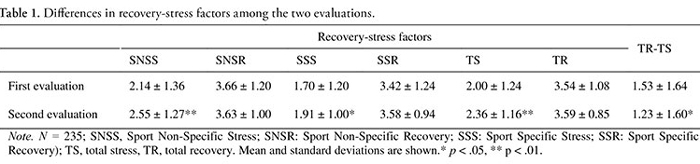
<body><![CDATA[<p><font face="Verdana" size="2"><b>Statistical Analysis</b></font></p>    <p><font face="Verdana" size="2">All measures were normally distributed, as determined by the Shapiro-Wilks test. The associations between different measures were assessed by correlation analysis, controlling for sex and age. In order to determine how measure of resilient qualities associated with recovery-stress in the different season periods, values for the different factors of the RESTQ Sport were used as dependent variables in a 3 (resilience levels) x 2 (evaluation) multivariate analysis of covariance (MANCOVA) with age and sex as covariates. A Bonferroni test was performed for <i>post hoc</i> analyses to assess differences. All analyses were conducted using the SPSS for Windows software, version 20.0 (SPSS Inc, Chicago, IL, USA).</font></p>     <p>&nbsp;</p>    <p><font face="Verdana" size="2"><b>Results</b></font></p>    <p><font face="Verdana" size="2">Data obtained indicate an absence of significant differences in resilience during the last mesocycle and after an important competition (120 ± 15 y 119 ± 17, respectively). However, differences were observed in some of the RESTQ Sport factors, with significantly higher scores in Sport Non-Specific Stress (SNSS) (+19%; p &lt;. 01), Sport Specific Stress (SSS) (+12%, p &lt; .05) or Total Stress (TS) (+18%; p &lt; .01), and lower scores in Total Recovery-Total Stress (TR-TS) (-24%; p &lt; .05) during the second evaluation (<a href="#t1">Table 1</a>).</font></p>     <p align="center"><font face="Verdana" size="2"><a name="t1"><img src="/img/revistas/cpd/v17n2/psicologia_deporte2_01.jpg"></a></font></p>     <p>&nbsp;</p>     <p><font face="Verdana" size="2"><a href="#t2">Table 2</a> shows the correlations between resilience levels and the different factors of the RESTQ-Sport in the two evaluations. The Pearson correlation coefficients indicated that resilience correlated positively with recovery factors: Sport Non-Specific Recovery (SNSR), Sport Specific Recovery (SSR) and Total Recovery (TR) (p &lt;. 001), and negatively with stress factors (SNSS, SSS and TS) (p &lt;. 001). Especially relevant is the relationship between resilience and TR-TS (<a href="#f1">Figure 1</a>), which shows that a highly significant correlation exists both before the last mesocycle and after a competition (r = .484, <i>p</i> &lt; .001 y r = .449, p &lt; .001, respectively).</font></p>     <p align="center"><font face="Verdana" size="2"><a name="t2"><img src="/img/revistas/cpd/v17n2/psicologia_deporte2_t2.jpg"></a></font></p>     <p align="center"><font face="Verdana" size="2"><a name="f1"><img src="/img/revistas/cpd/v17n2/psicologia_deporte2_f1.jpg"></a></font></p>     ]]></body>
<body><![CDATA[<p>&nbsp;</p>     <p><font face="Verdana" size="2">Results from the multivariate analysis of variance showed no significant effect of the covariates age and gender, and the model was reduce to a simple MANOVA. Main effects were obtained for resilience r (Wilks l = 0.89, F(2,462) = 3.49, <i>p</i> &lt; .001) and evaluation ((Wilks l = 0.91, F(2,462) = 2.47, <i>p</i> &lt; .01), with no significant interaction ((Wilks l = 0.95, F(2,462) = 31.43, <i>p</i> &lt; .13). Follow-up univariate analysis showed that both before the first and the second evaluation significant differences existed in the RESTQ-Sport factors among participants with a different resilient profile (<a href="#t3">Table 3</a>). Participants with a low resilience were those reaching higher scores in the stress factors SNSS, SSS and TS, which significantly differed from those by participants with medium or high resilience values (<i>p</i> &lt; .05). On the contrary, high resilience scores associated to lower values in those stress factors, with higher scores in the recovery factors SNSR, SSR and TR (<i>p</i> &lt; .05). Therefore, the higher Recovery-Stress (TR-TS) scores corresponded to athletes which scored high in resilience, with values significantly higher than those from participants with low or medium resilience levels during both the first (low: +226%; <i>p</i> &lt; .05; medium: +38%; <i>p</i> &lt; .05) and the second evaluation (low: +287%; <i>p</i> &lt; .05; medium: +46%; <i>p</i> &lt; .05).</font></p>     <p align="center"><font face="Verdana" size="2"><a name="t3"><img src="/img/revistas/cpd/v17n2/psicologia_deporte2_03.jpg"></a></font></p>     <p>&nbsp;</p>     <p><font face="Verdana" size="2"><b>Discussion</b></font></p>    <p><font face="Verdana" size="2">The objective of this study was to investigate the relationship between recovery-stress levels and resilience profiles for a wide sample of athletes and for two moments of the season in which the burden of stress could change in relation to the pressure/relevance of the situation. The results confirm our starting hypotheses, and emphasize that resilience profiles did not differ between evaluations carried out in the last mesocycle and those during competition, while competition-related stress levels increased significantly. Moreover, high scores in resilience are negatively associated with stress, whereas there is a positive relationship with recovery.</font></p>    <p><font face="Verdana" size="2">The complex effects of stress and recovery can be studied by means of the RESTQ-Sport, a questionnaire including variables that refer to both intrinsic and extrinsic stressor sources in sporting practice (Kellmann &amp; Kallus, 2001). The RESTQ-Sport has been used as an evaluation instrument for monitoring athletes and the impact of training in multiple sports, with good results both in those in which raw physical condition is prioritized and in those in the technical-tactical aspect is more important (Coutts &amp; Wallace, 2007; Di Fronso, Nakamura, Bortoli, Robazza, &amp; Bertollo, 2013; Mäestu et al., 2006). Using this instrument, our group has shown that scores change significantly depending on training loads, in both individual and collective sports (González-Boto, Salguero, Tuero, González-Gallego, &amp; Márquez, 2008; Bresciani et al., 2010). In addition, we confirmed that it is a more sensitive instrument for early detection of overtraining than biological markers (Bresciani et al., 2011). In the present study, the various factors of the RESTQ-Sport changed during the second evaluation, corresponding to an important competition, with respect to the values observed before the last mesocycle, with an increase in scores for stress factors. These data confirm various previous studies showing that during competitive periods associated with an increase in the loads, maladaptive situations are created that translate into an increase in scores on the RESTQ-Sport's stress scales (Bresciani et al., 2010).</font></p>    <p><font face="Verdana" size="2">To measure resilience, we used Wagnild and Young's Resilience Scale (1993), an assessment tool that was adapted and validated recently in Spanish by Ruiz et al. (2012) for a group of 110 young footballers. Although in the original scale two factors are distinguished, the fact that in the Spanish version the second factor does not reach adequate values of reliability made us consider a single overall score of resilience. However, we cannot rule out, as Ruiz et al. (2012) already do in their original study of the Spanish version of the questionnaire, that the construct of resilience does not conform to a unitary construct, and research is needed on using well-founded models from the point of view of sporting performance. Resilience values are similar in our study to those obtained recently by García Secades et al. (2016) from a sample of similar characteristics, but lower than those of Ruiz et al. (2012) in their sample of young footballers. The fact that the latter used a smaller sample size, along with its various sociodemographic characteristics, may contribute to explaining these differences.</font></p>    <p><font face="Verdana" size="2">In contrast to what was observed with regard to stress factors in the RESTQ-Sport, the scores in the Resilience Scale did not differ significantly between evaluations corresponding to mesocycle and competition. Our data match those published by García Secades et al. (2016). This is an interesting fact, given that in the conceptualization of resilience there are authors who maintain the point of view that it is an individual, fixed and stable trait that allows adaptation to significant sources of stress or trauma (Lee, Nam, Kim, Kim, &amp; Lee, 2013), and it has been put forward that resilience could be explained within the concept of trait types: resilient, supracontrolled or infracontrolled (Asendorpf and van Aken, 1999). However, resilient personality is moulded by different environmental and contextual factors (Roberts &amp; Masten, 2004), and resilience tends to be considered as a dynamic process that can change with time and that depends on the interaction between numerous factors surrounding the individual (Luthar et al., 2000).</font></p>    <p><font face="Verdana" size="2">The results of our research indicate that scores for the various stress factors in the RESTQ-Sport correlate negatively with resilience, whereas recovery factors correlate positively. These relationships corroborate the conclusions obtained in previous research whose results suggest that resilience is correlated with various psychological variables closely linked to performance, in such a way that there are positive correlations with psychological well-being or sporting achievement and negative correlations with psychological distress (Hosseini &amp; Besharat, 2010, Nezhad &amp; Besharat, 2010). A meta-analysis carried out by Lee et al. (2013) confirmed the existence of negative associations with anxiety or depression and positive ones with optimism, self-efficacy and self-esteem. Very recently, it has been shown that resilience correlates positively in athletes whose coping focuses on the task, whereas there is a negative association with coping focused on emotions or on distraction (García Secades et al. 2016). Data obtained by analysis of variance allows an examination in greater depth of the relationship between resilience profile and recovery-stress that shows that from the moment when the last competitive mesocycle of the season starts there are differences in the second-order factors of RESTQ-Sport among participants with low, medium and high resilience profiles, and these differences are significant between participants with low and medium resilience scores. Our data follow a similar line to those obtained by Martin-Krumm et al. (2003), who in a group of 64 subjects observed that greater resilience was associated with lower levels of anxiety after a supposed failure of a motor task. Paul et al. (2012) have shown in relation to a group of 100 athletes practising various sports that the participants with lower symptoms of stress associated with training achieved higher scores in the Mental Toughness Questionnaire and that resilience training can increase psychomotor performance.</font></p>    ]]></body>
<body><![CDATA[<p><font face="Verdana" size="2">Subject to being endorsed and contrasted by future research, these findings suggest that a medium-level resilience profile is sufficient to be considered as a possible contributing factor to an athlete's being less stressed and his or her recovering better compared with athletes who display a low level of resilience. Our data support the idea put forward by Do Valle (2008) that the majority of pressures and tensions are self-imposed and that a good level of resilience helps athletes to cope more effectively with challenges and possible failures, shortening the time required for an optimal recovery.</font></p>     <p><font face="Verdana" size="2"><b>Practical Implications</b></font></p>    <p><font face="Verdana" size="2">In conclusion, an athlete's resilience profile seems to positively influence the recovery-stress processes. Although further research with greater control of objective loads are required to corroborate our results, data obtained suggest that improvement in resilience levels can be a key to athletic performance. This type of research would allow room for new areas of action in better planning of training programmes and in optimizing the performance of athletes during competition.</font></p>     <p>&nbsp;</p>     <p><font face="Verdana" size="2"><b>References</b></font></p>     <!-- ref --><p><font face="Verdana" size="2">1. Asendorpf, J. B., &amp; van Aken, M. A. G. (1999). Resilient, overcontrolled, and undercontrolled personality prototypes in childhood: Replicability, predictive power, and the trait-type issue. <i>Journal of Personality and Social Psychology, 77</i>(4), 815-832.    &nbsp;&nbsp;&nbsp;&nbsp;&nbsp;&nbsp;&nbsp;&nbsp;[&#160;<a href="javascript:void(0);" onclick="javascript: window.open('/scielo.php?script=sci_nlinks&ref=1665527&pid=S1578-8423201700020000800001&lng=','','width=640,height=500,resizable=yes,scrollbars=1,menubar=yes,');">Links</a>&#160;]<!-- end-ref --></font></p>    <!-- ref --><p><font face="Verdana" size="2">2. Bonanno, G. A. (2004). Loss, trauma and human resilience: Have we underestimated the human capacity to thrive after extremely aversive events? <i>American Psychologist, 59</i>(1), 20-28.    &nbsp;&nbsp;&nbsp;&nbsp;&nbsp;&nbsp;&nbsp;&nbsp;[&#160;<a href="javascript:void(0);" onclick="javascript: window.open('/scielo.php?script=sci_nlinks&ref=1665529&pid=S1578-8423201700020000800002&lng=','','width=640,height=500,resizable=yes,scrollbars=1,menubar=yes,');">Links</a>&#160;]<!-- end-ref --></font></p>    <!-- ref --><p><font face="Verdana" size="2">3. Bresciani, G., Cuevas, M. J., Garatachea, N., Molinero, O., Almar, M., De Paz, J. A., Márquez, S., &amp; González-Gallego, J. (2010). Monitoring biological and psychological measures through an entire season in handball players. <i>European Journal of Sport Science, 10</i>(6), 377-384.    &nbsp;&nbsp;&nbsp;&nbsp;&nbsp;&nbsp;&nbsp;&nbsp;[&#160;<a href="javascript:void(0);" onclick="javascript: window.open('/scielo.php?script=sci_nlinks&ref=1665531&pid=S1578-8423201700020000800003&lng=','','width=640,height=500,resizable=yes,scrollbars=1,menubar=yes,');">Links</a>&#160;]<!-- end-ref --></font></p>    <!-- ref --><p><font face="Verdana" size="2">4. Bresciani, G., Molinero, O., Cuevas, M. J., Almar, M., Suay, F., Salvador, A., De Paz, J. A., Márquez, S., &amp; González-Gallego, J. (2011). Signs of overload after an intensified training. <i>International Journal of Sports Medicine, 32</i>(5), 338-343.    &nbsp;&nbsp;&nbsp;&nbsp;&nbsp;&nbsp;&nbsp;&nbsp;[&#160;<a href="javascript:void(0);" onclick="javascript: window.open('/scielo.php?script=sci_nlinks&ref=1665533&pid=S1578-8423201700020000800004&lng=','','width=640,height=500,resizable=yes,scrollbars=1,menubar=yes,');">Links</a>&#160;]<!-- end-ref --></font></p>    <!-- ref --><p><font face="Verdana" size="2">5. Coutts, A. J., &amp; Wallace, L. K. M. (2007). Monitoring changes in performance, physiology, biochemistry, and psychology during overreaching and recovery in triathletes. <i>International Journal of Sport Medicine, 28</i>(2), 125-134.    &nbsp;&nbsp;&nbsp;&nbsp;&nbsp;&nbsp;&nbsp;&nbsp;[&#160;<a href="javascript:void(0);" onclick="javascript: window.open('/scielo.php?script=sci_nlinks&ref=1665535&pid=S1578-8423201700020000800005&lng=','','width=640,height=500,resizable=yes,scrollbars=1,menubar=yes,');">Links</a>&#160;]<!-- end-ref --></font></p>    <!-- ref --><p><font face="Verdana" size="2">6. De la Vega, R., Ruiz, R., Gómez, J., &amp; Rivera, O. (2013). Hardiness in professional Spanish firefighters. <i>Perceptual &amp; Motor Skills, 117</i>(2), 608-614.    &nbsp;&nbsp;&nbsp;&nbsp;&nbsp;&nbsp;&nbsp;&nbsp;[&#160;<a href="javascript:void(0);" onclick="javascript: window.open('/scielo.php?script=sci_nlinks&ref=1665537&pid=S1578-8423201700020000800006&lng=','','width=640,height=500,resizable=yes,scrollbars=1,menubar=yes,');">Links</a>&#160;]<!-- end-ref --></font></p>    <!-- ref --><p><font face="Verdana" size="2">7. Di Fronso, S., Nakamura, F.Y. Bortoli, L., Robazza, C., &amp; Bertollo, M. (2013). Stress and recovery balance in amateur basketball players: differences by gender and preparation phase. <i>International Journal of Sport Physiology and Performance, 8</i>(6), 618-622.    &nbsp;&nbsp;&nbsp;&nbsp;&nbsp;&nbsp;&nbsp;&nbsp;[&#160;<a href="javascript:void(0);" onclick="javascript: window.open('/scielo.php?script=sci_nlinks&ref=1665539&pid=S1578-8423201700020000800007&lng=','','width=640,height=500,resizable=yes,scrollbars=1,menubar=yes,');">Links</a>&#160;]<!-- end-ref --></font></p>    <!-- ref --><p><font face="Verdana" size="2">8. Do Valle, M. P. (2008). Coaching e resiliência: intervençoes possíveis para pressoes e medos de ginastas e esgrimistas. <i>Revista Brasileira de Psicologia do Esporte, 1</i>(1), 1-17.    &nbsp;&nbsp;&nbsp;&nbsp;&nbsp;&nbsp;&nbsp;&nbsp;[&#160;<a href="javascript:void(0);" onclick="javascript: window.open('/scielo.php?script=sci_nlinks&ref=1665541&pid=S1578-8423201700020000800008&lng=','','width=640,height=500,resizable=yes,scrollbars=1,menubar=yes,');">Links</a>&#160;]<!-- end-ref --></font></p>    <!-- ref --><p><font face="Verdana" size="2">9. Fletcher, D., &amp; Sarkar, M. (2012). A grounded theory of psychological resilience in Olympic champions. <i>Psychology of Sport and Exercise, 13</i>(5), 669-678.    &nbsp;&nbsp;&nbsp;&nbsp;&nbsp;&nbsp;&nbsp;&nbsp;[&#160;<a href="javascript:void(0);" onclick="javascript: window.open('/scielo.php?script=sci_nlinks&ref=1665543&pid=S1578-8423201700020000800009&lng=','','width=640,height=500,resizable=yes,scrollbars=1,menubar=yes,');">Links</a>&#160;]<!-- end-ref --></font></p>    <!-- ref --><p><font face="Verdana" size="2">10. García Secades, X., Molinero, O., Salguero, A., Ruiz, R., De la Vega, R., &amp; Márquez, S. (2016). Relationship between resilience and coping strategies in competitive sport. <i>Perceptual &amp; Motor Skills, 122</i>(1), 336-349.    &nbsp;&nbsp;&nbsp;&nbsp;&nbsp;&nbsp;&nbsp;&nbsp;[&#160;<a href="javascript:void(0);" onclick="javascript: window.open('/scielo.php?script=sci_nlinks&ref=1665545&pid=S1578-8423201700020000800010&lng=','','width=640,height=500,resizable=yes,scrollbars=1,menubar=yes,');">Links</a>&#160;]<!-- end-ref --></font></p>    <!-- ref --><p><font face="Verdana" size="2">11. González-Boto, R., Salguero, A., Tuero, C., González-Gallego, J., &amp; Márquez, S. (2008). Monitoring of the effects of training load changes on stress and recovery in swimmers. <i>Journal of Physiology and Biochemistry, 64</i>(1), 19-26, 2008.    &nbsp;&nbsp;&nbsp;&nbsp;&nbsp;&nbsp;&nbsp;&nbsp;[&#160;<a href="javascript:void(0);" onclick="javascript: window.open('/scielo.php?script=sci_nlinks&ref=1665547&pid=S1578-8423201700020000800011&lng=','','width=640,height=500,resizable=yes,scrollbars=1,menubar=yes,');">Links</a>&#160;]<!-- end-ref --></font></p>    <!-- ref --><p><font face="Verdana" size="2">12. González-Boto, R., Salguero, A., Tuero, C., Kellmann, M., &amp; Márquez, S. (2008b). Spanish adaptation and analysis by structural equation modeling of an instrument for monitoring overtraining: The recovery-stress questionnaire (RESTQ-SPORT). <i>Social Behavior and Personality, 36</i>(5), 635-650.    &nbsp;&nbsp;&nbsp;&nbsp;&nbsp;&nbsp;&nbsp;&nbsp;[&#160;<a href="javascript:void(0);" onclick="javascript: window.open('/scielo.php?script=sci_nlinks&ref=1665549&pid=S1578-8423201700020000800012&lng=','','width=640,height=500,resizable=yes,scrollbars=1,menubar=yes,');">Links</a>&#160;]<!-- end-ref --></font></p>    <!-- ref --><p><font face="Verdana" size="2">13. González-Boto, R., Tuero, C., &amp; Márquez, S. (2006). El sobreentrenamiento en el deporte de competición: implicaciones psicológicas del desequilibrio entre estrés y recuperación. <i>Ansiedad y Estrés, 12</i>(1), 99-115.    &nbsp;&nbsp;&nbsp;&nbsp;&nbsp;&nbsp;&nbsp;&nbsp;[&#160;<a href="javascript:void(0);" onclick="javascript: window.open('/scielo.php?script=sci_nlinks&ref=1665551&pid=S1578-8423201700020000800013&lng=','','width=640,height=500,resizable=yes,scrollbars=1,menubar=yes,');">Links</a>&#160;]<!-- end-ref --></font></p>    <!-- ref --><p><font face="Verdana" size="2">14. González-Boto, R., Salguero, A., Tuero, C., &amp; Márquez, S. (2009). Validez concurrente de la versión española del Cuestionario de Recuperación-Estrés para deportistas (RESTQ-Sport). <i>Revista de Psicología del Deporte, 18</i>(1), 53-72.    &nbsp;&nbsp;&nbsp;&nbsp;&nbsp;&nbsp;&nbsp;&nbsp;[&#160;<a href="javascript:void(0);" onclick="javascript: window.open('/scielo.php?script=sci_nlinks&ref=1665553&pid=S1578-8423201700020000800014&lng=','','width=640,height=500,resizable=yes,scrollbars=1,menubar=yes,');">Links</a>&#160;]<!-- end-ref --></font></p>    <!-- ref --><p><font face="Verdana" size="2">15. Gould, D., Dieffenbach, K., &amp; Moffett, A. (2002). Psychological characteristics and their development in Olympic champions. <i>Journal of Applied Sport Psychology, 14</i>(3), 172-204.    &nbsp;&nbsp;&nbsp;&nbsp;&nbsp;&nbsp;&nbsp;&nbsp;[&#160;<a href="javascript:void(0);" onclick="javascript: window.open('/scielo.php?script=sci_nlinks&ref=1665555&pid=S1578-8423201700020000800015&lng=','','width=640,height=500,resizable=yes,scrollbars=1,menubar=yes,');">Links</a>&#160;]<!-- end-ref --></font></p>    <!-- ref --><p><font face="Verdana" size="2">16. Gucciardi, D. F., Jackson, B., Coulter, T. J., &amp; Mallett, C. J. (2011). The Connor-Davidson Resilience Scale (CD-RISC): Dimensionality and age-related measurement invariance with Australian cricketers. <i>Psychology of Sport and Exercise, 12</i>(4), 423-433.    &nbsp;&nbsp;&nbsp;&nbsp;&nbsp;&nbsp;&nbsp;&nbsp;[&#160;<a href="javascript:void(0);" onclick="javascript: window.open('/scielo.php?script=sci_nlinks&ref=1665557&pid=S1578-8423201700020000800016&lng=','','width=640,height=500,resizable=yes,scrollbars=1,menubar=yes,');">Links</a>&#160;]<!-- end-ref --></font></p>    <!-- ref --><p><font face="Verdana" size="2">17. Holt, N. L., &amp; Dunn, J. G. H. (2004). Toward a grounded theory of the psychosocial competencies and environmental conditions associated with soccer success. <i>Journal of Applied Sport Psychology, 16</i>(3), 199-219.    &nbsp;&nbsp;&nbsp;&nbsp;&nbsp;&nbsp;&nbsp;&nbsp;[&#160;<a href="javascript:void(0);" onclick="javascript: window.open('/scielo.php?script=sci_nlinks&ref=1665559&pid=S1578-8423201700020000800017&lng=','','width=640,height=500,resizable=yes,scrollbars=1,menubar=yes,');">Links</a>&#160;]<!-- end-ref --></font></p>    <!-- ref --><p><font face="Verdana" size="2">18. Hosseini, S. A., &amp; Besharat, M. A. (2010). Relation of resilience whit sport achievement and mental health in a sample of athletes. <i>Procedia Social and Behavioral Sciences, 5</i>, 633-638.    &nbsp;&nbsp;&nbsp;&nbsp;&nbsp;&nbsp;&nbsp;&nbsp;[&#160;<a href="javascript:void(0);" onclick="javascript: window.open('/scielo.php?script=sci_nlinks&ref=1665561&pid=S1578-8423201700020000800018&lng=','','width=640,height=500,resizable=yes,scrollbars=1,menubar=yes,');">Links</a>&#160;]<!-- end-ref --></font></p>    <!-- ref --><p><font face="Verdana" size="2">19. Kellmann, M. (2010). Preventing overtraining in athletes in high-intensity sports and stress/recovery monitoring. <i>Scandinavian Journal of Medicine &amp; Sceience in Sports, 20</i>(2), 95-102.    &nbsp;&nbsp;&nbsp;&nbsp;&nbsp;&nbsp;&nbsp;&nbsp;[&#160;<a href="javascript:void(0);" onclick="javascript: window.open('/scielo.php?script=sci_nlinks&ref=1665563&pid=S1578-8423201700020000800019&lng=','','width=640,height=500,resizable=yes,scrollbars=1,menubar=yes,');">Links</a>&#160;]<!-- end-ref --></font></p>    <!-- ref --><p><font face="Verdana" size="2">20. Kellmann, M., &amp; Kallus, K. W. (2001). <i>Recovery-Stress Questionnaire for Athletes: User Manual.</i> Champaign, IL: Human Kinetics.    &nbsp;&nbsp;&nbsp;&nbsp;&nbsp;&nbsp;&nbsp;&nbsp;[&#160;<a href="javascript:void(0);" onclick="javascript: window.open('/scielo.php?script=sci_nlinks&ref=1665565&pid=S1578-8423201700020000800020&lng=','','width=640,height=500,resizable=yes,scrollbars=1,menubar=yes,');">Links</a>&#160;]<!-- end-ref --></font></p>    <!-- ref --><p><font face="Verdana" size="2">21. Lee, J. H., Nam, S. K., Kim, A , Kim, B., Lee, M. Y., &amp; Lee, S. M. (2013). Resilience: A meta-analytic approach. <i>Journal of Counseling and Development, 29, 269</i>-279.    &nbsp;&nbsp;&nbsp;&nbsp;&nbsp;&nbsp;&nbsp;&nbsp;[&#160;<a href="javascript:void(0);" onclick="javascript: window.open('/scielo.php?script=sci_nlinks&ref=1665567&pid=S1578-8423201700020000800021&lng=','','width=640,height=500,resizable=yes,scrollbars=1,menubar=yes,');">Links</a>&#160;]<!-- end-ref --></font></p>    <!-- ref --><p><font face="Verdana" size="2">22. Machida, M., Irwin, B., &amp; Feltz, D. (2013). Resilience in competitive athletes with spinal cord injury: the role of sport participation. <i>Qualitative Health Research, 23</i>(8), 1054-1065.    &nbsp;&nbsp;&nbsp;&nbsp;&nbsp;&nbsp;&nbsp;&nbsp;[&#160;<a href="javascript:void(0);" onclick="javascript: window.open('/scielo.php?script=sci_nlinks&ref=1665569&pid=S1578-8423201700020000800022&lng=','','width=640,height=500,resizable=yes,scrollbars=1,menubar=yes,');">Links</a>&#160;]<!-- end-ref --></font></p>    <!-- ref --><p><font face="Verdana" size="2">23. Luthar, S. S. (2006). Resilience in development: A synthesis of research across five decades. En D. Cicchetti y D. J. Cohen (Eds.), <i>Developmental Psychopathology: Risk, Disorder, and Adaptation</i>, (pp. 740-795). Nueva York: Wiley.    &nbsp;&nbsp;&nbsp;&nbsp;&nbsp;&nbsp;&nbsp;&nbsp;[&#160;<a href="javascript:void(0);" onclick="javascript: window.open('/scielo.php?script=sci_nlinks&ref=1665571&pid=S1578-8423201700020000800023&lng=','','width=640,height=500,resizable=yes,scrollbars=1,menubar=yes,');">Links</a>&#160;]<!-- end-ref --></font></p>    <!-- ref --><p><font face="Verdana" size="2">24. Luthar, S. S., Cicchetti, D., &amp; Becker, B. (2000). The construct of resilience: Implications for interventions and social policies. <i>Development and Psychopathology, 12</i>, 857-885.    &nbsp;&nbsp;&nbsp;&nbsp;&nbsp;&nbsp;&nbsp;&nbsp;[&#160;<a href="javascript:void(0);" onclick="javascript: window.open('/scielo.php?script=sci_nlinks&ref=1665573&pid=S1578-8423201700020000800024&lng=','','width=640,height=500,resizable=yes,scrollbars=1,menubar=yes,');">Links</a>&#160;]<!-- end-ref --></font></p>    <!-- ref --><p><font face="Verdana" size="2">25. Mäestu, J., Jürimäe, J., Kreegipuu, K., &amp;Jürimäe, T. (2006). Changes in perceived stress and recovery during heavy training in highly trained male rowers. <i>The Sport Psychologist, 20</i>, 24-39.    &nbsp;&nbsp;&nbsp;&nbsp;&nbsp;&nbsp;&nbsp;&nbsp;[&#160;<a href="javascript:void(0);" onclick="javascript: window.open('/scielo.php?script=sci_nlinks&ref=1665575&pid=S1578-8423201700020000800025&lng=','','width=640,height=500,resizable=yes,scrollbars=1,menubar=yes,');">Links</a>&#160;]<!-- end-ref --></font></p>    <!-- ref --><p><font face="Verdana" size="2">26. Martin-Krumm, C. P., Sarrazin, P. G., Peterson, C., &amp; Famose, J. P. (2003). Explanatory style and resilience after sport failure. <i>Personality and Individual Differences, 35</i>(5), 1685-1695.    &nbsp;&nbsp;&nbsp;&nbsp;&nbsp;&nbsp;&nbsp;&nbsp;[&#160;<a href="javascript:void(0);" onclick="javascript: window.open('/scielo.php?script=sci_nlinks&ref=1665577&pid=S1578-8423201700020000800026&lng=','','width=640,height=500,resizable=yes,scrollbars=1,menubar=yes,');">Links</a>&#160;]<!-- end-ref --></font></p>    <!-- ref --><p><font face="Verdana" size="2">27. McDonald, J.H. (2014). <i>Handbook of Biological Statistics (3rd ed.).</i> Baltimore: Sparky House Publishing.    &nbsp;&nbsp;&nbsp;&nbsp;&nbsp;&nbsp;&nbsp;&nbsp;[&#160;<a href="javascript:void(0);" onclick="javascript: window.open('/scielo.php?script=sci_nlinks&ref=1665579&pid=S1578-8423201700020000800027&lng=','','width=640,height=500,resizable=yes,scrollbars=1,menubar=yes,');">Links</a>&#160;]<!-- end-ref --></font></p>    <!-- ref --><p><font face="Verdana" size="2">28. McKay, J., Niven, A. G., Lavallee, D., &amp;White, A. (2008). Sources of strain among elite UK track athletes. <i>The Sport Psychologist</i>, <i>22</i>(2), 143-163.    &nbsp;&nbsp;&nbsp;&nbsp;&nbsp;&nbsp;&nbsp;&nbsp;[&#160;<a href="javascript:void(0);" onclick="javascript: window.open('/scielo.php?script=sci_nlinks&ref=1665581&pid=S1578-8423201700020000800028&lng=','','width=640,height=500,resizable=yes,scrollbars=1,menubar=yes,');">Links</a>&#160;]<!-- end-ref --></font></p>    <!-- ref --><p><font face="Verdana" size="2">29. Nezhad, M. A. S., &amp; Besharat, M. A. (2010). Relations of resilience and hardiness with sport achievement and mental health in a sample of athletes. <i>Procedia Social and Behavioral Sciences, 5</i>, 757-763.    &nbsp;&nbsp;&nbsp;&nbsp;&nbsp;&nbsp;&nbsp;&nbsp;[&#160;<a href="javascript:void(0);" onclick="javascript: window.open('/scielo.php?script=sci_nlinks&ref=1665583&pid=S1578-8423201700020000800029&lng=','','width=640,height=500,resizable=yes,scrollbars=1,menubar=yes,');">Links</a>&#160;]<!-- end-ref --></font></p>    <!-- ref --><p><font face="Verdana" size="2">30. Paul, M., Khanna, N., &amp; Sandhu, J. S. (2012). Psycho-motor analysis of athletes under overtraining stress. <i>Serbain Journal of Sports Science, 63</i>(3), 95-101.    &nbsp;&nbsp;&nbsp;&nbsp;&nbsp;&nbsp;&nbsp;&nbsp;[&#160;<a href="javascript:void(0);" onclick="javascript: window.open('/scielo.php?script=sci_nlinks&ref=1665585&pid=S1578-8423201700020000800030&lng=','','width=640,height=500,resizable=yes,scrollbars=1,menubar=yes,');">Links</a>&#160;]<!-- end-ref --></font></p>    <!-- ref --><p><font face="Verdana" size="2">31. Roberts, J. M., &amp; Masten, A. S. (2004). Resilience in context. In R. D. Peters, R. McMahon, &amp; B. Leadbeater (Eds.), <i>Resilience in Children, Families, and Communities: Linking Context to Practice and Policy</i> (pp. 13-25). New York, NY: Kluwer Academic/Plenum.    &nbsp;&nbsp;&nbsp;&nbsp;&nbsp;&nbsp;&nbsp;&nbsp;[&#160;<a href="javascript:void(0);" onclick="javascript: window.open('/scielo.php?script=sci_nlinks&ref=1665587&pid=S1578-8423201700020000800031&lng=','','width=640,height=500,resizable=yes,scrollbars=1,menubar=yes,');">Links</a>&#160;]<!-- end-ref --></font></p>    <!-- ref --><p><font face="Verdana" size="2">32. Ruiz, R., de la Vega, R., Poveda, J., Rosado, A., &amp; Serpa, S. (2012). Análisis psicométrico de la Escala de Resiliencia en el deporte del fútbol. <i>Revista de Psicología del Deporte, 21</i>(1), 143-151.    &nbsp;&nbsp;&nbsp;&nbsp;&nbsp;&nbsp;&nbsp;&nbsp;[&#160;<a href="javascript:void(0);" onclick="javascript: window.open('/scielo.php?script=sci_nlinks&ref=1665589&pid=S1578-8423201700020000800032&lng=','','width=640,height=500,resizable=yes,scrollbars=1,menubar=yes,');">Links</a>&#160;]<!-- end-ref --></font></p>    <!-- ref --><p><font face="Verdana" size="2">33. Sarkar, M., &amp; Fletcher, D. (2013). How should we measure psychological resilience in sport performers? <i>Measurement in Physical Education and Exercise Science, 17</i>(4), 264-280.    &nbsp;&nbsp;&nbsp;&nbsp;&nbsp;&nbsp;&nbsp;&nbsp;[&#160;<a href="javascript:void(0);" onclick="javascript: window.open('/scielo.php?script=sci_nlinks&ref=1665591&pid=S1578-8423201700020000800033&lng=','','width=640,height=500,resizable=yes,scrollbars=1,menubar=yes,');">Links</a>&#160;]<!-- end-ref --></font></p>    <!-- ref --><p><font face="Verdana" size="2">34. Sarkar, M., &amp; Fletcher, D. (2014a). Psychological resilience in sport performers: a review of stressors and protective factors. <i>Journal of Sport Science, 32</i>(15), 1419-34.    &nbsp;&nbsp;&nbsp;&nbsp;&nbsp;&nbsp;&nbsp;&nbsp;[&#160;<a href="javascript:void(0);" onclick="javascript: window.open('/scielo.php?script=sci_nlinks&ref=1665593&pid=S1578-8423201700020000800034&lng=','','width=640,height=500,resizable=yes,scrollbars=1,menubar=yes,');">Links</a>&#160;]<!-- end-ref --></font></p>    <!-- ref --><p><font face="Verdana" size="2">35. Sarkar, M., &amp; Fletcher, D. (2014b). Ordinary magic, extraordinary performance: Psychological resilience and thriving in high achievers. <i>Sport, Exercise, and Performance Psychology, 3</i>, 46-60.    &nbsp;&nbsp;&nbsp;&nbsp;&nbsp;&nbsp;&nbsp;&nbsp;[&#160;<a href="javascript:void(0);" onclick="javascript: window.open('/scielo.php?script=sci_nlinks&ref=1665595&pid=S1578-8423201700020000800035&lng=','','width=640,height=500,resizable=yes,scrollbars=1,menubar=yes,');">Links</a>&#160;]<!-- end-ref --></font></p>    <!-- ref --><p><font face="Verdana" size="2">36. Wagnild, G., &amp; Young, H. (1993). Development and psychometric evaluation of the Resilience Scale. <i>Journal of Nursing Measurement, 1</i>(2), 165-178.    &nbsp;&nbsp;&nbsp;&nbsp;&nbsp;&nbsp;&nbsp;&nbsp;[&#160;<a href="javascript:void(0);" onclick="javascript: window.open('/scielo.php?script=sci_nlinks&ref=1665597&pid=S1578-8423201700020000800036&lng=','','width=640,height=500,resizable=yes,scrollbars=1,menubar=yes,');">Links</a>&#160;]<!-- end-ref --></font></p>    <!-- ref --><p><font face="Verdana" size="2">37. Weissensteiner, J. R., Abernethy, B., &amp; Farrow, D. (2009). Towards the development of a conceptual model of batting expertise in cricket: A grounded theory approach. <i>Journal of Applied Psychology, 21</i>(3), 276-292.    &nbsp;&nbsp;&nbsp;&nbsp;&nbsp;&nbsp;&nbsp;&nbsp;[&#160;<a href="javascript:void(0);" onclick="javascript: window.open('/scielo.php?script=sci_nlinks&ref=1665599&pid=S1578-8423201700020000800037&lng=','','width=640,height=500,resizable=yes,scrollbars=1,menubar=yes,');">Links</a>&#160;]<!-- end-ref --></font></p>    <!-- ref --><p><font face="Verdana" size="2">38. Yi, J. P., Smith, R. E., &amp; Vitaliano, P. P. (2005). Stress-resilience, illness, and coping: a person-focused investigation of young women athletes. <i>Journal of Behavioral Medicine, 28</i>, 257-265.    &nbsp;&nbsp;&nbsp;&nbsp;&nbsp;&nbsp;&nbsp;&nbsp;[&#160;<a href="javascript:void(0);" onclick="javascript: window.open('/scielo.php?script=sci_nlinks&ref=1665601&pid=S1578-8423201700020000800038&lng=','','width=640,height=500,resizable=yes,scrollbars=1,menubar=yes,');">Links</a>&#160;]<!-- end-ref --></font></p>     <p>&nbsp;</p>     <p>&nbsp;</p>     <p><font face="Verdana" size="2"><a href="#top"><img border="0" src="/img/revistas/cpd/v17n2/seta.gif" width="15" height="17"></a><a name="bajo"></a><b>Correspondence:</b>    <br>Sara Márquez,    <br>Departamento de Educación Física y Deportiva,    <br>Universidad de León,    <br>24071 León (España).    <br>E-mail:  <a href="mailto:smarr@unileon.es">smarr@unileon.es</a></font></p>     <p><font face="Verdana" size="2">Recibido: 30/03/2016    ]]></body>
<body><![CDATA[<br>Aceptado: 16/05/2017</font></p>      ]]></body><back>
<ref-list>
<ref id="B1">
<label>1</label><nlm-citation citation-type="journal">
<person-group person-group-type="author">
<name>
<surname><![CDATA[Asendorpf]]></surname>
<given-names><![CDATA[J. B.]]></given-names>
</name>
<name>
<surname><![CDATA[van Aken]]></surname>
<given-names><![CDATA[M. A. G.]]></given-names>
</name>
</person-group>
<article-title xml:lang="en"><![CDATA[Resilient, overcontrolled, and undercontrolled personality prototypes in childhood: Replicability, predictive power, and the trait-type issue]]></article-title>
<source><![CDATA[Journal of Personality and Social Psychology]]></source>
<year>1999</year>
<volume>77</volume>
<numero>4</numero>
<issue>4</issue>
<page-range>815-832</page-range></nlm-citation>
</ref>
<ref id="B2">
<label>2</label><nlm-citation citation-type="journal">
<person-group person-group-type="author">
<name>
<surname><![CDATA[Bonanno]]></surname>
<given-names><![CDATA[G. A.]]></given-names>
</name>
</person-group>
<article-title xml:lang="en"><![CDATA[Loss, trauma and human resilience: Have we underestimated the human capacity to thrive after extremely aversive events?]]></article-title>
<source><![CDATA[American Psychologist]]></source>
<year>2004</year>
<volume>59</volume>
<numero>1</numero>
<issue>1</issue>
<page-range>20-28</page-range></nlm-citation>
</ref>
<ref id="B3">
<label>3</label><nlm-citation citation-type="journal">
<person-group person-group-type="author">
<name>
<surname><![CDATA[Bresciani]]></surname>
<given-names><![CDATA[G.]]></given-names>
</name>
<name>
<surname><![CDATA[Cuevas]]></surname>
<given-names><![CDATA[M. J.]]></given-names>
</name>
<name>
<surname><![CDATA[Garatachea]]></surname>
<given-names><![CDATA[N.]]></given-names>
</name>
<name>
<surname><![CDATA[Molinero]]></surname>
<given-names><![CDATA[O.]]></given-names>
</name>
<name>
<surname><![CDATA[Almar]]></surname>
<given-names><![CDATA[M.]]></given-names>
</name>
<name>
<surname><![CDATA[De Paz]]></surname>
<given-names><![CDATA[J. A.]]></given-names>
</name>
<name>
<surname><![CDATA[Márquez]]></surname>
<given-names><![CDATA[S.]]></given-names>
</name>
<name>
<surname><![CDATA[González-Gallego]]></surname>
<given-names><![CDATA[J.]]></given-names>
</name>
</person-group>
<article-title xml:lang="en"><![CDATA[Monitoring biological and psychological measures through an entire season in handball players]]></article-title>
<source><![CDATA[European Journal of Sport Science]]></source>
<year>2010</year>
<volume>10</volume>
<numero>6</numero>
<issue>6</issue>
<page-range>377-384</page-range></nlm-citation>
</ref>
<ref id="B4">
<label>4</label><nlm-citation citation-type="journal">
<person-group person-group-type="author">
<name>
<surname><![CDATA[Bresciani]]></surname>
<given-names><![CDATA[G.]]></given-names>
</name>
<name>
<surname><![CDATA[Molinero]]></surname>
<given-names><![CDATA[O.]]></given-names>
</name>
<name>
<surname><![CDATA[Cuevas]]></surname>
<given-names><![CDATA[M. J.]]></given-names>
</name>
<name>
<surname><![CDATA[Almar]]></surname>
<given-names><![CDATA[M.]]></given-names>
</name>
<name>
<surname><![CDATA[Suay]]></surname>
<given-names><![CDATA[F.]]></given-names>
</name>
<name>
<surname><![CDATA[Salvador]]></surname>
<given-names><![CDATA[A.]]></given-names>
</name>
<name>
<surname><![CDATA[De Paz]]></surname>
<given-names><![CDATA[J. A.]]></given-names>
</name>
<name>
<surname><![CDATA[Márquez]]></surname>
<given-names><![CDATA[S.]]></given-names>
</name>
<name>
<surname><![CDATA[González-Gallego]]></surname>
<given-names><![CDATA[J.]]></given-names>
</name>
</person-group>
<article-title xml:lang="en"><![CDATA[Signs of overload after an intensified training]]></article-title>
<source><![CDATA[International Journal of Sports Medicine]]></source>
<year>2011</year>
<volume>32</volume>
<numero>5</numero>
<issue>5</issue>
<page-range>338-343</page-range></nlm-citation>
</ref>
<ref id="B5">
<label>5</label><nlm-citation citation-type="journal">
<person-group person-group-type="author">
<name>
<surname><![CDATA[Coutts]]></surname>
<given-names><![CDATA[A. J.]]></given-names>
</name>
<name>
<surname><![CDATA[Wallace]]></surname>
<given-names><![CDATA[L. K. M.]]></given-names>
</name>
</person-group>
<article-title xml:lang="en"><![CDATA[Monitoring changes in performance, physiology, biochemistry, and psychology during overreaching and recovery in triathletes]]></article-title>
<source><![CDATA[International Journal of Sport Medicine]]></source>
<year>2007</year>
<volume>28</volume>
<numero>2</numero>
<issue>2</issue>
<page-range>125-134</page-range></nlm-citation>
</ref>
<ref id="B6">
<label>6</label><nlm-citation citation-type="journal">
<person-group person-group-type="author">
<name>
<surname><![CDATA[De la Vega]]></surname>
<given-names><![CDATA[R.]]></given-names>
</name>
<name>
<surname><![CDATA[Ruiz]]></surname>
<given-names><![CDATA[R.]]></given-names>
</name>
<name>
<surname><![CDATA[Gómez]]></surname>
<given-names><![CDATA[J.]]></given-names>
</name>
<name>
<surname><![CDATA[Rivera]]></surname>
<given-names><![CDATA[O.]]></given-names>
</name>
</person-group>
<article-title xml:lang="en"><![CDATA[Hardiness in professional Spanish firefighters]]></article-title>
<source><![CDATA[Perceptual & Motor Skills]]></source>
<year>2013</year>
<volume>117</volume>
<numero>2</numero>
<issue>2</issue>
<page-range>608-614</page-range></nlm-citation>
</ref>
<ref id="B7">
<label>7</label><nlm-citation citation-type="journal">
<person-group person-group-type="author">
<name>
<surname><![CDATA[Di Fronso]]></surname>
<given-names><![CDATA[S.]]></given-names>
</name>
<name>
<surname><![CDATA[Nakamura]]></surname>
<given-names><![CDATA[F.Y.]]></given-names>
</name>
<name>
<surname><![CDATA[Bortoli]]></surname>
<given-names><![CDATA[L.]]></given-names>
</name>
<name>
<surname><![CDATA[Robazza]]></surname>
<given-names><![CDATA[C.]]></given-names>
</name>
<name>
<surname><![CDATA[Bertollo]]></surname>
<given-names><![CDATA[M.]]></given-names>
</name>
</person-group>
<article-title xml:lang="en"><![CDATA[Stress and recovery balance in amateur basketball players: differences by gender and preparation phase]]></article-title>
<source><![CDATA[International Journal of Sport Physiology and Performance]]></source>
<year>2013</year>
<volume>8</volume>
<numero>6</numero>
<issue>6</issue>
<page-range>618-622</page-range></nlm-citation>
</ref>
<ref id="B8">
<label>8</label><nlm-citation citation-type="journal">
<person-group person-group-type="author">
<name>
<surname><![CDATA[Do Valle]]></surname>
<given-names><![CDATA[M. P.]]></given-names>
</name>
</person-group>
<article-title xml:lang="pt"><![CDATA[Coaching e resiliência: intervençoes possíveis para pressoes e medos de ginastas e esgrimistas]]></article-title>
<source><![CDATA[Revista Brasileira de Psicologia do Esporte]]></source>
<year>2008</year>
<volume>1</volume>
<numero>1</numero>
<issue>1</issue>
<page-range>1-17</page-range></nlm-citation>
</ref>
<ref id="B9">
<label>9</label><nlm-citation citation-type="journal">
<person-group person-group-type="author">
<name>
<surname><![CDATA[Fletcher]]></surname>
<given-names><![CDATA[D.]]></given-names>
</name>
<name>
<surname><![CDATA[Sarkar]]></surname>
<given-names><![CDATA[M.]]></given-names>
</name>
</person-group>
<article-title xml:lang="en"><![CDATA[A grounded theory of psychological resilience in Olympic champions]]></article-title>
<source><![CDATA[Psychology of Sport and Exercise]]></source>
<year>2012</year>
<volume>13</volume>
<numero>5</numero>
<issue>5</issue>
<page-range>669-678</page-range></nlm-citation>
</ref>
<ref id="B10">
<label>10</label><nlm-citation citation-type="journal">
<person-group person-group-type="author">
<name>
<surname><![CDATA[García Secades]]></surname>
<given-names><![CDATA[X.]]></given-names>
</name>
<name>
<surname><![CDATA[Molinero]]></surname>
<given-names><![CDATA[O.]]></given-names>
</name>
<name>
<surname><![CDATA[Salguero]]></surname>
<given-names><![CDATA[A.]]></given-names>
</name>
<name>
<surname><![CDATA[Ruiz]]></surname>
<given-names><![CDATA[R.]]></given-names>
</name>
<name>
<surname><![CDATA[De la Vega]]></surname>
<given-names><![CDATA[R.]]></given-names>
</name>
<name>
<surname><![CDATA[Márquez]]></surname>
<given-names><![CDATA[S.]]></given-names>
</name>
</person-group>
<article-title xml:lang="en"><![CDATA[Relationship between resilience and coping strategies in competitive sport]]></article-title>
<source><![CDATA[Perceptual & Motor Skills]]></source>
<year>2016</year>
<volume>122</volume>
<numero>1</numero>
<issue>1</issue>
<page-range>336-349</page-range></nlm-citation>
</ref>
<ref id="B11">
<label>11</label><nlm-citation citation-type="journal">
<person-group person-group-type="author">
<name>
<surname><![CDATA[González-Boto]]></surname>
<given-names><![CDATA[R.]]></given-names>
</name>
<name>
<surname><![CDATA[Salguero]]></surname>
<given-names><![CDATA[A.]]></given-names>
</name>
<name>
<surname><![CDATA[Tuero]]></surname>
<given-names><![CDATA[C.]]></given-names>
</name>
<name>
<surname><![CDATA[González-Gallego]]></surname>
<given-names><![CDATA[J.]]></given-names>
</name>
<name>
<surname><![CDATA[Márquez]]></surname>
<given-names><![CDATA[S.]]></given-names>
</name>
</person-group>
<article-title xml:lang="en"><![CDATA[Monitoring of the effects of training load changes on stress and recovery in swimmers]]></article-title>
<source><![CDATA[Journal of Physiology and Biochemistry]]></source>
<year>2008</year>
<month>20</month>
<day>08</day>
<volume>64</volume>
<numero>1</numero>
<issue>1</issue>
<page-range>19-26</page-range></nlm-citation>
</ref>
<ref id="B12">
<label>12</label><nlm-citation citation-type="journal">
<person-group person-group-type="author">
<name>
<surname><![CDATA[González-Boto]]></surname>
<given-names><![CDATA[R.]]></given-names>
</name>
<name>
<surname><![CDATA[Salguero]]></surname>
<given-names><![CDATA[A.]]></given-names>
</name>
<name>
<surname><![CDATA[Tuero]]></surname>
<given-names><![CDATA[C.]]></given-names>
</name>
<name>
<surname><![CDATA[Kellmann]]></surname>
<given-names><![CDATA[M.]]></given-names>
</name>
<name>
<surname><![CDATA[Márquez]]></surname>
<given-names><![CDATA[S.]]></given-names>
</name>
</person-group>
<article-title xml:lang="en"><![CDATA[Spanish adaptation and analysis by structural equation modeling of an instrument for monitoring overtraining: The recovery-stress questionnaire (RESTQ-SPORT)]]></article-title>
<source><![CDATA[Social Behavior and Personality]]></source>
<year>2008</year>
<volume>36</volume>
<numero>5</numero>
<issue>5</issue>
<page-range>635-650</page-range></nlm-citation>
</ref>
<ref id="B13">
<label>13</label><nlm-citation citation-type="journal">
<person-group person-group-type="author">
<name>
<surname><![CDATA[González-Boto]]></surname>
<given-names><![CDATA[R.]]></given-names>
</name>
<name>
<surname><![CDATA[Tuero]]></surname>
<given-names><![CDATA[C.]]></given-names>
</name>
<name>
<surname><![CDATA[Márquez]]></surname>
<given-names><![CDATA[S.]]></given-names>
</name>
</person-group>
<article-title xml:lang="es"><![CDATA[El sobreentrenamiento en el deporte de competición: implicaciones psicológicas del desequilibrio entre estrés y recuperación]]></article-title>
<source><![CDATA[Ansiedad y Estrés]]></source>
<year>2006</year>
<volume>12</volume>
<numero>1</numero>
<issue>1</issue>
<page-range>99-115</page-range></nlm-citation>
</ref>
<ref id="B14">
<label>14</label><nlm-citation citation-type="journal">
<person-group person-group-type="author">
<name>
<surname><![CDATA[González-Boto]]></surname>
<given-names><![CDATA[R.]]></given-names>
</name>
<name>
<surname><![CDATA[Salguero]]></surname>
<given-names><![CDATA[A.]]></given-names>
</name>
<name>
<surname><![CDATA[Tuero]]></surname>
<given-names><![CDATA[C.]]></given-names>
</name>
<name>
<surname><![CDATA[Márquez]]></surname>
<given-names><![CDATA[S.]]></given-names>
</name>
</person-group>
<article-title xml:lang="es"><![CDATA[Validez concurrente de la versión española del Cuestionario de Recuperación-Estrés para deportistas (RESTQ-Sport)]]></article-title>
<source><![CDATA[Revista de Psicología del Deporte]]></source>
<year>2009</year>
<volume>18</volume>
<numero>1</numero>
<issue>1</issue>
<page-range>53-72</page-range></nlm-citation>
</ref>
<ref id="B15">
<label>15</label><nlm-citation citation-type="journal">
<person-group person-group-type="author">
<name>
<surname><![CDATA[Gould]]></surname>
<given-names><![CDATA[D.]]></given-names>
</name>
<name>
<surname><![CDATA[Dieffenbach]]></surname>
<given-names><![CDATA[K.]]></given-names>
</name>
<name>
<surname><![CDATA[Moffett]]></surname>
<given-names><![CDATA[A.]]></given-names>
</name>
</person-group>
<article-title xml:lang="en"><![CDATA[Psychological characteristics and their development in Olympic champions]]></article-title>
<source><![CDATA[Journal of Applied Sport Psychology]]></source>
<year>2002</year>
<volume>14</volume>
<numero>3</numero>
<issue>3</issue>
<page-range>172-204</page-range></nlm-citation>
</ref>
<ref id="B16">
<label>16</label><nlm-citation citation-type="journal">
<person-group person-group-type="author">
<name>
<surname><![CDATA[Gucciardi]]></surname>
<given-names><![CDATA[D. F.]]></given-names>
</name>
<name>
<surname><![CDATA[Jackson]]></surname>
<given-names><![CDATA[B.]]></given-names>
</name>
<name>
<surname><![CDATA[Coulter]]></surname>
<given-names><![CDATA[T. J.]]></given-names>
</name>
<name>
<surname><![CDATA[Mallett]]></surname>
<given-names><![CDATA[C. J.]]></given-names>
</name>
</person-group>
<article-title xml:lang="en"><![CDATA[The Connor-Davidson Resilience Scale (CD-RISC): Dimensionality and age-related measurement invariance with Australian cricketers]]></article-title>
<source><![CDATA[Psychology of Sport and Exercise]]></source>
<year>2011</year>
<volume>12</volume>
<numero>4</numero>
<issue>4</issue>
<page-range>423-433</page-range></nlm-citation>
</ref>
<ref id="B17">
<label>17</label><nlm-citation citation-type="journal">
<person-group person-group-type="author">
<name>
<surname><![CDATA[Holt]]></surname>
<given-names><![CDATA[N. L.]]></given-names>
</name>
<name>
<surname><![CDATA[Dunn]]></surname>
<given-names><![CDATA[J. G. H.]]></given-names>
</name>
</person-group>
<article-title xml:lang="en"><![CDATA[Toward a grounded theory of the psychosocial competencies and environmental conditions associated with soccer success]]></article-title>
<source><![CDATA[Journal of Applied Sport Psychology]]></source>
<year>2004</year>
<volume>16</volume>
<numero>3</numero>
<issue>3</issue>
<page-range>199-219</page-range></nlm-citation>
</ref>
<ref id="B18">
<label>18</label><nlm-citation citation-type="journal">
<person-group person-group-type="author">
<name>
<surname><![CDATA[Hosseini]]></surname>
<given-names><![CDATA[S. A.]]></given-names>
</name>
<name>
<surname><![CDATA[Besharat]]></surname>
<given-names><![CDATA[M. A.]]></given-names>
</name>
</person-group>
<article-title xml:lang="en"><![CDATA[Relation of resilience whit sport achievement and mental health in a sample of athletes]]></article-title>
<source><![CDATA[Procedia Social and Behavioral Sciences]]></source>
<year>2010</year>
<volume>5</volume>
<page-range>633-638</page-range></nlm-citation>
</ref>
<ref id="B19">
<label>19</label><nlm-citation citation-type="journal">
<person-group person-group-type="author">
<name>
<surname><![CDATA[Kellmann]]></surname>
<given-names><![CDATA[M.]]></given-names>
</name>
</person-group>
<article-title xml:lang="en"><![CDATA[Preventing overtraining in athletes in high-intensity sports and stress/recovery monitoring]]></article-title>
<source><![CDATA[Scandinavian Journal of Medicine & Sceience in Sports]]></source>
<year>2010</year>
<volume>20</volume>
<numero>2</numero>
<issue>2</issue>
<page-range>95-102</page-range></nlm-citation>
</ref>
<ref id="B20">
<label>20</label><nlm-citation citation-type="book">
<person-group person-group-type="author">
<name>
<surname><![CDATA[Kellmann]]></surname>
<given-names><![CDATA[M.]]></given-names>
</name>
<name>
<surname><![CDATA[Kallus]]></surname>
<given-names><![CDATA[K. W.]]></given-names>
</name>
</person-group>
<source><![CDATA[Recovery-Stress Questionnaire for Athletes: User Manual]]></source>
<year>2001</year>
<publisher-loc><![CDATA[Champaign^eIL IL]]></publisher-loc>
<publisher-name><![CDATA[Human Kinetics]]></publisher-name>
</nlm-citation>
</ref>
<ref id="B21">
<label>21</label><nlm-citation citation-type="journal">
<person-group person-group-type="author">
<name>
<surname><![CDATA[Lee]]></surname>
<given-names><![CDATA[J. H.]]></given-names>
</name>
<name>
<surname><![CDATA[Nam]]></surname>
<given-names><![CDATA[S. K.]]></given-names>
</name>
<name>
<surname><![CDATA[Kim]]></surname>
<given-names><![CDATA[A]]></given-names>
</name>
<name>
<surname><![CDATA[Kim]]></surname>
<given-names><![CDATA[B.]]></given-names>
</name>
<name>
<surname><![CDATA[Lee]]></surname>
<given-names><![CDATA[M. Y.]]></given-names>
</name>
<name>
<surname><![CDATA[Lee]]></surname>
<given-names><![CDATA[S. M.]]></given-names>
</name>
</person-group>
<article-title xml:lang="en"><![CDATA[Resilience: A meta-analytic approach]]></article-title>
<source><![CDATA[Journal of Counseling and Development]]></source>
<year>2013</year>
<volume>29</volume>
<page-range>269-279</page-range></nlm-citation>
</ref>
<ref id="B22">
<label>22</label><nlm-citation citation-type="journal">
<person-group person-group-type="author">
<name>
<surname><![CDATA[Machida]]></surname>
<given-names><![CDATA[M.]]></given-names>
</name>
<name>
<surname><![CDATA[Irwin]]></surname>
<given-names><![CDATA[B.]]></given-names>
</name>
<name>
<surname><![CDATA[Feltz]]></surname>
<given-names><![CDATA[D.]]></given-names>
</name>
</person-group>
<article-title xml:lang="en"><![CDATA[Resilience in competitive athletes with spinal cord injury: the role of sport participation]]></article-title>
<source><![CDATA[Qualitative Health Research]]></source>
<year>2013</year>
<volume>23</volume>
<numero>8</numero>
<issue>8</issue>
<page-range>1054-1065</page-range></nlm-citation>
</ref>
<ref id="B23">
<label>23</label><nlm-citation citation-type="book">
<person-group person-group-type="author">
<name>
<surname><![CDATA[Luthar]]></surname>
<given-names><![CDATA[S. S.]]></given-names>
</name>
</person-group>
<article-title xml:lang="en"><![CDATA[Resilience in development: A synthesis of research across five decades]]></article-title>
<person-group person-group-type="editor">
<name>
<surname><![CDATA[Cicchetti]]></surname>
<given-names><![CDATA[D.]]></given-names>
</name>
<name>
<surname><![CDATA[Cohen]]></surname>
<given-names><![CDATA[D. J.]]></given-names>
</name>
</person-group>
<source><![CDATA[Developmental Psychopathology: Risk, Disorder, and Adaptation]]></source>
<year>2006</year>
<page-range>740-795</page-range><publisher-loc><![CDATA[Nueva York ]]></publisher-loc>
<publisher-name><![CDATA[Wiley]]></publisher-name>
</nlm-citation>
</ref>
<ref id="B24">
<label>24</label><nlm-citation citation-type="journal">
<person-group person-group-type="author">
<name>
<surname><![CDATA[Luthar]]></surname>
<given-names><![CDATA[S. S.]]></given-names>
</name>
<name>
<surname><![CDATA[Cicchetti]]></surname>
<given-names><![CDATA[D.]]></given-names>
</name>
<name>
<surname><![CDATA[Becker]]></surname>
<given-names><![CDATA[B.]]></given-names>
</name>
</person-group>
<article-title xml:lang="en"><![CDATA[The construct of resilience: Implications for interventions and social policies]]></article-title>
<source><![CDATA[Development and Psychopathology]]></source>
<year>2000</year>
<volume>12</volume>
<page-range>857-885</page-range></nlm-citation>
</ref>
<ref id="B25">
<label>25</label><nlm-citation citation-type="journal">
<person-group person-group-type="author">
<name>
<surname><![CDATA[Mäestu]]></surname>
<given-names><![CDATA[J.]]></given-names>
</name>
<name>
<surname><![CDATA[Jürimäe]]></surname>
<given-names><![CDATA[J.]]></given-names>
</name>
<name>
<surname><![CDATA[Kreegipuu]]></surname>
<given-names><![CDATA[K.]]></given-names>
</name>
<name>
<surname><![CDATA[Jürimäe]]></surname>
<given-names><![CDATA[T.]]></given-names>
</name>
</person-group>
<article-title xml:lang="en"><![CDATA[Changes in perceived stress and recovery during heavy training in highly trained male rowers]]></article-title>
<source><![CDATA[The Sport Psychologist]]></source>
<year>2006</year>
<volume>20</volume>
<page-range>24-39</page-range></nlm-citation>
</ref>
<ref id="B26">
<label>26</label><nlm-citation citation-type="journal">
<person-group person-group-type="author">
<name>
<surname><![CDATA[Martin-Krumm]]></surname>
<given-names><![CDATA[C. P.]]></given-names>
</name>
<name>
<surname><![CDATA[Sarrazin]]></surname>
<given-names><![CDATA[P. G.]]></given-names>
</name>
<name>
<surname><![CDATA[Peterson]]></surname>
<given-names><![CDATA[C.]]></given-names>
</name>
<name>
<surname><![CDATA[Famose]]></surname>
<given-names><![CDATA[J. P.]]></given-names>
</name>
</person-group>
<article-title xml:lang="en"><![CDATA[Explanatory style and resilience after sport failure]]></article-title>
<source><![CDATA[Personality and Individual Differences]]></source>
<year>2003</year>
<volume>35</volume>
<numero>5</numero>
<issue>5</issue>
<page-range>1685-1695</page-range></nlm-citation>
</ref>
<ref id="B27">
<label>27</label><nlm-citation citation-type="book">
<person-group person-group-type="author">
<name>
<surname><![CDATA[McDonald]]></surname>
<given-names><![CDATA[J.H.]]></given-names>
</name>
</person-group>
<source><![CDATA[Handbook of Biological Statistics]]></source>
<year>2014</year>
<edition>3</edition>
<publisher-loc><![CDATA[Baltimore ]]></publisher-loc>
<publisher-name><![CDATA[Sparky House Publishing]]></publisher-name>
</nlm-citation>
</ref>
<ref id="B28">
<label>28</label><nlm-citation citation-type="journal">
<person-group person-group-type="author">
<name>
<surname><![CDATA[McKay]]></surname>
<given-names><![CDATA[J.]]></given-names>
</name>
<name>
<surname><![CDATA[Niven]]></surname>
<given-names><![CDATA[A. G.]]></given-names>
</name>
<name>
<surname><![CDATA[Lavallee]]></surname>
<given-names><![CDATA[D.]]></given-names>
</name>
<name>
<surname><![CDATA[White]]></surname>
<given-names><![CDATA[A.]]></given-names>
</name>
</person-group>
<article-title xml:lang="en"><![CDATA[Sources of strain among elite UK track athletes]]></article-title>
<source><![CDATA[The Sport Psychologist]]></source>
<year>2008</year>
<volume>22</volume>
<numero>2</numero>
<issue>2</issue>
<page-range>143-163</page-range></nlm-citation>
</ref>
<ref id="B29">
<label>29</label><nlm-citation citation-type="journal">
<person-group person-group-type="author">
<name>
<surname><![CDATA[Nezhad]]></surname>
<given-names><![CDATA[M. A. S.]]></given-names>
</name>
<name>
<surname><![CDATA[Besharat]]></surname>
<given-names><![CDATA[M. A.]]></given-names>
</name>
</person-group>
<article-title xml:lang="en"><![CDATA[Relations of resilience and hardiness with sport achievement and mental health in a sample of athletes]]></article-title>
<source><![CDATA[Procedia Social and Behavioral Sciences]]></source>
<year>2010</year>
<volume>5</volume>
<page-range>757-763</page-range></nlm-citation>
</ref>
<ref id="B30">
<label>30</label><nlm-citation citation-type="journal">
<person-group person-group-type="author">
<name>
<surname><![CDATA[Paul]]></surname>
<given-names><![CDATA[M.]]></given-names>
</name>
<name>
<surname><![CDATA[Khanna]]></surname>
<given-names><![CDATA[N.]]></given-names>
</name>
<name>
<surname><![CDATA[Sandhu]]></surname>
<given-names><![CDATA[J. S.]]></given-names>
</name>
</person-group>
<article-title xml:lang="en"><![CDATA[Psycho-motor analysis of athletes under overtraining stress]]></article-title>
<source><![CDATA[Serbain Journal of Sports Science]]></source>
<year>2012</year>
<volume>63</volume>
<numero>3</numero>
<issue>3</issue>
<page-range>95-101</page-range></nlm-citation>
</ref>
<ref id="B31">
<label>31</label><nlm-citation citation-type="book">
<person-group person-group-type="author">
<name>
<surname><![CDATA[Roberts]]></surname>
<given-names><![CDATA[J. M.]]></given-names>
</name>
<name>
<surname><![CDATA[Masten]]></surname>
<given-names><![CDATA[A. S.]]></given-names>
</name>
</person-group>
<article-title xml:lang="en"><![CDATA[Resilience in context]]></article-title>
<person-group person-group-type="editor">
<name>
<surname><![CDATA[Peters]]></surname>
<given-names><![CDATA[R. D.]]></given-names>
</name>
<name>
<surname><![CDATA[McMahon]]></surname>
<given-names><![CDATA[R.]]></given-names>
</name>
<name>
<surname><![CDATA[Leadbeater]]></surname>
<given-names><![CDATA[B.]]></given-names>
</name>
</person-group>
<source><![CDATA[Resilience in Children, Families, and Communities: Linking Context to Practice and Policy]]></source>
<year>2004</year>
<page-range>13-25</page-range><publisher-loc><![CDATA[New York^eNY NY]]></publisher-loc>
<publisher-name><![CDATA[Kluwer Academic/Plenum]]></publisher-name>
</nlm-citation>
</ref>
<ref id="B32">
<label>32</label><nlm-citation citation-type="journal">
<person-group person-group-type="author">
<name>
<surname><![CDATA[Ruiz]]></surname>
<given-names><![CDATA[R.]]></given-names>
</name>
<name>
<surname><![CDATA[de la Vega]]></surname>
<given-names><![CDATA[R.]]></given-names>
</name>
<name>
<surname><![CDATA[Poveda]]></surname>
<given-names><![CDATA[J.]]></given-names>
</name>
<name>
<surname><![CDATA[Rosado]]></surname>
<given-names><![CDATA[A.]]></given-names>
</name>
<name>
<surname><![CDATA[Serpa]]></surname>
<given-names><![CDATA[S.]]></given-names>
</name>
</person-group>
<article-title xml:lang="es"><![CDATA[Análisis psicométrico de la Escala de Resiliencia en el deporte del fútbol]]></article-title>
<source><![CDATA[Revista de Psicología del Deporte]]></source>
<year>2012</year>
<volume>21</volume>
<numero>1</numero>
<issue>1</issue>
<page-range>143-151</page-range></nlm-citation>
</ref>
<ref id="B33">
<label>33</label><nlm-citation citation-type="journal">
<person-group person-group-type="author">
<name>
<surname><![CDATA[Sarkar]]></surname>
<given-names><![CDATA[M.]]></given-names>
</name>
<name>
<surname><![CDATA[Fletcher]]></surname>
<given-names><![CDATA[D.]]></given-names>
</name>
</person-group>
<article-title xml:lang="en"><![CDATA[How should we measure psychological resilience in sport performers?]]></article-title>
<source><![CDATA[Measurement in Physical Education and Exercise Science]]></source>
<year>2013</year>
<volume>17</volume>
<numero>4</numero>
<issue>4</issue>
<page-range>264-280</page-range></nlm-citation>
</ref>
<ref id="B34">
<label>34</label><nlm-citation citation-type="journal">
<person-group person-group-type="author">
<name>
<surname><![CDATA[Sarkar]]></surname>
<given-names><![CDATA[M.]]></given-names>
</name>
<name>
<surname><![CDATA[Fletcher]]></surname>
<given-names><![CDATA[D.]]></given-names>
</name>
</person-group>
<article-title xml:lang="en"><![CDATA[Psychological resilience in sport performers: a review of stressors and protective factors]]></article-title>
<source><![CDATA[Journal of Sport Science]]></source>
<year>2014</year>
<month>a</month>
<volume>32</volume>
<numero>15</numero>
<issue>15</issue>
<page-range>1419-34</page-range></nlm-citation>
</ref>
<ref id="B35">
<label>35</label><nlm-citation citation-type="journal">
<person-group person-group-type="author">
<name>
<surname><![CDATA[Sarkar]]></surname>
<given-names><![CDATA[M.]]></given-names>
</name>
<name>
<surname><![CDATA[Fletcher]]></surname>
<given-names><![CDATA[D.]]></given-names>
</name>
</person-group>
<article-title xml:lang="en"><![CDATA[Ordinary magic, extraordinary performance: Psychological resilience and thriving in high achievers]]></article-title>
<source><![CDATA[Sport, Exercise, and Performance Psychology]]></source>
<year>2014</year>
<month>b</month>
<volume>3</volume>
<page-range>46-60</page-range></nlm-citation>
</ref>
<ref id="B36">
<label>36</label><nlm-citation citation-type="journal">
<person-group person-group-type="author">
<name>
<surname><![CDATA[Wagnild]]></surname>
<given-names><![CDATA[G.]]></given-names>
</name>
<name>
<surname><![CDATA[Young]]></surname>
<given-names><![CDATA[H.]]></given-names>
</name>
</person-group>
<article-title xml:lang="en"><![CDATA[Development and psychometric evaluation of the Resilience Scale]]></article-title>
<source><![CDATA[Journal of Nursing Measurement]]></source>
<year>1993</year>
<volume>1</volume>
<numero>2</numero>
<issue>2</issue>
<page-range>165-178</page-range></nlm-citation>
</ref>
<ref id="B37">
<label>37</label><nlm-citation citation-type="journal">
<person-group person-group-type="author">
<name>
<surname><![CDATA[Weissensteiner]]></surname>
<given-names><![CDATA[J. R.]]></given-names>
</name>
<name>
<surname><![CDATA[Abernethy]]></surname>
<given-names><![CDATA[B.]]></given-names>
</name>
<name>
<surname><![CDATA[Farrow]]></surname>
<given-names><![CDATA[D.]]></given-names>
</name>
</person-group>
<article-title xml:lang="en"><![CDATA[Towards the development of a conceptual model of batting expertise in cricket: A grounded theory approach]]></article-title>
<source><![CDATA[Journal of Applied Psychology]]></source>
<year>2009</year>
<volume>21</volume>
<numero>3</numero>
<issue>3</issue>
<page-range>276-292</page-range></nlm-citation>
</ref>
<ref id="B38">
<label>38</label><nlm-citation citation-type="journal">
<person-group person-group-type="author">
<name>
<surname><![CDATA[Yi]]></surname>
<given-names><![CDATA[J. P.]]></given-names>
</name>
<name>
<surname><![CDATA[Smith]]></surname>
<given-names><![CDATA[R. E.]]></given-names>
</name>
<name>
<surname><![CDATA[Vitaliano]]></surname>
<given-names><![CDATA[P. P.]]></given-names>
</name>
</person-group>
<article-title xml:lang="en"><![CDATA[Stress-resilience, illness, and coping: a person-focused investigation of young women athletes]]></article-title>
<source><![CDATA[Journal of Behavioral Medicine]]></source>
<year>2005</year>
<volume>28</volume>
<page-range>257-265</page-range></nlm-citation>
</ref>
</ref-list>
</back>
</article>
