<?xml version="1.0" encoding="ISO-8859-1"?><article xmlns:mml="http://www.w3.org/1998/Math/MathML" xmlns:xlink="http://www.w3.org/1999/xlink" xmlns:xsi="http://www.w3.org/2001/XMLSchema-instance">
<front>
<journal-meta>
<journal-id>1578-908X</journal-id>
<journal-title><![CDATA[Acción Psicológica]]></journal-title>
<abbrev-journal-title><![CDATA[Acción psicol.]]></abbrev-journal-title>
<issn>1578-908X</issn>
<publisher>
<publisher-name><![CDATA[Universidad Nacional de Educación a Distancia (UNED)]]></publisher-name>
</publisher>
</journal-meta>
<article-meta>
<article-id>S1578-908X2013000100013</article-id>
<article-id pub-id-type="doi">10.5944/ap.10.1.7040</article-id>
<title-group>
<article-title xml:lang="en"><![CDATA[Religious orientation and psychological well-being among Spanish undergraduates]]></article-title>
<article-title xml:lang="es"><![CDATA[Orientaciones religiosas y bienestar psicológico de los estudiantes universitarios españoles]]></article-title>
</title-group>
<contrib-group>
<contrib contrib-type="author">
<name>
<surname><![CDATA[García-Alandete]]></surname>
<given-names><![CDATA[Joaquín]]></given-names>
</name>
<xref ref-type="aff" rid="A01"/>
</contrib>
<contrib contrib-type="author">
<name>
<surname><![CDATA[Bernabé Valero]]></surname>
<given-names><![CDATA[Gloria]]></given-names>
</name>
<xref ref-type="aff" rid="A01"/>
</contrib>
</contrib-group>
<aff id="A01">
<institution><![CDATA[,Universidad Católica de Valencia Departamento de Metodología, Psicología Básica y Psicología Social ]]></institution>
<addr-line><![CDATA[Valencia ]]></addr-line>
</aff>
<pub-date pub-type="pub">
<day>00</day>
<month>06</month>
<year>2013</year>
</pub-date>
<pub-date pub-type="epub">
<day>00</day>
<month>06</month>
<year>2013</year>
</pub-date>
<volume>10</volume>
<numero>1</numero>
<fpage>135</fpage>
<lpage>148</lpage>
<copyright-statement/>
<copyright-year/>
<self-uri xlink:href="http://scielo.isciii.es/scielo.php?script=sci_arttext&amp;pid=S1578-908X2013000100013&amp;lng=en&amp;nrm=iso"></self-uri><self-uri xlink:href="http://scielo.isciii.es/scielo.php?script=sci_abstract&amp;pid=S1578-908X2013000100013&amp;lng=en&amp;nrm=iso"></self-uri><self-uri xlink:href="http://scielo.isciii.es/scielo.php?script=sci_pdf&amp;pid=S1578-908X2013000100013&amp;lng=en&amp;nrm=iso"></self-uri><abstract abstract-type="short" xml:lang="en"><p><![CDATA[This paper analyzes the relationship between intrinsic/extrinsic/quest religious orientation and psychological well-being in a sample of 180 Spanish undergraduates, 138 women (76.7%) and 42 men (23.3%), aged 18-55, M = 22.91, sD = 6.71. Spanish adaptations of the Batson and Ventis´ Religious Orientation Scaleand the Ryff´s psychological Well-Being Scales were used to this aim. The results of a multiple regression analysis showed (1) a positive relationship between the intrinsic orientation and the psychological well-being measures except for Autonomy, (2) a negative relationship between the extrinsic orientation and Autonomy, and (3) a negative relationship between the quest orientation, Self-acceptance and Purpose in life. The results are discussed in the light of previous researches.]]></p></abstract>
<abstract abstract-type="short" xml:lang="es"><p><![CDATA[Se analiza la relación entre las orientaciones religiosas intrínseca/extrínseca/de búsqueda y el bienestar psicológico en una muestra de 180 universitarios españoles, 138 mujeres (76.7%) y 42 hombres (23.3%), con edades entre 18 y 55 anos, M = 22.91, DT = 6.71. Se usaron adaptaciones españolas de la Escala de orientación Religiosa, de Batson y Ventis, y las Escalas de Bienestar psicológico de Ryff. Los resultados de un análisis de regresión múltiple mostraron (1) una relación positiva entre la orientación intrínseca y las medidas de bienestar psicológico, excepto Autonomía, (2) una relación negativa entre la orientación extrínseca y Autonomía, y (3) una relación negativa entre la orientación de búsqueda, Autoaceptación y Propósito en la Vida. Los resultados se discuten a la luz de investigaciones previas.]]></p></abstract>
<kwd-group>
<kwd lng="en"><![CDATA[Intrinsic religiosity]]></kwd>
<kwd lng="en"><![CDATA[extrinsic religiosity]]></kwd>
<kwd lng="en"><![CDATA[quest religiosity]]></kwd>
<kwd lng="en"><![CDATA[psychological well-being]]></kwd>
<kwd lng="en"><![CDATA[multiple regression]]></kwd>
<kwd lng="es"><![CDATA[Religiosidad intrínseca]]></kwd>
<kwd lng="es"><![CDATA[religiosidad extrínseca]]></kwd>
<kwd lng="es"><![CDATA[religiosidad de búsqueda]]></kwd>
<kwd lng="es"><![CDATA[bienestar psicológico]]></kwd>
<kwd lng="es"><![CDATA[regresión múltiple]]></kwd>
</kwd-group>
</article-meta>
</front><body><![CDATA[ <p>&nbsp;</p>     <p>&nbsp;</p>     <p><font face="Verdana" size="4"><b>Religious orientation and psychological well-being among spanish undergraduates</b></font></p>     <p><font face="Verdana" size="4"><b>Orientaciones religiosas y bienestar psicológico de los estudiantes universitarios españoles</b></font></p>     <p>&nbsp;</p>     <p>&nbsp;</p>     <p><font face="Verdana" size="2"><b>Joaquín García-Alandete y Gloria Bernabé Valero</b></font></p>     <p><font face="Verdana" size="2">Departamento de Metodología, Psicología Básica y Psicología Social, Universidad Católica de Valencia <a href="mailto:ximo.garcia@ucv.es">ximo.garcia@ucv.es</a></font></p>     <p>&nbsp;</p>     <p>&nbsp;</p> <hr size="1">     ]]></body>
<body><![CDATA[<p><font face="Verdana" size="2"><b>ABSTRACT</b></font></p>     <p><font face="Verdana" size="2">This paper analyzes the relationship between intrinsic/extrinsic/quest religious orientation and psychological well-being in a sample of 180 Spanish undergraduates, 138 women (76.7%) and 42 men (23.3%), aged 18-55, <i>M</i> = 22.91, <i>sD</i> = 6.71. Spanish adaptations of the Batson and Ventis´ <i> Religious Orientation Scale</i>and the Ryff´s <i>psychological Well-Being Scales </i>were used to this aim. The results of a multiple regression analysis showed (1) a positive relationship between the intrinsic orientation and the psychological well-being measures except for Autonomy, (2) a negative relationship between the extrinsic orientation and Autonomy, and (3) a negative relationship between the quest orientation, Self-acceptance and Purpose in life. The results are discussed in the light of previous researches.</font></p>     <p><font face="Verdana" size="2"><b>Key words:</b> Intrinsic religiosity, extrinsic religiosity, quest religiosity, psychological well-being, multiple regression.</font></p> <hr size="1">     <p><font face="Verdana" size="2"><b>RESUMEN</b></font></p>     <p><font face="Verdana" size="2">Se analiza la relación entre las orientaciones religiosas intrínseca/extrínseca/de búsqueda y el bienestar psicológico en una muestra de 180 universitarios españoles, 138 mujeres (76.7%) y 42 hombres (23.3%), con edades entre 18 y 55 anos, <i>M</i> = 22.91, <i>DT</i> = 6.71. Se usaron adaptaciones españolas de la <i>Escala de orientación Religiosa</i>, de Batson y Ventis, y las <i>Escalas de Bienestar psicológico</i> de Ryff. Los resultados de un análisis de regresión múltiple mostraron (1) una relación positiva entre la orientación intrínseca y las medidas de bienestar psicológico, excepto Autonomía, (2) una relación negativa entre la orientación extrínseca y Autonomía, y (3) una relación negativa entre la orientación de búsqueda, Autoaceptación y Propósito en la Vida. Los resultados se discuten a la luz de investigaciones previas.</font></p>     <p><font face="Verdana" size="2"><b>Palabras clave:</b> Religiosidad intrínseca, religiosidad extrínseca, religiosidad de búsqueda, bienestar psicológico, regresión múltiple.</font></p> <hr size="1">     <p>&nbsp;</p>     <p><font face="Verdana" size="2"><b>Introduction</b></font></p>     <p><font face="Verdana" size="2">Several studies have reported positive relations among religiosity, psychological wellbeing, happiness, meaning in life, and mental health (Batson, Schoenrade & Ventis, 1993; García-Alandete, 2010; Hackney & Sanders, 2003; Koenig, 1998; Moreira-Almeida, Neto & Koenig, 2006; Paloutzian & Park, 2005; Pargament, 1997; Pargament et al., 1992). When assessing religiosity by means of variables such as religious self-identification, degree of personal religiosity, or frequency of attendance to worship and praying, among others, personal style of living religion might be as important, if not more, as to analyze its relationship with psychological well-being (Watson, Morris & Hood, 1992). Regarding this, Allport (1950) distinguished between a mature religiosity and an immature one. Mature religiosity was associated to the integration and organization of personality, consistent morality, and flexible and complex cognitive style, all this opposed to fanaticism and rigidity of thought. On the contrary, Allport related immature religiosity with self-gratification, which did not contribute to the integration of personality or self-reflection.</font></p>     <p><font face="Verdana" size="2">Later, Allport and Ross (1967) distinguished two religious orientations: intrinsic and extrinsic. The intrinsic orientation involves: the experience of religion as an end in itself and as a fundamental reason for life, the consideration of religion as an axis and absolute discretion in personal decisions, it is inclusive and source of existential sense, and it involves the internalization of the belief system, which is in harmony with the rest of the needs, these being considered less important though. Ultimately, intrinsic religiosity implies to live religion as a value and meaning. On the contrary, the extrinsic implies that religion is a means to achieve one´s interest and personal purposes (security, social status, entertainment, self-justification, life-style support, etc.). The belief system is superficially sustained and selectively fulfilled to meet more pragmatic and beneficial needs, then it is purely utilitarian and instrumental (Allport & Ross, 1967; Hunsberger, 1999; Nielsen, 1995). Allport considered both intrinsic and extrinsic religiosity as mutually exclusive, corresponding to the mature and immature religiosity, respectively. A sign of the maturity of the intrinsic orientation would be its negative relationship with prejudice, enmity, contempt, and intolerance, as opposed to the extrinsic, which is positively related with these attitudes (Allport, 1966; Allport & Ross, 1967).</font></p>     ]]></body>
<body><![CDATA[<p><font face="Verdana" size="2">On the other hand, Batson (1976) suggested three independent religious orientations, so that a person may score on the three: Means, End (both comparable to the extrinsic and intrinsic respectively, so that hereinafter they will called so), and Quest. To measure these religious orientations, Batson and Ventis (1982) developed the <i> Religious Orientation Scale</i>, of which a Spanish version was used in the present study, below described. Batson and Ventis (1982) used to build this scale (1) their <i>Religious life Inventory</i>, a 25-item questionnaire with three subscales that measures external (extrinsic), internal (intrinsic), and interational (quest) orientations, (2) their <i>Doctrinal  Orthodoxy Scale</i>, a 12-item scale that measures the individual´s belief in the traditional religious doctrine, and (3) the Allport and Ross´ (1967) intrinsic-extrinsic scale. By means of a Principal Components Analysis using these scales, Batson and Ventis (1982) obtained the <i> Religious Orientation Scale</i>.</font></p>     <p><font face="Verdana" size="2">The quest orientation is characterized as not dogmatic but flexible and by a fundamental question about the whole existence without reducing its complexity, a positive experience of the religious matters, and an openness to change regarding religious matters. Batson considers that quest orientation is mature and the intrinsic is immature (dogmatic and inflexible). As a sign of the maturity, Batson (1976) obtained positive relationships between the quest orientation and prosocial behavior (compassion), whereas the same author, along with Batson, Naifeh, and Pate (1978) found a negative relationship between racial prejudice and discrimination (greater than at the other two religious orientations), which would control the effect of social desirability.</font></p>     <p><font face="Verdana" size="2">However, Ventis (1995) obtained (1) that intrinsic orientation was positively related to appropriate social behavior, self-acceptance and self-actualization, unification and organization of the personality, as well as opening and mental flexibility; he also found out (2) that extrinsic orientation was predominantly related to these variables in a negative way, and (3) that quest orientation (although less thoroughly studied) gave rise to mixed results. In addition, intrinsic orientation related negatively to mental illness, concern, and guilt, as Allport (1966) found, too. These patterns of relationships have been obtained with different measures of psychosocial health, including psychological well-being, showing that intrinsic orientation is positively related, unlike extrinsic and quest (Genia, 1996; Genia & Shaw, 1991; Griffin, 2002; Holt, Clark & Klem, 2007; Lewis, Maltby& Day, 2005; Maltby, Lewis & Day, 1999, 2000, 2003; Maltby & Day, 2004; Mela et al., 2008; Salmanpour & Issazadegan, 2012; Saroglou, 2002; Worthington, Kurusu, McCullogh & Sandage, 1996).</font></p>     <p><font face="Verdana" size="2">With the exception of Ramírez (2006), Núnez, Moral, and Moreno (2010), Núnez-Alarcón, Moreno-Jiménez, and Moral-Toranzo, (2011), and Núnez, Moreno, Moral, and Sánchez (2011), we have not found any more studies targeting at Spanish population in which the <i> Religious Orientation Scale</i> (Batson & Ventis, 1982) was used. None of those papers is about the relationship between religious orientation and psychological well-being either. Despite its relevance and being extensively investigated in other countries, it remains an unattended issue in Spain. This circumstance increases the interest of this work, whose objective is to analyze the relationship between the religious orientation and the psychological well-being in a sample of Spanish undergraduates. The hypothesis that we propose is that intrinsic orientation relates positively to psychological well-being, while extrinsic and quest relate negatively.</font></p>     <p>&nbsp;</p>     <p><font face="Verdana" size="2"><b>Method</b></font></p>     <p><font face="Verdana" size="2"><b>Study participants</b></font></p>     <p><font face="Verdana" size="2">The study included 180 Spanish undergraduates, 138 women (76.7%), and 42 men (23.3%), both groups aged from 18 to 55 years, <i>M</i> = 22.91,  <i>SD</i> = 6.71. All of them were recruited by incidental sampling. Participation was voluntary and anonymous, and participants did not receive any compensation for it. They were given appropriate instructions for the fulfillment of the protocol, which included the scales described below.</font></p>     <p><font face="Verdana" size="2"><b>Instruments</b></font></p>     <p><font face="Verdana" size="2"><i>Religious Orientation Scale</i> (ROS; Batson & Ventis, 1982). We used the Ramírez´s (2006) Spanish adaptation, a 27-item scale Likert-type (1 = Strongly disagree, 9 = Strongly agree) that identifies intrinsic, extrinsic, and quest religious orientations as independent dimensions, which means that individuals would score in all of them.</font></p>     ]]></body>
<body><![CDATA[<p><font face="Verdana" size="2"><i>Scales of Psychologycal Well-Being</i> (SPWB; Ryff, 1989a, 1989b). A Spanish adaptation by Díaz et al. (2006) was used, a 29-item scale Likert-type (1 = Strongly disagree, 6 = Strongly agree) that assesses the psychological wellbeing understood as personal development and commitment to the existential life challenges. It works through six scales: Self-acceptance (positive attitudes toward oneself), Positive Relations (warm, trusting interpersonal relations and strong feelings of empathy and affection), Autonomy (self-determination, independence, internal locus of control, individuation, and internal regulation of behaviour), Environmental Mastery (ability to choose or create environments suitable to his or her psychic conditions), Personal Growth (continuing ability to develop one´s potential, to grow and expand as a person), and Purpose in Life (clear comprehension of life´s purpose, sense of directedness, and intentionality) (Keyes, Shmotkin & Ryff, 2002; Ryff, 1989a, 1989b; Ryff & Keyes, 1995; Ryff & Singer, 1998, 2008).</font></p>     <p><font face="Verdana" size="2"><b>Procedure and analysis</b></font></p>     <p><font face="Verdana" size="2">Participants fulfilled the protocol, which included the scales of religious orientation and psychological well-being, in the classrooms in which they usually developed their academic activities and under our supervision. The average time to fill out the protocol was 30 minutes approximately. The anonymity and confidentiality of the data were emphasized, and the doubts about the procedure for completing the protocol were solved.</font></p>     <p><font face="Verdana" size="2">SPSS 15.0 for Windows was used for the descriptive statistics and the estimation of the internal consistency (Cronbach´s alpha) of the scales. A multiple regression with all variables entered simultaneously was used to test the hypothesis.</font></p>     <p>&nbsp;</p>     <p><font face="Verdana" size="2"><b>Results</b></font></p>     <p><font face="Verdana" size="2"><a href="#t1">Table 1</a> shows the descriptive statistics and the internal consistency of the scales. The Cronbach´s alpha values ranged from acceptable to excellent (Grounlund, 1985; Nunnally, 1978).</font></p>     <p>&nbsp;</p>     <p align="center"><font face="Verdana" size="2"><a name="t1"><img src="/img/revistas/acp/v10n1/libre2_tabla1.jpg"></a></font></p>     <p>&nbsp;</p>     ]]></body>
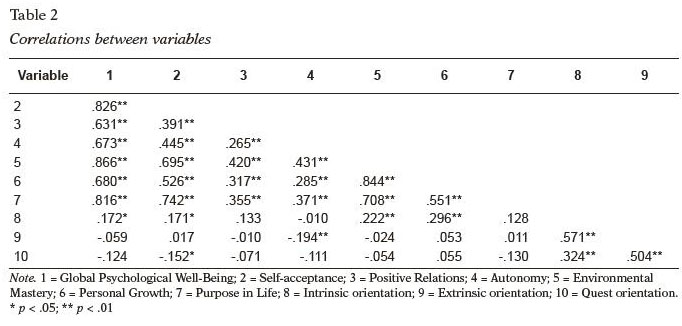
<body><![CDATA[<p><font face="Verdana" size="2"><a href="#t2">Table 2</a> shows the correlations between the religious orientations and the dimensions of psychological web-being.</font></p>     <p>&nbsp;</p>     <p align="center"><font face="Verdana" size="2"><a name="t2"><img src="/img/revistas/acp/v10n1/libre2_tabla2.jpg"></a></font></p>     <p>&nbsp;</p>     <p><font face="Verdana" size="2">A multiple regression with intrinsic, extrinsic, and quest religious orientations entered simultaneously showed that were explained the 3.6% of Positive Relations, the 5% of Purpose in Life, the 5.3% of Autonomy, the 7.7% of Self-acceptance, the 8.2% of Global Psychological Well-Being, the 8.7% of Environmental Mastery, and, the 10.8% of Personal Growth. That is, a small size of the <i>R<sup>2</sup></i> effect (Cohen, 1988) (<a href="#t3">table 3</a>).</font></p>     <p>&nbsp;</p>     <p align="center"><font face="Verdana" size="2"><a name="t3"><img src="/img/revistas/acp/v10n1/libre2_tabla3.jpg"></a></font></p>     <p>&nbsp;</p>     <p><font face="Verdana" size="2">Except for Positive Relations, <i>F</i>(3, 176) = 2.177, <i>p</i> =.092, the regression models were significant for Global Psychological Well-Being, <i>F</i>(3, 176) = 5.206, <i>p</i> = .002, Self-acceptance,<i> F</i>(3, 176) = 4.925, <i>p</i> = .003, Autonomy, <i>F</i>(3, 176) = 3.290, <i>p</i> = .022, Environmental Mastery,<i> F</i>(3, 176) = 5.587, <i>p</i> = .001, Personal Growth, <i>F</i>(3, 176) = 7.116, <i>p</i> = .000, and Purpose in Life, <i>F</i>(3, 176) = 3.061, <i>p</i> = .030.</font></p>     <p><font face="Verdana" size="2"><a href="#t4">Table 4</a> shows the regression coefficients of the models. The non-standardized B coefficient was positive for the relationship between the intrinsic orientation and all the measures of psychological well-being, and negative for all the relationships between the extrinsic orientation and these measures. In the case of quest orientation, the non-standardized B coefficients were negative, except for Personal Growth, which was positive. That means that psychological well-being increased with the intrinsic orientation and decreased with the extrinsic and quest orientations (except for the last, at Personal Growth). However, only the regression equations corresponding to the relationships between (1) Global Psychological Well-Being, Positive Relations, Environmental Mastery, Personal Growth, and intrinsic orientation, (2) Autonomy and extrinsic (negatively), and (3) Self-acceptance, Purpose in Life, intrinsic (positively) and quest (negatively), were significant.</font></p>     ]]></body>
<body><![CDATA[<p>&nbsp;</p>     <p align="center"><font face="Verdana" size="2"><a name="t4"><img src="/img/revistas/acp/v10n1/libre2_tabla4.jpg"></a></font></p>     <p>&nbsp;</p>     <p><font face="Verdana" size="2">Since the results of the regression were little powerful, the differences in psychological wellbeing among extreme groups in the three religious orientations -that is, purest profileswere analyzed. The cut-off points to form the groups were established by the means and standard deviation (+/-1 SD).  <a href="#t5">Table 5</a> shows the descriptive statistics and the test of equality of group means of the three religious orientations. There was significant the difference in Environmental Mastery between the extreme groups of the intrinsic religious orientation, <i>t</i>(101) = 2.097, <i>p</i> = .038. The group of less intrinsic religiosity showed more Environmental Mastery.</font></p>     <p>&nbsp;</p>     <p align="center"><font face="Verdana" size="2"><a name="t5"><img src="/img/revistas/acp/v10n1/libre2_tabla5.jpg"></a></font></p>     <p>&nbsp;</p>     <p>&nbsp;</p>     <p><font face="Verdana" size="2"><b>Discusión</b></font></p>     <p><font face="Verdana" size="2">The objective of this work was to analyze the relationships between religious orientation and psychological well-being in a sample of Spanish undergraduates, using the Spanish adaptations of the Batson and Ventis´ <i> Religious Orientation Scales</i> (Ramírez, 2006) and the Ryff´s <i>Scales of Psychological Well-Being</i> (Díaz et al., 2006). We hypothesized that the intrinsic orientation would be positively related to the psychological well-being and, on the other hand, extrinsic and quest orientations would be negatively related. A multiple regression analysis with enter method was conducted to test this hypothesis.</font></p>     ]]></body>
<body><![CDATA[<p><font face="Verdana" size="2">Our results support the hypothesis and coincide with studies that from decades ago reported positive relationships between intrinsic religiosity and well-being, and negative or non significant relationships between psychological well-being and extrinsic religiosity (Allport & Ross, 1967; Batson & Ventis, 1982; Batson et al., 1993; Bergin, 1991; Donahue, 1985; Griffin, 2002; Holt et al., 2007; Lewis et al., 2005; Maltby et al., 1999, 2000, 2003; Mela et al., 2008; Ventis, 1995; Wigert, 2002; Worthington et al., 1996). These results would also endorse Allport´s concept of intrinsic religiosity as mature.</font></p>     <p><font face="Verdana" size="2">Although with small sizes of regression coefficients (Cohen, 1988), intrinsic orientation was significantly related with the measures of psychological well-being, except for Autonomy, &beta; = .151, <i>p</i> = .093. On the contrary, extrinsic orientation showed negative relationships with all measures of psychological wellbeing, although, as noted, only the relationship with Autonomy, &beta; = .267, <i>p</i> = .007 was statistically significant. That is, the individuals more extrinsically orientated have less sense of selfdetermination, perception of control of life, and a greater sense of being under the circumstances conditioning. They need to be positively valued and accepted within the religious community and so they depend a lot on the others´ opinion about them.</font></p>     <p><font face="Verdana" size="2">Why intrinsic orientation is not significantly related to Autonomy? We don´t have evidence of a suppressor effect or know what variable(s) fully mediate a previously significant relationship. In this case, we can´t say why the variables are uncorrelated, but a hypothesis could be that the intrinsically oriented individuals, that is, individuals with internal religious convictions, believe that God and His Providence are significant aspects of the existence. One´s own life is not independent of God, who would have an absolute value. For someone with an intrinsic religiosity, God´s will and moves must be respected and taken into account. Autonomy would be subtle in the intrinsic believer bacause of avoidance of self-sufficiency. On the other hand, the relationship between intrinsic orientation and Autonomy would be mediated as well since the intrinsically oriented individual takes others into account, just under his religious beliefs, without losing personal autonomy. In short, Autonomy is subtle at the intrinsic believer because of his own sense of personal dependence on God and his consideration towards the others.</font></p>     <p><font face="Verdana" size="2">Moreover, quest orientation showed a negative relationship with all the measures of psychological well-being, although it was only significant regarding Self-acceptance, &beta; = .228, <i>p</i> = .007, and Purpose in Life, &beta; = .192, <i>p</i> = .026. This religious orientation would not be a mature religiosity, contrary to what was stated by Batson and others (Batson, 1976; Batson et al., 1978, 1993; Batson & Raynor-Prince, 1983; Batson & Schoenrade, 1991a, 1991b; Batson & Ventis, 1982; Burris, 1994; Hunt & King, 1971; McFarland & Warren, 1992). This is supported by works that report relationships between quest orientation and the primary traits related to neuroticism (Hills, Francis, Argyle & Jackson, 2004), schizotypal traits (Joseph, Smith & Diduca, 2002), and religious conflict and anxiety (Kojetin, McIntosh, Bridges & Spilka, 1987; Spilka, Hood & Gorsuch, 1985). In addition to what was said, the negative relationship between quest and Self-acceptance and Purpose in Life can be explained because this religious scale involves a continuous process of doubt and rethinking of important aspects of self and life, as well as the positive assessment of this continuous questioning and review. It could be conceptually close to the idea of crisis in the development of identity (Erikson, 1997; Marcia, 2002). According to these authors, in the formation of personal identity, individuals go through stages of crisis, which are considered as a process of exploration of alternatives, so when a person finds a satisfactory option he or she is able to undertake and achieve his or her identity. Particularly in the religious sphere, the moratorium (exploration of alternatives) could resemble the contents of the quest scale. By contrast, Self-acceptance and Purpose in Life would relate to the acceptance of experiences, achievements, and vital objectives, that is, with issues significantly related to achievement of identity. Our results suggest that participants who scored higher in quest orientation could be in a process of moratorium in terms of self-image and vital goals and purposes. These results may be more important in adolescent and young adult populations, who possibly still have not finalized their process of exploration of the religious matters and, therefore, the achievement of their identity.</font></p>     <p><font face="Verdana" size="2">However, one should be cautious with the conclusions since the quest scale might have a poor fit and create validity problems (Beck, Baker, Robbins & Dow, 2001; Beck & Jessup, 2004; Donahue, 1985; Edwards, Hall & Slater, 2002; Núnez, Moreno, Moral & Sánchez, 2011; Watson et al., 1992). Interpretation of the items may be personal and they can be interpreted as religious or as anti-religious: in individuals with strong religious commitment this scale was strongly associated with well-being, while this was not the case in those who did not have this religious commitment and, therefore, interpreted the scale differently. This would explain why previous research has found mixed results. For example, quest orientation has been related to spiritual well-being, being this relationship mediated by development of identity and personal meaning (Klaassen & McDonald, 2002), as well as development of moral reasoning, specifically with postconventionality (Sapp & Gladding, 1989).</font></p>     <p><font face="Verdana" size="2">The cultural context might significantly influence the relationship between religious orientation and psychological well-being. Colbert (2004) did not obtain significant correlations between the religious orientation and the psychological variables associated with wellbeing in an African American sample. Lavric and Flere (2008) concluded in a cross-cultural study that  Religious Orientation Scales are not entirely applicable to the majority of the observed cultures, and that every culture is characterized by a different relationship between religiosity and well-being: this relationship is stronger in societies with a higher level of religiosity. In the Spanish sociological context, according to some studies (e.g., González-Anleo & González, 2010), religion is undergoing a rapid and pronounced decline in recent decades, which might explain the low percentages of explained variance of psychological well-being in our study. Within a society suffering a fast and thorough process of secularization, young people turn to other sources of well-being different than religion. As Christopher (1999) pointed out, psychological well-being is strongly conditioned by the socio-cultural context, and religion is an important component of this. All of this indicates the desirability, if not the need, to deepen in the conceptualization of the religious orientations in the light of the social reality, which is dynamic and changing. Likewise, it is necessary to deepen in the study of the religious phenomenon and its relationship with several psychosocial variables from a cross-cultural perspective (Flere, Edwards & Klanjsek, 2008; Núnez, Moral & Moreno, 2010).</font></p>     <p><font face="Verdana" size="2">In addition to the possible sociological variables that could influence the relationships between religious orientation and psychological well-being, it would be advisable to analyze the role of other individual variables that could mediate, such as frequency of praying, importance of God in life, and importance of religion in life (Maltby et al., 1999; Saroglou & Mathijsen, 2007), as well as meaning in life (George, Ellison & Larson, 2002; Steger & Frazier, 2005), motivation and the social-cognitive schemes (Neyrinck, Lens, Vansteenkiste& Soenens, 2010), or the affective, cognitive, and conative components of attitudes toward religious beliefs and practices (Kristensen, Pedersen & Williams, 2002). Possibly these or other variables might explain that less intrinsic religiosity is associated to more Environmental Mastery, that is, (1) a sense of competence in managing the environment, (2) to control complex array of external activities, (3) to make effective use of surrounding opportunities, and (4) ability to choose or create contexts suitable to personal needs and values (Ryff and Keyes, 1995). More intrinsic religiosity could difficult the achievement of a sense of control over the environment. The degree of intrinsic religiosity was not significant for the rest of scales of psychological well-being. Furthermore, the degree of extrinsic religiosity and quest was not significant in relation to psychological well-being.</font></p>     <p><font face="Verdana" size="2">Without prejudice to its contributions, we can point out some limitations in this study. First, the sample is only made up of undergraduates. Future studies should consider more representative samples of the population, diverse and heterogeneous samples, such as samples belonging to different cultures and religions (e.g., Johnstone et al., 2012). Likewise, it would be important to count on several measures of religiosity, spirituality, well-being, and mental health, to have both more elements of contrast and offer more significant conclusions about their relationships. It would also be interesting to carry out statistical analyses which would report not predictively (such as the regression model), but causally (such as the path analysis or the structural equation modeling) about the relationships between religiosity (assessed in its various dimensions, and in its degree) and psychological well-being and other measures of mental health, including the variables that could mediate.</font></p>     <p>&nbsp;</p>     <p><font face="Verdana" size="2"><b>References</b></font></p>     ]]></body>
<body><![CDATA[<!-- ref --><p><font face="Verdana" size="2">1. Allport, G. W. (1950). The individual and his religion. New York, NY: Macmillan.    &nbsp;&nbsp;&nbsp;&nbsp;&nbsp;&nbsp;&nbsp;&nbsp;[&#160;<a href="javascript:void(0);" onclick="javascript: window.open('/scielo.php?script=sci_nlinks&ref=005362&pid=S1578-908X201300010001300001&lng=','','width=640,height=500,resizable=yes,scrollbars=1,menubar=yes,');">Links</a>&#160;]<!-- end-ref --></font></p>    <!-- ref --><p><font face="Verdana" size="2">2. Allport, G. W. (1966). Religious context of prejudice. Journal for the Scientific Study of Religion, 5, 447-457. doi:10.2307/1384172.    &nbsp;&nbsp;&nbsp;&nbsp;&nbsp;&nbsp;&nbsp;&nbsp;[&#160;<a href="javascript:void(0);" onclick="javascript: window.open('/scielo.php?script=sci_nlinks&ref=005364&pid=S1578-908X201300010001300002&lng=','','width=640,height=500,resizable=yes,scrollbars=1,menubar=yes,');">Links</a>&#160;]<!-- end-ref --></font></p>    <!-- ref --><p><font face="Verdana" size="2">3. Allport, G. W. & Ross, J. M. (1967). Personal religious orientation and prejudice. Journal of Personalit y and Social Psychology, 5, 432-433. doi:10.1037/h0021212.    &nbsp;&nbsp;&nbsp;&nbsp;&nbsp;&nbsp;&nbsp;&nbsp;[&#160;<a href="javascript:void(0);" onclick="javascript: window.open('/scielo.php?script=sci_nlinks&ref=005366&pid=S1578-908X201300010001300003&lng=','','width=640,height=500,resizable=yes,scrollbars=1,menubar=yes,');">Links</a>&#160;]<!-- end-ref --></font></p>    <!-- ref --><p><font face="Verdana" size="2">4. Batson, C. D. (1976). Religion as Prosocial: Agent or Double Agent? Journal for the Scientific Study of Religion, 15, 29-45. doi:10.2307/1384312.    &nbsp;&nbsp;&nbsp;&nbsp;&nbsp;&nbsp;&nbsp;&nbsp;[&#160;<a href="javascript:void(0);" onclick="javascript: window.open('/scielo.php?script=sci_nlinks&ref=005368&pid=S1578-908X201300010001300004&lng=','','width=640,height=500,resizable=yes,scrollbars=1,menubar=yes,');">Links</a>&#160;]<!-- end-ref --></font></p>    <!-- ref --><p><font face="Verdana" size="2">5. Batson, C. D. & Raynor-Prince, L. (1983). Religious Orientation and Complexity of Thought Ab ou t Existential Concern. Journal for the Scientific Study of Religion, 22, 38-50. doi:10.2307/1385590.    &nbsp;&nbsp;&nbsp;&nbsp;&nbsp;&nbsp;&nbsp;&nbsp;[&#160;<a href="javascript:void(0);" onclick="javascript: window.open('/scielo.php?script=sci_nlinks&ref=005370&pid=S1578-908X201300010001300005&lng=','','width=640,height=500,resizable=yes,scrollbars=1,menubar=yes,');">Links</a>&#160;]<!-- end-ref --></font></p>    ]]></body>
<body><![CDATA[<!-- ref --><p><font face="Verdana" size="2">6. Batson, C. D. & Schoenrade, P. (1991a). Measuring religion as quest: 1) Validity concerns. Journal for the Scientific Study of Religion, 30, 416-429. doi:10.2307/1387277.    &nbsp;&nbsp;&nbsp;&nbsp;&nbsp;&nbsp;&nbsp;&nbsp;[&#160;<a href="javascript:void(0);" onclick="javascript: window.open('/scielo.php?script=sci_nlinks&ref=005372&pid=S1578-908X201300010001300006&lng=','','width=640,height=500,resizable=yes,scrollbars=1,menubar=yes,');">Links</a>&#160;]<!-- end-ref --></font></p>    <!-- ref --><p><font face="Verdana" size="2">7. Batson, C. D. & Schoenrade, P. (1991b). Measuring Religion as Quest: 2) Reliability Concerns. Journal for the Scientific Study of Religion, 30, 430437. doi:10.2307/1387278.    &nbsp;&nbsp;&nbsp;&nbsp;&nbsp;&nbsp;&nbsp;&nbsp;[&#160;<a href="javascript:void(0);" onclick="javascript: window.open('/scielo.php?script=sci_nlinks&ref=005374&pid=S1578-908X201300010001300007&lng=','','width=640,height=500,resizable=yes,scrollbars=1,menubar=yes,');">Links</a>&#160;]<!-- end-ref --></font></p>    <!-- ref --><p><font face="Verdana" size="2">8. Batson, C. D. & Ventis, W. L. (1982). The religious experience: A social-psychological perspective. New York, NY: Oxford University Press.    &nbsp;&nbsp;&nbsp;&nbsp;&nbsp;&nbsp;&nbsp;&nbsp;[&#160;<a href="javascript:void(0);" onclick="javascript: window.open('/scielo.php?script=sci_nlinks&ref=005376&pid=S1578-908X201300010001300008&lng=','','width=640,height=500,resizable=yes,scrollbars=1,menubar=yes,');">Links</a>&#160;]<!-- end-ref --></font></p>    <!-- ref --><p><font face="Verdana" size="2">9. Batson, C. D., Naifeh, S. J. & Pate, S. (1978). Social desirability, religious orientation, and racial prejudice. Journal for the Scientific Study of Religion, 17, 31-41. doi:10.2307/1385425.    &nbsp;&nbsp;&nbsp;&nbsp;&nbsp;&nbsp;&nbsp;&nbsp;[&#160;<a href="javascript:void(0);" onclick="javascript: window.open('/scielo.php?script=sci_nlinks&ref=005378&pid=S1578-908X201300010001300009&lng=','','width=640,height=500,resizable=yes,scrollbars=1,menubar=yes,');">Links</a>&#160;]<!-- end-ref --></font></p>    <!-- ref --><p><font face="Verdana" size="2">10. Batson, C. D., Schoenrade, P. & Ventis, W. L. (1993). Religion and the Individual:  a social-psychological perspective. New York, NY: Oxford University Press.    &nbsp;&nbsp;&nbsp;&nbsp;&nbsp;&nbsp;&nbsp;&nbsp;[&#160;<a href="javascript:void(0);" onclick="javascript: window.open('/scielo.php?script=sci_nlinks&ref=005380&pid=S1578-908X201300010001300010&lng=','','width=640,height=500,resizable=yes,scrollbars=1,menubar=yes,');">Links</a>&#160;]<!-- end-ref --></font></p>    ]]></body>
<body><![CDATA[<!-- ref --><p><font face="Verdana" size="2">11. Beck, R. & Jessup, R. (2004). The multidimensional nature of Quest motivation. Journal of Psychology and Theology, 32, 283-294.    &nbsp;&nbsp;&nbsp;&nbsp;&nbsp;&nbsp;&nbsp;&nbsp;[&#160;<a href="javascript:void(0);" onclick="javascript: window.open('/scielo.php?script=sci_nlinks&ref=005382&pid=S1578-908X201300010001300011&lng=','','width=640,height=500,resizable=yes,scrollbars=1,menubar=yes,');">Links</a>&#160;]<!-- end-ref --></font></p>    <!-- ref --><p><font face="Verdana" size="2">12. Beck, R., Baker, L., Robbins, M. & Dow, S. (2001). A second look at Quest motivation: Is Quest unidimensional or multidimensional? Journal of Psychology and Theology, 29, 148-157.    &nbsp;&nbsp;&nbsp;&nbsp;&nbsp;&nbsp;&nbsp;&nbsp;[&#160;<a href="javascript:void(0);" onclick="javascript: window.open('/scielo.php?script=sci_nlinks&ref=005384&pid=S1578-908X201300010001300012&lng=','','width=640,height=500,resizable=yes,scrollbars=1,menubar=yes,');">Links</a>&#160;]<!-- end-ref --></font></p>    <!-- ref --><p><font face="Verdana" size="2">13. Burris, C. T. (1994). Curvilinearity and Religious Types: A Second Look at Intrinsic, Extrinsic, and Quest Relations. The International Journal for the Psychology of Religion, 4(4), 245-260. doi:10.1207/s15327582ijpr0404_5.    &nbsp;&nbsp;&nbsp;&nbsp;&nbsp;&nbsp;&nbsp;&nbsp;[&#160;<a href="javascript:void(0);" onclick="javascript: window.open('/scielo.php?script=sci_nlinks&ref=005386&pid=S1578-908X201300010001300013&lng=','','width=640,height=500,resizable=yes,scrollbars=1,menubar=yes,');">Links</a>&#160;]<!-- end-ref --></font></p>    <!-- ref --><p><font face="Verdana" size="2">14. Christopher, J. C. (1999). Situating Psychological Well-Being: Exploring the Cultural Roots of Its Theory and Research. Journal of Counseling and Development , 77 (2), 141-152. doi:10.1002/j.1556-6676.1999.tb02434.x.    &nbsp;&nbsp;&nbsp;&nbsp;&nbsp;&nbsp;&nbsp;&nbsp;[&#160;<a href="javascript:void(0);" onclick="javascript: window.open('/scielo.php?script=sci_nlinks&ref=005388&pid=S1578-908X201300010001300014&lng=','','width=640,height=500,resizable=yes,scrollbars=1,menubar=yes,');">Links</a>&#160;]<!-- end-ref --></font></p>    <!-- ref --><p><font face="Verdana" size="2">15. Cohen, J. (1988). Statistical Power Analysis for the Behavioral Sciences (2nd ed.). Hillsdale, NJ: Lawrence Erlbaum Associates.    &nbsp;&nbsp;&nbsp;&nbsp;&nbsp;&nbsp;&nbsp;&nbsp;[&#160;<a href="javascript:void(0);" onclick="javascript: window.open('/scielo.php?script=sci_nlinks&ref=005390&pid=S1578-908X201300010001300015&lng=','','width=640,height=500,resizable=yes,scrollbars=1,menubar=yes,');">Links</a>&#160;]<!-- end-ref --></font></p>    ]]></body>
<body><![CDATA[<!-- ref --><p><font face="Verdana" size="2">16. Colbert, L. K. (2004). A study of religiosity and psychological well being among African Americans: Implications for counseling and psychotherapeutic processes. Dissertation Abstracts International Section A: Humanities and Social Sciences, 64(12-A), 43-54.    &nbsp;&nbsp;&nbsp;&nbsp;&nbsp;&nbsp;&nbsp;&nbsp;[&#160;<a href="javascript:void(0);" onclick="javascript: window.open('/scielo.php?script=sci_nlinks&ref=005392&pid=S1578-908X201300010001300016&lng=','','width=640,height=500,resizable=yes,scrollbars=1,menubar=yes,');">Links</a>&#160;]<!-- end-ref --></font></p>    <!-- ref --><p><font face="Verdana" size="2">17. Díaz, D., Rodríguez-Carvajal, R., Blanco, A., Moreno-Jiménez, B., Gallardo, I., Valle C. & van Dierendonck, D. (2006). Adaptación española de las escalas de bienestar psicológico de Ryff (Spanish adaptation of the Psychological Well-Being Scales (PWBS)). Psicothema, 18(3), 572-577.    &nbsp;&nbsp;&nbsp;&nbsp;&nbsp;&nbsp;&nbsp;&nbsp;[&#160;<a href="javascript:void(0);" onclick="javascript: window.open('/scielo.php?script=sci_nlinks&ref=005394&pid=S1578-908X201300010001300017&lng=','','width=640,height=500,resizable=yes,scrollbars=1,menubar=yes,');">Links</a>&#160;]<!-- end-ref --></font></p>    <!-- ref --><p><font face="Verdana" size="2">18. Donahue, M. J. (1985). Intrinsic and extrinsic religiousness: A review and meta-analysis. Journal of Personality and Social Psychology, 48, 400-419. doi:10.1037/0022-3514.48.2.400.    &nbsp;&nbsp;&nbsp;&nbsp;&nbsp;&nbsp;&nbsp;&nbsp;[&#160;<a href="javascript:void(0);" onclick="javascript: window.open('/scielo.php?script=sci_nlinks&ref=005396&pid=S1578-908X201300010001300018&lng=','','width=640,height=500,resizable=yes,scrollbars=1,menubar=yes,');">Links</a>&#160;]<!-- end-ref --></font></p>    <!-- ref --><p><font face="Verdana" size="2">19. Edwards, K. J., Hall, T. W. & Slater, W. (2002, August). The structure of the quest construct. Paper presented at the American Psychological Association convention, Chicago.    &nbsp;&nbsp;&nbsp;&nbsp;&nbsp;&nbsp;&nbsp;&nbsp;[&#160;<a href="javascript:void(0);" onclick="javascript: window.open('/scielo.php?script=sci_nlinks&ref=005398&pid=S1578-908X201300010001300019&lng=','','width=640,height=500,resizable=yes,scrollbars=1,menubar=yes,');">Links</a>&#160;]<!-- end-ref --></font></p>    <!-- ref --><p><font face="Verdana" size="2">20. Erikson, E. H. (1997). The live cycle completed. New York, NY: W. W. Norton and Company.    &nbsp;&nbsp;&nbsp;&nbsp;&nbsp;&nbsp;&nbsp;&nbsp;[&#160;<a href="javascript:void(0);" onclick="javascript: window.open('/scielo.php?script=sci_nlinks&ref=005400&pid=S1578-908X201300010001300020&lng=','','width=640,height=500,resizable=yes,scrollbars=1,menubar=yes,');">Links</a>&#160;]<!-- end-ref --></font></p>    ]]></body>
<body><![CDATA[<!-- ref --><p><font face="Verdana" size="2">21. Flere, S., Edwards, K. J. & Klanjsek, R. (2008). Religious Orientation in Three Central European Environments: Quest, Intrinsic, and Extrinsic Dimensions. The International Journal for the Psychology of Religion, 18, 1-21. doi:10.1080/10508610701719280.    &nbsp;&nbsp;&nbsp;&nbsp;&nbsp;&nbsp;&nbsp;&nbsp;[&#160;<a href="javascript:void(0);" onclick="javascript: window.open('/scielo.php?script=sci_nlinks&ref=005402&pid=S1578-908X201300010001300021&lng=','','width=640,height=500,resizable=yes,scrollbars=1,menubar=yes,');">Links</a>&#160;]<!-- end-ref --></font></p>    <!-- ref --><p><font face="Verdana" size="2">22. García-Alandete, J. (2010). Psicología positiva, felicidad y religión (Positive psychology, happiness, and religion). Religión y Cultura, 253-254, 523-548.    &nbsp;&nbsp;&nbsp;&nbsp;&nbsp;&nbsp;&nbsp;&nbsp;[&#160;<a href="javascript:void(0);" onclick="javascript: window.open('/scielo.php?script=sci_nlinks&ref=005404&pid=S1578-908X201300010001300022&lng=','','width=640,height=500,resizable=yes,scrollbars=1,menubar=yes,');">Links</a>&#160;]<!-- end-ref --></font></p>    <!-- ref --><p><font face="Verdana" size="2">23. Genia, V. (1996). I, E, Quest, and Fundamentalism as Predictors of Psychological and Spiritual Well-Being. Journal for the Scientific Study of Religion, 35(1), 56-64. doi:10.2307/1386395.    &nbsp;&nbsp;&nbsp;&nbsp;&nbsp;&nbsp;&nbsp;&nbsp;[&#160;<a href="javascript:void(0);" onclick="javascript: window.open('/scielo.php?script=sci_nlinks&ref=005406&pid=S1578-908X201300010001300023&lng=','','width=640,height=500,resizable=yes,scrollbars=1,menubar=yes,');">Links</a>&#160;]<!-- end-ref --></font></p>    <!-- ref --><p><font face="Verdana" size="2">24. Genia, V. & Shaw, D. G. (1991). Religion, Intrinsic-Extrinsic Orientation and Depression. Review of Religious Research, 32(3), 274-283. doi:10.2307/3511212.    &nbsp;&nbsp;&nbsp;&nbsp;&nbsp;&nbsp;&nbsp;&nbsp;[&#160;<a href="javascript:void(0);" onclick="javascript: window.open('/scielo.php?script=sci_nlinks&ref=005408&pid=S1578-908X201300010001300024&lng=','','width=640,height=500,resizable=yes,scrollbars=1,menubar=yes,');">Links</a>&#160;]<!-- end-ref --></font></p>    <!-- ref --><p><font face="Verdana" size="2">25. George, L. K., Ellison, C. G. & Larson, D. B. (2002). Explaining the relationships between religious involvement and health. Psychological Inquiry, 13, 190-200. doi:10.1207/S15327965PLI1303_04.    &nbsp;&nbsp;&nbsp;&nbsp;&nbsp;&nbsp;&nbsp;&nbsp;[&#160;<a href="javascript:void(0);" onclick="javascript: window.open('/scielo.php?script=sci_nlinks&ref=005410&pid=S1578-908X201300010001300025&lng=','','width=640,height=500,resizable=yes,scrollbars=1,menubar=yes,');">Links</a>&#160;]<!-- end-ref --></font></p>    ]]></body>
<body><![CDATA[<!-- ref --><p><font face="Verdana" size="2">26. González-Anleo, J. & González, J. (2010). Jóvenes españoles 2010 (Young spanish 2010). Madrid: España: Fundación SM.    &nbsp;&nbsp;&nbsp;&nbsp;&nbsp;&nbsp;&nbsp;&nbsp;[&#160;<a href="javascript:void(0);" onclick="javascript: window.open('/scielo.php?script=sci_nlinks&ref=005412&pid=S1578-908X201300010001300026&lng=','','width=640,height=500,resizable=yes,scrollbars=1,menubar=yes,');">Links</a>&#160;]<!-- end-ref --></font></p>    <!-- ref --><p><font face="Verdana" size="2">27. Griffin, G. A. (2002). Creativity and religious orientation: An interactional study of psychological wellbeing. Dissertation Abstracts International: Section B: The Sciences and Engineering, 63(2-B), 1026.    &nbsp;&nbsp;&nbsp;&nbsp;&nbsp;&nbsp;&nbsp;&nbsp;[&#160;<a href="javascript:void(0);" onclick="javascript: window.open('/scielo.php?script=sci_nlinks&ref=005414&pid=S1578-908X201300010001300027&lng=','','width=640,height=500,resizable=yes,scrollbars=1,menubar=yes,');">Links</a>&#160;]<!-- end-ref --></font></p>    <!-- ref --><p><font face="Verdana" size="2">28. Grounlound, N. E. (1985). Measurement and Evaluation in Teaching. New York, NY: Macmillan.    &nbsp;&nbsp;&nbsp;&nbsp;&nbsp;&nbsp;&nbsp;&nbsp;[&#160;<a href="javascript:void(0);" onclick="javascript: window.open('/scielo.php?script=sci_nlinks&ref=005416&pid=S1578-908X201300010001300028&lng=','','width=640,height=500,resizable=yes,scrollbars=1,menubar=yes,');">Links</a>&#160;]<!-- end-ref --></font></p>    <!-- ref --><p><font face="Verdana" size="2">29. Hackney, C. H. & Sanders, G. S. (2003). Religiosity and Mental Health: A Meta-Analysis of Recent Studies. Journal for the Scientific Study of Religion, 42(1), 43-55. doi:10.1111/1468-5906.t01-1-00160.    &nbsp;&nbsp;&nbsp;&nbsp;&nbsp;&nbsp;&nbsp;&nbsp;[&#160;<a href="javascript:void(0);" onclick="javascript: window.open('/scielo.php?script=sci_nlinks&ref=005418&pid=S1578-908X201300010001300029&lng=','','width=640,height=500,resizable=yes,scrollbars=1,menubar=yes,');">Links</a>&#160;]<!-- end-ref --></font></p>    <!-- ref --><p><font face="Verdana" size="2">30. Hills, P., Francis, L. J., Argyle, M. & Jackson, C.J. (2004). Primary personality trait correlates of religious practice and orientation. Personality and Individual Differences, 36(1), 61-73. doi:10.1016/S0191-8869(03)00051-5.    &nbsp;&nbsp;&nbsp;&nbsp;&nbsp;&nbsp;&nbsp;&nbsp;[&#160;<a href="javascript:void(0);" onclick="javascript: window.open('/scielo.php?script=sci_nlinks&ref=005420&pid=S1578-908X201300010001300030&lng=','','width=640,height=500,resizable=yes,scrollbars=1,menubar=yes,');">Links</a>&#160;]<!-- end-ref --></font></p>    ]]></body>
<body><![CDATA[<!-- ref --><p><font face="Verdana" size="2">31. Holt, C. L., Clark, E. M. & Klem, P. R. (2007). Expansion and Validation of the Spi ritual Health Locus of Control Scale. Journal of Health Psychology, 12(4), 597-612. doi:10.1177/1359105307078166.    &nbsp;&nbsp;&nbsp;&nbsp;&nbsp;&nbsp;&nbsp;&nbsp;[&#160;<a href="javascript:void(0);" onclick="javascript: window.open('/scielo.php?script=sci_nlinks&ref=005422&pid=S1578-908X201300010001300031&lng=','','width=640,height=500,resizable=yes,scrollbars=1,menubar=yes,');">Links</a>&#160;]<!-- end-ref --></font></p>    <!-- ref --><p><font face="Verdana" size="2">32. Hunsberger, B. (1999). Social-psychological causes of faith; new findings offer compelling clues. Free Inquiry, 19(3), 34-38.    &nbsp;&nbsp;&nbsp;&nbsp;&nbsp;&nbsp;&nbsp;&nbsp;[&#160;<a href="javascript:void(0);" onclick="javascript: window.open('/scielo.php?script=sci_nlinks&ref=005424&pid=S1578-908X201300010001300032&lng=','','width=640,height=500,resizable=yes,scrollbars=1,menubar=yes,');">Links</a>&#160;]<!-- end-ref --></font></p>    <!-- ref --><p><font face="Verdana" size="2">33. Hunt, R. A. & King, M. B. (1971). The intrinsicextrinsic concept: A review and evaluation. Journal for the Scientific Study of Religion, 10(4), 339-356. doi:10.2307/1384780.    &nbsp;&nbsp;&nbsp;&nbsp;&nbsp;&nbsp;&nbsp;&nbsp;[&#160;<a href="javascript:void(0);" onclick="javascript: window.open('/scielo.php?script=sci_nlinks&ref=005426&pid=S1578-908X201300010001300033&lng=','','width=640,height=500,resizable=yes,scrollbars=1,menubar=yes,');">Links</a>&#160;]<!-- end-ref --></font></p>    <!-- ref --><p><font face="Verdana" size="2">34. Johnstone, B., Yoon, D. P., Cohen, D., Schopp, L. H., McCormack, G., Campbell, J. & Smith, M. (2012). Relationships Among Spirituality, Religious Practices, Personality Factors, and Health for Five Different Faith Traditions. Journal of Religion and Health, May 23 (Epub ahead of print). doi:10.1007/s10943-012-9615-8.    &nbsp;&nbsp;&nbsp;&nbsp;&nbsp;&nbsp;&nbsp;&nbsp;[&#160;<a href="javascript:void(0);" onclick="javascript: window.open('/scielo.php?script=sci_nlinks&ref=005428&pid=S1578-908X201300010001300034&lng=','','width=640,height=500,resizable=yes,scrollbars=1,menubar=yes,');">Links</a>&#160;]<!-- end-ref --></font></p>    <!-- ref --><p><font face="Verdana" size="2">35. Joseph, S., Smith, D. & Diduca, D. (2002). Religious orientation and its association with personality, schizotypal traits and manic-depressive experiences. Mental Health, Religion and Culture,5(1), 73-81. doi:10.1080/13674670110112721.    &nbsp;&nbsp;&nbsp;&nbsp;&nbsp;&nbsp;&nbsp;&nbsp;[&#160;<a href="javascript:void(0);" onclick="javascript: window.open('/scielo.php?script=sci_nlinks&ref=005430&pid=S1578-908X201300010001300035&lng=','','width=640,height=500,resizable=yes,scrollbars=1,menubar=yes,');">Links</a>&#160;]<!-- end-ref --></font></p>    ]]></body>
<body><![CDATA[<!-- ref --><p><font face="Verdana" size="2">36. Keyes, C. L. M., Shmotkin, D. & Ryff, C. D. (2002). Optimizing well-being: The empirical encounter of two traditions. Journal of Personality and Social Psychology, 82(6), 1007-1022. doi:10.1037//0022-3514.82.6.1007.    &nbsp;&nbsp;&nbsp;&nbsp;&nbsp;&nbsp;&nbsp;&nbsp;[&#160;<a href="javascript:void(0);" onclick="javascript: window.open('/scielo.php?script=sci_nlinks&ref=005432&pid=S1578-908X201300010001300036&lng=','','width=640,height=500,resizable=yes,scrollbars=1,menubar=yes,');">Links</a>&#160;]<!-- end-ref --></font></p>    <!-- ref --><p><font face="Verdana" size="2">37. Klaassen, D. W. & McDonald, M. J. (2002). Quest and identity development: Re-examining pathways for existential search. The International Journal for the Psychology of Religion, 12(3), 189-200. doi:10.1207/S15327582IJPR1203_05.    &nbsp;&nbsp;&nbsp;&nbsp;&nbsp;&nbsp;&nbsp;&nbsp;[&#160;<a href="javascript:void(0);" onclick="javascript: window.open('/scielo.php?script=sci_nlinks&ref=005434&pid=S1578-908X201300010001300037&lng=','','width=640,height=500,resizable=yes,scrollbars=1,menubar=yes,');">Links</a>&#160;]<!-- end-ref --></font></p>    <!-- ref --><p><font face="Verdana" size="2">38. Koenig, H. (1998). Handbook of Religion and Mental Health. San Diego, CA: Academic Press.    &nbsp;&nbsp;&nbsp;&nbsp;&nbsp;&nbsp;&nbsp;&nbsp;[&#160;<a href="javascript:void(0);" onclick="javascript: window.open('/scielo.php?script=sci_nlinks&ref=005436&pid=S1578-908X201300010001300038&lng=','','width=640,height=500,resizable=yes,scrollbars=1,menubar=yes,');">Links</a>&#160;]<!-- end-ref --></font></p>    <!-- ref --><p><font face="Verdana" size="2">39. Kojetin, B. A., McIntosh, D. N., Bridges, R.A. & Spilka, B. (1987). Quest: Constructive search or religious conflict? Journal for the Scientific Study of Religion, 26, 111-115. doi:10.2307/1385845.    &nbsp;&nbsp;&nbsp;&nbsp;&nbsp;&nbsp;&nbsp;&nbsp;[&#160;<a href="javascript:void(0);" onclick="javascript: window.open('/scielo.php?script=sci_nlinks&ref=005438&pid=S1578-908X201300010001300039&lng=','','width=640,height=500,resizable=yes,scrollbars=1,menubar=yes,');">Links</a>&#160;]<!-- end-ref --></font></p>    <!-- ref --><p><font face="Verdana" size="2">40. Kristensen, K. B., Pedersen, D. M. & Williams, R. N. (2002). Profiling religious maturity: The relationship of religious attitude components to religious orientations. Journal for the Scientific Study of Religion, 40(1), 75-86.    &nbsp;&nbsp;&nbsp;&nbsp;&nbsp;&nbsp;&nbsp;&nbsp;[&#160;<a href="javascript:void(0);" onclick="javascript: window.open('/scielo.php?script=sci_nlinks&ref=005440&pid=S1578-908X201300010001300040&lng=','','width=640,height=500,resizable=yes,scrollbars=1,menubar=yes,');">Links</a>&#160;]<!-- end-ref --></font></p>    ]]></body>
<body><![CDATA[<!-- ref --><p><font face="Verdana" size="2">41. Lavric, M. & Flere, S. (2008). The role of culture in the relationship between religiosity and psychological well-being. Journal of Religion and Health, 47(2), 164-175.    &nbsp;&nbsp;&nbsp;&nbsp;&nbsp;&nbsp;&nbsp;&nbsp;[&#160;<a href="javascript:void(0);" onclick="javascript: window.open('/scielo.php?script=sci_nlinks&ref=005442&pid=S1578-908X201300010001300041&lng=','','width=640,height=500,resizable=yes,scrollbars=1,menubar=yes,');">Links</a>&#160;]<!-- end-ref --></font></p>    <!-- ref --><p><font face="Verdana" size="2">42. Lewis, C., Maltby, J. & Day, L. (2005). Religious orientation, religious coping and happiness among UK adults. Personality and Individual Differences, 38(5), 1193-1202. doi:10.1016/j. paid.2004.08.002.    &nbsp;&nbsp;&nbsp;&nbsp;&nbsp;&nbsp;&nbsp;&nbsp;[&#160;<a href="javascript:void(0);" onclick="javascript: window.open('/scielo.php?script=sci_nlinks&ref=005444&pid=S1578-908X201300010001300042&lng=','','width=640,height=500,resizable=yes,scrollbars=1,menubar=yes,');">Links</a>&#160;]<!-- end-ref --></font></p>    <!-- ref --><p><font face="Verdana" size="2">43. Maltby, J. & Day, L. (2004). Should never the twain meet? Integrating models of religious personality and religious mental health. Personality and Individual Differences, 36, 1275-1290. doi:10.1016/S0191-8869(03)00215-0.    &nbsp;&nbsp;&nbsp;&nbsp;&nbsp;&nbsp;&nbsp;&nbsp;[&#160;<a href="javascript:void(0);" onclick="javascript: window.open('/scielo.php?script=sci_nlinks&ref=005446&pid=S1578-908X201300010001300043&lng=','','width=640,height=500,resizable=yes,scrollbars=1,menubar=yes,');">Links</a>&#160;]<!-- end-ref --></font></p>    <!-- ref --><p><font face="Verdana" size="2">44. Maltby, J., Lewis, C. & Day, L. (1999). Religious orientation and psychological well-being: The role of the frequency of personal prayer. British Journal of Health Psychology, 4(4), 363-378. doi:10.1348/135910799168704.    &nbsp;&nbsp;&nbsp;&nbsp;&nbsp;&nbsp;&nbsp;&nbsp;[&#160;<a href="javascript:void(0);" onclick="javascript: window.open('/scielo.php?script=sci_nlinks&ref=005448&pid=S1578-908X201300010001300044&lng=','','width=640,height=500,resizable=yes,scrollbars=1,menubar=yes,');">Links</a>&#160;]<!-- end-ref --></font></p>    <!-- ref --><p><font face="Verdana" size="2">45. Maltby, J., Lewis, C. & Day, L. (2000). Depressive symptoms and religious orientation: Examining the relationship between religiosity and depression within the context of other correlates of depression. Personality and Individual Differences, 28(2), 383-393. doi:10.1016/S01918869(99)00108-7.    &nbsp;&nbsp;&nbsp;&nbsp;&nbsp;&nbsp;&nbsp;&nbsp;[&#160;<a href="javascript:void(0);" onclick="javascript: window.open('/scielo.php?script=sci_nlinks&ref=005450&pid=S1578-908X201300010001300045&lng=','','width=640,height=500,resizable=yes,scrollbars=1,menubar=yes,');">Links</a>&#160;]<!-- end-ref --></font></p>    ]]></body>
<body><![CDATA[<!-- ref --><p><font face="Verdana" size="2">46. Maltby, J., Lewis, C. & Day, L. (2003). Religious orientation, religious coping and appraisals of stress: Assessing primary appraisal factors in the relationship between religiosity and psychological well-being. Personality and Individual Differences, 34(7), 1209-1224. doi:10.1016/ S0191-8869(02)00110-1.    &nbsp;&nbsp;&nbsp;&nbsp;&nbsp;&nbsp;&nbsp;&nbsp;[&#160;<a href="javascript:void(0);" onclick="javascript: window.open('/scielo.php?script=sci_nlinks&ref=005452&pid=S1578-908X201300010001300046&lng=','','width=640,height=500,resizable=yes,scrollbars=1,menubar=yes,');">Links</a>&#160;]<!-- end-ref --></font></p>    <!-- ref --><p><font face="Verdana" size="2">47. Marcia, J. E. (2002). Identity and psychosocial development in adulthood. Identity, 2, 7-28. doi:10.1207/S1532706XID0201_02.    &nbsp;&nbsp;&nbsp;&nbsp;&nbsp;&nbsp;&nbsp;&nbsp;[&#160;<a href="javascript:void(0);" onclick="javascript: window.open('/scielo.php?script=sci_nlinks&ref=005454&pid=S1578-908X201300010001300047&lng=','','width=640,height=500,resizable=yes,scrollbars=1,menubar=yes,');">Links</a>&#160;]<!-- end-ref --></font></p>    <!-- ref --><p><font face="Verdana" size="2">48. McFarland, S. G. & Warren, J. C. (1992). Religious Orientations and Selective Exposure among Fundamentalist Christians. Journal for the Scientific Study of Religion, 31(2), 163-174. doi:10.2307/1387006.    &nbsp;&nbsp;&nbsp;&nbsp;&nbsp;&nbsp;&nbsp;&nbsp;[&#160;<a href="javascript:void(0);" onclick="javascript: window.open('/scielo.php?script=sci_nlinks&ref=005456&pid=S1578-908X201300010001300048&lng=','','width=640,height=500,resizable=yes,scrollbars=1,menubar=yes,');">Links</a>&#160;]<!-- end-ref --></font></p>    <!-- ref --><p><font face="Verdana" size="2">49. Mela, M. A., Marcoux, E., Baetz, M., Griffin, R., Angelski, C. & Deqiang, G. (2008). The effect of religiosity and spirituality on psychological well-being among forensic psychiatric patients in Canada. Mental Health, Religion and Culture, 11(5), 517-532. doi:10.1080/13674670701584847.    &nbsp;&nbsp;&nbsp;&nbsp;&nbsp;&nbsp;&nbsp;&nbsp;[&#160;<a href="javascript:void(0);" onclick="javascript: window.open('/scielo.php?script=sci_nlinks&ref=005458&pid=S1578-908X201300010001300049&lng=','','width=640,height=500,resizable=yes,scrollbars=1,menubar=yes,');">Links</a>&#160;]<!-- end-ref --></font></p>    <!-- ref --><p><font face="Verdana" size="2">50. Moreira-Almeida, A., Neto, F. L. & Koenig, H. G. (2006). Religiosidade e saúde mental: Uma revis&atilde;o (Religiousness and mental health: A review). Revista Brasileira de Psiquiatria, 28(3), 242-250. doi:10.1590/S1516-44462006005000006.    &nbsp;&nbsp;&nbsp;&nbsp;&nbsp;&nbsp;&nbsp;&nbsp;[&#160;<a href="javascript:void(0);" onclick="javascript: window.open('/scielo.php?script=sci_nlinks&ref=005460&pid=S1578-908X201300010001300050&lng=','','width=640,height=500,resizable=yes,scrollbars=1,menubar=yes,');">Links</a>&#160;]<!-- end-ref --></font></p>    ]]></body>
<body><![CDATA[<!-- ref --><p><font face="Verdana" size="2">51. Neyrinck, B., Lens, W., Vansteenkiste, M. & Soenens, B. (2010). Updating Allport´s and Batson´s Framework of Religious Orientations: A Reevaluation from the Perspective of SelfDetermination Theory and Wulff´s Social Cognitive Model. Journal for the Scientific Study of Religion, 49(3), 425-438. doi:10.1111/j.14685906.2010.01520.x.    &nbsp;&nbsp;&nbsp;&nbsp;&nbsp;&nbsp;&nbsp;&nbsp;[&#160;<a href="javascript:void(0);" onclick="javascript: window.open('/scielo.php?script=sci_nlinks&ref=005462&pid=S1578-908X201300010001300051&lng=','','width=640,height=500,resizable=yes,scrollbars=1,menubar=yes,');">Links</a>&#160;]<!-- end-ref --></font></p>    <!-- ref --><p><font face="Verdana" size="2">52. Nielsen, M. E. (1995) Operationalizing Religious Orientation: Iron Rods and Compasses. The Journal of Psychology, 129(5), 485-494. doi:10.1 080/00223980.1995.9914921.    &nbsp;&nbsp;&nbsp;&nbsp;&nbsp;&nbsp;&nbsp;&nbsp;[&#160;<a href="javascript:void(0);" onclick="javascript: window.open('/scielo.php?script=sci_nlinks&ref=005464&pid=S1578-908X201300010001300052&lng=','','width=640,height=500,resizable=yes,scrollbars=1,menubar=yes,');">Links</a>&#160;]<!-- end-ref --></font></p>    <!-- ref --><p><font face="Verdana" size="2">53. Núnez, M., Moral, F. & Moreno, M. P. (2010). Impacto diferencial de la religión en el prejuicio entre muestras cristianas y musulmanas (Differential impact of religion on prejudice in Muslim and Christian samples). Escritos de Psicología, 3(4), 11-20.    &nbsp;&nbsp;&nbsp;&nbsp;&nbsp;&nbsp;&nbsp;&nbsp;[&#160;<a href="javascript:void(0);" onclick="javascript: window.open('/scielo.php?script=sci_nlinks&ref=005466&pid=S1578-908X201300010001300053&lng=','','width=640,height=500,resizable=yes,scrollbars=1,menubar=yes,');">Links</a>&#160;]<!-- end-ref --></font></p>    <!-- ref --><p><font face="Verdana" size="2">54. Núnez, M., Moreno, M. P., Moral, F. & Sánchez, M. (2011). Validación de una escala de orientación religiosa en muestras cristiana y musulmana (Validation of a scale of religious orientation in Christian and Muslim samples). Metodología de Encuestas , 13, 97-119.    &nbsp;&nbsp;&nbsp;&nbsp;&nbsp;&nbsp;&nbsp;&nbsp;[&#160;<a href="javascript:void(0);" onclick="javascript: window.open('/scielo.php?script=sci_nlinks&ref=005468&pid=S1578-908X201300010001300054&lng=','','width=640,height=500,resizable=yes,scrollbars=1,menubar=yes,');">Links</a>&#160;]<!-- end-ref --></font></p>    <!-- ref --><p><font face="Verdana" size="2">55. Núnez-Alarcón, M., Moreno-Jiménez, M. P. & Moral-Toranzo, F. (2011). Modelo causal del prejuicio religioso (Causal model of religious prejudice). Anales de psicología, 27(3), 852-861.    &nbsp;&nbsp;&nbsp;&nbsp;&nbsp;&nbsp;&nbsp;&nbsp;[&#160;<a href="javascript:void(0);" onclick="javascript: window.open('/scielo.php?script=sci_nlinks&ref=005470&pid=S1578-908X201300010001300055&lng=','','width=640,height=500,resizable=yes,scrollbars=1,menubar=yes,');">Links</a>&#160;]<!-- end-ref --></font></p>    ]]></body>
<body><![CDATA[<!-- ref --><p><font face="Verdana" size="2">56. Nunnaly, J. (1978).  Psychometric Theory. New York, NY: McGraw Hill.    &nbsp;&nbsp;&nbsp;&nbsp;&nbsp;&nbsp;&nbsp;&nbsp;[&#160;<a href="javascript:void(0);" onclick="javascript: window.open('/scielo.php?script=sci_nlinks&ref=005472&pid=S1578-908X201300010001300056&lng=','','width=640,height=500,resizable=yes,scrollbars=1,menubar=yes,');">Links</a>&#160;]<!-- end-ref --></font></p>    <!-- ref --><p><font face="Verdana" size="2">57. Paloutzian, R. F. & Park, C. L. (2005). Handbook of the psychology of Religion and spirituality. New York, NY: Guilford Press.    &nbsp;&nbsp;&nbsp;&nbsp;&nbsp;&nbsp;&nbsp;&nbsp;[&#160;<a href="javascript:void(0);" onclick="javascript: window.open('/scielo.php?script=sci_nlinks&ref=005474&pid=S1578-908X201300010001300057&lng=','','width=640,height=500,resizable=yes,scrollbars=1,menubar=yes,');">Links</a>&#160;]<!-- end-ref --></font></p>    <!-- ref --><p><font face="Verdana" size="2">58. Pargament, K. I. (1997). The psychology of Religion and Coping: Theory, Research, practice. New York, NY: Guilford Press.    &nbsp;&nbsp;&nbsp;&nbsp;&nbsp;&nbsp;&nbsp;&nbsp;[&#160;<a href="javascript:void(0);" onclick="javascript: window.open('/scielo.php?script=sci_nlinks&ref=005476&pid=S1578-908X201300010001300058&lng=','','width=640,height=500,resizable=yes,scrollbars=1,menubar=yes,');">Links</a>&#160;]<!-- end-ref --></font></p>    <!-- ref --><p><font face="Verdana" size="2">59. Pargament, K. I., Olsen, H., Reilly, B., Fal gout, K., Ensing, D. S. & Van Haitsma, K. (1992). God Help Me (II): The Relationship of Religious Orientations to Religious Coping with Negative Life Events. Journal for the Scientific Study of Religion, 31(4), 504-513. doi:10.2307/1386859.    &nbsp;&nbsp;&nbsp;&nbsp;&nbsp;&nbsp;&nbsp;&nbsp;[&#160;<a href="javascript:void(0);" onclick="javascript: window.open('/scielo.php?script=sci_nlinks&ref=005478&pid=S1578-908X201300010001300059&lng=','','width=640,height=500,resizable=yes,scrollbars=1,menubar=yes,');">Links</a>&#160;]<!-- end-ref --></font></p>    <!-- ref --><p><font face="Verdana" size="2">60. Ramírez, M. C. (2006). Una adaptación española de la Escala de Orientación Religiosa de Batson y Ventis (A Spanish adaptation of the Batson and Ventis´s  Religious Orientation Scale). Revista de Psicolog&iacute;a General y Aplicada, 59(1-2), 309-318.    &nbsp;&nbsp;&nbsp;&nbsp;&nbsp;&nbsp;&nbsp;&nbsp;[&#160;<a href="javascript:void(0);" onclick="javascript: window.open('/scielo.php?script=sci_nlinks&ref=005480&pid=S1578-908X201300010001300060&lng=','','width=640,height=500,resizable=yes,scrollbars=1,menubar=yes,');">Links</a>&#160;]<!-- end-ref --></font></p>    ]]></body>
<body><![CDATA[<!-- ref --><p><font face="Verdana" size="2">61. Ryff, C. D. (1989a). Happiness is Everything, or is It? Explorations on the Meaning of Psychological Well-Being. Journal of Personality and Social Psychology, 57, 1069-1081. doi:10.1037//00223514.57.6.1069.    &nbsp;&nbsp;&nbsp;&nbsp;&nbsp;&nbsp;&nbsp;&nbsp;[&#160;<a href="javascript:void(0);" onclick="javascript: window.open('/scielo.php?script=sci_nlinks&ref=005482&pid=S1578-908X201300010001300061&lng=','','width=640,height=500,resizable=yes,scrollbars=1,menubar=yes,');">Links</a>&#160;]<!-- end-ref --></font></p>    <!-- ref --><p><font face="Verdana" size="2">62. Ryff, C. D. (1989b). Beyond Ponce de Leon and Life Satisfaction: New Directions in Quest of Successful Aging. International Journal of Behavioral Development, 12, 35-55. doi:10.1177/016502548901200102.    &nbsp;&nbsp;&nbsp;&nbsp;&nbsp;&nbsp;&nbsp;&nbsp;[&#160;<a href="javascript:void(0);" onclick="javascript: window.open('/scielo.php?script=sci_nlinks&ref=005484&pid=S1578-908X201300010001300062&lng=','','width=640,height=500,resizable=yes,scrollbars=1,menubar=yes,');">Links</a>&#160;]<!-- end-ref --></font></p>    <!-- ref --><p><font face="Verdana" size="2">63. Ryff, C. & Keyes, C. (1995). The structure of psychological well-being revisited. Journal of Personality and Social Psychology, 69(4), 719-727. doi:10.1037//0022-3514.69.4.719.    &nbsp;&nbsp;&nbsp;&nbsp;&nbsp;&nbsp;&nbsp;&nbsp;[&#160;<a href="javascript:void(0);" onclick="javascript: window.open('/scielo.php?script=sci_nlinks&ref=005486&pid=S1578-908X201300010001300063&lng=','','width=640,height=500,resizable=yes,scrollbars=1,menubar=yes,');">Links</a>&#160;]<!-- end-ref --></font></p>    <!-- ref --><p><font face="Verdana" size="2">64. Ryff, C. D. & Singer, B. H. (1998). The Contours of Positive Human Health. Psychological Inquiry, 9(1), 1-28. doi:10.1207/s15327965pli0901_1.    &nbsp;&nbsp;&nbsp;&nbsp;&nbsp;&nbsp;&nbsp;&nbsp;[&#160;<a href="javascript:void(0);" onclick="javascript: window.open('/scielo.php?script=sci_nlinks&ref=005488&pid=S1578-908X201300010001300064&lng=','','width=640,height=500,resizable=yes,scrollbars=1,menubar=yes,');">Links</a>&#160;]<!-- end-ref --></font></p>    <!-- ref --><p><font face="Verdana" size="2">65. Ryff, C. D. & Singer, B. H. (2008). Know Thyself and Become What You Are: A Eudaimonic Approach to Psychological Well-Being. Journal of Happiness Studies, 9(1), 13-39. doi:10.1007/ s10902-006-9019-0.    &nbsp;&nbsp;&nbsp;&nbsp;&nbsp;&nbsp;&nbsp;&nbsp;[&#160;<a href="javascript:void(0);" onclick="javascript: window.open('/scielo.php?script=sci_nlinks&ref=005490&pid=S1578-908X201300010001300065&lng=','','width=640,height=500,resizable=yes,scrollbars=1,menubar=yes,');">Links</a>&#160;]<!-- end-ref --></font></p>    ]]></body>
<body><![CDATA[<!-- ref --><p><font face="Verdana" size="2">66. Salmanpour, H. & Issazadegan, A. (2012). Religiosity Orientations and Personality Traits with Death Obsession. International Journal of Psychological Studies, 4(1), 150-157. doi:10.5539/ijps.v4nlpl50.    &nbsp;&nbsp;&nbsp;&nbsp;&nbsp;&nbsp;&nbsp;&nbsp;[&#160;<a href="javascript:void(0);" onclick="javascript: window.open('/scielo.php?script=sci_nlinks&ref=005492&pid=S1578-908X201300010001300066&lng=','','width=640,height=500,resizable=yes,scrollbars=1,menubar=yes,');">Links</a>&#160;]<!-- end-ref --></font></p>    <!-- ref --><p><font face="Verdana" size="2">67. Sapp, G. L. & Gladding, S. T. (1989). Correlates of religious orientation, religiosity, and moral judgment. Counseling and Values, 33(2), 140-145. doi:10.1002/j.2161-007X.1989.tb00753.x.    &nbsp;&nbsp;&nbsp;&nbsp;&nbsp;&nbsp;&nbsp;&nbsp;[&#160;<a href="javascript:void(0);" onclick="javascript: window.open('/scielo.php?script=sci_nlinks&ref=005494&pid=S1578-908X201300010001300067&lng=','','width=640,height=500,resizable=yes,scrollbars=1,menubar=yes,');">Links</a>&#160;]<!-- end-ref --></font></p>    <!-- ref --><p><font face="Verdana" size="2">68. Saroglou, V. (2002). Religion and the five factors of personality: a meta-analytic review. Personality and Individual Differences, 32, 15-25. doi:10.1016/S0191-8869(00)00233-6.    &nbsp;&nbsp;&nbsp;&nbsp;&nbsp;&nbsp;&nbsp;&nbsp;[&#160;<a href="javascript:void(0);" onclick="javascript: window.open('/scielo.php?script=sci_nlinks&ref=005496&pid=S1578-908X201300010001300068&lng=','','width=640,height=500,resizable=yes,scrollbars=1,menubar=yes,');">Links</a>&#160;]<!-- end-ref --></font></p>    <!-- ref --><p><font face="Verdana" size="2">69. Saroglou, V. & Mathijsen, F. (2007). Religion, multiple identities, and acculturation: A study of Muslim immigrants in Belgium. Archive for the Psychology of Religion, 29, 177-98. doi:10.1163/008467207X188757.    &nbsp;&nbsp;&nbsp;&nbsp;&nbsp;&nbsp;&nbsp;&nbsp;[&#160;<a href="javascript:void(0);" onclick="javascript: window.open('/scielo.php?script=sci_nlinks&ref=005498&pid=S1578-908X201300010001300069&lng=','','width=640,height=500,resizable=yes,scrollbars=1,menubar=yes,');">Links</a>&#160;]<!-- end-ref --></font></p>    <!-- ref --><p><font face="Verdana" size="2">70. Spilka, B., Hood, R. W. & Gorsuch, R. L. (1985). The psycholog y of religion: An empirical approach. Englewood Cliffs, NJ: Prentice-Hall.    &nbsp;&nbsp;&nbsp;&nbsp;&nbsp;&nbsp;&nbsp;&nbsp;[&#160;<a href="javascript:void(0);" onclick="javascript: window.open('/scielo.php?script=sci_nlinks&ref=005500&pid=S1578-908X201300010001300070&lng=','','width=640,height=500,resizable=yes,scrollbars=1,menubar=yes,');">Links</a>&#160;]<!-- end-ref --></font></p>    ]]></body>
<body><![CDATA[<!-- ref --><p><font face="Verdana" size="2">71. Steger, M. F. & Frazier, P. (2005). Meaning in life: One link in the chain from religiousness to wellbeing. Journal of Counseling Pyschology, 52, 574-582. doi:10.1037/0022-0167.52.4.574.    &nbsp;&nbsp;&nbsp;&nbsp;&nbsp;&nbsp;&nbsp;&nbsp;[&#160;<a href="javascript:void(0);" onclick="javascript: window.open('/scielo.php?script=sci_nlinks&ref=005502&pid=S1578-908X201300010001300071&lng=','','width=640,height=500,resizable=yes,scrollbars=1,menubar=yes,');">Links</a>&#160;]<!-- end-ref --></font></p>    <!-- ref --><p><font face="Verdana" size="2">72. Ventis, W. L. (1995). The Relationships Between Religion and Mental Health. Journal of Social Issues, 51(2), 33-48. doi:10.1111/j.1540-4560.1995.tb01322.x.    &nbsp;&nbsp;&nbsp;&nbsp;&nbsp;&nbsp;&nbsp;&nbsp;[&#160;<a href="javascript:void(0);" onclick="javascript: window.open('/scielo.php?script=sci_nlinks&ref=005504&pid=S1578-908X201300010001300072&lng=','','width=640,height=500,resizable=yes,scrollbars=1,menubar=yes,');">Links</a>&#160;]<!-- end-ref --></font></p>    <!-- ref --><p><font face="Verdana" size="2">73. Watson, P. J., Morris, R. J. & Hood, R. W. (1992). Quest and identity within a religious ideological surround. Journal of Psychology and Theology, 20(4), 376-388.    &nbsp;&nbsp;&nbsp;&nbsp;&nbsp;&nbsp;&nbsp;&nbsp;[&#160;<a href="javascript:void(0);" onclick="javascript: window.open('/scielo.php?script=sci_nlinks&ref=005506&pid=S1578-908X201300010001300073&lng=','','width=640,height=500,resizable=yes,scrollbars=1,menubar=yes,');">Links</a>&#160;]<!-- end-ref --></font></p>    <!-- ref --><p><font face="Verdana" size="2">74. Wigert, L. R. (2002). An investigation of the relationships among personality traits, locus of control, religious orientation, and life satisfaction: A path analytical study. Dissertation Abstracts International: Section B: The Sciences and Engineering, 62(10-B), 4828.    &nbsp;&nbsp;&nbsp;&nbsp;&nbsp;&nbsp;&nbsp;&nbsp;[&#160;<a href="javascript:void(0);" onclick="javascript: window.open('/scielo.php?script=sci_nlinks&ref=005508&pid=S1578-908X201300010001300074&lng=','','width=640,height=500,resizable=yes,scrollbars=1,menubar=yes,');">Links</a>&#160;]<!-- end-ref --></font></p>    <!-- ref --><p><font face="Verdana" size="2">75. Worthington, E. L., Kurusu, T. A., McCullogh, M. E. & Sandage, S. J. (1996). Empirical research on religion and psychotherapeutic processes and outcomes: A 10-year review and research prospectus. Psychological Bulletin, 119(3), 448-487. doi:10.1037//0033-2909.119.3.448.    &nbsp;&nbsp;&nbsp;&nbsp;&nbsp;&nbsp;&nbsp;&nbsp;[&#160;<a href="javascript:void(0);" onclick="javascript: window.open('/scielo.php?script=sci_nlinks&ref=005510&pid=S1578-908X201300010001300075&lng=','','width=640,height=500,resizable=yes,scrollbars=1,menubar=yes,');">Links</a>&#160;]<!-- end-ref --></font></p>     ]]></body>
<body><![CDATA[<p>&nbsp;</p>     <p>&nbsp;</p>     <p><font face="Verdana" size="2">Recibido: 05-02-2013    <br>Aceptado: 25-04-2013</font></p>      ]]></body><back>
<ref-list>
<ref id="B1">
<label>1</label><nlm-citation citation-type="book">
<person-group person-group-type="author">
<name>
<surname><![CDATA[Allport]]></surname>
<given-names><![CDATA[G. W.]]></given-names>
</name>
</person-group>
<source><![CDATA[The individual and his religion]]></source>
<year>1950</year>
<publisher-loc><![CDATA[New York^eNY NY]]></publisher-loc>
<publisher-name><![CDATA[Macmillan]]></publisher-name>
</nlm-citation>
</ref>
<ref id="B2">
<label>2</label><nlm-citation citation-type="journal">
<person-group person-group-type="author">
<name>
<surname><![CDATA[Allport]]></surname>
<given-names><![CDATA[G. W.]]></given-names>
</name>
</person-group>
<article-title xml:lang="en"><![CDATA[Religious context of prejudice]]></article-title>
<source><![CDATA[Journal for the Scientific Study of Religion]]></source>
<year>1966</year>
<volume>5</volume>
<page-range>447-457</page-range></nlm-citation>
</ref>
<ref id="B3">
<label>3</label><nlm-citation citation-type="journal">
<person-group person-group-type="author">
<name>
<surname><![CDATA[Allport]]></surname>
<given-names><![CDATA[G. W.]]></given-names>
</name>
<name>
<surname><![CDATA[Ross]]></surname>
<given-names><![CDATA[J. M.]]></given-names>
</name>
</person-group>
<article-title xml:lang="en"><![CDATA[Personal religious orientation and prejudice]]></article-title>
<source><![CDATA[Journal of Personalit y and Social Psychology]]></source>
<year>1967</year>
<volume>5</volume>
<page-range>432-433</page-range></nlm-citation>
</ref>
<ref id="B4">
<label>4</label><nlm-citation citation-type="journal">
<person-group person-group-type="author">
<name>
<surname><![CDATA[Batson]]></surname>
<given-names><![CDATA[C. D.]]></given-names>
</name>
</person-group>
<article-title xml:lang="en"><![CDATA[Religion as Prosocial: Agent or Double Agent?]]></article-title>
<source><![CDATA[Journal for the Scientific Study of Religion]]></source>
<year>1976</year>
<volume>15</volume>
<page-range>29-45</page-range></nlm-citation>
</ref>
<ref id="B5">
<label>5</label><nlm-citation citation-type="journal">
<person-group person-group-type="author">
<name>
<surname><![CDATA[Batson]]></surname>
<given-names><![CDATA[C. D.]]></given-names>
</name>
<name>
<surname><![CDATA[Raynor-Prince]]></surname>
<given-names><![CDATA[L.]]></given-names>
</name>
</person-group>
<article-title xml:lang="en"><![CDATA[Religious Orientation and Complexity of Thought Ab ou t Existential Concern]]></article-title>
<source><![CDATA[Journal for the Scientific Study of Religion]]></source>
<year>1983</year>
<volume>22</volume>
<page-range>38-50</page-range></nlm-citation>
</ref>
<ref id="B6">
<label>6</label><nlm-citation citation-type="journal">
<person-group person-group-type="author">
<name>
<surname><![CDATA[Batson]]></surname>
<given-names><![CDATA[C. D.]]></given-names>
</name>
<name>
<surname><![CDATA[Schoenrade]]></surname>
<given-names><![CDATA[P.]]></given-names>
</name>
</person-group>
<article-title xml:lang="en"><![CDATA[Measuring religion as quest: 1) Validity concerns]]></article-title>
<source><![CDATA[Journal for the Scientific Study of Religion]]></source>
<year>1991</year>
<volume>30</volume>
<page-range>416-429</page-range></nlm-citation>
</ref>
<ref id="B7">
<label>7</label><nlm-citation citation-type="journal">
<person-group person-group-type="author">
<name>
<surname><![CDATA[Batson]]></surname>
<given-names><![CDATA[C. D.]]></given-names>
</name>
<name>
<surname><![CDATA[Schoenrade]]></surname>
<given-names><![CDATA[P]]></given-names>
</name>
</person-group>
<article-title xml:lang="en"><![CDATA[Measuring Religion as Quest: 2) Reliability Concerns]]></article-title>
<source><![CDATA[Journal for the Scientific Study of Religion]]></source>
<year>1991</year>
<volume>30</volume>
<page-range>430437</page-range></nlm-citation>
</ref>
<ref id="B8">
<label>8</label><nlm-citation citation-type="book">
<person-group person-group-type="author">
<name>
<surname><![CDATA[Batson]]></surname>
<given-names><![CDATA[C. D.]]></given-names>
</name>
<name>
<surname><![CDATA[Ventis]]></surname>
<given-names><![CDATA[W. L.]]></given-names>
</name>
</person-group>
<source><![CDATA[The religious experience: A social-psychological perspective]]></source>
<year>1982</year>
<publisher-loc><![CDATA[New York^eNY NY]]></publisher-loc>
<publisher-name><![CDATA[Oxford University Press]]></publisher-name>
</nlm-citation>
</ref>
<ref id="B9">
<label>9</label><nlm-citation citation-type="journal">
<person-group person-group-type="author">
<name>
<surname><![CDATA[Batson]]></surname>
<given-names><![CDATA[C. D.]]></given-names>
</name>
<name>
<surname><![CDATA[Naifeh]]></surname>
<given-names><![CDATA[S. J.]]></given-names>
</name>
<name>
<surname><![CDATA[Pate]]></surname>
<given-names><![CDATA[S.]]></given-names>
</name>
</person-group>
<article-title xml:lang="en"><![CDATA[Social desirability, religious orientation, and racial prejudice]]></article-title>
<source><![CDATA[Journal for the Scientific Study of Religion]]></source>
<year>1978</year>
<volume>17</volume>
<page-range>31-41</page-range></nlm-citation>
</ref>
<ref id="B10">
<label>10</label><nlm-citation citation-type="book">
<person-group person-group-type="author">
<name>
<surname><![CDATA[Batson]]></surname>
<given-names><![CDATA[C. D.]]></given-names>
</name>
<name>
<surname><![CDATA[Schoenrade]]></surname>
<given-names><![CDATA[P.]]></given-names>
</name>
<name>
<surname><![CDATA[Ventis]]></surname>
<given-names><![CDATA[W. L.]]></given-names>
</name>
</person-group>
<source><![CDATA[Religion and the Individual: a social-psychological perspective]]></source>
<year>1993</year>
<publisher-loc><![CDATA[New York^eNY NY]]></publisher-loc>
<publisher-name><![CDATA[Oxford University Press]]></publisher-name>
</nlm-citation>
</ref>
<ref id="B11">
<label>11</label><nlm-citation citation-type="journal">
<person-group person-group-type="author">
<name>
<surname><![CDATA[Beck]]></surname>
<given-names><![CDATA[R.]]></given-names>
</name>
<name>
<surname><![CDATA[Jessup]]></surname>
<given-names><![CDATA[R.]]></given-names>
</name>
</person-group>
<article-title xml:lang="en"><![CDATA[The multidimensional nature of Quest motivation]]></article-title>
<source><![CDATA[Journal of Psychology and Theology]]></source>
<year>2004</year>
<volume>32</volume>
<page-range>283-294</page-range></nlm-citation>
</ref>
<ref id="B12">
<label>12</label><nlm-citation citation-type="journal">
<person-group person-group-type="author">
<name>
<surname><![CDATA[Beck]]></surname>
<given-names><![CDATA[R.]]></given-names>
</name>
<name>
<surname><![CDATA[Baker]]></surname>
<given-names><![CDATA[L.]]></given-names>
</name>
<name>
<surname><![CDATA[Robbins]]></surname>
<given-names><![CDATA[M.]]></given-names>
</name>
<name>
<surname><![CDATA[Dow]]></surname>
<given-names><![CDATA[S.]]></given-names>
</name>
</person-group>
<article-title xml:lang="en"><![CDATA[A second look at Quest motivation: Is Quest unidimensional or multidimensional?]]></article-title>
<source><![CDATA[Journal of Psychology and Theology]]></source>
<year>2001</year>
<volume>29</volume>
<page-range>148-157</page-range></nlm-citation>
</ref>
<ref id="B13">
<label>13</label><nlm-citation citation-type="journal">
<person-group person-group-type="author">
<name>
<surname><![CDATA[Burris]]></surname>
<given-names><![CDATA[C. T.]]></given-names>
</name>
</person-group>
<article-title xml:lang="en"><![CDATA[Curvilinearity and Religious Types: A Second Look at Intrinsic, Extrinsic, and Quest Relations]]></article-title>
<source><![CDATA[The International Journal for the Psychology of Religion]]></source>
<year>1994</year>
<volume>4</volume>
<numero>4</numero>
<issue>4</issue>
<page-range>245-260</page-range></nlm-citation>
</ref>
<ref id="B14">
<label>14</label><nlm-citation citation-type="journal">
<person-group person-group-type="author">
<name>
<surname><![CDATA[Christopher]]></surname>
<given-names><![CDATA[J. C.]]></given-names>
</name>
</person-group>
<article-title xml:lang="en"><![CDATA[Situating Psychological Well-Being: Exploring the Cultural Roots of Its Theory and Research]]></article-title>
<source><![CDATA[Journal of Counseling and Development]]></source>
<year>1999</year>
<volume>77</volume>
<numero>2</numero>
<issue>2</issue>
<page-range>141-152</page-range></nlm-citation>
</ref>
<ref id="B15">
<label>15</label><nlm-citation citation-type="book">
<person-group person-group-type="author">
<name>
<surname><![CDATA[Cohen]]></surname>
<given-names><![CDATA[J.]]></given-names>
</name>
</person-group>
<source><![CDATA[Statistical Power Analysis for the Behavioral Sciences]]></source>
<year>1988</year>
<edition>2</edition>
<publisher-loc><![CDATA[Hillsdale^eNJ NJ]]></publisher-loc>
<publisher-name><![CDATA[Lawrence Erlbaum Associates]]></publisher-name>
</nlm-citation>
</ref>
<ref id="B16">
<label>16</label><nlm-citation citation-type="journal">
<person-group person-group-type="author">
<name>
<surname><![CDATA[Colbert]]></surname>
<given-names><![CDATA[L. K.]]></given-names>
</name>
</person-group>
<article-title xml:lang="en"><![CDATA[A study of religiosity and psychological well being among African Americans: Implications for counseling and psychotherapeutic processes]]></article-title>
<source><![CDATA[Dissertation Abstracts International Section A: Humanities and Social Sciences]]></source>
<year>2004</year>
<volume>64</volume>
<numero>12-A</numero>
<issue>12-A</issue>
<page-range>43-54</page-range></nlm-citation>
</ref>
<ref id="B17">
<label>17</label><nlm-citation citation-type="journal">
<person-group person-group-type="author">
<name>
<surname><![CDATA[Díaz]]></surname>
<given-names><![CDATA[D.]]></given-names>
</name>
<name>
<surname><![CDATA[Rodríguez-Carvajal]]></surname>
<given-names><![CDATA[R.]]></given-names>
</name>
<name>
<surname><![CDATA[Blanco]]></surname>
<given-names><![CDATA[A.]]></given-names>
</name>
<name>
<surname><![CDATA[Moreno-Jiménez]]></surname>
<given-names><![CDATA[B.]]></given-names>
</name>
<name>
<surname><![CDATA[Gallardo]]></surname>
<given-names><![CDATA[I.]]></given-names>
</name>
<name>
<surname><![CDATA[Valle]]></surname>
<given-names><![CDATA[C.]]></given-names>
</name>
<name>
<surname><![CDATA[van Dierendonck]]></surname>
<given-names><![CDATA[D.]]></given-names>
</name>
</person-group>
<article-title xml:lang="es"><![CDATA[Adaptación española de las escalas de bienestar psicológico de Ryff (Spanish adaptation of the Psychological Well-Being Scales (PWBS))]]></article-title>
<source><![CDATA[Psicothema]]></source>
<year>2006</year>
<volume>18</volume>
<numero>3</numero>
<issue>3</issue>
<page-range>572-577</page-range></nlm-citation>
</ref>
<ref id="B18">
<label>18</label><nlm-citation citation-type="journal">
<person-group person-group-type="author">
<name>
<surname><![CDATA[Donahue]]></surname>
<given-names><![CDATA[M. J.]]></given-names>
</name>
</person-group>
<article-title xml:lang="en"><![CDATA[Intrinsic and extrinsic religiousness: A review and meta-analysis]]></article-title>
<source><![CDATA[Journal of Personality and Social Psychology]]></source>
<year>1985</year>
<volume>48</volume>
<page-range>400-419</page-range></nlm-citation>
</ref>
<ref id="B19">
<label>19</label><nlm-citation citation-type="confpro">
<person-group person-group-type="author">
<name>
<surname><![CDATA[Edwards]]></surname>
<given-names><![CDATA[K. J.]]></given-names>
</name>
<name>
<surname><![CDATA[Hall]]></surname>
<given-names><![CDATA[T. W.]]></given-names>
</name>
<name>
<surname><![CDATA[Slater]]></surname>
<given-names><![CDATA[W.]]></given-names>
</name>
</person-group>
<source><![CDATA[The structure of the quest construct]]></source>
<year>2002</year>
<month>, </month>
<day>Au</day>
<conf-name><![CDATA[ American Psychological Association convention]]></conf-name>
<conf-loc> </conf-loc>
<publisher-loc><![CDATA[Chicago ]]></publisher-loc>
</nlm-citation>
</ref>
<ref id="B20">
<label>20</label><nlm-citation citation-type="book">
<person-group person-group-type="author">
<name>
<surname><![CDATA[Erikson]]></surname>
<given-names><![CDATA[E. H.]]></given-names>
</name>
</person-group>
<source><![CDATA[The live cycle completed]]></source>
<year>1997</year>
<publisher-loc><![CDATA[New York^eNY NY]]></publisher-loc>
<publisher-name><![CDATA[W. W. Norton and Company]]></publisher-name>
</nlm-citation>
</ref>
<ref id="B21">
<label>21</label><nlm-citation citation-type="journal">
<person-group person-group-type="author">
<name>
<surname><![CDATA[Flere]]></surname>
<given-names><![CDATA[S.]]></given-names>
</name>
<name>
<surname><![CDATA[Edwards]]></surname>
<given-names><![CDATA[K. J.]]></given-names>
</name>
<name>
<surname><![CDATA[Klanjsek]]></surname>
<given-names><![CDATA[R.]]></given-names>
</name>
</person-group>
<article-title xml:lang="en"><![CDATA[Religious Orientation in Three Central European Environments: Quest, Intrinsic, and Extrinsic Dimensions]]></article-title>
<source><![CDATA[The International Journal for the Psychology of Religion]]></source>
<year>2008</year>
<volume>18</volume>
<page-range>1-21</page-range></nlm-citation>
</ref>
<ref id="B22">
<label>22</label><nlm-citation citation-type="journal">
<person-group person-group-type="author">
<name>
<surname><![CDATA[García-Alandete]]></surname>
<given-names><![CDATA[J.]]></given-names>
</name>
</person-group>
<article-title xml:lang="es"><![CDATA[Psicología positiva, felicidad y religión]]></article-title>
<source><![CDATA[Religión y Cultura]]></source>
<year>2010</year>
<volume>253-254</volume>
<page-range>523-548</page-range></nlm-citation>
</ref>
<ref id="B23">
<label>23</label><nlm-citation citation-type="journal">
<person-group person-group-type="author">
<name>
<surname><![CDATA[Genia]]></surname>
<given-names><![CDATA[V.]]></given-names>
</name>
</person-group>
<article-title xml:lang="en"><![CDATA[I, E, Quest, and Fundamentalism as Predictors of Psychological and Spiritual Well-Being]]></article-title>
<source><![CDATA[Journal for the Scientific Study of Religion]]></source>
<year>1996</year>
<volume>35</volume>
<numero>1</numero>
<issue>1</issue>
<page-range>56-64</page-range></nlm-citation>
</ref>
<ref id="B24">
<label>24</label><nlm-citation citation-type="journal">
<person-group person-group-type="author">
<name>
<surname><![CDATA[Genia]]></surname>
<given-names><![CDATA[V.]]></given-names>
</name>
<name>
<surname><![CDATA[Shaw]]></surname>
<given-names><![CDATA[D. G.]]></given-names>
</name>
</person-group>
<article-title xml:lang="en"><![CDATA[Religion, Intrinsic-Extrinsic Orientation and Depression]]></article-title>
<source><![CDATA[Review of Religious Research]]></source>
<year>1991</year>
<volume>32</volume>
<numero>3</numero>
<issue>3</issue>
<page-range>274-283</page-range></nlm-citation>
</ref>
<ref id="B25">
<label>25</label><nlm-citation citation-type="journal">
<person-group person-group-type="author">
<name>
<surname><![CDATA[George]]></surname>
<given-names><![CDATA[L. K.]]></given-names>
</name>
<name>
<surname><![CDATA[Ellison]]></surname>
<given-names><![CDATA[C. G.]]></given-names>
</name>
<name>
<surname><![CDATA[Larson]]></surname>
<given-names><![CDATA[D. B.]]></given-names>
</name>
</person-group>
<article-title xml:lang="en"><![CDATA[Explaining the relationships between religious involvement and health]]></article-title>
<source><![CDATA[Psychological Inquiry]]></source>
<year>2002</year>
<volume>13</volume>
<page-range>190-200</page-range></nlm-citation>
</ref>
<ref id="B26">
<label>26</label><nlm-citation citation-type="book">
<person-group person-group-type="author">
<name>
<surname><![CDATA[González-Anleo]]></surname>
<given-names><![CDATA[J.]]></given-names>
</name>
<name>
<surname><![CDATA[González]]></surname>
<given-names><![CDATA[J.]]></given-names>
</name>
</person-group>
<source><![CDATA[Jóvenes españoles 2010]]></source>
<year>2010</year>
<publisher-loc><![CDATA[Madrid ]]></publisher-loc>
<publisher-name><![CDATA[Fundación SM]]></publisher-name>
</nlm-citation>
</ref>
<ref id="B27">
<label>27</label><nlm-citation citation-type="journal">
<person-group person-group-type="author">
<name>
<surname><![CDATA[Griffin]]></surname>
<given-names><![CDATA[G. A.]]></given-names>
</name>
</person-group>
<article-title xml:lang="en"><![CDATA[Creativity and religious orientation: An interactional study of psychological wellbeing]]></article-title>
<source><![CDATA[Dissertation Abstracts International: Section B: The Sciences and Engineering]]></source>
<year>2002</year>
<volume>63</volume>
<numero>2-B</numero>
<issue>2-B</issue>
<page-range>1026</page-range></nlm-citation>
</ref>
<ref id="B28">
<label>28</label><nlm-citation citation-type="book">
<person-group person-group-type="author">
<name>
<surname><![CDATA[Grounlound]]></surname>
<given-names><![CDATA[N. E.]]></given-names>
</name>
</person-group>
<source><![CDATA[Measurement and Evaluation in Teaching]]></source>
<year>1985</year>
<publisher-loc><![CDATA[New York^eNY NY]]></publisher-loc>
<publisher-name><![CDATA[Macmillan]]></publisher-name>
</nlm-citation>
</ref>
<ref id="B29">
<label>29</label><nlm-citation citation-type="journal">
<person-group person-group-type="author">
<name>
<surname><![CDATA[Hackney]]></surname>
<given-names><![CDATA[C. H.]]></given-names>
</name>
<name>
<surname><![CDATA[Sanders]]></surname>
<given-names><![CDATA[G. S.]]></given-names>
</name>
</person-group>
<article-title xml:lang="en"><![CDATA[Religiosity and Mental Health: A Meta-Analysis of Recent Studies]]></article-title>
<source><![CDATA[Journal for the Scientific Study of Religion]]></source>
<year>2003</year>
<volume>42</volume>
<numero>1</numero>
<issue>1</issue>
<page-range>43-55</page-range></nlm-citation>
</ref>
<ref id="B30">
<label>30</label><nlm-citation citation-type="journal">
<person-group person-group-type="author">
<name>
<surname><![CDATA[Hills]]></surname>
<given-names><![CDATA[P.]]></given-names>
</name>
<name>
<surname><![CDATA[Francis]]></surname>
<given-names><![CDATA[L. J.]]></given-names>
</name>
<name>
<surname><![CDATA[Argyle]]></surname>
<given-names><![CDATA[M.]]></given-names>
</name>
<name>
<surname><![CDATA[Jackson]]></surname>
<given-names><![CDATA[C.J.]]></given-names>
</name>
</person-group>
<article-title xml:lang="en"><![CDATA[Primary personality trait correlates of religious practice and orientation]]></article-title>
<source><![CDATA[Personality and Individual Differences]]></source>
<year>2004</year>
<volume>36</volume>
<numero>1</numero>
<issue>1</issue>
<page-range>61-73</page-range></nlm-citation>
</ref>
<ref id="B31">
<label>31</label><nlm-citation citation-type="journal">
<person-group person-group-type="author">
<name>
<surname><![CDATA[Holt]]></surname>
<given-names><![CDATA[C. L.]]></given-names>
</name>
<name>
<surname><![CDATA[Clark]]></surname>
<given-names><![CDATA[E. M.]]></given-names>
</name>
<name>
<surname><![CDATA[Klem]]></surname>
<given-names><![CDATA[P. R.]]></given-names>
</name>
</person-group>
<article-title xml:lang="en"><![CDATA[Expansion and Validation of the Spi ritual Health Locus of Control Scale]]></article-title>
<source><![CDATA[Journal of Health Psychology]]></source>
<year>2007</year>
<volume>12</volume>
<numero>4</numero>
<issue>4</issue>
<page-range>597-612</page-range></nlm-citation>
</ref>
<ref id="B32">
<label>32</label><nlm-citation citation-type="journal">
<person-group person-group-type="author">
<name>
<surname><![CDATA[Hunsberger]]></surname>
<given-names><![CDATA[B.]]></given-names>
</name>
</person-group>
<article-title xml:lang="en"><![CDATA[Social-psychological causes of faith: new findings offer compelling clues]]></article-title>
<source><![CDATA[Free Inquiry]]></source>
<year>1999</year>
<volume>19</volume>
<numero>3</numero>
<issue>3</issue>
<page-range>34-38</page-range></nlm-citation>
</ref>
<ref id="B33">
<label>33</label><nlm-citation citation-type="journal">
<person-group person-group-type="author">
<name>
<surname><![CDATA[Hunt]]></surname>
<given-names><![CDATA[R. A.]]></given-names>
</name>
<name>
<surname><![CDATA[King]]></surname>
<given-names><![CDATA[M. B.]]></given-names>
</name>
</person-group>
<article-title xml:lang="en"><![CDATA[The intrinsicextrinsic concept: A review and evaluation]]></article-title>
<source><![CDATA[Journal for the Scientific Study of Religion]]></source>
<year>1971</year>
<volume>10</volume>
<numero>4</numero>
<issue>4</issue>
<page-range>339-356</page-range></nlm-citation>
</ref>
<ref id="B34">
<label>34</label><nlm-citation citation-type="journal">
<person-group person-group-type="author">
<name>
<surname><![CDATA[Johnstone]]></surname>
<given-names><![CDATA[B.]]></given-names>
</name>
<name>
<surname><![CDATA[Yoon]]></surname>
<given-names><![CDATA[D. P.]]></given-names>
</name>
<name>
<surname><![CDATA[Cohen]]></surname>
<given-names><![CDATA[D.]]></given-names>
</name>
<name>
<surname><![CDATA[Schopp]]></surname>
<given-names><![CDATA[L. H.]]></given-names>
</name>
<name>
<surname><![CDATA[McCormack]]></surname>
<given-names><![CDATA[G.]]></given-names>
</name>
<name>
<surname><![CDATA[Campbell]]></surname>
<given-names><![CDATA[J.]]></given-names>
</name>
<name>
<surname><![CDATA[Smith]]></surname>
<given-names><![CDATA[M.]]></given-names>
</name>
</person-group>
<article-title xml:lang="en"><![CDATA[Relationships Among Spirituality, Religious Practices, Personality Factors, and Health for Five Different Faith Traditions]]></article-title>
<source><![CDATA[Journal of Religion and Health]]></source>
<year>2012</year>
</nlm-citation>
</ref>
<ref id="B35">
<label>35</label><nlm-citation citation-type="journal">
<person-group person-group-type="author">
<name>
<surname><![CDATA[Joseph]]></surname>
<given-names><![CDATA[S.]]></given-names>
</name>
<name>
<surname><![CDATA[Smith]]></surname>
<given-names><![CDATA[D.]]></given-names>
</name>
<name>
<surname><![CDATA[Diduca]]></surname>
<given-names><![CDATA[D.]]></given-names>
</name>
</person-group>
<article-title xml:lang="en"><![CDATA[Religious orientation and its association with personality, schizotypal traits and manic-depressive experiences]]></article-title>
<source><![CDATA[Mental Health, Religion and Culture]]></source>
<year>2002</year>
<volume>5</volume>
<numero>1</numero>
<issue>1</issue>
<page-range>73-81</page-range></nlm-citation>
</ref>
<ref id="B36">
<label>36</label><nlm-citation citation-type="journal">
<person-group person-group-type="author">
<name>
<surname><![CDATA[Keyes]]></surname>
<given-names><![CDATA[C. L. M.]]></given-names>
</name>
<name>
<surname><![CDATA[Shmotkin]]></surname>
<given-names><![CDATA[D. & R]]></given-names>
</name>
<name>
<surname><![CDATA[ff]]></surname>
<given-names><![CDATA[C. D.]]></given-names>
</name>
</person-group>
<article-title xml:lang="en"><![CDATA[Optimizing well-being: The empirical encounter of two traditions]]></article-title>
<source><![CDATA[Journal of Personality and Social Psychology]]></source>
<year>2002</year>
<volume>82</volume>
<numero>6</numero>
<issue>6</issue>
<page-range>1007-1022</page-range></nlm-citation>
</ref>
<ref id="B37">
<label>37</label><nlm-citation citation-type="journal">
<person-group person-group-type="author">
<name>
<surname><![CDATA[Klaassen]]></surname>
<given-names><![CDATA[D. W.]]></given-names>
</name>
<name>
<surname><![CDATA[McDonald]]></surname>
<given-names><![CDATA[M. J.]]></given-names>
</name>
</person-group>
<article-title xml:lang="en"><![CDATA[Quest and identity development: Re-examining pathways for existential search]]></article-title>
<source><![CDATA[The International Journal for the Psychology of Religion]]></source>
<year>2002</year>
<volume>12</volume>
<numero>3</numero>
<issue>3</issue>
<page-range>189-200</page-range></nlm-citation>
</ref>
<ref id="B38">
<label>38</label><nlm-citation citation-type="book">
<person-group person-group-type="author">
<name>
<surname><![CDATA[Koenig]]></surname>
<given-names><![CDATA[H.]]></given-names>
</name>
</person-group>
<source><![CDATA[Handbook of Religion and Mental Health]]></source>
<year>1998</year>
<publisher-loc><![CDATA[San Diego^eCA CA]]></publisher-loc>
<publisher-name><![CDATA[Academic Press]]></publisher-name>
</nlm-citation>
</ref>
<ref id="B39">
<label>39</label><nlm-citation citation-type="journal">
<person-group person-group-type="author">
<name>
<surname><![CDATA[Kojetin]]></surname>
<given-names><![CDATA[B. A.]]></given-names>
</name>
<name>
<surname><![CDATA[McIntosh]]></surname>
<given-names><![CDATA[D. N.]]></given-names>
</name>
<name>
<surname><![CDATA[Bridges]]></surname>
<given-names><![CDATA[R.A.]]></given-names>
</name>
<name>
<surname><![CDATA[Spilka]]></surname>
<given-names><![CDATA[B.]]></given-names>
</name>
</person-group>
<article-title xml:lang="en"><![CDATA[Quest: Constructive search or religious conflict?]]></article-title>
<source><![CDATA[Journal for the Scientific Study of Religion]]></source>
<year>1987</year>
<volume>26</volume>
<page-range>111-115</page-range></nlm-citation>
</ref>
<ref id="B40">
<label>40</label><nlm-citation citation-type="journal">
<person-group person-group-type="author">
<name>
<surname><![CDATA[Kristensen]]></surname>
<given-names><![CDATA[K. B.]]></given-names>
</name>
<name>
<surname><![CDATA[Pedersen]]></surname>
<given-names><![CDATA[D. M.]]></given-names>
</name>
<name>
<surname><![CDATA[Williams]]></surname>
<given-names><![CDATA[R. N.]]></given-names>
</name>
</person-group>
<article-title xml:lang="en"><![CDATA[Profiling religious maturity: The relationship of religious attitude components to religious orientations]]></article-title>
<source><![CDATA[Journal for the Scientific Study of Religion]]></source>
<year>2002</year>
<volume>40</volume>
<numero>1</numero>
<issue>1</issue>
<page-range>75-86</page-range></nlm-citation>
</ref>
<ref id="B41">
<label>41</label><nlm-citation citation-type="journal">
<person-group person-group-type="author">
<name>
<surname><![CDATA[Lavric]]></surname>
<given-names><![CDATA[M.]]></given-names>
</name>
<name>
<surname><![CDATA[Flere]]></surname>
<given-names><![CDATA[S.]]></given-names>
</name>
</person-group>
<article-title xml:lang="en"><![CDATA[The role of culture in the relationship between religiosity and psychological well-being]]></article-title>
<source><![CDATA[Journal of Religion and Health]]></source>
<year>2008</year>
<volume>47</volume>
<numero>2</numero>
<issue>2</issue>
<page-range>164-175</page-range></nlm-citation>
</ref>
<ref id="B42">
<label>42</label><nlm-citation citation-type="journal">
<person-group person-group-type="author">
<name>
<surname><![CDATA[Lewis]]></surname>
<given-names><![CDATA[C.]]></given-names>
</name>
<name>
<surname><![CDATA[Maltby]]></surname>
<given-names><![CDATA[J.]]></given-names>
</name>
<name>
<surname><![CDATA[Day]]></surname>
<given-names><![CDATA[L.]]></given-names>
</name>
</person-group>
<article-title xml:lang="en"><![CDATA[Religious orientation, religious coping and happiness among UK adults]]></article-title>
<source><![CDATA[Personality and Individual Differences]]></source>
<year>2005</year>
<volume>38</volume>
<numero>5</numero>
<issue>5</issue>
<page-range>1193-1202</page-range></nlm-citation>
</ref>
<ref id="B43">
<label>43</label><nlm-citation citation-type="journal">
<person-group person-group-type="author">
<name>
<surname><![CDATA[Maltby]]></surname>
<given-names><![CDATA[J.]]></given-names>
</name>
<name>
<surname><![CDATA[Day]]></surname>
<given-names><![CDATA[L.]]></given-names>
</name>
</person-group>
<article-title xml:lang="en"><![CDATA[Should never the twain meet?: Integrating models of religious personality and religious mental health]]></article-title>
<source><![CDATA[Personality and Individual Differences]]></source>
<year>2004</year>
<volume>36</volume>
<page-range>1275-1290</page-range></nlm-citation>
</ref>
<ref id="B44">
<label>44</label><nlm-citation citation-type="journal">
<person-group person-group-type="author">
<name>
<surname><![CDATA[Maltby]]></surname>
<given-names><![CDATA[J.]]></given-names>
</name>
<name>
<surname><![CDATA[Lewis]]></surname>
<given-names><![CDATA[C.]]></given-names>
</name>
<name>
<surname><![CDATA[Day]]></surname>
<given-names><![CDATA[L.]]></given-names>
</name>
</person-group>
<article-title xml:lang="en"><![CDATA[Religious orientation and psychological well-being: The role of the frequency of personal prayer]]></article-title>
<source><![CDATA[British Journal of Health Psychology]]></source>
<year>1999</year>
<volume>4</volume>
<numero>4</numero>
<issue>4</issue>
<page-range>363-378</page-range></nlm-citation>
</ref>
<ref id="B45">
<label>45</label><nlm-citation citation-type="journal">
<person-group person-group-type="author">
<name>
<surname><![CDATA[Maltby]]></surname>
<given-names><![CDATA[J.]]></given-names>
</name>
<name>
<surname><![CDATA[Lewis]]></surname>
<given-names><![CDATA[C.]]></given-names>
</name>
<name>
<surname><![CDATA[Day]]></surname>
<given-names><![CDATA[L.]]></given-names>
</name>
</person-group>
<article-title xml:lang="en"><![CDATA[Depressive symptoms and religious orientation: Examining the relationship between religiosity and depression within the context of other correlates of depression]]></article-title>
<source><![CDATA[Personality and Individual Differences]]></source>
<year>2000</year>
<volume>28</volume>
<numero>2</numero>
<issue>2</issue>
<page-range>383-393</page-range></nlm-citation>
</ref>
<ref id="B46">
<label>46</label><nlm-citation citation-type="journal">
<person-group person-group-type="author">
<name>
<surname><![CDATA[Maltby]]></surname>
<given-names><![CDATA[J.]]></given-names>
</name>
<name>
<surname><![CDATA[Lewis]]></surname>
<given-names><![CDATA[C.]]></given-names>
</name>
<name>
<surname><![CDATA[Day]]></surname>
<given-names><![CDATA[L.]]></given-names>
</name>
</person-group>
<article-title xml:lang="en"><![CDATA[Religious orientation, religious coping and appraisals of stress: Assessing primary appraisal factors in the relationship between religiosity and psychological well-being]]></article-title>
<source><![CDATA[Personality and Individual Differences]]></source>
<year>2003</year>
<volume>34</volume>
<numero>7</numero>
<issue>7</issue>
<page-range>1209-1224</page-range></nlm-citation>
</ref>
<ref id="B47">
<label>47</label><nlm-citation citation-type="journal">
<person-group person-group-type="author">
<name>
<surname><![CDATA[Marcia]]></surname>
<given-names><![CDATA[J. E.]]></given-names>
</name>
</person-group>
<article-title xml:lang="en"><![CDATA[Identity and psychosocial development in adulthood]]></article-title>
<source><![CDATA[Identity]]></source>
<year>2002</year>
<volume>2</volume>
<page-range>7-28</page-range></nlm-citation>
</ref>
<ref id="B48">
<label>48</label><nlm-citation citation-type="journal">
<person-group person-group-type="author">
<name>
<surname><![CDATA[McFarland]]></surname>
<given-names><![CDATA[S. G.]]></given-names>
</name>
<name>
<surname><![CDATA[Warren]]></surname>
<given-names><![CDATA[J. C.]]></given-names>
</name>
</person-group>
<article-title xml:lang="en"><![CDATA[Religious Orientations and Selective Exposure among Fundamentalist Christians]]></article-title>
<source><![CDATA[Journal for the Scientific Study of Religion]]></source>
<year>1992</year>
<volume>31</volume>
<numero>2</numero>
<issue>2</issue>
<page-range>163-174</page-range></nlm-citation>
</ref>
<ref id="B49">
<label>49</label><nlm-citation citation-type="journal">
<person-group person-group-type="author">
<name>
<surname><![CDATA[Mela]]></surname>
<given-names><![CDATA[M. A.]]></given-names>
</name>
<name>
<surname><![CDATA[Marcoux]]></surname>
<given-names><![CDATA[E.]]></given-names>
</name>
<name>
<surname><![CDATA[Baetz]]></surname>
<given-names><![CDATA[M.]]></given-names>
</name>
<name>
<surname><![CDATA[Griffin]]></surname>
<given-names><![CDATA[R.]]></given-names>
</name>
<name>
<surname><![CDATA[Angelski]]></surname>
<given-names><![CDATA[C.]]></given-names>
</name>
<name>
<surname><![CDATA[Deqiang]]></surname>
<given-names><![CDATA[G.]]></given-names>
</name>
</person-group>
<article-title xml:lang="en"><![CDATA[The effect of religiosity and spirituality on psychological well-being among forensic psychiatric patients in Canada]]></article-title>
<source><![CDATA[Mental Health, Religion and Culture]]></source>
<year>2008</year>
<volume>11</volume>
<numero>5</numero>
<issue>5</issue>
<page-range>517-532</page-range></nlm-citation>
</ref>
<ref id="B50">
<label>50</label><nlm-citation citation-type="journal">
<person-group person-group-type="author">
<name>
<surname><![CDATA[Moreira-Almeida]]></surname>
<given-names><![CDATA[A.]]></given-names>
</name>
<name>
<surname><![CDATA[Neto]]></surname>
<given-names><![CDATA[F. L.]]></given-names>
</name>
<name>
<surname><![CDATA[Koenig]]></surname>
<given-names><![CDATA[H. G.]]></given-names>
</name>
</person-group>
<article-title xml:lang="en"><![CDATA[Religiosidade e saúde mental: Uma revisão]]></article-title>
<source><![CDATA[Revista Brasileira de Psiquiatria]]></source>
<year>2006</year>
<volume>28</volume>
<numero>3</numero>
<issue>3</issue>
<page-range>242-250</page-range></nlm-citation>
</ref>
<ref id="B51">
<label>51</label><nlm-citation citation-type="journal">
<person-group person-group-type="author">
<name>
<surname><![CDATA[Neyrinck]]></surname>
<given-names><![CDATA[B.]]></given-names>
</name>
<name>
<surname><![CDATA[Lens]]></surname>
<given-names><![CDATA[W.]]></given-names>
</name>
<name>
<surname><![CDATA[Vansteenkiste]]></surname>
<given-names><![CDATA[M.]]></given-names>
</name>
<name>
<surname><![CDATA[Soenens]]></surname>
<given-names><![CDATA[B.]]></given-names>
</name>
</person-group>
<article-title xml:lang="en"><![CDATA[Updating Allport´s and Batson´s Framework of Religious Orientations: A Reevaluation from the Perspective of SelfDetermination Theory and Wulff´s Social Cognitive Model]]></article-title>
<source><![CDATA[Journal for the Scientific Study of Religion]]></source>
<year>2010</year>
<volume>49</volume>
<numero>3</numero>
<issue>3</issue>
<page-range>425-438</page-range></nlm-citation>
</ref>
<ref id="B52">
<label>52</label><nlm-citation citation-type="journal">
<person-group person-group-type="author">
<name>
<surname><![CDATA[Nielsen]]></surname>
<given-names><![CDATA[M. E.]]></given-names>
</name>
</person-group>
<article-title xml:lang="en"><![CDATA[Operationalizing Religious Orientation: Iron Rods and Compasses]]></article-title>
<source><![CDATA[The Journal of Psychology]]></source>
<year>1995</year>
<volume>129</volume>
<numero>5</numero>
<issue>5</issue>
<page-range>485-494</page-range></nlm-citation>
</ref>
<ref id="B53">
<label>53</label><nlm-citation citation-type="journal">
<person-group person-group-type="author">
<name>
<surname><![CDATA[Núnez]]></surname>
<given-names><![CDATA[M.]]></given-names>
</name>
<name>
<surname><![CDATA[Moral]]></surname>
<given-names><![CDATA[F.]]></given-names>
</name>
<name>
<surname><![CDATA[Moreno]]></surname>
<given-names><![CDATA[M. P.]]></given-names>
</name>
</person-group>
<article-title xml:lang="es"><![CDATA[Impacto diferencial de la religión en el prejuicio entre muestras cristianas y musulmanas]]></article-title>
<source><![CDATA[Escritos de Psicología]]></source>
<year>2010</year>
<volume>3</volume>
<numero>4</numero>
<issue>4</issue>
<page-range>11-20</page-range></nlm-citation>
</ref>
<ref id="B54">
<label>54</label><nlm-citation citation-type="journal">
<person-group person-group-type="author">
<name>
<surname><![CDATA[Núnez]]></surname>
<given-names><![CDATA[M.]]></given-names>
</name>
<name>
<surname><![CDATA[Moreno]]></surname>
<given-names><![CDATA[M. P.]]></given-names>
</name>
<name>
<surname><![CDATA[Moral]]></surname>
<given-names><![CDATA[F.]]></given-names>
</name>
<name>
<surname><![CDATA[Sánchez]]></surname>
<given-names><![CDATA[M.]]></given-names>
</name>
</person-group>
<article-title xml:lang="es"><![CDATA[Validación de una escala de orientación religiosa en muestras cristiana y musulmana]]></article-title>
<source><![CDATA[Metodología de Encuestas]]></source>
<year>2011</year>
<volume>13</volume>
<page-range>97-119</page-range></nlm-citation>
</ref>
<ref id="B55">
<label>55</label><nlm-citation citation-type="journal">
<person-group person-group-type="author">
<name>
<surname><![CDATA[Núnez-Alarcón]]></surname>
<given-names><![CDATA[M.]]></given-names>
</name>
<name>
<surname><![CDATA[Moreno-Jiménez]]></surname>
<given-names><![CDATA[M. P.]]></given-names>
</name>
<name>
<surname><![CDATA[Moral-Toranzo]]></surname>
<given-names><![CDATA[F.]]></given-names>
</name>
</person-group>
<article-title xml:lang="es"><![CDATA[Modelo causal del prejuicio religioso]]></article-title>
<source><![CDATA[Anales de psicología]]></source>
<year>2011</year>
<volume>27</volume>
<numero>3</numero>
<issue>3</issue>
<page-range>852-861</page-range></nlm-citation>
</ref>
<ref id="B56">
<label>56</label><nlm-citation citation-type="book">
<person-group person-group-type="author">
<name>
<surname><![CDATA[Nunnaly]]></surname>
<given-names><![CDATA[J.]]></given-names>
</name>
</person-group>
<source><![CDATA[Psychometric Theory]]></source>
<year>1978</year>
<publisher-loc><![CDATA[New York^eNY NY]]></publisher-loc>
<publisher-name><![CDATA[McGraw Hill]]></publisher-name>
</nlm-citation>
</ref>
<ref id="B57">
<label>57</label><nlm-citation citation-type="book">
<person-group person-group-type="author">
<name>
<surname><![CDATA[Paloutzian]]></surname>
<given-names><![CDATA[R. F.]]></given-names>
</name>
<name>
<surname><![CDATA[Park]]></surname>
<given-names><![CDATA[C. L.]]></given-names>
</name>
</person-group>
<source><![CDATA[Handbook of the psychology of Religion and spirituality]]></source>
<year>2005</year>
<publisher-loc><![CDATA[New York^eNY NY]]></publisher-loc>
<publisher-name><![CDATA[Guilford Press]]></publisher-name>
</nlm-citation>
</ref>
<ref id="B58">
<label>58</label><nlm-citation citation-type="book">
<person-group person-group-type="author">
<name>
<surname><![CDATA[Pargament]]></surname>
<given-names><![CDATA[K. I.]]></given-names>
</name>
</person-group>
<source><![CDATA[The psychology of Religion and Coping: Theory, Research, practice]]></source>
<year>1997</year>
<publisher-loc><![CDATA[New York^eNY NY]]></publisher-loc>
<publisher-name><![CDATA[Guilford Press]]></publisher-name>
</nlm-citation>
</ref>
<ref id="B59">
<label>59</label><nlm-citation citation-type="journal">
<person-group person-group-type="author">
<name>
<surname><![CDATA[Pargament]]></surname>
<given-names><![CDATA[K. I.]]></given-names>
</name>
<name>
<surname><![CDATA[Olsen]]></surname>
<given-names><![CDATA[H.]]></given-names>
</name>
<name>
<surname><![CDATA[Reilly]]></surname>
<given-names><![CDATA[B.]]></given-names>
</name>
<name>
<surname><![CDATA[Fal gout]]></surname>
<given-names><![CDATA[K.]]></given-names>
</name>
<name>
<surname><![CDATA[Ensing]]></surname>
<given-names><![CDATA[D. S.]]></given-names>
</name>
<name>
<surname><![CDATA[Van Haitsma]]></surname>
<given-names><![CDATA[K.]]></given-names>
</name>
</person-group>
<article-title xml:lang="en"><![CDATA[God Help Me (II): The Relationship of Religious Orientations to Religious Coping with Negative Life Events]]></article-title>
<source><![CDATA[Journal for the Scientific Study of Religion]]></source>
<year>1992</year>
<volume>31</volume>
<numero>4</numero>
<issue>4</issue>
<page-range>504-513</page-range></nlm-citation>
</ref>
<ref id="B60">
<label>60</label><nlm-citation citation-type="journal">
<person-group person-group-type="author">
<name>
<surname><![CDATA[Ramírez]]></surname>
<given-names><![CDATA[M. C.]]></given-names>
</name>
</person-group>
<article-title xml:lang="es"><![CDATA[Una adaptación española de la Escala de Orientación Religiosa de Batson y Ventis]]></article-title>
<source><![CDATA[Revista de Psicología General y Aplicada]]></source>
<year>2006</year>
<volume>59</volume>
<numero>1-2</numero>
<issue>1-2</issue>
<page-range>309-318</page-range></nlm-citation>
</ref>
<ref id="B61">
<label>61</label><nlm-citation citation-type="journal">
<person-group person-group-type="author">
<name>
<surname><![CDATA[Ryff]]></surname>
<given-names><![CDATA[C. D.]]></given-names>
</name>
</person-group>
<article-title xml:lang="en"><![CDATA[Happiness is Everything, or is It?: Explorations on the Meaning of Psychological Well-Being]]></article-title>
<source><![CDATA[Journal of Personality and Social Psychology]]></source>
<year>1989</year>
<volume>57</volume>
<page-range>1069-1081</page-range></nlm-citation>
</ref>
<ref id="B62">
<label>62</label><nlm-citation citation-type="journal">
<person-group person-group-type="author">
<name>
<surname><![CDATA[Ryff]]></surname>
<given-names><![CDATA[C. D.]]></given-names>
</name>
</person-group>
<article-title xml:lang="en"><![CDATA[Beyond Ponce de Leon and Life Satisfaction: New Directions in Quest of Successful Aging]]></article-title>
<source><![CDATA[International Journal of Behavioral Development]]></source>
<year>1989</year>
<volume>12</volume>
<page-range>35-55</page-range></nlm-citation>
</ref>
<ref id="B63">
<label>63</label><nlm-citation citation-type="journal">
<person-group person-group-type="author">
<name>
<surname><![CDATA[Ryff]]></surname>
<given-names><![CDATA[C.]]></given-names>
</name>
<name>
<surname><![CDATA[Keyes]]></surname>
<given-names><![CDATA[C.]]></given-names>
</name>
</person-group>
<article-title xml:lang="en"><![CDATA[The structure of psychological well-being revisited]]></article-title>
<source><![CDATA[Journal of Personality and Social Psychology]]></source>
<year>1995</year>
<volume>69</volume>
<numero>4</numero>
<issue>4</issue>
<page-range>719-727</page-range></nlm-citation>
</ref>
<ref id="B64">
<label>64</label><nlm-citation citation-type="journal">
<person-group person-group-type="author">
<name>
<surname><![CDATA[Ryff]]></surname>
<given-names><![CDATA[C. D.]]></given-names>
</name>
<name>
<surname><![CDATA[Singer]]></surname>
<given-names><![CDATA[B. H.]]></given-names>
</name>
</person-group>
<article-title xml:lang="en"><![CDATA[The Contours of Positive Human Health]]></article-title>
<source><![CDATA[Psychological Inquiry]]></source>
<year>1998</year>
<volume>9</volume>
<numero>1</numero>
<issue>1</issue>
<page-range>1-28</page-range></nlm-citation>
</ref>
<ref id="B65">
<label>65</label><nlm-citation citation-type="journal">
<person-group person-group-type="author">
<name>
<surname><![CDATA[Ryff]]></surname>
<given-names><![CDATA[C. D.]]></given-names>
</name>
<name>
<surname><![CDATA[Singer]]></surname>
<given-names><![CDATA[B. H.]]></given-names>
</name>
</person-group>
<article-title xml:lang="en"><![CDATA[Know Thyself and Become What You Are: A Eudaimonic Approach to Psychological Well-Being]]></article-title>
<source><![CDATA[Journal of Happiness Studies]]></source>
<year>2008</year>
<volume>9</volume>
<numero>1</numero>
<issue>1</issue>
<page-range>13-39</page-range></nlm-citation>
</ref>
<ref id="B66">
<label>66</label><nlm-citation citation-type="journal">
<person-group person-group-type="author">
<name>
<surname><![CDATA[Salmanpour]]></surname>
<given-names><![CDATA[H.]]></given-names>
</name>
<name>
<surname><![CDATA[Issazadegan]]></surname>
<given-names><![CDATA[A.]]></given-names>
</name>
</person-group>
<article-title xml:lang="en"><![CDATA[Religiosity Orientations and Personality Traits with Death Obsession]]></article-title>
<source><![CDATA[International Journal of Psychological Studies]]></source>
<year>2012</year>
<volume>4</volume>
<numero>1</numero>
<issue>1</issue>
<page-range>150-157</page-range></nlm-citation>
</ref>
<ref id="B67">
<label>67</label><nlm-citation citation-type="journal">
<person-group person-group-type="author">
<name>
<surname><![CDATA[Sapp]]></surname>
<given-names><![CDATA[G. L.]]></given-names>
</name>
<name>
<surname><![CDATA[Gladding]]></surname>
<given-names><![CDATA[S. T.]]></given-names>
</name>
</person-group>
<article-title xml:lang="en"><![CDATA[Correlates of religious orientation, religiosity, and moral judgment]]></article-title>
<source><![CDATA[Counseling and Values]]></source>
<year>1989</year>
<volume>33</volume>
<numero>2</numero>
<issue>2</issue>
<page-range>140-145</page-range></nlm-citation>
</ref>
<ref id="B68">
<label>68</label><nlm-citation citation-type="journal">
<person-group person-group-type="author">
<name>
<surname><![CDATA[Saroglou]]></surname>
<given-names><![CDATA[V.]]></given-names>
</name>
</person-group>
<article-title xml:lang="en"><![CDATA[Religion and the five factors of personality: a meta-analytic review]]></article-title>
<source><![CDATA[Personality and Individual Differences]]></source>
<year>2002</year>
<volume>32</volume>
<page-range>15-25</page-range></nlm-citation>
</ref>
<ref id="B69">
<label>69</label><nlm-citation citation-type="journal">
<person-group person-group-type="author">
<name>
<surname><![CDATA[Saroglou]]></surname>
<given-names><![CDATA[V.]]></given-names>
</name>
<name>
<surname><![CDATA[Mathijsen]]></surname>
<given-names><![CDATA[F.]]></given-names>
</name>
</person-group>
<article-title xml:lang="en"><![CDATA[Religion, multiple identities, and acculturation: A study of Muslim immigrants in Belgium]]></article-title>
<source><![CDATA[Archive for the Psychology of Religion]]></source>
<year>2007</year>
<volume>29</volume>
<page-range>177-98</page-range></nlm-citation>
</ref>
<ref id="B70">
<label>70</label><nlm-citation citation-type="book">
<person-group person-group-type="author">
<name>
<surname><![CDATA[Spilka]]></surname>
<given-names><![CDATA[B.]]></given-names>
</name>
<name>
<surname><![CDATA[Hood]]></surname>
<given-names><![CDATA[R. W.]]></given-names>
</name>
<name>
<surname><![CDATA[Gorsuch]]></surname>
<given-names><![CDATA[R. L.]]></given-names>
</name>
</person-group>
<source><![CDATA[The psycholog y of religion: An empirical approach]]></source>
<year>1985</year>
<publisher-loc><![CDATA[Englewood Cliffs^eNJ NJ]]></publisher-loc>
<publisher-name><![CDATA[Prentice-Hall]]></publisher-name>
</nlm-citation>
</ref>
<ref id="B71">
<label>71</label><nlm-citation citation-type="journal">
<person-group person-group-type="author">
<name>
<surname><![CDATA[Steger]]></surname>
<given-names><![CDATA[M. F.]]></given-names>
</name>
<name>
<surname><![CDATA[Frazier]]></surname>
<given-names><![CDATA[P.]]></given-names>
</name>
</person-group>
<article-title xml:lang="en"><![CDATA[Meaning in life: One link in the chain from religiousness to wellbeing]]></article-title>
<source><![CDATA[Journal of Counseling Pyschology]]></source>
<year>2005</year>
<volume>52</volume>
<page-range>574-582</page-range></nlm-citation>
</ref>
<ref id="B72">
<label>72</label><nlm-citation citation-type="journal">
<person-group person-group-type="author">
<name>
<surname><![CDATA[Ventis]]></surname>
<given-names><![CDATA[W. L.]]></given-names>
</name>
</person-group>
<article-title xml:lang="en"><![CDATA[The Relationships Between Religion and Mental Health]]></article-title>
<source><![CDATA[Journal of Social Issues]]></source>
<year>1995</year>
<volume>51</volume>
<numero>2</numero>
<issue>2</issue>
<page-range>33-48</page-range></nlm-citation>
</ref>
<ref id="B73">
<label>73</label><nlm-citation citation-type="journal">
<person-group person-group-type="author">
<name>
<surname><![CDATA[Watson]]></surname>
<given-names><![CDATA[P. J.]]></given-names>
</name>
<name>
<surname><![CDATA[Morris]]></surname>
<given-names><![CDATA[R. J.]]></given-names>
</name>
<name>
<surname><![CDATA[Hood]]></surname>
<given-names><![CDATA[R. W.]]></given-names>
</name>
</person-group>
<article-title xml:lang="en"><![CDATA[Quest and identity within a religious ideological surround]]></article-title>
<source><![CDATA[Journal of Psychology and Theology]]></source>
<year>1992</year>
<volume>20</volume>
<numero>4</numero>
<issue>4</issue>
<page-range>376-388</page-range></nlm-citation>
</ref>
<ref id="B74">
<label>74</label><nlm-citation citation-type="journal">
<person-group person-group-type="author">
<name>
<surname><![CDATA[Wigert]]></surname>
<given-names><![CDATA[L. R.]]></given-names>
</name>
</person-group>
<article-title xml:lang="en"><![CDATA[An investigation of the relationships among personality traits, locus of control, religious orientation, and life satisfaction: A path analytical study]]></article-title>
<source><![CDATA[Dissertation Abstracts International: Section B: The Sciences and Engineering]]></source>
<year>2002</year>
<volume>62</volume>
<numero>10-B</numero>
<issue>10-B</issue>
<page-range>4828</page-range></nlm-citation>
</ref>
<ref id="B75">
<label>75</label><nlm-citation citation-type="journal">
<person-group person-group-type="author">
<name>
<surname><![CDATA[Worthington]]></surname>
<given-names><![CDATA[E. L.]]></given-names>
</name>
<name>
<surname><![CDATA[Kurusu]]></surname>
<given-names><![CDATA[T. A.]]></given-names>
</name>
<name>
<surname><![CDATA[McCullogh]]></surname>
<given-names><![CDATA[M. E.]]></given-names>
</name>
<name>
<surname><![CDATA[Sandage]]></surname>
<given-names><![CDATA[S. J.]]></given-names>
</name>
</person-group>
<article-title xml:lang="en"><![CDATA[Empirical research on religion and psychotherapeutic processes and outcomes: A 10-year review and research prospectus]]></article-title>
<source><![CDATA[Psychological Bulletin]]></source>
<year>1996</year>
<volume>119</volume>
<numero>3</numero>
<issue>3</issue>
<page-range>448-487</page-range></nlm-citation>
</ref>
</ref-list>
</back>
</article>