<?xml version="1.0" encoding="ISO-8859-1"?><article xmlns:mml="http://www.w3.org/1998/Math/MathML" xmlns:xlink="http://www.w3.org/1999/xlink" xmlns:xsi="http://www.w3.org/2001/XMLSchema-instance">
<front>
<journal-meta>
<journal-id>1698-6946</journal-id>
<journal-title><![CDATA[Medicina Oral, Patología Oral y Cirugía Bucal (Internet)]]></journal-title>
<abbrev-journal-title><![CDATA[Med. oral patol. oral cir.bucal (Internet)]]></abbrev-journal-title>
<issn>1698-6946</issn>
<publisher>
<publisher-name><![CDATA[Sociedad Española de Medicina Oral]]></publisher-name>
</publisher>
</journal-meta>
<article-meta>
<article-id>S1698-69462006000100007</article-id>
<title-group>
<article-title xml:lang="en"><![CDATA[Prevalence of the patients with history of hepatitis in a dental faculty]]></article-title>
</title-group>
<contrib-group>
<contrib contrib-type="author">
<name>
<surname><![CDATA[Ilgüy]]></surname>
<given-names><![CDATA[Dilhan]]></given-names>
</name>
<xref ref-type="aff" rid="A01"/>
</contrib>
<contrib contrib-type="author">
<name>
<surname><![CDATA[Ilgüy]]></surname>
<given-names><![CDATA[Mehmet]]></given-names>
</name>
<xref ref-type="aff" rid="A01"/>
</contrib>
<contrib contrib-type="author">
<name>
<surname><![CDATA[Dinçer]]></surname>
<given-names><![CDATA[Semanur]]></given-names>
</name>
<xref ref-type="aff" rid="A01"/>
</contrib>
<contrib contrib-type="author">
<name>
<surname><![CDATA[Bayirli]]></surname>
<given-names><![CDATA[Gündüz]]></given-names>
</name>
<xref ref-type="aff" rid="A01"/>
</contrib>
</contrib-group>
<aff id="A01">
<institution><![CDATA[,Yeditepe University Faculty of Dentistry Department of Oral Diagnosis and Radiology]]></institution>
<addr-line><![CDATA[Istanbul ]]></addr-line>
<country>Turkey</country>
</aff>
<pub-date pub-type="pub">
<day>00</day>
<month>02</month>
<year>2006</year>
</pub-date>
<pub-date pub-type="epub">
<day>00</day>
<month>02</month>
<year>2006</year>
</pub-date>
<volume>11</volume>
<numero>1</numero>
<fpage>29</fpage>
<lpage>32</lpage>
<copyright-statement/>
<copyright-year/>
<self-uri xlink:href="http://scielo.isciii.es/scielo.php?script=sci_arttext&amp;pid=S1698-69462006000100007&amp;lng=en&amp;nrm=iso"></self-uri><self-uri xlink:href="http://scielo.isciii.es/scielo.php?script=sci_abstract&amp;pid=S1698-69462006000100007&amp;lng=en&amp;nrm=iso"></self-uri><self-uri xlink:href="http://scielo.isciii.es/scielo.php?script=sci_pdf&amp;pid=S1698-69462006000100007&amp;lng=en&amp;nrm=iso"></self-uri><abstract abstract-type="short" xml:lang="en"><p><![CDATA[Objectives: The aim of the study is to investigate the prevalence of the dental patients who had a history of hepatitis. Study design: A total of 13.527 records of patients who were examined between October 1, 2002 and October 1, 2004 were reviewed retrospectively. The medical histories of patients were taken before routine clinical and radiographic examination. A dental software program was used for the collection of data. The chi-square test was utilized to evaluate correlations between different parameters. Results: The percentage of the patients who had a medical history of hepatitis was 7.9% (n=1065). Within the total patients; history of hepatitis A was found as 3.2% (n=438), hepatitis B was 2.3% (n=308), hepatitis C was 0.1% (n=16). The frequency of the patients who were hepatitis B carriers was 0.8% (n=113) and 17% (n=181) of patients did not know which type of hepatitis they had suffered from. Conclusions: Because dentists are particularly at risk for contacting hepatitis, a strict sterilization procedure is mandatory to prevent the transmission.]]></p></abstract>
<kwd-group>
<kwd lng="en"><![CDATA[Prevalence]]></kwd>
<kwd lng="en"><![CDATA[hepatitis]]></kwd>
<kwd lng="en"><![CDATA[hepatitis carrier]]></kwd>
<kwd lng="en"><![CDATA[dental patients]]></kwd>
<kwd lng="en"><![CDATA[medical history]]></kwd>
</kwd-group>
</article-meta>
</front><body><![CDATA[ <a name="top"></a>    <p align="right"><b><font face="Verdana" size="2">ORAL MEDICINE AND PATHOLOGY</font></b>    <p align="right">&nbsp;    <p align="left"><b><font face="Verdana" size="4">Prevalence of the patients with history of hepatitis in a dental faculty</font></b>    <p align="left">&nbsp;    <p align="left">&nbsp;    <p align="left"><b><font face="Verdana" size="2">Dilhan &#304;lgüy<sup>1</sup>, Mehmet &#304;lgüy<sup>1</sup>, Semanur Dinçer <sup>1</sup>, Gündüz Bayirli <sup>1</sup></font></b>    <p align="left"><font face="Verdana" size="2">(1) Department of Oral Diagnosis and Radiology, Faculty of Dentistry, Yeditepe University, Istanbul, Turkey</font>    <p align="left"><a href="#down"><font face="Verdana" size="2">Correspondence</font></a>    <p align="left">&nbsp;    ]]></body>
<body><![CDATA[<p align="left">&nbsp; <hr size="1">     <p align="left"><b><font face="Verdana" size="2">ABSTRACT</font> </b>     <p><font face="Verdana" size="2"><b>Objectives: </b> The aim of the study is to investigate the prevalence of the dental patients who had a history of hepatitis.</font><b><font face="Verdana" size="2">    <br> Study design:</font></b><font face="Verdana" size="2"><b> </b> A total of 13.527 records of patients who were examined between October 1, 2002 and October 1, 2004 were reviewed retrospectively. The medical histories of patients were taken before routine clinical and radiographic examination. A dental software program was used for the collection of data. The chi-square test was utilized to evaluate correlations between different parameters.<b>    <br> Results:</b> <i> </i></font><font face="Verdana" size="2">The percentage of the patients who had a medical history of hepatitis was 7.9% (n=1065). Within the total patients; history of hepatitis A was found as 3.2% (n=438), hepatitis B was 2.3% (n=308), hepatitis C was 0.1% (n=16). The frequency of the patients who were hepatitis B carriers was 0.8% (n=113) and 17% (n=181) of patients did not know which type of hepatitis they had suffered from.</font><b><font face="Verdana" size="2">    <br> Conclusions:</font></b><font face="Verdana" size="2"><b> </b> Because dentists are particularly at risk for contacting hepatitis, a strict sterilization procedure is mandatory to prevent the transmission.</font></p>     <p><b><font face="Verdana" size="2">Key words: </font> </b><font face="Verdana" size="2">Prevalence, hepatitis, hepatitis carrier, dental patients, medical history.</font></p> <hr size="1"> <i><font FACE="Verdana" SIZE="2">     <p></p> </font> </i><b>     <p>&nbsp;</p>     <p><font face="Verdana">Introduction</font></p> </b>     ]]></body>
<body><![CDATA[<p><font face="Verdana" size="2"> Hepatitis infections are community health problems in developing countries (1). A number of patients become chronic carriers of hepatitis antigen and are potentially infectious (2). Routes of transmission include vertical (mother to child or generation to generation through close contact and sanitary habits), early life horizontal transmission (through bites, lesions, and sanitary habits), and adult horizontal transmission (through sexual contact, intravenous drug use, and medical procedure exposure) and are evident to varying degrees in every country (3). </font> </p>    <p><font face="Verdana" size="2"> Hepatitis B and C infections are very important for dentists because of its transmission route. The dentists are particularly at risk because of exposure to the oral secretions and blood of potentially infectious patients (2). Before dental treatment, a detailed medical history should be taken to detect the patients with hepatitis. A few data are available regarding the frequency of hepatitis among the dental patients in Turkey. The aim of the study is to investigate the prevalence of the patients who had a history of hepatitis in a dental faculty. The study is based on patient self-reporting.</font> </p>     <p>&nbsp; </p>     <p><b><font face="Verdana">Methods</font> </p> </b>    <p><font face="Verdana" size="2">A total of 13527 records of patients who were examined between October 1, 2002 and October 1, 2004 were reviewed retrospectively. The study group consisted of adult patients, ages varying between 16 and 105 years, who were referred to our Oral Diagnostic Clinic for an oral examination and a dental treatment plan. The medical histories of patients were taken before routine clinical and radiographic examination. In cases of poor historians, additional information was obtained from the subjects family members. There were 24 main questions and each contained one or more further specific questions. If a patient was currently under the management of a physician (that is, receiving medicines and regular examinations) on the day of the first examination at our department, or if the patient had previously been diagnosed as having organic or functional disorders caused by past diseases, the patients answer was recorded as &quot;yes&quot;. The questions related with hepatitis were: 1) Have you ever had any types of hepatitis and if yes which type? 2) Have you ever been under the management of a physician because of hepatitis? 3) Are you a carrier? The answers to these questions were evaluated for the present study. A dental software program was used for the collection of data. The chi-square test was utilized to evaluate correlations between different parameters.</font></p>     <p>&nbsp;</p>     <p><b><font face="Verdana">Results</font></b></p>     <p><font face="Verdana" size="2">Of 13527 patients who participated in the study, 5260 were males (39%) and 8267 were females (61%). The average age of the patients was 44.35 years (range from 16  105 years) with a standard deviation of 17.36 years. The study group was divided into eight age groups. <a href="#t1"> Table 1</a> shows the age ranges of the patients. </font> </p>     <p align="center"><font face="Verdana" size="2"><a name="t1"><img border="0" src="/img/revistas/medicorpa/v11n1/07i.ht26.gif" width="403" height="388"></a> </font> </p>     <p><font face="Verdana" size="2">The percentage of the patients who had a medical history of hepatitis was 7.9% (n=1065). Within the total patients; history of hepatitis A was found as 3.2% (n=438), hepatitis B was 2.3% (n=308), hepatitis C was 0.1% (n=16). The number of patients with acute hepatitis was only nine. Among the patients who had the history of hepatitis, 17% (n=181) of patients did not know which type of hepatitis they had suffered from. The frequency of the patients who were hepatitis B carriers was 0.8% (n=113). Interestingly, no patient was detected with history of HIV infection. </font></p>    ]]></body>
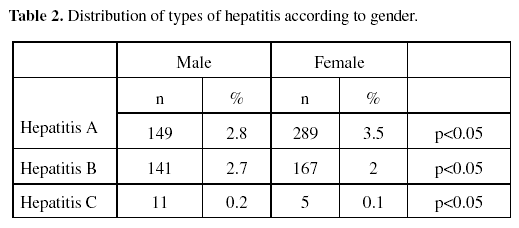
<body><![CDATA[<p><font face="Verdana" size="2"><a href="#t2">Table 2</a> shows the distribution of types of hepatitis according to gender. Hepatitis A was observed more frequently among females with a percentage of 3.5% (n=289) and the result was statistically significant  (p&lt;0.05). Hepatitis B and C were found more frequently among males with percentages of 2.7% and 0.2% respectively and the result was statistically significant (p&lt;0.05). </font></p>     <p align="center"><font face="Verdana" size="2"><a name="t2"><img border="0" src="/img/revistas/medicorpa/v11n1/07i.ht27.gif" width="519" height="228"></a> </font></p>     <p align="center">&nbsp;</p>     <p><font face="Verdana" size="2">In <a href="#t3"> Table 3</a>, it can be observed that 3.3% of the patients with hepatitis C was alcoholic. A statistically significant correlation was found between alcohol usage and presence of hepatitis C (p&lt;0.0001). </font> </p>     <p align="center"><font face="Verdana" size="2"><a name="t3"><img border="0" src="/img/revistas/medicorpa/v11n1/07i.ht28.gif" width="611" height="239"></a> </font></p> <font FACE="Verdana" SIZE="2">     <p></p> </font>     <p><b><font face="Verdana">Discussion</font></b></p>     <p><font face="Verdana" size="2"> Hepatitis is a world-wide problem. There are five million new cases every year (4). Chandler et al. (4) evaluated 716 dental patients  according to their medical histories and found the prevalence of hepatitis as 3.7% in Spain. Jainkittiwong et al. (5) found the prevalence of infectious diseases as 1.2% in 510 elderly who were interviewed for their medical histories in Thailand. In the present study the prevalence of the patients who had a history of hepatitis was 7.8%. Since Turkey is a developing country and an area of intermediate endemicity, the prevalence of hepatitis is high.</font>  </p>     <p><font face="Verdana" size="2"> Hepatitis A virus (HAV), being an enteric transmitting virus world wide, occurs mostly in developing countries (6). Carrilho et al. (7) stated that, the prevalence of hepatitis A varies greatly in different Brazilian regions, from 56% to 93% in Brazil. Radhakrishnan et al. (8) studied in 381 patients who were tested for agents HAV IgM in south India and detected that the prevalence of HAV as 13.3%. Junquera et al. (9) found the overall prevalence of HAV infection was 41.5% in Madrid by determining anti-HAV antibodies. Battikhi et al. (10) determined the seroepidemiology of Hepatitis A virus as 16.4% in Amman. According to Chandler et al. (4), the percent of the patients with hepatitis A was 1.11% in dental patients according to their medical history. In Turkey, previous seroepidemiologic studies showed that the frequency of this infection varies due to socio-economic differences in various regions as follows: 44.6% in Manisa (6), 43.2% in Edirne (11), 67.8% and 25.8% in Konya (12), 44.4% and 68.8 % in Duzce (13). In the present study, hepatitis A (3.2%) was the most common type compared to the other types of hepatitis. Since HAV infection is most frequently encountered in adolescents and young adults, applying the HAV vaccination in early childhood would be beneficial to decrease the prevalence of the infection and prevent HAV epidemics.</font> </p>    <p><font face="Verdana" size="2"> Hepatitis B virus (HBV) infection is a global health problem, with an estimated 400 million being chronic carriers of the virus (1). In Turkey, the most common transmission route of HBV was blood contact, following recent surgery, dental treatment, tooth extraction or body piercing and heterosexual transmission (14). The prevalence of HBV was determined as 1.5% in West Turkey (15). Leblebicio&#287;lu et al. (14) stated that HBV carriage was estimated as 6% in western parts of Turkey, rising to 12.5-14.3% in eastern and southeastern Turkey according to the serologic markers. A previous self-reporting study showed that the percentage of the dental patients who were HBV carriers was 1.53% in Spain (4). According to the findings of the present study, hepatitis B carriers constituted 0.8% of the total patients. Since the disease can be asymptomatic, most people are not even aware that they have had this disease in the past. Since acute HBV infection poses a significant health problem in Turkey, dentists should be aware of the medical risk of the hepatitis B infection. The Turkish government implemented a universal HBV immunisation programme in 2000 (16), and it is hoped that routine vaccination may protect adults from acute HBV infection.</font> </p>     ]]></body>
<body><![CDATA[<p><font face="Verdana" size="2"> In West Turkey, the prevalence of hepatitis C virus (HCV) infection was determined as 0.19% according to the serologic markers (15). Hepatitis C virus (HCV) infection has an estimated prevalence of 3% around the world. Unfortunately, many persons with HCV infection are asymptomatic (17). Blood transfusion is the main cause of infection (2). Previous seroepidemiologic studies showed that the prevalence of HCV in blood donors was 0.1% in Northern Europe (18), 1.47% in Mexico (19), 1.2 % in France (20) and 0.64% in Italy (21). In the present study, the frequency of the patients who had a history of hepatitis C was found as 0.1%. This finding is close to the percentages obtained in the previous studies.</font> </p>     <p><font face="Verdana" size="2"> It is known that patients with multiple sexual partners like male homosexuals, intravenous drug users have a high incidence of hepatitis B (2). Intravenous drug users has also accounted for a substantial portion of HCV infections (22). Sexual exposures among patients with chronic hepatitis C, may account for 10% to 20% of HCV transmissions (23). Although Battikhi et al. (10) did not found significant sex variation among the patient with hepatitis A, in the present study, a male predominance was found in terms of hepatitis B and C infection. One explanation of this result may be the fact that males are presumably more sexually active compared to females in our country due to some cultural limitations.</font>  </p>    <p><font face="Verdana" size="2"> It is an important point that hepatitis C virus (HCV) and human immunodeficiency virus (HIV) frequently co-exist due to shared routes of transmission (24-26). The World Health Organization (WHO) has estimated that there were 30.6 million cases of HIV/AIDS (5). Coulter et al. (24) concluded that, in spite of high rate of oral disease in persons with HIV, many do not use dental care regularly. Chandler et al. (4) stated that 1.53% of the dental patients were infected by HIV. In the present study, there were no HIV-infected adults. Patients with HIV, are monitored by the infection clinics of medicine, in case they need dental treatment, they are forwarded to a dental faculty which is in the same campus. Therefore, the possibility of the referral of a patient with HIV to our faculty is very low due to independent localization.</font> </p>     <p><font face="Verdana" size="2"> When skin is inadvertently punctured with instruments or needles, it is important to wash the wound thoroughly. Whenever feasible, the patients hepatitis surface antigen status should be determined. If parenteral exposure to blood that is HBsAg-positive has occurred, the dentist should receive hepatitis B immune globulin (2). Taking a thorough medical history is very important to identify patients who are potentially infectious. Because dentists are exposed to the blood and oral secretions of patients, they are particularly at risk for contacting hepatitis (2). A strict sterilization procedure is mandatory to prevent the transmission. With inadequate sterilization, the dentist and other patients can be infected with hepatitis, therefore adequate measures should definitely be taken.</font></p>     <p>&nbsp;</p>     <p><b><font face="Verdana">References</font></b></p>     <!-- ref --><p> <font face="Verdana" size="2"> 1. Lee WM. Hepatitis B virus infection. N Engl J Med 1997; 337:1733-45.</font> &nbsp;&nbsp;&nbsp;&nbsp;&nbsp;&nbsp;&nbsp;&nbsp;[&#160;<a href="javascript:void(0);" onclick="javascript: window.open('/scielo.php?script=sci_nlinks&ref=2959347&pid=S1698-6946200600010000700001&lng=','','width=640,height=500,resizable=yes,scrollbars=1,menubar=yes,');">Links</a>&#160;]<!-- end-ref --><!-- ref --><p> <font face="Verdana" size="2"> 2. Sonis ST, Fazio RC, Fang L, editors. Principles and Practice of Oral Medicine. Philadelphia: WB Saunders; 1995. p. 131-45.</font>  &nbsp;&nbsp;&nbsp;&nbsp;&nbsp;&nbsp;&nbsp;&nbsp;[&#160;<a href="javascript:void(0);" onclick="javascript: window.open('/scielo.php?script=sci_nlinks&ref=2959348&pid=S1698-6946200600010000700002&lng=','','width=640,height=500,resizable=yes,scrollbars=1,menubar=yes,');">Links</a>&#160;]<!-- end-ref --><!-- ref --><p> <font face="Verdana" size="2"> 3. Custer B, Sullivan SD, Hazlet TK, Iloeje U, Veenstra DL, Kowdley KV. Global epidemiology of hepatitis B virus. J Clin Gastroenterol 2004;38:158-68.</font> &nbsp;&nbsp;&nbsp;&nbsp;&nbsp;&nbsp;&nbsp;&nbsp;[&#160;<a href="javascript:void(0);" onclick="javascript: window.open('/scielo.php?script=sci_nlinks&ref=2959349&pid=S1698-6946200600010000700003&lng=','','width=640,height=500,resizable=yes,scrollbars=1,menubar=yes,');">Links</a>&#160;]<!-- end-ref --><!-- ref --><p> <font face="Verdana" size="2"> 4. Chandler-Gutierrez L, Martinez-Sahuquillo A, Bullon-Fernandez P. Evaluation of medical risk in dental practice through using the EMRRH questionnaire. Med Oral 2004; 9: 309-20.</font> &nbsp;&nbsp;&nbsp;&nbsp;&nbsp;&nbsp;&nbsp;&nbsp;[&#160;<a href="javascript:void(0);" onclick="javascript: window.open('/scielo.php?script=sci_nlinks&ref=2959350&pid=S1698-6946200600010000700004&lng=','','width=640,height=500,resizable=yes,scrollbars=1,menubar=yes,');">Links</a>&#160;]<!-- end-ref --><!-- ref --><p> <font face="Verdana" size="2"> 5. Jainkittivong A, Aneksuk V, Langlais RP. Medical health and medication use in elderly dental patients. J Contemp Dent Pract 2004;5:31-41.</font> &nbsp;&nbsp;&nbsp;&nbsp;&nbsp;&nbsp;&nbsp;&nbsp;[&#160;<a href="javascript:void(0);" onclick="javascript: window.open('/scielo.php?script=sci_nlinks&ref=2959351&pid=S1698-6946200600010000700005&lng=','','width=640,height=500,resizable=yes,scrollbars=1,menubar=yes,');">Links</a>&#160;]<!-- end-ref --><!-- ref --><p> <font face="Verdana" size="2"> 6. Tosun S, Ertan P, Kasirga E, Atman U.Changes in seroprevalence of hepatitis A in children and adolescents in Manisa, Turkey. Pediatr Int 2004;46:669-72.</font> &nbsp;&nbsp;&nbsp;&nbsp;&nbsp;&nbsp;&nbsp;&nbsp;[&#160;<a href="javascript:void(0);" onclick="javascript: window.open('/scielo.php?script=sci_nlinks&ref=2959352&pid=S1698-6946200600010000700006&lng=','','width=640,height=500,resizable=yes,scrollbars=1,menubar=yes,');">Links</a>&#160;]<!-- end-ref --><!-- ref --><p> <font face="Verdana" size="2"> 7. Carrilho FJ, Mendes Clemente C, Silva LC. Epidemiology of hepatitis A and E virus infection in Brazil. Gastroenterol Hepatol 2005; 28: 118-25.</font> &nbsp;&nbsp;&nbsp;&nbsp;&nbsp;&nbsp;&nbsp;&nbsp;[&#160;<a href="javascript:void(0);" onclick="javascript: window.open('/scielo.php?script=sci_nlinks&ref=2959353&pid=S1698-6946200600010000700007&lng=','','width=640,height=500,resizable=yes,scrollbars=1,menubar=yes,');">Links</a>&#160;]<!-- end-ref --><!-- ref --><p> <font face="Verdana" size="2"> 8. Radhakrishnan S, Raghuraman S, Abraham P, Kurian G, Chandy G, Sridharan G. Prevalence of enterically transmitted hepatitis viruses in patients attending a tertiary-care hospital in south India. Indian J Pathol Microbiol 2000;43 433-6.</font> &nbsp;&nbsp;&nbsp;&nbsp;&nbsp;&nbsp;&nbsp;&nbsp;[&#160;<a href="javascript:void(0);" onclick="javascript: window.open('/scielo.php?script=sci_nlinks&ref=2959354&pid=S1698-6946200600010000700008&lng=','','width=640,height=500,resizable=yes,scrollbars=1,menubar=yes,');">Links</a>&#160;]<!-- end-ref --><!-- ref --><p> <font face="Verdana" size="2"> 9.Junquera S, Mateos M, Lasa E, Chacon J, Baquero F. Seroepidemiologic study of hepatitis A in the community of Madrid during the year 2002. Enferm Infec Microbiol Clin 2004;22: 448-51.</font> &nbsp;&nbsp;&nbsp;&nbsp;&nbsp;&nbsp;&nbsp;&nbsp;[&#160;<a href="javascript:void(0);" onclick="javascript: window.open('/scielo.php?script=sci_nlinks&ref=2959355&pid=S1698-6946200600010000700009&lng=','','width=640,height=500,resizable=yes,scrollbars=1,menubar=yes,');">Links</a>&#160;]<!-- end-ref --><!-- ref --><p> <font face="Verdana" size="2"> 10. Battikhi MN, Battikhi EG. The seroepidemiology of Hepatitis A virus in Amman, Jordan. New Microbiol 2004;27: 215-20.</font> &nbsp;&nbsp;&nbsp;&nbsp;&nbsp;&nbsp;&nbsp;&nbsp;[&#160;<a href="javascript:void(0);" onclick="javascript: window.open('/scielo.php?script=sci_nlinks&ref=2959356&pid=S1698-6946200600010000700010&lng=','','width=640,height=500,resizable=yes,scrollbars=1,menubar=yes,');">Links</a>&#160;]<!-- end-ref --><!-- ref --><p> <font face="Verdana" size="2"> 11. Erdogan MS, Otkun M, Tatman-Otkun M, Akata F, Ture M. The epidemiology of hepatitis a virus infection in children, in Edirne, Turkey. Eur J Epidemiol 2004;19:267-73.</font> &nbsp;&nbsp;&nbsp;&nbsp;&nbsp;&nbsp;&nbsp;&nbsp;[&#160;<a href="javascript:void(0);" onclick="javascript: window.open('/scielo.php?script=sci_nlinks&ref=2959357&pid=S1698-6946200600010000700011&lng=','','width=640,height=500,resizable=yes,scrollbars=1,menubar=yes,');">Links</a>&#160;]<!-- end-ref --><!-- ref --><p> <font face="Verdana" size="2"> 12. Atabek ME, Fyndyk D, Gulyuz A, Erkul I. Prevalence of anti-HAV and anti-HEV antibodies in Konya, Turkey. Health Policy 2004;67:265-9.</font> &nbsp;&nbsp;&nbsp;&nbsp;&nbsp;&nbsp;&nbsp;&nbsp;[&#160;<a href="javascript:void(0);" onclick="javascript: window.open('/scielo.php?script=sci_nlinks&ref=2959358&pid=S1698-6946200600010000700012&lng=','','width=640,height=500,resizable=yes,scrollbars=1,menubar=yes,');">Links</a>&#160;]<!-- end-ref --><!-- ref --><p> <font face="Verdana" size="2"> 13. Sencan I, Sahin I, Kaya D, Oksuz S, Yildirim M. Assessment of HAV and HEV seroprevalence in children living in post-earthquake  camps from Duzce, Turkey. Eur J Epidemiol 2004;19:461-5.</font> &nbsp;&nbsp;&nbsp;&nbsp;&nbsp;&nbsp;&nbsp;&nbsp;[&#160;<a href="javascript:void(0);" onclick="javascript: window.open('/scielo.php?script=sci_nlinks&ref=2959359&pid=S1698-6946200600010000700013&lng=','','width=640,height=500,resizable=yes,scrollbars=1,menubar=yes,');">Links</a>&#160;]<!-- end-ref --><!-- ref --><p> <font face="Verdana" size="2"> 14. Leblebicioglu H, Eroglu C; Members of the Hepatitis Study Group. Acute hepatitis B virus infection in Turkey: epidemiology and genotype distribution. Clin Microbiol Infect 2004;10:537-41.</font> &nbsp;&nbsp;&nbsp;&nbsp;&nbsp;&nbsp;&nbsp;&nbsp;[&#160;<a href="javascript:void(0);" onclick="javascript: window.open('/scielo.php?script=sci_nlinks&ref=2959360&pid=S1698-6946200600010000700014&lng=','','width=640,height=500,resizable=yes,scrollbars=1,menubar=yes,');">Links</a>&#160;]<!-- end-ref --><!-- ref --><p> <font face="Verdana" size="2"> 15. Sakarya S, Oncu S, Ozturk B, Oncu S. Effect of preventive applications on prevalence of hepatitis B virus and hepatitis C virus infections in West Turkey. Saudi Med J 2004;25: 1070-2.</font> &nbsp;&nbsp;&nbsp;&nbsp;&nbsp;&nbsp;&nbsp;&nbsp;[&#160;<a href="javascript:void(0);" onclick="javascript: window.open('/scielo.php?script=sci_nlinks&ref=2959361&pid=S1698-6946200600010000700015&lng=','','width=640,height=500,resizable=yes,scrollbars=1,menubar=yes,');">Links</a>&#160;]<!-- end-ref --><!-- ref --><p> <font face="Verdana" size="2"> 16. Van Damme P. Hepatitis B: vaccination programmes in Europe-an update. Vaccine 2001;19:2375-9.</font>  &nbsp;&nbsp;&nbsp;&nbsp;&nbsp;&nbsp;&nbsp;&nbsp;[&#160;<a href="javascript:void(0);" onclick="javascript: window.open('/scielo.php?script=sci_nlinks&ref=2959362&pid=S1698-6946200600010000700016&lng=','','width=640,height=500,resizable=yes,scrollbars=1,menubar=yes,');">Links</a>&#160;]<!-- end-ref --><!-- ref --><p> <font face="Verdana" size="2"> 17. Mendez-Sanchez N, Ponciano-Rodriguez G, Chavez-Tapia NC, Motola-Kuba D, Almeda-Valdes P, Sanchez-Lara K, et al. Prevalence of hepatitis C infection in a population of asymptomatic people in a checkup unit in Mexico city. Dig Dis Sci 2005;50:733-7.</font> &nbsp;&nbsp;&nbsp;&nbsp;&nbsp;&nbsp;&nbsp;&nbsp;[&#160;<a href="javascript:void(0);" onclick="javascript: window.open('/scielo.php?script=sci_nlinks&ref=2959363&pid=S1698-6946200600010000700017&lng=','','width=640,height=500,resizable=yes,scrollbars=1,menubar=yes,');">Links</a>&#160;]<!-- end-ref --><!-- ref --><p> <font face="Verdana" size="2"> 18. Diz Dios P , Lodi G, Vásquez Garcia E, Porter S. El Virus de la hepatitis C. Implicaciones en odontologia. Med Oral 1997;2:209-18.</font> &nbsp;&nbsp;&nbsp;&nbsp;&nbsp;&nbsp;&nbsp;&nbsp;[&#160;<a href="javascript:void(0);" onclick="javascript: window.open('/scielo.php?script=sci_nlinks&ref=2959364&pid=S1698-6946200600010000700018&lng=','','width=640,height=500,resizable=yes,scrollbars=1,menubar=yes,');">Links</a>&#160;]<!-- end-ref --><!-- ref --><p> <font face="Verdana" size="2"> 19. Rivera-Lopez MR, Zavala-Mendez C, Arenas-Esqueda A. Prevalence for seropositivity for HIV, hepatitis B and hepatitis C in blood donors. Gac Med Mex 2004;140:657-60.</font> &nbsp;&nbsp;&nbsp;&nbsp;&nbsp;&nbsp;&nbsp;&nbsp;[&#160;<a href="javascript:void(0);" onclick="javascript: window.open('/scielo.php?script=sci_nlinks&ref=2959365&pid=S1698-6946200600010000700019&lng=','','width=640,height=500,resizable=yes,scrollbars=1,menubar=yes,');">Links</a>&#160;]<!-- end-ref --><!-- ref --><p> <font face="Verdana" size="2"> 20. Bellissima P, Bonfante S, Petralia A, Liardo A, Pulvirenti L, Romeo G. Prevalence of hepatitis C virus infection in different groups of selected populations. Infez Med 1996;4:143-5.</font> &nbsp;&nbsp;&nbsp;&nbsp;&nbsp;&nbsp;&nbsp;&nbsp;[&#160;<a href="javascript:void(0);" onclick="javascript: window.open('/scielo.php?script=sci_nlinks&ref=2959366&pid=S1698-6946200600010000700020&lng=','','width=640,height=500,resizable=yes,scrollbars=1,menubar=yes,');">Links</a>&#160;]<!-- end-ref --><!-- ref --><p> <font face="Verdana" size="2"> 21. Alter MJ. The epidemiology of acute and chronic hepatitis C. Clin Liver Dis 1997;1:559-68.</font> &nbsp;&nbsp;&nbsp;&nbsp;&nbsp;&nbsp;&nbsp;&nbsp;[&#160;<a href="javascript:void(0);" onclick="javascript: window.open('/scielo.php?script=sci_nlinks&ref=2959367&pid=S1698-6946200600010000700021&lng=','','width=640,height=500,resizable=yes,scrollbars=1,menubar=yes,');">Links</a>&#160;]<!-- end-ref --><!-- ref --><p> <font face="Verdana" size="2"> 22. Montella M, Crispo A, Grimaldi M, Angeletti C, Amore A, Ronga D, et al. Prevalence of hepatitis C virus infection in different population groups in southern Italy. Infection 2005; 33:103.</font> &nbsp;&nbsp;&nbsp;&nbsp;&nbsp;&nbsp;&nbsp;&nbsp;[&#160;<a href="javascript:void(0);" onclick="javascript: window.open('/scielo.php?script=sci_nlinks&ref=2959368&pid=S1698-6946200600010000700022&lng=','','width=640,height=500,resizable=yes,scrollbars=1,menubar=yes,');">Links</a>&#160;]<!-- end-ref --><!-- ref --><p> <font face="Verdana" size="2"> 23. Dieterich DT, Kontorinis N, Agarwal K.HIV/HCV co infection in clinical practice. J Int Assoc Physicians AIDS Care 2004;31: 4-14.</font> &nbsp;&nbsp;&nbsp;&nbsp;&nbsp;&nbsp;&nbsp;&nbsp;[&#160;<a href="javascript:void(0);" onclick="javascript: window.open('/scielo.php?script=sci_nlinks&ref=2959369&pid=S1698-6946200600010000700023&lng=','','width=640,height=500,resizable=yes,scrollbars=1,menubar=yes,');">Links</a>&#160;]<!-- end-ref --><!-- ref --><p> <font face="Verdana" size="2"> 24. Coulter ID, Marcus M, Freed JR, Der-Martirosian C, Cunningham WE, Andersen RM, et al. Use of dental care by HIV-infected medical patients. J Dent Res 2000;79: 1356-61.</font> &nbsp;&nbsp;&nbsp;&nbsp;&nbsp;&nbsp;&nbsp;&nbsp;[&#160;<a href="javascript:void(0);" onclick="javascript: window.open('/scielo.php?script=sci_nlinks&ref=2959370&pid=S1698-6946200600010000700024&lng=','','width=640,height=500,resizable=yes,scrollbars=1,menubar=yes,');">Links</a>&#160;]<!-- end-ref --><!-- ref --><p> <font face="Verdana" size="2"> 25. Babudieri S, Longo B, Sarmati L, Starnini G, Dori L, Suligoi B, et al. Correlates of HIV, HBV, and HCV infections in a prison inmate  population: Results from a multicentre study in Italy. J Med Virol 2005; 76:311-7.</font> &nbsp;&nbsp;&nbsp;&nbsp;&nbsp;&nbsp;&nbsp;&nbsp;[&#160;<a href="javascript:void(0);" onclick="javascript: window.open('/scielo.php?script=sci_nlinks&ref=2959371&pid=S1698-6946200600010000700025&lng=','','width=640,height=500,resizable=yes,scrollbars=1,menubar=yes,');">Links</a>&#160;]<!-- end-ref --><!-- ref --><p> <font face="Verdana" size="2"> 26. Mendes-Correa MC, Barone AA. Hepatitis C in patients co-infected with human immunodeficiency virus. A review and experience of a Brazilian ambulatory. Rev Inst Med Trop Sao Paulo 2005;47:59-64.</font> &nbsp;&nbsp;&nbsp;&nbsp;&nbsp;&nbsp;&nbsp;&nbsp;[&#160;<a href="javascript:void(0);" onclick="javascript: window.open('/scielo.php?script=sci_nlinks&ref=2959372&pid=S1698-6946200600010000700026&lng=','','width=640,height=500,resizable=yes,scrollbars=1,menubar=yes,');">Links</a>&#160;]<!-- end-ref --><p>&nbsp; </p>     <p>&nbsp; </p>     <p><b><font size="2"><a href="#top"><font face="Verdana"><img border="0" src="/img/revistas/medicorpa/v11n1/seta.gif" width="15" height="17"></font></a> <font face="Verdana"> <a name="down">Correspondence</a></font></font></b><font face="Verdana" size="2">    <br> Dilhan&#304;lgüy    <br> Yeditepe Üniversitesi Di&#351;Hekimli&#287;i Fakültesi Ba &#287;dat cad. No 238    <br> 34728 Göztepe-&#304;STANBUL    <br> TURKIYE    <br> Fax : +90 216 3636211    ]]></body>
<body><![CDATA[<br> E-mail: <a href="mailto:ilguy@yeditepe.edu.tr">ilguy@yeditepe.edu.tr</a></font> </p>     <p><font face="Verdana" size="2">Received: 9-03-2005    <br> Accepted: 22-06-2005</font></p>      ]]></body><back>
<ref-list>
<ref id="B1">
<label>1</label><nlm-citation citation-type="journal">
<person-group person-group-type="author">
<name>
<surname><![CDATA[Lee]]></surname>
<given-names><![CDATA[WM]]></given-names>
</name>
</person-group>
<article-title xml:lang="en"><![CDATA[Hepatitis B virus infection]]></article-title>
<source><![CDATA[N Engl J Med]]></source>
<year>1997</year>
<volume>337</volume>
<page-range>1733-45</page-range></nlm-citation>
</ref>
<ref id="B2">
<label>2</label><nlm-citation citation-type="book">
<person-group person-group-type="author">
<name>
<surname><![CDATA[Sonis]]></surname>
<given-names><![CDATA[ST]]></given-names>
</name>
<name>
<surname><![CDATA[Fazio]]></surname>
<given-names><![CDATA[RC]]></given-names>
</name>
<name>
<surname><![CDATA[Fang]]></surname>
<given-names><![CDATA[L]]></given-names>
</name>
</person-group>
<source><![CDATA[Principles and Practice of Oral Medicine]]></source>
<year>1995</year>
<publisher-loc><![CDATA[Philadelphia ]]></publisher-loc>
<publisher-name><![CDATA[WB Saunders]]></publisher-name>
</nlm-citation>
</ref>
<ref id="B3">
<label>3</label><nlm-citation citation-type="journal">
<person-group person-group-type="author">
<name>
<surname><![CDATA[Custer]]></surname>
<given-names><![CDATA[B]]></given-names>
</name>
<name>
<surname><![CDATA[Sullivan]]></surname>
<given-names><![CDATA[SD]]></given-names>
</name>
<name>
<surname><![CDATA[Hazlet]]></surname>
<given-names><![CDATA[TK]]></given-names>
</name>
<name>
<surname><![CDATA[Iloeje]]></surname>
<given-names><![CDATA[U]]></given-names>
</name>
<name>
<surname><![CDATA[Veenstra]]></surname>
<given-names><![CDATA[DL]]></given-names>
</name>
<name>
<surname><![CDATA[Kowdley]]></surname>
<given-names><![CDATA[KV]]></given-names>
</name>
</person-group>
<article-title xml:lang="en"><![CDATA[Global epidemiology of hepatitis B virus]]></article-title>
<source><![CDATA[J Clin Gastroenterol]]></source>
<year>2004</year>
<volume>38</volume>
<page-range>158-68</page-range></nlm-citation>
</ref>
<ref id="B4">
<label>4</label><nlm-citation citation-type="journal">
<person-group person-group-type="author">
<name>
<surname><![CDATA[Chandler-Gutierrez]]></surname>
<given-names><![CDATA[L]]></given-names>
</name>
<name>
<surname><![CDATA[Martinez-Sahuquillo]]></surname>
<given-names><![CDATA[A]]></given-names>
</name>
<name>
<surname><![CDATA[Bullon-Fernandez]]></surname>
<given-names><![CDATA[P]]></given-names>
</name>
</person-group>
<article-title xml:lang="en"><![CDATA[Evaluation of medical risk in dental practice through using the EMRRH questionnaire]]></article-title>
<source><![CDATA[Med Oral]]></source>
<year>2004</year>
<volume>9</volume>
<page-range>309-20</page-range></nlm-citation>
</ref>
<ref id="B5">
<label>5</label><nlm-citation citation-type="journal">
<person-group person-group-type="author">
<name>
<surname><![CDATA[Jainkittivong]]></surname>
<given-names><![CDATA[A]]></given-names>
</name>
<name>
<surname><![CDATA[Aneksuk]]></surname>
<given-names><![CDATA[V]]></given-names>
</name>
<name>
<surname><![CDATA[Langlais]]></surname>
<given-names><![CDATA[RP]]></given-names>
</name>
</person-group>
<article-title xml:lang="en"><![CDATA[Medical health and medication use in elderly dental patients]]></article-title>
<source><![CDATA[J Contemp Dent Pract]]></source>
<year>2004</year>
<volume>5</volume>
<page-range>31-41</page-range></nlm-citation>
</ref>
<ref id="B6">
<label>6</label><nlm-citation citation-type="journal">
<person-group person-group-type="author">
<name>
<surname><![CDATA[Tosun]]></surname>
<given-names><![CDATA[S]]></given-names>
</name>
<name>
<surname><![CDATA[Ertan]]></surname>
<given-names><![CDATA[P]]></given-names>
</name>
<name>
<surname><![CDATA[Kasirga]]></surname>
<given-names><![CDATA[E]]></given-names>
</name>
<name>
<surname><![CDATA[Atman]]></surname>
<given-names><![CDATA[U]]></given-names>
</name>
</person-group>
<article-title xml:lang="en"><![CDATA[Changes in seroprevalence of hepatitis A in children and adolescents in Manisa, Turkey]]></article-title>
<source><![CDATA[Pediatr Int]]></source>
<year>2004</year>
<volume>46</volume>
<page-range>669-72</page-range></nlm-citation>
</ref>
<ref id="B7">
<label>7</label><nlm-citation citation-type="journal">
<person-group person-group-type="author">
<name>
<surname><![CDATA[Carrilho]]></surname>
<given-names><![CDATA[FJ]]></given-names>
</name>
<name>
<surname><![CDATA[Mendes]]></surname>
<given-names><![CDATA[Clemente C]]></given-names>
</name>
<name>
<surname><![CDATA[Silva]]></surname>
<given-names><![CDATA[LC]]></given-names>
</name>
</person-group>
<article-title xml:lang="en"><![CDATA[Epidemiology of hepatitis A and E virus infection in Brazil]]></article-title>
<source><![CDATA[Gastroenterol Hepatol]]></source>
<year>2005</year>
<volume>28</volume>
<page-range>118-25</page-range></nlm-citation>
</ref>
<ref id="B8">
<label>8</label><nlm-citation citation-type="journal">
<person-group person-group-type="author">
<name>
<surname><![CDATA[Radhakrishnan]]></surname>
<given-names><![CDATA[S]]></given-names>
</name>
<name>
<surname><![CDATA[Raghuraman]]></surname>
<given-names><![CDATA[S]]></given-names>
</name>
<name>
<surname><![CDATA[Abraham]]></surname>
<given-names><![CDATA[P]]></given-names>
</name>
<name>
<surname><![CDATA[Kurian]]></surname>
<given-names><![CDATA[G]]></given-names>
</name>
<name>
<surname><![CDATA[Chandy]]></surname>
<given-names><![CDATA[G]]></given-names>
</name>
<name>
<surname><![CDATA[Sridharan]]></surname>
<given-names><![CDATA[G]]></given-names>
</name>
</person-group>
<article-title xml:lang="en"><![CDATA[Prevalence of enterically transmitted hepatitis viruses in patients attending a tertiary-care hospital in south India]]></article-title>
<source><![CDATA[Indian J Pathol Microbiol]]></source>
<year>2000</year>
<volume>43</volume>
<page-range>433-6</page-range></nlm-citation>
</ref>
<ref id="B9">
<label>9</label><nlm-citation citation-type="journal">
<person-group person-group-type="author">
<name>
<surname><![CDATA[Junquera]]></surname>
<given-names><![CDATA[S]]></given-names>
</name>
<name>
<surname><![CDATA[Mateos]]></surname>
<given-names><![CDATA[M]]></given-names>
</name>
<name>
<surname><![CDATA[Lasa]]></surname>
<given-names><![CDATA[E]]></given-names>
</name>
<name>
<surname><![CDATA[Chacon]]></surname>
<given-names><![CDATA[J]]></given-names>
</name>
<name>
<surname><![CDATA[Baquero]]></surname>
<given-names><![CDATA[F]]></given-names>
</name>
</person-group>
<article-title xml:lang="en"><![CDATA[Seroepidemiologic study of hepatitis A in the community of Madrid during the year 2002]]></article-title>
<source><![CDATA[Enferm Infec Microbiol Clin]]></source>
<year>2004</year>
<volume>22</volume>
<page-range>448-51</page-range></nlm-citation>
</ref>
<ref id="B10">
<label>10</label><nlm-citation citation-type="journal">
<person-group person-group-type="author">
<name>
<surname><![CDATA[Battikhi]]></surname>
<given-names><![CDATA[MN]]></given-names>
</name>
<name>
<surname><![CDATA[Battikhi]]></surname>
<given-names><![CDATA[EG]]></given-names>
</name>
</person-group>
<article-title xml:lang="en"><![CDATA[The seroepidemiology of Hepatitis A virus in Amman, Jordan]]></article-title>
<source><![CDATA[New Microbiol]]></source>
<year>2004</year>
<volume>27</volume>
<page-range>215-20</page-range></nlm-citation>
</ref>
<ref id="B11">
<label>11</label><nlm-citation citation-type="journal">
<person-group person-group-type="author">
<name>
<surname><![CDATA[Erdogan]]></surname>
<given-names><![CDATA[MS]]></given-names>
</name>
<name>
<surname><![CDATA[Otkun]]></surname>
<given-names><![CDATA[M]]></given-names>
</name>
<name>
<surname><![CDATA[Tatman-Otkun]]></surname>
<given-names><![CDATA[M]]></given-names>
</name>
<name>
<surname><![CDATA[Akata]]></surname>
<given-names><![CDATA[F]]></given-names>
</name>
<name>
<surname><![CDATA[Ture]]></surname>
<given-names><![CDATA[M]]></given-names>
</name>
</person-group>
<article-title xml:lang="en"><![CDATA[The epidemiology of hepatitis a virus infection in children, in Edirne, Turkey]]></article-title>
<source><![CDATA[Eur J Epidemiol]]></source>
<year>2004</year>
<volume>19</volume>
<page-range>267-73</page-range></nlm-citation>
</ref>
<ref id="B12">
<label>12</label><nlm-citation citation-type="journal">
<person-group person-group-type="author">
<name>
<surname><![CDATA[Atabek]]></surname>
<given-names><![CDATA[ME]]></given-names>
</name>
<name>
<surname><![CDATA[Fyndyk]]></surname>
<given-names><![CDATA[D]]></given-names>
</name>
<name>
<surname><![CDATA[Gulyuz]]></surname>
<given-names><![CDATA[A]]></given-names>
</name>
<name>
<surname><![CDATA[Erkul]]></surname>
<given-names><![CDATA[I]]></given-names>
</name>
</person-group>
<article-title xml:lang="en"><![CDATA[Prevalence of anti-HAV and anti-HEV antibodies in Konya, Turkey]]></article-title>
<source><![CDATA[Health Policy]]></source>
<year>2004</year>
<volume>67</volume>
<page-range>265-9</page-range></nlm-citation>
</ref>
<ref id="B13">
<label>13</label><nlm-citation citation-type="journal">
<person-group person-group-type="author">
<name>
<surname><![CDATA[Sencan]]></surname>
<given-names><![CDATA[I]]></given-names>
</name>
<name>
<surname><![CDATA[Sahin]]></surname>
<given-names><![CDATA[I]]></given-names>
</name>
<name>
<surname><![CDATA[Kaya]]></surname>
<given-names><![CDATA[D]]></given-names>
</name>
<name>
<surname><![CDATA[Oksuz]]></surname>
<given-names><![CDATA[S]]></given-names>
</name>
<name>
<surname><![CDATA[Yildirim]]></surname>
<given-names><![CDATA[M]]></given-names>
</name>
</person-group>
<article-title xml:lang="en"><![CDATA[Assessment of HAV and HEV seroprevalence in children living in post-earthquake camps from Duzce, Turkey]]></article-title>
<source><![CDATA[Eur J Epidemiol]]></source>
<year>2004</year>
<volume>19</volume>
<page-range>461-5</page-range></nlm-citation>
</ref>
<ref id="B14">
<label>14</label><nlm-citation citation-type="journal">
<person-group person-group-type="author">
<name>
<surname><![CDATA[Leblebicioglu]]></surname>
<given-names><![CDATA[H]]></given-names>
</name>
<name>
<surname><![CDATA[Eroglu]]></surname>
<given-names><![CDATA[C]]></given-names>
</name>
</person-group>
<collab>Hepatitis Study Group</collab>
<article-title xml:lang="en"><![CDATA[Acute hepatitis B virus infection in Turkey: epidemiology and genotype distribution]]></article-title>
<source><![CDATA[Clin Microbiol Infect]]></source>
<year>2004</year>
<volume>10</volume>
<page-range>537-41</page-range></nlm-citation>
</ref>
<ref id="B15">
<label>15</label><nlm-citation citation-type="journal">
<person-group person-group-type="author">
<name>
<surname><![CDATA[Sakarya]]></surname>
<given-names><![CDATA[S]]></given-names>
</name>
<name>
<surname><![CDATA[Oncu]]></surname>
<given-names><![CDATA[S]]></given-names>
</name>
<name>
<surname><![CDATA[Ozturk]]></surname>
<given-names><![CDATA[B]]></given-names>
</name>
<name>
<surname><![CDATA[Oncu]]></surname>
<given-names><![CDATA[S]]></given-names>
</name>
</person-group>
<article-title xml:lang="en"><![CDATA[Effect of preventive applications on prevalence of hepatitis B virus and hepatitis C virus infections in West Turkey]]></article-title>
<source><![CDATA[Saudi Med J]]></source>
<year>2004</year>
<volume>25</volume>
<page-range>1070-2</page-range></nlm-citation>
</ref>
<ref id="B16">
<label>16</label><nlm-citation citation-type="journal">
<person-group person-group-type="author">
<name>
<surname><![CDATA[Van Damme]]></surname>
<given-names><![CDATA[P]]></given-names>
</name>
</person-group>
<article-title xml:lang="en"><![CDATA[Hepatitis B: vaccination programmes in Europe-an update]]></article-title>
<source><![CDATA[Vaccine]]></source>
<year>2001</year>
<volume>19</volume>
<page-range>2375-9</page-range></nlm-citation>
</ref>
<ref id="B17">
<label>17</label><nlm-citation citation-type="journal">
<person-group person-group-type="author">
<name>
<surname><![CDATA[Mendez-Sanchez]]></surname>
<given-names><![CDATA[N]]></given-names>
</name>
<name>
<surname><![CDATA[Ponciano-Rodriguez]]></surname>
<given-names><![CDATA[G]]></given-names>
</name>
<name>
<surname><![CDATA[Chavez-Tapia]]></surname>
<given-names><![CDATA[NC]]></given-names>
</name>
<name>
<surname><![CDATA[Motola-Kuba]]></surname>
<given-names><![CDATA[D]]></given-names>
</name>
<name>
<surname><![CDATA[Almeda-Valdes]]></surname>
<given-names><![CDATA[P]]></given-names>
</name>
<name>
<surname><![CDATA[Sanchez-Lara]]></surname>
<given-names><![CDATA[K]]></given-names>
</name>
</person-group>
<article-title xml:lang="en"><![CDATA[Prevalence of hepatitis C infection in a population of asymptomatic people in a checkup unit in Mexico city]]></article-title>
<source><![CDATA[Dig Dis Sci]]></source>
<year>2005</year>
<volume>50</volume>
<page-range>733-7</page-range></nlm-citation>
</ref>
<ref id="B18">
<label>18</label><nlm-citation citation-type="journal">
<person-group person-group-type="author">
<name>
<surname><![CDATA[Diz Dios]]></surname>
<given-names><![CDATA[P]]></given-names>
</name>
<name>
<surname><![CDATA[Lodi]]></surname>
<given-names><![CDATA[G]]></given-names>
</name>
<name>
<surname><![CDATA[Vásquez Garcia]]></surname>
<given-names><![CDATA[E]]></given-names>
</name>
<name>
<surname><![CDATA[Porter]]></surname>
<given-names><![CDATA[S]]></given-names>
</name>
</person-group>
<article-title xml:lang="es"><![CDATA[El Virus de la hepatitis C: Implicaciones en odontologia]]></article-title>
<source><![CDATA[Med Oral]]></source>
<year>1997</year>
<volume>2</volume>
<page-range>209-18</page-range></nlm-citation>
</ref>
<ref id="B19">
<label>19</label><nlm-citation citation-type="journal">
<person-group person-group-type="author">
<name>
<surname><![CDATA[Rivera-Lopez]]></surname>
<given-names><![CDATA[MR]]></given-names>
</name>
<name>
<surname><![CDATA[Zavala-Mendez]]></surname>
<given-names><![CDATA[C]]></given-names>
</name>
<name>
<surname><![CDATA[Arenas-Esqueda]]></surname>
<given-names><![CDATA[A]]></given-names>
</name>
</person-group>
<article-title xml:lang="en"><![CDATA[Prevalence for seropositivity for HIV, hepatitis B and hepatitis C in blood donors]]></article-title>
<source><![CDATA[Gac Med Mex]]></source>
<year>2004</year>
<volume>140</volume>
<page-range>657-60</page-range></nlm-citation>
</ref>
<ref id="B20">
<label>20</label><nlm-citation citation-type="journal">
<person-group person-group-type="author">
<name>
<surname><![CDATA[Bellissima]]></surname>
<given-names><![CDATA[P]]></given-names>
</name>
<name>
<surname><![CDATA[Bonfante]]></surname>
<given-names><![CDATA[S]]></given-names>
</name>
<name>
<surname><![CDATA[Petralia]]></surname>
<given-names><![CDATA[A]]></given-names>
</name>
<name>
<surname><![CDATA[Liardo]]></surname>
<given-names><![CDATA[A]]></given-names>
</name>
<name>
<surname><![CDATA[Pulvirenti]]></surname>
<given-names><![CDATA[L]]></given-names>
</name>
<name>
<surname><![CDATA[Romeo]]></surname>
<given-names><![CDATA[G]]></given-names>
</name>
</person-group>
<article-title xml:lang="en"><![CDATA[Prevalence of hepatitis C virus infection in different groups of selected populations]]></article-title>
<source><![CDATA[Infez Med]]></source>
<year>1996</year>
<volume>4</volume>
<page-range>143-5</page-range></nlm-citation>
</ref>
<ref id="B21">
<label>21</label><nlm-citation citation-type="journal">
<person-group person-group-type="author">
<name>
<surname><![CDATA[Alter]]></surname>
<given-names><![CDATA[MJ]]></given-names>
</name>
</person-group>
<article-title xml:lang="en"><![CDATA[The epidemiology of acute and chronic hepatitis C]]></article-title>
<source><![CDATA[Clin Liver Dis]]></source>
<year>1997</year>
<volume>1</volume>
<page-range>559-68</page-range></nlm-citation>
</ref>
<ref id="B22">
<label>22</label><nlm-citation citation-type="journal">
<person-group person-group-type="author">
<name>
<surname><![CDATA[Montella]]></surname>
<given-names><![CDATA[M]]></given-names>
</name>
<name>
<surname><![CDATA[Crispo]]></surname>
<given-names><![CDATA[A]]></given-names>
</name>
<name>
<surname><![CDATA[Grimaldi]]></surname>
<given-names><![CDATA[M]]></given-names>
</name>
<name>
<surname><![CDATA[Angeletti]]></surname>
<given-names><![CDATA[C]]></given-names>
</name>
<name>
<surname><![CDATA[Amore]]></surname>
<given-names><![CDATA[A]]></given-names>
</name>
<name>
<surname><![CDATA[Ronga]]></surname>
<given-names><![CDATA[D]]></given-names>
</name>
</person-group>
<article-title xml:lang="en"><![CDATA[Prevalence of hepatitis C virus infection in different population groups in southern Italy]]></article-title>
<source><![CDATA[Infection]]></source>
<year>2005</year>
<volume>33</volume>
<page-range>103</page-range></nlm-citation>
</ref>
<ref id="B23">
<label>23</label><nlm-citation citation-type="journal">
<person-group person-group-type="author">
<name>
<surname><![CDATA[Dieterich]]></surname>
<given-names><![CDATA[DT]]></given-names>
</name>
<name>
<surname><![CDATA[Kontorinis]]></surname>
<given-names><![CDATA[N]]></given-names>
</name>
<name>
<surname><![CDATA[Agarwal]]></surname>
<given-names><![CDATA[K]]></given-names>
</name>
</person-group>
<article-title xml:lang="en"><![CDATA[HIV/HCV co infection in clinical practice]]></article-title>
<source><![CDATA[J Int Assoc Physicians AIDS Care]]></source>
<year>2004</year>
<volume>31</volume>
<page-range>4-14</page-range></nlm-citation>
</ref>
<ref id="B24">
<label>24</label><nlm-citation citation-type="journal">
<person-group person-group-type="author">
<name>
<surname><![CDATA[Coulter]]></surname>
<given-names><![CDATA[ID]]></given-names>
</name>
<name>
<surname><![CDATA[Marcus]]></surname>
<given-names><![CDATA[M]]></given-names>
</name>
<name>
<surname><![CDATA[Freed]]></surname>
<given-names><![CDATA[JR]]></given-names>
</name>
<name>
<surname><![CDATA[Der-Martirosian]]></surname>
<given-names><![CDATA[C]]></given-names>
</name>
<name>
<surname><![CDATA[Cunningham]]></surname>
<given-names><![CDATA[WE]]></given-names>
</name>
<name>
<surname><![CDATA[Andersen]]></surname>
<given-names><![CDATA[RM]]></given-names>
</name>
</person-group>
<article-title xml:lang="en"><![CDATA[Use of dental care by HIV-infected medical patients]]></article-title>
<source><![CDATA[J Dent Res]]></source>
<year>2000</year>
<volume>79</volume>
<page-range>1356-61</page-range></nlm-citation>
</ref>
<ref id="B25">
<label>25</label><nlm-citation citation-type="journal">
<person-group person-group-type="author">
<name>
<surname><![CDATA[Babudieri]]></surname>
<given-names><![CDATA[S]]></given-names>
</name>
<name>
<surname><![CDATA[Longo]]></surname>
<given-names><![CDATA[B]]></given-names>
</name>
<name>
<surname><![CDATA[Sarmati]]></surname>
<given-names><![CDATA[L]]></given-names>
</name>
<name>
<surname><![CDATA[Starnini]]></surname>
<given-names><![CDATA[G]]></given-names>
</name>
<name>
<surname><![CDATA[Dori]]></surname>
<given-names><![CDATA[L]]></given-names>
</name>
<name>
<surname><![CDATA[Suligoi]]></surname>
<given-names><![CDATA[B]]></given-names>
</name>
</person-group>
<article-title xml:lang="en"><![CDATA[Correlates of HIV, HBV, and HCV infections in a prison inmate population: Results from a multicentre study in Italy]]></article-title>
<source><![CDATA[J Med Virol]]></source>
<year>2005</year>
<volume>76</volume>
<page-range>311-7</page-range></nlm-citation>
</ref>
<ref id="B26">
<label>26</label><nlm-citation citation-type="journal">
<person-group person-group-type="author">
<name>
<surname><![CDATA[Mendes-Correa]]></surname>
<given-names><![CDATA[MC]]></given-names>
</name>
<name>
<surname><![CDATA[Barone]]></surname>
<given-names><![CDATA[AA]]></given-names>
</name>
</person-group>
<article-title xml:lang="en"><![CDATA[Hepatitis C in patients co-infected with human immunodeficiency virus: A review and experience of a Brazilian ambulatory]]></article-title>
<source><![CDATA[Rev Inst Med Trop Sao Paulo]]></source>
<year>2005</year>
<volume>47</volume>
<page-range>59-64</page-range></nlm-citation>
</ref>
</ref-list>
</back>
</article>