<?xml version="1.0" encoding="ISO-8859-1"?><article xmlns:mml="http://www.w3.org/1998/Math/MathML" xmlns:xlink="http://www.w3.org/1999/xlink" xmlns:xsi="http://www.w3.org/2001/XMLSchema-instance">
<front>
<journal-meta>
<journal-id>1698-6946</journal-id>
<journal-title><![CDATA[Medicina Oral, Patología Oral y Cirugía Bucal (Internet)]]></journal-title>
<abbrev-journal-title><![CDATA[Med. oral patol. oral cir.bucal (Internet)]]></abbrev-journal-title>
<issn>1698-6946</issn>
<publisher>
<publisher-name><![CDATA[Sociedad Española de Medicina Oral]]></publisher-name>
</publisher>
</journal-meta>
<article-meta>
<article-id>S1698-69462006000200007</article-id>
<title-group>
<article-title xml:lang="en"><![CDATA[Oral myiasis: A case report]]></article-title>
</title-group>
<contrib-group>
<contrib contrib-type="author">
<name>
<surname><![CDATA[Abdo]]></surname>
<given-names><![CDATA[Evandro Neves]]></given-names>
</name>
<xref ref-type="aff" rid="A01"/>
</contrib>
<contrib contrib-type="author">
<name>
<surname><![CDATA[Sette-Dias]]></surname>
<given-names><![CDATA[Ausgusto César]]></given-names>
</name>
<xref ref-type="aff" rid="A01"/>
</contrib>
<contrib contrib-type="author">
<name>
<surname><![CDATA[Comunian]]></surname>
<given-names><![CDATA[Cláudio Rômulo]]></given-names>
</name>
<xref ref-type="aff" rid="A01"/>
</contrib>
<contrib contrib-type="author">
<name>
<surname><![CDATA[Dutra]]></surname>
<given-names><![CDATA[Carlos Eduardo Assis]]></given-names>
</name>
<xref ref-type="aff" rid="A01"/>
</contrib>
<contrib contrib-type="author">
<name>
<surname><![CDATA[Aguiar]]></surname>
<given-names><![CDATA[Evandro Guimarães de]]></given-names>
</name>
<xref ref-type="aff" rid="A01"/>
</contrib>
</contrib-group>
<aff id="A01">
<institution><![CDATA[,Federal University from Minas Gerais-Brazil School of Dentistry ]]></institution>
<addr-line><![CDATA[Minas Gerais ]]></addr-line>
<country>Brazil</country>
</aff>
<pub-date pub-type="pub">
<day>00</day>
<month>04</month>
<year>2006</year>
</pub-date>
<pub-date pub-type="epub">
<day>00</day>
<month>04</month>
<year>2006</year>
</pub-date>
<volume>11</volume>
<numero>2</numero>
<fpage>130</fpage>
<lpage>131</lpage>
<copyright-statement/>
<copyright-year/>
<self-uri xlink:href="http://scielo.isciii.es/scielo.php?script=sci_arttext&amp;pid=S1698-69462006000200007&amp;lng=en&amp;nrm=iso"></self-uri><self-uri xlink:href="http://scielo.isciii.es/scielo.php?script=sci_abstract&amp;pid=S1698-69462006000200007&amp;lng=en&amp;nrm=iso"></self-uri><self-uri xlink:href="http://scielo.isciii.es/scielo.php?script=sci_pdf&amp;pid=S1698-69462006000200007&amp;lng=en&amp;nrm=iso"></self-uri><abstract abstract-type="short" xml:lang="en"><p><![CDATA[Oral Myiasis is a rare pathology in humans and is associated with poor oral hygiene, alcoholism, senility, supuranting lesions, severe halitosis and others conditions. The treatment is a mechanical removal of the maggots one by one but a systemic treatment with Ivermectin, a semi-synthetic macrolide antibiotic, have been used for treatment for oral myiasis. We present a case report of a 32-year-old man indigent, alcohol-dependent with an extensive necrotic area and acute swelling in upper lip and fetid odor. The patient’s manegement included topic use of gencian violet, oral therapy with ivermectin (6 mg orally), surgical exploration to remove the larvae and necrotic tissue. After the complete larvae removal the swelling and the wounds were healing normally, the patients was referred to plastic surgery to repair tissue damage. The prevention of human myiasis is by education, but unfortunately in the developing countries some people live in low social condition, predisposing the occurrence of the infestation.]]></p></abstract>
<kwd-group>
<kwd lng="en"><![CDATA[Myiasis]]></kwd>
<kwd lng="en"><![CDATA[oral infestation]]></kwd>
<kwd lng="en"><![CDATA[invermectin]]></kwd>
</kwd-group>
</article-meta>
</front><body><![CDATA[ <p align="right"><a name="top"><font face="Verdana" size="2"></font></a><font face="Verdana" size="2"><b>MEDICINA Y PATOLOGÍA ORAL</b></font></font>     <p>&nbsp;</p>     <p><b><font face="Verdana" size="4">Oral myiasis: A case report</font></b></p>     <p>&nbsp;</p>     <p>&nbsp;</p>     <p><b><font face="Verdana" size="2">Evandro Neves Abdo <sup>1</sup>, Ausgusto César Sette-Dias <sup>2</sup>, Cláudio Rômulo Comunian <sup>1</sup>,&nbsp;    <br>  Carlos Eduardo Assis Dutra <sup>1</sup>, Evandro Guimarães de Aguiar <sup>3</sup></font></font></b></p>     <p><font face="Verdana" size="2">(1) DDS, MSD    <br> (2) DDS    <br> (3) DDS, PHD. School of Dentistry of Federal Univesity from  Minas Gerais- Brazil</font></p>     ]]></body>
<body><![CDATA[<p><font face="Verdana" size="2"><a href="#down">Correspondence</a></font></p>     <p>&nbsp;</p>     <p>&nbsp;</p> <hr size="1">     <p><b><font face="Verdana" size="2">ABSTRACT</font></p> </b>     <p><font face="Verdana" size="2">Oral Myiasis is a rare pathology in humans and is associated  with poor oral hygiene, alcoholism, senility, supuranting lesions, severe  halitosis and others conditions. The treatment is a mechanical removal of the  maggots one by one but a systemic treatment with Ivermectin, a semi-synthetic  macrolide antibiotic, have been used for treatment for oral myiasis. We present  a case report of a 32-year-old man indigent, alcohol-dependent with an extensive  necrotic area and acute swelling in upper lip and fetid odor. The patient’s  manegement included topic use of gencian violet, oral therapy with ivermectin (6  mg orally), surgical exploration to remove the larvae and necrotic tissue. After  the complete larvae removal the swelling and the wounds were healing normally,  the patients was referred to plastic surgery to repair tissue damage. The  prevention of human myiasis is by education, but unfortunately in the developing  countries some people live in low social condition, predisposing the occurrence  of the infestation.</font></p>     <p><b><font face="Verdana" size="2">Key words:</font></b><font face="Verdana" size="2"> Myiasis, oral infestation, invermectin.</font></p> <hr size="1">  <i> </i><b>     <p>&nbsp;</p>     <p><font face="Verdana">Introduction</font></p> </b>     <p><font face="Verdana" size="2">The term myiasis (Greek: myi= fly) is used for refer the  infestation of living tissues of humans and animals, by diptereous eggs or  larvae (1).</font> </p>     <p><font face="Verdana" size="2">The oral cavity is rarely affecting by this infestation (2)  and the oral myiasis has been associated with poor oral hygiene, alcoholism,  senility, supuranting lesions, severe halitosis and others conditions (1-5).</font></p>     ]]></body>
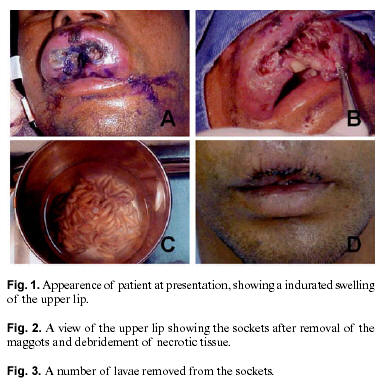
<body><![CDATA[<p><font face="Verdana" size="2">The myiasis can be classified as obligatory, when larvae  develop in living tissue, or facultative, when maggots feed on necrotic tissue.  The obligatory myiasis is more harmful for the humans. The most common anatomic  sites for myiais are the nose, eye, lung, ear, anus, vagina and more rarely, the  mouth (3).</font></p>     <p><font face="Verdana" size="2">The aim of this papers is to report an extensive case of  myiasis in upper lip.</font></p>     <p>&nbsp;</p>     <p><b><font face="Verdana">Report of Case</font></p> </b>      <p><font face="Verdana" size="2">A 32-year-old man indigent, alcohol-dependent, living on  streets, was brought to Odilon Behrens Hospital (OBH), in Belo Horizonte –  Brazil, and presented with acute upper lip swelling with an extensive necrotic  area and fetid odor. The oral examination revealed a diffused indurated swelling  nonfluctuant on palpation (<a href="#f1">Fig. 1</a>). In addition, general symptons including pain,  fever and malaise were present. The patient was drunk, presenting a poor oral  and general hygiene and was confused about the evolution time. The surface of  the swelling revealed several orificies which lived a number of maggots,  involving intra-orally mucolabial fold <a href="#f1"> (Fig. 2</a>). The management was performed by  Oral and Maxillofacial Surgeons from Surgery and Pathology Department of de  School Dentistry of the Federal University from Minas Gerais-Brazil.  Complementary treatment to the general symptons was carried out in the clinic  internal medicine of the OBH.</font> </p>     <p><font face="Verdana" size="2">The patient’s manegement included topic use of gencian violet,  oral therapy with ivermectin (6 mg orally), surgical exploration to remove the  larvae (<a href="#f1">Fig. 3</a>) and necrotic tissue. This procedure was carried out three times  for remove the remaining maggots and was observed, in the last procedure after 5  days of hospitalization, which the larvae were mobile. After the complete larvae  removal the swelling and the wounds were healing normally, the patients was  referred to plastic surgery to repair tissue damage.</font> </p>     <p align="center"><font face="Verdana" size="2"><a name="f1"><img border="0" src="/img/revistas/medicorpa/v11n2/07i.ht14.jpg" width="383" height="385"></a></font></p> <b>     <p>&nbsp;</p>     <p><font face="Verdana">Discussion</font></p> </b>      <p><font face="Verdana" size="2">Myiasis occurs by dipterous larvae developing in decaying  tissues and the developmental transition via the larval stage requires an  intermidiate host and the number of developing larvae depends on the number of  viable eggs deposited (4). The late diagnostic and the number of maggots in this  report, determined an extense tissue damage, have been necessary a esthetic  surgery.</font></p>     ]]></body>
<body><![CDATA[<p><font face="Verdana" size="2">The myiasis is diagnosed clinically based on presence of the  maggots (5-7) but the classification of the larvae rarely has been made. In the  present case was no possible to identify the larvae.</font></p>     <p><font face="Verdana" size="2">The risk factors for oral myiasis include suppurative lesions,  trauma in the face, mouth-breathers, extraction wonds and others conditions  (6-9). In this report it was not possible to identify a local condition in the  upper lip, however is possible suppose that trauma was the most probable local condition in the development of myiasis in an  alcoholics and abandoned person.</font></p>     <p><font face="Verdana" size="2">The traditional management for myiasis is the mechanical  removal of the maggots (6,7). When there are multiple larvae and in advanced  stages of maggots development and tissue destruction, local application of  several substances have been used to ensure complete removal of all larvae  (2-5,7). Recently a systemic treatment with Ivermectin, a semi-synthetic  macrolide antibiotic, have been used for treatment for oral myiasis (10).</font> </p>     <p><font face="Verdana" size="2">In the present case after 5 days, the maggots were mobile  despite the ivermectin therapy. The careful surgical removal of the larvae and  the adequate debridement of necrotic tissue were the efficient treatment.</font></p>     <p><font face="Verdana" size="2">The prevention of human myiasis is by education, but  unfortunately in the developing countries some people live in low condition,  predisposing the occurrence of the infestation.</font></p>     <p>&nbsp;</p>     <p><b><font face="Verdana">References</font></p> </b>     <!-- ref --><p><font face="Verdana" size="2">1. Millikan LE. Myiasis. Clin Dermatol 1999;17:191-5.</font>&nbsp;&nbsp;&nbsp;&nbsp;&nbsp;&nbsp;&nbsp;&nbsp;[&#160;<a href="javascript:void(0);" onclick="javascript: window.open('/scielo.php?script=sci_nlinks&ref=2946409&pid=S1698-6946200600020000700001&lng=','','width=640,height=500,resizable=yes,scrollbars=1,menubar=yes,');">Links</a>&#160;]<!-- end-ref --><!-- ref --><p><font face="Verdana" size="2">2. Pindborg JJ. Atlas of Diseases of the Oral Mucosa.  Philadelphia: PA, Sauders; 1992. p. 84-5.</font>&nbsp;&nbsp;&nbsp;&nbsp;&nbsp;&nbsp;&nbsp;&nbsp;[&#160;<a href="javascript:void(0);" onclick="javascript: window.open('/scielo.php?script=sci_nlinks&ref=2946410&pid=S1698-6946200600020000700002&lng=','','width=640,height=500,resizable=yes,scrollbars=1,menubar=yes,');">Links</a>&#160;]<!-- end-ref --><!-- ref --><p><font face="Verdana" size="2">3. Hall MJR, Wall R. Myiasis of Humans and Domestic Animals.  Adv Parasitol 1995;35:257-334.</font>&nbsp;&nbsp;&nbsp;&nbsp;&nbsp;&nbsp;&nbsp;&nbsp;[&#160;<a href="javascript:void(0);" onclick="javascript: window.open('/scielo.php?script=sci_nlinks&ref=2946411&pid=S1698-6946200600020000700003&lng=','','width=640,height=500,resizable=yes,scrollbars=1,menubar=yes,');">Links</a>&#160;]<!-- end-ref --><!-- ref --><p><font face="Verdana" size="2">4. Felices RR, Ogbureke KUE. Oral Myiasis: Report of Case and  Review of Management. J Oral Maxilofac Surg 1996;54:219-20.</font>&nbsp;&nbsp;&nbsp;&nbsp;&nbsp;&nbsp;&nbsp;&nbsp;[&#160;<a href="javascript:void(0);" onclick="javascript: window.open('/scielo.php?script=sci_nlinks&ref=2946412&pid=S1698-6946200600020000700004&lng=','','width=640,height=500,resizable=yes,scrollbars=1,menubar=yes,');">Links</a>&#160;]<!-- end-ref --><!-- ref --><p><font face="Verdana" size="2">5. Gomez RS, Perdigão PF, Pimenta FJ, Rios Leite AC, Tanos de  Lacerda JC, Custódio Neto AL. Oral Myiasis by Screwworm <i>Cochliomy Hominivorax</i>. Br  J Oral Maxillofac Surg 2003;41:115-6.</font>&nbsp;&nbsp;&nbsp;&nbsp;&nbsp;&nbsp;&nbsp;&nbsp;[&#160;<a href="javascript:void(0);" onclick="javascript: window.open('/scielo.php?script=sci_nlinks&ref=2946413&pid=S1698-6946200600020000700005&lng=','','width=640,height=500,resizable=yes,scrollbars=1,menubar=yes,');">Links</a>&#160;]<!-- end-ref --><!-- ref --><p><font face="Verdana" size="2">6. Bhatt AP, Jayakrishnan A. Oral Myiasis: a case report. Int  J Paediatr Dent 2000;10:67-70.</font> &nbsp;&nbsp;&nbsp;&nbsp;&nbsp;&nbsp;&nbsp;&nbsp;[&#160;<a href="javascript:void(0);" onclick="javascript: window.open('/scielo.php?script=sci_nlinks&ref=2946414&pid=S1698-6946200600020000700006&lng=','','width=640,height=500,resizable=yes,scrollbars=1,menubar=yes,');">Links</a>&#160;]<!-- end-ref --><!-- ref --><p><font face="Verdana" size="2">7. Al- Ismaily M, Scully C. Oral myiais: report of two cases.  Int J Paediatr Dent 1995;5:177-9.</font>&nbsp;&nbsp;&nbsp;&nbsp;&nbsp;&nbsp;&nbsp;&nbsp;[&#160;<a href="javascript:void(0);" onclick="javascript: window.open('/scielo.php?script=sci_nlinks&ref=2946415&pid=S1698-6946200600020000700007&lng=','','width=640,height=500,resizable=yes,scrollbars=1,menubar=yes,');">Links</a>&#160;]<!-- end-ref --><!-- ref --><p><font face="Verdana" size="2">8. Hakimi R, Yazdi I. Oral Mucosa Myiasis Caused by Oestrus  Ovis. Arch Iranian Med 2002;5:194-6.</font>&nbsp;&nbsp;&nbsp;&nbsp;&nbsp;&nbsp;&nbsp;&nbsp;[&#160;<a href="javascript:void(0);" onclick="javascript: window.open('/scielo.php?script=sci_nlinks&ref=2946416&pid=S1698-6946200600020000700008&lng=','','width=640,height=500,resizable=yes,scrollbars=1,menubar=yes,');">Links</a>&#160;]<!-- end-ref --><!-- ref --><p><font face="Verdana" size="2">9. Aguiar AMM, Enwonwu CO, Pires FR. Noma (cancrum oris)  Associated with Oral Myiasis in an Adult. Oral Dis 2003;9:158-9</font>&nbsp;&nbsp;&nbsp;&nbsp;&nbsp;&nbsp;&nbsp;&nbsp;[&#160;<a href="javascript:void(0);" onclick="javascript: window.open('/scielo.php?script=sci_nlinks&ref=2946417&pid=S1698-6946200600020000700009&lng=','','width=640,height=500,resizable=yes,scrollbars=1,menubar=yes,');">Links</a>&#160;]<!-- end-ref --><!-- ref --><p><font face="Verdana" size="2">10. Shinohara EH, Martini MZ, Oliveira Neto HG, Takahashi A.  Oral Myiasis Treated with Ivermectin: Case Report. Braz Dent J 2004;15:79-81.</font>&nbsp;&nbsp;&nbsp;&nbsp;&nbsp;&nbsp;&nbsp;&nbsp;[&#160;<a href="javascript:void(0);" onclick="javascript: window.open('/scielo.php?script=sci_nlinks&ref=2946418&pid=S1698-6946200600020000700010&lng=','','width=640,height=500,resizable=yes,scrollbars=1,menubar=yes,');">Links</a>&#160;]<!-- end-ref --><p>&nbsp;</p>      <p>&nbsp;</p>      <p><b><a href="#top"><font face="Verdana" size="2"><img border="0" src="/img/revistas/medicorpa/v11n2/seta.gif" width="15" height="17"></font></a> <font face="Verdana" size="2"> <a name="down">Correspondence    ]]></body>
<body><![CDATA[<br></a></font></b> </font><font face="Verdana" size="2">Prof. Evandro Neves Abdo    <br> Universidade Federal de Minas Gerais    <br> Faculdade de Odontologia    <br> Av: Antônio Carlos, 6627 sala 3204    <br> Belo Horizonte, MG, Brasil.    <br> CEP 31270901    <br> E-mail: <a href="mailto:enabdo@uai.com.br">enabdo@uai.com.br</a></font></p>      <p><font face="Verdana" size="2">Received: 10-07-2005    <br> Accepted: 30-10-2005</font> </p>      ]]></body><back>
<ref-list>
<ref id="B1">
<label>1</label><nlm-citation citation-type="journal">
<person-group person-group-type="author">
<name>
<surname><![CDATA[Millikan]]></surname>
<given-names><![CDATA[LE]]></given-names>
</name>
</person-group>
<article-title xml:lang="en"><![CDATA[Myiasis]]></article-title>
<source><![CDATA[Clin Dermatol]]></source>
<year>1999</year>
<volume>17</volume>
<page-range>191-5</page-range></nlm-citation>
</ref>
<ref id="B2">
<label>2</label><nlm-citation citation-type="book">
<person-group person-group-type="author">
<name>
<surname><![CDATA[Pindborg]]></surname>
<given-names><![CDATA[JJ]]></given-names>
</name>
</person-group>
<source><![CDATA[Atlas of Diseases of the Oral Mucosa]]></source>
<year>1992</year>
<page-range>84-5</page-range><publisher-loc><![CDATA[Philadelphia ]]></publisher-loc>
<publisher-name><![CDATA[Sauders]]></publisher-name>
</nlm-citation>
</ref>
<ref id="B3">
<label>3</label><nlm-citation citation-type="journal">
<person-group person-group-type="author">
<name>
<surname><![CDATA[Hall]]></surname>
<given-names><![CDATA[MJR]]></given-names>
</name>
<name>
<surname><![CDATA[Wall]]></surname>
<given-names><![CDATA[R]]></given-names>
</name>
</person-group>
<article-title xml:lang="en"><![CDATA[Myiasis of Humans and Domestic Animals]]></article-title>
<source><![CDATA[Adv Parasitol]]></source>
<year>1995</year>
<volume>35</volume>
<page-range>257-334</page-range></nlm-citation>
</ref>
<ref id="B4">
<label>4</label><nlm-citation citation-type="journal">
<person-group person-group-type="author">
<name>
<surname><![CDATA[Felices]]></surname>
<given-names><![CDATA[RR]]></given-names>
</name>
<name>
<surname><![CDATA[Ogbureke]]></surname>
<given-names><![CDATA[KUE]]></given-names>
</name>
</person-group>
<article-title xml:lang="en"><![CDATA[Oral Myiasis: Report of Case and Review of Management]]></article-title>
<source><![CDATA[J Oral Maxilofac Surg]]></source>
<year>1996</year>
<volume>54</volume>
<page-range>219-20</page-range></nlm-citation>
</ref>
<ref id="B5">
<label>5</label><nlm-citation citation-type="journal">
<person-group person-group-type="author">
<name>
<surname><![CDATA[Gomez]]></surname>
<given-names><![CDATA[RS]]></given-names>
</name>
<name>
<surname><![CDATA[Perdigão]]></surname>
<given-names><![CDATA[PF]]></given-names>
</name>
<name>
<surname><![CDATA[Pimenta]]></surname>
<given-names><![CDATA[FJ]]></given-names>
</name>
<name>
<surname><![CDATA[Rios Leite]]></surname>
<given-names><![CDATA[AC]]></given-names>
</name>
<name>
<surname><![CDATA[Tanos de Lacerda]]></surname>
<given-names><![CDATA[JC]]></given-names>
</name>
<name>
<surname><![CDATA[Custódio Neto]]></surname>
<given-names><![CDATA[AL]]></given-names>
</name>
</person-group>
<article-title xml:lang="en"><![CDATA[Oral Myiasis by Screwworm Cochliomy Hominivorax]]></article-title>
<source><![CDATA[Br J Oral Maxillofac Surg]]></source>
<year>2003</year>
<volume>41</volume>
<page-range>115-6</page-range></nlm-citation>
</ref>
<ref id="B6">
<label>6</label><nlm-citation citation-type="journal">
<person-group person-group-type="author">
<name>
<surname><![CDATA[Bhatt]]></surname>
<given-names><![CDATA[AP]]></given-names>
</name>
<name>
<surname><![CDATA[Jayakrishnan]]></surname>
<given-names><![CDATA[A]]></given-names>
</name>
</person-group>
<article-title xml:lang="en"><![CDATA[Oral Myiasis: a case report]]></article-title>
<source><![CDATA[Int J Paediatr Dent]]></source>
<year>2000</year>
<volume>10</volume>
<page-range>67-70</page-range></nlm-citation>
</ref>
<ref id="B7">
<label>7</label><nlm-citation citation-type="journal">
<person-group person-group-type="author">
<name>
<surname><![CDATA[Al- Ismaily]]></surname>
<given-names><![CDATA[M]]></given-names>
</name>
<name>
<surname><![CDATA[Scully]]></surname>
<given-names><![CDATA[C]]></given-names>
</name>
</person-group>
<article-title xml:lang="en"><![CDATA[Oral myiais: report of two cases]]></article-title>
<source><![CDATA[Int J Paediatr Dent]]></source>
<year>1995</year>
<volume>5</volume>
<page-range>177-9</page-range></nlm-citation>
</ref>
<ref id="B8">
<label>8</label><nlm-citation citation-type="journal">
<person-group person-group-type="author">
<name>
<surname><![CDATA[Hakimi]]></surname>
<given-names><![CDATA[R]]></given-names>
</name>
<name>
<surname><![CDATA[Yazdi]]></surname>
<given-names><![CDATA[I]]></given-names>
</name>
</person-group>
<article-title xml:lang="en"><![CDATA[Oral Mucosa Myiasis Caused by Oestrus Ovis]]></article-title>
<source><![CDATA[Arch Iranian Med]]></source>
<year>2002</year>
<volume>5</volume>
<page-range>194-6</page-range></nlm-citation>
</ref>
<ref id="B9">
<label>9</label><nlm-citation citation-type="journal">
<person-group person-group-type="author">
<name>
<surname><![CDATA[Aguiar]]></surname>
<given-names><![CDATA[AMM]]></given-names>
</name>
<name>
<surname><![CDATA[Enwonwu]]></surname>
<given-names><![CDATA[CO]]></given-names>
</name>
<name>
<surname><![CDATA[Pires]]></surname>
<given-names><![CDATA[FR]]></given-names>
</name>
</person-group>
<article-title xml:lang="en"><![CDATA[Noma (cancrum oris) Associated with Oral Myiasis in an Adult]]></article-title>
<source><![CDATA[Oral Dis]]></source>
<year>2003</year>
<volume>9</volume>
<page-range>158-9</page-range></nlm-citation>
</ref>
<ref id="B10">
<label>10</label><nlm-citation citation-type="journal">
<person-group person-group-type="author">
<name>
<surname><![CDATA[Shinohara]]></surname>
<given-names><![CDATA[EH]]></given-names>
</name>
<name>
<surname><![CDATA[Martini]]></surname>
<given-names><![CDATA[MZ]]></given-names>
</name>
<name>
<surname><![CDATA[Oliveira Neto]]></surname>
<given-names><![CDATA[HG]]></given-names>
</name>
<name>
<surname><![CDATA[Takahashi]]></surname>
<given-names><![CDATA[A]]></given-names>
</name>
</person-group>
<article-title xml:lang="en"><![CDATA[Oral Myiasis Treated with Ivermectin: Case Report]]></article-title>
<source><![CDATA[Braz Dent J]]></source>
<year>2004</year>
<volume>15</volume>
<page-range>79-81</page-range></nlm-citation>
</ref>
</ref-list>
</back>
</article>
