<?xml version="1.0" encoding="ISO-8859-1"?><article xmlns:mml="http://www.w3.org/1998/Math/MathML" xmlns:xlink="http://www.w3.org/1999/xlink" xmlns:xsi="http://www.w3.org/2001/XMLSchema-instance">
<front>
<journal-meta>
<journal-id>1698-6946</journal-id>
<journal-title><![CDATA[Medicina Oral, Patología Oral y Cirugía Bucal (Internet)]]></journal-title>
<abbrev-journal-title><![CDATA[Med. oral patol. oral cir.bucal (Internet)]]></abbrev-journal-title>
<issn>1698-6946</issn>
<publisher>
<publisher-name><![CDATA[Sociedad Española de Medicina Oral]]></publisher-name>
</publisher>
</journal-meta>
<article-meta>
<article-id>S1698-69462006000200009</article-id>
<title-group>
<article-title xml:lang="en"><![CDATA[Rhabdomyosarcoma of the Oral Tissues: two new cases and literature review]]></article-title>
</title-group>
<contrib-group>
<contrib contrib-type="author">
<name>
<surname><![CDATA[França]]></surname>
<given-names><![CDATA[Cristiane Miranda]]></given-names>
</name>
<xref ref-type="aff" rid="A01"/>
</contrib>
<contrib contrib-type="author">
<name>
<surname><![CDATA[Caran]]></surname>
<given-names><![CDATA[Eliana M. M.]]></given-names>
</name>
<xref ref-type="aff" rid="A02"/>
</contrib>
<contrib contrib-type="author">
<name>
<surname><![CDATA[Alves]]></surname>
<given-names><![CDATA[Maria Teresa S.]]></given-names>
</name>
<xref ref-type="aff" rid="A02"/>
</contrib>
<contrib contrib-type="author">
<name>
<surname><![CDATA[Barreto]]></surname>
<given-names><![CDATA[Adriana D.]]></given-names>
</name>
<xref ref-type="aff" rid="A02"/>
</contrib>
<contrib contrib-type="author">
<name>
<surname><![CDATA[Lopes]]></surname>
<given-names><![CDATA[Nilza N. F.]]></given-names>
</name>
<xref ref-type="aff" rid="A02"/>
</contrib>
</contrib-group>
<aff id="A01">
<institution><![CDATA[,Ibirapuera University Dental School ]]></institution>
<addr-line><![CDATA[ ]]></addr-line>
</aff>
<aff id="A02">
<institution><![CDATA[,Federal University of São Paulo Medical School of Sau Paulo Grupo de Apoio ao Adolescente e à Criança con Cancer (GRAACC)]]></institution>
<addr-line><![CDATA[ ]]></addr-line>
</aff>
<pub-date pub-type="pub">
<day>00</day>
<month>04</month>
<year>2006</year>
</pub-date>
<pub-date pub-type="epub">
<day>00</day>
<month>04</month>
<year>2006</year>
</pub-date>
<volume>11</volume>
<numero>2</numero>
<fpage>136</fpage>
<lpage>140</lpage>
<copyright-statement/>
<copyright-year/>
<self-uri xlink:href="http://scielo.isciii.es/scielo.php?script=sci_arttext&amp;pid=S1698-69462006000200009&amp;lng=en&amp;nrm=iso"></self-uri><self-uri xlink:href="http://scielo.isciii.es/scielo.php?script=sci_abstract&amp;pid=S1698-69462006000200009&amp;lng=en&amp;nrm=iso"></self-uri><self-uri xlink:href="http://scielo.isciii.es/scielo.php?script=sci_pdf&amp;pid=S1698-69462006000200009&amp;lng=en&amp;nrm=iso"></self-uri><abstract abstract-type="short" xml:lang="en"><p><![CDATA[Rhabdomyosarcoma (RMS) is a malignant soft tissue neoplasm consisting of cells derived from the primitive mesenchyme that exhibit a profound tendency to myogenesis. About 35% of RMS arises in the head and neck, being classified as parameningeal and non-orbital non-parameningeal forms. Parameningeal tumors carry the worst prognosis. The use of contemporary, multi-agent chemotherapy, radiotherapy, and surgery has made treatment of the disseminated disease possible, and has significantly improved overall survival from 25% in 1970 to 70% in 1991. Here, we present the management of two cases of orofacial RMS in adolescents: an 18-year-old, white female that had a 9-month history of a nodule in the left buccal mucosa, and a 19-year-old, white male who had been aware of a nodule in the left, posterior maxillary ridge with progressive growth for 4 months. Before final diagnosis, both cases were previously treated as inflammatory lesions. Their clinicopathological aspects, treatment, and poor survival as a consequence of delays in diagnosis are discussed.]]></p></abstract>
<kwd-group>
<kwd lng="en"><![CDATA[Rhabdomyosarcoma]]></kwd>
<kwd lng="en"><![CDATA[oral diseases]]></kwd>
<kwd lng="en"><![CDATA[diagnosis]]></kwd>
</kwd-group>
</article-meta>
</front><body><![CDATA[ <p align="right"><font face="Verdana" size="2"><b><a name="top"></a>MEDICINA Y PATOLOGÍA ORAL</font></b>     <p align="right">&nbsp;</p>     <p align="left"><b><font face="Verdana" size="4">Rhabdomyosarcoma of the Oral Tissues – two new cases and  literature review</font></b> </p>     <p align="left">&nbsp;</p>     <p align="left">&nbsp;</p>     <p align="left"><b><font face="Verdana" size="2">Cristiane Miranda França <sup>1</sup>, Eliana M. M. Caran <sup>2</sup>, Maria Teresa S. Alves <sup>3</sup>,&nbsp;    <br>  Adriana D. Barreto <sup>4</sup>, Nilza N. F. Lopes </font> <sup><font face="Verdana" size="2">5</font></sup></font></b></p>     <p align="left"><font face="Verdana" size="2">(1) Oral Pathologist, DDS, PhD, Biodentistry Post-Graduation  Program, Dental School, Ibirapuera University    <br> (2) Pediatric Oncologist, MD, PhD, Pediatric Institute –  GRAACC, Medical School of São Paulo, Federal University of São Paulo    <br> (3) Pathologist, MD, PhD, Pediatric Institute – GRAACC,  Medical School of São Paulo, Federal University of São Paulo.    ]]></body>
<body><![CDATA[<br> (4) DDS, Pediatric Institute – GRAACC, Medical School of São  Paulo, Federal University of São Paulo    <br> (5) DDS, Head of Dental Service, Pediatric Institute – GRAACC,  Medical School of São Paulo, Federal University of São Paulo</font></p>     <p align="left"><font face="Verdana" size="2"><a href="#down">Correspondence</a></font></p>     <p align="left">&nbsp;</p>     <p align="left">&nbsp;</p> <hr size="1">     <p align="left"><b><font face="Verdana" size="2">ABSTRACT</font></p> </b>     <p><font face="Verdana" size="2">Rhabdomyosarcoma (RMS) is a malignant soft tissue neoplasm  consisting of cells derived from the primitive mesenchyme that exhibit a  profound tendency to myogenesis. About 35% of RMS arises in the head and neck,  being classified as parameningeal and non-orbital non-parameningeal forms.  Parameningeal tumors carry the worst prognosis. The use of contemporary, multi-agent  chemotherapy, radiotherapy, and surgery has made treatment of the disseminated  disease possible, and has significantly improved overall survival from 25% in  1970 to 70% in 1991. Here, we present the management of two cases of orofacial  RMS in adolescents: an 18-year-old, white female that had a 9-month history of a  nodule in the left buccal mucosa, and a 19-year-old, white male who had been  aware of a nodule in the left, posterior maxillary ridge with progressive growth  for 4 months. Before final diagnosis, both cases were previously treated as  inflammatory lesions. Their clinicopathological aspects, treatment, and poor  survival as a consequence of delays in diagnosis are discussed.</font></p>     <p><b><font face="Verdana" size="2">Key words:</font></b><font face="Verdana" size="2"> Rhabdomyosarcoma, oral diseases,  diagnosis.</font></p> <hr size="1">  <i>  </i><b>     <p>&nbsp; </p>     <p>&nbsp;<font face="Verdana">Introduction</font> </p> </b>     ]]></body>
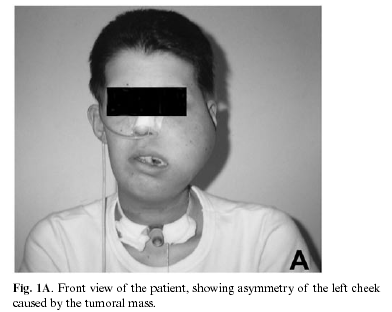
<body><![CDATA[<p><font face="Verdana" size="2">Rhabdomyosarcoma (RMS) is a malignant, soft tissue neoplasm  consisting of cells derived from the primitive mesenchyme that exhibit a  profound tendency to myogenesis. (1) Each year, 4.6 per million U.S. children  and adolescents younger than 20 years of age are diagnosed with RMS. (2) In  Brazil, the estimated incidence is 7.8 per million children under 15 years of  age. (3) The use of contemporary, multi-agent chemotherapy, radiotherapy, and  surgery has made treatment of the disseminated disease possible, and has  significantly improved overall survival from 25% in 1970 to 70% in 1991. (4)</font></p>     <p><font face="Verdana" size="2">About 35% of RMS arises in the head and neck. According to  their anatomical location and propensity for invasion of the central nervous  system, these RMSs are divided in orbital, parameningeal and non-orbital  non-parameningeal forms. Parameningeal tumors carry the worst prognosis. (4)</font></p>     <p><font face="Verdana" size="2">The histopathological and molecular spectrum manifested by  RMS has led to many classification systems. These differing morphological  features were recognized in the mid-1900s by Horn and Enterline who divided  rhabdomyosarcomas into embryonal (ERMS), alveolar, botryoid, and pleomorphic  subtypes. (1,5) Thus, a proliferation of subtle differences in diagnostic  criteria had developed. (1) In 1994, histological and biological studies have  resulted in the International Classification of RMS into prognostically  significant and diagnostically consistent subgroups based on the level of  agreement and power of prognostic prediction. Four broad subtypes of RMS were  established: (a) botryoid and spindle cell RMS (both less common variants of  ERMS); (b) embryonal RMS, generally having a superior prognosis; (c) alveolar (including  the solid-alveolar variant) RMS, generally having a poorer prognosis and (d)  undifferentiated sarcoma, also generally having a poorer prognosis. Finally, a  category of sarcoma nor otherwise specified was created for tumors that could  not be classified into an specific subtype. (1,5) Recently it was added to this  classification a subtype of RMS with rhabdoid-like features, whose prognosis is  not presently valuable. (6) It is now apparent that rhabdomyosarcoma comprises a  group of morphologically similar but biologically diverse lesions. (1)</font></p>     <p><font face="Verdana" size="2">Here, we present the management of two cases of orofacial RMS  in adolescents, and discuss their clinicopathological aspects, treatment, and  poor survival of these as a consequence of delays in diagnosis.</font></font></p>     <p>&nbsp;</p>     <p><b><font face="Verdana">Case reports</font></p>      <p><font face="Verdana" size="2">Case 1</font></p> </b>     <p><font face="Verdana" size="2">The Pediatric Institute – GRAACC is a branch of the Medical  School of São Paulo of the Federal University of São Paulo. Before beginning any  procedures, the patients or their guardians receive a detailed, informed consent  form that the case may be used for didatic purposes. Only those who sign the  form, of their own free will are included in published reports or study groups.</font></p>     <p><font face="Verdana" size="2">An 18-year-old, white female had a 9-month history of a  nodule in the left buccal mucosa. Initially, she consulted her dentist, who  performed a dental extraction. Subsequently, at the same site, she noted a  painless slowly-growing swelling, and one month later she was submitted to an  incisional biopsy that disclosed a histological diagnosis of &quot;solid alveolar  rhabdomyosarcoma&quot;. The patient was treated employing VAC chemotherapy (vincristine,  actinomycin-D, cyclophosphamide) alternated with ifosfamide/vepeside, and  complementary radiotherapy, receiving 3600 cGy. The tumor progressed and the  patient was referred to our service.</font> </p>     <p><font face="Verdana" size="2">At the time of admission, the patient exhibited an extensive  swelling in the oral cavity with imminent airway obstruction. A tracheostomy was  performed immediately (<a href="#f1a">Figure 1A</a>). An intra-oral exam was not possible  owing to the extent of the tumor. Computerized tomography scans showed an  infiltrative soft tissue mass causing maxillary destruction and displacement of  the adjacent structures (<a href="#f1b">Figure 1B</a>). Metastasis screenings indicated liver and  pulmonary involvement. Revision of the biopsy material confirmed the diagnosis  of RMS but the subtype was changed to &quot;undifferentiated sarcoma&quot; due its  negativity to immunohistochemical tests for myogenin, desmin, muscle-specific  actin, leukocyte common antigen and cytokeratins (Figures <a href="#f1c"> 1C</a> and <a href="#f1d">1D</a>).  Chemotherapy with topotecan, navelbin, carboplatin and vepeside was initiated  resulting in the partial regression of the tumor. The patient also received  complementary radiotherapy, reaching 7300 cGy in the oral cavity and 1200 cGy in  the lung. The patient died from respiratory failure caused by metastases in lung  20 months after admission to our service.</font> </p>     ]]></body>
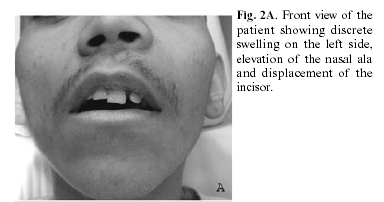
<body><![CDATA[<p align="center"><font face="Verdana" size="2"><a name="f1a"><img border="0" src="/img/revistas/medicorpa/v11n2/09i.ht17.gif" width="392" height="312"></a></font></p>     <p align="center"><font face="Verdana" size="2"><a name="f1b"><img border="0" src="/img/revistas/medicorpa/v11n2/09i.ht18.jpg" width="392" height="345"></a></font></p>     <p align="center"><font face="Verdana" size="2"><a name="f1c"><img border="0" src="/img/revistas/medicorpa/v11n2/09i.ht19.jpg" width="384" height="316"></a></font></p>     <p align="center"><font face="Verdana" size="2"><a name="f1d"><img border="0" src="/img/revistas/medicorpa/v11n2/09i.ht20.jpg" width="382" height="296"></a></font></p>     <p>&nbsp; </p>      <p><b><font face="Verdana" size="2">Case 2</font></b></p>      <p><font face="Verdana" size="2">A 19-year-old, white male had been aware of a nodule in the  left, posterior maxillary ridge with progressive growth for 4 months. Initially,  the patient was seen by a physician who prescribed antibiotic/anti-inflammatory  therapy. After two months an unsuccessful attempt was made to drain the lesion.  A biopsy was performed and a &quot;malignant tumor&quot; indicated. At the time of  admission to our service, the patient presented facial asymmetry with an  asymptomatic, fetid swelling on the left side (<a href="#f2a">Figure 2A</a>). Intra-oral  examination showed a 5 x 6 cm, red, firm mass with grayish areas of central  necrosis, covering the left side of the maxillary gingiva, from the central  incisor to the second molar (Figures <a href="#f2b"> 2B</a> and <a href="#f2c">2C</a>). The teeth involved in the mass  showed mobility although the patient still could talk and feed properly.</font> </p>     <p align="center"><font face="Verdana" size="2"><a name="f2a"><img border="0" src="/img/revistas/medicorpa/v11n2/09i.ht21.gif" width="384" height="202"></a></font></p>     <p align="center"><font face="Verdana" size="2"><a name="f2b"><img border="0" src="/img/revistas/medicorpa/v11n2/09i.ht22.gif" width="367" height="160"></a></font></p>     <p align="center"><font face="Verdana" size="2"><a name="f2c"><img border="0" src="/img/revistas/medicorpa/v11n2/09i.ht23.gif" width="371" height="200"></a></font></p>     ]]></body>
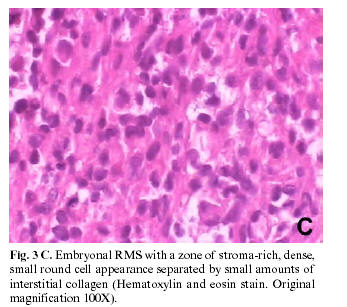
<body><![CDATA[<p align="center">&nbsp;</p>      <p><font face="Verdana" size="2">Computerized tomography scans revealed an irregular  destruction of the maxillary bone (Figures <a href="#f3ab"> 3A</a> and <a href="#f3ab">3B</a>). Findings by computerized  chest tomographies, complete blood cell count, and blood chemistry were all  within normal limits. An incisional biopsy was performed, and the specimens  disclosed embryonal rhabdomyosarcoma (<a href="#f3c">Figure 3C</a>). The immunohistochemical tests  were positive for desmin, vimentin and muscle actin, and negative for  cytokeratins and S100 protein (<a href="#f3d">Figure 3D</a>). Myogenin showed a cytoplasmic and  nonspecific background staining. The patient began a combined VAC chemotherapy  consisting of cyclophosphamide, vincristine and actinomycin-D; however, the  tumor continued to spread, and after four cycles reached 6 x 8 cm. The treatment  protocol was altered to topotecan, navelbine, ifosfamide, and vepeside, with an  associated dose of radiotherapy (5040 cGy). The tumor increased in size despite  treatment, and the patient died from lung metastases 8 months after admission to  the service.</font> </p>     <p align="center"><font face="Verdana" size="2"><a name="f3ab"><img border="0" src="/img/revistas/medicorpa/v11n2/09i.ht24.gif" width="393" height="628"></a></font></p> <b>      <p align="center"><font face="Verdana" size="2"><a name="f3c"><img border="0" src="/img/revistas/medicorpa/v11n2/09i.ht25.jpg" width="347" height="307"></a></font></p>     <p align="center"><font face="Verdana" size="2"><a name="f3d"><img border="0" src="/img/revistas/medicorpa/v11n2/09i.ht26.jpg" width="337" height="327"></a></font></p>     <p>&nbsp; </p>     <p><font face="Verdana">Discussion</font> </p> </b>     <p><font face="Verdana" size="2">Oral rhabdomyosarcomas are classified within the non-parameningeal  group of tumors, which present a better prognosis and tend not to invade the  central nervous system. (4) Further, with the advent of combined surgical,  chemotherapeutic, and radiotherapeutic management of RMS, the five-year survival  rate is approximately 85% for this RMS subtype. (7) Even so, we present two new  cases of oral rhabdomyosarcoma in adolescents with a fatal outcome.</font> </p>     <p><font face="Verdana" size="2">The young man exhibited embryonal RMS, no metastases on  initial treatment, and an 8-month survival period after admission to our service.  On the other hand, the woman suffered from an undifferentiated sarcoma with  metastases at admission, dying 20 months later. The opposite outcome would be  expected. This is a conflicting data with the literature (7-9), and we did not  have the possibility to perform molecular pathology investigations, but they may  have answered our question about the survival of the patients. Recent studies  suggest that the application of molecular pathology to classification of RMS  subtypes may help to resolve some of these controversies by the use of more  objective criteria based on genetic differences between the subtypes of RMS. For  example, it has been described that patients with the variant PAX7-FKHR  translocation have a more favorable prognosis than do those with the more common  PAX3-FKHR translocation. Even more intriguing is a preliminary report suggesting  a strikingly better outcome among patients with metastatic disease and variant-translocation-positive  alveolar RMS (estimated 4-year overall survival, 75% vs. 8% for patients with  PAX3-FKHR-positive alveolar RMS). (8)</font> </p>     <p><font face="Verdana" size="2">Although myogenin is considered a sensitive and specific  marker for RMS, more specific than desmin and muscle-specific actin and more  sensitive than myoglobin, (10) in our cases, clinicopathological data,  morphology and the immunohistochemical panel were more useful in the RMS  diagnosis than myogenin alone.</font></p>     ]]></body>
<body><![CDATA[<p><font face="Verdana" size="2">The incidence of RMS is highest in children 1-4 years of age,  falling to a lower rate at 10-14 years, and remaining steady between 15-19 years  of age. (11) This tumor is usually fast-growing and infiltrative, and often  appears as an enlarging, painless mass. Initial symptoms may be vague, and may  mimic other childhood and adolescent, soft-tissue sarcomas such as fibrosarcoma,  leiomyosarcoma and neurofibrosarcoma. (12)</font></p>     <p><font face="Verdana" size="2">Bras <i>et al.</i> (1987) found that of 12 patients with RMS,  the interval between the first symptoms and biopsy ranged from 0 to 26 weeks,  with a median of 7 weeks and an average of 7.4 weeks. (13) In most cases, when  initially examined, the patients already exhibit large tumors due to their rapid  growth and the frequent delay in medical consultation. Since the late 1970´s it  is believed that suspected infection constitutes an important cause of the delay  in RMS diagnosis. (13) Our patient cases confirm this finding, although, given  the lack of inflammatory symptoms in both cases, there was a misdiagnosis of  dental abscess or pulpitis. This misdiagnosis delayed the patients´ diagnoses  for 3 months, and the lesions were inappropriately managed, increasing the  patients´ morbidity.</font> </p>     <p><font face="Verdana" size="2">In the advanced stages of the disease, because of the  infiltrative growth, and depending on the site of the tumor, pain, paresthesia,  loosening of the teeth, and trismus occur. (13,14) The first patient showed  involvement of the teeth as a consequence of tumor growth, while the second  patient had affected teeth since the very beginning of her complaint.</font> </p>     <p><font face="Verdana" size="2">Site predilection in the oral cavity varies according to  different authors, some finding that the palate is the commonest site, while  others report that the tongue is the most common site. (14,15) The patients  described here had lesions of the hard palate and alveolar ridge.</font></p>     <p>&nbsp;</p>     <p><b><font face="Verdana">Conclusion</font></p> </b>     <p><font face="Verdana" size="2">Despite marked improvement in RMS survival over the past  decades, it is known that, in addition to a poor prognosis for patients over  ten-years old, delays in diagnosis have a profoundly unfavorable impact on  prognosis as illustrated by the cases presented here. Finally, when a  non-resolving nodule arouses suspicion, before the clinician begins  antibiotic/anti-inflammatory therapy, support for the hypothesis of infection or  inflammatory disease must be obtained from anamnesis and physical examination.  Otherwise, a biopsy should be performed and the patient immediately referred to  a recognized diagnostic center. The initial management of any tumor is critical  to a satisfactory outcome of the disease.</font> </p>     <p>&nbsp; </p>     <p><b><font face="Verdana">References</font> </p> </b>     <!-- ref --><p><font face="Verdana" size="2">1. Parham DM<b>. </b>Pathologic classification of  rhabdomyosarcomas and correlations with molecular studies. Mod Pathol  2001;14:506-14.</font>&nbsp;&nbsp;&nbsp;&nbsp;&nbsp;&nbsp;&nbsp;&nbsp;[&#160;<a href="javascript:void(0);" onclick="javascript: window.open('/scielo.php?script=sci_nlinks&ref=2946604&pid=S1698-6946200600020000900001&lng=','','width=640,height=500,resizable=yes,scrollbars=1,menubar=yes,');">Links</a>&#160;]<!-- end-ref --><!-- ref --><p><font face="Verdana" size="2">2. Ries LAG, Smith MA, Gurney JG eds. Cancer incidence and  survival among children and adolescents: United States SEER Program 1975-1995.  Bethesda, National Cancer Institute; 1999. p. 111-24.</font>&nbsp;&nbsp;&nbsp;&nbsp;&nbsp;&nbsp;&nbsp;&nbsp;[&#160;<a href="javascript:void(0);" onclick="javascript: window.open('/scielo.php?script=sci_nlinks&ref=2946605&pid=S1698-6946200600020000900002&lng=','','width=640,height=500,resizable=yes,scrollbars=1,menubar=yes,');">Links</a>&#160;]<!-- end-ref --><!-- ref --><p><font face="Verdana" size="2">3. Stiller CA, Parkin DM. Geographic and ethnic variations in  the incidence of childhood cancer. Br Med Bull 1996;52:682-703.</font> &nbsp;&nbsp;&nbsp;&nbsp;&nbsp;&nbsp;&nbsp;&nbsp;[&#160;<a href="javascript:void(0);" onclick="javascript: window.open('/scielo.php?script=sci_nlinks&ref=2946606&pid=S1698-6946200600020000900003&lng=','','width=640,height=500,resizable=yes,scrollbars=1,menubar=yes,');">Links</a>&#160;]<!-- end-ref --><!-- ref --><p><font face="Verdana" size="2">4. Crist WM, Anderson JR, Meza JL, Fryer C, Raney RB, Ruymann  FB, et al. Intergroup rhabdomyosarcoma study-IV: results for patients with  nonmetastatic disease. J Clin Oncol 2001;19:3091-102.</font>&nbsp;&nbsp;&nbsp;&nbsp;&nbsp;&nbsp;&nbsp;&nbsp;[&#160;<a href="javascript:void(0);" onclick="javascript: window.open('/scielo.php?script=sci_nlinks&ref=2946607&pid=S1698-6946200600020000900004&lng=','','width=640,height=500,resizable=yes,scrollbars=1,menubar=yes,');">Links</a>&#160;]<!-- end-ref --><!-- ref --><p><font face="Verdana" size="2">5. Asmar L, Gehan EA, Newton WA, Webber BL, Marsden HB, van  Unnik AJ, et al. Agreement among and within groups of pathologists in the  classification of rhabdomyosarcoma and related childhood sarcomas. Report of an  international study of four pathology classifications. Cancer 1994;74:2579-88.</font>&nbsp;&nbsp;&nbsp;&nbsp;&nbsp;&nbsp;&nbsp;&nbsp;[&#160;<a href="javascript:void(0);" onclick="javascript: window.open('/scielo.php?script=sci_nlinks&ref=2946608&pid=S1698-6946200600020000900005&lng=','','width=640,height=500,resizable=yes,scrollbars=1,menubar=yes,');">Links</a>&#160;]<!-- end-ref --><!-- ref --><p><font face="Verdana" size="2">6. Kodet R, Newton WA Jr, Hamoudi AB, Asmar L. Rhabdomyosarcomas with intermediate-filament inclusions and features of rhabdoid  tumors. Light microscopic and immunohistochemical study. Am J Surg Pathol  1991;15:257-67.</font> &nbsp;&nbsp;&nbsp;&nbsp;&nbsp;&nbsp;&nbsp;&nbsp;[&#160;<a href="javascript:void(0);" onclick="javascript: window.open('/scielo.php?script=sci_nlinks&ref=2946609&pid=S1698-6946200600020000900006&lng=','','width=640,height=500,resizable=yes,scrollbars=1,menubar=yes,');">Links</a>&#160;]<!-- end-ref --><!-- ref --><p><font face="Verdana" size="2">7. Stiller CA, Stevens MC, Magnani C, Corazziari I<b>. </b> EUROCARE Working Group. Survival of children with soft-tissue sarcoma in Europe  since 1978: results from the EUROCARE study. Eur J Cancer 2001;37:767-74.</font>&nbsp;&nbsp;&nbsp;&nbsp;&nbsp;&nbsp;&nbsp;&nbsp;[&#160;<a href="javascript:void(0);" onclick="javascript: window.open('/scielo.php?script=sci_nlinks&ref=2946610&pid=S1698-6946200600020000900007&lng=','','width=640,height=500,resizable=yes,scrollbars=1,menubar=yes,');">Links</a>&#160;]<!-- end-ref --><!-- ref --><p><font face="Verdana" size="2">8. Sorensen PH, Lynch JC, Qualman SJ, Tirabosco R, Lim JF,  Maurer HM. PAX3-FKHR and PAX7-FKHR gene fusions are prognostic indicators in  alveolar rhabdomyosarcoma: a report from the children’s oncology group. J Clin  Oncol 2002;20:2672-9.</font> &nbsp;&nbsp;&nbsp;&nbsp;&nbsp;&nbsp;&nbsp;&nbsp;[&#160;<a href="javascript:void(0);" onclick="javascript: window.open('/scielo.php?script=sci_nlinks&ref=2946611&pid=S1698-6946200600020000900008&lng=','','width=640,height=500,resizable=yes,scrollbars=1,menubar=yes,');">Links</a>&#160;]<!-- end-ref --><!-- ref --><p><font face="Verdana" size="2">9. Meehan S, Davis V, Brahim JS. Embryonal rhabdomyosarcoma  of the floor of the mouth. A case report. Oral Surg Oral Med Oral Pathol  1994;78:603-6.</font>&nbsp;&nbsp;&nbsp;&nbsp;&nbsp;&nbsp;&nbsp;&nbsp;[&#160;<a href="javascript:void(0);" onclick="javascript: window.open('/scielo.php?script=sci_nlinks&ref=2946612&pid=S1698-6946200600020000900009&lng=','','width=640,height=500,resizable=yes,scrollbars=1,menubar=yes,');">Links</a>&#160;]<!-- end-ref --><!-- ref --><p><font face="Verdana" size="2">10. Cessna MH, Zhou H, Perkins SL, Tripp SR, Layfield L,  Daines C, et al. Are myogenin and myoD1 expression specific for rhabdomyosarcoma?  A study of 150 cases, with emphasis on spindle cell mimics. Am J Surg Pathol  2001;25:1150-7.</font>&nbsp;&nbsp;&nbsp;&nbsp;&nbsp;&nbsp;&nbsp;&nbsp;[&#160;<a href="javascript:void(0);" onclick="javascript: window.open('/scielo.php?script=sci_nlinks&ref=2946613&pid=S1698-6946200600020000900010&lng=','','width=640,height=500,resizable=yes,scrollbars=1,menubar=yes,');">Links</a>&#160;]<!-- end-ref --><!-- ref --><p><font face="Verdana" size="2">11. Hicks J, Flaitz C. Rhabdomyosarcoma of the head and neck  in children. Oral Oncol 2002;38:450-9.</font>&nbsp;&nbsp;&nbsp;&nbsp;&nbsp;&nbsp;&nbsp;&nbsp;[&#160;<a href="javascript:void(0);" onclick="javascript: window.open('/scielo.php?script=sci_nlinks&ref=2946614&pid=S1698-6946200600020000900011&lng=','','width=640,height=500,resizable=yes,scrollbars=1,menubar=yes,');">Links</a>&#160;]<!-- end-ref --><!-- ref --><p><font face="Verdana" size="2">12. McDowell HP. Update on childhood rhabdomyosarcoma. Arch  Dis Child 2003;88:354-7.</font>&nbsp;&nbsp;&nbsp;&nbsp;&nbsp;&nbsp;&nbsp;&nbsp;[&#160;<a href="javascript:void(0);" onclick="javascript: window.open('/scielo.php?script=sci_nlinks&ref=2946615&pid=S1698-6946200600020000900012&lng=','','width=640,height=500,resizable=yes,scrollbars=1,menubar=yes,');">Links</a>&#160;]<!-- end-ref --><!-- ref --><p><font face="Verdana" size="2">13. Bras J, Batsakis JG, Luna MAO. Rhabdomyosarcoma of the  oral soft tissues. Oral Surg Oral Med Oral Pathol 1987;64:585-96.</font>&nbsp;&nbsp;&nbsp;&nbsp;&nbsp;&nbsp;&nbsp;&nbsp;[&#160;<a href="javascript:void(0);" onclick="javascript: window.open('/scielo.php?script=sci_nlinks&ref=2946616&pid=S1698-6946200600020000900013&lng=','','width=640,height=500,resizable=yes,scrollbars=1,menubar=yes,');">Links</a>&#160;]<!-- end-ref --><!-- ref --><p><font face="Verdana" size="2">14. Chen SY, Thakur A, Miller AS, Harwick RD.  Rhabdomyosarcoma of the oral cavity. Report of four cases. Oral Surg Oral Med  Oral Pathol Oral Radiol Endod 1995;80:192-201.</font>&nbsp;&nbsp;&nbsp;&nbsp;&nbsp;&nbsp;&nbsp;&nbsp;[&#160;<a href="javascript:void(0);" onclick="javascript: window.open('/scielo.php?script=sci_nlinks&ref=2946617&pid=S1698-6946200600020000900014&lng=','','width=640,height=500,resizable=yes,scrollbars=1,menubar=yes,');">Links</a>&#160;]<!-- end-ref --><!-- ref --><p><font face="Verdana" size="2">15. Pavithran K, Doval DC, Mukherjee G, Kannan V, Kumaraswamy  SV, Bapsy PP<b>. </b>Rhabdomyosarcoma of the oral cavity--report of eight cases.  Acta Oncol 1997;36:819-21.</font>&nbsp;&nbsp;&nbsp;&nbsp;&nbsp;&nbsp;&nbsp;&nbsp;[&#160;<a href="javascript:void(0);" onclick="javascript: window.open('/scielo.php?script=sci_nlinks&ref=2946618&pid=S1698-6946200600020000900015&lng=','','width=640,height=500,resizable=yes,scrollbars=1,menubar=yes,');">Links</a>&#160;]<!-- end-ref --><p>&nbsp;</p>      <p>&nbsp;</p>      <p><b><a href="#top"><font face="Verdana" size="2"><img border="0" src="/img/revistas/medicorpa/v11n2/seta.gif" width="15" height="17"></font></a> <font face="Verdana" size="2"> <a name="down">Correspondence    <br></a></font></font></b> <font face="Verdana" size="2">Profa. Dra. Cristiane Miranda França    <br> Av. Conselheiro Rodrigues Alves # 948, apto 93 – Vila Mariana    <br> São Paulo – SP – Brazil 04014-002    ]]></body>
<body><![CDATA[<br> Email: <a href="mailto:crispadron@uol.com.br">crispadron@uol.com.br</a></font></p>      <p><font face="Verdana" size="2">Received: 14-08-2005    <br> Accepted: 4-01-2006</font> </p>      ]]></body><back>
<ref-list>
<ref id="B1">
<label>1</label><nlm-citation citation-type="journal">
<person-group person-group-type="author">
<name>
<surname><![CDATA[Parham]]></surname>
<given-names><![CDATA[DM]]></given-names>
</name>
</person-group>
<article-title xml:lang="en"><![CDATA[Pathologic classification of rhabdomyosarcomas and correlations with molecular studies]]></article-title>
<source><![CDATA[Mod Pathol]]></source>
<year>2001</year>
<volume>14</volume>
<page-range>506-14</page-range></nlm-citation>
</ref>
<ref id="B2">
<label>2</label><nlm-citation citation-type="book">
<person-group person-group-type="author">
<name>
<surname><![CDATA[Ries]]></surname>
<given-names><![CDATA[LAG]]></given-names>
</name>
<name>
<surname><![CDATA[Smith]]></surname>
<given-names><![CDATA[MA]]></given-names>
</name>
<name>
<surname><![CDATA[Gurney]]></surname>
<given-names><![CDATA[JG]]></given-names>
</name>
</person-group>
<source><![CDATA[Cancer incidence and survival among children and adolescents: United States SEER Program 1975-1995]]></source>
<year>1999</year>
<page-range>111-24</page-range><publisher-loc><![CDATA[Bethesda ]]></publisher-loc>
<publisher-name><![CDATA[National Cancer Institute]]></publisher-name>
</nlm-citation>
</ref>
<ref id="B3">
<label>3</label><nlm-citation citation-type="journal">
<person-group person-group-type="author">
<name>
<surname><![CDATA[Stiller]]></surname>
<given-names><![CDATA[CA]]></given-names>
</name>
<name>
<surname><![CDATA[Parkin]]></surname>
<given-names><![CDATA[DM]]></given-names>
</name>
</person-group>
<article-title xml:lang="en"><![CDATA[Geographic and ethnic variations in the incidence of childhood cancer]]></article-title>
<source><![CDATA[Br Med Bull]]></source>
<year>1996</year>
<volume>52</volume>
<page-range>682-703</page-range></nlm-citation>
</ref>
<ref id="B4">
<label>4</label><nlm-citation citation-type="journal">
<person-group person-group-type="author">
<name>
<surname><![CDATA[Crist]]></surname>
<given-names><![CDATA[WM]]></given-names>
</name>
<name>
<surname><![CDATA[Anderson]]></surname>
<given-names><![CDATA[JR]]></given-names>
</name>
<name>
<surname><![CDATA[Meza]]></surname>
<given-names><![CDATA[JL]]></given-names>
</name>
<name>
<surname><![CDATA[Fryer]]></surname>
<given-names><![CDATA[C]]></given-names>
</name>
<name>
<surname><![CDATA[Raney]]></surname>
<given-names><![CDATA[RB]]></given-names>
</name>
<name>
<surname><![CDATA[Ruymann]]></surname>
<given-names><![CDATA[FB]]></given-names>
</name>
</person-group>
<article-title xml:lang="en"><![CDATA[Intergroup rhabdomyosarcoma study-IV: results for patients with nonmetastatic disease]]></article-title>
<source><![CDATA[J Clin Oncol]]></source>
<year>2001</year>
<volume>19</volume>
<page-range>3091-102</page-range></nlm-citation>
</ref>
<ref id="B5">
<label>5</label><nlm-citation citation-type="journal">
<person-group person-group-type="author">
<name>
<surname><![CDATA[Asmar]]></surname>
<given-names><![CDATA[L]]></given-names>
</name>
<name>
<surname><![CDATA[Gehan]]></surname>
<given-names><![CDATA[EA]]></given-names>
</name>
<name>
<surname><![CDATA[Newton]]></surname>
<given-names><![CDATA[WA]]></given-names>
</name>
<name>
<surname><![CDATA[Webber]]></surname>
<given-names><![CDATA[BL]]></given-names>
</name>
<name>
<surname><![CDATA[Marsden]]></surname>
<given-names><![CDATA[HB]]></given-names>
</name>
<name>
<surname><![CDATA[van Unnik]]></surname>
<given-names><![CDATA[AJ]]></given-names>
</name>
</person-group>
<article-title xml:lang="en"><![CDATA[Agreement among and within groups of pathologists in the classification of rhabdomyosarcoma and related childhood sarcomas: Report of an international study of four pathology classifications]]></article-title>
<source><![CDATA[Cancer]]></source>
<year>1994</year>
<volume>74</volume>
<page-range>2579-88</page-range></nlm-citation>
</ref>
<ref id="B6">
<label>6</label><nlm-citation citation-type="journal">
<person-group person-group-type="author">
<name>
<surname><![CDATA[Kodet]]></surname>
<given-names><![CDATA[R]]></given-names>
</name>
<name>
<surname><![CDATA[Newton]]></surname>
<given-names><![CDATA[WA Jr]]></given-names>
</name>
<name>
<surname><![CDATA[Hamoudi]]></surname>
<given-names><![CDATA[AB]]></given-names>
</name>
<name>
<surname><![CDATA[Asmar]]></surname>
<given-names><![CDATA[L]]></given-names>
</name>
</person-group>
<article-title xml:lang="en"><![CDATA[Rhabdomyosarcomas with intermediate-filament inclusions and features of rhabdoid tumors: Light microscopic and immunohistochemical study]]></article-title>
<source><![CDATA[Am J Surg Pathol]]></source>
<year>1991</year>
<volume>15</volume>
<page-range>257-67</page-range></nlm-citation>
</ref>
<ref id="B7">
<label>7</label><nlm-citation citation-type="journal">
<person-group person-group-type="author">
<name>
<surname><![CDATA[Stiller]]></surname>
<given-names><![CDATA[CA]]></given-names>
</name>
<name>
<surname><![CDATA[Stevens]]></surname>
<given-names><![CDATA[MC]]></given-names>
</name>
<name>
<surname><![CDATA[Magnani]]></surname>
<given-names><![CDATA[C]]></given-names>
</name>
<name>
<surname><![CDATA[Corazziari]]></surname>
<given-names><![CDATA[I]]></given-names>
</name>
</person-group>
<article-title xml:lang="en"><![CDATA[EUROCARE Working Group. Survival of children with soft-tissue sarcoma in Europe since 1978: results from the EUROCARE study]]></article-title>
<source><![CDATA[Eur J Cancer]]></source>
<year>2001</year>
<volume>37</volume>
<page-range>767-74</page-range></nlm-citation>
</ref>
<ref id="B8">
<label>8</label><nlm-citation citation-type="journal">
<person-group person-group-type="author">
<name>
<surname><![CDATA[Sorensen]]></surname>
<given-names><![CDATA[PH]]></given-names>
</name>
<name>
<surname><![CDATA[Lynch]]></surname>
<given-names><![CDATA[JC]]></given-names>
</name>
<name>
<surname><![CDATA[Qualman]]></surname>
<given-names><![CDATA[SJ]]></given-names>
</name>
<name>
<surname><![CDATA[Tirabosco]]></surname>
<given-names><![CDATA[R]]></given-names>
</name>
<name>
<surname><![CDATA[Lim]]></surname>
<given-names><![CDATA[JF]]></given-names>
</name>
<name>
<surname><![CDATA[Maurer]]></surname>
<given-names><![CDATA[HM]]></given-names>
</name>
</person-group>
<article-title xml:lang="en"><![CDATA[PAX3-FKHR and PAX7-FKHR gene fusions are prognostic indicators in alveolar rhabdomyosarcoma: a report from the children’s oncology group]]></article-title>
<source><![CDATA[J Clin Oncol]]></source>
<year>2002</year>
<volume>20</volume>
<page-range>2672-9</page-range></nlm-citation>
</ref>
<ref id="B9">
<label>9</label><nlm-citation citation-type="journal">
<person-group person-group-type="author">
<name>
<surname><![CDATA[Meehan]]></surname>
<given-names><![CDATA[S]]></given-names>
</name>
<name>
<surname><![CDATA[Davis]]></surname>
<given-names><![CDATA[V]]></given-names>
</name>
<name>
<surname><![CDATA[Brahim]]></surname>
<given-names><![CDATA[JS]]></given-names>
</name>
</person-group>
<article-title xml:lang="en"><![CDATA[Embryonal rhabdomyosarcoma of the floor of the mouth: A case report]]></article-title>
<source><![CDATA[Oral Surg Oral Med Oral Pathol]]></source>
<year>1994</year>
<volume>78</volume>
<page-range>603-6</page-range></nlm-citation>
</ref>
<ref id="B10">
<label>10</label><nlm-citation citation-type="journal">
<person-group person-group-type="author">
<name>
<surname><![CDATA[Cessna]]></surname>
<given-names><![CDATA[MH]]></given-names>
</name>
<name>
<surname><![CDATA[Zhou]]></surname>
<given-names><![CDATA[H]]></given-names>
</name>
<name>
<surname><![CDATA[Perkins]]></surname>
<given-names><![CDATA[SL]]></given-names>
</name>
<name>
<surname><![CDATA[Tripp]]></surname>
<given-names><![CDATA[SR]]></given-names>
</name>
<name>
<surname><![CDATA[Layfield]]></surname>
<given-names><![CDATA[L]]></given-names>
</name>
<name>
<surname><![CDATA[Daines]]></surname>
<given-names><![CDATA[C]]></given-names>
</name>
</person-group>
<article-title xml:lang="en"><![CDATA[Are myogenin and myoD1 expression specific for rhabdomyosarcoma: A study of 150 cases, with emphasis on spindle cell mimics]]></article-title>
<source><![CDATA[Am J Surg Pathol]]></source>
<year>2001</year>
<volume>25</volume>
<page-range>1150-7</page-range></nlm-citation>
</ref>
<ref id="B11">
<label>11</label><nlm-citation citation-type="journal">
<person-group person-group-type="author">
<name>
<surname><![CDATA[Hicks]]></surname>
<given-names><![CDATA[J]]></given-names>
</name>
<name>
<surname><![CDATA[Flaitz]]></surname>
<given-names><![CDATA[C]]></given-names>
</name>
</person-group>
<article-title xml:lang="en"><![CDATA[Rhabdomyosarcoma of the head and neck in children]]></article-title>
<source><![CDATA[Oral Oncol]]></source>
<year>2002</year>
<volume>38</volume>
<page-range>450-9</page-range></nlm-citation>
</ref>
<ref id="B12">
<label>12</label><nlm-citation citation-type="journal">
<person-group person-group-type="author">
<name>
<surname><![CDATA[McDowell]]></surname>
<given-names><![CDATA[HP]]></given-names>
</name>
</person-group>
<article-title xml:lang="en"><![CDATA[Update on childhood rhabdomyosarcoma]]></article-title>
<source><![CDATA[Arch Dis Child]]></source>
<year>2003</year>
<volume>88</volume>
<page-range>354-7</page-range></nlm-citation>
</ref>
<ref id="B13">
<label>13</label><nlm-citation citation-type="journal">
<person-group person-group-type="author">
<name>
<surname><![CDATA[Bras]]></surname>
<given-names><![CDATA[J]]></given-names>
</name>
<name>
<surname><![CDATA[Batsakis]]></surname>
<given-names><![CDATA[JG]]></given-names>
</name>
<name>
<surname><![CDATA[Luna]]></surname>
<given-names><![CDATA[MAO]]></given-names>
</name>
</person-group>
<article-title xml:lang="en"><![CDATA[Rhabdomyosarcoma of the oral soft tissues]]></article-title>
<source><![CDATA[Oral Surg Oral Med Oral Pathol]]></source>
<year>1987</year>
<volume>64</volume>
<page-range>585-96</page-range></nlm-citation>
</ref>
<ref id="B14">
<label>14</label><nlm-citation citation-type="journal">
<person-group person-group-type="author">
<name>
<surname><![CDATA[Chen]]></surname>
<given-names><![CDATA[SY]]></given-names>
</name>
<name>
<surname><![CDATA[Thakur]]></surname>
<given-names><![CDATA[A]]></given-names>
</name>
<name>
<surname><![CDATA[Miller]]></surname>
<given-names><![CDATA[AS]]></given-names>
</name>
<name>
<surname><![CDATA[Harwick]]></surname>
<given-names><![CDATA[RD]]></given-names>
</name>
</person-group>
<article-title xml:lang="en"><![CDATA[Rhabdomyosarcoma of the oral cavity: Report of four cases]]></article-title>
<source><![CDATA[Oral Surg Oral Med Oral Pathol Oral Radiol Endod]]></source>
<year>1995</year>
<volume>80</volume>
<page-range>192-201</page-range></nlm-citation>
</ref>
<ref id="B15">
<label>15</label><nlm-citation citation-type="journal">
<person-group person-group-type="author">
<name>
<surname><![CDATA[Pavithran]]></surname>
<given-names><![CDATA[K]]></given-names>
</name>
<name>
<surname><![CDATA[Doval]]></surname>
<given-names><![CDATA[DC]]></given-names>
</name>
<name>
<surname><![CDATA[Mukherjee]]></surname>
<given-names><![CDATA[G]]></given-names>
</name>
<name>
<surname><![CDATA[Kannan]]></surname>
<given-names><![CDATA[V]]></given-names>
</name>
<name>
<surname><![CDATA[Kumaraswamy]]></surname>
<given-names><![CDATA[SV]]></given-names>
</name>
<name>
<surname><![CDATA[Bapsy]]></surname>
<given-names><![CDATA[PP]]></given-names>
</name>
</person-group>
<article-title xml:lang="en"><![CDATA[Rhabdomyosarcoma of the oral cavity: report of eight cases]]></article-title>
<source><![CDATA[Acta Oncol]]></source>
<year>1997</year>
<volume>36</volume>
<page-range>819-21</page-range></nlm-citation>
</ref>
</ref-list>
</back>
</article>