<?xml version="1.0" encoding="ISO-8859-1"?><article xmlns:mml="http://www.w3.org/1998/Math/MathML" xmlns:xlink="http://www.w3.org/1999/xlink" xmlns:xsi="http://www.w3.org/2001/XMLSchema-instance">
<front>
<journal-meta>
<journal-id>1698-6946</journal-id>
<journal-title><![CDATA[Medicina Oral, Patología Oral y Cirugía Bucal (Internet)]]></journal-title>
<abbrev-journal-title><![CDATA[Med. oral patol. oral cir.bucal (Internet)]]></abbrev-journal-title>
<issn>1698-6946</issn>
<publisher>
<publisher-name><![CDATA[Sociedad Española de Medicina Oral]]></publisher-name>
</publisher>
</journal-meta>
<article-meta>
<article-id>S1698-69462006000200017</article-id>
<title-group>
<article-title xml:lang="en"><![CDATA[Facial nerve paralysis after impacted lower third molar surgery: A literature review and case report]]></article-title>
</title-group>
<contrib-group>
<contrib contrib-type="author">
<name>
<surname><![CDATA[Vasconcelos]]></surname>
<given-names><![CDATA[Belmiro Cavalcanti do Egito]]></given-names>
</name>
<xref ref-type="aff" rid="A01"/>
</contrib>
<contrib contrib-type="author">
<name>
<surname><![CDATA[Bessa-Nogueira]]></surname>
<given-names><![CDATA[Ricardo Viana]]></given-names>
</name>
</contrib>
<contrib contrib-type="author">
<name>
<surname><![CDATA[Maurette]]></surname>
<given-names><![CDATA[Paul Edward]]></given-names>
</name>
</contrib>
<contrib contrib-type="author">
<name>
<surname><![CDATA[Carneiro]]></surname>
<given-names><![CDATA[Suzana Célia Soares de Aguiar]]></given-names>
</name>
</contrib>
</contrib-group>
<aff id="A01">
<institution><![CDATA[,University of Pernambuco  ]]></institution>
<addr-line><![CDATA[Recife ]]></addr-line>
<country>Brazil</country>
</aff>
<pub-date pub-type="pub">
<day>00</day>
<month>04</month>
<year>2006</year>
</pub-date>
<pub-date pub-type="epub">
<day>00</day>
<month>04</month>
<year>2006</year>
</pub-date>
<volume>11</volume>
<numero>2</numero>
<fpage>175</fpage>
<lpage>178</lpage>
<copyright-statement/>
<copyright-year/>
<self-uri xlink:href="http://scielo.isciii.es/scielo.php?script=sci_arttext&amp;pid=S1698-69462006000200017&amp;lng=en&amp;nrm=iso"></self-uri><self-uri xlink:href="http://scielo.isciii.es/scielo.php?script=sci_abstract&amp;pid=S1698-69462006000200017&amp;lng=en&amp;nrm=iso"></self-uri><self-uri xlink:href="http://scielo.isciii.es/scielo.php?script=sci_pdf&amp;pid=S1698-69462006000200017&amp;lng=en&amp;nrm=iso"></self-uri><abstract abstract-type="short" xml:lang="en"><p><![CDATA[Facial nerve paralisys (FNP) is the most commom cranial nerve disorders and it results in a characteristic facial distortion that is determined in part by the nerves branches involved. With multiples etiologies, these included trauma, tumor formation, idiopathic conditions, cerebral infarct, pseudobulbar palsy and viruses. FNP during dental treatment is very rare and can be associated with the injection of local anesthetic, prolonged attempt to remove a mandibular third molar and subsequent infection. We report a case of a 21 years-old black woman who developed a Bell’s palsy after an impacted third molar surgery under local anaesthesia, present a FNP classificated like a grade IV by the House-Brackmann’s grading system. The treatment was based of prescription of a citidine and uridine complex (NÚCLEO CMP tm) one tablet twice per day and a close follow up. Three months later that had begining the treatment, the patient recovery her normal facial muscle activity.]]></p></abstract>
<kwd-group>
<kwd lng="en"><![CDATA[Facial Palsy]]></kwd>
<kwd lng="en"><![CDATA[bell’s palsy]]></kwd>
<kwd lng="en"><![CDATA[third molar]]></kwd>
<kwd lng="en"><![CDATA[postoperatory complications]]></kwd>
<kwd lng="en"><![CDATA[tooth extractions]]></kwd>
</kwd-group>
</article-meta>
</front><body><![CDATA[ <p align="right"><font face="Verdana" size="2"><a name="top"></a><b>CIRUGÍA BUCAL</b></font>     <p>&nbsp;</p>     <p><font face="Verdana" size="4"><b>Facial nerve paralysis after impacted lower third molar surgery:</b> &nbsp;    <br> </font><b><font face="Verdana" size="4">A literature review and case report</font></b></p>     <p>&nbsp;</p>     <p>&nbsp;</p>     <p><b><font face="Verdana" size="2">Belmiro Cavalcanti do Egito Vasconcelos <sup>1</sup>, Ricardo Viana Bessa-Nogueira <sup>2</sup>,&nbsp;    <br> Paul Edward Maurette <sup>2</sup>, Suzana Célia Soares de Aguiar Carneiro <sup>3</sup></b></p>     <p><font face="Verdana" size="2">(1) Chairman of the PhD Program in Oral and Maxillofacial Surgery    <br> (2) Student, PhD Program in Oral and Maxillofacial Surgery    ]]></body>
<body><![CDATA[<br> (3) Student, Master Program in Oral and Maxillofacial Surgery.  University of Pernambuco - Recife - Brazil</font></p>     <p><font face="Verdana" size="2"><a href="#down">Correspondence</a></font></p>     <p>&nbsp;</p>     <p>&nbsp;</p> <hr size="1">     <p><b><font face="Verdana" size="2">ABSTRACT</font></p> </b>     <p><font face="Verdana" size="2">Facial nerve paralisys (FNP) is the most commom cranial nerve  disorders and it results in a characteristic facial distortion that is  determined in part by the nerves branches involved. With multiples etiologies,  these included trauma, tumor formation, idiopathic conditions, cerebral infarct,  pseudobulbar palsy and viruses. FNP during dental treatment is very rare and can  be associated with the injection of local anesthetic, prolonged attempt to  remove a mandibular third molar and subsequent infection. We report a case of a  21 years-old black woman who developed a Bell’s palsy after an impacted third  molar surgery under local anaesthesia, present a FNP classificated like a grade  IV by the House-Brackmann’s grading system. The treatment was based of  prescription of a citidine and uridine complex (NÚCLEO CMP <sup>tm</sup>) one  tablet twice per day and a close follow up. Three months later that had begining  the treatment, the patient recovery her normal facial muscle activity.</font></p> </font> <b>     <p><font face="Verdana" size="2">Key words:</font></b><font face="Verdana" size="2">  Facial Palsy,  bell’s palsy, third molar, postoperatory complications, tooth extractions.</font></p>  <hr size="1">  <b>     <p>&nbsp;</p>     <p><font face="Verdana">Introduction</font></p> </b>     <p><font face="Verdana" size="2">Only few authors have described cases of facial nerve injury  due the dental practice (1-6). Gray et al. (1) published multiple cases of  peripheral facial nerve paralysis of dental origin, one of which was apparently  related to a prolonged attempt to remove a mandibular third molar and subsequent  infection. He also cited 3 cases caused by the local anesthesia technique that  had a maximum recovery period of 7 hours. The case caused by a dental infection  had not recovered 90% of full muscular function until five months.</font> </p>     ]]></body>
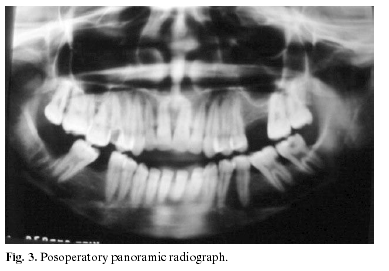
<body><![CDATA[<p>&nbsp; </p>     <p><b><font face="Verdana">Report of case</font> </p> </b>     <p><font face="Verdana" size="2">A 21 years-old black woman was referred to an oral surgeon to  have her third molar removed. At that time her chief complains were a mild pain in the area of the lower right third molar, a light swelling on the right side  of her face and a little difficulty to open her mouth wide. The oral surgeon  therefore prescribed analgesics and instructed her to do a better local hygiene.  After two weeks the patient was submitted to the surgical procedure. The  anesthesia of inferior alveolar nerve and the lingual nerve were made with 3  cartridges of 2% lidocaine with 1:200.000 epinephrine; a disposable regular  dental needle mounted on a dental syringe was used. Good anesthesia was achieved  in normal time and the molar was removed without difficulties. There was no sign  of facial paralysis at the end of the surgical procedure that could be noticed  by the patient or by the oral surgeon.</font> </p>     <p><font face="Verdana" size="2">After 4 hours her lips and tongue was in deep anesthesia. In  the morning after the surgery, the patient noticed that the right side of her  face was too heavy and couldn’t smile or wink or close her right eye with  maximal effort. During the same day the patient returned to the oral surgeon. He  noticed that the patient had lost the control of her right facial muscles; the  patient couldn’t close her eyes with maximal effort or smile symmetrically.  Therefore, he prescribed a vitamin B complex (CITANEURIN <sup>tm</sup>)  one tablet twice per day. After 3 days the patient stills complaining that her  eye waters and the corner of her mouth droops.</font></p>     <p><font face="Verdana" size="2">At the forth day the patient was referred to the service of  oral and maxillofacial surgery of the Oswaldo Cruz Hospital - Recife - Brazil.  On her the admission, physical examination showed that the patient could not  move the right side of her face normally or raise her right eyebrow or close  completely her right eye with effort (Fig. <a href="#f1"> 1</a> and <a href="#f2">2</a>); in the intra-oral  examination her right third molar region was healing quite normally. There was  no preceding retro-auricular pain, no deafness or hyperacusis, and no loss of  taste sensation in the tongue on her right side.</font></p>     <p align="center"><font face="Verdana" size="2"><a name="f1"><img border="0" src="/img/revistas/medicorpa/v11n2/17i.ht71.jpg" width="387" height="303"></a></font></p>     <p align="center"><font face="Verdana" size="2"><a name="f2"><img border="0" src="/img/revistas/medicorpa/v11n2/17i.ht72.jpg" width="388" height="312"></a></font></p>     <p><font face="Verdana" size="2">No herpetic vesicles were found and there was no fever. There  was no past history of facial paralysis following a dental procedure. A  panoramic radiography was taken and showed nothing uncommon (<a href="#f3">Fig. 3</a>).</font> </p>     <p align="center"><font face="Verdana" size="2"><a name="f3"><img border="0" src="/img/revistas/medicorpa/v11n2/17i.ht73.gif" width="389" height="271"></a></font> </p>     <p><font face="Verdana" size="2">A diagnosis of a moderately severe dysfunction of the seventh  cranial nerve or grade IV of the House-Brackmann grading system for facial  paralysis, due possibly to the local anesthetic injection, was made. The  treatment consisted of administration of a citidine and uridine complex (NÚCLEO  CMP <sup>tm</sup>) one tablet twice per day. Her oral surgeon was  consulted and he informed that the local anesthetic solution and the needle were  in condition of use and there was no complication during the surgical procedure.  During the first 3 weeks of follow up the patient showed a good recovery (grade  II of the House-Brackmann grading system). However, her facial nerve activity  was slowly responding. After three months of follow up the patient recovery from  the facial musculature paralysis (<a href="#f4">Fig. 4</a>).</font> </p>      ]]></body>
<body><![CDATA[<p align="center"><font face="Verdana" size="2"><a name="f4"><img border="0" src="/img/revistas/medicorpa/v11n2/17i.ht74.jpg" width="386" height="326"></a></font></p>  <b>     <p>&nbsp;</p>     <p><font face="Verdana">Discussion</font></p> </b>      <p><font face="Verdana" size="2">The incidence of postoperative paralysis of the facial or  damage to lingual and/or inferior alveolar nerves is described by many authors  (6-9). The literature describes different etiologies, such as: local anesthesia  (6,9), tooth extraction (3,4,6), infections (1,5), osteotomies, preprosthethic  procedures, excision of tumors or cysts, surgery of TMJ7,8 and surgical  treatment of facial fractures and cleft lip/palate (10).</font></p>     <p><font face="Verdana" size="2">Facial nerve paralysis may be central or peripheral in origin,  complete or incomplete. Its cause is varied and included trauma, tumor formation,  iatrogenic problems, idiopathic conditions, cerebral infarct, pseudobulbar palsy  and viruses. It results in a characteristic facial distortion that is determined  in part by the nerves branches involved (3,11). It is rarely a complication of  tooth extraction (3).</font> </p>     <p><font face="Verdana" size="2">The literature reports three mechanisms, in which a dental  procedure could damage a nervous structure: direct trauma to nerve from a needle,  intraneural hematoma formation or compression and local anesthetic toxicity  (3,9).</font></p>     <p><font face="Verdana" size="2">Direct trauma seems unlikely since many patients report  experiencing trauma to the nerve when they feel the electric shock sensation on  injection of the needle. However, virtually all these symptoms resolve  completely with no residual nerve damage (9). In addition, nerves such as the  inferior alveolar and lingual nerves are between 2 and 3 mm in diameter and  consist of a number of fascicles; in comparison, a 25 or 27 gauge local anesthetic  needle is smaller than 0.5mm in external diameter, and when it encounters a  nerve, its tendency is to separate the fascicles and pass between them (9).</font></p>      <p><font face="Verdana" size="2">In other hand the needle may hit one of the small blood  vessels running within the epineurium, causing hemorrhage within the nerve,  which results in compression and fibrosis. This compression could occur fairly  quickly (within 20 to 30 minutes) such that the damage will have taken place by  the time the local anesthetic would be expected to wear off. Thus, the patient  would be unaware of the increasing pressure on the nerve and the resulting  damage (9).</font></p>     <p><font face="Verdana" size="2">The literature reports a case of facial paralysis due to  infection, the most likely mechanism of facial nerve paralysis was compression  caused by an unusual swelling of the posterior auricular region. However  compression of the nerve alone is unlikely the sole cause because minimal  improvement in nerve function was noted despite early decompression through  incision and drainage. Similarly, toxicity is unlikely to be the only cause of  the paralysis, because only the frontal branch was involved. Although the exact  mechanism remains unknown, multiple factors were probably involved in causing  this unusual consequence of relatively common illness (6).</font></p>     <p><font face="Verdana" size="2">The facial paralysis as a complication of dental extraction,  it may result from direct tissue damage from a blast of air into the tissue with  dissection through the fascial spaces (3). Because of this potential, one should  not use forced air when cleaning an extraction site. Careful water irrigation  may accomplish the same task and minimize the risk of subcutaneous emphysema,  secondary infection and nerve injury. One should consider prescribing steroids  for the patient to decrease the edema and to provide neural membrane  stabilization once the examination has been completed and a diagnosis  established. Normally, nerve dysfunction was resolved within 1 week (5).</font></p>     ]]></body>
<body><![CDATA[<p><font face="Verdana" size="2">The literature describes a case of the recurrent peripheral  facial nerve palsy after dental procedures (4). In this report a patient had  unilateral facial paralysis on two separated occasions, each time within 24  hours of a dental procedure. 5 days earlier, 24 hours after extraction of the  left lower wisdom tooth, he had developed a left facial nerve palsy, which had  resolved within 2 weeks without any complication. Two years later he required  removal of the other three wisdom teeth and once again, within 24 hours of the  surgical procedure, he developed a typical left facial weakness and taste  dysfunction, identical to the previous episode, again lasting for less than 2  weeks with no sequelae. The exact mechanism to explain this facial weakness  after a dental procedure remains uncertain. Direct anesthesia of the facial  nerve has been proposed, since this could explain the rapid onset occurring at  the time when the anesthetic agent is being infused. Some authors, however,  consider this to be unlikely and cite the difficulty with which the facial nerve  can be anesthetized via the oral cavity. Furthermore, such local mechanisms  cannot explain the involvement of the upper divisions of the facial nerve and  the corda tympani or development of facial weakness when an upper tooth was  extracted. Reflex vasospasm of the branches of the external carotid artery due  to the stimulation of the sympathetic plexus, leading to ischemia of the facial  nerve. Alternatively, another pathway was observed by the literature: a  retrograde epidural compression edema with ischemia of the facial nerve is also  possible. Such a mechanism is consistent with the pathogenesis of idiopathic  Bell’s palsy where nerve compression in bony canal plays an important role in  the pathogenesis of facial paralysis (4).</font></p>     <p><font face="Verdana" size="2">The local anesthetic itself may be neurotoxic and may damage  the nerve. In fact, most local anesthetic is neurotoxic, although some present  more risks than others. Procaine and tetracaine cause more nerve damage than  bupivacaine or lidocaine, although lidocaine can also be neurotoxic. However,  neurotoxicity normally occurs only when the local anesthetic is injected  intrathecally, whereby it can cause the cauda equine syndrome or  intrafascicularly in high concentrations. Again, we could only expect  intrafascicular injections of local anesthetic to affect the skin or mucosal  area and sensory paramenters supplied by that fascicle and not the whole nerve.  Some researchers have also suggested alternative pathways for the breakdown of  commonly used local anesthetic agents, possibly resulting in the formation of  aromatic alcohols around the nerves, which may result in the equivalent of an  alcohol block that causes prolonged nerve damage (9).</font></p>     <p><font face="Verdana" size="2">There have been several attempts to grade facial palsy but  none have been universally accepted (12). The House and Brackmann grading system  has been recommend as a universal standard for assessing the degree of facial  palsy (12). Some authors studied this grading system and concluded that the  House and Brackmann grading system is a simple and robust method of assessing  facial function (12). Others compared the House and Brackmann and Yanagihara  grading system in relation to eletroneurographic (ENoG) technique in 30  consecutive patients with Bell’s palsy and concluded that the ENoG was more  accurate in predicting a favorable prognosis compared with clinical grading  (13). Initial Yanagihara grading appears to provide more prognostic information  than the House-Brackmann grading. However, the two clinical grading system  strongly resemble each other and comparable in the time course of Bell’s palsy.  The pattern of clinical grading and ENoG depends on the degree of palsy, which  in turn is depedent on the relation between neurapraxia and degeneration (13).</font></p>     <p><font face="Verdana" size="2">The literature reports a case of a peripheral facial nerve  paralysis after local dental anesthesia (2,6). The onset of the paralysis was 13  days after the injection. The treatment was made with triamcinolone, 4 mg four  times daily, for 10 days, with the dose being gradually reduced. The recovery  period was 4 weeks. This steroid therapy was done in this case to prevent  possible denervation of the facial muscles. Judging from the quit dramatic  recovery on the second day of medication and the subsequent full recovery, the  value of steroid therapy in this case was significant, but this author also  reports that the prognosis have been good in the reported cases treated without  or with steroids (2).</font> </p>     <p><font face="Verdana" size="2">Talzi, Soichot and Perrin report that the treatment of Bell’s  palsy is still controversial because the benefit of acyclovir has not been  definitively established. However, the safety of this antiherpetic drug combined  with prednisone and its possible effectiveness in improving facial functional  outcomes in patients with Bell’s palsy make most experts favor its use with  corticosteroids as soon as possible to treat patients with this disease (6).</font></p>     <p><font face="Verdana" size="2">In this presented case this temporary peripheral paralysis of  the facial nerve could be caused by the postoperative edema in the region of the  parotid gland or an alteration in the anesthetic solution. We could not say if  the recovery of paralysis was due to use of NUCLEO CMP, although was observed  that when the patient started to use the drug the recovery was abruptly.</font> </p>     <p>&nbsp; </p>     <p><b><font face="Verdana">References</font> </p> </b>     <!-- ref --><p><font face="Verdana" size="2">1. Gray RLM. Peripheral facial nerve paralysis of dental  origin. Br J Oral Surg 1978;16:143-50.</font>&nbsp;&nbsp;&nbsp;&nbsp;&nbsp;&nbsp;&nbsp;&nbsp;[&#160;<a href="javascript:void(0);" onclick="javascript: window.open('/scielo.php?script=sci_nlinks&ref=2947118&pid=S1698-6946200600020001700001&lng=','','width=640,height=500,resizable=yes,scrollbars=1,menubar=yes,');">Links</a>&#160;]<!-- end-ref --><!-- ref --><p><font face="Verdana" size="2">2. Ling KC. Peripheral facial nerve paralysis after local  dental anesthesia. Oral Surg Oral Med Oral Pathol 1985;60:23-4.</font>&nbsp;&nbsp;&nbsp;&nbsp;&nbsp;&nbsp;&nbsp;&nbsp;[&#160;<a href="javascript:void(0);" onclick="javascript: window.open('/scielo.php?script=sci_nlinks&ref=2947119&pid=S1698-6946200600020001700002&lng=','','width=640,height=500,resizable=yes,scrollbars=1,menubar=yes,');">Links</a>&#160;]<!-- end-ref --><!-- ref --><p><font face="Verdana" size="2">3. Burke RH, Adams JL. Immediate cranial nerve paralysis  during removal of a mandibular third molar. Oral Surg Oral Med Oral Pathol  1987;63:172-4.</font>&nbsp;&nbsp;&nbsp;&nbsp;&nbsp;&nbsp;&nbsp;&nbsp;[&#160;<a href="javascript:void(0);" onclick="javascript: window.open('/scielo.php?script=sci_nlinks&ref=2947120&pid=S1698-6946200600020001700003&lng=','','width=640,height=500,resizable=yes,scrollbars=1,menubar=yes,');">Links</a>&#160;]<!-- end-ref --><!-- ref --><p><font face="Verdana" size="2">4. Shuaib A, Lee MA. Recurrent peripheral facial nerve palsy  after dental procedures. Oral Surg Oral Med Oral Pathol 1990;70:738-40.</font>&nbsp;&nbsp;&nbsp;&nbsp;&nbsp;&nbsp;&nbsp;&nbsp;[&#160;<a href="javascript:void(0);" onclick="javascript: window.open('/scielo.php?script=sci_nlinks&ref=2947121&pid=S1698-6946200600020001700004&lng=','','width=640,height=500,resizable=yes,scrollbars=1,menubar=yes,');">Links</a>&#160;]<!-- end-ref --><!-- ref --><p><font face="Verdana" size="2">5. Bobbitt TD, Subach PF, Giordano LS, Carmony BR. Partial  facial nerve paralysis resulting from an infected mandibular third molar. J Oral  Maxillofac Surg 2000; 58:682-5.</font> &nbsp;&nbsp;&nbsp;&nbsp;&nbsp;&nbsp;&nbsp;&nbsp;[&#160;<a href="javascript:void(0);" onclick="javascript: window.open('/scielo.php?script=sci_nlinks&ref=2947122&pid=S1698-6946200600020001700005&lng=','','width=640,height=500,resizable=yes,scrollbars=1,menubar=yes,');">Links</a>&#160;]<!-- end-ref --><!-- ref --><p><font face="Verdana" size="2">6. Tazi M, Soichot P, Perrin D. Facial palsy following dental  extraction: report of 2 cases. J Oral Maxillofac Surg 2003;61:840-4.</font>&nbsp;&nbsp;&nbsp;&nbsp;&nbsp;&nbsp;&nbsp;&nbsp;[&#160;<a href="javascript:void(0);" onclick="javascript: window.open('/scielo.php?script=sci_nlinks&ref=2947123&pid=S1698-6946200600020001700006&lng=','','width=640,height=500,resizable=yes,scrollbars=1,menubar=yes,');">Links</a>&#160;]<!-- end-ref --><!-- ref --><p><font face="Verdana" size="2">7. Weinberg S, Kryshtalskyj B. Facial nerve function  following temporomandibular joint surgery using the preauricular approach. J  Oral Maxillofac Surg 1992;50:1048-51.</font>&nbsp;&nbsp;&nbsp;&nbsp;&nbsp;&nbsp;&nbsp;&nbsp;[&#160;<a href="javascript:void(0);" onclick="javascript: window.open('/scielo.php?script=sci_nlinks&ref=2947124&pid=S1698-6946200600020001700007&lng=','','width=640,height=500,resizable=yes,scrollbars=1,menubar=yes,');">Links</a>&#160;]<!-- end-ref --><!-- ref --><p><font face="Verdana" size="2">8. Hall MB, Brown RW, Lebowitz MS. Facial nerve injury during  surgery of the temporomandibular joint: a comparison of two dissection  techniques. J Oral Maxillofac Surg 1985;43:20-3.</font> &nbsp;&nbsp;&nbsp;&nbsp;&nbsp;&nbsp;&nbsp;&nbsp;[&#160;<a href="javascript:void(0);" onclick="javascript: window.open('/scielo.php?script=sci_nlinks&ref=2947125&pid=S1698-6946200600020001700008&lng=','','width=640,height=500,resizable=yes,scrollbars=1,menubar=yes,');">Links</a>&#160;]<!-- end-ref --><!-- ref --><p><font face="Verdana" size="2">9. Pogrel, MA, Bryan J, Regezi JA. Nerve damage associated  with inferior alveolar nerve blocks. J Am Dent Assoc 1995; 126:1150-5.</font> &nbsp;&nbsp;&nbsp;&nbsp;&nbsp;&nbsp;&nbsp;&nbsp;[&#160;<a href="javascript:void(0);" onclick="javascript: window.open('/scielo.php?script=sci_nlinks&ref=2947126&pid=S1698-6946200600020001700009&lng=','','width=640,height=500,resizable=yes,scrollbars=1,menubar=yes,');">Links</a>&#160;]<!-- end-ref --><!-- ref --><p><font face="Verdana" size="2">10. Akal UK, Sayan NB, Aydogan S, Yaman Z. Evaluation of the  neurosensory deficiencies of oral and maxillofacial region following surgery.  Int J Oral Maxillofac Surg 2000; 29:331-6.</font>&nbsp;&nbsp;&nbsp;&nbsp;&nbsp;&nbsp;&nbsp;&nbsp;[&#160;<a href="javascript:void(0);" onclick="javascript: window.open('/scielo.php?script=sci_nlinks&ref=2947127&pid=S1698-6946200600020001700010&lng=','','width=640,height=500,resizable=yes,scrollbars=1,menubar=yes,');">Links</a>&#160;]<!-- end-ref --><!-- ref --><p><font face="Verdana" size="2">11. Jackson CG, Doersten PG. The facial nerve-current trends  in diagnosis, treatment, and rehabilition. Medical Clinics of North America  1999;83:179-90.</font>&nbsp;&nbsp;&nbsp;&nbsp;&nbsp;&nbsp;&nbsp;&nbsp;[&#160;<a href="javascript:void(0);" onclick="javascript: window.open('/scielo.php?script=sci_nlinks&ref=2947128&pid=S1698-6946200600020001700011&lng=','','width=640,height=500,resizable=yes,scrollbars=1,menubar=yes,');">Links</a>&#160;]<!-- end-ref --><!-- ref --><p><font face="Verdana" size="2">12. Evans RA, Harries ML, Baguley DM, Moffat DA. Reliability  of the House and brackmann grading system for facial palsy. J Laryngol Otol  1989;103:1045-6.</font> &nbsp;&nbsp;&nbsp;&nbsp;&nbsp;&nbsp;&nbsp;&nbsp;[&#160;<a href="javascript:void(0);" onclick="javascript: window.open('/scielo.php?script=sci_nlinks&ref=2947129&pid=S1698-6946200600020001700012&lng=','','width=640,height=500,resizable=yes,scrollbars=1,menubar=yes,');">Links</a>&#160;]<!-- end-ref --><!-- ref --><p><font face="Verdana" size="2">13. Engstrom M, Jonsson L, Grindlund M, Stalberg E. House-Brackmann  and Yanagihara grading scores in relation to electroneurographic results in the  time course of Bell’s palsy. Acta Otolaryngol 1998;118:783-9.</font>&nbsp;&nbsp;&nbsp;&nbsp;&nbsp;&nbsp;&nbsp;&nbsp;[&#160;<a href="javascript:void(0);" onclick="javascript: window.open('/scielo.php?script=sci_nlinks&ref=2947130&pid=S1698-6946200600020001700013&lng=','','width=640,height=500,resizable=yes,scrollbars=1,menubar=yes,');">Links</a>&#160;]<!-- end-ref --><p>&nbsp;</p>     <p>&nbsp;</p>     <p><b><font face="Verdana" size="2"><a href="#top"><img border="0" src="/img/revistas/medicorpa/v11n2/seta.gif" width="15" height="17"></a> <a name="down">Correspondence    <br> </a></font></b><font face="Verdana" size="2">Dr. Belmiro Cavalcanti do Egito Vasconcelos    <br> University of Pernambuco    <br> Department of Oral and Maxillofacial Surgery    <br> Av. General Newton Cavalcanti 1650    <br> Camaragibe – Pernambuco – Brasil    <br> CP: 1028    ]]></body>
<body><![CDATA[<br> E-mail: <a href="mailto:belmiro@fop.upe.br">belmiro@fop.upe.br</a></font></p>     <p><font face="Verdana" size="2">Received: 30-09-2004    <br> Accepted: 25-03-2005</font> </p>      ]]></body><back>
<ref-list>
<ref id="B1">
<label>1</label><nlm-citation citation-type="journal">
<person-group person-group-type="author">
<name>
<surname><![CDATA[Gray]]></surname>
<given-names><![CDATA[RLM]]></given-names>
</name>
</person-group>
<article-title xml:lang="en"><![CDATA[Peripheral facial nerve paralysis of dental origin]]></article-title>
<source><![CDATA[Br J Oral Surg]]></source>
<year>1978</year>
<volume>16</volume>
<page-range>143-50</page-range></nlm-citation>
</ref>
<ref id="B2">
<label>2</label><nlm-citation citation-type="journal">
<person-group person-group-type="author">
<name>
<surname><![CDATA[Ling]]></surname>
<given-names><![CDATA[KC]]></given-names>
</name>
</person-group>
<article-title xml:lang="en"><![CDATA[Peripheral facial nerve paralysis after local dental anesthesia]]></article-title>
<source><![CDATA[Oral Surg Oral Med Oral Pathol]]></source>
<year>1985</year>
<volume>60</volume>
<page-range>23-4</page-range></nlm-citation>
</ref>
<ref id="B3">
<label>3</label><nlm-citation citation-type="journal">
<person-group person-group-type="author">
<name>
<surname><![CDATA[Burke]]></surname>
<given-names><![CDATA[RH]]></given-names>
</name>
<name>
<surname><![CDATA[Adams]]></surname>
<given-names><![CDATA[JL]]></given-names>
</name>
</person-group>
<article-title xml:lang="en"><![CDATA[Immediate cranial nerve paralysis during removal of a mandibular third molar]]></article-title>
<source><![CDATA[Oral Surg Oral Med Oral Pathol]]></source>
<year>1987</year>
<volume>63</volume>
<page-range>172-4</page-range></nlm-citation>
</ref>
<ref id="B4">
<label>4</label><nlm-citation citation-type="journal">
<person-group person-group-type="author">
<name>
<surname><![CDATA[Shuaib]]></surname>
<given-names><![CDATA[A]]></given-names>
</name>
<name>
<surname><![CDATA[Lee]]></surname>
<given-names><![CDATA[MA]]></given-names>
</name>
</person-group>
<article-title xml:lang="en"><![CDATA[Recurrent peripheral facial nerve palsy after dental procedures]]></article-title>
<source><![CDATA[Oral Surg Oral Med Oral Pathol]]></source>
<year>1990</year>
<volume>70</volume>
<page-range>738-40</page-range></nlm-citation>
</ref>
<ref id="B5">
<label>5</label><nlm-citation citation-type="journal">
<person-group person-group-type="author">
<name>
<surname><![CDATA[Bobbitt]]></surname>
<given-names><![CDATA[TD]]></given-names>
</name>
<name>
<surname><![CDATA[Subach]]></surname>
<given-names><![CDATA[PF]]></given-names>
</name>
<name>
<surname><![CDATA[Giordano]]></surname>
<given-names><![CDATA[LS]]></given-names>
</name>
<name>
<surname><![CDATA[Carmony]]></surname>
<given-names><![CDATA[BR]]></given-names>
</name>
</person-group>
<article-title xml:lang="en"><![CDATA[Partial facial nerve paralysis resulting from an infected mandibular third molar]]></article-title>
<source><![CDATA[J Oral Maxillofac Surg]]></source>
<year>2000</year>
<volume>58</volume>
<page-range>682-5</page-range></nlm-citation>
</ref>
<ref id="B6">
<label>6</label><nlm-citation citation-type="journal">
<person-group person-group-type="author">
<name>
<surname><![CDATA[Tazi]]></surname>
<given-names><![CDATA[M]]></given-names>
</name>
<name>
<surname><![CDATA[Soichot]]></surname>
<given-names><![CDATA[P]]></given-names>
</name>
<name>
<surname><![CDATA[Perrin]]></surname>
<given-names><![CDATA[D]]></given-names>
</name>
</person-group>
<article-title xml:lang="en"><![CDATA[Facial palsy following dental extraction: report of 2 cases]]></article-title>
<source><![CDATA[J Oral Maxillofac Surg]]></source>
<year>2003</year>
<volume>61</volume>
<page-range>840-4</page-range></nlm-citation>
</ref>
<ref id="B7">
<label>7</label><nlm-citation citation-type="journal">
<person-group person-group-type="author">
<name>
<surname><![CDATA[Weinberg]]></surname>
<given-names><![CDATA[S]]></given-names>
</name>
<name>
<surname><![CDATA[Kryshtalskyj]]></surname>
<given-names><![CDATA[B]]></given-names>
</name>
</person-group>
<article-title xml:lang="en"><![CDATA[Facial nerve function following temporomandibular joint surgery using the preauricular approach]]></article-title>
<source><![CDATA[J Oral Maxillofac Surg]]></source>
<year>1992</year>
<volume>50</volume>
<page-range>1048-51</page-range></nlm-citation>
</ref>
<ref id="B8">
<label>8</label><nlm-citation citation-type="journal">
<person-group person-group-type="author">
<name>
<surname><![CDATA[Hall]]></surname>
<given-names><![CDATA[MB]]></given-names>
</name>
<name>
<surname><![CDATA[Brown]]></surname>
<given-names><![CDATA[RW]]></given-names>
</name>
<name>
<surname><![CDATA[Lebowitz]]></surname>
<given-names><![CDATA[MS]]></given-names>
</name>
</person-group>
<article-title xml:lang="en"><![CDATA[Facial nerve injury during surgery of the temporomandibular joint: a comparison of two dissection techniques]]></article-title>
<source><![CDATA[J Oral Maxillofac Surg]]></source>
<year>1985</year>
<volume>43</volume>
<page-range>20-3</page-range></nlm-citation>
</ref>
<ref id="B9">
<label>9</label><nlm-citation citation-type="journal">
<person-group person-group-type="author">
<name>
<surname><![CDATA[Pogrel]]></surname>
<given-names><![CDATA[MA]]></given-names>
</name>
<name>
<surname><![CDATA[Bryan]]></surname>
<given-names><![CDATA[J]]></given-names>
</name>
<name>
<surname><![CDATA[Regezi]]></surname>
<given-names><![CDATA[JA]]></given-names>
</name>
</person-group>
<article-title xml:lang="en"><![CDATA[Nerve damage associated with inferior alveolar nerve blocks]]></article-title>
<source><![CDATA[J Am Dent Assoc]]></source>
<year>1995</year>
<volume>126</volume>
<page-range>1150-5</page-range></nlm-citation>
</ref>
<ref id="B10">
<label>10</label><nlm-citation citation-type="journal">
<person-group person-group-type="author">
<name>
<surname><![CDATA[Akal]]></surname>
<given-names><![CDATA[UK]]></given-names>
</name>
<name>
<surname><![CDATA[Sayan]]></surname>
<given-names><![CDATA[NB]]></given-names>
</name>
<name>
<surname><![CDATA[Aydogan]]></surname>
<given-names><![CDATA[S]]></given-names>
</name>
<name>
<surname><![CDATA[Yaman]]></surname>
<given-names><![CDATA[Z]]></given-names>
</name>
</person-group>
<article-title xml:lang="en"><![CDATA[Evaluation of the neurosensory deficiencies of oral and maxillofacial region following surgery]]></article-title>
<source><![CDATA[Int J Oral Maxillofac Surg]]></source>
<year>2000</year>
<volume>29</volume>
<page-range>331-6</page-range></nlm-citation>
</ref>
<ref id="B11">
<label>11</label><nlm-citation citation-type="journal">
<person-group person-group-type="author">
<name>
<surname><![CDATA[Jackson]]></surname>
<given-names><![CDATA[CG]]></given-names>
</name>
<name>
<surname><![CDATA[Doersten]]></surname>
<given-names><![CDATA[PG]]></given-names>
</name>
</person-group>
<article-title xml:lang="en"><![CDATA[The facial nerve-current trends in diagnosis, treatment, and rehabilition]]></article-title>
<source><![CDATA[Medical Clinics of North America]]></source>
<year>1999</year>
<volume>83</volume>
<page-range>179-90</page-range></nlm-citation>
</ref>
<ref id="B12">
<label>12</label><nlm-citation citation-type="journal">
<person-group person-group-type="author">
<name>
<surname><![CDATA[Evans]]></surname>
<given-names><![CDATA[RA]]></given-names>
</name>
<name>
<surname><![CDATA[Harries]]></surname>
<given-names><![CDATA[ML]]></given-names>
</name>
<name>
<surname><![CDATA[Baguley]]></surname>
<given-names><![CDATA[DM]]></given-names>
</name>
<name>
<surname><![CDATA[Moffat]]></surname>
<given-names><![CDATA[DA]]></given-names>
</name>
</person-group>
<article-title xml:lang="en"><![CDATA[Reliability of the House and brackmann grading system for facial palsy]]></article-title>
<source><![CDATA[J Laryngol Otol]]></source>
<year>1989</year>
<volume>103</volume>
<page-range>1045-6</page-range></nlm-citation>
</ref>
<ref id="B13">
<label>13</label><nlm-citation citation-type="journal">
<person-group person-group-type="author">
<name>
<surname><![CDATA[Engstrom]]></surname>
<given-names><![CDATA[M]]></given-names>
</name>
<name>
<surname><![CDATA[Jonsson]]></surname>
<given-names><![CDATA[L]]></given-names>
</name>
<name>
<surname><![CDATA[Grindlund]]></surname>
<given-names><![CDATA[M]]></given-names>
</name>
<name>
<surname><![CDATA[Stalberg]]></surname>
<given-names><![CDATA[E]]></given-names>
</name>
</person-group>
<article-title xml:lang="en"><![CDATA[House-Brackmann and Yanagihara grading scores in relation to electroneurographic results in the time course of Bell’s palsy]]></article-title>
<source><![CDATA[Acta Otolaryngol]]></source>
<year>1998</year>
<volume>118</volume>
<page-range>783-9</page-range></nlm-citation>
</ref>
</ref-list>
</back>
</article>