<?xml version="1.0" encoding="ISO-8859-1"?><article xmlns:mml="http://www.w3.org/1998/Math/MathML" xmlns:xlink="http://www.w3.org/1999/xlink" xmlns:xsi="http://www.w3.org/2001/XMLSchema-instance">
<front>
<journal-meta>
<journal-id>1698-6946</journal-id>
<journal-title><![CDATA[Medicina Oral, Patología Oral y Cirugía Bucal (Internet)]]></journal-title>
<abbrev-journal-title><![CDATA[Med. oral patol. oral cir.bucal (Internet)]]></abbrev-journal-title>
<issn>1698-6946</issn>
<publisher>
<publisher-name><![CDATA[Sociedad Española de Medicina Oral]]></publisher-name>
</publisher>
</journal-meta>
<article-meta>
<article-id>S1698-69462006000400001</article-id>
<title-group>
<article-title xml:lang="en"><![CDATA[Delayed contact sensitivity on the lips and oral mucosa due to propolis-case report]]></article-title>
</title-group>
<contrib-group>
<contrib contrib-type="author">
<name>
<surname><![CDATA[Brailo]]></surname>
<given-names><![CDATA[V.]]></given-names>
</name>
<xref ref-type="aff" rid="A01"/>
</contrib>
<contrib contrib-type="author">
<name>
<surname><![CDATA[Vucicevic Boras]]></surname>
<given-names><![CDATA[Vanja]]></given-names>
</name>
<xref ref-type="aff" rid="A01"/>
</contrib>
<contrib contrib-type="author">
<name>
<surname><![CDATA[Alajbeg]]></surname>
<given-names><![CDATA[I.]]></given-names>
</name>
<xref ref-type="aff" rid="A01"/>
</contrib>
<contrib contrib-type="author">
<name>
<surname><![CDATA[Vidovic Juras]]></surname>
<given-names><![CDATA[D.]]></given-names>
</name>
<xref ref-type="aff" rid="A01"/>
</contrib>
</contrib-group>
<aff id="A01">
<institution><![CDATA[,University of Zagred School of Dentistry Department of Oral Medicine]]></institution>
<addr-line><![CDATA[Zagreb ]]></addr-line>
<country>Croatia</country>
</aff>
<pub-date pub-type="pub">
<day>00</day>
<month>07</month>
<year>2006</year>
</pub-date>
<pub-date pub-type="epub">
<day>00</day>
<month>07</month>
<year>2006</year>
</pub-date>
<volume>11</volume>
<numero>4</numero>
<fpage>303</fpage>
<lpage>304</lpage>
<copyright-statement/>
<copyright-year/>
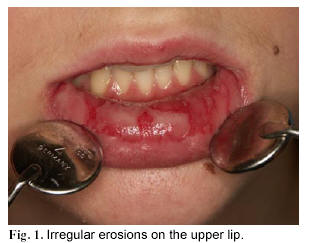
<self-uri xlink:href="http://scielo.isciii.es/scielo.php?script=sci_arttext&amp;pid=S1698-69462006000400001&amp;lng=en&amp;nrm=iso"></self-uri><self-uri xlink:href="http://scielo.isciii.es/scielo.php?script=sci_abstract&amp;pid=S1698-69462006000400001&amp;lng=en&amp;nrm=iso"></self-uri><self-uri xlink:href="http://scielo.isciii.es/scielo.php?script=sci_pdf&amp;pid=S1698-69462006000400001&amp;lng=en&amp;nrm=iso"></self-uri><abstract abstract-type="short" xml:lang="en"><p><![CDATA[We report a rare case of a patient who was referred to the Department of Oral medicine in Zagreb, Croatia. The patient was 20 years old, otherwise healthy and not taking any medication. She presented with irregular erosions partially covered with pseudomembranes that involved both lips and retrocomissural mucosa. Discrete erosion was also noticed on her lower lingual gingiva in the area 42. She reported a propolis solution self-medication for treatment of recurrent aphthous ulcers. After ten days of propolis application, lip and oral lesions developed. Patch test to propolis was proven. We highlight the fact that some folk medicine medications, such as propolis, although being known for many decades to be helpful in various conditions, in some individuals might lead to unwanted side-effects due to its antigenic potential. Additionally, every colleague, during the differential diagnosis of the oral lesions must bear in mind unwanted reactions to folk medicine products.]]></p></abstract>
<kwd-group>
<kwd lng="en"><![CDATA[Oral reaction]]></kwd>
<kwd lng="en"><![CDATA[propolis]]></kwd>
</kwd-group>
</article-meta>
</front><body><![CDATA[ <p align="right"><b><font face="Verdana" size="2"><a name="top"></a>ORAL MEDICINE AND PATHOLOGY</font></b></p>     <p align="right">&nbsp;</p>     <p align="left"><FONT SIZE="4" FACE="Verdana"><B>Delayed contact sensitivity on the lips and oral mucosa due to propolis-case report</B></FONT></p>     <p align="left">&nbsp;</p>     <p align="left">&nbsp;</p>     <p align="left"><FONT FACE="Verdana" SIZE="2"><B>V. Brailo, Vanja Vucicevic Boras, I. Alajbeg, Vidovic Juras D.</B></FONT></p>     <P><FONT FACE="Verdana" SIZE="2">Department of Oral medicine, School of Dentistry, University of Zagreb, Gunduliceva 5, Zagreb, Croatia</FONT></P>     <P><font face="Verdana" size="2"><a href="#back">Correspondence</a></font></P>     <P>&nbsp;</P>     <P>&nbsp;</P> <hr size="1">     ]]></body>
<body><![CDATA[<P><FONT FACE="Verdana" size="2"><B>ABSTRACT</B></FONT></P>     <P><FONT FACE="Verdana" SIZE="2">We report a rare case of a patient who was referred to the Department of Oral medicine in Zagreb, Croatia. The patient was 20 years old, otherwise healthy and not taking any medication. She presented with irregular erosions partially covered with pseudomembranes that involved both lips and retrocomissural mucosa. Discrete erosion was also noticed on her lower lingual gingiva in the area 42. She reported a propolis solution self-medication for treatment of recurrent aphthous ulcers. After ten days of propolis application, lip and oral lesions developed. Patch test to propolis was proven. We highlight the fact that some folk medicine medications, such as propolis, although being known for many decades to be helpful in various conditions, in some individuals might lead to unwanted side-effects due to its antigenic potential. Additionally, every colleague, during the differential diagnosis of the oral lesions must bear in mind unwanted reactions to folk medicine products.</FONT></P>     <P><FONT FACE="Verdana" SIZE="2"><B>Key words:</B> Oral reaction, propolis.</FONT></P> <hr size="1">      <P>&nbsp;</P>      <P>&nbsp;</P>      <P><FONT FACE="Verdana"><B>Introduction</B></FONT></P>      <P><FONT FACE="Verdana" SIZE="2">Propolis is a resinous product collected by honeybees and used in the construction of their nests. It has been used as a folk-medicine for more than than 2000 years and has been reported to exert a broad spectrum of biological functions including anti-inflammatory, antibiotic, antioxidant, antifungal and anticancer (1). Chemical composition of propolis depends on vegetation at the site of collection but the main constituents are terpenoids, steroids, flavonids, phenolic acids and their esters. However, it is also known as the potential allergen. Up to now, more than 180 propolis compounds have been identified and the most powerful sensitizers known are esters of the caffeic acid (phenylethyl caffeate and methylbutenyl caffeate). Additonally, other constituents like free aromatic acids, isoferulates and flavonids may play a role in propolis allergy (2, 3). Propolis allergy has been well documented throughout the literature and its frequency varies between 1.2 % as reported by Woehrl et al (4) up to 6.55% as reported by Rieder et al (5). Giusti et al (6) reported that 5.9% of patch tested children showed positive allergic reaction to propolis.</FONT></P>      <P><FONT FACE="Verdana" SIZE="2">We report an interesting case of delayed contact sensitivity developing on the lips and on the oral mucosa as a result of topical propolis use for the treatment of recurrent aphthous ulceration.</FONT></P>      <P>&nbsp;</P>      <P><FONT FACE="Verdana"><B>C</B></FONT><b><font face="Verdana">ase report</font></b></P>      ]]></body>
<body><![CDATA[<P><font face="Verdana" size="2">A female patient 20 years old was referred to our Department because of the lesions that were present on her lips and oral mucosa for one week. Clinical examination revealed irregular erosions partially covered with pseudomembranes that involved both lips and retrocomissural mucosa (<a href="#f1">Figure 1</a> and <a href="#f2">2</a>). Discrete erosion was also noticed on her lower lingual gingiva in the area 42. The eruption of lesions was not accompanied by any systemic symptoms and none of the other parts of the body were involved. Detailed medical history showed no systemic disease and medication intake, except that the patient occasionally suffers from recurrent aphthous ulceration. However, this time she reported self-prescribed topical use of propolis solution for the treatment of recurrent aphthous ulceration three weeks ago. Eruption of the lesions started 10 days after she began to use propolis solution. At our Department, the patient was advised to cease propolis use and was prescribed 0.05% bethamethasone dipropionate in orabase three times a day for the next 14 days. At the review, no lesions could be seen and we performed a patch test with the propolis solution that patient used. The propolis solution was mixed with orabase (Stomadhesive<sup>&reg;</sup>, ConvaTec Ltd) in its full concentration (first pacth) as well as diluted solution (50% of propolis solution, second patch) which were then applied on patient&#180;s forearm for the next 48 hours. Furthermore, pure orabase mixed with 0.9 % saline (third patch) and patch itself (fourth patch) were also applied to patients forearm in order to avoid possible misinterpretations of the test results that might have arisen due to orabase or patch glue allergy. After the patches were removed, a strong positive reaction beneath patch with propolis in full concentration was noticed. Other tested areas were all negative, and the diagnosis of delayed contact sensitivity was established.</font></P>      <P align="center"><a name="f1"> <img border="0" src="/img/revistas/medicorpa/v11n4/01.htm1.jpg" width="309" height="243"></a></P>     <P align="center"><a name="f2"> <img border="0" src="/img/revistas/medicorpa/v11n4/01.htm2.jpg" width="308" height="257"></a></P>     <P>&nbsp;</P>      <P><FONT FACE="Verdana"><B>Discussion</B></FONT></P>      <P><FONT FACE="Verdana" SIZE="2">Due to its therapeutic benefits propolis is very popular remedy in the folk medicine for the treatment of various oral conditions. Kiderman et al (7) reported beneficiary effect of the propolis treatment in an infant with eosinophilic ulcers. Recently, Feres et al (8) found in vitro that propolis has significant antimicrobial properties in the saliva of patients with periodontal disease. On the other hand, there are few reports its antigenicity on the oral mucosa. Fernandez et al (9) reported two cases of allergic stomatitis accompanied with labial oedema, dysphonia and dyspnoea after topical use of propolis solution and lozenges. Pasolini et al (10) described a patient who developed contact cheilitis due to intake of propolis enriched honey. Hay and Greig (11) reported a case of oral mucositis with ulceration in a patient who used propolis lozenges every day after dinner. This case report emphasizes antigenic potential of propolis and suggests that it should be used carefully as topical agent in the treatment of oral diseases. Also, it highlights the fact that propolis delayed contact sensitivity should be taken into account in the differential diagnosis of the oral lesions.</FONT></P>      <P>&nbsp;</P>      <P><FONT FACE="Verdana"><B>References</B></FONT></P>      <!-- ref --><P><FONT FACE="Verdana" SIZE="2">1. Castaldo S, Capasso F. Propolis, an old remedy used in modern medicine. Fitoterapia 2002;73:1-6.</FONT>&nbsp;&nbsp;&nbsp;&nbsp;&nbsp;&nbsp;&nbsp;&nbsp;[&#160;<a href="javascript:void(0);" onclick="javascript: window.open('/scielo.php?script=sci_nlinks&ref=2960709&pid=S1698-6946200600040000100001&lng=','','width=640,height=500,resizable=yes,scrollbars=1,menubar=yes,');">Links</a>&#160;]<!-- end-ref --><!-- ref --><P><FONT FACE="Verdana" SIZE="2">2. Fernandez SG, Aleman EA, Figueroa BE, Fagoaga EG, Rivera JM, Purroy AI. Direct and airborne contact dermatitis from propolis in beekeepers. Contact Dermatitis 2004;50:320-1.</FONT>&nbsp;&nbsp;&nbsp;&nbsp;&nbsp;&nbsp;&nbsp;&nbsp;[&#160;<a href="javascript:void(0);" onclick="javascript: window.open('/scielo.php?script=sci_nlinks&ref=2960710&pid=S1698-6946200600040000100002&lng=','','width=640,height=500,resizable=yes,scrollbars=1,menubar=yes,');">Links</a>&#160;]<!-- end-ref --><!-- ref --><P><FONT FACE="Verdana" SIZE="2">3. Hsu CY, Chiang WC, Weng TI, Chen WJ, Yuan A. Laryngeal edema and anaphylactic shock after topical propolis use for acute pharyngitis. Am J Emerg Med 2004;22:432-3.</FONT>&nbsp;&nbsp;&nbsp;&nbsp;&nbsp;&nbsp;&nbsp;&nbsp;[&#160;<a href="javascript:void(0);" onclick="javascript: window.open('/scielo.php?script=sci_nlinks&ref=2960711&pid=S1698-6946200600040000100003&lng=','','width=640,height=500,resizable=yes,scrollbars=1,menubar=yes,');">Links</a>&#160;]<!-- end-ref --><!-- ref --><P><FONT FACE="Verdana" SIZE="2">4. Woehrl S, Hemmer W, Focke M, Goetz M, Jarisch R. The significance of fragrance mix, balsam of Peru, colophony and propolis as screening tools in the detection of fragrance allergy. Br J Dermatol 2001;145:268-73.</FONT>&nbsp;&nbsp;&nbsp;&nbsp;&nbsp;&nbsp;&nbsp;&nbsp;[&#160;<a href="javascript:void(0);" onclick="javascript: window.open('/scielo.php?script=sci_nlinks&ref=2960712&pid=S1698-6946200600040000100004&lng=','','width=640,height=500,resizable=yes,scrollbars=1,menubar=yes,');">Links</a>&#160;]<!-- end-ref --><!-- ref --><P><FONT FACE="Verdana" SIZE="2">5. Rieder N, Komericki P, Hausen BM, Fritsch P, Aberer W. The seamy side of natural medicine: contact sensitisation to arnica (Arnica montana L.) and marigold (Calendula officinalis L.). Contact Dermatitis 2001;45:269-72.</FONT>&nbsp;&nbsp;&nbsp;&nbsp;&nbsp;&nbsp;&nbsp;&nbsp;[&#160;<a href="javascript:void(0);" onclick="javascript: window.open('/scielo.php?script=sci_nlinks&ref=2960713&pid=S1698-6946200600040000100005&lng=','','width=640,height=500,resizable=yes,scrollbars=1,menubar=yes,');">Links</a>&#160;]<!-- end-ref --><!-- ref --><P><FONT FACE="Verdana" SIZE="2">6. Giusti F, Miglietta R, Pepe P, Seidenari S. Sensitization to propolis in 1255 children undergoing patch testing. Contact Dermatitis 2004;51:255-8.</FONT>&nbsp;&nbsp;&nbsp;&nbsp;&nbsp;&nbsp;&nbsp;&nbsp;[&#160;<a href="javascript:void(0);" onclick="javascript: window.open('/scielo.php?script=sci_nlinks&ref=2960714&pid=S1698-6946200600040000100006&lng=','','width=640,height=500,resizable=yes,scrollbars=1,menubar=yes,');">Links</a>&#160;]<!-- end-ref --><!-- ref --><P><FONT FACE="Verdana" SIZE="2">7. Kiderman A, Torten R, Furst AL, Reinus K. Bilateral eosinophilic ulcers in an infant treated with propolis. J Derm T 2001;12:29-31.</FONT>&nbsp;&nbsp;&nbsp;&nbsp;&nbsp;&nbsp;&nbsp;&nbsp;[&#160;<a href="javascript:void(0);" onclick="javascript: window.open('/scielo.php?script=sci_nlinks&ref=2960715&pid=S1698-6946200600040000100007&lng=','','width=640,height=500,resizable=yes,scrollbars=1,menubar=yes,');">Links</a>&#160;]<!-- end-ref --><!-- ref --><P><FONT FACE="Verdana" SIZE="2">8. Feres M, Figueiredo LC, Barreto IM, Coelho MH, Araujo MW, Cortelli SC. In vitro antimicrobial activity of plant extracts and propolis in saliva samples of healthy and periodontally-involved subjects. J Int Acad Periodontol 2005;7:90-6.</FONT>&nbsp;&nbsp;&nbsp;&nbsp;&nbsp;&nbsp;&nbsp;&nbsp;[&#160;<a href="javascript:void(0);" onclick="javascript: window.open('/scielo.php?script=sci_nlinks&ref=2960716&pid=S1698-6946200600040000100008&lng=','','width=640,height=500,resizable=yes,scrollbars=1,menubar=yes,');">Links</a>&#160;]<!-- end-ref --><!-- ref --><P><FONT FACE="Verdana" SIZE="2">9. Fernandez SG, Luaces EL, Madoz SE, Aleman EA, Apinaniz MA, Purroy AI. Allergic contact stomatitis due to therapeutic propolis. Contact Dermatitis 2004;50:321.</FONT>&nbsp;&nbsp;&nbsp;&nbsp;&nbsp;&nbsp;&nbsp;&nbsp;[&#160;<a href="javascript:void(0);" onclick="javascript: window.open('/scielo.php?script=sci_nlinks&ref=2960717&pid=S1698-6946200600040000100009&lng=','','width=640,height=500,resizable=yes,scrollbars=1,menubar=yes,');">Links</a>&#160;]<!-- end-ref --><!-- ref --><P><FONT FACE="Verdana" SIZE="2">10. Pasolini G, Semenza D, Capazera R, Sala R, Zane C, Rodell R, et al. Allergic contact cheilitis induced by contact with propolis-enriched honey. Contact Dermatitis 2004; 50:322-3.</FONT>&nbsp;&nbsp;&nbsp;&nbsp;&nbsp;&nbsp;&nbsp;&nbsp;[&#160;<a href="javascript:void(0);" onclick="javascript: window.open('/scielo.php?script=sci_nlinks&ref=2960718&pid=S1698-6946200600040000100010&lng=','','width=640,height=500,resizable=yes,scrollbars=1,menubar=yes,');">Links</a>&#160;]<!-- end-ref --><!-- ref --><P><FONT FACE="Verdana" SIZE="2">11. Hay KD, Greig DE. Propolis allergy: a cause of oral mucositis with ulceration. Oral Surg Oral Med Oral Pathol 1990;70:584-6.</FONT>&nbsp;&nbsp;&nbsp;&nbsp;&nbsp;&nbsp;&nbsp;&nbsp;[&#160;<a href="javascript:void(0);" onclick="javascript: window.open('/scielo.php?script=sci_nlinks&ref=2960719&pid=S1698-6946200600040000100011&lng=','','width=640,height=500,resizable=yes,scrollbars=1,menubar=yes,');">Links</a>&#160;]<!-- end-ref --><P>&nbsp;</P>      ]]></body>
<body><![CDATA[<P>&nbsp;</P>      <P><FONT FACE="Verdana" SIZE="2"><b><a name="back" href="#top"><img border="0" src="/img/revistas/medicorpa/v11n4/seta.gif" width="15" height="17"></a>   Correspondence:</b>    <br> Vanja VucicevicBoras    <br> Department of Oral medicine    <br> School of Dentistry    <br> University of Queensland    <br> 200 Turbot street    <br> Brisbane, 4000 QLD    <br> Australia    <br> E-mail: <a href="mailto:borasvanja@yahoo.com">borasvanja@yahoo.com</a></FONT></P>      ]]></body>
<body><![CDATA[<P><font face="Verdana" size="2">Received: 9-10-2005    <br>Accepted: 16-11-2005</font></P>      ]]></body><back>
<ref-list>
<ref id="B1">
<label>1</label><nlm-citation citation-type="journal">
<person-group person-group-type="author">
<name>
<surname><![CDATA[Castaldo]]></surname>
<given-names><![CDATA[S]]></given-names>
</name>
<name>
<surname><![CDATA[Capasso]]></surname>
<given-names><![CDATA[F]]></given-names>
</name>
</person-group>
<article-title xml:lang="en"><![CDATA[Propolis, an old remedy used in modern medicine]]></article-title>
<source><![CDATA[Fitoterapia]]></source>
<year>2002</year>
<volume>73</volume>
<page-range>1-6</page-range></nlm-citation>
</ref>
<ref id="B2">
<label>2</label><nlm-citation citation-type="journal">
<person-group person-group-type="author">
<name>
<surname><![CDATA[Fernandez]]></surname>
<given-names><![CDATA[SG]]></given-names>
</name>
<name>
<surname><![CDATA[Aleman]]></surname>
<given-names><![CDATA[EA]]></given-names>
</name>
<name>
<surname><![CDATA[Figueroa]]></surname>
<given-names><![CDATA[BE]]></given-names>
</name>
<name>
<surname><![CDATA[Fagoaga]]></surname>
<given-names><![CDATA[EG]]></given-names>
</name>
<name>
<surname><![CDATA[Rivera]]></surname>
<given-names><![CDATA[JM]]></given-names>
</name>
<name>
<surname><![CDATA[Purroy]]></surname>
<given-names><![CDATA[AI]]></given-names>
</name>
</person-group>
<article-title xml:lang="en"><![CDATA[Direct and airborne contact dermatitis from propolis in beekeepers]]></article-title>
<source><![CDATA[Contact Dermatitis]]></source>
<year>2004</year>
<volume>50</volume>
<page-range>320-1</page-range></nlm-citation>
</ref>
<ref id="B3">
<label>3</label><nlm-citation citation-type="journal">
<person-group person-group-type="author">
<name>
<surname><![CDATA[Hsu]]></surname>
<given-names><![CDATA[CY]]></given-names>
</name>
<name>
<surname><![CDATA[Chiang]]></surname>
<given-names><![CDATA[WC]]></given-names>
</name>
<name>
<surname><![CDATA[Weng]]></surname>
<given-names><![CDATA[TI]]></given-names>
</name>
<name>
<surname><![CDATA[Chen]]></surname>
<given-names><![CDATA[WJ]]></given-names>
</name>
<name>
<surname><![CDATA[Yuan]]></surname>
<given-names><![CDATA[A]]></given-names>
</name>
</person-group>
<article-title xml:lang="en"><![CDATA[Laryngeal edema and anaphylactic shock after topical propolis use for acute pharyngitis]]></article-title>
<source><![CDATA[Am J Emerg Med]]></source>
<year>2004</year>
<volume>22</volume>
<page-range>432-3</page-range></nlm-citation>
</ref>
<ref id="B4">
<label>4</label><nlm-citation citation-type="journal">
<person-group person-group-type="author">
<name>
<surname><![CDATA[Woehrl]]></surname>
<given-names><![CDATA[S]]></given-names>
</name>
<name>
<surname><![CDATA[Hemmer]]></surname>
<given-names><![CDATA[W]]></given-names>
</name>
<name>
<surname><![CDATA[Focke]]></surname>
<given-names><![CDATA[M]]></given-names>
</name>
<name>
<surname><![CDATA[Goetz]]></surname>
<given-names><![CDATA[M]]></given-names>
</name>
<name>
<surname><![CDATA[Jarisch]]></surname>
<given-names><![CDATA[R]]></given-names>
</name>
</person-group>
<article-title xml:lang="en"><![CDATA[The significance of fragrance mix, balsam of Peru, colophony and propolis as screening tools in the detection of fragrance allergy]]></article-title>
<source><![CDATA[Br J Dermatol]]></source>
<year>2001</year>
<volume>145</volume>
<page-range>268-73</page-range></nlm-citation>
</ref>
<ref id="B5">
<label>5</label><nlm-citation citation-type="journal">
<person-group person-group-type="author">
<name>
<surname><![CDATA[Rieder]]></surname>
<given-names><![CDATA[N]]></given-names>
</name>
<name>
<surname><![CDATA[Komericki]]></surname>
<given-names><![CDATA[P]]></given-names>
</name>
<name>
<surname><![CDATA[Hausen]]></surname>
<given-names><![CDATA[BM]]></given-names>
</name>
<name>
<surname><![CDATA[Fritsch]]></surname>
<given-names><![CDATA[P]]></given-names>
</name>
<name>
<surname><![CDATA[Aberer]]></surname>
<given-names><![CDATA[W]]></given-names>
</name>
</person-group>
<article-title xml:lang="en"><![CDATA[The seamy side of natural medicine: contact sensitisation to arnica (Arnica montana L.) and marigold (Calendula officinalis L.).]]></article-title>
<source><![CDATA[Contact Dermatitis]]></source>
<year>2001</year>
<volume>45</volume>
<page-range>269-72</page-range></nlm-citation>
</ref>
<ref id="B6">
<label>6</label><nlm-citation citation-type="journal">
<person-group person-group-type="author">
<name>
<surname><![CDATA[Giusti]]></surname>
<given-names><![CDATA[F]]></given-names>
</name>
<name>
<surname><![CDATA[Miglietta]]></surname>
<given-names><![CDATA[R]]></given-names>
</name>
<name>
<surname><![CDATA[Pepe]]></surname>
<given-names><![CDATA[P]]></given-names>
</name>
<name>
<surname><![CDATA[Seidenari]]></surname>
<given-names><![CDATA[S]]></given-names>
</name>
</person-group>
<article-title xml:lang="en"><![CDATA[Sensitization to propolis in 1255 children undergoing patch testing]]></article-title>
<source><![CDATA[Contact Dermatitis]]></source>
<year>2004</year>
<volume>51</volume>
<page-range>255-8</page-range></nlm-citation>
</ref>
<ref id="B7">
<label>7</label><nlm-citation citation-type="journal">
<person-group person-group-type="author">
<name>
<surname><![CDATA[Kiderman]]></surname>
<given-names><![CDATA[A]]></given-names>
</name>
<name>
<surname><![CDATA[Torten]]></surname>
<given-names><![CDATA[R]]></given-names>
</name>
<name>
<surname><![CDATA[Furst]]></surname>
<given-names><![CDATA[AL]]></given-names>
</name>
<name>
<surname><![CDATA[Reinus]]></surname>
<given-names><![CDATA[K]]></given-names>
</name>
</person-group>
<article-title xml:lang="en"><![CDATA[Bilateral eosinophilic ulcers in an infant treated with propolis]]></article-title>
<source><![CDATA[J Derm T]]></source>
<year>2001</year>
<volume>12</volume>
<page-range>29-31</page-range></nlm-citation>
</ref>
<ref id="B8">
<label>8</label><nlm-citation citation-type="journal">
<person-group person-group-type="author">
<name>
<surname><![CDATA[Feres]]></surname>
<given-names><![CDATA[M]]></given-names>
</name>
<name>
<surname><![CDATA[Figueiredo]]></surname>
<given-names><![CDATA[LC]]></given-names>
</name>
<name>
<surname><![CDATA[Barreto]]></surname>
<given-names><![CDATA[IM]]></given-names>
</name>
<name>
<surname><![CDATA[Coelho]]></surname>
<given-names><![CDATA[MH]]></given-names>
</name>
<name>
<surname><![CDATA[Araujo]]></surname>
<given-names><![CDATA[MW]]></given-names>
</name>
<name>
<surname><![CDATA[Cortelli]]></surname>
<given-names><![CDATA[SC]]></given-names>
</name>
</person-group>
<article-title xml:lang="en"><![CDATA[In vitro antimicrobial activity of plant extracts and propolis in saliva samples of healthy and periodontally-involved subjects]]></article-title>
<source><![CDATA[J Int Acad Periodontol]]></source>
<year>2005</year>
<volume>7</volume>
<page-range>90-6</page-range></nlm-citation>
</ref>
<ref id="B9">
<label>9</label><nlm-citation citation-type="journal">
<person-group person-group-type="author">
<name>
<surname><![CDATA[Fernandez]]></surname>
<given-names><![CDATA[SG]]></given-names>
</name>
<name>
<surname><![CDATA[Luaces]]></surname>
<given-names><![CDATA[EL]]></given-names>
</name>
<name>
<surname><![CDATA[Madoz]]></surname>
<given-names><![CDATA[SE]]></given-names>
</name>
<name>
<surname><![CDATA[Aleman]]></surname>
<given-names><![CDATA[EA]]></given-names>
</name>
<name>
<surname><![CDATA[Apinaniz]]></surname>
<given-names><![CDATA[MA]]></given-names>
</name>
<name>
<surname><![CDATA[Purroy]]></surname>
<given-names><![CDATA[AI]]></given-names>
</name>
</person-group>
<article-title xml:lang="en"><![CDATA[Allergic contact stomatitis due to therapeutic propolis]]></article-title>
<source><![CDATA[Contact Dermatitis]]></source>
<year>2004</year>
<volume>50</volume>
<page-range>321</page-range></nlm-citation>
</ref>
<ref id="B10">
<label>10</label><nlm-citation citation-type="journal">
<person-group person-group-type="author">
<name>
<surname><![CDATA[Pasolini]]></surname>
<given-names><![CDATA[G]]></given-names>
</name>
<name>
<surname><![CDATA[Semenza]]></surname>
<given-names><![CDATA[D]]></given-names>
</name>
<name>
<surname><![CDATA[Capazera]]></surname>
<given-names><![CDATA[R]]></given-names>
</name>
<name>
<surname><![CDATA[Sala]]></surname>
<given-names><![CDATA[R]]></given-names>
</name>
<name>
<surname><![CDATA[Zane]]></surname>
<given-names><![CDATA[C]]></given-names>
</name>
<name>
<surname><![CDATA[Rodell]]></surname>
<given-names><![CDATA[R]]></given-names>
</name>
</person-group>
<article-title xml:lang="en"><![CDATA[Allergic contact cheilitis induced by contact with propolis-enriched honey]]></article-title>
<source><![CDATA[Contact Dermatitis]]></source>
<year>2004</year>
<volume>50</volume>
<page-range>322-3</page-range></nlm-citation>
</ref>
<ref id="B11">
<label>11</label><nlm-citation citation-type="journal">
<person-group person-group-type="author">
<name>
<surname><![CDATA[Hay]]></surname>
<given-names><![CDATA[KD]]></given-names>
</name>
<name>
<surname><![CDATA[Greig]]></surname>
<given-names><![CDATA[DE]]></given-names>
</name>
</person-group>
<article-title xml:lang="en"><![CDATA[Propolis allergy: a cause of oral mucositis with ulceration]]></article-title>
<source><![CDATA[Oral Surg Oral Med Oral Pathol]]></source>
<year>1990</year>
<volume>70</volume>
<page-range>584-6</page-range></nlm-citation>
</ref>
</ref-list>
</back>
</article>
