<?xml version="1.0" encoding="ISO-8859-1"?><article xmlns:mml="http://www.w3.org/1998/Math/MathML" xmlns:xlink="http://www.w3.org/1999/xlink" xmlns:xsi="http://www.w3.org/2001/XMLSchema-instance">
<front>
<journal-meta>
<journal-id>1698-6946</journal-id>
<journal-title><![CDATA[Medicina Oral, Patología Oral y Cirugía Bucal (Internet)]]></journal-title>
<abbrev-journal-title><![CDATA[Med. oral patol. oral cir.bucal (Internet)]]></abbrev-journal-title>
<issn>1698-6946</issn>
<publisher>
<publisher-name><![CDATA[Sociedad Española de Medicina Oral]]></publisher-name>
</publisher>
</journal-meta>
<article-meta>
<article-id>S1698-69462006000400010</article-id>
<title-group>
<article-title xml:lang="en"><![CDATA[Stafne bone cavity: Magnetic resonance imaging]]></article-title>
</title-group>
<contrib-group>
<contrib contrib-type="author">
<name>
<surname><![CDATA[Segev]]></surname>
<given-names><![CDATA[Yoram]]></given-names>
</name>
<xref ref-type="aff" rid="A01"/>
</contrib>
<contrib contrib-type="author">
<name>
<surname><![CDATA[Puterman]]></surname>
<given-names><![CDATA[Max]]></given-names>
</name>
<xref ref-type="aff" rid="A02"/>
</contrib>
<contrib contrib-type="author">
<name>
<surname><![CDATA[Bodner]]></surname>
<given-names><![CDATA[Lipa]]></given-names>
</name>
<xref ref-type="aff" rid="A01"/>
</contrib>
</contrib-group>
<aff id="A01">
<institution><![CDATA[,Soroka University Medical Center Department of Oral and Maxillofacial Surgery ]]></institution>
<addr-line><![CDATA[ ]]></addr-line>
</aff>
<aff id="A02">
<institution><![CDATA[,Soroka University Medical Center Department of Otolaryngology Head and Neack Surgery ]]></institution>
<addr-line><![CDATA[ ]]></addr-line>
</aff>
<pub-date pub-type="pub">
<day>00</day>
<month>07</month>
<year>2006</year>
</pub-date>
<pub-date pub-type="epub">
<day>00</day>
<month>07</month>
<year>2006</year>
</pub-date>
<volume>11</volume>
<numero>4</numero>
<fpage>345</fpage>
<lpage>347</lpage>
<copyright-statement/>
<copyright-year/>
<self-uri xlink:href="http://scielo.isciii.es/scielo.php?script=sci_arttext&amp;pid=S1698-69462006000400010&amp;lng=en&amp;nrm=iso"></self-uri><self-uri xlink:href="http://scielo.isciii.es/scielo.php?script=sci_abstract&amp;pid=S1698-69462006000400010&amp;lng=en&amp;nrm=iso"></self-uri><self-uri xlink:href="http://scielo.isciii.es/scielo.php?script=sci_pdf&amp;pid=S1698-69462006000400010&amp;lng=en&amp;nrm=iso"></self-uri><abstract abstract-type="short" xml:lang="en"><p><![CDATA[A case of Stafne bone cavity (SBC) affecting the body of the mandible of a 51-year-old female is reported. The imaging modalities included panoramic radiograph, computed tomography (CT) and magnetic resonance (MR) imaging. Panoramic radiograph and CT were able to determine the outline of the cavity and its three dimentional shape, but failed to precisely diagnose the soft tissue content of the cavity. MR imaging demonstrated that the bony cavity is filled with soft tissue that is continuous and identical in signal with that of the submandibular salivary gland. Based on the MR imaging a diagnosis of SBC was made and no further studies or surgical treatment were initated. MR imaging should be considered the diagnostic technique in cases where SBC is suspected. Recognition of the lesion should preclude any further treatment or surgical exploration.]]></p></abstract>
<kwd-group>
<kwd lng="en"><![CDATA[Mandible]]></kwd>
<kwd lng="en"><![CDATA[lingual bone cavity]]></kwd>
<kwd lng="en"><![CDATA[Stafne bone cavity]]></kwd>
<kwd lng="en"><![CDATA[CT]]></kwd>
<kwd lng="en"><![CDATA[MR]]></kwd>
<kwd lng="en"><![CDATA[imaging]]></kwd>
</kwd-group>
</article-meta>
</front><body><![CDATA[   <b><font FACE="Verdana" SIZE="2">     <p ALIGN="right"><a name="TOP"></a>ORAL SURGERY</p>     <p ALIGN="right">&nbsp;</p>     <p ALIGN="left"></font><font FACE="Verdana" SIZE="4">Stafne bone cavity – Magnetic resonance imaging</p>     <p ALIGN="left">&nbsp;</p>     <p ALIGN="left">&nbsp;</p>     <p ALIGN="left"></font><font FACE="Verdana" SIZE="2">Yoram Segev<sup>1</sup>, Max Puterman<sup>2</sup>, Lipa  Bodner<sup>3</p> </sup> </font></b><font FACE="Verdana"> </font><font FACE="Verdana" SIZE="2">     <p><sup>1</sup>Senior Staff, Department of Diagnostic Radiology <sup>    <br> 2</sup>Senior Lecturer , Department of Otolaryngology  Head and Neack Surgery <sup>    <br> 3</sup>Associate Professor and Chairman, Department of Oral and  Maxillofacial Surgery,&nbsp;    ]]></body>
<body><![CDATA[<br>  Soroka University Medical Center and Ben Gurion  University of the Negev, Beer-Sheva , Israel</p> </font><font FACE="Verdana" SIZE="1"> <font SIZE="2">     <p><a href="#back">Correspondence</a></p>     <p>&nbsp;</p>     <p>&nbsp;</p>     <p>&nbsp;</p> <hr size="1"><b>     <p>ABSTRACT</p> </b>     <p>A case of Stafne bone cavity (SBC) affecting the body of the  mandible of a 51-year-old female is reported. The imaging modalities included  panoramic radiograph, computed tomography (CT) and magnetic resonance (MR)  imaging.     <br> Panoramic radiograph and CT were able to determine the  outline of the cavity and its three dimentional shape, but failed to precisely  diagnose the soft tissue content of the cavity. MR imaging demonstrated that the  bony cavity is filled with soft tissue that is continuous and identical in  signal with that of the submandibular salivary gland.     <br> Based on the MR imaging a diagnosis of SBC was made and no  further studies or surgical treatment were initated. MR imaging should be  considered the diagnostic technique in cases where SBC is suspected. Recognition  of the lesion should preclude any further treatment or surgical exploration.</p> <b>     <p>Key words:</b> Mandible, lingual bone cavity, Stafne bone cavity, CT, MR,  imaging. </p>  </font> </font><font FACE="Verdana" SIZE="2"> <hr size="1"> </font><font FACE="Verdana">     ]]></body>
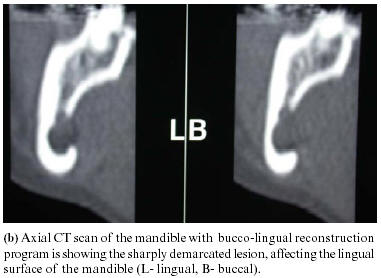
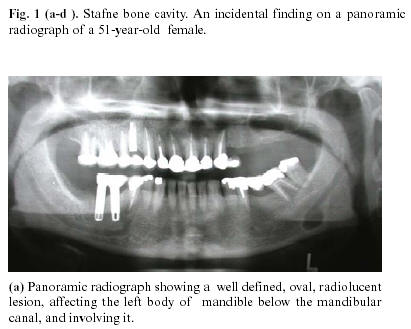
<body><![CDATA[<p>&nbsp;</p>     <p>&nbsp;</p>     <p><b> Introduction</p> </b> </font><font FACE="Verdana" SIZE="2">     <p>Stafne bone cavity (SBC), also known as lingual mandibular  bone defect , is a bony cavity of the mandible containing salivary gland. This  cavity has a cystlike appearance on plain film radiographs. It was described for  the first time by in 1942 by Stafne, who reported on 35 cases appearing as round  or ovoid, well-defined, unilocular radiolucencies, located below the mandibular  canal, between the first molar and the angle of the mandible. A SBC is usually  an asymptomatic incidental radiologic findings, and mostly affect males in the  their fifth to seventh decade of life. Surgical exploration has shown salivary  gland tissue in the concavity , often in continuity with the submandibular gland  (1,2). There has been some debate regarding the nature of the lesion,whether a  congenital or a developmental in origin (3,4). </p>     <p>Although the radiologic features of SBC have been widely  reported , these include mainly the plain film and CT appearance. The MR imaging  has been reported only scarcely (5-7) . The purpose of the present report is to  describe a case occuring in the body of mandible with focus on the role of MR  imaging in establishment of the final diagnosis.</font></p>     <p>&nbsp;</p>     <p><font FACE="Verdana"><b>Report of Case</p> </b> </font><font FACE="Verdana" SIZE="2">     <p>A 51-year-old female was referred by her dentist with an  asymptomatic&quot;lesion&quot; in the mandible, discovered incidentally on a panoramic  radiograph done for routine dental treatment. There was no previous trauma to  the mandible or contributory medical history. Extraoral and intraoral  examination revealed no remarkable findings. </p>     <p>There was no cervical lymphadenopathy and the laboratory data  were unremarkable. </p>     <p>Panoramic radiograph revealed a unilocular, oval radiolucent  lesion with well defined sclerotic borders, situated at the second and third molar  region, below the mandibular canal. The cortical outline of the mandibular canal  was clearly visible anterior and posterior to the lesion, with no sign of  displacement. (<a href="#f1a">Fig 1a</a>). Axial CT scan of the mandible with bucco-lingual  reconstruction program (DentaScan, General Electric, Milwaukee, USA), revealed  discontinuity in the lingual cortex and some erosion in the buccal cortex (<a href="#f1b">Fig  1b</a>). The content of the lesion appeared to be a soft tissue mass. </p>     ]]></body>
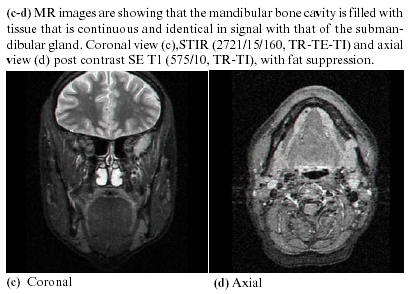
<body><![CDATA[<p align="center"> <a name="f1a"><img border="0" src="/img/revistas/medicorpa/v11n4/10i.ht1.jpg" width="411" height="329"></a></p>     <p align="center"><a name="f1b"><img border="0" src="/img/revistas/medicorpa/v11n4/10i.ht2.jpg" width="381" height="278"></a></p>     <p align="center"><a name="f1cd"> <img border="0" src="/img/revistas/medicorpa/v11n4/10i.ht3.jpg" width="413" height="294"></a></p>     <p>&nbsp; </p>     <p>MR imaging of the mandible disclosed that the bone cavity is  filled with soft tissue that is continuous and identical in signal with that of  the submandibular gland.This could be seen in all types of sequences and in  various plains (Fig <a href="#f1cd">1c</a>, <a href="#f1cd">1d</a>). A diagnosis of SBC was made and no further  investigations or therapy were initiated. </p>     <p>&nbsp; </p>     <p></font><b><font FACE="Verdana">Discussion </p> </font> </b><font FACE="Verdana" SIZE="2">     <p>The SBC was first discribed by Stafne in 1942. Since then  numerous cases of the entitiy have been reported (1,2,5,8-12). The exact  pathogenesis is still obscure. Stafne suggested that the cavity could result  from a failure of normal bone deposition in the region formely occupied by  cartilage (1,8). However, the most widely accepted view is that the cavities  develop as a result of a localized pressure atrophy of the lingual surface of  the mandible from the adjacent salivary gland (9).</p>     <p>This theory is supported by findings of radiolicencies in  association with both submandibular and sublingual salivary glands (10).  Surgical series, following exploration of the mandibular bony defect, have noted  salivary tissue within the bony defect, however, non salivary tissue, such as  lymphatic tissue, muscle and blood vessels have also been reported . The non  salivary gland tissue findings in the surgical reports may be explained by  intermitted gland herniation, regression of the herniated gland or surgical  disruption of the cavity content (13).Most reports on SBC, are case reports and  have discussed their findings on intraoral dental films, plain films of the  mandible or pamoramic radiographs. Although these imaging techniques may be  sufficient for diagnosis in some cases, they may not be enough for a definitive  diagnosis in many other cases, especially, where the lesion is atypical, such as  lobulated , incomplete sclerotic margins, multiple, or unusual location(6,13). </p>     <p>The differential diagnosis of SBC includes benign and  malignant jaw lesions such as: odontogenic cystic lesion, nonossifying fibroma,  fibrous displasia, vascular malformation, focal osteoporotic bone marrow defect,  brown tumor of hyperparathyroidism, ameloblastoma, basal cell nevus syndrom,  giant cell tumor or a metastasis from a primary malignant tumor . Therefore, in  some cases more confirmatory diagnostic tools are mandatory. Sialography is able  to depict salivary tissue in the bony cavity and has been used to confirm the  diagnosis (14). However, there were case reports of surgically proved SBC with  negative results in sialography (15). </p>     ]]></body>
<body><![CDATA[<p>Some CT evaluations of SBC were able to show salivary tissue  within the bone defect (14,16, 17). </p>      <p>The fact that CT is more specific to bone lesions of the jaws  and much less so to soft tissue have led some outhors to advocate MR imaging as  the primary diagnostic technique (5-7). Some authors however, have advocated MR  imaging only after they had exposed their patients to unnecessary surgical  exploration (5,6). The main advantage of MR imaging is its superior soft tissue  characterization and discrimination. The superior soft tissue contrast of MR  imaging should be adequate to make the diagnosis of SBC, even without any  intravenous contrast material. Its major disadvantage is the high cost and the  distortion artifacts produced by dental material. Branstetter et al (7) were the  first to establish a diagnosis of SBC merely on MR imaging with no further  treatment. Our case is apparantly the second one. In the present case MR imaging  was performed only after panoramic radiograph and Dental CT scan were unable to  establish a precise diagnosis, regarding the content of the bony cavity. MR  imaging , by demonstrating that the cavity is occupued by extension of the  submandibular gland , established a definitive and solid diagnosis of SBC. In  agreement with Branstetter et al (7), MR imaging should be considered a primary  diagnostic technique in cases where SBC is suspected.</p>     <p>Recognition of the lesion should preclude any treatment or  surgical exploration.</p>     <p>&nbsp;</p>     <p></font><font FACE="Verdana"><b>References</p> </b> </font> <font FACE="Verdana" SIZE="2">     <!-- ref --><p>1. Stafne EC. Bone cavities situated near the angle of  mandible. J Am Dent Assoc 1942;29:1969-72.&nbsp;&nbsp;&nbsp;&nbsp;&nbsp;&nbsp;&nbsp;&nbsp;[&#160;<a href="javascript:void(0);" onclick="javascript: window.open('/scielo.php?script=sci_nlinks&ref=2952032&pid=S1698-6946200600040001000001&lng=','','width=640,height=500,resizable=yes,scrollbars=1,menubar=yes,');">Links</a>&#160;]<!-- end-ref --><!-- ref --><p>2. Tolman DE, Stafne EC. Developmental bone defects of the  mandible .Oral Surg Oral Med Oral Pathol 1967;24:488-90.&nbsp;&nbsp;&nbsp;&nbsp;&nbsp;&nbsp;&nbsp;&nbsp;[&#160;<a href="javascript:void(0);" onclick="javascript: window.open('/scielo.php?script=sci_nlinks&ref=2952033&pid=S1698-6946200600040001000002&lng=','','width=640,height=500,resizable=yes,scrollbars=1,menubar=yes,');">Links</a>&#160;]<!-- end-ref --><!-- ref --><p>3. Lello GE, Makek M. Stafne’s mandibular lingual cortical  defect. Discussion of aetiology. J Maxillofac Surg 1985;13:172-6.&nbsp;&nbsp;&nbsp;&nbsp;&nbsp;&nbsp;&nbsp;&nbsp;[&#160;<a href="javascript:void(0);" onclick="javascript: window.open('/scielo.php?script=sci_nlinks&ref=2952034&pid=S1698-6946200600040001000003&lng=','','width=640,height=500,resizable=yes,scrollbars=1,menubar=yes,');">Links</a>&#160;]<!-- end-ref --><!-- ref --><p>4. Reuter I. An unusual case of Stafne bone cavity with  extra-osseous course of the mandibular neurovascular bundle. Dentomaxillofac  Radiol 1998;27:189-91.&nbsp;&nbsp;&nbsp;&nbsp;&nbsp;&nbsp;&nbsp;&nbsp;[&#160;<a href="javascript:void(0);" onclick="javascript: window.open('/scielo.php?script=sci_nlinks&ref=2952035&pid=S1698-6946200600040001000004&lng=','','width=640,height=500,resizable=yes,scrollbars=1,menubar=yes,');">Links</a>&#160;]<!-- end-ref --><!-- ref --><p>5. Grellner TJ, Frost DE, Brannon RB. Lingual mandibular bone  defect ; report of three cases. J Oral Maxillofac Surg 1990;48:288-96.&nbsp;&nbsp;&nbsp;&nbsp;&nbsp;&nbsp;&nbsp;&nbsp;[&#160;<a href="javascript:void(0);" onclick="javascript: window.open('/scielo.php?script=sci_nlinks&ref=2952036&pid=S1698-6946200600040001000005&lng=','','width=640,height=500,resizable=yes,scrollbars=1,menubar=yes,');">Links</a>&#160;]<!-- end-ref --><!-- ref --><p>6. Barak S, Katz J, Mintz S. Anterior lingual mandibular  salivary gland defect: a dilemma in diagnosis. Br J Oral Maxillofac Surg  1993;31:318-20.&nbsp;&nbsp;&nbsp;&nbsp;&nbsp;&nbsp;&nbsp;&nbsp;[&#160;<a href="javascript:void(0);" onclick="javascript: window.open('/scielo.php?script=sci_nlinks&ref=2952037&pid=S1698-6946200600040001000006&lng=','','width=640,height=500,resizable=yes,scrollbars=1,menubar=yes,');">Links</a>&#160;]<!-- end-ref --><!-- ref --><p>7. Branstetter BF, Weisman JL, Kaplan SB. Imaging of a Stafne  bone cavity: what MR adds and why a new name is needed. Am J Neuroradiol  1999;20:587-9. &nbsp;&nbsp;&nbsp;&nbsp;&nbsp;&nbsp;&nbsp;&nbsp;[&#160;<a href="javascript:void(0);" onclick="javascript: window.open('/scielo.php?script=sci_nlinks&ref=2952038&pid=S1698-6946200600040001000007&lng=','','width=640,height=500,resizable=yes,scrollbars=1,menubar=yes,');">Links</a>&#160;]<!-- end-ref --><!-- ref --><p>8. Killey HC, Kay LW, Seward GR. Benign cystic lesions of the  jaws, their diagnosis and treatment. London, Churchil Livingstone; 1977. p.  146-9&nbsp;&nbsp;&nbsp;&nbsp;&nbsp;&nbsp;&nbsp;&nbsp;[&#160;<a href="javascript:void(0);" onclick="javascript: window.open('/scielo.php?script=sci_nlinks&ref=2952039&pid=S1698-6946200600040001000008&lng=','','width=640,height=500,resizable=yes,scrollbars=1,menubar=yes,');">Links</a>&#160;]<!-- end-ref --><!-- ref --><p>9. Boyle CA, Horner K, Coulthard P, Fleming GI. Multiple  stafne bone cavities: a diagnostic dilema.Dent Update 2000;27:494-7.&nbsp;&nbsp;&nbsp;&nbsp;&nbsp;&nbsp;&nbsp;&nbsp;[&#160;<a href="javascript:void(0);" onclick="javascript: window.open('/scielo.php?script=sci_nlinks&ref=2952040&pid=S1698-6946200600040001000009&lng=','','width=640,height=500,resizable=yes,scrollbars=1,menubar=yes,');">Links</a>&#160;]<!-- end-ref --><!-- ref --><p>10. de Courten A, Kuffer R, Samson J, Lombardi T. Anterior  lingual mandibular salivary gland defect (Stafne defect) presenting as a  residual cyst. Oral Surg Oral Med Oral Pathol Oral Radiol Endod 2002;94:460-4.&nbsp;&nbsp;&nbsp;&nbsp;&nbsp;&nbsp;&nbsp;&nbsp;[&#160;<a href="javascript:void(0);" onclick="javascript: window.open('/scielo.php?script=sci_nlinks&ref=2952041&pid=S1698-6946200600040001000010&lng=','','width=640,height=500,resizable=yes,scrollbars=1,menubar=yes,');">Links</a>&#160;]<!-- end-ref --><!-- ref --><p>11. Poveda R. Stafne’s cavity. Med Oral 2004;9:271.&nbsp;&nbsp;&nbsp;&nbsp;&nbsp;&nbsp;&nbsp;&nbsp;[&#160;<a href="javascript:void(0);" onclick="javascript: window.open('/scielo.php?script=sci_nlinks&ref=2952042&pid=S1698-6946200600040001000011&lng=','','width=640,height=500,resizable=yes,scrollbars=1,menubar=yes,');">Links</a>&#160;]<!-- end-ref --><!-- ref --><p>12. Belmonte- Caro R, Velez- Gutierrez MJ, Garcia De La Vega-  Sosa FJ, Garcia- Perla- Garcia A, Infante- Cossio PA, Diaz- Fernandez JM, et al.  A Stafne’s cavity with unuaual location in the mandibular anterior area. Med  Oral 2005;10:173-9. &nbsp;&nbsp;&nbsp;&nbsp;&nbsp;&nbsp;&nbsp;&nbsp;[&#160;<a href="javascript:void(0);" onclick="javascript: window.open('/scielo.php?script=sci_nlinks&ref=2952043&pid=S1698-6946200600040001000012&lng=','','width=640,height=500,resizable=yes,scrollbars=1,menubar=yes,');">Links</a>&#160;]<!-- end-ref --><!-- ref --><p>13. Tsui SH, Chan FF. Lingual mandibular bone defect: case  report and review of the literature. Aust Dent J 1994;39:368-71.&nbsp;&nbsp;&nbsp;&nbsp;&nbsp;&nbsp;&nbsp;&nbsp;[&#160;<a href="javascript:void(0);" onclick="javascript: window.open('/scielo.php?script=sci_nlinks&ref=2952044&pid=S1698-6946200600040001000013&lng=','','width=640,height=500,resizable=yes,scrollbars=1,menubar=yes,');">Links</a>&#160;]<!-- end-ref --><!-- ref --><p>14. Tonigana K, Kuga Y, Kubota K, Ohba T. Stafne’s bone  cavity in the anterior mandible . Dentomaxillofac Radiol 1990;19;28-30.&nbsp;&nbsp;&nbsp;&nbsp;&nbsp;&nbsp;&nbsp;&nbsp;[&#160;<a href="javascript:void(0);" onclick="javascript: window.open('/scielo.php?script=sci_nlinks&ref=2952045&pid=S1698-6946200600040001000014&lng=','','width=640,height=500,resizable=yes,scrollbars=1,menubar=yes,');">Links</a>&#160;]<!-- end-ref --><!-- ref --><p>15. Oikarinen VJ, Wolf J, Julku M. A sterosialographic study  of developmental mandibular bone defects(Stafne’s idiopathic bone cavities). Int  J Oral Surg 1975;4:51-4.&nbsp;&nbsp;&nbsp;&nbsp;&nbsp;&nbsp;&nbsp;&nbsp;[&#160;<a href="javascript:void(0);" onclick="javascript: window.open('/scielo.php?script=sci_nlinks&ref=2952046&pid=S1698-6946200600040001000015&lng=','','width=640,height=500,resizable=yes,scrollbars=1,menubar=yes,');">Links</a>&#160;]<!-- end-ref --><!-- ref --><p>16. Ariji E, Fugiwara N, Tabata O,Nakayama E, Kanda S,  Shiratsuchi Y et al. Stafne’s bone cavity ; classification based on outlune and  content determined by computer tomography. Oral Surg Oral Med Oral Pathol  1993;76:375-80.&nbsp;&nbsp;&nbsp;&nbsp;&nbsp;&nbsp;&nbsp;&nbsp;[&#160;<a href="javascript:void(0);" onclick="javascript: window.open('/scielo.php?script=sci_nlinks&ref=2952047&pid=S1698-6946200600040001000016&lng=','','width=640,height=500,resizable=yes,scrollbars=1,menubar=yes,');">Links</a>&#160;]<!-- end-ref --><!-- ref --><p>17. Slasky BS, Bar-Ziv J. Lingual mandibular bony defects: CT  in the buccolingual plane. J Comput Assist Tomogr 1996;20:439-43. &nbsp;&nbsp;&nbsp;&nbsp;&nbsp;&nbsp;&nbsp;&nbsp;[&#160;<a href="javascript:void(0);" onclick="javascript: window.open('/scielo.php?script=sci_nlinks&ref=2952048&pid=S1698-6946200600040001000017&lng=','','width=640,height=500,resizable=yes,scrollbars=1,menubar=yes,');">Links</a>&#160;]<!-- end-ref --><p>&nbsp; </p>     <p>&nbsp; </p>     <p><b><a name="back" href="#TOP"><img border="0" src="/img/revistas/medicorpa/v11n4/seta.gif" width="15" height="17"></a>  Correspondence:    <br> </b>Prof. Lipa Bodner,     <br> Department of OMF Surgery,     <br> Soroka University Medical Center,    <br> P.O. Box 151,    <br> Beer-Sheva 84101, Israel.    ]]></body>
<body><![CDATA[<br> Fax: 972-8-6403651    <br> E-mail: <a href="mailto:lbodner@bgu.ac.il">lbodner@bgu.ac.il</a> </p>     <p>Received: 23-12-2005     <br> Accepted: 29-03-2006</p> </font>      ]]></body><back>
<ref-list>
<ref id="B1">
<label>1</label><nlm-citation citation-type="journal">
<person-group person-group-type="author">
<name>
<surname><![CDATA[Stafne]]></surname>
<given-names><![CDATA[EC]]></given-names>
</name>
</person-group>
<article-title xml:lang="en"><![CDATA[Bone cavities situated near the angle of mandible]]></article-title>
<source><![CDATA[J Am Dent Assoc]]></source>
<year>1942</year>
<volume>29</volume>
<page-range>1969-72</page-range></nlm-citation>
</ref>
<ref id="B2">
<label>2</label><nlm-citation citation-type="journal">
<person-group person-group-type="author">
<name>
<surname><![CDATA[Tolman]]></surname>
<given-names><![CDATA[DE]]></given-names>
</name>
<name>
<surname><![CDATA[Stafne]]></surname>
<given-names><![CDATA[EC]]></given-names>
</name>
</person-group>
<article-title xml:lang="en"><![CDATA[Developmental bone defects of the mandible]]></article-title>
<source><![CDATA[Oral Surg Oral Med Oral Pathol]]></source>
<year>1967</year>
<volume>24</volume>
<page-range>488-90</page-range></nlm-citation>
</ref>
<ref id="B3">
<label>3</label><nlm-citation citation-type="journal">
<person-group person-group-type="author">
<name>
<surname><![CDATA[Lello]]></surname>
<given-names><![CDATA[GE]]></given-names>
</name>
<name>
<surname><![CDATA[Makek]]></surname>
<given-names><![CDATA[M]]></given-names>
</name>
</person-group>
<article-title xml:lang="en"><![CDATA[Stafne’s mandibular lingual cortical defect: Discussion of aetiology]]></article-title>
<source><![CDATA[J Maxillofac Surg]]></source>
<year>1985</year>
<volume>13</volume>
<page-range>172-6</page-range></nlm-citation>
</ref>
<ref id="B4">
<label>4</label><nlm-citation citation-type="journal">
<person-group person-group-type="author">
<name>
<surname><![CDATA[Reuter]]></surname>
<given-names><![CDATA[I]]></given-names>
</name>
</person-group>
<article-title xml:lang="en"><![CDATA[An unusual case of Stafne bone cavity with extra-osseous course of the mandibular neurovascular bundle]]></article-title>
<source><![CDATA[Dentomaxillofac Radiol]]></source>
<year>1998</year>
<volume>27</volume>
<page-range>189-91</page-range></nlm-citation>
</ref>
<ref id="B5">
<label>5</label><nlm-citation citation-type="journal">
<person-group person-group-type="author">
<name>
<surname><![CDATA[Grellner]]></surname>
<given-names><![CDATA[TJ]]></given-names>
</name>
<name>
<surname><![CDATA[Frost]]></surname>
<given-names><![CDATA[DE]]></given-names>
</name>
<name>
<surname><![CDATA[Brannon]]></surname>
<given-names><![CDATA[RB]]></given-names>
</name>
</person-group>
<article-title xml:lang="en"><![CDATA[Lingual mandibular bone defect: report of three cases]]></article-title>
<source><![CDATA[J Oral Maxillofac Surg]]></source>
<year>1990</year>
<volume>48</volume>
<page-range>288-96</page-range></nlm-citation>
</ref>
<ref id="B6">
<label>6</label><nlm-citation citation-type="journal">
<person-group person-group-type="author">
<name>
<surname><![CDATA[Barak]]></surname>
<given-names><![CDATA[S]]></given-names>
</name>
<name>
<surname><![CDATA[Katz]]></surname>
<given-names><![CDATA[J]]></given-names>
</name>
<name>
<surname><![CDATA[Mintz]]></surname>
<given-names><![CDATA[S]]></given-names>
</name>
</person-group>
<article-title xml:lang="en"><![CDATA[Anterior lingual mandibular salivary gland defect: a dilemma in diagnosis]]></article-title>
<source><![CDATA[Br J Oral Maxillofac Surg]]></source>
<year>1993</year>
<volume>31</volume>
<page-range>318-20</page-range></nlm-citation>
</ref>
<ref id="B7">
<label>7</label><nlm-citation citation-type="journal">
<person-group person-group-type="author">
<name>
<surname><![CDATA[Branstetter]]></surname>
<given-names><![CDATA[BF]]></given-names>
</name>
<name>
<surname><![CDATA[Weisman]]></surname>
<given-names><![CDATA[JL]]></given-names>
</name>
<name>
<surname><![CDATA[Kaplan]]></surname>
<given-names><![CDATA[SB]]></given-names>
</name>
</person-group>
<article-title xml:lang="en"><![CDATA[Imaging of a Stafne bone cavity: what MR adds and why a new name is needed]]></article-title>
<source><![CDATA[Am J Neuroradiol]]></source>
<year>1999</year>
<volume>20</volume>
<page-range>587-9</page-range></nlm-citation>
</ref>
<ref id="B8">
<label>8</label><nlm-citation citation-type="book">
<person-group person-group-type="author">
<name>
<surname><![CDATA[Killey]]></surname>
<given-names><![CDATA[HC]]></given-names>
</name>
<name>
<surname><![CDATA[Kay]]></surname>
<given-names><![CDATA[LW]]></given-names>
</name>
<name>
<surname><![CDATA[Seward]]></surname>
<given-names><![CDATA[GR]]></given-names>
</name>
</person-group>
<source><![CDATA[Benign cystic lesions of the jaws, their diagnosis and treatment]]></source>
<year>1977</year>
<page-range>146-9</page-range><publisher-loc><![CDATA[London ]]></publisher-loc>
<publisher-name><![CDATA[Churchil Livingstone]]></publisher-name>
</nlm-citation>
</ref>
<ref id="B9">
<label>9</label><nlm-citation citation-type="journal">
<person-group person-group-type="author">
<name>
<surname><![CDATA[Boyle]]></surname>
<given-names><![CDATA[CA]]></given-names>
</name>
<name>
<surname><![CDATA[Horner]]></surname>
<given-names><![CDATA[K]]></given-names>
</name>
<name>
<surname><![CDATA[Coulthard]]></surname>
<given-names><![CDATA[P]]></given-names>
</name>
<name>
<surname><![CDATA[Fleming]]></surname>
<given-names><![CDATA[GI]]></given-names>
</name>
</person-group>
<article-title xml:lang="en"><![CDATA[Multiple stafne bone cavities: a diagnostic dilema]]></article-title>
<source><![CDATA[Dent Update]]></source>
<year>2000</year>
<volume>27</volume>
<page-range>494-7</page-range></nlm-citation>
</ref>
<ref id="B10">
<label>10</label><nlm-citation citation-type="journal">
<person-group person-group-type="author">
<name>
<surname><![CDATA[de Courten]]></surname>
<given-names><![CDATA[A]]></given-names>
</name>
<name>
<surname><![CDATA[Kuffer]]></surname>
<given-names><![CDATA[R]]></given-names>
</name>
<name>
<surname><![CDATA[Samson]]></surname>
<given-names><![CDATA[J]]></given-names>
</name>
<name>
<surname><![CDATA[Lombardi]]></surname>
<given-names><![CDATA[T]]></given-names>
</name>
</person-group>
<article-title xml:lang="en"><![CDATA[Anterior lingual mandibular salivary gland defect (Stafne defect) presenting as a residual cyst]]></article-title>
<source><![CDATA[Oral Surg Oral Med Oral Pathol Oral Radiol Endod]]></source>
<year>2002</year>
<volume>94</volume>
<page-range>460-4</page-range></nlm-citation>
</ref>
<ref id="B11">
<label>11</label><nlm-citation citation-type="journal">
<person-group person-group-type="author">
<name>
<surname><![CDATA[Poveda]]></surname>
<given-names><![CDATA[R]]></given-names>
</name>
</person-group>
<article-title xml:lang="en"><![CDATA[Stafne’s cavity]]></article-title>
<source><![CDATA[Med Oral]]></source>
<year>2004</year>
<volume>9</volume>
<page-range>271</page-range></nlm-citation>
</ref>
<ref id="B12">
<label>12</label><nlm-citation citation-type="journal">
<person-group person-group-type="author">
<name>
<surname><![CDATA[Belmonte-Caro]]></surname>
<given-names><![CDATA[R]]></given-names>
</name>
<name>
<surname><![CDATA[Velez-Gutierrez]]></surname>
<given-names><![CDATA[MJ]]></given-names>
</name>
<name>
<surname><![CDATA[Garcia De La Vega- Sosa]]></surname>
<given-names><![CDATA[FJ]]></given-names>
</name>
<name>
<surname><![CDATA[Garcia-Perla- Garcia]]></surname>
<given-names><![CDATA[A]]></given-names>
</name>
<name>
<surname><![CDATA[Infante-Cossio]]></surname>
<given-names><![CDATA[PA]]></given-names>
</name>
<name>
<surname><![CDATA[Diaz-Fernandez]]></surname>
<given-names><![CDATA[JM]]></given-names>
</name>
</person-group>
<article-title xml:lang="en"><![CDATA[A Stafne’s cavity with unuaual location in the mandibular anterior area]]></article-title>
<source><![CDATA[Med Oral]]></source>
<year>2005</year>
<volume>10</volume>
<page-range>173-9</page-range></nlm-citation>
</ref>
<ref id="B13">
<label>13</label><nlm-citation citation-type="journal">
<person-group person-group-type="author">
<name>
<surname><![CDATA[Tsui]]></surname>
<given-names><![CDATA[SH]]></given-names>
</name>
<name>
<surname><![CDATA[Chan]]></surname>
<given-names><![CDATA[FF]]></given-names>
</name>
</person-group>
<article-title xml:lang="en"><![CDATA[Lingual mandibular bone defect: case report and review of the literature]]></article-title>
<source><![CDATA[Aust Dent J]]></source>
<year>1994</year>
<volume>39</volume>
<page-range>368-71</page-range></nlm-citation>
</ref>
<ref id="B14">
<label>14</label><nlm-citation citation-type="journal">
<person-group person-group-type="author">
<name>
<surname><![CDATA[Tonigana]]></surname>
<given-names><![CDATA[K]]></given-names>
</name>
<name>
<surname><![CDATA[Kuga]]></surname>
<given-names><![CDATA[Y]]></given-names>
</name>
<name>
<surname><![CDATA[Kubota]]></surname>
<given-names><![CDATA[K]]></given-names>
</name>
<name>
<surname><![CDATA[Ohba]]></surname>
<given-names><![CDATA[T]]></given-names>
</name>
</person-group>
<article-title xml:lang="en"><![CDATA[Stafne’s bone cavity in the anterior mandible]]></article-title>
<source><![CDATA[Dentomaxillofac Radiol]]></source>
<year>1990</year>
<volume>19</volume>
<page-range>28-30</page-range></nlm-citation>
</ref>
<ref id="B15">
<label>15</label><nlm-citation citation-type="journal">
<person-group person-group-type="author">
<name>
<surname><![CDATA[Oikarinen]]></surname>
<given-names><![CDATA[VJ]]></given-names>
</name>
<name>
<surname><![CDATA[Wolf]]></surname>
<given-names><![CDATA[J]]></given-names>
</name>
<name>
<surname><![CDATA[Julku]]></surname>
<given-names><![CDATA[M]]></given-names>
</name>
</person-group>
<article-title xml:lang="en"><![CDATA[A sterosialographic study of developmental mandibular bone defects(Stafne’s idiopathic bone cavities)]]></article-title>
<source><![CDATA[Int J Oral Surg]]></source>
<year>1975</year>
<volume>4</volume>
<page-range>51-4</page-range></nlm-citation>
</ref>
<ref id="B16">
<label>16</label><nlm-citation citation-type="journal">
<person-group person-group-type="author">
<name>
<surname><![CDATA[Ariji]]></surname>
<given-names><![CDATA[E]]></given-names>
</name>
<name>
<surname><![CDATA[Fugiwara]]></surname>
<given-names><![CDATA[N]]></given-names>
</name>
<name>
<surname><![CDATA[Tabata]]></surname>
<given-names><![CDATA[O]]></given-names>
</name>
<name>
<surname><![CDATA[Nakayama]]></surname>
<given-names><![CDATA[E]]></given-names>
</name>
<name>
<surname><![CDATA[Kanda]]></surname>
<given-names><![CDATA[S]]></given-names>
</name>
<name>
<surname><![CDATA[Shiratsuchi]]></surname>
<given-names><![CDATA[Y]]></given-names>
</name>
</person-group>
<article-title xml:lang="en"><![CDATA[Stafne’s bone cavity: classification based on outlune and content determined by computer tomography]]></article-title>
<source><![CDATA[Oral Surg Oral Med Oral Pathol]]></source>
<year>1993</year>
<volume>76</volume>
<page-range>375-80</page-range></nlm-citation>
</ref>
<ref id="B17">
<label>17</label><nlm-citation citation-type="journal">
<person-group person-group-type="author">
<name>
<surname><![CDATA[Slasky]]></surname>
<given-names><![CDATA[BS]]></given-names>
</name>
<name>
<surname><![CDATA[Bar-Ziv]]></surname>
<given-names><![CDATA[J]]></given-names>
</name>
</person-group>
<article-title xml:lang="en"><![CDATA[Lingual mandibular bony defects: CT in the buccolingual plane]]></article-title>
<source><![CDATA[J Comput Assist Tomogr]]></source>
<year>1996</year>
<volume>20</volume>
<page-range>439-43</page-range></nlm-citation>
</ref>
</ref-list>
</back>
</article>