<?xml version="1.0" encoding="ISO-8859-1"?><article xmlns:mml="http://www.w3.org/1998/Math/MathML" xmlns:xlink="http://www.w3.org/1999/xlink" xmlns:xsi="http://www.w3.org/2001/XMLSchema-instance">
<front>
<journal-meta>
<journal-id>1698-6946</journal-id>
<journal-title><![CDATA[Medicina Oral, Patología Oral y Cirugía Bucal (Internet)]]></journal-title>
<abbrev-journal-title><![CDATA[Med. oral patol. oral cir.bucal (Internet)]]></abbrev-journal-title>
<issn>1698-6946</issn>
<publisher>
<publisher-name><![CDATA[Sociedad Española de Medicina Oral]]></publisher-name>
</publisher>
</journal-meta>
<article-meta>
<article-id>S1698-69462006000500011</article-id>
<title-group>
<article-title xml:lang="en"><![CDATA[Glove perforation during oral surgical procedures]]></article-title>
</title-group>
<contrib-group>
<contrib contrib-type="author">
<name>
<surname><![CDATA[Lopes de Freitas Xavier]]></surname>
<given-names><![CDATA[Ruth]]></given-names>
</name>
<xref ref-type="aff" rid="A01"/>
</contrib>
<contrib contrib-type="author">
<name>
<surname><![CDATA[Cavalcanti do Egito Vasconcelos]]></surname>
<given-names><![CDATA[Belmiro]]></given-names>
</name>
<xref ref-type="aff" rid="A01"/>
</contrib>
<contrib contrib-type="author">
<name>
<surname><![CDATA[Ferreira da Silva]]></surname>
<given-names><![CDATA[Luiz Carlos]]></given-names>
</name>
<xref ref-type="aff" rid="A01"/>
</contrib>
<contrib contrib-type="author">
<name>
<surname><![CDATA[Granja Porto]]></surname>
<given-names><![CDATA[Gabriela]]></given-names>
</name>
<xref ref-type="aff" rid="A01"/>
</contrib>
</contrib-group>
<aff id="A01">
<institution><![CDATA[,University of Pernambuco Department of Oral and Maxillofacial Surgery ]]></institution>
<addr-line><![CDATA[ Recife]]></addr-line>
<country>Brazil</country>
</aff>
<pub-date pub-type="pub">
<day>00</day>
<month>09</month>
<year>2006</year>
</pub-date>
<pub-date pub-type="epub">
<day>00</day>
<month>09</month>
<year>2006</year>
</pub-date>
<volume>11</volume>
<numero>5</numero>
<fpage>433</fpage>
<lpage>436</lpage>
<copyright-statement/>
<copyright-year/>
<self-uri xlink:href="http://scielo.isciii.es/scielo.php?script=sci_arttext&amp;pid=S1698-69462006000500011&amp;lng=en&amp;nrm=iso"></self-uri><self-uri xlink:href="http://scielo.isciii.es/scielo.php?script=sci_abstract&amp;pid=S1698-69462006000500011&amp;lng=en&amp;nrm=iso"></self-uri><self-uri xlink:href="http://scielo.isciii.es/scielo.php?script=sci_pdf&amp;pid=S1698-69462006000500011&amp;lng=en&amp;nrm=iso"></self-uri><abstract abstract-type="short" xml:lang="en"><p><![CDATA[Objective: The aim of this study was to determine the incidence of glove perforation among undergraduates and residents performing maxillofacial surgery and identify procedures associated with the perforations. Study Design: For this purpose, 200 pairs of surgical gloves were used. For inspecting the perforations, the gloves were filled with water, at least 500 ml. Results: Sixteen gloves (8%) were perforated, 8 (4%) by residents and 8 (4%) by undergraduate students. Only the residents noticed that 2 gloves (1%) were perforated and identified the object causing the perforation. The left hand was the more affected with 9 perforations (4.5%). The finger pulp was the region most affected with 12 perforations (6%). The perforated forefinger appeared in 8 gloves (4%), representing the highest incidence of perforations. Conclusion: We concluded there was no difference in surgical glove perforation between undergraduate students and residents, the incidence of perforations was greater in the left hand (nondominant hand) and the fingers in which most perforations occurred were the forefinger and the thumb.]]></p></abstract>
<kwd-group>
<kwd lng="en"><![CDATA[Surgical gloves]]></kwd>
<kwd lng="en"><![CDATA[surgery]]></kwd>
<kwd lng="en"><![CDATA[oral]]></kwd>
</kwd-group>
</article-meta>
</front><body><![CDATA[ <p align="right"><b><font size="2" face="Verdana">CIRUGÍA BUCAL</font></b></p>     <p>&nbsp;</p>     <p><b><font size="2" face="Verdana"><a name="top"></a></font> <font face="Verdana" size="4">Glove perforation during oral surgical procedures</font></b></p>     <p>&nbsp;</p>     <p>&nbsp;</p>     <p><b><font face="Verdana"><font size="2">Ruth Lopes de Freitas Xavier<sup>1</sup>, Belmiro Cavalcanti do Egito Vasconcelos<sup>2</sup>, Luiz Carlos Ferreira da Silva<sup>3</sup>, Gabriela Granja Porto</font><sup><font size="2">4</font></sup></font></b></p>     <p><font size="2" face="Verdana">(1) Senior Resident, Department of Oral and Maxillofacial Surgery    <br> (2) Senior Lecturer in Oral and Maxillofacial Surgery. Director of the MSc and PhD programs in Oral and Maxillofacial Surgery    <br> (3) Postgraduate Student of the PhD in Oral and Maxillofacial Surgery    <br> (4) Postgraduate Student of the MSc in Oral and Maxillofacial Surgery. University of Pernambuco , Recife, Brazil</font></p>     ]]></body>
<body><![CDATA[<p><font face="Verdana" size="2"><a href="#back">Address for correspondence</a></font></p>     <p>&nbsp;</p>     <p>&nbsp;</p>  <hr size="1">      <p><b><font size="2" face="Verdana">ABSTRACT</font></b></p>     <p><font face="Verdana"><b><font size="2">Objective:</font></b><font size="2"> The aim of this study was to determine the incidence of glove perforation among undergraduates and residents performing maxillofacial surgery and identify procedures associated with the perforations.</font><b><font size="2">    <br> Study Design</font></b><font size="2">: For this purpose, 200 pairs of surgical gloves were used. For inspecting the perforations, the gloves were filled with water, at least 500 ml.</font><b><font size="2">    <br> Results</font></b><font size="2">: Sixteen gloves (8%) were perforated, 8 (4%) by residents and 8 (4%) by undergraduate students. Only the residents noticed that 2 gloves (1%) were perforated and identified the object causing the perforation. The left hand was the more affected with 9 perforations (4.5%). The finger pulp was the region most affected with 12 perforations (6%). The perforated forefinger appeared in 8 gloves (4%), representing the highest incidence of perforations.</font><b><font size="2">    <br> Conclusion</font></b><font size="2">: We concluded there was no difference in surgical glove perforation between undergraduate students and residents, the incidence of perforations was greater in the left hand (nondominant hand) and the fingers in which most perforations occurred were the forefinger and the thumb.</font></font></p>     <p><font face="Verdana"><b><font size="2">Key words:</font></b><font size="2"> Surgical gloves, surgery, oral.</font></font></p>  <hr size="1">      <p>&nbsp;</p>     ]]></body>
<body><![CDATA[<p><b><font face="Verdana">Introduction</font></b></p>     <p>    <p><font size="2" face="Verdana">Since the 80´s, wearing gloves has been mandatory for protecting both patient and surgeon from the risk of cross-infection during oral surgical procedures (1,2).</font></p>     <p><font size="2" face="Verdana">Gloves may be perforated during use, which may vary among different types of gloves and surgeons (3). Among medical professionals, surgeons present the highest risk because of their extensive use of needles and perforating instruments in surgical procedures (4). The risk of glove puncture has been reported to be between 4 and 50% (5), which is significantly increased when the procedure lasts more than two hours (3). The incidence of perforations during the treatment of mandibular fractures is greater than 50%, with over 90% of perforations unnoticed at the time of surgery (2).</font></p>     <p><font size="2" face="Verdana">The glove type (material and brand) has a great influence on the incidence of perforations, as latex gloves are more resistant to puncture than vinyl ones (6). Based upon this, the types of glove used by surgeons have changed over the years, and research is needed to evaluate them periodically.</font></p>     <p><font size="2" face="Verdana">The aims of this study were therefore to determine the incidence of latex glove perforation among undergraduates and residents performing maxillofacial surgery in the University of Pernambuco and identify procedures associated with these perforations.</font></p>     <p>&nbsp;</p>     <p><b><font face="Verdana">Material and methods</font></b></p>     <p><font size="2" face="Verdana">From August to December 2004, at the University of Pernambuco, gloves used in oral surgical procedures by the undergraduate students and residents in maxillofacial surgery were examined for perforation. A total of 400 latex gloves (MADEITEX<sup>®</sup>, São José dos Campos – São Paulo - Brazil) in 200 procedures (100 for undergraduates and 100 for residents) were tested by the water infusion method after each operation by a single observer (7,8,9). A control sample of 20 pairs of gloves (MADEITEX<sup>®</sup>) was tested for perforation.</font></p>     <p><font size="2" face="Verdana">The following information was documented by the surgeon of each team right after the completion of the procedure: type of surgery (bony or soft tissue), whether surgeon was right- or left-handed, whether the perforation was noticed at the moment it occurred and what procedure was being performed at the time, what instrument punctured the glove and whether there was a wound. A hand drawing was also made to identify the exact place of puncture.</font></p>     ]]></body>
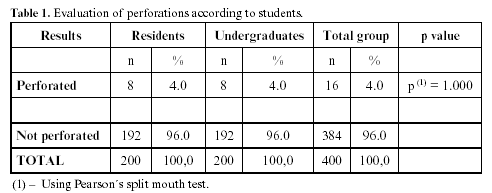
<body><![CDATA[<p><font size="2" face="Verdana">All gloves were collected by the observer and taken to the laboratory. At least 500 ml of water was used to inflate each glove. To facilitate the examination the gloves were positioned against a dark background.</font></p>     <p><font size="2" face="Verdana">The opening for the hand was closed and the perforation rate was evaluated by stretching the gloves for 20 seconds and examining each finger, palm and back of the glove.</font></p>     <p>&nbsp;</p>     <p><b><font face="Verdana">Results</font></b></p>     <p><font size="2" face="Verdana">Two perforations were observed in the control group, one of which was between the middle finger and ring finger and the other one between the forefinger and middle finger.</font></p>     <p><font size="2" face="Verdana">Out of the 200 pairs used, 100 were used by undergraduate students and 100 by residents. Nineteen students were left-handed, thirteen of whom were undergraduates and 6 residents.</font></p>     <p><font size="2" face="Verdana">Sixteen pairs had punctures (8%) in which only one glove was perforated in two places (pulp of the forefinger and middle finger of the right hand of a right-handed undergraduate) and in one pair there was one perforation in each glove. Eight perforated pairs were in the residents group and eight in the undergraduate one (<a href="#t1">Table 1</a>).</font></p>     <p align="center"><font size="2" face="Verdana"><a name="t1"><img border="0" src="/img/revistas/medicorpa/v11n5/11e.ht1.gif" width="492" height="193"></a></font></p>      <p><font size="2" face="Verdana">    <br> Two perforations (1%) were noticed by the surgeon, both of them occurring among the residents. One perforation was during the suture with the needle and the other was during the movement of sectioning the needle of the irrigation syringe, both for the extraction of third molars.</font></p>     ]]></body>
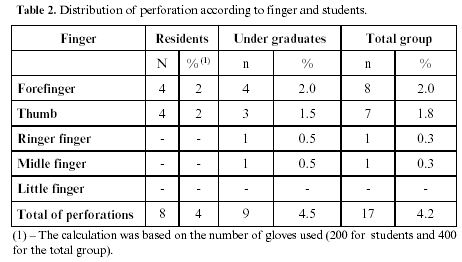
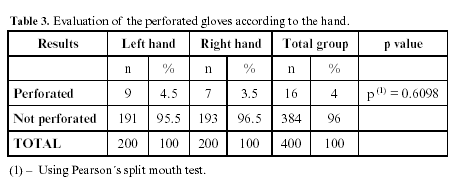
<body><![CDATA[<p><font size="2" face="Verdana">The distribution of the 17 perforations in 16 gloves according to the finger they occurred and the type of student is shown in  <a href="#t2">Table 2</a>. A total of 7.5% of the gloves were perforated in both the thumb and index finger.</font></p>     <p align="center"><font size="2" face="Verdana"><a name="t2"><img border="0" src="/img/revistas/medicorpa/v11n5/11e.ht2.gif" width="462" height="262"></a></font></p>      <p><font size="2" face="Verdana">The distribution of the perforated gloves according to the hand is shown in  <a href="#t3">Table 3</a>. The left hand had 1% more perforations than the right hand. There were no significant differences between the two sides (p &gt; 0.05).</font></p>     <p align="center"><font size="2" face="Verdana"><a name="t3"><img border="0" src="/img/revistas/medicorpa/v11n5/11e.ht3.gif" width="452" height="178"></a></font></p>      <p><font size="2" face="Verdana">    <br> The finger pulp was the most affected region, with a total of 12 perforations (6% of the pairs), followed by the dorsal region, with only 4 perforated gloves (2% of the pairs).</font></p>     <p><font size="2" face="Verdana">Two cases of perforations among left-handed residents occurred, one on the dorsum of the forefinger of the right hand and the other on the pulp of the thumb of the left hand. Both occurred during a third molar removal. None of the left-handed undergraduates perforated a glove.</font></p>    <p> <font size="2" face="Verdana">Among the residents all perforations occurred during third molar removal. Among undergraduate students three procedures were for third molar removal, three for first molar, one for canine and one for premolar extraction.</font></p>     <p>&nbsp;</p>     <p><b><font face="Verdana">Discussion</font></b></p>     ]]></body>
<body><![CDATA[<p><font size="2" face="Verdana">With increasing awareness of the risk of transmission of pathogens from patients to the medical staff during surgery, particularly the hepatitis B virus and HIV, there is increasing interest in protecting the surgeon from the patient (10). Surgeons have the highest risk of contact with patients´ blood and body fluids, and breaches in gloving material may expose operating staff to risk of infections (4,10). Thus many studies in glove perforations have been made; however in minor oral procedures there have been very few.</font></p>    <p> <font size="2" face="Verdana">Laine and Pertti (11), in a literature review, stated that glove perforations are quite common and are not noticed by surgeons during the procedure. Glove puncture rates are found to be as high as 61%. Baggett and Burke (12) found a rate of 16% during surgical extractions. This study found a lower rate of 8%, which is at variance with the greater rates in the literature. This study thus agrees with the literature in relation to the failure to detect perforation during the procedure for oral surgery, for out of the sixteen gloves perforated, only 2 were noticed at the time they occurred.</font></p>    <p> <font size="2" face="Verdana">Latex is a more resistant material than vinyl, providing more protection against infection (3). Perhaps that was the reason for the low rate of perforations in this study, in which only latex gloves were used.</font></p>    <p> <font size="2" face="Verdana">Surgical glove perforations resulting from manufacturing problems are very rare (4). Unlike the perforations originating at the factory, the ones that occurred during the study were not in the interdigital region, a fact that probably had no influence on the outcome of the study.</font></p>    <p> <font size="2" face="Verdana">More than 60% of glove perforations are in the thumb and the  forefinger (9,12). According to Laine and Pertti (11) and Laine and Aarnio (13), the forefinger of the left hand is the most perforated (32-35%), followed by the thumb (19-24%). Burke et al. (14) found a higher risk to glove puncture in the non-working hand while carrying out soft tissue repair in oral surgery procedures. This is because surgeons hold the instruments in the dominant hand and grasp the tissues with the passive hand. In addition, the needle holder is often held with the right hand and the needle may accidentally perforate the glove of the opposite hand. In this study, the thumb and forefinger also showed a high frequency of perforations.</font></p>     <p><font size="2" face="Verdana">In comparison to the operative procedures, according to Bagget and Burke (12), surgical extraction had greater number of punctures in the gloves than other procedures such as crown preparation, non-surgical extraction, endodontic therapy, scaling and polishing. In this study the procedure most susceptible to perforation in oral surgical procedures was third molar extraction in this study.</font></p>     <p><font size="2" face="Verdana">In total hip arthroplasty and thoracoscopic procedures have been recommended changing gloves at regular intervals (2 hours) is an effective way to decrease the incidence of glove perforation and contamination (15,16).</font></p>     <p><font size="2" face="Verdana">The use of surgical gloves markedly reduces the risk of contamination by blood and other body fluids and double gloving is even more efficient than single gloving (11,13,17). Despite this, the use of double gloves has not been widely accepted. One reason may be the suggestion that double gloving can reduce sensation in the hand (13). Therefore, it would be far simpler and less expensive if the gloves had reinforcement in the fingers that are most often perforated, namely thumb and forefinger.</font></p>     <p>&nbsp;</p>     <p><b><font face="Verdana">Conclusions</font></b></p>     ]]></body>
<body><![CDATA[<p><font size="2" face="Verdana">1. The frequency of glove perforation was not high, and the number of perforations among undergraduate students and residents was similar.</font></p>    <p> <font size="2" face="Verdana">2. The left hand, not the dominant hand, had the greater number of perforations.</font></p>     <p><font size="2" face="Verdana">3. Perforations originating at the factory are usually found in the interdigital region, but those resulting from surgery occur in the pulp of the forefinger and thumb.</font></p>     <p>&nbsp;</p>     <p><b><font face="Verdana">References</font></b></p>     <!-- ref --><p><font size="2" face="Verdana">1. Crawford JJ. State-of- the-art practical infection control in dentistry. J Am Dent Assoc 1985;110:629-33.</font>&nbsp;&nbsp;&nbsp;&nbsp;&nbsp;&nbsp;&nbsp;&nbsp;[&#160;<a href="javascript:void(0);" onclick="javascript: window.open('/scielo.php?script=sci_nlinks&ref=2969969&pid=S1698-6946200600050001100001&lng=','','width=640,height=500,resizable=yes,scrollbars=1,menubar=yes,');">Links</a>&#160;]<!-- end-ref --><!-- ref --><p><font size="2" face="Verdana">2. Avery CME, Hjort A, Walsh S, Johnson PA. Glove perforation during surgical extraction of wisdom teeth. Oral Surg Oral Med Oral Pathol Oral Radiol Endod 1998;86:23-5.</font>&nbsp;&nbsp;&nbsp;&nbsp;&nbsp;&nbsp;&nbsp;&nbsp;[&#160;<a href="javascript:void(0);" onclick="javascript: window.open('/scielo.php?script=sci_nlinks&ref=2969970&pid=S1698-6946200600050001100002&lng=','','width=640,height=500,resizable=yes,scrollbars=1,menubar=yes,');">Links</a>&#160;]<!-- end-ref --><!-- ref --><p><font size="2" face="Verdana">3. Burke FJT, Lewis HG, Wilson NHF. The incidence of puncture in gloves worn during orthodontic clinical practice. Am J Orthod Dentofacial Orthop 1991;99:477-81.</font>&nbsp;&nbsp;&nbsp;&nbsp;&nbsp;&nbsp;&nbsp;&nbsp;[&#160;<a href="javascript:void(0);" onclick="javascript: window.open('/scielo.php?script=sci_nlinks&ref=2969971&pid=S1698-6946200600050001100003&lng=','','width=640,height=500,resizable=yes,scrollbars=1,menubar=yes,');">Links</a>&#160;]<!-- end-ref --><!-- ref --><p><font size="2" face="Verdana">4. Barbosa MVJ, Nahas FX, Ferreira LM, Farah AB, Ayaviri NA, Bariani RL. Risk of glove perforation in minor and major plastic surgery procedures. Aesthetic Plast Surg 2004;27:481-4.</font>&nbsp;&nbsp;&nbsp;&nbsp;&nbsp;&nbsp;&nbsp;&nbsp;[&#160;<a href="javascript:void(0);" onclick="javascript: window.open('/scielo.php?script=sci_nlinks&ref=2969972&pid=S1698-6946200600050001100004&lng=','','width=640,height=500,resizable=yes,scrollbars=1,menubar=yes,');">Links</a>&#160;]<!-- end-ref --><!-- ref --><p><font size="2" face="Verdana">5. Yinusa W, Li YH, Chow W, Ho WY, Leong JCY. Glove punctures in orthopaedic surgery. Int Orthop 2004;28:36-9.</font>&nbsp;&nbsp;&nbsp;&nbsp;&nbsp;&nbsp;&nbsp;&nbsp;[&#160;<a href="javascript:void(0);" onclick="javascript: window.open('/scielo.php?script=sci_nlinks&ref=2969973&pid=S1698-6946200600050001100005&lng=','','width=640,height=500,resizable=yes,scrollbars=1,menubar=yes,');">Links</a>&#160;]<!-- end-ref --><!-- ref --><p><font size="2" face="Verdana">6. Checchi L, Montebugnoli L, Boschi S, D’Achille C. Influence of dental glove type on the penetration of liquid through experimental perforation: A spectrophotometric analysis. Quintessence Int 1994;25:647-9.</font>&nbsp;&nbsp;&nbsp;&nbsp;&nbsp;&nbsp;&nbsp;&nbsp;[&#160;<a href="javascript:void(0);" onclick="javascript: window.open('/scielo.php?script=sci_nlinks&ref=2969974&pid=S1698-6946200600050001100006&lng=','','width=640,height=500,resizable=yes,scrollbars=1,menubar=yes,');">Links</a>&#160;]<!-- end-ref --><!-- ref --><p><font size="2" face="Verdana">7. Burke FJT, Alderson JJ, Wilson NHF. The incidence of holes in gloves supplied for routine use in clinical practice. Dent Pract 1988;26:14.</font>&nbsp;&nbsp;&nbsp;&nbsp;&nbsp;&nbsp;&nbsp;&nbsp;[&#160;<a href="javascript:void(0);" onclick="javascript: window.open('/scielo.php?script=sci_nlinks&ref=2969975&pid=S1698-6946200600050001100007&lng=','','width=640,height=500,resizable=yes,scrollbars=1,menubar=yes,');">Links</a>&#160;]<!-- end-ref --><!-- ref --><p><font size="2" face="Verdana">8. Brough SJ, Hunt MT, Barrie WW. Surgical glove perforations. Br J Surg 1988;75:317.</font>&nbsp;&nbsp;&nbsp;&nbsp;&nbsp;&nbsp;&nbsp;&nbsp;[&#160;<a href="javascript:void(0);" onclick="javascript: window.open('/scielo.php?script=sci_nlinks&ref=2969976&pid=S1698-6946200600050001100008&lng=','','width=640,height=500,resizable=yes,scrollbars=1,menubar=yes,');">Links</a>&#160;]<!-- end-ref --><!-- ref --><p><font size="2" face="Verdana">9. Burke FJT, Wilson NHF. The incidence of undiagnosed punctures in non-sterile gloves. Br Dent J 1990;168:67-71.</font>&nbsp;&nbsp;&nbsp;&nbsp;&nbsp;&nbsp;&nbsp;&nbsp;[&#160;<a href="javascript:void(0);" onclick="javascript: window.open('/scielo.php?script=sci_nlinks&ref=2969977&pid=S1698-6946200600050001100009&lng=','','width=640,height=500,resizable=yes,scrollbars=1,menubar=yes,');">Links</a>&#160;]<!-- end-ref --><!-- ref --><p><font size="2" face="Verdana">10. Thomas S, Agarwal M, Mehta G. Intraoperative glove perforation – single versus double gloving in protection against skin contamination. Postgrad Med J 2001;77:458-60.</font>&nbsp;&nbsp;&nbsp;&nbsp;&nbsp;&nbsp;&nbsp;&nbsp;[&#160;<a href="javascript:void(0);" onclick="javascript: window.open('/scielo.php?script=sci_nlinks&ref=2969978&pid=S1698-6946200600050001100010&lng=','','width=640,height=500,resizable=yes,scrollbars=1,menubar=yes,');">Links</a>&#160;]<!-- end-ref --><!-- ref --><p><font size="2" face="Verdana">11. Laine MD, Pertti MDA. How often does glove perforation occur in surgery? Comparison between single gloves and a double-gloving system. Am J Surg 2001;181:564-6.</font>&nbsp;&nbsp;&nbsp;&nbsp;&nbsp;&nbsp;&nbsp;&nbsp;[&#160;<a href="javascript:void(0);" onclick="javascript: window.open('/scielo.php?script=sci_nlinks&ref=2969979&pid=S1698-6946200600050001100011&lng=','','width=640,height=500,resizable=yes,scrollbars=1,menubar=yes,');">Links</a>&#160;]<!-- end-ref --><!-- ref --><p><font size="2" face="Verdana">12. Baggett FJ, Burke FJT. An assessment of the incidence of punctures in gloves when worn for routine operative procedures. Br Dent J 1993;174: 412-6.</font>&nbsp;&nbsp;&nbsp;&nbsp;&nbsp;&nbsp;&nbsp;&nbsp;[&#160;<a href="javascript:void(0);" onclick="javascript: window.open('/scielo.php?script=sci_nlinks&ref=2969980&pid=S1698-6946200600050001100012&lng=','','width=640,height=500,resizable=yes,scrollbars=1,menubar=yes,');">Links</a>&#160;]<!-- end-ref --><!-- ref --><p><font size="2" face="Verdana">13. Laine T, Aarnio P. Glove perforation in orthopaedic and trauma surgery. A comparison between single, double indicator gloving and double gloving with two regular gloves. J Bone Joint Surg Br 2004;86:898-900.</font>&nbsp;&nbsp;&nbsp;&nbsp;&nbsp;&nbsp;&nbsp;&nbsp;[&#160;<a href="javascript:void(0);" onclick="javascript: window.open('/scielo.php?script=sci_nlinks&ref=2969981&pid=S1698-6946200600050001100013&lng=','','width=640,height=500,resizable=yes,scrollbars=1,menubar=yes,');">Links</a>&#160;]<!-- end-ref --><!-- ref --><p><font size="2" face="Verdana">14. Burke FJT, Baggett FJ, Lomax AM. Assessment of the risk of glove puncture during oral surgery procedures. Oral Surg Oral Med Oral Pathol Oral Radiol Endod 1996;82:18-21.</font>&nbsp;&nbsp;&nbsp;&nbsp;&nbsp;&nbsp;&nbsp;&nbsp;[&#160;<a href="javascript:void(0);" onclick="javascript: window.open('/scielo.php?script=sci_nlinks&ref=2969982&pid=S1698-6946200600050001100014&lng=','','width=640,height=500,resizable=yes,scrollbars=1,menubar=yes,');">Links</a>&#160;]<!-- end-ref --><!-- ref --><p><font size="2" face="Verdana">15. Al-Maiyah M, Bajwa A, Mackenney P, Port A, Gregg PJ, Hill D, Finn P. Glove perforation and contamination in primary total hip arthroplasty.J Bone Joint Surg Br 2005;87:556-9.</font>&nbsp;&nbsp;&nbsp;&nbsp;&nbsp;&nbsp;&nbsp;&nbsp;[&#160;<a href="javascript:void(0);" onclick="javascript: window.open('/scielo.php?script=sci_nlinks&ref=2969983&pid=S1698-6946200600050001100015&lng=','','width=640,height=500,resizable=yes,scrollbars=1,menubar=yes,');">Links</a>&#160;]<!-- end-ref --><!-- ref --><p><font size="2" face="Verdana">16. Kojima Y, Ohashi M. Unnoticed glove perforation during thoracoscopic and open thoracic surgery. Ann Thorac Surg 2005;80:1078-80.</font>&nbsp;&nbsp;&nbsp;&nbsp;&nbsp;&nbsp;&nbsp;&nbsp;[&#160;<a href="javascript:void(0);" onclick="javascript: window.open('/scielo.php?script=sci_nlinks&ref=2969984&pid=S1698-6946200600050001100016&lng=','','width=640,height=500,resizable=yes,scrollbars=1,menubar=yes,');">Links</a>&#160;]<!-- end-ref --><!-- ref --><p><font size="2" face="Verdana">17. Schwimmer A, Massoumi M, Barr CE. Efficacy of double gloving to prevent inner glove perforation during outpatient oral surgical procedures. J Am Dent Assoc 1994;125:196-8.</font>&nbsp;&nbsp;&nbsp;&nbsp;&nbsp;&nbsp;&nbsp;&nbsp;[&#160;<a href="javascript:void(0);" onclick="javascript: window.open('/scielo.php?script=sci_nlinks&ref=2969985&pid=S1698-6946200600050001100017&lng=','','width=640,height=500,resizable=yes,scrollbars=1,menubar=yes,');">Links</a>&#160;]<!-- end-ref --><p>&nbsp;</p>     <p>&nbsp;</p>     <p><font face="Verdana"><b><font size="2"><a href="#top"> <img border="0" src="/img/revistas/medicorpa/v11n5/seta.gif" width="15" height="17"></a><a name="back"></a> Address for correspondence:</font></b><font size="2">    <br> Dr. B. Vasconcelos    <br> Faculdade de Odontologia de Pernambuco    <br> Departamento de Cirurgia e Traumatologia BMF    <br> Av. General Newton Cavalcanti, 1650 Camaragibe - PE    <br> 54753-220 Brazil    ]]></body>
<body><![CDATA[<br> E-mail: <a href="mailto:belmiro@fop.upe.br">belmiro@fop.upe.br</a></font></font></p>     <p><font size="2" face="Verdana">Received: 13-11-2005    <br> Accepted: 10-01-2006</font></p>       ]]></body><back>
<ref-list>
<ref id="B1">
<label>1</label><nlm-citation citation-type="journal">
<person-group person-group-type="author">
<name>
<surname><![CDATA[Crawford]]></surname>
<given-names><![CDATA[JJ]]></given-names>
</name>
</person-group>
<article-title xml:lang="en"><![CDATA[State-of- the-art practical infection control in dentistry]]></article-title>
<source><![CDATA[J Am Dent Assoc]]></source>
<year>1985</year>
<volume>110</volume>
<page-range>629-33</page-range></nlm-citation>
</ref>
<ref id="B2">
<label>2</label><nlm-citation citation-type="journal">
<person-group person-group-type="author">
<name>
<surname><![CDATA[Avery]]></surname>
<given-names><![CDATA[CME]]></given-names>
</name>
<name>
<surname><![CDATA[Hjort]]></surname>
<given-names><![CDATA[A]]></given-names>
</name>
<name>
<surname><![CDATA[Walsh]]></surname>
<given-names><![CDATA[S]]></given-names>
</name>
<name>
<surname><![CDATA[Johnson]]></surname>
<given-names><![CDATA[PA]]></given-names>
</name>
</person-group>
<article-title xml:lang="en"><![CDATA[Glove perforation during surgical extraction of wisdom teeth]]></article-title>
<source><![CDATA[Oral Surg Oral Med Oral Pathol Oral Radiol Endod]]></source>
<year>1998</year>
<volume>86</volume>
<page-range>23-5</page-range></nlm-citation>
</ref>
<ref id="B3">
<label>3</label><nlm-citation citation-type="journal">
<person-group person-group-type="author">
<name>
<surname><![CDATA[Burke]]></surname>
<given-names><![CDATA[FJT]]></given-names>
</name>
<name>
<surname><![CDATA[Lewis]]></surname>
<given-names><![CDATA[HG]]></given-names>
</name>
<name>
<surname><![CDATA[Wilson]]></surname>
<given-names><![CDATA[NHF]]></given-names>
</name>
</person-group>
<article-title xml:lang="en"><![CDATA[The incidence of puncture in gloves worn during orthodontic clinical practice]]></article-title>
<source><![CDATA[Am J Orthod Dentofacial Orthop]]></source>
<year>1991</year>
<volume>99</volume>
<page-range>477-81</page-range></nlm-citation>
</ref>
<ref id="B4">
<label>4</label><nlm-citation citation-type="journal">
<person-group person-group-type="author">
<name>
<surname><![CDATA[Barbosa]]></surname>
<given-names><![CDATA[MVJ]]></given-names>
</name>
<name>
<surname><![CDATA[Nahas]]></surname>
<given-names><![CDATA[FX]]></given-names>
</name>
<name>
<surname><![CDATA[Ferreira]]></surname>
<given-names><![CDATA[LM]]></given-names>
</name>
<name>
<surname><![CDATA[Farah]]></surname>
<given-names><![CDATA[AB]]></given-names>
</name>
<name>
<surname><![CDATA[Ayaviri]]></surname>
<given-names><![CDATA[NA]]></given-names>
</name>
<name>
<surname><![CDATA[Bariani]]></surname>
<given-names><![CDATA[RL]]></given-names>
</name>
</person-group>
<article-title xml:lang="en"><![CDATA[Risk of glove perforation in minor and major plastic surgery procedures]]></article-title>
<source><![CDATA[Aesthetic Plast Surg]]></source>
<year>2004</year>
<volume>27</volume>
<page-range>481-4</page-range></nlm-citation>
</ref>
<ref id="B5">
<label>5</label><nlm-citation citation-type="journal">
<person-group person-group-type="author">
<name>
<surname><![CDATA[Yinusa]]></surname>
<given-names><![CDATA[W]]></given-names>
</name>
<name>
<surname><![CDATA[Li]]></surname>
<given-names><![CDATA[YH]]></given-names>
</name>
<name>
<surname><![CDATA[Chow]]></surname>
<given-names><![CDATA[W]]></given-names>
</name>
<name>
<surname><![CDATA[Ho]]></surname>
<given-names><![CDATA[WY]]></given-names>
</name>
<name>
<surname><![CDATA[Leong]]></surname>
<given-names><![CDATA[JCY]]></given-names>
</name>
</person-group>
<article-title xml:lang="en"><![CDATA[Glove punctures in orthopaedic surgery]]></article-title>
<source><![CDATA[Int Orthop]]></source>
<year>2004</year>
<volume>28</volume>
<page-range>36-9</page-range></nlm-citation>
</ref>
<ref id="B6">
<label>6</label><nlm-citation citation-type="journal">
<person-group person-group-type="author">
<name>
<surname><![CDATA[Checchi]]></surname>
<given-names><![CDATA[L]]></given-names>
</name>
<name>
<surname><![CDATA[Montebugnoli]]></surname>
<given-names><![CDATA[L]]></given-names>
</name>
<name>
<surname><![CDATA[Boschi]]></surname>
<given-names><![CDATA[S]]></given-names>
</name>
<name>
<surname><![CDATA[D’Achille]]></surname>
<given-names><![CDATA[C]]></given-names>
</name>
</person-group>
<article-title xml:lang="en"><![CDATA[Influence of dental glove type on the penetration of liquid through experimental perforation: A spectrophotometric analysis]]></article-title>
<source><![CDATA[Quintessence Int]]></source>
<year>1994</year>
<volume>25</volume>
<page-range>647-9</page-range></nlm-citation>
</ref>
<ref id="B7">
<label>7</label><nlm-citation citation-type="journal">
<person-group person-group-type="author">
<name>
<surname><![CDATA[Burke]]></surname>
<given-names><![CDATA[FJT]]></given-names>
</name>
<name>
<surname><![CDATA[Alderson]]></surname>
<given-names><![CDATA[JJ]]></given-names>
</name>
<name>
<surname><![CDATA[Wilson]]></surname>
<given-names><![CDATA[NHF]]></given-names>
</name>
</person-group>
<article-title xml:lang="en"><![CDATA[The incidence of holes in gloves supplied for routine use in clinical practice]]></article-title>
<source><![CDATA[Dent Pract]]></source>
<year>1988</year>
<volume>26</volume>
<page-range>14</page-range></nlm-citation>
</ref>
<ref id="B8">
<label>8</label><nlm-citation citation-type="journal">
<person-group person-group-type="author">
<name>
<surname><![CDATA[Brough]]></surname>
<given-names><![CDATA[SJ]]></given-names>
</name>
<name>
<surname><![CDATA[Hunt]]></surname>
<given-names><![CDATA[MT]]></given-names>
</name>
<name>
<surname><![CDATA[Barrie]]></surname>
<given-names><![CDATA[WW]]></given-names>
</name>
</person-group>
<article-title xml:lang="en"><![CDATA[Surgical glove perforations]]></article-title>
<source><![CDATA[Br J Surg]]></source>
<year>1988</year>
<volume>75</volume>
<page-range>317</page-range></nlm-citation>
</ref>
<ref id="B9">
<label>9</label><nlm-citation citation-type="journal">
<person-group person-group-type="author">
<name>
<surname><![CDATA[Burke]]></surname>
<given-names><![CDATA[FJT]]></given-names>
</name>
<name>
<surname><![CDATA[Wilson]]></surname>
<given-names><![CDATA[NHF]]></given-names>
</name>
</person-group>
<article-title xml:lang="en"><![CDATA[The incidence of undiagnosed punctures in non-sterile gloves]]></article-title>
<source><![CDATA[Br Dent J]]></source>
<year>1990</year>
<volume>168</volume>
<page-range>67-71</page-range></nlm-citation>
</ref>
<ref id="B10">
<label>10</label><nlm-citation citation-type="journal">
<person-group person-group-type="author">
<name>
<surname><![CDATA[Thomas]]></surname>
<given-names><![CDATA[S]]></given-names>
</name>
<name>
<surname><![CDATA[Agarwal]]></surname>
<given-names><![CDATA[M]]></given-names>
</name>
<name>
<surname><![CDATA[Mehta]]></surname>
<given-names><![CDATA[G]]></given-names>
</name>
</person-group>
<article-title xml:lang="en"><![CDATA[Intraoperative glove perforation: single versus double gloving in protection against skin contamination]]></article-title>
<source><![CDATA[Postgrad Med J]]></source>
<year>2001</year>
<volume>77</volume>
<page-range>458-60</page-range></nlm-citation>
</ref>
<ref id="B11">
<label>11</label><nlm-citation citation-type="journal">
<person-group person-group-type="author">
<name>
<surname><![CDATA[Laine]]></surname>
<given-names><![CDATA[MD]]></given-names>
</name>
<name>
<surname><![CDATA[Pertti]]></surname>
<given-names><![CDATA[MDA]]></given-names>
</name>
</person-group>
<article-title xml:lang="en"><![CDATA[How often does glove perforation occur in surgery?: Comparison between single gloves and a double-gloving system]]></article-title>
<source><![CDATA[Am J Surg]]></source>
<year>2001</year>
<volume>181</volume>
<page-range>564-6</page-range></nlm-citation>
</ref>
<ref id="B12">
<label>12</label><nlm-citation citation-type="journal">
<person-group person-group-type="author">
<name>
<surname><![CDATA[Baggett]]></surname>
<given-names><![CDATA[FJ]]></given-names>
</name>
<name>
<surname><![CDATA[Burke]]></surname>
<given-names><![CDATA[FJT]]></given-names>
</name>
</person-group>
<article-title xml:lang="en"><![CDATA[An assessment of the incidence of punctures in gloves when worn for routine operative procedures]]></article-title>
<source><![CDATA[Br Dent J]]></source>
<year>1993</year>
<volume>174</volume>
<page-range>412-6</page-range></nlm-citation>
</ref>
<ref id="B13">
<label>13</label><nlm-citation citation-type="journal">
<person-group person-group-type="author">
<name>
<surname><![CDATA[Laine]]></surname>
<given-names><![CDATA[T]]></given-names>
</name>
<name>
<surname><![CDATA[Aarnio]]></surname>
<given-names><![CDATA[P]]></given-names>
</name>
</person-group>
<article-title xml:lang="en"><![CDATA[Glove perforation in orthopaedic and trauma surgery: A comparison between single, double indicator gloving and double gloving with two regular gloves]]></article-title>
<source><![CDATA[J Bone Joint Surg Br]]></source>
<year>2004</year>
<volume>86</volume>
<page-range>898-900</page-range></nlm-citation>
</ref>
<ref id="B14">
<label>14</label><nlm-citation citation-type="journal">
<person-group person-group-type="author">
<name>
<surname><![CDATA[Burke]]></surname>
<given-names><![CDATA[FJT]]></given-names>
</name>
<name>
<surname><![CDATA[Baggett]]></surname>
<given-names><![CDATA[FJ]]></given-names>
</name>
<name>
<surname><![CDATA[Lomax]]></surname>
<given-names><![CDATA[AM]]></given-names>
</name>
</person-group>
<article-title xml:lang="en"><![CDATA[Assessment of the risk of glove puncture during oral surgery procedures]]></article-title>
<source><![CDATA[Oral Surg Oral Med Oral Pathol Oral Radiol Endod]]></source>
<year>1996</year>
<volume>82</volume>
<page-range>18-21</page-range></nlm-citation>
</ref>
<ref id="B15">
<label>15</label><nlm-citation citation-type="journal">
<person-group person-group-type="author">
<name>
<surname><![CDATA[Al-Maiyah]]></surname>
<given-names><![CDATA[M]]></given-names>
</name>
<name>
<surname><![CDATA[Bajwa]]></surname>
<given-names><![CDATA[A]]></given-names>
</name>
<name>
<surname><![CDATA[Mackenney]]></surname>
<given-names><![CDATA[P]]></given-names>
</name>
<name>
<surname><![CDATA[Port]]></surname>
<given-names><![CDATA[A]]></given-names>
</name>
<name>
<surname><![CDATA[Gregg]]></surname>
<given-names><![CDATA[PJ]]></given-names>
</name>
<name>
<surname><![CDATA[Hill]]></surname>
<given-names><![CDATA[D]]></given-names>
</name>
<name>
<surname><![CDATA[Finn]]></surname>
<given-names><![CDATA[P]]></given-names>
</name>
</person-group>
<article-title xml:lang="en"><![CDATA[Glove perforation and contamination in primary total hip arthroplasty]]></article-title>
<source><![CDATA[J Bone Joint Surg Br]]></source>
<year>2005</year>
<volume>87</volume>
<page-range>556-9</page-range></nlm-citation>
</ref>
<ref id="B16">
<label>16</label><nlm-citation citation-type="journal">
<person-group person-group-type="author">
<name>
<surname><![CDATA[Kojima]]></surname>
<given-names><![CDATA[Y]]></given-names>
</name>
<name>
<surname><![CDATA[Ohashi]]></surname>
<given-names><![CDATA[M]]></given-names>
</name>
</person-group>
<article-title xml:lang="en"><![CDATA[Unnoticed glove perforation during thoracoscopic and open thoracic surgery]]></article-title>
<source><![CDATA[Ann Thorac Surg]]></source>
<year>2005</year>
<volume>80</volume>
<page-range>1078-80</page-range></nlm-citation>
</ref>
<ref id="B17">
<label>17</label><nlm-citation citation-type="journal">
<person-group person-group-type="author">
<name>
<surname><![CDATA[Schwimmer]]></surname>
<given-names><![CDATA[A]]></given-names>
</name>
<name>
<surname><![CDATA[Massoumi]]></surname>
<given-names><![CDATA[M]]></given-names>
</name>
<name>
<surname><![CDATA[Barr]]></surname>
<given-names><![CDATA[CE]]></given-names>
</name>
</person-group>
<article-title xml:lang="en"><![CDATA[Efficacy of double gloving to prevent inner glove perforation during outpatient oral surgical procedures]]></article-title>
<source><![CDATA[J Am Dent Assoc]]></source>
<year>1994</year>
<volume>125</volume>
<page-range>196-8</page-range></nlm-citation>
</ref>
</ref-list>
</back>
</article>