<?xml version="1.0" encoding="ISO-8859-1"?><article xmlns:mml="http://www.w3.org/1998/Math/MathML" xmlns:xlink="http://www.w3.org/1999/xlink" xmlns:xsi="http://www.w3.org/2001/XMLSchema-instance">
<front>
<journal-meta>
<journal-id>1698-6946</journal-id>
<journal-title><![CDATA[Medicina Oral, Patología Oral y Cirugía Bucal (Internet)]]></journal-title>
<abbrev-journal-title><![CDATA[Med. oral patol. oral cir.bucal (Internet)]]></abbrev-journal-title>
<issn>1698-6946</issn>
<publisher>
<publisher-name><![CDATA[Sociedad Española de Medicina Oral]]></publisher-name>
</publisher>
</journal-meta>
<article-meta>
<article-id>S1698-69462007000300002</article-id>
<title-group>
<article-title xml:lang="en"><![CDATA[Antibiotic use in dental practice: A review]]></article-title>
</title-group>
<contrib-group>
<contrib contrib-type="author">
<name>
<surname><![CDATA[Poveda Roda]]></surname>
<given-names><![CDATA[Rafael]]></given-names>
</name>
<xref ref-type="aff" rid="A01"/>
</contrib>
<contrib contrib-type="author">
<name>
<surname><![CDATA[Bagán]]></surname>
<given-names><![CDATA[José Vicente]]></given-names>
</name>
<xref ref-type="aff" rid="A01"/>
</contrib>
<contrib contrib-type="author">
<name>
<surname><![CDATA[Sanchis Bielsa]]></surname>
<given-names><![CDATA[José María]]></given-names>
</name>
<xref ref-type="aff" rid="A01"/>
</contrib>
<contrib contrib-type="author">
<name>
<surname><![CDATA[Carbonell Pastor]]></surname>
<given-names><![CDATA[Enrique]]></given-names>
</name>
<xref ref-type="aff" rid="A01"/>
</contrib>
</contrib-group>
<aff id="A01">
<institution><![CDATA[,Valencia University General Hospital Service of Stomatology ]]></institution>
<addr-line><![CDATA[Valencia ]]></addr-line>
</aff>
<pub-date pub-type="pub">
<day>00</day>
<month>05</month>
<year>2007</year>
</pub-date>
<pub-date pub-type="epub">
<day>00</day>
<month>05</month>
<year>2007</year>
</pub-date>
<volume>12</volume>
<numero>3</numero>
<fpage>186</fpage>
<lpage>192</lpage>
<copyright-statement/>
<copyright-year/>
<self-uri xlink:href="http://scielo.isciii.es/scielo.php?script=sci_arttext&amp;pid=S1698-69462007000300002&amp;lng=en&amp;nrm=iso"></self-uri><self-uri xlink:href="http://scielo.isciii.es/scielo.php?script=sci_abstract&amp;pid=S1698-69462007000300002&amp;lng=en&amp;nrm=iso"></self-uri><self-uri xlink:href="http://scielo.isciii.es/scielo.php?script=sci_pdf&amp;pid=S1698-69462007000300002&amp;lng=en&amp;nrm=iso"></self-uri><abstract abstract-type="short" xml:lang="en"><p><![CDATA[Antibiotics are commonly used in dental practice. It has been estimated that 10% of all antibiotic prescriptions are related with dental infections. The association amoxicillin-clavulanate was the drug most frequently prescribed by dentists during 2005, at least in the Valencian Community (Spain). The use of antibiotics in dental practice is characterized by empirical prescription based on clinical and bacteriological epidemiological factors, with the use of broad spectrum antibiotics for short periods of time, and the application of a very narrow range of antibiotics. The simultaneous prescription of nonsteroidal antiinflammatory drugs (NSAIDs) can modify the bioavailability of the antibiotic. In turn, an increased number of bacterial strains resistant to conventional antibiotics are found in the oral cavity. Antibiotics are indicated for the treatment of odontogenic infections, oral non-odontogenic infections, as prophylaxis against focal infection, and as prophylaxis against local infection and spread to neighboring tissues and organs. Pregnancy, kidney failure and liver failure are situations requiring special caution on the part of the clinician when indicating antibiotic treatment. The present study attempts to contribute to rational antibiotic use, with a review of the general characteristics of these drugs.]]></p></abstract>
<abstract abstract-type="short" xml:lang="es"><p><![CDATA[Los antibióticos son fármacos de uso cotidiano en odontología. Se estima que el 10% de las prescripciones antibióticas están relacionadas con la infección odontogénica. La asociación amoxicilina-clavulánico fue el fármaco más prescrito por dentistas durante 2005, al menos en la Comunidad Autónoma Valenciana. El uso de antibióticos en odontología se caracteriza por una prescripción empírica basada en epidemiología clínica y bacteriana, el uso de antibióticos de amplio espectro durante periodos breves de tiempo y el manejo de una batería muy reducida de antibióticos. La prescripción simultánea de AINES (antiinflamatorios no esteroideos) puede modificar la biodisponibilidad del antibiótico. Se detecta un aumento de número de cepas resistentes a los antibióticos convencionales en la cavidad oral. La indicación antibiótica se realiza para tratamiento de la infección odontogénica, de infecciones orales no odontogénicas, como profilaxis de la infección focal y como profilaxis de la infección local y la extensión a tejidos y órganos vecinos. El embarazo, la insuficiencia renal y la insuficiencia hepática son situaciones que requieren una especial atención del clínico antes de indicar un tratamiento antibiótico. El objetivo del presente trabajo es intentar contribuir a un uso racional de los antibióticos revisando sus características generales.]]></p></abstract>
<kwd-group>
<kwd lng="en"><![CDATA[Antibiotic]]></kwd>
<kwd lng="en"><![CDATA[infection]]></kwd>
<kwd lng="en"><![CDATA[odontogenic]]></kwd>
<kwd lng="en"><![CDATA[prophylaxis]]></kwd>
<kwd lng="es"><![CDATA[Antibiótico]]></kwd>
<kwd lng="es"><![CDATA[infección]]></kwd>
<kwd lng="es"><![CDATA[odontogénica]]></kwd>
<kwd lng="es"><![CDATA[profilaxis]]></kwd>
</kwd-group>
</article-meta>
</front><body><![CDATA[ <p>&nbsp;</p>     <p>&nbsp;</p>     <p><B><font size="4" face="Verdana"><a name="top"></a>Antibiotic use in dental practice. A review</font></B></p>     <p>&nbsp;</p>     <p>&nbsp;</p>     <p><font face="Verdana"><B><font size="2">Rafael Poveda Roda<sup>1</sup>, José Vicente Bagán<sup>2</sup>, José María Sanchis Bielsa<sup>1</sup>, Enrique Carbonell Pastor</font><sup><font size="2">1</font></sup></B></font></p>     <p><font size="2" face="Verdana">(1) Physician and dentist. Service of Stomatology, Valencia University General Hospital    <br> (2) Chairman of Oral Medicine, Valencia University, and Head of the Service of Stomatology, Valencia University General Hospital. Valencia</font></p>      <p><font size="2" face="Verdana"><a href="#back">Correspondence</a></font></p>     <p>&nbsp;</p>     ]]></body>
<body><![CDATA[<p>&nbsp;</p><hr size="1">     <p><B><font size="2" face="Verdana">ABSTRACT</font></B></p>     <p><font size="2" face="Verdana">Antibiotics are commonly used in dental practice. It has been estimated that 10% of all antibiotic prescriptions are related with dental infections. The association amoxicillin-clavulanate was the drug most frequently prescribed by dentists during 2005, at least in the Valencian Community (Spain). The use of antibiotics in dental practice is characterized by empirical prescription based on clinical and bacteriological epidemiological factors, with the use of broad spectrum antibiotics for short periods of time, and the application of a very narrow range of antibiotics. The simultaneous prescription of nonsteroidal antiinflammatory drugs (NSAIDs) can modify the bioavailability of the antibiotic. In turn, an increased number of bacterial strains resistant to conventional antibiotics are found in the oral cavity.    <BR>Antibiotics are indicated for the treatment of odontogenic infections, oral non-odontogenic infections, as prophylaxis against focal infection, and as prophylaxis against local infection and spread to neighboring tissues and organs.    <BR>Pregnancy, kidney failure and liver failure are situations requiring special caution on the part of the clinician when indicating antibiotic treatment.    <BR>The present study attempts to contribute to rational antibiotic use, with a review of the general characteristics of these drugs.</font></p>     <p><font face="Verdana"><B><font size="2">Key words:</font></B><font size="2"> Antibiotic, infection, odontogenic, prophylaxis.</font></font></p> <hr size="1">     <p><B><font size="2" face="Verdana">RESUMEN</font></B></p>     <p><font size="2" face="Verdana">Los antibióticos son fármacos de uso cotidiano en odontología. Se estima que el 10% de las prescripciones antibióticas están relacionadas con la infección odontogénica. La asociación amoxicilina-clavulánico fue el fármaco más prescrito por dentistas durante 2005, al menos en la Comunidad Autónoma Valenciana. El uso de antibióticos en odontología se caracteriza por una prescripción empírica basada en epidemiología clínica y bacteriana, el uso de antibióticos de amplio espectro durante periodos breves de tiempo y el manejo de una batería muy reducida de antibióticos. La prescripción simultánea de AINES (antiinflamatorios no esteroideos) puede modificar la biodisponibilidad del antibiótico. Se detecta un aumento de número de cepas resistentes a los antibióticos convencionales en la cavidad oral.    <br> La indicación antibiótica se realiza para tratamiento de la infección odontogénica, de infecciones orales no odontogénicas, como profilaxis de la infección focal y como profilaxis de la infección local y la extensión a tejidos y órganos vecinos.    ]]></body>
<body><![CDATA[<br> El embarazo, la insuficiencia renal y la insuficiencia hepática son situaciones que requieren una especial atención del clínico antes de indicar un tratamiento antibiótico.    <br> El objetivo del presente trabajo es intentar contribuir a un uso racional de los antibióticos revisando sus características generales.</font></p>     <p><font face="Verdana"><B><font size="2">Palabras clave:</font></B><font size="2"> Antibiótico, infección, odontogénica, profilaxis.</font></font></p> <hr size="1">     <p>&nbsp;</p>     <p><B><font face="Verdana">Introduction</font></B></p>     <p><font size="2" face="Verdana">Antibiotic treatment is an aspect of pharmacotherapy with the  particularity of affording both etiological and curative action. It was  introduced in the mid-twentieth century in the form of sulfa drugs (1935),  penicillin (1941), tetracyclines (1948) and erythromycin (1952). Since then,  antibiotics have focused much clinical and pharmacological research, in response  to the progressive challenges posed by bacterial infections: identification of  new pathogens, the development of resistances to antibiotics, the consolidation  of new diseases, and novel clinical situations (increase in chronic processes,  survival of patients with disorders considered to be fatal until only recently, etc.) (1).</font></p>     <p><font size="2" face="Verdana">A good example of the usefulness of these drugs is provided  by the fact that in the period 1998-2000, the number of daily doses of  antibiotics per 1000 inhabitants was 30.7 with a cost of 47.18 euros/1000  inhabitants/day. Furthermore, in Spain during the year 2004, the public National  Health Care System prescribed 25.61 million containers of macrolides,  combinations of penicillins, other betalactams and fluorquinolones, with a total  cost of 336.12 million euros (2). The fact that no antibiotic is included among  the 35 most widely consumed generic drug products during the year 2004 is  misleading. This is because antibiotics are generally prescribed for acute  episodes and for brief periods of time, while the most heavily consumed  medicines are those prescribed for chronic processes (antihypertensive agents,  hypolipidemic drugs, antacids, antiinflammatory drugs, bisphosphonates, bronchodilators, etc.).</font></p>     <p><font size="2" face="Verdana">Bacterial infections are common in dental and oral clinical  practice; as a result, antibiotic use prescribed for their treatment is also  frequent. In Spain, it has been estimated that odontogenic infections are the cause of 10% of all antibiotic prescriptions (3).</font></p>     <p><font size="2" face="Verdana">In the Valencian Community (Spain), dentists in the public  health care system during the year 2005 prescribed a total of 43,490 antibiotic  containers, with a total cost of 274,439.82 euros. In relative terms, these  figures represent 0.94% of the total antibiotic containers and 0.51% of the  total antibiotic expenditure generated by the public health care system in the  Valencian Community. By pharmaceutical specialties or drug products, amoxicillin  and the association amoxicillin-clavulanic acid accounted for 67.8% of all  prescriptions and 59.4% of the global cost. The association amoxicillin-clavulanic  acid was the most frequently prescribed treatment, representing 38.7% of all  prescriptions and 45.7% of the net cost. Spiramycin and the association  spiramycin and metronidazole in turn accounted for 13.34% of the prescriptions  and 10.2% of the global expenditure. Lastly, clindamycin represented 4% of the  prescriptions and 4.2% of the costs. In sum, three drug substances and two drug  associations or combinations of these same three drug substances account for 95%  of all antibiotic prescriptions made by dentists in the context of the public health care system, and 75% of the total antibiotic cost.</font></p>     <p><font size="2" face="Verdana">The present study reviews antibiotic use in dental practice, and contributes elements to favor the rational use of such medicines.</font></p>     ]]></body>
<body><![CDATA[<p>&nbsp;</p>     <p><B><font face="Verdana">Particularities</font><font face="Verdana"> of antibiotic use in dental and oral clinical practice</font></B></p>     <p><font size="2" face="Verdana">Dentist use of antibiotics is characterized by a number of  particularities. In effect, antibiotic prescription is empirical, i.e., the  clinician does not know what microorganism is responsible for the infection,  since pus or exudate cultures are not commonly made. Based on clinical and  bacterial epidemiological data, the germs responsible for the infectious process  are suspected, and treatment is decided on a presumptive basis, fundamented on  probabilistic reasoning (4).</font></p>     <p><font size="2" face="Verdana">As a result of the above, broad spectrum antibiotics are  typically prescribed. A broad range of organisms can be isolated from the oral  cavity, and although not all of them are potential human pathogens, the list of  bacteria related with oral infections is relatively long (cocci, bacilli,  grampositive and gramnegative organisms, aerobes and anaerobes).</font></p>     <p><font size="2" face="Verdana">As has been commented above, a very limited range of drug  products is typically used – sometimes as few as two or three antibiotics. In  turn, prescription is characteristically made for short periods of time –  typically no more than 7-10 days.</font></p>     <p><font size="2" face="Verdana">The antibiotic sensitivity of the bacteria found within the  oral cavity is gradually decreasing, and a growing number of resistant strains  is detected – particularly <i>Porphyromona</i> and <i>Prevotella</i> (5), though the  phenomenon has also been reported for <i>Streptoccocus viridans</i> and for drugs such  as the macrolides, penicillin and clindamycin (6,7).</font></p>     <p><font size="2" face="Verdana">Antibiotic prescription is almost invariably associated with  the prescription of nonsteroidal antiinflammatory drugs (NSAIDs). There are many  potential interactions between these two drug categories – the most common  situation being an NSAID-mediated reduction of antibiotic bioavailability and  thus effect (8,9), though some combinations of drugs such as cephalosporins and  ibuprofen, or tetracyclines with naproxen or diclofenac, have been shown to  exert the opposite effect, i.e., an increase in the bioavailability of the  antibiotic (10,11).</font></p>     <p><i><font size="2" face="Verdana">The target: microorganism</font></i></p>     <p><font size="2" face="Verdana">The human oral cavity contains a very broad range of germs.  In effect, some authors speak of more than 500 different species, and Liebana  even reports that all known microorganisms related to the human species are at  some time isolated from the oral cavity as either transient (the majority) or  resident species (only a few) (12). Despite this great variety of germs, those  most commonly isolated from oral, dental, apical and periodontal exudates and  pus are more limited in number – comprising organisms considered to be more  pathogenic and which focus the majority of studies on antibiotic efficacy.</font></p>     <p><font size="2" face="Verdana">Isla et al. (13) compared the efficacy of antibiotics  commonly used in dental and oral clinical practice in application to the  bacteria most frequently isolated in odontogenic infections (<i>S. viridans</i>,  <i>Peptostreptococcus</i> spp, <i>Prevotella intermedia</i>, <i>Porphyromona gingivalis</i> and <i>Fusobacterium nucleatum</i>), based on pharmacokinetic and pharmacodynamic (PK/PD)  analyses (effect of the human body upon the drug, reflected by the plasma  concentration profile -pharmacokinetics-, and the effect of the drug upon the  body, as defined by the minimum inhibitory concentration, or MIC -pharmacodynamics-.  On the basis of the results of their study, the authors suggested the<i> </i> recommended clindamycin dose to be 300 mg/6 hours, and 500 mg/8 hours or 2000 mg/12  hours for amoxicillin-clavulanic acid (with 125 mg of clavulanate in both  cases). In turn, they reported that the association spiramycin-metronidazole at  the usual dosage fails to cover the full bacterial spectrum in infections of  this kind. The authors concluded that amoxicillin-clavulanic acid, clindamycin  and moxifloxacin are the antibiotics of choice for the treatment of odontogenic  infections – though they also pointed to the need for clinical trials to confirm  the usefulness of PK/PD studies in these processes.</font></p>     ]]></body>
<body><![CDATA[<p><font size="2" face="Verdana">Bresco-Salinas et al. (5), in a clinical study of 64 patients  with acute infection of pulp origin or pericoronaritis, found the germs most  commonly isolated from the infection zone to be <i>Streptoccocus</i>, <i>Enterococcus</i>,  <i>Bacteroides</i>, <i>Fusobacterium</i>, <i>Porphyromonas</i>, <i>Prevotella</i> and <i>Actinobacillus</i>. In the  study of sensitivity to different antibiotics, they found amoxicillin and the  association amoxicillin-clavulanic acid to offer very good results in the in  vitro control of most of the germs identified (resistances &lt; 10%) – though for <i>Bacteroides</i> and <i>Prevotella intermedia</i> the bacterial resistance rate was in the  range of 25%. Antibiotics commonly used in dental practice, such as erythromycin,  metronidazole or azithromycin, were found to be ineffective in application to  over 30% of the strains (39.1%, 50.5% and 33.2%, respectively). Linezolid was  the antibiotic with the best performance, proving effective in 94.6% of the  strains. This antibiotic belongs to the family of oxazolidinones, which act by  inhibiting protein synthesis, and which are effective against multiresistant  grampositive germs and anaerobes. Linezolid is marketed in Spain under the brand  name of Zyvoxid<sup>®</sup> (14). The authors consider amoxicillin to be the drug of choice  in processes of this kind, and that clindamycin should be the alternative in the  event of treatment failure or of patient allergy to penicillin.</font></p>     <p><font size="2" face="Verdana">Slightly divergent results have been published by Liñares and  Martin-Herrero (15), who considered amoxicillin-clavulanate to be the option  with the fewest resistant strains. Amoxicillin shows resistances in 30-80% of  all strains of <i>Prevotella</i> and <i>Porphyromona</i>, and the macrolides are scantly  effective. However, in this study, clindamycin and metronidazole were seen to be  active against all the pathogens examined, except <i>Actinobacillus  actinomycetemcomitans</i>.</font></p>     <p><font size="2" face="Verdana">More rotund findings have been reported by Sobottka et al.  (16), who after isolating 87 pathogens from 37 patients with odontogenic  abscesses, found 100% to be sensitive to amoxicillin-clavulanic acid. Excellent  results were also obtained with fluorquinolones (moxifloxacin and levofloxacin),  with sensitivity in 98% of all strains. The results were somewhat more discrete  (sensitivity in the range of 70-75%) with doxycycline, clindamycin and  penicillin.</font></p>     <p><font size="2" face="Verdana">Kirkwood, in a review on the use of antibiotics in orofacial  infections (18), considered that although the penicillins traditionally have  been used for the treatment of odontogenic infections, the growing presence of  bacteria resistant to penicillin have caused other antibacterials – particularly  clindamycin – to become the drugs of choice for treating infections of this kind,  due to their good tolerance, low emergence of resistances, and the high drug  concentrations reached in bone. In contrast to the above, Swift et al. (19)  indicate that despite the recent introduction of many new antimicrobials, none  have demonstrated significant benefit justifying their replacement of penicillin  derivatives in application to orofacial infections. Furthermore, they consider  that the appropriate use of these drugs, together with surgery, constitute  adequate treatment for odontogenic infections.</font></p>     <p><font size="2" face="Verdana">To summarize, and as pointed out by Morcillo (19), a  polymicrobial flora has been described in odontogenic infections, with strict  anaerobes, and with a relatively limited microbial spectrum (despite the  enormous variety of bacteria that transit through or colonize the oral cavity).  This means that of the broad range of antibacterials available, a few drugs will  suffice to treat odontogenic infections despite the empirical approach to  management.</font></p>     <p><font size="2" face="Verdana"> <a target="_blank" href="/img/revistas/medicorpa/v12n3/02_medora52.gif">Table 1</a> reports the antibiotics most commonly used in dental  practice, with an indication of the corresponding doses.</font></p>     <p>&nbsp;</p>     <p><B><font face="Verdana">Indications of antibiotic treatment</font></B></p>     <p><font size="2" face="Verdana">The drawback to the evident benefits of antibiotic treatment  is represented by the undesired effects of their use. On one hand there are side  effects with repercussions for the patient, such as gastric, hematological,  neurological, dermatological, allergic and other disorders. On the other hand,  the development of bacterial resistances is of great importance for both  individual patient and public health – the paradigm in this case being the ß-lactamase  producing bacterial strains. As was demonstrated by Kuriyama et al. (20), ß-lactamase  producing bacteria are isolated with increased frequency from the purulent  exudate of odontogenic infections in patients that have received previous  treatment with beta-lactams, and the longer the duration of such prior treatment  the greater the number of resistant bacterial strains isolated.</font></p>     <p><font size="2" face="Verdana">Rational antibiotic use is thus required in dental and oral  clinical practice, to ensure maximum efficacy while at the same time minimizing  the side effects and the appearance of resistances.</font></p>     ]]></body>
<body><![CDATA[<p><font size="2" face="Verdana">Antibiotics are typically prescribed in dental practice for  some of the following purposes: (a) as treatment for acute odontogenic  infections; (b) as treatment for non-odontogenic infections; (c) as prophylaxis  against focal infection in patients at risk (endocarditis and joint prostheses);  and (d) as prophylaxis against local infection and systemic spread in oral  surgery.</font></p>     <p>&nbsp;</p>     <p><B><font face="Verdana">Treatment of the acute odontogenic infection</font></B></p>     <p><font size="2" face="Verdana">Despite the high incidence of odontogenic infections, there  are no uniform criteria regarding the use of antibiotics to treat them. Bascones  et al. (21), in a consensus document on the subject, suggested that treatment  should be provided in some acute situations of odontogenic infection of pulp  origin as a complement to root canal treatment, in ulcerative necrotizing  gingivitis, in periapical abscesses, in aggressive periodontitis, and in severe  infections of the fascial layers and deep tissues of the head and neck.</font></p>     <p><font size="2" face="Verdana">They do not recommend antibiotic treatment in chronic gingivitis or periodontal abscesses (except in the presence of dissemination).</font></p>     <p><font size="2" face="Verdana">There is considerable agreement that the beta-lactam derivatives are the antibiotics of choice for these processes, provided there are no allergies or intolerances. However, there is less consensus regarding which drug belonging this family should be prescribed. While some authors consider the natural and semisynthetic penicillins (amoxicillin) to be the options of first choice (22), others prefer the association amoxicillin-clavulanate, due to the growing number of bacterial resistance, as well as its broad spectrum, pharmacokinetic profile, tolerance and dosing characteristics (23). As has been commented above, some authors have proposed clindamycin as the drug of choice, in view of its good absorption, low incidence of bacterial resistances, and the high antibiotic concentrations reached in bone (17).</font></p>     <p>&nbsp;</p>     <p><B><font face="Verdana">Treatment of non-odontogenic infections</font></B></p>     <p><font size="2" face="Verdana">Non-odontogenic infections include specific infections of the  oral cavity (tuberculosis, syphilis, leprosy), and nonspecific infections of the  mucosal membranes, muscles and fascias, salivary glands and bone. Bone  infections are included here on the grounds that many of them may be of dental  origin. These processes require prolonged treatments, and drug associations are  used that usually include clindamycin, due to its capacity to reach high  concentrations in bone (24), and fluorquinolones (ciprofloxacin, norfloxacin,  moxifloxacin) – to extend the bacterial spectrum to include gramnegative bacilli,  grampositive aerobic cocci and, in the case of third generation fluorquinolones  (moxifloxacin), anaerobes (25).</font></p>     <p><font size="2" face="Verdana">An anecdotal observation is that Bystedt et al. (24) found  the maximum mandibular concentration of antibiotic to correspond to doxycycline,  with 2.6 µm/gram, versus 0.6 µm/gram of clindamycin.</font></p>     ]]></body>
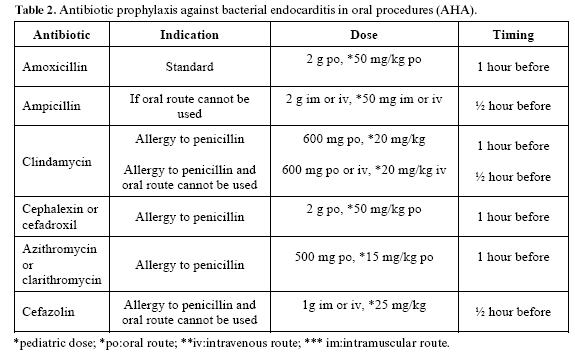
<body><![CDATA[<p><font size="2" face="Verdana">It is recommended that empirical treatment with betalactams  associated to fluorquinolones should be limited, since both groups of  antibiotics activate common resistance mechanisms – thus favoring the appearance  of resistances in important pathogens such as <i>Pseudomona aeruginosa</i> and <i>Acinetobacter</i> spp (26).</font></p>     <p><font size="2" face="Verdana">The treatment of specific infections caused by mycobacteria  requires the use of antibiotics for long periods of time (from 6 months to 2  years), and includes the administration of dapsone (a sulfamide analog),  clofazimine (a dye with bactericidal action) and rifampicin for leprosy, and  associations of ethambutol, isoniazid, rifampicin, pyrazinamide and streptomycin  for tuberculosis (27). The treatment of syphilis, caused by Treponema pallidum,  is based on the use of penicillin G benzatine. Administration comprises 2.4  million IU in a single intramuscular dose in the primary period, three doses of  2.4 million IU via the intramuscular route, spaced one week apart, in the  secondary period. In the tertiary period a first treatment is provided with  intravenous penicillin G, followed by penicillin G benzatine via the  intramuscular route once a week during 3 weeks, involving a dose of 2.4 million  IU each.</font></p>     <p>&nbsp;</p>     <p><B><font face="Verdana">Prophylaxis</font><font face="Verdana"> of focal infection</font></B></p>     <p><font size="2" face="Verdana">The use of antibiotics as prophylaxis for focal infection is common practice, and has been widely accepted in the dental profession. The paradigm of this model of treatment is the prevention of bacterial endocarditis, indicated in risk patients in the context of any invasive procedure within the oral cavity – and following the guidelines of the American Hearth Association (AHA) (28) (<a href="#t2">Table 2</a>).</font></p>     <p align="center"><font size="2" face="Verdana"><a name="t2"><img border="0" src="/img/revistas/medicorpa/v12n3/02_medora53.gif" width="575" height="354"></a></font></p>     <p><font size="2" face="Verdana">Nevertheless, there are doubts in relation to this practice. Firstly, transient bacteremia occurs not only after dental treatments such as extractions (35-80%) or periodontal surgery (30-88%). It also occurs in the context of tooth brushing (40%) or while chewing gum (20%), and is proportional to the trauma caused and to the number of germs colonizing the affected zone. Secondly, not only bacteria cause endocarditis, and of those that do cause the disease, many are resistant to the antibiotics administered as prophylaxis (fundamentally amoxicillin). Lastly, it is known that most cases of bacterial endocarditis are not related with invasive procedures, and that dental care is only responsible for a minimum percentage of cases of the disease.</font></p>     <p><font size="2" face="Verdana">Despite the mentioned inconveniences, antibiotic prophylaxis  is still recommended in patients at risk (29). However, the results of a survey  conducted by Tomas-Carmona et al. (30) on the knowledge and approach to the  prevention of bacterial endocarditis among Spanish dentists showed that fewer  than 30% of the professionals were aware of correct antibiotic indications and  posology.</font></p>     <p><font size="2" face="Verdana">There is no scientific basis for recommending systematic  antibiotic prophylaxis prior to invasive dental treatment in patients with total  joint prostheses (31). Jacobson published a study on 2693 patients with total  joint replacement (hip or knee). In 30 of the patients he detected infection of  the prosthesis, and in only one case was a time relationship with prior dental  treatment established. Furthermore, 54% of the germs isolated were <i>Staphylococcus aureus</i> and <i>epidermidis</i> (32).</font></p>     <p><font size="2" face="Verdana">According to the American Dental Association and the American  Academy of Orthopedic Surgeons, evaluation is required of antibiotic prophylaxis  in patients with total joint prostheses in the presence of immune deficiency,  when contemplating high risk dental procedures in patients with prostheses in  place for less than two years, and in patients who have already suffered past  joint prosthesis infections (33).</font></p>     ]]></body>
<body><![CDATA[<p>&nbsp;</p>     <p><B><font face="Verdana">Prophylaxis of local infection and systemic spread</font></B></p>     <p><font size="2" face="Verdana">Prophylaxis of local infection is taken to comprise the  administration of antibiotics on a pre-, intra- or postoperative basis, to  prevent bacterial proliferation and dissemination within and from the surgical  wound. Few clinical studies to date have evaluated this type of treatment. Some  authors have reported its efficacy, with statistically significant differences  in the frequency of infectious complications in surgical extractions of lower  third molars between patients who had received some form of antibiotic treatment  and those without (34).</font></p>     <p><font size="2" face="Verdana">In a retrospective study of infections following periodontal  surgery in 390 patients and involving 1053 surgical procedures carried out by  Powell et al. (35), the reported total frequency of infections was found to be  2.09% - no differences being recorded between those patients administered  antibiotics perioperatively and those without. The authors therefore did not  consider it to be justified to administer antibiotics on a postoperative basis  with the sole purpose of avoiding postoperative infections in operations of this  type, which included curettage with flap raising, the placement of implants,  sinus lifting, soft tissue autografts and coronal displacement flaps.</font></p>     <p><font size="2" face="Verdana">In a consensus document on the use of antibiotic prophylaxis  in dental surgery and procedures published in 2006 (36), prophylaxis in oral  surgery in a healthy patient was only recommended in the case of the removal of  impacted teeth, periapical surgery, bone surgery, implant surgery, bone grafting  and surgery for benign tumors. In subjects with risk factors for local or  systemic infection - including oncological patients, immune suppressed  individuals, patients with metabolic disorders such as diabetes, and  splenectomized patients, prophylactic antibiotic coverage should be provided  before attempting any invasive procedure.</font></p>     <p><font size="2" face="Verdana">The use of antibiotics in endodontics should be reserved for  patients with signs of local infection, malaise of fever. Prophylactic or  preventive use should be reserved for endocarditis and the systemic disorders  commented above – avoiding indiscriminate antibiotic use (37).</font></p>     <p>&nbsp;</p>     <p><B><font face="Verdana">Precautions with antibiotic use</font></B></p>     <p><i><font size="2" face="Verdana">- Pregnancy</font></i></p>     <p><font size="2" face="Verdana">The legal and ethical impossibility of conducting clinical  trials in humans to evaluate the risks of antibiotic treatment during pregnancy  has given rise to uncertainties as to the use of such drugs in these patients.  The United States Food and Drug Administration (FDA) has established four levels  of drug risk during pregnancy: (A) without demonstrated risk; (B) without  effects in animals, though with undemonstrated innocuousness in humans; (C) no  studies conducted in either animals or humans, or teratogenic effects recorded  in animals without due evaluation in humans; and (D) teratogenic effects upon  the fetus – use of the drug being conditioned to the obtainment of benefit that  outweighs the risks. A final group (X) in turn contemplates teratogenic effects  that outweigh any possible benefit derived from the drug.</font></p>     ]]></body>
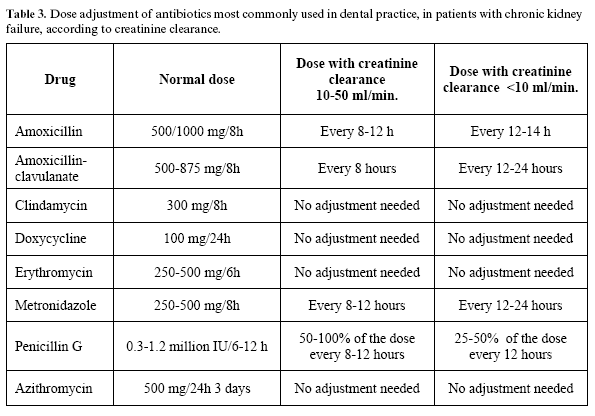
<body><![CDATA[<p><font size="2" face="Verdana">No antibiotic corresponds to group A. On the other hand,  group B (i.e., warranting caution with treatment during pregnancy) contains the  following antibiotics: azithromycin, cephalosporins, erythromycin, metronidazole  and penicillins with or without beta-lactamase inhibitors. Group C in turn  includes clarithromycin, the fluorquinolones and the sulfa drugs (including  dapsone). Finally, group D contains the aminoglycosides and tetracyclines (38).</font></p>     <p><i><font size="2" face="Verdana">- Kidney failure</font></i></p>     <p><font size="2" face="Verdana">Many antibiotics are actively eliminated through the kidneys.  The presence of impaired renal function requires reduction of the drug dose in  order to avoid excessively elevated plasma drug concentrations that could lead  to toxicity. dose adjustment can be carried out by reducing the amount  administered in each dose or by increasing the interval between doses (without  modifying the amount of drug). Neither approach has been shown to be superior  (39).</font></p>     <p><font size="2" face="Verdana"><a href="#t3">Table 3</a> reports some of the antibiotics most frequently used in dental practice, with the dose adjustments required according to the degree of kidney failure (assessed according to creatinine clearance).</font></p>     <p align="center"><font size="2" face="Verdana"><a name="t3"><img border="0" src="/img/revistas/medicorpa/v12n3/02_medora54.gif" width="595" height="416"></a></font></p>     <p><i><font size="2" face="Verdana">- Liver failure</font></i></p>     <p><font size="2" face="Verdana">Some antibiotics are metabolized in the liver, followed by elimination in bile. In patients with liver failure, the use of such antibiotics should be restricted in order to avoid toxicity secondary to overdose. Erythromycin, clindamycin, metronidazole and anti-tuberculosis drugs are antibiotics requiring dose adjustments when administered to patients with liver failure.</font></p>     <p><font size="2" face="Verdana">Regardless of the above considerations, some antibiotics are potentially hepatotoxic. As a result, and whenever possible, they should be avoided in patients with some active liver disorder. Specifically, tetracyclines and anti-tuberculosis drugs should be avoided (40).</font></p>     <p>&nbsp;</p>     <p><B><font face="Verdana">References</font></B></p>     ]]></body>
<body><![CDATA[<!-- ref --><p><font size="2" face="Verdana">1. Morcillo E, Cortijo J, Villagrasa V. Bases farmacológicas de la antibioticoterapia en infecciones odontogénicas. Med Oral 1996;1:15-23.</font>&nbsp;&nbsp;&nbsp;&nbsp;&nbsp;&nbsp;&nbsp;&nbsp;[&#160;<a href="javascript:void(0);" onclick="javascript: window.open('/scielo.php?script=sci_nlinks&ref=2961427&pid=S1698-6946200700030000200001&lng=','','width=640,height=500,resizable=yes,scrollbars=1,menubar=yes,');">Links</a>&#160;]<!-- end-ref --><!-- ref --><p> <font size="2" face="Verdana">2. Grupos terapéuticos de mayor consumo en el Sistema nacional de Salud durante 2004. Información Terapéutica del Sistema nacional de Salud 2005;29:49-53.</font>&nbsp;&nbsp;&nbsp;&nbsp;&nbsp;&nbsp;&nbsp;&nbsp;[&#160;<a href="javascript:void(0);" onclick="javascript: window.open('/scielo.php?script=sci_nlinks&ref=2961428&pid=S1698-6946200700030000200002&lng=','','width=640,height=500,resizable=yes,scrollbars=1,menubar=yes,');">Links</a>&#160;]<!-- end-ref --><!-- ref --><p> <font size="2" face="Verdana">3. Machuca M, Espejo, Gutierrez L, Herrera J. Análisis de la prescripción antibiótica en una farmacia comunitaria. Pharm Care Esp 2000;18:300-7.</font>&nbsp;&nbsp;&nbsp;&nbsp;&nbsp;&nbsp;&nbsp;&nbsp;[&#160;<a href="javascript:void(0);" onclick="javascript: window.open('/scielo.php?script=sci_nlinks&ref=2961429&pid=S1698-6946200700030000200003&lng=','','width=640,height=500,resizable=yes,scrollbars=1,menubar=yes,');">Links</a>&#160;]<!-- end-ref --><!-- ref --><p> <font size="2" face="Verdana">4. Vallano A, Izarra A. Principios de terapéutica antimicrobiana. Medicine 2006;9:3196-203.</font>&nbsp;&nbsp;&nbsp;&nbsp;&nbsp;&nbsp;&nbsp;&nbsp;[&#160;<a href="javascript:void(0);" onclick="javascript: window.open('/scielo.php?script=sci_nlinks&ref=2961430&pid=S1698-6946200700030000200004&lng=','','width=640,height=500,resizable=yes,scrollbars=1,menubar=yes,');">Links</a>&#160;]<!-- end-ref --><!-- ref --><p> <font size="2" face="Verdana">5. Bresco-Salinas M, Costa-Riu N, Berini-Aytes L, Gay-Escoda C. Susceptibilidad antibiótica de las bacterias causantes de infecciones odontogénicas. Med Oral Patol Oral Cir Bucal 2006;11:51-6.</font>&nbsp;&nbsp;&nbsp;&nbsp;&nbsp;&nbsp;&nbsp;&nbsp;[&#160;<a href="javascript:void(0);" onclick="javascript: window.open('/scielo.php?script=sci_nlinks&ref=2961431&pid=S1698-6946200700030000200005&lng=','','width=640,height=500,resizable=yes,scrollbars=1,menubar=yes,');">Links</a>&#160;]<!-- end-ref --><!-- ref --><p> <font size="2" face="Verdana">6. Aracil B, Minambres M, Oteo J, Torres C, Gomez-Garces JL, Alos JI. High prevalence of erythromycin-resistant and clindamycin-susceptible (M phenotype) viridans group streptococci from pharyngeal samples: a reservoir of mef genes in commensal bacteria. J Antimicrob Chemother 2001;48:592-4.</font>&nbsp;&nbsp;&nbsp;&nbsp;&nbsp;&nbsp;&nbsp;&nbsp;[&#160;<a href="javascript:void(0);" onclick="javascript: window.open('/scielo.php?script=sci_nlinks&ref=2961432&pid=S1698-6946200700030000200006&lng=','','width=640,height=500,resizable=yes,scrollbars=1,menubar=yes,');">Links</a>&#160;]<!-- end-ref --><!-- ref --><p> <font size="2" face="Verdana">7. Groppo FC, Castro FM, Pacheco AB, Motta RH, Filho TR, Ramacciato JC, et al. Antimicrobial resistance of Staphylococcus aureus and oral streptococci strains from high-risk ndocarditis patients. Gen Dent 2005;53:410-3.</font>&nbsp;&nbsp;&nbsp;&nbsp;&nbsp;&nbsp;&nbsp;&nbsp;[&#160;<a href="javascript:void(0);" onclick="javascript: window.open('/scielo.php?script=sci_nlinks&ref=2961433&pid=S1698-6946200700030000200007&lng=','','width=640,height=500,resizable=yes,scrollbars=1,menubar=yes,');">Links</a>&#160;]<!-- end-ref --><!-- ref --><p> <font size="2" face="Verdana">8. Groppo FC, Simoes RP, Ramacciato JC, Rehder V, de Andrade ED, Mattos-Filho TR. Effect of sodium diclofenac on serum and tissue concentration of amoxicillin and on staphylococcal infection. Biol Pharm Bull 2004;27:52-5.</font>&nbsp;&nbsp;&nbsp;&nbsp;&nbsp;&nbsp;&nbsp;&nbsp;[&#160;<a href="javascript:void(0);" onclick="javascript: window.open('/scielo.php?script=sci_nlinks&ref=2961434&pid=S1698-6946200700030000200008&lng=','','width=640,height=500,resizable=yes,scrollbars=1,menubar=yes,');">Links</a>&#160;]<!-- end-ref --><!-- ref --><p> <font size="2" face="Verdana">9. de Cassia Bergamaschi C, Motta RH, Franco GC, Cogo K, Montan MF, Ambrosano GM, et al. Effect of sodium diclofenac on the bioavailability of amoxicillin. Int J Antimicrob Agents 2006;27:417-22.</font>&nbsp;&nbsp;&nbsp;&nbsp;&nbsp;&nbsp;&nbsp;&nbsp;[&#160;<a href="javascript:void(0);" onclick="javascript: window.open('/scielo.php?script=sci_nlinks&ref=2961435&pid=S1698-6946200700030000200009&lng=','','width=640,height=500,resizable=yes,scrollbars=1,menubar=yes,');">Links</a>&#160;]<!-- end-ref --><!-- ref --><p> <font size="2" face="Verdana">10. Tsivou E, Melakopoulos I, Kotsiou A, Anagnostopoulou S, Tesseromatis C. Alterations in cefalosporin levels in the serum and mandible of hyperlipaedemic rats after co-administration of ibuprofen. Eur J Drug Metab Pharmacokinet 2005;30:171-4.</font>&nbsp;&nbsp;&nbsp;&nbsp;&nbsp;&nbsp;&nbsp;&nbsp;[&#160;<a href="javascript:void(0);" onclick="javascript: window.open('/scielo.php?script=sci_nlinks&ref=2961436&pid=S1698-6946200700030000200010&lng=','','width=640,height=500,resizable=yes,scrollbars=1,menubar=yes,');">Links</a>&#160;]<!-- end-ref --><!-- ref --><p> <font size="2" face="Verdana">11. Oh YH, Han HK. Pharmacokinetic interaction of tetracycline with non-steroidal anti-inflammatory drugs via organic anion transporters in rats. Pharmacol Res 2006;53:75-9.</font>&nbsp;&nbsp;&nbsp;&nbsp;&nbsp;&nbsp;&nbsp;&nbsp;[&#160;<a href="javascript:void(0);" onclick="javascript: window.open('/scielo.php?script=sci_nlinks&ref=2961437&pid=S1698-6946200700030000200011&lng=','','width=640,height=500,resizable=yes,scrollbars=1,menubar=yes,');">Links</a>&#160;]<!-- end-ref --><!-- ref --><p> <font size="2" face="Verdana">12. Liébana-Ureña J, González MP, Liébana MJ, Parra LE. Composición y ecología de la microbiota oral. En: Liébana-Ureña J Ed. Microbiología Oral. Madrid:McGraw-Hill; 2002. p. 514-25.</font>&nbsp;&nbsp;&nbsp;&nbsp;&nbsp;&nbsp;&nbsp;&nbsp;[&#160;<a href="javascript:void(0);" onclick="javascript: window.open('/scielo.php?script=sci_nlinks&ref=2961438&pid=S1698-6946200700030000200012&lng=','','width=640,height=500,resizable=yes,scrollbars=1,menubar=yes,');">Links</a>&#160;]<!-- end-ref --><!-- ref --><p> <font size="2" face="Verdana">13. Isla A, Canut A, Rodriguez Gascon A, Pedraz JL. Análisis farmacocinético/framacodinámico (PK/PD) de la antibioterapia en odontoestomatología. Enferm Infecc Microbiol Clin 2005;23:116-21.</font>&nbsp;&nbsp;&nbsp;&nbsp;&nbsp;&nbsp;&nbsp;&nbsp;[&#160;<a href="javascript:void(0);" onclick="javascript: window.open('/scielo.php?script=sci_nlinks&ref=2961439&pid=S1698-6946200700030000200013&lng=','','width=640,height=500,resizable=yes,scrollbars=1,menubar=yes,');">Links</a>&#160;]<!-- end-ref --><!-- ref --><p> <font size="2" face="Verdana">14. Catálogo de Medicamentos. Colección Consejo Plus Tomo I. Madrid: Consejo General de Colegios Oficiales de Farmacéuticos;2006. p.1594-6</font>&nbsp;&nbsp;&nbsp;&nbsp;&nbsp;&nbsp;&nbsp;&nbsp;[&#160;<a href="javascript:void(0);" onclick="javascript: window.open('/scielo.php?script=sci_nlinks&ref=2961440&pid=S1698-6946200700030000200014&lng=','','width=640,height=500,resizable=yes,scrollbars=1,menubar=yes,');">Links</a>&#160;]<!-- end-ref --><!-- ref --><p> <font size="2" face="Verdana">15. Liñares R, Martín-Herrero JE. Bases farmacológicas del tratamiento antibiótico de las enfermedades periodontales y periimplantarias. Av Odontoestomatol 2003; especial:23-33.</font>&nbsp;&nbsp;&nbsp;&nbsp;&nbsp;&nbsp;&nbsp;&nbsp;[&#160;<a href="javascript:void(0);" onclick="javascript: window.open('/scielo.php?script=sci_nlinks&ref=2961441&pid=S1698-6946200700030000200015&lng=','','width=640,height=500,resizable=yes,scrollbars=1,menubar=yes,');">Links</a>&#160;]<!-- end-ref --><!-- ref --><p> <font size="2" face="Verdana">16. Sobottka I, Cachovan G, Sturenburg E, Ahlers MO, Laufs R, Platzer U, et al. In vitro activity of moxifloxacin against bacteria isolated from odontogenic abscesses. Antimicrob Agents Chemother 2002;46:4019-21.</font>&nbsp;&nbsp;&nbsp;&nbsp;&nbsp;&nbsp;&nbsp;&nbsp;[&#160;<a href="javascript:void(0);" onclick="javascript: window.open('/scielo.php?script=sci_nlinks&ref=2961442&pid=S1698-6946200700030000200016&lng=','','width=640,height=500,resizable=yes,scrollbars=1,menubar=yes,');">Links</a>&#160;]<!-- end-ref --><!-- ref --><p> <font size="2" face="Verdana">17. Kirkwood KL. Update on antibiotics used to treat orofacial infections. Alpha Omegan 2003;96:28-34.</font>&nbsp;&nbsp;&nbsp;&nbsp;&nbsp;&nbsp;&nbsp;&nbsp;[&#160;<a href="javascript:void(0);" onclick="javascript: window.open('/scielo.php?script=sci_nlinks&ref=2961443&pid=S1698-6946200700030000200017&lng=','','width=640,height=500,resizable=yes,scrollbars=1,menubar=yes,');">Links</a>&#160;]<!-- end-ref --><!-- ref --><p> <font size="2" face="Verdana">18. Swift JQ, Gulden WS. Antibiotic therapy--managing odontogenic infections. Dent Clin North Am 2002;46:623-33.</font>&nbsp;&nbsp;&nbsp;&nbsp;&nbsp;&nbsp;&nbsp;&nbsp;[&#160;<a href="javascript:void(0);" onclick="javascript: window.open('/scielo.php?script=sci_nlinks&ref=2961444&pid=S1698-6946200700030000200018&lng=','','width=640,height=500,resizable=yes,scrollbars=1,menubar=yes,');">Links</a>&#160;]<!-- end-ref --><!-- ref --><p> <font size="2" face="Verdana">19. Morcillo E. Fundamentos farmacológicos de la terapéutica antimicrobiana. Av Odontoestomatol 1997;Sppl A:29-35.</font>&nbsp;&nbsp;&nbsp;&nbsp;&nbsp;&nbsp;&nbsp;&nbsp;[&#160;<a href="javascript:void(0);" onclick="javascript: window.open('/scielo.php?script=sci_nlinks&ref=2961445&pid=S1698-6946200700030000200019&lng=','','width=640,height=500,resizable=yes,scrollbars=1,menubar=yes,');">Links</a>&#160;]<!-- end-ref --><!-- ref --><p> <font size="2" face="Verdana">20. Kuriyama T, Nakagawa K, Karasawa T, Saiki Y, Yamamoto E, Nakamura S. Past administration of beta-lactam antibiotics and increase in the emergence of beta-lactamase-producing bacteria in patients with orofacial odontogenic infections. Oral Surg Oral Med Oral Pathol Oral Radiol Endod 2000;89:186-92.</font>&nbsp;&nbsp;&nbsp;&nbsp;&nbsp;&nbsp;&nbsp;&nbsp;[&#160;<a href="javascript:void(0);" onclick="javascript: window.open('/scielo.php?script=sci_nlinks&ref=2961446&pid=S1698-6946200700030000200020&lng=','','width=640,height=500,resizable=yes,scrollbars=1,menubar=yes,');">Links</a>&#160;]<!-- end-ref --><!-- ref --><p> <font size="2" face="Verdana">21. Bascones Martinez A, Aguirre Urizar JM, Bermejo Fenoll A, Blanco Carrion A, Gay-Escoda C, Gonzalez-Moles MA, et al. Documento de consenso sobre el tratamiento antimicrobiano de las infecciones bacterianas odontogénicas.Med Oral Patol Oral Cir Bucal 2004;9:369-76.</font>&nbsp;&nbsp;&nbsp;&nbsp;&nbsp;&nbsp;&nbsp;&nbsp;[&#160;<a href="javascript:void(0);" onclick="javascript: window.open('/scielo.php?script=sci_nlinks&ref=2961447&pid=S1698-6946200700030000200021&lng=','','width=640,height=500,resizable=yes,scrollbars=1,menubar=yes,');">Links</a>&#160;]<!-- end-ref --><!-- ref --><p> <font size="2" face="Verdana">22. Berini L, Gay C. Normas generales de tratamiento de la infección odontogénica. Antibioticoterapia. Profilaxis de las infecciones postquirúrgicas y a distancia. En:Gay C, Berini L, eds. Tratado de Cirugía Bucal. Tomo I. Madrid:Ergón; 2004. p. 617-38.</font>&nbsp;&nbsp;&nbsp;&nbsp;&nbsp;&nbsp;&nbsp;&nbsp;[&#160;<a href="javascript:void(0);" onclick="javascript: window.open('/scielo.php?script=sci_nlinks&ref=2961448&pid=S1698-6946200700030000200022&lng=','','width=640,height=500,resizable=yes,scrollbars=1,menubar=yes,');">Links</a>&#160;]<!-- end-ref --><!-- ref --><p> <font size="2" face="Verdana">23. Maestre-Vera JR. Opciones terapéuticas en la infección de origen odontogénico. Med Oral Patol Oral Cir Bucal 2004;9 Suppl:19-31.</font>&nbsp;&nbsp;&nbsp;&nbsp;&nbsp;&nbsp;&nbsp;&nbsp;[&#160;<a href="javascript:void(0);" onclick="javascript: window.open('/scielo.php?script=sci_nlinks&ref=2961449&pid=S1698-6946200700030000200023&lng=','','width=640,height=500,resizable=yes,scrollbars=1,menubar=yes,');">Links</a>&#160;]<!-- end-ref --><!-- ref --><p> <font size="2" face="Verdana">24. Bystedt H, DAhlback A, Dornbusch K, Nord CE. Concentrations of azidocillin, erythromycin, doxycycline and clindamycin in human mandibular bone. Int J Oral Surg 1978;7:442-9.</font>&nbsp;&nbsp;&nbsp;&nbsp;&nbsp;&nbsp;&nbsp;&nbsp;[&#160;<a href="javascript:void(0);" onclick="javascript: window.open('/scielo.php?script=sci_nlinks&ref=2961450&pid=S1698-6946200700030000200024&lng=','','width=640,height=500,resizable=yes,scrollbars=1,menubar=yes,');">Links</a>&#160;]<!-- end-ref --><!-- ref --><p> <font size="2" face="Verdana">25. Parra J, Peña A, Martínez MA, Hernández J. Quinolonas, sulfamidas, trmetoprima, cotrimoxazol. Medicine 2006;9:3538-43.</font>&nbsp;&nbsp;&nbsp;&nbsp;&nbsp;&nbsp;&nbsp;&nbsp;[&#160;<a href="javascript:void(0);" onclick="javascript: window.open('/scielo.php?script=sci_nlinks&ref=2961451&pid=S1698-6946200700030000200025&lng=','','width=640,height=500,resizable=yes,scrollbars=1,menubar=yes,');">Links</a>&#160;]<!-- end-ref --><!-- ref --><p> <font size="2" face="Verdana">26. Peterson LR. Squeezing the antibiotic balloon: the impact of antimicrobial classes on emerging resistance. Clin Microbiol Infect 2005;11:4-16.</font>&nbsp;&nbsp;&nbsp;&nbsp;&nbsp;&nbsp;&nbsp;&nbsp;[&#160;<a href="javascript:void(0);" onclick="javascript: window.open('/scielo.php?script=sci_nlinks&ref=2961452&pid=S1698-6946200700030000200026&lng=','','width=640,height=500,resizable=yes,scrollbars=1,menubar=yes,');">Links</a>&#160;]<!-- end-ref --><!-- ref --><p> <font size="2" face="Verdana">27. Rozman C. Compendio de Medicina Interna. Madrid: Elsevier 2006. p. 683-90.</font>&nbsp;&nbsp;&nbsp;&nbsp;&nbsp;&nbsp;&nbsp;&nbsp;[&#160;<a href="javascript:void(0);" onclick="javascript: window.open('/scielo.php?script=sci_nlinks&ref=2961453&pid=S1698-6946200700030000200027&lng=','','width=640,height=500,resizable=yes,scrollbars=1,menubar=yes,');">Links</a>&#160;]<!-- end-ref --><!-- ref --><p> <font size="2" face="Verdana">28. Dajani AS, Taubert KA, Wilson W, Bolger AF, Bayer A, Ferrieri P, et al .Prevention of bacterial endocarditis: recommendations by the American Heart Association. J Am Dent Assoc 1997;128:1142-51.</font>&nbsp;&nbsp;&nbsp;&nbsp;&nbsp;&nbsp;&nbsp;&nbsp;[&#160;<a href="javascript:void(0);" onclick="javascript: window.open('/scielo.php?script=sci_nlinks&ref=2961454&pid=S1698-6946200700030000200028&lng=','','width=640,height=500,resizable=yes,scrollbars=1,menubar=yes,');">Links</a>&#160;]<!-- end-ref --><!-- ref --><p> <font size="2" face="Verdana">29. ADA. Terapéutica Dental. Barcelona:Masson; 2003. p. 596-600</font>&nbsp;&nbsp;&nbsp;&nbsp;&nbsp;&nbsp;&nbsp;&nbsp;[&#160;<a href="javascript:void(0);" onclick="javascript: window.open('/scielo.php?script=sci_nlinks&ref=2961455&pid=S1698-6946200700030000200029&lng=','','width=640,height=500,resizable=yes,scrollbars=1,menubar=yes,');">Links</a>&#160;]<!-- end-ref --><!-- ref --><p> <font size="2" face="Verdana">30. Tomas Carmona I, Diz Dios P, Limeres Posse J, Outumuro Rial M, Caamano Duran F, Fernandez Feijoo J, et al. Chemoprophylaxis of bacterial endocarditis recommended by general dental practitioners in Spain. Med Oral 2004;9:56-62.</font>&nbsp;&nbsp;&nbsp;&nbsp;&nbsp;&nbsp;&nbsp;&nbsp;[&#160;<a href="javascript:void(0);" onclick="javascript: window.open('/scielo.php?script=sci_nlinks&ref=2961456&pid=S1698-6946200700030000200030&lng=','','width=640,height=500,resizable=yes,scrollbars=1,menubar=yes,');">Links</a>&#160;]<!-- end-ref --><!-- ref --><p> <font size="2" face="Verdana">31. Pallasch TJ, Slots J. Antibiotic prophylaxis and the medically compromised patient. Periodontol 2000 1996;10:107-38.</font>&nbsp;&nbsp;&nbsp;&nbsp;&nbsp;&nbsp;&nbsp;&nbsp;[&#160;<a href="javascript:void(0);" onclick="javascript: window.open('/scielo.php?script=sci_nlinks&ref=2961457&pid=S1698-6946200700030000200031&lng=','','width=640,height=500,resizable=yes,scrollbars=1,menubar=yes,');">Links</a>&#160;]<!-- end-ref --><!-- ref --><p> <font size="2" face="Verdana">32. Jacobson JJ, Millard HD, Plezia R, Blankenship JR. Dental treatment and late prosthetic joint infections. Oral Surg Oral Med Oral Pathol 1986;61:413-7.</font>&nbsp;&nbsp;&nbsp;&nbsp;&nbsp;&nbsp;&nbsp;&nbsp;[&#160;<a href="javascript:void(0);" onclick="javascript: window.open('/scielo.php?script=sci_nlinks&ref=2961458&pid=S1698-6946200700030000200032&lng=','','width=640,height=500,resizable=yes,scrollbars=1,menubar=yes,');">Links</a>&#160;]<!-- end-ref --><!-- ref --><p> <font size="2" face="Verdana">33. American Dental Association; American Academy of Orthopedic Surgeons. Antibiotic prophylaxis for dental patients with total joint replacements. J Am Dent Assoc 2003;134:895-9.</font>&nbsp;&nbsp;&nbsp;&nbsp;&nbsp;&nbsp;&nbsp;&nbsp;[&#160;<a href="javascript:void(0);" onclick="javascript: window.open('/scielo.php?script=sci_nlinks&ref=2961459&pid=S1698-6946200700030000200033&lng=','','width=640,height=500,resizable=yes,scrollbars=1,menubar=yes,');">Links</a>&#160;]<!-- end-ref --><!-- ref --><p> <font size="2" face="Verdana">34. Martínez Lacasa J, Jiménez, Ferrás VA, Garcia Rey G, Bosom M, Solá-Morales O et al. A double-blind placebo-controlled, randosmised comparative phase III clinical trial of pharmacokinetiocally enhanced amoxicillin-clavulanate 2000/125, as prophilaxis or as treatment versus placebo for infectious and inflammatory morbidity after third molar mandibular removal. Program and abstracs of the 43rd InterScience Conference on Antimicrobial Agents and Chemotherapy. Chicago 2003. American Society for Mocrobiology, Washington DC. Citado en: Gutiérrez JL, Bagán JV, Bascones A, Llamas R, Llena J, Morales A, et al. Documento de consenso sobre la utilización de profilaxis antibiótica en cirugía. Med Oral Patol Oral Cir Bucal 2006;11:119-36.</font>&nbsp;&nbsp;&nbsp;&nbsp;&nbsp;&nbsp;&nbsp;&nbsp;[&#160;<a href="javascript:void(0);" onclick="javascript: window.open('/scielo.php?script=sci_nlinks&ref=2961460&pid=S1698-6946200700030000200034&lng=','','width=640,height=500,resizable=yes,scrollbars=1,menubar=yes,');">Links</a>&#160;]<!-- end-ref --><!-- ref --><p> <font size="2" face="Verdana">35. Powell CA, Mealey BL, Deas DE, McDonnell HT, Moritz AJ. Post-surgical infections: prevalence associated with various periodontal surgical procedures. J Periodontol 2005;76:329-33.</font>&nbsp;&nbsp;&nbsp;&nbsp;&nbsp;&nbsp;&nbsp;&nbsp;[&#160;<a href="javascript:void(0);" onclick="javascript: window.open('/scielo.php?script=sci_nlinks&ref=2961461&pid=S1698-6946200700030000200035&lng=','','width=640,height=500,resizable=yes,scrollbars=1,menubar=yes,');">Links</a>&#160;]<!-- end-ref --><!-- ref --><p> <font size="2" face="Verdana">36. Gutierrez JL, Bagan JV, Bascones A, Llamas R, Llena J, Morales A et al. documento de consenso sobre la utilización de profilaxis antibiótica en cirugía y procedimientos dentales. Med Oral Patol Oral Cir Bucal 2006;11:119-36.</font>&nbsp;&nbsp;&nbsp;&nbsp;&nbsp;&nbsp;&nbsp;&nbsp;[&#160;<a href="javascript:void(0);" onclick="javascript: window.open('/scielo.php?script=sci_nlinks&ref=2961462&pid=S1698-6946200700030000200036&lng=','','width=640,height=500,resizable=yes,scrollbars=1,menubar=yes,');">Links</a>&#160;]<!-- end-ref --><!-- ref --><p> <font size="2" face="Verdana">37. Abbott PV, Hume WR, Pearman JW. Antibiotics and endodontics. Aust Dent J 1990;35:50-60.</font>&nbsp;&nbsp;&nbsp;&nbsp;&nbsp;&nbsp;&nbsp;&nbsp;[&#160;<a href="javascript:void(0);" onclick="javascript: window.open('/scielo.php?script=sci_nlinks&ref=2961463&pid=S1698-6946200700030000200037&lng=','','width=640,height=500,resizable=yes,scrollbars=1,menubar=yes,');">Links</a>&#160;]<!-- end-ref --><!-- ref --><p> <font size="2" face="Verdana">38. Michavila A, Flórez J, García-Lobo JM. Farmacología de las enfermedades infecciosas. Principios generales, selección y asociación de antibióticos. En: Flórez J. Ed. Farmacología humana 4ªed. Barcelona: Masson SA; 2005. p. 1081-103.</font>&nbsp;&nbsp;&nbsp;&nbsp;&nbsp;&nbsp;&nbsp;&nbsp;[&#160;<a href="javascript:void(0);" onclick="javascript: window.open('/scielo.php?script=sci_nlinks&ref=2961464&pid=S1698-6946200700030000200038&lng=','','width=640,height=500,resizable=yes,scrollbars=1,menubar=yes,');">Links</a>&#160;]<!-- end-ref --><!-- ref --><p> <font size="2" face="Verdana">39. Livornese LL Jr, Slavin D, Gilbert B, Robbins P, Santoro J. Use of antibacterial agents in renal failure. Infect Dis Clin North Am 2004;18:551-79.</font>&nbsp;&nbsp;&nbsp;&nbsp;&nbsp;&nbsp;&nbsp;&nbsp;[&#160;<a href="javascript:void(0);" onclick="javascript: window.open('/scielo.php?script=sci_nlinks&ref=2961465&pid=S1698-6946200700030000200039&lng=','','width=640,height=500,resizable=yes,scrollbars=1,menubar=yes,');">Links</a>&#160;]<!-- end-ref --><!-- ref --><p> <font size="2" face="Verdana">40. Douglas LR, Douglas JB, Sieck JO, Smith PJ. Oral management of the patient with end-stage liver disease and the liver transplant patient. Oral Surg Oral Med Oral Pathol Oral Radiol Endod 1998;86:55-64.</font>&nbsp;&nbsp;&nbsp;&nbsp;&nbsp;&nbsp;&nbsp;&nbsp;[&#160;<a href="javascript:void(0);" onclick="javascript: window.open('/scielo.php?script=sci_nlinks&ref=2961466&pid=S1698-6946200700030000200040&lng=','','width=640,height=500,resizable=yes,scrollbars=1,menubar=yes,');">Links</a>&#160;]<!-- end-ref --><p>&nbsp;</p>     <p>&nbsp;</p>     <p><a href="#top"><img border="0" src="/img/revistas/medicorpa/v12n3/seta.gif" width="15" height="17"></a><font face="Verdana"><B><font size="2"><a name="back"></a>Correspondence:</font></B><font size="2">    <BR>Dr. Rafael Poveda Roda    <BR>Servicio de Estomatología.    <BR>Hospital General Universitario de Valencia.    <BR>Av/ Tres Cruces nº 4    <BR>46014 Valencia    <BR>E-mail:  </font><a href="mailto:poveda_raf@gva.es"><font size="2">poveda_raf@gva.es</font></a></font></p>     <p><font size="2" face="Verdana">Received: 8-08-2006    ]]></body>
<body><![CDATA[<BR>Accepted: 9-12-2006</font></p>      ]]></body><back>
<ref-list>
<ref id="B1">
<label>1</label><nlm-citation citation-type="journal">
<person-group person-group-type="author">
<name>
<surname><![CDATA[Morcillo]]></surname>
<given-names><![CDATA[E]]></given-names>
</name>
<name>
<surname><![CDATA[Cortijo]]></surname>
<given-names><![CDATA[J]]></given-names>
</name>
<name>
<surname><![CDATA[Villagrasa]]></surname>
<given-names><![CDATA[V]]></given-names>
</name>
</person-group>
<article-title xml:lang="es"><![CDATA[Bases farmacológicas de la antibioticoterapia en infecciones odontogénicas]]></article-title>
<source><![CDATA[Med Oral]]></source>
<year>1996</year>
<volume>1</volume>
<page-range>15-23</page-range></nlm-citation>
</ref>
<ref id="B2">
<label>2</label><nlm-citation citation-type="">
<collab>Grupos terapéuticos de mayor consumo en el Sistema nacional de Salud durante 2004</collab>
<source><![CDATA[Información Terapéutica del Sistema nacional de Salud]]></source>
<year>2005</year>
<volume>29</volume>
<page-range>49-53</page-range></nlm-citation>
</ref>
<ref id="B3">
<label>3</label><nlm-citation citation-type="journal">
<person-group person-group-type="author">
<name>
<surname><![CDATA[Machuca]]></surname>
<given-names><![CDATA[M]]></given-names>
</name>
<name>
<surname><![CDATA[Espejo]]></surname>
</name>
<name>
<surname><![CDATA[Gutierrez]]></surname>
<given-names><![CDATA[L]]></given-names>
</name>
<name>
<surname><![CDATA[Herrera]]></surname>
<given-names><![CDATA[J]]></given-names>
</name>
</person-group>
<article-title xml:lang="es"><![CDATA[Análisis de la prescripción antibiótica en una farmacia comunitaria]]></article-title>
<source><![CDATA[Pharm Care Esp]]></source>
<year>2000</year>
<volume>18</volume>
<page-range>300-7</page-range></nlm-citation>
</ref>
<ref id="B4">
<label>4</label><nlm-citation citation-type="journal">
<person-group person-group-type="author">
<name>
<surname><![CDATA[Vallano]]></surname>
<given-names><![CDATA[A]]></given-names>
</name>
<name>
<surname><![CDATA[Izarra]]></surname>
<given-names><![CDATA[A]]></given-names>
</name>
</person-group>
<article-title xml:lang="es"><![CDATA[Principios de terapéutica antimicrobiana]]></article-title>
<source><![CDATA[Medicine]]></source>
<year>2006</year>
<volume>9</volume>
<page-range>3196-203</page-range></nlm-citation>
</ref>
<ref id="B5">
<label>5</label><nlm-citation citation-type="journal">
<person-group person-group-type="author">
<name>
<surname><![CDATA[Bresco-Salinas]]></surname>
<given-names><![CDATA[M]]></given-names>
</name>
<name>
<surname><![CDATA[Costa-Riu]]></surname>
<given-names><![CDATA[N]]></given-names>
</name>
<name>
<surname><![CDATA[Berini-Aytes]]></surname>
<given-names><![CDATA[L]]></given-names>
</name>
<name>
<surname><![CDATA[Gay-Escoda]]></surname>
<given-names><![CDATA[C]]></given-names>
</name>
</person-group>
<article-title xml:lang="es"><![CDATA[Susceptibilidad antibiótica de las bacterias causantes de infecciones odontogénicas]]></article-title>
<source><![CDATA[Med Oral Patol Oral Cir Bucal]]></source>
<year>2006</year>
<volume>11</volume>
<page-range>51-6</page-range></nlm-citation>
</ref>
<ref id="B6">
<label>6</label><nlm-citation citation-type="journal">
<person-group person-group-type="author">
<name>
<surname><![CDATA[Aracil]]></surname>
<given-names><![CDATA[B]]></given-names>
</name>
<name>
<surname><![CDATA[Minambres]]></surname>
<given-names><![CDATA[M]]></given-names>
</name>
<name>
<surname><![CDATA[Oteo]]></surname>
<given-names><![CDATA[J]]></given-names>
</name>
<name>
<surname><![CDATA[Torres]]></surname>
<given-names><![CDATA[C]]></given-names>
</name>
<name>
<surname><![CDATA[Gomez-Garces]]></surname>
<given-names><![CDATA[JL]]></given-names>
</name>
<name>
<surname><![CDATA[Alos]]></surname>
<given-names><![CDATA[JI]]></given-names>
</name>
</person-group>
<article-title xml:lang="en"><![CDATA[High prevalence of erythromycin-resistant and clindamycin-susceptible (M phenotype) viridans group streptococci from pharyngeal samples: a reservoir of mef genes in commensal bacteria]]></article-title>
<source><![CDATA[J Antimicrob Chemother]]></source>
<year>2001</year>
<volume>48</volume>
<page-range>592-4</page-range></nlm-citation>
</ref>
<ref id="B7">
<label>7</label><nlm-citation citation-type="journal">
<person-group person-group-type="author">
<name>
<surname><![CDATA[Groppo]]></surname>
<given-names><![CDATA[FC]]></given-names>
</name>
<name>
<surname><![CDATA[Castro]]></surname>
<given-names><![CDATA[FM]]></given-names>
</name>
<name>
<surname><![CDATA[Pacheco]]></surname>
<given-names><![CDATA[AB]]></given-names>
</name>
<name>
<surname><![CDATA[Motta]]></surname>
<given-names><![CDATA[RH]]></given-names>
</name>
<name>
<surname><![CDATA[Filho]]></surname>
<given-names><![CDATA[TR]]></given-names>
</name>
<name>
<surname><![CDATA[Ramacciato]]></surname>
<given-names><![CDATA[JC]]></given-names>
</name>
</person-group>
<article-title xml:lang="en"><![CDATA[Antimicrobial resistance of Staphylococcus aureus and oral streptococci strains from high-risk ndocarditis patients]]></article-title>
<source><![CDATA[Gen Dent]]></source>
<year>2005</year>
<volume>53</volume>
<page-range>410-3</page-range></nlm-citation>
</ref>
<ref id="B8">
<label>8</label><nlm-citation citation-type="journal">
<person-group person-group-type="author">
<name>
<surname><![CDATA[Groppo]]></surname>
<given-names><![CDATA[FC]]></given-names>
</name>
<name>
<surname><![CDATA[Simoes]]></surname>
<given-names><![CDATA[RP]]></given-names>
</name>
<name>
<surname><![CDATA[Ramacciato]]></surname>
<given-names><![CDATA[JC]]></given-names>
</name>
<name>
<surname><![CDATA[Rehder]]></surname>
<given-names><![CDATA[V]]></given-names>
</name>
<name>
<surname><![CDATA[de Andrade]]></surname>
<given-names><![CDATA[ED]]></given-names>
</name>
<name>
<surname><![CDATA[Mattos-Filho]]></surname>
<given-names><![CDATA[TR]]></given-names>
</name>
</person-group>
<article-title xml:lang="en"><![CDATA[Effect of sodium diclofenac on serum and tissue concentration of amoxicillin and on staphylococcal infection]]></article-title>
<source><![CDATA[Biol Pharm Bull]]></source>
<year>2004</year>
<volume>27</volume>
<page-range>52-5</page-range></nlm-citation>
</ref>
<ref id="B9">
<label>9</label><nlm-citation citation-type="journal">
<person-group person-group-type="author">
<name>
<surname><![CDATA[de Cassia Bergamaschi]]></surname>
<given-names><![CDATA[C]]></given-names>
</name>
<name>
<surname><![CDATA[Motta]]></surname>
<given-names><![CDATA[RH]]></given-names>
</name>
<name>
<surname><![CDATA[Franco]]></surname>
<given-names><![CDATA[GC]]></given-names>
</name>
<name>
<surname><![CDATA[Cogo]]></surname>
<given-names><![CDATA[K]]></given-names>
</name>
<name>
<surname><![CDATA[Montan]]></surname>
<given-names><![CDATA[MF]]></given-names>
</name>
<name>
<surname><![CDATA[Ambrosano]]></surname>
<given-names><![CDATA[GM]]></given-names>
</name>
</person-group>
<article-title xml:lang="en"><![CDATA[Effect of sodium diclofenac on the bioavailability of amoxicillin]]></article-title>
<source><![CDATA[Int J Antimicrob Agents]]></source>
<year>2006</year>
<volume>27</volume>
<page-range>417-22</page-range></nlm-citation>
</ref>
<ref id="B10">
<label>10</label><nlm-citation citation-type="journal">
<person-group person-group-type="author">
<name>
<surname><![CDATA[Tsivou]]></surname>
<given-names><![CDATA[E]]></given-names>
</name>
<name>
<surname><![CDATA[Melakopoulos]]></surname>
<given-names><![CDATA[I]]></given-names>
</name>
<name>
<surname><![CDATA[Kotsiou]]></surname>
<given-names><![CDATA[A]]></given-names>
</name>
<name>
<surname><![CDATA[Anagnostopoulou]]></surname>
<given-names><![CDATA[S]]></given-names>
</name>
<name>
<surname><![CDATA[Tesseromatis]]></surname>
<given-names><![CDATA[C]]></given-names>
</name>
</person-group>
<article-title xml:lang="en"><![CDATA[Alterations in cefalosporin levels in the serum and mandible of hyperlipaedemic rats after co-administration of ibuprofen]]></article-title>
<source><![CDATA[Eur J Drug Metab Pharmacokinet]]></source>
<year>2005</year>
<volume>30</volume>
<page-range>171-4</page-range></nlm-citation>
</ref>
<ref id="B11">
<label>11</label><nlm-citation citation-type="journal">
<person-group person-group-type="author">
<name>
<surname><![CDATA[Oh]]></surname>
<given-names><![CDATA[YH]]></given-names>
</name>
<name>
<surname><![CDATA[Han]]></surname>
<given-names><![CDATA[HK]]></given-names>
</name>
</person-group>
<article-title xml:lang="en"><![CDATA[Pharmacokinetic interaction of tetracycline with non-steroidal anti-inflammatory drugs via organic anion transporters in rats]]></article-title>
<source><![CDATA[Pharmacol Res]]></source>
<year>2006</year>
<volume>53</volume>
<page-range>75-9</page-range></nlm-citation>
</ref>
<ref id="B12">
<label>12</label><nlm-citation citation-type="book">
<person-group person-group-type="author">
<name>
<surname><![CDATA[Liébana-Ureña]]></surname>
<given-names><![CDATA[J]]></given-names>
</name>
<name>
<surname><![CDATA[González]]></surname>
<given-names><![CDATA[MP]]></given-names>
</name>
<name>
<surname><![CDATA[Liébana]]></surname>
<given-names><![CDATA[MJ]]></given-names>
</name>
<name>
<surname><![CDATA[Parra]]></surname>
<given-names><![CDATA[LE]]></given-names>
</name>
</person-group>
<article-title xml:lang="es"><![CDATA[Composición y ecología de la microbiota oral]]></article-title>
<person-group person-group-type="editor">
<name>
<surname><![CDATA[Liébana-Ureña]]></surname>
<given-names><![CDATA[J]]></given-names>
</name>
</person-group>
<source><![CDATA[Microbiología Oral]]></source>
<year>2002</year>
<page-range>514-25</page-range><publisher-loc><![CDATA[Madrid ]]></publisher-loc>
<publisher-name><![CDATA[McGraw-Hill]]></publisher-name>
</nlm-citation>
</ref>
<ref id="B13">
<label>13</label><nlm-citation citation-type="journal">
<person-group person-group-type="author">
<name>
<surname><![CDATA[Isla]]></surname>
<given-names><![CDATA[A]]></given-names>
</name>
<name>
<surname><![CDATA[Canut]]></surname>
<given-names><![CDATA[A]]></given-names>
</name>
<name>
<surname><![CDATA[Rodriguez Gascon]]></surname>
<given-names><![CDATA[A]]></given-names>
</name>
<name>
<surname><![CDATA[Pedraz]]></surname>
<given-names><![CDATA[JL]]></given-names>
</name>
</person-group>
<article-title xml:lang="es"><![CDATA[Análisis farmacocinético/framacodinámico (PK/PD) de la antibioterapia en odontoestomatología]]></article-title>
<source><![CDATA[Enferm Infecc Microbiol Clin]]></source>
<year>2005</year>
<volume>23</volume>
<page-range>116-21</page-range></nlm-citation>
</ref>
<ref id="B14">
<label>14</label><nlm-citation citation-type="book">
<source><![CDATA[Catálogo de Medicamentos]]></source>
<year>2006</year>
<volume>I</volume>
<page-range>1594-6</page-range><publisher-loc><![CDATA[Madrid ]]></publisher-loc>
<publisher-name><![CDATA[Consejo General de Colegios Oficiales de Farmacéuticos]]></publisher-name>
</nlm-citation>
</ref>
<ref id="B15">
<label>15</label><nlm-citation citation-type="journal">
<person-group person-group-type="author">
<name>
<surname><![CDATA[Liñares]]></surname>
<given-names><![CDATA[R]]></given-names>
</name>
<name>
<surname><![CDATA[Martín-Herrero]]></surname>
<given-names><![CDATA[JE]]></given-names>
</name>
</person-group>
<article-title xml:lang="es"><![CDATA[Bases farmacológicas del tratamiento antibiótico de las enfermedades periodontales y periimplantarias]]></article-title>
<source><![CDATA[Av Odontoestomatol]]></source>
<year>2003</year>
<volume>especial</volume>
<page-range>23-33</page-range></nlm-citation>
</ref>
<ref id="B16">
<label>16</label><nlm-citation citation-type="journal">
<person-group person-group-type="author">
<name>
<surname><![CDATA[Sobottka]]></surname>
<given-names><![CDATA[I]]></given-names>
</name>
<name>
<surname><![CDATA[Cachovan]]></surname>
<given-names><![CDATA[G]]></given-names>
</name>
<name>
<surname><![CDATA[Sturenburg]]></surname>
<given-names><![CDATA[E]]></given-names>
</name>
<name>
<surname><![CDATA[Ahlers]]></surname>
<given-names><![CDATA[MO]]></given-names>
</name>
<name>
<surname><![CDATA[Laufs]]></surname>
<given-names><![CDATA[R]]></given-names>
</name>
<name>
<surname><![CDATA[Platzer]]></surname>
<given-names><![CDATA[U]]></given-names>
</name>
</person-group>
<article-title xml:lang="en"><![CDATA[In vitro activity of moxifloxacin against bacteria isolated from odontogenic abscesses]]></article-title>
<source><![CDATA[Antimicrob Agents Chemother]]></source>
<year>2002</year>
<volume>46</volume>
<page-range>4019-21</page-range></nlm-citation>
</ref>
<ref id="B17">
<label>17</label><nlm-citation citation-type="journal">
<person-group person-group-type="author">
<name>
<surname><![CDATA[Kirkwood]]></surname>
<given-names><![CDATA[KL]]></given-names>
</name>
</person-group>
<article-title xml:lang="en"><![CDATA[Update on antibiotics used to treat orofacial infections]]></article-title>
<source><![CDATA[Alpha Omegan]]></source>
<year>2003</year>
<volume>96</volume>
<page-range>28-34</page-range></nlm-citation>
</ref>
<ref id="B18">
<label>18</label><nlm-citation citation-type="journal">
<person-group person-group-type="author">
<name>
<surname><![CDATA[Swift]]></surname>
<given-names><![CDATA[JQ]]></given-names>
</name>
<name>
<surname><![CDATA[Gulden]]></surname>
<given-names><![CDATA[WS]]></given-names>
</name>
</person-group>
<article-title xml:lang="en"><![CDATA[Antibiotic therapy: managing odontogenic infections]]></article-title>
<source><![CDATA[Dent Clin North Am]]></source>
<year>2002</year>
<volume>46</volume>
<page-range>623-33</page-range></nlm-citation>
</ref>
<ref id="B19">
<label>19</label><nlm-citation citation-type="journal">
<person-group person-group-type="author">
<name>
<surname><![CDATA[Morcillo]]></surname>
<given-names><![CDATA[E]]></given-names>
</name>
</person-group>
<article-title xml:lang="es"><![CDATA[Fundamentos farmacológicos de la terapéutica antimicrobiana]]></article-title>
<source><![CDATA[Av Odontoestomatol]]></source>
<year>1997</year>
<numero>^sA</numero>
<issue>^sA</issue>
<supplement>A</supplement>
<page-range>29-35</page-range></nlm-citation>
</ref>
<ref id="B20">
<label>20</label><nlm-citation citation-type="journal">
<person-group person-group-type="author">
<name>
<surname><![CDATA[Kuriyama]]></surname>
<given-names><![CDATA[T]]></given-names>
</name>
<name>
<surname><![CDATA[Nakagawa]]></surname>
<given-names><![CDATA[K]]></given-names>
</name>
<name>
<surname><![CDATA[Karasawa]]></surname>
<given-names><![CDATA[T]]></given-names>
</name>
<name>
<surname><![CDATA[Saiki]]></surname>
<given-names><![CDATA[Y]]></given-names>
</name>
<name>
<surname><![CDATA[Yamamoto]]></surname>
<given-names><![CDATA[E]]></given-names>
</name>
<name>
<surname><![CDATA[Nakamura]]></surname>
<given-names><![CDATA[S]]></given-names>
</name>
</person-group>
<article-title xml:lang="en"><![CDATA[Past administration of beta-lactam antibiotics and increase in the emergence of beta-lactamase-producing bacteria in patients with orofacial odontogenic infections]]></article-title>
<source><![CDATA[Oral Surg Oral Med Oral Pathol Oral Radiol Endod]]></source>
<year>2000</year>
<volume>89</volume>
<page-range>186-92</page-range></nlm-citation>
</ref>
<ref id="B21">
<label>21</label><nlm-citation citation-type="journal">
<person-group person-group-type="author">
<name>
<surname><![CDATA[Bascones Martinez]]></surname>
<given-names><![CDATA[A]]></given-names>
</name>
<name>
<surname><![CDATA[Aguirre Urizar]]></surname>
<given-names><![CDATA[JM]]></given-names>
</name>
<name>
<surname><![CDATA[Bermejo Fenoll]]></surname>
<given-names><![CDATA[A]]></given-names>
</name>
<name>
<surname><![CDATA[Blanco Carrion]]></surname>
<given-names><![CDATA[A]]></given-names>
</name>
<name>
<surname><![CDATA[Gay-Escoda]]></surname>
<given-names><![CDATA[C]]></given-names>
</name>
<name>
<surname><![CDATA[Gonzalez-Moles]]></surname>
<given-names><![CDATA[MA]]></given-names>
</name>
</person-group>
<article-title xml:lang="es"><![CDATA[Documento de consenso sobre el tratamiento antimicrobiano de las infecciones bacterianas odontogénicas]]></article-title>
<source><![CDATA[Med Oral Patol Oral Cir Bucal]]></source>
<year>2004</year>
<volume>9</volume>
<page-range>369-76</page-range></nlm-citation>
</ref>
<ref id="B22">
<label>22</label><nlm-citation citation-type="book">
<person-group person-group-type="author">
<name>
<surname><![CDATA[Berini]]></surname>
<given-names><![CDATA[L]]></given-names>
</name>
<name>
<surname><![CDATA[Gay]]></surname>
<given-names><![CDATA[C]]></given-names>
</name>
</person-group>
<article-title xml:lang="es"><![CDATA[Normas generales de tratamiento de la infección odontogénica: Antibioticoterapia. Profilaxis de las infecciones postquirúrgicas y a distancia]]></article-title>
<person-group person-group-type="editor">
<name>
<surname><![CDATA[Gay]]></surname>
<given-names><![CDATA[C]]></given-names>
</name>
<name>
<surname><![CDATA[Berini]]></surname>
<given-names><![CDATA[L]]></given-names>
</name>
</person-group>
<source><![CDATA[Tratado de Cirugía Bucal]]></source>
<year>2004</year>
<volume>I</volume>
<page-range>617-38</page-range><publisher-loc><![CDATA[Madrid ]]></publisher-loc>
<publisher-name><![CDATA[Ergón]]></publisher-name>
</nlm-citation>
</ref>
<ref id="B23">
<label>23</label><nlm-citation citation-type="journal">
<person-group person-group-type="author">
<name>
<surname><![CDATA[Maestre-Vera]]></surname>
<given-names><![CDATA[JR]]></given-names>
</name>
</person-group>
<article-title xml:lang="es"><![CDATA[Opciones terapéuticas en la infección de origen odontogénico]]></article-title>
<source><![CDATA[Med Oral Patol Oral Cir Bucal]]></source>
<year>2004</year>
<volume>9 Suppl</volume>
<page-range>19-31</page-range></nlm-citation>
</ref>
<ref id="B24">
<label>24</label><nlm-citation citation-type="journal">
<person-group person-group-type="author">
<name>
<surname><![CDATA[Bystedt]]></surname>
<given-names><![CDATA[H]]></given-names>
</name>
<name>
<surname><![CDATA[DAhlback]]></surname>
<given-names><![CDATA[A]]></given-names>
</name>
<name>
<surname><![CDATA[Dornbusch]]></surname>
<given-names><![CDATA[K]]></given-names>
</name>
<name>
<surname><![CDATA[Nord]]></surname>
<given-names><![CDATA[CE]]></given-names>
</name>
</person-group>
<article-title xml:lang="en"><![CDATA[Concentrations of azidocillin, erythromycin, doxycycline and clindamycin in human mandibular bone]]></article-title>
<source><![CDATA[Int J Oral Surg]]></source>
<year>1978</year>
<volume>7</volume>
<page-range>442-9</page-range></nlm-citation>
</ref>
<ref id="B25">
<label>25</label><nlm-citation citation-type="journal">
<person-group person-group-type="author">
<name>
<surname><![CDATA[Parra]]></surname>
<given-names><![CDATA[J]]></given-names>
</name>
<name>
<surname><![CDATA[Peña]]></surname>
<given-names><![CDATA[A]]></given-names>
</name>
<name>
<surname><![CDATA[Martínez]]></surname>
<given-names><![CDATA[MA]]></given-names>
</name>
<name>
<surname><![CDATA[Hernández]]></surname>
<given-names><![CDATA[J]]></given-names>
</name>
</person-group>
<article-title xml:lang="es"><![CDATA[Quinolonas, sulfamidas, trmetoprima, cotrimoxazol]]></article-title>
<source><![CDATA[Medicine]]></source>
<year>2006</year>
<volume>9</volume>
<page-range>3538-43</page-range></nlm-citation>
</ref>
<ref id="B26">
<label>26</label><nlm-citation citation-type="journal">
<person-group person-group-type="author">
<name>
<surname><![CDATA[Peterson]]></surname>
<given-names><![CDATA[LR]]></given-names>
</name>
</person-group>
<article-title xml:lang="en"><![CDATA[Squeezing the antibiotic balloon: the impact of antimicrobial classes on emerging resistance]]></article-title>
<source><![CDATA[Clin Microbiol Infect]]></source>
<year>2005</year>
<volume>11</volume>
<page-range>4-16</page-range></nlm-citation>
</ref>
<ref id="B27">
<label>27</label><nlm-citation citation-type="book">
<person-group person-group-type="author">
<name>
<surname><![CDATA[Rozman]]></surname>
<given-names><![CDATA[C]]></given-names>
</name>
</person-group>
<source><![CDATA[Compendio de Medicina Interna]]></source>
<year>2006</year>
<page-range>683-90</page-range><publisher-loc><![CDATA[Madrid ]]></publisher-loc>
<publisher-name><![CDATA[Elsevier]]></publisher-name>
</nlm-citation>
</ref>
<ref id="B28">
<label>28</label><nlm-citation citation-type="journal">
<person-group person-group-type="author">
<name>
<surname><![CDATA[Dajani]]></surname>
<given-names><![CDATA[AS]]></given-names>
</name>
<name>
<surname><![CDATA[Taubert]]></surname>
<given-names><![CDATA[KA]]></given-names>
</name>
<name>
<surname><![CDATA[Wilson]]></surname>
<given-names><![CDATA[W]]></given-names>
</name>
<name>
<surname><![CDATA[Bolger]]></surname>
<given-names><![CDATA[AF]]></given-names>
</name>
<name>
<surname><![CDATA[Bayer]]></surname>
<given-names><![CDATA[A]]></given-names>
</name>
<name>
<surname><![CDATA[Ferrieri]]></surname>
<given-names><![CDATA[P]]></given-names>
</name>
</person-group>
<article-title xml:lang="en"><![CDATA[Prevention of bacterial endocarditis: recommendations by the American Heart Association]]></article-title>
<source><![CDATA[J Am Dent Assoc]]></source>
<year>1997</year>
<volume>128</volume>
<page-range>1142-51</page-range></nlm-citation>
</ref>
<ref id="B29">
<label>29</label><nlm-citation citation-type="book">
<collab>ADA</collab>
<source><![CDATA[Terapéutica Dental]]></source>
<year>2003</year>
<page-range>596-600</page-range><publisher-loc><![CDATA[Barcelona ]]></publisher-loc>
<publisher-name><![CDATA[Masson]]></publisher-name>
</nlm-citation>
</ref>
<ref id="B30">
<label>30</label><nlm-citation citation-type="journal">
<person-group person-group-type="author">
<name>
<surname><![CDATA[Tomas Carmona]]></surname>
<given-names><![CDATA[I]]></given-names>
</name>
<name>
<surname><![CDATA[Diz Dios]]></surname>
<given-names><![CDATA[P]]></given-names>
</name>
<name>
<surname><![CDATA[Limeres Posse]]></surname>
<given-names><![CDATA[J]]></given-names>
</name>
<name>
<surname><![CDATA[Outumuro Rial]]></surname>
<given-names><![CDATA[M]]></given-names>
</name>
<name>
<surname><![CDATA[Caamano Duran]]></surname>
<given-names><![CDATA[F]]></given-names>
</name>
<name>
<surname><![CDATA[Fernandez Feijoo]]></surname>
<given-names><![CDATA[J]]></given-names>
</name>
</person-group>
<article-title xml:lang="en"><![CDATA[Chemoprophylaxis of bacterial endocarditis recommended by general dental practitioners in Spain]]></article-title>
<source><![CDATA[Med Oral]]></source>
<year>2004</year>
<volume>9</volume>
<page-range>56-62</page-range></nlm-citation>
</ref>
<ref id="B31">
<label>31</label><nlm-citation citation-type="journal">
<person-group person-group-type="author">
<name>
<surname><![CDATA[Pallasch]]></surname>
<given-names><![CDATA[TJ]]></given-names>
</name>
<name>
<surname><![CDATA[Slots]]></surname>
<given-names><![CDATA[J]]></given-names>
</name>
</person-group>
<article-title xml:lang="en"><![CDATA[Antibiotic prophylaxis and the medically compromised patient]]></article-title>
<source><![CDATA[Periodontol 2000]]></source>
<year>1996</year>
<volume>10</volume>
<page-range>107-38</page-range></nlm-citation>
</ref>
<ref id="B32">
<label>32</label><nlm-citation citation-type="journal">
<person-group person-group-type="author">
<name>
<surname><![CDATA[Jacobson]]></surname>
<given-names><![CDATA[JJ]]></given-names>
</name>
<name>
<surname><![CDATA[Millard]]></surname>
<given-names><![CDATA[HD]]></given-names>
</name>
<name>
<surname><![CDATA[Plezia]]></surname>
<given-names><![CDATA[R]]></given-names>
</name>
<name>
<surname><![CDATA[Blankenship]]></surname>
<given-names><![CDATA[JR]]></given-names>
</name>
</person-group>
<article-title xml:lang="en"><![CDATA[Dental treatment and late prosthetic joint infections]]></article-title>
<source><![CDATA[Oral Surg Oral Med Oral Pathol]]></source>
<year>1986</year>
<volume>61</volume>
<page-range>413-7</page-range></nlm-citation>
</ref>
<ref id="B33">
<label>33</label><nlm-citation citation-type="journal">
<collab>American Dental Association</collab>
<collab>American Academy of Orthopedic Surgeons</collab>
<article-title xml:lang="en"><![CDATA[Antibiotic prophylaxis for dental patients with total joint replacements]]></article-title>
<source><![CDATA[J Am Dent Assoc]]></source>
<year>2003</year>
<volume>134</volume>
<page-range>895-9</page-range></nlm-citation>
</ref>
<ref id="B34">
<label>34</label><nlm-citation citation-type="">
<source><![CDATA[]]></source>
<year></year>
</nlm-citation>
</ref>
<ref id="B35">
<label>35</label><nlm-citation citation-type="journal">
<person-group person-group-type="author">
<name>
<surname><![CDATA[Powell]]></surname>
<given-names><![CDATA[CA]]></given-names>
</name>
<name>
<surname><![CDATA[Mealey]]></surname>
<given-names><![CDATA[BL]]></given-names>
</name>
<name>
<surname><![CDATA[Deas]]></surname>
<given-names><![CDATA[DE]]></given-names>
</name>
<name>
<surname><![CDATA[McDonnell]]></surname>
<given-names><![CDATA[HT]]></given-names>
</name>
<name>
<surname><![CDATA[Moritz]]></surname>
<given-names><![CDATA[AJ]]></given-names>
</name>
</person-group>
<article-title xml:lang="en"><![CDATA[Post-surgical infections: prevalence associated with various periodontal surgical procedures]]></article-title>
<source><![CDATA[J Periodontol]]></source>
<year>2005</year>
<volume>76</volume>
<page-range>329-33</page-range></nlm-citation>
</ref>
<ref id="B36">
<label>36</label><nlm-citation citation-type="journal">
<person-group person-group-type="author">
<name>
<surname><![CDATA[Gutierrez]]></surname>
<given-names><![CDATA[JL]]></given-names>
</name>
<name>
<surname><![CDATA[Bagan]]></surname>
<given-names><![CDATA[JV]]></given-names>
</name>
<name>
<surname><![CDATA[Bascones]]></surname>
<given-names><![CDATA[A]]></given-names>
</name>
<name>
<surname><![CDATA[Llamas]]></surname>
<given-names><![CDATA[R]]></given-names>
</name>
<name>
<surname><![CDATA[Llena]]></surname>
<given-names><![CDATA[J]]></given-names>
</name>
<name>
<surname><![CDATA[Morales]]></surname>
<given-names><![CDATA[A]]></given-names>
</name>
</person-group>
<article-title xml:lang="es"><![CDATA[documento de consenso sobre la utilización de profilaxis antibiótica en cirugía y procedimientos dentales]]></article-title>
<source><![CDATA[Med Oral Patol Oral Cir Bucal]]></source>
<year>2006</year>
<volume>11</volume>
<page-range>119-36</page-range></nlm-citation>
</ref>
<ref id="B37">
<label>37</label><nlm-citation citation-type="journal">
<person-group person-group-type="author">
<name>
<surname><![CDATA[Abbott]]></surname>
<given-names><![CDATA[PV]]></given-names>
</name>
<name>
<surname><![CDATA[Hume]]></surname>
<given-names><![CDATA[WR]]></given-names>
</name>
<name>
<surname><![CDATA[Pearman]]></surname>
<given-names><![CDATA[JW]]></given-names>
</name>
</person-group>
<article-title xml:lang="en"><![CDATA[Antibiotics and endodontics]]></article-title>
<source><![CDATA[Aust Dent J]]></source>
<year>1990</year>
<volume>35</volume>
<page-range>50-60</page-range></nlm-citation>
</ref>
<ref id="B38">
<label>38</label><nlm-citation citation-type="book">
<person-group person-group-type="author">
<name>
<surname><![CDATA[Michavila]]></surname>
<given-names><![CDATA[A]]></given-names>
</name>
<name>
<surname><![CDATA[Flórez]]></surname>
<given-names><![CDATA[J]]></given-names>
</name>
<name>
<surname><![CDATA[García-Lobo]]></surname>
<given-names><![CDATA[JM]]></given-names>
</name>
</person-group>
<article-title xml:lang="es"><![CDATA[Farmacología de las enfermedades infecciosas: Principios generales, selección y asociación de antibióticos]]></article-title>
<person-group person-group-type="editor">
<name>
<surname><![CDATA[Flórez]]></surname>
<given-names><![CDATA[J.]]></given-names>
</name>
</person-group>
<source><![CDATA[Farmacología humana]]></source>
<year>2005</year>
<edition>4</edition>
<page-range>1081-103</page-range><publisher-loc><![CDATA[Barcelona ]]></publisher-loc>
<publisher-name><![CDATA[Masson SA]]></publisher-name>
</nlm-citation>
</ref>
<ref id="B39">
<label>39</label><nlm-citation citation-type="journal">
<person-group person-group-type="author">
<name>
<surname><![CDATA[Livornese]]></surname>
<given-names><![CDATA[LL Jr]]></given-names>
</name>
<name>
<surname><![CDATA[Slavin]]></surname>
<given-names><![CDATA[D]]></given-names>
</name>
<name>
<surname><![CDATA[Gilbert]]></surname>
<given-names><![CDATA[B]]></given-names>
</name>
<name>
<surname><![CDATA[Robbins]]></surname>
<given-names><![CDATA[P]]></given-names>
</name>
<name>
<surname><![CDATA[Santoro]]></surname>
<given-names><![CDATA[J]]></given-names>
</name>
</person-group>
<article-title xml:lang="en"><![CDATA[Use of antibacterial agents in renal failure]]></article-title>
<source><![CDATA[Infect Dis Clin North Am]]></source>
<year>2004</year>
<volume>18</volume>
<page-range>551-79</page-range></nlm-citation>
</ref>
<ref id="B40">
<label>40</label><nlm-citation citation-type="journal">
<person-group person-group-type="author">
<name>
<surname><![CDATA[Douglas]]></surname>
<given-names><![CDATA[LR]]></given-names>
</name>
<name>
<surname><![CDATA[Douglas]]></surname>
<given-names><![CDATA[JB]]></given-names>
</name>
<name>
<surname><![CDATA[Sieck]]></surname>
<given-names><![CDATA[JO]]></given-names>
</name>
<name>
<surname><![CDATA[Smith]]></surname>
<given-names><![CDATA[PJ]]></given-names>
</name>
</person-group>
<article-title xml:lang="en"><![CDATA[Oral management of the patient with end-stage liver disease and the liver transplant patient]]></article-title>
<source><![CDATA[Oral Surg Oral Med Oral Pathol Oral Radiol Endod]]></source>
<year>1998</year>
<volume>86</volume>
<page-range>55-64</page-range></nlm-citation>
</ref>
</ref-list>
</back>
</article>