<?xml version="1.0" encoding="ISO-8859-1"?><article xmlns:mml="http://www.w3.org/1998/Math/MathML" xmlns:xlink="http://www.w3.org/1999/xlink" xmlns:xsi="http://www.w3.org/2001/XMLSchema-instance">
<front>
<journal-meta>
<journal-id>1698-6946</journal-id>
<journal-title><![CDATA[Medicina Oral, Patología Oral y Cirugía Bucal (Internet)]]></journal-title>
<abbrev-journal-title><![CDATA[Med. oral patol. oral cir.bucal (Internet)]]></abbrev-journal-title>
<issn>1698-6946</issn>
<publisher>
<publisher-name><![CDATA[Sociedad Española de Medicina Oral]]></publisher-name>
</publisher>
</journal-meta>
<article-meta>
<article-id>S1698-69462007000300007</article-id>
<title-group>
<article-title xml:lang="en"><![CDATA[Oral aphthous-like ulceration due to tiotropium bromide]]></article-title>
</title-group>
<contrib-group>
<contrib contrib-type="author">
<name>
<surname><![CDATA[Vucicevic Boras]]></surname>
<given-names><![CDATA[Vanja]]></given-names>
</name>
<xref ref-type="aff" rid="A01"/>
</contrib>
<contrib contrib-type="author">
<name>
<surname><![CDATA[Savage]]></surname>
<given-names><![CDATA[Neil]]></given-names>
</name>
<xref ref-type="aff" rid="A01"/>
</contrib>
<contrib contrib-type="author">
<name>
<surname><![CDATA[Mohamad Zaini]]></surname>
<given-names><![CDATA[Zuraiza]]></given-names>
</name>
<xref ref-type="aff" rid="A01"/>
</contrib>
</contrib-group>
<aff id="A01">
<institution><![CDATA[,University of Queensland School of Dental medicine Department of Oral medicine]]></institution>
<addr-line><![CDATA[Brisbane ]]></addr-line>
<country>Australia</country>
</aff>
<pub-date pub-type="pub">
<day>00</day>
<month>05</month>
<year>2007</year>
</pub-date>
<pub-date pub-type="epub">
<day>00</day>
<month>05</month>
<year>2007</year>
</pub-date>
<volume>12</volume>
<numero>3</numero>
<fpage>205</fpage>
<lpage>208</lpage>
<copyright-statement/>
<copyright-year/>
<self-uri xlink:href="http://scielo.isciii.es/scielo.php?script=sci_arttext&amp;pid=S1698-69462007000300007&amp;lng=en&amp;nrm=iso"></self-uri><self-uri xlink:href="http://scielo.isciii.es/scielo.php?script=sci_abstract&amp;pid=S1698-69462007000300007&amp;lng=en&amp;nrm=iso"></self-uri><self-uri xlink:href="http://scielo.isciii.es/scielo.php?script=sci_pdf&amp;pid=S1698-69462007000300007&amp;lng=en&amp;nrm=iso"></self-uri><abstract abstract-type="short" xml:lang="en"><p><![CDATA[Unwanted side-effects of a drug therapy are well known to oral medicine specialists and other colleagues. Usually they manifest itself as dry mouth, taste disturbances, various allergic or toxic reactions on the lips and/or in the oral cavity. However, the list of the drugs which might induce unwanted reactions is everyday becoming longer as more and more drugs are introduced on the market. Certain problems when diagnosing and reporting unwanted side effects of the drugs exist as only accurate method of diagnosis is repeated drug use in controlled clinical setting where fatal consequences due to the anaphilactic shock could be avoided. We report a side effect reaction to tiotropium bromide (Spiriva®) cap used with HandiHaler manifesting itself as an oral ulceration in a 65 yrs old male. On the third day of drug intake the patient developed oral ulceration two times in a period of few months. Other medications he has been using for several years. To our knowledge this is a first report as an oral side-effect of this drug used for treatment of chronic obstructive pulmonary disease (COPD).]]></p></abstract>
<kwd-group>
<kwd lng="en"><![CDATA[Oral ulceration]]></kwd>
<kwd lng="en"><![CDATA[side effect of drug]]></kwd>
<kwd lng="en"><![CDATA[tiotropium bromide]]></kwd>
</kwd-group>
</article-meta>
</front><body><![CDATA[ <p>&nbsp;</p>     <p>&nbsp;</p>     <p><font face="Verdana" size="4"><B><a name="top"></a>Oral aphthous-like ulceration due to tiotropium bromide</B></font></p>     <p>&nbsp;</p>     <p>&nbsp;</p>     <p><font face="Verdana" size="2"><B>Vanja Vucicevic Boras, Neil Savage, Zuraiza Mohamad Zaini</B></font></p>     <p><font face="Verdana" size="2">Department of Oral medicine, School of Dental medicine, 200 Turbot Street, University of Queensland, Brisbane, Australia</font></p>      <p><font face="Verdana" size="2"><a href="#back">Correspondence</a></font></p>     <p>&nbsp;</p>     <p>&nbsp;</p><hr size="1">     ]]></body>
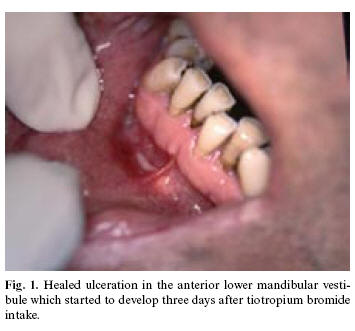
<body><![CDATA[<p><font face="Verdana" size="2"><B>ABSTRACT</B></font></p>     <p><font face="Verdana" size="2">Unwanted side-effects of a drug therapy are well known to oral medicine specialists and other colleagues. Usually they manifest itself as dry mouth, taste disturbances, various allergic or toxic reactions on the lips and/or in the oral cavity. However, the list of the drugs which might induce unwanted reactions is everyday becoming longer as more and more drugs are introduced on the market. Certain problems when diagnosing and reporting unwanted side effects of the drugs exist as only accurate method of diagnosis is repeated drug use in controlled clinical setting where fatal consequences due to the anaphilactic shock could be avoided. We report a side effect reaction to tiotropium bromide (Spiriva<sup>®</sup>) cap used with HandiHaler manifesting itself as an oral ulceration in a 65 yrs old male. On the third day of drug intake the patient developed oral ulceration two times in a period of few months. Other medications he has been using for several years. To our knowledge this is a first report as an oral side-effect of this drug used for treatment of chronic obstructive pulmonary disease (COPD).</font></p>     <p><font face="Verdana" size="2"><B>Key words:</B> Oral ulceration, side effect of drug, tiotropium bromide.</font></p>  <hr size="1">      <p>&nbsp;</p>     <p><font face="Verdana"><B>Introduction</B></font></p>     <p><font face="Verdana" size="2">Virtually every drug has the potential to cause adverse  reactions on the oral mucosa but some have greater ability to do so. So far, a  wide range of drugs have been recognized as potential inducers of unwanted  adverse reactions in the oral cavity. Smith and Burtner (1) reviewed such  reactions after administration of 200 most frequently prescribed drugs and  reported that the most freuquent ones were dry mouth (80.5%), dysgeusia (47.5%)  and stomatitis (33.9%). However, other reactions to numerous drugs such as  swellings, hypersalivation, discoloration of saliva, white lesions, oral burns,  fixed drugs eruptions, mucositis, neoplasms, pemphigus and pemphigoid reactions  and other bullous disorders, mucosal pigmentation, lichenoid reactions,  cheilitis, neuropathies, and halitosis have been reported throughout the  literature (2).</font></p>     <p><font face="Verdana" size="2">Drug-related aphthous-like ulceration have been reported  after the use of beta blockers such as labetalol, captopril, nicorandil and non-steroidal  anti-inflammatory drugs (NSAID). Also such reactions have been described after  the use of mycophenolate or sirolimus, sodium lauryl sulfate, protease  inhibitors, tacrolimus and sulfonamides, though the exact pathogenic mechanisms  are unclear in all of these. A case control study has now confirmed the  association of oral ulceration with NSAIDs and beta blockers, whereas all the  other data are obtained from case reports, small series and non-peer-reviewed  reports (2). Recently, we have reported a case report of a delayed contact  sensitivity on the lips and oral mucosa due to propolis (3).</font></p>     <p>&nbsp;</p>     <p><font face="Verdana"><B>Case report</B></font></p>     <p><font face="Verdana" size="2">The patient, 65 years old was reviewed on the annual  appointment for long-standing oral lichen planus at the Department of Oral  medicine, University of Queensland. At the time his lesions of oral lichen  planus were barely visible and only discrete whitish lines were seen on the  lateral left side of the tongue. However, during the examination, he reported  development of the ulceration in the vestibular mucosa in the region 41 and 42  which started after he took the third cap (by use of HandiHaler) of tiotropium  bromide for his COPD symptoms. At the closer inspection the ulceration has now  been in healing phase (<a href="#f1">Figure 1</a>). Additionally patient reported that last time  he was using tiotropium bromide also after 3 days of therapy, the ulceration  developed. Given the clear relationship between appearence of the lesion and the  administration of tiotropium bromide the patient was advised to stop taking it.  The lesion resolved after ten days. Detailed medical history revealed that he  suffered heart attack before 18 years and he had blood transfusion eleven years  ago. From time to time he has lower back pain. Apart from that he has been using  the same medications throughout many years such as diltiazem hydrochloride (Cardizem<sup>®</sup>;  240 mg/day), isosorbide dinitrate (Isordil<sup>®</sup>; 5mg/6x a day), candesartan  cilexetil (Atacand<sup>®</sup>; 8mg/day), perindopril erbumine (Coversyl<sup>®</sup> plus; 4/1.25 a  day), aspirin (Astrix<sup>®</sup>; 100 mg/day), biperiden hydrochloride (Akineton<sup>®</sup>; 2mg/day).  To date, 3 months from our patients last review no such lesions developed and  patient stopped taking tiotropium bromide. A biopsy was not taken because there  was a clear relationship between the drug use and oral lesion.</font></p>     ]]></body>
<body><![CDATA[<p align="center"><font face="Verdana" size="2"><a name="f1"><img border="0" src="/img/revistas/medicorpa/v12n3/07_medora68.jpg" width="355" height="331"></a></font></p>     <p align="center">&nbsp;</p>     <p align="left"><font face="Verdana"><B>Discussion</B></font></p>     <p><font face="Verdana" size="2">Long-acting bronchodilators are the mainstream for the  treatment of COPD nowadays, and in the last 3 years tiotropium bromide has been  put on the market in Western countries (1). So far, it has been documented that  tiotropium bromide results in dry mouth in approximatelly 10-16% of the patients  which is reversible and rarely causes discontinuation of therapy (2).  Additionally drug may have various side effects involving skin (rash, urticaria  and pruritus), urinary difficulties and retention, constipation, blurred vision  and glaucoma, increased heart rate and cough as well as throat iritation. Also  hypersensitivity reactions including isolated cases of angioedema have been  reported (4). Most recently, subacute cutaneous lupus erythematosus through  inhalation route has been described in one patient and paralytic ileus in  another (5,6). Despite enhanced specific chemical effects of muscarinic drugs,  side-effects on other organs can not be avoided completely as confirmed in this  case report.</font></p>     <p>&nbsp;</p>     <p><font face="Verdana"><B>References</B></font></p>     <!-- ref --><p><font face="Verdana" size="2">1. Smith RG, Burtner AP. Oral side-effects of the most frequently prescribed drugs. Spec Care Dent 1994;14:96-102.</font>&nbsp;&nbsp;&nbsp;&nbsp;&nbsp;&nbsp;&nbsp;&nbsp;[&#160;<a href="javascript:void(0);" onclick="javascript: window.open('/scielo.php?script=sci_nlinks&ref=2975498&pid=S1698-6946200700030000700001&lng=','','width=640,height=500,resizable=yes,scrollbars=1,menubar=yes,');">Links</a>&#160;]<!-- end-ref --><!-- ref --><p> <font face="Verdana" size="2">2. Scully C, Bagan JV. Adverse drug reactions in the orofacial region. Crit Rev Oral Biol Med 2004;15:221-39.</font>&nbsp;&nbsp;&nbsp;&nbsp;&nbsp;&nbsp;&nbsp;&nbsp;[&#160;<a href="javascript:void(0);" onclick="javascript: window.open('/scielo.php?script=sci_nlinks&ref=2975499&pid=S1698-6946200700030000700002&lng=','','width=640,height=500,resizable=yes,scrollbars=1,menubar=yes,');">Links</a>&#160;]<!-- end-ref --><!-- ref --><p> <font face="Verdana" size="2">3. Brailo V, Vucicevic-Boras V, Alajbeg I, Vidovic-Juras D. Delayed contact sensitivity on the lips and oral mucosa due to propolis-case report. Med Oral Patol Oral Cir Bucal 2006;11:303-4.</font>&nbsp;&nbsp;&nbsp;&nbsp;&nbsp;&nbsp;&nbsp;&nbsp;[&#160;<a href="javascript:void(0);" onclick="javascript: window.open('/scielo.php?script=sci_nlinks&ref=2975500&pid=S1698-6946200700030000700003&lng=','','width=640,height=500,resizable=yes,scrollbars=1,menubar=yes,');">Links</a>&#160;]<!-- end-ref --><!-- ref --><p> <font face="Verdana" size="2">4. Tashkin DP, Cooper CB. The role of long-acting bronchodilators in the management of stable COPD. Chest 2004;125:249-59.</font>&nbsp;&nbsp;&nbsp;&nbsp;&nbsp;&nbsp;&nbsp;&nbsp;[&#160;<a href="javascript:void(0);" onclick="javascript: window.open('/scielo.php?script=sci_nlinks&ref=2975501&pid=S1698-6946200700030000700004&lng=','','width=640,height=500,resizable=yes,scrollbars=1,menubar=yes,');">Links</a>&#160;]<!-- end-ref --><!-- ref --><p> <font face="Verdana" size="2">5. Gross NJ. Tiotropium bromide. Chest 2004;126:1946-53.</font>&nbsp;&nbsp;&nbsp;&nbsp;&nbsp;&nbsp;&nbsp;&nbsp;[&#160;<a href="javascript:void(0);" onclick="javascript: window.open('/scielo.php?script=sci_nlinks&ref=2975502&pid=S1698-6946200700030000700005&lng=','','width=640,height=500,resizable=yes,scrollbars=1,menubar=yes,');">Links</a>&#160;]<!-- end-ref --><!-- ref --><p> <font face="Verdana" size="2">6. Tashkin DP. Is a long-acting inhaled bronchodilator the first agent to use in stable chronic obstructive pulmonary disease. Curr Opin Pulm Med 2005;11:121-8.</font>&nbsp;&nbsp;&nbsp;&nbsp;&nbsp;&nbsp;&nbsp;&nbsp;[&#160;<a href="javascript:void(0);" onclick="javascript: window.open('/scielo.php?script=sci_nlinks&ref=2975503&pid=S1698-6946200700030000700006&lng=','','width=640,height=500,resizable=yes,scrollbars=1,menubar=yes,');">Links</a>&#160;]<!-- end-ref --><p>&nbsp;</p>     <p>&nbsp;</p>     <p><a href="#top"><img border="0" src="/img/revistas/medicorpa/v12n3/seta.gif" width="15" height="17"></a><font face="Verdana" size="2"><B><a name="back"></a>Correspondence:</B>    <BR>Dr.Vanja Vucicevic Boras    <BR>Dept. of Oral medicine    <BR>School of Dentistry    <BR>University of Queensland    <BR>200 Turbot Street    ]]></body>
<body><![CDATA[<BR>Brisbane, 4000, QLD    <BR>Australia    <BR>E-mail:  <a href="mailto:borasvanja@yahoo.com">borasvanja@yahoo.com</a></font></p>     <p><font face="Verdana" size="2">Received: 14-03-2006    <BR>Accepted: 30-01-2007</font></p>      ]]></body><back>
<ref-list>
<ref id="B1">
<label>1</label><nlm-citation citation-type="journal">
<person-group person-group-type="author">
<name>
<surname><![CDATA[Smith]]></surname>
<given-names><![CDATA[RG]]></given-names>
</name>
<name>
<surname><![CDATA[Burtner]]></surname>
<given-names><![CDATA[AP]]></given-names>
</name>
</person-group>
<article-title xml:lang="en"><![CDATA[Oral side-effects of the most frequently prescribed drugs]]></article-title>
<source><![CDATA[Spec Care Dent]]></source>
<year>1994</year>
<volume>14</volume>
<page-range>96-102</page-range></nlm-citation>
</ref>
<ref id="B2">
<label>2</label><nlm-citation citation-type="journal">
<person-group person-group-type="author">
<name>
<surname><![CDATA[Scully]]></surname>
<given-names><![CDATA[C]]></given-names>
</name>
<name>
<surname><![CDATA[Bagan]]></surname>
<given-names><![CDATA[JV]]></given-names>
</name>
</person-group>
<article-title xml:lang="en"><![CDATA[Adverse drug reactions in the orofacial region]]></article-title>
<source><![CDATA[Crit Rev Oral Biol Med]]></source>
<year>2004</year>
<volume>15</volume>
<page-range>221-39</page-range></nlm-citation>
</ref>
<ref id="B3">
<label>3</label><nlm-citation citation-type="journal">
<person-group person-group-type="author">
<name>
<surname><![CDATA[Brailo]]></surname>
<given-names><![CDATA[V]]></given-names>
</name>
<name>
<surname><![CDATA[Vucicevic-Boras]]></surname>
<given-names><![CDATA[V]]></given-names>
</name>
<name>
<surname><![CDATA[Alajbeg]]></surname>
<given-names><![CDATA[I]]></given-names>
</name>
<name>
<surname><![CDATA[Vidovic-Juras]]></surname>
<given-names><![CDATA[D]]></given-names>
</name>
</person-group>
<article-title xml:lang="en"><![CDATA[Delayed contact sensitivity on the lips and oral mucosa due to propolis-case report]]></article-title>
<source><![CDATA[Med Oral Patol Oral Cir Bucal]]></source>
<year>2006</year>
<volume>11</volume>
<page-range>303-4</page-range></nlm-citation>
</ref>
<ref id="B4">
<label>4</label><nlm-citation citation-type="journal">
<person-group person-group-type="author">
<name>
<surname><![CDATA[Tashkin]]></surname>
<given-names><![CDATA[DP]]></given-names>
</name>
<name>
<surname><![CDATA[Cooper]]></surname>
<given-names><![CDATA[CB]]></given-names>
</name>
</person-group>
<article-title xml:lang="en"><![CDATA[The role of long-acting bronchodilators in the management of stable COPD]]></article-title>
<source><![CDATA[Chest]]></source>
<year>2004</year>
<volume>125</volume>
<page-range>249-59</page-range></nlm-citation>
</ref>
<ref id="B5">
<label>5</label><nlm-citation citation-type="journal">
<person-group person-group-type="author">
<name>
<surname><![CDATA[Gross]]></surname>
<given-names><![CDATA[NJ]]></given-names>
</name>
</person-group>
<article-title xml:lang="en"><![CDATA[Tiotropium bromide]]></article-title>
<source><![CDATA[Chest]]></source>
<year>2004</year>
<volume>126</volume>
<page-range>1946-53</page-range></nlm-citation>
</ref>
<ref id="B6">
<label>6</label><nlm-citation citation-type="journal">
<person-group person-group-type="author">
<name>
<surname><![CDATA[Tashkin]]></surname>
<given-names><![CDATA[DP]]></given-names>
</name>
</person-group>
<article-title xml:lang="en"><![CDATA[Is a long-acting inhaled bronchodilator the first agent to use in stable chronic obstructive pulmonary disease]]></article-title>
<source><![CDATA[Curr Opin Pulm Med]]></source>
<year>2005</year>
<volume>11</volume>
<page-range>121-8</page-range></nlm-citation>
</ref>
</ref-list>
</back>
</article>
