<?xml version="1.0" encoding="ISO-8859-1"?><article xmlns:mml="http://www.w3.org/1998/Math/MathML" xmlns:xlink="http://www.w3.org/1999/xlink" xmlns:xsi="http://www.w3.org/2001/XMLSchema-instance">
<front>
<journal-meta>
<journal-id>1698-6946</journal-id>
<journal-title><![CDATA[Medicina Oral, Patología Oral y Cirugía Bucal (Internet)]]></journal-title>
<abbrev-journal-title><![CDATA[Med. oral patol. oral cir.bucal (Internet)]]></abbrev-journal-title>
<issn>1698-6946</issn>
<publisher>
<publisher-name><![CDATA[Sociedad Española de Medicina Oral]]></publisher-name>
</publisher>
</journal-meta>
<article-meta>
<article-id>S1698-69462007000600003</article-id>
<title-group>
<article-title xml:lang="en"><![CDATA[Congenital granular cell tumor (congenital epulis): A lesion of multidisciplinary interest]]></article-title>
</title-group>
<contrib-group>
<contrib contrib-type="author">
<name>
<surname><![CDATA[Silva]]></surname>
<given-names><![CDATA[Guilherme Costa Carvalho]]></given-names>
</name>
<xref ref-type="aff" rid="A01"/>
</contrib>
<contrib contrib-type="author">
<name>
<surname><![CDATA[Tainah Couto]]></surname>
<given-names><![CDATA[Vieira]]></given-names>
</name>
<xref ref-type="aff" rid="A02"/>
</contrib>
<contrib contrib-type="author">
<name>
<surname><![CDATA[Vieira]]></surname>
<given-names><![CDATA[Janaina Couto]]></given-names>
</name>
<xref ref-type="aff" rid="A03"/>
</contrib>
<contrib contrib-type="author">
<name>
<surname><![CDATA[Martins]]></surname>
<given-names><![CDATA[Carlos Roberto]]></given-names>
</name>
<xref ref-type="aff" rid="A04"/>
</contrib>
<contrib contrib-type="author">
<name>
<surname><![CDATA[Silva]]></surname>
<given-names><![CDATA[Edgard Carvalho]]></given-names>
</name>
<xref ref-type="aff" rid="A05"/>
</contrib>
</contrib-group>
<aff id="A01">
<institution><![CDATA[,Catholic University of Minas Gerais School of Dentistry Masters Program in Dentistry]]></institution>
<addr-line><![CDATA[ Minas Gerais]]></addr-line>
</aff>
<aff id="A02">
<institution><![CDATA[,Universidade Federal de Minas Gerais School of Dentistry Department of Pediatric Dentistry and Orthodontics]]></institution>
<addr-line><![CDATA[ Minas Gerais]]></addr-line>
</aff>
<aff id="A03">
<institution><![CDATA[,Santa Casa Hospital of Belo Horizonte Otorhinolaryngology Section ]]></institution>
<addr-line><![CDATA[Belo Horizonte ]]></addr-line>
</aff>
<aff id="A04">
<institution><![CDATA[,Catholic University of Minas Gerais School of Dentistry ]]></institution>
<addr-line><![CDATA[ Minas Gerais]]></addr-line>
</aff>
<aff id="A05">
<institution><![CDATA[,Universidade Federal de Minas Gerais School of Dentistry Department of Oral Surgery and Pathology]]></institution>
<addr-line><![CDATA[Belo Horizonte Minas Gerais]]></addr-line>
<country>Brasil</country>
</aff>
<pub-date pub-type="pub">
<day>00</day>
<month>10</month>
<year>2007</year>
</pub-date>
<pub-date pub-type="epub">
<day>00</day>
<month>10</month>
<year>2007</year>
</pub-date>
<volume>12</volume>
<numero>6</numero>
<fpage>428</fpage>
<lpage>430</lpage>
<copyright-statement/>
<copyright-year/>
<self-uri xlink:href="http://scielo.isciii.es/scielo.php?script=sci_arttext&amp;pid=S1698-69462007000600003&amp;lng=en&amp;nrm=iso"></self-uri><self-uri xlink:href="http://scielo.isciii.es/scielo.php?script=sci_abstract&amp;pid=S1698-69462007000600003&amp;lng=en&amp;nrm=iso"></self-uri><self-uri xlink:href="http://scielo.isciii.es/scielo.php?script=sci_pdf&amp;pid=S1698-69462007000600003&amp;lng=en&amp;nrm=iso"></self-uri><abstract abstract-type="short" xml:lang="en"><p><![CDATA[Congenital granular cell tumor (CGCT), or congenital epulis, is an uncommon benign soft tissue lesion that usually arises from the alveolar mucosa of neonates and may cause respiratory and feeding problems. We report a case of a 3-day-old female newborn, who presented an intraoral tumor mass which was protruding from her mouth, compromising feeding. Under general anesthesia, the lesion was completely removed and the patient had an uneventful postoperative course. Clinical features and treatment approaches are presented and discussed, emphasizing the necessity of a multidisciplinary approach in such cases.]]></p></abstract>
<kwd-group>
<kwd lng="en"><![CDATA[Congenital epulis]]></kwd>
<kwd lng="en"><![CDATA[congenital granular cell tumor]]></kwd>
<kwd lng="en"><![CDATA[Neumann’s tumor]]></kwd>
<kwd lng="en"><![CDATA[gingival tumor]]></kwd>
</kwd-group>
</article-meta>
</front><body><![CDATA[ <p>&nbsp;</p>     <p>&nbsp;</p>     <p><font face="Verdana" size="4"><B><a name="top"></a>Congenital granular cell tumor (congenital epulis): A lesion of multidisciplinary interest</B></font></p>     <p>&nbsp;</p>     <p>&nbsp;</p>     <p><font face="Verdana" size="2"><B>Guilherme Costa Carvalho Silva<sup>1</sup>, Tainah Couto Vieira<sup>2</sup>, Janaina Couto Vieira<sup>3</sup>, Carlos Roberto Martins<sup>4</sup>, Edgard Carvalho Silva<sup>5</sup></B></font></p>     <p><font face="Verdana" size="2">(1) DDS, MDS. Fellow, Masters Program in Dentistry, School of Dentistry, Catholic University of Minas Gerais    <BR>(2) DDS. Resident, Department of Pediatric Dentistry and Orthodontics, School of Dentistry, Universidade Federal de Minas Gerais    <BR>(3) MD. Resident, Otorhinolaryngology Section, Santa Casa Hospital of Belo Horizonte    <BR>(4) DDS, PhD. Professor of Oral Pathology, School of Dentistry, Catholic University of Minas Gerais    ]]></body>
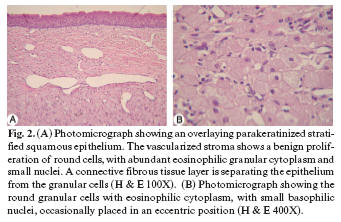
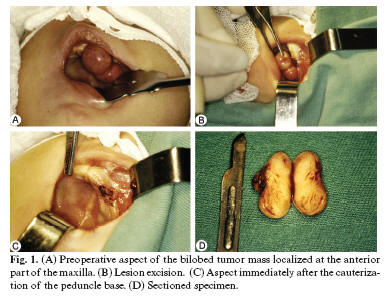
<body><![CDATA[<BR>(5) DDS, PhD. Emeritus Professor and Chairman, Department of Oral Surgery and Pathology, School of Dentistry, Universidade Federal de Minas Gerais, Belo Horizonte, Brasil</font></p>     <p><font face="Verdana" size="2"><a href="#bajo">Correspondence</a></font></p>     <p>&nbsp;</p>     <p>&nbsp;</p><hr size="1">     <p><font face="Verdana" size="2"><b>ABSTRACT</b></font></p>     <p><font face="Verdana" size="2">Congenital granular cell tumor (CGCT), or congenital epulis, is an uncommon benign soft tissue lesion that usually arises from the alveolar mucosa of neonates and may cause respiratory and feeding problems. We report a case of a 3-day-old female newborn, who presented an intraoral tumor mass which was protruding from her mouth, compromising feeding. Under general anesthesia, the lesion was completely removed and the patient had an uneventful postoperative course. Clinical features and treatment approaches are presented and discussed, emphasizing the necessity of a multidisciplinary approach in such cases.</font></p>     <p><font face="Verdana" size="2"><B>Key words:</B> Congenital epulis, congenital granular cell tumor, Neumann’s tumor, gingival tumor.</font></p> <hr size="1">     <p>&nbsp;</p>     <p><font face="Verdana"><B>Introduction</B></font></p>     <p><font face="Verdana" size="2">Congenital granular cell tumor (CGCT), first described by Neumann (1) in 1871, is a benign soft tissue lesion of the neonate that almost always arises from the alveolar mucosa. It is also known as congenital epulis or Neumann’s tumor. Lesions may be sessile or pedunculated, normally colored or reddish, varying in size from several millimeters to a few centimeters (2), it is typically seen protruding from the neonate’s mouth. Females are affected from 8 to 10 times more frequently than males (2,3), perhaps indicating a hormonal component in its development. The CGCT occurs more frequently in the maxilla (maxillary/mandibular ratio: 3:1), mainly on its anterior portion (2,3). Usually, it is presented as a single lesion, however multiples cases have been reported (3-6).</font></p>     ]]></body>
<body><![CDATA[<p><font face="Verdana" size="2">Surgical excision is advocated as the treatment of choice for CGCT, preferably immediately after detection, since spontaneous regression is rare and large tumors may cause airway obstruction and feeding difficulties (3-11). There are no reports showing CGCT recurrence or malignant transformation (3).</font></p>     <p><font face="Verdana" size="2">The histological picture shows large, round cells with abundant eosinophilic granular cytoplasm, and round or oval lightly basophilic nuclei (3,4,6-10). The histogenesis of this tumor has been investigated, although it remains controversial and inconclusive (3).</font></p>     <p><font face="Verdana" size="2">The aim of this paper is to report a case of CGCT in a 3-day-old girl, presenting the clinical and histological characteristics of the lesion and to point out the importance of a multidisciplinary approach to diagnosis and treatment.</font></p>     <p>&nbsp;</p>     <p><font face="Verdana"><B>Case report</B></font></p>     <p><font face="Verdana" size="2">A 3-day-old Caucasian girl, born at 40 weeks’ gestation weighing 2.95 kg, was brought by her mother for evaluation of a mass protruding from her mouth, which was causing feeding difficulties, but no airway obstruction. The infant was born by normal vaginal delivery, with uneventful prenatal and perinatal course, and was otherwise healthy. According to her mother she had already been examined by a pediatrician and an obstetrician, who were not able to diagnose the alteration.</font></p>     <p><font face="Verdana" size="2">Intraoral examination revealed a bilobed and pedunculated tumoral mass, with color similar to the adjacent mucosa, arising from the alveolar mucosa on the left maxillary canine region. It was approximately 2 cm in diameter, had a smooth and firm surface and was protruding slightly from the mouth (<a href="#f1">Figure 1A</a>). Based on the clinical features of the lesion, a CGCT diagnosis was considered and complete surgical removal of the lesion was recommended.</font></p>     <p><font face="Verdana" size="2">Under general anesthesia with nasotracheal intubation, the tumor was completely excised using electrocautery (<a href="#f1">Figures 1B and 1C</a>). Bleeding was minimal and the infant recovered with no complications. Breast-feeding began three hours after the surgery. The excised material (<a href="#f1">Figure 1D</a>) was sent for histological examination and the diagnosis was CGCT (<a href="#f2">Figures 2A and 2B</a>).</font></p>     <p align="center"><font face="Verdana" size="2"><a name="f1"><img border="0" src="/img/revistas/medicorpa/v12n6/03.htm6.jpg" width="388" height="299"></a></font></p>     <p>&nbsp;</p>     ]]></body>
<body><![CDATA[<p align="center"><font face="Verdana" size="2"><a name="f2"><img border="0" src="/img/revistas/medicorpa/v12n6/03.htm7.jpg" width="341" height="222"></a></font></p>     <p>&nbsp;</p>     <p><font face="Verdana"><B>Discussion</B></font></p>     <p><font face="Verdana" size="2">CGCT is usually referred as congenital epulis in the medical literature. However, epulis is a non-specific term used to designate hyperplastic gingival tissue or gingival tumor masses. Since there are cases which are not exclusively related to the gingiva (3,6), it seems that the term CGCT would be more appropriate.</font></p>     <p><font face="Verdana" size="2">It presents a wide range of differential diagnoses, such as granular cell tumor, fibroma and melanotic neuroectodermal tumor of infancy, among others. However, the clinical diagnosis is usually simple due to the typical occurrence in the maxillary alveolar mucosa of newborn girls.</font></p>     <p><font face="Verdana" size="2">Intrauterine images of the tumor may be obtained by ultrasonography (7,8-10) or even by magnetic resonance (10), mainly in the last weeks of pregnancy. Although there are studies that affirm successful prenatal diagnosis of CGCT (9,10), these studies actually obtained images of the tumor mass, suggesting CGCT, but the diagnosis could not be conclusive.</font></p>     <p><font face="Verdana" size="2">Prenatal imaging is important in the choice of delivery method, since large tumors may compromise a normal vaginal delivery and a cesarean operation may be necessary (9-11). Also, the identification of a tumor on a fetus may help the intervention planning, and allows the family to prepare psychologically for eventual procedures that will take place in the newborn. Unfortunately, prenatal ultrasound images of the patient were not obtained.</font></p>     <p><font face="Verdana" size="2">The treatment of choice is surgical excision, to be performed as soon as possible (2-11). The use of general anesthesia seems to be the recommended procedure in such cases (3,5,8). There are reports of lesion removal without the use of anesthesia (10), however this kind of procedure is not justified since these surgical interventions are elective. The CGCT removal under local anesthesia is also an alternative (7) when intubation is not possible (4) or in cases of small lesions. There is also the possibility of removal during the delivery, in cases where the lesion was detected during pregnancy (9). This approach may eliminate additional procedures such as anesthesia and intubation, and provides the newborn a free airway and an unobstructed oral cavity immediately after birth.</font></p>     <p><font face="Verdana" size="2">The CGCT diagnosis and management is of interest for the oral and maxillofacial surgeon, the radiologist, the anesthetist, the otorhinolaryngologist, the pediatrician and the obstetrician-gynecologist. Although several professionals are involved with prenatal and delivery care, sometimes a lesion such as the one reported may cause surprise and concern to the medical team. The interaction between professionals involved with the prenatal care and those involved in the treatment of oral and maxillofacial lesions and syndromes, would certainly optimize the diagnosis and treatment approaches in such cases.</font></p>     <p>&nbsp;</p>     ]]></body>
<body><![CDATA[<p><font face="Verdana"><B>References</B></font></p>     <!-- ref --><p><font face="Verdana" size="2">1. Neumann E. Elin Fall von Congenitaler Epulis. Arch Heilk. 1871;12:189.</font>&nbsp;&nbsp;&nbsp;&nbsp;&nbsp;&nbsp;&nbsp;&nbsp;[&#160;<a href="javascript:void(0);" onclick="javascript: window.open('/scielo.php?script=sci_nlinks&ref=2967889&pid=S1698-6946200700060000300001&lng=','','width=640,height=500,resizable=yes,scrollbars=1,menubar=yes,');">Links</a>&#160;]<!-- end-ref --><!-- ref --><p><font face="Verdana" size="2">2. Fuhr AH, Krogh PH. Congenital epulis of the newborn: centennial review of the literature and a report of case. J Oral Surg. 1972 Jan;30(1):30-5.</font>&nbsp;&nbsp;&nbsp;&nbsp;&nbsp;&nbsp;&nbsp;&nbsp;[&#160;<a href="javascript:void(0);" onclick="javascript: window.open('/scielo.php?script=sci_nlinks&ref=2967890&pid=S1698-6946200700060000300002&lng=','','width=640,height=500,resizable=yes,scrollbars=1,menubar=yes,');">Links</a>&#160;]<!-- end-ref --><!-- ref --><p><font face="Verdana" size="2">3. Loyola AM, Gatti AF, Pinto DS Jr, Mesquita RA. Alveolar and extra-alveolar granular cell lesions of the newborn: report of case and review of literature. Oral Surg Oral Med Oral Pathol Oral Radiol Endod. 1997 Dec;84(6):668-71.</font>&nbsp;&nbsp;&nbsp;&nbsp;&nbsp;&nbsp;&nbsp;&nbsp;[&#160;<a href="javascript:void(0);" onclick="javascript: window.open('/scielo.php?script=sci_nlinks&ref=2967891&pid=S1698-6946200700060000300003&lng=','','width=640,height=500,resizable=yes,scrollbars=1,menubar=yes,');">Links</a>&#160;]<!-- end-ref --><!-- ref --><p><font face="Verdana" size="2">4. Parmigiani S, Giordano G, Fellegara G, Brevi B, Magnani C. A rare case of multiple congenital epulis. J Matern Fetal Neonatal Med. 2004 Nov;16 Suppl 2:55-8.</font>&nbsp;&nbsp;&nbsp;&nbsp;&nbsp;&nbsp;&nbsp;&nbsp;[&#160;<a href="javascript:void(0);" onclick="javascript: window.open('/scielo.php?script=sci_nlinks&ref=2967892&pid=S1698-6946200700060000300004&lng=','','width=640,height=500,resizable=yes,scrollbars=1,menubar=yes,');">Links</a>&#160;]<!-- end-ref --><!-- ref --><p><font face="Verdana" size="2">5. Canavan-Holliday KS, Lawson RA. Anaesthetic management of the newborn with multiple congenital epulides. Br J Anaesth. 2004 Nov;93(5):742-4. Epub 2004 Sep 3.</font>&nbsp;&nbsp;&nbsp;&nbsp;&nbsp;&nbsp;&nbsp;&nbsp;[&#160;<a href="javascript:void(0);" onclick="javascript: window.open('/scielo.php?script=sci_nlinks&ref=2967893&pid=S1698-6946200700060000300005&lng=','','width=640,height=500,resizable=yes,scrollbars=1,menubar=yes,');">Links</a>&#160;]<!-- end-ref --><!-- ref --><p><font face="Verdana" size="2">6. Yavuzer R, Ataoglu O, Sari A. Multiple congenital epulis of the alveolar ridge and tongue. Ann Plast Surg. 2001 Aug;47(2):199-202.</font>&nbsp;&nbsp;&nbsp;&nbsp;&nbsp;&nbsp;&nbsp;&nbsp;[&#160;<a href="javascript:void(0);" onclick="javascript: window.open('/scielo.php?script=sci_nlinks&ref=2967894&pid=S1698-6946200700060000300006&lng=','','width=640,height=500,resizable=yes,scrollbars=1,menubar=yes,');">Links</a>&#160;]<!-- end-ref --><!-- ref --><p><font face="Verdana" size="2">7. Song WS, Kim JW, Kim YG, Ryu DM. A case report of congenital epulis in the fetus. J Oral Maxillofac Surg. 2005 Jan;63(1):135-7.</font>&nbsp;&nbsp;&nbsp;&nbsp;&nbsp;&nbsp;&nbsp;&nbsp;[&#160;<a href="javascript:void(0);" onclick="javascript: window.open('/scielo.php?script=sci_nlinks&ref=2967895&pid=S1698-6946200700060000300007&lng=','','width=640,height=500,resizable=yes,scrollbars=1,menubar=yes,');">Links</a>&#160;]<!-- end-ref --><!-- ref --><p><font face="Verdana" size="2">8. Lapid O, Shaco-Levy R, Krieger Y, Kachko L, Sagi A. Congenital epulis. Pediatrics. 2001 Feb;107(2):E22.</font>&nbsp;&nbsp;&nbsp;&nbsp;&nbsp;&nbsp;&nbsp;&nbsp;[&#160;<a href="javascript:void(0);" onclick="javascript: window.open('/scielo.php?script=sci_nlinks&ref=2967896&pid=S1698-6946200700060000300008&lng=','','width=640,height=500,resizable=yes,scrollbars=1,menubar=yes,');">Links</a>&#160;]<!-- end-ref --><!-- ref --><p><font face="Verdana" size="2">9. Kumar P, Kim HH, Zahtz GD, Valderrama E, Steele AM. Obstructive congenital epulis: prenatal diagnosis and perinatal management. Laryngoscope. 2002 Nov;112(11):1935-9.</font>&nbsp;&nbsp;&nbsp;&nbsp;&nbsp;&nbsp;&nbsp;&nbsp;[&#160;<a href="javascript:void(0);" onclick="javascript: window.open('/scielo.php?script=sci_nlinks&ref=2967897&pid=S1698-6946200700060000300009&lng=','','width=640,height=500,resizable=yes,scrollbars=1,menubar=yes,');">Links</a>&#160;]<!-- end-ref --><!-- ref --><p><font face="Verdana" size="2">10. Nakata M, Anno K, Matsumori LT, Sumie M, Sase M, Nakano T, et al. Prenatal diagnosis of congenital epulis: a case report. Ultrasound Obstet Gynecol. 2002 Dec;20(6):627-9.</font>&nbsp;&nbsp;&nbsp;&nbsp;&nbsp;&nbsp;&nbsp;&nbsp;[&#160;<a href="javascript:void(0);" onclick="javascript: window.open('/scielo.php?script=sci_nlinks&ref=2967898&pid=S1698-6946200700060000300010&lng=','','width=640,height=500,resizable=yes,scrollbars=1,menubar=yes,');">Links</a>&#160;]<!-- end-ref --><!-- ref --><p><font face="Verdana" size="2">11. Roy S, Sinsky A, Williams B, Desilets V, Patenaude YG. Congenital epulis: prenatal imaging with MRI and ultrasound. Pediatr Radiol. 2003 Nov;33(11):800-3. Epub 2003 Sep 5.</font>&nbsp;&nbsp;&nbsp;&nbsp;&nbsp;&nbsp;&nbsp;&nbsp;[&#160;<a href="javascript:void(0);" onclick="javascript: window.open('/scielo.php?script=sci_nlinks&ref=2967899&pid=S1698-6946200700060000300011&lng=','','width=640,height=500,resizable=yes,scrollbars=1,menubar=yes,');">Links</a>&#160;]<!-- end-ref --><p>&nbsp;</p>     <p>&nbsp;</p>     <p><font face="Verdana" size="2"><b><a href="#top"><img border="0" src="/img/revistas/medicorpa/v12n6/seta.gif" width="15" height="17"></a> <a name="bajo"></a>Correspondence:</b>    <BR>Dr. Guilherme Costa Carvalho Silva    <BR>Av Afonso Pena 4334    <BR>Belo Horizonte, MG, 30130-009, Brasil    <BR>E-mail: <a href="mailto:guilhermeccs@ufmg.br">guilhermeccs@ufmg.br</a></font></p>     <p><font face="Verdana" size="2">Received: 16-08-2006    ]]></body>
<body><![CDATA[<BR>Accepted: 12-07-2007</font></p>      ]]></body><back>
<ref-list>
<ref id="B1">
<label>1</label><nlm-citation citation-type="journal">
<person-group person-group-type="author">
<name>
<surname><![CDATA[Neumann]]></surname>
<given-names><![CDATA[E]]></given-names>
</name>
</person-group>
<article-title xml:lang="de"><![CDATA[Elin Fall von Congenitaler Epulis]]></article-title>
<source><![CDATA[Arch Heilk.]]></source>
<year>1871</year>
<volume>12</volume>
<page-range>189</page-range></nlm-citation>
</ref>
<ref id="B2">
<label>2</label><nlm-citation citation-type="journal">
<person-group person-group-type="author">
<name>
<surname><![CDATA[Fuhr]]></surname>
<given-names><![CDATA[AH]]></given-names>
</name>
<name>
<surname><![CDATA[Krogh]]></surname>
<given-names><![CDATA[PH]]></given-names>
</name>
</person-group>
<article-title xml:lang="en"><![CDATA[Congenital epulis of the newborn: centennial review of the literature and a report of case]]></article-title>
<source><![CDATA[J Oral Surg.]]></source>
<year>1972</year>
<month> J</month>
<day>an</day>
<volume>30</volume>
<numero>1</numero>
<issue>1</issue>
<page-range>30-5</page-range></nlm-citation>
</ref>
<ref id="B3">
<label>3</label><nlm-citation citation-type="journal">
<person-group person-group-type="author">
<name>
<surname><![CDATA[Loyola]]></surname>
<given-names><![CDATA[AM]]></given-names>
</name>
<name>
<surname><![CDATA[Gatti]]></surname>
<given-names><![CDATA[AF]]></given-names>
</name>
<name>
<surname><![CDATA[Pinto]]></surname>
<given-names><![CDATA[DS Jr]]></given-names>
</name>
<name>
<surname><![CDATA[Mesquita]]></surname>
<given-names><![CDATA[RA]]></given-names>
</name>
</person-group>
<article-title xml:lang="en"><![CDATA[Alveolar and extra-alveolar granular cell lesions of the newborn: report of case and review of literature]]></article-title>
<source><![CDATA[Oral Surg Oral Med Oral Pathol Oral Radiol Endod.]]></source>
<year>1997</year>
<month> D</month>
<day>ec</day>
<volume>84</volume>
<numero>6</numero>
<issue>6</issue>
<page-range>668-71</page-range></nlm-citation>
</ref>
<ref id="B4">
<label>4</label><nlm-citation citation-type="journal">
<person-group person-group-type="author">
<name>
<surname><![CDATA[Parmigiani]]></surname>
<given-names><![CDATA[S]]></given-names>
</name>
<name>
<surname><![CDATA[Giordano]]></surname>
<given-names><![CDATA[G]]></given-names>
</name>
<name>
<surname><![CDATA[Fellegara]]></surname>
<given-names><![CDATA[G]]></given-names>
</name>
<name>
<surname><![CDATA[Brevi]]></surname>
<given-names><![CDATA[B]]></given-names>
</name>
<name>
<surname><![CDATA[Magnani]]></surname>
<given-names><![CDATA[C]]></given-names>
</name>
</person-group>
<article-title xml:lang="en"><![CDATA[A rare case of multiple congenital epulis]]></article-title>
<source><![CDATA[J Matern Fetal Neonatal Med.]]></source>
<year>2004</year>
<month> N</month>
<day>ov</day>
<volume>16</volume>
<numero>^s2</numero>
<issue>^s2</issue>
<supplement>2</supplement>
<page-range>55-8</page-range></nlm-citation>
</ref>
<ref id="B5">
<label>5</label><nlm-citation citation-type="journal">
<person-group person-group-type="author">
<name>
<surname><![CDATA[Canavan-Holliday]]></surname>
<given-names><![CDATA[KS]]></given-names>
</name>
<name>
<surname><![CDATA[Lawson]]></surname>
<given-names><![CDATA[RA]]></given-names>
</name>
</person-group>
<article-title xml:lang="en"><![CDATA[Anaesthetic management of the newborn with multiple congenital epulides]]></article-title>
<source><![CDATA[Br J Anaesth.]]></source>
<year>2004</year>
<month> N</month>
<day>ov</day>
<volume>93</volume>
<numero>5</numero>
<issue>5</issue>
<page-range>742-4</page-range></nlm-citation>
</ref>
<ref id="B6">
<label>6</label><nlm-citation citation-type="journal">
<person-group person-group-type="author">
<name>
<surname><![CDATA[Yavuzer]]></surname>
<given-names><![CDATA[R]]></given-names>
</name>
<name>
<surname><![CDATA[Ataoglu]]></surname>
<given-names><![CDATA[O]]></given-names>
</name>
<name>
<surname><![CDATA[Sari]]></surname>
<given-names><![CDATA[A]]></given-names>
</name>
</person-group>
<article-title xml:lang="en"><![CDATA[Multiple congenital epulis of the alveolar ridge and tongue]]></article-title>
<source><![CDATA[Ann Plast Surg.]]></source>
<year>2001</year>
<month> A</month>
<day>ug</day>
<volume>47</volume>
<numero>2</numero>
<issue>2</issue>
<page-range>199-202</page-range></nlm-citation>
</ref>
<ref id="B7">
<label>7</label><nlm-citation citation-type="journal">
<person-group person-group-type="author">
<name>
<surname><![CDATA[Song]]></surname>
<given-names><![CDATA[WS]]></given-names>
</name>
<name>
<surname><![CDATA[Kim]]></surname>
<given-names><![CDATA[JW]]></given-names>
</name>
<name>
<surname><![CDATA[Kim]]></surname>
<given-names><![CDATA[YG]]></given-names>
</name>
<name>
<surname><![CDATA[Ryu]]></surname>
<given-names><![CDATA[DM]]></given-names>
</name>
</person-group>
<article-title xml:lang="en"><![CDATA[A case report of congenital epulis in the fetus]]></article-title>
<source><![CDATA[J Oral Maxillofac Surg.]]></source>
<year>2005</year>
<month> J</month>
<day>an</day>
<volume>63</volume>
<numero>1</numero>
<issue>1</issue>
<page-range>135-7</page-range></nlm-citation>
</ref>
<ref id="B8">
<label>8</label><nlm-citation citation-type="journal">
<person-group person-group-type="author">
<name>
<surname><![CDATA[Lapid]]></surname>
<given-names><![CDATA[O]]></given-names>
</name>
<name>
<surname><![CDATA[Shaco-Levy]]></surname>
<given-names><![CDATA[R]]></given-names>
</name>
<name>
<surname><![CDATA[Krieger]]></surname>
<given-names><![CDATA[Y]]></given-names>
</name>
<name>
<surname><![CDATA[Kachko]]></surname>
<given-names><![CDATA[L]]></given-names>
</name>
<name>
<surname><![CDATA[Sagi]]></surname>
<given-names><![CDATA[A]]></given-names>
</name>
</person-group>
<article-title xml:lang="en"><![CDATA[Congenital epulis]]></article-title>
<source><![CDATA[Pediatrics]]></source>
<year>2001</year>
<month> F</month>
<day>eb</day>
<volume>107</volume>
<numero>2</numero>
<issue>2</issue>
<page-range>E22</page-range></nlm-citation>
</ref>
<ref id="B9">
<label>9</label><nlm-citation citation-type="journal">
<person-group person-group-type="author">
<name>
<surname><![CDATA[Kumar]]></surname>
<given-names><![CDATA[P]]></given-names>
</name>
<name>
<surname><![CDATA[Kim]]></surname>
<given-names><![CDATA[HH]]></given-names>
</name>
<name>
<surname><![CDATA[Zahtz]]></surname>
<given-names><![CDATA[GD]]></given-names>
</name>
<name>
<surname><![CDATA[Valderrama]]></surname>
<given-names><![CDATA[E]]></given-names>
</name>
<name>
<surname><![CDATA[Steele]]></surname>
<given-names><![CDATA[AM]]></given-names>
</name>
</person-group>
<article-title xml:lang="en"><![CDATA[Obstructive congenital epulis: prenatal diagnosis and perinatal management]]></article-title>
<source><![CDATA[Laryngoscope]]></source>
<year>2002</year>
<month> N</month>
<day>ov</day>
<volume>112</volume>
<numero>11</numero>
<issue>11</issue>
<page-range>1935-9</page-range></nlm-citation>
</ref>
<ref id="B10">
<label>10</label><nlm-citation citation-type="journal">
<person-group person-group-type="author">
<name>
<surname><![CDATA[Nakata]]></surname>
<given-names><![CDATA[M]]></given-names>
</name>
<name>
<surname><![CDATA[Anno]]></surname>
<given-names><![CDATA[K]]></given-names>
</name>
<name>
<surname><![CDATA[Matsumori]]></surname>
<given-names><![CDATA[LT]]></given-names>
</name>
<name>
<surname><![CDATA[Sumie]]></surname>
<given-names><![CDATA[M]]></given-names>
</name>
<name>
<surname><![CDATA[Sase]]></surname>
<given-names><![CDATA[M]]></given-names>
</name>
<name>
<surname><![CDATA[Nakano]]></surname>
<given-names><![CDATA[T]]></given-names>
</name>
</person-group>
<article-title xml:lang="en"><![CDATA[Prenatal diagnosis of congenital epulis: a case report]]></article-title>
<source><![CDATA[Ultrasound Obstet Gynecol.]]></source>
<year>2002</year>
<month> D</month>
<day>ec</day>
<volume>20</volume>
<numero>6</numero>
<issue>6</issue>
<page-range>627-9</page-range></nlm-citation>
</ref>
<ref id="B11">
<label>11</label><nlm-citation citation-type="journal">
<person-group person-group-type="author">
<name>
<surname><![CDATA[Roy]]></surname>
<given-names><![CDATA[S]]></given-names>
</name>
<name>
<surname><![CDATA[Sinsky]]></surname>
<given-names><![CDATA[A]]></given-names>
</name>
<name>
<surname><![CDATA[Williams]]></surname>
<given-names><![CDATA[B]]></given-names>
</name>
<name>
<surname><![CDATA[Desilets]]></surname>
<given-names><![CDATA[V]]></given-names>
</name>
<name>
<surname><![CDATA[Patenaude]]></surname>
<given-names><![CDATA[YG]]></given-names>
</name>
</person-group>
<article-title xml:lang="en"><![CDATA[Congenital epulis: prenatal imaging with MRI and ultrasound]]></article-title>
<source><![CDATA[Pediatr Radiol.]]></source>
<year>2003</year>
<month> N</month>
<day>ov</day>
<volume>33</volume>
<numero>11</numero>
<issue>11</issue>
<page-range>800-3</page-range></nlm-citation>
</ref>
</ref-list>
</back>
</article>