<?xml version="1.0" encoding="ISO-8859-1"?><article xmlns:mml="http://www.w3.org/1998/Math/MathML" xmlns:xlink="http://www.w3.org/1999/xlink" xmlns:xsi="http://www.w3.org/2001/XMLSchema-instance">
<front>
<journal-meta>
<journal-id>1698-6946</journal-id>
<journal-title><![CDATA[Medicina Oral, Patología Oral y Cirugía Bucal (Internet)]]></journal-title>
<abbrev-journal-title><![CDATA[Med. oral patol. oral cir.bucal (Internet)]]></abbrev-journal-title>
<issn>1698-6946</issn>
<publisher>
<publisher-name><![CDATA[Sociedad Española de Medicina Oral]]></publisher-name>
</publisher>
</journal-meta>
<article-meta>
<article-id>S1698-69462007000600005</article-id>
<title-group>
<article-title xml:lang="en"><![CDATA[pH and salivary sodium bicarbonate during the administration protocol for methotrexate in children with leukemia]]></article-title>
</title-group>
<contrib-group>
<contrib contrib-type="author">
<name>
<surname><![CDATA[Rojas de Morales]]></surname>
<given-names><![CDATA[Thais]]></given-names>
</name>
<xref ref-type="aff" rid="A01"/>
</contrib>
<contrib contrib-type="author">
<name>
<surname><![CDATA[Navas]]></surname>
<given-names><![CDATA[Rita]]></given-names>
</name>
<xref ref-type="aff" rid="A01"/>
</contrib>
<contrib contrib-type="author">
<name>
<surname><![CDATA[Viera]]></surname>
<given-names><![CDATA[Ninoska]]></given-names>
</name>
<xref ref-type="aff" rid="A01"/>
</contrib>
<contrib contrib-type="author">
<name>
<surname><![CDATA[Álvarez]]></surname>
<given-names><![CDATA[Carmen Julia]]></given-names>
</name>
<xref ref-type="aff" rid="A01"/>
</contrib>
<contrib contrib-type="author">
<name>
<surname><![CDATA[Chaparro]]></surname>
<given-names><![CDATA[Neira]]></given-names>
</name>
<xref ref-type="aff" rid="A01"/>
</contrib>
<contrib contrib-type="author">
<name>
<surname><![CDATA[Griman]]></surname>
<given-names><![CDATA[Dariana]]></given-names>
</name>
</contrib>
</contrib-group>
<aff id="A01">
<institution><![CDATA[,University of Zulia Faculty of Dentistry Research Institute]]></institution>
<addr-line><![CDATA[ Zulia]]></addr-line>
</aff>
<pub-date pub-type="pub">
<day>00</day>
<month>10</month>
<year>2007</year>
</pub-date>
<pub-date pub-type="epub">
<day>00</day>
<month>10</month>
<year>2007</year>
</pub-date>
<volume>12</volume>
<numero>6</numero>
<fpage>435</fpage>
<lpage>439</lpage>
<copyright-statement/>
<copyright-year/>
<self-uri xlink:href="http://scielo.isciii.es/scielo.php?script=sci_arttext&amp;pid=S1698-69462007000600005&amp;lng=en&amp;nrm=iso"></self-uri><self-uri xlink:href="http://scielo.isciii.es/scielo.php?script=sci_abstract&amp;pid=S1698-69462007000600005&amp;lng=en&amp;nrm=iso"></self-uri><self-uri xlink:href="http://scielo.isciii.es/scielo.php?script=sci_pdf&amp;pid=S1698-69462007000600005&amp;lng=en&amp;nrm=iso"></self-uri><abstract abstract-type="short" xml:lang="en"><p><![CDATA[Objective: To analyze the behavior of pH and sodium bicarbonate (NAHCO3) in the saliva of patients with leukemia during the administration protocol for Methotrexate (Mtx). Materials and Methods: A controlled clinical essay was carried out on 23 patients between 4 and 18 years of age with high-risk Acute Lymphoblastic Leukemia. Sampling was carried out at To: basal condition; T1: 12 hours after intravenous administration of sodium bicarbonate, before administering Mtx and T2: 3 hours after administering Mtx, the time of maximum concentration. Chiron-Diagnostic 378® equipment was used to determine pH and sodium bicarbonate. The data was interpreted using Analysis of Variance at the 5% significance level. Results: The highest values of sodium bicarbonate were observed at T2, with salivary pH levels remaining within neutrality ranges, diminishing slightly in T1. Conclusion. In this study, the dose of sodium bicarbonate considered in the administration protocol of 3 g /m² Mtx, kept sodium bicarbonate levels in saliva at normal levels and pH neutral.]]></p></abstract>
<kwd-group>
<kwd lng="en"><![CDATA[Salivary pH]]></kwd>
<kwd lng="en"><![CDATA[salivary sodium bicarbonate]]></kwd>
<kwd lng="en"><![CDATA[methotrexate]]></kwd>
<kwd lng="en"><![CDATA[leukemia]]></kwd>
</kwd-group>
</article-meta>
</front><body><![CDATA[ <p>&nbsp;</p>     <p>&nbsp;</p>     <p><font face="Verdana" size="4"><B><a name="top"></a>pH and salivary sodium bicarbonate during the administration protocol for methotrexate in children with leukemia</B></font></p>     <p>&nbsp;</p>     <p>&nbsp;</p>     <p><font face="Verdana" size="2"><B>Thais Rojas de Morales<sup>1</sup>, Rita Navas<sup>1</sup>, Ninoska Viera<sup>2</sup>, Carmen Julia Álvarez<sup>3</sup>, Neira Chaparro<sup>2</sup>, Dariana Griman<sup>4</sup></B></font></p>     <p><font face="Verdana" size="2">(1) Full Professor. Research Institute, Faculty of Dentistry, University of Zulia    <BR>(2) Associate Professor. Research Institute, Faculty of Dentistry, University of Zulia    <BR>(3) Adjunct Professor. Research Institute, Faculty of Dentistry, University of Zulia    <BR>(4) Research Assistant. Dental Surgeon</font></p>     ]]></body>
<body><![CDATA[<p><font face="Verdana" size="2"><a href="#bajo">Correspondence</a></font></p>     <p>&nbsp;</p>     <p>&nbsp;</p><hr size="1">     <p><font face="Verdana" size="2"><b>ABSTRACT</b></font></p>     <p><font face="Verdana" size="2"><B>Objective:</B> To analyze the behavior of pH and sodium bicarbonate (NAHCO3) in the saliva of patients with leukemia during the administration protocol for Methotrexate (Mtx).    <BR><B>Materials and Methods:</B> A controlled clinical essay was carried out on 23 patients between 4 and 18 years of age with high-risk Acute Lymphoblastic Leukemia. Sampling was carried out at T<sub>o</sub>: basal condition; T<sub>1</sub>: 12 hours after intravenous administration of sodium bicarbonate, before administering Mtx and T<sub>2</sub>: 3 hours after administering Mtx, the time of maximum concentration. Chiron-Diagnostic 378<sup>®</sup> equipment was used to determine pH and sodium bicarbonate. The data was interpreted using Analysis of Variance at the 5% significance level.    <BR><B>Results:</B> The highest values of sodium bicarbonate were observed at T<sub>2</sub>, with salivary pH levels remaining within neutrality ranges, diminishing slightly in T<sub>1</sub>.    <BR><B>Conclusion.</B> In this study, the dose of sodium bicarbonate considered in the administration protocol of 3 g /m<sup>2</sup> Mtx, kept sodium bicarbonate levels in saliva at normal levels and pH neutral.</font></p>     <p><font face="Verdana" size="2"><B>Key words:</B> Salivary pH, salivary sodium bicarbonate, methotrexate, leukemia.</font></p> <hr size="1">     <p>&nbsp;</p>     ]]></body>
<body><![CDATA[<p><font face="Verdana"><B>Introduction</B></font></p>     <p><font face="Verdana" size="2">The capacity of human saliva to stabilize acids is essential for maintaining pH in the oral environment above critical levels for hydroxyapatite to protect the teeth from demineralization. The system responsible for the buffering capacity of human saliva includes bicarbonate, phosphate and proteins (1), with the bicarbonate buffer system being the most important (2). It is believed that the transportation of bicarbonate to the salivary glands occurs via the changing mechanisms of bicarbonate/chlorine. The concentration of bicarbonate in the saliva is a consequence of the metabolic passage of CO2 through the salivary glands (1). CO2 is diffused freely through the epithelial boundary and, due to the presence of the protein carbonic anhydrase, acid neutralization by the salivary bicarbonate is facilitated (3).</font></p>     <p><font face="Verdana" size="2">The modification of the ecological equilibrium of the buccal cavity is related to the presence of systemic diseases or the administration of medication, all of which could produce quali-quantitative changes in the saliva (4-6), among which pH and sodium bicarbonate (NAHCO3) are worthy of mention (2).</font></p>     <p><font face="Verdana" size="2">Clinical and forensic research has demonstrated that the salivary concentration of a substance may be related to its concentration in blood; the substances may pass from the plasma to saliva through intercellular or intracellular transportation. The latter could be by active transportation or by passive diffusion, which will depend on molecular weight, lipidic solubility, degree of ionization and proteic load. The mechanisms whereby a substance is transferred to saliva have an important implication for their use in diagnosing (7). In the case of a patient with cancer, the administration of acid substances such as Methotrexate in doses over 2 g/m<sup>2</sup>, requires the administration of alkaline substances such as sodium bicarbonate before and during 72 hours in order to maintain hyperhydration and obtain alkaline diuresis, since the blood’s most important tampon uses bicarbonate – a basic compound in equilibrium with carbonic anhydride, an acid compound.</font></p>     <p><font face="Verdana" size="2">The more acid penetrates the blood, the more bicarbonate and the less CO2 are produced; on the other hand, the more the base penetrates the blood, the more CO2 and the less bicarbonate are produced; in both cases, the effect on pH is minimized (8), which could cause variations in pH and sodium bicarbonate levels in the saliva. A previous study concluded that the administration of methotrexate or cyclophosphamide did not modify the salivary buffering capacity in pediatric patients with cancer (9); these considerations served as the basis for this study, the purpose of which was to analyze the behavior of sodium bicarbonate in the saliva of patients with high-risk acute lymphoblastic leukemia, the oncological treatment protocol of which uses high doses of Mtx.</font></p>     <p>&nbsp;</p>     <p><font face="Verdana"><B>Materials and methods</B></font></p>     <p><font face="Verdana" size="2"><I>-Patients</I></font></p>     <p><font face="Verdana" size="2">The population was made up of the children and adolescents that attended the Oncohematological Unit of the Hospital de Especialidades Pediátricas (Hospital of Pediatric Specialties) (HEP), State of Zulia, Venezuela, between April 2004 and May 2005. The sample comprised 23 patients ranging from 4 to 18 years of age. Inclusion criteria: Patients must have been diagnosed with Acute Lymphoblastic Leukemia (ALL) in accordance with the French –American – British (FAB) (10), with indication to receive the Total XV Protocol of St Jude Children’s Research Hospital, which includes the administration of high doses of methotrexate (3g/m<sup>2</sup>) and hyperhydration with sodium bicarbonate (12 mEq/m<sup>2</sup>), during the consolidation phase (day 44, day 51) and maintenance phase (weeks 10,20,24,31,39 and 47). Exclusion criterion: The presence of active carious cavities. This study was approved by the Ethics Committee of the HEP; each parent or guardian signed an agreement report once the purpose therefore was explained to him or her.</font></p>     <p><font face="Verdana" size="2"><I>-Saliva samples</I></font></p>     ]]></body>
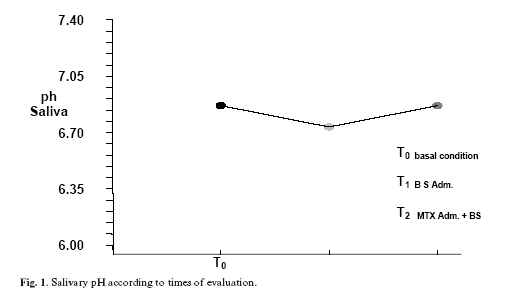
<body><![CDATA[<p><font face="Verdana" size="2">Saliva samples were collected from the patients selected for the study during one of the cycles of the consolidation phase (day 44) or maintenance (weeks 10, 20, 24, 31 and 47). The saliva was collected with the patient sitting upright and relaxed, stimulating saliva production by their chewing a paraffin capsule at three times: T<sub>0</sub>: basal condition, considered as the moment at which the administration of high doses of methotrexate has not been started; T<sub>1</sub>: 12 hours after beginning the administration of intravenous sodium bicarbonate and before administering Mtx; and T<sub>2</sub>: three hours after concluding the administration of Mtx, the time of maximum concentration (<a target="_blank" href="/img/revistas/medicorpa/v12n6/05.htm10.gif">Table 1</a>). In this study, ranges of pH will be considered within normal limits when values are between 6.0 and 7.5 (1) and salivary sodium bicarbonate levels of 5.8611 ± 2.7248 mmol/l (11). Chiron-Diagnostic 378<sup>®</sup> equipment was used to determine pH and sodium bicarbonate, following the specifications of the manufacturer.</font></p>     <p><font face="Verdana" size="2"><I>-Administering chemotherapy</I></font></p>     <p><font face="Verdana" size="2">Once authorized to receive high doses of Mtx, hyperhydration of the patient was begun with 12 mEq/m2 of sodium bicarbonate before and during the 72 hours following the administration of Mtx, with dose distributed in a single injection of 500 mg/m<sup>2</sup>, followed by 2.500 mg/m<sup>2</sup> diluted in dextrose at 5% for three hours, both indicated intravenously.</font></p>     <p><font face="Verdana" size="2"><I>-Statistical analysis</I></font></p>     <p><font face="Verdana" size="2">The data was processed and analyzed with the Prisma Statistical Program, Version 4, using Analysis of Variance (ANOVA) at a 5% significance level in which the between-subjects factor was age and the in-subject factor the evaluation times.</font></p>     <p>&nbsp;</p>     <p><font face="Verdana"><B>Results</B></font></p>     <p><font face="Verdana" size="2">The samples from 23 patients with ages ranging between 4 and 18 years were analyzed. The patients were classified into four age groups: &#8804; 5 (10 patients), from 5-10 (4 patients), 10-15 (5 patients) and &gt; 15 (4 patients).</font></p>     <p><font face="Verdana" size="2"><I>-pH in saliva</I></font></p>     <p><font face="Verdana" size="2">The average values of pH in saliva (<a href="#f1">Figure 1</a>) showed no significant differences between T<sub>0</sub>, T<sub>1</sub> and T<sub>2</sub>. However, there is a slight decrease during T<sub>1</sub>.</font></p>     ]]></body>
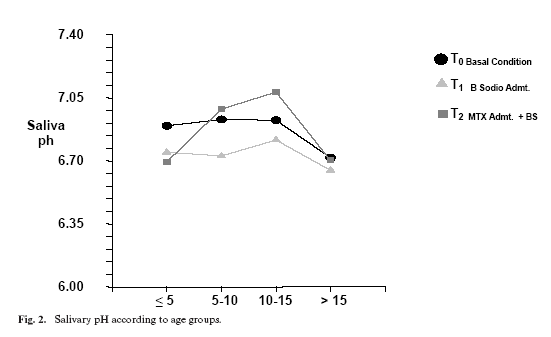
<body><![CDATA[<p align="center"><font face="Verdana" size="2"><a name="f1"><img border="0" src="/img/revistas/medicorpa/v12n6/05.htm11.gif" width="516" height="297"></a></font></p>     <p><font face="Verdana" size="2"><a href="#f2">Figure 2</a> shows that the highest levels of pH observed during the study were located in the 10-15-year group and the lowest in the &gt;15 group; likewise, this group showed the least difference between the averages of pH levels reached in T<sub>0</sub> , T<sub>1</sub> and T<sub>2</sub>.</font></p>     <p align="center"><font face="Verdana" size="2"><a name="f2"><img border="0" src="/img/revistas/medicorpa/v12n6/05.htm12.gif" width="551" height="337"></a></font></p>     <p align="center">&nbsp;</p>     <p><font face="Verdana" size="2">No significant differences were found upon relating pH levels during the different evaluation times and the age groups. On the other hand, in spite of the fact that higher pH levels were observed in the 5-10 and 10-15 age groups during the different evaluation times, no significant differences were detected between them.</font></p>     <p><font face="Verdana" size="2"><I>-Sodium bicarbonate in saliva</I></font></p>     <p><font face="Verdana" size="2">The behavior of bicarbonate levels in saliva was similar to that of salivary pH during the different treatment phases. The statistical test showed no significant differences. In <a href="#f3">Figure 3</a>, a higher level of salivary bicarbonate can be observed at T<sub>2</sub> with respect to the levels at T<sub>0</sub> and T<sub>1</sub>. The concentration of bicarbonate in saliva (<a href="#f4">Figure 4</a>) showed a slight increase for the 10-15 age group and a decrease for the &lt;15 age group in the different treatment phases. Bicarbonate concentration at T<sub>2</sub> was above that observed at T<sub>0</sub> and T<sub>1</sub>, except in the &#8804;5 age group, in which sodium bicarbonate concentration was slightly higher at T<sub>0</sub>. The greatest difference in sodium bicarbonate concentration was observed in the 10-15 age group, between T<sub>2</sub> and the other evaluation times.</font></p>     <p>&nbsp;</p>     <p align="center"><font face="Verdana" size="2"><a name="f3"><img border="0" src="/img/revistas/medicorpa/v12n6/05.htm13.gif" width="462" height="208"></a></font></p>     <p>&nbsp;</p>     ]]></body>
<body><![CDATA[<p align="center"><font face="Verdana" size="2"><a name="f4"><img border="0" src="/img/revistas/medicorpa/v12n6/05.htm14.gif" width="470" height="285"></a></font></p>     <p>&nbsp;</p>     <p><font face="Verdana"><B>Discussion</B></font></p>     <p><font face="Verdana" size="2">The administration of Mtx produced no variations in pH and salivary sodium bicarbonate, differing from Olofsson et al (4), Ertugrul et al (5) and Al-Nowaiser et al (6), which could in this case be explained by the use, during the administration protocol of the cytostatic agent, of an optimum dose of sodium bicarbonate, thus maintaining levels of sodium bicarbonate within normal ranges and neutral pH in the saliva.</font></p>     <p><font face="Verdana" size="2">Contrary to expectations, the lowest values of pH and salivary bicarbonate were observed during the administration of the bicarbonate (T<sub>1</sub>), when chemotherapy administration was started. It is possible that, at central level, the action of psychological (12) or psychopathological (13) factors such as stress or anxiety –not considered in this study– could have caused a decrease in the salivary flow rate, which is very closely related to bicarbonate concentration (14). Although this study did not evaluate the salivary flow rate, it may be considered that the emotional aspect and not chemotherapy was probably responsible for this result, since chemotherapy may cause alterations that are usually temporary and less severe than those produced by radiotherapy as reported by Valicena and Escalona (15), who suggest that chemotherapy may produce changes in salivation, with total saliva presenting modifications in composition or decreasing slightly. The increase in pH levels and bicarbonate during T<sub>2</sub> could be related to bicarbonate concentrations in the blood, probably due to the continuous infusion received during 48 hours, time enough to allow the passage of sodium bicarbonate from the blood to the saliva (16).</font></p>     <p><font face="Verdana" size="2">The levels of pH at T<sub>0</sub> decreased as the age of the patients under evaluation increased. The presence of local factors such as dental caries, plaque level and gingivitis could have influenced our findings; Zambrano et al (17) point out that these factors increase with age, which produces quali-quantitative changes in the microbial flora of the saliva and induces a decrease in salivary pH.</font></p>     <p><font face="Verdana" size="2">It is thereby concluded that the dose of sodium bicarbonate considered in the administration protocol of 3 g /m2 of Mtx, kept the levels of sodium bicarbonate within normal ranges and neutral pH. It would be pertinent to continue with studies that could include measuring saliva flow rate and considering health-disease conditions in the mouth as variables moderating the parameters evaluated here, as well as the relationship between the values of pH and sodium bicarbonate in blood and saliva.</font></p>     <p>&nbsp;</p>     <p><font face="Verdana"><B>Acknowledgement</B></font></p>     <p><font face="Verdana" size="2">Our thanks to Council for Scientific and Humanistic Development (CONDES) University of Zulia, for financial support, to the Oncohematology Unit and the Clinical Laboratory of Hospital of Pediatric Specialties (HEP) , State of Zulia, Venezuela for their invaluable contribution to the execution of this research project.</font></p>     ]]></body>
<body><![CDATA[<p>&nbsp;</p>     <p><font face="Verdana"><B>References</B></font></p>     <!-- ref --><p><font face="Verdana" size="2">1. Pedersen AM, Bardow A, Nauntofte B. Salivary changes and dental caries as potential oral markers of autoimmune salivary gland dysfunction in primary Sjogren’s syndrome. BMC Clin Pathol. 2005 Mar 1;5(1):4.</font>&nbsp;&nbsp;&nbsp;&nbsp;&nbsp;&nbsp;&nbsp;&nbsp;[&#160;<a href="javascript:void(0);" onclick="javascript: window.open('/scielo.php?script=sci_nlinks&ref=2968813&pid=S1698-6946200700060000500001&lng=','','width=640,height=500,resizable=yes,scrollbars=1,menubar=yes,');">Links</a>&#160;]<!-- end-ref --><!-- ref --><p><font face="Verdana" size="2">2. Bardow A, Moe D, Nyvad B, Nauntofte B. The buffer capacity and buffer systems of human whole saliva measured without loss of CO2. Arch Oral Biol. 2000 Jan;45(1):1-12.</font>&nbsp;&nbsp;&nbsp;&nbsp;&nbsp;&nbsp;&nbsp;&nbsp;[&#160;<a href="javascript:void(0);" onclick="javascript: window.open('/scielo.php?script=sci_nlinks&ref=2968814&pid=S1698-6946200700060000500002&lng=','','width=640,height=500,resizable=yes,scrollbars=1,menubar=yes,');">Links</a>&#160;]<!-- end-ref --><!-- ref --><p><font face="Verdana" size="2">3. Kimoto M, Kishino M, Yura Y, Ogawa Y. A role of salivary carbonic anhydrase VI in dental plaque. Arch Oral Biol. 2006 Feb;51(2):117-22. Epub 2005 Jun 14.</font>&nbsp;&nbsp;&nbsp;&nbsp;&nbsp;&nbsp;&nbsp;&nbsp;[&#160;<a href="javascript:void(0);" onclick="javascript: window.open('/scielo.php?script=sci_nlinks&ref=2968815&pid=S1698-6946200700060000500003&lng=','','width=640,height=500,resizable=yes,scrollbars=1,menubar=yes,');">Links</a>&#160;]<!-- end-ref --><!-- ref --><p><font face="Verdana" size="2">4. Basic Cariology &#091;homepage on the Internet&#093;. Malmo University. Faculty of Odontology. Department of Cariology 2001 &#091;cited 2006 Aug 30&#093;. Available from <a target="_blank" href="http://www.db.od.mah.se/car/data/basic.html">http://www.db.od.mah.se/car/data/basic.html</a>.</font>    &nbsp;&nbsp;&nbsp;&nbsp;&nbsp;&nbsp;&nbsp;&nbsp;[&#160;<a href="javascript:void(0);" onclick="javascript: window.open('/scielo.php?script=sci_nlinks&ref=2968816&pid=S1698-6946200700060000500004&lng=','','width=640,height=500,resizable=yes,scrollbars=1,menubar=yes,');">Links</a>&#160;]<!-- end-ref --></p>    <!-- ref --><p><font face="Verdana" size="2">5. Ertugrul F, Elbek-Cubukcu C, Sabah E, Mir S. The oral health status of children undergoing hemodialysis treatment. Turk J Pediatr. 2003 Apr-Jun;45(2):108-13.</font>    &nbsp;&nbsp;&nbsp;&nbsp;&nbsp;&nbsp;&nbsp;&nbsp;[&#160;<a href="javascript:void(0);" onclick="javascript: window.open('/scielo.php?script=sci_nlinks&ref=2968818&pid=S1698-6946200700060000500005&lng=','','width=640,height=500,resizable=yes,scrollbars=1,menubar=yes,');">Links</a>&#160;]<!-- end-ref --></p>    <!-- ref --><p><font face="Verdana" size="2">6. Al-Nowaiser A, Roberts GJ, Trompeter RS, Wilson M, Lucas VS. Oral health in children with chronic renal failure. Pediatr Nephrol. 2003 Jan;18(1):39-45. Epub 2002 Nov 22.</font>    &nbsp;&nbsp;&nbsp;&nbsp;&nbsp;&nbsp;&nbsp;&nbsp;[&#160;<a href="javascript:void(0);" onclick="javascript: window.open('/scielo.php?script=sci_nlinks&ref=2968820&pid=S1698-6946200700060000500006&lng=','','width=640,height=500,resizable=yes,scrollbars=1,menubar=yes,');">Links</a>&#160;]<!-- end-ref --></p>    <!-- ref --><p><font face="Verdana" size="2">7. Medina R, Moran E, Regalado M, Bergado G. La saliva como medio de diagnóstico de VIH. Rev Cubana Estomatol 2000; 37(3):146-56.</font>    &nbsp;&nbsp;&nbsp;&nbsp;&nbsp;&nbsp;&nbsp;&nbsp;[&#160;<a href="javascript:void(0);" onclick="javascript: window.open('/scielo.php?script=sci_nlinks&ref=2968822&pid=S1698-6946200700060000500007&lng=','','width=640,height=500,resizable=yes,scrollbars=1,menubar=yes,');">Links</a>&#160;]<!-- end-ref --></p>    <!-- ref --><p><font face="Verdana" size="2">8. Manual Merck de información médica para el hogar. &#091;homepage on the Internet&#093;. SECCION 12. Trastornos de la nutricion y del metabolismo. Capitulo 138. Equilibrio acidobásico &#091;updated 2005&#093;. Available from: <a target="_blank" href="http://www.msd.com.mx/publicaciones/mmerck_hogar/seccion_12/seccion_12_138.html">http://www.msd.com.mx/publicaciones/mmerck_hogar/seccion_12/seccion_12_138.html</a></font>    &nbsp;&nbsp;&nbsp;&nbsp;&nbsp;&nbsp;&nbsp;&nbsp;[&#160;<a href="javascript:void(0);" onclick="javascript: window.open('/scielo.php?script=sci_nlinks&ref=2968824&pid=S1698-6946200700060000500008&lng=','','width=640,height=500,resizable=yes,scrollbars=1,menubar=yes,');">Links</a>&#160;]<!-- end-ref --></p>    <!-- ref --><p><font face="Verdana" size="2">9. Rojas-Morales T, Lugo Z, Santana Y, Navas R, Zambrano O, Viera N, et al. Capacity buffer of the saliva in children and adolescents with cancer: Variations induced by the administration of metotrexate or cyclophosphamide. Med Oral Patol Oral Cir Bucal. 2005 Jul 1;10 Suppl 2:E103-8.</font>    &nbsp;&nbsp;&nbsp;&nbsp;&nbsp;&nbsp;&nbsp;&nbsp;[&#160;<a href="javascript:void(0);" onclick="javascript: window.open('/scielo.php?script=sci_nlinks&ref=2968826&pid=S1698-6946200700060000500009&lng=','','width=640,height=500,resizable=yes,scrollbars=1,menubar=yes,');">Links</a>&#160;]<!-- end-ref --></p>    <!-- ref --><p><font face="Verdana" size="2">10. Bennett JM, Catovsky D, Daniel MT, Flandrin G, Galton DA, Gralnick HR, et al. Proposals for the classification of the acute leukaemias. French-American-British (FAB) co-operative group. Br J Haematol. 1976 Aug;33(4):451-8.</font>    &nbsp;&nbsp;&nbsp;&nbsp;&nbsp;&nbsp;&nbsp;&nbsp;[&#160;<a href="javascript:void(0);" onclick="javascript: window.open('/scielo.php?script=sci_nlinks&ref=2968828&pid=S1698-6946200700060000500010&lng=','','width=640,height=500,resizable=yes,scrollbars=1,menubar=yes,');">Links</a>&#160;]<!-- end-ref --></p>    <!-- ref --><p><font face="Verdana" size="2">11. Fenoll-Palomares C, Muñoz Montagud JV, Sanchiz V, Herreros B, Hernandez V, Minguez M, et al. Unstimulated salivary flow rate, pH and buffer capacity of saliva in healthy volunteers. Rev Esp Enferm Dig. 2004 Nov;96(11):773-83.</font>    &nbsp;&nbsp;&nbsp;&nbsp;&nbsp;&nbsp;&nbsp;&nbsp;[&#160;<a href="javascript:void(0);" onclick="javascript: window.open('/scielo.php?script=sci_nlinks&ref=2968830&pid=S1698-6946200700060000500011&lng=','','width=640,height=500,resizable=yes,scrollbars=1,menubar=yes,');">Links</a>&#160;]<!-- end-ref --></p>    <!-- ref --><p><font face="Verdana" size="2">12. Bergdahl M, Bergdahl J. Perceived taste disturbance in adults: prevalence and association with oral and psychological factors and medication. Clin Oral Investig. 2002 Sep;6(3):145-9. Epub 2002 Aug 16.</font>    &nbsp;&nbsp;&nbsp;&nbsp;&nbsp;&nbsp;&nbsp;&nbsp;[&#160;<a href="javascript:void(0);" onclick="javascript: window.open('/scielo.php?script=sci_nlinks&ref=2968832&pid=S1698-6946200700060000500012&lng=','','width=640,height=500,resizable=yes,scrollbars=1,menubar=yes,');">Links</a>&#160;]<!-- end-ref --></p>    <!-- ref --><p><font face="Verdana" size="2">13. Bergdahl M, Bergdahl J. Low unstimulated salivary flow and subjective oral dryness: association with medication, anxiety, depression, and stress. J Dent Res. 2000 Sep;79(9):1652-8.</font>    &nbsp;&nbsp;&nbsp;&nbsp;&nbsp;&nbsp;&nbsp;&nbsp;[&#160;<a href="javascript:void(0);" onclick="javascript: window.open('/scielo.php?script=sci_nlinks&ref=2968834&pid=S1698-6946200700060000500013&lng=','','width=640,height=500,resizable=yes,scrollbars=1,menubar=yes,');">Links</a>&#160;]<!-- end-ref --></p>    <!-- ref --><p><font face="Verdana" size="2">14. Wikner S, Soder PO. Factors associated with salivary buffering capacity in young adults in Stockholm, Sweden. Scand J Dent Res. 1994 Feb;102(1):50-3.</font>    &nbsp;&nbsp;&nbsp;&nbsp;&nbsp;&nbsp;&nbsp;&nbsp;[&#160;<a href="javascript:void(0);" onclick="javascript: window.open('/scielo.php?script=sci_nlinks&ref=2968836&pid=S1698-6946200700060000500014&lng=','','width=640,height=500,resizable=yes,scrollbars=1,menubar=yes,');">Links</a>&#160;]<!-- end-ref --></p>    <!-- ref --><p><font face="Verdana" size="2">15. Valicena M, Escalona LA. Manejo Terapeútico del paciente con xerostomía. Acta Odontol Venez. 2001 Dic;39(3):70-9.</font>    &nbsp;&nbsp;&nbsp;&nbsp;&nbsp;&nbsp;&nbsp;&nbsp;[&#160;<a href="javascript:void(0);" onclick="javascript: window.open('/scielo.php?script=sci_nlinks&ref=2968838&pid=S1698-6946200700060000500015&lng=','','width=640,height=500,resizable=yes,scrollbars=1,menubar=yes,');">Links</a>&#160;]<!-- end-ref --></p>    <!-- ref --><p><font face="Verdana" size="2">16. Smith PM. Mechanisms of secretion by salivary glands. In: Edgar WM, Mullane DM, editors. Saliva and oral health. London: British Dental Association;1996. p. 9-25.</font>    &nbsp;&nbsp;&nbsp;&nbsp;&nbsp;&nbsp;&nbsp;&nbsp;[&#160;<a href="javascript:void(0);" onclick="javascript: window.open('/scielo.php?script=sci_nlinks&ref=2968840&pid=S1698-6946200700060000500016&lng=','','width=640,height=500,resizable=yes,scrollbars=1,menubar=yes,');">Links</a>&#160;]<!-- end-ref --></p>    <!-- ref --><p><font face="Verdana" size="2">17. Zambrano O, Rojas de Morales T, Navas R, Viera N, Tirado D, Rivera L. Respuesta inflamatoria gingival en niños y adolescentes con neoplásias linfohematopoyéticas. Interciencia. 2002 Sep;27(9): 471-5.</font>&nbsp;&nbsp;&nbsp;&nbsp;&nbsp;&nbsp;&nbsp;&nbsp;[&#160;<a href="javascript:void(0);" onclick="javascript: window.open('/scielo.php?script=sci_nlinks&ref=2968842&pid=S1698-6946200700060000500017&lng=','','width=640,height=500,resizable=yes,scrollbars=1,menubar=yes,');">Links</a>&#160;]<!-- end-ref --><p>&nbsp;</p>     <p>&nbsp;</p>     <p><font face="Verdana" size="2"><b><a href="#top"><img border="0" src="/img/revistas/medicorpa/v12n6/seta.gif" width="15" height="17"></a> <a name="bajo"></a>Correspondence:</b>    <BR>Dra Thais Rojas de Morales    <BR>Calle 65 equina con Av.19.    <BR>Edificio Ciencia y Salud. 3er piso.    <BR>Maracaibo. Zulia.    <BR>Venezuela. Postal Code 400    ]]></body>
<body><![CDATA[<BR>E-mail: <a href="mailto:moralesrojas@cantv.net">moralesrojas@cantv.net</a></font></p>     <p><font face="Verdana" size="2">Received: 24-08-2006    <BR>Accepted: 3-06-2007</font></p>      ]]></body><back>
<ref-list>
<ref id="B1">
<label>1</label><nlm-citation citation-type="journal">
<person-group person-group-type="author">
<name>
<surname><![CDATA[Pedersen]]></surname>
<given-names><![CDATA[AM]]></given-names>
</name>
<name>
<surname><![CDATA[Bardow]]></surname>
<given-names><![CDATA[A]]></given-names>
</name>
<name>
<surname><![CDATA[Nauntofte]]></surname>
<given-names><![CDATA[B]]></given-names>
</name>
</person-group>
<article-title xml:lang="en"><![CDATA[Salivary changes and dental caries as potential oral markers of autoimmune salivary gland dysfunction in primary Sjogren’s syndrome]]></article-title>
<source><![CDATA[BMC Clin Pathol]]></source>
<year>2005</year>
<month> M</month>
<day>ar</day>
<volume>5</volume>
<numero>1</numero>
<issue>1</issue>
<page-range>4</page-range></nlm-citation>
</ref>
<ref id="B2">
<label>2</label><nlm-citation citation-type="journal">
<person-group person-group-type="author">
<name>
<surname><![CDATA[Bardow]]></surname>
<given-names><![CDATA[A]]></given-names>
</name>
<name>
<surname><![CDATA[Moe]]></surname>
<given-names><![CDATA[D]]></given-names>
</name>
<name>
<surname><![CDATA[Nyvad]]></surname>
<given-names><![CDATA[B]]></given-names>
</name>
<name>
<surname><![CDATA[Nauntofte]]></surname>
<given-names><![CDATA[B]]></given-names>
</name>
</person-group>
<article-title xml:lang="en"><![CDATA[The buffer capacity and buffer systems of human whole saliva measured without loss of CO2]]></article-title>
<source><![CDATA[Arch Oral Biol]]></source>
<year>2000</year>
<month> J</month>
<day>an</day>
<volume>45</volume>
<numero>1</numero>
<issue>1</issue>
<page-range>1-12</page-range></nlm-citation>
</ref>
<ref id="B3">
<label>3</label><nlm-citation citation-type="journal">
<person-group person-group-type="author">
<name>
<surname><![CDATA[Kimoto]]></surname>
<given-names><![CDATA[M]]></given-names>
</name>
<name>
<surname><![CDATA[Kishino]]></surname>
<given-names><![CDATA[M]]></given-names>
</name>
<name>
<surname><![CDATA[Yura]]></surname>
<given-names><![CDATA[Y]]></given-names>
</name>
<name>
<surname><![CDATA[Ogawa]]></surname>
<given-names><![CDATA[Y]]></given-names>
</name>
</person-group>
<article-title xml:lang="en"><![CDATA[A role of salivary carbonic anhydrase VI in dental plaque]]></article-title>
<source><![CDATA[Arch Oral Biol.]]></source>
<year>2006</year>
<month> F</month>
<day>eb</day>
<volume>51</volume>
<numero>2</numero>
<issue>2</issue>
<page-range>117-22</page-range></nlm-citation>
</ref>
<ref id="B4">
<label>4</label><nlm-citation citation-type="book">
<source><![CDATA[Basic Cariology: homepage on the Internet]]></source>
<year>2001</year>
<publisher-name><![CDATA[Malmo University. Faculty of Odontology. Department of Cariology]]></publisher-name>
</nlm-citation>
</ref>
<ref id="B5">
<label>5</label><nlm-citation citation-type="journal">
<person-group person-group-type="author">
<name>
<surname><![CDATA[Ertugrul]]></surname>
<given-names><![CDATA[F]]></given-names>
</name>
<name>
<surname><![CDATA[Elbek-Cubukcu]]></surname>
<given-names><![CDATA[C]]></given-names>
</name>
<name>
<surname><![CDATA[Sabah]]></surname>
<given-names><![CDATA[E]]></given-names>
</name>
<name>
<surname><![CDATA[Mir]]></surname>
<given-names><![CDATA[S]]></given-names>
</name>
</person-group>
<article-title xml:lang="en"><![CDATA[The oral health status of children undergoing hemodialysis treatment]]></article-title>
<source><![CDATA[Turk J Pediatr.]]></source>
<year>2003</year>
<month> A</month>
<day>pr</day>
<volume>45</volume>
<numero>2</numero>
<issue>2</issue>
<page-range>108-13</page-range></nlm-citation>
</ref>
<ref id="B6">
<label>6</label><nlm-citation citation-type="journal">
<person-group person-group-type="author">
<name>
<surname><![CDATA[Al-Nowaiser]]></surname>
<given-names><![CDATA[A]]></given-names>
</name>
<name>
<surname><![CDATA[Roberts]]></surname>
<given-names><![CDATA[GJ]]></given-names>
</name>
<name>
<surname><![CDATA[Trompeter]]></surname>
<given-names><![CDATA[RS]]></given-names>
</name>
<name>
<surname><![CDATA[Wilson]]></surname>
<given-names><![CDATA[M]]></given-names>
</name>
<name>
<surname><![CDATA[Lucas]]></surname>
<given-names><![CDATA[VS]]></given-names>
</name>
</person-group>
<article-title xml:lang="en"><![CDATA[Oral health in children with chronic renal failure]]></article-title>
<source><![CDATA[Pediatr Nephrol.]]></source>
<year>2003</year>
<month> J</month>
<day>an</day>
<volume>18</volume>
<numero>1</numero>
<issue>1</issue>
<page-range>39-45</page-range></nlm-citation>
</ref>
<ref id="B7">
<label>7</label><nlm-citation citation-type="journal">
<person-group person-group-type="author">
<name>
<surname><![CDATA[Medina]]></surname>
<given-names><![CDATA[R]]></given-names>
</name>
<name>
<surname><![CDATA[Moran]]></surname>
<given-names><![CDATA[E]]></given-names>
</name>
<name>
<surname><![CDATA[Regalado]]></surname>
<given-names><![CDATA[M]]></given-names>
</name>
<name>
<surname><![CDATA[Bergado]]></surname>
<given-names><![CDATA[G]]></given-names>
</name>
</person-group>
<article-title xml:lang="es"><![CDATA[La saliva como medio de diagnóstico de VIH]]></article-title>
<source><![CDATA[Rev Cubana Estomatol]]></source>
<year>2000</year>
<volume>37</volume>
<numero>3</numero>
<issue>3</issue>
<page-range>146-56</page-range></nlm-citation>
</ref>
<ref id="B8">
<label>8</label><nlm-citation citation-type="">
<source><![CDATA[Manual Merck de información médica para el hogar]]></source>
<year>2005</year>
</nlm-citation>
</ref>
<ref id="B9">
<label>9</label><nlm-citation citation-type="journal">
<person-group person-group-type="author">
<name>
<surname><![CDATA[Rojas-Morales]]></surname>
<given-names><![CDATA[T]]></given-names>
</name>
<name>
<surname><![CDATA[Lugo]]></surname>
<given-names><![CDATA[Z]]></given-names>
</name>
<name>
<surname><![CDATA[Santana]]></surname>
<given-names><![CDATA[Y]]></given-names>
</name>
<name>
<surname><![CDATA[Navas]]></surname>
<given-names><![CDATA[R]]></given-names>
</name>
<name>
<surname><![CDATA[Zambrano]]></surname>
<given-names><![CDATA[O]]></given-names>
</name>
<name>
<surname><![CDATA[Viera]]></surname>
<given-names><![CDATA[N]]></given-names>
</name>
</person-group>
<article-title xml:lang="en"><![CDATA[Capacity buffer of the saliva in children and adolescents with cancer: Variations induced by the administration of metotrexate or cyclophosphamide]]></article-title>
<source><![CDATA[Med Oral Patol Oral Cir Bucal.]]></source>
<year>2005</year>
<month> J</month>
<day>ul</day>
<volume>10</volume>
<numero>^s2</numero>
<issue>^s2</issue>
<supplement>2</supplement>
<page-range>E103-8</page-range></nlm-citation>
</ref>
<ref id="B10">
<label>10</label><nlm-citation citation-type="journal">
<person-group person-group-type="author">
<name>
<surname><![CDATA[Bennett]]></surname>
<given-names><![CDATA[JM]]></given-names>
</name>
<name>
<surname><![CDATA[Catovsky]]></surname>
<given-names><![CDATA[D]]></given-names>
</name>
<name>
<surname><![CDATA[Daniel]]></surname>
<given-names><![CDATA[MT]]></given-names>
</name>
<name>
<surname><![CDATA[Flandrin]]></surname>
<given-names><![CDATA[G]]></given-names>
</name>
<name>
<surname><![CDATA[Galton]]></surname>
<given-names><![CDATA[DA]]></given-names>
</name>
<name>
<surname><![CDATA[Gralnick]]></surname>
<given-names><![CDATA[HR]]></given-names>
</name>
</person-group>
<article-title xml:lang="en"><![CDATA[Proposals for the classification of the acute leukaemias: French-American-British (FAB) co-operative group]]></article-title>
<source><![CDATA[Br J Haematol.]]></source>
<year>1976</year>
<month> A</month>
<day>ug</day>
<volume>33</volume>
<numero>4</numero>
<issue>4</issue>
<page-range>451-8</page-range></nlm-citation>
</ref>
<ref id="B11">
<label>11</label><nlm-citation citation-type="journal">
<person-group person-group-type="author">
<name>
<surname><![CDATA[Fenoll-Palomares]]></surname>
<given-names><![CDATA[C]]></given-names>
</name>
<name>
<surname><![CDATA[Muñoz Montagud]]></surname>
<given-names><![CDATA[JV]]></given-names>
</name>
<name>
<surname><![CDATA[Sanchiz]]></surname>
<given-names><![CDATA[V]]></given-names>
</name>
<name>
<surname><![CDATA[Herreros]]></surname>
<given-names><![CDATA[B]]></given-names>
</name>
<name>
<surname><![CDATA[Hernandez]]></surname>
<given-names><![CDATA[V]]></given-names>
</name>
<name>
<surname><![CDATA[Minguez]]></surname>
<given-names><![CDATA[M]]></given-names>
</name>
</person-group>
<article-title xml:lang="en"><![CDATA[Unstimulated salivary flow rate, pH and buffer capacity of saliva in healthy volunteers]]></article-title>
<source><![CDATA[Rev Esp Enferm Dig.]]></source>
<year>2004</year>
<month> N</month>
<day>ov</day>
<volume>96</volume>
<numero>11</numero>
<issue>11</issue>
<page-range>773-83</page-range></nlm-citation>
</ref>
<ref id="B12">
<label>12</label><nlm-citation citation-type="journal">
<person-group person-group-type="author">
<name>
<surname><![CDATA[Bergdahl]]></surname>
<given-names><![CDATA[M]]></given-names>
</name>
<name>
<surname><![CDATA[Bergdahl]]></surname>
<given-names><![CDATA[J]]></given-names>
</name>
</person-group>
<article-title xml:lang="en"><![CDATA[Perceived taste disturbance in adults: prevalence and association with oral and psychological factors and medication]]></article-title>
<source><![CDATA[Clin Oral Investig.]]></source>
<year>2002</year>
<month> S</month>
<day>ep</day>
<volume>6</volume>
<numero>3</numero>
<issue>3</issue>
<page-range>145-9</page-range></nlm-citation>
</ref>
<ref id="B13">
<label>13</label><nlm-citation citation-type="journal">
<person-group person-group-type="author">
<name>
<surname><![CDATA[Bergdahl]]></surname>
<given-names><![CDATA[M]]></given-names>
</name>
<name>
<surname><![CDATA[Bergdahl]]></surname>
<given-names><![CDATA[J]]></given-names>
</name>
</person-group>
<article-title xml:lang="en"><![CDATA[Low unstimulated salivary flow and subjective oral dryness: association with medication, anxiety, depression, and stress]]></article-title>
<source><![CDATA[J Dent Res.]]></source>
<year>2000</year>
<month> S</month>
<day>ep</day>
<volume>79</volume>
<numero>9</numero>
<issue>9</issue>
<page-range>1652-8</page-range></nlm-citation>
</ref>
<ref id="B14">
<label>14</label><nlm-citation citation-type="journal">
<person-group person-group-type="author">
<name>
<surname><![CDATA[Wikner]]></surname>
<given-names><![CDATA[S]]></given-names>
</name>
<name>
<surname><![CDATA[Soder]]></surname>
<given-names><![CDATA[PO]]></given-names>
</name>
</person-group>
<article-title xml:lang="en"><![CDATA[Factors associated with salivary buffering capacity in young adults in Stockholm, Sweden]]></article-title>
<source><![CDATA[Scand J Dent Res.]]></source>
<year>1994</year>
<month> F</month>
<day>eb</day>
<volume>102</volume>
<numero>1</numero>
<issue>1</issue>
<page-range>50-3</page-range></nlm-citation>
</ref>
<ref id="B15">
<label>15</label><nlm-citation citation-type="journal">
<person-group person-group-type="author">
<name>
<surname><![CDATA[Valicena]]></surname>
<given-names><![CDATA[M]]></given-names>
</name>
<name>
<surname><![CDATA[Escalona]]></surname>
<given-names><![CDATA[LA]]></given-names>
</name>
</person-group>
<article-title xml:lang="es"><![CDATA[Manejo Terapeútico del paciente con xerostomía]]></article-title>
<source><![CDATA[Acta Odontol Venez.]]></source>
<year>2001</year>
<month> D</month>
<day>ic</day>
<volume>39</volume>
<numero>3</numero>
<issue>3</issue>
<page-range>70-9</page-range></nlm-citation>
</ref>
<ref id="B16">
<label>16</label><nlm-citation citation-type="book">
<person-group person-group-type="author">
<name>
<surname><![CDATA[Smith]]></surname>
<given-names><![CDATA[PM]]></given-names>
</name>
</person-group>
<article-title xml:lang="en"><![CDATA[Mechanisms of secretion by salivary glands]]></article-title>
<person-group person-group-type="editor">
<name>
<surname><![CDATA[Edgar]]></surname>
<given-names><![CDATA[WM]]></given-names>
</name>
<name>
<surname><![CDATA[Mullane]]></surname>
<given-names><![CDATA[DM]]></given-names>
</name>
</person-group>
<source><![CDATA[Saliva and oral health]]></source>
<year>1996</year>
<page-range>9-25</page-range><publisher-loc><![CDATA[London ]]></publisher-loc>
<publisher-name><![CDATA[British Dental Association]]></publisher-name>
</nlm-citation>
</ref>
<ref id="B17">
<label>17</label><nlm-citation citation-type="journal">
<person-group person-group-type="author">
<name>
<surname><![CDATA[Zambrano]]></surname>
<given-names><![CDATA[O]]></given-names>
</name>
<name>
<surname><![CDATA[Rojas de Morales]]></surname>
<given-names><![CDATA[T]]></given-names>
</name>
<name>
<surname><![CDATA[Navas]]></surname>
<given-names><![CDATA[R]]></given-names>
</name>
<name>
<surname><![CDATA[Viera]]></surname>
<given-names><![CDATA[N]]></given-names>
</name>
<name>
<surname><![CDATA[Tirado]]></surname>
<given-names><![CDATA[D]]></given-names>
</name>
<name>
<surname><![CDATA[Rivera]]></surname>
<given-names><![CDATA[L]]></given-names>
</name>
</person-group>
<article-title xml:lang="es"><![CDATA[Respuesta inflamatoria gingival en niños y adolescentes con neoplásias linfohematopoyéticas]]></article-title>
<source><![CDATA[Interciencia.]]></source>
<year>2002</year>
<month> S</month>
<day>ep</day>
<volume>27</volume>
<numero>9</numero>
<issue>9</issue>
<page-range>471-5</page-range></nlm-citation>
</ref>
</ref-list>
</back>
</article>