<?xml version="1.0" encoding="ISO-8859-1"?><article xmlns:mml="http://www.w3.org/1998/Math/MathML" xmlns:xlink="http://www.w3.org/1999/xlink" xmlns:xsi="http://www.w3.org/2001/XMLSchema-instance">
<front>
<journal-meta>
<journal-id>1698-6946</journal-id>
<journal-title><![CDATA[Medicina Oral, Patología Oral y Cirugía Bucal (Internet)]]></journal-title>
<abbrev-journal-title><![CDATA[Med. oral patol. oral cir.bucal (Internet)]]></abbrev-journal-title>
<issn>1698-6946</issn>
<publisher>
<publisher-name><![CDATA[Sociedad Española de Medicina Oral]]></publisher-name>
</publisher>
</journal-meta>
<article-meta>
<article-id>S1698-69462007000800008</article-id>
<title-group>
<article-title xml:lang="en"><![CDATA[New dental simulator for microsurgical training preliminary overview]]></article-title>
</title-group>
<contrib-group>
<contrib contrib-type="author">
<name>
<surname><![CDATA[Usón Gargallo]]></surname>
<given-names><![CDATA[Jesús]]></given-names>
</name>
<xref ref-type="aff" rid="A01"/>
</contrib>
<contrib contrib-type="author">
<name>
<surname><![CDATA[Abellán Rubio]]></surname>
<given-names><![CDATA[Elena]]></given-names>
</name>
<xref ref-type="aff" rid="A01"/>
</contrib>
<contrib contrib-type="author">
<name>
<surname><![CDATA[Gutiérrez Pérez]]></surname>
<given-names><![CDATA[José Luis]]></given-names>
</name>
<xref ref-type="aff" rid="A02"/>
<xref ref-type="aff" rid="A03"/>
</contrib>
<contrib contrib-type="author">
<name>
<surname><![CDATA[Torres Lagares]]></surname>
<given-names><![CDATA[Daniel]]></given-names>
</name>
<xref ref-type="aff" rid="A03"/>
</contrib>
<contrib contrib-type="author">
<name>
<surname><![CDATA[Calles Vázquez]]></surname>
<given-names><![CDATA[Carmen]]></given-names>
</name>
<xref ref-type="aff" rid="A01"/>
</contrib>
</contrib-group>
<aff id="A01">
<institution><![CDATA[,Minimally Invasive Surgery Centre Microsurgery Unit ]]></institution>
<addr-line><![CDATA[Cáceres ]]></addr-line>
</aff>
<aff id="A02">
<institution><![CDATA[,Virgen del Rocío University Hospitals Maxillofacial Surgery Department ]]></institution>
<addr-line><![CDATA[ ]]></addr-line>
</aff>
<aff id="A03">
<institution><![CDATA[,University of Seville Faculty of Dentistry ]]></institution>
<addr-line><![CDATA[Seville ]]></addr-line>
</aff>
<pub-date pub-type="pub">
<day>00</day>
<month>12</month>
<year>2007</year>
</pub-date>
<pub-date pub-type="epub">
<day>00</day>
<month>12</month>
<year>2007</year>
</pub-date>
<volume>12</volume>
<numero>8</numero>
<fpage>582</fpage>
<lpage>584</lpage>
<copyright-statement/>
<copyright-year/>
<self-uri xlink:href="http://scielo.isciii.es/scielo.php?script=sci_arttext&amp;pid=S1698-69462007000800008&amp;lng=en&amp;nrm=iso"></self-uri><self-uri xlink:href="http://scielo.isciii.es/scielo.php?script=sci_abstract&amp;pid=S1698-69462007000800008&amp;lng=en&amp;nrm=iso"></self-uri><self-uri xlink:href="http://scielo.isciii.es/scielo.php?script=sci_pdf&amp;pid=S1698-69462007000800008&amp;lng=en&amp;nrm=iso"></self-uri><abstract abstract-type="short" xml:lang="en"><p><![CDATA[Objective: To present a new simulator designed at the Minimally Invasive Surgery Centre (Cáceres) which offers an integral, effective and viable training system that can be used for learning microsurgical techniques. Study design: A square methacrylate block was used. Animal jaws were fixed to the sides by means of butterfly screws. This block also has a drainage tube to facilitate the escape of fluids. Results: Excellent results were obtained using this simulator in microsurgical suturing training in dental, Oral and Maxillofacial Surgery Conclusions: We believe that this simulator is an essential component in microsurgical training. It is an ethically and morally valid training method with which various suturing techniques can be practised before using live animals and before applying these to daily clinical practice.]]></p></abstract>
<kwd-group>
<kwd lng="en"><![CDATA[Microsurgery]]></kwd>
<kwd lng="en"><![CDATA[training]]></kwd>
<kwd lng="en"><![CDATA[suturing technique]]></kwd>
<kwd lng="en"><![CDATA[learning]]></kwd>
<kwd lng="en"><![CDATA[dental surgery]]></kwd>
<kwd lng="en"><![CDATA[Oral Surgery]]></kwd>
<kwd lng="en"><![CDATA[Maxillofacial Surgery]]></kwd>
</kwd-group>
</article-meta>
</front><body><![CDATA[ <p>&nbsp;</p>     <p><font face="Verdana" size="4"><B><a name="top"></a>New dental simulator for microsurgical training preliminary overview</B></font></p>     <p>&nbsp;</p>     <p>&nbsp;</p>     <p><font face="Verdana" size="2"><B>Jesús Usón Gargallo<sup>1</sup>, Elena Abellán Rubio<sup>1</sup>, José Luis Gutiérrez Pérez<sup>2</sup>, Daniel Torres Lagares<sup>3</sup>, Carmen Calles Vázquez<sup>1</sup></B></font></p>     <p><font face="Verdana" size="2">(1) Microsurgery Unit. Minimally Invasive Surgery Centre. Cáceres    <BR>(2) Head of the Maxillofacial Surgery Department, Virgen del Rocío University Hospitals. Professor of Oral Surgery. Faculty of Dentistry. University of Seville. Seville    <BR>(3) Assistant Lecturer of Oral Surgery. University of Seville. Seville. Spain</font></p>     <p><font face="Verdana" size="2"><a href="#back">Correspondence</a></font></p>     <p>&nbsp;</p>     ]]></body>
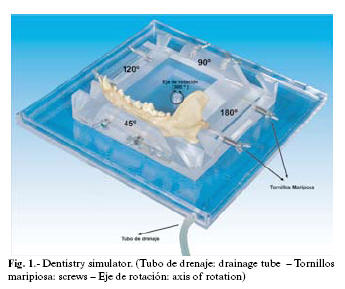
<body><![CDATA[<p>&nbsp;</p> <hr size="1">     <p><font face="Verdana" size="2"><b>ABSTRACT</b></font></p>     <p><font face="Verdana" size="2"><B>Objective:</B> To present a new simulator designed at the Minimally Invasive Surgery Centre (Cáceres) which offers an integral, effective and viable training system that can be used for learning microsurgical techniques.    <BR><B>Study design:</B> A square methacrylate block was used. Animal jaws were fixed to the sides by means of butterfly screws. This block also has a drainage tube to facilitate the escape of fluids.    <BR><B>Results:</B> Excellent results were obtained using this simulator in microsurgical suturing training in dental, Oral and Maxillofacial Surgery    <BR><B>Conclusions:</B> We believe that this simulator is an essential component in microsurgical training. It is an ethically and morally valid training method with which various suturing techniques can be practised before using live animals and before applying these to daily clinical practice.</font></p>     <p><font face="Verdana" size="2"><B>Key words:</B> Microsurgery, training, suturing technique, learning, dental surgery, Oral Surgery, Maxillofacial Surgery.</font></p> <hr size="1">     <p>&nbsp;</p>     <p><font face="Verdana"><B>Introduction</B></font></p>     <p><font face="Verdana" size="2">Microsurgery can be defined as &quot;surgery which makes use of magnifying techniques in the operating field to see above the normal range of vision&quot;. The Real Academia Española de la Lengua (1989) which regulates the Spanish language defines &quot;micro&quot; as: a quantifier prefix which gives the meaning of &quot;small&quot; to a word. &quot;Surgery&quot; is defined as the section of medicine which aims to cure illnesses by means of surgical operations (1).</font></p>     ]]></body>
<body><![CDATA[<p><font face="Verdana" size="2">Specific surgical material is required to practice microsurgical techniques. This is usually finer and more delicate than that used in conventional surgery: smaller suture material, special needles, and most importantly visual magnifying aids (2-5). The combination of these factors makes it important that the techniques are corrected acquired in an individual manner carrying out continuous practice of the new skills obtained (6-7). In the Minimally Invasive Surgery Centre (MISC), we have designed a simulator (<a href="#f1">Fig. 1</a>) which reproduces real situations on organic and methacrylate material, using various positions and levels of difficulty in order to learn microsurgical suturing techniques in Dental, Oral and Maxillofacial Surgery. Other training in more advanced techniques can also be acquired in periapical surgery and endodontics in general, avoiding the use of live subjects and in particular, preventing practice on human patients. A more precise simulation is obtained with this simulator since it more closely resembles actual microsurgical techniques in these fields and also requires a more demanding, refined technique.</font></p>     <p align="center"><a name="f1"><img border="0" src="/img/revistas/medicorpa/v12n8/08_f1.jpg" width="345" height="289"></a></p>     <p>&nbsp;</p>     <p><font face="Verdana"><B>Material and methods</B></font></p>     <p><font face="Verdana" size="2">Description of simulator and instructions for use.</font></p>     <p><font face="Verdana" size="2">The dental simulator that has been designed in the Minimally Invasive Surgery Centre (<a href="#f1">Fig. 1</a>) is made up of a 44 mm thick methacrylate square block with four openings to position the jaws of various animals (extracted post-mortem) at varying degrees of inclination: 90º, 105º, 115º and 130º. The jaws are fixed to the sides of the openings of the methacrylate block using butterfly screws (<a href="#f1">Fig. 1</a>). The simulator also turns 360º on a central axis (rotation axis <a href="#f1">Fig. 1</a>), in both a clockwise and counter-clockwise direction. This feature, together with the varying degrees of inclination in which the jaws can be positioned, offers numerous positions for practice. Different levels of difficulty and subsequently various real situations in daily clinical practice on human patients can be reproduced.</font></p>     <p><font face="Verdana" size="2">The methacrylate block is joined to a methacrylate box by a nut which permits the simulator to rotate. It also has a drainage tube to facilitate the escape of fluids (<a href="#f1">Fig. 1</a>).</font></p>     <p><font face="Verdana" size="2">Jaws from organic subjects are fixed in various positions to the simulator in order to practice microsurgical suturing techniques and other more advanced techniques in periapical surgery and endodontics in general. This avoids the use of live subjects and especially, practice on human subjects.</font></p>     <p>&nbsp;</p>     <p><font face="Verdana"><B>Results</B></font></p>     ]]></body>
<body><![CDATA[<p><font face="Verdana" size="2">The excellent results obtained for this microsurgical suturing training method have proven the success of the simulator. 50 dental, oral and maxillofacial surgeons learned suturing techniques by using this method. All of these were specialists who have attended microsurgical beginners and advanced courses in our Microsurgery Unit, where they practised suturing techniques by carrying out various types of grafts in the simulator.</font></p>     <p><font face="Verdana" size="2">A further 100 specialists answered a survey, giving their opinions regarding the use of the simulator for initial training of the microsurgical suturing techniques.</font></p>     <p><font face="Verdana" size="2">All of the abovementioned specialists who have been trained in microsurgical techniques using the practice card<sup>1 </sup>and subsequently the simulator answered a survey giving their opinions about the advantages or disadvantages of the use of the simulator and whether or not it should be included in the microsurgical training programme within their specialty.</font></p>     <p><font face="Verdana" size="2">When asked about the importance of time spent using the simulator on a 1-10 score, 90% of the 100 specialists taking the survey answered 10, 6% answered 9, 2% answered 8, and 2% answered 7.</font></p>     <p><font face="Verdana" size="2">98% of the 100 respondents preferred to begin a one day training course using the dental simulator instead of directly carrying out the techniques on live rats.</font></p>     <p>&nbsp;</p>     <p><font face="Verdana"><B>Discussion</B></font></p>     <p><font face="Verdana" size="2">The simulator used by the Microsurgical Unit of the MISC provides an ethically sound training system which allows trainees to acquire microsuturing techniques without having to learn from mistakes made on live animals. A progressive training system is required, initially using inert material (practice card) (1) and subsequently the dental simulator, since this method also gives better results in the same time frame.</font></p>     <p><font face="Verdana" size="2">Based on our many years of experience in microsurgical training and on the surveys and statistical studies conducted by the Microsurgical Unit, we conclude that this simulator is a crucial element for learning microsurgical suturing techniques in Dental, Oral and Maxillofacial Surgery. The simulator allows trainees to acquire the skills required and at the same time reduces the number of animals used and the cost. It can therefore be considered an ethical training method (8,9).</font></p>     <p><font face="Verdana" size="2">Although innate talent plays an important role in acquiring microsurgical suturing skills for their application in these specialties, when the simulator is used, the trainee manages to perform better-quality stitches with greater ease in three or four hours of practice. This may seem difficult at the beginning; but is subsequently beneficial since in our experience, microsurgical techniques can only be mastered after many years of microsurgical training. Furthermore, we should bear in mind that skill in the suturing technique is an essential, decisive factor in microsurgical training (10,11).</font></p>     ]]></body>
<body><![CDATA[<p>&nbsp;</p>     <p><font face="Verdana"><B>References</B></font></p>     <!-- ref --><p><font face="Verdana" size="2">1. Uson J, Calles MC. Design of a new suture practice card for microsurgical training. Microsurgery. 2002;22(8):324-8.</font>&nbsp;&nbsp;&nbsp;&nbsp;&nbsp;&nbsp;&nbsp;&nbsp;[&#160;<a href="javascript:void(0);" onclick="javascript: window.open('/scielo.php?script=sci_nlinks&ref=2987329&pid=S1698-6946200700080000800001&lng=','','width=640,height=500,resizable=yes,scrollbars=1,menubar=yes,');">Links</a>&#160;]<!-- end-ref --><!-- ref --><p> <font face="Verdana" size="2">2. Adrales GL, Chu UB, Witzke DB, Donnelly MB, Hoskins D, Mastrangelo MJ Jr, et al. Evaluating minimally invasive surgery training using low-cost mechanical simulations. Surg Endosc. 2003 Apr;17(4):580-5.</font>&nbsp;&nbsp;&nbsp;&nbsp;&nbsp;&nbsp;&nbsp;&nbsp;[&#160;<a href="javascript:void(0);" onclick="javascript: window.open('/scielo.php?script=sci_nlinks&ref=2987330&pid=S1698-6946200700080000800002&lng=','','width=640,height=500,resizable=yes,scrollbars=1,menubar=yes,');">Links</a>&#160;]<!-- end-ref --><!-- ref --><p> <font face="Verdana" size="2">3. Cuschieri, A. No authors listed Training and simulation. Minim Invasive Ther Allied Technol. 2001 Mar;10(2):67-74.</font>&nbsp;&nbsp;&nbsp;&nbsp;&nbsp;&nbsp;&nbsp;&nbsp;[&#160;<a href="javascript:void(0);" onclick="javascript: window.open('/scielo.php?script=sci_nlinks&ref=2987331&pid=S1698-6946200700080000800003&lng=','','width=640,height=500,resizable=yes,scrollbars=1,menubar=yes,');">Links</a>&#160;]<!-- end-ref --><!-- ref --><p> <font face="Verdana" size="2">4. DesCoteaux JG, Leclere H. Learning surgical technical skills. Can J Surg. 1995 Feb;38(1):33-8.</font>&nbsp;&nbsp;&nbsp;&nbsp;&nbsp;&nbsp;&nbsp;&nbsp;[&#160;<a href="javascript:void(0);" onclick="javascript: window.open('/scielo.php?script=sci_nlinks&ref=2987332&pid=S1698-6946200700080000800004&lng=','','width=640,height=500,resizable=yes,scrollbars=1,menubar=yes,');">Links</a>&#160;]<!-- end-ref --><!-- ref --><p> <font face="Verdana" size="2">5. Haluck RS, Krummel TM. Computers and virtual reality for surgical education in the 21st century. Arch Surg. 2000 Jul;135(7):786-92.</font>&nbsp;&nbsp;&nbsp;&nbsp;&nbsp;&nbsp;&nbsp;&nbsp;[&#160;<a href="javascript:void(0);" onclick="javascript: window.open('/scielo.php?script=sci_nlinks&ref=2987333&pid=S1698-6946200700080000800005&lng=','','width=640,height=500,resizable=yes,scrollbars=1,menubar=yes,');">Links</a>&#160;]<!-- end-ref --><!-- ref --><p> <font face="Verdana" size="2">6. Rogers DA, Elstein AS, Bordage G. Improving continuing medical education for surgical techniques: applying the lessons learned in the first decade of minimal access surgery. Ann Surg. 2001 Feb;233(2):159-66.</font>&nbsp;&nbsp;&nbsp;&nbsp;&nbsp;&nbsp;&nbsp;&nbsp;[&#160;<a href="javascript:void(0);" onclick="javascript: window.open('/scielo.php?script=sci_nlinks&ref=2987334&pid=S1698-6946200700080000800006&lng=','','width=640,height=500,resizable=yes,scrollbars=1,menubar=yes,');">Links</a>&#160;]<!-- end-ref --><!-- ref --><p> <font face="Verdana" size="2">7. Bro-Nielsen M. Finite element modeling in surgery simulation Proceedings of the IEEE. 1998; 86: 490-503.</font>&nbsp;&nbsp;&nbsp;&nbsp;&nbsp;&nbsp;&nbsp;&nbsp;[&#160;<a href="javascript:void(0);" onclick="javascript: window.open('/scielo.php?script=sci_nlinks&ref=2987335&pid=S1698-6946200700080000800007&lng=','','width=640,height=500,resizable=yes,scrollbars=1,menubar=yes,');">Links</a>&#160;]<!-- end-ref --><!-- ref --><p> <font face="Verdana" size="2">8. Wanzel KR, Ward M, Reznick RK. Teaching the surgical craft: From selection to certification. Curr Probl Surg. 2002 Jun;39(6):573-659.</font>&nbsp;&nbsp;&nbsp;&nbsp;&nbsp;&nbsp;&nbsp;&nbsp;[&#160;<a href="javascript:void(0);" onclick="javascript: window.open('/scielo.php?script=sci_nlinks&ref=2987336&pid=S1698-6946200700080000800008&lng=','','width=640,height=500,resizable=yes,scrollbars=1,menubar=yes,');">Links</a>&#160;]<!-- end-ref --><!-- ref --><p> <font face="Verdana" size="2">9. Dubrowski A, Carnahan H. Principles of motor learning: Can they be applied to surgical education? FOCUS Surg Ed. 2003; 20: 22-32.</font>&nbsp;&nbsp;&nbsp;&nbsp;&nbsp;&nbsp;&nbsp;&nbsp;[&#160;<a href="javascript:void(0);" onclick="javascript: window.open('/scielo.php?script=sci_nlinks&ref=2987337&pid=S1698-6946200700080000800009&lng=','','width=640,height=500,resizable=yes,scrollbars=1,menubar=yes,');">Links</a>&#160;]<!-- end-ref --><!-- ref --><p> <font face="Verdana" size="2">10. Kneebone RL, Scott W, Darzi A, Horrocks M. Simulation and clinical practice: strengthening the relationship. Med Educ. 2004 Oct;38(10):1095-102.</font>&nbsp;&nbsp;&nbsp;&nbsp;&nbsp;&nbsp;&nbsp;&nbsp;[&#160;<a href="javascript:void(0);" onclick="javascript: window.open('/scielo.php?script=sci_nlinks&ref=2987338&pid=S1698-6946200700080000800010&lng=','','width=640,height=500,resizable=yes,scrollbars=1,menubar=yes,');">Links</a>&#160;]<!-- end-ref --><!-- ref --><p> <font face="Verdana" size="2">11. Anastakis DJ, Wanzel KR, Brown MH, McIlroy JH, Hamstra SJ, Ali J, et al. Evaluating the effectiveness of a 2-year curriculum in a surgical skills center. Am J Surg. 2003 Apr;185(4):378-85.</font>&nbsp;&nbsp;&nbsp;&nbsp;&nbsp;&nbsp;&nbsp;&nbsp;[&#160;<a href="javascript:void(0);" onclick="javascript: window.open('/scielo.php?script=sci_nlinks&ref=2987339&pid=S1698-6946200700080000800011&lng=','','width=640,height=500,resizable=yes,scrollbars=1,menubar=yes,');">Links</a>&#160;]<!-- end-ref --><p>&nbsp;</p>     <p>&nbsp;</p>     <p><a href="#top"><img border="0" src="/img/revistas/medicorpa/v12n8/seta.gif" width="15" height="17"></a><font face="Verdana" size="2"><b><a name="back"></a>Correspondence:</b>    <BR>Dra. Elena Abellán Rubio    <BR>Centro de Cirugía de Mínima Invasión &quot;Jesús Usón&quot;    <BR>Crta. Nacional 521; Km 41,8 km    <BR>10071 Cáceres, SPAIN.    ]]></body>
<body><![CDATA[<BR>E-mail:  <a href="mailto:eabellan@ccmijesususon.com">eabellan@ccmijesususon.com</a></font></p>     <p><font face="Verdana" size="2">Received: 11-1-2007    <BR>Accepted: 23-10-2007</font></p>       ]]></body><back>
<ref-list>
<ref id="B1">
<label>1</label><nlm-citation citation-type="journal">
<person-group person-group-type="author">
<name>
<surname><![CDATA[Uson]]></surname>
<given-names><![CDATA[J]]></given-names>
</name>
<name>
<surname><![CDATA[Calles]]></surname>
<given-names><![CDATA[MC]]></given-names>
</name>
</person-group>
<article-title xml:lang="en"><![CDATA[Design of a new suture practice card for microsurgical training]]></article-title>
<source><![CDATA[Microsurgery]]></source>
<year>2002</year>
<volume>22</volume>
<numero>8</numero>
<issue>8</issue>
<page-range>324-8</page-range></nlm-citation>
</ref>
<ref id="B2">
<label>2</label><nlm-citation citation-type="journal">
<person-group person-group-type="author">
<name>
<surname><![CDATA[Adrales]]></surname>
<given-names><![CDATA[GL]]></given-names>
</name>
<name>
<surname><![CDATA[Chu]]></surname>
<given-names><![CDATA[UB]]></given-names>
</name>
<name>
<surname><![CDATA[Witzke]]></surname>
<given-names><![CDATA[DB]]></given-names>
</name>
<name>
<surname><![CDATA[Donnelly]]></surname>
<given-names><![CDATA[MB]]></given-names>
</name>
<name>
<surname><![CDATA[Hoskins]]></surname>
<given-names><![CDATA[D]]></given-names>
</name>
<name>
<surname><![CDATA[Mastrangelo]]></surname>
<given-names><![CDATA[MJ Jr]]></given-names>
</name>
</person-group>
<article-title xml:lang="en"><![CDATA[Evaluating minimally invasive surgery training using low-cost mechanical simulations]]></article-title>
<source><![CDATA[Surg Endosc.]]></source>
<year>2003</year>
<month> A</month>
<day>pr</day>
<volume>17</volume>
<numero>4</numero>
<issue>4</issue>
<page-range>580-5</page-range></nlm-citation>
</ref>
<ref id="B3">
<label>3</label><nlm-citation citation-type="journal">
<person-group person-group-type="author">
<name>
<surname><![CDATA[Cuschieri]]></surname>
<given-names><![CDATA[A]]></given-names>
</name>
</person-group>
<article-title xml:lang="en"><![CDATA[No authors listed Training and simulation]]></article-title>
<source><![CDATA[Minim Invasive Ther Allied Technol.]]></source>
<year>2001</year>
<month> M</month>
<day>ar</day>
<volume>10</volume>
<numero>2</numero>
<issue>2</issue>
<page-range>67-74</page-range></nlm-citation>
</ref>
<ref id="B4">
<label>4</label><nlm-citation citation-type="journal">
<person-group person-group-type="author">
<name>
<surname><![CDATA[DesCoteaux]]></surname>
<given-names><![CDATA[JG]]></given-names>
</name>
<name>
<surname><![CDATA[Leclere]]></surname>
<given-names><![CDATA[H]]></given-names>
</name>
</person-group>
<article-title xml:lang="en"><![CDATA[Learning surgical technical skills]]></article-title>
<source><![CDATA[Can J Surg.]]></source>
<year>1995</year>
<month> F</month>
<day>eb</day>
<volume>38</volume>
<numero>1</numero>
<issue>1</issue>
<page-range>33-8</page-range></nlm-citation>
</ref>
<ref id="B5">
<label>5</label><nlm-citation citation-type="journal">
<person-group person-group-type="author">
<name>
<surname><![CDATA[Haluck]]></surname>
<given-names><![CDATA[RS]]></given-names>
</name>
<name>
<surname><![CDATA[Krummel]]></surname>
<given-names><![CDATA[TM]]></given-names>
</name>
</person-group>
<article-title xml:lang="en"><![CDATA[Computers and virtual reality for surgical education in the 21st century]]></article-title>
<source><![CDATA[Arch Surg.]]></source>
<year>2000</year>
<month> J</month>
<day>ul</day>
<volume>135</volume>
<numero>7</numero>
<issue>7</issue>
<page-range>786-92</page-range></nlm-citation>
</ref>
<ref id="B6">
<label>6</label><nlm-citation citation-type="journal">
<person-group person-group-type="author">
<name>
<surname><![CDATA[Rogers]]></surname>
<given-names><![CDATA[DA]]></given-names>
</name>
<name>
<surname><![CDATA[Elstein]]></surname>
<given-names><![CDATA[AS]]></given-names>
</name>
<name>
<surname><![CDATA[Bordage]]></surname>
<given-names><![CDATA[G]]></given-names>
</name>
</person-group>
<article-title xml:lang="en"><![CDATA[Improving continuing medical education for surgical techniques: applying the lessons learned in the first decade of minimal access surgery]]></article-title>
<source><![CDATA[Ann Surg.]]></source>
<year>2001</year>
<month> F</month>
<day>eb</day>
<volume>233</volume>
<numero>2</numero>
<issue>2</issue>
<page-range>159-66</page-range></nlm-citation>
</ref>
<ref id="B7">
<label>7</label><nlm-citation citation-type="journal">
<person-group person-group-type="author">
<name>
<surname><![CDATA[Bro-Nielsen]]></surname>
<given-names><![CDATA[M]]></given-names>
</name>
</person-group>
<article-title xml:lang="en"><![CDATA[Finite element modeling in surgery simulation]]></article-title>
<source><![CDATA[Proceedings of the IEEE]]></source>
<year>1998</year>
<volume>86</volume>
<page-range>490-503</page-range></nlm-citation>
</ref>
<ref id="B8">
<label>8</label><nlm-citation citation-type="journal">
<person-group person-group-type="author">
<name>
<surname><![CDATA[Wanzel]]></surname>
<given-names><![CDATA[KR]]></given-names>
</name>
<name>
<surname><![CDATA[Ward]]></surname>
<given-names><![CDATA[M]]></given-names>
</name>
<name>
<surname><![CDATA[Reznick]]></surname>
<given-names><![CDATA[RK]]></given-names>
</name>
</person-group>
<article-title xml:lang="en"><![CDATA[Teaching the surgical craft: From selection to certification]]></article-title>
<source><![CDATA[Curr Probl Surg.]]></source>
<year>2002</year>
<month> J</month>
<day>un</day>
<volume>39</volume>
<numero>6</numero>
<issue>6</issue>
<page-range>573-659</page-range></nlm-citation>
</ref>
<ref id="B9">
<label>9</label><nlm-citation citation-type="journal">
<person-group person-group-type="author">
<name>
<surname><![CDATA[Dubrowski]]></surname>
<given-names><![CDATA[A]]></given-names>
</name>
<name>
<surname><![CDATA[Carnahan]]></surname>
<given-names><![CDATA[H]]></given-names>
</name>
</person-group>
<article-title xml:lang="en"><![CDATA[Principles of motor learning: Can they be applied to surgical education?]]></article-title>
<source><![CDATA[FOCUS Surg Ed.]]></source>
<year>2003</year>
<volume>20</volume>
<page-range>22-32</page-range></nlm-citation>
</ref>
<ref id="B10">
<label>10</label><nlm-citation citation-type="journal">
<person-group person-group-type="author">
<name>
<surname><![CDATA[Kneebone]]></surname>
<given-names><![CDATA[RL]]></given-names>
</name>
<name>
<surname><![CDATA[Scott]]></surname>
<given-names><![CDATA[W]]></given-names>
</name>
<name>
<surname><![CDATA[Darzi]]></surname>
<given-names><![CDATA[A]]></given-names>
</name>
<name>
<surname><![CDATA[Horrocks]]></surname>
<given-names><![CDATA[M]]></given-names>
</name>
</person-group>
<article-title xml:lang="en"><![CDATA[Simulation and clinical practice: strengthening the relationship]]></article-title>
<source><![CDATA[Med Educ.]]></source>
<year>2004</year>
<month> O</month>
<day>ct</day>
<volume>38</volume>
<numero>10</numero>
<issue>10</issue>
<page-range>1095-102</page-range></nlm-citation>
</ref>
<ref id="B11">
<label>11</label><nlm-citation citation-type="journal">
<person-group person-group-type="author">
<name>
<surname><![CDATA[Anastakis]]></surname>
<given-names><![CDATA[DJ]]></given-names>
</name>
<name>
<surname><![CDATA[Wanzel]]></surname>
<given-names><![CDATA[KR]]></given-names>
</name>
<name>
<surname><![CDATA[Brown]]></surname>
<given-names><![CDATA[MH]]></given-names>
</name>
<name>
<surname><![CDATA[McIlroy]]></surname>
<given-names><![CDATA[JH]]></given-names>
</name>
<name>
<surname><![CDATA[Hamstra]]></surname>
<given-names><![CDATA[SJ]]></given-names>
</name>
<name>
<surname><![CDATA[Ali]]></surname>
<given-names><![CDATA[J]]></given-names>
</name>
</person-group>
<article-title xml:lang="en"><![CDATA[Evaluating the effectiveness of a 2-year curriculum in a surgical skills center]]></article-title>
<source><![CDATA[Am J Surg.]]></source>
<year>2003</year>
<month> A</month>
<day>pr</day>
<volume>185</volume>
<numero>4</numero>
<issue>4</issue>
<page-range>378-85</page-range></nlm-citation>
</ref>
</ref-list>
</back>
</article>
