<?xml version="1.0" encoding="ISO-8859-1"?><article xmlns:mml="http://www.w3.org/1998/Math/MathML" xmlns:xlink="http://www.w3.org/1999/xlink" xmlns:xsi="http://www.w3.org/2001/XMLSchema-instance">
<front>
<journal-meta>
<journal-id>1885-642X</journal-id>
<journal-title><![CDATA[Pharmacy Practice (Granada)]]></journal-title>
<abbrev-journal-title><![CDATA[Pharmacy pract. (Granada Ed. impr.)]]></abbrev-journal-title>
<issn>1885-642X</issn>
<publisher>
<publisher-name><![CDATA[Centro de Investigaciones y Publicaciones Farmacéuticas]]></publisher-name>
</publisher>
</journal-meta>
<article-meta>
<article-id>S1885-642X2006000400006</article-id>
<title-group>
<article-title xml:lang="en"><![CDATA[Assessment of patient knowledge of diabetic goals, self-reported medication adherence, and goal attainment]]></article-title>
</title-group>
<contrib-group>
<contrib contrib-type="author">
<name>
<surname><![CDATA[Whitley]]></surname>
<given-names><![CDATA[Heather P.]]></given-names>
</name>
<xref ref-type="aff" rid="A01"/>
<xref ref-type="aff" rid="A02"/>
</contrib>
<contrib contrib-type="author">
<name>
<surname><![CDATA[Fermo]]></surname>
<given-names><![CDATA[Joli D.]]></given-names>
</name>
<xref ref-type="aff" rid="A03"/>
</contrib>
<contrib contrib-type="author">
<name>
<surname><![CDATA[Ragucci]]></surname>
<given-names><![CDATA[Kelly]]></given-names>
</name>
<xref ref-type="aff" rid="A03"/>
</contrib>
<contrib contrib-type="author">
<name>
<surname><![CDATA[Chumney]]></surname>
<given-names><![CDATA[Elinor C.]]></given-names>
</name>
<xref ref-type="aff" rid="A03"/>
</contrib>
</contrib-group>
<aff id="A01">
<institution><![CDATA[,Auburn University Harrison School of Pharmacy Department of Pharmacy Practice ]]></institution>
<addr-line><![CDATA[ ]]></addr-line>
</aff>
<aff id="A02">
<institution><![CDATA[,University of Alabama School of Medicine Department of Community and Rural Medicine]]></institution>
<addr-line><![CDATA[Tuscaloosa Alabama]]></addr-line>
<country>USA</country>
</aff>
<aff id="A03">
<institution><![CDATA[,South Carolina College of Pharmacy Department of Pharmacy and Clinical Sciences ]]></institution>
<addr-line><![CDATA[ South Carolina]]></addr-line>
<country>USA</country>
</aff>
<pub-date pub-type="pub">
<day>00</day>
<month>12</month>
<year>2006</year>
</pub-date>
<pub-date pub-type="epub">
<day>00</day>
<month>12</month>
<year>2006</year>
</pub-date>
<volume>4</volume>
<numero>4</numero>
<fpage>183</fpage>
<lpage>190</lpage>
<copyright-statement/>
<copyright-year/>
<self-uri xlink:href="http://scielo.isciii.es/scielo.php?script=sci_arttext&amp;pid=S1885-642X2006000400006&amp;lng=en&amp;nrm=iso"></self-uri><self-uri xlink:href="http://scielo.isciii.es/scielo.php?script=sci_abstract&amp;pid=S1885-642X2006000400006&amp;lng=en&amp;nrm=iso"></self-uri><self-uri xlink:href="http://scielo.isciii.es/scielo.php?script=sci_pdf&amp;pid=S1885-642X2006000400006&amp;lng=en&amp;nrm=iso"></self-uri><abstract abstract-type="short" xml:lang="en"><p><![CDATA[Background: Medication adherence is an integral aspect of disease state management for patients with chronic illnesses, including diabetes mellitus. It has been hypothesized that patients with diabetes who have poor medication adherence may have less knowledge of overall therapeutic goals and may be less likely to attain these goals. Objective: The purpose of this study was to assess self-reported medication adherence, knowledge of therapeutic goals (hemoglobin A1C [A1C], low density lipoprotein cholesterol [LDL-C] and blood pressure [BP]), and goal attainment in adult patients with diabetes. Methods: A survey was created to assess medication adherence, knowledge of therapeutic goals, and goal attainment for adult patients with diabetes followed at an internal medicine or a family medicine clinic. Surveys were self-administered prior to office visits. Additional data were collected from the electronic medical record. Statistical analysis was performed. Results: A total of 149 patients were enrolled. Knowledge of therapeutic goals was reported by 14%, 34%, and 18% of survived patients for LDL-C, BP, and A1C, respectively. Forty-six percent, 37%, and 40% of patients achieved LDL-C, BP, and A1C goals, respectively. Low prescribing of cholesterol-lowering medications was an interesting secondary finding; 36% of patients not at LDL-C goal had not been prescribed a medication targeted to lower cholesterol. Forty-eight percent of patients were medication non-adherent; most frequently reported reasons for non-adherence were forgot (34%) and too expensive (14%). Patients at A1C goal were more adherent than patients not at goal (p=0.025). Conclusion: The majority did not reach goals and were unknowledgeable of goals; however, most were provided prescriptions to treat these parameters. Goal parameters should be revisited often amongst multidisciplinary team members with frequent and open communications. Additionally, it is imperative that practitioners discuss the importance of medication adherence with every patient at every visit.]]></p></abstract>
<abstract abstract-type="short" xml:lang="es"><p><![CDATA[Antecedentes: La adherencia al tratamiento es un aspecto integral de la gestión de la enfermedad para pacientes con enfermedades crónicas, como la diabetes mellitus. Se ha sugerido que los pacientes con diabetes que tienen baja adherencia a la medicación pueden tener peor conocimiento de los objetivos terapéuticos generales y puede ser menos probable que los alcancen. Objetivo: El propósito de este estudio fue evaluar la adherencia auto-comunicada a la medicación, el conocimiento de los objetivos terapéuticos (hemoglobina A1C [A1C], lipoproteinas de baja densidad [LDL-C] y presión arterial), y la consecución de objetivos en adultos con diabetes. Métodos: Se creó un cuestionario para evaluar la adherencia a la medicación, el conocimiento de objetivos terapéuticos, y la consecución de objetivos para adultos con diabetes seguidos en un departamento de medicina interna o de medicina de familia. Los cuestionarios se entregaron antes de la visita a la clínica. Se recogieron datos adicionales de las historias clínicas electrónicas. Se realizó un análisis estadístico. Resultados: Se incluyó un total de 140 pacientes. El conocimiento de los objetivos terapéuticos fue comunicado por el 14%, 34% y 18% de los pacientes encuestados para LDL-C, PA y A1C, respectivamente. El 46%, el 37% y el 40% de los pacientes alcanzó los objetivos de LDL-C, PA, y A1C, respectivamente. La baja prescripción de hipolipemiantes fue un hallazgo secundario interesante; el 36% de los pacientes no tenían prescrito un medicamento para bajar el colesterol. El 48% de los pacientes eran incumplidores; los motivos más frecuentemente comunicados para incumplir fueron el olvido (34%) y demasiado caro (14%). Los pacientes en el objetivo de A1C eran más cumplidores que los que no estaban en el objetivo (p=0,025). Conclusión: La mayoría no alcanza los objetivos y eran desconocedores de los objetivos; sin embargo, a la mayoría e les habían proporcionado medicamentos para tratar esos parámetros. Los parámetros objetivos deberían revisarse más a menudo entre los miembros del equipo multidisciplinario con comunicaciones abiertas y frecuentes. Además, es necesario que los facultativos discutan la importancia del cumplimiento de la medicación con capa paciente en cada visita.]]></p></abstract>
<kwd-group>
<kwd lng="en"><![CDATA[Patient Compliance]]></kwd>
<kwd lng="en"><![CDATA[Diabetes Mellitus]]></kwd>
<kwd lng="en"><![CDATA[Comprehension]]></kwd>
<kwd lng="en"><![CDATA[Treatment Outcome]]></kwd>
<kwd lng="en"><![CDATA[United States]]></kwd>
<kwd lng="es"><![CDATA[Cumplimento]]></kwd>
<kwd lng="es"><![CDATA[Diabetes mellitus]]></kwd>
<kwd lng="es"><![CDATA[Comprensión]]></kwd>
<kwd lng="es"><![CDATA[Resultados del tratamiento]]></kwd>
<kwd lng="es"><![CDATA[Estados Unidos]]></kwd>
</kwd-group>
</article-meta>
</front><body><![CDATA[    <table border="1" width="100%">     <tr>       <td width="100%">             <p align="center"><b><font face="Arial">Original Research</font></b></td>     </tr>   </table>        <p align="center"><b><font size=5>Assessment of patient knowledge of diabetic goals, self-reported medication adherence,    <br>   and goal attainment</font></b></p>     <p align="center">Heather P. WHITLEY, Joli D. FERMO, Kelly RAGUCCI, Elinor C.    CHUMNEY.</p>     <p align="center">   <table border="0" width="100%">     <tr>       <td width="48%" valign="top">      <p><b>ABSTRACT</b></p>                                <p>Background: Medication adherence is an integral aspect of disease state          management for patients with chronic illnesses, including diabetes mellitus.          It has been hypothesized that patients with diabetes who have poor medication          adherence may have less knowledge of overall therapeutic goals and may          be less likely to attain these goals.    <br>         Objective: The purpose of this study was to assess self-reported medication          adherence, knowledge of therapeutic goals (hemoglobin A1C [A1C], low density          lipoprotein cholesterol [LDL-C] and blood pressure [BP]), and goal attainment          in adult patients with diabetes.    <br>         Methods: A survey was created to assess medication adherence, knowledge          of therapeutic goals, and goal attainment for adult patients with diabetes          followed at an internal medicine or a family medicine clinic. Surveys          were self-administered prior to office visits. Additional data were collected          from the electronic medical record. Statistical analysis was performed.             ]]></body>
<body><![CDATA[<br>         Results: A total of 149 patients were enrolled. Knowledge of therapeutic          goals was reported by 14%, 34%, and 18% of survived patients for LDL-C,          BP, and A1C, respectively. Forty-six percent, 37%, and 40% of patients          achieved LDL-C, BP, and A1C goals, respectively. Low prescribing of cholesterol-lowering          medications was an interesting secondary finding; 36% of patients not          at LDL-C goal had not been prescribed a medication targeted to lower cholesterol.          Forty-eight percent of patients were medication non-adherent; most frequently          reported reasons for non-adherence were forgot (34%) and too expensive          (14%). Patients at A1C goal were more adherent than patients not at goal          (p=0.025).    <br>         Conclusion: The majority did not reach goals and were unknowledgeable          of goals; however, most were provided prescriptions to treat these parameters.          Goal parameters should be revisited often amongst multidisciplinary team          members with frequent and open communications. Additionally, it is imperative          that practitioners discuss the importance of medication adherence with          every patient at every visit.</p>           <p><b>Key words</b>: Patient Compliance. Diabetes Mellitus. Comprehension.          Treatment Outcome. United States.</p>       </td>       <td width="4%" valign="top"></td>       <td width="48%" valign="top">     <p><b>RESUMEN</b></p>                      <p>Antecedentes: La adherencia al tratamiento es un aspecto integral de          la gesti&oacute;n de la enfermedad para pacientes con enfermedades cr&oacute;nicas,          como la diabetes mellitus. Se ha sugerido que los pacientes con diabetes          que tienen baja adherencia a la medicaci&oacute;n pueden tener peor conocimiento          de los objetivos terap&eacute;uticos generales y puede ser menos probable          que los alcancen.    <br>         Objetivo: El prop&oacute;sito de este estudio fue evaluar la adherencia          auto-comunicada a la medicaci&oacute;n, el conocimiento de los objetivos          terap&eacute;uticos (hemoglobina A1C [A1C], lipoproteinas de baja densidad          [LDL-C] y presi&oacute;n arterial), y la consecuci&oacute;n de objetivos          en adultos con diabetes.    <br>         M&eacute;todos: Se cre&oacute; un cuestionario para evaluar la adherencia          a la medicaci&oacute;n, el conocimiento de objetivos terap&eacute;uticos,          y la consecuci&oacute;n de objetivos para adultos con diabetes seguidos          en un departamento de medicina interna o de medicina de familia. Los cuestionarios          se entregaron antes de la visita a la cl&iacute;nica. Se recogieron datos          adicionales de las historias cl&iacute;nicas electr&oacute;nicas. Se realiz&oacute;          un an&aacute;lisis estad&iacute;stico.    <br>         Resultados: Se incluy&oacute; un total de 140 pacientes. El conocimiento          de los objetivos terap&eacute;uticos fue comunicado por el 14%, 34% y          18% de los pacientes encuestados para LDL-C, PA y A1C, respectivamente.          El 46%, el 37% y el 40% de los pacientes alcanz&oacute; los objetivos          de LDL-C, PA, y A1C, respectivamente. La baja prescripci&oacute;n de hipolipemiantes          fue un hallazgo secundario interesante; el 36% de los pacientes no ten&iacute;an          prescrito un medicamento para bajar el colesterol. El 48% de los pacientes          eran incumplidores; los motivos m&aacute;s frecuentemente comunicados          para incumplir fueron el olvido (34%) y demasiado caro (14%). Los pacientes          en el objetivo de A1C eran m&aacute;s cumplidores que los que no estaban          en el objetivo (p=0,025).    <br>         Conclusi&oacute;n: La mayor&iacute;a no alcanza los objetivos y eran desconocedores          de los objetivos; sin embargo, a la mayor&iacute;a e les hab&iacute;an          proporcionado medicamentos para tratar esos par&aacute;metros. Los par&aacute;metros          objetivos deber&iacute;an revisarse m&aacute;s a menudo entre los miembros          del equipo multidisciplinario con comunicaciones abiertas y frecuentes.          Adem&aacute;s, es necesario que los facultativos discutan la importancia          del cumplimiento de la medicaci&oacute;n con capa paciente en cada visita.</p>           <p><b>Palabras clave</b>: Cumplimento. Diabetes mellitus. Comprensi&oacute;n.          Resultados del tratamiento. Estados Unidos.</p>       </td>     </tr>   </table> </p> <hr align="left" width="30%">     ]]></body>
<body><![CDATA[<p><font size="2">Heather P. WHITLEY. PharmD, BCPS. Department of Pharmacy Practice,    Auburn University Harrison School of Pharmacy and Department of Community and    Rural Medicine, University of Alabama School of Medicine, Tuscaloosa, Alabama    (USA).    <br>   Joli D. FERMO. PharmD, BCPS, BC-ADM, CDE. Department of Pharmacy and Clinical    Sciences, South Carolina College of Pharmacy. South Carolina (USA).    <br>   Kelly RAGUCCI. PharmD, FCCP, BCPS, CDE. Department of Pharmacy and Clinical    Sciences, South Carolina College of Pharmacy. South Carolina (USA).    <br>   Elinor C. CHUMNEY. PhD. Department of Pharmacy and Clinical Sciences, South    Carolina College of Pharmacy. South Carolina (USA).</font></p>        <p>&nbsp;</p>     <p><b>INTRODUCTION</b></p>     <p>Diabetes is a chronic illness that requires continuous medical care and patient    education in order to prevent microvascular and macrovascular complications.    Nearly 21 million people in the United States have this disease and it remains    the most common cause of blindness, kidney failure, and amputations in adults.    Furthermore, the risk of heart disease and stroke is two to four folds greater    among people with diabetes.<sup>1</sup> At least 65 percent of people with diabetes    will die from a heart attack or stroke, yet many individuals remain unaware    of these risks.<sup>2</sup> Recent randomized controlled trials have emphasized    the importance of goal attainment in order to prevent these long-term complications    of both type 1 and type 2 diabetes.<sup>3-6</sup></p>     <p>According to the American Diabetes Association, the target for long-term glycemic    control in patients with diabetes is a A1C value of less than 7%.<sup>7</sup>    Since patients with diabetes are at increased risk for cardiovascular events,    additional treatment goals include achieving BP less than 130/80 mmHg and LDL-C    less than 100 mg/dL (or less than 70 mg/dL for those at “very high risk”).<sup>7-10</sup>    Limitations to patients achieving these goals may include underutilization of    medications, poor medication adherence, under appreciation of goal attainment    importance, or lack of goal knowledge. The purpose of this study is to assess    patients’ knowledge of therapeutic goals, self-reported adherence to goal-related    medications, and attainment of therapeutic goal targets (A1C, LDL-C, and BP)    in adult patients with diabetes mellitus.</p>     <p>&nbsp;</p>     <p><b>METHODS</b></p>     ]]></body>
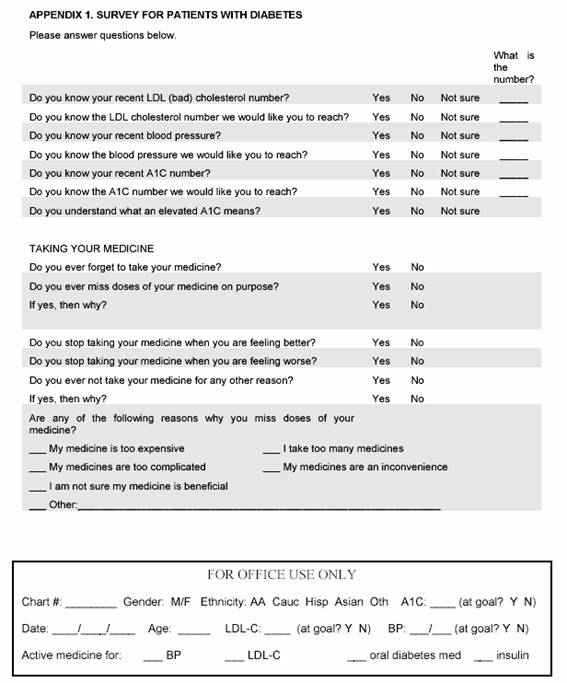
<body><![CDATA[<p>A standardized survey was created for adult patients (older 18 years of age)    with type 1 or type 2 diabetes in order to assess their knowledge of therapeutic    goals, medication adherence, and goal attainment (<a href="#ap1">Appendix 1</a>).    Survey questions were derived from Morisky, et al in an effort to provide an    additional level of validity.<sup>11</sup></p>       <p align="center"><a name="ap1"><img border="0" src="/img/revistas/pharmacy/v4n4/183-190_05.jpg" width="567" height="683"></a></p>     <p>The study was conducted between October 2005 and March 2006 at two primary    care clinics where family medicine and internal medicine attending and resident    physicians practice. The majority of patients followed at each of the clinics    had multiple chronic disease states and many were indigent. All patients 18    years of age or older, who maintained a diagnosis of type 1 or type 2 diabetes,    were eligible for inclusion if they were followed by a physician within either    clinic. Exclusion criteria included age less than 18 years, pregnant, mentally    impaired, or without a diagnosis of type 1 or type 2 diabetes. While in the    waiting room, prior to the office visit, eligible patients self-administered    the one-page survey and returned the completed survey to the clinical pharmacist.</p>     <p>Although definitions and goal values of A1C, BP, and cholesterol were not    explained to patients until after the survey was completed, so as to decrease    bias, the clinical pharmacist was available if questions arose. This often provided    the opportunity to educate patients and identify adherence problems. Patients    with known or discovered low literacy levels were offered help reading and completing    the survey. These functions were performed in an effort to increase survey validity    by ensuring patient comprehension of survey questions and to eliminate errors    due to misunderstanding.</p>     <p>Demographic information and objective data, including prescribed medications,    were collected from the electronic medical record and entered into a Microsoft    Access database and analyzed with StataTM statistical software (Stata Corporation,    College Station, TX). For analysis, patient survey answers of “not sure” were    equivalent to “no.” A series of analyses to investigate the relationships between    patient survey responses and objective data recorded in the electronic medical    record was conducted. Pearson correlation coefficients were used to examine    pair wise relationships in the data. T-tests were used to compare differences    in adherence levels between those who did and did not attain various clinical    goals.</p>     <p>The Institutional Review Board at the Medical University of South Carolina    (MUSC) approved this study; all patients provided consent to participate. All    collected data was kept in a locked drawer in the primary investigator’s office.    Only the primary and co-investigators had access to the collected information    and all published results were de-identified to further ensure patient confidentiality.    Actions to ensure patient confidentiality were discussed with each patient during    the review of informed consent.</p>     <p>&nbsp;</p>     <p><b>RESULTS</b></p>     <p>A total of 149 patients were enrolled in the study, all of whom completed the    survey. All were diagnosed with type 2 diabetes; by chance no patient had a    diagnosis of type 1 diabetes. Three quarters of patients were female (n=112),    the average age was 61 years, and 77% (n=114) were African American. Average    BP was 136/71 mmHg (37%, n=55 at goal of = 130/80 mmHg), average A1C was 8.1%    (40%, n=59 at goal of = 7%), and LDL-C was 105 mg/dl (46%, n=69 at goal of =    100 mg/dl). Eighty-eight percent of patients (n=131) were taking at least one    antihypertensive medication, 69% (n=103) were taking a medication for hyperlipidemia,    and 83% (n=124) were using medication to control diabetes; 44% (n=66) were using    an oral antidiabetic agent as monotherapy, 16% (n=24) using insulin as monotherapy,    and 23% (n=34) were using combination therapy with oral agents and insulin.    Of those patients who were not at goal and should have been taking medicine    to control their condition, 9% (n=8 of 94 not at BP goal) were not using any    antihypertensive therapy, 36% (n=29 of 80 not at LDL-C goal) were not using    a cholesterol-lowering agent, and 8% (n=7 of 90 not at A1c goal) were not using    either an oral agent or insulin to control blood glucose. Additional patient    demographics are described in <a href="#t1">Table 1</a>.</p>     <p align="center"><a name="t1"><img border="0" src="/img/revistas/pharmacy/v4n4/183-190_01.jpg" width="302" height="430"></a></p>     ]]></body>
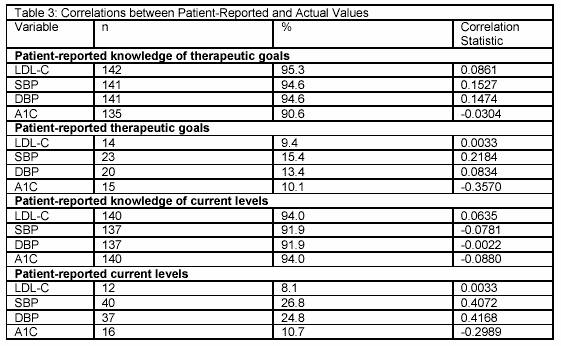
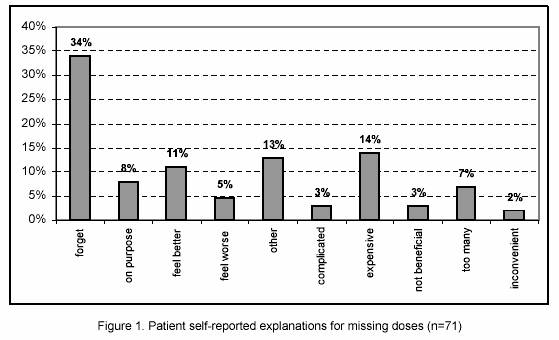
<body><![CDATA[<p><a href="#t2">Table 2</a> describes patient-reported knowledge of therapeutic    goals and current levels. Overall, more patients reported knowing their therapeutic    BP goal and current BP level (34% and 39% respectively) than their LDL-C and    A1C goals and levels. For those patients who attained their LDL-C, BP, or A1C    goal, only 35, 29, and 33% reported knowledge of the respective therapeutic    goal. Also of note, approximately one-fifth of patients reported knowledge of    A1C interpretation.</p>     <p align="center"><a name="t2"><img border="0" src="/img/revistas/pharmacy/v4n4/183-190_02.jpg" width="567" height="67"></a></p>     <p>Although 14, 39, and 10% of patients reported knowledge of their A1C, BP,    and LDL-C respectively, very few patients provided actual values in support,    and only a portion of those reported values were accurate. Only 12 self-reported    their current LDL-C, whereas 16 reported their A1C, 40 reported their systolic    BP, and 37 reported their diastolic BP. Low or even negative correlations between    the self-reported levels and those listed in medical records were detected.    When comparing the patient-reported LDL-C with their actual LDL-C found in the    electronic medical record, no correlation existed (r=0.003). There was a surprisingly    negative correlation between A1C values that patients reported on their survey    and actual values recorded in the electronic medical record (r=-0.299). Correlation    statistics between the patient-reported and actual BP values were more encouraging,    with both demonstrating a relatively strong positive relationship (r&gt;0.40)    (See <a href="#t3">Table 3</a>). This strong positive relationship could be    attributed to a larger sample size for this portion of the analysis, with over    35 patients completing BP values on the survey.</p>     <p align="center"><a name="t3"><img border="0" src="/img/revistas/pharmacy/v4n4/183-190_03.jpg" width="561" height="346"></a></p>     <p>Medication non-adherence was defined as patients self-reporting at least one    reason for missed doses. By this definition, a total of 71 patients (48%) were    deemed to be non-adherent with their medications. In this population, the most    frequently identified reasons for medication non-adherence included the following:    forgetfulness (34%), the patient felt better (11%), medications too expensive    (14%), and other (13%), as further described in <a href="#f1">Figure 1</a>.    Using a two-sample t-test, a significant positive relationship between the level    of adherence and A1C goal attainment was found (p=0.025). Patients at A1C goal    were more adherent on average (mean 0.49, range 0-2 “yes” responses) than patients    who did not reach A1C goal (mean 0.88, range 0-5 “yes” responses). The differences    in adherence by BP goal (0.74 if attained goal and 0.66 if did not attain goal,    p=0.65) or LDL-C goal (0.67 if attained goal and 0.76 if did not attain goal,    p=0.56) were not significant.</p>     <p align="center"><a name="f1"><img border="0" src="/img/revistas/pharmacy/v4n4/183-190_04.jpg" width="559" height="340"></a></p>     <p>&nbsp;</p>     <p><b>DISCUSSION</b></p>     <p>The patient population analyzed was representative of the larger diabetic population    within South Carolina, as they were predominately African American with a similar    mean age.<sup>12</sup> Of interest, the majority of patients were not at LDL-C, BP, or    A1C goal, although most were provided prescriptions to treat these parameters.    Of those patients not at A1C or BP goal, only a small percent (4% and 9%, respectively)    had not been prescribed medications to lower these values. Low prescribing of    cholesterol-lowering medications, while not the focus of the study, was an interesting    secondary finding; 36% of patients not at LDL-C goal had not been prescribed    a medication targeted to lower cholesterol. Another study demonstrated more    bothersome results; Fuke and colleagues analyzed diabetic patients with and    without coronary heart disease to determine the proportion who attained LDL-C    goal of =100 mg/dl. The analysis showed that 68.8% of the population was not    prescribed lipid-lowering drug therapy, and of that cohort, only 14.7% had attained    LDL goal, leaving 85.3% of patients not reaching goal and still not using appropriate    medication therapy.<sup>13</sup> Together, these studies highlight the underutilization    of LDL-C lowering therapy and the inappropriately low goal attainment among    patients at greatest risk for cardiovascular-related deaths.</p>     <p>One potential solution to increase appropriate prescribing of cholesterol therapy    may be the development of a pharmacist managed cholesterol focused clinic. Since    pharmacists are familiar with drug and disease state management, they are ideal    clinicians for managing patients with dyslipidemia through such practices.<sup>14-16</sup>    Lipid management programs, headed by clinical pharmacists, increase the number    of at-risk-patients identified for developing heart disease and allow pharmacists    to educate patients about the implications of elevated cholesterol levels and    methods to decrease high cholesterol.<sup>17</sup> Studies have found a 26% and 27.7% decrease    in LDL-C levels through pharmacist involvement in patients warranting primary    and secondary prevention, respectively.<sup>18,19</sup> Cording and colleagues demonstrated    that implementation of a pharmacist-managed lipid clinic within a primary care    medical clinic helped 77% of patients reach their LDL-C goal over a course of    12 months.<sup>20</sup> Another potential solution to increase therapeutic goal attainment    may include integration of a multidisciplinary team approach to patient care.    Patients treated for dyslipidemia through a multidisciplinary team in an outpatient    setting were four times more likely to attain their NCEP goal (p&lt;0.001) than    those treated via traditional methods.<sup>21</sup> Collectively, implementation of lipid    management clinics and/or integration of multidisciplinary health care teams    may improve prescribing of cholesterol-lowering medications, goal attainment,    and ultimately mortality.</p>     ]]></body>
<body><![CDATA[<p>Lack of current value and therapeutic goal knowledge was also alarmingly low.    Although between 10 and 39% of patients reported knowledge of therapeutic goals    and current values, as low as 8% actually provided documentation of knowledge.    One could interpret this lack of information as a knowledge deficit. It is hence    appropriate to conclude that these patients frequently do not know the goals    of therapy, and are unaware of their current A1C, LDL-C, or BP values. It is    also worth mentioning that only one fifth of patients reported knowing the interpretation    of A1C, although this was not demonstrated for verification. Therefore, patients    may have not truly understood the meaning of A1C; thus, 20% could be an overestimation.</p>     <p>Interestingly, patients more frequently reported knowledge of BP than A1C and    LDL-C goals. This could be attributed to the increased frequency of BP measurements,    as it is evaluated at all visits and automated cuffs are often available for    use at many pharmacies. Additionally, patients may be more familiar with their    BP values and goals because results are immediately available and reported to    patients after testing. LDL-C and A1C analysis, by contrast, are less frequently    performed, as they require phlebotomy and thus, have greater lag times until    results are available.</p>     <p>To increase the frequency of testing and decrease lag time to result obtainment    the addition of point-of-care (POC) instruments to test A1C and LDL-C may prove    useful. Use of POC tests are expanding rapidly at 12-15% annually.<sup>22</sup> Specifically,    ambulatory care clinical pharmacists equipped with a POC test could readily    assess lipid and A1C levels, provide results and education to the patient, and    make necessary therapeutic changes targeted to patient-specific goals.<sup>23</sup> Studies    demonstrate POC testing used by pharmacists improve patient compliance with    medication regimens<sup>17</sup>, while others have noted that therapeutic decision-making,    goal attainment, and treatment outcomes are enhanced.<sup>24,25</sup> In turn, use of this    type of technology by clinical pharmacists may increase dose titration, improve    patient knowledge and perceived importance of goal achievement, and facilitate    LDL-C and A1C goal attainment.</p>     <p>When comparing self-reported medication adherence to target goal attainment,    a significant positive relationship was found between the level of adherence    and A1C goal attainment. On the other hand, there appeared to be no relationship    between medication adherence and control of BP or LDL-C. A plausible explanation    for this discrepancy could be the reliability of measurement and confounding    factors. A1C reflects patient control of blood glucose over several months and    has very few acute confounders. Conversely, both BP and LDL-C are easily influenced    by alterations in weight, diet, and exercise. Additionally, BP readings are    more easily affected by acute variables such as stress, pain, caffeine intake,    smoking, and variability induced by appropriate measurement techniques. Such    confounders, including appropriate method of testing BP, were not controlled    during this analysis.    <br>   Forgetfulness was the most frequently reported reason for medication non-adherence,    followed by medications being too expensive, and patients feeling better. Poor    adherence to medications contributes to morbidity, mortality, and increased    health care costs.<sup>26</sup> However, given the need for these patients to take a variety    of medications, with different dosage frequencies and numbers of tablets at    various times of the day, it is not surprising that non-adherence occurs. Several    studies have already demonstrated this point.<sup>27,28</sup></p>     <p>As healthcare providers, we can help patients overcome some of these obstacles    that lead to medication non-adherence. Osterberg and Blaschke advised practitioners    to always assess for poor adherence.<sup>26</sup> They recommended providers emphasize    the importance of the medication regimen, make the regimen simple, and customize    the regimen to the patient’s lifestyle. Additionally, we can aid patients in    identifying methods to help them remember to take their medication, and thus    improve adherence. Per our patient population, this may include simple changes,    such as moving the time various medications are administered or using reminders    to tie daily activities to medication use. Beyond the use of a standard weekly    pill box, more advanced technology could include the use of pill boxes with    audible reminders and digital alarm clocks on cellular phones or personal digital    assistance devices.<sup>26</sup> Approximately 14% of assessed patients complained of poor    adherence due to the expense of medication regimens. As healthcare providers,    it is essential to consider the patient’s ability to afford prescriptions prior    to adding new medications. Likewise, it is important to identify poor medication    adherence due to cost. Regimens should be altered to provide therapeutic options    at lower cost, such as switching from brand to generic or a generic class equivalent    when possible. It is important to advise these patients that there may not be    a less expensive alternative in a once-a-day formulation. In this case, cost    versus benefit must be assessed. Lastly, practitioners should frequently remind    patients that maintenance medications for chronic disease states, such as hypertension,    diabetes, and hyperlipidemia, are not to be discontinued when they feel better    or once therapeutic goals are reached. The more information and understanding    that patients have regarding their disease states and pharmacologic therapies,    the more likely they are to adhere to those therapies.<sup>29</sup> The authors, Hsaio    and Salmon, strongly believe that patients who are most likely to respond and    reach goals are those who are willing to make behavioral changes and take responsibility    for their own health care. Therefore, adequate follow-up, motivation and empowerment    techniques are increasingly important.</p>     <p>There are limitations to this investigation. Since patients were completing    a self-reported survey, recall bias may have induced error. The potential inability    to correctly remember reasons for medication non-adherence could potentially    skew the data. Secondly, patients were surveyed at varying time points after    the diagnosis of diabetes, and the number of interactions with healthcare professionals    concerning diabetes management was not assessed. One would anticipate that patients    who had been diagnosed with diabetes and had several appointments with a clinical    diabetes educator may have greater knowledge and better control of their disease    state than would a newly diagnosed individual. Although the authors cannot assume    that these findings could be generalized to the population at large, including    those with type 1 diabetes, our patient population does seem to be typical of    patients with type 2 diabetes, as they also suffered from hypertension and hyperlipidemia.</p>     <p>&nbsp;</p>     <p><b>CONCLUSIONS</b></p>     <p>In addition to providing insight into patients’ knowledge of diabetic therapeutic    goals, the information gained from this study has several implications for clinical    practice. First, it is evident by the data gathered in previous trials, and    confirmed by this study, that patients are frequently not reaching therapeutic    goals; however, most were provided prescriptions to treat these parameters.    Unfortunately, a large proportion of patients who had not attained LDL-C goal    still were not prescribed appropriate medications to target cholesterol. Additionally,    patients were frequently unaware of therapeutic goals and almost half were medication    non-adherent. Actions may be taken to improve these aspects of patient knowledge,    adherence, and goal attainment may include addition of POC testing devices,    implementation of pharmacy driven clinics, or functioning within multidisciplinary    teams. Regardless of implemented actions, it is imperative that practitioners    discuss the importance of medication adherence with every patient at every visit.    Together the implementation of these three actions may better help patients    achieve therapeutic targets and avoid unnecessary microvascular and macrovascular    complications.</p>     ]]></body>
<body><![CDATA[<p>&nbsp;</p>     <p><b>ACKNOWLEDGEMENTS</b></p>     <p>The authors acknowledge the contributions of Laura Foxhall, RN, Medical University    of South Carolina and Bart Lawrence, PharmD, Pfizer Inc.</p>     <p>&nbsp;</p> <table border="1" width="100%">     <tr>       <td width="100%">             <p align="center"><b><font face="Arial">References</font></b></td>     </tr>   </table>        <!-- ref --><p>1. Centers for Disease Control and Prevention. National diabetes fact sheet: general information and national estimates on diabetes in the United States, 2005. Atlanta, GA: U.S. Department of Health and Human Services, Centers for Disease Control and prevention, 2005.&nbsp;&nbsp;&nbsp;&nbsp;&nbsp;&nbsp;&nbsp;&nbsp;[&#160;<a href="javascript:void(0);" onclick="javascript: window.open('/scielo.php?script=sci_nlinks&ref=4232138&pid=S1885-642X200600040000600001&lng=','','width=640,height=500,resizable=yes,scrollbars=1,menubar=yes,');">Links</a>&#160;]<!-- end-ref --><!-- ref --><p>2. American Diabetes Association. Available from: <a href="http://www.diabetes.org/home.jsp" target="_blank">http://www.diabetes.org/home.jsp</a> (Accessed January 19, 2006).&nbsp;&nbsp;&nbsp;&nbsp;&nbsp;&nbsp;&nbsp;&nbsp;[&#160;<a href="javascript:void(0);" onclick="javascript: window.open('/scielo.php?script=sci_nlinks&ref=4232139&pid=S1885-642X200600040000600002&lng=','','width=640,height=500,resizable=yes,scrollbars=1,menubar=yes,');">Links</a>&#160;]<!-- end-ref --><!-- ref --><p>3. The Diabetes Control and Complications Trial Research Group, The Effect of Intensive Treatment of Diabetes on the Development and Progression of Long-Term Complications in Insulin-Dependent Diabetes Mellitus. N Engl J Med 1993;329:977-986.&nbsp;&nbsp;&nbsp;&nbsp;&nbsp;&nbsp;&nbsp;&nbsp;[&#160;<a href="javascript:void(0);" onclick="javascript: window.open('/scielo.php?script=sci_nlinks&ref=4232140&pid=S1885-642X200600040000600003&lng=','','width=640,height=500,resizable=yes,scrollbars=1,menubar=yes,');">Links</a>&#160;]<!-- end-ref --><!-- ref --><p>4. Stratton IM, Adler AI, Neil HAW, et al. Association of glycaemia with macrovascular and microvascular complications of type 2 diabetes (UKPDS 35): prospective observational study. BMJ 2000;321:405-12.&nbsp;&nbsp;&nbsp;&nbsp;&nbsp;&nbsp;&nbsp;&nbsp;[&#160;<a href="javascript:void(0);" onclick="javascript: window.open('/scielo.php?script=sci_nlinks&ref=4232141&pid=S1885-642X200600040000600004&lng=','','width=640,height=500,resizable=yes,scrollbars=1,menubar=yes,');">Links</a>&#160;]<!-- end-ref --><!-- ref --><p>5. Adler AI, Stratton IM, Neil HAW, et al. Association of systolic blood pressure with macrovascular and microvascular complications of type 2 diabetes (UKPDS 36): prospective observational study. BMJ 2000;321:412-9.&nbsp;&nbsp;&nbsp;&nbsp;&nbsp;&nbsp;&nbsp;&nbsp;[&#160;<a href="javascript:void(0);" onclick="javascript: window.open('/scielo.php?script=sci_nlinks&ref=4232142&pid=S1885-642X200600040000600005&lng=','','width=640,height=500,resizable=yes,scrollbars=1,menubar=yes,');">Links</a>&#160;]<!-- end-ref --><!-- ref --><p>6. DCCT/EDIC Study Research Group. Intensive diabetes treatment and cardiovascular disease in patients with type 1 diabetes. N Engl J Med. 2005;353(25):2643-53.&nbsp;&nbsp;&nbsp;&nbsp;&nbsp;&nbsp;&nbsp;&nbsp;[&#160;<a href="javascript:void(0);" onclick="javascript: window.open('/scielo.php?script=sci_nlinks&ref=4232143&pid=S1885-642X200600040000600006&lng=','','width=640,height=500,resizable=yes,scrollbars=1,menubar=yes,');">Links</a>&#160;]<!-- end-ref --><!-- ref --><p>7. Standards of Medical Care in Diabetes–2006. American Diabetes Association. Diabetes Care 2006;29:S4-42.&nbsp;&nbsp;&nbsp;&nbsp;&nbsp;&nbsp;&nbsp;&nbsp;[&#160;<a href="javascript:void(0);" onclick="javascript: window.open('/scielo.php?script=sci_nlinks&ref=4232144&pid=S1885-642X200600040000600007&lng=','','width=640,height=500,resizable=yes,scrollbars=1,menubar=yes,');">Links</a>&#160;]<!-- end-ref --><!-- ref --><p>8. Chobanian AV, Bakris GL, Black HR, et al, and the National High Blood Pressure Education Program Coordinating Committee. Seventh Report of the Joint National Committee on Prevention, Detection, Evaluation, and Treatment of High Blood Pressure. Hypertension 2003;42:1206-52.&nbsp;&nbsp;&nbsp;&nbsp;&nbsp;&nbsp;&nbsp;&nbsp;[&#160;<a href="javascript:void(0);" onclick="javascript: window.open('/scielo.php?script=sci_nlinks&ref=4232145&pid=S1885-642X200600040000600008&lng=','','width=640,height=500,resizable=yes,scrollbars=1,menubar=yes,');">Links</a>&#160;]<!-- end-ref --><!-- ref --><p>9. Executive Summary of the Third Report of the National Cholesterol Education Program (NCEP) Expert Panel on Detection, Evaluation, and Treatment of High Blood Cholesterol in Adults (Adult Treatment Panel III). Expert Panel on Detection, Evaluation, and Treatment of High Blood Cholesterol in Adults. JAMA 2001;285:2486-97.&nbsp;&nbsp;&nbsp;&nbsp;&nbsp;&nbsp;&nbsp;&nbsp;[&#160;<a href="javascript:void(0);" onclick="javascript: window.open('/scielo.php?script=sci_nlinks&ref=4232146&pid=S1885-642X200600040000600009&lng=','','width=640,height=500,resizable=yes,scrollbars=1,menubar=yes,');">Links</a>&#160;]<!-- end-ref --><!-- ref --><p>10. Zhou J, Werstuck GH, Lhot&aacute;k S, et al. Association of multiple cellular Stress Pathways with accelerated atherosclerosis in hyperhomocysteinemic apolipoprotein E-deficient mice. Circulation 2004;110:227-39.&nbsp;&nbsp;&nbsp;&nbsp;&nbsp;&nbsp;&nbsp;&nbsp;[&#160;<a href="javascript:void(0);" onclick="javascript: window.open('/scielo.php?script=sci_nlinks&ref=4232147&pid=S1885-642X200600040000600010&lng=','','width=640,height=500,resizable=yes,scrollbars=1,menubar=yes,');">Links</a>&#160;]<!-- end-ref --><!-- ref --><p>11. Morisky DE, Green LW, Levine DM. Concurrent and predictive validity of a self-reported measure of medication adherence. Medical Care 1986;24(1):67-74.&nbsp;&nbsp;&nbsp;&nbsp;&nbsp;&nbsp;&nbsp;&nbsp;[&#160;<a href="javascript:void(0);" onclick="javascript: window.open('/scielo.php?script=sci_nlinks&ref=4232148&pid=S1885-642X200600040000600011&lng=','','width=640,height=500,resizable=yes,scrollbars=1,menubar=yes,');">Links</a>&#160;]<!-- end-ref --><!-- ref --><p>12. Department of health and environmental control (DHEC). Burden of diabetes in South Carolina 2003. Diabetes initiative of South Carolina. 2003:26.&nbsp;&nbsp;&nbsp;&nbsp;&nbsp;&nbsp;&nbsp;&nbsp;[&#160;<a href="javascript:void(0);" onclick="javascript: window.open('/scielo.php?script=sci_nlinks&ref=4232149&pid=S1885-642X200600040000600012&lng=','','width=640,height=500,resizable=yes,scrollbars=1,menubar=yes,');">Links</a>&#160;]<!-- end-ref --><!-- ref --><p>13. Fuke D, Hunt J, Siemienczuk J, et al. Cholesterol Management of Patients With Diabetes in a Primary Care Practice–Based Research Network. Am J Manag Care 2004;10(2):130-136.&nbsp;&nbsp;&nbsp;&nbsp;&nbsp;&nbsp;&nbsp;&nbsp;[&#160;<a href="javascript:void(0);" onclick="javascript: window.open('/scielo.php?script=sci_nlinks&ref=4232150&pid=S1885-642X200600040000600013&lng=','','width=640,height=500,resizable=yes,scrollbars=1,menubar=yes,');">Links</a>&#160;]<!-- end-ref --><!-- ref --><p>14. Furmaga E. Pharmacist management of a hyperlipidemia clinic. Am J Hosp Pharm 1993;50:91-5.&nbsp;&nbsp;&nbsp;&nbsp;&nbsp;&nbsp;&nbsp;&nbsp;[&#160;<a href="javascript:void(0);" onclick="javascript: window.open('/scielo.php?script=sci_nlinks&ref=4232151&pid=S1885-642X200600040000600014&lng=','','width=640,height=500,resizable=yes,scrollbars=1,menubar=yes,');">Links</a>&#160;]<!-- end-ref --><!-- ref --><p>15. Ito M. Should hyperlipidemia in the elderly be treated? Am J Health-Syst Pharm 1993;53:2867-71.&nbsp;&nbsp;&nbsp;&nbsp;&nbsp;&nbsp;&nbsp;&nbsp;[&#160;<a href="javascript:void(0);" onclick="javascript: window.open('/scielo.php?script=sci_nlinks&ref=4232152&pid=S1885-642X200600040000600015&lng=','','width=640,height=500,resizable=yes,scrollbars=1,menubar=yes,');">Links</a>&#160;]<!-- end-ref --><!-- ref --><p>16. MacKinnon G. Hyperlipidemia management: opportunity for pharmacists in community practice. Pharm Times 1998;Dec:24-39.&nbsp;&nbsp;&nbsp;&nbsp;&nbsp;&nbsp;&nbsp;&nbsp;[&#160;<a href="javascript:void(0);" onclick="javascript: window.open('/scielo.php?script=sci_nlinks&ref=4232153&pid=S1885-642X200600040000600016&lng=','','width=640,height=500,resizable=yes,scrollbars=1,menubar=yes,');">Links</a>&#160;]<!-- end-ref --><!-- ref --><p>17. Jafari M, Masih M, Emerson JF. The value of pharmacist involvement in a point-of-care service, walk-in lipid screening program. Pharmacotherapy 2001;21(11):1403-1406.&nbsp;&nbsp;&nbsp;&nbsp;&nbsp;&nbsp;&nbsp;&nbsp;[&#160;<a href="javascript:void(0);" onclick="javascript: window.open('/scielo.php?script=sci_nlinks&ref=4232154&pid=S1885-642X200600040000600017&lng=','','width=640,height=500,resizable=yes,scrollbars=1,menubar=yes,');">Links</a>&#160;]<!-- end-ref --><!-- ref --><p>18. Ching Lee SS, Cheung PP, Chow MSS. Benefits of individualized counseling by the pharmacist on the treatment outcomes of hyperlipidemia in Hong Kong. J Clin Pharmacol 2004;44:632-639.&nbsp;&nbsp;&nbsp;&nbsp;&nbsp;&nbsp;&nbsp;&nbsp;[&#160;<a href="javascript:void(0);" onclick="javascript: window.open('/scielo.php?script=sci_nlinks&ref=4232155&pid=S1885-642X200600040000600018&lng=','','width=640,height=500,resizable=yes,scrollbars=1,menubar=yes,');">Links</a>&#160;]<!-- end-ref --><!-- ref --><p>19. Carson J. Pharmacist-coordinated program to improve use of pharmacotherapies for reducing risk of coronary artery disease in low-income adults. Am J Health-Syst Pharm 1999;56:2319-24.&nbsp;&nbsp;&nbsp;&nbsp;&nbsp;&nbsp;&nbsp;&nbsp;[&#160;<a href="javascript:void(0);" onclick="javascript: window.open('/scielo.php?script=sci_nlinks&ref=4232156&pid=S1885-642X200600040000600019&lng=','','width=640,height=500,resizable=yes,scrollbars=1,menubar=yes,');">Links</a>&#160;]<!-- end-ref --><!-- ref --><p>20. Cording MA, Engelbrecht-Zadvorny EB, Pettit BJ, Eastham JH, Sandoval R. Development of a pharmacist-managed lipid clinic. Ann Pharmacother 2002;36:892-904.&nbsp;&nbsp;&nbsp;&nbsp;&nbsp;&nbsp;&nbsp;&nbsp;[&#160;<a href="javascript:void(0);" onclick="javascript: window.open('/scielo.php?script=sci_nlinks&ref=4232157&pid=S1885-642X200600040000600020&lng=','','width=640,height=500,resizable=yes,scrollbars=1,menubar=yes,');">Links</a>&#160;]<!-- end-ref --><!-- ref --><p>21. Shaffer J, Wexler L. Reducing low-density lipoprotein cholesterol levels in an ambulatory care system: results of a mulitdisiplinary collaborative practice lipid clinic compared with traditional physician-based care. Arch Intern Med 1995;155:2330-5.&nbsp;&nbsp;&nbsp;&nbsp;&nbsp;&nbsp;&nbsp;&nbsp;[&#160;<a href="javascript:void(0);" onclick="javascript: window.open('/scielo.php?script=sci_nlinks&ref=4232158&pid=S1885-642X200600040000600021&lng=','','width=640,height=500,resizable=yes,scrollbars=1,menubar=yes,');">Links</a>&#160;]<!-- end-ref --><!-- ref --><p>22. Kost GJ. Preventing medical errors in point-of-care-testing security, validation, performance, safeguards, and connectivity. Arch Pathol Lab Med 2001;125:1307-15.&nbsp;&nbsp;&nbsp;&nbsp;&nbsp;&nbsp;&nbsp;&nbsp;[&#160;<a href="javascript:void(0);" onclick="javascript: window.open('/scielo.php?script=sci_nlinks&ref=4232159&pid=S1885-642X200600040000600022&lng=','','width=640,height=500,resizable=yes,scrollbars=1,menubar=yes,');">Links</a>&#160;]<!-- end-ref --><!-- ref --><p>23. Taylor JR, Lopez LM. Cholesterol: Point-of-care testing. Ann Pharmacother 2004;38:1252-7.&nbsp;&nbsp;&nbsp;&nbsp;&nbsp;&nbsp;&nbsp;&nbsp;[&#160;<a href="javascript:void(0);" onclick="javascript: window.open('/scielo.php?script=sci_nlinks&ref=4232160&pid=S1885-642X200600040000600023&lng=','','width=640,height=500,resizable=yes,scrollbars=1,menubar=yes,');">Links</a>&#160;]<!-- end-ref --><!-- ref --><p>24. Gutierres SL, Welty TE. Point-of-care testing: an introduction. Ann Pharmacother 2004;38:119-25.&nbsp;&nbsp;&nbsp;&nbsp;&nbsp;&nbsp;&nbsp;&nbsp;[&#160;<a href="javascript:void(0);" onclick="javascript: window.open('/scielo.php?script=sci_nlinks&ref=4232161&pid=S1885-642X200600040000600024&lng=','','width=640,height=500,resizable=yes,scrollbars=1,menubar=yes,');">Links</a>&#160;]<!-- end-ref --><!-- ref --><p>25. Kennedy L, Herman WH, Strange P, Harris A. GOAL AIC Team. Impact of active versus usual algorithmic titration of basal insulin and point-of-care versus laboratory measurement of HbA1c on glycemic control in patients with type 2 diabetes: the Glycemic Optimization with Algorithms and Labs at Point of Care (GOAL A1C) trial. Diabetes Care 2006;29(1):1-8.&nbsp;&nbsp;&nbsp;&nbsp;&nbsp;&nbsp;&nbsp;&nbsp;[&#160;<a href="javascript:void(0);" onclick="javascript: window.open('/scielo.php?script=sci_nlinks&ref=4232162&pid=S1885-642X200600040000600025&lng=','','width=640,height=500,resizable=yes,scrollbars=1,menubar=yes,');">Links</a>&#160;]<!-- end-ref --><!-- ref --><p>26. Osterberg L, Blaschke T. Adherence to medication. N Engl J Med 2005;353:487-97.&nbsp;&nbsp;&nbsp;&nbsp;&nbsp;&nbsp;&nbsp;&nbsp;[&#160;<a href="javascript:void(0);" onclick="javascript: window.open('/scielo.php?script=sci_nlinks&ref=4232163&pid=S1885-642X200600040000600026&lng=','','width=640,height=500,resizable=yes,scrollbars=1,menubar=yes,');">Links</a>&#160;]<!-- end-ref --><!-- ref --><p>27. Reasner CA, Goke B. Overcoming the barriers to effective glycemic control for type 2 diabetes. Br J Diabetes Vasc Dis 2002;2:290-5.&nbsp;&nbsp;&nbsp;&nbsp;&nbsp;&nbsp;&nbsp;&nbsp;[&#160;<a href="javascript:void(0);" onclick="javascript: window.open('/scielo.php?script=sci_nlinks&ref=4232164&pid=S1885-642X200600040000600027&lng=','','width=640,height=500,resizable=yes,scrollbars=1,menubar=yes,');">Links</a>&#160;]<!-- end-ref --><!-- ref --><p>28. Blandford L, Dans PE, Ober JD, Wheelock C. Analyzing variations in medication compliance related to individual drug, drug class, and prescribing physician. J Managed Care Pharm 1999;5:47-5.&nbsp;&nbsp;&nbsp;&nbsp;&nbsp;&nbsp;&nbsp;&nbsp;[&#160;<a href="javascript:void(0);" onclick="javascript: window.open('/scielo.php?script=sci_nlinks&ref=4232165&pid=S1885-642X200600040000600028&lng=','','width=640,height=500,resizable=yes,scrollbars=1,menubar=yes,');">Links</a>&#160;]<!-- end-ref --><!-- ref --><p>29. Hsaio LD, Salmon JW. Predicting adherence to prescription medication purchase among HMO enrollees with diabetes. J Managed Care Pharm 1999;5:336-41.&nbsp;&nbsp;&nbsp;&nbsp;&nbsp;&nbsp;&nbsp;&nbsp;[&#160;<a href="javascript:void(0);" onclick="javascript: window.open('/scielo.php?script=sci_nlinks&ref=4232166&pid=S1885-642X200600040000600029&lng=','','width=640,height=500,resizable=yes,scrollbars=1,menubar=yes,');">Links</a>&#160;]<!-- end-ref --> ]]></body><back>
<ref-list>
<ref id="B1">
<label>1</label><nlm-citation citation-type="book">
<collab>Centers for Disease Control and Prevention</collab>
<source><![CDATA[National diabetes fact sheet: general information and national estimates on diabetes in the United States, 2005]]></source>
<year>2005</year>
<publisher-loc><![CDATA[Atlanta^eGA GA]]></publisher-loc>
<publisher-name><![CDATA[U.S. Department of Health and Human ServicesCenters for Disease Control and prevention]]></publisher-name>
</nlm-citation>
</ref>
<ref id="B2">
<label>2</label><nlm-citation citation-type="">
<collab>American Diabetes Association</collab>
<source><![CDATA[]]></source>
<year></year>
</nlm-citation>
</ref>
<ref id="B3">
<label>3</label><nlm-citation citation-type="journal">
<collab>The Diabetes Control and Complications Trial Research Group</collab>
<article-title xml:lang="en"><![CDATA[The Effect of Intensive Treatment of Diabetes on the Development and Progression of Long-Term Complications in Insulin: Dependent Diabetes Mellitus]]></article-title>
<source><![CDATA[N Engl J Med]]></source>
<year>1993</year>
<volume>329</volume>
<page-range>977-986</page-range></nlm-citation>
</ref>
<ref id="B4">
<label>4</label><nlm-citation citation-type="journal">
<person-group person-group-type="author">
<name>
<surname><![CDATA[Stratton]]></surname>
<given-names><![CDATA[IM]]></given-names>
</name>
<name>
<surname><![CDATA[Adler]]></surname>
<given-names><![CDATA[AI]]></given-names>
</name>
<name>
<surname><![CDATA[Neil]]></surname>
<given-names><![CDATA[HAW]]></given-names>
</name>
</person-group>
<article-title xml:lang="en"><![CDATA[Association of glycaemia with macrovascular and microvascular complications of type 2 diabetes (UKPDS 35): prospective observational study]]></article-title>
<source><![CDATA[BMJ]]></source>
<year>2000</year>
<volume>321</volume>
<page-range>405-12</page-range></nlm-citation>
</ref>
<ref id="B5">
<label>5</label><nlm-citation citation-type="journal">
<person-group person-group-type="author">
<name>
<surname><![CDATA[Adler]]></surname>
<given-names><![CDATA[AI]]></given-names>
</name>
<name>
<surname><![CDATA[Stratton]]></surname>
<given-names><![CDATA[IM]]></given-names>
</name>
<name>
<surname><![CDATA[Neil]]></surname>
<given-names><![CDATA[HAW]]></given-names>
</name>
</person-group>
<article-title xml:lang="en"><![CDATA[Association of systolic blood pressure with macrovascular and microvascular complications of type 2 diabetes (UKPDS 36): prospective observational study]]></article-title>
<source><![CDATA[BMJ]]></source>
<year>2000</year>
<volume>321</volume>
<page-range>412-9</page-range></nlm-citation>
</ref>
<ref id="B6">
<label>6</label><nlm-citation citation-type="journal">
<collab>DCCT/EDIC Study Research Group</collab>
<article-title xml:lang="en"><![CDATA[Intensive diabetes treatment and cardiovascular disease in patients with type 1 diabetes]]></article-title>
<source><![CDATA[N Engl J Med.]]></source>
<year>2005</year>
<volume>353</volume>
<numero>25</numero>
<issue>25</issue>
<page-range>2643-53</page-range></nlm-citation>
</ref>
<ref id="B7">
<label>7</label><nlm-citation citation-type="journal">
<collab>American Diabetes Association</collab>
<article-title xml:lang="en"><![CDATA[Standards of Medical Care in Diabetes-2006]]></article-title>
<source><![CDATA[Diabetes Care]]></source>
<year>2006</year>
<volume>29</volume>
<page-range>S4-42</page-range></nlm-citation>
</ref>
<ref id="B8">
<label>8</label><nlm-citation citation-type="journal">
<person-group person-group-type="author">
<name>
<surname><![CDATA[Chobanian]]></surname>
<given-names><![CDATA[AV]]></given-names>
</name>
<name>
<surname><![CDATA[Bakris]]></surname>
<given-names><![CDATA[GL]]></given-names>
</name>
<name>
<surname><![CDATA[Black]]></surname>
<given-names><![CDATA[HR]]></given-names>
</name>
</person-group>
<article-title xml:lang="en"><![CDATA[Seventh Report of the Joint National Committee on Prevention, Detection, Evaluation, and Treatment of High Blood Pressure]]></article-title>
<source><![CDATA[Hypertension]]></source>
<year>2003</year>
<volume>42</volume>
<page-range>1206-52</page-range></nlm-citation>
</ref>
<ref id="B9">
<label>9</label><nlm-citation citation-type="journal">
<collab>Expert Panel on Detection, Evaluation, and Treatment of High Blood Cholesterol in Adults</collab>
<article-title xml:lang="en"><![CDATA[Executive Summary of the Third Report of the National Cholesterol Education Program (NCEP) Expert Panel on Detection, Evaluation, and Treatment of High Blood Cholesterol in Adults (Adult Treatment Panel III)]]></article-title>
<source><![CDATA[JAMA]]></source>
<year>2001</year>
<volume>285</volume>
<page-range>2486-97</page-range></nlm-citation>
</ref>
<ref id="B10">
<label>10</label><nlm-citation citation-type="journal">
<person-group person-group-type="author">
<name>
<surname><![CDATA[Zhou]]></surname>
<given-names><![CDATA[J]]></given-names>
</name>
<name>
<surname><![CDATA[Werstuck]]></surname>
<given-names><![CDATA[GH]]></given-names>
</name>
<name>
<surname><![CDATA[Lhoták]]></surname>
<given-names><![CDATA[S]]></given-names>
</name>
</person-group>
<article-title xml:lang="en"><![CDATA[Association of multiple cellular Stress Pathways with accelerated atherosclerosis in hyperhomocysteinemic apolipoprotein E-deficient mice]]></article-title>
<source><![CDATA[Circulation]]></source>
<year>2004</year>
<volume>110</volume>
<page-range>227-39</page-range></nlm-citation>
</ref>
<ref id="B11">
<label>11</label><nlm-citation citation-type="journal">
<person-group person-group-type="author">
<name>
<surname><![CDATA[Morisky]]></surname>
<given-names><![CDATA[DE]]></given-names>
</name>
<name>
<surname><![CDATA[Green]]></surname>
<given-names><![CDATA[LW]]></given-names>
</name>
<name>
<surname><![CDATA[Levine]]></surname>
<given-names><![CDATA[DM]]></given-names>
</name>
</person-group>
<article-title xml:lang="en"><![CDATA[Concurrent and predictive validity of a self-reported measure of medication adherence]]></article-title>
<source><![CDATA[Medical Care]]></source>
<year>1986</year>
<volume>24</volume>
<numero>1</numero>
<issue>1</issue>
<page-range>67-74</page-range></nlm-citation>
</ref>
<ref id="B12">
<label>12</label><nlm-citation citation-type="book">
<collab>Department of health and environmental control (DHEC)</collab>
<source><![CDATA[Burden of diabetes in South Carolina 2003]]></source>
<year>2003</year>
<page-range>26</page-range><publisher-name><![CDATA[Diabetes initiative of South Carolina]]></publisher-name>
</nlm-citation>
</ref>
<ref id="B13">
<label>13</label><nlm-citation citation-type="journal">
<person-group person-group-type="author">
<name>
<surname><![CDATA[Fuke]]></surname>
<given-names><![CDATA[D]]></given-names>
</name>
<name>
<surname><![CDATA[Hunt]]></surname>
<given-names><![CDATA[J]]></given-names>
</name>
<name>
<surname><![CDATA[Siemienczuk]]></surname>
<given-names><![CDATA[J]]></given-names>
</name>
</person-group>
<article-title xml:lang="en"><![CDATA[Cholesterol Management of Patients With Diabetes in a Primary Care Practice-Based Research Network]]></article-title>
<source><![CDATA[Am J Manag Care]]></source>
<year>2004</year>
<volume>10</volume>
<numero>2</numero>
<issue>2</issue>
<page-range>130-136</page-range></nlm-citation>
</ref>
<ref id="B14">
<label>14</label><nlm-citation citation-type="journal">
<person-group person-group-type="author">
<name>
<surname><![CDATA[Furmaga]]></surname>
<given-names><![CDATA[E]]></given-names>
</name>
</person-group>
<article-title xml:lang="en"><![CDATA[Pharmacist management of a hyperlipidemia clinic]]></article-title>
<source><![CDATA[Am J Hosp Pharm]]></source>
<year>1993</year>
<volume>50</volume>
<page-range>91-5</page-range></nlm-citation>
</ref>
<ref id="B15">
<label>15</label><nlm-citation citation-type="journal">
<person-group person-group-type="author">
<name>
<surname><![CDATA[Ito]]></surname>
<given-names><![CDATA[M]]></given-names>
</name>
</person-group>
<article-title xml:lang="en"><![CDATA[Should hyperlipidemia in the elderly be treated]]></article-title>
<source><![CDATA[Am J Health-Syst Pharm]]></source>
<year>1993</year>
<volume>53</volume>
<page-range>2867-71</page-range></nlm-citation>
</ref>
<ref id="B16">
<label>16</label><nlm-citation citation-type="journal">
<person-group person-group-type="author">
<name>
<surname><![CDATA[MacKinnon]]></surname>
<given-names><![CDATA[G]]></given-names>
</name>
</person-group>
<article-title xml:lang="en"><![CDATA[Hyperlipidemia management: opportunity for pharmacists in community practice]]></article-title>
<source><![CDATA[Pharm Times]]></source>
<year>1998</year>
<volume>Dec</volume>
<page-range>24-39</page-range></nlm-citation>
</ref>
<ref id="B17">
<label>17</label><nlm-citation citation-type="journal">
<person-group person-group-type="author">
<name>
<surname><![CDATA[Jafari]]></surname>
<given-names><![CDATA[M]]></given-names>
</name>
<name>
<surname><![CDATA[Masih]]></surname>
<given-names><![CDATA[M]]></given-names>
</name>
<name>
<surname><![CDATA[Emerson]]></surname>
<given-names><![CDATA[JF]]></given-names>
</name>
</person-group>
<article-title xml:lang="en"><![CDATA[The value of pharmacist involvement in a point-of-care service, walk-in lipid screening program]]></article-title>
<source><![CDATA[Pharmacotherapy]]></source>
<year>2001</year>
<volume>21</volume>
<numero>11</numero>
<issue>11</issue>
<page-range>1403-1406</page-range></nlm-citation>
</ref>
<ref id="B18">
<label>18</label><nlm-citation citation-type="journal">
<person-group person-group-type="author">
<name>
<surname><![CDATA[Ching Lee]]></surname>
<given-names><![CDATA[SS]]></given-names>
</name>
<name>
<surname><![CDATA[Cheung]]></surname>
<given-names><![CDATA[PP]]></given-names>
</name>
<name>
<surname><![CDATA[Chow]]></surname>
<given-names><![CDATA[MSS]]></given-names>
</name>
</person-group>
<article-title xml:lang="en"><![CDATA[Benefits of individualized counseling by the pharmacist on the treatment outcomes of hyperlipidemia in Hong Kong]]></article-title>
<source><![CDATA[J Clin Pharmacol]]></source>
<year>2004</year>
<volume>44</volume>
<page-range>632-639</page-range></nlm-citation>
</ref>
<ref id="B19">
<label>19</label><nlm-citation citation-type="journal">
<person-group person-group-type="author">
<name>
<surname><![CDATA[Carson]]></surname>
<given-names><![CDATA[J]]></given-names>
</name>
</person-group>
<article-title xml:lang="en"><![CDATA[Pharmacist-coordinated program to improve use of pharmacotherapies for reducing risk of coronary artery disease in low-income adults]]></article-title>
<source><![CDATA[Am J Health-Syst Pharm]]></source>
<year>1999</year>
<volume>56</volume>
<page-range>2319-24</page-range></nlm-citation>
</ref>
<ref id="B20">
<label>20</label><nlm-citation citation-type="journal">
<person-group person-group-type="author">
<name>
<surname><![CDATA[Cording]]></surname>
<given-names><![CDATA[MA]]></given-names>
</name>
<name>
<surname><![CDATA[Engelbrecht-Zadvorny]]></surname>
<given-names><![CDATA[EB]]></given-names>
</name>
<name>
<surname><![CDATA[Pettit]]></surname>
<given-names><![CDATA[BJ]]></given-names>
</name>
<name>
<surname><![CDATA[Eastham]]></surname>
<given-names><![CDATA[JH]]></given-names>
</name>
<name>
<surname><![CDATA[Sandoval]]></surname>
<given-names><![CDATA[R]]></given-names>
</name>
</person-group>
<article-title xml:lang="en"><![CDATA[Development of a pharmacist-managed lipid clinic]]></article-title>
<source><![CDATA[Ann Pharmacother]]></source>
<year>2002</year>
<volume>36</volume>
<page-range>892-904</page-range></nlm-citation>
</ref>
<ref id="B21">
<label>21</label><nlm-citation citation-type="journal">
<person-group person-group-type="author">
<name>
<surname><![CDATA[Shaffer]]></surname>
<given-names><![CDATA[J]]></given-names>
</name>
<name>
<surname><![CDATA[Wexler]]></surname>
<given-names><![CDATA[L]]></given-names>
</name>
</person-group>
<article-title xml:lang="en"><![CDATA[Reducing low-density lipoprotein cholesterol levels in an ambulatory care system: results of a mulitdisiplinary collaborative practice lipid clinic compared with traditional physician-based care]]></article-title>
<source><![CDATA[Arch Intern Med]]></source>
<year>1995</year>
<volume>155</volume>
<page-range>2330-5</page-range></nlm-citation>
</ref>
<ref id="B22">
<label>22</label><nlm-citation citation-type="journal">
<person-group person-group-type="author">
<name>
<surname><![CDATA[Kost]]></surname>
<given-names><![CDATA[GJ]]></given-names>
</name>
</person-group>
<article-title xml:lang="en"><![CDATA[Preventing medical errors in point-of-care-testing security, validation, performance, safeguards, and connectivity]]></article-title>
<source><![CDATA[Arch Pathol Lab Med]]></source>
<year>2001</year>
<volume>125</volume>
<page-range>1307-15</page-range></nlm-citation>
</ref>
<ref id="B23">
<label>23</label><nlm-citation citation-type="journal">
<person-group person-group-type="author">
<name>
<surname><![CDATA[Taylor]]></surname>
<given-names><![CDATA[JR]]></given-names>
</name>
<name>
<surname><![CDATA[Lopez]]></surname>
<given-names><![CDATA[LM]]></given-names>
</name>
</person-group>
<article-title xml:lang="en"><![CDATA[Cholesterol: Point-of-care testing]]></article-title>
<source><![CDATA[Ann Pharmacother]]></source>
<year>2004</year>
<volume>38</volume>
<page-range>1252-7</page-range></nlm-citation>
</ref>
<ref id="B24">
<label>24</label><nlm-citation citation-type="journal">
<person-group person-group-type="author">
<name>
<surname><![CDATA[Gutierres]]></surname>
<given-names><![CDATA[SL]]></given-names>
</name>
<name>
<surname><![CDATA[Welty]]></surname>
<given-names><![CDATA[TE]]></given-names>
</name>
</person-group>
<article-title xml:lang="en"><![CDATA[Point-of-care testing: an introduction]]></article-title>
<source><![CDATA[Ann Pharmacother]]></source>
<year>2004</year>
<volume>38</volume>
<page-range>119-25</page-range></nlm-citation>
</ref>
<ref id="B25">
<label>25</label><nlm-citation citation-type="journal">
<person-group person-group-type="author">
<name>
<surname><![CDATA[Kennedy]]></surname>
<given-names><![CDATA[L]]></given-names>
</name>
<name>
<surname><![CDATA[Herman]]></surname>
<given-names><![CDATA[WH]]></given-names>
</name>
<name>
<surname><![CDATA[Strange]]></surname>
<given-names><![CDATA[P]]></given-names>
</name>
<name>
<surname><![CDATA[Harris]]></surname>
<given-names><![CDATA[A]]></given-names>
</name>
</person-group>
<article-title xml:lang="en"><![CDATA[GOAL AIC Team. Impact of active versus usual algorithmic titration of basal insulin and point-of-care versus laboratory measurement of HbA1c on glycemic control in patients with type 2 diabetes: the Glycemic Optimization with Algorithms and Labs at Point of Care (GOAL A1C) trial]]></article-title>
<source><![CDATA[Diabetes Care]]></source>
<year>2006</year>
<volume>29</volume>
<numero>1</numero>
<issue>1</issue>
<page-range>1-8</page-range></nlm-citation>
</ref>
<ref id="B26">
<label>26</label><nlm-citation citation-type="journal">
<person-group person-group-type="author">
<name>
<surname><![CDATA[Osterberg]]></surname>
<given-names><![CDATA[L]]></given-names>
</name>
<name>
<surname><![CDATA[Blaschke]]></surname>
<given-names><![CDATA[T]]></given-names>
</name>
</person-group>
<article-title xml:lang="en"><![CDATA[Adherence to medication]]></article-title>
<source><![CDATA[N Engl J Med]]></source>
<year>2005</year>
<volume>353</volume>
<page-range>487-97</page-range></nlm-citation>
</ref>
<ref id="B27">
<label>27</label><nlm-citation citation-type="journal">
<person-group person-group-type="author">
<name>
<surname><![CDATA[Reasner]]></surname>
<given-names><![CDATA[CA]]></given-names>
</name>
<name>
<surname><![CDATA[Goke]]></surname>
<given-names><![CDATA[B]]></given-names>
</name>
</person-group>
<article-title xml:lang="en"><![CDATA[Overcoming the barriers to effective glycemic control for type 2 diabetes]]></article-title>
<source><![CDATA[Br J Diabetes Vasc Dis]]></source>
<year>2002</year>
<volume>2</volume>
<page-range>290-5</page-range></nlm-citation>
</ref>
<ref id="B28">
<label>28</label><nlm-citation citation-type="journal">
<person-group person-group-type="author">
<name>
<surname><![CDATA[Blandford]]></surname>
<given-names><![CDATA[L]]></given-names>
</name>
<name>
<surname><![CDATA[Dans]]></surname>
<given-names><![CDATA[PE]]></given-names>
</name>
<name>
<surname><![CDATA[Ober]]></surname>
<given-names><![CDATA[JD]]></given-names>
</name>
<name>
<surname><![CDATA[Wheelock]]></surname>
<given-names><![CDATA[C]]></given-names>
</name>
</person-group>
<article-title xml:lang="en"><![CDATA[Analyzing variations in medication compliance related to individual drug, drug class, and prescribing physician]]></article-title>
<source><![CDATA[J Managed Care Pharm]]></source>
<year>1999</year>
<volume>5</volume>
<page-range>47-5</page-range></nlm-citation>
</ref>
<ref id="B29">
<label>29</label><nlm-citation citation-type="journal">
<person-group person-group-type="author">
<name>
<surname><![CDATA[Hsaio]]></surname>
<given-names><![CDATA[LD]]></given-names>
</name>
<name>
<surname><![CDATA[Salmon]]></surname>
<given-names><![CDATA[JW]]></given-names>
</name>
</person-group>
<article-title xml:lang="en"><![CDATA[Predicting adherence to prescription medication purchase among HMO enrollees with diabetes]]></article-title>
<source><![CDATA[J Managed Care Pharm]]></source>
<year>1999</year>
<volume>5</volume>
<page-range>336-41</page-range></nlm-citation>
</ref>
</ref-list>
</back>
</article>