<?xml version="1.0" encoding="ISO-8859-1"?><article xmlns:mml="http://www.w3.org/1998/Math/MathML" xmlns:xlink="http://www.w3.org/1999/xlink" xmlns:xsi="http://www.w3.org/2001/XMLSchema-instance">
<front>
<journal-meta>
<journal-id>1885-642X</journal-id>
<journal-title><![CDATA[Pharmacy Practice (Granada)]]></journal-title>
<abbrev-journal-title><![CDATA[Pharmacy Pract (Granada)]]></abbrev-journal-title>
<issn>1885-642X</issn>
<publisher>
<publisher-name><![CDATA[Centro de Investigaciones y Publicaciones Farmacéuticas]]></publisher-name>
</publisher>
</journal-meta>
<article-meta>
<article-id>S1885-642X2007000100007</article-id>
<title-group>
<article-title xml:lang="en"><![CDATA[Positive and Negative Syndrome Scale as a long-term outcome measurement tool in patients receiving clozapine ODT: a Pilot Study]]></article-title>
</title-group>
<contrib-group>
<contrib contrib-type="author">
<name>
<surname><![CDATA[Shankar]]></surname>
<given-names><![CDATA[Gollapudi]]></given-names>
</name>
<xref ref-type="aff" rid="A01"/>
</contrib>
<contrib contrib-type="author">
<name>
<surname><![CDATA[Nate]]></surname>
<given-names><![CDATA[Carmen]]></given-names>
</name>
<xref ref-type="aff" rid="A01"/>
</contrib>
</contrib-group>
<aff id="A01">
<institution><![CDATA[,Western University of Health Sciences and Medical Director College of Pharmacy ]]></institution>
<addr-line><![CDATA[Pomona CA]]></addr-line>
<country>USA</country>
</aff>
<pub-date pub-type="pub">
<day>00</day>
<month>03</month>
<year>2007</year>
</pub-date>
<pub-date pub-type="epub">
<day>00</day>
<month>03</month>
<year>2007</year>
</pub-date>
<volume>5</volume>
<numero>1</numero>
<fpage>42</fpage>
<lpage>45</lpage>
<copyright-statement/>
<copyright-year/>
<self-uri xlink:href="http://scielo.isciii.es/scielo.php?script=sci_arttext&amp;pid=S1885-642X2007000100007&amp;lng=en&amp;nrm=iso"></self-uri><self-uri xlink:href="http://scielo.isciii.es/scielo.php?script=sci_abstract&amp;pid=S1885-642X2007000100007&amp;lng=en&amp;nrm=iso"></self-uri><self-uri xlink:href="http://scielo.isciii.es/scielo.php?script=sci_pdf&amp;pid=S1885-642X2007000100007&amp;lng=en&amp;nrm=iso"></self-uri><abstract abstract-type="short" xml:lang="en"><p><![CDATA[Objective: This pilot, twelve-week, open-label study examined the effect of clozapine orally disintegrating tablet or ODT in patients with schizophrenia and schizoaffective disorder utilizing Positive and Negative Syndrome Scale (PANSS) as a long-term outcome measurement tool. Methods: The final study sample consisted of nineteen subjects who were residents a long-term care psychiatric facility in Pomona, California. Subjects were using clozapine ODT (FazaClo®) at the most clinically effective dosage depending on their symptoms and at the discretion of the psychiatrist and psychopharm consultant. PANSS were administered at baseline, week-4, week-8 and week-12. Paired sample t-tests were used to calculate the statistical significance of the mean differences for scores at baseline and week-12. Results: Mean differences from baseline indicated significant improvement on total score, as well as positive, negative, cognitive and general psychopathology subscales after twelve weeks of treatment. The greater average reduction in the negative syndrome subscale across the twelve weeks possibly illustrates the ability of clozapine ODT in improving negative symptoms, including cognitive function which is their ability to participate in their personal care and creative expressions in dance, arts, games, poetry to a greater extent their overall, quality of life and living along with the effect on positive symptoms. Conclusion: Overall, clozapine proved to affect a broad range of psychopathology including cognitive functions in this schizophrenic sample.]]></p></abstract>
<abstract abstract-type="short" xml:lang="es"><p><![CDATA[Objetivo: Este estudio piloto de 12 semanas examinó el efecto de comprimidos oralmente dispersables (OD) de clozapina en pacientes con esquizofrenia o desordenes esquizo-afectivos utilizando la escala Positive and Negative Syndrome Scale (PANSS) como herramienta de medida de resultados. Métodos: La muestra final de estudio consistió en 19 individuos que residían en una clínica siquiátrica de larga estancia en Pomona, California. Los individuos estaban utilizando clozapina OD (FazaClo®) a la dosis más efectiva clínicamente dependiendo de sus síntomas y a discreción del psiquiatra y el consultor psicofarmacéutico. Se administró el PANS Sal inicio, en las emana 4, semana 8 y semana 12. Se utilizaron t-test apareados para calcular la significación estadística de las diferencias de las medias para las puntuaciones basales y en la semana 12. Resultados: Las diferencias medias del valor inicial indicaron mejora significativa en la puntuación total, así como en las subescalas positiva, negativa y de psicopatología general después de 12 semanas de tratamiento. La mayor media de reducción en la subescala negativa tras las 12 semanas posiblemente ilustra la capacidad de la clozapina OD para mejorar los síntomas negativos, incluyendo la función cognitiva que es la capacidad de participare n su cuidado personal y las expresiones creativa sen baile, arte, juegos, poesía y en mayor escalas u calidad de vida general ye l sobrellevar los efectos en los síntomas positivos. Conclusión: En general, la clozapina demostró afectar un amplio margen del a psicopatología, que incluye las funciones cognitiva sen esta muestra de esquizofrénicos.]]></p></abstract>
<kwd-group>
<kwd lng="en"><![CDATA[Antipsychotic Agents]]></kwd>
<kwd lng="en"><![CDATA[Quality of Life]]></kwd>
<kwd lng="en"><![CDATA[Treatment Outcome]]></kwd>
<kwd lng="en"><![CDATA[United States]]></kwd>
<kwd lng="es"><![CDATA[Antipsicóticos]]></kwd>
<kwd lng="es"><![CDATA[Calidad de vida]]></kwd>
<kwd lng="es"><![CDATA[Resultados del tratamiento]]></kwd>
<kwd lng="es"><![CDATA[Estados Unidos]]></kwd>
</kwd-group>
</article-meta>
</front><body><![CDATA[  <table border="1" width="100%"> <tr> <td width="100%">     <p align="center"><b><font face="Arial">Original Research</font></b></td> </tr> </table>      <p align="center"><b><font size=5>Positive and Negative Syndrome Scale as a long-term outcome measurement tool in patients receiving clozapine ODT- A Pilot Study</font></b></p>     <p align="center">Gollapudi SHANKAR, Carmen NATE.</p>     <p align="center"> <table border="0" width="100%"> <tr> <td width="48%" valign="top">      <p><b>ABSTRACT</b></p>      <p>Objective: This pilot, twelve-week, open-label study examined the effect  of clozapine orally disintegrating tablet or ODT in patients with schizophrenia  and schizoaffective disorder utilizing Positive and Negative Syndrome  Scale (PANSS) as a long-term outcome measurement tool.    <br> Methods: The final study sample consisted of nineteen subjects who were  residents a long-term care psychiatric facility in Pomona, California.  Subjects were using clozapine ODT (FazaClo&reg;) at the most clinically  effective dosage depending on their symptoms and at the discretion of  the psychiatrist and psychopharm consultant. PANSS were administered at  baseline, week-4, week-8 and week-12. Paired sample t-tests were used  to calculate the statistical significance of the mean differences for  scores at baseline and week-12.     <br> Results: Mean differences from baseline indicated significant improvement  on total score, as well as positive, negative, cognitive and general psychopathology  subscales after twelve weeks of treatment. The greater average reduction  in the negative syndrome subscale across the twelve weeks possibly illustrates  the ability of clozapine ODT in improving negative symptoms, including  cognitive function which is their ability to participate in their personal  care and creative expressions in dance, arts, games, poetry to a greater  extent their overall, quality of life and living along with the effect  on positive symptoms.    <br> Conclusion: Overall, clozapine proved to affect a broad range of psychopathology  including cognitive functions in this schizophrenic sample.</p>     ]]></body>
<body><![CDATA[<p><b>Key words</b>: Antipsychotic Agents. Quality of Life. Treatment Outcome.  United States.</p> </td> <td width="4%" valign="top"></td> <td width="48%" valign="top">     <p><b>RESUMEN</b></p>      <p>Objetivo: Este estudio piloto de 12 semanas examin&oacute; el efecto de  comprimidos oralmente dispersables (OD) de clozapina en pacientes con  esquizofrenia o desordenes esquizo-afectivos utilizando la escala Positive  and Negative Syndrome Scale (PANSS) como herramienta de medida de resultados.    <br> M&eacute;todos: La muestra final de estudio consisti&oacute; en 19 individuos  que resid&iacute;an en una cl&iacute;nica siqui&aacute;trica de larga  estancia en Pomona, California. Los individuos estaban utilizando clozapina  OD (FazaClo&reg;) a la dosis m&aacute;s efectiva cl&iacute;nicamente dependiendo  de sus s&iacute;ntomas y a discreci&oacute;n del psiquiatra y el consultor  psicofarmac&eacute;utico. Se administr&oacute; el PANS Sal inicio, en  las emana 4, semana 8 y semana 12. Se utilizaron t-test apareados para  calcular la significaci&oacute;n estad&iacute;stica de las diferencias  de las medias para las puntuaciones basales y en la semana 12.    <br> Resultados: Las diferencias medias del valor inicial indicaron mejora  significativa en la puntuaci&oacute;n total, as&iacute; como en las subescalas  positiva, negativa y de psicopatolog&iacute;a general despu&eacute;s de  12 semanas de tratamiento. La mayor media de reducci&oacute;n en la subescala  negativa tras las 12 semanas posiblemente ilustra la capacidad de la clozapina  OD para mejorar los s&iacute;ntomas negativos, incluyendo la funci&oacute;n  cognitiva que es la capacidad de participare n su cuidado personal y las  expresiones creativa sen baile, arte, juegos, poes&iacute;a y en mayor  escalas u calidad de vida general ye l sobrellevar los efectos en los  s&iacute;ntomas positivos.    <br> Conclusi&oacute;n: En general, la clozapina demostr&oacute; afectar un  amplio margen del a psicopatolog&iacute;a, que incluye las funciones cognitiva  sen esta muestra de esquizofr&eacute;nicos.</p>     <p><b>Palabras clave</b>: Antipsic&oacute;ticos. Calidad de vida. Resultados  del tratamiento. Estados Unidos.</p> </td> </tr> </table> </p> <hr align="left" width="30%">     <p><font size="2">Gollapudi SHANKAR. PharmD. Assistant Professor of Pharmacy Practice-Psychiatry.  College of Pharmacy, Western University of Health Sciences, Pomona, CA (USA).    <br> Carmen NATE. MD. Clinical Assistant Professor of Psychiatry. College of Pharmacy,  Western University of Health Sciences and Medical Director, Olive Vista , Pomona,  CA (USA).</font></p>      <p>&nbsp;</p>     ]]></body>
<body><![CDATA[<p><b>INTRODUCTION</b></p>     <p>Approximately 20% of the two million Americans who suffer from schizophrenia  are considered refractory because they receive modest benefit from conventional  antipsychotic medications. Clozapine is the only atypical antipsychotic drug  indicated for treatment-refractory schizophrenia based on its established superior  efficacy. It is the only atypical antipsychotic that is approved for the reduction  of suicidal behaviour.<sup>1</sup> Patients who are refractory to treatment are typically  more disabled as compared to other patients with schizophrenia and have a history  of poor adherence which may contribute to relapse, adequate treatment can be  challenging. Orally disintegrating tablets (ODT) of clozapine, offers a better  way to increase adherence and improve control of psychotic symptoms.<sup>2</sup></p>     <p>The Positive and Negative Syndrome Scale (PANSS) is an established psychiatric  rating system that is an operationalized, drug-sensitive instrument that offers  balanced representation of positive and negative symptoms and estimates their  relationship to one another and to global (or general) psychopathology. The  reliability and stability of the PANSS was tested previously in a large study.<sup>3</sup>  Previous studies have shown that clozapine treatment significantly improve PANSS  scores in patients with schizophrenia or schizoaffective disorder after 12 and  14 weeks of treatment.<sup>4,5</sup></p>     <p>In this study, PANSS is conducted on patients receiving clozapine ODT in a  free-standing mental health facility to determine long term patient outcomes  in cognition as related to creativity and quality of life.</p>     <p>The main purpose of the prospective study is to use the Positive and Negative  Syndrome Scale (PANSS) as a tool to evaluate changes in positive, negative and  cognitive symptoms in patients with schizophrenia or schizoaffective disorder  who are receiving clozapine orally disintegrating tablet or ODT (FazaClo&reg;).</p>     <p>&nbsp;</p>     <p><b>METHODS</b></p>     <p><b>Subjects</b></p>     <p>Inclusion Criteria: Study subjects were selected by reviewing clients' medical  charts in Olive Vista, a long-term care psychiatric facility, in Pomona, California.  Clients were included in the study if they were on either on clozapine ODT or  clozapine, and also have the following inclusion criteria: (1) diagnosis of  schizophrenia or schizoaffective disorder diagnosed based on DSM-IV by the facility's  psychiatrist; (2) have been placed on clozapine ODT by the facility's psychiatrist  or had been on the study medication before coming to this facility due to refractory  to previous antipsychotic medication treatments. Subjects from 18 – 65 years  of age were included. Subjects currently using other typical or atypical antipsychotic  medications are not excluded.</p>     <p>Exclusion Criteria: Clients allergic to clozapine ODT or clozapine, or intolerant  to the study medications due to severe adverse drug reactions were excluded.</p>     ]]></body>
<body><![CDATA[<p>The study received IRB approval; and informed consents were obtained from  each of the study subjects. All subjects were on dosages of clozapine ODT that  were titrated by the facility psychiatrist to achieve maximum clinical benefits  not based on PANSS scores. Other than encouraging the subjects in their creative  expressions of music, art, drama, games, poetry, humor, ensure their need for  medication compliance and their sense of spiritual value no treatment intervention  was necessary to carry out the study except the allowance of dosage reduction  of study medications in the event of adverse drug reaction.</p>     <p><b> Design and Assessment </b></p>     <p>Positive and Negative Syndrome Scale (PANSS) composes of 3 components: Positive  (P), Negative (N) and cognitive or General Psychopathology (G).</p>     <p>Positive syndrome is composed of symptoms such as delusions, hallucinations  and disorganized thinking. Negative syndrome is characterized by deficits in  cognitive, affective, and social functions, including blunting of affect and  passive withdrawal. General Psychopathology is composed of many deficits in  cognition such as disorientation, poor attention, lack of insight and active  social avoidance.</p>     <p>Positive and Negative subscales each contain 7 items (P1 – P7, N1 – N7); General  Psychopathology subscale contains 16 items with the major emphasis on cognition  (G 1 - G16) (<a href="#t1">Table 1</a>).</p>     <p align="center"><a name="t1"><img border="0" src="/img/revistas/pharmacy/v5n1/042-045_01.jpg" width="567" height="238"></a></p>     <p>Each item is scored from 1-7 based on the presence and severity of symptoms:  (1 = absent, 2 = minimal, 3 = mild, 4 = moderate, 5 = moderate severe, 6 = severe,  7 = extreme).</p>     <p>Each item on the PANSS is accompanied by a complete definition as well as thorough  anchoring criteria for all 7 rating points. Based on the above scoring method,  the least scores for the Positive and Negative subscales are 7 points each,  and 16 points for the cognitive category; for a combined total of minimum 30  points. Most points for each category are 49, 49 and 112 for Positive, Negative,  and cognition, respectively; for a combined total of maximum 210 points.</p>     <p>Subjects were interviewed by the facility's psychiatrist and Psychiatric pharmacist  at baseline and every 4 weeks thereafter (baseline, week-4, week-8 and week-12). The  interviewer asked questions pertaining to PANSS and also encouraged subjects  to discuss their history, circumstances surrounding their hospitalization, their  current life situation and their symptoms. The objective of this process is  to establish rapport and allow subjects to express areas of concern. During  each clinical interview, subject's affective, motor, behavioral and cognitive  functions were observed. Their ability to participate by empowering them through  their creative expressions and their integrative and interactive functions were  also directly observed by the interviewers.</p>     <p>The duration of each clinical interview was 15-20 minutes. Their overall functioning  in their creative, integrative and interactive expressions as an exclusive group  in each separate sessions was 20 to 30 minutes The PANSS ratings are based on  all information derived from the clinical interview, direct observation of the  subjects and reports of primary care staff.</p>     ]]></body>
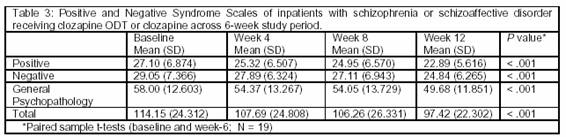
<body><![CDATA[<p>Each rating was assigned by first referring to the item definition to determine  presence of a symptom. The severity of an item is then determined by deciding  which anchoring point best described the subject's functioning, whether or not  all components of the description are observed. The highest applicable rating  was always assigned even if the subject meets criteria for the lower rating  as well. White blood cell (WBC) count with differential and absolute neutrophil  count (ANC) are monitored weekly to avoid hematologic adverse reactions, such  as agranulocytosis. Paired sample t-tests were used to compare the total score  improvement as well as score improvement in each of the three subscales (positive,  negative and general psychopathology) at baseline and the end of 12-weeks of  treatment. Results are statistical significant if P&lt;0.05.</p>     <p>&nbsp;</p>     <p><b>RESULTS</b></p>     <p>Final sample consisted of nineteen males and one female at the beginning of  the study. However only nineteen clients finished the 12-week study (March 27th,  2006 to June 19th, 2006); one male client was transferred to another psychiatric  facility before the week-4 assessment period. Final assessment thus only included  data for 19 subjects who finished the study. Mean age of 39.5 years; range from  20 – 54 years of age.</p>     <p align="center"><a name="t2""><img border="0" src="/img/revistas/pharmacy/v5n1/042-045_02.jpg" width="309" height="154"></a></p>     <p>Clozapine ODT dosing ranged 300 mg – 900 mg daily throughout the study period.  35% of subjects were on clozapine ODT as monotherapy. Other concurrent antipsychotic  medications include ziprasidone, quetiapine, risperidone, olanzapine, aripiprazole,  haloperidol, and chlorpromazine. None of the subject experienced agranulocytosis  during the 6-week study period. One subject developed seizure during week-8  resulted in the dose reduction of study medication from 900 mg to 600 mg daily.</p>     <p>Improvement in mean PANSS scores was observed in all three categories across  the 12-week study period (<a href="#t3">Table 3</a>). Paired sample t-tests  showed statistically significant differences in all three scales and the total  score between baseline and at week-6 (<a href="#t3">Table 3</a>).Compared to  baseline, at week-12, the average reduction in Positive scale was 4.000 &plusmn;  2.828 points, 4.947 &plusmn; 3.341 points in Negative scale, and 7.842 &plusmn;  5.833 points in General psychopathology scale (<a href="#t4">Table 4</a>). Two  subjects were discharged at week-12, and one subject was planning to be discharged  shortly after reaching acceptable, stable clinical improvement.</p>     <p align="center"><a name="t3"><img border="0" src="/img/revistas/pharmacy/v5n1/042-045_03.jpg" width="566" height="137"></a></p>     <p align="center"><a name="t4"><img border="0" src="/img/revistas/pharmacy/v5n1/042-045_04.jpg" width="299" height="126"></a></p>     <p>&nbsp;</p>     ]]></body>
<body><![CDATA[<p><b>DISCUSSION</b></p>     <p>The results of the initial part of a longer study showed a statistical significant  improvement in all three areas of PANSS at the end of 12-week when compared  to baseline. On average, scores in all three areas (positive, negative and cognitive)  progressively improved over the 12-week study period. A greater improvement  in negative scale compared to the positive scale was observed during the 6-week  study period (-4.947 vs. -4.000). Negative syndrome is characterized by deficits  in cognitive, affective, and social functions, including blunting of affect  and passive withdrawal. This observation concurs with the current understanding  of the clinical benefit of clozapine and other atypical antipsychotics, that  in addition to improving positive and negative symptoms of schizophrenia (ex:  delusion, hallucination, paranoia, etc.), these medications are effective in  improving cognitive symptoms including their creative expressions and overall  quality of life as their compliance are ensured.</p>     <p>The greater improvement in negative symptoms, including cognitive functions,  observed in this study is in accordance with results of some previous studies.  A study done on subjects with schizophrenia or schizoaffective disorder by Volavka  et al<sup>5</sup> in 2002 comparing clozapine, olanzapine, risperidone and haloperidol  showed that clozapine was the most effective treatment for negative symptoms.  Lindemayer et al<sup>4</sup> (1994) showed improvement in all three categories of PANSS  in 12-weeks treatment period in treatment-refractory schizophrenics with significant  negative symptoms while on clozapine.</p>     <p>The study did not exclude subjects who were on other antipsychotic medications  (in addition to clozapine ODT); the effect of other concurrent antipsychotic  medications could have compounded the results of the study. However, it is a  common, clinical practice for patients with schizophrenia or schizoaffective  disorder to be on more than one antipsychotic. Clozapine usually is added as  a last option to control psychotic symptoms or negative symptoms. This was an  open-label study such that the clinical interviewers/investigators were not  blinded to the dosage of study medications the subjects were using. It would  be very difficult to blind the interviewers/investigators since one of them  was the facility psychiatrist.</p>     <p>Clinical relevance and importance of current study: Unlike previous studies,  clozapine ODT is used in here. Clozapine is typically used for refractory schizophrenia  or schizoaffective disorder after other atypical antipsychotics, so its clinical  effect on positive and negative symptoms, including cognition, is emphasized  in the study. Primary measure of efficacy is the improvement in total PANSS  score after twelve weeks of clozapine ODT treatment, including total score,  as well as positive, negative and cognition (or general psychopathology) subscales  in the study.</p>     <p>&nbsp;</p>     <p><b>CONCLUSIONS</b></p>     <p>The present study used PANSS as an outcome measuring tool to evaluate the  effect of clozapine ODT in patients with schizophrenia and schizoaffective disorder.  The results of the 12-week preliminary study period showed statistically significant  improvement in total score as well as in positive, negative and general psychopathology  scales. The statistically significant improvement in PANSS further validates  the clinical benefit of clozapine in treating refractory schizophrenia. Clozapine  is typically reserved as treatment resistant schizophrenia due its potential  risk of inducing agranulocytosis, so patients usually are given clozapine after  they have only responded minimally to other antipsychotics. The promising results  of the study confer hope to those refractory-schizophrenic patients and their  families, in that, clozapine can help to improve positive and negative symptoms,  and more importantly, cognition (creativity and expression). With improved cognition,  patients can function more normally and more independently in society.</p>     <p>&nbsp;</p>     <p><b>ACKNOWLEDGEMENT</b></p>     ]]></body>
<body><![CDATA[<p>The authors would like to thank the following people for their support of  this project:</p>     <p>• Alamo Pharmaceutical and Ms. Cheryl Eakin for their grant for this study.    <br> • Ryan Quist, Ph.D. for his statistical expertise.</p>     <p>&nbsp;</p>     <p>&nbsp;</p> <table border="1" width="100%"> <tr> <td width="100%">     <p align="center"><b><font face="Arial">References</font></b></td> </tr> </table>      <!-- ref --><p>1. Lexi-Comp. UpToDate&reg;: "Clozapine: Drug information.    &nbsp;&nbsp;&nbsp;&nbsp;&nbsp;&nbsp;&nbsp;&nbsp;[&#160;<a href="javascript:void(0);" onclick="javascript: window.open('/scielo.php?script=sci_nlinks&ref=4250764&pid=S1885-642X200700010000700001&lng=','','width=640,height=500,resizable=yes,scrollbars=1,menubar=yes,');">Links</a>&#160;]<!-- end-ref -->".</p>     <!-- ref --><p>2. Alamo Pharmaceuticals. FazaClo&reg; General Information.  <a target="_blank" href="http://www.fazaclo.com/GeneralInfo.asp">http://www.fazaclo.com/GeneralInfo.asp</a>. (Accessed 03/02/2006).    &nbsp;&nbsp;&nbsp;&nbsp;&nbsp;&nbsp;&nbsp;&nbsp;[&#160;<a href="javascript:void(0);" onclick="javascript: window.open('/scielo.php?script=sci_nlinks&ref=4250766&pid=S1885-642X200700010000700002&lng=','','width=640,height=500,resizable=yes,scrollbars=1,menubar=yes,');">Links</a>&#160;]<!-- end-ref --></p>     ]]></body>
<body><![CDATA[<!-- ref --><p>3. Kay SR, Fiszbein A, Opler LA. The Positive and Negative Syndrome Scale (PANSS) for schizophrenia. Schizophrenia Bulletin 1987; 2:261-76.    &nbsp;&nbsp;&nbsp;&nbsp;&nbsp;&nbsp;&nbsp;&nbsp;[&#160;<a href="javascript:void(0);" onclick="javascript: window.open('/scielo.php?script=sci_nlinks&ref=4250768&pid=S1885-642X200700010000700003&lng=','','width=640,height=500,resizable=yes,scrollbars=1,menubar=yes,');">Links</a>&#160;]<!-- end-ref --></p>     <!-- ref --><p>4. Lindenmayer J, Grochowski S, Mabugat L. Clozapine effects on Positive and Negative Symptoms: A six-month trial in treatment-refractory schizophrenics. J Clin Psychopharmacol 1994; 14:201-4.    &nbsp;&nbsp;&nbsp;&nbsp;&nbsp;&nbsp;&nbsp;&nbsp;[&#160;<a href="javascript:void(0);" onclick="javascript: window.open('/scielo.php?script=sci_nlinks&ref=4250770&pid=S1885-642X200700010000700004&lng=','','width=640,height=500,resizable=yes,scrollbars=1,menubar=yes,');">Links</a>&#160;]<!-- end-ref --></p>     <!-- ref --><p>5. Volavka J, Czobor P, Sheitman B, Lindenmayer J, Citrome L, McEvoy JP, Cooper TB, Chakos M, Lieberman JA. Clozapine, olanzapine, risperidone, and haloperidol in the treatment of patients with chronic schizophrenia and schizoaffective disorder. Am J Psychiatry 2002; 159:255-62.    &nbsp;&nbsp;&nbsp;&nbsp;&nbsp;&nbsp;&nbsp;&nbsp;[&#160;<a href="javascript:void(0);" onclick="javascript: window.open('/scielo.php?script=sci_nlinks&ref=4250772&pid=S1885-642X200700010000700005&lng=','','width=640,height=500,resizable=yes,scrollbars=1,menubar=yes,');">Links</a>&#160;]<!-- end-ref --></p>      ]]></body><back>
<ref-list>
<ref id="B1">
<label>1</label><nlm-citation citation-type="">
<source><![CDATA[]]></source>
<year></year>
</nlm-citation>
</ref>
<ref id="B2">
<label>2</label><nlm-citation citation-type="">
<collab>Alamo Pharmaceuticals</collab>
<source><![CDATA[FazaClo® General Information]]></source>
<year></year>
</nlm-citation>
</ref>
<ref id="B3">
<label>3</label><nlm-citation citation-type="journal">
<person-group person-group-type="author">
<name>
<surname><![CDATA[Kay]]></surname>
<given-names><![CDATA[SR]]></given-names>
</name>
<name>
<surname><![CDATA[Fiszbein]]></surname>
<given-names><![CDATA[A]]></given-names>
</name>
<name>
<surname><![CDATA[Opler]]></surname>
<given-names><![CDATA[LA]]></given-names>
</name>
</person-group>
<article-title xml:lang="en"><![CDATA[The Positive and Negative Syndrome Scale (PANSS) for schizophrenia]]></article-title>
<source><![CDATA[Schizophrenia Bulletin]]></source>
<year>1987</year>
<volume>2</volume>
<page-range>261-76</page-range></nlm-citation>
</ref>
<ref id="B4">
<label>4</label><nlm-citation citation-type="journal">
<person-group person-group-type="author">
<name>
<surname><![CDATA[Lindenmayer]]></surname>
<given-names><![CDATA[J]]></given-names>
</name>
<name>
<surname><![CDATA[Grochowski]]></surname>
<given-names><![CDATA[S]]></given-names>
</name>
<name>
<surname><![CDATA[Mabugat]]></surname>
<given-names><![CDATA[L]]></given-names>
</name>
</person-group>
<article-title xml:lang="en"><![CDATA[Clozapine effects on Positive and Negative Symptoms: A six-month trial in treatment-refractory schizophrenics]]></article-title>
<source><![CDATA[J Clin Psychopharmacol]]></source>
<year>1994</year>
<volume>14</volume>
<page-range>201-4</page-range></nlm-citation>
</ref>
<ref id="B5">
<label>5</label><nlm-citation citation-type="journal">
<person-group person-group-type="author">
<name>
<surname><![CDATA[Volavka]]></surname>
<given-names><![CDATA[J]]></given-names>
</name>
<name>
<surname><![CDATA[Czobor]]></surname>
<given-names><![CDATA[P]]></given-names>
</name>
<name>
<surname><![CDATA[Sheitman]]></surname>
<given-names><![CDATA[B]]></given-names>
</name>
<name>
<surname><![CDATA[Lindenmayer]]></surname>
<given-names><![CDATA[J]]></given-names>
</name>
<name>
<surname><![CDATA[Citrome]]></surname>
<given-names><![CDATA[L]]></given-names>
</name>
<name>
<surname><![CDATA[McEvoy]]></surname>
<given-names><![CDATA[JP]]></given-names>
</name>
<name>
<surname><![CDATA[Cooper]]></surname>
<given-names><![CDATA[TB]]></given-names>
</name>
<name>
<surname><![CDATA[Chakos]]></surname>
<given-names><![CDATA[M]]></given-names>
</name>
<name>
<surname><![CDATA[Lieberman]]></surname>
<given-names><![CDATA[JA]]></given-names>
</name>
</person-group>
<article-title xml:lang="en"><![CDATA[Clozapine, olanzapine, risperidone, and haloperidol in the treatment of patients with chronic schizophrenia and schizoaffective disorder]]></article-title>
<source><![CDATA[Am J Psychiatry]]></source>
<year>2002</year>
<volume>159</volume>
<page-range>255-62</page-range></nlm-citation>
</ref>
</ref-list>
</back>
</article>