<?xml version="1.0" encoding="ISO-8859-1"?><article xmlns:mml="http://www.w3.org/1998/Math/MathML" xmlns:xlink="http://www.w3.org/1999/xlink" xmlns:xsi="http://www.w3.org/2001/XMLSchema-instance">
<front>
<journal-meta>
<journal-id>1885-642X</journal-id>
<journal-title><![CDATA[Pharmacy Practice (Granada)]]></journal-title>
<abbrev-journal-title><![CDATA[Pharmacy Pract (Granada)]]></abbrev-journal-title>
<issn>1885-642X</issn>
<publisher>
<publisher-name><![CDATA[Centro de Investigaciones y Publicaciones Farmacéuticas]]></publisher-name>
</publisher>
</journal-meta>
<article-meta>
<article-id>S1885-642X2007000200001</article-id>
<title-group>
<article-title xml:lang="en"><![CDATA[Varenicline: a review of the literature and place in therapy]]></article-title>
</title-group>
<contrib-group>
<contrib contrib-type="author">
<name>
<surname><![CDATA[Whitley]]></surname>
<given-names><![CDATA[Heather P.]]></given-names>
</name>
<xref ref-type="aff" rid="A01"/>
</contrib>
<contrib contrib-type="author">
<name>
<surname><![CDATA[Moorman]]></surname>
<given-names><![CDATA[Krystal L.]]></given-names>
</name>
<xref ref-type="aff" rid="A01"/>
</contrib>
</contrib-group>
<aff id="A01">
<institution><![CDATA[,Auburn University Harrison School of Pharmacy Department of Pharmacy Practice ]]></institution>
<addr-line><![CDATA[Tuscaloosa ]]></addr-line>
<country>USA</country>
</aff>
<aff id="A02">
<institution><![CDATA[,Kaiser Permanente Department of Pharmacy ]]></institution>
<addr-line><![CDATA[Colorado Region ]]></addr-line>
<country>USA</country>
</aff>
<pub-date pub-type="pub">
<day>00</day>
<month>06</month>
<year>2007</year>
</pub-date>
<pub-date pub-type="epub">
<day>00</day>
<month>06</month>
<year>2007</year>
</pub-date>
<volume>5</volume>
<numero>2</numero>
<fpage>51</fpage>
<lpage>58</lpage>
<copyright-statement/>
<copyright-year/>
<self-uri xlink:href="http://scielo.isciii.es/scielo.php?script=sci_arttext&amp;pid=S1885-642X2007000200001&amp;lng=en&amp;nrm=iso"></self-uri><self-uri xlink:href="http://scielo.isciii.es/scielo.php?script=sci_abstract&amp;pid=S1885-642X2007000200001&amp;lng=en&amp;nrm=iso"></self-uri><self-uri xlink:href="http://scielo.isciii.es/scielo.php?script=sci_pdf&amp;pid=S1885-642X2007000200001&amp;lng=en&amp;nrm=iso"></self-uri><abstract abstract-type="short" xml:lang="en"><p><![CDATA[Evidence regarding the health consequences of smoking is undeniable, yet 21% of the American population continues to smoke. In addition to behavioral modifications, first-line treatment options include nicotine replacement therapies and bupropion SR. Varenicline, which was recently approved by the Food and Drug Administration (FDA), offers a novel mechanism of action for smoking cessation. This article reviews current first-line smoking cessation aids and evaluates the clinical trials pertaining to the efficacy and safety of varenicline. Additionally, the authors attempt to establish the role of varenicline in smoking cessation therapy and determine whether varenicline should be used prior to other first-line smoking cessation aids, particularly considering the lower costs of generic alternatives. At present, clinical studies have not established the efficacy of varenicline after repeated courses, following bupropion failures, or in various unstudied populations. Relatively poor study outcomes emphasize the need to provide patients with behavioral counseling throughout each quit attempt and for 1 year past the quit date.]]></p></abstract>
<abstract abstract-type="short" xml:lang="es"><p><![CDATA[La evidencia sobre las consecuencias sanitarias del tabaco es incontestable, aunque el 21% de la población americana continua fumando. Además de las modificaciones del comportamiento, las opciones de primera línea en el tratamiento incluyen terapias de sustitución nicotínica y bupropion SR. La varenicilina, que ha sido recientemente aprobada por la Administración de Alimentos y Medicamentos (FDA), ofrece un mecanismo de acción novedoso para el abandono del tabaco. Este artículo revisa las actuales ayudas de primera línea para la cesación tabáquica y evalúa los ensayos clínicos relativos a la eficacia y seguridad de la varenicilina. Además, los autores intentan establecer el papel del a varenicilina en el tratamiento de cesación tabáquica y determinar si la varenicilina debería ser usada antes de otras ayudas de primera línea, particularmente considerando el bajo coste de las alternativas genéricas. Ene l presente, los estudios clínicos no han establecido la eficacia del a varenicilina después de ciclos repetidos, tras fallos del bupropion, o en diversas poblaciones no estudiadas. Los resultados relativamente pobres de estudios enfatizan la necesidad de proporcionar a los pacientes consejo comportamental en cada tentativa de abandono y durante un año después de la tentativa.]]></p></abstract>
<kwd-group>
<kwd lng="en"><![CDATA[Smoking Cessation]]></kwd>
<kwd lng="en"><![CDATA[Varenicline]]></kwd>
<kwd lng="en"><![CDATA[Tobacco]]></kwd>
<kwd lng="en"><![CDATA[Behavior Therapy]]></kwd>
<kwd lng="es"><![CDATA[Cesación tabáquica]]></kwd>
<kwd lng="es"><![CDATA[Vareniclina Tabaco]]></kwd>
<kwd lng="es"><![CDATA[Tratamiento comportamental]]></kwd>
</kwd-group>
</article-meta>
</front><body><![CDATA[  <table border="1" width="100%"> <tr> <td width="100%">     <p align="center"><b><font face="Arial">Review</font></b></td> </tr> </table>     <p align="center"><b><font size=5>Varenicline: A review of the literature and place in therapy</font></b></p>     <p align="center">Heather P. WHITLEY, Krystal L. MOORMAN.</p>     <p align="center"> <table border="0" width="100%"> <tr> <td width="48%" valign="top">      <p><b>ABSTRACT</b></p>     <p>Evidence regarding the health consequences of smoking is undeniable,  yet 21% of the American population continues to smoke. In addition to  behavioral modifications, first-line treatment options include nicotine  replacement therapies and bupropion SR. Varenicline, which was recently  approved by the Food and Drug Administration (FDA), offers a novel mechanism  of action for smoking cessation. This article reviews current first-line  smoking cessation aids and evaluates the clinical trials pertaining to  the efficacy and safety of varenicline. Additionally, the authors attempt  to establish the role of varenicline in smoking cessation therapy and  determine whether varenicline should be used prior to other first-line  smoking cessation aids, particularly considering the lower costs of generic  alternatives. At present, clinical studies have not established the efficacy  of varenicline after repeated courses, following bupropion failures, or  in various unstudied populations. Relatively poor study outcomes emphasize  the need to provide patients with behavioral counseling throughout each  quit attempt and for 1 year past the quit date.</p>     <p><b>Key words</b>: Smoking Cessation. Varenicline. Tobacco. Behavior Therapy.  </p> </td> <td width="4%" valign="top"></td> <td width="48%" valign="top">     <p><b>RESUMEN</b></p>     <p>La evidencia sobre las consecuencias sanitarias del tabaco es incontestable,  aunque el 21% de la poblaci&oacute;n americana continua fumando. Adem&aacute;s  de las modificaciones del comportamiento, las opciones de primera l&iacute;nea  en el tratamiento incluyen terapias de sustituci&oacute;n nicot&iacute;nica  y bupropion SR. La varenicilina, que ha sido recientemente aprobada por  la Administraci&oacute;n de Alimentos y Medicamentos (FDA), ofrece un  mecanismo de acci&oacute;n novedoso para el abandono del tabaco. Este  art&iacute;culo revisa las actuales ayudas de primera l&iacute;nea para  la cesaci&oacute;n tab&aacute;quica y eval&uacute;a los ensayos cl&iacute;nicos  relativos a la eficacia y seguridad de la varenicilina. Adem&aacute;s,  los autores intentan establecer el papel del a varenicilina en el tratamiento  de cesaci&oacute;n tab&aacute;quica y determinar si la varenicilina deber&iacute;a  ser usada antes de otras ayudas de primera l&iacute;nea, particularmente  considerando el bajo coste de las alternativas gen&eacute;ricas. Ene l  presente, los estudios cl&iacute;nicos no han establecido la eficacia  del a varenicilina despu&eacute;s de ciclos repetidos, tras fallos del  bupropion, o en diversas poblaciones no estudiadas. Los resultados relativamente  pobres de estudios enfatizan la necesidad de proporcionar a los pacientes  consejo comportamental en cada tentativa de abandono y durante un a&ntilde;o  despu&eacute;s de la tentativa.</p>     ]]></body>
<body><![CDATA[<p><b>Palabras clave</b>: Cesaci&oacute;n tab&aacute;quica. Vareniclina  Tabaco. Tratamiento comportamental.</p> </td> </tr> </table> <hr align="left" width="30%">     <p><font size="2">Heather P. WHITLEY, PharmD, BCPS. Department of Pharmacy Practice,  Auburn University Harrison School of Pharmacy; and Department of Community and  Rural Medicine, University of Alabama School of Medicine, Tuscaloosa,AL (USA).    <br> Krystal L. MOORMAN, PharmD. Department of Pharmacy, Kaiser Permanente- Colorado  Region (USA).</font></p>      <p>&nbsp;</p>     <p><b>INTRODUCTION</b></p>     <p>Although the importance of smoking cessation is not a new concept, the use  of a recently Food and Drug Administration (FDA)-approved medication is causing  much discussion in the outpatient setting. Varenicline was approved by the FDA  for sales in the United States on May 11, 2006, and was launched in August 2006.  Since that time, the authors have experienced frequent requests for varenicline  prescriptions by patients in primary care clinics. Although the clinical efficacy  and usefulness of varenicline is relevant,<sup>1</sup> a more important question, given  the over-the-counter (OTC) status of many nicotine replacement therapies (NRT)  and the generic manufacturing of bupropion SR, is what is the appropriate place  in therapy for varenicline. After reviewing the negative consequences and addictive  potential of nicotine, this article reviews the efficacy of current first-line  smoking cessation aids, including varenicline and attempts to determine the  appropriate place in therapy for varenicline in relation to the other products.  </p>     <p><b> Impact of Smoking</b></p>     <p>Evidence regarding the devastating health consequences of smoking is undeniable.  Not only is overall mortality increased up to 2-fold, but patients who smoke  are at 2 to 4 times greater risk of developing cancer, cardiovascular disease,  cerebrovascular disease, peripheral vascular disease, chronic obstructive pulmonary  disease, and osteoporosis. Furthermore, smoking contributes to approximately  1 in 5 American deaths.<sup>2</sup> Each year over 400,000 people die prematurely due to  tobacco-related illnesses.<sup>3</sup> The Centers for Disease Control and Prevention (CDC)  identifies smoking as the single most important reversible risk factor for preventing  disease and premature death. Despite the known negative impact of tobacco use,  the CDC estimated that in 2005, 45.1 million (20.9%) American adults smoked  which has increased from previous years.<sup>4</sup></p>     <p>The economic burden of smoking-related illnesses has an equally impressive  impact. Annual direct medical expenditures in 1998 reached $75.5 billion, while  the annual indirect costs were approximately $81.9 billion.<sup>5</sup> Collectively, society  pays around $7.18 per pack of cigarettes smoked.<sup>5</sup></p>     <p>The negative impact upon morbidity, mortality, and the economy heighten the  importance of aiding every patient who desires a smoke-free life in achieving  his/her goal. An estimated 70-80% of smokers report a desire to quit using tobacco,6-9  although the majority report "not thinking about quitting within the next 6  months".<sup>7</sup> Furthermore, those who do attempt abstaining from tobacco use often  relapse within the first month of being smoke-free.<sup>9,10</sup> Less than 20% of all  quit attempts remain successful at one year.<sup>6,11,12</sup> Previous studies indicate  that several quit attempts (4 to 11) are generally undertaken before becoming  permanently tobacco-free.<sup>13</sup> Annually, only 2.5% of current smokers permanently  stop smoking.<sup>6,14</sup> The relapse incidence and smoke-free duration until relapse  speaks volumes to the addictive properties of nicotine.</p>     ]]></body>
<body><![CDATA[<p>Addictive Properties of Nicotine</p>     <p>Addiction is a complex behavioral phenomenon which causes a range of effects,  from social to biochemical interactions.<sup>9,15,16</sup> Tobacco contains many chemical  compounds; however, nicotine is the principle addictive component.<sup>15,16</sup> Nicotine  activates the mesolimbic dopamine system within the brain, thus stimulating  the reward pathway. Specifically, these affects have been linked to the ability  of nicotine to bind to alpha4beta2 acetylcholine receptors in the ventral tegmental  region of the brain.<sup>10</sup> Like other addictive substances, elimination of the amplified  reward pathway leads to negative feelings, behaviors, and quickly results in  relapses. It is thus no surprise that the first smoking cessation pharmacologic  aid was the administration of lower levels of nicotine in place of regular use.  </p>     <p>Withdrawal Effects</p>     <p>Withdrawal effects are common upon nicotine discontinuation and typically  present within 4 to 6 hours of nicotine deprivation in a regular smoker.<sup>10</sup> Common  withdrawal effects may include depression, irritability, anxiety, difficulty  concentrating, hunger, impatience, fatigue, nervousness, restlessness, and insomnia.  These symptoms usually peak within the first few days and resolve within 1 month  of abstinence initiation.<sup>10</sup> Cravings for nicotine are also frequently present,  although not considered a withdrawal symptom by DSM-IV. Unconsciously, tobacco  users maintain a minimum serum nicotine level in order to prevent these withdrawal  symptoms while maintaining pleasure and arousal.<sup>8</sup></p>     <p><b> Review of Pharmacologic and Nonpharmacologic Options </b></p>     <p>Behavioral Modification Therapy</p>     <p>Behavioral modification therapy is founded on the concept that one learns  to smoke, and therefore must learn to quit. Goals of behavioral therapy are  to change the behaviors and social cues that lead to smoking. Behavioral therapy  should reinforce the importance of not smoking, provide practical counseling  to aid in evaluating past quit attempts in efforts to improve the success of  future attempts, and problem solving skills to help prevent relapses. During  counseling sessions patients should be educated about the benefits of social  support, as it provides positive influences and accountability.<sup>17</sup> Most behavioral  modifications are initiated prior to cessation and are extremely helpful for  determining the most effective treatment plan.<sup>17</sup> The duration of such behavioral  counseling has a strong correlation with efficacy of success.<sup>17</sup> Additionally,  intensive behavioral therapy, with or without pharmacologic therapy, improves  smoking cessation outcomes.<sup>10,18-20</sup> Unfortunately, clinical experience shows  that behavioral therapy is often neglected.</p>     <p>Pharmacotherapy</p>     <p>Until the late 1990s nicotine replacement therapy (NRT) was the only pharmacologic  modality available to aid patients in becoming smoke-free. NRTs are available  in 5 different delivery formulations; all are over-the-counter except for the  inhaler and nasal spray. Although the efficacy of NRT is better than placebo,  continuous abstinence rates after 12 weeks of NRT have been reported at only  20 to 24%.<sup>21</sup> Addition of NRT to behavioral modifications improves success rates  by approximately 2-fold.<sup>22</sup> Using NRT attenuates withdrawal cravings by maintaining  lower levels of plasma nicotine.<sup>23,24</sup> The absence of withdrawal symptoms helps  patients focus on nonpharmacologic therapies to achieve a smoke-free status.  One particular draw back of NRT is the potential for cross abuse and addiction.  Following nicotine nasal spray use, up to 43% of patients still administer the  NRT after 1 year, although no longer smoking.<sup>25</sup></p>     <p>Several studies have compared the efficacy of adding short-acting NRT to long-acting  NRT.<sup>26-32</sup> The long-acting NRT patch maintains a constant low level of serum  nicotine, while the administration of short acting products (ie. nicotine gum,  nasal spray, and inhaler) aid with breakthrough withdrawal cravings. Although  the results are mixed, a Cochrane database analysis indicated that the pooled  results demonstrate a modest, but statistically significant benefit for combination  therapy (OR 1.42; 95%CI 1.14;1.76).<sup>22</sup> As a result, the US treatment guidelines  recommend combination therapy for those patients who experienced multiple failed  quit attempts using monotherapy.<sup>17</sup></p>     ]]></body>
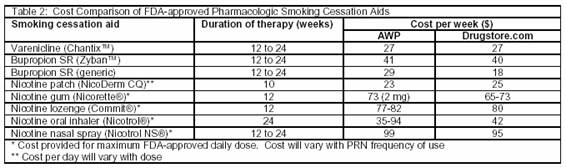
<body><![CDATA[<p>Bupropion SR was FDA-approved in May 1997 as the first nicotine-free prescription  medication to aid in smoking cessation. Use of bupropion SR, in combination  with behavioral modifications, proved to be 1.2-times and 2.3-times more efficacious  over the patch or behavioral modifications alone, respectively.<sup>33</sup> The mechanism  of benefit includes decreased withdrawal symptoms, predominately irritability,  frustration, anxiety, difficulty concentrating, and restlessness, by increasing  dopamine and norepinephrine concentrations within the mesolimbic center of the  brain. Although adverse effects such as dry mouth and insomnia are generally  mild and rarely affected discontinuation rates in bupropion studies, the dose-related  incidence of seizures does limit the use of bupropion in some patients.<sup>34</sup></p>     <p>Combination therapy with bupropion SR and NRT has also proven to be beneficial,  but limited data exist. A 1999 study enrolled subjects into 1 of 3 treatment  arms where they were randomized to either bupropion SR and NRT patch, bupropion  SR and placebo patch, or NRT patch and placebo tablets.<sup>33</sup> Results indicated  that, although dual therapy was better than NRT alone, it was only equivalent  to bupropion monotherapy. Despite the improved success bupropion SR and NRT  offer, there is still clearly room for enhanced efficacy with smoking cessation  aids.</p>     <p>Varenicline</p>     <p>In May 2006, the FDA approved varenicline via the fast-track approval process.  Varenicline is a partial agonist of the neuronal alpha4beta2 nicotinic acetylcholine  receptor, within the mesolimbic system of the brain. Nicotine reaches this location  of the brain within 10 to 20 seconds after cigarette smoking.<sup>9,35</sup>  Here it binds to the alpha4beta2 nicotinic acetylcholine receptor inducing a  conformational change, and allowing the influx of dopamine into the synaptic  cleft.<sup>16</sup> The drug was developed by altering the structure of (-)cytisine,  a natural compound known to have partial agonist activity at the alpha4beta2  nicotinic acetylcholine receptor that has previously been studied as a smoking  cessation aid.<sup>36</sup> Like nicotine, varenicline also provides agonism  to the receptor, but to a much lower degree (approximately 60% stimulation of  nicotine).<sup>23</sup> Thus, a smaller amount of dopamine is released into  the synaptic cleft. By providing this low level of dopamine stimulation, varenicline  aids in the attenuation of withdrawal symptoms and cravings for nicotine.</p>     <p>Secondly, by occupying the active site, varenicline provides competitive inhibition  with nicotine to activate the alfa4beta2 receptors. Thus, nicotine is unable  to activate the central nervous mesolimbic dopamine system in the presence of  varenicline therapy. In turn, the neuronal mechanism underlying reinforcement  and reward experienced upon smoking is blunted.<sup>37</sup></p>     <p>Analysis of Varenicline Literature</p>     <p>Gonzales et al (n=1025) and Jorenby et al (n=1027) conducted clinical trials  evaluating the efficacy of varenicline compared with both placebo and bupropion  SR. The studies had identical designs and were randomized, double-blind, placebo-controlled,  multicenter trials with a 12-week treatment period and 52-week follow-up. Eligible  patients were between the ages of 18 and 75 years, smoked at least 10 cigarettes  per day, and had not been abstinent from cigarette smoking for longer than 3  months in the last year. Exclusion criteria are summarized in <a href="#t1">table  1</a>. Patients were randomized to treatment with varenicline, bupropion SR,  or placebo. Patients in the varenicline arm received 0.5 mg/day on days 1 to  3; 0.5 mg twice daily on days 4 to 7; and 1 mg twice daily through week 12.  Patients randomized to bupropion received 150 mg/day on days 1 to 3 and 150  mg twice daily through week 12.</p>     <p align="center"><a name="t1"><img border="0" src="/img/revistas/pharmacy/v5n2/051-058_01.jpg" width="567" height="528"></a></p>     <p>A target quit date was set for day 8 of the study. Patients were contacted  via telephone 3 days after the quit date. In addition, patients attended weekly  visits throughout the 12-week treatment phase. At each visit, brief behavioral  modification counseling (10 minutes or less) was provided. Those patients who  completed the 12-week treatment phase were included in the follow-up phase,  which lasted from week 13 through week 52. During the follow-up phase, patients  were seen in clinic approximately every 12 weeks and were evaluated via telephone  on 6 additional occasions. During each contact, patients were evaluated for  cigarette smoking and were provided brief counseling.</p>     <p>The primary endpoint in both trials was the 4-week continuous abstinence rate  for weeks 9 through 12. This was defined as the proportion of subjects who reported  neither smoking nor use of any nicotine-containing products, confirmed by an  exhaled carbon monoxide (CO) concentration of 10 ppm or less. Secondary outcomes  were continuous abstinence rates from week 9 through 24 and week 9 through 52.</p>     ]]></body>
<body><![CDATA[<p>Completion rates at week 52 ranged from 54 to 70%. The average age of participants  was around 42 years; patients smoked an average of 22 cigarettes per day, and  had been smoking for approximately 24 years. The mean Fagerstr&ouml;m Test score,  reported in the Jorenby study, was 5.4. In both trials, patients randomized  to receive varenicline were 4 times (OR=3.85) and 2 times (OR=1.93 and 1.90)  more likely to remain smoke-free compared with placebo and bupropion SR, respectively  during weeks 9 through 12. Additionally, 80 to 85% of randomized patients had  at least one previous quit attempt during which the patient may have used NRT,  clonidine, or nortriptyline, thus indicating that varenicline is beneficial  in the face of previous therapeutic failures with these agents.<sup>37,38</sup></p>     <p>Unfortunately, there are limitations in these trials that may reduce the external  validity of the data obtained. The patient population studied in all varenicline  trials were predominately Caucasian men and women in their mid forties. This  narrow scope of studied subjects limits the ability to extrapolate effects to  other ethnicities and age groups. It is important to note that all randomized  patients smoked cigarettes rather than using other tobacco-containing products.  As a result, the utility of varenicline in non-cigarette tobacco users is unknown.  Exclusion criteria were exceptionally broad, such that any patient with a current  or prior history of a major cardiovascular-, neurologic-, or psychiatric problem  was not enrolled into the studies. It is perhaps most concerning that patients  at the highest risk for tobacco-related death were excluded.</p>     <p>Per the study design, patients were provided initial and weekly individualized  counseling on behavioral modifications through week 12. Through the duration  of the study (weeks 13-52) patients were still provided brief counseling on  a monthly basis. Enrolled patients were required to be individuals motivated  to quit using tobacco. In light of these additional nonpharmacologic therapies,  it would be unreasonable to expect the majority of patients treated in the standard  outpatient setting to achieve such results, as few are initially motivated or  provided such extensive behavioral counseling on a regular basis. Furthermore,  abstinence rates were based on patient report. Although CO measurements were  used to confirm reports, this method is not a reliable means to verify smoking  history for the 1 week or more that elapsed between visits, as the half-life  of CO is only 4 to 5 hours.<sup>40</sup></p>     <p>It should be noted that at the end of the studies, a statistically significant  difference in smoking abstinence rates between patients randomized to varenicline  and bupropion SR was not demonstrated consistently &#091;p=0.57 (Gonzales), p=0.004  (Jorenby)&#093;, although the abstinence rate with varenicline was always statistically  different compared with placebo &#091;p=0.001 (Gonzales), p&lt;0.001 (Jorenby)&#093;.  Surprisingly, Jorenby and colleagues, noted a lack of statistically significant  differences between bupropion SR and placebo at the end of the study (p=0.08).  This lack of difference clouds the accuracy of the bupropion arm in this study,  possibly representing a type I error in the analysis between bupropion SR and  varenicline.</p>     <p>Lastly, an average of only 20% of patients randomized to varenicline remained  tobacco-free at the conclusion of the 52-week study. This emphasizes the continued  high relapse rate, regardless of the pharmacologic or nonpharmacologic therapy  used to aid in the initial quit attempt.</p>     <p>The effect of maintenance therapy with varenicline was also evaluated by Tonstad  et al. This was a 52-week, multicenter trial including cigarette smokers between  the ages of 18 and 75 years who smoked an average of 10 or more cigarettes per  day with no abstinence period greater than 3 months. Exclusion criteria are  summarized in <a href="#t1">table 1</a>. Patients first participated in 12 weeks  of open-label therapy with varenicline 0.5 mg/day on days 1 to 3; 0.5 mg twice  daily on days 4 to 7; and 1 mg twice daily through week 12. Subjects who abstained  from all forms of tobacco use, including nicotine replacement therapy, for at  least the last 7 days of the treatment period were randomized to either varenicline  1 mg twice daily or placebo for another 12 weeks. Abstinence was confirmed by  an end expiratory CO concentration of 10 ppm or less. After 12 weeks of double-blind  therapy, patients were followed for an additional 28 weeks. Patients were also  provided with brief smoking cessation counseling at baseline and on a weekly  basis.</p>     <p>The primary efficacy end point was the continuous abstinence rate, confirmed  by CO expiration, from week 13 through 24. Secondary outcomes included continuous  abstinence from week 13 through 52 and time to first relapse.</p>     <p>Of the 1927 patients enrolled in the open-label phase, 1210 were eligible  and agreed to participate in double-blind treatment. On average, participants  were 45 years old, had a Fagerstr&ouml;m Test score of 5.4, smoked for 27 years,  and consumed an average of 22 cigarettes per day. Approximately 82% of patients  made at least 1 previous attempt to stop smoking.</p>     <p>The continuous abstinence rate for weeks 13 through 24 was approximately 2.5  times greater with varenicline compared with placebo (OR=2.48; 95%CI 1.95;3.16  P&lt;0.001). Results through week 52 were less impressive, but still statistically  significant (OR=1.34; 95%CI 1.06;1.69 P=0.02). In order to achieve continuous  abstinence in 1 patient from week 13 through 24, 5 patients would need to be  treated with varenicline 1 mg, twice daily for 24 weeks. In order to achieve  the same endpoint at 52 weeks, 14 patients would need to be treated. The median  time to first relapse was significantly longer in the varenicline group than  in the placebo groups (198 days vs. 87 days; P&lt;0.001).<sup>41</sup></p>     <p>In addition to the limitations encountered in the trials conducted by Gonzales  and Jorenby, the Tonstad trial may have had issues maintaining the study blind.  A common adverse effect in all varenicline clinical studies was nausea. Patients  and investigators were familiar with this side effect experienced with varenicline  treatment prior to entering the double-blind portion of this study. The incidence  of nausea with varenicline was approximately twice that of placebo. Therefore,  patients who experienced nausea in the double-blind phase may have suspected  the arm to which they were randomized. Given that tolerance to this adverse  effect may develop with time, this may or may not have affected the study outcome.  Another limitation of the trial is the absence of an active comparator which  would have made the data more applicable to clinical practice. Although this  trial indicates that 12 additional weeks of varenicline therapy, at an approximate  cost of $300, appears to be better than placebo it does not provide insight  in quantifying efficacy of varenicline compared with bupropion. Finally, by  including only patients who demonstrated some degree of success in the open-label  phase of the trial, the investigators may have biased the study in favor of  varenicline.</p>     ]]></body>
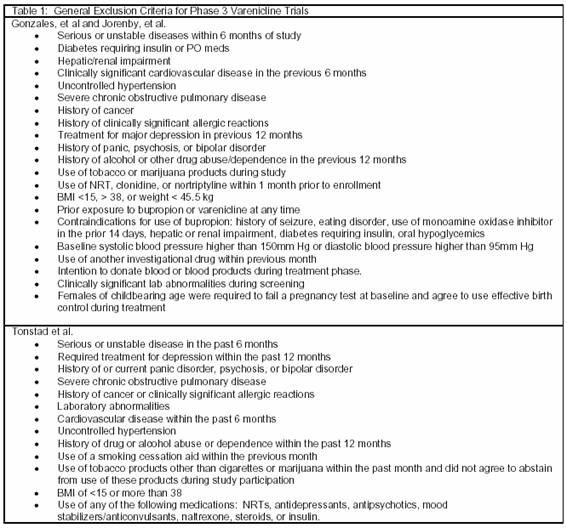
<body><![CDATA[<p>From these data, prescribers should note that varenicline is not a magic bullet.  For optimal efficacy varenicline should be prescribed along with intense behavioral  modification therapy that is provided at regular and frequent intervals before,  during, and for a substantial period after the treatment phase.</p>     <p>Place in therapy for varenicline</p>     <p>According to the US guideline, all willing and interested patients should  be offered pharmacologic therapy for smoking cessation.<sup>17</sup> Considering this,  the question that remains a challenge to practitioners is whether varenicline  should be considered prior to other first-line therapies. Based on currently  available literature, the appropriate place for varenicline in therapy is not  clear. It is important to note that there is no apparent role for concomitant  NRT and varenicline because varenicline would block the nicotine at the receptor  per its mechanism of action. Published studies with varenicline contain limitations,  as previously discussed, which weaken the external validity. Additionally, they  do not compare varenicline to NRT and non-NRT other than bupropion. However,  to aid practitioners in selecting the most appropriate agent for their patients  we provide the following recommendations to help determine the appropriate place  in therapy for varenicline.</p>     <p>If bupropion therapy is contraindicated, the choice between varenicline and  NRT is a matter of cost, compliance, and continued nicotine use. Although application  of NRT provides lower plasma concentrations than cigarettes and lower health  risks than continued tobacco use,<sup>42</sup> patients who absolutely require immediate  nicotine cessation may benefit greater from non-NRT. This eliminates all nicotine  administration and potential for cross addiction. As most NRTs are administered  multiple times per day, poor adherence may reduce success rates,<sup>23</sup>  whereas only twice daily dosing of varenicline may be more manageable from a  compliance standpoint. At first glance, varenicline therapy appears more economical  compared to most NRT. However, costs provided in <a href="#t2">table 2</a> are  based on maximum FDA-approved daily doses per week. Patients frequently do not  use this maximum daily allowance and may decrease the frequency of prn use over  time. Therefore, the cost of NRT may be lower or equivalent to varenicline therapy.  (See <a href="#t2">table 2</a>). Additionally, NRT may be preferred in patients  without contraindications due to the vast amount of experience and safety data  available compared with varenicline.</p>     <p align="center"><a name="t2"><img border="0" src="/img/revistas/pharmacy/v5n2/051-058_02.jpg" width="566" height="168"></a></p>     <p>The choice of pharmacologic therapy is further complicated in patients who  may benefit from either oral agent, particularly considering lower cost generic  equivalents. Each practitioner should consider whether the patient will benefit  from the initial boost in abstinence rates seen with varenicline which is almost  2 times that of bupropion. However, this initial and unsustained benefit, which  may last only 24 weeks,<sup>38</sup> comes at an additional cost of $108 for that 3-month  period compared with generic bupropion SR. The practitioner should recall that  after completing a 24-week trial of either varenicline or bupropion studies  showed mixed results of those remaining smoke-free at the 52-week follow-up.<sup>39</sup>  In light of this, the less expensive option of generic bupropion may be equally  effective in the long-term, and thus may be a better first-line option.</p>     <p>The appropriate place for varenicline use in patients with several past attempts  to quit, including prior use of bupropion therapy is still unclear. Patients  enrolled in clinical trials had no previous exposure to bupropion; therefore,  the efficacy of varenicline in patients who have previously failed bupropion  SR is unknown at this time. Whether repeated courses of varenicline will yield  a decrease in efficacy similar to that experienced with bupropion SR retreatment<sup>43</sup>  remains to be determined. Lastly, it is unknown whether varenicline will prove  useful in treating patients who use tobacco-containing products other than cigarettes.  Future studies should address these issues as well as determine the benefit  of varenicline in the unstudied populations, including non-Caucasians, teenagers,  the elderly, and those with cardiovascular, endocrine, or psychiatric illnesses  who were excluded from varenicline clinical trials.</p>     <p>Regardless of when varenicline is used, it is vital to consider the important  role continued education and encouragement play. Practitioners should make every  attempt to ask, advise, assess, assist, and arrange as encouraged in the treatment  guidelines.<sup>17</sup> Without these important nonpharmacologic modalities, patients  are not provided the best possible chance of becoming smoke-free.</p>     <p>&nbsp;</p>     <p><b>CONCLUSION</b></p>     ]]></body>
<body><![CDATA[<p>Varenicline offers a novel mechanism of action in smoking cessation therapy  and appears to be more effective than bupropion at week 12 in the limited population  studied. Only time and experience will determine the role varenicline will play  in diverse populations, after bupropion SR failures, and with repeated courses.  Relatively poor study outcomes emphasize the need to provide every patient with  intense behavioral counseling throughout each quit attempt and at least 1 year  past the quit date.</p>     <p>&nbsp;</p>     <p><b>DISCLOSURE</b></p>     <p>The authors have no financial information to disclose or any other conflict  of interest.</p>     <p>&nbsp;</p> <table border="1" width="100%"> <tr> <td width="100%">     <p align="center"><b><font face="Arial">References</font></b></td> </tr> </table>      <!-- ref --><p>1. Klesges RC, Johnson KC, Somes G. Varenicline for smoking cessation. Definite promise, but no panacea. JAMA 2006;296(1):94-5.    &nbsp;&nbsp;&nbsp;&nbsp;&nbsp;&nbsp;&nbsp;&nbsp;[&#160;<a href="javascript:void(0);" onclick="javascript: window.open('/scielo.php?script=sci_nlinks&ref=4227844&pid=S1885-642X200700020000100001&lng=','','width=640,height=500,resizable=yes,scrollbars=1,menubar=yes,');">Links</a>&#160;]<!-- end-ref --></p>     <!-- ref --><p>2. American Cancer Society. Cigarette Smoking. (revised 11-14-2003) Available on line at: <a target="_blank" href="http://www.cancer.org/docroot/PED/content/PED_10_2X_Cigarette_Smoking_and_Cancer.asp">http://www.cancer.org/docroot/PED/content/PED_10_2X_Cigarette_Smoking_and_Cancer.asp</a>. Accessed November 29, 2006.    &nbsp;&nbsp;&nbsp;&nbsp;&nbsp;&nbsp;&nbsp;&nbsp;[&#160;<a href="javascript:void(0);" onclick="javascript: window.open('/scielo.php?script=sci_nlinks&ref=4227846&pid=S1885-642X200700020000100002&lng=','','width=640,height=500,resizable=yes,scrollbars=1,menubar=yes,');">Links</a>&#160;]<!-- end-ref --></p>     ]]></body>
<body><![CDATA[<!-- ref --><p>3. Centers for Disease Control and Prevention. Annual smoking-attributable mortality, years of potential life lost, and productivity lost – United States, 1997-2001. MMWR 2005;54(25):625-8.    &nbsp;&nbsp;&nbsp;&nbsp;&nbsp;&nbsp;&nbsp;&nbsp;[&#160;<a href="javascript:void(0);" onclick="javascript: window.open('/scielo.php?script=sci_nlinks&ref=4227848&pid=S1885-642X200700020000100003&lng=','','width=640,height=500,resizable=yes,scrollbars=1,menubar=yes,');">Links</a>&#160;]<!-- end-ref --></p>     <!-- ref --><p>4. Centers for Disease Control and Prevention (CDC). Tobacco use among adults – United States 2005. 2006;55(42):1146-53.    &nbsp;&nbsp;&nbsp;&nbsp;&nbsp;&nbsp;&nbsp;&nbsp;[&#160;<a href="javascript:void(0);" onclick="javascript: window.open('/scielo.php?script=sci_nlinks&ref=4227850&pid=S1885-642X200700020000100004&lng=','','width=640,height=500,resizable=yes,scrollbars=1,menubar=yes,');">Links</a>&#160;]<!-- end-ref --></p>     <!-- ref --><p>5. Centers for Disease Control and Prevention. Annual Smoking-Attributable Mortality, Years of Potential Life Lost, and Economic Costs --- United States, 1995—1999. MMWR 2002;51(14):300-3.    &nbsp;&nbsp;&nbsp;&nbsp;&nbsp;&nbsp;&nbsp;&nbsp;[&#160;<a href="javascript:void(0);" onclick="javascript: window.open('/scielo.php?script=sci_nlinks&ref=4227852&pid=S1885-642X200700020000100005&lng=','','width=640,height=500,resizable=yes,scrollbars=1,menubar=yes,');">Links</a>&#160;]<!-- end-ref --></p>     <!-- ref --><p>6. Benowitz NL. Nicotine addiction. Primary Care 1999;26:611-31.    &nbsp;&nbsp;&nbsp;&nbsp;&nbsp;&nbsp;&nbsp;&nbsp;[&#160;<a href="javascript:void(0);" onclick="javascript: window.open('/scielo.php?script=sci_nlinks&ref=4227854&pid=S1885-642X200700020000100006&lng=','','width=640,height=500,resizable=yes,scrollbars=1,menubar=yes,');">Links</a>&#160;]<!-- end-ref --></p>     <!-- ref --><p>7. Prochaska JO, DiClemente CC, Norcross JC. In search of how people change: Applications to addictive behaviors. Am Psychol 1992;47(9):1102–4.    &nbsp;&nbsp;&nbsp;&nbsp;&nbsp;&nbsp;&nbsp;&nbsp;[&#160;<a href="javascript:void(0);" onclick="javascript: window.open('/scielo.php?script=sci_nlinks&ref=4227856&pid=S1885-642X200700020000100007&lng=','','width=640,height=500,resizable=yes,scrollbars=1,menubar=yes,');">Links</a>&#160;]<!-- end-ref --></p>     ]]></body>
<body><![CDATA[<!-- ref --><p>8. Leave the pack behind, World no-tobacco day. World Health Organization. May 1999.    &nbsp;&nbsp;&nbsp;&nbsp;&nbsp;&nbsp;&nbsp;&nbsp;[&#160;<a href="javascript:void(0);" onclick="javascript: window.open('/scielo.php?script=sci_nlinks&ref=4227858&pid=S1885-642X200700020000100008&lng=','','width=640,height=500,resizable=yes,scrollbars=1,menubar=yes,');">Links</a>&#160;]<!-- end-ref --></p>     <!-- ref --><p>9. Benowitz NL.. Cigarette smoking and nicotine addiction. Med Clin North Am 1992;76(2):415-37.    &nbsp;&nbsp;&nbsp;&nbsp;&nbsp;&nbsp;&nbsp;&nbsp;[&#160;<a href="javascript:void(0);" onclick="javascript: window.open('/scielo.php?script=sci_nlinks&ref=4227860&pid=S1885-642X200700020000100009&lng=','','width=640,height=500,resizable=yes,scrollbars=1,menubar=yes,');">Links</a>&#160;]<!-- end-ref --></p>     <!-- ref --><p>10. Foulds J. The neurobiological basis for partial agonist treatment of nicotine dependence: varenicline. Int J Clin Pract 2006;60(5):571–6.    &nbsp;&nbsp;&nbsp;&nbsp;&nbsp;&nbsp;&nbsp;&nbsp;[&#160;<a href="javascript:void(0);" onclick="javascript: window.open('/scielo.php?script=sci_nlinks&ref=4227862&pid=S1885-642X200700020000100010&lng=','','width=640,height=500,resizable=yes,scrollbars=1,menubar=yes,');">Links</a>&#160;]<!-- end-ref --></p>     <!-- ref --><p>11. Balfour DJ, F&auml;gerstrom KO. Pharmacology of nicotine and its therapeutic use in smoking cessation and neurodegenerative disorders. Pharmacol Ther 1996;72:51-81.    &nbsp;&nbsp;&nbsp;&nbsp;&nbsp;&nbsp;&nbsp;&nbsp;[&#160;<a href="javascript:void(0);" onclick="javascript: window.open('/scielo.php?script=sci_nlinks&ref=4227864&pid=S1885-642X200700020000100011&lng=','','width=640,height=500,resizable=yes,scrollbars=1,menubar=yes,');">Links</a>&#160;]<!-- end-ref --></p>     <!-- ref --><p>12. Schelling TC. Addictive drugs: the cigarette experience. Science 1992;255:430-3.    &nbsp;&nbsp;&nbsp;&nbsp;&nbsp;&nbsp;&nbsp;&nbsp;[&#160;<a href="javascript:void(0);" onclick="javascript: window.open('/scielo.php?script=sci_nlinks&ref=4227866&pid=S1885-642X200700020000100012&lng=','','width=640,height=500,resizable=yes,scrollbars=1,menubar=yes,');">Links</a>&#160;]<!-- end-ref --></p>     ]]></body>
<body><![CDATA[<p>13. Smoke-free Workplaces. The World Bank. October 2003. Accessed: November 28, 2006. at: http://web.worldbank.org/WBSITE/EXTERNAL/TOPICS/EXTHEALTHNUTRITIONANDPOPULATION/EXTPHAAG/0,,contentMDK:20796948    <br> ~menuPK:1314827~pagePK:64229817~piPK:64229743~theSitePK:672263,00.html</p>     <!-- ref --><p>14. US Department of Health and Human Services. Healthy people 2010: understanding and improving health. 2nd ed. Washington, DC: US Department of Health and Human Services; 2000. Available at <a target="_blank" href="http://www.healthypeople.gov">http://www.healthypeople.gov</a>&nbsp;&nbsp;&nbsp;&nbsp;&nbsp;&nbsp;&nbsp;&nbsp;[&#160;<a href="javascript:void(0);" onclick="javascript: window.open('/scielo.php?script=sci_nlinks&ref=4227870&pid=S1885-642X200700020000100013&lng=','','width=640,height=500,resizable=yes,scrollbars=1,menubar=yes,');">Links</a>&#160;]<!-- end-ref --><!-- ref --><p>15. Dani JA, de Biasi M. Cellular mechanisms of nicotine addiction. Pharmacol Biochem Behav 2001;70:439-446.    &nbsp;&nbsp;&nbsp;&nbsp;&nbsp;&nbsp;&nbsp;&nbsp;[&#160;<a href="javascript:void(0);" onclick="javascript: window.open('/scielo.php?script=sci_nlinks&ref=4227871&pid=S1885-642X200700020000100014&lng=','','width=640,height=500,resizable=yes,scrollbars=1,menubar=yes,');">Links</a>&#160;]<!-- end-ref --></p>     <!-- ref --><p>16. Mansvelder HD, McGehee DS. Cellular and synaptic mechanisms of nicotine addiction. J Neurobiol 2002;53:606-17.    &nbsp;&nbsp;&nbsp;&nbsp;&nbsp;&nbsp;&nbsp;&nbsp;[&#160;<a href="javascript:void(0);" onclick="javascript: window.open('/scielo.php?script=sci_nlinks&ref=4227873&pid=S1885-642X200700020000100015&lng=','','width=640,height=500,resizable=yes,scrollbars=1,menubar=yes,');">Links</a>&#160;]<!-- end-ref --></p>     <!-- ref --><p>17. Fiore MC, Bailey, WC, Cohen SJ, et al. Treating Tobacco Use and Dependence. Clinical Practice Guidelines. Rockville, MD: US Department of Health and Human Services. Public Health Service. October 2000.    &nbsp;&nbsp;&nbsp;&nbsp;&nbsp;&nbsp;&nbsp;&nbsp;[&#160;<a href="javascript:void(0);" onclick="javascript: window.open('/scielo.php?script=sci_nlinks&ref=4227875&pid=S1885-642X200700020000100016&lng=','','width=640,height=500,resizable=yes,scrollbars=1,menubar=yes,');">Links</a>&#160;]<!-- end-ref --></p>     <!-- ref --><p>18. Foulds J, Gandhi KK, Steinberg MB et al. Factors associated with quitting smoking at a tobacco dependence treatment clinic. Am J Health Behav 2006; 30: 400-12.    &nbsp;&nbsp;&nbsp;&nbsp;&nbsp;&nbsp;&nbsp;&nbsp;[&#160;<a href="javascript:void(0);" onclick="javascript: window.open('/scielo.php?script=sci_nlinks&ref=4227877&pid=S1885-642X200700020000100017&lng=','','width=640,height=500,resizable=yes,scrollbars=1,menubar=yes,');">Links</a>&#160;]<!-- end-ref --></p>     <!-- ref --><p>19. Hall SM, Humfleet GL, Reus VI et al. Extended nortriptyline and psychological treatment for cigarette smoking. Am J Psychiatry 2004; 161: 2100–7.    &nbsp;&nbsp;&nbsp;&nbsp;&nbsp;&nbsp;&nbsp;&nbsp;[&#160;<a href="javascript:void(0);" onclick="javascript: window.open('/scielo.php?script=sci_nlinks&ref=4227879&pid=S1885-642X200700020000100018&lng=','','width=640,height=500,resizable=yes,scrollbars=1,menubar=yes,');">Links</a>&#160;]<!-- end-ref --></p>     <!-- ref --><p>20. Steinberg MB, Foulds J, Richardson DL et al. Pharmacotherapy and smoking cessation at a tobacco dependence clinic. Prev Med 2006; 42: 114–9.    &nbsp;&nbsp;&nbsp;&nbsp;&nbsp;&nbsp;&nbsp;&nbsp;[&#160;<a href="javascript:void(0);" onclick="javascript: window.open('/scielo.php?script=sci_nlinks&ref=4227881&pid=S1885-642X200700020000100019&lng=','','width=640,height=500,resizable=yes,scrollbars=1,menubar=yes,');">Links</a>&#160;]<!-- end-ref --></p>     <!-- ref --><p>21. Hajek P, West R, Foulds J, Nilsson F, Burrows S, Meadow A. Randomized comparative trial of nicotine polacrilex, a transdermal patch, nasal spray, and an inhaler. Arch Intern Med 1999;159:2033-8.    &nbsp;&nbsp;&nbsp;&nbsp;&nbsp;&nbsp;&nbsp;&nbsp;[&#160;<a href="javascript:void(0);" onclick="javascript: window.open('/scielo.php?script=sci_nlinks&ref=4227883&pid=S1885-642X200700020000100020&lng=','','width=640,height=500,resizable=yes,scrollbars=1,menubar=yes,');">Links</a>&#160;]<!-- end-ref --></p>     <!-- ref --><p>22. Silagy C, Lancaster T, Stead L, Mant D, Fowler G. Nicotine replacement therapy for smoking cessation. Cochrane Database of Syst Rev 2001;(3):CD000146.    &nbsp;&nbsp;&nbsp;&nbsp;&nbsp;&nbsp;&nbsp;&nbsp;[&#160;<a href="javascript:void(0);" onclick="javascript: window.open('/scielo.php?script=sci_nlinks&ref=4227885&pid=S1885-642X200700020000100021&lng=','','width=640,height=500,resizable=yes,scrollbars=1,menubar=yes,');">Links</a>&#160;]<!-- end-ref --></p>     <!-- ref --><p>23. New weapon to curb smoking. No more excuses to delay treatment. Arch Intern Med 2006;166:1547-1550.    &nbsp;&nbsp;&nbsp;&nbsp;&nbsp;&nbsp;&nbsp;&nbsp;[&#160;<a href="javascript:void(0);" onclick="javascript: window.open('/scielo.php?script=sci_nlinks&ref=4227887&pid=S1885-642X200700020000100022&lng=','','width=640,height=500,resizable=yes,scrollbars=1,menubar=yes,');">Links</a>&#160;]<!-- end-ref --></p>     <!-- ref --><p>24. Gourlay SG, McNeil JJ. Antismoking products. Med J Aust 1990;153:699-707.    &nbsp;&nbsp;&nbsp;&nbsp;&nbsp;&nbsp;&nbsp;&nbsp;[&#160;<a href="javascript:void(0);" onclick="javascript: window.open('/scielo.php?script=sci_nlinks&ref=4227889&pid=S1885-642X200700020000100023&lng=','','width=640,height=500,resizable=yes,scrollbars=1,menubar=yes,');">Links</a>&#160;]<!-- end-ref --></p>     <!-- ref --><p>25. West R, Hajek P, Foulds J, Nilsson F, May S, Meadows A. A comparison of the abuse liability and dependence potential of nicotine patch, gum, spray, and inhaler. Psychopharmacology (Berl) 2000;149:198-202.    &nbsp;&nbsp;&nbsp;&nbsp;&nbsp;&nbsp;&nbsp;&nbsp;[&#160;<a href="javascript:void(0);" onclick="javascript: window.open('/scielo.php?script=sci_nlinks&ref=4227891&pid=S1885-642X200700020000100024&lng=','','width=640,height=500,resizable=yes,scrollbars=1,menubar=yes,');">Links</a>&#160;]<!-- end-ref --></p>     <!-- ref --><p>26. Kornitzer M, Kittel F, Dramaix M, Bourdoux P. A double blind study of 2 mg versus 4 mg nicotine-gum in an industrial setting. J Psychosom Res 1987;31:171-6.    &nbsp;&nbsp;&nbsp;&nbsp;&nbsp;&nbsp;&nbsp;&nbsp;[&#160;<a href="javascript:void(0);" onclick="javascript: window.open('/scielo.php?script=sci_nlinks&ref=4227893&pid=S1885-642X200700020000100025&lng=','','width=640,height=500,resizable=yes,scrollbars=1,menubar=yes,');">Links</a>&#160;]<!-- end-ref --></p>     <!-- ref --><p>27. Puska P, Korhonen HJ, Vartiainen E, Urjanheimo EL, Gustavsson G, Westin A. Combined use of nicotine patch and gum compared with gum alone in smoking cessation: a clinical trial in North Karelia. Tobacco Control 1995;4:231-5.    &nbsp;&nbsp;&nbsp;&nbsp;&nbsp;&nbsp;&nbsp;&nbsp;[&#160;<a href="javascript:void(0);" onclick="javascript: window.open('/scielo.php?script=sci_nlinks&ref=4227895&pid=S1885-642X200700020000100026&lng=','','width=640,height=500,resizable=yes,scrollbars=1,menubar=yes,');">Links</a>&#160;]<!-- end-ref --></p>     <!-- ref --><p>28. Blondal T, Gudmundsson LJ, Olafsdottir I, Gustavsson G, Westin A. Nicotine nasal spray with nicotine patch for smoking cessation: randomized trial with six year follow up. BMJ 1999;318:285-9.    &nbsp;&nbsp;&nbsp;&nbsp;&nbsp;&nbsp;&nbsp;&nbsp;[&#160;<a href="javascript:void(0);" onclick="javascript: window.open('/scielo.php?script=sci_nlinks&ref=4227897&pid=S1885-642X200700020000100027&lng=','','width=640,height=500,resizable=yes,scrollbars=1,menubar=yes,');">Links</a>&#160;]<!-- end-ref --></p>     <!-- ref --><p>29. Bohadana A, Nilsson F, Rasmussen T, Martinet Y. Nicotine inhaler and nicotine patch as a combination therapy for smoking cessation - A randomized, double-blind, placebo-controlled trial. Arch Intern Med 2000;160:3128-34.    &nbsp;&nbsp;&nbsp;&nbsp;&nbsp;&nbsp;&nbsp;&nbsp;[&#160;<a href="javascript:void(0);" onclick="javascript: window.open('/scielo.php?script=sci_nlinks&ref=4227899&pid=S1885-642X200700020000100028&lng=','','width=640,height=500,resizable=yes,scrollbars=1,menubar=yes,');">Links</a>&#160;]<!-- end-ref --></p>     <!-- ref --><p>30. Tonnesen P, Mikkelsen KL. Smoking cessation with four nicotine replacement regimens in a lung clinic. Eur Respir J 2000;16(4):717-22.    &nbsp;&nbsp;&nbsp;&nbsp;&nbsp;&nbsp;&nbsp;&nbsp;[&#160;<a href="javascript:void(0);" onclick="javascript: window.open('/scielo.php?script=sci_nlinks&ref=4227901&pid=S1885-642X200700020000100029&lng=','','width=640,height=500,resizable=yes,scrollbars=1,menubar=yes,');">Links</a>&#160;]<!-- end-ref --></p>     <!-- ref --><p>31. Croghan GA, Sloan JA, Croghan IT, Novotny P, Hurt RD, DeKrey WL et al. Comparison of nicotine patch alone versus nicotine nasal spray alone versus a combination for treating smokers: A minimal intervention, randomized multicenter trial in a nonspecialized setting. Nicotine &amp; Tobacco Research 2003;5(2) :181-7.    &nbsp;&nbsp;&nbsp;&nbsp;&nbsp;&nbsp;&nbsp;&nbsp;[&#160;<a href="javascript:void(0);" onclick="javascript: window.open('/scielo.php?script=sci_nlinks&ref=4227903&pid=S1885-642X200700020000100030&lng=','','width=640,height=500,resizable=yes,scrollbars=1,menubar=yes,');">Links</a>&#160;]<!-- end-ref --></p>     <!-- ref --><p>32. Hand S, Edwards S, Campbell IA, Cannings R. Controlled trial of three weeks nicotine replacement treatment in hospital patients also given advice and support. Thorax 2002;57(8) :715-8.    &nbsp;&nbsp;&nbsp;&nbsp;&nbsp;&nbsp;&nbsp;&nbsp;[&#160;<a href="javascript:void(0);" onclick="javascript: window.open('/scielo.php?script=sci_nlinks&ref=4227905&pid=S1885-642X200700020000100031&lng=','','width=640,height=500,resizable=yes,scrollbars=1,menubar=yes,');">Links</a>&#160;]<!-- end-ref --></p>     <!-- ref --><p>33. Jorenby DE, Leischow SJ, Nides MA, Rennard SI, Johnston JA, Hughes AR, et al. A controlled trial of sustained-release bupropion, a nicotine patch, or both for smoking cessation. N Engl J Med 1999;340:685-91.    &nbsp;&nbsp;&nbsp;&nbsp;&nbsp;&nbsp;&nbsp;&nbsp;[&#160;<a href="javascript:void(0);" onclick="javascript: window.open('/scielo.php?script=sci_nlinks&ref=4227907&pid=S1885-642X200700020000100032&lng=','','width=640,height=500,resizable=yes,scrollbars=1,menubar=yes,');">Links</a>&#160;]<!-- end-ref --></p>     <!-- ref --><p>34. Zyban (package insert). Research Triangle Park, NC: GlaxoSmithKline, DSM Pharmaceuticals, Inc., 2006.    &nbsp;&nbsp;&nbsp;&nbsp;&nbsp;&nbsp;&nbsp;&nbsp;[&#160;<a href="javascript:void(0);" onclick="javascript: window.open('/scielo.php?script=sci_nlinks&ref=4227909&pid=S1885-642X200700020000100033&lng=','','width=640,height=500,resizable=yes,scrollbars=1,menubar=yes,');">Links</a>&#160;]<!-- end-ref --></p>     <!-- ref --><p>35. McClure JB, Swan GE. Tailoring nicotine replacement therapy; Rationale and potential approaches. CNS Drugs 2006;20(4):281-91.    &nbsp;&nbsp;&nbsp;&nbsp;&nbsp;&nbsp;&nbsp;&nbsp;[&#160;<a href="javascript:void(0);" onclick="javascript: window.open('/scielo.php?script=sci_nlinks&ref=4227911&pid=S1885-642X200700020000100034&lng=','','width=640,height=500,resizable=yes,scrollbars=1,menubar=yes,');">Links</a>&#160;]<!-- end-ref --></p>     <!-- ref --><p>36. Coe JW, Brooks PR, Vetelino MG, Wirtz MC, Arnold EP, Huang J, et al. Varenicline: An alpha4beta2 Nicotinic Receptor Partial Agonist for Smoking Cessation. J Med Chem 2005;48:3474-77.    &nbsp;&nbsp;&nbsp;&nbsp;&nbsp;&nbsp;&nbsp;&nbsp;[&#160;<a href="javascript:void(0);" onclick="javascript: window.open('/scielo.php?script=sci_nlinks&ref=4227913&pid=S1885-642X200700020000100035&lng=','','width=640,height=500,resizable=yes,scrollbars=1,menubar=yes,');">Links</a>&#160;]<!-- end-ref --></p>     <!-- ref --><p>37. Chantix (package insert). New York, NY; Pfizer Labs, 2006.    &nbsp;&nbsp;&nbsp;&nbsp;&nbsp;&nbsp;&nbsp;&nbsp;[&#160;<a href="javascript:void(0);" onclick="javascript: window.open('/scielo.php?script=sci_nlinks&ref=4227915&pid=S1885-642X200700020000100036&lng=','','width=640,height=500,resizable=yes,scrollbars=1,menubar=yes,');">Links</a>&#160;]<!-- end-ref --></p>     <!-- ref --><p>38. Gonzales D, Rennard SI, Nides M, Onchen C, Azoulay S, Billing CB, et al. Varenicline, an alpha4beta2 nicotinic acetylcholine receptor partial agonist, vs sustained-release bupropion and placebo for smoking cessation. JAMA 2006;296:47-55.    &nbsp;&nbsp;&nbsp;&nbsp;&nbsp;&nbsp;&nbsp;&nbsp;[&#160;<a href="javascript:void(0);" onclick="javascript: window.open('/scielo.php?script=sci_nlinks&ref=4227917&pid=S1885-642X200700020000100037&lng=','','width=640,height=500,resizable=yes,scrollbars=1,menubar=yes,');">Links</a>&#160;]<!-- end-ref --></p>     <!-- ref --><p>39. Jorenby DE, Hays JT, Rigotti NA, Azoulay S, Watsky EJ, Williams KE, et al. Efficacy of varenicline, an alpha4beta2 nicotinic acetylcholine receptor partial agonist, vs placebo or sustained-release bupropion for smoking cessation. JAMA 2006;296:56-63.    &nbsp;&nbsp;&nbsp;&nbsp;&nbsp;&nbsp;&nbsp;&nbsp;[&#160;<a href="javascript:void(0);" onclick="javascript: window.open('/scielo.php?script=sci_nlinks&ref=4227919&pid=S1885-642X200700020000100038&lng=','','width=640,height=500,resizable=yes,scrollbars=1,menubar=yes,');">Links</a>&#160;]<!-- end-ref --></p>     <!-- ref --><p>40. Stewart RD. The effect of carbon monoxide on humans. Annu Rev of Pharmacol 1975;15:409-23.    &nbsp;&nbsp;&nbsp;&nbsp;&nbsp;&nbsp;&nbsp;&nbsp;[&#160;<a href="javascript:void(0);" onclick="javascript: window.open('/scielo.php?script=sci_nlinks&ref=4227921&pid=S1885-642X200700020000100039&lng=','','width=640,height=500,resizable=yes,scrollbars=1,menubar=yes,');">Links</a>&#160;]<!-- end-ref --></p>     <!-- ref --><p>41. Tonstad S, Tonnesen P, Hajek P, Williams KE, Billing CB, Reeves KR. Effect of maintenance therapy with varenicline on smoking cessation. JAMA 2006;296:64-71.    &nbsp;&nbsp;&nbsp;&nbsp;&nbsp;&nbsp;&nbsp;&nbsp;[&#160;<a href="javascript:void(0);" onclick="javascript: window.open('/scielo.php?script=sci_nlinks&ref=4227923&pid=S1885-642X200700020000100040&lng=','','width=640,height=500,resizable=yes,scrollbars=1,menubar=yes,');">Links</a>&#160;]<!-- end-ref --></p>     <!-- ref --><p>42. McNeill A, Foulds J, Bates C. Regulation of nicotine replacement therapies (NRT): a critique of current practice. Addiction 2004;(4):CD000031.    &nbsp;&nbsp;&nbsp;&nbsp;&nbsp;&nbsp;&nbsp;&nbsp;[&#160;<a href="javascript:void(0);" onclick="javascript: window.open('/scielo.php?script=sci_nlinks&ref=4227925&pid=S1885-642X200700020000100041&lng=','','width=640,height=500,resizable=yes,scrollbars=1,menubar=yes,');">Links</a>&#160;]<!-- end-ref --></p>     <!-- ref --><p>43. Gonzales DH, Nides MA, Ferry LH, Kustra RP, Jamerson BD, Segall N, Buaron K, Metz A. Bupropion SR as an aid to smoking cessation in smokers treated previously with bupropion: A randomized placebo-controlled study. Clin Pharmacol Ther 2001;69:438-44.    &nbsp;&nbsp;&nbsp;&nbsp;&nbsp;&nbsp;&nbsp;&nbsp;[&#160;<a href="javascript:void(0);" onclick="javascript: window.open('/scielo.php?script=sci_nlinks&ref=4227927&pid=S1885-642X200700020000100042&lng=','','width=640,height=500,resizable=yes,scrollbars=1,menubar=yes,');">Links</a>&#160;]<!-- end-ref --></p>       ]]></body><back>
<ref-list>
<ref id="B1">
<label>1</label><nlm-citation citation-type="journal">
<person-group person-group-type="author">
<name>
<surname><![CDATA[Klesges]]></surname>
<given-names><![CDATA[RC]]></given-names>
</name>
<name>
<surname><![CDATA[Johnson]]></surname>
<given-names><![CDATA[KC]]></given-names>
</name>
<name>
<surname><![CDATA[Somes]]></surname>
<given-names><![CDATA[G]]></given-names>
</name>
</person-group>
<article-title xml:lang="en"><![CDATA[Varenicline for smoking cessation: Definite promise, but no panacea]]></article-title>
<source><![CDATA[JAMA]]></source>
<year>2006</year>
<volume>296</volume>
<numero>1</numero>
<issue>1</issue>
<page-range>94-5</page-range></nlm-citation>
</ref>
<ref id="B2">
<label>2</label><nlm-citation citation-type="">
<collab>American Cancer Society</collab>
<source><![CDATA[Cigarette Smoking]]></source>
<year></year>
</nlm-citation>
</ref>
<ref id="B3">
<label>3</label><nlm-citation citation-type="journal">
<collab>Centers for Disease Control and Prevention</collab>
<article-title xml:lang="en"><![CDATA[Annual smoking-attributable mortality, years of potential life lost, and productivity lost - United States, 1997-2001]]></article-title>
<source><![CDATA[MMWR]]></source>
<year>2005</year>
<volume>54</volume>
<numero>25</numero>
<issue>25</issue>
<page-range>625-8</page-range></nlm-citation>
</ref>
<ref id="B4">
<label>4</label><nlm-citation citation-type="">
<collab>Centers for Disease Control and Prevention (CDC)</collab>
<article-title xml:lang="en"><![CDATA[Tobacco use among adults - United States 2005]]></article-title>
<source><![CDATA[]]></source>
<year>2006</year>
<volume>55</volume>
<numero>42</numero>
<issue>42</issue>
<page-range>1146-53</page-range></nlm-citation>
</ref>
<ref id="B5">
<label>5</label><nlm-citation citation-type="journal">
<collab>Centers for Disease Control and Prevention</collab>
<article-title xml:lang="en"><![CDATA[Annual Smoking-Attributable Mortality, Years of Potential Life Lost, and Economic Costs --- United States, 1995-1999]]></article-title>
<source><![CDATA[MMWR]]></source>
<year>2002</year>
<volume>51</volume>
<numero>14</numero>
<issue>14</issue>
<page-range>300-3</page-range></nlm-citation>
</ref>
<ref id="B6">
<label>6</label><nlm-citation citation-type="journal">
<person-group person-group-type="author">
<name>
<surname><![CDATA[Benowitz]]></surname>
<given-names><![CDATA[NL]]></given-names>
</name>
</person-group>
<article-title xml:lang="en"><![CDATA[Nicotine addiction]]></article-title>
<source><![CDATA[Primary Care]]></source>
<year>1999</year>
<volume>26</volume>
<page-range>611-31</page-range></nlm-citation>
</ref>
<ref id="B7">
<label>7</label><nlm-citation citation-type="journal">
<person-group person-group-type="author">
<name>
<surname><![CDATA[Prochaska]]></surname>
<given-names><![CDATA[JO]]></given-names>
</name>
<name>
<surname><![CDATA[DiClemente]]></surname>
<given-names><![CDATA[CC]]></given-names>
</name>
<name>
<surname><![CDATA[Norcross]]></surname>
<given-names><![CDATA[JC]]></given-names>
</name>
</person-group>
<article-title xml:lang="en"><![CDATA[In search of how people change: Applications to addictive behaviors]]></article-title>
<source><![CDATA[Am Psychol]]></source>
<year>1992</year>
<volume>47</volume>
<numero>9</numero>
<issue>9</issue>
<page-range>1102-4</page-range></nlm-citation>
</ref>
<ref id="B8">
<label>8</label><nlm-citation citation-type="">
<collab>World Health Organization</collab>
<source><![CDATA[Leave the pack behind, World no-tobacco day]]></source>
<year>May </year>
<month>19</month>
<day>99</day>
</nlm-citation>
</ref>
<ref id="B9">
<label>9</label><nlm-citation citation-type="journal">
<person-group person-group-type="author">
<name>
<surname><![CDATA[Benowitz]]></surname>
<given-names><![CDATA[NL]]></given-names>
</name>
</person-group>
<article-title xml:lang="en"><![CDATA[Cigarette smoking and nicotine addiction]]></article-title>
<source><![CDATA[Med Clin North Am]]></source>
<year>1992</year>
<volume>76</volume>
<numero>2</numero>
<issue>2</issue>
<page-range>415-37</page-range></nlm-citation>
</ref>
<ref id="B10">
<label>10</label><nlm-citation citation-type="journal">
<person-group person-group-type="author">
<name>
<surname><![CDATA[Foulds]]></surname>
<given-names><![CDATA[J]]></given-names>
</name>
</person-group>
<article-title xml:lang="en"><![CDATA[The neurobiological basis for partial agonist treatment of nicotine dependence: varenicline]]></article-title>
<source><![CDATA[Int J Clin Pract]]></source>
<year>2006</year>
<volume>60</volume>
<numero>5</numero>
<issue>5</issue>
<page-range>571-6</page-range></nlm-citation>
</ref>
<ref id="B11">
<label>11</label><nlm-citation citation-type="journal">
<person-group person-group-type="author">
<name>
<surname><![CDATA[Balfour]]></surname>
<given-names><![CDATA[DJ]]></given-names>
</name>
<name>
<surname><![CDATA[Fägerstrom]]></surname>
<given-names><![CDATA[KO]]></given-names>
</name>
</person-group>
<article-title xml:lang="en"><![CDATA[Pharmacology of nicotine and its therapeutic use in smoking cessation and neurodegenerative disorders]]></article-title>
<source><![CDATA[Pharmacol Ther]]></source>
<year>1996</year>
<volume>72</volume>
<page-range>51-81</page-range></nlm-citation>
</ref>
<ref id="B12">
<label>12</label><nlm-citation citation-type="journal">
<person-group person-group-type="author">
<name>
<surname><![CDATA[Schelling]]></surname>
<given-names><![CDATA[TC]]></given-names>
</name>
</person-group>
<article-title xml:lang="en"><![CDATA[Addictive drugs: the cigarette experience]]></article-title>
<source><![CDATA[Science]]></source>
<year>1992</year>
<volume>255</volume>
<page-range>430-3</page-range></nlm-citation>
</ref>
<ref id="B13">
<label>14</label><nlm-citation citation-type="book">
<collab>US Department of Health and Human Services</collab>
<source><![CDATA[Healthy people 2010: understanding and improving health]]></source>
<year>2000</year>
<edition>2</edition>
<publisher-loc><![CDATA[Washington, DC ]]></publisher-loc>
<publisher-name><![CDATA[US Department of Health and Human Services]]></publisher-name>
</nlm-citation>
</ref>
<ref id="B14">
<label>15</label><nlm-citation citation-type="journal">
<person-group person-group-type="author">
<name>
<surname><![CDATA[Dani]]></surname>
<given-names><![CDATA[JA]]></given-names>
</name>
<name>
<surname><![CDATA[de Biasi]]></surname>
<given-names><![CDATA[M]]></given-names>
</name>
</person-group>
<article-title xml:lang="en"><![CDATA[Cellular mechanisms of nicotine addiction]]></article-title>
<source><![CDATA[Pharmacol Biochem Behav]]></source>
<year>2001</year>
<volume>70</volume>
<page-range>439-446</page-range></nlm-citation>
</ref>
<ref id="B15">
<label>16</label><nlm-citation citation-type="journal">
<person-group person-group-type="author">
<name>
<surname><![CDATA[Mansvelder]]></surname>
<given-names><![CDATA[HD]]></given-names>
</name>
<name>
<surname><![CDATA[McGehee]]></surname>
<given-names><![CDATA[DS]]></given-names>
</name>
</person-group>
<article-title xml:lang="en"><![CDATA[Cellular and synaptic mechanisms of nicotine addiction]]></article-title>
<source><![CDATA[J Neurobiol]]></source>
<year>2002</year>
<volume>53</volume>
<page-range>606-17</page-range></nlm-citation>
</ref>
<ref id="B16">
<label>17</label><nlm-citation citation-type="book">
<person-group person-group-type="author">
<name>
<surname><![CDATA[Fiore]]></surname>
<given-names><![CDATA[MC]]></given-names>
</name>
<name>
<surname><![CDATA[Bailey]]></surname>
<given-names><![CDATA[WC]]></given-names>
</name>
<name>
<surname><![CDATA[Cohen]]></surname>
<given-names><![CDATA[SJ]]></given-names>
</name>
</person-group>
<source><![CDATA[Treating Tobacco Use and Dependence: Clinical Practice Guidelines]]></source>
<year>Octo</year>
<month>be</month>
<day>r </day>
<publisher-loc><![CDATA[Rockville, MD ]]></publisher-loc>
<publisher-name><![CDATA[US Department of Health and Human Services. Public Health Service]]></publisher-name>
</nlm-citation>
</ref>
<ref id="B17">
<label>18</label><nlm-citation citation-type="journal">
<person-group person-group-type="author">
<name>
<surname><![CDATA[Foulds]]></surname>
<given-names><![CDATA[J]]></given-names>
</name>
<name>
<surname><![CDATA[Gandhi]]></surname>
<given-names><![CDATA[KK]]></given-names>
</name>
<name>
<surname><![CDATA[Steinberg]]></surname>
<given-names><![CDATA[MB]]></given-names>
</name>
</person-group>
<article-title xml:lang="en"><![CDATA[Factors associated with quitting smoking at a tobacco dependence treatment clinic]]></article-title>
<source><![CDATA[Am J Health Behav]]></source>
<year>2006</year>
<volume>30</volume>
<page-range>400-12</page-range></nlm-citation>
</ref>
<ref id="B18">
<label>19</label><nlm-citation citation-type="journal">
<person-group person-group-type="author">
<name>
<surname><![CDATA[Hall]]></surname>
<given-names><![CDATA[SM]]></given-names>
</name>
<name>
<surname><![CDATA[Humfleet]]></surname>
<given-names><![CDATA[GL]]></given-names>
</name>
<name>
<surname><![CDATA[Reus]]></surname>
<given-names><![CDATA[VI]]></given-names>
</name>
</person-group>
<article-title xml:lang="en"><![CDATA[Extended nortriptyline and psychological treatment for cigarette smoking]]></article-title>
<source><![CDATA[Am J Psychiatry]]></source>
<year>2004</year>
<volume>161</volume>
<page-range>2100-7</page-range></nlm-citation>
</ref>
<ref id="B19">
<label>20</label><nlm-citation citation-type="journal">
<person-group person-group-type="author">
<name>
<surname><![CDATA[Steinberg]]></surname>
<given-names><![CDATA[MB]]></given-names>
</name>
<name>
<surname><![CDATA[Foulds]]></surname>
<given-names><![CDATA[J]]></given-names>
</name>
<name>
<surname><![CDATA[Richardson]]></surname>
<given-names><![CDATA[DL]]></given-names>
</name>
</person-group>
<article-title xml:lang="en"><![CDATA[Pharmacotherapy and smoking cessation at a tobacco dependence clinic]]></article-title>
<source><![CDATA[Prev Med]]></source>
<year>2006</year>
<volume>42</volume>
<page-range>114-9</page-range></nlm-citation>
</ref>
<ref id="B20">
<label>21</label><nlm-citation citation-type="journal">
<person-group person-group-type="author">
<name>
<surname><![CDATA[Hajek]]></surname>
<given-names><![CDATA[P]]></given-names>
</name>
<name>
<surname><![CDATA[West]]></surname>
<given-names><![CDATA[R]]></given-names>
</name>
<name>
<surname><![CDATA[Foulds]]></surname>
<given-names><![CDATA[J]]></given-names>
</name>
<name>
<surname><![CDATA[Nilsson]]></surname>
<given-names><![CDATA[F]]></given-names>
</name>
<name>
<surname><![CDATA[Burrows]]></surname>
<given-names><![CDATA[S]]></given-names>
</name>
<name>
<surname><![CDATA[Meadow]]></surname>
<given-names><![CDATA[A]]></given-names>
</name>
</person-group>
<article-title xml:lang="en"><![CDATA[Randomized comparative trial of nicotine polacrilex, a transdermal patch, nasal spray, and an inhaler]]></article-title>
<source><![CDATA[Arch Intern Med]]></source>
<year>1999</year>
<volume>159</volume>
<page-range>2033-8</page-range></nlm-citation>
</ref>
<ref id="B21">
<label>22</label><nlm-citation citation-type="journal">
<person-group person-group-type="author">
<name>
<surname><![CDATA[Silagy]]></surname>
<given-names><![CDATA[C]]></given-names>
</name>
<name>
<surname><![CDATA[Lancaster]]></surname>
<given-names><![CDATA[T]]></given-names>
</name>
<name>
<surname><![CDATA[Stead]]></surname>
<given-names><![CDATA[L]]></given-names>
</name>
<name>
<surname><![CDATA[Mant]]></surname>
<given-names><![CDATA[D]]></given-names>
</name>
<name>
<surname><![CDATA[Fowler]]></surname>
<given-names><![CDATA[G]]></given-names>
</name>
</person-group>
<article-title xml:lang="en"><![CDATA[Nicotine replacement therapy for smoking cessation]]></article-title>
<source><![CDATA[Cochrane Database of Syst Rev]]></source>
<year>2001</year>
<numero>3</numero>
<issue>3</issue>
<page-range>CD000146</page-range></nlm-citation>
</ref>
<ref id="B22">
<label>23</label><nlm-citation citation-type="journal">
<article-title xml:lang="en"><![CDATA[New weapon to curb smoking: No more excuses to delay treatment]]></article-title>
<source><![CDATA[Arch Intern Med]]></source>
<year>2006</year>
<volume>166</volume>
<page-range>1547-1550</page-range></nlm-citation>
</ref>
<ref id="B23">
<label>24</label><nlm-citation citation-type="journal">
<person-group person-group-type="author">
<name>
<surname><![CDATA[Gourlay]]></surname>
<given-names><![CDATA[SG]]></given-names>
</name>
<name>
<surname><![CDATA[McNeil]]></surname>
<given-names><![CDATA[JJ]]></given-names>
</name>
</person-group>
<article-title xml:lang="en"><![CDATA[Antismoking products]]></article-title>
<source><![CDATA[Med J Aust]]></source>
<year>1990</year>
<volume>153</volume>
<page-range>699-707</page-range></nlm-citation>
</ref>
<ref id="B24">
<label>25</label><nlm-citation citation-type="journal">
<person-group person-group-type="author">
<name>
<surname><![CDATA[West]]></surname>
<given-names><![CDATA[R]]></given-names>
</name>
<name>
<surname><![CDATA[Hajek]]></surname>
<given-names><![CDATA[P]]></given-names>
</name>
<name>
<surname><![CDATA[Foulds]]></surname>
<given-names><![CDATA[J]]></given-names>
</name>
<name>
<surname><![CDATA[Nilsson]]></surname>
<given-names><![CDATA[F]]></given-names>
</name>
<name>
<surname><![CDATA[May]]></surname>
<given-names><![CDATA[S]]></given-names>
</name>
<name>
<surname><![CDATA[Meadows]]></surname>
<given-names><![CDATA[A]]></given-names>
</name>
</person-group>
<article-title xml:lang="en"><![CDATA[A comparison of the abuse liability and dependence potential of nicotine patch, gum, spray, and inhaler]]></article-title>
<source><![CDATA[Psychopharmacology (Berl)]]></source>
<year>2000</year>
<volume>149</volume>
<page-range>198-202</page-range></nlm-citation>
</ref>
<ref id="B25">
<label>26</label><nlm-citation citation-type="journal">
<person-group person-group-type="author">
<name>
<surname><![CDATA[Kornitzer]]></surname>
<given-names><![CDATA[M]]></given-names>
</name>
<name>
<surname><![CDATA[Kittel]]></surname>
<given-names><![CDATA[F]]></given-names>
</name>
<name>
<surname><![CDATA[Dramaix]]></surname>
<given-names><![CDATA[M]]></given-names>
</name>
<name>
<surname><![CDATA[Bourdoux]]></surname>
<given-names><![CDATA[P]]></given-names>
</name>
</person-group>
<article-title xml:lang="en"><![CDATA[A double blind study of 2 mg versus 4 mg nicotine-gum in an industrial setting]]></article-title>
<source><![CDATA[J Psychosom Res]]></source>
<year>1987</year>
<volume>31</volume>
<page-range>171-6</page-range></nlm-citation>
</ref>
<ref id="B26">
<label>27</label><nlm-citation citation-type="journal">
<person-group person-group-type="author">
<name>
<surname><![CDATA[Puska]]></surname>
<given-names><![CDATA[P]]></given-names>
</name>
<name>
<surname><![CDATA[Korhonen]]></surname>
<given-names><![CDATA[HJ]]></given-names>
</name>
<name>
<surname><![CDATA[Vartiainen]]></surname>
<given-names><![CDATA[E]]></given-names>
</name>
<name>
<surname><![CDATA[Urjanheimo]]></surname>
<given-names><![CDATA[EL]]></given-names>
</name>
<name>
<surname><![CDATA[Gustavsson]]></surname>
<given-names><![CDATA[G]]></given-names>
</name>
<name>
<surname><![CDATA[Westin]]></surname>
<given-names><![CDATA[A]]></given-names>
</name>
</person-group>
<article-title xml:lang="en"><![CDATA[Combined use of nicotine patch and gum compared with gum alone in smoking cessation: a clinical trial in North Karelia]]></article-title>
<source><![CDATA[Tobacco Control]]></source>
<year>1995</year>
<volume>4</volume>
<page-range>231-5</page-range></nlm-citation>
</ref>
<ref id="B27">
<label>28</label><nlm-citation citation-type="journal">
<person-group person-group-type="author">
<name>
<surname><![CDATA[Blondal]]></surname>
<given-names><![CDATA[T]]></given-names>
</name>
<name>
<surname><![CDATA[Gudmundsson]]></surname>
<given-names><![CDATA[LJ]]></given-names>
</name>
<name>
<surname><![CDATA[Olafsdottir]]></surname>
<given-names><![CDATA[I]]></given-names>
</name>
<name>
<surname><![CDATA[Gustavsson]]></surname>
<given-names><![CDATA[G]]></given-names>
</name>
<name>
<surname><![CDATA[Westin]]></surname>
<given-names><![CDATA[A]]></given-names>
</name>
</person-group>
<article-title xml:lang="en"><![CDATA[Nicotine nasal spray with nicotine patch for smoking cessation: randomized trial with six year follow up]]></article-title>
<source><![CDATA[BMJ]]></source>
<year>1999</year>
<volume>318</volume>
<page-range>285-9</page-range></nlm-citation>
</ref>
<ref id="B28">
<label>29</label><nlm-citation citation-type="journal">
<person-group person-group-type="author">
<name>
<surname><![CDATA[Bohadana]]></surname>
<given-names><![CDATA[A]]></given-names>
</name>
<name>
<surname><![CDATA[Nilsson]]></surname>
<given-names><![CDATA[F]]></given-names>
</name>
<name>
<surname><![CDATA[Rasmussen]]></surname>
<given-names><![CDATA[T]]></given-names>
</name>
<name>
<surname><![CDATA[Martinet]]></surname>
<given-names><![CDATA[Y]]></given-names>
</name>
</person-group>
<article-title xml:lang="en"><![CDATA[Nicotine inhaler and nicotine patch as a combination therapy for smoking cessation - A randomized, double-blind, placebo-controlled trial]]></article-title>
<source><![CDATA[Arch Intern Med]]></source>
<year>2000</year>
<volume>160</volume>
<page-range>3128-34</page-range></nlm-citation>
</ref>
<ref id="B29">
<label>30</label><nlm-citation citation-type="journal">
<person-group person-group-type="author">
<name>
<surname><![CDATA[Tonnesen]]></surname>
<given-names><![CDATA[P]]></given-names>
</name>
<name>
<surname><![CDATA[Mikkelsen]]></surname>
<given-names><![CDATA[KL]]></given-names>
</name>
</person-group>
<article-title xml:lang="en"><![CDATA[Smoking cessation with four nicotine replacement regimens in a lung clinic]]></article-title>
<source><![CDATA[Eur Respir J]]></source>
<year>2000</year>
<volume>16</volume>
<numero>4</numero>
<issue>4</issue>
<page-range>717-22</page-range></nlm-citation>
</ref>
<ref id="B30">
<label>31</label><nlm-citation citation-type="journal">
<person-group person-group-type="author">
<name>
<surname><![CDATA[Croghan]]></surname>
<given-names><![CDATA[GA]]></given-names>
</name>
<name>
<surname><![CDATA[Sloan]]></surname>
<given-names><![CDATA[JA]]></given-names>
</name>
<name>
<surname><![CDATA[Croghan]]></surname>
<given-names><![CDATA[IT]]></given-names>
</name>
<name>
<surname><![CDATA[Novotny]]></surname>
<given-names><![CDATA[P]]></given-names>
</name>
<name>
<surname><![CDATA[Hurt]]></surname>
<given-names><![CDATA[RD]]></given-names>
</name>
<name>
<surname><![CDATA[DeKrey]]></surname>
<given-names><![CDATA[WL]]></given-names>
</name>
</person-group>
<article-title xml:lang="en"><![CDATA[Comparison of nicotine patch alone versus nicotine nasal spray alone versus a combination for treating smokers: A minimal intervention, randomized multicenter trial in a nonspecialized setting]]></article-title>
<source><![CDATA[Nicotine & Tobacco Research]]></source>
<year>2003</year>
<volume>5</volume>
<numero>2</numero>
<issue>2</issue>
<page-range>181-7</page-range></nlm-citation>
</ref>
<ref id="B31">
<label>32</label><nlm-citation citation-type="journal">
<person-group person-group-type="author">
<name>
<surname><![CDATA[Hand]]></surname>
<given-names><![CDATA[S]]></given-names>
</name>
<name>
<surname><![CDATA[Edwards]]></surname>
<given-names><![CDATA[S]]></given-names>
</name>
<name>
<surname><![CDATA[Campbell]]></surname>
<given-names><![CDATA[IA]]></given-names>
</name>
<name>
<surname><![CDATA[Cannings]]></surname>
<given-names><![CDATA[R]]></given-names>
</name>
</person-group>
<article-title xml:lang="en"><![CDATA[Controlled trial of three weeks nicotine replacement treatment in hospital patients also given advice and support]]></article-title>
<source><![CDATA[Thorax]]></source>
<year>2002</year>
<volume>57</volume>
<page-range>715-8</page-range></nlm-citation>
</ref>
<ref id="B32">
<label>33</label><nlm-citation citation-type="journal">
<person-group person-group-type="author">
<name>
<surname><![CDATA[Jorenby]]></surname>
<given-names><![CDATA[DE]]></given-names>
</name>
<name>
<surname><![CDATA[Leischow]]></surname>
<given-names><![CDATA[SJ]]></given-names>
</name>
<name>
<surname><![CDATA[Nides]]></surname>
<given-names><![CDATA[MA]]></given-names>
</name>
<name>
<surname><![CDATA[Rennard]]></surname>
<given-names><![CDATA[SI]]></given-names>
</name>
<name>
<surname><![CDATA[Johnston]]></surname>
<given-names><![CDATA[JA]]></given-names>
</name>
<name>
<surname><![CDATA[Hughes]]></surname>
<given-names><![CDATA[AR]]></given-names>
</name>
</person-group>
<article-title xml:lang="en"><![CDATA[A controlled trial of sustained-release bupropion, a nicotine patch, or both for smoking cessation]]></article-title>
<source><![CDATA[N Engl J Med]]></source>
<year>1999</year>
<volume>340</volume>
<page-range>685-91</page-range></nlm-citation>
</ref>
<ref id="B33">
<label>34</label><nlm-citation citation-type="book">
<source><![CDATA[Zyban (package insert)]]></source>
<year>2006</year>
<publisher-loc><![CDATA[Research Triangle Park, NC ]]></publisher-loc>
<publisher-name><![CDATA[GlaxoSmithKline, DSM Pharmaceuticals, Inc.]]></publisher-name>
</nlm-citation>
</ref>
<ref id="B34">
<label>35</label><nlm-citation citation-type="journal">
<person-group person-group-type="author">
<name>
<surname><![CDATA[McClure]]></surname>
<given-names><![CDATA[JB]]></given-names>
</name>
<name>
<surname><![CDATA[Swan]]></surname>
<given-names><![CDATA[GE]]></given-names>
</name>
</person-group>
<article-title xml:lang="en"><![CDATA[Tailoring nicotine replacement therapy; Rationale and potential approaches]]></article-title>
<source><![CDATA[CNS Drugs]]></source>
<year>2006</year>
<volume>20</volume>
<numero>4</numero>
<issue>4</issue>
<page-range>281-91</page-range></nlm-citation>
</ref>
<ref id="B35">
<label>36</label><nlm-citation citation-type="journal">
<person-group person-group-type="author">
<name>
<surname><![CDATA[Coe]]></surname>
<given-names><![CDATA[JW]]></given-names>
</name>
<name>
<surname><![CDATA[Brooks]]></surname>
<given-names><![CDATA[PR]]></given-names>
</name>
<name>
<surname><![CDATA[Vetelino]]></surname>
<given-names><![CDATA[MG]]></given-names>
</name>
<name>
<surname><![CDATA[Wirtz]]></surname>
<given-names><![CDATA[MC]]></given-names>
</name>
<name>
<surname><![CDATA[Arnold]]></surname>
<given-names><![CDATA[EP]]></given-names>
</name>
<name>
<surname><![CDATA[Huang]]></surname>
<given-names><![CDATA[J]]></given-names>
</name>
</person-group>
<article-title xml:lang="en"><![CDATA[Varenicline: An alpha4beta2 Nicotinic Receptor Partial Agonist for Smoking Cessation]]></article-title>
<source><![CDATA[J Med Chem]]></source>
<year>2005</year>
<volume>48</volume>
<page-range>3474-77</page-range></nlm-citation>
</ref>
<ref id="B36">
<label>37</label><nlm-citation citation-type="book">
<source><![CDATA[Chantix (package insert)]]></source>
<year>2006</year>
<publisher-loc><![CDATA[New York, NY ]]></publisher-loc>
<publisher-name><![CDATA[Pfizer Labs]]></publisher-name>
</nlm-citation>
</ref>
<ref id="B37">
<label>38</label><nlm-citation citation-type="journal">
<person-group person-group-type="author">
<name>
<surname><![CDATA[Gonzales]]></surname>
<given-names><![CDATA[D]]></given-names>
</name>
<name>
<surname><![CDATA[Rennard]]></surname>
<given-names><![CDATA[SI]]></given-names>
</name>
<name>
<surname><![CDATA[Nides]]></surname>
<given-names><![CDATA[M]]></given-names>
</name>
<name>
<surname><![CDATA[Onchen]]></surname>
<given-names><![CDATA[C]]></given-names>
</name>
<name>
<surname><![CDATA[Azoulay]]></surname>
<given-names><![CDATA[S]]></given-names>
</name>
<name>
<surname><![CDATA[Billing]]></surname>
<given-names><![CDATA[CB]]></given-names>
</name>
</person-group>
<article-title xml:lang="en"><![CDATA[Varenicline, an alpha4beta2 nicotinic acetylcholine receptor partial agonist, vs sustained-release bupropion and placebo for smoking cessation]]></article-title>
<source><![CDATA[JAMA]]></source>
<year>2006</year>
<volume>296</volume>
<page-range>47-55</page-range></nlm-citation>
</ref>
<ref id="B38">
<label>39</label><nlm-citation citation-type="journal">
<person-group person-group-type="author">
<name>
<surname><![CDATA[Jorenby]]></surname>
<given-names><![CDATA[DE]]></given-names>
</name>
<name>
<surname><![CDATA[Hays]]></surname>
<given-names><![CDATA[JT]]></given-names>
</name>
<name>
<surname><![CDATA[Rigotti]]></surname>
<given-names><![CDATA[NA]]></given-names>
</name>
<name>
<surname><![CDATA[Azoulay]]></surname>
<given-names><![CDATA[S]]></given-names>
</name>
<name>
<surname><![CDATA[Watsky]]></surname>
<given-names><![CDATA[EJ]]></given-names>
</name>
<name>
<surname><![CDATA[Williams]]></surname>
<given-names><![CDATA[KE]]></given-names>
</name>
</person-group>
<article-title xml:lang="en"><![CDATA[Efficacy of varenicline, an alpha4beta2 nicotinic acetylcholine receptor partial agonist, vs placebo or sustained-release bupropion for smoking cessation]]></article-title>
<source><![CDATA[JAMA]]></source>
<year>2006</year>
<volume>296</volume>
<page-range>56-63</page-range></nlm-citation>
</ref>
<ref id="B39">
<label>40</label><nlm-citation citation-type="journal">
<person-group person-group-type="author">
<name>
<surname><![CDATA[Stewart]]></surname>
<given-names><![CDATA[RD]]></given-names>
</name>
</person-group>
<article-title xml:lang="en"><![CDATA[The effect of carbon monoxide on humans]]></article-title>
<source><![CDATA[Annu Rev of Pharmacol]]></source>
<year>1975</year>
<volume>15</volume>
<page-range>409-23</page-range></nlm-citation>
</ref>
<ref id="B40">
<label>41</label><nlm-citation citation-type="journal">
<person-group person-group-type="author">
<name>
<surname><![CDATA[Tonstad]]></surname>
<given-names><![CDATA[S]]></given-names>
</name>
<name>
<surname><![CDATA[Tonnesen]]></surname>
<given-names><![CDATA[P]]></given-names>
</name>
<name>
<surname><![CDATA[Hajek]]></surname>
<given-names><![CDATA[P]]></given-names>
</name>
<name>
<surname><![CDATA[Williams]]></surname>
<given-names><![CDATA[KE]]></given-names>
</name>
<name>
<surname><![CDATA[Billing]]></surname>
<given-names><![CDATA[CB]]></given-names>
</name>
<name>
<surname><![CDATA[Reeves]]></surname>
<given-names><![CDATA[KR]]></given-names>
</name>
</person-group>
<article-title xml:lang="en"><![CDATA[Effect of maintenance therapy with varenicline on smoking cessation]]></article-title>
<source><![CDATA[JAMA]]></source>
<year>2006</year>
<volume>296</volume>
<page-range>64-71</page-range></nlm-citation>
</ref>
<ref id="B41">
<label>42</label><nlm-citation citation-type="journal">
<person-group person-group-type="author">
<name>
<surname><![CDATA[McNeill]]></surname>
<given-names><![CDATA[A]]></given-names>
</name>
<name>
<surname><![CDATA[Foulds]]></surname>
<given-names><![CDATA[J]]></given-names>
</name>
<name>
<surname><![CDATA[Bates]]></surname>
<given-names><![CDATA[C]]></given-names>
</name>
</person-group>
<article-title xml:lang="en"><![CDATA[Regulation of nicotine replacement therapies (NRT): a critique of current practice]]></article-title>
<source><![CDATA[Addiction]]></source>
<year>2004</year>
<volume>(4)</volume>
<page-range>CD000031</page-range></nlm-citation>
</ref>
<ref id="B42">
<label>43</label><nlm-citation citation-type="journal">
<person-group person-group-type="author">
<name>
<surname><![CDATA[Gonzales]]></surname>
<given-names><![CDATA[DH]]></given-names>
</name>
<name>
<surname><![CDATA[Nides]]></surname>
<given-names><![CDATA[MA]]></given-names>
</name>
<name>
<surname><![CDATA[Ferry]]></surname>
<given-names><![CDATA[LH]]></given-names>
</name>
<name>
<surname><![CDATA[Kustra]]></surname>
<given-names><![CDATA[RP]]></given-names>
</name>
<name>
<surname><![CDATA[Jamerson]]></surname>
<given-names><![CDATA[BD]]></given-names>
</name>
<name>
<surname><![CDATA[Segall]]></surname>
<given-names><![CDATA[N]]></given-names>
</name>
<name>
<surname><![CDATA[Buaron]]></surname>
<given-names><![CDATA[K]]></given-names>
</name>
<name>
<surname><![CDATA[Metz]]></surname>
<given-names><![CDATA[A]]></given-names>
</name>
</person-group>
<article-title xml:lang="en"><![CDATA[Bupropion SR as an aid to smoking cessation in smokers treated previously with bupropion: A randomized placebo-controlled study]]></article-title>
<source><![CDATA[Clin Pharmacol Ther]]></source>
<year>2001</year>
<volume>69</volume>
<page-range>438-44</page-range></nlm-citation>
</ref>
</ref-list>
</back>
</article>