<?xml version="1.0" encoding="ISO-8859-1"?><article xmlns:mml="http://www.w3.org/1998/Math/MathML" xmlns:xlink="http://www.w3.org/1999/xlink" xmlns:xsi="http://www.w3.org/2001/XMLSchema-instance">
<front>
<journal-meta>
<journal-id>1885-642X</journal-id>
<journal-title><![CDATA[Pharmacy Practice (Granada)]]></journal-title>
<abbrev-journal-title><![CDATA[Pharmacy Pract (Granada)]]></abbrev-journal-title>
<issn>1885-642X</issn>
<publisher>
<publisher-name><![CDATA[Centro de Investigaciones y Publicaciones Farmacéuticas]]></publisher-name>
</publisher>
</journal-meta>
<article-meta>
<article-id>S1885-642X2008000100002</article-id>
<title-group>
<article-title xml:lang="en"><![CDATA[A drug cost model for injuries due to road traffic accidents]]></article-title>
</title-group>
<contrib-group>
<contrib contrib-type="author">
<name>
<surname><![CDATA[Riewpaiboon]]></surname>
<given-names><![CDATA[Arthorn]]></given-names>
</name>
<xref ref-type="aff" rid="A01"/>
</contrib>
<contrib contrib-type="author">
<name>
<surname><![CDATA[Piyanuch]]></surname>
<given-names><![CDATA[Piyauthakit]]></given-names>
</name>
<xref ref-type="aff" rid="A01"/>
</contrib>
<contrib contrib-type="author">
<name>
<surname><![CDATA[Srijariya]]></surname>
<given-names><![CDATA[Witsanuchai]]></given-names>
</name>
<xref ref-type="aff" rid="A01"/>
</contrib>
<contrib contrib-type="author">
<name>
<surname><![CDATA[Chaikledkaew]]></surname>
<given-names><![CDATA[Usa]]></given-names>
</name>
<xref ref-type="aff" rid="A01"/>
</contrib>
</contrib-group>
<aff id="A01">
<institution><![CDATA[,Mahidol University Faculty of Pharmacy Department of Pharmacy]]></institution>
<addr-line><![CDATA[Thailand ]]></addr-line>
</aff>
<pub-date pub-type="pub">
<day>00</day>
<month>03</month>
<year>2008</year>
</pub-date>
<pub-date pub-type="epub">
<day>00</day>
<month>03</month>
<year>2008</year>
</pub-date>
<volume>6</volume>
<numero>1</numero>
<fpage>9</fpage>
<lpage>14</lpage>
<copyright-statement/>
<copyright-year/>
<self-uri xlink:href="http://scielo.isciii.es/scielo.php?script=sci_arttext&amp;pid=S1885-642X2008000100002&amp;lng=en&amp;nrm=iso"></self-uri><self-uri xlink:href="http://scielo.isciii.es/scielo.php?script=sci_abstract&amp;pid=S1885-642X2008000100002&amp;lng=en&amp;nrm=iso"></self-uri><self-uri xlink:href="http://scielo.isciii.es/scielo.php?script=sci_pdf&amp;pid=S1885-642X2008000100002&amp;lng=en&amp;nrm=iso"></self-uri><abstract abstract-type="short" xml:lang="en"><p><![CDATA[Objective: This study aimed to develop a drug cost model for injuries due to road traffic accidents for patients receiving treatment at a regional hospital in Thailand. Methods: The study was designed as a retrospective, descriptive analysis. The cases were all from road traffic accidents receiving treatment at a public regional hospital in the fiscal year 2004. Results: Three thousand seven hundred and twenty-three road accident patients were included in the study. The mean drug cost per case was USD18.20 (SD=73.49, median=2.36). The fitted drug cost model had an adjusted R2 of 0.449. The positive significant predictor variables of drug costs were prolonged length of stay, age over 30 years old, male, Universal Health Coverage Scheme, time of accident during 18:00-24:00 o’clock, and motorcycle comparing to bus. To forecast the drug budget for 2006, there were two approaches identified, the mean drug cost and the predicted average drug cost. The predicted average drug cost was calculated based on the forecasted values of statistically significant (p<0.05) predictor variables included in the fitted model; predicted total drug cost was USD44,334. Alternatively, based on the mean cost, predicted total drug cost in 2006 was USD63,408. This was 43% higher than the figure based on the predicted cost approach. Conclusions: The planned budget of drug cost based on the mean cost and predicted average cost were meaningfully different. The application of a predicted average cost model could result in a more accurate budget planning than that of a mean statistic approach.]]></p></abstract>
<abstract abstract-type="short" xml:lang="es"><p><![CDATA[Objetivo: Este estudio trató de desarrollar un modelo de coste de medicamentos para las heridas debidas a los accidentes de tráfico en pacientes que reciben tratamiento en un hospital regional en Tailandia. Métodos: Este estudio se diseñó como un análisis descriptivo retrospectivo. Los casos fueron todos los accidentes de tráfico que recibieron tratamiento en un hospital regional público en el año fiscal 2004. Resultados: Se incluyeron en el estudio 3723 accidentes de tráfico. La media de coste por caso fue de 18,20 USD (DE=73,49, mediana=2.36). El modelo de ajuste de coste de medicamentos tenía un R2 ajustado de 0,449. Las variables significativamente predictivas positivas fueron la estancia prolongada, edad mayor de 30 años, hombre, Universal Health Coverage Scheme, hora del accidente de 18:00 a 24:00, y la motocicleta comparada con el autobús. Para predecir el presupuesto de medicamentos de 2006, se identificaron dos aproximaciones, el coste medio de medicamentos y el coste medio previsto de medicamentos. El coste medio previsto de medicamentos se calculó en base a los valores estadísticamente significativos (p<0,05) de las variables predictivas incluidas en el modelo de ajuste; el coste de medicamentos previsto fue de 44.334 USD. Alternativamente, en base al coste medio, el coste total de medicamentos previsto en 2006 fue de 63.408 USD. Este fue un 43% mayor que la cifra basada en el coste aproximado previsto. Conclusiones: El presupuesto planificado de de coste en medicamentos basado en la media del coste y el coste medio predicho eran sustancialmente diferentes. La aplicación de un modelo de coste medio predicho podría producir una planificación de presupuestos más ajustada que la aproximación estadística.]]></p></abstract>
<kwd-group>
<kwd lng="en"><![CDATA[Accidents]]></kwd>
<kwd lng="en"><![CDATA[Traffic]]></kwd>
<kwd lng="en"><![CDATA[Drug Costs]]></kwd>
<kwd lng="en"><![CDATA[Thailand]]></kwd>
<kwd lng="es"><![CDATA[Accidentes de tráfico]]></kwd>
<kwd lng="es"><![CDATA[Costes de medicamentos]]></kwd>
<kwd lng="es"><![CDATA[Tailandia]]></kwd>
</kwd-group>
</article-meta>
</front><body><![CDATA[      <table border="1" width="100%">     <tr>       <td width="100%">             <p align="center"><b><font face="Arial">Original Research</font></b></td>     </tr>   </table>        <p align="center"><b><font size=5>A drug cost model for injuries due to road traffic accidents</font></b></p>     <p align="center">Arthorn RIEWPAIBOON, Piyanuch PIYAUTHAKIT, Witsanuchai SRIJARIYA, Usa CHAIKLEDKAEW.</p>     <p align="center">   <table border="0" width="100%">     <tr>       <td width="48%" valign="top">      <p><b>ABSTRACT</b></p>                                <p>Objective: This study aimed to develop a drug cost model for injuries          due to road traffic accidents for patients receiving treatment at a regional          hospital in Thailand.     <br>         Methods: The study was designed as a retrospective, descriptive analysis.          The cases were all from road traffic accidents receiving treatment at          a public regional hospital in the fiscal year 2004.     <br>         Results: Three thousand seven hundred and twenty-three road accident patients          were included in the study. The mean drug cost per case was USD18.20 (SD=73.49,          median=2.36). The fitted drug cost model had an adjusted R2 of 0.449.          The positive significant predictor variables of drug costs were prolonged          length of stay, age over 30 years old, male, Universal Health Coverage          Scheme, time of accident during 18:00-24:00 o’clock, and motorcycle comparing          to bus. To forecast the drug budget for 2006, there were two approaches          identified, the mean drug cost and the predicted average drug cost. The          predicted average drug cost was calculated based on the forecasted values          of statistically significant (p&lt;0.05) predictor variables included          in the fitted model; predicted total drug cost was USD44,334. Alternatively,          based on the mean cost, predicted total drug cost in 2006 was USD63,408.          This was 43% higher than the figure based on the predicted cost approach.    <br>         Conclusions: The planned budget of drug cost based on the mean cost and          predicted average cost were meaningfully different. The application of          a predicted average cost model could result in a more accurate budget          planning than that of a mean statistic approach.</p>           ]]></body>
<body><![CDATA[<p><b>Key words</b>: Accidents, Traffic. Drug Costs. Thailand. </p>       </td>       <td width="4%" valign="top"></td>       <td width="48%" valign="top">     <p><b>RESUMEN</b></p>                      <p>Objetivo: Este estudio trat&oacute; de desarrollar un modelo de coste          de medicamentos para las heridas debidas a los accidentes de tr&aacute;fico          en pacientes que reciben tratamiento en un hospital regional en Tailandia.    <br>         M&eacute;todos: Este estudio se dise&ntilde;&oacute; como un an&aacute;lisis          descriptivo retrospectivo. Los casos fueron todos los accidentes de tr&aacute;fico          que recibieron tratamiento en un hospital regional p&uacute;blico en el          a&ntilde;o fiscal 2004.     <br>         Resultados: Se incluyeron en el estudio 3723 accidentes de tr&aacute;fico.          La media de coste por caso fue de 18,20 USD (DE=73,49, mediana=2.36).          El modelo de ajuste de coste de medicamentos ten&iacute;a un R2 ajustado          de 0,449. Las variables significativamente predictivas positivas fueron          la estancia prolongada, edad mayor de 30 a&ntilde;os, hombre, Universal          Health Coverage Scheme, hora del accidente de 18:00 a 24:00, y la motocicleta          comparada con el autob&uacute;s. Para predecir el presupuesto de medicamentos          de 2006, se identificaron dos aproximaciones, el coste medio de medicamentos          y el coste medio previsto de medicamentos. El coste medio previsto de          medicamentos se calcul&oacute; en base a los valores estad&iacute;sticamente          significativos (p&lt;0,05) de las variables predictivas incluidas en el          modelo de ajuste; el coste de medicamentos previsto fue de 44.334 USD.          Alternativamente, en base al coste medio, el coste total de medicamentos          previsto en 2006 fue de 63.408 USD. Este fue un 43% mayor que la cifra          basada en el coste aproximado previsto.    <br>         Conclusiones: El presupuesto planificado de de coste en medicamentos basado          en la media del coste y el coste medio predicho eran sustancialmente diferentes.          La aplicaci&oacute;n de un modelo de coste medio predicho podr&iacute;a          producir una planificaci&oacute;n de presupuestos m&aacute;s ajustada          que la aproximaci&oacute;n estad&iacute;stica.</p>           <p><b>Palabras clave</b>: Accidentes de tr&aacute;fico. Costes de medicamentos.          Tailandia.</p>       </td>     </tr>   </table> </p> <hr align="left" width="30%">     <p><font size="2">Arthorn RIEWPAIBOON, BPharm, PhD. Associate Professor. Division    of Social and Administrative Pharmacy, Department of Pharmacy, Faculty of Pharmacy,    Mahidol University, Bangkok, (Thailand).    <br>   Piyanuch PIYAUTHAKIT B Pharm. Division of Social and Administrative Pharmacy,    Department of Pharmacy, Faculty of Pharmacy, Mahidol University, Bangkok, (Thailand).    <br>   Witsanuchai SRIJARIYA MSc in Pharm. Division of Social and Administrative Pharmacy,    Department of Pharmacy, Faculty of Pharmacy, Mahidol University, Bangkok, (Thailand).    ]]></body>
<body><![CDATA[<br>   Usa CHAIKLEDKAEW, B Pharm, PhD. Division of Social and Administrative Pharmacy,    Department of Pharmacy, Faculty of Pharmacy, Mahidol University, Bangkok, (Thailand).</font></p>        <p>&nbsp;</p>     <p><b>INTRODUCTION</b></p>     <p>In the past decade, road traffic accidents (RTAs) have become one of the top-ten    leading causes of fatality in Thailand, a country with a 62.5 million population.<sup>1</sup>    The deaths from RTAs were 21.5, 20.4 and 19.8 per 100,000 populations for 2002,    2003 and 2004, respectively. The rates of admission to government hospitals    (80.5% of total beds in the country in 2004) due to RTAs were 307.5, 331.1 and    334.2 per 100,000 populations in 2002, 2003 and 2004, respectively.<sup>2</sup>    Regarding health expenditure, the treatment expenditure due to road traffic    injuries in 2000 was approximately 35,933 million THB or USD 893 million (USD1    = 40.22 Thai baht; THB). Based on a recently report, the total health expenditure    in 2002 was approximately 333,765 million THB or USD7,762 million (USD 1 = 43.00THB).    The drug expenditure was estimated at 66,827 million THB or USD 1554 million    at Thai wholesale prices or 120,289 million THB or USD 2797 million at Thai    retail prices. This accounted for 36.04 % of the total health expenditure or    2.21% of gross domestic products (GDP).<sup>3</sup> This data illustrates that    drug expenditure as a proportion of total health expenditure in Thailand is    relatively high. </p>     <p>Hospitals in Thailand directly receive reimbursements from the Social Security    Office, the Comptroller General’s Department, and the National Health Security    Office for private employees under the Social Security Scheme (SSS), the Civil    Servants under the Medical Benefit Scheme (CSMBS), and the rest of the population    under the Universal Coverage of Health Care Scheme (UC), respectively. The main    reimbursement system is capitation for the SSS and UC, excluding the CSMBS,    for a fee-for-service basis.<sup>4</sup> This capitation system covers about 40 million    people (approximately two-thirds of the Thai population). Based on these methods    of financing health care, hospital administrators need economic data for efficient    management.</p>     <p>Accordingly, we need to know the drug costs of road traffic accidents as supporting    information for budget management and a planned road traffic injuries campaign.    However, there are few studies on the costs of road traffic accidents in Thailand,    and most of them are based on hospital charges, not costs.<sup>5-9</sup> Therefore, it    is important to know the drug costs of road traffic injuries in Thailand and    their associated factors.</p>      <p>&nbsp;</p>     <p><b>METHODS</b></p>     <p>This research was designed as a cost-of-illness study<sup>10</sup> employing the prevalence-based    approach from a provider’s perspective. The costs included the acquisition drug    cost due to the study illness, as well as complications, but did not include    co-morbidities. The study cases included were road traffic accident patients    diagnosed as code V01 - V89 in the International Classification of Diseases,    10th Revision (ICD-10).<sup>11</sup> These patients were from a purposively selected hospital,    Buddhachinaraj Hospital. It is a 904-bed public regional hospital, 377 kilometres    north of Bangkok. All road traffic accident patients (both out-patients and    in-patients) who received treatment during the fiscal year 2004 (October 1,    2003 - September 30, 2004) were included in the study. A sample size for the    cost function analysis<sup>12</sup> was calculated to confirm that the models were not    underpowered.</p>     <p>(1) n (at least) = 30 x IV    ]]></body>
<body><![CDATA[<br>   &nbsp;&nbsp;&nbsp;&nbsp;&nbsp;&nbsp;&nbsp;&nbsp;where; n = sample size    <br>   &nbsp;&nbsp;&nbsp;&nbsp;&nbsp;&nbsp;&nbsp;&nbsp;&nbsp;IV = number of independent    variables</p>     <p>Based on our review<sup>13</sup>, the factors affecting drug cost were hypothesized as    follows:</p>     <p>(2) Drug cost = <em>f</em> (demographic characteristic, accident type, service    utilization)</p>     <p>From the hypothesis, there were 17 independent variables, so the minimum sample    size was 510 cases. The variables included in this study are presented in <a href="#t1">Table    1</a>. They consisted of the following: demographic characteristics including    gender, age, and health insurance scheme; accident characteristics including    type of vehicles involved and time of accident; and medical service utilization    including hospitalization days and drug costs. The total drug cost was calculated    by the summation of the results of multiplying the quantities of each drug and    its acquisition unit cost at 2004 prices.</p>     <p align="center"><a name="t1"><img border="0" src="/img/revistas/pharmacy/v6n1/009-014_01.gif" width="567" height="284"></a></p>      <p>The data were retrospectively retrieved from the hospital database. Descriptive    statistics were used to summarize the dependent and independent variables. Stepwise    multiple regression analysis14 was employed to analyze the relationship between    the drug cost (dependent variable) and potential predictor variables (independent    variables). In the forward stepwise regression model, independent variables    with a probability value of F statistics &lt;0.05 on the analysis were entered    and those with &gt;0.10 were removed. The statistical assumptions and models    were examined for the following: normal distribution, homoscesdasticity, multicollinearity,    influential observations, and outliers.<sup>14</sup></p>      <p>&nbsp;</p>     <p><b>RESULTS</b></p>     <p><b>Patient characteristics and drug utilization</b></p>     ]]></body>
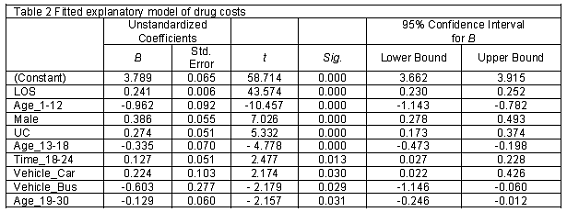
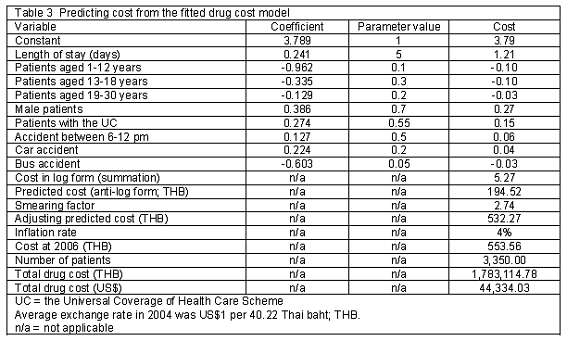
<body><![CDATA[<p>Three thousand seven hundred and twenty-three patients were analyzed. The    majority of patients were male (69.3%). The mean age of those involved was 31.28    years (SD=16.98), and most of the patients were younger than 30 years of age    (55.2%). Approximately half of the patients (52.7%) received treatment as in-patients.    Most payments (54.4%) were under the Universal Health Coverage Scheme (UC),    followed by out-of-pocket (26.6%), Civil Servants Medical Benefit Scheme (CSMBS)    (12.2%,), Social Security Scheme (SSS) (6.7%), and Motor Vehicle Accident Victim    Protection Insurance (0.1%). Additionally, the vehicle involved in most of the    patients’ accident was the motorcycle (77.7%). The total drug costs of all cases    (n = 3,723) was 2,725,206.65 THB or USD 67,757.50 (average exchange rate in    2004;15 USD 1 = 40.22 Thai baht; THB). The mean drug cost was 731.99 THB (USD    18.20) per patient with a median of 95.00 THB (USD 2.36). The 95% confidence    interval was 637.01THB (USD 15.84) to 826.97THB (USD 20.56).</p>     <p><b>Drug cost model</b></p>     <p>The cost model was formulated as an explanatory model. Drug cost as the dependent    variable was not normally distributed. Therefore, a natural logarithmic transformation    was undertaken. The predictor variable definitions are presented in <a href="#t1">Table    1</a>. <a href="#t2">Table 2</a> shows the fitted explanatory model with the    adjusted R2=0.449 and a probability-value of F statistics &lt;0.001. Thus, forty-five    percent of the variations in drug costs could be explained by the variables    included in the model. The significant predictor variables of drug costs were    prolonged length of stay, age group (Younger aged patients were associated with    lower costs than middle aged adults.), gender (male), Universal Coverage scheme    (UC), time of accident (18:00 – 24:00 o’clock), and type of vehicle (Bus use    was associated with a reduction in costs compared to motorcycles). The model    met the model checking criteria (Durbin-Watson =1.911, Leverage statistics =0.004,    Cook’s distance=0, VIF&lt;1.21, Tolerance &gt;0.826, Condition index &lt;5.95).14    The fitted model of drug cost is presented as follows:</p>     <p align="center"><a name="t2"><img border="0" src="/img/revistas/pharmacy/v6n1/009-014_02.gif" width="567" height="212"></a></p>      <p>(3) Lncost = 3.789 + 0.241 LOS - 0.962 Age_1-12 + 0.386 Male + 0.274 UC - 0.335 Age_13-18 + 0.127 Time_18-24 + 0.224 Vehicle_Car- 0.603 Vehicle_Bus – 0.129 Age_19-30</p>     <p>Alternatively, the model is presented in the following form:<sup>16</sup></p>     <p>(4) Ln_Cost = 3.789+(0.241xLength of stay)-(0.962x%Patients age 1-12 years)-    (0.335x% Patients age 13-18 years)-(0.129x% Patients age 19-30 years)+(0.386x%Male    patients)+(0.274x%Patients under UC scheme)+(0.127x%Patients during 6-12pm)+(0.224x%Patients    due to car accidents)-(0.603x% Patients due to bus accidents)</p>     <p>To estimate the expected response on an untransformed scale after fitting a    linear regression model of a transformed scale, there is a need to adjust it    by the smearing factor.<sup>17,18</sup> The smearing factor of the drug cost model in this    study was 2.7363. </p>     <p>To forecast the budget for the drug supply in 2006, based on our model, we    expect to have a 10% decrease in road accident-related cases due to the national    road safety campaign focusing on motorcycling behavior. The expected number    is 3,350 cases, with an average patient population of 70% male, five days of    hospitalization, 10% age 1-12 years, 30% age 13-18 years, 20% age 19-30 years,    45% under the Universal Coverage of Health Care Scheme, 50% accidents occurring    from 6-12 pm, 20% car accidents, and 5% bus accidents. The expected inflation    rate between 2004 and 2006 for medical care is 4%. The calculation was initially    done byplacing the value of the individual predictor variable into the model    to multiply it with the coefficient resulting in the cost caused by the variable.    Then, the summation of the costs was exponentiated, resulting in the cost in    anti-log form. This method was applied elsewhere.<sup>16</sup> This cost was    adjusted by multiplying with the smearing factor followed by the inflation rate.    Finally, the predicted drug cost per patient is 554 THB at 2006 prices. The    predicted total drug cost in 2006 is 1,783,115 THB or USD 44,334. The calculation    of the predicted cost is illustrated in <a href="#t3">Table 3</a>.</p>     <p align="center"><a name="t3"><img border="0" src="/img/revistas/pharmacy/v6n1/009-014_03.gif" width="567" height="341"></a></p>      ]]></body>
<body><![CDATA[<p>&nbsp;</p>     <p><b>DISCUSSION</b></p>     <p>The mean drug cost is USD 18.20 while the median is USD 2.36. This indicated    that the sample data is skewed to the right. The drug cost has a similar nature    to that of health care cost. A small proportion of patients incur extremely    high costs relative to most patients.<sup>19</sup> Particularly in this study,    the samples were injured patients from various types of road traffic accidents    including both out-patients and in-patients, with approximately half being out-patients.    Therefore, most of the patients’ symptoms might only have mild severity, even    though the study hospital is a regional tertiary hospital. In addition, the    hospital employed physicians with specialties and sub-specialties. Perhaps physicians    trained as specialists or sub-specialists may be more likely to use expensive    drugs from international pharmaceutical companies that must be imported into    Thailand. The prices of these drugs are much higher than domestically produced    drugs. Therefore, the average cost might not be generalizable to other Thai    hospitals, particularly the district hospitals. The fitted model of drug cost    presented in Equation 3 is explained by the following independent variables.    Three age groups between 1-30 years had a negative effect compared to the age    group of 31-60 years. This means that patients aged between 31-60 years had    higher drug costs than the other age groups. This might be because adult patients    receive higher doses of drugs than do children. This study did not account for    accident severity, though cost may be positively associated with levels of severity.<sup>7,20,21</sup>    Thus, it could be that adult patients were admitted with more severe injuries    than other age groups. For gender, the male patients showed higher costs than    the female patients. This could be explained by the fact that male patients    tend to be drunk drivers and exhibit a more aggressive driving behavior, thus    resulting in more severe injuries. The patients under the Universal Health Coverage    Scheme (UC) had lower costs than other insurance schemes. This might be an effect    of the health financing methods. Public hospitals in Thailand receive a fixed    per-capita budget per person registered to the UC. The physicians are urged    to control expenditure of such patients. This phenomenon is demonstrated in    other studies.<sup>13,22-24</sup> Similarly, the effect of insurance schemes    on drug costs has been published in the United States.<sup>16</sup> Regarding    to vehicle types, injuries due to bus accidents had less costs in contrast to    motorcycle accidents. It was found that only 10% of patients due to motorcycle    accidents wore helmets.<sup>25</sup> Therefore, these patients had a tendency    to have a higher accident severity. Considering the time of the accidents, it    was found that patients whose accidents occurred during the evening (6-12 pm)    had more drug costs than those whose accidents occurred at other times. This    might be related to the drunk-driving behavior. There was a study that reported    on severity of injuries and methods of transfer to the hospital as having an    effect on hospitalization.<sup>26</sup> These factors were not included in this    study. For future studies, the addition of such variables to the model might    increase the power of the model’s explanation. This is because hospitalization    has more effect on drug use than those of ambulatory services.</p>     <p>Management of the drug supply is one of the pivotal activities in the health    care system and covers the selection, procurement, distribution, and use of    the drugs.<sup>27</sup> Estimating future drug consumption is an important part of drug    supply management. Conventionally, there are three methods of estimating drug    requirements (i.e., population-based estimates, service-based estimates, and    consumption-based estimates).<sup>27</sup> Population-based estimates consider the epidemiological    assessment of a country’s most important diseases and health problems. Service-based    estimates are based on the number of services provided by the program. Consumption-based    estimates take into account previous utilization records. </p>     <p>The predicted total drug cost in 2006 is 1,783,115 THB or USD 44,334 as illustrated    in <a href="#t3">Table 3</a>. Conventionally, the total cost is estimated as    an arithmetic mean multiplied by the number of patients.<sup>28</sup> The mean cost is    adjusted by the inflation rate. Then, the total drug cost in 2006 would be 731.99    x 1.04 THB x 3,350 cases = 2,550,253 THB or USD 63,408. The difference is USD    19,074 or 43% higher than that of the predicted cost approach. The variation    of the forecasted budget is quite large. The predicted average drug costs from    the fitted model are calculated based on the forecasted epidemiological data    resulting from the road safety campaign. This would result in a more accurate    budget planning than that of forecasting based on only the mean statistic. This    technique has been applied elsewhere.<sup>16,29</sup> However, the exact model is not directly    exportable for use at other hospitals, although the methodology is. This can    be explained by the following reasons. First, drug costs change over time, it    is not static. Even if the variables remain constant, the coefficient values    of the variable will change over time. Second, the parameters in the model are    specific to the population studied. In different population characteristics,    different variables may be more predictive of drug costs than the ones tested    in this study.<sup>16</sup> In addition, it is essential to note that the variation of    cost among organizations is based on price variances (prices of resources used),    efficiency variances (resource use behavior), and volume variances (output production).<sup>30</sup></p>      <p>&nbsp;</p>     <p><b>CONCLUSION</b></p>     <p>Based on the fitted model, the significant predictor variables include patient    characteristics (age, gender, and health insurance schemes), accident characteristics    (type of vehicle and time of accident) and hospital service utilization (hospitalization    days). The predicted average drug cost from the fitted model and the epidemiological    forecast resulting from the road safety campaign will provide a more accurate    budget planning than that of forecasting based on a mean statistic. Therefore,    the cost model could be employed as a hospital financial management tool.</p>      <p>&nbsp;</p>     <p><b>ACKNOWLEDGMENTS</b></p>     ]]></body>
<body><![CDATA[<p>We would like to thank the director and the hospital staff of the Buddhachinaraj    Hospital. We would also like to extend our appreciation to Mr. Perry Whalley,    the Language Center, Faculty of Graduate Studies, Mahidol University for his    advice on manuscript presentation.</p>      <p>&nbsp;</p>     <p><b>CONFLICT OF INTEREST</b></p>     <p>None declared. Contract grant sponsor: The Health Promotion Foundation, Bangkok,    Thailand. </p>      <p>&nbsp;</p> <table border="1" width="100%">     <tr>       <td width="100%">             <p align="center"><b><font face="Arial">References</font></b></td>     </tr>   </table>        <!-- ref --><p>1. Sintuvanich A. The impact of industrialization on road traffic accidents in Thailand. J Med Assoc Thai. October 1, 1997 1997;80(10):631-635.    &nbsp;&nbsp;&nbsp;&nbsp;&nbsp;&nbsp;&nbsp;&nbsp;[&#160;<a href="javascript:void(0);" onclick="javascript: window.open('/scielo.php?script=sci_nlinks&ref=4231432&pid=S1885-642X200800010000200001&lng=','','width=640,height=500,resizable=yes,scrollbars=1,menubar=yes,');">Links</a>&#160;]<!-- end-ref --></p>     <!-- ref --><p>2. Alpha Research, ed. Thailand public health 2006-2007. Nonthaburi: Alpha Research; 2006.    &nbsp;&nbsp;&nbsp;&nbsp;&nbsp;&nbsp;&nbsp;&nbsp;[&#160;<a href="javascript:void(0);" onclick="javascript: window.open('/scielo.php?script=sci_nlinks&ref=4231434&pid=S1885-642X200800010000200002&lng=','','width=640,height=500,resizable=yes,scrollbars=1,menubar=yes,');">Links</a>&#160;]<!-- end-ref --></p>     ]]></body>
<body><![CDATA[<!-- ref --><p>3. Wibulpolprasert S, ed. Thailand health profile 2001-2004. Bangkok: Bureau of Policy and Strategy, Ministry of Public Health; 2005.    &nbsp;&nbsp;&nbsp;&nbsp;&nbsp;&nbsp;&nbsp;&nbsp;[&#160;<a href="javascript:void(0);" onclick="javascript: window.open('/scielo.php?script=sci_nlinks&ref=4231436&pid=S1885-642X200800010000200003&lng=','','width=640,height=500,resizable=yes,scrollbars=1,menubar=yes,');">Links</a>&#160;]<!-- end-ref --></p>     <!-- ref --><p>4. Srithamrongsawat S. Progress and achievement: universal coverage of health care scheme annual report 2004. Bangkok: National Health Security Office; 2004.    &nbsp;&nbsp;&nbsp;&nbsp;&nbsp;&nbsp;&nbsp;&nbsp;[&#160;<a href="javascript:void(0);" onclick="javascript: window.open('/scielo.php?script=sci_nlinks&ref=4231438&pid=S1885-642X200800010000200004&lng=','','width=640,height=500,resizable=yes,scrollbars=1,menubar=yes,');">Links</a>&#160;]<!-- end-ref --></p>     <!-- ref --><p>5. Tosutho R. Economic loss and road accident related factors &#091;Master of Science in Health Economics&#093;. Bangkok: Department of Economics, Chulalongkorn University; 1997.    &nbsp;&nbsp;&nbsp;&nbsp;&nbsp;&nbsp;&nbsp;&nbsp;[&#160;<a href="javascript:void(0);" onclick="javascript: window.open('/scielo.php?script=sci_nlinks&ref=4231440&pid=S1885-642X200800010000200005&lng=','','width=640,height=500,resizable=yes,scrollbars=1,menubar=yes,');">Links</a>&#160;]<!-- end-ref --></p>     <!-- ref --><p>6. Pitagpravej T. &#091;Economic losses due to transport accidents&#093; (in Thai Language). J Health Science. 1997;6(2):185-193.    &nbsp;&nbsp;&nbsp;&nbsp;&nbsp;&nbsp;&nbsp;&nbsp;[&#160;<a href="javascript:void(0);" onclick="javascript: window.open('/scielo.php?script=sci_nlinks&ref=4231442&pid=S1885-642X200800010000200006&lng=','','width=640,height=500,resizable=yes,scrollbars=1,menubar=yes,');">Links</a>&#160;]<!-- end-ref --></p>     <!-- ref --><p>7. Podhipak A. The study of costs of road accident among patients admitted in the general hospitals: Bangkok metropolitan area &#091;Master of Science in Public Health&#093;. Bangkok, Mahidol University; 1996.    &nbsp;&nbsp;&nbsp;&nbsp;&nbsp;&nbsp;&nbsp;&nbsp;[&#160;<a href="javascript:void(0);" onclick="javascript: window.open('/scielo.php?script=sci_nlinks&ref=4231444&pid=S1885-642X200800010000200007&lng=','','width=640,height=500,resizable=yes,scrollbars=1,menubar=yes,');">Links</a>&#160;]<!-- end-ref --></p>     ]]></body>
<body><![CDATA[<!-- ref --><p>8. Pulpanyawong K, Somboonkul S, Chadthong K. Epidemiologic characteristics of road traffic injuries in Chumphon Hospital, March-August 1997 (in Thai Language). J Health Science. 1998;7(3):311-318.    &nbsp;&nbsp;&nbsp;&nbsp;&nbsp;&nbsp;&nbsp;&nbsp;[&#160;<a href="javascript:void(0);" onclick="javascript: window.open('/scielo.php?script=sci_nlinks&ref=4231446&pid=S1885-642X200800010000200008&lng=','','width=640,height=500,resizable=yes,scrollbars=1,menubar=yes,');">Links</a>&#160;]<!-- end-ref --></p>     <!-- ref --><p>9. Suriyawongpaisal P, Kanchanasut S. Road traffic injuries in Thailand: trends, selected underlying determinants and status of intervention. Inj Control Saf Promot. 2003;10(1-2):95-104.    &nbsp;&nbsp;&nbsp;&nbsp;&nbsp;&nbsp;&nbsp;&nbsp;[&#160;<a href="javascript:void(0);" onclick="javascript: window.open('/scielo.php?script=sci_nlinks&ref=4231448&pid=S1885-642X200800010000200009&lng=','','width=640,height=500,resizable=yes,scrollbars=1,menubar=yes,');">Links</a>&#160;]<!-- end-ref --></p>     <!-- ref --><p>10. Kobelt G. Health economics: an introduction to economic evaluation. second ed. London: Office of Health Economics; 2002.    &nbsp;&nbsp;&nbsp;&nbsp;&nbsp;&nbsp;&nbsp;&nbsp;[&#160;<a href="javascript:void(0);" onclick="javascript: window.open('/scielo.php?script=sci_nlinks&ref=4231450&pid=S1885-642X200800010000200010&lng=','','width=640,height=500,resizable=yes,scrollbars=1,menubar=yes,');">Links</a>&#160;]<!-- end-ref --></p>     <!-- ref --><p>11. World Health Organization. ICD-10: International statistical classification of diseases and related health problems tenth revision. Geneva: World Health Organization; 1992.    &nbsp;&nbsp;&nbsp;&nbsp;&nbsp;&nbsp;&nbsp;&nbsp;[&#160;<a href="javascript:void(0);" onclick="javascript: window.open('/scielo.php?script=sci_nlinks&ref=4231452&pid=S1885-642X200800010000200011&lng=','','width=640,height=500,resizable=yes,scrollbars=1,menubar=yes,');">Links</a>&#160;]<!-- end-ref --></p>     <!-- ref --><p>12. Lwanga SK, Lemeshow S. Sample size determination in health studies: a practical manual. Geneva: World Health Organization; 1991.    &nbsp;&nbsp;&nbsp;&nbsp;&nbsp;&nbsp;&nbsp;&nbsp;[&#160;<a href="javascript:void(0);" onclick="javascript: window.open('/scielo.php?script=sci_nlinks&ref=4231454&pid=S1885-642X200800010000200012&lng=','','width=640,height=500,resizable=yes,scrollbars=1,menubar=yes,');">Links</a>&#160;]<!-- end-ref --></p>     ]]></body>
<body><![CDATA[<!-- ref --><p>13. Munnae K. Factors affecting drug and other treatment expenditure in traffic accident patients &#091;M.S. Thesis in Pharmacy (Pharmacy Administration)&#093;. Bangkok: Faculty of Graduate studies, Mahidol University; 1999.    &nbsp;&nbsp;&nbsp;&nbsp;&nbsp;&nbsp;&nbsp;&nbsp;[&#160;<a href="javascript:void(0);" onclick="javascript: window.open('/scielo.php?script=sci_nlinks&ref=4231456&pid=S1885-642X200800010000200013&lng=','','width=640,height=500,resizable=yes,scrollbars=1,menubar=yes,');">Links</a>&#160;]<!-- end-ref --></p>     <!-- ref --><p>14. Cohen J, Cohen P, West SG, Aiken LS. Applied multiple regression/ correlation analysis for the behavioral sciences Third ed. New Jersey: Lawrence Erlbaum Associates, Inc.; 2003.    &nbsp;&nbsp;&nbsp;&nbsp;&nbsp;&nbsp;&nbsp;&nbsp;[&#160;<a href="javascript:void(0);" onclick="javascript: window.open('/scielo.php?script=sci_nlinks&ref=4231458&pid=S1885-642X200800010000200014&lng=','','width=640,height=500,resizable=yes,scrollbars=1,menubar=yes,');">Links</a>&#160;]<!-- end-ref --></p>     <!-- ref --><p>15. Bank of Thailand. Foreign Exchange Rates Bank of Thailand. Available at:  <a target="_blank" href="http://www.bot.or.th/bothomepage/databank/FinMarkets/ExchangeRate/exchange_e.asp">http://www.bot.or.th/bothomepage/databank/FinMarkets/ExchangeRate/exchange_e.asp</a>. Accessed February 5, 2007.    &nbsp;&nbsp;&nbsp;&nbsp;&nbsp;&nbsp;&nbsp;&nbsp;[&#160;<a href="javascript:void(0);" onclick="javascript: window.open('/scielo.php?script=sci_nlinks&ref=4231460&pid=S1885-642X200800010000200015&lng=','','width=640,height=500,resizable=yes,scrollbars=1,menubar=yes,');">Links</a>&#160;]<!-- end-ref --></p>     <!-- ref --><p>16. Petitta A, Patel RP, Zarowitz BJ. Developing a drug-cost model for a capitated patient population in an integrated health care system. Am J Health Syst Pharm. 2002;59(2):143-146.    &nbsp;&nbsp;&nbsp;&nbsp;&nbsp;&nbsp;&nbsp;&nbsp;[&#160;<a href="javascript:void(0);" onclick="javascript: window.open('/scielo.php?script=sci_nlinks&ref=4231462&pid=S1885-642X200800010000200016&lng=','','width=640,height=500,resizable=yes,scrollbars=1,menubar=yes,');">Links</a>&#160;]<!-- end-ref --></p>     <!-- ref --><p>17. Duan N. Smearing estimator: a nonparametric retransformation method. J Am Stat Assoc. 1983;78(383):605-610.    &nbsp;&nbsp;&nbsp;&nbsp;&nbsp;&nbsp;&nbsp;&nbsp;[&#160;<a href="javascript:void(0);" onclick="javascript: window.open('/scielo.php?script=sci_nlinks&ref=4231464&pid=S1885-642X200800010000200017&lng=','','width=640,height=500,resizable=yes,scrollbars=1,menubar=yes,');">Links</a>&#160;]<!-- end-ref --></p>     ]]></body>
<body><![CDATA[<!-- ref --><p>18. Smith M, Barnett P. What is retransformation bias, and how can it be corrected? Available at: www.herc.research.med.va.gov/faqE2_retransformation.pdf Accessed August 5, 2005.    &nbsp;&nbsp;&nbsp;&nbsp;&nbsp;&nbsp;&nbsp;&nbsp;[&#160;<a href="javascript:void(0);" onclick="javascript: window.open('/scielo.php?script=sci_nlinks&ref=4231466&pid=S1885-642X200800010000200018&lng=','','width=640,height=500,resizable=yes,scrollbars=1,menubar=yes,');">Links</a>&#160;]<!-- end-ref --></p>     <!-- ref --><p>19. Zhou X-HA, Ramsey S. Assessing the equality of means of healthcare costs. Expert Rev Pharmacoeconomics Outcomes Res. 2003;3(5):561-567.    &nbsp;&nbsp;&nbsp;&nbsp;&nbsp;&nbsp;&nbsp;&nbsp;[&#160;<a href="javascript:void(0);" onclick="javascript: window.open('/scielo.php?script=sci_nlinks&ref=4231468&pid=S1885-642X200800010000200019&lng=','','width=640,height=500,resizable=yes,scrollbars=1,menubar=yes,');">Links</a>&#160;]<!-- end-ref --></p>     <!-- ref --><p>20. Hendrie D, Rosman DL, Harris AH. Hospital inpatient costs resulting from road crashes in Western Australia. Aust J Public Health. 1994;18(4):380-388.    &nbsp;&nbsp;&nbsp;&nbsp;&nbsp;&nbsp;&nbsp;&nbsp;[&#160;<a href="javascript:void(0);" onclick="javascript: window.open('/scielo.php?script=sci_nlinks&ref=4231470&pid=S1885-642X200800010000200020&lng=','','width=640,height=500,resizable=yes,scrollbars=1,menubar=yes,');">Links</a>&#160;]<!-- end-ref --></p>     <!-- ref --><p>21. Langley JD, Phillips D, Marshall SW. Inpatient costs of injury due to motor vehicle traffic crashes in New Zealand. Accid Anal Prev. 1993;25(5):585-592.    &nbsp;&nbsp;&nbsp;&nbsp;&nbsp;&nbsp;&nbsp;&nbsp;[&#160;<a href="javascript:void(0);" onclick="javascript: window.open('/scielo.php?script=sci_nlinks&ref=4231472&pid=S1885-642X200800010000200021&lng=','','width=640,height=500,resizable=yes,scrollbars=1,menubar=yes,');">Links</a>&#160;]<!-- end-ref --></p>     <!-- ref --><p>22. Chaikledkaew U, Pongcharoensuk P, Ongphiphadhanakul B, Chaiyakunapruk N. Factors associated with healthcare expenditures and hospitalizations in Thai patients with diabetes at four public hospitals. Mahidol Univ J Pharm Sci. 2005;32:1-6.    &nbsp;&nbsp;&nbsp;&nbsp;&nbsp;&nbsp;&nbsp;&nbsp;[&#160;<a href="javascript:void(0);" onclick="javascript: window.open('/scielo.php?script=sci_nlinks&ref=4231474&pid=S1885-642X200800010000200022&lng=','','width=640,height=500,resizable=yes,scrollbars=1,menubar=yes,');">Links</a>&#160;]<!-- end-ref --></p>     ]]></body>
<body><![CDATA[<!-- ref --><p>23. Riewpaiboon A, Intraprakan K, Phoungkatesunthorn S. Predicting treatment cost of bacterial diarrhea at a regional Hospital in Thailand. Bangkok: Faculty of Pharmacy, Mahidol University; 2007.    &nbsp;&nbsp;&nbsp;&nbsp;&nbsp;&nbsp;&nbsp;&nbsp;[&#160;<a href="javascript:void(0);" onclick="javascript: window.open('/scielo.php?script=sci_nlinks&ref=4231476&pid=S1885-642X200800010000200023&lng=','','width=640,height=500,resizable=yes,scrollbars=1,menubar=yes,');">Links</a>&#160;]<!-- end-ref --></p>     <!-- ref --><p>24. Riewpaiboon A, Youngkong S, Sreshthaputra N, Stewart JF, Samosornsuk S, Chaicumpa W, et al. A cost function analysis of shigellosis in Thailand. Value in Health 2008 (accepted).    &nbsp;&nbsp;&nbsp;&nbsp;&nbsp;&nbsp;&nbsp;&nbsp;[&#160;<a href="javascript:void(0);" onclick="javascript: window.open('/scielo.php?script=sci_nlinks&ref=4231478&pid=S1885-642X200800010000200024&lng=','','width=640,height=500,resizable=yes,scrollbars=1,menubar=yes,');">Links</a>&#160;]<!-- end-ref --></p>     <!-- ref --><p>25. Thanaboriboon Y. Risk factors of road traffic accident (in Thai language). Health situation in Thailand. 2006;2(10):1-6.    &nbsp;&nbsp;&nbsp;&nbsp;&nbsp;&nbsp;&nbsp;&nbsp;[&#160;<a href="javascript:void(0);" onclick="javascript: window.open('/scielo.php?script=sci_nlinks&ref=4231480&pid=S1885-642X200800010000200025&lng=','','width=640,height=500,resizable=yes,scrollbars=1,menubar=yes,');">Links</a>&#160;]<!-- end-ref --></p>     <!-- ref --><p>26. Jirojwong S, Rudtanasudjatum K, Watcharavitoon P, Sathitsathien W, Sangjun S. Non-fatal injuries sustained in road traffic accidents: a pilot study in provincial hospitals in Chon Buri, Thailand. Southeast Asian J Trop Med Public Health. 2002;33(1):193-200.    &nbsp;&nbsp;&nbsp;&nbsp;&nbsp;&nbsp;&nbsp;&nbsp;[&#160;<a href="javascript:void(0);" onclick="javascript: window.open('/scielo.php?script=sci_nlinks&ref=4231482&pid=S1885-642X200800010000200026&lng=','','width=640,height=500,resizable=yes,scrollbars=1,menubar=yes,');">Links</a>&#160;]<!-- end-ref --></p>     <!-- ref --><p>27. Bates J, Henk dB, Cross PN, Dias V, Hartman AF, Hewitt W, et al. Managing drug supply; the selection, procurement, distribution, and use of pharmaceuticals in primary health care. Boston: Management Sciences for Health; 1981.    &nbsp;&nbsp;&nbsp;&nbsp;&nbsp;&nbsp;&nbsp;&nbsp;[&#160;<a href="javascript:void(0);" onclick="javascript: window.open('/scielo.php?script=sci_nlinks&ref=4231484&pid=S1885-642X200800010000200027&lng=','','width=640,height=500,resizable=yes,scrollbars=1,menubar=yes,');">Links</a>&#160;]<!-- end-ref --></p>     ]]></body>
<body><![CDATA[<!-- ref --><p>28. Barber JA, Thompson SG. Analysis and interpretation of cost data in randomised controlled trials: review of published studies. BMJ. 1998;317:1195-1200.    &nbsp;&nbsp;&nbsp;&nbsp;&nbsp;&nbsp;&nbsp;&nbsp;[&#160;<a href="javascript:void(0);" onclick="javascript: window.open('/scielo.php?script=sci_nlinks&ref=4231486&pid=S1885-642X200800010000200028&lng=','','width=640,height=500,resizable=yes,scrollbars=1,menubar=yes,');">Links</a>&#160;]<!-- end-ref --></p>     <!-- ref --><p>29. Hoffman JM, Shah ND, Vermeulen LC, Hunkler RJ, Hontz KM. Projecting future drug expenditures--2005. Am J Health Syst Pharm. 2005;62:149-167.    &nbsp;&nbsp;&nbsp;&nbsp;&nbsp;&nbsp;&nbsp;&nbsp;[&#160;<a href="javascript:void(0);" onclick="javascript: window.open('/scielo.php?script=sci_nlinks&ref=4231488&pid=S1885-642X200800010000200029&lng=','','width=640,height=500,resizable=yes,scrollbars=1,menubar=yes,');">Links</a>&#160;]<!-- end-ref --></p>     <!-- ref --><p>30. Shepard DS, Hodgkin D, Anthony YE. Analysis of hospital costs: a manual for managers. Geneva: The World Health Organization; 2000.    &nbsp;&nbsp;&nbsp;&nbsp;&nbsp;&nbsp;&nbsp;&nbsp;[&#160;<a href="javascript:void(0);" onclick="javascript: window.open('/scielo.php?script=sci_nlinks&ref=4231490&pid=S1885-642X200800010000200030&lng=','','width=640,height=500,resizable=yes,scrollbars=1,menubar=yes,');">Links</a>&#160;]<!-- end-ref --></p>      ]]></body><back>
<ref-list>
<ref id="B1">
<label>1</label><nlm-citation citation-type="journal">
<person-group person-group-type="author">
<name>
<surname><![CDATA[Sintuvanich]]></surname>
<given-names><![CDATA[A]]></given-names>
</name>
</person-group>
<article-title xml:lang="en"><![CDATA[The impact of industrialization on road traffic accidents in Thailand]]></article-title>
<source><![CDATA[J Med Assoc Thai]]></source>
<year>Octo</year>
<month>be</month>
<day>r </day>
<volume>80</volume>
<numero>10</numero>
<issue>10</issue>
<page-range>631-635</page-range></nlm-citation>
</ref>
<ref id="B2">
<label>2</label><nlm-citation citation-type="book">
<source><![CDATA[Thailand public health 2006-2007]]></source>
<year>2006</year>
<publisher-loc><![CDATA[Nonthaburi ]]></publisher-loc>
<publisher-name><![CDATA[Alpha Research]]></publisher-name>
</nlm-citation>
</ref>
<ref id="B3">
<label>3</label><nlm-citation citation-type="book">
<person-group person-group-type="author">
<name>
<surname><![CDATA[Wibulpolprasert]]></surname>
<given-names><![CDATA[S]]></given-names>
</name>
</person-group>
<source><![CDATA[Thailand health profile 2001-2004]]></source>
<year>2005</year>
<publisher-loc><![CDATA[Bangkok ]]></publisher-loc>
<publisher-name><![CDATA[Bureau of Policy and Strategy, Ministry of Public Health]]></publisher-name>
</nlm-citation>
</ref>
<ref id="B4">
<label>4</label><nlm-citation citation-type="book">
<person-group person-group-type="author">
<name>
<surname><![CDATA[Srithamrongsawat]]></surname>
<given-names><![CDATA[S]]></given-names>
</name>
</person-group>
<source><![CDATA[Progress and achievement: universal coverage of health care scheme annual report 2004]]></source>
<year>2004</year>
<publisher-loc><![CDATA[Bangkok ]]></publisher-loc>
<publisher-name><![CDATA[National Health Security Office]]></publisher-name>
</nlm-citation>
</ref>
<ref id="B5">
<label>5</label><nlm-citation citation-type="book">
<person-group person-group-type="author">
<name>
<surname><![CDATA[Tosutho]]></surname>
<given-names><![CDATA[R]]></given-names>
</name>
</person-group>
<source><![CDATA[Economic loss and road accident related factors]]></source>
<year>1997</year>
<publisher-loc><![CDATA[Bangkok ]]></publisher-loc>
<publisher-name><![CDATA[Department of Economics, Chulalongkorn University]]></publisher-name>
</nlm-citation>
</ref>
<ref id="B6">
<label>6</label><nlm-citation citation-type="journal">
<person-group person-group-type="author">
<name>
<surname><![CDATA[Pitagpravej]]></surname>
<given-names><![CDATA[T]]></given-names>
</name>
</person-group>
<article-title xml:lang="en"><![CDATA[Economic losses due to transport accidents: in Thai Language]]></article-title>
<source><![CDATA[J Health Science]]></source>
<year>1997</year>
<volume>6</volume>
<numero>2</numero>
<issue>2</issue>
<page-range>185-193</page-range></nlm-citation>
</ref>
<ref id="B7">
<label>7</label><nlm-citation citation-type="book">
<person-group person-group-type="author">
<name>
<surname><![CDATA[Podhipak]]></surname>
<given-names><![CDATA[A]]></given-names>
</name>
</person-group>
<source><![CDATA[The study of costs of road accident among patients admitted in the general hospitals: Bangkok metropolitan area]]></source>
<year>1996</year>
<publisher-loc><![CDATA[Bangkok ]]></publisher-loc>
<publisher-name><![CDATA[Mahidol University]]></publisher-name>
</nlm-citation>
</ref>
<ref id="B8">
<label>8</label><nlm-citation citation-type="journal">
<person-group person-group-type="author">
<name>
<surname><![CDATA[Pulpanyawong]]></surname>
<given-names><![CDATA[K]]></given-names>
</name>
<name>
<surname><![CDATA[Somboonkul]]></surname>
<given-names><![CDATA[S]]></given-names>
</name>
<name>
<surname><![CDATA[Chadthong]]></surname>
<given-names><![CDATA[K]]></given-names>
</name>
</person-group>
<article-title xml:lang="en"><![CDATA[Epidemiologic characteristics of road traffic injuries in Chumphon Hospital]]></article-title>
<source><![CDATA[J Health Science]]></source>
<year>Marc</year>
<month>h-</month>
<day>Au</day>
<volume>7</volume>
<numero>3</numero>
<issue>3</issue>
<page-range>311-318</page-range></nlm-citation>
</ref>
<ref id="B9">
<label>9</label><nlm-citation citation-type="journal">
<person-group person-group-type="author">
<name>
<surname><![CDATA[Suriyawongpaisal]]></surname>
<given-names><![CDATA[P]]></given-names>
</name>
<name>
<surname><![CDATA[Kanchanasut]]></surname>
<given-names><![CDATA[S]]></given-names>
</name>
</person-group>
<article-title xml:lang="en"><![CDATA[Road traffic injuries in Thailand: trends, selected underlying determinants and status of intervention]]></article-title>
<source><![CDATA[Inj Control Saf Promot]]></source>
<year>2003</year>
<volume>10</volume>
<numero>1-2</numero>
<issue>1-2</issue>
<page-range>95-104</page-range></nlm-citation>
</ref>
<ref id="B10">
<label>10</label><nlm-citation citation-type="book">
<person-group person-group-type="author">
<name>
<surname><![CDATA[Kobelt]]></surname>
<given-names><![CDATA[G]]></given-names>
</name>
</person-group>
<source><![CDATA[Health economics: an introduction to economic evaluation]]></source>
<year>2002</year>
<edition>second</edition>
<publisher-loc><![CDATA[London ]]></publisher-loc>
<publisher-name><![CDATA[Office of Health Economics]]></publisher-name>
</nlm-citation>
</ref>
<ref id="B11">
<label>11</label><nlm-citation citation-type="book">
<collab>World Health Organization</collab>
<source><![CDATA[ICD-10: International statistical classification of diseases and related health problems tenth revision]]></source>
<year>1992</year>
<publisher-loc><![CDATA[Geneva ]]></publisher-loc>
<publisher-name><![CDATA[World Health Organization]]></publisher-name>
</nlm-citation>
</ref>
<ref id="B12">
<label>12</label><nlm-citation citation-type="book">
<person-group person-group-type="author">
<name>
<surname><![CDATA[Lwanga]]></surname>
<given-names><![CDATA[SK]]></given-names>
</name>
<name>
<surname><![CDATA[Lemeshow]]></surname>
<given-names><![CDATA[S]]></given-names>
</name>
</person-group>
<source><![CDATA[Sample size determination in health studies: a practical manual]]></source>
<year>1991</year>
<publisher-loc><![CDATA[Geneva ]]></publisher-loc>
<publisher-name><![CDATA[World Health Organization]]></publisher-name>
</nlm-citation>
</ref>
<ref id="B13">
<label>13</label><nlm-citation citation-type="book">
<person-group person-group-type="author">
<name>
<surname><![CDATA[Munnae]]></surname>
<given-names><![CDATA[K]]></given-names>
</name>
</person-group>
<source><![CDATA[Factors affecting drug and other treatment expenditure in traffic accident patients]]></source>
<year>1999</year>
<publisher-loc><![CDATA[Bangkok ]]></publisher-loc>
<publisher-name><![CDATA[Faculty of Graduate studies, Mahidol University]]></publisher-name>
</nlm-citation>
</ref>
<ref id="B14">
<label>14</label><nlm-citation citation-type="book">
<person-group person-group-type="author">
<name>
<surname><![CDATA[Cohen]]></surname>
<given-names><![CDATA[J]]></given-names>
</name>
<name>
<surname><![CDATA[Cohen]]></surname>
<given-names><![CDATA[P]]></given-names>
</name>
<name>
<surname><![CDATA[West]]></surname>
<given-names><![CDATA[SG]]></given-names>
</name>
<name>
<surname><![CDATA[Aiken]]></surname>
<given-names><![CDATA[LS]]></given-names>
</name>
</person-group>
<source><![CDATA[Applied multiple regression/ correlation analysis for the behavioral sciences]]></source>
<year>2003</year>
<edition>Third</edition>
<publisher-loc><![CDATA[New Jersey ]]></publisher-loc>
<publisher-name><![CDATA[Lawrence Erlbaum Associates, Inc.]]></publisher-name>
</nlm-citation>
</ref>
<ref id="B15">
<label>15</label><nlm-citation citation-type="">
<source><![CDATA[Bank of Thailand: Foreign Exchange Rates Bank of Thailand]]></source>
<year>Febr</year>
<month>ua</month>
<day>ry</day>
</nlm-citation>
</ref>
<ref id="B16">
<label>16</label><nlm-citation citation-type="journal">
<person-group person-group-type="author">
<name>
<surname><![CDATA[Petitta]]></surname>
<given-names><![CDATA[A]]></given-names>
</name>
<name>
<surname><![CDATA[Patel]]></surname>
<given-names><![CDATA[RP]]></given-names>
</name>
<name>
<surname><![CDATA[Zarowitz]]></surname>
<given-names><![CDATA[BJ]]></given-names>
</name>
</person-group>
<article-title xml:lang="en"><![CDATA[Developing a drug-cost model for a capitated patient population in an integrated health care system]]></article-title>
<source><![CDATA[Am J Health Syst Pharm]]></source>
<year>2002</year>
<volume>59</volume>
<numero>2</numero>
<issue>2</issue>
<page-range>143-146</page-range></nlm-citation>
</ref>
<ref id="B17">
<label>17</label><nlm-citation citation-type="journal">
<person-group person-group-type="author">
<name>
<surname><![CDATA[Duan]]></surname>
<given-names><![CDATA[N]]></given-names>
</name>
</person-group>
<article-title xml:lang="en"><![CDATA[Smearing estimator: a nonparametric retransformation method]]></article-title>
<source><![CDATA[J Am Stat Assoc]]></source>
<year>1983</year>
<volume>78</volume>
<numero>383</numero>
<issue>383</issue>
<page-range>605-610</page-range></nlm-citation>
</ref>
<ref id="B18">
<label>18</label><nlm-citation citation-type="">
<person-group person-group-type="author">
<name>
<surname><![CDATA[Smith]]></surname>
<given-names><![CDATA[M]]></given-names>
</name>
<name>
<surname><![CDATA[Barnett]]></surname>
<given-names><![CDATA[P]]></given-names>
</name>
</person-group>
<source><![CDATA[What is retransformation bias, and how can it be corrected?]]></source>
<year>Augu</year>
<month>st</month>
<day> 5</day>
</nlm-citation>
</ref>
<ref id="B19">
<label>19</label><nlm-citation citation-type="journal">
<person-group person-group-type="author">
<name>
<surname><![CDATA[Zhou]]></surname>
<given-names><![CDATA[X-HA]]></given-names>
</name>
<name>
<surname><![CDATA[Ramsey]]></surname>
<given-names><![CDATA[S]]></given-names>
</name>
</person-group>
<article-title xml:lang="en"><![CDATA[Assessing the equality of means of healthcare costs]]></article-title>
<source><![CDATA[Expert Rev Pharmacoeconomics Outcomes Res]]></source>
<year>2003</year>
<volume>3</volume>
<numero>5</numero>
<issue>5</issue>
<page-range>561-567</page-range></nlm-citation>
</ref>
<ref id="B20">
<label>20</label><nlm-citation citation-type="journal">
<person-group person-group-type="author">
<name>
<surname><![CDATA[Hendrie]]></surname>
<given-names><![CDATA[D]]></given-names>
</name>
<name>
<surname><![CDATA[Rosman]]></surname>
<given-names><![CDATA[DL]]></given-names>
</name>
<name>
<surname><![CDATA[Harris]]></surname>
<given-names><![CDATA[AH]]></given-names>
</name>
</person-group>
<article-title xml:lang="en"><![CDATA[Hospital inpatient costs resulting from road crashes in Western Australia]]></article-title>
<source><![CDATA[Aust J Public Health]]></source>
<year>1994</year>
<volume>18</volume>
<numero>4</numero>
<issue>4</issue>
<page-range>380-388</page-range></nlm-citation>
</ref>
<ref id="B21">
<label>21</label><nlm-citation citation-type="journal">
<person-group person-group-type="author">
<name>
<surname><![CDATA[Langley]]></surname>
<given-names><![CDATA[JD]]></given-names>
</name>
<name>
<surname><![CDATA[Phillips]]></surname>
<given-names><![CDATA[D]]></given-names>
</name>
<name>
<surname><![CDATA[Marshall]]></surname>
<given-names><![CDATA[SW]]></given-names>
</name>
</person-group>
<article-title xml:lang="en"><![CDATA[Inpatient costs of injury due to motor vehicle traffic crashes in New Zealand]]></article-title>
<source><![CDATA[Accid Anal Prev]]></source>
<year>1993</year>
<volume>25</volume>
<numero>5</numero>
<issue>5</issue>
<page-range>585-592</page-range></nlm-citation>
</ref>
<ref id="B22">
<label>22</label><nlm-citation citation-type="journal">
<person-group person-group-type="author">
<name>
<surname><![CDATA[Chaikledkaew]]></surname>
<given-names><![CDATA[U]]></given-names>
</name>
<name>
<surname><![CDATA[Pongcharoensuk]]></surname>
<given-names><![CDATA[P]]></given-names>
</name>
<name>
<surname><![CDATA[Ongphiphadhanakul]]></surname>
<given-names><![CDATA[B]]></given-names>
</name>
<name>
<surname><![CDATA[Chaiyakunapruk]]></surname>
<given-names><![CDATA[N]]></given-names>
</name>
</person-group>
<article-title xml:lang="en"><![CDATA[Factors associated with healthcare expenditures and hospitalizations in Thai patients with diabetes at four public hospitals]]></article-title>
<source><![CDATA[Mahidol Univ J Pharm Sci]]></source>
<year>2005</year>
<volume>32</volume>
<page-range>1-6</page-range></nlm-citation>
</ref>
<ref id="B23">
<label>23</label><nlm-citation citation-type="book">
<person-group person-group-type="author">
<name>
<surname><![CDATA[Riewpaiboon]]></surname>
<given-names><![CDATA[A]]></given-names>
</name>
<name>
<surname><![CDATA[Intraprakan]]></surname>
<given-names><![CDATA[K]]></given-names>
</name>
<name>
<surname><![CDATA[Phoungkatesunthorn]]></surname>
<given-names><![CDATA[S]]></given-names>
</name>
</person-group>
<source><![CDATA[Predicting treatment cost of bacterial diarrhea at a regional Hospital in Thailand. Bangkok]]></source>
<year>2007</year>
<publisher-name><![CDATA[Faculty of Pharmacy]]></publisher-name>
</nlm-citation>
</ref>
<ref id="B24">
<label>24</label><nlm-citation citation-type="journal">
<person-group person-group-type="author">
<name>
<surname><![CDATA[Riewpaiboon]]></surname>
<given-names><![CDATA[A]]></given-names>
</name>
<name>
<surname><![CDATA[Youngkong]]></surname>
<given-names><![CDATA[S]]></given-names>
</name>
<name>
<surname><![CDATA[Sreshthaputra]]></surname>
<given-names><![CDATA[N]]></given-names>
</name>
<name>
<surname><![CDATA[Stewart]]></surname>
<given-names><![CDATA[JF]]></given-names>
</name>
<name>
<surname><![CDATA[Samosornsuk]]></surname>
<given-names><![CDATA[S]]></given-names>
</name>
<name>
<surname><![CDATA[Chaicumpa]]></surname>
<given-names><![CDATA[W]]></given-names>
</name>
</person-group>
<article-title xml:lang="en"><![CDATA[A cost function analysis of shigellosis in Thailand]]></article-title>
<source><![CDATA[Value in Health]]></source>
<year>2008</year>
</nlm-citation>
</ref>
<ref id="B25">
<label>25</label><nlm-citation citation-type="journal">
<person-group person-group-type="author">
<name>
<surname><![CDATA[Thanaboriboon]]></surname>
<given-names><![CDATA[Y]]></given-names>
</name>
</person-group>
<article-title xml:lang="en"><![CDATA[Risk factors of road traffic accident (in Thai language)]]></article-title>
<source><![CDATA[Health situation in Thailand]]></source>
<year>2006</year>
<volume>2</volume>
<numero>10</numero>
<issue>10</issue>
<page-range>1-6</page-range></nlm-citation>
</ref>
<ref id="B26">
<label>26</label><nlm-citation citation-type="journal">
<person-group person-group-type="author">
<name>
<surname><![CDATA[Jirojwong]]></surname>
<given-names><![CDATA[S]]></given-names>
</name>
<name>
<surname><![CDATA[Rudtanasudjatum]]></surname>
<given-names><![CDATA[K]]></given-names>
</name>
<name>
<surname><![CDATA[Watcharavitoon]]></surname>
<given-names><![CDATA[P]]></given-names>
</name>
<name>
<surname><![CDATA[Sathitsathien]]></surname>
<given-names><![CDATA[W]]></given-names>
</name>
<name>
<surname><![CDATA[Sangjun]]></surname>
<given-names><![CDATA[S]]></given-names>
</name>
</person-group>
<article-title xml:lang="en"><![CDATA[Non-fatal injuries sustained in road traffic accidents: a pilot study in provincial hospitals in Chon Buri, Thailand]]></article-title>
<source><![CDATA[Southeast Asian J Trop Med Public Health]]></source>
<year>2002</year>
<volume>33</volume>
<numero>1</numero>
<issue>1</issue>
<page-range>193-200</page-range></nlm-citation>
</ref>
<ref id="B27">
<label>27</label><nlm-citation citation-type="book">
<person-group person-group-type="author">
<name>
<surname><![CDATA[Bates]]></surname>
<given-names><![CDATA[J]]></given-names>
</name>
<name>
<surname><![CDATA[Henk]]></surname>
<given-names><![CDATA[dB]]></given-names>
</name>
<name>
<surname><![CDATA[Cross]]></surname>
<given-names><![CDATA[PN]]></given-names>
</name>
<name>
<surname><![CDATA[Dias]]></surname>
<given-names><![CDATA[V]]></given-names>
</name>
<name>
<surname><![CDATA[Hartman]]></surname>
<given-names><![CDATA[AF]]></given-names>
</name>
<name>
<surname><![CDATA[Hewitt]]></surname>
<given-names><![CDATA[W]]></given-names>
</name>
</person-group>
<source><![CDATA[Managing drug supply; the selection, procurement, distribution, and use of pharmaceuticals in primary health care]]></source>
<year>1981</year>
<publisher-loc><![CDATA[Boston ]]></publisher-loc>
<publisher-name><![CDATA[Management Sciences for Health]]></publisher-name>
</nlm-citation>
</ref>
<ref id="B28">
<label>28</label><nlm-citation citation-type="journal">
<person-group person-group-type="author">
<name>
<surname><![CDATA[Barber]]></surname>
<given-names><![CDATA[JA]]></given-names>
</name>
<name>
<surname><![CDATA[Thompson]]></surname>
<given-names><![CDATA[SG]]></given-names>
</name>
</person-group>
<article-title xml:lang="en"><![CDATA[Analysis and interpretation of cost data in randomised controlled trials: review of published studies]]></article-title>
<source><![CDATA[BMJ]]></source>
<year>1998</year>
<volume>317</volume>
<page-range>1195-1200</page-range></nlm-citation>
</ref>
<ref id="B29">
<label>29</label><nlm-citation citation-type="journal">
<person-group person-group-type="author">
<name>
<surname><![CDATA[Hoffman]]></surname>
<given-names><![CDATA[JM]]></given-names>
</name>
<name>
<surname><![CDATA[Shah]]></surname>
<given-names><![CDATA[ND]]></given-names>
</name>
<name>
<surname><![CDATA[Vermeulen]]></surname>
<given-names><![CDATA[LC]]></given-names>
</name>
<name>
<surname><![CDATA[Hunkler]]></surname>
<given-names><![CDATA[RJ]]></given-names>
</name>
<name>
<surname><![CDATA[Hontz]]></surname>
<given-names><![CDATA[KM]]></given-names>
</name>
</person-group>
<article-title xml:lang="en"><![CDATA[Projecting future drug expenditures--2005]]></article-title>
<source><![CDATA[Am J Health Syst Pharm]]></source>
<year>2005</year>
<volume>62</volume>
<page-range>149-167</page-range></nlm-citation>
</ref>
<ref id="B30">
<label>30</label><nlm-citation citation-type="book">
<person-group person-group-type="author">
<name>
<surname><![CDATA[Shepard]]></surname>
<given-names><![CDATA[DS]]></given-names>
</name>
<name>
<surname><![CDATA[Hodgkin]]></surname>
<given-names><![CDATA[D]]></given-names>
</name>
<name>
<surname><![CDATA[Anthony]]></surname>
<given-names><![CDATA[YE]]></given-names>
</name>
</person-group>
<source><![CDATA[Analysis of hospital costs: a manual for managers]]></source>
<year>2000</year>
<publisher-loc><![CDATA[Geneva ]]></publisher-loc>
<publisher-name><![CDATA[The World Health Organization]]></publisher-name>
</nlm-citation>
</ref>
</ref-list>
</back>
</article>