<?xml version="1.0" encoding="ISO-8859-1"?><article xmlns:mml="http://www.w3.org/1998/Math/MathML" xmlns:xlink="http://www.w3.org/1999/xlink" xmlns:xsi="http://www.w3.org/2001/XMLSchema-instance">
<front>
<journal-meta>
<journal-id>1885-642X</journal-id>
<journal-title><![CDATA[Pharmacy Practice (Granada)]]></journal-title>
<abbrev-journal-title><![CDATA[Pharmacy Pract (Granada)]]></abbrev-journal-title>
<issn>1885-642X</issn>
<publisher>
<publisher-name><![CDATA[Centro de Investigaciones y Publicaciones Farmacéuticas]]></publisher-name>
</publisher>
</journal-meta>
<article-meta>
<article-id>S1885-642X2008000100003</article-id>
<title-group>
<article-title xml:lang="en"><![CDATA[Perception of teratogenic and foetotoxic risk by health professionals: a survey in Midi-Pyrenees area]]></article-title>
</title-group>
<contrib-group>
<contrib contrib-type="author">
<name>
<surname><![CDATA[Damase-Michel]]></surname>
<given-names><![CDATA[Christine]]></given-names>
</name>
<xref ref-type="aff" rid="A01"/>
</contrib>
<contrib contrib-type="author">
<name>
<surname><![CDATA[Pichereau]]></surname>
<given-names><![CDATA[Juliette]]></given-names>
</name>
<xref ref-type="aff" rid="A01"/>
</contrib>
<contrib contrib-type="author">
<name>
<surname><![CDATA[Pathak]]></surname>
<given-names><![CDATA[Atul]]></given-names>
</name>
<xref ref-type="aff" rid="A01"/>
</contrib>
<contrib contrib-type="author">
<name>
<surname><![CDATA[Lacroix]]></surname>
<given-names><![CDATA[Isabelle]]></given-names>
</name>
<xref ref-type="aff" rid="A01"/>
</contrib>
<contrib contrib-type="author">
<name>
<surname><![CDATA[Montastruc]]></surname>
<given-names><![CDATA[Jean Louis]]></given-names>
</name>
<xref ref-type="aff" rid="A01"/>
</contrib>
</contrib-group>
<aff id="A01">
<institution><![CDATA[,University of Toulouse III Paul Sabatier Faculty of Medicine Research Unit of Pharmacoepidemiology]]></institution>
<addr-line><![CDATA[ ]]></addr-line>
<country>France</country>
</aff>
<pub-date pub-type="pub">
<day>00</day>
<month>03</month>
<year>2008</year>
</pub-date>
<pub-date pub-type="epub">
<day>00</day>
<month>03</month>
<year>2008</year>
</pub-date>
<volume>6</volume>
<numero>1</numero>
<fpage>15</fpage>
<lpage>19</lpage>
<copyright-statement/>
<copyright-year/>
<self-uri xlink:href="http://scielo.isciii.es/scielo.php?script=sci_arttext&amp;pid=S1885-642X2008000100003&amp;lng=en&amp;nrm=iso"></self-uri><self-uri xlink:href="http://scielo.isciii.es/scielo.php?script=sci_abstract&amp;pid=S1885-642X2008000100003&amp;lng=en&amp;nrm=iso"></self-uri><self-uri xlink:href="http://scielo.isciii.es/scielo.php?script=sci_pdf&amp;pid=S1885-642X2008000100003&amp;lng=en&amp;nrm=iso"></self-uri><abstract abstract-type="short" xml:lang="en"><p><![CDATA[Counselling or prescribing drugs during pregnancy requires health professionals to assess risk/benefit ratio for women and their baby. A misperception of the risk may lead to inappropriate decisions for pregnancy outcomes. The aim of the present study was to assess teratogenic and/or foetotoxic risk perception of common medications by general practitioners (GPs) and community pharmacists (CPs) from the Midi-Pyrenees area. Methods: 103 GPs and 104 CPs were interviewed. For 21 given drugs, a visual-analogue scale was used to evaluate the risk to give birth to a malformed infant if the mother had taken the drug during first trimester of pregnancy. For 9 drugs, health professionals had to say if they thought there was a potential foetotoxic and/or neonatal risk when drugs were administered during late pregnancy. Results: 97% and 91% of GPs and CPs respectively thought that isotretinoin and thalidomide are teratogenic and more than 80% thought that amoxicillin and acetaminophen are safe in early pregnancy. However, 19% of the GPs and 33% of CPs answered there were no teratogenic risk for valproate. Around 11% of both GPs and CPs said that warfarin was safe during pregnancy. For 22% of GPs and for 13% and 27% of CPs respectively, ibuprofen and enalapril were safe on late pregnancy. For each drug, mean value of perceived teratogenic risk by health professionals was higher than values that can be found in scientific references. Concerning isotretinoin, thalidomide and metoclopramide, perceived teratogenic risk was higher for CPs. Conclusion: These data show that the potential teratogenic and foetotoxic risk of several commonly used drugs is unknown by health professionals. Conversely, GPs and CPs who think that a risk exists, overestimate it. This misperception can lead to inappropriate decisions for pregnancy outcomes.]]></p></abstract>
<abstract abstract-type="short" xml:lang="es"><p><![CDATA[Aconsejar o prescribir medicamentos durante el embarazo requiere que los profesionales de la salud evalúen la relación riesgo/beneficio para la mujer y su bebé. Una mala percepción del riesgo, puede llevar a decisiones inapropiadas para los resultados del embarazo. El objetivo del presente estudio fue evaluar la percepción del riesgo teratogénico y/o fetotóxico de medicamentos frecuentes por médicos generales (MG) y farmacéuticos comunitarios (FC) de la región de Midi-Pyrenees. Métodos: Se entrevistó a 103 MG y 104 FC. Se utilizó una escala visual analógica EVA para evaluar el riesgo de dar a luz un niño malformado si la madre había usado el medicamento durante el primer trimestre de embarazo. Para 9 medicamentos, los profesionales tenían que decir si pensaban que había un riesgo teratogéncio y/o fetotóxico cuando se administraban los medicamentos al final del embarazo. Resultados: el 97% y el 91% de los MG y FC respectivamente pensaron que la isotretinoína y la talidomida eran teratogénicos y más del 80% pensó que la amoxicilina y el paracetamol eran seguros al principio del embarazo. Sin embargo, el 19% de los MG y el 33 de los FC respondió que no había riesgo teratogénico en el valproato. Cerca del 11% tanto de MG y de FC dijo que la warfarina era segura durante el embarazo. Para el 22% de los MG y para 13% y 27% de FC el ibuprofeno y el enalaprilo eran seguros al final del embarazo, respectivamente. Para cada medicamento, el valor medio del riesgo teratogénico para los profesionales era superior a los valores encontrados en la literatura. Relativamente a la isotretinoína, talidomina y metoclopramida, el riesgo percibido era superior para los FC. Conclusión: Estos datos muestran que el posible riesgo teratogénico y fetotóxico de varios medicamentos frecuentemente utilizados no es conocido por los profesionales de la salud. Por el contrario, los MG y FC que piensan que existe riesgo, lo sobre-estiman. Esta mala interpretación puede conducir a decisiones inapropiadas en el embarazo.]]></p></abstract>
<kwd-group>
<kwd lng="en"><![CDATA[Teratogens]]></kwd>
<kwd lng="en"><![CDATA[Health Knowledge]]></kwd>
<kwd lng="en"><![CDATA[Attitudes]]></kwd>
<kwd lng="en"><![CDATA[Practice]]></kwd>
<kwd lng="en"><![CDATA[France]]></kwd>
<kwd lng="es"><![CDATA[Teratógenos]]></kwd>
<kwd lng="es"><![CDATA[Conocimiento]]></kwd>
<kwd lng="es"><![CDATA[actitudes y práctica sanitarias]]></kwd>
<kwd lng="es"><![CDATA[Francia]]></kwd>
</kwd-group>
</article-meta>
</front><body><![CDATA[      <table border="1" width="100%">     <tr>       <td width="100%">             <p align="center"><b><font face="Arial">Original Research</font></b></td>     </tr>   </table>        <p align="center"><b><font size=5>Perception of teratogenic and foetotoxic risk by health professionals: a survey in Midi-Pyrenees area</font></b></p>     <p align="center">Christine DAMASE-MICHEL, Juliette PICHEREAU, Atul PATHAK, Isabelle LACROIX, Jean Louis MONTASTRUC.</p>     <p align="center">   <table border="0" width="100%">     <tr>       <td width="48%" valign="top">      <p><b>ABSTRACT</b></p>                                <p>Counselling or prescribing drugs during pregnancy requires health professionals          to assess risk/benefit ratio for women and their baby. A misperception          of the risk may lead to inappropriate decisions for pregnancy outcomes.              <br>         The aim of the present study was to assess teratogenic and/or foetotoxic          risk perception of common medications by general practitioners (GPs) and          community pharmacists (CPs) from the Midi-Pyrenees area.    <br>         Methods: 103 GPs and 104 CPs were interviewed. For 21 given drugs, a visual-analogue          scale was used to evaluate the risk to give birth to a malformed infant          if the mother had taken the drug during first trimester of pregnancy.          For 9 drugs, health professionals had to say if they thought there was          a potential foetotoxic and/or neonatal risk when drugs were administered          during late pregnancy.    <br>         Results: 97% and 91% of GPs and CPs respectively thought that isotretinoin          and thalidomide are teratogenic and more than 80% thought that amoxicillin          and acetaminophen are safe in early pregnancy. However, 19% of the GPs          and 33% of CPs answered there were no teratogenic risk for valproate.          Around 11% of both GPs and CPs said that warfarin was safe during pregnancy.          For 22% of GPs and for 13% and 27% of CPs respectively, ibuprofen and          enalapril were safe on late pregnancy. For each drug, mean value of perceived          teratogenic risk by health professionals was higher than values that can          be found in scientific references. Concerning isotretinoin, thalidomide          and metoclopramide, perceived teratogenic risk was higher for CPs.    ]]></body>
<body><![CDATA[<br>         Conclusion: These data show that the potential teratogenic and foetotoxic          risk of several commonly used drugs is unknown by health professionals.          Conversely, GPs and CPs who think that a risk exists, overestimate it.          This misperception can lead to inappropriate decisions for pregnancy outcomes.</p>           <p><b>Key words</b>: Teratogens. Health Knowledge, Attitudes, Practice.          France. </p>       </td>       <td width="4%" valign="top"></td>       <td width="48%" valign="top">     <p><b>RESUMEN</b></p>                      <p>Aconsejar o prescribir medicamentos durante el embarazo requiere que          los profesionales de la salud eval&uacute;en la relaci&oacute;n riesgo/beneficio          para la mujer y su beb&eacute;. Una mala percepci&oacute;n del riesgo,          puede llevar a decisiones inapropiadas para los resultados del embarazo.    <br>         El objetivo del presente estudio fue evaluar la percepci&oacute;n del          riesgo teratog&eacute;nico y/o fetot&oacute;xico de medicamentos frecuentes          por m&eacute;dicos generales (MG) y farmac&eacute;uticos comunitarios          (FC) de la regi&oacute;n de Midi-Pyrenees.    <br>         M&eacute;todos: Se entrevist&oacute; a 103 MG y 104 FC. Se utiliz&oacute;          una escala visual anal&oacute;gica EVA para evaluar el riesgo de dar a          luz un ni&ntilde;o malformado si la madre hab&iacute;a usado el medicamento          durante el primer trimestre de embarazo. Para 9 medicamentos, los profesionales          ten&iacute;an que decir si pensaban que hab&iacute;a un riesgo teratog&eacute;ncio          y/o fetot&oacute;xico cuando se administraban los medicamentos al final          del embarazo.    <br>         Resultados: el 97% y el 91% de los MG y FC respectivamente pensaron que          la isotretino&iacute;na y la talidomida eran teratog&eacute;nicos y m&aacute;s          del 80% pens&oacute; que la amoxicilina y el paracetamol eran seguros          al principio del embarazo. Sin embargo, el 19% de los MG y el 33 de los          FC respondi&oacute; que no hab&iacute;a riesgo teratog&eacute;nico en          el valproato. Cerca del 11% tanto de MG y de FC dijo que la warfarina          era segura durante el embarazo. Para el 22% de los MG y para 13% y 27%          de FC el ibuprofeno y el enalaprilo eran seguros al final del embarazo,          respectivamente. Para cada medicamento, el valor medio del riesgo teratog&eacute;nico          para los profesionales era superior a los valores encontrados en la literatura.          Relativamente a la isotretino&iacute;na, talidomina y metoclopramida,          el riesgo percibido era superior para los FC.    <br>         Conclusi&oacute;n: Estos datos muestran que el posible riesgo teratog&eacute;nico          y fetot&oacute;xico de varios medicamentos frecuentemente utilizados no          es conocido por los profesionales de la salud. Por el contrario, los MG          y FC que piensan que existe riesgo, lo sobre-estiman. Esta mala interpretaci&oacute;n          puede conducir a decisiones inapropiadas en el embarazo.</p>           <p><b>Palabras clave</b>: Terat&oacute;genos. Conocimiento, actitudes y          pr&aacute;ctica sanitarias. Francia.</p>       </td>     </tr>   </table> </p> <hr align="left" width="30%">     <p><font size="2">Christine DAMASE-MICHEL. PharmD PhD. Department of Pharmacology,    Research Unit of Pharmacoepidemiology, Faculty of Medicine, University of Toulouse    III Paul Sabatier, (France).    ]]></body>
<body><![CDATA[<br>   Juliette PICHEREAU. PharmD. Department of Pharmacology, Research Unit of Pharmacoepidemiology,    Faculty of Medicine, University of Toulouse III Paul Sabatier, (France).    <br>   Atul PATHAK. MD PhD. Department of Pharmacology, Research Unit of Pharmacoepidemiology,    Faculty of Medicine, University of Toulouse III Paul Sabatier, (France).    <br>   Isabelle LACROIX. Pharm D. Department of Pharmacology, Research Unit of Pharmacoepidemiology,    Faculty of Medicine, University of Toulouse III Paul Sabatier, (France).    <br>   Jean Louis MONTASTRUC. MD PhD. Department of Pharmacology, Research Unit of    Pharmacoepidemiology, Faculty of Medicine, University of Toulouse III Paul Sabatier,    (France).</font></p>        <p>&nbsp;</p>     <p><b>INTRODUCTION</b></p>     <p>After thalidomide had been marketed in the 1960s, people became aware of the    teratogenic risk of drug used during pregnancy. Due to this event and several    others (diethylstilbestrol in the 70s and retinoids in the 80s), drug prescription    for a pregnant woman induces anxiety, not only for woman, but, also for health    professionals. However, drug prescription in pregnancy is common.<sup>1</sup> Prescribing    or counselling drugs during pregnancy requires health professionals to assess    a benefit/risk ratio not only for woman herself but also for her baby. Thus,    a right evaluation of the risk is essential. A lack of knowledge of teratogenic    or foetotoxic properties of a drug may enhance the risk of neonatal malformation    or disease. Conversely, if the risk of malformation is overestimated, this may    lead to disadvantageous decisions for the woman and her intended infant. Moreover,    previous studies from our group have found differences in the perception of    risks according to drugs in a same pharmacological class<sup>2</sup> or to health professionals.<sup>2,3</sup></p>     <p>The aim of the present study was to evaluate the knowledge of medication risk during pregnancy of general practitioners (GP) and community pharmacists (CP) of Midi-Pyrenees area.</p>      <p>&nbsp;</p>     <p><b>METHODS</b></p>     ]]></body>
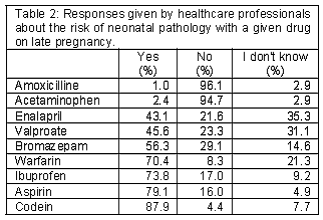
<body><![CDATA[<p>General practitioners (GPs) and community pharmacists (CPs) of Midi-Pyrenees    area were interviewed at the beginning of continuous courses, the subjects of    which were different from drug and pregnancy. They were asked to answer individually    and spontaneously to the questionnaire. All questionnaires were collected at    the end of the session. Nobody refused to participate.</p>     <p>The questionnaire contained two parts. The first one concerned the teratogenic    risk. The respondents were asked to indicate whether they think there is a risk    when a given drug is taken on the first trimester of pregnancy; the possible    answers were “yes”, “no” or “no idea”. Moreover, for each drug, health professionals    were asked to put a mark along the line of a visual analogue scale (VAS) to    indicate their estimation of the potential teratogenic risk of the drug. The    question was: “a drug may affect formation and development of the organs of    the embryo when it is taken on the first trimester of pregnancy. For each drug    below, do you think there is a malformation risk? Put a harrow on the scale    from 0% to 100% to indicate the value of teratogenic risk. (0%: no risk, 100%:    all neonates have a birth defect”)”. The VAS measured 20 cm and was delimited    by 2 vertical lines, from 0% (no malformation) to 100% (all the newborns were    malformed). The VAS was longer than usual in order to permit a more precise    evaluation of the risk value for small levels. A list of about 20 drugs was    established including common medicine of different pharmacotherapeutic classes:    antibiotic, analgesic, anti-inflammatory, anxiolytics, antiepileptics, antipsychotics,    contraceptives, anti-emetics, anti-acid….The non proprietary name and the trade    mark were given for each drug. </p>     <p>The second part of the questionnaire concerned the occurrence of neonatal    pathology due to drug intake on late pregnancy. For 9 drugs, the respondent    had to answer by “yes”, “no” or “I don’t know” to the following question: &quot;do    you think that a neonatal pathology could occur with this drug when it is used    on late pregnancy?&quot;</p>     <p>The questionnaire has been completed by 103 GPs (64 men, 25 women and 14 who    did not specify their gender) and by 104 CPs (16 men and 88 women). One GP did    not complete the second part of a questionnaire. </p>     <p>The level of the risk was quantified by measuring the distance in millimetres    from the 0% to the mark indicated by the health professional on the VAS. The    mean and standard error of the mean values of the estimated risk were calculated    for each group and drug. To determinate abstention rate, for each drug, we computed    the percentage of CPs or GPs who did not put a mark on the corresponding line.    Then, we calculate the mean value of these percentages for the 21 drugs. The    “true” value of the risk was evaluated from published studies and reference    sources (books<sup>4</sup>, on line data bases<sup>5,6</sup>). To compare the    results, a chi-scare test was performed. With a value of p&lt;0.05, the differences    were considered as statistically significant.</p>      <p>&nbsp;</p>     <p><b>RESULTS</b></p>     <p><b>Teratogenic risk of drugs </b></p>     <p>(<a href="#t1">Table 1</a>) The percentage of health professionals giving a    positive answer about the existence of a teratogenic risk ranged from 6% for    amoxicillin and acetaminophen to 97% for isotretinoin. Drugs considered as dangerous    by more than 50% of health professionals were the following: isotretinoin, thalidomide,    gentamicine, lithium, norfloxacine, ibuprofene, aspirine, cyproterone + ethynylestradiol,    carbamazepin, warfarin, oral contraceptive and erythromycin. Acetaminophen,    amoxicillin, domperidone and metoclopramide were mainly considered as safe.    11% of health professionals thought there is no risk with warfarin and 30% did    not know. 26% answered that there is no risk with valproate and 23% had no idea.    Nearly 17% thought that there is no risk with carbamazepine and 25% did not    give an opinion. Concerning lithium, 6% answered that there is no risk and more    than 20% had no opinion. 2% and nearly 6% of health professionals had no idea    about the teratogenic risk of isotretinoin and thalidomide respectively. </p>     <p align="center"><a name="t1"><img border="0" src="/img/revistas/pharmacy/v6n1/015-019_01.gif" width="363" height="446"></a></p>      ]]></body>
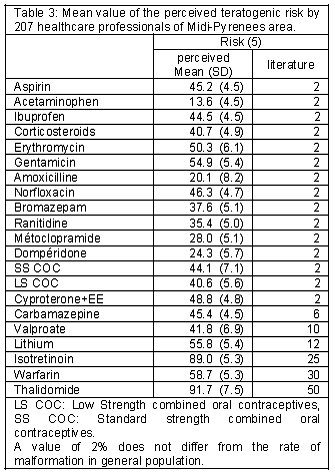
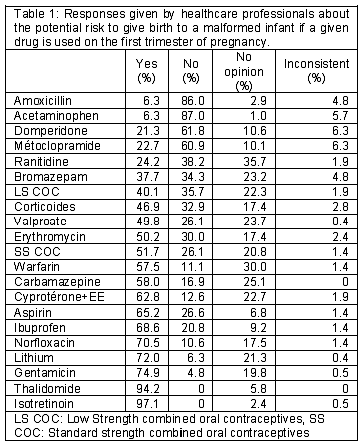
<body><![CDATA[<p>There were statistically different responses between GPs and CPs for 12 drugs.    67% of the GPs have associated valproate with a teratogenic risk when CPs opinion    is controversial (33% positive, 33% negative and 34% no idea). Concerning Bromazepam,    47% of the GPs thought there is a teratogenic risk and only 29% of the CPs had    this opinion. Concerning other drugs for which there is a difference in risk    knowledge (warfarin, lithium, gentamicin, norfloxacine, ibuprofene, carbamazepine,    erythromycin, ranitidine, metoclopramide and domperidone), GPs generally gave    more clear-cut responses than CPs (“no opinion” was more frequent for CPs: 26%    for CP versus 14% for GPs).</p>     <p><b>Risk of neonatal disease</b></p>     <p>(<a href="#t2">Table 2</a>) A majority of health professionals answered that    codein, aspirin, ibuprofen, warfarin and bromazepam, are not safe if they are    consumed on late pregnancy and more than 90% of them thought that acetaminophen    and amoxicillin are safe. However, 16%, 17% and 22% answered that there is no    foetal and/or neonatal risk when aspirin, ibuprofen and enalapril are administered    on late pregnancy. More than 30% of the subjects had no idea about the risk    of neonatal pathology if enalapril or valproate are administered close to the    end of pregnancy.</p>     <p align="center"><a name="t2"><img border="0" src="/img/revistas/pharmacy/v6n1/015-019_02.gif" width="323" height="220"></a></p>      <p>Compared to the GPs the pharmacist had a worse knowledge of neonatal risk with valproate. 62% of GPs though that valproate is not safe vs. 30% of the CPs.</p>      <p><b>Teratogenic risk assessment</b></p>     <p><a href="#t3">Table 3</a> indicates the mean values of the perceived risk    estimated by health professionals. For all drugs, the teratogenic risk was overestimated    when compared to values from the literature. The estimation of the risk ranged    from 13% for acetaminophen to 92% for Thalidomide. 51% of CPs did not indicate    a mark on the VAS (vs 19% of the GPs). When GPs and CPs are compared, the perception    of teratogenic risk was statistically higher for CPs (p&lt;0,05) for isotretinoin    (CPs=94% ; GPs=85%), thalidomide (CPs=94%, GPs=90%) and metoclopramide (CPs=45%,    GPs=23%).</p>     <p align="center"><a name="t3"><img border="0" src="/img/revistas/pharmacy/v6n1/015-019_03.gif" width="335" height="474"></a></p>      <p>&nbsp;</p>     <p><b>DISCUSSION</b></p>     ]]></body>
<body><![CDATA[<p>The present study evaluates teratogenic and/or foetotoxic risk perception of    common medications by GPs and CPs of Midi-Pyrenees area. It shows that the potential    risks for the embryo or the foetus of several commonly used drugs is unknown    by a lot of health professionals. In addition, when it is known, teratogenic    risk is overestimated.</p>     <p>The lack of opinion and false answers observed in the responses to the questionnaire    suggest a lack of knowledge on drug use in pregnancy. Such a result has already    been observed by our group in an opinion survey of CPs about drug counselling    in pregnancy. It has been shown that CPs do not always give appropriate advice    to pregnant women.<sup>7</sup> This could be explained by several points. First, initial    training about drug use in pregnancy is insufficient during pharmaceutical and    medical studies (2h within 6 years for CPs and 3.5h within 9 years for GPs).    Moreover, some continuous trainings deal with this subject but until now health    professionals are not obliged to follow these courses. French scientific books    on this topic are few. At last, information could be misunderstood.</p>     <p>Health professionals overestimated the teratogenic risk for all drugs included    in our questionnaire. Several reasons could explain this misperception. Fear    about teratogenicity appeared since thalidomide disaster. This fear has been    increased by other events (diethystilbestrol and retinoids) that occurred later    and were widely reported by media. GPs and pharmacists are also afraid of litigation.    On another hand, it is possible that the mark given graphically on the VAS does    not really correspond to the value thought by the participant. Nevertheless,    a longer VAS than usually has been chosen to better evaluate small percentages.    We also wanted to use the same methodology as a Spanish group<sup>8</sup> who had performed    a similar study including physicians in order to compare our results with theirs    for GPs. Moreover, even if the indicated value on the VAS does not correspond    to the real perception of the respondent, the difference obtained between the    "true" risk and the one estimated is so large that the conclusion    remains appropriate.</p>     <p>Thus, for several drugs, we compared our GPs results with those reported in    the Spanish study where both women from the general population and physicians    (GPs, gynaecologists, students during preclinical and clinical training) had    been included. For all these drugs, GPs of Midi-Pyrenees area gave a higher    value than the Spanish GPs. This fact could be explained by the difference in    the sample size (25 GP in the Spanish study; 103 GP for the present study).    By chance, the Spanish group might have included in the survey physicians who    had a better teratogenic risk perception. On the other hand, it is possible    that Spanish initial training is more consistent on this topic. Indeed, concerning    Spanish medical students (during preclinical and clinical training), risk perception    declined as they mature. At last, during life work, continual course, information    and communication might be better than in France. </p>     <p>Disparities which were observed in responses according to the profession or    within the same profession suggest the intervention of external factors besides    pharmacological knowledge. Indeed, health professional opinion may be modified    by their kind of practice, training, experience, conviction, ethic…This influence    of external factors has already been suggested in a study showing significant    differences between GPs and pharmacists for medication use.9 In the present    study, GPs generally gave more clear-cut responses than CPs that can be explained    by the fact that GPs have to decide to prescribe a drug or not in a pregnant    woman. </p>     <p>This high perception of teratogenic risk could lead to disadvantageous decisions    for pregnant women and her intended infant. Indeed, a pregnant woman with an    acute or chronic disease could be treated inadequately causing physiological    and psychological pain to herself and to her foetus too. If a drug is used through    inadvertence on the first trimester, the woman could ask for pregnancy termination    all the more because women rated teratogenic risk significantly higher than    health professionals.<sup>8,10</sup> The fact that CPs perceive a higher risk than it is    implies that they cannot counteract the fear that can be induced by the information    which was given by the GP to pregnant women.</p>     <p>To face up this misperception of teratogenic risk and to refresh the knowledge    on medication risk during pregnancy, the more adequate approach could be education    and continuous diffusion of reliable information since Sanz et al. observed    that risk perception declines as medical students receive more courses. It is    also important to improve the initial and continuous training on this field.    Indeed, a more accurate perception of the risk will permit healthcare professionals    to give better advice. It has been shown that the tendency to terminate pregnancy    significantly decreased after an antenatal consultation about drug exposition.<sup>11,12</sup>    Moreover, counselling can decrease the perception of teratogenic risk by women    themselves.<sup>13</sup> Another point concerns the way the risk is communicated. The ways    in which risks are presented can affect the ways in which they are perceived.<sup>10,14-16 </sup>   Even if a Canadian study has pointed out the difficulty of changing the opinion    despite evidence-based facts<sup>14</sup>, the evaluation of teratogenic risk should be    carried on in the future since doubt increases risk perception.</p>      <p>&nbsp;</p>     <p><b>CONCLUSION</b></p>     <p>Potential teratogenic and foetotoxic risks are not well-known by general practitioners as well as community pharmacists. Health professionals who think that a risk exists, overestimate it. This misperception can lead to inappropriate decisions for pregnancy outcomes. More efforts are needed to sensitize general practitioners and community pharmacists during initial and continuous trainings and to better communicate on teratogenic risk to inform pregnant patients.</p>      ]]></body>
<body><![CDATA[<p>&nbsp;</p>     <p><b>ACKNOWLEDGMENTS</b></p>     <p>We thank general practitioners and community pharmacists who have participated to the study.</p>      <p>&nbsp;</p>     <p><b>CONFLICT OF INTEREST</b></p>     <p>None declared. No external funding sources declared.</p>     <p>&nbsp;</p> <table border="1" width="100%">     <tr>       <td width="100%">             <p align="center"><b><font face="Arial">References</font></b></td>     </tr>   </table>        <!-- ref --><p>1. Lacroix I, Damase-Michel C, Lapeyre-Mestre M, Montastruc JL. Prescription of drugs during pregnancy in France. Lancet 2000;256:1735-6.    &nbsp;&nbsp;&nbsp;&nbsp;&nbsp;&nbsp;&nbsp;&nbsp;[&#160;<a href="javascript:void(0);" onclick="javascript: window.open('/scielo.php?script=sci_nlinks&ref=4231594&pid=S1885-642X200800010000300001&lng=','','width=640,height=500,resizable=yes,scrollbars=1,menubar=yes,');">Links</a>&#160;]<!-- end-ref --></p>     ]]></body>
<body><![CDATA[<!-- ref --><p>2. Montastruc JL, Bongard V, Lapeyre-Mestre M. Perception of the risk of gastrointestinal adverse drug reactions with non-steroidal anti-inflammatory drugs (including coxibs) : differences among general practitioners, gastroenterologists and rheumatologists. Eur J Clin Pharmacol. 2003;59:685-8.    &nbsp;&nbsp;&nbsp;&nbsp;&nbsp;&nbsp;&nbsp;&nbsp;[&#160;<a href="javascript:void(0);" onclick="javascript: window.open('/scielo.php?script=sci_nlinks&ref=4231596&pid=S1885-642X200800010000300002&lng=','','width=640,height=500,resizable=yes,scrollbars=1,menubar=yes,');">Links</a>&#160;]<!-- end-ref --></p>     <!-- ref --><p>3. Bongard V, M&eacute;nard-Tach&eacute; S, Bagheri H, Kabiri K, Lapeyre-Mestre M, Montastruc JL. Perception of the risk of adverse drug reactions : differences between health professionals and non health professionals. Br J Clin Pharmacol. 2002;54:433-6.    &nbsp;&nbsp;&nbsp;&nbsp;&nbsp;&nbsp;&nbsp;&nbsp;[&#160;<a href="javascript:void(0);" onclick="javascript: window.open('/scielo.php?script=sci_nlinks&ref=4231598&pid=S1885-642X200800010000300003&lng=','','width=640,height=500,resizable=yes,scrollbars=1,menubar=yes,');">Links</a>&#160;]<!-- end-ref --></p>     <!-- ref --><p>4. Briggs GG, Freeman RK, Yaffe SJ. Drugs in pregnancy and lactation: a reference guide for fetal and neonatal risk, 6th Edition, Lippincott Williams and Wilkins eds, Baltimore, 2002.    &nbsp;&nbsp;&nbsp;&nbsp;&nbsp;&nbsp;&nbsp;&nbsp;[&#160;<a href="javascript:void(0);" onclick="javascript: window.open('/scielo.php?script=sci_nlinks&ref=4231600&pid=S1885-642X200800010000300004&lng=','','width=640,height=500,resizable=yes,scrollbars=1,menubar=yes,');">Links</a>&#160;]<!-- end-ref --></p>     <!-- ref --><p>5. Reprotox: An information system on environmental hazards to human reproduction and development. The reproductive toxicology center, Bethesda,  <a target="_blank" href="http://www.reprotox.org/Default.aspx">www.reprotox.org</a>&nbsp;&nbsp;&nbsp;&nbsp;&nbsp;&nbsp;&nbsp;&nbsp;[&#160;<a href="javascript:void(0);" onclick="javascript: window.open('/scielo.php?script=sci_nlinks&ref=4231602&pid=S1885-642X200800010000300005&lng=','','width=640,height=500,resizable=yes,scrollbars=1,menubar=yes,');">Links</a>&#160;]<!-- end-ref --><!-- ref --><p>6. Friedman JM, Polifka JE. Teris: The teratogenic information system. University of Washington,  <a target="_blank" href="http://apps.medical.washington.edu/Teris/Teris1a.aspx?ReturnUrl=/teris/Default.aspx">http:apps.medical.washington.edu/teris/</a>&nbsp;&nbsp;&nbsp;&nbsp;&nbsp;&nbsp;&nbsp;&nbsp;[&#160;<a href="javascript:void(0);" onclick="javascript: window.open('/scielo.php?script=sci_nlinks&ref=4231603&pid=S1885-642X200800010000300006&lng=','','width=640,height=500,resizable=yes,scrollbars=1,menubar=yes,');">Links</a>&#160;]<!-- end-ref --><!-- ref --><p>7. Damase-Michel C, Vi&eacute; C, Lacroix I, Lapeyre-Mestre M, Montastruc JL. Drug counselling in pregnancy: an opinion survey of French community pharmacists. Pharmacoepidemiol Drug Saf. 2004;13:711-5.    &nbsp;&nbsp;&nbsp;&nbsp;&nbsp;&nbsp;&nbsp;&nbsp;[&#160;<a href="javascript:void(0);" onclick="javascript: window.open('/scielo.php?script=sci_nlinks&ref=4231604&pid=S1885-642X200800010000300007&lng=','','width=640,height=500,resizable=yes,scrollbars=1,menubar=yes,');">Links</a>&#160;]<!-- end-ref --></p>     ]]></body>
<body><![CDATA[<!-- ref --><p>8. Sanz E, Gomez-Lopez T, Martinez-Quintas MJ. Perception of teratogenic risk of common medicines. Eur J Obstet Gynecol Reprod Biol. 2001;95:127-31.    &nbsp;&nbsp;&nbsp;&nbsp;&nbsp;&nbsp;&nbsp;&nbsp;[&#160;<a href="javascript:void(0);" onclick="javascript: window.open('/scielo.php?script=sci_nlinks&ref=4231606&pid=S1885-642X200800010000300008&lng=','','width=640,height=500,resizable=yes,scrollbars=1,menubar=yes,');">Links</a>&#160;]<!-- end-ref --></p>     <!-- ref --><p>9. Bootman JL, Hurd PD, Gaines JA. Physician and pharmacist attitudes toward medication use. Am J Hosp Pharm. 1982; 39:818-21.    &nbsp;&nbsp;&nbsp;&nbsp;&nbsp;&nbsp;&nbsp;&nbsp;[&#160;<a href="javascript:void(0);" onclick="javascript: window.open('/scielo.php?script=sci_nlinks&ref=4231608&pid=S1885-642X200800010000300009&lng=','','width=640,height=500,resizable=yes,scrollbars=1,menubar=yes,');">Links</a>&#160;]<!-- end-ref --></p>     <!-- ref --><p>10. Pole M, Einarson A, Pairaudeau N, Einarson T, Koren G. Drug Labelling and risk perceptions of teratogenicity : A survey of pregnant canadian women and their health professionals. J Clin Pharmacol. 2000;40:573-7.    &nbsp;&nbsp;&nbsp;&nbsp;&nbsp;&nbsp;&nbsp;&nbsp;[&#160;<a href="javascript:void(0);" onclick="javascript: window.open('/scielo.php?script=sci_nlinks&ref=4231610&pid=S1885-642X200800010000300010&lng=','','width=640,height=500,resizable=yes,scrollbars=1,menubar=yes,');">Links</a>&#160;]<!-- end-ref --></p>     <!-- ref --><p>11. Koren G, Bologa M, Long D, Feldman Y, Shear NH. Perception of teratogenic risk by pregnant women exposed to drugs and chemicals during the first trimester. Am J Obstet Gynecol. 1989;160:1190-4.    &nbsp;&nbsp;&nbsp;&nbsp;&nbsp;&nbsp;&nbsp;&nbsp;[&#160;<a href="javascript:void(0);" onclick="javascript: window.open('/scielo.php?script=sci_nlinks&ref=4231612&pid=S1885-642X200800010000300011&lng=','','width=640,height=500,resizable=yes,scrollbars=1,menubar=yes,');">Links</a>&#160;]<!-- end-ref --></p>     <!-- ref --><p>12. Koren G, Bologa M, Pastuszak A. Women’s perception of teratogenic risk. Can J Public Health 1991;82:S11-4.    &nbsp;&nbsp;&nbsp;&nbsp;&nbsp;&nbsp;&nbsp;&nbsp;[&#160;<a href="javascript:void(0);" onclick="javascript: window.open('/scielo.php?script=sci_nlinks&ref=4231614&pid=S1885-642X200800010000300012&lng=','','width=640,height=500,resizable=yes,scrollbars=1,menubar=yes,');">Links</a>&#160;]<!-- end-ref --></p>     ]]></body>
<body><![CDATA[<!-- ref --><p>13. Mazzota P, Magee LA, Maltepe C, Lifshitz A, Navioz Y, Koren G. The perception of teratogenic risk by women with nausea and vomiting of pregnancy. Reprod Toxicol. 1999;13:313-9.    &nbsp;&nbsp;&nbsp;&nbsp;&nbsp;&nbsp;&nbsp;&nbsp;[&#160;<a href="javascript:void(0);" onclick="javascript: window.open('/scielo.php?script=sci_nlinks&ref=4231616&pid=S1885-642X200800010000300013&lng=','','width=640,height=500,resizable=yes,scrollbars=1,menubar=yes,');">Links</a>&#160;]<!-- end-ref --></p>     <!-- ref --><p>14. Jasper JD, Goel R, Einarson A, Gallo M, Koren G. Effects of framing on teratogenic risk perception in pregnant women. Lancet 2001;358:1237-8.    &nbsp;&nbsp;&nbsp;&nbsp;&nbsp;&nbsp;&nbsp;&nbsp;[&#160;<a href="javascript:void(0);" onclick="javascript: window.open('/scielo.php?script=sci_nlinks&ref=4231618&pid=S1885-642X200800010000300014&lng=','','width=640,height=500,resizable=yes,scrollbars=1,menubar=yes,');">Links</a>&#160;]<!-- end-ref --></p>     <!-- ref --><p>15. Polifka JE, Faustman EM, Neil N. Weighing the risks and the benefits: a call for the empirical assessment of perceived teratogenic risk. Reprod Toxicol. 1997;11:633-40.    &nbsp;&nbsp;&nbsp;&nbsp;&nbsp;&nbsp;&nbsp;&nbsp;[&#160;<a href="javascript:void(0);" onclick="javascript: window.open('/scielo.php?script=sci_nlinks&ref=4231620&pid=S1885-642X200800010000300015&lng=','','width=640,height=500,resizable=yes,scrollbars=1,menubar=yes,');">Links</a>&#160;]<!-- end-ref --></p>     <!-- ref --><p>16. Aronson JK. Risk perception in drug therapy : Editors’view. Br J Clin Pharmacol. 2006;62:135-7.    &nbsp;&nbsp;&nbsp;&nbsp;&nbsp;&nbsp;&nbsp;&nbsp;[&#160;<a href="javascript:void(0);" onclick="javascript: window.open('/scielo.php?script=sci_nlinks&ref=4231622&pid=S1885-642X200800010000300016&lng=','','width=640,height=500,resizable=yes,scrollbars=1,menubar=yes,');">Links</a>&#160;]<!-- end-ref --></p>      ]]></body><back>
<ref-list>
<ref id="B1">
<label>1</label><nlm-citation citation-type="journal">
<person-group person-group-type="author">
<name>
<surname><![CDATA[Lacroix]]></surname>
<given-names><![CDATA[I]]></given-names>
</name>
<name>
<surname><![CDATA[Damase-Michel]]></surname>
<given-names><![CDATA[C]]></given-names>
</name>
<name>
<surname><![CDATA[Lapeyre-Mestre]]></surname>
<given-names><![CDATA[M]]></given-names>
</name>
<name>
<surname><![CDATA[Montastruc]]></surname>
<given-names><![CDATA[JL]]></given-names>
</name>
</person-group>
<article-title xml:lang="en"><![CDATA[Prescription of drugs during pregnancy in France]]></article-title>
<source><![CDATA[Lancet]]></source>
<year>2000</year>
<volume>256</volume>
<page-range>1735-6</page-range></nlm-citation>
</ref>
<ref id="B2">
<label>2</label><nlm-citation citation-type="journal">
<person-group person-group-type="author">
<name>
<surname><![CDATA[Montastruc]]></surname>
<given-names><![CDATA[JL]]></given-names>
</name>
<name>
<surname><![CDATA[Bongard]]></surname>
<given-names><![CDATA[V]]></given-names>
</name>
<name>
<surname><![CDATA[Lapeyre-Mestre]]></surname>
<given-names><![CDATA[M]]></given-names>
</name>
</person-group>
<article-title xml:lang="en"><![CDATA[Perception of the risk of gastrointestinal adverse drug reactions with non-steroidal anti-inflammatory drugs (including coxibs): differences among general practitioners, gastroenterologists and rheumatologists]]></article-title>
<source><![CDATA[Eur J Clin Pharmacol]]></source>
<year>2003</year>
<volume>59</volume>
<page-range>685-8</page-range></nlm-citation>
</ref>
<ref id="B3">
<label>3</label><nlm-citation citation-type="journal">
<person-group person-group-type="author">
<name>
<surname><![CDATA[Bongard]]></surname>
<given-names><![CDATA[V]]></given-names>
</name>
<name>
<surname><![CDATA[Ménard-Taché]]></surname>
<given-names><![CDATA[S]]></given-names>
</name>
<name>
<surname><![CDATA[Bagheri]]></surname>
<given-names><![CDATA[H]]></given-names>
</name>
<name>
<surname><![CDATA[Kabiri]]></surname>
<given-names><![CDATA[K]]></given-names>
</name>
<name>
<surname><![CDATA[Lapeyre-Mestre]]></surname>
<given-names><![CDATA[M]]></given-names>
</name>
<name>
<surname><![CDATA[Montastruc]]></surname>
<given-names><![CDATA[JL]]></given-names>
</name>
</person-group>
<article-title xml:lang="en"><![CDATA[Perception of the risk of adverse drug reactions: differences between health professionals and non health professionals]]></article-title>
<source><![CDATA[Br J Clin Pharmacol]]></source>
<year>2002</year>
<volume>54</volume>
<page-range>433-6</page-range></nlm-citation>
</ref>
<ref id="B4">
<label>4</label><nlm-citation citation-type="book">
<person-group person-group-type="author">
<name>
<surname><![CDATA[Briggs]]></surname>
<given-names><![CDATA[GG]]></given-names>
</name>
<name>
<surname><![CDATA[Freeman]]></surname>
<given-names><![CDATA[RK]]></given-names>
</name>
<name>
<surname><![CDATA[Yaffe]]></surname>
<given-names><![CDATA[SJ]]></given-names>
</name>
</person-group>
<source><![CDATA[Drugs in pregnancy and lactation: a reference guide for fetal and neonatal risk]]></source>
<year>2002</year>
<edition>6</edition>
<publisher-loc><![CDATA[Baltimore ]]></publisher-loc>
<publisher-name><![CDATA[Lippincott Williams and Wilkins]]></publisher-name>
</nlm-citation>
</ref>
<ref id="B5">
<label>5</label><nlm-citation citation-type="book">
<source><![CDATA[Reprotox: An information system on environmental hazards to human reproduction and development]]></source>
<year></year>
<publisher-loc><![CDATA[Bethesda ]]></publisher-loc>
<publisher-name><![CDATA[The reproductive toxicology center]]></publisher-name>
</nlm-citation>
</ref>
<ref id="B6">
<label>6</label><nlm-citation citation-type="book">
<person-group person-group-type="author">
<name>
<surname><![CDATA[Friedman]]></surname>
<given-names><![CDATA[JM]]></given-names>
</name>
<name>
<surname><![CDATA[Polifka]]></surname>
<given-names><![CDATA[JE]]></given-names>
</name>
</person-group>
<source><![CDATA[Teris: The teratogenic information system]]></source>
<year></year>
<publisher-name><![CDATA[University of Washington]]></publisher-name>
</nlm-citation>
</ref>
<ref id="B7">
<label>7</label><nlm-citation citation-type="journal">
<person-group person-group-type="author">
<name>
<surname><![CDATA[Damase-Michel]]></surname>
<given-names><![CDATA[C]]></given-names>
</name>
<name>
<surname><![CDATA[Vié]]></surname>
<given-names><![CDATA[C]]></given-names>
</name>
<name>
<surname><![CDATA[Lacroix]]></surname>
<given-names><![CDATA[I]]></given-names>
</name>
<name>
<surname><![CDATA[Lapeyre-Mestre]]></surname>
<given-names><![CDATA[M]]></given-names>
</name>
<name>
<surname><![CDATA[Montastruc]]></surname>
<given-names><![CDATA[JL]]></given-names>
</name>
</person-group>
<article-title xml:lang="en"><![CDATA[Drug counselling in pregnancy: an opinion survey of French community pharmacists]]></article-title>
<source><![CDATA[Pharmacoepidemiol Drug Saf]]></source>
<year>2004</year>
<volume>13</volume>
<page-range>711-5</page-range></nlm-citation>
</ref>
<ref id="B8">
<label>8</label><nlm-citation citation-type="journal">
<person-group person-group-type="author">
<name>
<surname><![CDATA[Sanz]]></surname>
<given-names><![CDATA[E]]></given-names>
</name>
<name>
<surname><![CDATA[Gomez-Lopez]]></surname>
<given-names><![CDATA[T]]></given-names>
</name>
<name>
<surname><![CDATA[Martinez-Quintas]]></surname>
<given-names><![CDATA[MJ]]></given-names>
</name>
</person-group>
<article-title xml:lang="en"><![CDATA[Perception of teratogenic risk of common medicines]]></article-title>
<source><![CDATA[Eur J Obstet Gynecol Reprod Biol]]></source>
<year>2001</year>
<volume>95</volume>
<page-range>127-31</page-range></nlm-citation>
</ref>
<ref id="B9">
<label>9</label><nlm-citation citation-type="journal">
<person-group person-group-type="author">
<name>
<surname><![CDATA[Bootman]]></surname>
<given-names><![CDATA[JL]]></given-names>
</name>
<name>
<surname><![CDATA[Hurd]]></surname>
<given-names><![CDATA[PD]]></given-names>
</name>
<name>
<surname><![CDATA[Gaines]]></surname>
<given-names><![CDATA[JA]]></given-names>
</name>
</person-group>
<article-title xml:lang="en"><![CDATA[Physician and pharmacist attitudes toward medication use]]></article-title>
<source><![CDATA[Am J Hosp Pharm]]></source>
<year>1982</year>
<volume>39</volume>
<page-range>818-21</page-range></nlm-citation>
</ref>
<ref id="B10">
<label>10</label><nlm-citation citation-type="journal">
<person-group person-group-type="author">
<name>
<surname><![CDATA[Pole]]></surname>
<given-names><![CDATA[M]]></given-names>
</name>
<name>
<surname><![CDATA[Einarson]]></surname>
<given-names><![CDATA[A]]></given-names>
</name>
<name>
<surname><![CDATA[Pairaudeau]]></surname>
<given-names><![CDATA[N]]></given-names>
</name>
<name>
<surname><![CDATA[Einarson]]></surname>
<given-names><![CDATA[T]]></given-names>
</name>
<name>
<surname><![CDATA[Koren]]></surname>
<given-names><![CDATA[G]]></given-names>
</name>
</person-group>
<article-title xml:lang="en"><![CDATA[Drug Labelling and risk perceptions of teratogenicity: A survey of pregnant canadian women and their health professionals]]></article-title>
<source><![CDATA[J Clin Pharmacol]]></source>
<year>2000</year>
<volume>40</volume>
<page-range>573-7</page-range></nlm-citation>
</ref>
<ref id="B11">
<label>11</label><nlm-citation citation-type="journal">
<person-group person-group-type="author">
<name>
<surname><![CDATA[Koren]]></surname>
<given-names><![CDATA[G]]></given-names>
</name>
<name>
<surname><![CDATA[Bologa]]></surname>
<given-names><![CDATA[M]]></given-names>
</name>
<name>
<surname><![CDATA[Long]]></surname>
<given-names><![CDATA[D]]></given-names>
</name>
<name>
<surname><![CDATA[Feldman]]></surname>
<given-names><![CDATA[Y]]></given-names>
</name>
<name>
<surname><![CDATA[Shear]]></surname>
<given-names><![CDATA[NH]]></given-names>
</name>
</person-group>
<article-title xml:lang="en"><![CDATA[Perception of teratogenic risk by pregnant women exposed to drugs and chemicals during the first trimester]]></article-title>
<source><![CDATA[Am J Obstet Gynecol]]></source>
<year>1989</year>
<volume>160</volume>
<page-range>1190-4</page-range></nlm-citation>
</ref>
<ref id="B12">
<label>12</label><nlm-citation citation-type="journal">
<person-group person-group-type="author">
<name>
<surname><![CDATA[Koren]]></surname>
<given-names><![CDATA[G]]></given-names>
</name>
<name>
<surname><![CDATA[Bologa]]></surname>
<given-names><![CDATA[M]]></given-names>
</name>
<name>
<surname><![CDATA[Pastuszak]]></surname>
<given-names><![CDATA[A]]></given-names>
</name>
</person-group>
<article-title xml:lang="en"><![CDATA[Women’s perception of teratogenic risk]]></article-title>
<source><![CDATA[Can J Public Health]]></source>
<year>1991</year>
<volume>82</volume>
<page-range>S11-4</page-range></nlm-citation>
</ref>
<ref id="B13">
<label>13</label><nlm-citation citation-type="journal">
<person-group person-group-type="author">
<name>
<surname><![CDATA[Mazzota]]></surname>
<given-names><![CDATA[P]]></given-names>
</name>
<name>
<surname><![CDATA[Magee]]></surname>
<given-names><![CDATA[LA]]></given-names>
</name>
<name>
<surname><![CDATA[Maltepe]]></surname>
<given-names><![CDATA[C]]></given-names>
</name>
<name>
<surname><![CDATA[Lifshitz]]></surname>
<given-names><![CDATA[A]]></given-names>
</name>
<name>
<surname><![CDATA[Navioz]]></surname>
<given-names><![CDATA[Y]]></given-names>
</name>
<name>
<surname><![CDATA[Koren]]></surname>
<given-names><![CDATA[G]]></given-names>
</name>
</person-group>
<article-title xml:lang="en"><![CDATA[The perception of teratogenic risk by women with nausea and vomiting of pregnancy]]></article-title>
<source><![CDATA[Reprod Toxicol.]]></source>
<year>1999</year>
<volume>13</volume>
<page-range>313-9</page-range></nlm-citation>
</ref>
<ref id="B14">
<label>14</label><nlm-citation citation-type="journal">
<person-group person-group-type="author">
<name>
<surname><![CDATA[Jasper]]></surname>
<given-names><![CDATA[JD]]></given-names>
</name>
<name>
<surname><![CDATA[Goel]]></surname>
<given-names><![CDATA[R]]></given-names>
</name>
<name>
<surname><![CDATA[Einarson]]></surname>
<given-names><![CDATA[A]]></given-names>
</name>
<name>
<surname><![CDATA[Gallo]]></surname>
<given-names><![CDATA[M]]></given-names>
</name>
<name>
<surname><![CDATA[Koren]]></surname>
<given-names><![CDATA[G]]></given-names>
</name>
</person-group>
<article-title xml:lang="en"><![CDATA[Effects of framing on teratogenic risk perception in pregnant women]]></article-title>
<source><![CDATA[Lancet]]></source>
<year>2001</year>
<volume>358</volume>
<page-range>1237-8</page-range></nlm-citation>
</ref>
<ref id="B15">
<label>15</label><nlm-citation citation-type="journal">
<person-group person-group-type="author">
<name>
<surname><![CDATA[Polifka]]></surname>
<given-names><![CDATA[JE]]></given-names>
</name>
<name>
<surname><![CDATA[Faustman]]></surname>
<given-names><![CDATA[EM]]></given-names>
</name>
<name>
<surname><![CDATA[Neil]]></surname>
<given-names><![CDATA[N]]></given-names>
</name>
</person-group>
<article-title xml:lang="en"><![CDATA[Weighing the risks and the benefits: a call for the empirical assessment of perceived teratogenic risk]]></article-title>
<source><![CDATA[Reprod Toxicol.]]></source>
<year>1997</year>
<volume>11</volume>
<page-range>633-40</page-range></nlm-citation>
</ref>
<ref id="B16">
<label>16</label><nlm-citation citation-type="journal">
<person-group person-group-type="author">
<name>
<surname><![CDATA[Aronson]]></surname>
<given-names><![CDATA[JK]]></given-names>
</name>
</person-group>
<article-title xml:lang="en"><![CDATA[Risk perception in drug therapy: Editors’view]]></article-title>
<source><![CDATA[Br J Clin Pharmacol.]]></source>
<year>2006</year>
<volume>62</volume>
<page-range>135-7</page-range></nlm-citation>
</ref>
</ref-list>
</back>
</article>