<?xml version="1.0" encoding="ISO-8859-1"?><article xmlns:mml="http://www.w3.org/1998/Math/MathML" xmlns:xlink="http://www.w3.org/1999/xlink" xmlns:xsi="http://www.w3.org/2001/XMLSchema-instance">
<front>
<journal-meta>
<journal-id>1885-642X</journal-id>
<journal-title><![CDATA[Pharmacy Practice (Granada)]]></journal-title>
<abbrev-journal-title><![CDATA[Pharmacy Pract (Granada)]]></abbrev-journal-title>
<issn>1885-642X</issn>
<publisher>
<publisher-name><![CDATA[Centro de Investigaciones y Publicaciones Farmacéuticas]]></publisher-name>
</publisher>
</journal-meta>
<article-meta>
<article-id>S1885-642X2010000100003</article-id>
<title-group>
<article-title xml:lang="en"><![CDATA[Evaluation of breast cancer awareness among female university students in Malaysia]]></article-title>
<article-title xml:lang="es"><![CDATA[Evaluación del conocimiento sobre cáncer de mama entre estudiantes universitarias en Malasia]]></article-title>
</title-group>
<contrib-group>
<contrib contrib-type="author">
<name>
<surname><![CDATA[Hadi]]></surname>
<given-names><![CDATA[Muhammad A.]]></given-names>
</name>
<xref ref-type="aff" rid="A01"/>
</contrib>
<contrib contrib-type="author">
<name>
<surname><![CDATA[Hassali]]></surname>
<given-names><![CDATA[Mohammed A.]]></given-names>
</name>
<xref ref-type="aff" rid="A02"/>
</contrib>
<contrib contrib-type="author">
<name>
<surname><![CDATA[Shafie]]></surname>
<given-names><![CDATA[Asrul A.]]></given-names>
</name>
<xref ref-type="aff" rid="A02"/>
</contrib>
<contrib contrib-type="author">
<name>
<surname><![CDATA[Awaisu]]></surname>
<given-names><![CDATA[Ahmed]]></given-names>
</name>
<xref ref-type="aff" rid="A02"/>
</contrib>
</contrib-group>
<aff id="A01">
<institution><![CDATA[,Universiti Teknologi MARA Faculty of Pharmacy Department of Clinical Pharmacy]]></institution>
<addr-line><![CDATA[Shah Alam ]]></addr-line>
<country>Malaysia</country>
</aff>
<aff id="A02">
<institution><![CDATA[,Universiti Sains Malaysia School of Pharmaceutical Sciences ]]></institution>
<addr-line><![CDATA[ ]]></addr-line>
</aff>
<pub-date pub-type="pub">
<day>00</day>
<month>03</month>
<year>2010</year>
</pub-date>
<pub-date pub-type="epub">
<day>00</day>
<month>03</month>
<year>2010</year>
</pub-date>
<volume>8</volume>
<numero>1</numero>
<fpage>29</fpage>
<lpage>34</lpage>
<copyright-statement/>
<copyright-year/>
<self-uri xlink:href="http://scielo.isciii.es/scielo.php?script=sci_arttext&amp;pid=S1885-642X2010000100003&amp;lng=en&amp;nrm=iso"></self-uri><self-uri xlink:href="http://scielo.isciii.es/scielo.php?script=sci_abstract&amp;pid=S1885-642X2010000100003&amp;lng=en&amp;nrm=iso"></self-uri><self-uri xlink:href="http://scielo.isciii.es/scielo.php?script=sci_pdf&amp;pid=S1885-642X2010000100003&amp;lng=en&amp;nrm=iso"></self-uri><abstract abstract-type="short" xml:lang="en"><p><![CDATA[Breast cancer is the most common cancer and the leading cause of cancer death among women of all ethnic and age groups in Malaysia. Objective: The objectives of this study were to evaluate the knowledge of breast cancer risk factors, symptoms and methods of screening among female university students and their perception towards the disease treatment outcomes. Methods: A cross-sectional survey was conducted from February to March 2008 at Universiti Sains Malaysia. Two hundred participants from 10 randomly selected faculties were interviewed face to face by a trained pharmacist using a validated questionnaire. In addition to their demographic characteristics, participants were required to answer 22 questions concerning knowledge of breast cancer and five questions related to their perception of breast cancer management and treatment outcomes. Data were analyzed using SPSS version 15. Results: The mean age of the respondents was 26.7 (SD=1.9) years. The results showed that the vast majority of the female university students had inadequate knowledge of breast cancer. The mean total knowledge score of the students was 60.7%. Indian students had significantly less knowledge of breast cancer compared to their Chinese and Malay counterparts (p<0.05). However, more than two third of the students were aware of breast self examination (BSE) and clinical breast examination (CBE) recommendations. Furthermore, the students had positive perceptions towards the treatment outcomes of breast cancer. Conclusion: This study has highlighted the need of a breast cancer awareness campaign, which should also stress the importance of early detection and reporting of breast cancer.]]></p></abstract>
<abstract abstract-type="short" xml:lang="es"><p><![CDATA[El cáncer de mama es el cáncer más común y la mayor causa de muerte entre jóvenes de todos los grupos étnicos y edad en Malasia. Objetivo: Los objetivos de este estudio fueron evaluar el conocimiento sobre los factores de riesgo de cáncer de mama, los síntomas y los métodos de rastreo entre estudiantes universitarias y su percepción hacia los resultados del tratamiento de la enfermedad. Métodos: Se realizó un estudio transversal de febrero a marzo e 2008 en la Universidad Sains Malaysia. Un farmacéutico entrenado entrevistó cara a cara a 200 participantes entre las 10 facultades aleatoriamente seleccionadas utilizando un cuestionario validado. Además, de sus características demográficas e les pidió que respondiesen 22 preguntas relativas al conocimiento del cáncer de mama y 5 relativas a su percepción sobre los resultados de su gestión y tratamiento. Los datos se analizaron utilizando el SPSS versión 15. Resultados: La media de edad de los respondentes era de 26,7 (DE=1,9) años. Los resultados mostraron que la gran mayoría de las estudiantes universitarias tenían conocimientos inadecuados sobre el cáncer de mama. La media de puntuación total fue del 60,7%. Las estudiantes indias tenían significativamente menos conocimiento que sus colegas chinas y malayas (p<0,05). Sin embargo, más de dos tercios de las estudiantes conocían las recomendaciones de auto-exámenes de cáncer de mama y de exámenes clínicos de mama. Incluso, las estudiantes tenían una percepción positiva sobre los resultados del tratamiento del cáncer de mama. Conclusión: Este estudio indicó la necesidad de una campaña de concienciación sobre el cáncer de mama, que también debería remarcar la importancia de la detección temprana y la comunicación del cáncer de mama.]]></p></abstract>
<kwd-group>
<kwd lng="en"><![CDATA[Breast Neoplasms]]></kwd>
<kwd lng="en"><![CDATA[Awareness]]></kwd>
<kwd lng="en"><![CDATA[Breast Self-Examination]]></kwd>
<kwd lng="en"><![CDATA[Malaysia]]></kwd>
<kwd lng="es"><![CDATA[Neoplasias de mama]]></kwd>
<kwd lng="es"><![CDATA[Conocimiento]]></kwd>
<kwd lng="es"><![CDATA[Auto-examen de mama]]></kwd>
<kwd lng="es"><![CDATA[Malasia]]></kwd>
</kwd-group>
</article-meta>
</front><body><![CDATA[ <p><font face="Verdana" size="2"><b>ORIGINAL RESEARCH</b></font></p>     <p>&nbsp;</p>     <p><font face="Verdana" size="4"><b>Evaluation of breast cancer awareness among female university students in Malaysia</b></font></p>     <p><font face="Verdana" size="4"><b>Evaluaci&oacute;n del conocimiento sobre c&aacute;ncer de mama entre estudiantes universitarias en Malasia</b></font></p>     <p>&nbsp;</p>     <p>&nbsp;</p>     <p><font face="Verdana" size="2"><b>Muhammad A. Hadi<sup>1</sup>, Mohammed A. Hassali<sup>2</sup>, Asrul A. Shafie<sup>3</sup>, Ahmed Awaisu<sup>4</sup></b></font></p>     <p><font face="Verdana" size="2">1 BPharm, MPharm (Clinical). Department of Clinical Pharmacy, Faculty of Pharmacy, Universiti Teknologi MARA. Shah Alam. (Malaysia).    <br>2 BPharm, MPharm (Clinical), PhD. Discipline of Social and Administrative Pharmacy, School of Pharmaceutical Sciences, Universiti Sains Malaysia. Penang (Malaysia).    <br>3 BPharm, PhD. Discipline of Social and Administrative Pharmacy, School of Pharmaceutical Sciences, Universiti Sains Malaysia. Penang (Malaysia).    ]]></body>
<body><![CDATA[<br>4 BPharm, MPharm (Clinical), PhD research fellow. Discipline of Clinical Pharmacy, School of Pharmaceutical Sciences, Universiti Sains Malaysia. Penang (Malaysia).</font></p>     <p>&nbsp;</p>     <p>&nbsp;</p> <hr size="1">     <p><font face="Verdana" size="2"><b>SUMMARY</b></font></p>     <p><font face="Verdana" size="2">Breast cancer is the most common cancer and the leading cause of cancer death among women of all ethnic and age groups in Malaysia.    <br><b>Objective:</b> The objectives of this study were to evaluate the knowledge of breast cancer risk factors, symptoms and methods of screening among female university students and their perception towards the disease treatment outcomes.    <br><b>Methods:</b> A cross-sectional survey was conducted from February to March 2008 at Universiti Sains Malaysia. Two hundred participants from 10 randomly selected faculties were interviewed face to face by a trained pharmacist using a validated questionnaire. In addition to their demographic characteristics, participants were required to answer 22 questions concerning knowledge of breast cancer and five questions related to their perception of breast cancer management and treatment outcomes. Data were analyzed using SPSS version 15.    <br><b>Results:</b> The mean age of the respondents was 26.7 (SD=1.9) years. The results showed that the vast majority of the female university students had inadequate knowledge of breast cancer. The mean total knowledge score of the students was 60.7%. Indian students had significantly less knowledge of breast cancer compared to their Chinese and Malay counterparts (p&lt;0.05). However, more than two third of the students were aware of breast self examination (BSE) and clinical breast examination (CBE) recommendations. Furthermore, the students had positive perceptions towards the treatment outcomes of breast cancer.    <br><b>Conclusion:</b> This study has highlighted the need of a breast cancer awareness campaign, which should also stress the importance of early detection and reporting of breast cancer.</font></p>     <p><font face="Verdana" size="2"><b>Key words:</b> Breast Neoplasms. Awareness. Breast Self-Examination. Malaysia.</font></p> <hr size="1">     ]]></body>
<body><![CDATA[<p><font face="Verdana" size="2"><b>RESUMEN</b></font></p>     <p><font face="Verdana" size="2">El c&aacute;ncer de mama es el c&aacute;ncer m&aacute;s com&uacute;n y la mayor causa de muerte entre j&oacute;venes de todos los grupos &eacute;tnicos y edad en Malasia.    <br><b>Objetivo:</b> Los objetivos de este estudio fueron evaluar el conocimiento sobre los factores de riesgo de c&aacute;ncer de mama, los s&iacute;ntomas y los m&eacute;todos de rastreo entre estudiantes universitarias y su percepci&oacute;n hacia los resultados del tratamiento de la enfermedad.    <br><b>M&eacute;todos:</b> Se realiz&oacute; un estudio transversal de febrero a marzo e 2008 en la Universidad Sains Malaysia. Un farmac&eacute;utico entrenado entrevist&oacute; cara a cara a 200 participantes entre las 10 facultades aleatoriamente seleccionadas utilizando un cuestionario validado. Adem&aacute;s, de sus caracter&iacute;sticas demogr&aacute;ficas e les pidi&oacute; que respondiesen 22 preguntas relativas al conocimiento del c&aacute;ncer de mama y 5 relativas a su percepci&oacute;n sobre los resultados de su gesti&oacute;n y tratamiento. Los datos se analizaron utilizando el SPSS versi&oacute;n 15.    <br><b>Resultados:</b> La media de edad de los respondentes era de 26,7 (DE=1,9) a&ntilde;os. Los resultados mostraron que la gran mayor&iacute;a de las estudiantes universitarias ten&iacute;an conocimientos inadecuados sobre el c&aacute;ncer de mama. La media de puntuaci&oacute;n total fue del 60,7%. Las estudiantes indias ten&iacute;an significativamente menos conocimiento que sus colegas chinas y malayas (p&lt;0,05). Sin embargo, m&aacute;s de dos tercios de las estudiantes conoc&iacute;an las recomendaciones de auto-ex&aacute;menes de c&aacute;ncer de mama y de ex&aacute;menes cl&iacute;nicos de mama. Incluso, las estudiantes ten&iacute;an una percepci&oacute;n positiva sobre los resultados del tratamiento del c&aacute;ncer de mama.    <br><b>Conclusi&oacute;n:</b> Este estudio indic&oacute; la necesidad de una campa&ntilde;a de concienciaci&oacute;n sobre el c&aacute;ncer de mama, que tambi&eacute;n deber&iacute;a remarcar la importancia de la detecci&oacute;n temprana y la comunicaci&oacute;n del c&aacute;ncer de mama.</font></p>     <p><font face="Verdana" size="2"><b>Palabras clave:</b> Neoplasias de mama. Conocimiento. Auto-examen de mama. Malasia.</font></p> <hr size="1">     <p>&nbsp;</p>     <p><font face="Verdana" size="2"><b>Introduction</b></font></p>     <p><font face="Verdana" size="2">Unlike developed nations, mortality associated with breast cancer among women remains a matter of serious concern in the developing nations. Malaysia is a multi-ethnic developing country with Malay, Chinese, and Indian ethnic groups being the most common. In Malaysia, breast cancer is the most common cancer among all ethnic groups and principal cause of cancer death in women, accounting for about 11% of all medical certified deaths.<sup>1</sup> Although it appears that the incidence of breast cancer in Malaysia is lower than in developed countries, the difference may be attributable to the difficulties in getting accurate data and to under-reporting of cases.<sup>2</sup> The age pattern showed a peak age-specific incidence rate for the 50-59 years of age, and then declined in the older women.<sup>3</sup> The overall age-standardized incidence rate (ASR) was 46.2 per 100,000 women. The Chinese ethnic group had the highest incidence, with an ASR of 59.7 per 100,000 population followed by Indian: 55.8 and Malay: 33.9 per 100,000 population in 2003.<sup>3</sup></font></p>     ]]></body>
<body><![CDATA[<p><font face="Verdana" size="2">Increased tumor size<sup>4</sup> and poor long-term survival<sup>4,5</sup> have been associated with delayed presentation of symptomatic breast cancer for three or more months from the first detection to the time of diagnosis and treatment. Approximately 20-30% of Caucasian women wait for at least three months before seeking help for breast cancer symptoms.<sup>6</sup> In Malaysia, 50-60% of women present in Stage 3 and 4 with little or no benefit to be derived from any form of therapy.<sup>7</sup> In developing countries, it is suggested that negative socio-cultural perception of breast cancer, strong beliefs in traditional medicine and perhaps strong religious beliefs are the main reasons for the delay in presentation.<sup>8,9</sup> There are also data suggesting that factors related to women's knowledge and beliefs about breast cancer and its management may contribute significantly to medical help-seeking behaviors.<sup>10</sup> Understanding the factors that influence patients´ delay in seeking breast cancer treatment is therefore necessary to improve its treatment outcomes.</font></p>     <p><font face="Verdana" size="2">In Malaysia, breast cancer awareness studies are not well documented. The objectives of this study were to assess the knowledge of breast cancer among female university students at Universiti Sains Malaysia, Penang and their perception towards its treatment outcomes. This was the first part of a larger study which was targeted to assess breast cancer knowledge in the state of Penang, Malaysia.</font></p>     <p>&nbsp;</p>     <p><font face="Verdana" size="2"><b>Methods</b></font></p>     <p><font face="Verdana" size="2">Study design and population</font></p>     <p><font face="Verdana" size="2">A cross sectional survey was conducted from 5th February to 15th March 2008 at Universiti Sains Malaysia, Penang, Malaysia. Penang is the eighth most populous state of Malaysia, with the Chinese ethnic group as the majority (42.6%), followed by Malay (41%) and Indian (9.9%).<sup>11</sup> Two hundred female students were recruited from ten randomly selected faculties/schools. Schools of Medicine and Pharmaceutical Sciences were excluded from the sampling frame in order to ensure unbiased student selection. Students with no personal history of breast cancer and the ability to understand the questionnaire were recruited for the study. Verbal informed consent was obtained from all the study participants</font></p>     <p><font face="Verdana" size="2">Data collection</font></p>     <p><font face="Verdana" size="2">Each participant was interviewed face-to-face by a trained researcher (MAH) using a validated questionnaire. The questionnaire was designed to obtain information on socio-demographic characteristics, knowledge, and perceptions of breast cancer. It was developed based on information drawn from the literature on risk factors, signs and symptoms, and common methods for early detection of breast cancer. Questions on the perception of breast cancer were adapted and modified from a study by Grunfeld et. al.<sup>12</sup> A five-point Likert type scale (from strongly agree to strongly disagree) was used to elicit the perception of the women towards management and treatment outcomes of breast cancer. Developed in English language, the questionnaire was then translated into Bahasa Malay, which is the national language of Malaysia. The translation was validated using the standard forward and backward method. Face and content validation was done by two senior faculty members (MAAH and AAS), an oncologist (EMM) and an oncology pharmacist (TJK). The questionnaire was pre-tested on a convenient sample of 30 women (not included in final sample) drawn from the target population. In addition to questions on socio-demographic characteristics (age, level of education, monthly income, employment status and race), the final instrument had 27 items and was divided into four parts: general knowledge of breast cancer: 4 questions; knowledge of risk factors: 10 questions; knowledge of symptoms and screening tests: 8 questions; and perception towards the management and treatment outcomes of breast cancer: 5 questions. Participants were awarded one point for each correct response and zero points for each wrong or "do not know" response on items related to knowledge. The maximum score was 22, since questions on perception of the management and treatment outcomes of breast cancer were not scored.</font></p>     <p><font face="Verdana" size="2">Data analysis</font></p>     <p><font face="Verdana" size="2">All data were analyzed using the Statistical Package for the Social Sciences (SPSS Inc., Chicago, IL) version 15.0 and Microsoft Excel. One-way ANOVA with Post Hoc Tukey HSD (Honestly Significant Difference: a Post Hoc analysis used for multiple comparisons in order to detect where differences exist between pair-wise groups) was used. The level of statistical significance was set at p&lt;0.05.</font></p>     ]]></body>
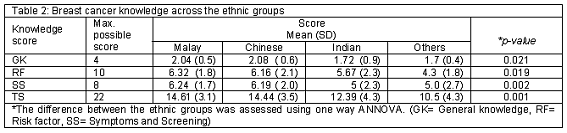
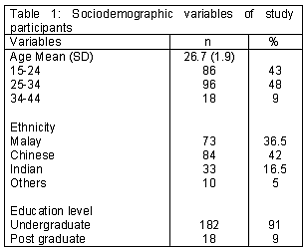
<body><![CDATA[<p>&nbsp;</p>     <p><font face="Verdana" size="2"><b>Results</b></font></p>     <p><font face="Verdana" size="2">The mean age of the participants was 26.7 (SD=1.9) years (<a href="#tab1">Table 1</a>). Chinese ethnic group constituted the majority of the participants (42%) followed by the Malay (36.5%). Ninety-one percent of the respondents were undergraduate students.</font></p>     <p align="center"><a name="tab1" id="tab1"></a>    <br><img src="/img/revistas/pharmacy/v8n1/original2_t1.gif" width="307" height="251"></font></p>     <p>&nbsp;</p>     <p><font face="Verdana" size="2">The overall mean total score of breast cancer knowledge was 13.97 (SD=3.71). There was a significant difference in mean total score of breast cancer knowledge among the ethnic groups (<a href="#tab2">Table 2</a>). Post-Hoc analysis (Tukey HSD) showed that Indians had significantly less knowledge as compared to Malay (p=0.01) and Chinese (p=0.02). However, there was no significant difference in the mean total score of Chinese and Malay ethnic groups (p=0.99).</font></p>     <p align="center"><a name="tab2" id="tab2"></a>    <br><img src="/img/revistas/pharmacy/v8n1/original2_t2.gif" width="567" height="133"></font></p>     <p>&nbsp;</p>     ]]></body>
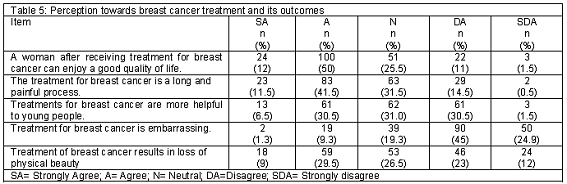
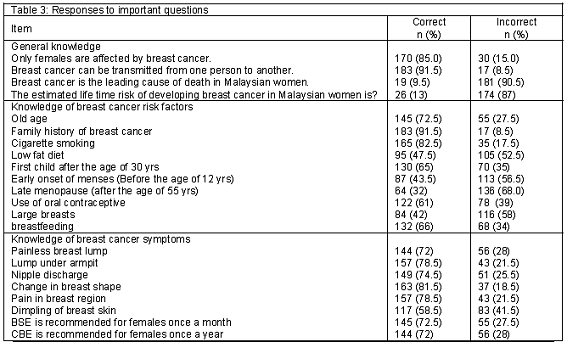
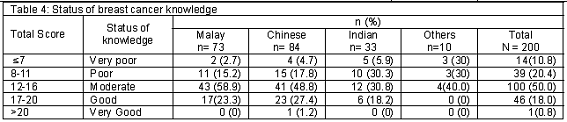
<body><![CDATA[<p><font face="Verdana" size="2">Responses to some important questions are shown in <a href="#tab3">Table 3</a>. One hundred and eighty-one (90.5%) of the participants wrongly believed that breast cancer was the leading cause of death in women and only 26 (13%) correctly recognized the estimated lifetime risk of developing breast cancer to be 1 in 19 in Malaysian women. More than two-third of the study participants acknowledged family history, old age and cigarette smoking as potential risk factors for breast cancer. A vast majority of the study participants were unable to appreciate complex risk factors such as menopause after the age of 55 years (68%), early onset of menses (56.5%) and first child after the age of 30 years (35%) are associated with breast cancer. Lump under armpit and pain in the breast region were the most frequently correctly identified symptoms of breast cancer. Surprisingly, 145 (72.5%) study participants were aware about the recommendations for practicing breast self examination (BSE) and 144 (72%) for clinical breast examination (CBE).</font></p>     <p align="center"><a name="tab3" id="tab3"></a>    <br><img src="/img/revistas/pharmacy/v8n1/original2_t3.gif" width="567" height="342"></font></p>     <p>&nbsp;</p>     <p><font face="Verdana" size="2">Further categorization of degree of knowledge using an arbitrary scoring scale, developed from literature, shown in <a href="#tab4">Table 4</a> revealed that about 27.4% of Chinese, 23.3% of Malay and only 18.2% of Indians had good knowledge of breast cancer. Less than 1% of the participants had very good knowledge and more than 30% of the study population had poor to very poor knowledge.</font></p>     <p align="center"><a name="tab4" id="tab4"></a>    <br><img src="/img/revistas/pharmacy/v8n1/original2_t4.gif" width="567" height="122"></font></p>     <p>&nbsp;</p>     <p><font face="Verdana" size="2">More than half of the participants (62%) believed that woman can enjoy a good quality of life after receiving the treatment for breast cancer (<a href="#tab5">Table 5</a>). Only 21 (10.6%) participants believed that breast cancer treatment is embarrassing.. However, more than 50 % agreed that the treatment is a long and painful process.</font></p>     <p align="center"><a name="tab5" id="tab5"></a>    ]]></body>
<body><![CDATA[<br><img src="/img/revistas/pharmacy/v8n1/original2_t5.gif" width="567" height="184"></font></p>     <p>&nbsp;</p>     <p><font face="Verdana" size="2"><b>Discussion</b></font></p>     <p><font face="Verdana" size="2">Our findings confirmed the previous reports<sup>8,13-15</sup> that the deficit in knowledge of symptoms and risk factors might be the reasons for the delayed presentation of breast cancer in developing countries. However, in developed nations where there is a diminution in mortality secondary to early detection and improved treatment modalities<sup>16,17</sup>, delayed presentation remains a problem for older women as seen in British<sup>12</sup>, American<sup>18</sup>, and Australian women.<sup>19</sup> It has been reported that older adults should not be expected to seek medical help despite symptoms of disease, since these symptoms may not cause them any pain or affect their functioning.<sup>20</sup> It is also noteworthy that women in the older age group, who are at increased risk of developing breast cancer lack sufficient knowledge about risk factors and symptoms of breast cancer.</font></p>     <p><font face="Verdana" size="2">In the present survey, most women respondents were aware of BSE and CBE, which is in contrast with the findings of another Malaysian study<sup>21</sup>, in which only 24.4% of women practiced BSE once a month and 18.4% had a Pap smear examination within the last three years. These variations can be explained by the difference in the study population as the latter study was conducted among electronic factory workers who usually come from lower socioeconomic status and less educated. The Malaysian Ministry of Health promotes the practice of monthly BSE for women above the age of 20 years, and annual CBE by medical or paramedical personnel.<sup>1</sup> There is consistent evidence in the literature that CBE and mammography can reduce mortality due to early detection and treatment of breast cancer.<sup>22</sup> On the other hand, the effectiveness of BSE in reducing mortality is controversial, since clinical trials<sup>23,24</sup> did not find any evidence that practicing it is beneficial in reducing mortality. Instead, higher rate of physician visits, increased level of anxiety and benign biopsies with consequent use of health resources were observed in women who were taught BSE.<sup>23</sup> However, some scholars argue that practicing BSE make women more "breast aware" and consequently more liable to detect tumors since many breast tumors are discovered by women themselves.<sup>25</sup> In developing countries like Malaysia where there is no nationwide population-based breast screening mammography program7 due to limited resources, BSE is considered to be a simple, inexpensive, non-invasive, and non-hazardous intervention, which is not only acceptable, cost-effective and appropriate, but also encourages women to take an active responsibility in preventive health.<sup>1</sup></font></p>     <p><font face="Verdana" size="2">Among the risk factor assessed in this study, family history of breast cancer was the most commonly identified risk factor, consistent with a recent cross-sectional study of knowledge and belief conducted among British women.<sup>12</sup> Similarly, women in the British study were unable to appreciate complex risk factors such as early onset of menses and late menopause. Recognizing the whole range of breast cancer symptoms is essential for early self-detection and treatment of breast cancer. Any intervention to improve knowledge of symptoms should also aim at limiting anxiety and ensuring medical facilities are not overloaded by help-seeking for benign symptoms.<sup>12</sup></font></p>     <p><font face="Verdana" size="2">The vast majority of our study participants had correct beliefs about breast cancer management and its outcomes. They, however, had negative perception of breast cancer treatment by considering it to be a long-term and painful process.</font></p>     <p><font face="Verdana" size="2">The results of this survey suggest the need for educational programs as tools for improving the current knowledge of breast cancer, targeting women through the mass media and perhaps clinical settings. The programs should also emphasize the need for prevention of breast cancer by avoiding exposure to potential carcinogens such as frequent X-rays exposure and cigarette smoke, and promoting healthy diets that are rich in fiber and contain less saturated fat, in addition to physical exercise. Television and radio broadcasts and distribution of leaflets should be used to disseminate the required information pertaining breast cancer. Although, television and radio appear to be better media to reach a wider audience, their benefits may be limited only to people who have access to them. Available data suggest that people prefer to learn about cancer-related issues from their doctors and health organizations. Therefore, proper counseling should be routinely given by healthcare providers within hospitals and clinics to improve breast cancer knowledge and in this setting leaflets may be an effective tool. The primary goal is to improve the survival rate by promoting early detection and medical help-seeking behaviors among women.</font></p>     <p><font face="Verdana" size="2">The study was conducted among the students of Universiti Sains Malaysia only and therefore might not be a representative of all universities across Malaysia. Furthermore, the current study was never designed to appraise the breast self examination technique of study participants.</font></p>     <p>&nbsp;</p>     ]]></body>
<body><![CDATA[<p><font face="Verdana" size="2"><b>Conclusions</b></font></p>     <p><font face="Verdana" size="2">Overall, the students had limited knowledge of risk factors and sign and symptoms of breast cancer. However, the students were aware of BSE and CBE guidelines. Furthermore, they had positive perception towards breast cancer treatment and its outcomes. The need of an intensive breast cancer awareness campaign which should also stress the importance of early detection and reporting is evident keeping in view the current status of breast cancer knowledge.</font></p>     <p>&nbsp;</p>     <p><font face="Verdana" size="2"><b>Conflict of interest</b></font></p>     <p><font face="Verdana" size="2">None declared. No external funding was obtained for this research project.</font></p>     <p>&nbsp;</p>     <p><font face="Verdana" size="2"><b>References</b></font></p>     <!-- ref --><p><font face="Verdana" size="2">1. Narimah A, Rugayah HB, Tahir A, Maimunah AH. Breast Examination, National Health and Morbidity Survey 1996 Volume 20 Kuala Lumpur, Public Health Institute, Ministry of Health, Malaysia 1999.    &nbsp;&nbsp;&nbsp;&nbsp;&nbsp;&nbsp;&nbsp;&nbsp;[&#160;<a href="javascript:void(0);" onclick="javascript: window.open('/scielo.php?script=sci_nlinks&ref=4243210&pid=S1885-642X201000010000300001&lng=','','width=640,height=500,resizable=yes,scrollbars=1,menubar=yes,');">Links</a>&#160;]<!-- end-ref --></font></p>    <!-- ref --><p><font face="Verdana" size="2">2. Hisham AN, Yip CH. Spectrum of breast cancer in Malaysian women. World J. Surg. 2003; 27:921-923.    &nbsp;&nbsp;&nbsp;&nbsp;&nbsp;&nbsp;&nbsp;&nbsp;[&#160;<a href="javascript:void(0);" onclick="javascript: window.open('/scielo.php?script=sci_nlinks&ref=4243212&pid=S1885-642X201000010000300002&lng=','','width=640,height=500,resizable=yes,scrollbars=1,menubar=yes,');">Links</a>&#160;]<!-- end-ref --></font></p>    <!-- ref --><p><font face="Verdana" size="2">3. National Cancer registry. Second report on cancer incidence in Malaysia 2003; Available at  <a target="_blank" href="http://www.radiologymalaysia.org/Archive/NCR/2ndNCR.pdf">www.radiologymalaysia.org/Archive/NCR/2ndNCR.pdf</a> (Accessed 2007-09-15).    &nbsp;&nbsp;&nbsp;&nbsp;&nbsp;&nbsp;&nbsp;&nbsp;[&#160;<a href="javascript:void(0);" onclick="javascript: window.open('/scielo.php?script=sci_nlinks&ref=4243214&pid=S1885-642X201000010000300003&lng=','','width=640,height=500,resizable=yes,scrollbars=1,menubar=yes,');">Links</a>&#160;]<!-- end-ref --></font></p>    <!-- ref --><p><font face="Verdana" size="2">4. Richards MA, Smith P, Ramirez AJ, Fentiman IS, Rubens RD. The influence on survival of delay in the presentation and treatment of symptomatic breast cancer. Br J Cancer. 1999;79:858-864.    &nbsp;&nbsp;&nbsp;&nbsp;&nbsp;&nbsp;&nbsp;&nbsp;[&#160;<a href="javascript:void(0);" onclick="javascript: window.open('/scielo.php?script=sci_nlinks&ref=4243216&pid=S1885-642X201000010000300004&lng=','','width=640,height=500,resizable=yes,scrollbars=1,menubar=yes,');">Links</a>&#160;]<!-- end-ref --></font></p>    <!-- ref --><p><font face="Verdana" size="2">5. Rossi S, Cinini C, Di Pietro C, Lombardi CP, Crucitti A, Bellantone R, Crucitti F. Diagnostic delay in breast cancer: correlation with disease stage and prognosis. Tumori. 1990;76:559-562.    &nbsp;&nbsp;&nbsp;&nbsp;&nbsp;&nbsp;&nbsp;&nbsp;[&#160;<a href="javascript:void(0);" onclick="javascript: window.open('/scielo.php?script=sci_nlinks&ref=4243218&pid=S1885-642X201000010000300005&lng=','','width=640,height=500,resizable=yes,scrollbars=1,menubar=yes,');">Links</a>&#160;]<!-- end-ref --></font></p>    <!-- ref --><p><font face="Verdana" size="2">6. Richards MA, Westcombe AM, Love SB, Littlejohns P, Ramirez AJ. Influence of delay on survival in patients with breast cancer: a systematic review. Lancet. 1999;353:1119-1126.    &nbsp;&nbsp;&nbsp;&nbsp;&nbsp;&nbsp;&nbsp;&nbsp;[&#160;<a href="javascript:void(0);" onclick="javascript: window.open('/scielo.php?script=sci_nlinks&ref=4243220&pid=S1885-642X201000010000300006&lng=','','width=640,height=500,resizable=yes,scrollbars=1,menubar=yes,');">Links</a>&#160;]<!-- end-ref --></font></p>    <!-- ref --><p><font face="Verdana" size="2">7. Hisham AN, Yip CH. Overview of breast cancer in Malaysian women: A problem with late diagnosis. Asian J Surg. 2004;27:130-133.    &nbsp;&nbsp;&nbsp;&nbsp;&nbsp;&nbsp;&nbsp;&nbsp;[&#160;<a href="javascript:void(0);" onclick="javascript: window.open('/scielo.php?script=sci_nlinks&ref=4243222&pid=S1885-642X201000010000300007&lng=','','width=640,height=500,resizable=yes,scrollbars=1,menubar=yes,');">Links</a>&#160;]<!-- end-ref --></font></p>    <!-- ref --><p><font face="Verdana" size="2">8. Rashidi A, Rajaram SS. Middle Eastern Asian Islamic women and breast self-examination. Needs assessment. Cancer Nurs. 2000;23:64-70.    &nbsp;&nbsp;&nbsp;&nbsp;&nbsp;&nbsp;&nbsp;&nbsp;[&#160;<a href="javascript:void(0);" onclick="javascript: window.open('/scielo.php?script=sci_nlinks&ref=4243224&pid=S1885-642X201000010000300008&lng=','','width=640,height=500,resizable=yes,scrollbars=1,menubar=yes,');">Links</a>&#160;]<!-- end-ref --></font></p>    <!-- ref --><p><font face="Verdana" size="2">9. Rajaram SS, Rashidi A. Asian-Islamic women and breast cancer screening: a socio-cultural analysis. Women Health. 1999;28:45-48.    &nbsp;&nbsp;&nbsp;&nbsp;&nbsp;&nbsp;&nbsp;&nbsp;[&#160;<a href="javascript:void(0);" onclick="javascript: window.open('/scielo.php?script=sci_nlinks&ref=4243226&pid=S1885-642X201000010000300009&lng=','','width=640,height=500,resizable=yes,scrollbars=1,menubar=yes,');">Links</a>&#160;]<!-- end-ref --></font></p>    <!-- ref --><p><font face="Verdana" size="2">10. Odusanya OO, Tayo OO. Breast cancer knowledge, attitudes and practice among nurses in Lagos, Nigeria. Acta Oncol. 2001;40:844-848.    &nbsp;&nbsp;&nbsp;&nbsp;&nbsp;&nbsp;&nbsp;&nbsp;[&#160;<a href="javascript:void(0);" onclick="javascript: window.open('/scielo.php?script=sci_nlinks&ref=4243228&pid=S1885-642X201000010000300010&lng=','','width=640,height=500,resizable=yes,scrollbars=1,menubar=yes,');">Links</a>&#160;]<!-- end-ref --></font></p>    <!-- ref --><p><font face="Verdana" size="2">11. Department of Statistics. Malaysia Year Book of Statistics 2007. Kuala Lumpur: Department of Statistics Malaysia, 2007.    &nbsp;&nbsp;&nbsp;&nbsp;&nbsp;&nbsp;&nbsp;&nbsp;[&#160;<a href="javascript:void(0);" onclick="javascript: window.open('/scielo.php?script=sci_nlinks&ref=4243230&pid=S1885-642X201000010000300011&lng=','','width=640,height=500,resizable=yes,scrollbars=1,menubar=yes,');">Links</a>&#160;]<!-- end-ref --></font></p>    <!-- ref --><p><font face="Verdana" size="2">12. Grunfeld EA, Ramirez AJ, Hunter MS, Richards MA. Women's knowledge and beliefs regarding breast cancer. Br J Cancer. 2002;86:1373-1378.    &nbsp;&nbsp;&nbsp;&nbsp;&nbsp;&nbsp;&nbsp;&nbsp;[&#160;<a href="javascript:void(0);" onclick="javascript: window.open('/scielo.php?script=sci_nlinks&ref=4243232&pid=S1885-642X201000010000300012&lng=','','width=640,height=500,resizable=yes,scrollbars=1,menubar=yes,');">Links</a>&#160;]<!-- end-ref --></font></p>    <!-- ref --><p><font face="Verdana" size="2">13. Usmani K, Khanum A, Afzal H, Ahmad N. Breast cancer in Pakistani women. J Environ Pathol Toxicol Oncol. 1996;15:251-253.    &nbsp;&nbsp;&nbsp;&nbsp;&nbsp;&nbsp;&nbsp;&nbsp;[&#160;<a href="javascript:void(0);" onclick="javascript: window.open('/scielo.php?script=sci_nlinks&ref=4243234&pid=S1885-642X201000010000300013&lng=','','width=640,height=500,resizable=yes,scrollbars=1,menubar=yes,');">Links</a>&#160;]<!-- end-ref --></font></p>    <!-- ref --><p><font face="Verdana" size="2">14. Harirchi I, Ebrahimi M, Zamani N, Jarvandi S, Montazeri A. Breast cancer in Iran: a review of 903 case records. Public Health. 2000;114:143-145.    &nbsp;&nbsp;&nbsp;&nbsp;&nbsp;&nbsp;&nbsp;&nbsp;[&#160;<a href="javascript:void(0);" onclick="javascript: window.open('/scielo.php?script=sci_nlinks&ref=4243236&pid=S1885-642X201000010000300014&lng=','','width=640,height=500,resizable=yes,scrollbars=1,menubar=yes,');">Links</a>&#160;]<!-- end-ref --></font></p>    <!-- ref --><p><font face="Verdana" size="2">15. Okobia MN, Bunker CH, Okonofua FE, Osime U: Knowledge, attitude and practice of Nigerian women towards breast cancer: A cross-sectional study. World J Surg Oncol.. 2006; 4(11):1477-7819.    &nbsp;&nbsp;&nbsp;&nbsp;&nbsp;&nbsp;&nbsp;&nbsp;[&#160;<a href="javascript:void(0);" onclick="javascript: window.open('/scielo.php?script=sci_nlinks&ref=4243238&pid=S1885-642X201000010000300015&lng=','','width=640,height=500,resizable=yes,scrollbars=1,menubar=yes,');">Links</a>&#160;]<!-- end-ref --></font></p>    <!-- ref --><p><font face="Verdana" size="2">16. Peto R, Boreham J, Clarke M, Davies C, Beral V. UK and USA breast cancer deaths down 25% at ages 20-69. Lancet. 2000;355:1822.    &nbsp;&nbsp;&nbsp;&nbsp;&nbsp;&nbsp;&nbsp;&nbsp;[&#160;<a href="javascript:void(0);" onclick="javascript: window.open('/scielo.php?script=sci_nlinks&ref=4243240&pid=S1885-642X201000010000300016&lng=','','width=640,height=500,resizable=yes,scrollbars=1,menubar=yes,');">Links</a>&#160;]<!-- end-ref --></font></p>    <!-- ref --><p><font face="Verdana" size="2">17. Ramirez AJ, Westcombe AM, Burgess CC, Sutton S, Johns LP, Richards MA. Factors predicting delayed presentation of symptomatic breast cancer: a systematic review. Lancet.1999;353:1127-1131.    &nbsp;&nbsp;&nbsp;&nbsp;&nbsp;&nbsp;&nbsp;&nbsp;[&#160;<a href="javascript:void(0);" onclick="javascript: window.open('/scielo.php?script=sci_nlinks&ref=4243242&pid=S1885-642X201000010000300017&lng=','','width=640,height=500,resizable=yes,scrollbars=1,menubar=yes,');">Links</a>&#160;]<!-- end-ref --></font></p>    <!-- ref --><p><font face="Verdana" size="2">18. Breslow RA, Sorkin JD, Frey CM, Kessler LG. American´s knowledge of cancer risk and survival. Prev Med. 1997;26:170-177.    &nbsp;&nbsp;&nbsp;&nbsp;&nbsp;&nbsp;&nbsp;&nbsp;[&#160;<a href="javascript:void(0);" onclick="javascript: window.open('/scielo.php?script=sci_nlinks&ref=4243244&pid=S1885-642X201000010000300018&lng=','','width=640,height=500,resizable=yes,scrollbars=1,menubar=yes,');">Links</a>&#160;]<!-- end-ref --></font></p>    <!-- ref --><p><font face="Verdana" size="2">19. Paul C, Barratt A, Redman S, Cockburn J, Lowe J. Knowledge and perceptions about breast cancer incidence, fatality and risk among Australian women. Aust NZ J Public Health. 1999;23:396-400.    &nbsp;&nbsp;&nbsp;&nbsp;&nbsp;&nbsp;&nbsp;&nbsp;[&#160;<a href="javascript:void(0);" onclick="javascript: window.open('/scielo.php?script=sci_nlinks&ref=4243246&pid=S1885-642X201000010000300019&lng=','','width=640,height=500,resizable=yes,scrollbars=1,menubar=yes,');">Links</a>&#160;]<!-- end-ref --></font></p>    <!-- ref --><p><font face="Verdana" size="2">20. Ford G, Taylor R. The elderly as under consulters: a critical reappraisal. J R Coll Gen Pract. 1985;35:244-247.    &nbsp;&nbsp;&nbsp;&nbsp;&nbsp;&nbsp;&nbsp;&nbsp;[&#160;<a href="javascript:void(0);" onclick="javascript: window.open('/scielo.php?script=sci_nlinks&ref=4243248&pid=S1885-642X201000010000300020&lng=','','width=640,height=500,resizable=yes,scrollbars=1,menubar=yes,');">Links</a>&#160;]<!-- end-ref --></font></p>    <!-- ref --><p><font face="Verdana" size="2">21. Chee HL, Rashidah S, K Shamsuddin Intan O. Factors related to the practice of breast self examination (BSE) and Pap smear screening among Malaysian women workers in selected electronics factories. BMC Women's Health 2003;3:3.    &nbsp;&nbsp;&nbsp;&nbsp;&nbsp;&nbsp;&nbsp;&nbsp;[&#160;<a href="javascript:void(0);" onclick="javascript: window.open('/scielo.php?script=sci_nlinks&ref=4243250&pid=S1885-642X201000010000300021&lng=','','width=640,height=500,resizable=yes,scrollbars=1,menubar=yes,');">Links</a>&#160;]<!-- end-ref --></font></p>    <!-- ref --><p><font face="Verdana" size="2">22. Dbameharha YA. Knowledge about breast cancer and mammography in breast cancer screening among women awaiting mammography. Turk J Med Sci. 2005;35:35-42.    &nbsp;&nbsp;&nbsp;&nbsp;&nbsp;&nbsp;&nbsp;&nbsp;[&#160;<a href="javascript:void(0);" onclick="javascript: window.open('/scielo.php?script=sci_nlinks&ref=4243252&pid=S1885-642X201000010000300022&lng=','','width=640,height=500,resizable=yes,scrollbars=1,menubar=yes,');">Links</a>&#160;]<!-- end-ref --></font></p>    <!-- ref --><p><font face="Verdana" size="2">23. Baxter N; Canadian Task Force on Preventive Health Care. Preventive health care, 2001 update: should women be routinely taught breast self-examination to screen for breast cancer? CMAJ. 2001;164(13):1837-1846.    &nbsp;&nbsp;&nbsp;&nbsp;&nbsp;&nbsp;&nbsp;&nbsp;[&#160;<a href="javascript:void(0);" onclick="javascript: window.open('/scielo.php?script=sci_nlinks&ref=4243254&pid=S1885-642X201000010000300023&lng=','','width=640,height=500,resizable=yes,scrollbars=1,menubar=yes,');">Links</a>&#160;]<!-- end-ref --></font></p>    <!-- ref --><p><font face="Verdana" size="2">24. Thomas DB, Gao DL, Ray RM, Wang WW, Allison CJ, Chen FL, Porter P, Hu YW, Zhao GL, Pan LD, Li W, Wu C, Coriaty Z, Evans I, Lin MG, Stalsberg H, Self SG. Randomized trial of breast self-examination in Shanghai: final results. J Natl Cancer Inst. 2002;94(19):1445-1457.    &nbsp;&nbsp;&nbsp;&nbsp;&nbsp;&nbsp;&nbsp;&nbsp;[&#160;<a href="javascript:void(0);" onclick="javascript: window.open('/scielo.php?script=sci_nlinks&ref=4243256&pid=S1885-642X201000010000300024&lng=','','width=640,height=500,resizable=yes,scrollbars=1,menubar=yes,');">Links</a>&#160;]<!-- end-ref --></font></p>    <!-- ref --><p><font face="Verdana" size="2">25. Larkin M. Breast self-examination does more harm than good, says task force. Lancet. 2001;357:2109.    &nbsp;&nbsp;&nbsp;&nbsp;&nbsp;&nbsp;&nbsp;&nbsp;[&#160;<a href="javascript:void(0);" onclick="javascript: window.open('/scielo.php?script=sci_nlinks&ref=4243258&pid=S1885-642X201000010000300025&lng=','','width=640,height=500,resizable=yes,scrollbars=1,menubar=yes,');">Links</a>&#160;]<!-- end-ref --></font></p>     <p>&nbsp;</p>     <p>&nbsp;</p>     <p><font face="Verdana" size="2">Received: 15.08.09    ]]></body>
<body><![CDATA[<br>Accepted: 11.01.10</font></p>      ]]></body><back>
<ref-list>
<ref id="B1">
<label>1</label><nlm-citation citation-type="book">
<person-group person-group-type="author">
<name>
<surname><![CDATA[Narimah]]></surname>
<given-names><![CDATA[A]]></given-names>
</name>
<name>
<surname><![CDATA[Rugayah]]></surname>
<given-names><![CDATA[HB]]></given-names>
</name>
<name>
<surname><![CDATA[Tahir]]></surname>
<given-names><![CDATA[A]]></given-names>
</name>
<name>
<surname><![CDATA[Maimunah]]></surname>
<given-names><![CDATA[AH]]></given-names>
</name>
</person-group>
<source><![CDATA[Breast Examination, National Health and Morbidity Survey 1996]]></source>
<year>1999</year>
<volume>20</volume>
<publisher-loc><![CDATA[Kuala Lumpur ]]></publisher-loc>
<publisher-name><![CDATA[Public Health InstituteMinistry of Health]]></publisher-name>
</nlm-citation>
</ref>
<ref id="B2">
<label>2</label><nlm-citation citation-type="journal">
<person-group person-group-type="author">
<name>
<surname><![CDATA[Hisham]]></surname>
<given-names><![CDATA[AN]]></given-names>
</name>
<name>
<surname><![CDATA[Yip]]></surname>
<given-names><![CDATA[CH]]></given-names>
</name>
</person-group>
<article-title xml:lang="en"><![CDATA[Spectrum of breast cancer in Malaysian women]]></article-title>
<source><![CDATA[World J. Surg.]]></source>
<year>2003</year>
<volume>27</volume>
<page-range>921-923</page-range></nlm-citation>
</ref>
<ref id="B3">
<label>3</label><nlm-citation citation-type="">
<source><![CDATA[National Cancer registry: Second report on cancer incidence in Malaysia 2003]]></source>
<year></year>
</nlm-citation>
</ref>
<ref id="B4">
<label>4</label><nlm-citation citation-type="journal">
<person-group person-group-type="author">
<name>
<surname><![CDATA[Richards]]></surname>
<given-names><![CDATA[MA]]></given-names>
</name>
<name>
<surname><![CDATA[Smith]]></surname>
<given-names><![CDATA[P]]></given-names>
</name>
<name>
<surname><![CDATA[Ramirez]]></surname>
<given-names><![CDATA[AJ]]></given-names>
</name>
<name>
<surname><![CDATA[Fentiman]]></surname>
<given-names><![CDATA[IS]]></given-names>
</name>
<name>
<surname><![CDATA[Rubens]]></surname>
<given-names><![CDATA[RD]]></given-names>
</name>
</person-group>
<article-title xml:lang="en"><![CDATA[The influence on survival of delay in the presentation and treatment of symptomatic breast cancer]]></article-title>
<source><![CDATA[Br J Cancer.]]></source>
<year>1999</year>
<volume>79</volume>
<page-range>858-864</page-range></nlm-citation>
</ref>
<ref id="B5">
<label>5</label><nlm-citation citation-type="journal">
<person-group person-group-type="author">
<name>
<surname><![CDATA[Rossi]]></surname>
<given-names><![CDATA[S]]></given-names>
</name>
<name>
<surname><![CDATA[Cinini]]></surname>
<given-names><![CDATA[C]]></given-names>
</name>
<name>
<surname><![CDATA[Di Pietro]]></surname>
<given-names><![CDATA[C]]></given-names>
</name>
<name>
<surname><![CDATA[Lombardi]]></surname>
<given-names><![CDATA[CP]]></given-names>
</name>
<name>
<surname><![CDATA[Crucitti]]></surname>
<given-names><![CDATA[A]]></given-names>
</name>
<name>
<surname><![CDATA[Bellantone]]></surname>
<given-names><![CDATA[R]]></given-names>
</name>
<name>
<surname><![CDATA[Crucitti]]></surname>
<given-names><![CDATA[F]]></given-names>
</name>
</person-group>
<article-title xml:lang="en"><![CDATA[Diagnostic delay in breast cancer: correlation with disease stage and prognosis]]></article-title>
<source><![CDATA[Tumori.]]></source>
<year>1990</year>
<volume>76</volume>
<page-range>559-562</page-range></nlm-citation>
</ref>
<ref id="B6">
<label>6</label><nlm-citation citation-type="journal">
<person-group person-group-type="author">
<name>
<surname><![CDATA[Richards]]></surname>
<given-names><![CDATA[MA]]></given-names>
</name>
<name>
<surname><![CDATA[Westcombe]]></surname>
<given-names><![CDATA[AM]]></given-names>
</name>
<name>
<surname><![CDATA[Love]]></surname>
<given-names><![CDATA[SB]]></given-names>
</name>
<name>
<surname><![CDATA[Littlejohns]]></surname>
<given-names><![CDATA[P]]></given-names>
</name>
<name>
<surname><![CDATA[Ramirez]]></surname>
<given-names><![CDATA[AJ]]></given-names>
</name>
</person-group>
<article-title xml:lang="en"><![CDATA[Influence of delay on survival in patients with breast cancer: a systematic review]]></article-title>
<source><![CDATA[Lancet.]]></source>
<year>1999</year>
<volume>353</volume>
<page-range>1119-1126</page-range></nlm-citation>
</ref>
<ref id="B7">
<label>7</label><nlm-citation citation-type="journal">
<person-group person-group-type="author">
<name>
<surname><![CDATA[Hisham]]></surname>
<given-names><![CDATA[AN]]></given-names>
</name>
<name>
<surname><![CDATA[Yip]]></surname>
<given-names><![CDATA[CH]]></given-names>
</name>
</person-group>
<article-title xml:lang="en"><![CDATA[Overview of breast cancer in Malaysian women: A problem with late diagnosis]]></article-title>
<source><![CDATA[Asian J Surg.]]></source>
<year>2004</year>
<volume>27</volume>
<page-range>130-133</page-range></nlm-citation>
</ref>
<ref id="B8">
<label>8</label><nlm-citation citation-type="journal">
<person-group person-group-type="author">
<name>
<surname><![CDATA[Rashidi]]></surname>
<given-names><![CDATA[A]]></given-names>
</name>
<name>
<surname><![CDATA[Rajaram]]></surname>
<given-names><![CDATA[SS]]></given-names>
</name>
</person-group>
<article-title xml:lang="en"><![CDATA[Middle Eastern Asian Islamic women and breast self-examination: Needs assessment]]></article-title>
<source><![CDATA[Cancer Nurs.]]></source>
<year>2000</year>
<volume>23</volume>
<page-range>64-70</page-range></nlm-citation>
</ref>
<ref id="B9">
<label>9</label><nlm-citation citation-type="journal">
<person-group person-group-type="author">
<name>
<surname><![CDATA[Rajaram]]></surname>
<given-names><![CDATA[SS]]></given-names>
</name>
<name>
<surname><![CDATA[Rashidi]]></surname>
<given-names><![CDATA[A]]></given-names>
</name>
</person-group>
<article-title xml:lang="en"><![CDATA[Asian-Islamic women and breast cancer screening: a socio-cultural analysis]]></article-title>
<source><![CDATA[Women Health]]></source>
<year>1999</year>
<volume>28</volume>
<page-range>45-48</page-range></nlm-citation>
</ref>
<ref id="B10">
<label>10</label><nlm-citation citation-type="journal">
<person-group person-group-type="author">
<name>
<surname><![CDATA[Odusanya]]></surname>
<given-names><![CDATA[OO]]></given-names>
</name>
<name>
<surname><![CDATA[Tayo]]></surname>
<given-names><![CDATA[OO]]></given-names>
</name>
</person-group>
<article-title xml:lang="en"><![CDATA[Breast cancer knowledge, attitudes and practice among nurses in Lagos, Nigeria]]></article-title>
<source><![CDATA[Acta Oncol.]]></source>
<year>2001</year>
<volume>40</volume>
<page-range>844-848</page-range></nlm-citation>
</ref>
<ref id="B11">
<label>11</label><nlm-citation citation-type="book">
<collab>Department of Statistics</collab>
<source><![CDATA[Malaysia Year Book of Statistics 2007]]></source>
<year>2007</year>
<publisher-loc><![CDATA[Kuala Lumpur ]]></publisher-loc>
<publisher-name><![CDATA[Department of Statistics Malaysia]]></publisher-name>
</nlm-citation>
</ref>
<ref id="B12">
<label>12</label><nlm-citation citation-type="journal">
<person-group person-group-type="author">
<name>
<surname><![CDATA[Grunfeld]]></surname>
<given-names><![CDATA[EA]]></given-names>
</name>
<name>
<surname><![CDATA[Ramirez]]></surname>
<given-names><![CDATA[AJ]]></given-names>
</name>
<name>
<surname><![CDATA[Hunter]]></surname>
<given-names><![CDATA[MS]]></given-names>
</name>
<name>
<surname><![CDATA[Richards]]></surname>
<given-names><![CDATA[MA]]></given-names>
</name>
</person-group>
<article-title xml:lang="en"><![CDATA[Women's knowledge and beliefs regarding breast cancer]]></article-title>
<source><![CDATA[Br J Cancer.]]></source>
<year>2002</year>
<volume>86</volume>
<page-range>1373-1378</page-range></nlm-citation>
</ref>
<ref id="B13">
<label>13</label><nlm-citation citation-type="journal">
<person-group person-group-type="author">
<name>
<surname><![CDATA[Usmani]]></surname>
<given-names><![CDATA[K]]></given-names>
</name>
<name>
<surname><![CDATA[Khanum]]></surname>
<given-names><![CDATA[A]]></given-names>
</name>
<name>
<surname><![CDATA[Afzal]]></surname>
<given-names><![CDATA[H]]></given-names>
</name>
<name>
<surname><![CDATA[Ahmad]]></surname>
<given-names><![CDATA[N]]></given-names>
</name>
</person-group>
<article-title xml:lang="en"><![CDATA[Breast cancer in Pakistani women]]></article-title>
<source><![CDATA[J Environ Pathol Toxicol Oncol.]]></source>
<year>1996</year>
<volume>15</volume>
<page-range>251-253</page-range></nlm-citation>
</ref>
<ref id="B14">
<label>14</label><nlm-citation citation-type="journal">
<person-group person-group-type="author">
<name>
<surname><![CDATA[Harirchi]]></surname>
<given-names><![CDATA[I]]></given-names>
</name>
<name>
<surname><![CDATA[Ebrahimi]]></surname>
<given-names><![CDATA[M]]></given-names>
</name>
<name>
<surname><![CDATA[Zamani]]></surname>
<given-names><![CDATA[N]]></given-names>
</name>
<name>
<surname><![CDATA[Jarvandi]]></surname>
<given-names><![CDATA[S]]></given-names>
</name>
<name>
<surname><![CDATA[Montazeri]]></surname>
<given-names><![CDATA[A]]></given-names>
</name>
</person-group>
<article-title xml:lang="en"><![CDATA[Breast cancer in Iran: a review of 903 case records]]></article-title>
<source><![CDATA[Public Health]]></source>
<year>2000</year>
<volume>114</volume>
<page-range>143-145</page-range></nlm-citation>
</ref>
<ref id="B15">
<label>15</label><nlm-citation citation-type="journal">
<person-group person-group-type="author">
<name>
<surname><![CDATA[Okobia]]></surname>
<given-names><![CDATA[MN]]></given-names>
</name>
<name>
<surname><![CDATA[Bunker]]></surname>
<given-names><![CDATA[CH]]></given-names>
</name>
<name>
<surname><![CDATA[Okonofua]]></surname>
<given-names><![CDATA[FE]]></given-names>
</name>
<name>
<surname><![CDATA[Osime]]></surname>
<given-names><![CDATA[U]]></given-names>
</name>
</person-group>
<article-title xml:lang="en"><![CDATA[Knowledge, attitude and practice of Nigerian women towards breast cancer: A cross-sectional study]]></article-title>
<source><![CDATA[World J Surg Oncol..]]></source>
<year>2006</year>
<volume>4</volume>
<numero>11</numero>
<issue>11</issue>
<page-range>1477-7819</page-range></nlm-citation>
</ref>
<ref id="B16">
<label>16</label><nlm-citation citation-type="journal">
<person-group person-group-type="author">
<name>
<surname><![CDATA[Peto]]></surname>
<given-names><![CDATA[R]]></given-names>
</name>
<name>
<surname><![CDATA[Boreham]]></surname>
<given-names><![CDATA[J]]></given-names>
</name>
<name>
<surname><![CDATA[Clarke]]></surname>
<given-names><![CDATA[M]]></given-names>
</name>
<name>
<surname><![CDATA[Davies]]></surname>
<given-names><![CDATA[C]]></given-names>
</name>
<name>
<surname><![CDATA[Beral]]></surname>
<given-names><![CDATA[V]]></given-names>
</name>
</person-group>
<article-title xml:lang="en"><![CDATA[UK and USA breast cancer deaths down 25% at ages 20-69]]></article-title>
<source><![CDATA[Lancet.]]></source>
<year>2000</year>
<volume>355</volume>
<page-range>1822</page-range></nlm-citation>
</ref>
<ref id="B17">
<label>17</label><nlm-citation citation-type="journal">
<person-group person-group-type="author">
<name>
<surname><![CDATA[Ramirez]]></surname>
<given-names><![CDATA[AJ]]></given-names>
</name>
<name>
<surname><![CDATA[Westcombe]]></surname>
<given-names><![CDATA[AM]]></given-names>
</name>
<name>
<surname><![CDATA[Burgess]]></surname>
<given-names><![CDATA[CC]]></given-names>
</name>
<name>
<surname><![CDATA[Sutton]]></surname>
<given-names><![CDATA[S]]></given-names>
</name>
<name>
<surname><![CDATA[Johns]]></surname>
<given-names><![CDATA[LP]]></given-names>
</name>
<name>
<surname><![CDATA[Richards]]></surname>
<given-names><![CDATA[MA]]></given-names>
</name>
</person-group>
<article-title xml:lang="en"><![CDATA[Factors predicting delayed presentation of symptomatic breast cancer: a systematic review]]></article-title>
<source><![CDATA[Lancet.]]></source>
<year>1999</year>
<volume>353</volume>
<page-range>1127-1131</page-range></nlm-citation>
</ref>
<ref id="B18">
<label>18</label><nlm-citation citation-type="journal">
<person-group person-group-type="author">
<name>
<surname><![CDATA[Breslow]]></surname>
<given-names><![CDATA[RA]]></given-names>
</name>
<name>
<surname><![CDATA[Sorkin]]></surname>
<given-names><![CDATA[JD]]></given-names>
</name>
<name>
<surname><![CDATA[Frey]]></surname>
<given-names><![CDATA[CM]]></given-names>
</name>
<name>
<surname><![CDATA[Kessler]]></surname>
<given-names><![CDATA[LG]]></given-names>
</name>
</person-group>
<article-title xml:lang="en"><![CDATA[American´s knowledge of cancer risk and survival]]></article-title>
<source><![CDATA[Prev Med.]]></source>
<year>1997</year>
<volume>26</volume>
<page-range>170-177</page-range></nlm-citation>
</ref>
<ref id="B19">
<label>19</label><nlm-citation citation-type="journal">
<person-group person-group-type="author">
<name>
<surname><![CDATA[Paul]]></surname>
<given-names><![CDATA[C]]></given-names>
</name>
<name>
<surname><![CDATA[Barratt]]></surname>
<given-names><![CDATA[A]]></given-names>
</name>
<name>
<surname><![CDATA[Redman]]></surname>
<given-names><![CDATA[S]]></given-names>
</name>
<name>
<surname><![CDATA[Cockburn]]></surname>
<given-names><![CDATA[J]]></given-names>
</name>
<name>
<surname><![CDATA[Lowe]]></surname>
<given-names><![CDATA[J]]></given-names>
</name>
</person-group>
<article-title xml:lang="en"><![CDATA[Knowledge and perceptions about breast cancer incidence, fatality and risk among Australian women]]></article-title>
<source><![CDATA[Aust NZ J Public Health.]]></source>
<year>1999</year>
<volume>23</volume>
<page-range>396-400</page-range></nlm-citation>
</ref>
<ref id="B20">
<label>20</label><nlm-citation citation-type="journal">
<person-group person-group-type="author">
<name>
<surname><![CDATA[Ford]]></surname>
<given-names><![CDATA[G]]></given-names>
</name>
<name>
<surname><![CDATA[Taylor]]></surname>
<given-names><![CDATA[R]]></given-names>
</name>
</person-group>
<article-title xml:lang="en"><![CDATA[The elderly as under consulters: a critical reappraisal]]></article-title>
<source><![CDATA[J R Coll Gen Pract.]]></source>
<year>1985</year>
<volume>35</volume>
<page-range>244-247</page-range></nlm-citation>
</ref>
<ref id="B21">
<label>21</label><nlm-citation citation-type="journal">
<person-group person-group-type="author">
<name>
<surname><![CDATA[Chee]]></surname>
<given-names><![CDATA[HL]]></given-names>
</name>
<name>
<surname><![CDATA[Rashidah]]></surname>
<given-names><![CDATA[S, K]]></given-names>
</name>
<name>
<surname><![CDATA[Shamsuddin Intan]]></surname>
<given-names><![CDATA[O.]]></given-names>
</name>
</person-group>
<article-title xml:lang="en"><![CDATA[Factors related to the practice of breast self examination (BSE) and Pap smear screening among Malaysian women workers in selected electronics factories]]></article-title>
<source><![CDATA[BMC Women's Health]]></source>
<year>2003</year>
<volume>3</volume>
<page-range>3</page-range></nlm-citation>
</ref>
<ref id="B22">
<label>22</label><nlm-citation citation-type="journal">
<person-group person-group-type="author">
<name>
<surname><![CDATA[Dbameharha]]></surname>
<given-names><![CDATA[YA]]></given-names>
</name>
</person-group>
<article-title xml:lang="en"><![CDATA[Knowledge about breast cancer and mammography in breast cancer screening among women awaiting mammography]]></article-title>
<source><![CDATA[Turk J Med Sci.]]></source>
<year>2005</year>
<volume>35</volume>
<page-range>35-42</page-range></nlm-citation>
</ref>
<ref id="B23">
<label>23</label><nlm-citation citation-type="journal">
<person-group person-group-type="author">
<name>
<surname><![CDATA[Baxter]]></surname>
<given-names><![CDATA[N]]></given-names>
</name>
</person-group>
<collab>Canadian Task Force on Preventive Health Care</collab>
<article-title xml:lang="en"><![CDATA[Preventive health care, 2001 update: should women be routinely taught breast self-examination to screen for breast cancer]]></article-title>
<source><![CDATA[CMAJ.]]></source>
<year>2001</year>
<volume>164</volume>
<numero>13</numero>
<issue>13</issue>
<page-range>1837-1846</page-range></nlm-citation>
</ref>
<ref id="B24">
<label>24</label><nlm-citation citation-type="journal">
<person-group person-group-type="author">
<name>
<surname><![CDATA[Thomas]]></surname>
<given-names><![CDATA[DB]]></given-names>
</name>
<name>
<surname><![CDATA[Gao]]></surname>
<given-names><![CDATA[DL]]></given-names>
</name>
<name>
<surname><![CDATA[Ray]]></surname>
<given-names><![CDATA[RM]]></given-names>
</name>
<name>
<surname><![CDATA[Wang]]></surname>
<given-names><![CDATA[WW]]></given-names>
</name>
<name>
<surname><![CDATA[Allison]]></surname>
<given-names><![CDATA[CJ]]></given-names>
</name>
<name>
<surname><![CDATA[Chen]]></surname>
<given-names><![CDATA[FL]]></given-names>
</name>
<name>
<surname><![CDATA[Porter]]></surname>
<given-names><![CDATA[P]]></given-names>
</name>
<name>
<surname><![CDATA[Hu]]></surname>
<given-names><![CDATA[YW]]></given-names>
</name>
<name>
<surname><![CDATA[Zhao]]></surname>
<given-names><![CDATA[GL]]></given-names>
</name>
<name>
<surname><![CDATA[Pan]]></surname>
<given-names><![CDATA[LD]]></given-names>
</name>
<name>
<surname><![CDATA[Li]]></surname>
<given-names><![CDATA[W]]></given-names>
</name>
<name>
<surname><![CDATA[Wu]]></surname>
<given-names><![CDATA[C]]></given-names>
</name>
<name>
<surname><![CDATA[Coriaty]]></surname>
<given-names><![CDATA[Z]]></given-names>
</name>
<name>
<surname><![CDATA[Evans]]></surname>
<given-names><![CDATA[I]]></given-names>
</name>
<name>
<surname><![CDATA[Lin]]></surname>
<given-names><![CDATA[MG]]></given-names>
</name>
<name>
<surname><![CDATA[Stalsberg]]></surname>
<given-names><![CDATA[H]]></given-names>
</name>
<name>
<surname><![CDATA[Self]]></surname>
<given-names><![CDATA[SG]]></given-names>
</name>
</person-group>
<article-title xml:lang="en"><![CDATA[Randomized trial of breast self-examination in Shanghai: final results]]></article-title>
<source><![CDATA[J Natl Cancer Inst.]]></source>
<year>2002</year>
<volume>94</volume>
<numero>19</numero>
<issue>19</issue>
<page-range>1445-1457</page-range></nlm-citation>
</ref>
<ref id="B25">
<label>25</label><nlm-citation citation-type="journal">
<person-group person-group-type="author">
<name>
<surname><![CDATA[Larkin]]></surname>
<given-names><![CDATA[M]]></given-names>
</name>
</person-group>
<article-title xml:lang="en"><![CDATA[Breast self-examination does more harm than good, says task force]]></article-title>
<source><![CDATA[Lancet.]]></source>
<year>2001</year>
<volume>357</volume>
<page-range>2109</page-range></nlm-citation>
</ref>
</ref-list>
</back>
</article>