<?xml version="1.0" encoding="ISO-8859-1"?><article xmlns:mml="http://www.w3.org/1998/Math/MathML" xmlns:xlink="http://www.w3.org/1999/xlink" xmlns:xsi="http://www.w3.org/2001/XMLSchema-instance">
<front>
<journal-meta>
<journal-id>1885-642X</journal-id>
<journal-title><![CDATA[Pharmacy Practice (Granada)]]></journal-title>
<abbrev-journal-title><![CDATA[Pharmacy Pract (Granada)]]></abbrev-journal-title>
<issn>1885-642X</issn>
<publisher>
<publisher-name><![CDATA[Centro de Investigaciones y Publicaciones Farmacéuticas]]></publisher-name>
</publisher>
</journal-meta>
<article-meta>
<article-id>S1885-642X2014000400007</article-id>
<title-group>
<article-title xml:lang="en"><![CDATA[Defining "elderly" in clinical practice guidelines for pharmacotherapy]]></article-title>
<article-title xml:lang="es"><![CDATA[Definiendo "anciano" en las guías de práctica clínica para farmacoterapia]]></article-title>
</title-group>
<contrib-group>
<contrib contrib-type="author">
<name>
<surname><![CDATA[Singh]]></surname>
<given-names><![CDATA[Shamsher]]></given-names>
</name>
<xref ref-type="aff" rid="A01"/>
</contrib>
<contrib contrib-type="author">
<name>
<surname><![CDATA[Bajorek]]></surname>
<given-names><![CDATA[Beata]]></given-names>
</name>
<xref ref-type="aff" rid="A01"/>
</contrib>
</contrib-group>
<aff id="A01">
<institution><![CDATA[,University of Technology Sydney Graduate School of Health School of Pharmacy]]></institution>
<addr-line><![CDATA[Sydney NSW]]></addr-line>
<country>Australia</country>
</aff>
<pub-date pub-type="pub">
<day>00</day>
<month>12</month>
<year>2014</year>
</pub-date>
<pub-date pub-type="epub">
<day>00</day>
<month>12</month>
<year>2014</year>
</pub-date>
<volume>12</volume>
<numero>4</numero>
<fpage>0</fpage>
<lpage>0</lpage>
<copyright-statement/>
<copyright-year/>
<self-uri xlink:href="http://scielo.isciii.es/scielo.php?script=sci_arttext&amp;pid=S1885-642X2014000400007&amp;lng=en&amp;nrm=iso"></self-uri><self-uri xlink:href="http://scielo.isciii.es/scielo.php?script=sci_abstract&amp;pid=S1885-642X2014000400007&amp;lng=en&amp;nrm=iso"></self-uri><self-uri xlink:href="http://scielo.isciii.es/scielo.php?script=sci_pdf&amp;pid=S1885-642X2014000400007&amp;lng=en&amp;nrm=iso"></self-uri><abstract abstract-type="short" xml:lang="en"><p><![CDATA[Objective: To identify how "elderly" patients are defined and considered within Australian clinical guidelines for the use of pharmacotherapy. Method: Guidelines pertaining to the use of pharmacotherapy, focusing on conditions described in National Health Priority Areas, were identified using databases (Medline, Google Scholar) and organisation websites (Department of Health and Ageing, National Heart Foundation, National Health and Medical Research Council). Guidelines were reviewed and qualitatively analysed to identify any references or definitions of "elderly" persons. Results: Among the 20 guidelines reviewed, 3 defined "elderly" by chronological age (i.e., years since birth) while the remaining 17 guidelines did not define "elderly" in any way. All 20 guidelines used the term "elderly", whilst some guidelines provided age (chronological)-based dosage recommendations suggesting an ageist or generalist approach in their representation of "elderly", for which rationale was seldom provided. Thematic analysis of the statements revealed five key themes regarding how "elderly" was considered within the guidelines, broadly describing "elderly" persons as being frail and with altered pharmacology. Some guidelines also highlighted the limited evidence base to direct clinical decision-making. A continuum of perceptions of ageing also emerged out of the identified themes. Conclusion: Clinical practice guidelines currently do not adequately define "elderly" persons and provide limited guidance on how to apply treatment recommendations to older persons. The representation of "elderly" in guidelines needs to be less based on chronological age or generic definitions focusing more on establishing a direct link between an individual patient´s characteristics and the pharmacology of their prescribed medication. Clinical guidelines that do not offer any practical descriptions of the features of ageing that are specifically related to the use of pharmacotherapy, or how to assess these in individual patients, render decision-making challenging.]]></p></abstract>
<abstract abstract-type="short" xml:lang="es"><p><![CDATA[Objetivo: Identificar como se define a los "ancianos" y se les considera en las guías clínicas para uso de farmacoterapia. Método: Usando bases de datos (Medline, Google Scholar) y páginas web de las organizaciones (Department of Health and Ageing, National Heart Foundation, National Health and Medical Research Council) se identificaron las guías relativas al uso de farmacoterapia centradas en problemas de salud. Se revisaron las guías y se analizaron cualitativamente para identificar referencias o definiciones de personas "ancianas". Resultados: entre las 20 guías revisadas, 3 definían "anciano" por la edad cronológica (i.e. años desde el nacimiento), mientras que las 17 guías restantes no definían "anciano" de forma alguna. Las 20 guías usaban el término "anciano", aunque algunas proporcionaban recomendaciones de dosificación basadas en la edad (cronológicas) sugiriendo un abordaje peyorativo o generalista en la representación del "anciano", para lo que raras veces se proporcionaba una justificación. El análisis temático de las afirmaciones reveló cinco temas en relación a como el "anciano" era considerado en las guías, describiendo en general al "anciano" como personas frágiles con farmacología alterada. Algunas guías también remarcaban la evidencia limitada para la toma de decisiones clínicas. También emergía de los temas identificados una idea de continuo de la percepción de envejecimiento. Conclusión: Las guías de práctica clínica no definen adecuadamente a las personas "ancianas" y proporcionan una limitada orientación sobre cómo proveer recomendaciones de tratamiento a personas mayores. La representación de "anciano" en las guías necesita estar menos basada en la edad cronológica o definición genérica, centrándose más en establecer un vínculo directo entre las características de un paciente individual y la farmacología de la medicación prescrita. Las guías clínicas que no ofrecen ninguna descripción práctica de los hechos del envejecimiento que se relacionan específicamente con la farmacoterapia, o como evaluar a esos pacientes individuales, provocan una toma de decisiones arriesgada.]]></p></abstract>
<kwd-group>
<kwd lng="en"><![CDATA[Aged]]></kwd>
<kwd lng="en"><![CDATA[Drug Therapy]]></kwd>
<kwd lng="en"><![CDATA[Practice Guidelines as Topic]]></kwd>
<kwd lng="en"><![CDATA[Terminology as Topic]]></kwd>
<kwd lng="es"><![CDATA[Anciano]]></kwd>
<kwd lng="es"><![CDATA[Farmacoterapia]]></kwd>
<kwd lng="es"><![CDATA[Guías de Práctica Clínica como Asunto]]></kwd>
<kwd lng="es"><![CDATA[Terminología como Asunto]]></kwd>
</kwd-group>
</article-meta>
</front><body><![CDATA[ <p><font face="Verdana" size="2"><b>ORIGINAL RESEARCH</b></font></p>     <p>&nbsp;</p>     <p><font face="Verdana" size="4"><b>Defining "elderly&quot; in clinical practice guidelines for pharmacotherapy</b></font></p>     <p><font face="Verdana" size="4"><b>Definiendo "anciano&quot; en las gu&iacute;as de pr&aacute;ctica cl&iacute;nica para farmacoterapia</b></font></p>     <p>&nbsp;</p>     <p>&nbsp;</p>     <p><font face="Verdana" size="2"><b>Shamsher Singh<sup>1</sup> and Beata Bajorek<sup>2</sup></b></font></p>     <p><font face="Verdana" size="2"><sup>1</sup> BPharm MPharm. School of Pharmacy, Graduate School of Health, University of Technology Sydney. Sydney, NSW (Australia). <a href="mailto:shamshersingh@student.uts.edu.au">shamshersingh@student.uts.edu.au</a>    <br><sup>2</sup> BPharm GradCertEdStud GDipClinPharm PhD. Associate Professor. School of Pharmacy, Graduate School of Health, University of Technology Sydney. Sydney, NSW (Australia). <a href="mailto:Beata.Bajorek@uts.edu.au">Beata.Bajorek@uts.edu.au</a></font></p>     <p>&nbsp;</p>     ]]></body>
<body><![CDATA[<p>&nbsp;</p> <hr size="1">    <p><font face="Verdana" size="2"><b>ABSTRACT</b></font></p>     <p><font face="Verdana" size="2"><b>Objective:</b> To identify how "elderly" patients are defined and considered within Australian clinical guidelines for the use of pharmacotherapy.    <br><b>Method:</b> Guidelines pertaining to the use of pharmacotherapy, focusing on conditions described in National Health Priority Areas, were identified using databases (Medline, Google Scholar) and organisation websites (Department of Health and Ageing, National Heart Foundation, National Health and Medical Research Council). Guidelines were reviewed and qualitatively analysed to identify any references or definitions of "elderly" persons.    <br><b>Results:</b> Among the 20 guidelines reviewed, 3 defined "elderly" by chronological age (i.e., years since birth) while the remaining 17 guidelines did not define "elderly" in any way. All 20 guidelines used the term "elderly", whilst some guidelines provided age (chronological)-based dosage recommendations suggesting an ageist or generalist approach in their representation of "elderly", for which rationale was seldom provided. Thematic analysis of the statements revealed five key themes regarding how "elderly" was considered within the guidelines, broadly describing "elderly" persons as being frail and with altered pharmacology. Some guidelines also highlighted the limited evidence base to direct clinical decision-making. A continuum of perceptions of ageing also emerged out of the identified themes.    <br><b>Conclusion:</b> Clinical practice guidelines currently do not adequately define "elderly" persons and provide limited guidance on how to apply treatment recommendations to older persons. The representation of "elderly" in guidelines needs to be less based on chronological age or generic definitions focusing more on establishing a direct link between an individual patient´s characteristics and the pharmacology of their prescribed medication. Clinical guidelines that do not offer any practical descriptions of the features of ageing that are specifically related to the use of pharmacotherapy, or how to assess these in individual patients, render decision-making challenging.</font></p>     <p><font face="Verdana" size="2"><b>Key words:</b> Aged; Drug Therapy; Practice Guidelines as Topic; Terminology as Topic.</font></p> <hr size="1">    <p><font face="Verdana" size="2"><b>RESUMEN</b></font></p>     <p><font face="Verdana" size="2"><b>Objetivo:</b> Identificar como se define a los "ancianos" y se les considera en las gu&iacute;as cl&iacute;nicas para uso de farmacoterapia.    <br><b>M&eacute;todo:</b> Usando bases de datos (Medline, Google Scholar) y p&aacute;ginas web de las organizaciones (Department of Health and Ageing, National Heart Foundation, National Health and Medical Research Council) se identificaron las gu&iacute;as relativas al uso de farmacoterapia centradas en problemas de salud. Se revisaron las gu&iacute;as y se analizaron cualitativamente para identificar referencias o definiciones de personas "ancianas".    ]]></body>
<body><![CDATA[<br><b>Resultados:</b> entre las 20 gu&iacute;as revisadas, 3 defin&iacute;an "anciano" por la edad cronol&oacute;gica (i.e. a&ntilde;os desde el nacimiento), mientras que las 17 gu&iacute;as restantes no defin&iacute;an "anciano" de forma alguna. Las 20 gu&iacute;as usaban el t&eacute;rmino "anciano", aunque algunas proporcionaban recomendaciones de dosificaci&oacute;n basadas en la edad (cronol&oacute;gicas) sugiriendo un abordaje peyorativo o generalista en la representaci&oacute;n del "anciano", para lo que raras veces se proporcionaba una justificaci&oacute;n. El an&aacute;lisis tem&aacute;tico de las afirmaciones revel&oacute; cinco temas en relaci&oacute;n a como el "anciano" era considerado en las gu&iacute;as, describiendo en general al "anciano" como personas fr&aacute;giles con farmacolog&iacute;a alterada. Algunas gu&iacute;as tambi&eacute;n remarcaban la evidencia limitada para la toma de decisiones cl&iacute;nicas. Tambi&eacute;n emerg&iacute;a de los temas identificados una idea de continuo de la percepci&oacute;n de envejecimiento.    <br><b>Conclusi&oacute;n:</b> Las gu&iacute;as de pr&aacute;ctica cl&iacute;nica no definen adecuadamente a las personas "ancianas" y proporcionan una limitada orientaci&oacute;n sobre c&oacute;mo proveer recomendaciones de tratamiento a personas mayores. La representaci&oacute;n de "anciano" en las gu&iacute;as necesita estar menos basada en la edad cronol&oacute;gica o definici&oacute;n gen&eacute;rica, centr&aacute;ndose m&aacute;s en establecer un v&iacute;nculo directo entre las caracter&iacute;sticas de un paciente individual y la farmacolog&iacute;a de la medicaci&oacute;n prescrita. Las gu&iacute;as cl&iacute;nicas que no ofrecen ninguna descripci&oacute;n pr&aacute;ctica de los hechos del envejecimiento que se relacionan espec&iacute;ficamente con la farmacoterapia, o como evaluar a esos pacientes individuales, provocan una toma de decisiones arriesgada.</font></p>     <p><font face="Verdana" size="2"><b>Palabras clave:</b> Anciano; Farmacoterapia; Gu&iacute;as de Pr&aacute;ctica Cl&iacute;nica como Asunto; Terminolog&iacute;a como Asunto.</font></p> <hr size="1">     <p>&nbsp;</p>     <p><font face="Verdana" size="2"><b>Introduction</b></font></p>     <p><font face="Verdana" size="2">Globally, the population is ageing and the World Health Organisation (WHO) predicts that, by 2050, the population aged 60 years or more will double, whilst those aged 80 years or more will number 400 million persons.<sup>1</sup> This extension of the lifespan is looked upon as a triumph of medical advances, stemming from access to better treatments as well as a focus on preventive therapies; the use of pharmacotherapy is the key contributor to this.<sup>2</sup> Overall, people are using more medication than ever before and, whilst the use of pharmacotherapy has helped people live longer, its use is more complicated and risk-prone in older persons.<sup>3</sup> Herein lays the conundrum: pharmacotherapy has facilitated the ageing of the population, however, in the process, has created a population of persons that needs complex polypharmacy to manage their chronic health conditions3, but who also are at-risk of age-associated physiological, functional, and cognitive changes that increase the risk of adverse drug effects.<sup>4</sup></font></p>     <p><font face="Verdana" size="2">Inappropriate prescribing is often observed in older persons, with reports of both over-treatment<sup>5</sup> and under-treatment6, rendering this population vulnerable to adverse clinical outcomes. Often, at the core of this inappropriate prescribing, is decision-making based on chronological age, which has sometimes been referred to as "ageism" in the use of pharmacotherapy.<sup>7</sup> Decision-making based on chronological age has been associated with the under-treatment of acute myocardial infarction6, congestive heart failure<sup>8</sup>, and atrial fibrillation.<sup>9</sup> While there is no doubt that health care professionals possess the skills to make individualised treatment decisions, there are "hot spots" in practice where decision-making is particularly challenging and which needs some support. The evidence-base specifically highlights the issues of potential age-biases in prescribing, and this is reinforced by emotive discussions taking place in various practice settings identifying the experiences of practitioners and patients alike.<sup>10, 11</sup> One classic example of this is in atrial fibrillation treatment; patients aged 80 years or more have been found to be five times less likely to receive warfarin compared to those aged less than 80 years.<sup>9</sup></font></p>     <p><font face="Verdana" size="2">Ageing, an inevitable process, is commonly measured by chronological age and, as a convention, a person aged 65 years or more is often referred to as "elderly".<sup>12,13</sup> However, the ageing process is not uniform across the population due to differences in genetics, lifestyle, and overall health.<sup>14</sup> Thus, chronological age fails to address the heterogeneity observed among the "elderly", particularly in regard to their pharmacotherapy needs where pharmacokinetic and pharmacodynamic factors necessitate individualisation of regimens.<sup>14</sup> However, there are no concrete definitions of "elderly" that appropriately characterise this patient population; in using the generic terms "elderly" and "older persons´ (even within this manuscript) there may be variable interpretations of the type of patients that is being referred to, and this is problematic when decision-making specifically refers to these. These issues have never been more relevant to clinical practice, given the increasing emphasis on patient-centred care.<sup>15</sup> Although, much attention has been paid to developing models and tools which help to individualise therapy (e.g., pharmacometrics<sup>16</sup> and physiology-based pharmacokinetic (PBPK) modelling)<sup>17</sup>, seldom do they account for the diverse range of age-associated factors that influence decision-making in older persons. Moreover, these tools often include age as a determining parameter, with limited ability to tailor therapy to the needs of individual patients according to their unique attributes. For instance, one pharmacometric model defining the relationship between warfarin dose and the international normalised ratio has been based on genetic variations and chronological age only, without consideration of other key patient characteristics (e.g., comorbidities, polypharmacy, cognitive and functional impairments).<sup>18</sup> Features of ageing must be appropriately considered within any strategy or tool (including clinical practice guidelines) focused on the individualisation of therapy.</font></p>     <p><font face="Verdana" size="2">Clinical practice guidelines are "systematically developed statements to assist practitioner and patient decisions about appropriate health care for specific clinical circumstances&quot;.<sup>19,20</sup> A systematic review of clinicians´ attitudes towards clinical guidelines has found that 70% of the clinicians agree that guidelines are an important source of information. However, 30% criticised these guidelines for their limited applicability to individual patients.<sup>21</sup> Thus, it is important to understand what limits the value of these guidelines in actual practice. The aim of this study was to explore how Australian clinical practice guidelines define an "elderly" patient, to what extent treatment recommendations are made specifically using these terms, and how they consider age-related parameters in the use of pharmacotherapy.</font></p>     <p>&nbsp;</p>     ]]></body>
<body><![CDATA[<p><font face="Verdana" size="2"><b>Methods</b></font></p>     <p><font face="Verdana" size="2"><a target="_blank" href="/img/revistas/pharmacy/v12n4/original6_f1.gif">Figure 1</a> describes the search strategy, data extraction, and search results. A structured review of clinical practice guidelines relating to the use of pharmacotherapy in Australia was undertaken, specifically identifying within each guideline:</font></p>     <blockquote>     <p><font face="Verdana" size="2">&#8226; Any specific definition of being "elderly" (quantitative or qualitative definitions)</font></p>     <p><font face="Verdana" size="2">&#8226; Pharmacokinetic and pharmacodynamic considerations while defining "elderly"</font></p>     <p><font face="Verdana" size="2">&#8226; Any age-specific consideration mentioned in the guidelines while making treatment recommendations</font></p> </blockquote>     <p><font face="Verdana" size="2">The focus was specifically on clinical conditions mentioned as National Health Priority Areas (NHPA) which include arthritis, asthma, cancer, cardiovascular health, diabetes, dementia, mental health, and obesity, accounting for 72.8% of the total disease and injury burden in Australia.<sup>22</sup> In Australia, the development of clinical practice guidelines is primarily overseen by the National Health and Medical Research Council (NHMRC), and/or specific professional organisations and societies specialising in particular areas (e.g. National Heart Foundation, National Stroke Foundation). These clinical practice guidelines are principally directed toward those clinicians and practitioners who are involved in therapeutic decision-making, including prescribers and treatment reviewers.</font></p>     <p><font face="Verdana" size="2">Guidelines were sourced from an online repository (Clinical Practice Guidelines Portal- an initiative of the NHMRC)<sup>23</sup> that was specifically developed to provide ready access to clinical guidelines via a single entry point. A search of the repository was undertaken to identify those guidelines addressing NHPAs, using key words relating to disease/condition names. Other key websites were additionally searched, including the Department of Health and Ageing, the National Heart Foundation of Australia, and NHMRC, as well as online databases, Google Scholar and Medline. Only current guidelines that were available in their entirety were selected for review, excluding those listed as rescinded. In total, 28 guidelines were initially identified, of which 8 were excluded from further review: 5 guidelines were listed as rescinded, and 3 guidelines were in fact only summaries of original guidelines. The remaining 20 guidelines were then reviewed in regard to their consideration of older persons in treatment recommendations.</font></p>     <p><font face="Verdana" size="2">To qualitatively analyse any descriptors of "elderly", thematic analysis<sup>24</sup> was applied to statements mentioning age related terms such as "elderly" or "older". To ensure the reliability of the analysis (thematic coding and interpretation), the extracted statements were independently reviewed by both researchers. The themes were independently derived, before a joint discussion to ensure a consensus was reached. Once the core themes had been elicited, their relationship to each other was also explored.</font></p>     <p>&nbsp;</p>     ]]></body>
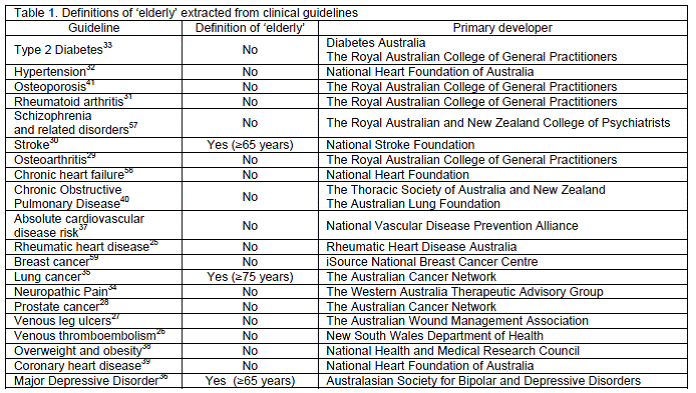
<body><![CDATA[<p><font face="Verdana" size="2"><b>Results</b></font></p>     <p><font face="Verdana" size="2">Overall, 20 guidelines were reviewed (<a href="#t1">Table 1</a>). Of these, 3 guidelines defined being "elderly" using chronological age; two guidelines defined "elderly" by chronological age of 65 years or more and one guideline used the chronological age of 75 years or more. The remaining 17 guidelines did not define "elderly" by any specific measure.</font></p>     <p>&nbsp;</p>     <p align="center"><font face="Verdana" size="2"><a name="t1"><img src="/img/revistas/pharmacy/v12n4/original6_t1.gif"></a></font></p>     <p>&nbsp;</p>     <p><font face="Verdana" size="2">None of the 20 guidelines purposefully emphasised altered drug pharmacology in older persons to distinguish how the use of the pharmacotherapy might differ in the "elderly". However, the guidelines did include statements about specific recommendations, cautionary statements, referral procedures, diagnostic, and emergency care for "elderly" patients. Five key themes emerged from the qualitative analysis of these statements, outlining how "elderly" patients were variably considered within practice guidelines. The elicited core themes were explored for their relationship to each other, and the continuum of perceptions about the different levels of understanding about "ageing" and its application in decision-making was mapped: awareness, acknowledgement, isolation, fear, and evolution (<a target="_blank" href="/img/revistas/pharmacy/v12n4/original6_f1.gif">Figure 1</a>). The key themes were:</font></p>     <blockquote>     <p><font face="Verdana" size="2">&#8226; Age as a surrogate to comorbidity (Awareness)</font></p>     <p><font face="Verdana" size="2">&#8226; Recognition of issues related to altered drug pharmacology in elderly patients (Acknowledgement, Isolation)</font></p>     <p><font face="Verdana" size="2">&#8226; Limited evidence base to define recommendations for older patients (Isolation)</font></p>     ]]></body>
<body><![CDATA[<p><font face="Verdana" size="2">&#8226; Old age is associated with restrictions to the use of pharmacotherapy (Isolation, Fear)</font></p>     <p><font face="Verdana" size="2">&#8226; Features of frailty may underpin treatment recommendations (Evolution)</font></p> </blockquote>     <p><font face="Verdana" size="2"><b>Age as a surrogate to comorbidity (Awareness)</b></font></p>     <p><font face="Verdana" size="2">In four guidelines, the statements assumed that older persons had multiple co-morbidities and were at-risk of imminent death, almost treating the term "elderly" as a surrogate for comorbidity and expected "end of life". Indeed, several guidelines acknowledged that the risk or prevalence of some diseases was higher in older persons, and therefore there was a need to treat more older persons, although none specifically described the considerations for using the therapies in this patient population.</font></p>     <blockquote>     <p><font face="Verdana" size="2">"In most affluent populations, including much of Australia, ARF (Acute Rheumatic Fever) is now rare, and RHD (Rheumatic Heart Disease) occurs predominantly in the <b>elderly</b>".<sup>25</sup></font></p>     <p><font face="Verdana" size="2">&quot;As the majority of cancer patients are <b>elderly</b>, and as the incidence of VTE (Venous Thromboembolism) increases dramatically in patients aged greater than 55 years, most if not all cancer patients admitted to the hospital will fall into a high risk for subsequent VTE".<sup>26</sup></font></p>     <p><font face="Verdana" size="2">"It is well established that VLUs (Venous Leg Ulcers) occur more often in <b>older</b> adults.<sup>27</sup></font></p>     <p><font face="Verdana" size="2">"It is therefore evident that for the foreseeable future we will continue to need to care for a significant number of <b>older</b> men with metastatic disease".<sup>28</sup></font></p> </blockquote>     <p><font face="Verdana" size="2"><b>Recognition of issues related to altered drug pharmacology in elderly patients (Acknowledgement, Isolation)</b></font></p>     ]]></body>
<body><![CDATA[<p><font face="Verdana" size="2">In less than half of the guidelines (n=8), some statements stated the need to adjust drug doses in the elderly to reduce the risk of adverse drug outcomes. The underpinning link to the pharmacology of the therapy may be obvious to most clinicians, although none of the guidelines purposefully described the specific pharmacokinetic and pharmacodynamic considerations.</font></p>     <blockquote>     <p><font face="Verdana" size="2">"GPs should apply caution when using traditional NSAIDs and COX-2 NSAIDs in view of the known side effects, especially in the <b>elderly</b>, and those on concomitant medications. Careful monitoring of blood pressure and renal function is indicated in <b>older</b> people and others at risk when using these agents".<sup>29</sup></font></p>     <p><font face="Verdana" size="2">"GPs should commence opioids at low starting dose with slow titration dose, particularly in people at increased risk of adverse effects, such as the <b>elderly</b>, and closely monitor patients for adverse effects".<sup>29</sup></font></p>     <p><font face="Verdana" size="2">"The known cardiotoxic risk of tricyclic antidepressants (especially in overdose) needs to be balanced by the analgesic benefits for more <b>elderly</b> patients with stroke".<sup>30</sup></font></p>     <p><font face="Verdana" size="2">"Addition of GI protective drugs to conventional NSAIDs can significantly reduce complications such as the incidence of GI bleeding and is recommended for RA patients over <b>65 years of age</b>".<sup>31</sup></font></p>     <p><font face="Verdana" size="2">"Commence at the lowest possible dose (ACE inhibitors and Angiotensin II receptor antagonists) in <b>elderly</b> patients and those taking diuretics".<sup>32</sup></font></p>     <p><font face="Verdana" size="2">"Lowest doses (of Amlodipine and Felodipine) are recommended, particularly in the <b>elderly</b>".<sup>32</sup></font></p>     <p><font face="Verdana" size="2">"With sulphonylureas special care needs to be taken, especially in the <b>elderly</b>, not to precipitate hypoglycaemia".<sup>33</sup></font></p>     <p><font face="Verdana" size="2">"Starting dose for pregablin is 75 mg bd (25-50 mg in the <b>elderly</b> and frail)&quot;.<sup>34</sup></font></p>     ]]></body>
<body><![CDATA[<p><font face="Verdana" size="2">"Care should always be taken with opioid doses in the <b>elderly</b> and in the use of morphine in patients with renal failure".<sup>35</sup></font></p>     <p><font face="Verdana" size="2">"More caution (with tricyclic antidepressants) is indicated in children and the <b>elderly</b> and at higher doses".<sup>36</sup></font></p> </blockquote>     <p><font face="Verdana" size="2"><b>Limited evidence base to define recommendations for older patients (Isolation)</b></font></p>     <p><font face="Verdana" size="2">The statements from only two guidelines implied or otherwise specifically stated that there was a limited evidence base for the use of pharmacotherapy in older persons, and therefore afforded no practical advice to assist clinical decision-making.</font></p>     <blockquote>     <p><font face="Verdana" size="2">"However not all clinical situations in which their (blood pressure and lipid-lowering agents) use may be considered have been covered by clinical trials, e.g. in the <b>elderly</b>".<sup>37</sup></font></p>     <p><font face="Verdana" size="2">"There is insufficient data to evaluate the safety and efficacy of weight loss medication...in <b>older</b> adults".<sup>38</sup></font></p> </blockquote>     <p><font face="Verdana" size="2"><b>Old age is associated with restrictions to the use of pharmacotherapy (Isolation, Fear)</b></font></p>     <p><font face="Verdana" size="2">A quarter of guidelines (n=5) included statements that indicated that the use of pharmacotherapy should be restricted in older persons, and in some cases a specific chronological age was cited. The rationale for these restrictions was seldom provided, suggestive of potentially age-biased recommendations, some of which related to perceived safety considerations whilst other relating to treatment efficacy.</font></p>     <p><font face="Verdana" size="2">Recommendations based on perceived safety considerations:</font></p>     ]]></body>
<body><![CDATA[<blockquote>     <p><font face="Verdana" size="2">"Prazosin not recommended in the <b>elderly</b> or patients with autonomic symptoms or cardiac failure".<sup>33</sup></font></p>     <p><font face="Verdana" size="2">"For patients with ACS (acute coronary syndromes) who are undergoing stenting, Prasugrel 10mg/day can be used as an alternative to Clopidogrel for 12 to 15 months. Avoid prescribing Prasugrel in patients with an increased risk of bleeding: for example, patients with history of smoke/TIA, low body weight (&lt;60 kg), and <b>advanced age</b> (&gt;75years)".<sup>39</sup></font></p> </blockquote>     <p><font face="Verdana" size="2">Recommendations relating to efficacy:</font></p>     <blockquote>     <p><font face="Verdana" size="2">"CEA (carotid endarterectomy) for asymptomatic carotid stenosis is more beneficial for men than women and for younger rather than <b>older</b> patients".<sup>30</sup></font></p>     <p><font face="Verdana" size="2">"Pneumococcal vaccination is known to be highly effective in preventing invasive bacteraemic pneumococcal pneumonia, but may be less effective in <b>elderly</b> or immunosuppressed patient".<sup>40</sup></font></p> </blockquote>     <p><font face="Verdana" size="2">Unlike the preceding examples highlighting restrictions for the use of therapy in older persons, one statement, in contrast, limited the use of a therapy to "older&quot; patients only (in preference to younger persons).</font></p>     <blockquote>     <p><font face="Verdana" size="2">"The use of thiazide diuretics as first line therapy (for hypertension) to be limited to <b>older</b> patients".<sup>32</sup></font></p> </blockquote>     ]]></body>
<body><![CDATA[<p><font face="Verdana" size="2">Such statements reflect an underestimation of remaining life expectancy in those aged 65 or more, and suggest that it may be appropriate to accept the risks of therapy more so in older persons.</font></p>     <p><font face="Verdana" size="2"><b>Features of frailty may underpin treatment recommendations (Evolution)</b></font></p>     <p><font face="Verdana" size="2">Although none of the guidelines specifically discussed or described frailty, four guidelines included statements that suggested a link between frailty and ageing. Some of the recommendations mentioned attributes of old age (such as cognitive impairment, physical status) which may affect medication use/management in the elderly. Broadly speaking, the statements here address the concept of frailty and its application to clinical decision-making.</font></p>     <p><font face="Verdana" size="2">Recommendations associated with prescribing:</font></p>     <blockquote>     <p><font face="Verdana" size="2">"Less (insulin dose) may be required in <b>elderly</b>, active, thin patients and more in the overweight and underactive".<sup>33</sup></font></p>     <p><font face="Verdana" size="2">"Antihypertensive therapy should be initiated with caution in the <b>very old</b> or frail (patients with comorbid acute stroke condition)".<sup>32</sup></font></p>     <p><font face="Verdana" size="2">"Calcium intake is often sub-optimal in the <b>elderly</b> (especially institutionalised patients)".<sup>41</sup></font></p> </blockquote>     <p><font face="Verdana" size="2">Generalised statements:</font></p>     <blockquote>     ]]></body>
<body><![CDATA[<p><font face="Verdana" size="2">"Many <b>older</b> people already have limited mobility, and obesity is likely to aggravate the problem and increase the risk of further functional problem".<sup>38</sup></font></p>     <p><font face="Verdana" size="2">"The effect of excess weight on comorbidities such as Type 2 diabetes also reduce the ability of <b>older</b> people to participate in social and physical activities".<sup>38</sup></font></p> </blockquote>     <p>&nbsp;</p>     <p><font face="Verdana" size="2"><b>Discussion</b></font></p>     <p><font face="Verdana" size="2">A key finding of this study is that contemporary clinical guidelines either did not define "elderly" by any useful means (85%) and/or otherwise employed chronological age as a definition (15%). While two guidelines defined those aged 65 or beyond as "elderly", one guideline used 75 years as cut-off for its description of "elderly". This variability in setting a "cut-off&quot; chronological age while defining "elderly" is another issue which impedes a uniform description of "elderly". Similar trends in variably defining "elderly" have been observed in a range of disease-specific clinical studies, for instance atrial fibrillation.<sup>42-44</sup></font></p>     <p><font face="Verdana" size="2">Any underpinning characterisations of the "elderly" appear to be very generic, not evidence-based, and potentially biased. Although most guidelines apparently consider the "elderly" population as a vulnerable population when it comes to using pharmacotherapy, few guidelines are suggestive of the relationship between frailty and ageing, or the relationship between actual physiological changes and the pharmacological handling of a drug. More importantly, none of the guidelines identified that ageing is a heterogeneous process and therefore treatment use must be based on an individual assessment of relevant parameters underpinning the risk versus benefit of therapy.</font></p>     <p><font face="Verdana" size="2">Individualised pharmacotherapy begins with the realisation that vulnerability to a particular clinical condition, its course, and response to prescribed pharmacotherapy are dependent on multiple factors including ageing, gender, genetics, lifestyle, and social-cultural aspects.<sup>45</sup> Based on these factors, differing significantly from person to person, patients can be stratified for treatment recommendations, supporting a patient-centre treatment approach. Any treatment recommendation presented by clinical guidelines that regard the "elderly to be a homogenous group of people may limit the clinical benefits of therapy.<sup>46</sup> For instance, one of the guidelines reviewed in this study limited the use of thiazide diuretics (associated with elevated risk of diabetes) as first line therapy to older people only.<sup>32</sup></font></p>     <p><font face="Verdana" size="2">Few studies have systematically addressed the issue of chronological age-based descriptions of "elderly" in clinical settings; however a few have argued the need to review definition. Orimo <i>et al.</i><sup>13</sup> considered that, given the improving health status and functional independence in older persons, changing cut-off age from 65 years to 75 years to define "elderly". Similarly, improvements in health, cognition, and functional abilities of those aged 70 or more were observed in a longitudinal study supporting the need to change the cut-off age for defining "elderly".<sup>47</sup> However, some researchers have recommended other options for defining being "old&quot;, for example, the use of biological age.<sup>48,49</sup> In the context of clinical guidelines, it is important to base treatment recommendations on an individual assessment of those specific factors known to affect the use of a particular medication and avoid using generic age-based approaches. Other guidelines (not relevant to pharmacotherapy) also highlight the requirement of such an approach.<sup>50</sup></font></p>     <p><font face="Verdana" size="2">Clinical practice guidelines are important tools, but are frequently criticised for their insensitivity towards the needs of, and/or their limited applicability to, the older patient population.<sup>51</sup> The findings of this study support this, in that the reviewed guidelines failed to present a comprehensive or practical definition of "elderly" either in qualitative or quantitative terms. Chronological age-based definitions of "elderly", as presented in three guidelines, provide no insight about the actual health status and unique needs of a patient. Thus, such recommendations have limited ability to assist health professionals in decision-making. A patient´s unique characteristics such as: altered drug handling, physical/functional and cognitive function, extent of comorbidity, polypharmacy, social situation, and quality of life, should be considered in clinical guidelines. Current guidelines only allude to these issues at a surface-level, without adequate definition and support, and a few continue to use relatively arbitrary definitions of ageing based on chronological age.</font></p>     <p><font face="Verdana" size="2">As the continuum of perception of "ageing&quot; ranges from "awareness&quot; to "evolution&quot;, there is an increasing focus on to assist clinicians in prescribing for the "elderly". Tools such as STOPP and START criteria<sup>52</sup>, BEERS criteria<sup>53</sup>, as well as pharmacist-led review services<sup>54,55</sup> can assist in rationalising therapy. The concept of frailty is also emerging as a more reliable predictor of the heterogeneity that exists in this potentially vulnerable population.<sup>49</sup> The frailty index might be operationalised to determine the biological age of a patient<sup>48</sup>, providing a longitudinal measure of health status in an individual which can subsequently be applied to guide decision-making.<sup>14</sup></font></p>     ]]></body>
<body><![CDATA[<p><font face="Verdana" size="2">The inclusion of only Australian guidelines is a potential limitation of this study. However, although Australian guidelines have often (historically) been derived from international ones, this is less common in contemporary practice.<sup>56</sup> Whilst it is not expected that practice and guidelines differ substantially in Australia compared to comparable international settings, further research in this area is needed to confirm the full scope of the issues.</font></p>     <p><font face="Verdana" size="2">This study highlights the existing gaps in understanding of "old&quot; age and the "elderly" underpinning some potential age-biases in medication prescribing, and highlighting the limited extent to which current clinical practice guidelines address this. Although clinicians´ abilities are not in question here, it is apparent that clinical guidelines often do not provide enough guidance on how to translate recommendations to individual patients, particularly older persons. More attention needs to be paid to this within guidelines given that no other factor displays more inter-patient variability in its presentation than "age&quot;.</font></p>     <p>&nbsp;</p>     <p><font face="Verdana" size="2"><b>Conclusions</b></font></p>     <p><font face="Verdana" size="2">Clinical practice guidelines currently do not adequately define "elderly" persons and provide limited guidance on how to apply treatment recommendations to older persons. The representation of "elderly" in guidelines needs to be less based on chronological age or generic definitions focusing more on establishing a direct link between an individual patient´s characteristics and the pharmacology of their prescribed medication. Clinical guidelines that do not offer any practical descriptions of the features of ageing that are specifically related to the use of pharmacotherapy, or how to assess these in individual patients, render decision-making challenging.</font></p>     <p>&nbsp;</p>     <p><font face="Verdana" size="2"><b>Conflict of interest</b></font></p>     <p><font face="Verdana" size="2">None to declare.</font></p>     <p><font face="Verdana" size="2">Funding: The preparation of this manuscript did not receive funding.</font></p>     <p>&nbsp;</p>     ]]></body>
<body><![CDATA[<p><font face="Verdana" size="2"><b>References</b></font></p>     <!-- ref --><p><font face="Verdana" size="2">1. World Health Organisation. 10 facts on ageing and the life course. 2012. <a target="_blank" href="http://www.who.int/features/factfiles/ageing/ageing_facts/en/index.html">http://www.who.int/features/factfiles/ageing/ageing_facts/en/index.html</a> (accessed 02/02/2014).    &nbsp;&nbsp;&nbsp;&nbsp;&nbsp;&nbsp;&nbsp;&nbsp;[&#160;<a href="javascript:void(0);" onclick="javascript: window.open('/scielo.php?script=sci_nlinks&ref=4274738&pid=S1885-642X201400040000700001&lng=','','width=640,height=500,resizable=yes,scrollbars=1,menubar=yes,');">Links</a>&#160;]<!-- end-ref --></font></p>    <!-- ref --><p><font face="Verdana" size="2">2. Cherubini A, Corsonello A, Lattanzio F. Underprescription of Beneficial Medicines in Older People. Drugs Aging. 2012;29(6):463-475. doi: 10.2165/11631750-000000000-00000.    &nbsp;&nbsp;&nbsp;&nbsp;&nbsp;&nbsp;&nbsp;&nbsp;[&#160;<a href="javascript:void(0);" onclick="javascript: window.open('/scielo.php?script=sci_nlinks&ref=4274740&pid=S1885-642X201400040000700002&lng=','','width=640,height=500,resizable=yes,scrollbars=1,menubar=yes,');">Links</a>&#160;]<!-- end-ref --></font></p>    <!-- ref --><p><font face="Verdana" size="2">3. Nyborg G, Straand J, Brekke M. Inappropriate prescribing for the elderly - a modern epidemic? Eur J Clin Pharmacol. 2012;68(7):1085-1094. doi: 10.1007/s00228-012-1223-8.    &nbsp;&nbsp;&nbsp;&nbsp;&nbsp;&nbsp;&nbsp;&nbsp;[&#160;<a href="javascript:void(0);" onclick="javascript: window.open('/scielo.php?script=sci_nlinks&ref=4274742&pid=S1885-642X201400040000700003&lng=','','width=640,height=500,resizable=yes,scrollbars=1,menubar=yes,');">Links</a>&#160;]<!-- end-ref --></font></p>    <!-- ref --><p><font face="Verdana" size="2">4. Hubbard RE, O'Mahony MS, Woodhouse KW. Medication prescribing in frail older people. Eur J Clin Pharmacol. 2013;69(3):319-326. doi: 10.1007/s00228-012-1387-2.    &nbsp;&nbsp;&nbsp;&nbsp;&nbsp;&nbsp;&nbsp;&nbsp;[&#160;<a href="javascript:void(0);" onclick="javascript: window.open('/scielo.php?script=sci_nlinks&ref=4274744&pid=S1885-642X201400040000700004&lng=','','width=640,height=500,resizable=yes,scrollbars=1,menubar=yes,');">Links</a>&#160;]<!-- end-ref --></font></p>    <!-- ref --><p><font face="Verdana" size="2">5. Hanlon JT, Wang X, Castle NG, Stone RA, Handler SM, Semla TP, Pugh MJ, Berlowitz DR, Dysken MW. Potential underuse, overuse, and inappropriate use of antidepressants in older veteran nursing home residents. J Am Geriatr Soc. 2011;59(8):1412-1420. doi: 10.1111/j.1532-5415.2011.03522.x.    &nbsp;&nbsp;&nbsp;&nbsp;&nbsp;&nbsp;&nbsp;&nbsp;[&#160;<a href="javascript:void(0);" onclick="javascript: window.open('/scielo.php?script=sci_nlinks&ref=4274746&pid=S1885-642X201400040000700005&lng=','','width=640,height=500,resizable=yes,scrollbars=1,menubar=yes,');">Links</a>&#160;]<!-- end-ref --></font></p>    <!-- ref --><p><font face="Verdana" size="2">6. Tran CTT, Laupacis A, Mamdani MM, Tu JV. Effect of age on the use of evidence-based therapies for acute myocardial infarction. Am Heart J. 2004;148(5):834-841. doi: 10.1016/j.ahj.2003.11.028.    &nbsp;&nbsp;&nbsp;&nbsp;&nbsp;&nbsp;&nbsp;&nbsp;[&#160;<a href="javascript:void(0);" onclick="javascript: window.open('/scielo.php?script=sci_nlinks&ref=4274748&pid=S1885-642X201400040000700006&lng=','','width=640,height=500,resizable=yes,scrollbars=1,menubar=yes,');">Links</a>&#160;]<!-- end-ref --></font></p>    <!-- ref --><p><font face="Verdana" size="2">7. Jacobson TA. Overcoming 'ageism' bias in the treatment of hypercholesterolaemia : a review of safety issues with statins in the elderly. Drug Saf. 2006;29(5):421-448.    &nbsp;&nbsp;&nbsp;&nbsp;&nbsp;&nbsp;&nbsp;&nbsp;[&#160;<a href="javascript:void(0);" onclick="javascript: window.open('/scielo.php?script=sci_nlinks&ref=4274750&pid=S1885-642X201400040000700007&lng=','','width=640,height=500,resizable=yes,scrollbars=1,menubar=yes,');">Links</a>&#160;]<!-- end-ref --></font></p>    <!-- ref --><p><font face="Verdana" size="2">8. Boyles PJ, Peterson GM, Bleasel MD, Vial JH. Undertreatment of congestive heart failure in an Australian setting. J Clin Pharm Ther. 2004;29(1):15-22. doi:10.1046/j.1365-2710.2003.00531.x.    &nbsp;&nbsp;&nbsp;&nbsp;&nbsp;&nbsp;&nbsp;&nbsp;[&#160;<a href="javascript:void(0);" onclick="javascript: window.open('/scielo.php?script=sci_nlinks&ref=4274752&pid=S1885-642X201400040000700008&lng=','','width=640,height=500,resizable=yes,scrollbars=1,menubar=yes,');">Links</a>&#160;]<!-- end-ref --></font></p>    <!-- ref --><p><font face="Verdana" size="2">9. Krass I, Ogle SJ, Duguid MJ, Shenfield GM, Bajorek BV. The impact of age on antithrombotic use in elderly patients with non-valvular atrial fibrillation. Australas J Ageing. 2002;21(1):36-41. doi:10.1111/j.1741-6612.2002.tb00413.x.    &nbsp;&nbsp;&nbsp;&nbsp;&nbsp;&nbsp;&nbsp;&nbsp;[&#160;<a href="javascript:void(0);" onclick="javascript: window.open('/scielo.php?script=sci_nlinks&ref=4274754&pid=S1885-642X201400040000700009&lng=','','width=640,height=500,resizable=yes,scrollbars=1,menubar=yes,');">Links</a>&#160;]<!-- end-ref --></font></p>    <!-- ref --><p><font face="Verdana" size="2">10. Fraenkel L, Rabidou N, Dhar R. Are rheumatologists' treatment decisions influenced by patients' age? Rheumatology (Oxford). 2006;45(12):1555-1557. doi:10.1093/rheumatology/kel144.    &nbsp;&nbsp;&nbsp;&nbsp;&nbsp;&nbsp;&nbsp;&nbsp;[&#160;<a href="javascript:void(0);" onclick="javascript: window.open('/scielo.php?script=sci_nlinks&ref=4274756&pid=S1885-642X201400040000700010&lng=','','width=640,height=500,resizable=yes,scrollbars=1,menubar=yes,');">Links</a>&#160;]<!-- end-ref --></font></p>    <!-- ref --><p><font face="Verdana" size="2">11. Harries C, Forrest D, Harvey N, McClelland A, Bowling A. Which doctors are influenced by a patient´s age? A multi-method study of angina treatment in general practice, cardiology and gerontology. Qual Saf Health Care. 2007;16(1):23-27. doi:10.1136/qshc.2006.018036.    &nbsp;&nbsp;&nbsp;&nbsp;&nbsp;&nbsp;&nbsp;&nbsp;[&#160;<a href="javascript:void(0);" onclick="javascript: window.open('/scielo.php?script=sci_nlinks&ref=4274758&pid=S1885-642X201400040000700011&lng=','','width=640,height=500,resizable=yes,scrollbars=1,menubar=yes,');">Links</a>&#160;]<!-- end-ref --></font></p>    <!-- ref --><p><font face="Verdana" size="2">12. World Health Organisation. Definition of an older or elderly person. WHO, Geneva, Switzerland. 2010. <a target="_blank" href="http://www.who.int/healthinfo/survey/ageingdefnolder/en/index.html">http://www.who.int/healthinfo/survey/ageingdefnolder/en/index.html</a> (accessed 12/11/2013).    &nbsp;&nbsp;&nbsp;&nbsp;&nbsp;&nbsp;&nbsp;&nbsp;[&#160;<a href="javascript:void(0);" onclick="javascript: window.open('/scielo.php?script=sci_nlinks&ref=4274760&pid=S1885-642X201400040000700012&lng=','','width=640,height=500,resizable=yes,scrollbars=1,menubar=yes,');">Links</a>&#160;]<!-- end-ref --></font></p>    <!-- ref --><p><font face="Verdana" size="2">13. Orimo H, Ito H, Suzuki T, Araki A, Hosoi T, Sawabe M. Reviewing the definition of "elderly". Geriatrics &amp; gerontology international. 2006;6(3):149-158. doi: 10.1111/j.1447-0594.2006.00341.x.    &nbsp;&nbsp;&nbsp;&nbsp;&nbsp;&nbsp;&nbsp;&nbsp;[&#160;<a href="javascript:void(0);" onclick="javascript: window.open('/scielo.php?script=sci_nlinks&ref=4274762&pid=S1885-642X201400040000700013&lng=','','width=640,height=500,resizable=yes,scrollbars=1,menubar=yes,');">Links</a>&#160;]<!-- end-ref --></font></p>    <!-- ref --><p><font face="Verdana" size="2">14. Levine ME. Modeling the Rate of Senescence: Can Estimated Biological Age Predict Mortality More Accurately Than Chronological Age? J Gerontol A Biol Sci Med Sci. 2013;68(6):667-674. doi: 10.1093/gerona/gls233.    &nbsp;&nbsp;&nbsp;&nbsp;&nbsp;&nbsp;&nbsp;&nbsp;[&#160;<a href="javascript:void(0);" onclick="javascript: window.open('/scielo.php?script=sci_nlinks&ref=4274764&pid=S1885-642X201400040000700014&lng=','','width=640,height=500,resizable=yes,scrollbars=1,menubar=yes,');">Links</a>&#160;]<!-- end-ref --></font></p>    <!-- ref --><p><font face="Verdana" size="2">15. Ferguson LM, Ward H, Card S, Sheppard S, McMurtry J. Putting the "patient&quot; back into patient-centred care: An education perspective. Nurse Educ Pract. 2013;13(4):283-287. doi: 10.1016/j.nepr.2013.03.016.    &nbsp;&nbsp;&nbsp;&nbsp;&nbsp;&nbsp;&nbsp;&nbsp;[&#160;<a href="javascript:void(0);" onclick="javascript: window.open('/scielo.php?script=sci_nlinks&ref=4274766&pid=S1885-642X201400040000700015&lng=','','width=640,height=500,resizable=yes,scrollbars=1,menubar=yes,');">Links</a>&#160;]<!-- end-ref --></font></p>    <!-- ref --><p><font face="Verdana" size="2">16. Lesko LJ, Schmidt S. Individualization of drug therapy: history, present state, and opportunities for the future. Clin Pharmacol Ther. 2012;92(4):458-466. doi: 10.1038/clpt.2012.113.    &nbsp;&nbsp;&nbsp;&nbsp;&nbsp;&nbsp;&nbsp;&nbsp;[&#160;<a href="javascript:void(0);" onclick="javascript: window.open('/scielo.php?script=sci_nlinks&ref=4274768&pid=S1885-642X201400040000700016&lng=','','width=640,height=500,resizable=yes,scrollbars=1,menubar=yes,');">Links</a>&#160;]<!-- end-ref --></font></p>    <!-- ref --><p><font face="Verdana" size="2">17. Zhao P, Zhang L, Grillo JA, Liu Q, Bullock JM, Moon YJ, Song P, Brar SS, Madabushi R, Wu TC, Booth BP, Rahman NA, Reynolds KS, Gil Berglund E, Lesko LJ, Huang SM. Applications of Physiologically Based Pharmacokinetic (PBPK) Modeling and Simulation During Regulatory Review. Clin Pharmacol Ther. 2011;89(2):259-67. doi: 10.1038/clpt.2010.298.    &nbsp;&nbsp;&nbsp;&nbsp;&nbsp;&nbsp;&nbsp;&nbsp;[&#160;<a href="javascript:void(0);" onclick="javascript: window.open('/scielo.php?script=sci_nlinks&ref=4274770&pid=S1885-642X201400040000700017&lng=','','width=640,height=500,resizable=yes,scrollbars=1,menubar=yes,');">Links</a>&#160;]<!-- end-ref --></font></p>    <!-- ref --><p><font face="Verdana" size="2">18. Hamberg AK, Wadelius M, Lindh JD, Dahl ML, Padrini R, Deloukas P, Rane A, Jonsson EN. A Pharmacometric Model Describing the Relationship Between Warfarin Dose and INR Response With Respect to Variations in CYP2C9, VKORC1, and Age. Clin Pharmacol Ther. 2010;87(6):727-734. doi: 10.1038/clpt.2010.37.    &nbsp;&nbsp;&nbsp;&nbsp;&nbsp;&nbsp;&nbsp;&nbsp;[&#160;<a href="javascript:void(0);" onclick="javascript: window.open('/scielo.php?script=sci_nlinks&ref=4274772&pid=S1885-642X201400040000700018&lng=','','width=640,height=500,resizable=yes,scrollbars=1,menubar=yes,');">Links</a>&#160;]<!-- end-ref --></font></p>    <!-- ref --><p><font face="Verdana" size="2">19. Field MJ, Lohr KN. Clinical Practice Guidelines: directions for a new program. Washington, DC: Institute of Medicine, National Academy Press; 1990.    &nbsp;&nbsp;&nbsp;&nbsp;&nbsp;&nbsp;&nbsp;&nbsp;[&#160;<a href="javascript:void(0);" onclick="javascript: window.open('/scielo.php?script=sci_nlinks&ref=4274774&pid=S1885-642X201400040000700019&lng=','','width=640,height=500,resizable=yes,scrollbars=1,menubar=yes,');">Links</a>&#160;]<!-- end-ref --></font></p>    <!-- ref --><p><font face="Verdana" size="2">20. Tricoci P, Allen JM, Kramer JM, Califf RM, Smith SC. Scientific evidence underlying the ACC/AHA clinical practice guidelines. JAMA. 2009;301(8):831-841. doi: 10.1001/jama.2009.205.    &nbsp;&nbsp;&nbsp;&nbsp;&nbsp;&nbsp;&nbsp;&nbsp;[&#160;<a href="javascript:void(0);" onclick="javascript: window.open('/scielo.php?script=sci_nlinks&ref=4274776&pid=S1885-642X201400040000700020&lng=','','width=640,height=500,resizable=yes,scrollbars=1,menubar=yes,');">Links</a>&#160;]<!-- end-ref --></font></p>    <!-- ref --><p><font face="Verdana" size="2">21. Farquhar CM, Kofa EW, Slutsky JR. Clinicians' attitudes to clinical practice guidelines: a systematic review. Med J Aust. 2002;177(9):502-506.    &nbsp;&nbsp;&nbsp;&nbsp;&nbsp;&nbsp;&nbsp;&nbsp;[&#160;<a href="javascript:void(0);" onclick="javascript: window.open('/scielo.php?script=sci_nlinks&ref=4274778&pid=S1885-642X201400040000700021&lng=','','width=640,height=500,resizable=yes,scrollbars=1,menubar=yes,');">Links</a>&#160;]<!-- end-ref --></font></p>    <!-- ref --><p><font face="Verdana" size="2">22. AIHW, Begg S, Vos T, Barker B, Stevenson C, Stanley L, Lapez A. The burden of disease and injury in Australia 2003. 2007. <a target="_blank" href="http://www.aihw.gov.au/publication-detail/?id=6442467990">http://www.aihw.gov.au/publication-detail/?id=6442467990</a> (accessed 8/10/2014).    &nbsp;&nbsp;&nbsp;&nbsp;&nbsp;&nbsp;&nbsp;&nbsp;[&#160;<a href="javascript:void(0);" onclick="javascript: window.open('/scielo.php?script=sci_nlinks&ref=4274780&pid=S1885-642X201400040000700022&lng=','','width=640,height=500,resizable=yes,scrollbars=1,menubar=yes,');">Links</a>&#160;]<!-- end-ref --></font></p>    <!-- ref --><p><font face="Verdana" size="2">23. Clinical Practice Guidelines Portal. <a target="_blank" href="https://www.clinicalguidelines.gov.au/">https://www.clinicalguidelines.gov.au/</a> (accessed 23/10/2014).    &nbsp;&nbsp;&nbsp;&nbsp;&nbsp;&nbsp;&nbsp;&nbsp;[&#160;<a href="javascript:void(0);" onclick="javascript: window.open('/scielo.php?script=sci_nlinks&ref=4274782&pid=S1885-642X201400040000700023&lng=','','width=640,height=500,resizable=yes,scrollbars=1,menubar=yes,');">Links</a>&#160;]<!-- end-ref --></font></p>    <!-- ref --><p><font face="Verdana" size="2">24. Joffe H, Yardley L. Content and thematic analysis. In: Research methods for clinical and health psychology. London; SAGE; 2004. ISBN: 9780761971917.    &nbsp;&nbsp;&nbsp;&nbsp;&nbsp;&nbsp;&nbsp;&nbsp;[&#160;<a href="javascript:void(0);" onclick="javascript: window.open('/scielo.php?script=sci_nlinks&ref=4274784&pid=S1885-642X201400040000700024&lng=','','width=640,height=500,resizable=yes,scrollbars=1,menubar=yes,');">Links</a>&#160;]<!-- end-ref --></font></p>    <!-- ref --><p><font face="Verdana" size="2">25. RHD Australia (ARF/RHD writing group) National Heart Foundation of Australia and the Cardiac Society of Australia and New Zealand. Australian guideline for prevention, diagnosis and mangement of acute rheumatic fever and rheumatic heart disease. 2012. <a target="_blank" href="http://www.rhdaustralia.org.au/sites/default/files/guideline_0.pdf">http://www.rhdaustralia.org.au/sites/default/files/guideline_0.pdf</a> (accessed 14/03/2014).    &nbsp;&nbsp;&nbsp;&nbsp;&nbsp;&nbsp;&nbsp;&nbsp;[&#160;<a href="javascript:void(0);" onclick="javascript: window.open('/scielo.php?script=sci_nlinks&ref=4274786&pid=S1885-642X201400040000700025&lng=','','width=640,height=500,resizable=yes,scrollbars=1,menubar=yes,');">Links</a>&#160;]<!-- end-ref --></font></p>    <!-- ref --><p><font face="Verdana" size="2">26. National Health and Medical Research Council. Clinical practice guideline for the prevention of venous thromboembolism (deep vein thrombosis and pulmonary embolism) in patients admitted to Australian hospitals. Melbourne: National Health and Medical Research Council. 2009. <a target="_blank" href="http://www.nhmrc.gov.au/_files_nhmrc/file/nics/programs/vtp/guideline_prevention_venous_thromboembolism.pdf">http://www.nhmrc.gov.au/_files_nhmrc/file/nics/programs/vtp/guideline_prevention_venous_thromboembolism.pdf</a> (accessed 18/03/2014).    &nbsp;&nbsp;&nbsp;&nbsp;&nbsp;&nbsp;&nbsp;&nbsp;[&#160;<a href="javascript:void(0);" onclick="javascript: window.open('/scielo.php?script=sci_nlinks&ref=4274788&pid=S1885-642X201400040000700026&lng=','','width=640,height=500,resizable=yes,scrollbars=1,menubar=yes,');">Links</a>&#160;]<!-- end-ref --></font></p>    <!-- ref --><p><font face="Verdana" size="2">27. Australian and New Zealand Clinical practice Guideline for Prevention and Management of Venous Leg Ulcers. <a target="_blank" href="http://www.awma.com.au/publications/2011_awma_vlug.pdf">http://www.awma.com.au/publications/2011_awma_vlug.pdf</a> (accessed 22/03/2014).    &nbsp;&nbsp;&nbsp;&nbsp;&nbsp;&nbsp;&nbsp;&nbsp;[&#160;<a href="javascript:void(0);" onclick="javascript: window.open('/scielo.php?script=sci_nlinks&ref=4274790&pid=S1885-642X201400040000700027&lng=','','width=640,height=500,resizable=yes,scrollbars=1,menubar=yes,');">Links</a>&#160;]<!-- end-ref --></font></p>    <!-- ref --><p><font face="Verdana" size="2">28. Australian Cancer Network Management of Metastatic Prostate Cancer Working Party. Clinical Practice Guidelines for the Management of Locally Advanced and Metastatic Prostate Cancer. Cancer Council Australia and Australian Cancer Network, Sydney. 2010. <a target="_blank" href="http://www.cancer.org.au/content/pdf/HealthProfessionals/ClinicalGuidelines/FINAL_Advanced_Prostate_Cancer_Guidelines.pdf">http://www.cancer.org.au/content/pdf/HealthProfessionals/ClinicalGuidelines/FINAL_Advanced_Prostate_Cancer_Guidelines.pdf</a> (accessed 05/03/2014).    &nbsp;&nbsp;&nbsp;&nbsp;&nbsp;&nbsp;&nbsp;&nbsp;[&#160;<a href="javascript:void(0);" onclick="javascript: window.open('/scielo.php?script=sci_nlinks&ref=4274792&pid=S1885-642X201400040000700028&lng=','','width=640,height=500,resizable=yes,scrollbars=1,menubar=yes,');">Links</a>&#160;]<!-- end-ref --></font></p>    <!-- ref --><p><font face="Verdana" size="2">29. Guideline for the non-surgical management of hip and knee osteoarthritis. 2009. <a target="_blank" href="http://www.racgp.org.au/download/documents/Guidelines/Musculoskeletal/racgp_oa_guideline.pdf">http://www.racgp.org.au/download/documents/Guidelines/Musculoskeletal/racgp_oa_guideline.pdf</a> (accessed 03/03/2014).    &nbsp;&nbsp;&nbsp;&nbsp;&nbsp;&nbsp;&nbsp;&nbsp;[&#160;<a href="javascript:void(0);" onclick="javascript: window.open('/scielo.php?script=sci_nlinks&ref=4274794&pid=S1885-642X201400040000700029&lng=','','width=640,height=500,resizable=yes,scrollbars=1,menubar=yes,');">Links</a>&#160;]<!-- end-ref --></font></p>    <!-- ref --><p><font face="Verdana" size="2">30. National Stroke Foundation. Clinical Guidelines for Stroke Management. Melbourne Australia. 2010. <a target="_blank" href="http://strokefoundation.com.au/site/media/clinical_guidelines_stroke_managment_2010_interactive.pdf">http://strokefoundation.com.au/site/media/clinical_guidelines_stroke_managment_2010_interactive.pdf</a> (accessed 10/03/2014).    &nbsp;&nbsp;&nbsp;&nbsp;&nbsp;&nbsp;&nbsp;&nbsp;[&#160;<a href="javascript:void(0);" onclick="javascript: window.open('/scielo.php?script=sci_nlinks&ref=4274796&pid=S1885-642X201400040000700030&lng=','','width=640,height=500,resizable=yes,scrollbars=1,menubar=yes,');">Links</a>&#160;]<!-- end-ref --></font></p>    <!-- ref --><p><font face="Verdana" size="2">31. Clinical guideline for the diagnosis and management of early rheumatoid arthritis. 2009. <a target="_blank" href="http://www.racgp.org.au/download/documents/Guidelines/Musculoskeletal/racgp_ra_guideline.pdf">http://www.racgp.org.au/download/documents/Guidelines/Musculoskeletal/racgp_ra_guideline.pdf</a> (accessed 16/02/2014).    &nbsp;&nbsp;&nbsp;&nbsp;&nbsp;&nbsp;&nbsp;&nbsp;[&#160;<a href="javascript:void(0);" onclick="javascript: window.open('/scielo.php?script=sci_nlinks&ref=4274798&pid=S1885-642X201400040000700031&lng=','','width=640,height=500,resizable=yes,scrollbars=1,menubar=yes,');">Links</a>&#160;]<!-- end-ref --></font></p>    <!-- ref --><p><font face="Verdana" size="2">32. National Heart Foundation of Australia (National Blood Pressure and Vascular Disease Advisory Committee). Guide to management of hypertension 2008. Updated December 2010. 2008. <a target="_blank" href="http://www.heartfoundation.org.au/SiteCollectionDocuments/HypertensionGuidelines2008to2010Update.pdf">http://www.heartfoundation.org.au/SiteCollectionDocuments/HypertensionGuidelines2008to2010Update.pdf</a> (accessed 28/02/2014).    &nbsp;&nbsp;&nbsp;&nbsp;&nbsp;&nbsp;&nbsp;&nbsp;[&#160;<a href="javascript:void(0);" onclick="javascript: window.open('/scielo.php?script=sci_nlinks&ref=4274800&pid=S1885-642X201400040000700032&lng=','','width=640,height=500,resizable=yes,scrollbars=1,menubar=yes,');">Links</a>&#160;]<!-- end-ref --></font></p>    <!-- ref --><p><font face="Verdana" size="2">33. Diabetes Management in General Practice 2011/12. <a target="_blank" href="http://www.racgp.org.au/download/documents/Guidelines/Diabetes/201107diabetesmanagementingeneralpractice.pdf">http://www.racgp.org.au/download/documents/Guidelines/Diabetes/201107diabetesmanagementingeneralpractice.pdf</a> (accessed 13/03/2014).    &nbsp;&nbsp;&nbsp;&nbsp;&nbsp;&nbsp;&nbsp;&nbsp;[&#160;<a href="javascript:void(0);" onclick="javascript: window.open('/scielo.php?script=sci_nlinks&ref=4274802&pid=S1885-642X201400040000700033&lng=','','width=640,height=500,resizable=yes,scrollbars=1,menubar=yes,');">Links</a>&#160;]<!-- end-ref --></font></p>    <!-- ref --><p><font face="Verdana" size="2">34. Western Australian Therapeutic Advisory Group. Guidelines for the Treatment of Neuropathic Pain. 2013. <a target="_blank" href="http://www.watag.org.au/watag/docs/130717_Advisory%20Note_Neuropathic%20Pain%20Guidelines%20ver2.pdf">http://www.watag.org.au/watag/docs/130717_Advisory Note_Neuropathic Pain Guidelines ver2.pdf</a> (accessed 13/03/2014).    &nbsp;&nbsp;&nbsp;&nbsp;&nbsp;&nbsp;&nbsp;&nbsp;[&#160;<a href="javascript:void(0);" onclick="javascript: window.open('/scielo.php?script=sci_nlinks&ref=4274804&pid=S1885-642X201400040000700034&lng=','','width=640,height=500,resizable=yes,scrollbars=1,menubar=yes,');">Links</a>&#160;]<!-- end-ref --></font></p>    <!-- ref --><p><font face="Verdana" size="2">35. The Australian Cancer Network. Clinical Practice Guidelines for the Prevention, Diagnosis and Management of Lung Cancer. 2004. <a target="_blank" href="http://www.nhmrc.gov.au/_files_nhmrc/publications/attachments/cp97.pdf">http://www.nhmrc.gov.au/_files_nhmrc/publications/attachments/cp97.pdf</a> (accessed 13/03/2014).    &nbsp;&nbsp;&nbsp;&nbsp;&nbsp;&nbsp;&nbsp;&nbsp;[&#160;<a href="javascript:void(0);" onclick="javascript: window.open('/scielo.php?script=sci_nlinks&ref=4274806&pid=S1885-642X201400040000700035&lng=','','width=640,height=500,resizable=yes,scrollbars=1,menubar=yes,');">Links</a>&#160;]<!-- end-ref --></font></p>    <!-- ref --><p><font face="Verdana" size="2">36. Dodd S, Malhi GS, Tiller J, Schweitzer I, Hickie I, Khoo JP, Bassett DL, Lyndon B, Mitchell PB, Parker G, Fitzgerald PB, Udina M, Singh A, Moylan S, Giorlando F, Doughty C, Davey CG, Theodoros M, Berk M. A Consensus Statement for Safety Monitoring Guidelines of Treatments for Major Depressive Disorder. Aust N Z J Psychiatry. 2011;45(9):712-725. doi: 10.3109/00048674.2011.595686.    &nbsp;&nbsp;&nbsp;&nbsp;&nbsp;&nbsp;&nbsp;&nbsp;[&#160;<a href="javascript:void(0);" onclick="javascript: window.open('/scielo.php?script=sci_nlinks&ref=4274808&pid=S1885-642X201400040000700036&lng=','','width=640,height=500,resizable=yes,scrollbars=1,menubar=yes,');">Links</a>&#160;]<!-- end-ref --></font></p>    <!-- ref --><p><font face="Verdana" size="2">37. National Vascular Disease Prevention Alliance. Guidelines for the management of absolute cardiovascular disease risk. 2012. <a target="_blank" href="http://strokefoundation.com.au/site/media/AbsoluteCVD_GL_webready.pdf">http://strokefoundation.com.au/site/media/AbsoluteCVD_GL_webready.pdf</a> (accessed 13/03/2014).    &nbsp;&nbsp;&nbsp;&nbsp;&nbsp;&nbsp;&nbsp;&nbsp;[&#160;<a href="javascript:void(0);" onclick="javascript: window.open('/scielo.php?script=sci_nlinks&ref=4274810&pid=S1885-642X201400040000700037&lng=','','width=640,height=500,resizable=yes,scrollbars=1,menubar=yes,');">Links</a>&#160;]<!-- end-ref --></font></p>    <!-- ref --><p><font face="Verdana" size="2">38. National Health and Medical Research Council. Clinical practice guidelines for the management of overweight and obesity in adults, adolescents and children in Australia. 2013. <a target="_blank" href="http://www.nhmrc.gov.au/_files_nhmrc/publications/attachments/n57_obesity_guidelines_131003.pdf">http://www.nhmrc.gov.au/_files_nhmrc/publications/attachments/n57_obesity_guidelines_131003.pdf</a> (accessed 15/03/2014).    &nbsp;&nbsp;&nbsp;&nbsp;&nbsp;&nbsp;&nbsp;&nbsp;[&#160;<a href="javascript:void(0);" onclick="javascript: window.open('/scielo.php?script=sci_nlinks&ref=4274812&pid=S1885-642X201400040000700038&lng=','','width=640,height=500,resizable=yes,scrollbars=1,menubar=yes,');">Links</a>&#160;]<!-- end-ref --></font></p>    <!-- ref --><p><font face="Verdana" size="2">39. National Heart Foundation of Australia and the Cardiac Society of Australia and New Zealand. Reducing risk in heart disease: an expert guide to clinical practice for secondary prevention of coronary heart disease. Melbourne: National Heart Foundation of Australia. 2012. <a target="_blank" href="http://www.heartfoundation.org.au/SiteCollectionDocuments/Reducing-risk-in-heart-disease.pdf">http://www.heartfoundation.org.au/SiteCollectionDocuments/Reducing-risk-in-heart-disease.pdf</a> (accessed 13/03/2014).    &nbsp;&nbsp;&nbsp;&nbsp;&nbsp;&nbsp;&nbsp;&nbsp;[&#160;<a href="javascript:void(0);" onclick="javascript: window.open('/scielo.php?script=sci_nlinks&ref=4274814&pid=S1885-642X201400040000700039&lng=','','width=640,height=500,resizable=yes,scrollbars=1,menubar=yes,');">Links</a>&#160;]<!-- end-ref --></font></p>    <!-- ref --><p><font face="Verdana" size="2">40. Frith PA. The COPDX Plan: Australian and New Zealand guidelines for the management of chronic obstructive pulmonary disease 2003. Med J Aust. 2003;178(Suppl):S7-S39.    &nbsp;&nbsp;&nbsp;&nbsp;&nbsp;&nbsp;&nbsp;&nbsp;[&#160;<a href="javascript:void(0);" onclick="javascript: window.open('/scielo.php?script=sci_nlinks&ref=4274816&pid=S1885-642X201400040000700040&lng=','','width=640,height=500,resizable=yes,scrollbars=1,menubar=yes,');">Links</a>&#160;]<!-- end-ref --></font></p>    <!-- ref --><p><font face="Verdana" size="2">41. Clinical guieline for the prevention and treatment of osteoporosis in postmenopausal women and older men. 2010. <a target="_blank" href="http://www.racgp.org.au/download/documents/Guidelines/Musculoskeletal/racgp_osteo_guideline.pdf">http://www.racgp.org.au/download/documents/Guidelines/Musculoskeletal/racgp_osteo_guideline.pdf</a> (accessed 15/03/2014).    &nbsp;&nbsp;&nbsp;&nbsp;&nbsp;&nbsp;&nbsp;&nbsp;[&#160;<a href="javascript:void(0);" onclick="javascript: window.open('/scielo.php?script=sci_nlinks&ref=4274818&pid=S1885-642X201400040000700041&lng=','','width=640,height=500,resizable=yes,scrollbars=1,menubar=yes,');">Links</a>&#160;]<!-- end-ref --></font></p>    <!-- ref --><p><font face="Verdana" size="2">42. Mant J, Hobbs FDR, Fletcher K, Roalfe A, Fitzmaurice D, Lip GYH, Murray E. Warfarin versus aspirin for stroke prevention in an elderly community population with atrial fibrillation (the Birmingham Atrial Fibrillation Treatment of the Aged Study, BAFTA): a randomised controlled trial. Lancet.370(9586):493-503. doi: 10.1016/S0140-6736(07)61233-1.    &nbsp;&nbsp;&nbsp;&nbsp;&nbsp;&nbsp;&nbsp;&nbsp;[&#160;<a href="javascript:void(0);" onclick="javascript: window.open('/scielo.php?script=sci_nlinks&ref=4274820&pid=S1885-642X201400040000700042&lng=','','width=640,height=500,resizable=yes,scrollbars=1,menubar=yes,');">Links</a>&#160;]<!-- end-ref --></font></p>    <!-- ref --><p><font face="Verdana" size="2">43. Carlsson J, Tebbe U, Rox J, Harmjanz D, Haerten K, Neuhaus K-L, Seidel F, Niederer W, Miketic S. Cardioversion of atrial fibrillation in the elderly. Am J Cardiol. 1996;78(12):1380-1384. doi: 10.1016/S0002-9149(96)00647-9.    &nbsp;&nbsp;&nbsp;&nbsp;&nbsp;&nbsp;&nbsp;&nbsp;[&#160;<a href="javascript:void(0);" onclick="javascript: window.open('/scielo.php?script=sci_nlinks&ref=4274822&pid=S1885-642X201400040000700043&lng=','','width=640,height=500,resizable=yes,scrollbars=1,menubar=yes,');">Links</a>&#160;]<!-- end-ref --></font></p>    <!-- ref --><p><font face="Verdana" size="2">44. Guiot A, Jongnarangsin K, Chugh A, Suwanagool A, Latchamsetty R, Myles JD, Jiang Q, Crawford T, Good E, Pelosi F Jr, Bogun F, Morady F, Oral H. Anticoagulant Therapy and Risk of Cerebrovascular Events After Catheter Ablation of Atrial Fibrillation in the Elderly. J Cardiovasc Electrophysiol. 2012;23(1):36-43. doi: 10.1111/j.1540-8167.2011.02141.x.    &nbsp;&nbsp;&nbsp;&nbsp;&nbsp;&nbsp;&nbsp;&nbsp;[&#160;<a href="javascript:void(0);" onclick="javascript: window.open('/scielo.php?script=sci_nlinks&ref=4274824&pid=S1885-642X201400040000700044&lng=','','width=640,height=500,resizable=yes,scrollbars=1,menubar=yes,');">Links</a>&#160;]<!-- end-ref --></font></p>    <!-- ref --><p><font face="Verdana" size="2">45. Kraft K, Hoffmann W. Challenge of evidence in individualized medicine. Per Med. 2012;9(1):65-71.    &nbsp;&nbsp;&nbsp;&nbsp;&nbsp;&nbsp;&nbsp;&nbsp;[&#160;<a href="javascript:void(0);" onclick="javascript: window.open('/scielo.php?script=sci_nlinks&ref=4274826&pid=S1885-642X201400040000700045&lng=','','width=640,height=500,resizable=yes,scrollbars=1,menubar=yes,');">Links</a>&#160;]<!-- end-ref --></font></p>    <!-- ref --><p><font face="Verdana" size="2">46. Cho S, Lau S, Tandon V, Kumi K, Pfuma E, Abernethy DR. Geriatric drug evaluation: where are we now and where should we be in the future? Arch Intern Med. 2011;171(10):937-940. doi:10.1001/archinternmed.2011.152.    &nbsp;&nbsp;&nbsp;&nbsp;&nbsp;&nbsp;&nbsp;&nbsp;[&#160;<a href="javascript:void(0);" onclick="javascript: window.open('/scielo.php?script=sci_nlinks&ref=4274828&pid=S1885-642X201400040000700046&lng=','','width=640,height=500,resizable=yes,scrollbars=1,menubar=yes,');">Links</a>&#160;]<!-- end-ref --></font></p>    <!-- ref --><p><font face="Verdana" size="2">47. Jacobs JM, Maaravi Y, Cohen A, Bursztyn M, Ein-Mor E, Stessman J. Changing Profile of Health and Function from Age 70 to 85 Years. Gerontology. 2012;58(4):313-321. doi: 10.1159/000335238.    &nbsp;&nbsp;&nbsp;&nbsp;&nbsp;&nbsp;&nbsp;&nbsp;[&#160;<a href="javascript:void(0);" onclick="javascript: window.open('/scielo.php?script=sci_nlinks&ref=4274830&pid=S1885-642X201400040000700047&lng=','','width=640,height=500,resizable=yes,scrollbars=1,menubar=yes,');">Links</a>&#160;]<!-- end-ref --></font></p>    <!-- ref --><p><font face="Verdana" size="2">48. Goggins WB, Woo J, Sham A, Ho SC. Frailty Index as a Measure of Biological Age in a Chinese Population. J Gerontol A Biol Sci Med Sci. 2005;60(8):1046-1051. doi:10.1093/gerona/60.8.1046.    &nbsp;&nbsp;&nbsp;&nbsp;&nbsp;&nbsp;&nbsp;&nbsp;[&#160;<a href="javascript:void(0);" onclick="javascript: window.open('/scielo.php?script=sci_nlinks&ref=4274832&pid=S1885-642X201400040000700048&lng=','','width=640,height=500,resizable=yes,scrollbars=1,menubar=yes,');">Links</a>&#160;]<!-- end-ref --></font></p>    <!-- ref --><p><font face="Verdana" size="2">49. Mitnitski AB, Graham JE, Mogilner AJ, Rockwood K. Frailty, fitness and late-life mortality in relation to chronological and biological age. BMC Geriatr. 2002;2:1.    &nbsp;&nbsp;&nbsp;&nbsp;&nbsp;&nbsp;&nbsp;&nbsp;[&#160;<a href="javascript:void(0);" onclick="javascript: window.open('/scielo.php?script=sci_nlinks&ref=4274834&pid=S1885-642X201400040000700049&lng=','','width=640,height=500,resizable=yes,scrollbars=1,menubar=yes,');">Links</a>&#160;]<!-- end-ref --></font></p>    <!-- ref --><p><font face="Verdana" size="2">50. Guidelines for the ethical management of people with advanced chronic or terminal conditions in the final months of life. 2011. <a target="_blank" href="https://www.nhmrc.gov.au/guidelines/publications/rec31">https://www.nhmrc.gov.au/guidelines/publications/rec31</a> (accessed 28/05/2014).    &nbsp;&nbsp;&nbsp;&nbsp;&nbsp;&nbsp;&nbsp;&nbsp;[&#160;<a href="javascript:void(0);" onclick="javascript: window.open('/scielo.php?script=sci_nlinks&ref=4274836&pid=S1885-642X201400040000700050&lng=','','width=640,height=500,resizable=yes,scrollbars=1,menubar=yes,');">Links</a>&#160;]<!-- end-ref --></font></p>    <!-- ref --><p><font face="Verdana" size="2">51. Carlsen B, Glenton C, Pope C. Thou shalt versus thou shalt not: a meta-synthesis of GPs' attitudes to clinical practice guidelines. Br J Gen Pract. 2007;57(545):971-978. doi: 10.3399/096016407782604820.    &nbsp;&nbsp;&nbsp;&nbsp;&nbsp;&nbsp;&nbsp;&nbsp;[&#160;<a href="javascript:void(0);" onclick="javascript: window.open('/scielo.php?script=sci_nlinks&ref=4274838&pid=S1885-642X201400040000700051&lng=','','width=640,height=500,resizable=yes,scrollbars=1,menubar=yes,');">Links</a>&#160;]<!-- end-ref --></font></p>    <!-- ref --><p><font face="Verdana" size="2">52. O´Mahony D, Gallagher P, Ryan C, Byrne S, Hamilton H, Barry P, O´Connor M, Kennedy J. STOPP &amp; START criteria: A new approach to detecting potentially inappropriate prescribing in old age. Eur Geriatr Med. 2010;1(1):45-51. doi: 10.1016/j.eurger.2010.01.007.    &nbsp;&nbsp;&nbsp;&nbsp;&nbsp;&nbsp;&nbsp;&nbsp;[&#160;<a href="javascript:void(0);" onclick="javascript: window.open('/scielo.php?script=sci_nlinks&ref=4274840&pid=S1885-642X201400040000700052&lng=','','width=640,height=500,resizable=yes,scrollbars=1,menubar=yes,');">Links</a>&#160;]<!-- end-ref --></font></p>    <!-- ref --><p><font face="Verdana" size="2">53. American Geriatrics Society 2012 Beers Criteria Update Expert Panel. American Geriatrics Society updated Beers Criteria for potentially inappropriate medication use in older adults. J Am Geriatr Soc. 2012;60(4):616-631. doi: 10.1111/j.1532-5415.2012.03923.x.    &nbsp;&nbsp;&nbsp;&nbsp;&nbsp;&nbsp;&nbsp;&nbsp;[&#160;<a href="javascript:void(0);" onclick="javascript: window.open('/scielo.php?script=sci_nlinks&ref=4274842&pid=S1885-642X201400040000700053&lng=','','width=640,height=500,resizable=yes,scrollbars=1,menubar=yes,');">Links</a>&#160;]<!-- end-ref --></font></p>    <!-- ref --><p><font face="Verdana" size="2">54. Vinks THAM, Egberts TCG, De Lange TM, De Koning FHP. Pharmacist-based medication review reduces potential drug-related problems in the elderly: the SMOG controlled trial. Drugs Aging. 2009;26(2):123-133. doi: 10.2165/0002512-200926020-00004.    &nbsp;&nbsp;&nbsp;&nbsp;&nbsp;&nbsp;&nbsp;&nbsp;[&#160;<a href="javascript:void(0);" onclick="javascript: window.open('/scielo.php?script=sci_nlinks&ref=4274844&pid=S1885-642X201400040000700054&lng=','','width=640,height=500,resizable=yes,scrollbars=1,menubar=yes,');">Links</a>&#160;]<!-- end-ref --></font></p>    <!-- ref --><p><font face="Verdana" size="2">55. Castelino RL, Bajorek BV, Chen TF. Are interventions recommended by pharmacists during Home Medicines Review evidence-based? J Eval Clin Pract. 2011;17(1):104-110. doi: 10.1111/j.1365-2753.2010.01375.x.    &nbsp;&nbsp;&nbsp;&nbsp;&nbsp;&nbsp;&nbsp;&nbsp;[&#160;<a href="javascript:void(0);" onclick="javascript: window.open('/scielo.php?script=sci_nlinks&ref=4274846&pid=S1885-642X201400040000700055&lng=','','width=640,height=500,resizable=yes,scrollbars=1,menubar=yes,');">Links</a>&#160;]<!-- end-ref --></font></p>    <!-- ref --><p><font face="Verdana" size="2">56. National Health and Medical Research Council. 2014 Annual Report on Australian Clinical Practice Guidelines. 2014. <a target="_blank" href="https://www.nhmrc.gov.au/_files_nhmrc/publications/attachments/nh165_2014_nhmrc_clinical_guidelines_annual_report_140805.pdf">https://www.nhmrc.gov.au/_files_nhmrc/publications/attachments/nh165_2014_nhmrc_clinical_guidelines_annual_report_140805.pdf</a> (accessed 10/10/2014).    &nbsp;&nbsp;&nbsp;&nbsp;&nbsp;&nbsp;&nbsp;&nbsp;[&#160;<a href="javascript:void(0);" onclick="javascript: window.open('/scielo.php?script=sci_nlinks&ref=4274848&pid=S1885-642X201400040000700056&lng=','','width=640,height=500,resizable=yes,scrollbars=1,menubar=yes,');">Links</a>&#160;]<!-- end-ref --></font></p>    <!-- ref --><p><font face="Verdana" size="2">57. Royal Australian and New Zealand College of Psychiatrists clinical practice guidelines for the treatment of schizophrenia and related disorders. Aust N Z J Psychiatry. 2005;39(1-2):1-30. doi: 10.1080/j.1440-1614.2005.01516.x.    &nbsp;&nbsp;&nbsp;&nbsp;&nbsp;&nbsp;&nbsp;&nbsp;[&#160;<a href="javascript:void(0);" onclick="javascript: window.open('/scielo.php?script=sci_nlinks&ref=4274850&pid=S1885-642X201400040000700057&lng=','','width=640,height=500,resizable=yes,scrollbars=1,menubar=yes,');">Links</a>&#160;]<!-- end-ref --></font></p>    <!-- ref --><p><font face="Verdana" size="2">58. National Heart Foundation of Australia and the Cardiac Society of Australia and New Zealand (Chronic Heart Failure Guidelines Expet Writing Panel). Guidelines for the prevention, detection and mangement of chronic heart failure in Australia. In: Updated October 2011. <a target="_blank" href="http://www.heartfoundation.org.au/SiteCollectionDocuments/Chronic_Heart_Failure_Guidelines_2011.pdf">http://www.heartfoundation.org.au/SiteCollectionDocuments/Chronic_Heart_Failure_Guidelines_2011.pdf</a> (accessed 23/03/2014).    &nbsp;&nbsp;&nbsp;&nbsp;&nbsp;&nbsp;&nbsp;&nbsp;[&#160;<a href="javascript:void(0);" onclick="javascript: window.open('/scielo.php?script=sci_nlinks&ref=4274852&pid=S1885-642X201400040000700058&lng=','','width=640,height=500,resizable=yes,scrollbars=1,menubar=yes,');">Links</a>&#160;]<!-- end-ref --></font></p>    <!-- ref --><p><font face="Verdana" size="2">59. iSource National Breast Cancer Centre. Clinical practice guidelines for the management of early breast cancer: Second edition. <a target="_blank" href="http://www.nhmrc.gov.au/_files_nhmrc/publications/attachments/cp74.pdf">http://www.nhmrc.gov.au/_files_nhmrc/publications/attachments/cp74.pdf</a> (accessed 13/03/2014).    &nbsp;&nbsp;&nbsp;&nbsp;&nbsp;&nbsp;&nbsp;&nbsp;[&#160;<a href="javascript:void(0);" onclick="javascript: window.open('/scielo.php?script=sci_nlinks&ref=4274854&pid=S1885-642X201400040000700059&lng=','','width=640,height=500,resizable=yes,scrollbars=1,menubar=yes,');">Links</a>&#160;]<!-- end-ref --></font></p>     <p>&nbsp;</p>     ]]></body>
<body><![CDATA[<p>&nbsp;</p>     <p><font face="Verdana" size="2">Received (first version): 3-Jul-2014    <br>Accepted: 15-Nov-2014</font></p>      ]]></body><back>
<ref-list>
<ref id="B1">
<label>1</label><nlm-citation citation-type="">
<collab>World Health Organisation</collab>
<source><![CDATA[10 facts on ageing and the life course]]></source>
<year>2012</year>
</nlm-citation>
</ref>
<ref id="B2">
<label>2</label><nlm-citation citation-type="journal">
<person-group person-group-type="author">
<name>
<surname><![CDATA[Cherubini]]></surname>
<given-names><![CDATA[A]]></given-names>
</name>
<name>
<surname><![CDATA[Corsonello]]></surname>
<given-names><![CDATA[A]]></given-names>
</name>
<name>
<surname><![CDATA[Lattanzio]]></surname>
<given-names><![CDATA[F]]></given-names>
</name>
</person-group>
<article-title xml:lang="en"><![CDATA[Underprescription of Beneficial Medicines in Older People]]></article-title>
<source><![CDATA[Drugs Aging]]></source>
<year>2012</year>
<volume>29</volume>
<numero>6</numero>
<issue>6</issue>
<page-range>463-475</page-range></nlm-citation>
</ref>
<ref id="B3">
<label>3</label><nlm-citation citation-type="journal">
<person-group person-group-type="author">
<name>
<surname><![CDATA[Nyborg]]></surname>
<given-names><![CDATA[G]]></given-names>
</name>
<name>
<surname><![CDATA[Straand]]></surname>
<given-names><![CDATA[J]]></given-names>
</name>
<name>
<surname><![CDATA[Brekke]]></surname>
<given-names><![CDATA[M]]></given-names>
</name>
</person-group>
<article-title xml:lang="en"><![CDATA[Inappropriate prescribing for the elderly: a modern epidemic?]]></article-title>
<source><![CDATA[Eur J Clin Pharmacol.]]></source>
<year>2012</year>
<volume>68</volume>
<numero>7</numero>
<issue>7</issue>
<page-range>1085-1094</page-range></nlm-citation>
</ref>
<ref id="B4">
<label>4</label><nlm-citation citation-type="journal">
<person-group person-group-type="author">
<name>
<surname><![CDATA[Hubbard]]></surname>
<given-names><![CDATA[RE]]></given-names>
</name>
<name>
<surname><![CDATA[O'Mahony]]></surname>
<given-names><![CDATA[MS]]></given-names>
</name>
<name>
<surname><![CDATA[Woodhouse]]></surname>
<given-names><![CDATA[KW]]></given-names>
</name>
</person-group>
<article-title xml:lang="en"><![CDATA[Medication prescribing in frail older people]]></article-title>
<source><![CDATA[Eur J Clin Pharmacol.]]></source>
<year>2013</year>
<volume>69</volume>
<numero>3</numero>
<issue>3</issue>
<page-range>319-326</page-range></nlm-citation>
</ref>
<ref id="B5">
<label>5</label><nlm-citation citation-type="journal">
<person-group person-group-type="author">
<name>
<surname><![CDATA[Hanlon]]></surname>
<given-names><![CDATA[JT]]></given-names>
</name>
<name>
<surname><![CDATA[Wang]]></surname>
<given-names><![CDATA[X]]></given-names>
</name>
<name>
<surname><![CDATA[Castle]]></surname>
<given-names><![CDATA[NG]]></given-names>
</name>
<name>
<surname><![CDATA[Stone]]></surname>
<given-names><![CDATA[RA]]></given-names>
</name>
<name>
<surname><![CDATA[Handler]]></surname>
<given-names><![CDATA[SM]]></given-names>
</name>
<name>
<surname><![CDATA[Semla]]></surname>
<given-names><![CDATA[TP]]></given-names>
</name>
<name>
<surname><![CDATA[Pugh]]></surname>
<given-names><![CDATA[MJ]]></given-names>
</name>
<name>
<surname><![CDATA[Berlowitz]]></surname>
<given-names><![CDATA[DR]]></given-names>
</name>
<name>
<surname><![CDATA[Dysken]]></surname>
<given-names><![CDATA[MW]]></given-names>
</name>
</person-group>
<article-title xml:lang="en"><![CDATA[Potential underuse, overuse, and inappropriate use of antidepressants in older veteran nursing home residents]]></article-title>
<source><![CDATA[J Am Geriatr Soc.]]></source>
<year>2011</year>
<volume>59</volume>
<numero>8</numero>
<issue>8</issue>
<page-range>1412-1420</page-range></nlm-citation>
</ref>
<ref id="B6">
<label>6</label><nlm-citation citation-type="journal">
<person-group person-group-type="author">
<name>
<surname><![CDATA[Tran]]></surname>
<given-names><![CDATA[CTT]]></given-names>
</name>
<name>
<surname><![CDATA[Laupacis]]></surname>
<given-names><![CDATA[A]]></given-names>
</name>
<name>
<surname><![CDATA[Mamdani]]></surname>
<given-names><![CDATA[MM]]></given-names>
</name>
<name>
<surname><![CDATA[Tu]]></surname>
<given-names><![CDATA[JV]]></given-names>
</name>
</person-group>
<article-title xml:lang="en"><![CDATA[Effect of age on the use of evidence-based therapies for acute myocardial infarction]]></article-title>
<source><![CDATA[Am Heart J.]]></source>
<year>2004</year>
<volume>148</volume>
<numero>5</numero>
<issue>5</issue>
<page-range>834-841</page-range></nlm-citation>
</ref>
<ref id="B7">
<label>7</label><nlm-citation citation-type="journal">
<person-group person-group-type="author">
<name>
<surname><![CDATA[Jacobson]]></surname>
<given-names><![CDATA[TA]]></given-names>
</name>
</person-group>
<article-title xml:lang="en"><![CDATA[Overcoming 'ageism' bias in the treatment of hypercholesterolaemia: a review of safety issues with statins in the elderly]]></article-title>
<source><![CDATA[Drug Saf.]]></source>
<year>2006</year>
<volume>29</volume>
<numero>5</numero>
<issue>5</issue>
<page-range>421-448</page-range></nlm-citation>
</ref>
<ref id="B8">
<label>8</label><nlm-citation citation-type="journal">
<person-group person-group-type="author">
<name>
<surname><![CDATA[Boyles]]></surname>
<given-names><![CDATA[PJ]]></given-names>
</name>
<name>
<surname><![CDATA[Peterson]]></surname>
<given-names><![CDATA[GM]]></given-names>
</name>
<name>
<surname><![CDATA[Bleasel]]></surname>
<given-names><![CDATA[MD]]></given-names>
</name>
<name>
<surname><![CDATA[Vial]]></surname>
<given-names><![CDATA[JH]]></given-names>
</name>
</person-group>
<article-title xml:lang="en"><![CDATA[Undertreatment of congestive heart failure in an Australian setting]]></article-title>
<source><![CDATA[J Clin Pharm Ther.]]></source>
<year>2004</year>
<volume>29</volume>
<numero>1</numero>
<issue>1</issue>
<page-range>15-22</page-range></nlm-citation>
</ref>
<ref id="B9">
<label>9</label><nlm-citation citation-type="journal">
<person-group person-group-type="author">
<name>
<surname><![CDATA[Krass]]></surname>
<given-names><![CDATA[I]]></given-names>
</name>
<name>
<surname><![CDATA[Ogle]]></surname>
<given-names><![CDATA[SJ]]></given-names>
</name>
<name>
<surname><![CDATA[Duguid]]></surname>
<given-names><![CDATA[MJ]]></given-names>
</name>
<name>
<surname><![CDATA[Shenfield]]></surname>
<given-names><![CDATA[GM]]></given-names>
</name>
<name>
<surname><![CDATA[Bajorek]]></surname>
<given-names><![CDATA[BV]]></given-names>
</name>
</person-group>
<article-title xml:lang="en"><![CDATA[The impact of age on antithrombotic use in elderly patients with non-valvular atrial fibrillation]]></article-title>
<source><![CDATA[Australas J Ageing]]></source>
<year>2002</year>
<volume>21</volume>
<numero>1</numero>
<issue>1</issue>
<page-range>36-41</page-range></nlm-citation>
</ref>
<ref id="B10">
<label>10</label><nlm-citation citation-type="journal">
<person-group person-group-type="author">
<name>
<surname><![CDATA[Fraenkel]]></surname>
<given-names><![CDATA[L]]></given-names>
</name>
<name>
<surname><![CDATA[Rabidou]]></surname>
<given-names><![CDATA[N]]></given-names>
</name>
<name>
<surname><![CDATA[Dhar]]></surname>
<given-names><![CDATA[R]]></given-names>
</name>
</person-group>
<article-title xml:lang="en"><![CDATA[Are rheumatologists' treatment decisions influenced by patients' age?]]></article-title>
<source><![CDATA[Rheumatology (Oxford)]]></source>
<year>2006</year>
<volume>45</volume>
<numero>12</numero>
<issue>12</issue>
<page-range>1555-1557</page-range></nlm-citation>
</ref>
<ref id="B11">
<label>11</label><nlm-citation citation-type="journal">
<person-group person-group-type="author">
<name>
<surname><![CDATA[Harries]]></surname>
<given-names><![CDATA[C]]></given-names>
</name>
<name>
<surname><![CDATA[Forrest]]></surname>
<given-names><![CDATA[D]]></given-names>
</name>
<name>
<surname><![CDATA[Harvey]]></surname>
<given-names><![CDATA[N]]></given-names>
</name>
<name>
<surname><![CDATA[McClelland]]></surname>
<given-names><![CDATA[A]]></given-names>
</name>
<name>
<surname><![CDATA[Bowling]]></surname>
<given-names><![CDATA[A]]></given-names>
</name>
</person-group>
<article-title xml:lang="en"><![CDATA[Which doctors are influenced by a patient´s age: A multi-method study of angina treatment in general practice, cardiology and gerontology]]></article-title>
<source><![CDATA[Qual Saf Health Care]]></source>
<year>2007</year>
<volume>16</volume>
<numero>1</numero>
<issue>1</issue>
<page-range>23-27</page-range></nlm-citation>
</ref>
<ref id="B12">
<label>12</label><nlm-citation citation-type="book">
<collab>World Health Organisation</collab>
<source><![CDATA[Definition of an older or elderly person]]></source>
<year>2010</year>
<publisher-loc><![CDATA[Geneva ]]></publisher-loc>
<publisher-name><![CDATA[WHOSwitzerland]]></publisher-name>
</nlm-citation>
</ref>
<ref id="B13">
<label>13</label><nlm-citation citation-type="journal">
<person-group person-group-type="author">
<name>
<surname><![CDATA[Orimo]]></surname>
<given-names><![CDATA[H]]></given-names>
</name>
<name>
<surname><![CDATA[Ito]]></surname>
<given-names><![CDATA[H]]></given-names>
</name>
<name>
<surname><![CDATA[Suzuki]]></surname>
<given-names><![CDATA[T]]></given-names>
</name>
<name>
<surname><![CDATA[Araki]]></surname>
<given-names><![CDATA[A]]></given-names>
</name>
<name>
<surname><![CDATA[Hosoi]]></surname>
<given-names><![CDATA[T]]></given-names>
</name>
<name>
<surname><![CDATA[Sawabe]]></surname>
<given-names><![CDATA[M]]></given-names>
</name>
</person-group>
<article-title xml:lang="en"><![CDATA[Reviewing the definition of "elderly"]]></article-title>
<source><![CDATA[Geriatrics & gerontology international]]></source>
<year>2006</year>
<volume>6</volume>
<numero>3</numero>
<issue>3</issue>
<page-range>149-158</page-range></nlm-citation>
</ref>
<ref id="B14">
<label>14</label><nlm-citation citation-type="journal">
<person-group person-group-type="author">
<name>
<surname><![CDATA[Levine]]></surname>
<given-names><![CDATA[ME]]></given-names>
</name>
</person-group>
<article-title xml:lang="en"><![CDATA[Modeling the Rate of Senescence: Can Estimated Biological Age Predict Mortality More Accurately Than Chronological Age?]]></article-title>
<source><![CDATA[J Gerontol A Biol Sci Med Sci.]]></source>
<year>2013</year>
<volume>68</volume>
<numero>6</numero>
<issue>6</issue>
<page-range>667-674</page-range></nlm-citation>
</ref>
<ref id="B15">
<label>15</label><nlm-citation citation-type="journal">
<person-group person-group-type="author">
<name>
<surname><![CDATA[Ferguson]]></surname>
<given-names><![CDATA[LM]]></given-names>
</name>
<name>
<surname><![CDATA[Ward]]></surname>
<given-names><![CDATA[H]]></given-names>
</name>
<name>
<surname><![CDATA[Card]]></surname>
<given-names><![CDATA[S]]></given-names>
</name>
<name>
<surname><![CDATA[Sheppard]]></surname>
<given-names><![CDATA[S]]></given-names>
</name>
<name>
<surname><![CDATA[McMurtry]]></surname>
<given-names><![CDATA[J]]></given-names>
</name>
</person-group>
<article-title xml:lang="en"><![CDATA[Putting the "patient" back into patient-centred care: An education perspective]]></article-title>
<source><![CDATA[Nurse Educ Pract.]]></source>
<year>2013</year>
<volume>13</volume>
<numero>4</numero>
<issue>4</issue>
<page-range>283-287</page-range></nlm-citation>
</ref>
<ref id="B16">
<label>16</label><nlm-citation citation-type="journal">
<person-group person-group-type="author">
<name>
<surname><![CDATA[Lesko]]></surname>
<given-names><![CDATA[LJ]]></given-names>
</name>
<name>
<surname><![CDATA[Schmidt]]></surname>
<given-names><![CDATA[S]]></given-names>
</name>
</person-group>
<article-title xml:lang="en"><![CDATA[Individualization of drug therapy: history, present state, and opportunities for the future]]></article-title>
<source><![CDATA[Clin Pharmacol Ther.]]></source>
<year>2012</year>
<volume>92</volume>
<numero>4</numero>
<issue>4</issue>
<page-range>458-466</page-range></nlm-citation>
</ref>
<ref id="B17">
<label>17</label><nlm-citation citation-type="journal">
<person-group person-group-type="author">
<name>
<surname><![CDATA[Zhao]]></surname>
<given-names><![CDATA[P]]></given-names>
</name>
<name>
<surname><![CDATA[Zhang]]></surname>
<given-names><![CDATA[L]]></given-names>
</name>
<name>
<surname><![CDATA[Grillo]]></surname>
<given-names><![CDATA[JA]]></given-names>
</name>
<name>
<surname><![CDATA[Liu]]></surname>
<given-names><![CDATA[Q]]></given-names>
</name>
<name>
<surname><![CDATA[Bullock]]></surname>
<given-names><![CDATA[JM]]></given-names>
</name>
<name>
<surname><![CDATA[Moon]]></surname>
<given-names><![CDATA[YJ]]></given-names>
</name>
<name>
<surname><![CDATA[Song]]></surname>
<given-names><![CDATA[P]]></given-names>
</name>
<name>
<surname><![CDATA[Brar]]></surname>
<given-names><![CDATA[SS]]></given-names>
</name>
<name>
<surname><![CDATA[Madabushi]]></surname>
<given-names><![CDATA[R]]></given-names>
</name>
<name>
<surname><![CDATA[Wu]]></surname>
<given-names><![CDATA[TC]]></given-names>
</name>
<name>
<surname><![CDATA[Booth]]></surname>
<given-names><![CDATA[BP]]></given-names>
</name>
<name>
<surname><![CDATA[Rahman]]></surname>
<given-names><![CDATA[NA]]></given-names>
</name>
<name>
<surname><![CDATA[Reynolds]]></surname>
<given-names><![CDATA[KS]]></given-names>
</name>
<name>
<surname><![CDATA[Gil Berglund]]></surname>
<given-names><![CDATA[E]]></given-names>
</name>
<name>
<surname><![CDATA[Lesko]]></surname>
<given-names><![CDATA[LJ]]></given-names>
</name>
<name>
<surname><![CDATA[Huang]]></surname>
<given-names><![CDATA[SM]]></given-names>
</name>
</person-group>
<article-title xml:lang="en"><![CDATA[Applications of Physiologically Based Pharmacokinetic (PBPK) Modeling and Simulation During Regulatory Review]]></article-title>
<source><![CDATA[Clin Pharmacol Ther.]]></source>
<year>2011</year>
<volume>89</volume>
<numero>2</numero>
<issue>2</issue>
<page-range>259-67</page-range></nlm-citation>
</ref>
<ref id="B18">
<label>18</label><nlm-citation citation-type="journal">
<person-group person-group-type="author">
<name>
<surname><![CDATA[Hamberg]]></surname>
<given-names><![CDATA[AK]]></given-names>
</name>
<name>
<surname><![CDATA[Wadelius]]></surname>
<given-names><![CDATA[M]]></given-names>
</name>
<name>
<surname><![CDATA[Lindh]]></surname>
<given-names><![CDATA[JD]]></given-names>
</name>
<name>
<surname><![CDATA[Dahl]]></surname>
<given-names><![CDATA[ML]]></given-names>
</name>
<name>
<surname><![CDATA[Padrini]]></surname>
<given-names><![CDATA[R]]></given-names>
</name>
<name>
<surname><![CDATA[Deloukas]]></surname>
<given-names><![CDATA[P]]></given-names>
</name>
<name>
<surname><![CDATA[Rane]]></surname>
<given-names><![CDATA[A]]></given-names>
</name>
<name>
<surname><![CDATA[Jonsson]]></surname>
<given-names><![CDATA[EN]]></given-names>
</name>
</person-group>
<article-title xml:lang="en"><![CDATA[A Pharmacometric Model Describing the Relationship Between Warfarin Dose and INR Response With Respect to Variations in CYP2C9, VKORC1, and Age]]></article-title>
<source><![CDATA[Clin Pharmacol Ther.]]></source>
<year>2010</year>
<volume>87</volume>
<numero>6</numero>
<issue>6</issue>
<page-range>727-734</page-range></nlm-citation>
</ref>
<ref id="B19">
<label>19</label><nlm-citation citation-type="book">
<person-group person-group-type="author">
<name>
<surname><![CDATA[Field]]></surname>
<given-names><![CDATA[MJ]]></given-names>
</name>
<name>
<surname><![CDATA[Lohr]]></surname>
<given-names><![CDATA[KN]]></given-names>
</name>
</person-group>
<source><![CDATA[Clinical Practice Guidelines: directions for a new program]]></source>
<year>1990</year>
<publisher-loc><![CDATA[Washington^eDC DC]]></publisher-loc>
<publisher-name><![CDATA[Institute of Medicine, National Academy Press]]></publisher-name>
</nlm-citation>
</ref>
<ref id="B20">
<label>20</label><nlm-citation citation-type="journal">
<person-group person-group-type="author">
<name>
<surname><![CDATA[Tricoci]]></surname>
<given-names><![CDATA[P]]></given-names>
</name>
<name>
<surname><![CDATA[Allen]]></surname>
<given-names><![CDATA[JM]]></given-names>
</name>
<name>
<surname><![CDATA[Kramer]]></surname>
<given-names><![CDATA[JM]]></given-names>
</name>
<name>
<surname><![CDATA[Califf]]></surname>
<given-names><![CDATA[RM]]></given-names>
</name>
<name>
<surname><![CDATA[Smith]]></surname>
<given-names><![CDATA[SC]]></given-names>
</name>
</person-group>
<article-title xml:lang="en"><![CDATA[Scientific evidence underlying the ACC/AHA clinical practice guidelines]]></article-title>
<source><![CDATA[JAMA]]></source>
<year>2009</year>
<volume>301</volume>
<numero>8</numero>
<issue>8</issue>
<page-range>831-841</page-range></nlm-citation>
</ref>
<ref id="B21">
<label>21</label><nlm-citation citation-type="journal">
<person-group person-group-type="author">
<name>
<surname><![CDATA[Farquhar]]></surname>
<given-names><![CDATA[CM]]></given-names>
</name>
<name>
<surname><![CDATA[Kofa]]></surname>
<given-names><![CDATA[EW]]></given-names>
</name>
<name>
<surname><![CDATA[Slutsky]]></surname>
<given-names><![CDATA[JR]]></given-names>
</name>
</person-group>
<article-title xml:lang="en"><![CDATA[Clinicians' attitudes to clinical practice guidelines: a systematic review]]></article-title>
<source><![CDATA[Med J Aust.]]></source>
<year>2002</year>
<volume>177</volume>
<numero>9</numero>
<issue>9</issue>
<page-range>502-506</page-range></nlm-citation>
</ref>
<ref id="B22">
<label>22</label><nlm-citation citation-type="">
<person-group person-group-type="author">
<name>
<surname><![CDATA[Begg]]></surname>
<given-names><![CDATA[S]]></given-names>
</name>
<name>
<surname><![CDATA[Vos]]></surname>
<given-names><![CDATA[T]]></given-names>
</name>
<name>
<surname><![CDATA[Barker]]></surname>
<given-names><![CDATA[B]]></given-names>
</name>
<name>
<surname><![CDATA[Stevenson]]></surname>
<given-names><![CDATA[C]]></given-names>
</name>
<name>
<surname><![CDATA[Stanley]]></surname>
<given-names><![CDATA[L]]></given-names>
</name>
<name>
<surname><![CDATA[Lapez]]></surname>
<given-names><![CDATA[A]]></given-names>
</name>
</person-group>
<collab>AIHW</collab>
<source><![CDATA[The burden of disease and injury in Australia 2003]]></source>
<year>2007</year>
</nlm-citation>
</ref>
<ref id="B23">
<label>23</label><nlm-citation citation-type="">
<collab>Clinical Practice Guidelines Portal</collab>
<source><![CDATA[]]></source>
<year></year>
</nlm-citation>
</ref>
<ref id="B24">
<label>24</label><nlm-citation citation-type="book">
<person-group person-group-type="author">
<name>
<surname><![CDATA[Joffe]]></surname>
<given-names><![CDATA[H]]></given-names>
</name>
<name>
<surname><![CDATA[Yardley]]></surname>
<given-names><![CDATA[L]]></given-names>
</name>
</person-group>
<article-title xml:lang="en"><![CDATA[Content and thematic analysis]]></article-title>
<source><![CDATA[Research methods for clinical and health psychology]]></source>
<year>2004</year>
<publisher-loc><![CDATA[London ]]></publisher-loc>
<publisher-name><![CDATA[SAGE]]></publisher-name>
</nlm-citation>
</ref>
<ref id="B25">
<label>25</label><nlm-citation citation-type="">
<collab>RHD Australia (ARF/RHD writing group)</collab>
<collab>National Heart Foundation of Australia</collab>
<collab>Cardiac Society of Australia and New Zealand</collab>
<source><![CDATA[Australian guideline for prevention, diagnosis and mangement of acute rheumatic fever and rheumatic heart disease]]></source>
<year>2012</year>
</nlm-citation>
</ref>
<ref id="B26">
<label>26</label><nlm-citation citation-type="book">
<collab>National Health and Medical Research Council</collab>
<source><![CDATA[Clinical practice guideline for the prevention of venous thromboembolism (deep vein thrombosis and pulmonary embolism) in patients admitted to Australian hospitals]]></source>
<year>2009</year>
<publisher-loc><![CDATA[Melbourne ]]></publisher-loc>
<publisher-name><![CDATA[National Health and Medical Research Council]]></publisher-name>
</nlm-citation>
</ref>
<ref id="B27">
<label>27</label><nlm-citation citation-type="">
<source><![CDATA[Australian and New Zealand Clinical practice Guideline for Prevention and Management of Venous Leg Ulcers]]></source>
<year></year>
</nlm-citation>
</ref>
<ref id="B28">
<label>28</label><nlm-citation citation-type="book">
<collab>Australian Cancer Network Management of Metastatic Prostate Cancer Working Party</collab>
<source><![CDATA[Clinical Practice Guidelines for the Management of Locally Advanced and Metastatic Prostate Cancer]]></source>
<year>2010</year>
<publisher-loc><![CDATA[Sydney ]]></publisher-loc>
<publisher-name><![CDATA[Cancer Council Australia and Australian Cancer Network]]></publisher-name>
</nlm-citation>
</ref>
<ref id="B29">
<label>29</label><nlm-citation citation-type="">
<source><![CDATA[Guideline for the non-surgical management of hip and knee osteoarthritis]]></source>
<year>2009</year>
</nlm-citation>
</ref>
<ref id="B30">
<label>30</label><nlm-citation citation-type="">
<collab>National Stroke Foundation</collab>
<source><![CDATA[Clinical Guidelines for Stroke Management]]></source>
<year>2010</year>
<publisher-loc><![CDATA[Melbourne ]]></publisher-loc>
</nlm-citation>
</ref>
<ref id="B31">
<label>31</label><nlm-citation citation-type="">
<source><![CDATA[Clinical guideline for the diagnosis and management of early rheumatoid arthritis]]></source>
<year>2009</year>
</nlm-citation>
</ref>
<ref id="B32">
<label>32</label><nlm-citation citation-type="">
<collab>National Heart Foundation of Australia^dNational Blood Pressure and Vascular Disease Advisory Committee</collab>
<source><![CDATA[Guide to management of hypertension 2008: Updated December 2010]]></source>
<year>2008</year>
</nlm-citation>
</ref>
<ref id="B33">
<label>33</label><nlm-citation citation-type="">
<source><![CDATA[Diabetes Management in General Practice 2011/12]]></source>
<year></year>
</nlm-citation>
</ref>
<ref id="B34">
<label>34</label><nlm-citation citation-type="">
<collab>Western Australian Therapeutic Advisory Group</collab>
<source><![CDATA[Guidelines for the Treatment of Neuropathic Pain]]></source>
<year>2013</year>
</nlm-citation>
</ref>
<ref id="B35">
<label>35</label><nlm-citation citation-type="">
<collab>The Australian Cancer Network</collab>
<source><![CDATA[Clinical Practice Guidelines for the Prevention, Diagnosis and Management of Lung Cancer]]></source>
<year>2004</year>
</nlm-citation>
</ref>
<ref id="B36">
<label>36</label><nlm-citation citation-type="journal">
<person-group person-group-type="author">
<name>
<surname><![CDATA[Dodd]]></surname>
<given-names><![CDATA[S]]></given-names>
</name>
<name>
<surname><![CDATA[Malhi]]></surname>
<given-names><![CDATA[GS]]></given-names>
</name>
<name>
<surname><![CDATA[Tiller]]></surname>
<given-names><![CDATA[J]]></given-names>
</name>
<name>
<surname><![CDATA[Schweitzer]]></surname>
<given-names><![CDATA[I]]></given-names>
</name>
<name>
<surname><![CDATA[Hickie]]></surname>
<given-names><![CDATA[I]]></given-names>
</name>
<name>
<surname><![CDATA[Khoo]]></surname>
<given-names><![CDATA[JP]]></given-names>
</name>
<name>
<surname><![CDATA[Bassett]]></surname>
<given-names><![CDATA[DL]]></given-names>
</name>
<name>
<surname><![CDATA[Lyndon]]></surname>
<given-names><![CDATA[B]]></given-names>
</name>
<name>
<surname><![CDATA[Mitchell]]></surname>
<given-names><![CDATA[PB]]></given-names>
</name>
<name>
<surname><![CDATA[Parker]]></surname>
<given-names><![CDATA[G]]></given-names>
</name>
<name>
<surname><![CDATA[Fitzgerald]]></surname>
<given-names><![CDATA[PB]]></given-names>
</name>
<name>
<surname><![CDATA[Udina]]></surname>
<given-names><![CDATA[M]]></given-names>
</name>
<name>
<surname><![CDATA[Singh]]></surname>
<given-names><![CDATA[A]]></given-names>
</name>
<name>
<surname><![CDATA[Moylan]]></surname>
<given-names><![CDATA[S]]></given-names>
</name>
<name>
<surname><![CDATA[Giorlando]]></surname>
<given-names><![CDATA[F]]></given-names>
</name>
<name>
<surname><![CDATA[Doughty]]></surname>
<given-names><![CDATA[C]]></given-names>
</name>
<name>
<surname><![CDATA[Davey]]></surname>
<given-names><![CDATA[CG]]></given-names>
</name>
<name>
<surname><![CDATA[Theodoros]]></surname>
<given-names><![CDATA[M]]></given-names>
</name>
<name>
<surname><![CDATA[Berk]]></surname>
<given-names><![CDATA[M]]></given-names>
</name>
</person-group>
<article-title xml:lang="en"><![CDATA[A Consensus Statement for Safety Monitoring Guidelines of Treatments for Major Depressive Disorder]]></article-title>
<source><![CDATA[Aust N Z J Psychiatry]]></source>
<year>2011</year>
<volume>45</volume>
<numero>9</numero>
<issue>9</issue>
<page-range>712-725</page-range></nlm-citation>
</ref>
<ref id="B37">
<label>37</label><nlm-citation citation-type="">
<collab>National Vascular Disease Prevention Alliance</collab>
<source><![CDATA[Guidelines for the management of absolute cardiovascular disease risk]]></source>
<year>2012</year>
</nlm-citation>
</ref>
<ref id="B38">
<label>38</label><nlm-citation citation-type="">
<collab>National Health and Medical Research Council</collab>
<source><![CDATA[Clinical practice guidelines for the management of overweight and obesity in adults, adolescents and children in Australia]]></source>
<year>2013</year>
</nlm-citation>
</ref>
<ref id="B39">
<label>39</label><nlm-citation citation-type="book">
<collab>National Heart Foundation of Australia</collab>
<collab>Cardiac Society of Australia and New Zealand</collab>
<source><![CDATA[Reducing risk in heart disease: an expert guide to clinical practice for secondary prevention of coronary heart disease]]></source>
<year>2012</year>
<publisher-loc><![CDATA[Melbourne ]]></publisher-loc>
<publisher-name><![CDATA[National Heart Foundation of Australia]]></publisher-name>
</nlm-citation>
</ref>
<ref id="B40">
<label>40</label><nlm-citation citation-type="journal">
<person-group person-group-type="author">
<name>
<surname><![CDATA[Frith]]></surname>
<given-names><![CDATA[PA]]></given-names>
</name>
</person-group>
<article-title xml:lang="en"><![CDATA[The COPDX Plan: Australian and New Zealand guidelines for the management of chronic obstructive pulmonary disease 2003]]></article-title>
<source><![CDATA[Med J Aust.]]></source>
<year>2003</year>
<volume>178</volume>
<page-range>S7-S39</page-range></nlm-citation>
</ref>
<ref id="B41">
<label>41</label><nlm-citation citation-type="">
<source><![CDATA[Clinical guieline for the prevention and treatment of osteoporosis in postmenopausal women and older men]]></source>
<year>2010</year>
</nlm-citation>
</ref>
<ref id="B42">
<label>42</label><nlm-citation citation-type="journal">
<person-group person-group-type="author">
<name>
<surname><![CDATA[Mant]]></surname>
<given-names><![CDATA[J]]></given-names>
</name>
<name>
<surname><![CDATA[Hobbs]]></surname>
<given-names><![CDATA[FDR]]></given-names>
</name>
<name>
<surname><![CDATA[Fletcher]]></surname>
<given-names><![CDATA[K]]></given-names>
</name>
<name>
<surname><![CDATA[Roalfe]]></surname>
<given-names><![CDATA[A]]></given-names>
</name>
<name>
<surname><![CDATA[Fitzmaurice]]></surname>
<given-names><![CDATA[D]]></given-names>
</name>
<name>
<surname><![CDATA[Lip]]></surname>
<given-names><![CDATA[GYH]]></given-names>
</name>
<name>
<surname><![CDATA[Murray]]></surname>
<given-names><![CDATA[E]]></given-names>
</name>
</person-group>
<article-title xml:lang="en"><![CDATA[Warfarin versus aspirin for stroke prevention in an elderly community population with atrial fibrillation (the Birmingham Atrial Fibrillation Treatment of the Aged Study, BAFTA): a randomised controlled trial]]></article-title>
<source><![CDATA[Lancet]]></source>
<year></year>
<volume>370</volume>
<numero>9586</numero>
<issue>9586</issue>
<page-range>493-503</page-range></nlm-citation>
</ref>
<ref id="B43">
<label>43</label><nlm-citation citation-type="journal">
<person-group person-group-type="author">
<name>
<surname><![CDATA[Carlsson]]></surname>
<given-names><![CDATA[J]]></given-names>
</name>
<name>
<surname><![CDATA[Tebbe]]></surname>
<given-names><![CDATA[U]]></given-names>
</name>
<name>
<surname><![CDATA[Rox]]></surname>
<given-names><![CDATA[J]]></given-names>
</name>
<name>
<surname><![CDATA[Harmjanz]]></surname>
<given-names><![CDATA[D]]></given-names>
</name>
<name>
<surname><![CDATA[Haerten]]></surname>
<given-names><![CDATA[K]]></given-names>
</name>
<name>
<surname><![CDATA[Neuhaus]]></surname>
<given-names><![CDATA[K-L]]></given-names>
</name>
<name>
<surname><![CDATA[Seidel]]></surname>
<given-names><![CDATA[F]]></given-names>
</name>
<name>
<surname><![CDATA[Niederer]]></surname>
<given-names><![CDATA[W]]></given-names>
</name>
<name>
<surname><![CDATA[Miketic]]></surname>
<given-names><![CDATA[S]]></given-names>
</name>
</person-group>
<article-title xml:lang="en"><![CDATA[Cardioversion of atrial fibrillation in the elderly]]></article-title>
<source><![CDATA[Am J Cardiol.]]></source>
<year>1996</year>
<volume>78</volume>
<numero>12</numero>
<issue>12</issue>
<page-range>1380-1384</page-range></nlm-citation>
</ref>
<ref id="B44">
<label>44</label><nlm-citation citation-type="journal">
<person-group person-group-type="author">
<name>
<surname><![CDATA[Guiot]]></surname>
<given-names><![CDATA[A]]></given-names>
</name>
<name>
<surname><![CDATA[Jongnarangsin]]></surname>
<given-names><![CDATA[K]]></given-names>
</name>
<name>
<surname><![CDATA[Chugh]]></surname>
<given-names><![CDATA[A]]></given-names>
</name>
<name>
<surname><![CDATA[Suwanagool]]></surname>
<given-names><![CDATA[A]]></given-names>
</name>
<name>
<surname><![CDATA[Latchamsetty]]></surname>
<given-names><![CDATA[R]]></given-names>
</name>
<name>
<surname><![CDATA[Myles]]></surname>
<given-names><![CDATA[JD]]></given-names>
</name>
<name>
<surname><![CDATA[Jiang]]></surname>
<given-names><![CDATA[Q]]></given-names>
</name>
<name>
<surname><![CDATA[Crawford]]></surname>
<given-names><![CDATA[T]]></given-names>
</name>
<name>
<surname><![CDATA[Good]]></surname>
<given-names><![CDATA[E]]></given-names>
</name>
<name>
<surname><![CDATA[Pelosi]]></surname>
<given-names><![CDATA[F Jr]]></given-names>
</name>
<name>
<surname><![CDATA[Bogun]]></surname>
<given-names><![CDATA[F]]></given-names>
</name>
<name>
<surname><![CDATA[Morady]]></surname>
<given-names><![CDATA[F]]></given-names>
</name>
<name>
<surname><![CDATA[Oral]]></surname>
<given-names><![CDATA[H]]></given-names>
</name>
</person-group>
<article-title xml:lang="en"><![CDATA[Anticoagulant Therapy and Risk of Cerebrovascular Events After Catheter Ablation of Atrial Fibrillation in the Elderly]]></article-title>
<source><![CDATA[J Cardiovasc Electrophysiol.]]></source>
<year>2012</year>
<volume>23</volume>
<numero>1</numero>
<issue>1</issue>
<page-range>36-43</page-range></nlm-citation>
</ref>
<ref id="B45">
<label>45</label><nlm-citation citation-type="journal">
<person-group person-group-type="author">
<name>
<surname><![CDATA[Kraft]]></surname>
<given-names><![CDATA[K]]></given-names>
</name>
<name>
<surname><![CDATA[Hoffmann]]></surname>
<given-names><![CDATA[W]]></given-names>
</name>
</person-group>
<article-title xml:lang="en"><![CDATA[Challenge of evidence in individualized medicine]]></article-title>
<source><![CDATA[Per Med.]]></source>
<year>2012</year>
<volume>9</volume>
<numero>1</numero>
<issue>1</issue>
<page-range>65-71</page-range></nlm-citation>
</ref>
<ref id="B46">
<label>46</label><nlm-citation citation-type="journal">
<person-group person-group-type="author">
<name>
<surname><![CDATA[Cho]]></surname>
<given-names><![CDATA[S]]></given-names>
</name>
<name>
<surname><![CDATA[Lau]]></surname>
<given-names><![CDATA[S]]></given-names>
</name>
<name>
<surname><![CDATA[Tandon]]></surname>
<given-names><![CDATA[V]]></given-names>
</name>
<name>
<surname><![CDATA[Kumi]]></surname>
<given-names><![CDATA[K]]></given-names>
</name>
<name>
<surname><![CDATA[Pfuma]]></surname>
<given-names><![CDATA[E]]></given-names>
</name>
<name>
<surname><![CDATA[Abernethy]]></surname>
<given-names><![CDATA[DR]]></given-names>
</name>
</person-group>
<article-title xml:lang="en"><![CDATA[Geriatric drug evaluation: where are we now and where should we be in the future?]]></article-title>
<source><![CDATA[Arch Intern Med.]]></source>
<year>2011</year>
<volume>171</volume>
<numero>10</numero>
<issue>10</issue>
<page-range>937-940</page-range></nlm-citation>
</ref>
<ref id="B47">
<label>47</label><nlm-citation citation-type="journal">
<person-group person-group-type="author">
<name>
<surname><![CDATA[Jacobs]]></surname>
<given-names><![CDATA[JM]]></given-names>
</name>
<name>
<surname><![CDATA[Maaravi]]></surname>
<given-names><![CDATA[Y]]></given-names>
</name>
<name>
<surname><![CDATA[Cohen]]></surname>
<given-names><![CDATA[A]]></given-names>
</name>
<name>
<surname><![CDATA[Bursztyn]]></surname>
<given-names><![CDATA[M]]></given-names>
</name>
<name>
<surname><![CDATA[Ein-Mor]]></surname>
<given-names><![CDATA[E]]></given-names>
</name>
<name>
<surname><![CDATA[Stessman]]></surname>
<given-names><![CDATA[J]]></given-names>
</name>
</person-group>
<article-title xml:lang="en"><![CDATA[Changing Profile of Health and Function from Age 70 to 85 Years]]></article-title>
<source><![CDATA[Gerontology]]></source>
<year>2012</year>
<volume>58</volume>
<numero>4</numero>
<issue>4</issue>
<page-range>313-321</page-range></nlm-citation>
</ref>
<ref id="B48">
<label>48</label><nlm-citation citation-type="journal">
<person-group person-group-type="author">
<name>
<surname><![CDATA[Goggins]]></surname>
<given-names><![CDATA[WB]]></given-names>
</name>
<name>
<surname><![CDATA[Woo]]></surname>
<given-names><![CDATA[J]]></given-names>
</name>
<name>
<surname><![CDATA[Sham]]></surname>
<given-names><![CDATA[A]]></given-names>
</name>
<name>
<surname><![CDATA[Ho]]></surname>
<given-names><![CDATA[SC]]></given-names>
</name>
</person-group>
<article-title xml:lang="en"><![CDATA[Frailty Index as a Measure of Biological Age in a Chinese Population]]></article-title>
<source><![CDATA[J Gerontol A Biol Sci Med Sci.]]></source>
<year>2005</year>
<volume>60</volume>
<numero>8</numero>
<issue>8</issue>
<page-range>1046-1051</page-range></nlm-citation>
</ref>
<ref id="B49">
<label>49</label><nlm-citation citation-type="journal">
<person-group person-group-type="author">
<name>
<surname><![CDATA[Mitnitski]]></surname>
<given-names><![CDATA[AB]]></given-names>
</name>
<name>
<surname><![CDATA[Graham]]></surname>
<given-names><![CDATA[JE]]></given-names>
</name>
<name>
<surname><![CDATA[Mogilner]]></surname>
<given-names><![CDATA[AJ]]></given-names>
</name>
<name>
<surname><![CDATA[Rockwood]]></surname>
<given-names><![CDATA[K]]></given-names>
</name>
</person-group>
<article-title xml:lang="en"><![CDATA[Frailty, fitness and late-life mortality in relation to chronological and biological age]]></article-title>
<source><![CDATA[BMC Geriatr.]]></source>
<year>2002</year>
<volume>2</volume>
</nlm-citation>
</ref>
<ref id="B50">
<label>50</label><nlm-citation citation-type="">
<source><![CDATA[Guidelines for the ethical management of people with advanced chronic or terminal conditions in the final months of life]]></source>
<year>2011</year>
</nlm-citation>
</ref>
<ref id="B51">
<label>51</label><nlm-citation citation-type="journal">
<person-group person-group-type="author">
<name>
<surname><![CDATA[Carlsen]]></surname>
<given-names><![CDATA[B]]></given-names>
</name>
<name>
<surname><![CDATA[Glenton]]></surname>
<given-names><![CDATA[C]]></given-names>
</name>
<name>
<surname><![CDATA[Pope]]></surname>
<given-names><![CDATA[C]]></given-names>
</name>
</person-group>
<article-title xml:lang="en"><![CDATA[Thou shalt versus thou shalt not: a meta-synthesis of GPs' attitudes to clinical practice guidelines]]></article-title>
<source><![CDATA[Br J Gen Pract.]]></source>
<year>2007</year>
<volume>57</volume>
<numero>545</numero>
<issue>545</issue>
<page-range>971-978</page-range></nlm-citation>
</ref>
<ref id="B52">
<label>52</label><nlm-citation citation-type="journal">
<person-group person-group-type="author">
<name>
<surname><![CDATA[O´Mahony]]></surname>
<given-names><![CDATA[D]]></given-names>
</name>
<name>
<surname><![CDATA[Gallagher]]></surname>
<given-names><![CDATA[P]]></given-names>
</name>
<name>
<surname><![CDATA[Ryan]]></surname>
<given-names><![CDATA[C]]></given-names>
</name>
<name>
<surname><![CDATA[Byrne]]></surname>
<given-names><![CDATA[S]]></given-names>
</name>
<name>
<surname><![CDATA[Hamilton]]></surname>
<given-names><![CDATA[H]]></given-names>
</name>
<name>
<surname><![CDATA[Barry]]></surname>
<given-names><![CDATA[P]]></given-names>
</name>
<name>
<surname><![CDATA[O´Connor]]></surname>
<given-names><![CDATA[M]]></given-names>
</name>
<name>
<surname><![CDATA[Kennedy]]></surname>
<given-names><![CDATA[J]]></given-names>
</name>
</person-group>
<article-title xml:lang="en"><![CDATA[STOPP & START criteria: A new approach to detecting potentially inappropriate prescribing in old age]]></article-title>
<source><![CDATA[Eur Geriatr Med.]]></source>
<year>2010</year>
<volume>1</volume>
<numero>1</numero>
<issue>1</issue>
<page-range>45-51</page-range></nlm-citation>
</ref>
<ref id="B53">
<label>53</label><nlm-citation citation-type="journal">
<collab>American Geriatrics Society^d2012 Beers Criteria Update Expert Panel</collab>
<article-title xml:lang="en"><![CDATA[American Geriatrics Society updated Beers Criteria for potentially inappropriate medication use in older adults]]></article-title>
<source><![CDATA[J Am Geriatr Soc.]]></source>
<year>2012</year>
<volume>60</volume>
<numero>4</numero>
<issue>4</issue>
<page-range>616-631</page-range></nlm-citation>
</ref>
<ref id="B54">
<label>54</label><nlm-citation citation-type="journal">
<person-group person-group-type="author">
<name>
<surname><![CDATA[Vinks]]></surname>
<given-names><![CDATA[THAM]]></given-names>
</name>
<name>
<surname><![CDATA[Egberts]]></surname>
<given-names><![CDATA[TCG]]></given-names>
</name>
<name>
<surname><![CDATA[De Lange]]></surname>
<given-names><![CDATA[TM]]></given-names>
</name>
<name>
<surname><![CDATA[De Koning]]></surname>
<given-names><![CDATA[FHP]]></given-names>
</name>
</person-group>
<article-title xml:lang="en"><![CDATA[Pharmacist-based medication review reduces potential drug-related problems in the elderly: the SMOG controlled trial]]></article-title>
<source><![CDATA[Drugs Aging]]></source>
<year>2009</year>
<volume>26</volume>
<numero>2</numero>
<issue>2</issue>
<page-range>123-133</page-range></nlm-citation>
</ref>
<ref id="B55">
<label>55</label><nlm-citation citation-type="journal">
<person-group person-group-type="author">
<name>
<surname><![CDATA[Castelino]]></surname>
<given-names><![CDATA[RL]]></given-names>
</name>
<name>
<surname><![CDATA[Bajorek]]></surname>
<given-names><![CDATA[BV]]></given-names>
</name>
<name>
<surname><![CDATA[Chen]]></surname>
<given-names><![CDATA[TF]]></given-names>
</name>
</person-group>
<article-title xml:lang="en"><![CDATA[Are interventions recommended by pharmacists during Home Medicines Review evidence-based?]]></article-title>
<source><![CDATA[J Eval Clin Pract.]]></source>
<year>2011</year>
<volume>17</volume>
<numero>1</numero>
<issue>1</issue>
<page-range>104-110</page-range></nlm-citation>
</ref>
<ref id="B56">
<label>56</label><nlm-citation citation-type="">
<collab>National Health and Medical Research Council</collab>
<source><![CDATA[2014 Annual Report on Australian Clinical Practice Guidelines]]></source>
<year>2014</year>
</nlm-citation>
</ref>
<ref id="B57">
<label>57</label><nlm-citation citation-type="journal">
<collab>Royal Australian and New Zealand College of Psychiatrists</collab>
<article-title xml:lang="en"><![CDATA[clinical practice guidelines for the treatment of schizophrenia and related disorders]]></article-title>
<source><![CDATA[Aust N Z J Psychiatry]]></source>
<year>2005</year>
<volume>39</volume>
<numero>1-2</numero>
<issue>1-2</issue>
<page-range>1-30</page-range></nlm-citation>
</ref>
<ref id="B58">
<label>58</label><nlm-citation citation-type="">
<collab>National Heart Foundation of Australia</collab>
<collab>Cardiac Society of Australia and New Zealand</collab>
<article-title xml:lang="en"><![CDATA[Guidelines for the prevention, detection and mangement of chronic heart failure in Australia]]></article-title>
<source><![CDATA[Updated October 2011]]></source>
<year></year>
</nlm-citation>
</ref>
<ref id="B59">
<label>59</label><nlm-citation citation-type="">
<collab>iSource National Breast Cancer Centre</collab>
<source><![CDATA[Clinical practice guidelines for the management of early breast cancer]]></source>
<year></year>
</nlm-citation>
</ref>
</ref-list>
</back>
</article>
