<?xml version="1.0" encoding="ISO-8859-1"?><article xmlns:mml="http://www.w3.org/1998/Math/MathML" xmlns:xlink="http://www.w3.org/1999/xlink" xmlns:xsi="http://www.w3.org/2001/XMLSchema-instance">
<front>
<journal-meta>
<journal-id>1885-642X</journal-id>
<journal-title><![CDATA[Pharmacy Practice (Granada)]]></journal-title>
<abbrev-journal-title><![CDATA[Pharmacy Pract (Granada)]]></abbrev-journal-title>
<issn>1885-642X</issn>
<publisher>
<publisher-name><![CDATA[Centro de Investigaciones y Publicaciones Farmacéuticas]]></publisher-name>
</publisher>
</journal-meta>
<article-meta>
<article-id>S1885-642X2016000100003</article-id>
<article-id pub-id-type="doi">10.18549/PharmPract.2016.01.639</article-id>
<title-group>
<article-title xml:lang="en"><![CDATA[Associations between patient factors and medication adherence: a Jordanian experience]]></article-title>
</title-group>
<contrib-group>
<contrib contrib-type="author">
<name>
<surname><![CDATA[Basheti]]></surname>
<given-names><![CDATA[Iman A.]]></given-names>
</name>
<xref ref-type="aff" rid="A01"/>
</contrib>
<contrib contrib-type="author">
<name>
<surname><![CDATA[El Hait]]></surname>
<given-names><![CDATA[Sami Saqf]]></given-names>
</name>
<xref ref-type="aff" rid="A02"/>
</contrib>
<contrib contrib-type="author">
<name>
<surname><![CDATA[Qunaibi]]></surname>
<given-names><![CDATA[Eyad A.]]></given-names>
</name>
<xref ref-type="aff" rid="A03"/>
</contrib>
<contrib contrib-type="author">
<name>
<surname><![CDATA[Aburuz]]></surname>
<given-names><![CDATA[Salah]]></given-names>
</name>
<xref ref-type="aff" rid="A04"/>
</contrib>
<contrib contrib-type="author">
<name>
<surname><![CDATA[Bulatova]]></surname>
<given-names><![CDATA[Nailya]]></given-names>
</name>
<xref ref-type="aff" rid="A04"/>
</contrib>
</contrib-group>
<aff id="A01">
<institution><![CDATA[,Applied Sciences University Faculty of Pharmacy Department of Clinical Pharmacy and Therapeutics]]></institution>
<addr-line><![CDATA[Amman ]]></addr-line>
<country>Jordan</country>
</aff>
<aff id="A02">
<institution><![CDATA[,Sanofi Department of Quality Assurance ]]></institution>
<addr-line><![CDATA[Jeddah ]]></addr-line>
<country>Saudi Arabia</country>
</aff>
<aff id="A03">
<institution><![CDATA[,Applied Sciences University Faculty of Pharmacy Department of Clinical Pharmacy]]></institution>
<addr-line><![CDATA[Amman ]]></addr-line>
<country>Jordan</country>
</aff>
<aff id="A04">
<institution><![CDATA[,University of Jordan Department of Biopharmaceutics & Clinical Pharmacy ]]></institution>
<addr-line><![CDATA[Amman ]]></addr-line>
<country>Jordan</country>
</aff>
<pub-date pub-type="pub">
<day>00</day>
<month>03</month>
<year>2016</year>
</pub-date>
<pub-date pub-type="epub">
<day>00</day>
<month>03</month>
<year>2016</year>
</pub-date>
<volume>14</volume>
<numero>1</numero>
<fpage>0</fpage>
<lpage>0</lpage>
<copyright-statement/>
<copyright-year/>
<self-uri xlink:href="http://scielo.isciii.es/scielo.php?script=sci_arttext&amp;pid=S1885-642X2016000100003&amp;lng=en&amp;nrm=iso"></self-uri><self-uri xlink:href="http://scielo.isciii.es/scielo.php?script=sci_abstract&amp;pid=S1885-642X2016000100003&amp;lng=en&amp;nrm=iso"></self-uri><self-uri xlink:href="http://scielo.isciii.es/scielo.php?script=sci_pdf&amp;pid=S1885-642X2016000100003&amp;lng=en&amp;nrm=iso"></self-uri><abstract abstract-type="short" xml:lang="en"><p><![CDATA[Objective: To explore the effect of patient characteristics and health beliefs on their medication adherence. Methods: Patients (n=167) with chronic conditions (mean age 58.9; SD=13.54, 53% males) were recruited from March 2009- to March 2010 using a cross sectional study design. Data collected included patients&#8217; demographics, medical conditions, medications therapeutic regimen, frequency of physician visits and health beliefs. Patient self-reported adherence to medications was assessed by the researcher using a validated and published scale. Treatment related problems (TRPs) were evaluated for each patient by competent clinical pharmacists. Associations between patient characteristics/health beliefs with adherence were explored. Results: About half of the patients (46.1%) were non-adherent. A significant association was found between lower adherence and higher number of disease states (p<0.001), higher number of medications (p=0.001), and higher number of identified TRPs (p = 0.003). Patient adherence was positively affected by older age, higher educational level, and higher number of physician visits per month, while it was negatively affected by reporting difficulties with getting prescription refills on time. Conclusion: This study identified different factors that may negatively affect adherence, including higher number of medications and disease states, higher number of identified TRPs and inability to getting prescription refills on time. Hence, more care needs to be provided to patients with complex therapeutic regimens in order to enhance adherence.]]></p></abstract>
<kwd-group>
<kwd lng="en"><![CDATA[Medication Adherence]]></kwd>
<kwd lng="en"><![CDATA[Epidemiologic Factors]]></kwd>
<kwd lng="en"><![CDATA[Health Knowledge]]></kwd>
<kwd lng="en"><![CDATA[Attitudes]]></kwd>
<kwd lng="en"><![CDATA[Practice]]></kwd>
<kwd lng="en"><![CDATA[Jordan]]></kwd>
</kwd-group>
</article-meta>
</front><body><![CDATA[ <p><font face="Verdana" size="2"><b>ORIGINAL RESEARCH</b></font></p>     <p>&nbsp;</p>     <p><font face="Verdana" size="4"><b>Associations between patient factors and medication adherence: A Jordanian experience</b></font></p>     <p>&nbsp;</p>     <p>&nbsp;</p>     <p><font face="Verdana" size="2"><b>Iman A. Basheti<sup>1</sup>, Sami Saqf El Hait<sup>2</sup>, Eyad A. Qunaibi<sup>3</sup>, Salah Aburuz<sup>4</sup>, Nailya Bulatova<sup>5</sup></b></font></p>     <p><font face="Verdana" size="2"><sup>1</sup> Dean. Associate Professor in Clinical Pharmacy. Department of Clinical Pharmacy and Therapeutics, Faculty of Pharmacy, Applied Sciences University, Amman (Jordan). <a href="mailto:dr_iman@asu.edu.jo">dr_iman@asu.edu.jo</a>    <br><sup>2</sup> MPhil (Clin Pharm). Quality Assurance Supervisor. Department of Quality Assurance, Sanofi, Jeddah, (Saudi Arabia). <a href="mailto:ssaqfelhait@hotmail.com">ssaqfelhait@hotmail.com</a>    <br><sup>3</sup> Associate Professor in Clinical Pharmacy. Department of Clinical Pharmacy, Faculty of Pharmacy, Applied Sciences University. Amman (Jordan). <a href="mailto:eyadqunaibi@yahoo.com">eyadqunaibi@yahoo.com</a>    <br><sup>4</sup> Professor in Clinical Pharmacy. Department of Biopharmaceutics &amp; Clinical Pharmacy, University of Jordan. Amman (Jordan). <a href="mailto:aburuz@gmail.com">aburuz@gmail.com</a>    ]]></body>
<body><![CDATA[<br><sup>5</sup> Professor in Clinical Pharmacy. Department of Biopharmaceutics &amp; Clinical Pharmacy, University of Jordan. Amman (Jordan). <a href="mailto:nboulatova@hotmail.com">nboulatova@hotmail.com</a></font></p>     <p><font face="Verdana" size="2">The authors are grateful to the Applied Science Private University, Amman, Jordan, for the full financial support granted to this research project (Grant number DRGS-2013-2014-12).</font></p>     <p>&nbsp;</p>     <p>&nbsp;</p> <hr size="1">     <p><font face="Verdana" size="2"><b>ABSTRACT</b></font></p>     <p><font face="Verdana" size="2"><b>Objective:</b> To explore the effect of patient characteristics and health beliefs on their medication adherence.     <br><b>Methods:</b> Patients (n=167) with chronic conditions (mean age 58.9; SD=13.54, 53% males) were recruited from March 2009- to March 2010 using a cross sectional study design. Data collected included patients&#8217; demographics, medical conditions, medications therapeutic regimen, frequency of physician visits and health beliefs. Patient self-reported adherence to medications was assessed by the researcher using a validated and published scale. Treatment related problems (TRPs) were evaluated for each patient by competent clinical pharmacists. Associations between patient characteristics/health beliefs with adherence were explored.    <br><b>Results:</b> About half of the patients (46.1%) were non-adherent. A significant association was found between lower adherence and higher number of disease states (p&lt;0.001), higher number of medications (p=0.001), and higher number of identified TRPs (p = 0.003). Patient adherence was positively affected by older age, higher educational level, and higher number of physician visits per month, while it was negatively affected by reporting difficulties with getting prescription refills on time.    <br><b>Conclusion:</b> This study identified different factors that may negatively affect adherence, including higher number of medications and disease states, higher number of identified TRPs and inability to getting prescription refills on time. Hence, more care needs to be provided to patients with complex therapeutic regimens in order to enhance adherence.</font></p>     <p><font face="Verdana" size="2"><b>Key words:</b> Medication Adherence; Epidemiologic Factors; Health Knowledge, Attitudes, Practice; Jordan.</font></p> <hr size="1">     ]]></body>
<body><![CDATA[<p>&nbsp;</p>     <p><font face="Verdana" size="2"><b>Introduction</b></font></p>     <p><font face="Verdana" size="2">In the last few decades, there has been growing universal awareness of drug related problems among patients with chronic conditions.<sup>1</sup> Recent research around the globe, from the USA, to Australia, Europe and Jordan, has found medication adherence to be a detrimental factor in achieving optimal health outcomes.<sup>2</sup> In Jordan, majority of the population in the community remain non-adherent.<sup>3</sup></font></p>     <p><font face="Verdana" size="2">Better adherence has been strongly associated with improved survival and lower risk of hospitalization<sup>3</sup>, but factors affecting adherence and the nature of association between adherence and these factors remain unclear.<sup>4</sup> Identifying patients at highest risk of poor adherence and subsequent poor health-outcomes continues to challenge the healthcare community in Jordan as elsewhere.</font></p>     <p><font face="Verdana" size="2">Patient adherence is not only influenced by the healthcare system, but also by different social and cultural factors.<sup>5</sup> Ethnic differences in attitudes to medicines and medicines-taking have been documented, and investigating these differences is important for developing resources to assist health care providers in providing tailored patient care.<sup>6</sup> Investigating these factors in Jordan, a country with low income and unique health care system can unveil important commonalities and dissimilarities. Jordanian health care system lacks the general prescriber/family doctor structure, with up to 40% of patients self-medicate themselves, and up to 50% purchase their medications at community pharmacies without receiving pharmacist counselling.<sup>7-9</sup></font></p>     <p><font face="Verdana" size="2">The aim of this analysis was to explore the relationship of different patient characteristics and health beliefs with their adherence in a sample population in Jordan for patients with chronic conditions.</font></p>     <p>&nbsp;</p>     <p><font face="Verdana" size="2"><b>Methods</b></font></p>     <p><font face="Verdana" size="2"><b>Study design and clinical setting</b></font></p>     <p><font face="Verdana" size="2">This study was conducted from March 2009 to March 2010, in Amman, Jordan using a cross sectional study design. Ethics approval for this study was obtained from the Jordanian Ministry of Health and the Applied Science University Ethics Committee. Only patients with one or more of the following inclusion criteria were recruited into the study: taking 5 or more medications, taking more than 12 doses of medication per day, recently discharged from a hospital (in the last 4 weeks), had significant changes made to their medication regimen in the last 3 months (pre-set criteria included: ceasing and/or starting new medication/s for chronic condition/s). Children (below the age of 16) were excluded from the study.</font></p>     ]]></body>
<body><![CDATA[<p><font face="Verdana" size="2">In the course run by a researcher (IB), students attended 3 hour per week tutorials for 10 weeks. All students (n=167) of the 5<sup>th</sup> (final) year at Pharmacy Program enrolled in the clinical pharmacy and therapeutics course in the Applied Science University were asked to participate. Each student learnt patient interviewing skills during the course to qualify them for conducting a home medication review (HMR) for a real patient enrolled in the study.<sup>3</sup></font></p>     <p><font face="Verdana" size="2"><b>Recruitment process</b></font></p>     <p><font face="Verdana" size="2">Patients were recruited by the pharmacy students through community pharmacies following the consent of the pharmacist in charge. Majority of the students recruited patients from the community pharmacy at which they were interns. Hence, with each student recruiting one patient, each patient was recruited from a different pharmacy. During the recruitment phase, the students identified and invited into the study patients coming into the pharmacy with one or more inclusion criteria. Patients who agreed to participate provided informed written consent. All students provided the researchers with complete contact details of recruited patients for verification purposes.</font></p>     <p><font face="Verdana" size="2"><b>Data Collection</b></font></p>     <p><font face="Verdana" size="2">A patient interview was initially conducted by the students at the pharmacies to collect demographic data followed by an interview at the patients&#8217; homes to complete a pre-printed template designed by the researchers consisting of questions aimed at collating necessary data to complete the HMR process for the patient (further demographic details, medical conditions, medications therapeutic regimen, frequency of physician visits, health beliefs and patient self-reported adherence to medications). Similar to other clinical interviews, the home interview was designed to take an hour in total<sup>10</sup>, to enable the students to ask questions regarding all medications found in the patient&#8217;s drug cabinet and to complete the template. Contact details of physicians were made available by the patients, and the former were contacted by the students/researchers when needed. Once completion of the templates was approved by a researcher, treatment related problems (TRPs) for each patient were assessed by the researchers (reported elsewhere).<sup>3</sup></font></p>     <p><font face="Verdana" size="2"><b>Adherence to medications</b></font></p>     <p><font face="Verdana" size="2">Self-reported medication adherence was assessed utilizing a validated scale developed by Morisky <i>et al</i>.<sup>11</sup> translated into Arabic by accredited translators and then was tested for face validity. Patients were considered to have a problem with their knowledge if they failed to answer correctly any of the questions related to their medications&#8217; name, doses, indications or timing.</font></p>     <p><font face="Verdana" size="2"><b>The Brief Medication Questionnaire (BMQ)</b></font></p>     <p><font face="Verdana" size="2">The BMQ was adapted as opposed to &quot;design&quot; for this study, as a part of the template for self-completion by the patients. The BMQ questionnaire is a validated published tool used for the screening of patient adherence and barriers to it.<sup>12</sup> The tool was found effective when applied in clinical research studies similar to this study.<sup>13</sup> The questionnaire (Online <a target="_blank" href="/img/revistas/pharmacy/v14n1/original2_appendix.pdf">appendix 1</a>) includes four different dimensions.</font></p>     <p><font face="Verdana" size="2">The first is the &#8216;physical/mental assessment&#8217; dimension which included two sections, the physical health segment and the mental health segment.</font></p>     ]]></body>
<body><![CDATA[<p><font face="Verdana" size="2">The second section is the &#8216;Belief&#8217; dimension investigating patient belief about drug effects and bothersome features by exploring patient perception of how well their medical condition was going; how did they feel about the medications they were taking; and patients&#8217; existing concerns and worries about their medications.</font></p>     <p><font face="Verdana" size="2">The third section was the &#8216;recall&#8217; dimension, investigating patients&#8217; adherence to their treatment in the past three months, where patients were questioned whether they were careless about taking their medications, forgot to take their medications, stopped taking their medications because they felt better or felt worse.</font></p>     <p><font face="Verdana" size="2">The fourth section was the &#8216;medication problems&#8217; dimension, investigating patients&#8217; difficulties with opening or closing their drug bottles; reading the print on their bottle; remembering to take all of their pills and/or injections on time, getting their refills on time; taking so many medications on the same time; and giving themselves injections (for patients with diabetes mainly).</font></p>     <p><font face="Verdana" size="2">Before data collection, the questionnaire was translated into Arabic. To ensure face validity, the questionnaire was evaluated by three academics (IB, NB, EQ) who have previous experience in conducting clinical studies and have a wide range of clinical professional experience. The questionnaire was then completed by patients (n=10) to test for clarity of questions. Views and comments of respondents were considered by the researchers and then incorporated where appropriate into the final version of the questionnaire</font></p>     <p><font face="Verdana" size="2"><b>Data analysis</b></font></p>     <p><font face="Verdana" size="2">Upon evaluation of the completed patient templates, the following variables were tabulated into the SPSS version 17 (SPSS, Inc., Chicago, IL, USA). Patient demographic data (demographics), number of diseases, number of medications, number of TRPs, and patient answers to each of the questions in the physical/mental assessment dimension, belief dimension, recall dimension and medication problems dimension.</font></p>     <p><font face="Verdana" size="2">All categorical data were expressed as proportions (%), and continuous data as mean (SD). Descriptive analysis was conducted using mean and SD for continuous data and percentage for categorical variables. Chi squared test was used to evaluate differences between groups for categorical variables. Significance level was set at p&lt;0.05.</font></p>     <p><font face="Verdana" size="2">Patient self- reported adherence was measured by the outcomes of the 8-item Morisky Medication Adherence Scale (MMAS-8), which was treated as a total score (continuous data).</font></p>     <p><font face="Verdana" size="2">Initial screening of the data was carried out using univariate correlation analyses. A p value of less than 0.05 was considered statistically significant and all tests were two tailed. Any variable that had a p-value of less than or equal 0.05 was a candidate for multiple linear regression, after checking for the absence of multicollinearity, to determine potential predictors of the dependent variable, adherence.</font></p>     <p>&nbsp;</p>     ]]></body>
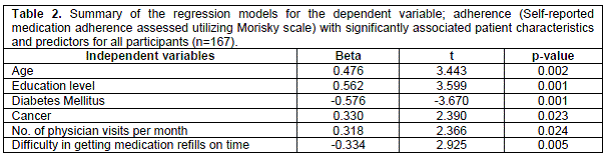
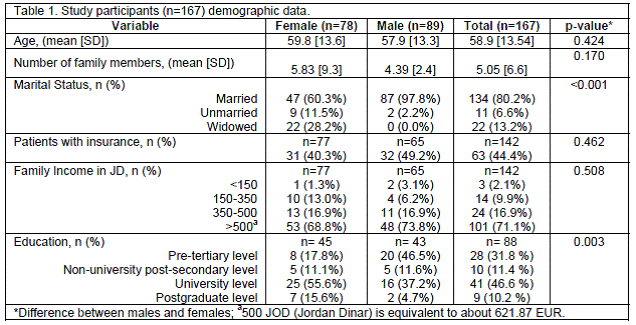
<body><![CDATA[<p><font face="Verdana" size="2"><b>Results</b></font></p>     <p><font face="Verdana" size="2">A total of 167 participants were enrolled in the study (only 3 patients declined from study participation). Mean age of the participants was 58.9; SD=13.54 and 53.3% (n=89) were males. As for the marital status, 80.2% (n=134) of the participants were married, with significantly more males reported married than females (p&lt;0.001) (<a href="#tab1">Table 1</a>). The average number of family members was similar for both genders (5.05; SD=6.6). For patients who reported their income (n=142), the majority of respondents (71.1%, n=101) reported an average income of more than 500 JOD (621.87 EUR). Less than half of the participants (44.4%, n=63) had medical insurance. More males stopped at pre-tertiary education compared to females, and more females had university and postgraduate education level (p=0.003) (<a href="#tab1">Table 1</a>).</font></p>     <p>&nbsp;</p>     <p align="center"><a name="tab1" id="tab1"></a><img src="/img/revistas/pharmacy/v14n1/original2_t1.gif" width="636" height="325"></font></p>     <p>&nbsp;</p>     <p><font face="Verdana" size="2">The mean number of disease conditions per patient was 4.1 SD=1.74, the mean number of medications taken by each patient was 8.06 SD=2.70, and the mean number of TRPs per patient was assessed to be 7.4 SD=2.8 (range of 1&#8211;16) (reported elsewhere).<sup>3</sup></font></p>     <p><font face="Verdana" size="2">Results from the MMAS-8 questionnaire showed that a high proportion of both females (46.7%, n=78) and males (53.3%, n=89) were non-adherent, with no significant difference between both genders (p=0.322, chi square test).</font></p>     <p><font face="Verdana" size="2">Significant association between better adherence and lower number of disease states (r=-0.368, p&lt;0.001), lower number of medications (r=-0.293, p=0.001), and lower number of identified TRPs (r=-0.332, p=0.003) was found.</font></p>     <p><font face="Verdana" size="2">Results of multiple linear regression showed that the final resultant model from the analysis reporting on the dependent variable, adherence (R<sup>2</sup>=0.454, p=0.001) indicated significant association with older age, higher educational level, and higher number of physician visits per month. Patients with diabetes mellitus showed significantly lower adherence levels, while patients with cancer showed significantly higher adherence levels. Difficulty in getting medication refills on time also showed significant association with lower adherence (<a href="#tab2">Table 2</a>).</font></p>     <p>&nbsp;</p>     ]]></body>
<body><![CDATA[<p align="center"><a name="tab2" id="tab2"></a><img src="/img/revistas/pharmacy/v14n1/original2_t2.gif" width="608" height="158"></font></p>     <p>&nbsp;</p>     <p><font face="Verdana" size="2"><b>Physical/mental assessment dimension</b></font></p>     <p><font face="Verdana" size="2">Participants&#8217; self-evaluation of their medical condition/s revealed that many patients felt it was &quot;good&quot; (34.7%) or at least &#8220;not bad&#8221; (40.7%). More than half of the patients (58.1%) reported that their medical condition restricted them from performing their normal daily activity to some extent. Questioning the degree to which physical health prevented patients from doing their daily activities showed that 47.9% suffered absolute, large or medium prevention. Majority (52.7%) reported that their illnesses prevented them to some degree from going up the stairs. About 29.3% believed that their physical condition prevented them completely from doing a certain activity that they loved (<a target="_blank" href="/img/revistas/pharmacy/v14n1/original2_t3.gif">Table 3</a>, part A).</font></p>     <p><font face="Verdana" size="2">The Mental dimension revealed that many patients (26.3%) believed that their mental health made them lower to some extent the physical activities they wanted to perform. This was reported significantly more by females (45.2%) than by males (19.2%) (p=0.01). More than half of the patients (58.7%) reported that their mental health prevented them from doing any of what they wished to achieve in their daily lives.</font></p>     <p><font face="Verdana" size="2">Regarding patients reporting how they felt about their condition in the past 4 weeks, less patients reported feeling calm all the time/most of the time when compared to feeling energetic or exhausted (<a target="_blank" href="/img/revistas/pharmacy/v14n1/original2_t3.gif">Table 3</a>, Part B).</font></p>     <p><font face="Verdana" size="2">Educational level showed significant association with patient answers to the questions: &#8220;To what degree does your physical health prevent you from doing your daily activities?&#8221;, and &#8216;Does your mental health condition prevent you from doing things you wished to achieve in your daily life?&#8217;. Patients with higher educational level reported lower influence of their medical illnesses (r=-0.353; p=0.001) and mental condition (r=-0.353, p=0.01) on their daily activities.</font></p>     <p><font face="Verdana" size="2"><b>Belief Dimension</b></font></p>     <p><font face="Verdana" size="2">When the participants were asked about their beliefs regarding their treatment and medical conditions, many (38.9%) reported that their illness was eradicated following initiation of their medical treatment, while 13.2% believed that their condition worsened following treatment. Regardless of the above, 64.5% of patients believed that their medications were important for their health and effective for preventing future health complications. Few (14.9%) believed that their medications were necessary only to relieve their short term symptoms. Some patients (18.1%) believed that their medications will terminate their &#8216;chronic condition&#8217;, a misconception considering the nature of their chronic conditions (<a target="_blank" href="/img/revistas/pharmacy/v14n1/original2_t4.gif">Table 4</a>).</font></p>     <p><font face="Verdana" size="2">Significant association between better adherence and patients positive beliefs regarding the effectiveness of treatment (p&lt;0.001) was also found (belief that their illness was eradicated following initiating of treatment and acknowledgement that medications will prevent future health complications). </font></p>     ]]></body>
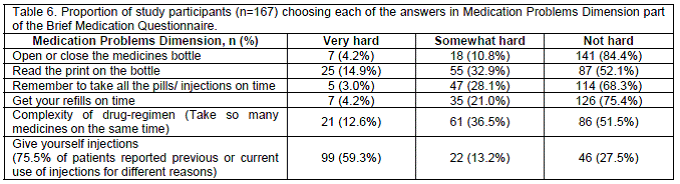
<body><![CDATA[<p><font face="Verdana" size="2">Majority of patients reported concerns about their medications, mostly regarding medications causing drug interactions, harming their stomach, or being unable to ever stop them after starting (<a target="_blank" href="/img/revistas/pharmacy/v14n1/original2_t4.gif">Table 4</a>).</font></p>     <p><font face="Verdana" size="2"><b>Recall dimension</b></font></p>     <p><font face="Verdana" size="2">This section defines adherence through patient perspectives. About quarter (24.5%) of the patients reported being usually/all the time careless about their medications. However, majority (63.5% and 70.8%) reported that they never stopped their medication due to feeling better or worse. Stopping medications due to feeling better or worse showed interesting differences (<a href="#tab5">Table 5</a>). Feeling &#8216;better&#8217; led to more patients stopping their medications on an &#8216;always/usually&#8217; basis (24.0%) when compared to feeling worse (12.0%). Common type of medications reported by the patients leading to frequent side-effects and poor adherence included aspirin (cyclooxygenase inhibitor) (14%), calcium channel blockers (10%), beta blocker (12.5%), diuretics (15.9%), biguanides (metformin) (11.0%), hypoglycemics (20%) and valproic acid (carboxyilic acid derivatives) (5%) and a combination of other drugs (11.6).</font></p>     <p>&nbsp;</p>     <p align="center"><a name="tab5" id="tab5"></a><img src="/img/revistas/pharmacy/v14n1/original2_t5.gif" width="688" height="200"></font></p>     <p>&nbsp;</p>     <p><font face="Verdana" size="2"><b>Medication Problems Dimension</b></font></p>     <p><font face="Verdana" size="2">Opening and closing the medication bottles was a problem to 15.0% of the patients, as they found it a somewhat/very hard maneuver to perform. Reading the prints on the medication bottles was a problem to more patients (47.8%) who found it somewhat/very hard to perform (<a href="#tab6">Table 6</a>).</font></p>     <p>&nbsp;</p>     <p align="center"><a name="tab6" id="tab6"></a><img src="/img/revistas/pharmacy/v14n1/original2_t6.gif" width="680" height="184"></font></p>     ]]></body>
<body><![CDATA[<p>&nbsp;</p>     <p><font face="Verdana" size="2">Most patients (31.1%) found taking their pills/injections on time somewhat/very hard. Getting medication refills on time was an issue to 25.2% of patients who found it somewhat/ very hard to do so. For those who found it hard to get their medication refills on time, barriers included non-availability of the medications in the pharmacy (15.0%), having to travel to the pharmacy (22.0%), and simply forgetfulness (63.0%).</font></p>     <p><font face="Verdana" size="2">Regarding the complexity of the therapeutic regimen (taking many medications at the same time), about half of the patients (49.1%) believed that their therapeutic regimen was very/somewhat complex. Out of the respondents who used injectable (75.5%, with 56.9% due to diabetes, 11.4% due to renal insufficiency, 7.2% due to other conditions), many reported that giving themselves the injections was very hard (59.3%).</font></p>     <p><font face="Verdana" size="2">No significant association between higher income or having insurance was found with getting medication refills on time (r=0.028, p=0.755; r=0.024, p=0.859 respectively).</font></p>     <p><font face="Verdana" size="2">Significant correlation between lower adherence and each of the following was found: higher regimen complexity (r=-0.267, p=0.011); difficulty in remembering to take all of the pills/injections on time (r=-0.209, p= 0.050); difficulty in getting refills on time (r=-0.260, p=0.016) and difficulty with opening/closing the drug container (r=-0.250, p=0.022).</font></p>     <p>&nbsp;</p>     <p><font face="Verdana" size="2"><b>Discussion</b></font></p>     <p><font face="Verdana" size="2">The World Health Organization identified the issue of adherence to medications as a growing concern adding to the burden of disease.<sup>14</sup> To our knowledge, this is the first exploratory study conducted in Jordan that investigated the effect of patient health beliefs on medication adherence for outpatients with chronic conditions. Most of the previous studies about patient health beliefs and their impact on medication adherence have been conducted in the USA, Australia, and Europe.<sup>14</sup> Investigating these issues in Jordan broadens the vision for more diverse social and cultural backgrounds. A lot of culture stands behind health beliefs and treatment decisions.<sup>5</sup> Socioeconomic and cultural differences have been proposed to influence patient adherence as much as the healthcare systems do.<sup>5</sup></font></p>     <p><font face="Verdana" size="2">Many of the associations between patient health beliefs and self-reported adherence identified in this study support findings from previous studies conducted in different countries. This study supports the finding that older age and more frequent physician visits have been associated with better adherence.<sup>15,16</sup> Similarly, complex medication regimens (polypharmacy) are associated with poor adherence.<sup>17</sup> Among all chronic conditions, diabetes mellitus was associated with significantly lower adherence while patients suffering from cancer showed significantly better adherence, similar to findings from previous studies.<sup>15,18</sup> This could be due to the short-term hidden effect of missing a dose for the former and patients&#8217; perceived significance of the treatment for the latter. Higher educational level also showed significant association with adherence as was reported elsewhere.<sup>15,19</sup> Hence, despite significant differences in the health system, socioeconomic background and cultural context, factors affecting adherence remain similar across the countries.</font></p>     <p><font face="Verdana" size="2">Although Jordan is a country with low income per capita, getting medication refills on time was not related to economic reasons, as no significant association was found with higher income or having insurance. Educated Jordanians were found more capable to cope with their disease states, as they reported less effect of their physical/mental conditions on their daily activities. Patients having better feelings about their medical condition/s promoted better adherence, possibly highlighting the significance of reassurance, a role in which the community pharmacist can contribute significantly in.</font></p>     ]]></body>
<body><![CDATA[<p><font face="Verdana" size="2">Patient&#8217;s negative beliefs can lead to poor adherence. About two-third of the patients in this study believed that their condition did not change or even was worsened following treatment. However, patients seemed to acknowledge that this can be due to the progress of their disease rather than drug failure, because nearly all of them believed that their medications were important for their health. Results showed that less medications was associated with better health beliefs about drug effectiveness. This finding can promote the use of combination dosage forms.</font></p>     <p><font face="Verdana" size="2">Majority of patients reported concerns about their medications causing drug side effects and harming their stomach or kidneys. Anecdotal comments showed that drug side effects led to more patients stopping their medication/s. This comes in agreement with previous studies conducted in Palestine<sup>20</sup> and Nigeria<sup>21</sup>, reporting that more drug adverse effects decreased patient adherence. Henceforth, patients with greater number of medications and more complex therapeutic regimens need more attention from the health care professionals in order to prevent the adverse effects of polypharmacy and hence improve adherence.</font></p>     <p><font face="Verdana" size="2">A connection was revealed between patient&#8217;s inability to get his/her medication refill on time and poor adherence. Strategies that would increase patient&#8217;s chances of getting their refills on time could involve phoning-in to a neighboring pharmacy for delivery of repeat medications, mail ordering and internet prescription refilling.<sup>15</sup></font></p>     <p><font face="Verdana" size="2">Limitations of study include the involvement of multiple interviewers which may have introduced some confounder and variability. Yet, data collection was completed by following strictly a questionnaire developed by the researcher. Analyses included comparisons of adherence across different chronic illnesses, while there may be illness-specific factors impacting adherence. Some of the questions in the BMQ questionnaire could be expressed in a clearer way to provide more accurate results. For example, the question that asks the patients about &#8216;how their medical condition is going&#8217;; the answers presented cannot be exhaustive and could lead patients to select an option that is not necessarily reflective of their actual view.&#8221; Hence, we recommend an extensive review to the content of the BMQ. As each student recruited one patient, there is a chance that students may have selected the most interesting patients, which can have implications for the generalizability of the results. This issue was avoided as much as possible by informing the students of the importance of random patient selection. Follow-up studies are needed to explore specific trends revealed by this exploratory study.</font></p>     <p>&nbsp;</p>     <p><font face="Verdana" size="2"><b>Conclusions</b></font></p>     <p><font face="Verdana" size="2">This study sheds the light on the importance of pharmacists and prescribers (e.g. physicians) evaluating patient&#8217;s pre-existing health beliefs regarding their illness and treatment<sup>22</sup>, in order to improve patient&#8217;s evaluation of the designated prescription, adherence and hence beneficial outcomes.<sup>23</sup> Results from this study unveiled findings that add to the literature on patient health beliefs and adherence. Certain patient characteristics and health beliefs were significantly associated with self- reported medication adherence. Older age, higher educational level, and higher number of physician visits per month led to better adherence. Higher number of medical conditions, higher number of medications, and more TRPs led to lower adherence. Reported patient difficulties in obtaining medication refills showed significant association with lower adherence. Patients with diabetes showed lower adherence levels, while cancer patients showed higher adherence levels. Taking these findings in consideration when planning individualised patient care plans and services can improve drug adherence.</font></p>     <p>&nbsp;</p>     <p><font face="Verdana" size="2"><b>Acknowledgements</b></font></p>     <p><font face="Verdana" size="2">The authors would like to thank all patients, community pharmacists and pharmacy students who participated in this study. We acknowledge the help of the pharmacist Mohamad Ghabayn with data entry and analysis.</font></p>     ]]></body>
<body><![CDATA[<p>&nbsp;</p>     <p><font face="Verdana" size="2"><b>Conflict of interest</b></font></p>     <p><font face="Verdana" size="2">None.</font></p>     <p>&nbsp;</p>     <p><font face="Verdana" size="2"><b>References</b></font></p>     <!-- ref --><p><font face="Verdana" size="2">1. National Institute of Health and Care Excellence. Medicines adherence: involving patients in decisions about prescribed medicines and supporting adherence (NICE guidelines). <a target="_blank" href="https://www.nice.org.uk/Guidance/CG76">https://www.nice.org.uk/Guidance/CG76</a> (accesed October 21, 2015).    &nbsp;&nbsp;&nbsp;&nbsp;&nbsp;&nbsp;&nbsp;&nbsp;[&#160;<a href="javascript:void(0);" onclick="javascript: window.open('/scielo.php?script=sci_nlinks&ref=4222159&pid=S1885-642X201600010000300001&lng=','','width=640,height=500,resizable=yes,scrollbars=1,menubar=yes,');">Links</a>&#160;]<!-- end-ref --></font></p>    <!-- ref --><p><font face="Verdana" size="2">2. Granger BB, Ekman I, Granger CB, Ostergren J, Olofsson B, Michelson E, McMurray JJV, Yusuf S, Pfeffer MA, Swedberg K. Adherence to medication according to sex and age in the CHARM programme. Eur J Heart Fail. 2009;11(11):1092-1098. doi: 10.1093/eurjhf/hfp142.    &nbsp;&nbsp;&nbsp;&nbsp;&nbsp;&nbsp;&nbsp;&nbsp;[&#160;<a href="javascript:void(0);" onclick="javascript: window.open('/scielo.php?script=sci_nlinks&ref=4222161&pid=S1885-642X201600010000300002&lng=','','width=640,height=500,resizable=yes,scrollbars=1,menubar=yes,');">Links</a>&#160;]<!-- end-ref --></font></p>    <!-- ref --><p><font face="Verdana" size="2">3. Basheti IA, Qunaibi EA, Bulatova NR, Samara S, AbuRuz S. Treatment related problems for outpatients with chronic diseases in Jordan: the value of home medication reviews. Int J Clin Pharm. 2013;35(1):92-100. doi: 10.1007/s11096-012-9713-4.    &nbsp;&nbsp;&nbsp;&nbsp;&nbsp;&nbsp;&nbsp;&nbsp;[&#160;<a href="javascript:void(0);" onclick="javascript: window.open('/scielo.php?script=sci_nlinks&ref=4222163&pid=S1885-642X201600010000300003&lng=','','width=640,height=500,resizable=yes,scrollbars=1,menubar=yes,');">Links</a>&#160;]<!-- end-ref --></font></p>    <!-- ref --><p><font face="Verdana" size="2">4. Lewis NJ, Bugdalski-Stutrud C, Abate MA, Blommel M, Wu CH, Gaither CA. The Medication Assessment Program: comprehensive medication assessments for persons taking multiple medications for chronic diseases. J Am Pharm Assoc (2003). 2008;48(2):171-180. doi: 10.1331/JAPhA.2008.07141</font>&nbsp;&nbsp;&nbsp;&nbsp;&nbsp;&nbsp;&nbsp;&nbsp;[&#160;<a href="javascript:void(0);" onclick="javascript: window.open('/scielo.php?script=sci_nlinks&ref=4222165&pid=S1885-642X201600010000300004&lng=','','width=640,height=500,resizable=yes,scrollbars=1,menubar=yes,');">Links</a>&#160;]<!-- end-ref --><!-- ref --><p><font face="Verdana" size="2">5. Horne R. Compliance, adherence, and concordance: implications for asthma treatment. Chest. 2006;130(1 Suppl):65S-72S.    &nbsp;&nbsp;&nbsp;&nbsp;&nbsp;&nbsp;&nbsp;&nbsp;[&#160;<a href="javascript:void(0);" onclick="javascript: window.open('/scielo.php?script=sci_nlinks&ref=4222166&pid=S1885-642X201600010000300005&lng=','','width=640,height=500,resizable=yes,scrollbars=1,menubar=yes,');">Links</a>&#160;]<!-- end-ref --></font></p>    <!-- ref --><p><font face="Verdana" size="2">6. Bassett-Clarke D, Krass I, Bajorek B. Ethnic differences of medicines-taking in older adults: a cross cultural study in New Zealand. Int J Pharm Pract. 2012;20(2):90-98. doi: 10.1111/j.2042-7174.2011.00169.x.    &nbsp;&nbsp;&nbsp;&nbsp;&nbsp;&nbsp;&nbsp;&nbsp;[&#160;<a href="javascript:void(0);" onclick="javascript: window.open('/scielo.php?script=sci_nlinks&ref=4222168&pid=S1885-642X201600010000300006&lng=','','width=640,height=500,resizable=yes,scrollbars=1,menubar=yes,');">Links</a>&#160;]<!-- end-ref --></font></p>    <!-- ref --><p><font face="Verdana" size="2">7. Otoom S BA, Hadidi H, Hasan M, Al-Saudi K. Evaluation of drug use in Jordan using WHO prescribing indicators. East Mediterr Health J. 2002;8(4-5):544-549.    &nbsp;&nbsp;&nbsp;&nbsp;&nbsp;&nbsp;&nbsp;&nbsp;[&#160;<a href="javascript:void(0);" onclick="javascript: window.open('/scielo.php?script=sci_nlinks&ref=4222170&pid=S1885-642X201600010000300007&lng=','','width=640,height=500,resizable=yes,scrollbars=1,menubar=yes,');">Links</a>&#160;]<!-- end-ref --></font></p>    <!-- ref --><p><font face="Verdana" size="2">8. Yousef AM, Al-Bakri AG, Bustanji Y, Wazaify M. Self-medication patterns in Amman, Jordan. Pharm World Sci. 2008;30(1):24-30.    &nbsp;&nbsp;&nbsp;&nbsp;&nbsp;&nbsp;&nbsp;&nbsp;[&#160;<a href="javascript:void(0);" onclick="javascript: window.open('/scielo.php?script=sci_nlinks&ref=4222172&pid=S1885-642X201600010000300008&lng=','','width=640,height=500,resizable=yes,scrollbars=1,menubar=yes,');">Links</a>&#160;]<!-- end-ref --></font></p>    ]]></body>
<body><![CDATA[<!-- ref --><p><font face="Verdana" size="2">9. Qunaibi E, Basheti IA, Hamadi SA, Bulatova NR, Shanah A, Abu-Gharbieh E. Effect of divergence in patients&#8217; socioeconomic background on their perspective of the role of the community pharmacist in Amman, Jordan. Trop J Pharm Res. 2013;12(2):247-253.    &nbsp;&nbsp;&nbsp;&nbsp;&nbsp;&nbsp;&nbsp;&nbsp;[&#160;<a href="javascript:void(0);" onclick="javascript: window.open('/scielo.php?script=sci_nlinks&ref=4222174&pid=S1885-642X201600010000300009&lng=','','width=640,height=500,resizable=yes,scrollbars=1,menubar=yes,');">Links</a>&#160;]<!-- end-ref --></font></p>    <!-- ref --><p><font face="Verdana" size="2">10. Roughead EE, Barratt JD, Gilbert AL. Medication-related problems commonly occurring in an Australian community setting. Pharmacoepidemiol Drug Saf. 2004;13(2):83-87.    &nbsp;&nbsp;&nbsp;&nbsp;&nbsp;&nbsp;&nbsp;&nbsp;[&#160;<a href="javascript:void(0);" onclick="javascript: window.open('/scielo.php?script=sci_nlinks&ref=4222176&pid=S1885-642X201600010000300010&lng=','','width=640,height=500,resizable=yes,scrollbars=1,menubar=yes,');">Links</a>&#160;]<!-- end-ref --></font></p>    <!-- ref --><p><font face="Verdana" size="2">11. Morisky DE, Green LW, Levine DM. Concurrent and predictive validity of a self-reported measure of medication adherence. Med Care. 1986;24(1):67-74.    &nbsp;&nbsp;&nbsp;&nbsp;&nbsp;&nbsp;&nbsp;&nbsp;[&#160;<a href="javascript:void(0);" onclick="javascript: window.open('/scielo.php?script=sci_nlinks&ref=4222178&pid=S1885-642X201600010000300011&lng=','','width=640,height=500,resizable=yes,scrollbars=1,menubar=yes,');">Links</a>&#160;]<!-- end-ref --></font></p>    <!-- ref --><p><font face="Verdana" size="2">12. Svarstad BL, Chewning BA, Sleath BL, Claesson C. The Brief Medication Questionnaire: a tool for screening patient adherence and barriers to adherence. Patient Educ Couns. 1999;37(2):113-124.    &nbsp;&nbsp;&nbsp;&nbsp;&nbsp;&nbsp;&nbsp;&nbsp;[&#160;<a href="javascript:void(0);" onclick="javascript: window.open('/scielo.php?script=sci_nlinks&ref=4222180&pid=S1885-642X201600010000300012&lng=','','width=640,height=500,resizable=yes,scrollbars=1,menubar=yes,');">Links</a>&#160;]<!-- end-ref --></font></p>    <!-- ref --><p><font face="Verdana" size="2">13. Krass I, Taylor SJ, Smith C, Armour CL. Impact on medication use and adherence of Australian pharmacists' diabetes care services. J Am Pharm Assoc (2003). 2005;45(1):33-40.    &nbsp;&nbsp;&nbsp;&nbsp;&nbsp;&nbsp;&nbsp;&nbsp;[&#160;<a href="javascript:void(0);" onclick="javascript: window.open('/scielo.php?script=sci_nlinks&ref=4222182&pid=S1885-642X201600010000300013&lng=','','width=640,height=500,resizable=yes,scrollbars=1,menubar=yes,');">Links</a>&#160;]<!-- end-ref --></font></p>    ]]></body>
<body><![CDATA[<!-- ref --><p><font face="Verdana" size="2">14. World Health Organization. Adherence to long-term therapies: evidence for action. Sabat&eacute; E eGWH, Organization; 2003. <a target="_blank" href="http://www.who.int/chp/knowledge/publications/adherence_introduction.pdf">http://www.who.int/chp/knowledge/publications/adherence_introduction.pdf</a> (accessed May 1, 2015).    &nbsp;&nbsp;&nbsp;&nbsp;&nbsp;&nbsp;&nbsp;&nbsp;[&#160;<a href="javascript:void(0);" onclick="javascript: window.open('/scielo.php?script=sci_nlinks&ref=4222184&pid=S1885-642X201600010000300014&lng=','','width=640,height=500,resizable=yes,scrollbars=1,menubar=yes,');">Links</a>&#160;]<!-- end-ref --></font></p>    <!-- ref --><p><font face="Verdana" size="2">15. Rolnick SJ, Pawloski PA, Hedblom BD, Asche SE, Bruzek RJ. Patient characteristics associated with medication adherence. Clin Med Res. 2013;11(2):54-65. doi: 10.3121/cmr.2013.1113.    &nbsp;&nbsp;&nbsp;&nbsp;&nbsp;&nbsp;&nbsp;&nbsp;[&#160;<a href="javascript:void(0);" onclick="javascript: window.open('/scielo.php?script=sci_nlinks&ref=4222186&pid=S1885-642X201600010000300015&lng=','','width=640,height=500,resizable=yes,scrollbars=1,menubar=yes,');">Links</a>&#160;]<!-- end-ref --></font></p>    <!-- ref --><p><font face="Verdana" size="2">16. Hong JS, Kang HC. Relationship between continuity of ambulatory care and medication adherence in adult patients with type 2 diabetes in Korea: a longitudinal analysis. Med Care. 2014;52(5):446-453. doi: 10.1097/MLR.0000000000000110.    &nbsp;&nbsp;&nbsp;&nbsp;&nbsp;&nbsp;&nbsp;&nbsp;[&#160;<a href="javascript:void(0);" onclick="javascript: window.open('/scielo.php?script=sci_nlinks&ref=4222188&pid=S1885-642X201600010000300016&lng=','','width=640,height=500,resizable=yes,scrollbars=1,menubar=yes,');">Links</a>&#160;]<!-- end-ref --></font></p>    <!-- ref --><p><font face="Verdana" size="2">17. Alhalaiqa F, Deane KH, Nawafleh AH, Clark A, Gray R. Adherence therapy for medication non-compliant patients with hypertension: a randomised controlled trial. J Hum Hypertens. 2012;26(2):117-126. doi: 10.1038/jhh.2010.133.    &nbsp;&nbsp;&nbsp;&nbsp;&nbsp;&nbsp;&nbsp;&nbsp;[&#160;<a href="javascript:void(0);" onclick="javascript: window.open('/scielo.php?script=sci_nlinks&ref=4222190&pid=S1885-642X201600010000300017&lng=','','width=640,height=500,resizable=yes,scrollbars=1,menubar=yes,');">Links</a>&#160;]<!-- end-ref --></font></p>    <!-- ref --><p><font face="Verdana" size="2">18. Liekens S, Hulshagen L, Dethier M, Laekeman G, Foulon  V. Adherence to chronic medication: also a frequent problem in Belgium!. J Pharm Belg. 2013;(4):18-27.    &nbsp;&nbsp;&nbsp;&nbsp;&nbsp;&nbsp;&nbsp;&nbsp;[&#160;<a href="javascript:void(0);" onclick="javascript: window.open('/scielo.php?script=sci_nlinks&ref=4222192&pid=S1885-642X201600010000300018&lng=','','width=640,height=500,resizable=yes,scrollbars=1,menubar=yes,');">Links</a>&#160;]<!-- end-ref --></font></p>    ]]></body>
<body><![CDATA[<!-- ref --><p><font face="Verdana" size="2">19. Jin J, Sklar GE, Min Sen Oh V, Chuen Li S. Factors affecting therapeutic compliance: A review from the patient's perspective. Ther Clin Risk Manag. 2008;4(1):269-286.    &nbsp;&nbsp;&nbsp;&nbsp;&nbsp;&nbsp;&nbsp;&nbsp;[&#160;<a href="javascript:void(0);" onclick="javascript: window.open('/scielo.php?script=sci_nlinks&ref=4222194&pid=S1885-642X201600010000300019&lng=','','width=640,height=500,resizable=yes,scrollbars=1,menubar=yes,');">Links</a>&#160;]<!-- end-ref --></font></p>    <!-- ref --><p><font face="Verdana" size="2">20. Sweileh WM, Zyoud SH, Abu Nab'a RJ, Deleq MI, Enaia MI, Nassar SM, Al-Jabi SW. Influence of patients' disease knowledge and beliefs about medicines on medication adherence: findings from a cross-sectional survey among patients with type 2 diabetes mellitus in Palestine. BMC Public Health. 2014;14:94. doi: 10.1186/1471-2458-14-94.    &nbsp;&nbsp;&nbsp;&nbsp;&nbsp;&nbsp;&nbsp;&nbsp;[&#160;<a href="javascript:void(0);" onclick="javascript: window.open('/scielo.php?script=sci_nlinks&ref=4222196&pid=S1885-642X201600010000300020&lng=','','width=640,height=500,resizable=yes,scrollbars=1,menubar=yes,');">Links</a>&#160;]<!-- end-ref --></font></p>    <!-- ref --><p><font face="Verdana" size="2">21. Danladi J, Falang K, Barde R, Jimam N, Dangiwa D, Jimoh H. Pharmaceutical care and medication adherence in management of psychosis in a Nigerian tertiary hospital. J Res Pharm Pract. 2013;2(2):83-87. doi: 10.4103/2279-042X.117388.    &nbsp;&nbsp;&nbsp;&nbsp;&nbsp;&nbsp;&nbsp;&nbsp;[&#160;<a href="javascript:void(0);" onclick="javascript: window.open('/scielo.php?script=sci_nlinks&ref=4222198&pid=S1885-642X201600010000300021&lng=','','width=640,height=500,resizable=yes,scrollbars=1,menubar=yes,');">Links</a>&#160;]<!-- end-ref --></font></p>    <!-- ref --><p><font face="Verdana" size="2">22. Weinman J, Petrie KJ, Moss-Morris R, Horne R. The illness perception questionnaire: A new method for assessing the cognitive representation of illness. Psychol Health. 1996;11(3):431-445.    &nbsp;&nbsp;&nbsp;&nbsp;&nbsp;&nbsp;&nbsp;&nbsp;[&#160;<a href="javascript:void(0);" onclick="javascript: window.open('/scielo.php?script=sci_nlinks&ref=4222200&pid=S1885-642X201600010000300022&lng=','','width=640,height=500,resizable=yes,scrollbars=1,menubar=yes,');">Links</a>&#160;]<!-- end-ref --></font></p>    <!-- ref --><p><font face="Verdana" size="2">23. Horne R, Chapman SC, Parham R, Freemantle N, Forbes A, Cooper V. Understanding patients' adherence-related beliefs about medicines prescribed for long-term conditions: a meta-analytic review of the Necessity-Concerns Framework. PLoS One. 2013;8(12):e80633. doi: 10.1371/journal.pone.0080633.    &nbsp;&nbsp;&nbsp;&nbsp;&nbsp;&nbsp;&nbsp;&nbsp;[&#160;<a href="javascript:void(0);" onclick="javascript: window.open('/scielo.php?script=sci_nlinks&ref=4222202&pid=S1885-642X201600010000300023&lng=','','width=640,height=500,resizable=yes,scrollbars=1,menubar=yes,');">Links</a>&#160;]<!-- end-ref --></font></p>     ]]></body>
<body><![CDATA[<p>&nbsp;</p>     <p>&nbsp;</p>     <p><font face="Verdana" size="2">Received (first version): 10.07.15    <br>Accepted: 12.02.16</font></p>      ]]></body><back>
<ref-list>
<ref id="B1">
<label>1</label><nlm-citation citation-type="">
<collab>National Institute of Health and Care Excellence</collab>
<source><![CDATA[Medicines adherence: involving patients in decisions about prescribed medicines and supporting adherence (NICE guidelines)]]></source>
<year></year>
</nlm-citation>
</ref>
<ref id="B2">
<label>2</label><nlm-citation citation-type="journal">
<person-group person-group-type="author">
<name>
<surname><![CDATA[Granger]]></surname>
<given-names><![CDATA[BB]]></given-names>
</name>
<name>
<surname><![CDATA[Ekman]]></surname>
<given-names><![CDATA[I]]></given-names>
</name>
<name>
<surname><![CDATA[Granger]]></surname>
<given-names><![CDATA[CB]]></given-names>
</name>
<name>
<surname><![CDATA[Ostergren]]></surname>
<given-names><![CDATA[J]]></given-names>
</name>
<name>
<surname><![CDATA[Olofsson]]></surname>
<given-names><![CDATA[B]]></given-names>
</name>
<name>
<surname><![CDATA[Michelson]]></surname>
<given-names><![CDATA[E]]></given-names>
</name>
<name>
<surname><![CDATA[McMurray]]></surname>
<given-names><![CDATA[JJV]]></given-names>
</name>
<name>
<surname><![CDATA[Yusuf]]></surname>
<given-names><![CDATA[S]]></given-names>
</name>
<name>
<surname><![CDATA[Pfeffer]]></surname>
<given-names><![CDATA[MA]]></given-names>
</name>
<name>
<surname><![CDATA[Swedberg]]></surname>
<given-names><![CDATA[K]]></given-names>
</name>
</person-group>
<article-title xml:lang="en"><![CDATA[Adherence to medication according to sex and age in the CHARM programme]]></article-title>
<source><![CDATA[Eur J Heart Fail.]]></source>
<year>2009</year>
<volume>11</volume>
<numero>11</numero>
<issue>11</issue>
<page-range>1092-1098</page-range></nlm-citation>
</ref>
<ref id="B3">
<label>3</label><nlm-citation citation-type="journal">
<person-group person-group-type="author">
<name>
<surname><![CDATA[Basheti]]></surname>
<given-names><![CDATA[IA]]></given-names>
</name>
<name>
<surname><![CDATA[Qunaibi]]></surname>
<given-names><![CDATA[EA]]></given-names>
</name>
<name>
<surname><![CDATA[Bulatova]]></surname>
<given-names><![CDATA[NR]]></given-names>
</name>
<name>
<surname><![CDATA[Samara]]></surname>
<given-names><![CDATA[S]]></given-names>
</name>
<name>
<surname><![CDATA[AbuRuz]]></surname>
<given-names><![CDATA[S]]></given-names>
</name>
</person-group>
<article-title xml:lang="en"><![CDATA[Treatment related problems for outpatients with chronic diseases in Jordan: the value of home medication reviews]]></article-title>
<source><![CDATA[Int J Clin Pharm.]]></source>
<year>2013</year>
<volume>35</volume>
<numero>1</numero>
<issue>1</issue>
<page-range>92-100</page-range></nlm-citation>
</ref>
<ref id="B4">
<label>4</label><nlm-citation citation-type="journal">
<person-group person-group-type="author">
<name>
<surname><![CDATA[Lewis]]></surname>
<given-names><![CDATA[NJ]]></given-names>
</name>
<name>
<surname><![CDATA[Bugdalski-Stutrud]]></surname>
<given-names><![CDATA[C]]></given-names>
</name>
<name>
<surname><![CDATA[Abate]]></surname>
<given-names><![CDATA[MA]]></given-names>
</name>
<name>
<surname><![CDATA[Blommel]]></surname>
<given-names><![CDATA[M]]></given-names>
</name>
<name>
<surname><![CDATA[Wu]]></surname>
<given-names><![CDATA[CH]]></given-names>
</name>
<name>
<surname><![CDATA[Gaither]]></surname>
<given-names><![CDATA[CA]]></given-names>
</name>
</person-group>
<article-title xml:lang="en"><![CDATA[The Medication Assessment Program: comprehensive medication assessments for persons taking multiple medications for chronic diseases]]></article-title>
<source><![CDATA[J Am Pharm Assoc (2003)]]></source>
<year>2008</year>
<volume>48</volume>
<numero>2</numero>
<issue>2</issue>
<page-range>171-180</page-range></nlm-citation>
</ref>
<ref id="B5">
<label>5</label><nlm-citation citation-type="journal">
<person-group person-group-type="author">
<name>
<surname><![CDATA[Horne]]></surname>
<given-names><![CDATA[R]]></given-names>
</name>
</person-group>
<article-title xml:lang="en"><![CDATA[Compliance, adherence, and concordance: implications for asthma treatment]]></article-title>
<source><![CDATA[Chest]]></source>
<year>2006</year>
<volume>130</volume>
<numero>1 Suppl</numero>
<issue>1 Suppl</issue>
<page-range>65S-72S</page-range></nlm-citation>
</ref>
<ref id="B6">
<label>6</label><nlm-citation citation-type="journal">
<person-group person-group-type="author">
<name>
<surname><![CDATA[Bassett-Clarke]]></surname>
<given-names><![CDATA[D]]></given-names>
</name>
<name>
<surname><![CDATA[Krass]]></surname>
<given-names><![CDATA[I]]></given-names>
</name>
<name>
<surname><![CDATA[Bajorek]]></surname>
<given-names><![CDATA[B]]></given-names>
</name>
</person-group>
<article-title xml:lang="en"><![CDATA[Ethnic differences of medicines-taking in older adults: a cross cultural study in New Zealand]]></article-title>
<source><![CDATA[Int J Pharm Pract.]]></source>
<year>2012</year>
<volume>20</volume>
<numero>2</numero>
<issue>2</issue>
<page-range>90-98</page-range></nlm-citation>
</ref>
<ref id="B7">
<label>7</label><nlm-citation citation-type="journal">
<person-group person-group-type="author">
<name>
<surname><![CDATA[Otoom]]></surname>
<given-names><![CDATA[S BA]]></given-names>
</name>
<name>
<surname><![CDATA[Hadidi]]></surname>
<given-names><![CDATA[H]]></given-names>
</name>
<name>
<surname><![CDATA[Hasan]]></surname>
<given-names><![CDATA[M]]></given-names>
</name>
<name>
<surname><![CDATA[Al-Saudi]]></surname>
<given-names><![CDATA[K]]></given-names>
</name>
</person-group>
<article-title xml:lang="en"><![CDATA[Evaluation of drug use in Jordan using WHO prescribing indicators]]></article-title>
<source><![CDATA[East Mediterr Health J.]]></source>
<year>2002</year>
<volume>8</volume>
<numero>4-5</numero>
<issue>4-5</issue>
<page-range>544-549</page-range></nlm-citation>
</ref>
<ref id="B8">
<label>8</label><nlm-citation citation-type="journal">
<person-group person-group-type="author">
<name>
<surname><![CDATA[Yousef]]></surname>
<given-names><![CDATA[AM]]></given-names>
</name>
<name>
<surname><![CDATA[Al-Bakri]]></surname>
<given-names><![CDATA[AG]]></given-names>
</name>
<name>
<surname><![CDATA[Bustanji]]></surname>
<given-names><![CDATA[Y]]></given-names>
</name>
<name>
<surname><![CDATA[Wazaify]]></surname>
<given-names><![CDATA[M]]></given-names>
</name>
</person-group>
<article-title xml:lang="en"><![CDATA[Self-medication patterns in Amman, Jordan]]></article-title>
<source><![CDATA[Pharm World Sci.]]></source>
<year>2008</year>
<volume>30</volume>
<numero>1</numero>
<issue>1</issue>
<page-range>24-30</page-range></nlm-citation>
</ref>
<ref id="B9">
<label>9</label><nlm-citation citation-type="journal">
<person-group person-group-type="author">
<name>
<surname><![CDATA[Qunaibi]]></surname>
<given-names><![CDATA[E]]></given-names>
</name>
<name>
<surname><![CDATA[Basheti]]></surname>
<given-names><![CDATA[IA]]></given-names>
</name>
<name>
<surname><![CDATA[Hamadi]]></surname>
<given-names><![CDATA[SA]]></given-names>
</name>
<name>
<surname><![CDATA[Bulatova]]></surname>
<given-names><![CDATA[NR]]></given-names>
</name>
<name>
<surname><![CDATA[Shanah]]></surname>
<given-names><![CDATA[A]]></given-names>
</name>
<name>
<surname><![CDATA[Abu-Gharbieh]]></surname>
<given-names><![CDATA[E]]></given-names>
</name>
</person-group>
<article-title xml:lang="en"><![CDATA[Effect of divergence in patients&#8217; socioeconomic background on their perspective of the role of the community pharmacist in Amman, Jordan]]></article-title>
<source><![CDATA[Trop J Pharm Res.]]></source>
<year>2013</year>
<volume>12</volume>
<numero>2</numero>
<issue>2</issue>
<page-range>247-253</page-range></nlm-citation>
</ref>
<ref id="B10">
<label>10</label><nlm-citation citation-type="journal">
<person-group person-group-type="author">
<name>
<surname><![CDATA[Roughead]]></surname>
<given-names><![CDATA[EE]]></given-names>
</name>
<name>
<surname><![CDATA[Barratt]]></surname>
<given-names><![CDATA[JD]]></given-names>
</name>
<name>
<surname><![CDATA[Gilbert]]></surname>
<given-names><![CDATA[AL]]></given-names>
</name>
</person-group>
<article-title xml:lang="en"><![CDATA[Medication-related problems commonly occurring in an Australian community setting]]></article-title>
<source><![CDATA[Pharmacoepidemiol Drug Saf.]]></source>
<year>2004</year>
<volume>13</volume>
<numero>2</numero>
<issue>2</issue>
<page-range>83-87</page-range></nlm-citation>
</ref>
<ref id="B11">
<label>11</label><nlm-citation citation-type="journal">
<person-group person-group-type="author">
<name>
<surname><![CDATA[Morisky]]></surname>
<given-names><![CDATA[DE]]></given-names>
</name>
<name>
<surname><![CDATA[Green]]></surname>
<given-names><![CDATA[LW]]></given-names>
</name>
<name>
<surname><![CDATA[Levine]]></surname>
<given-names><![CDATA[DM]]></given-names>
</name>
</person-group>
<article-title xml:lang="en"><![CDATA[Concurrent and predictive validity of a self-reported measure of medication adherence]]></article-title>
<source><![CDATA[Med Care]]></source>
<year>1986</year>
<volume>24</volume>
<numero>1</numero>
<issue>1</issue>
<page-range>67-74</page-range></nlm-citation>
</ref>
<ref id="B12">
<label>12</label><nlm-citation citation-type="journal">
<person-group person-group-type="author">
<name>
<surname><![CDATA[Svarstad]]></surname>
<given-names><![CDATA[BL]]></given-names>
</name>
<name>
<surname><![CDATA[Chewning]]></surname>
<given-names><![CDATA[BA]]></given-names>
</name>
<name>
<surname><![CDATA[Sleath]]></surname>
<given-names><![CDATA[BL]]></given-names>
</name>
<name>
<surname><![CDATA[Claesson]]></surname>
<given-names><![CDATA[C]]></given-names>
</name>
</person-group>
<article-title xml:lang="en"><![CDATA[The Brief Medication Questionnaire: a tool for screening patient adherence and barriers to adherence]]></article-title>
<source><![CDATA[Patient Educ Couns.]]></source>
<year>1999</year>
<volume>37</volume>
<numero>2</numero>
<issue>2</issue>
<page-range>113-124</page-range></nlm-citation>
</ref>
<ref id="B13">
<label>13</label><nlm-citation citation-type="journal">
<person-group person-group-type="author">
<name>
<surname><![CDATA[Krass]]></surname>
<given-names><![CDATA[I]]></given-names>
</name>
<name>
<surname><![CDATA[Taylor]]></surname>
<given-names><![CDATA[SJ]]></given-names>
</name>
<name>
<surname><![CDATA[Smith]]></surname>
<given-names><![CDATA[C]]></given-names>
</name>
<name>
<surname><![CDATA[Armour]]></surname>
<given-names><![CDATA[CL]]></given-names>
</name>
</person-group>
<article-title xml:lang="en"><![CDATA[Impact on medication use and adherence of Australian pharmacists' diabetes care services]]></article-title>
<source><![CDATA[J Am Pharm Assoc (2003)]]></source>
<year>2005</year>
<volume>45</volume>
<numero>1</numero>
<issue>1</issue>
<page-range>33-40</page-range></nlm-citation>
</ref>
<ref id="B14">
<label>14</label><nlm-citation citation-type="">
<person-group person-group-type="author">
<name>
<surname><![CDATA[Sabaté]]></surname>
<given-names><![CDATA[E]]></given-names>
</name>
</person-group>
<collab>World Health Organization</collab>
<source><![CDATA[Adherence to long-term therapies: evidence for action]]></source>
<year>2003</year>
</nlm-citation>
</ref>
<ref id="B15">
<label>15</label><nlm-citation citation-type="journal">
<person-group person-group-type="author">
<name>
<surname><![CDATA[Rolnick]]></surname>
<given-names><![CDATA[SJ]]></given-names>
</name>
<name>
<surname><![CDATA[Pawloski]]></surname>
<given-names><![CDATA[PA]]></given-names>
</name>
<name>
<surname><![CDATA[Hedblom]]></surname>
<given-names><![CDATA[BD]]></given-names>
</name>
<name>
<surname><![CDATA[Asche]]></surname>
<given-names><![CDATA[SE]]></given-names>
</name>
<name>
<surname><![CDATA[Bruzek]]></surname>
<given-names><![CDATA[RJ]]></given-names>
</name>
</person-group>
<article-title xml:lang="en"><![CDATA[Patient characteristics associated with medication adherence]]></article-title>
<source><![CDATA[Clin Med Res.]]></source>
<year>2013</year>
<volume>11</volume>
<numero>2</numero>
<issue>2</issue>
<page-range>54-65</page-range></nlm-citation>
</ref>
<ref id="B16">
<label>16</label><nlm-citation citation-type="journal">
<person-group person-group-type="author">
<name>
<surname><![CDATA[Hong]]></surname>
<given-names><![CDATA[JS]]></given-names>
</name>
<name>
<surname><![CDATA[Kang]]></surname>
<given-names><![CDATA[HC]]></given-names>
</name>
</person-group>
<article-title xml:lang="en"><![CDATA[Relationship between continuity of ambulatory care and medication adherence in adult patients with type 2 diabetes in Korea: a longitudinal analysis]]></article-title>
<source><![CDATA[Med Care]]></source>
<year>2014</year>
<volume>52</volume>
<numero>5</numero>
<issue>5</issue>
<page-range>446-453</page-range></nlm-citation>
</ref>
<ref id="B17">
<label>17</label><nlm-citation citation-type="journal">
<person-group person-group-type="author">
<name>
<surname><![CDATA[Alhalaiqa]]></surname>
<given-names><![CDATA[F]]></given-names>
</name>
<name>
<surname><![CDATA[Deane]]></surname>
<given-names><![CDATA[KH]]></given-names>
</name>
<name>
<surname><![CDATA[Nawafleh]]></surname>
<given-names><![CDATA[AH]]></given-names>
</name>
<name>
<surname><![CDATA[Clark]]></surname>
<given-names><![CDATA[A]]></given-names>
</name>
<name>
<surname><![CDATA[Gray]]></surname>
<given-names><![CDATA[R]]></given-names>
</name>
</person-group>
<article-title xml:lang="en"><![CDATA[Adherence therapy for medication non-compliant patients with hypertension: a randomised controlled trial]]></article-title>
<source><![CDATA[J Hum Hypertens.]]></source>
<year>2012</year>
<volume>26</volume>
<numero>2</numero>
<issue>2</issue>
<page-range>117-126</page-range></nlm-citation>
</ref>
<ref id="B18">
<label>18</label><nlm-citation citation-type="journal">
<person-group person-group-type="author">
<name>
<surname><![CDATA[Liekens]]></surname>
<given-names><![CDATA[S]]></given-names>
</name>
<name>
<surname><![CDATA[Hulshagen]]></surname>
<given-names><![CDATA[L]]></given-names>
</name>
<name>
<surname><![CDATA[Dethier]]></surname>
<given-names><![CDATA[M]]></given-names>
</name>
<name>
<surname><![CDATA[Laekeman]]></surname>
<given-names><![CDATA[G]]></given-names>
</name>
<name>
<surname><![CDATA[Foulon]]></surname>
<given-names><![CDATA[V]]></given-names>
</name>
</person-group>
<article-title xml:lang="en"><![CDATA[Adherence to chronic medication: also a frequent problem in Belgium!]]></article-title>
<source><![CDATA[J Pharm Belg.]]></source>
<year>2013</year>
<numero>4</numero>
<issue>4</issue>
<page-range>18-27</page-range></nlm-citation>
</ref>
<ref id="B19">
<label>19</label><nlm-citation citation-type="journal">
<person-group person-group-type="author">
<name>
<surname><![CDATA[Jin]]></surname>
<given-names><![CDATA[J]]></given-names>
</name>
<name>
<surname><![CDATA[Sklar]]></surname>
<given-names><![CDATA[GE]]></given-names>
</name>
<name>
<surname><![CDATA[Min Sen Oh]]></surname>
<given-names><![CDATA[V]]></given-names>
</name>
<name>
<surname><![CDATA[Chuen Li]]></surname>
<given-names><![CDATA[S]]></given-names>
</name>
</person-group>
<article-title xml:lang="en"><![CDATA[Factors affecting therapeutic compliance: A review from the patient's perspective]]></article-title>
<source><![CDATA[Ther Clin Risk Manag.]]></source>
<year>2008</year>
<volume>4</volume>
<numero>1</numero>
<issue>1</issue>
<page-range>269-286</page-range></nlm-citation>
</ref>
<ref id="B20">
<label>20</label><nlm-citation citation-type="journal">
<person-group person-group-type="author">
<name>
<surname><![CDATA[Sweileh]]></surname>
<given-names><![CDATA[WM]]></given-names>
</name>
<name>
<surname><![CDATA[Zyoud]]></surname>
<given-names><![CDATA[SH]]></given-names>
</name>
<name>
<surname><![CDATA[Abu]]></surname>
<given-names><![CDATA[Nab'a RJ]]></given-names>
</name>
<name>
<surname><![CDATA[Deleq]]></surname>
<given-names><![CDATA[MI]]></given-names>
</name>
<name>
<surname><![CDATA[Enaia]]></surname>
<given-names><![CDATA[MI]]></given-names>
</name>
<name>
<surname><![CDATA[Nassar]]></surname>
<given-names><![CDATA[SM]]></given-names>
</name>
<name>
<surname><![CDATA[Al-Jabi]]></surname>
<given-names><![CDATA[SW]]></given-names>
</name>
</person-group>
<article-title xml:lang="en"><![CDATA[Influence of patients' disease knowledge and beliefs about medicines on medication adherence: findings from a cross-sectional survey among patients with type 2 diabetes mellitus in Palestine]]></article-title>
<source><![CDATA[BMC Public Health]]></source>
<year>2014</year>
<volume>14</volume>
</nlm-citation>
</ref>
<ref id="B21">
<label>21</label><nlm-citation citation-type="journal">
<person-group person-group-type="author">
<name>
<surname><![CDATA[Danladi]]></surname>
<given-names><![CDATA[J]]></given-names>
</name>
<name>
<surname><![CDATA[Falang]]></surname>
<given-names><![CDATA[K]]></given-names>
</name>
<name>
<surname><![CDATA[Barde]]></surname>
<given-names><![CDATA[R]]></given-names>
</name>
<name>
<surname><![CDATA[Jimam]]></surname>
<given-names><![CDATA[N]]></given-names>
</name>
<name>
<surname><![CDATA[Dangiwa]]></surname>
<given-names><![CDATA[D]]></given-names>
</name>
<name>
<surname><![CDATA[Jimoh]]></surname>
<given-names><![CDATA[H]]></given-names>
</name>
</person-group>
<article-title xml:lang="en"><![CDATA[Pharmaceutical care and medication adherence in management of psychosis in a Nigerian tertiary hospital]]></article-title>
<source><![CDATA[J Res Pharm Pract.]]></source>
<year>2013</year>
<volume>2</volume>
<numero>2</numero>
<issue>2</issue>
<page-range>83-87</page-range></nlm-citation>
</ref>
<ref id="B22">
<label>22</label><nlm-citation citation-type="journal">
<person-group person-group-type="author">
<name>
<surname><![CDATA[Weinman]]></surname>
<given-names><![CDATA[J]]></given-names>
</name>
<name>
<surname><![CDATA[Petrie]]></surname>
<given-names><![CDATA[KJ]]></given-names>
</name>
<name>
<surname><![CDATA[Moss-Morris]]></surname>
<given-names><![CDATA[R]]></given-names>
</name>
<name>
<surname><![CDATA[Horne]]></surname>
<given-names><![CDATA[R]]></given-names>
</name>
</person-group>
<article-title xml:lang="en"><![CDATA[The illness perception questionnaire: A new method for assessing the cognitive representation of illness]]></article-title>
<source><![CDATA[Psychol Health]]></source>
<year>1996</year>
<volume>11</volume>
<numero>3</numero>
<issue>3</issue>
<page-range>431-445</page-range></nlm-citation>
</ref>
<ref id="B23">
<label>23</label><nlm-citation citation-type="journal">
<person-group person-group-type="author">
<name>
<surname><![CDATA[Horne]]></surname>
<given-names><![CDATA[R]]></given-names>
</name>
<name>
<surname><![CDATA[Chapman]]></surname>
<given-names><![CDATA[SC]]></given-names>
</name>
<name>
<surname><![CDATA[Parham]]></surname>
<given-names><![CDATA[R]]></given-names>
</name>
<name>
<surname><![CDATA[Freemantle]]></surname>
<given-names><![CDATA[N]]></given-names>
</name>
<name>
<surname><![CDATA[Forbes]]></surname>
<given-names><![CDATA[A]]></given-names>
</name>
<name>
<surname><![CDATA[Cooper]]></surname>
<given-names><![CDATA[V]]></given-names>
</name>
</person-group>
<article-title xml:lang="en"><![CDATA[Understanding patients' adherence-related beliefs about medicines prescribed for long-term conditions: a meta-analytic review of the Necessity-Concerns Framework]]></article-title>
<source><![CDATA[PLoS One]]></source>
<year>2013</year>
<volume>8</volume>
<numero>12</numero>
<issue>12</issue>
</nlm-citation>
</ref>
</ref-list>
</back>
</article>