<?xml version="1.0" encoding="ISO-8859-1"?><article xmlns:mml="http://www.w3.org/1998/Math/MathML" xmlns:xlink="http://www.w3.org/1999/xlink" xmlns:xsi="http://www.w3.org/2001/XMLSchema-instance">
<front>
<journal-meta>
<journal-id>1885-642X</journal-id>
<journal-title><![CDATA[Pharmacy Practice (Granada)]]></journal-title>
<abbrev-journal-title><![CDATA[Pharmacy Pract (Granada)]]></abbrev-journal-title>
<issn>1885-642X</issn>
<publisher>
<publisher-name><![CDATA[Centro de Investigaciones y Publicaciones Farmacéuticas]]></publisher-name>
</publisher>
</journal-meta>
<article-meta>
<article-id>S1885-642X2016000200001</article-id>
<article-id pub-id-type="doi">10.18549/PharmPract.2016.02.647</article-id>
<title-group>
<article-title xml:lang="en"><![CDATA[Evaluation of STAT medication ordering process in a community hospital]]></article-title>
</title-group>
<contrib-group>
<contrib contrib-type="author">
<name>
<surname><![CDATA[Abdelaziz]]></surname>
<given-names><![CDATA[Hani]]></given-names>
</name>
<xref ref-type="aff" rid="A01"/>
</contrib>
<contrib contrib-type="author">
<name>
<surname><![CDATA[Richardson]]></surname>
<given-names><![CDATA[Sandra]]></given-names>
</name>
<xref ref-type="aff" rid="A01"/>
</contrib>
<contrib contrib-type="author">
<name>
<surname><![CDATA[Walsh]]></surname>
<given-names><![CDATA[Kim]]></given-names>
</name>
<xref ref-type="aff" rid="A01"/>
</contrib>
<contrib contrib-type="author">
<name>
<surname><![CDATA[Nodzon]]></surname>
<given-names><![CDATA[Jessica]]></given-names>
</name>
<xref ref-type="aff" rid="A01"/>
</contrib>
<contrib contrib-type="author">
<name>
<surname><![CDATA[Schwartz]]></surname>
<given-names><![CDATA[Barbara]]></given-names>
</name>
<xref ref-type="aff" rid="A01"/>
</contrib>
</contrib-group>
<aff id="A01">
<institution><![CDATA[,Barnabas Health  ]]></institution>
<addr-line><![CDATA[West Orange NJ]]></addr-line>
<country>United States</country>
</aff>
<pub-date pub-type="pub">
<day>00</day>
<month>06</month>
<year>2016</year>
</pub-date>
<pub-date pub-type="epub">
<day>00</day>
<month>06</month>
<year>2016</year>
</pub-date>
<volume>14</volume>
<numero>2</numero>
<fpage>0</fpage>
<lpage>0</lpage>
<copyright-statement/>
<copyright-year/>
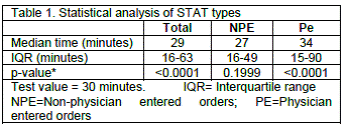
<self-uri xlink:href="http://scielo.isciii.es/scielo.php?script=sci_arttext&amp;pid=S1885-642X2016000200001&amp;lng=en&amp;nrm=iso"></self-uri><self-uri xlink:href="http://scielo.isciii.es/scielo.php?script=sci_abstract&amp;pid=S1885-642X2016000200001&amp;lng=en&amp;nrm=iso"></self-uri><self-uri xlink:href="http://scielo.isciii.es/scielo.php?script=sci_pdf&amp;pid=S1885-642X2016000200001&amp;lng=en&amp;nrm=iso"></self-uri><abstract abstract-type="short" xml:lang="en"><p><![CDATA[Background: In most health care facilities, problems related to delays in STAT medication order processing time are of common concern. Objective: The purpose of this study was to evaluate processing time for STAT orders at Kimball Medical Center. Methods: All STAT orders were reviewed to determine processing time; order processing time was also stratified by physician order entry (physician entered (PE) orders vs. non-physician entered (NPE) orders). Collected data included medication ordered, indication, time ordered, time verified by pharmacist, time sent from pharmacy, and time charted as given to the patient. Results: A total of 502 STAT orders were reviewed and 389 orders were included for analysis. Overall, median time was 29 minutes, IQR 16-63; p<0.0001.). The time needed to process NPE orders was significantly less than that needed for PE orders (median 27 vs. 34 minutes; p=0.026). In terms of NPE orders, the median total time required to process STAT orders for medications available in the Automated Dispensing Devices (ADM) was within 30 minutes, while that required to process orders for medications not available in the ADM was significantly greater than 30 minutes. For PE orders, the median total time required to process orders for medications available in the ADM (i.e., not requiring pharmacy involvement) was significantly greater than 30 minutes. [Median time = 34 minutes (p<0.001)]. Conclusion: We conclude that STAT order processing time may be improved by increasing the availability of medications in ADM, and pharmacy involvement in the verification process.]]></p></abstract>
<kwd-group>
<kwd lng="en"><![CDATA[Drug Prescriptions]]></kwd>
<kwd lng="en"><![CDATA[Medical Order Entry Systems]]></kwd>
<kwd lng="en"><![CDATA[Pharmacy Service]]></kwd>
<kwd lng="en"><![CDATA[Hospital]]></kwd>
<kwd lng="en"><![CDATA[Clinical Pharmacy Information Systems]]></kwd>
<kwd lng="en"><![CDATA[United States]]></kwd>
</kwd-group>
</article-meta>
</front><body><![CDATA[ <p><font face="Verdana" size="2"><b>ORIGINAL RESEARCH</b></font></p>     <p>&nbsp;</p>     <p><font face="Verdana" size="4"><b>Evaluation of STAT medication ordering process in a community hospital</b></font></p>     <p>&nbsp;</p>     <p>&nbsp;</p>     <p><font face="Verdana" size="2"><b>Hani Abdelaziz<sup>1</sup>, Sandra Richardson<sup>2</sup>, Kim Walsh<sup>3</sup>, Jessica Nodzon<sup>4</sup> and Barbara Schwartz<sup>5</sup></b></font></p>     <p><font face="Verdana" size="2"><sup>1</sup> Pharm. D. Barnabas Health. West Orange, NJ (United States). <a href="mailto:alsedace@gmail.com">alsedace@gmail.com</a>    <br><sup>2</sup> Pharm. D. Barnabas Health. West Orange, NJ (United States). <a href="mailto:srichardson@barnabashealth.org">srichardson@barnabashealth.org</a>    <br><sup>3</sup> RPh, MBA. Barnabas Health. West Orange, NJ (United States). <a href="mailto:kwalsh@barnabashealth.org">kwalsh@barnabashealth.org</a>    <br><sup>4</sup> Pharm. D. Barnabas Health. West Orange, NJ (United States). <a href="mailto:jnodzon@barnabashealth.org">jnodzon@barnabashealth.org</a>    ]]></body>
<body><![CDATA[<br><sup>5</sup> RPh. Barnabas Health. West Orange, NJ (United States).</font></p>     <p>&nbsp;</p>     <p>&nbsp;</p> <hr size="1">     <p><font face="Verdana" size="2"><b>ABSTRACT</b></font></p>     <p><font face="Verdana" size="2"><b>Background:</b> In most health care facilities, problems related to delays in STAT medication order processing time are of common concern.    <br><b>Objective:</b> The purpose of this study was to evaluate processing time for STAT orders at Kimball Medical Center.    <br><b>Methods:</b> All STAT orders were reviewed to determine processing time; order processing time was also stratified by physician order entry (physician entered (PE) orders vs. non-physician entered (NPE) orders). Collected data included medication ordered, indication, time ordered, time verified by pharmacist, time sent from pharmacy, and time charted as given to the patient.    <br><b>Results:</b> A total of 502 STAT orders were reviewed and 389 orders were included for analysis. Overall, median time was 29 minutes, IQR 16-63; p&lt;0.0001.). The time needed to process NPE orders was significantly less than that needed for PE orders (median 27 vs. 34 minutes; p=0.026). In terms of NPE orders, the median total time required to process STAT orders for medications available in the Automated Dispensing Devices (ADM) was within 30 minutes, while that required to process orders for medications not available in the ADM was significantly greater than 30 minutes. For PE orders, the median total time required to process orders for medications available in the ADM (i.e., not requiring pharmacy involvement) was significantly greater than 30 minutes. &#091;Median time = 34 minutes (p&lt;0.001)&#093;.    <br><b>Conclusion:</b> We conclude that STAT order processing time may be improved by increasing the availability of medications in ADM, and pharmacy involvement in the verification process.</font></p>     <p><font face="Verdana" size="2"><b>Key words:</b> Drug Prescriptions; Medical Order Entry Systems; Pharmacy Service, Hospital; Clinical Pharmacy Information Systems; United States.</font></p> <hr size="1">     ]]></body>
<body><![CDATA[<p>&nbsp;</p>     <p><font face="Verdana" size="2"><b>Introduction</b></font></p>     <p><font face="Verdana" size="2">HA medication order, which may be provided in verbal, written, or electronic form, is a direction given by a prescriber to dispense and administer medication for a certain medical indication.<sup>1-4</sup> Medication orders may be scheduled, as needed (PRN), or STAT &#091;"stat" is an abbreviation of the Latin word statim, meaning "immediately, without delay"&#093;; scheduled orders are typically utilized for medications that are designed to give a continuous effect over a certain period of time (e.g., antibiotics)<sup>5</sup>, while PRN orders are requested for medications that are to be given in the event of specific signs or symptoms (e.g., analgesics and antipyretics for pain and fever, respectively).<sup>6,7</sup> Many such orders are given as per protocol, or guidelines that dictate when to administer medication, without the need to be ordered with the appearance of signs and symptoms (e.g., insulin sliding scale).<sup>8</sup> Finally, STAT orders, which must be dispensed in a timely fashion, indicate immediate need for the medication.<sup>9</sup></font></p>     <p><font face="Verdana" size="2">Of the 3 types of medication orders, STAT orders are most challenging, because these agents must be dispensed in a short time without delay. In addition, STAT ordering is not limited to medications, and practitioners often write STAT orders for other purposes such as laboratory tests or radiological exams.<sup>10-13</sup> The Key steps in STAT ordering process are:</font></p>     <p><font face="Verdana" size="2">&bull; The medication is ordered by prescriber</font></p>     <p><font face="Verdana" size="2">&bull; The order is entered into the computer system</font></p>     <p><font face="Verdana" size="2">&bull; The order is verified by the pharmacy</font></p>     <p><font face="Verdana" size="2">&bull; The medication is delivered from pharmacy or dispensed from Automated Dispensing Devices (ADM) at nursing stations.</font></p>     <p><font face="Verdana" size="2">&bull; The medication is administered to the patient</font></p>     <p><font face="Verdana" size="2">A delay in administration of STAT medications is a common concern. This delay may be a result of one or more of the previous steps involved in the STAT ordering process</font></p>     ]]></body>
<body><![CDATA[<p><font face="Verdana" size="2">Delays in STAT order fulfillment may be prevented/minimized by determining which step(s) is/are the source of delay, and, development and implementation of interventions designed to improve STAT order fulfillment can help to improve this process. A thorough literature review revealed limited studies evaluating the STAT ordering process, but those that were identified showed the positive impact of interventions designed to improve this process. Specifically, a study found that implementation of certain criteria such as flagging STAT orders and development of guidelines to be followed for ordering STAT medications improved the process of STAT ordering.<sup>14</sup> Another study found that establishment of a dedicated phone line for STAT orders between pharmacy and nursing stations facilitated communication and solved many STAT orders problems.<sup>15</sup></font></p>     <p><font face="Verdana" size="2">The purpose of our study was to evaluate STAT order processing time at Kimball Medical Center, and to identify source(s) of delay, in order to develop strategies to correct procedural defects. In addition, this study was conducted to determine the medications most frequently ordered as STAT.</font></p>     <p>&nbsp;</p>     <p><font face="Verdana" size="2"><b>Methods</b></font></p>     <p><font face="Verdana" size="2">This was an observational study conducted at Kimball Medical Center (KMC), a 350-bed, fully accredited, acute care hospital in NJ. STAT orders were reviewed over 3 weeks for fulfillment time; inclusion criteria included any STAT order from any unit at KMC and from any prescriber for any indication.</font></p>     <p><font face="Verdana" size="2">There are two types of STAT orders utilized at KMC, namely Non-physician entered orders (NPE) and physician entered orders (PE). NPE orders are written by the prescriber or ordered verbally, and then transcribed onto a physician order sheet, scanned to the pharmacy, and entered into the computer system by ward nurse or medical transcriptionist. These orders are then verified by a pharmacist and dispensed from ADM or delivered from the pharmacy to the nursing station. PE orders, on the other hand, are entered into the computer system directly by the prescriber. These orders need not be transcribed, scanned to the pharmacy, or verified by the pharmacist (<a target="_blank" href="/img/revistas/pharmacy/v14n2/original1_f1.gif">Figure 1</a>).</font></p>     <p><font face="Verdana" size="2">NPE labels show order entry time and verification time, while PE labels show entry time only. These times, along with delivery time of any medication not available in ADM were recorded and used to determine the total time for order fulfillment, as well as the length of time required for each step in the process. In order to ensure blindness, STAT order labels were collected and reviewed by pharmacy staff not participating in the study.</font></p>     <p><font face="Verdana" size="2">To evaluate the STAT order timing process, an EXCEL software file was used to record the following:</font></p>     <p><font face="Verdana" size="2">&bull; Entry time into computer system by prescriber or authorized agent</font></p>     <p><font face="Verdana" size="2">&bull; Verification time by pharmacist for the NPE type.</font></p>     ]]></body>
<body><![CDATA[<p><font face="Verdana" size="2">&bull; Dispensing time for medication not available in ADM</font></p>     <p><font face="Verdana" size="2">&bull; Administration time</font></p>     <p><font face="Verdana" size="2">&bull; Total processing time for each STAT order.</font></p>     <p><font face="Verdana" size="2">The recorded data was then analyzed to determine average total processing time, and to compare it with policy time; according to KMC policy, STAT orders must be administered within 30 minutes of entry. In case of any delays for STAT order processing, data analysis was conducted to determine the source of delay, and its effect on total processing time.</font></p>     <p><font face="Verdana" size="2">The primary endpoints of the study were average and median total processing time of STAT orders, while secondary end points included most frequently ordered STAT medication and longest component of ordering process.</font></p>     <p><font face="Verdana" size="2"><b>Statistical analysis</b></font></p>     <p><font face="Verdana" size="2">To determine the processing time, statistical analysis for the data was performed using SPSS 20.0 (SPSS, Chicago, IL, USA) measuring different parameters such as mean (SD), median, and interquartile range (IQR) to increase the reliability of the results. To compare the processing time with the standard time and to show if there is a significant difference between the two types and the different steps within each type, we used Mann-Whitney test because it is much more sensitive than median or t-test, especially in the presence of outliers and when the data is neither symmetrically nor normally distributed.</font></p>     <p>&nbsp;</p>     <p><font face="Verdana" size="2"><b>Results</b></font></p>     <p><font face="Verdana" size="2">A total of 502 STAT orders were reviewed and included for analysis. Of these orders, 388 (77.6%) were recorded as administered. Of these, 210 (54.1%) orders were NPE, while 178 (45.8%) were PE (p = 0.1043).</font></p>     ]]></body>
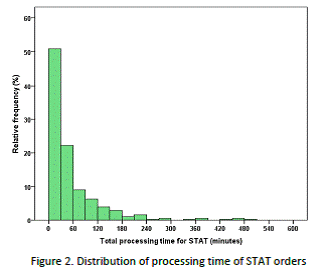
<body><![CDATA[<p><font face="Verdana" size="2">Total Time: Fifty one percent of all STAT orders were processed within 30 minutes; approximately 23% were processed in 30-60 minutes, while 26% took longer than one hour (<a href="#fig2">Figure 2</a>). Overall, the median time consumed to process all STAT orders was significantly less than 30 minutes (median 29 minutes, IQR 16-63; p&lt;0.0001) (<a href="#tab1">Table 1</a>).</font></p>     <p>&nbsp;</p>     <p align="center"><a name="fig2"><img src="/img/revistas/pharmacy/v14n2/original1_f2.gif"></a></p>     <p>&nbsp;</p>     <p align="center"><a name="tab1"><img src="/img/revistas/pharmacy/v14n2/original1_t1.gif"></a></p>     <p>&nbsp;</p>     <p><font face="Verdana" size="2">NPE vs. PE: The time needed to process NPE orders was significantly less than that needed for PE orders (median 27 vs. 34 minutes respectively; p=0.026).</font></p>     <p><font face="Verdana" size="2">NPE Orders: Median total time required to process STAT orders for medications available in the ADM was within 30 minutes &#091;Median time =25 minutes (p=0.983&#093;, (<a href="#tab2">Table 2</a>); the time spent prior to verification (pharmacy component) was significantly less than the time spent following verification (nursing component) (p&lt;0.001). For medications not available in the ADM, median total processing time was significantly greater than 30 minutes &#091;Median time=37 minutes (p=0.01&#093; (<a href="#tab2">Table 2</a>), and there was no significant difference between the time consumed before and after delivery from the pharmacy (p=0.186).</font></p>     <p>&nbsp;</p>     <p align="center"><a name="tab2"><img src="/img/revistas/pharmacy/v14n2/original1_t2.gif"></a></p>     ]]></body>
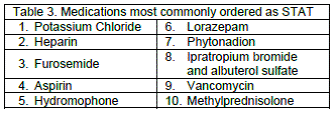
<body><![CDATA[<p>&nbsp;</p>     <p><font face="Verdana" size="2">PE Orders: Median total time required to process STAT orders for medications available in the ADM was significantly greater than 30 minutes. &#091;Median time=34 minutes (p&lt;0.001)&#093;, while that required for medications not available in the ADM (i.e., requiring pharmacy involvement) was not significantly more than 30 minutes. &#091;33 minutes (p=0.073)&#093;, and there was no significant difference between the time consumed before and after delivery from the pharmacy (p=0.135).</font></p>     <p><font face="Verdana" size="2">Additionally, the study found that common pharmacologic classes for medications ordered include cardiovascular agents, antimicrobials, antipsychotics, sedatives and analgesics, bronchodilators, corticosteroids, and laxatives. A list of the medications most commonly ordered as STAT can be found in <a href="#tab3">Table 3</a>.</font></p>     <p>&nbsp;</p>     <p align="center"><a name="tab3"><img src="/img/revistas/pharmacy/v14n2/original1_t3.gif"></a></p>     <p>&nbsp;</p>     <p><font face="Verdana" size="2"><b>Discussion</b></font></p>     <p><font face="Verdana" size="2">Evaluation of STAT processing is considered an essential process to improve the quality of medication administration.</font></p>     <p><font face="Verdana" size="2">Results of this study showed that approximately 20% of STAT orders were not documented as administered to patients. Further investigation is needed to determine the reason for lack of documentation of administration, to avoid any resultant clinical and/or financial issues.</font></p>     <p><font face="Verdana" size="2">Our study showed that the turnaround time of only 50% of STAT orders was within 30 minutes. This low percentage was explained through analysis of steps involved in both PE and NPE ordering types to help us figuring out which steps associated with the delay in processing STAT orders.</font></p>     ]]></body>
<body><![CDATA[<p><font face="Verdana" size="2">This study identifies that the availability of medications in ADM is a main factor in reducing the processing time, as can be seen in NPE in which the processing time was less significantly than 30 minutes with the availability of medications in the ADM. Most health care facilities stock STAT medications in ADMs, thereby facilitating rapid dispensing and administration to the patient.<sup>16-18</sup> Studies showed that availability of medication in ADM helps in reducing the round time cycle of STAT order processing as well as reducing error incidence.<sup>19,20</sup></font></p>     <p><font face="Verdana" size="2">Furthermore, the involvement of pharmacy is an important factor in decreasing the processing time. This fact can be seen in NPE in which the pharmacy verification step was involved and lead to decrease in the processing time to less than 30 min significantly even though more steps are involved in NPE orders. Possible reasons associated with this better outcome in NPE include nursing involvement in order entry. This may inform nurses early about the STAT order so they will be following the order. It is also noticed that pharmacy involvement in PE decreased the processing time significantly with non-availability of medication in ADM. This positive impact of pharmacy involvement may be explained by the fact that drug delivery through pneumatic tubes and clarification phone calls may alert nurses that medications are due for administration.</font></p>     <p><font face="Verdana" size="2">Management of hypokalemia was the most frequent reason for STAT orders.<sup>21</sup> Gennari found that up to 20% of hospitalized patients and up to 40% of patients on diuretics have hypokalemia.<sup>21</sup> Data indicates that 50% of patients who develop hypokalemia during hospitalization had normal potassium level at admission.<sup>22,23</sup> Early management of hypokalemia is very important to avoid cardiovascular adverse events such as cardiac arrest and death.<sup>24,25</sup></font></p>     <p><font face="Verdana" size="2">The second most frequent medication ordered as STAT in this study was heparin. Studies have shown that early anticoagulation is associated with low mortality, mainly in acute thrombosis such as pulmonary embolism.<sup>26</sup></font></p>     <p><font face="Verdana" size="2">Antimicrobials were frequently ordered as a STAT. The STAT administration of antibiotics is really required in some cases such as sepsis. Delayed administration of antibiotics for septic patients is associated with poor survival outcomes and increased length of stay, especially in area of higher urgency such as Intensive care units.<sup>27-29</sup></font></p>     <p><font face="Verdana" size="2">Nevertheless, the present study was conducted at a single hospital, and therefore the findings may not be generalizable to other hospitals. Another limitation of this study was the short period of this study. Despite these limitations, we have now an idea about some reasons associated with delay in STAT ordering process. In addition this study may give a model of analysis to be used for other hospital considering studying STAT ordering process.</font></p>     <p>&nbsp;</p>     <p><font face="Verdana" size="2"><b>Conclusions</b></font></p>     <p><font face="Verdana" size="2">We conclude that STAT order processing time may be improved by increasing the availability of medications in ADM, and maximizing pharmacy involvement in the order verification process.</font></p>     <p>&nbsp;</p>     ]]></body>
<body><![CDATA[<p><font face="Verdana" size="2"><b>Acknowledgements</b></font></p>     <p><font face="Verdana" size="2">We would like to express our very great appreciation to Robert T. Adamson, PharmD, Indu Lew, PharmD, Shilpa Amara, PharmD and Antonia Carbone, PharmD for their valuable and constructive suggestions and recommendations.</font></p>     <p>&nbsp;</p>     <p><font face="Verdana" size="2"><b>Conflict of interest</b></font></p>     <p><font face="Verdana" size="2">There are no conflicts of interest to declare.</font></p>     <p>&nbsp;</p>     <p><font face="Verdana" size="2"><b>References</b></font></p>     <!-- ref --><p><font face="Verdana" size="2">1. Shulman R, Singer M, Goldstone J, Bellingan G. Medication errors: aprospective cohort study of hand-written and computerised physician order entryin the intensive care unit. Crit Care. 2005 Oct 5;9(5):R516-R521.    &nbsp;&nbsp;&nbsp;&nbsp;&nbsp;&nbsp;&nbsp;&nbsp;[&#160;<a href="javascript:void(0);" onclick="javascript: window.open('/scielo.php?script=sci_nlinks&ref=4223892&pid=S1885-642X201600020000100001&lng=','','width=640,height=500,resizable=yes,scrollbars=1,menubar=yes,');">Links</a>&#160;]<!-- end-ref --></font></p>    <!-- ref --><p><font face="Verdana" size="2">2. Wakefield DS, Wakefield BJ. Are verbal orders a threat to patient safety? Qual Saf Health Care. 2009;18(3):165-168. doi: 10.1136/qshc.2009.034041.    &nbsp;&nbsp;&nbsp;&nbsp;&nbsp;&nbsp;&nbsp;&nbsp;[&#160;<a href="javascript:void(0);" onclick="javascript: window.open('/scielo.php?script=sci_nlinks&ref=4223894&pid=S1885-642X201600020000100002&lng=','','width=640,height=500,resizable=yes,scrollbars=1,menubar=yes,');">Links</a>&#160;]<!-- end-ref --></font></p>    <!-- ref --><p><font face="Verdana" size="2">3. Wakefield DS, Ward MM, Groath D, Schwichtenberg T, Magdits L, Brokel J, Crandall D. Complexity of medication-related verbal orders. Am J Med Qual. 2008;23(1):7-17. doi: 10.1177/1062860607310922.    &nbsp;&nbsp;&nbsp;&nbsp;&nbsp;&nbsp;&nbsp;&nbsp;[&#160;<a href="javascript:void(0);" onclick="javascript: window.open('/scielo.php?script=sci_nlinks&ref=4223896&pid=S1885-642X201600020000100003&lng=','','width=640,height=500,resizable=yes,scrollbars=1,menubar=yes,');">Links</a>&#160;]<!-- end-ref --></font></p>    <!-- ref --><p><font face="Verdana" size="2">4. Niazkhani Z, Pirnejad H, van der Sijs H, Aarts J. Evaluating the medication process in the context of CPOE use: the significance of working around the system. Int J Med Inform. 2011;80(7):490-506. doi: 10.1016/j.ijmedinf.2011.03.009.    &nbsp;&nbsp;&nbsp;&nbsp;&nbsp;&nbsp;&nbsp;&nbsp;[&#160;<a href="javascript:void(0);" onclick="javascript: window.open('/scielo.php?script=sci_nlinks&ref=4223898&pid=S1885-642X201600020000100004&lng=','','width=640,height=500,resizable=yes,scrollbars=1,menubar=yes,');">Links</a>&#160;]<!-- end-ref --></font></p>    <!-- ref --><p><font face="Verdana" size="2">5. Ross J. Clarity needed on standing orders. Nurs N Z. 1998;4(5):11.    &nbsp;&nbsp;&nbsp;&nbsp;&nbsp;&nbsp;&nbsp;&nbsp;[&#160;<a href="javascript:void(0);" onclick="javascript: window.open('/scielo.php?script=sci_nlinks&ref=4223900&pid=S1885-642X201600020000100005&lng=','','width=640,height=500,resizable=yes,scrollbars=1,menubar=yes,');">Links</a>&#160;]<!-- end-ref --></font></p>    <!-- ref --><p><font face="Verdana" size="2">6. Ayd FJ Jr. Problems with orders for medication as needed. Am J Psychiatry. 1985;142(8):939-942.    &nbsp;&nbsp;&nbsp;&nbsp;&nbsp;&nbsp;&nbsp;&nbsp;[&#160;<a href="javascript:void(0);" onclick="javascript: window.open('/scielo.php?script=sci_nlinks&ref=4223902&pid=S1885-642X201600020000100006&lng=','','width=640,height=500,resizable=yes,scrollbars=1,menubar=yes,');">Links</a>&#160;]<!-- end-ref --></font></p>    <!-- ref --><p><font face="Verdana" size="2">7. Gordon DB, Dahl J, Phillips P, Frandsen J, Cowley C, Foster RL, Fine PG, Miaskowski C, Fishman S, Finley RS; American Society for Pain Management Nursing; American Pain Society. The use of 'as-needed' range orders for opioid analgesics in the management of acute pain: a consensus statement of the American Society for Pain Management Nursing and the American Pain Society. Home Healthc Nurse. 2005;23(6):388-396.    &nbsp;&nbsp;&nbsp;&nbsp;&nbsp;&nbsp;&nbsp;&nbsp;[&#160;<a href="javascript:void(0);" onclick="javascript: window.open('/scielo.php?script=sci_nlinks&ref=4223904&pid=S1885-642X201600020000100007&lng=','','width=640,height=500,resizable=yes,scrollbars=1,menubar=yes,');">Links</a>&#160;]<!-- end-ref --></font></p>    <!-- ref --><p><font face="Verdana" size="2">8. Donihi AC, DiNardo MM, DeVita MA, Korytkowski MT. Use of a standardize protocol to decrease medication errors and adverse events related to sliding scale insulin. Qual Saf Health Care. 2006;15(2):89-91.    &nbsp;&nbsp;&nbsp;&nbsp;&nbsp;&nbsp;&nbsp;&nbsp;[&#160;<a href="javascript:void(0);" onclick="javascript: window.open('/scielo.php?script=sci_nlinks&ref=4223906&pid=S1885-642X201600020000100008&lng=','','width=640,height=500,resizable=yes,scrollbars=1,menubar=yes,');">Links</a>&#160;]<!-- end-ref --></font></p>    <!-- ref --><p><font face="Verdana" size="2">9. Fahimi F, Sahraee Z, Amini S. Evaluation of stat orders in a teaching hospital: a chart review. Clin Drug Investig. 2011;31(4):231-5. doi: 10.2165/11540000-000000000-00000.    &nbsp;&nbsp;&nbsp;&nbsp;&nbsp;&nbsp;&nbsp;&nbsp;[&#160;<a href="javascript:void(0);" onclick="javascript: window.open('/scielo.php?script=sci_nlinks&ref=4223908&pid=S1885-642X201600020000100009&lng=','','width=640,height=500,resizable=yes,scrollbars=1,menubar=yes,');">Links</a>&#160;]<!-- end-ref --></font></p>    <!-- ref --><p><font face="Verdana" size="2">10. Tiersten D. The "stat" problem. Clin Lab Med. 1983;3(3):499-507.    &nbsp;&nbsp;&nbsp;&nbsp;&nbsp;&nbsp;&nbsp;&nbsp;[&#160;<a href="javascript:void(0);" onclick="javascript: window.open('/scielo.php?script=sci_nlinks&ref=4223910&pid=S1885-642X201600020000100010&lng=','','width=640,height=500,resizable=yes,scrollbars=1,menubar=yes,');">Links</a>&#160;]<!-- end-ref --></font></p>    <!-- ref --><p><font face="Verdana" size="2">11. Kilgore ML, Steindel SJ, Smith JA. Evaluating stat testing options in an academic health center: therapeutic turnaround time and staff satisfaction. Clin Chem. 1998;44(8 Pt 1):1597-603.    &nbsp;&nbsp;&nbsp;&nbsp;&nbsp;&nbsp;&nbsp;&nbsp;[&#160;<a href="javascript:void(0);" onclick="javascript: window.open('/scielo.php?script=sci_nlinks&ref=4223912&pid=S1885-642X201600020000100011&lng=','','width=640,height=500,resizable=yes,scrollbars=1,menubar=yes,');">Links</a>&#160;]<!-- end-ref --></font></p>    <!-- ref --><p><font face="Verdana" size="2">12. Novis DA, Walsh MK, Dale JC, Howanitz PJ; College of American Pathologists Q-Tracks. Continuous monitoring of stat and routine outlier turnaround times: two College of American Pathologists Q-Tracks monitors in 291 hospitals. Arch Pathol Lab Med. 2004;128(6):621-626.    &nbsp;&nbsp;&nbsp;&nbsp;&nbsp;&nbsp;&nbsp;&nbsp;[&#160;<a href="javascript:void(0);" onclick="javascript: window.open('/scielo.php?script=sci_nlinks&ref=4223914&pid=S1885-642X201600020000100012&lng=','','width=640,height=500,resizable=yes,scrollbars=1,menubar=yes,');">Links</a>&#160;]<!-- end-ref --></font></p>    <!-- ref --><p><font face="Verdana" size="2">13. Wesp W. Using STAT properly. Radiol Manage. 2006;28(1):26-30.    &nbsp;&nbsp;&nbsp;&nbsp;&nbsp;&nbsp;&nbsp;&nbsp;[&#160;<a href="javascript:void(0);" onclick="javascript: window.open('/scielo.php?script=sci_nlinks&ref=4223916&pid=S1885-642X201600020000100013&lng=','','width=640,height=500,resizable=yes,scrollbars=1,menubar=yes,');">Links</a>&#160;]<!-- end-ref --></font></p>    <!-- ref --><p><font face="Verdana" size="2">14. Maddock JR, Hanson LB. Application of quality improvement techniques to the reduction of turnaround time for "STAT" and "ASAP" orders. Hosp Pharm. 1993;28(7):640-644.    &nbsp;&nbsp;&nbsp;&nbsp;&nbsp;&nbsp;&nbsp;&nbsp;[&#160;<a href="javascript:void(0);" onclick="javascript: window.open('/scielo.php?script=sci_nlinks&ref=4223918&pid=S1885-642X201600020000100014&lng=','','width=640,height=500,resizable=yes,scrollbars=1,menubar=yes,');">Links</a>&#160;]<!-- end-ref --></font></p>    <!-- ref --><p><font face="Verdana" size="2">15. Griswold M, Whitford M, Belemjian M, Delcoure K, Lesar T. Pharmacy "STAT" line to facilitate delivery of emergency medications: implementation and experience. Hosp Pharm. 1997;32(9):1245-1250.    &nbsp;&nbsp;&nbsp;&nbsp;&nbsp;&nbsp;&nbsp;&nbsp;[&#160;<a href="javascript:void(0);" onclick="javascript: window.open('/scielo.php?script=sci_nlinks&ref=4223920&pid=S1885-642X201600020000100015&lng=','','width=640,height=500,resizable=yes,scrollbars=1,menubar=yes,');">Links</a>&#160;]<!-- end-ref --></font></p>    <!-- ref --><p><font face="Verdana" size="2">16. Miller K, Shah M, Hitchcock L, Perry A, Englebright J, Perlin J, Burgess H. Evaluation of Medications Removed from Automated Dispensing Machines Using the Override Function Leading to Multiple System Changes. In: Henriksen K, Battles JB, Keyes MA, Grady ML, editors. Advances in Patient Safety: New Directions and Alternative Approaches (Vol. 4: Technology and Medication Safety). Rockville (MD): AHRQ; 2008.    &nbsp;&nbsp;&nbsp;&nbsp;&nbsp;&nbsp;&nbsp;&nbsp;[&#160;<a href="javascript:void(0);" onclick="javascript: window.open('/scielo.php?script=sci_nlinks&ref=4223922&pid=S1885-642X201600020000100016&lng=','','width=640,height=500,resizable=yes,scrollbars=1,menubar=yes,');">Links</a>&#160;]<!-- end-ref --></font></p>    <!-- ref --><p><font face="Verdana" size="2">17. Woehlck HJ, McQueen AM, Connolly LA. Off-hours unavailability of drugs during emergency situations with automated drug dispensing machines. Can J Anaesth. 2007;54(5):403-404.    &nbsp;&nbsp;&nbsp;&nbsp;&nbsp;&nbsp;&nbsp;&nbsp;[&#160;<a href="javascript:void(0);" onclick="javascript: window.open('/scielo.php?script=sci_nlinks&ref=4223924&pid=S1885-642X201600020000100017&lng=','','width=640,height=500,resizable=yes,scrollbars=1,menubar=yes,');">Links</a>&#160;]<!-- end-ref --></font></p>    <!-- ref --><p><font face="Verdana" size="2">18. Ishizuka H, Horiguchi M, Waki Y, Maeda M, Ishikura C. Computerized dispensing system: reducing the time of dispensing medicines. Int J Biomed Comput. 1991;28(1-2):137-146.    &nbsp;&nbsp;&nbsp;&nbsp;&nbsp;&nbsp;&nbsp;&nbsp;[&#160;<a href="javascript:void(0);" onclick="javascript: window.open('/scielo.php?script=sci_nlinks&ref=4223926&pid=S1885-642X201600020000100018&lng=','','width=640,height=500,resizable=yes,scrollbars=1,menubar=yes,');">Links</a>&#160;]<!-- end-ref --></font></p>    <!-- ref --><p><font face="Verdana" size="2">19. Hull T, Czirr L, Wilson M. Impact of medication storage cabinets on efficient delivery of medication and employee frustration. J Nurs Care Qual. 2010;25(4):352-357.    &nbsp;&nbsp;&nbsp;&nbsp;&nbsp;&nbsp;&nbsp;&nbsp;[&#160;<a href="javascript:void(0);" onclick="javascript: window.open('/scielo.php?script=sci_nlinks&ref=4223928&pid=S1885-642X201600020000100019&lng=','','width=640,height=500,resizable=yes,scrollbars=1,menubar=yes,');">Links</a>&#160;]<!-- end-ref --></font></p>    <!-- ref --><p><font face="Verdana" size="2">20. Chapuis C, Roustit M, Bal G, Schwebel C, Pansu P, David-Tchouda S, Foroni L, Calop J, Timsit JF, Allenet B, Bosson JL, Bedouch P. Automated drug dispensing system reduces medication errors in an intensive care setting. Crit Care Med. 2010;38(12):2275-2281. doi: 10.1097/CCM.0b013e3181f8569b.    &nbsp;&nbsp;&nbsp;&nbsp;&nbsp;&nbsp;&nbsp;&nbsp;[&#160;<a href="javascript:void(0);" onclick="javascript: window.open('/scielo.php?script=sci_nlinks&ref=4223930&pid=S1885-642X201600020000100020&lng=','','width=640,height=500,resizable=yes,scrollbars=1,menubar=yes,');">Links</a>&#160;]<!-- end-ref --></font></p>    <!-- ref --><p><font face="Verdana" size="2">21. Gennari FJ. Hypokalemia. N Engl J Med. 1998;339(7):451-458.    &nbsp;&nbsp;&nbsp;&nbsp;&nbsp;&nbsp;&nbsp;&nbsp;[&#160;<a href="javascript:void(0);" onclick="javascript: window.open('/scielo.php?script=sci_nlinks&ref=4223932&pid=S1885-642X201600020000100021&lng=','','width=640,height=500,resizable=yes,scrollbars=1,menubar=yes,');">Links</a>&#160;]<!-- end-ref --></font></p>    <!-- ref --><p><font face="Verdana" size="2">22. Janko O, Seier J, Zazgornik J. (Hypokalemia-incidence and severity in a general hospital). Wien Med Wochenschr. 1992;142(4):78-81.    &nbsp;&nbsp;&nbsp;&nbsp;&nbsp;&nbsp;&nbsp;&nbsp;[&#160;<a href="javascript:void(0);" onclick="javascript: window.open('/scielo.php?script=sci_nlinks&ref=4223934&pid=S1885-642X201600020000100022&lng=','','width=640,height=500,resizable=yes,scrollbars=1,menubar=yes,');">Links</a>&#160;]<!-- end-ref --></font></p>    <!-- ref --><p><font face="Verdana" size="2">23. Hwang JC, Wang CT, Chen CA, Chen HC. Hypokalemia is associated with increased mortality rate in chronic hemodialysis patients. Blood Purif. 2011;32(4):254-261. doi: 10.1159/000325226.    &nbsp;&nbsp;&nbsp;&nbsp;&nbsp;&nbsp;&nbsp;&nbsp;[&#160;<a href="javascript:void(0);" onclick="javascript: window.open('/scielo.php?script=sci_nlinks&ref=4223936&pid=S1885-642X201600020000100023&lng=','','width=640,height=500,resizable=yes,scrollbars=1,menubar=yes,');">Links</a>&#160;]<!-- end-ref --></font></p>    <!-- ref --><p><font face="Verdana" size="2">24. Siscovick DS, Raghunathan TE, Psaty BM, Koepsell TD, Wicklund KG, Lin X, Cobb L, Rautaharju PM, Copass MK, Wagner EH. Diuretic therapy for hypertension and the risk of primary cardiac arrest. N Engl J Med. 1994;330(26):1852-1857.    &nbsp;&nbsp;&nbsp;&nbsp;&nbsp;&nbsp;&nbsp;&nbsp;[&#160;<a href="javascript:void(0);" onclick="javascript: window.open('/scielo.php?script=sci_nlinks&ref=4223938&pid=S1885-642X201600020000100024&lng=','','width=640,height=500,resizable=yes,scrollbars=1,menubar=yes,');">Links</a>&#160;]<!-- end-ref --></font></p>    <!-- ref --><p><font face="Verdana" size="2">25. Cohen HW, Madhavan S, Alderman MH. High and low serum potassium associated with cardiovascular events in diuretic-treated patients. J Hypertens. 2001;19(7):1315-1323.    &nbsp;&nbsp;&nbsp;&nbsp;&nbsp;&nbsp;&nbsp;&nbsp;[&#160;<a href="javascript:void(0);" onclick="javascript: window.open('/scielo.php?script=sci_nlinks&ref=4223940&pid=S1885-642X201600020000100025&lng=','','width=640,height=500,resizable=yes,scrollbars=1,menubar=yes,');">Links</a>&#160;]<!-- end-ref --></font></p>    <!-- ref --><p><font face="Verdana" size="2">26. Smith SB, Geske JB, Maguire JM, Zane NA, Carter RE, Morgenthaler TI. Early anticoagulation is associated with reduced mortality for acute pulmonary embolism. Chest. 2010;137(6):1382-1390. doi: 10.1378/chest.09-0959.    &nbsp;&nbsp;&nbsp;&nbsp;&nbsp;&nbsp;&nbsp;&nbsp;[&#160;<a href="javascript:void(0);" onclick="javascript: window.open('/scielo.php?script=sci_nlinks&ref=4223942&pid=S1885-642X201600020000100026&lng=','','width=640,height=500,resizable=yes,scrollbars=1,menubar=yes,');">Links</a>&#160;]<!-- end-ref --></font></p>    <!-- ref --><p><font face="Verdana" size="2">27. Dickinson JD, Kollef MH. Early and adequate antibiotic therapy in the treatment of severe sepsis and septic shock. Curr Infect Dis Rep. 2011;13(5):399-405. doi: 10.1007/s11908-011-0206-8.    &nbsp;&nbsp;&nbsp;&nbsp;&nbsp;&nbsp;&nbsp;&nbsp;[&#160;<a href="javascript:void(0);" onclick="javascript: window.open('/scielo.php?script=sci_nlinks&ref=4223944&pid=S1885-642X201600020000100027&lng=','','width=640,height=500,resizable=yes,scrollbars=1,menubar=yes,');">Links</a>&#160;]<!-- end-ref --></font></p>    <!-- ref --><p><font face="Verdana" size="2">28. Men&eacute;ndez R, Torres A, Reyes S, Zalacain R, Capelastegui A, Aspa J, Border&iacute;as L, Mart&iacute;n-Villasclaras JJ, Bello S, Alfageme I, de Castro FR, Rello J, Molinos L, Ruiz-Manzano J. Initial management of pneumonia and sepsis: factors associated with improved outcome. Eur Respir J. 2012;39(1):156-162. doi: 10.1183/09031936.00188710.    &nbsp;&nbsp;&nbsp;&nbsp;&nbsp;&nbsp;&nbsp;&nbsp;[&#160;<a href="javascript:void(0);" onclick="javascript: window.open('/scielo.php?script=sci_nlinks&ref=4223946&pid=S1885-642X201600020000100028&lng=','','width=640,height=500,resizable=yes,scrollbars=1,menubar=yes,');">Links</a>&#160;]<!-- end-ref --></font></p>    <!-- ref --><p><font face="Verdana" size="2">29. Siddiqui S, Salahuddin N, Raza A, Razzak J. How early do antibiotics have to be to impact mortality in severe sepsis? A prospective, observational study from an emergency department. J Ayub Med Coll Abbottabad. 2009;21(4):106-110.    &nbsp;&nbsp;&nbsp;&nbsp;&nbsp;&nbsp;&nbsp;&nbsp;[&#160;<a href="javascript:void(0);" onclick="javascript: window.open('/scielo.php?script=sci_nlinks&ref=4223948&pid=S1885-642X201600020000100029&lng=','','width=640,height=500,resizable=yes,scrollbars=1,menubar=yes,');">Links</a>&#160;]<!-- end-ref --></font></p>     <p>&nbsp;</p>     <p>&nbsp;</p>     <p><font face="Verdana" size="2">Received (first version): 25.07.15    <br>Accepted: 12.05.16</font></p>      ]]></body><back>
<ref-list>
<ref id="B1">
<label>1</label><nlm-citation citation-type="journal">
<person-group person-group-type="author">
<name>
<surname><![CDATA[Shulman]]></surname>
<given-names><![CDATA[R]]></given-names>
</name>
<name>
<surname><![CDATA[Singer]]></surname>
<given-names><![CDATA[M]]></given-names>
</name>
<name>
<surname><![CDATA[Goldstone]]></surname>
<given-names><![CDATA[J]]></given-names>
</name>
<name>
<surname><![CDATA[Bellingan]]></surname>
<given-names><![CDATA[G.]]></given-names>
</name>
</person-group>
<article-title xml:lang="en"><![CDATA[Medication errors: aprospective cohort study of hand-written and computerised physician order entryin the intensive care unit]]></article-title>
<source><![CDATA[Crit Care.]]></source>
<year>2005</year>
<month> O</month>
<day>ct</day>
<volume>9</volume>
<numero>5</numero>
<issue>5</issue>
<page-range>R516-R521</page-range></nlm-citation>
</ref>
<ref id="B2">
<label>2</label><nlm-citation citation-type="journal">
<person-group person-group-type="author">
<name>
<surname><![CDATA[Wakefield]]></surname>
<given-names><![CDATA[DS]]></given-names>
</name>
<name>
<surname><![CDATA[Wakefield]]></surname>
<given-names><![CDATA[BJ.]]></given-names>
</name>
</person-group>
<article-title xml:lang="en"><![CDATA[Are verbal orders a threat to patient safety?]]></article-title>
<source><![CDATA[Qual Saf Health Care.]]></source>
<year>2009</year>
<volume>18</volume>
<numero>3</numero>
<issue>3</issue>
<page-range>165-168</page-range></nlm-citation>
</ref>
<ref id="B3">
<label>3</label><nlm-citation citation-type="journal">
<person-group person-group-type="author">
<name>
<surname><![CDATA[Wakefield]]></surname>
<given-names><![CDATA[DS]]></given-names>
</name>
<name>
<surname><![CDATA[Ward]]></surname>
<given-names><![CDATA[MM]]></given-names>
</name>
<name>
<surname><![CDATA[Groath]]></surname>
<given-names><![CDATA[D]]></given-names>
</name>
<name>
<surname><![CDATA[Schwichtenberg]]></surname>
<given-names><![CDATA[T]]></given-names>
</name>
<name>
<surname><![CDATA[Magdits]]></surname>
<given-names><![CDATA[L]]></given-names>
</name>
<name>
<surname><![CDATA[Brokel]]></surname>
<given-names><![CDATA[J]]></given-names>
</name>
<name>
<surname><![CDATA[Crandall]]></surname>
<given-names><![CDATA[D.]]></given-names>
</name>
</person-group>
<article-title xml:lang="en"><![CDATA[Complexity of medication-related verbal orders]]></article-title>
<source><![CDATA[Am J Med Qual.]]></source>
<year>2008</year>
<volume>23</volume>
<numero>1</numero>
<issue>1</issue>
<page-range>7-17</page-range></nlm-citation>
</ref>
<ref id="B4">
<label>4</label><nlm-citation citation-type="journal">
<person-group person-group-type="author">
<name>
<surname><![CDATA[Niazkhani]]></surname>
<given-names><![CDATA[Z]]></given-names>
</name>
<name>
<surname><![CDATA[Pirnejad]]></surname>
<given-names><![CDATA[H]]></given-names>
</name>
<name>
<surname><![CDATA[van der Sijs]]></surname>
<given-names><![CDATA[H]]></given-names>
</name>
<name>
<surname><![CDATA[Aarts]]></surname>
<given-names><![CDATA[J.]]></given-names>
</name>
</person-group>
<article-title xml:lang="en"><![CDATA[Evaluating the medication process in the context of CPOE use: the significance of working around the system]]></article-title>
<source><![CDATA[Int J Med Inform.]]></source>
<year>2011</year>
<volume>80</volume>
<numero>7</numero>
<issue>7</issue>
<page-range>490-506</page-range></nlm-citation>
</ref>
<ref id="B5">
<label>5</label><nlm-citation citation-type="journal">
<person-group person-group-type="author">
<name>
<surname><![CDATA[Ross]]></surname>
<given-names><![CDATA[J.]]></given-names>
</name>
</person-group>
<article-title xml:lang="en"><![CDATA[Clarity needed on standing orders]]></article-title>
<source><![CDATA[Nurs N Z.]]></source>
<year>1998</year>
<volume>4</volume>
<numero>5</numero>
<issue>5</issue>
<page-range>11</page-range></nlm-citation>
</ref>
<ref id="B6">
<label>6</label><nlm-citation citation-type="journal">
<person-group person-group-type="author">
<name>
<surname><![CDATA[Ayd]]></surname>
<given-names><![CDATA[FJ Jr.]]></given-names>
</name>
</person-group>
<article-title xml:lang="en"><![CDATA[Problems with orders for medication as needed]]></article-title>
<source><![CDATA[Am J Psychiatry]]></source>
<year>1985</year>
<volume>142</volume>
<numero>8</numero>
<issue>8</issue>
<page-range>939-942</page-range></nlm-citation>
</ref>
<ref id="B7">
<label>7</label><nlm-citation citation-type="journal">
<person-group person-group-type="author">
<name>
<surname><![CDATA[Gordon]]></surname>
<given-names><![CDATA[DB]]></given-names>
</name>
<name>
<surname><![CDATA[Dahl]]></surname>
<given-names><![CDATA[J]]></given-names>
</name>
<name>
<surname><![CDATA[Phillips]]></surname>
<given-names><![CDATA[P]]></given-names>
</name>
<name>
<surname><![CDATA[Frandsen]]></surname>
<given-names><![CDATA[J]]></given-names>
</name>
<name>
<surname><![CDATA[Cowley]]></surname>
<given-names><![CDATA[C]]></given-names>
</name>
<name>
<surname><![CDATA[Foster]]></surname>
<given-names><![CDATA[RL]]></given-names>
</name>
<name>
<surname><![CDATA[Fine]]></surname>
<given-names><![CDATA[PG]]></given-names>
</name>
<name>
<surname><![CDATA[Miaskowski]]></surname>
<given-names><![CDATA[C]]></given-names>
</name>
<name>
<surname><![CDATA[Fishman]]></surname>
<given-names><![CDATA[S]]></given-names>
</name>
<name>
<surname><![CDATA[Finley]]></surname>
<given-names><![CDATA[RS]]></given-names>
</name>
</person-group>
<collab>American Society for Pain Management Nursing</collab>
<collab>American Pain Society</collab>
<article-title xml:lang="en"><![CDATA[The use of 'as-needed' range orders for opioid analgesics in the management of acute pain: a consensus statement of the American Society for Pain Management Nursing and the American Pain Society]]></article-title>
<source><![CDATA[Home Healthc Nurse]]></source>
<year>2005</year>
<volume>23</volume>
<numero>6</numero>
<issue>6</issue>
<page-range>388-396</page-range></nlm-citation>
</ref>
<ref id="B8">
<label>8</label><nlm-citation citation-type="journal">
<person-group person-group-type="author">
<name>
<surname><![CDATA[Donihi]]></surname>
<given-names><![CDATA[AC]]></given-names>
</name>
<name>
<surname><![CDATA[DiNardo]]></surname>
<given-names><![CDATA[MM]]></given-names>
</name>
<name>
<surname><![CDATA[DeVita]]></surname>
<given-names><![CDATA[MA]]></given-names>
</name>
<name>
<surname><![CDATA[Korytkowski]]></surname>
<given-names><![CDATA[MT.]]></given-names>
</name>
</person-group>
<article-title xml:lang="en"><![CDATA[Use of a standardize protocol to decrease medication errors and adverse events related to sliding scale insulin]]></article-title>
<source><![CDATA[Qual Saf Health Care.]]></source>
<year>2006</year>
<volume>15</volume>
<numero>2</numero>
<issue>2</issue>
<page-range>89-91</page-range></nlm-citation>
</ref>
<ref id="B9">
<label>9</label><nlm-citation citation-type="journal">
<person-group person-group-type="author">
<name>
<surname><![CDATA[Fahimi]]></surname>
<given-names><![CDATA[F]]></given-names>
</name>
<name>
<surname><![CDATA[Sahraee]]></surname>
<given-names><![CDATA[Z]]></given-names>
</name>
<name>
<surname><![CDATA[Amini]]></surname>
<given-names><![CDATA[S.]]></given-names>
</name>
</person-group>
<article-title xml:lang="en"><![CDATA[Evaluation of stat orders in a teaching hospital: a chart review]]></article-title>
<source><![CDATA[Clin Drug Investig.]]></source>
<year>2011</year>
<volume>31</volume>
<numero>4</numero>
<issue>4</issue>
<page-range>231-5</page-range></nlm-citation>
</ref>
<ref id="B10">
<label>10</label><nlm-citation citation-type="journal">
<person-group person-group-type="author">
<name>
<surname><![CDATA[Tiersten]]></surname>
<given-names><![CDATA[D.]]></given-names>
</name>
</person-group>
<article-title xml:lang="en"><![CDATA[The "stat" problem]]></article-title>
<source><![CDATA[Clin Lab Med.]]></source>
<year>1983</year>
<volume>3</volume>
<numero>3</numero>
<issue>3</issue>
<page-range>499-507</page-range></nlm-citation>
</ref>
<ref id="B11">
<label>11</label><nlm-citation citation-type="journal">
<person-group person-group-type="author">
<name>
<surname><![CDATA[Kilgore]]></surname>
<given-names><![CDATA[ML]]></given-names>
</name>
<name>
<surname><![CDATA[Steindel]]></surname>
<given-names><![CDATA[SJ]]></given-names>
</name>
<name>
<surname><![CDATA[Smith]]></surname>
<given-names><![CDATA[JA.]]></given-names>
</name>
</person-group>
<article-title xml:lang="en"><![CDATA[Evaluating stat testing options in an academic health center: therapeutic turnaround time and staff satisfaction]]></article-title>
<source><![CDATA[Clin Chem.]]></source>
<year>1998</year>
<volume>44</volume>
<numero>8</numero>
<issue>8</issue>
<page-range>1597-603</page-range></nlm-citation>
</ref>
<ref id="B12">
<label>12</label><nlm-citation citation-type="journal">
<person-group person-group-type="author">
<name>
<surname><![CDATA[Novis]]></surname>
<given-names><![CDATA[DA]]></given-names>
</name>
<name>
<surname><![CDATA[Walsh]]></surname>
<given-names><![CDATA[MK]]></given-names>
</name>
<name>
<surname><![CDATA[Dale]]></surname>
<given-names><![CDATA[JC]]></given-names>
</name>
<name>
<surname><![CDATA[Howanitz]]></surname>
<given-names><![CDATA[PJ]]></given-names>
</name>
</person-group>
<collab>College of American Pathologists Q-Tracks</collab>
<article-title xml:lang="en"><![CDATA[Continuous monitoring of stat and routine outlier turnaround times: two College of American Pathologists Q-Tracks monitors in 291 hospitals]]></article-title>
<source><![CDATA[Arch Pathol Lab Med.]]></source>
<year>2004</year>
<volume>128</volume>
<numero>6</numero>
<issue>6</issue>
<page-range>621-626</page-range></nlm-citation>
</ref>
<ref id="B13">
<label>13</label><nlm-citation citation-type="journal">
<person-group person-group-type="author">
<name>
<surname><![CDATA[Wesp]]></surname>
<given-names><![CDATA[W.]]></given-names>
</name>
</person-group>
<article-title xml:lang="en"><![CDATA[Using STAT properly]]></article-title>
<source><![CDATA[Radiol Manage.]]></source>
<year>2006</year>
<volume>28</volume>
<numero>1</numero>
<issue>1</issue>
<page-range>26-30</page-range></nlm-citation>
</ref>
<ref id="B14">
<label>14</label><nlm-citation citation-type="journal">
<person-group person-group-type="author">
<name>
<surname><![CDATA[Maddock]]></surname>
<given-names><![CDATA[JR]]></given-names>
</name>
<name>
<surname><![CDATA[Hanson]]></surname>
<given-names><![CDATA[LB.]]></given-names>
</name>
</person-group>
<article-title xml:lang="en"><![CDATA[Application of quality improvement techniques to the reduction of turnaround time for "STAT" and "ASAP" orders]]></article-title>
<source><![CDATA[Hosp Pharm.]]></source>
<year>1993</year>
<volume>28</volume>
<numero>7</numero>
<issue>7</issue>
<page-range>640-644</page-range></nlm-citation>
</ref>
<ref id="B15">
<label>15</label><nlm-citation citation-type="journal">
<person-group person-group-type="author">
<name>
<surname><![CDATA[Griswold]]></surname>
<given-names><![CDATA[M]]></given-names>
</name>
<name>
<surname><![CDATA[Whitford]]></surname>
<given-names><![CDATA[M]]></given-names>
</name>
<name>
<surname><![CDATA[Belemjian]]></surname>
<given-names><![CDATA[M]]></given-names>
</name>
<name>
<surname><![CDATA[Delcoure]]></surname>
<given-names><![CDATA[K]]></given-names>
</name>
<name>
<surname><![CDATA[Lesar]]></surname>
<given-names><![CDATA[T.]]></given-names>
</name>
</person-group>
<article-title xml:lang="en"><![CDATA[Pharmacy "STAT" line to facilitate delivery of emergency medications: implementation and experience]]></article-title>
<source><![CDATA[Hosp Pharm.]]></source>
<year>1997</year>
<volume>32</volume>
<numero>9</numero>
<issue>9</issue>
<page-range>1245-1250</page-range></nlm-citation>
</ref>
<ref id="B16">
<label>16</label><nlm-citation citation-type="book">
<person-group person-group-type="author">
<name>
<surname><![CDATA[Miller]]></surname>
<given-names><![CDATA[K]]></given-names>
</name>
<name>
<surname><![CDATA[Shah]]></surname>
<given-names><![CDATA[M]]></given-names>
</name>
<name>
<surname><![CDATA[Hitchcock]]></surname>
<given-names><![CDATA[L]]></given-names>
</name>
<name>
<surname><![CDATA[Perry]]></surname>
<given-names><![CDATA[A]]></given-names>
</name>
<name>
<surname><![CDATA[Englebright]]></surname>
<given-names><![CDATA[J]]></given-names>
</name>
<name>
<surname><![CDATA[Perlin]]></surname>
<given-names><![CDATA[J]]></given-names>
</name>
<name>
<surname><![CDATA[Burgess]]></surname>
<given-names><![CDATA[H.]]></given-names>
</name>
</person-group>
<article-title xml:lang="en"><![CDATA[Evaluation of Medications Removed from Automated Dispensing Machines Using the Override Function Leading to Multiple System Changes]]></article-title>
<person-group person-group-type="editor">
<name>
<surname><![CDATA[Henriksen]]></surname>
<given-names><![CDATA[K]]></given-names>
</name>
<name>
<surname><![CDATA[Battles]]></surname>
<given-names><![CDATA[JB]]></given-names>
</name>
<name>
<surname><![CDATA[Keyes]]></surname>
<given-names><![CDATA[MA]]></given-names>
</name>
<name>
<surname><![CDATA[Grady]]></surname>
<given-names><![CDATA[ML]]></given-names>
</name>
</person-group>
<source><![CDATA[Advances in Patient Safety: New Directions and Alternative Approaches]]></source>
<year>2008</year>
<volume>4</volume>
<publisher-loc><![CDATA[Rockville^eMD MD]]></publisher-loc>
<publisher-name><![CDATA[AHRQ]]></publisher-name>
</nlm-citation>
</ref>
<ref id="B17">
<label>17</label><nlm-citation citation-type="journal">
<person-group person-group-type="author">
<name>
<surname><![CDATA[Woehlck]]></surname>
<given-names><![CDATA[HJ]]></given-names>
</name>
<name>
<surname><![CDATA[McQueen]]></surname>
<given-names><![CDATA[AM]]></given-names>
</name>
<name>
<surname><![CDATA[Connolly]]></surname>
<given-names><![CDATA[LA.]]></given-names>
</name>
</person-group>
<article-title xml:lang="en"><![CDATA[Off-hours unavailability of drugs during emergency situations with automated drug dispensing machines]]></article-title>
<source><![CDATA[Can J Anaesth.]]></source>
<year>2007</year>
<volume>54</volume>
<numero>5</numero>
<issue>5</issue>
<page-range>403-404</page-range></nlm-citation>
</ref>
<ref id="B18">
<label>18</label><nlm-citation citation-type="journal">
<person-group person-group-type="author">
<name>
<surname><![CDATA[Ishizuka]]></surname>
<given-names><![CDATA[H]]></given-names>
</name>
<name>
<surname><![CDATA[Horiguchi]]></surname>
<given-names><![CDATA[M]]></given-names>
</name>
<name>
<surname><![CDATA[Waki]]></surname>
<given-names><![CDATA[Y]]></given-names>
</name>
<name>
<surname><![CDATA[Maeda]]></surname>
<given-names><![CDATA[M]]></given-names>
</name>
<name>
<surname><![CDATA[Ishikura]]></surname>
<given-names><![CDATA[C.]]></given-names>
</name>
</person-group>
<article-title xml:lang="en"><![CDATA[Computerized dispensing system: reducing the time of dispensing medicines]]></article-title>
<source><![CDATA[Int J Biomed Comput.]]></source>
<year>1991</year>
<volume>28</volume>
<numero>1-2</numero>
<issue>1-2</issue>
<page-range>137-146</page-range></nlm-citation>
</ref>
<ref id="B19">
<label>19</label><nlm-citation citation-type="journal">
<person-group person-group-type="author">
<name>
<surname><![CDATA[Hull]]></surname>
<given-names><![CDATA[T]]></given-names>
</name>
<name>
<surname><![CDATA[Czirr]]></surname>
<given-names><![CDATA[L]]></given-names>
</name>
<name>
<surname><![CDATA[Wilson]]></surname>
<given-names><![CDATA[M.]]></given-names>
</name>
</person-group>
<article-title xml:lang="en"><![CDATA[Impact of medication storage cabinets on efficient delivery of medication and employee frustration]]></article-title>
<source><![CDATA[J Nurs Care Qual.]]></source>
<year>2010</year>
<volume>25</volume>
<numero>4</numero>
<issue>4</issue>
<page-range>352-357</page-range></nlm-citation>
</ref>
<ref id="B20">
<label>20</label><nlm-citation citation-type="journal">
<person-group person-group-type="author">
<name>
<surname><![CDATA[Chapuis]]></surname>
<given-names><![CDATA[C]]></given-names>
</name>
<name>
<surname><![CDATA[Roustit]]></surname>
<given-names><![CDATA[M]]></given-names>
</name>
<name>
<surname><![CDATA[Bal]]></surname>
<given-names><![CDATA[G]]></given-names>
</name>
<name>
<surname><![CDATA[Schwebel]]></surname>
<given-names><![CDATA[C]]></given-names>
</name>
<name>
<surname><![CDATA[Pansu]]></surname>
<given-names><![CDATA[P]]></given-names>
</name>
<name>
<surname><![CDATA[David-Tchouda]]></surname>
<given-names><![CDATA[S]]></given-names>
</name>
<name>
<surname><![CDATA[Foroni]]></surname>
<given-names><![CDATA[L]]></given-names>
</name>
<name>
<surname><![CDATA[Calop]]></surname>
<given-names><![CDATA[J]]></given-names>
</name>
<name>
<surname><![CDATA[Timsit]]></surname>
<given-names><![CDATA[JF]]></given-names>
</name>
<name>
<surname><![CDATA[Allenet]]></surname>
<given-names><![CDATA[B]]></given-names>
</name>
<name>
<surname><![CDATA[Bosson]]></surname>
<given-names><![CDATA[JL]]></given-names>
</name>
<name>
<surname><![CDATA[Bedouch]]></surname>
<given-names><![CDATA[P.]]></given-names>
</name>
</person-group>
<article-title xml:lang="en"><![CDATA[Automated drug dispensing system reduces medication errors in an intensive care setting]]></article-title>
<source><![CDATA[Crit Care Med.]]></source>
<year>2010</year>
<volume>38</volume>
<numero>12</numero>
<issue>12</issue>
<page-range>2275-2281</page-range></nlm-citation>
</ref>
<ref id="B21">
<label>21</label><nlm-citation citation-type="journal">
<person-group person-group-type="author">
<name>
<surname><![CDATA[Gennari]]></surname>
<given-names><![CDATA[FJ.]]></given-names>
</name>
</person-group>
<article-title xml:lang="en"><![CDATA[Hypokalemia]]></article-title>
<source><![CDATA[N Engl J Med.]]></source>
<year>1998</year>
<volume>339</volume>
<numero>7</numero>
<issue>7</issue>
<page-range>451-458</page-range></nlm-citation>
</ref>
<ref id="B22">
<label>22</label><nlm-citation citation-type="journal">
<person-group person-group-type="author">
<name>
<surname><![CDATA[Janko]]></surname>
<given-names><![CDATA[O]]></given-names>
</name>
<name>
<surname><![CDATA[Seier]]></surname>
<given-names><![CDATA[J]]></given-names>
</name>
<name>
<surname><![CDATA[Zazgornik]]></surname>
<given-names><![CDATA[J.]]></given-names>
</name>
</person-group>
<article-title xml:lang="en"><![CDATA[Hypokalemia-incidence and severity in a general hospital]]></article-title>
<source><![CDATA[Wien Med Wochenschr.]]></source>
<year>1992</year>
<volume>142</volume>
<numero>4</numero>
<issue>4</issue>
<page-range>78-81</page-range></nlm-citation>
</ref>
<ref id="B23">
<label>23</label><nlm-citation citation-type="journal">
<person-group person-group-type="author">
<name>
<surname><![CDATA[Hwang]]></surname>
<given-names><![CDATA[JC]]></given-names>
</name>
<name>
<surname><![CDATA[Wang]]></surname>
<given-names><![CDATA[CT]]></given-names>
</name>
<name>
<surname><![CDATA[Chen]]></surname>
<given-names><![CDATA[CA]]></given-names>
</name>
<name>
<surname><![CDATA[Chen]]></surname>
<given-names><![CDATA[HC.]]></given-names>
</name>
</person-group>
<article-title xml:lang="en"><![CDATA[Hypokalemia is associated with increased mortality rate in chronic hemodialysis patients]]></article-title>
<source><![CDATA[Blood Purif.]]></source>
<year>2011</year>
<volume>32</volume>
<numero>4</numero>
<issue>4</issue>
<page-range>254-261</page-range></nlm-citation>
</ref>
<ref id="B24">
<label>24</label><nlm-citation citation-type="journal">
<person-group person-group-type="author">
<name>
<surname><![CDATA[Siscovick]]></surname>
<given-names><![CDATA[DS]]></given-names>
</name>
<name>
<surname><![CDATA[Raghunathan]]></surname>
<given-names><![CDATA[TE]]></given-names>
</name>
<name>
<surname><![CDATA[Psaty]]></surname>
<given-names><![CDATA[BM]]></given-names>
</name>
<name>
<surname><![CDATA[Koepsell]]></surname>
<given-names><![CDATA[TD]]></given-names>
</name>
<name>
<surname><![CDATA[Wicklund]]></surname>
<given-names><![CDATA[KG]]></given-names>
</name>
<name>
<surname><![CDATA[Lin]]></surname>
<given-names><![CDATA[X]]></given-names>
</name>
<name>
<surname><![CDATA[Cobb]]></surname>
<given-names><![CDATA[L]]></given-names>
</name>
<name>
<surname><![CDATA[Rautaharju]]></surname>
<given-names><![CDATA[PM]]></given-names>
</name>
<name>
<surname><![CDATA[Copass]]></surname>
<given-names><![CDATA[MK]]></given-names>
</name>
<name>
<surname><![CDATA[Wagner]]></surname>
<given-names><![CDATA[EH.]]></given-names>
</name>
</person-group>
<article-title xml:lang="en"><![CDATA[Diuretic therapy for hypertension and the risk of primary cardiac arrest]]></article-title>
<source><![CDATA[N Engl J Med.]]></source>
<year>1994</year>
<volume>330</volume>
<numero>26</numero>
<issue>26</issue>
<page-range>1852-1857</page-range></nlm-citation>
</ref>
<ref id="B25">
<label>25</label><nlm-citation citation-type="journal">
<person-group person-group-type="author">
<name>
<surname><![CDATA[Cohen]]></surname>
<given-names><![CDATA[HW]]></given-names>
</name>
<name>
<surname><![CDATA[Madhavan]]></surname>
<given-names><![CDATA[S]]></given-names>
</name>
<name>
<surname><![CDATA[Alderman]]></surname>
<given-names><![CDATA[MH.]]></given-names>
</name>
</person-group>
<article-title xml:lang="en"><![CDATA[High and low serum potassium associated with cardiovascular events in diuretic-treated patients]]></article-title>
<source><![CDATA[J Hypertens.]]></source>
<year>2001</year>
<volume>19</volume>
<numero>7</numero>
<issue>7</issue>
<page-range>1315-1323</page-range></nlm-citation>
</ref>
<ref id="B26">
<label>26</label><nlm-citation citation-type="journal">
<person-group person-group-type="author">
<name>
<surname><![CDATA[Smith]]></surname>
<given-names><![CDATA[SB]]></given-names>
</name>
<name>
<surname><![CDATA[Geske]]></surname>
<given-names><![CDATA[JB]]></given-names>
</name>
<name>
<surname><![CDATA[Maguire]]></surname>
<given-names><![CDATA[JM]]></given-names>
</name>
<name>
<surname><![CDATA[Zane]]></surname>
<given-names><![CDATA[NA]]></given-names>
</name>
<name>
<surname><![CDATA[Carter]]></surname>
<given-names><![CDATA[RE]]></given-names>
</name>
<name>
<surname><![CDATA[Morgenthaler]]></surname>
<given-names><![CDATA[TI.]]></given-names>
</name>
</person-group>
<article-title xml:lang="en"><![CDATA[Early anticoagulation is associated with reduced mortality for acute pulmonary embolism]]></article-title>
<source><![CDATA[Chest]]></source>
<year>2010</year>
<volume>137</volume>
<numero>6</numero>
<issue>6</issue>
<page-range>1382-1390</page-range></nlm-citation>
</ref>
<ref id="B27">
<label>27</label><nlm-citation citation-type="journal">
<person-group person-group-type="author">
<name>
<surname><![CDATA[Dickinson]]></surname>
<given-names><![CDATA[JD]]></given-names>
</name>
<name>
<surname><![CDATA[Kollef]]></surname>
<given-names><![CDATA[MH.]]></given-names>
</name>
</person-group>
<article-title xml:lang="en"><![CDATA[Early and adequate antibiotic therapy in the treatment of severe sepsis and septic shock]]></article-title>
<source><![CDATA[Curr Infect Dis Rep.]]></source>
<year>2011</year>
<volume>13</volume>
<numero>5</numero>
<issue>5</issue>
<page-range>399-405</page-range></nlm-citation>
</ref>
<ref id="B28">
<label>28</label><nlm-citation citation-type="journal">
<person-group person-group-type="author">
<name>
<surname><![CDATA[Menéndez]]></surname>
<given-names><![CDATA[R]]></given-names>
</name>
<name>
<surname><![CDATA[Torres]]></surname>
<given-names><![CDATA[A]]></given-names>
</name>
<name>
<surname><![CDATA[Reyes]]></surname>
<given-names><![CDATA[S]]></given-names>
</name>
<name>
<surname><![CDATA[Zalacain]]></surname>
<given-names><![CDATA[R]]></given-names>
</name>
<name>
<surname><![CDATA[Capelastegui]]></surname>
<given-names><![CDATA[A]]></given-names>
</name>
<name>
<surname><![CDATA[Aspa]]></surname>
<given-names><![CDATA[J]]></given-names>
</name>
<name>
<surname><![CDATA[Borderías]]></surname>
<given-names><![CDATA[L]]></given-names>
</name>
<name>
<surname><![CDATA[Martín-Villasclaras]]></surname>
<given-names><![CDATA[JJ]]></given-names>
</name>
<name>
<surname><![CDATA[Bello]]></surname>
<given-names><![CDATA[S]]></given-names>
</name>
<name>
<surname><![CDATA[Alfageme]]></surname>
<given-names><![CDATA[I]]></given-names>
</name>
<name>
<surname><![CDATA[de Castro]]></surname>
<given-names><![CDATA[FR]]></given-names>
</name>
<name>
<surname><![CDATA[Rello]]></surname>
<given-names><![CDATA[J]]></given-names>
</name>
<name>
<surname><![CDATA[Molinos]]></surname>
<given-names><![CDATA[L]]></given-names>
</name>
<name>
<surname><![CDATA[Ruiz-Manzano]]></surname>
<given-names><![CDATA[J.]]></given-names>
</name>
</person-group>
<article-title xml:lang="en"><![CDATA[Initial management of pneumonia and sepsis: factors associated with improved outcome]]></article-title>
<source><![CDATA[Eur Respir J.]]></source>
<year>2012</year>
<volume>39</volume>
<numero>1</numero>
<issue>1</issue>
<page-range>156-162</page-range></nlm-citation>
</ref>
<ref id="B29">
<label>29</label><nlm-citation citation-type="journal">
<person-group person-group-type="author">
<name>
<surname><![CDATA[Siddiqui]]></surname>
<given-names><![CDATA[S]]></given-names>
</name>
<name>
<surname><![CDATA[Salahuddin]]></surname>
<given-names><![CDATA[N]]></given-names>
</name>
<name>
<surname><![CDATA[Raza]]></surname>
<given-names><![CDATA[A]]></given-names>
</name>
<name>
<surname><![CDATA[Razzak]]></surname>
<given-names><![CDATA[J.]]></given-names>
</name>
</person-group>
<article-title xml:lang="en"><![CDATA[How early do antibiotics have to be to impact mortality in severe sepsis?: A prospective, observational study from an emergency department]]></article-title>
<source><![CDATA[J Ayub Med Coll Abbottabad.]]></source>
<year>2009</year>
<volume>21</volume>
<numero>4</numero>
<issue>4</issue>
<page-range>106-110</page-range></nlm-citation>
</ref>
</ref-list>
</back>
</article>