<?xml version="1.0" encoding="ISO-8859-1"?><article xmlns:mml="http://www.w3.org/1998/Math/MathML" xmlns:xlink="http://www.w3.org/1999/xlink" xmlns:xsi="http://www.w3.org/2001/XMLSchema-instance">
<front>
<journal-meta>
<journal-id>1888-7546</journal-id>
<journal-title><![CDATA[Revista Andaluza de Medicina del Deporte]]></journal-title>
<abbrev-journal-title><![CDATA[Rev Andal Med Deporte]]></abbrev-journal-title>
<issn>1888-7546</issn>
<publisher>
<publisher-name><![CDATA[Centro Andaluz de Medicina del Deporte]]></publisher-name>
</publisher>
</journal-meta>
<article-meta>
<article-id>S1888-75462016000100003</article-id>
<article-id pub-id-type="doi">10.1016/j.ramd.2015.12.001</article-id>
<title-group>
<article-title xml:lang="en"><![CDATA[Workload and cortisol levels in helicopter combat pilots during simulated flights]]></article-title>
<article-title xml:lang="es"><![CDATA[Carga mental y niveles de cortisol en pilotos de helicóptero de combate en vuelos simulados]]></article-title>
<article-title xml:lang="pt"><![CDATA[Carga de trabalho e níveis de cortisol em pilotos de helicópteros de combate durante voos simulados]]></article-title>
</title-group>
<contrib-group>
<contrib contrib-type="author">
<name>
<surname><![CDATA[García-Mas]]></surname>
<given-names><![CDATA[A.]]></given-names>
</name>
<xref ref-type="aff" rid="A01"/>
</contrib>
<contrib contrib-type="author">
<name>
<surname><![CDATA[Ortega]]></surname>
<given-names><![CDATA[E.]]></given-names>
</name>
<xref ref-type="aff" rid="A02"/>
</contrib>
<contrib contrib-type="author">
<name>
<surname><![CDATA[Ponseti]]></surname>
<given-names><![CDATA[J.]]></given-names>
</name>
<xref ref-type="aff" rid="A03"/>
</contrib>
<contrib contrib-type="author">
<name>
<surname><![CDATA[Teresa]]></surname>
<given-names><![CDATA[C. de]]></given-names>
</name>
<xref ref-type="aff" rid="A04"/>
</contrib>
<contrib contrib-type="author">
<name>
<surname><![CDATA[Cárdenas]]></surname>
<given-names><![CDATA[D.]]></given-names>
</name>
<xref ref-type="aff" rid="A05"/>
</contrib>
</contrib-group>
<aff id="A01">
<institution><![CDATA[,Universitat de les Illes Balears (UIB) Psychology Faculty ]]></institution>
<addr-line><![CDATA[Palma de Mallorca ]]></addr-line>
<country>Spain</country>
</aff>
<aff id="A02">
<institution><![CDATA[,Universidad de Murcia Facultad de Ciencias del Deporte ]]></institution>
<addr-line><![CDATA[Murcia ]]></addr-line>
<country>Spain</country>
</aff>
<aff id="A03">
<institution><![CDATA[,Universitat de les Illes Balears (UIB) Department of Pedagogy, Physical Education and Sports ]]></institution>
<addr-line><![CDATA[ ]]></addr-line>
<country>Spain</country>
</aff>
<aff id="A04">
<institution><![CDATA[,Regional Government of Andalusia Ministry of Tourism and Sports Andalusian Center of Sports Medicine]]></institution>
<addr-line><![CDATA[ ]]></addr-line>
<country>Spain</country>
</aff>
<aff id="A05">
<institution><![CDATA[,University of Granada Faculty of Sport Sciences Department of Physical Education and Sport]]></institution>
<addr-line><![CDATA[Granada ]]></addr-line>
<country>Spain</country>
</aff>
<pub-date pub-type="pub">
<day>00</day>
<month>03</month>
<year>2016</year>
</pub-date>
<pub-date pub-type="epub">
<day>00</day>
<month>03</month>
<year>2016</year>
</pub-date>
<volume>9</volume>
<numero>1</numero>
<fpage>7</fpage>
<lpage>11</lpage>
<copyright-statement/>
<copyright-year/>
<self-uri xlink:href="http://scielo.isciii.es/scielo.php?script=sci_arttext&amp;pid=S1888-75462016000100003&amp;lng=en&amp;nrm=iso"></self-uri><self-uri xlink:href="http://scielo.isciii.es/scielo.php?script=sci_abstract&amp;pid=S1888-75462016000100003&amp;lng=en&amp;nrm=iso"></self-uri><self-uri xlink:href="http://scielo.isciii.es/scielo.php?script=sci_pdf&amp;pid=S1888-75462016000100003&amp;lng=en&amp;nrm=iso"></self-uri><abstract abstract-type="short" xml:lang="en"><p><![CDATA[Objective: Examine and compare the cortisol levels before and after a simulated flight related to workload in experienced helicopter combat pilots, searching for physiological levels of anxiety. Method: 15 volunteer Spanish Army helicopter combat pilots (36.83 ± 8.04 years) were studied before and after a simulated flight (eight new tasks). Salivary cortisol was measured by DRG salivary cortisol ELISA, and we studied workload using the NASA-TLX. Results: The differences in the mean values of cortisol level before (5.33 ± 1.55) and after the task at the flight simulator (4.47 ± 0.73) are statistically significant (t14 = 3.301; p =.005) with a high effect size (d = 0.75). Similar significant differences were also found (t14 = 3.301; p =.005) between the workload before (19.76 ± 10.54), and after the task (24.82 ± 10.42; medium effect size d = -0.48). No significant relationships were found between the cortisol levels and the workload. Conclusions: Cortisol levels in saliva and workload are the usual in stress situations, and change inversely: workload increases at the end of the task, whereas the cortisol levels decrease after the simulated flight. The somatic anxiety decreases as the task is done. In contrast, when the pilots are faced with new and demanding tasks, even if they fly this type of helicopter in different conditions, the workload increases toward the end of the task. From an applied point of view, these findings should impact the tactical, physical and mental training of such pilots.]]></p></abstract>
<abstract abstract-type="short" xml:lang="es"><p><![CDATA[Objetivo: Examinar y comparar los niveles de cortisol antes y después de un vuelo simulado en relación con la carga de trabajo de pilotos de helicópteros con experiencia de combate, en busca de niveles fisiológicos de la ansiedad. Método: Se estudió a 15 pilotos de helicópteros voluntarios del Ejército Español (36.83 ± 8.04 años) antes y después de un vuelo simulado compuesto por 8 tareas nuevas. El cortisol salival se midió por DRG Cortisol ELISA y la carga de trabajo con el NASA-TLX. Resultados: Las diferencias entre los valores medios de nivel de cortisol antes (5.33 ± 1.55) y después de la tarea en el simulador de vuelo (4.47 ± 0.73) son estadísticamente significativas (t14 = 3.301; p = 0.005; elevado tamaño de efecto, d = 0.75), así como (t14 = 3.301; p = 0.005) entre la carga de trabajo antes (19.76 ± 10.54) y después de la tarea (24.82 ± 10.42; tamaño de efecto medio, d = -0.48). No hubo relaciones significativas entre los niveles de cortisol y la carga de trabajo. Conclusiones: Los niveles de cortisol en saliva y la carga de trabajo son habituales en situaciones de estrés, y cambian inversamente: la carga de trabajo aumenta al final de la tarea, mientras que los niveles de cortisol -y de ansiedad somática- disminuyen después del vuelo simulado. En cambio, frente a tareas nuevas y exigentes, la carga de trabajo aumenta al final. Estos hallazgos deberían afectar la planificación del entrenamiento táctico, físico y mental de estos pilotos.]]></p></abstract>
<abstract abstract-type="short" xml:lang="pt"><p><![CDATA[Objetivo: Examinar e comparar os níveis de cortisol antes e depois de voo simulado em relação a carga de trabalho de experientes pilotos de helicóptero de combate, procurando por níveis fisiológicos de ansiedade. Métodos: 15 voluntários pilotos de helicópteros de combate do exército espanhol (36.83 ± 8.04 años) foram estudados antes e depois de um voo simulado (8 novas tarefas). Cortisol salivar foi mensurado por DRG Cortisol salivar ELISA, e foi estudado a carga de trabalho usando o NASA-TLX. Resultados: As diferenças nos valores médios dos níveis de cortisol antes (5.33 ± 1.55) e depois da tarefa no simulador de voo (4.47 ± 0.73) foram estatisticamente significantes (t14 = 3.301; p =.005) com o tamanho do efeito (d = 0.75). Diferenças significantes similares também foram encontradas (t14 = 3.301; p =.005) entre a carga de trabalho antes (19.76 ± 10.54), e depois da tarefa (24.82 ± 10.42); tamanho do efeito médio (d = -0.48). Nenhuma relação significativa foi encontrada entre os níveis de cortisol e a carga de trabalho. Conclusão: Níveis de cortisol na saliva e carga de trabalho são comuns em situações de estresse, e mudam inversamente: a carga de trabalho aumenta ao final da tarefa, enquanto o nível de cortisol diminui depois do voo simulado. A ansiedade somática diminui quando a tarefa acaba. Em contraste, quando os pilotos enfrentam uma nova e exigente tarefa, mesmo que eles voem no mesmo tipo de helicóptero em diferentes situações, a carga de trabalho aumenta em direção ao final da tarefa. Para um ponto de vista aplicável, os achados devem impactar o treinamento tático, físico e mental destes pilotos.]]></p></abstract>
<kwd-group>
<kwd lng="en"><![CDATA[Workload]]></kwd>
<kwd lng="en"><![CDATA[Anxiety]]></kwd>
<kwd lng="en"><![CDATA[Cortisol]]></kwd>
<kwd lng="en"><![CDATA[Simulated flights]]></kwd>
<kwd lng="en"><![CDATA[Combat helicopters]]></kwd>
<kwd lng="en"><![CDATA[Pilots]]></kwd>
<kwd lng="es"><![CDATA[Carga de trabajo]]></kwd>
<kwd lng="es"><![CDATA[Ansiedad]]></kwd>
<kwd lng="es"><![CDATA[Cortisol]]></kwd>
<kwd lng="es"><![CDATA[Vuelos simulados]]></kwd>
<kwd lng="es"><![CDATA[Helicópteros de combate]]></kwd>
<kwd lng="es"><![CDATA[Pilotos]]></kwd>
<kwd lng="pt"><![CDATA[Carga de trabalho]]></kwd>
<kwd lng="pt"><![CDATA[Ansiedade]]></kwd>
<kwd lng="pt"><![CDATA[Cortisol]]></kwd>
<kwd lng="pt"><![CDATA[Voos simulados]]></kwd>
<kwd lng="pt"><![CDATA[Helicópteros de combate]]></kwd>
<kwd lng="pt"><![CDATA[Pilotos]]></kwd>
</kwd-group>
</article-meta>
</front><body><![CDATA[  <a name="top"></a>    <p><font face="Verdana" size="2"><b>ORIGINAL ARTICLE</b></font></p>     <p>&nbsp;</p>     <p><font face="Verdana" size="4"><b>Workload and cortisol levels in helicopter combat pilots during simulated flights</b></font></p>     <p><font face="Verdana" size="4"><b>Carga mental y niveles de cortisol en pilotos de helicóptero de combate en vuelos simulados</b></font></p>     <p><font face="Verdana" size="4"><b>Carga de trabalho e níveis de cortisol em pilotos de helicópteros de combate durante voos simulados</b></font></p>     <p>&nbsp;</p>     <p>&nbsp;</p>     <p><font face="Verdana" size="2"><b>A. García-Mas<sup>a</sup>, E. Ortega<sup>b</sup>, J. Ponseti<sup>c</sup>, C. de Teresa<sup>d</sup> and D. Cárdenas<sup>e</sup></b></font></p>     <p><font face="Verdana" size="2"><sup>a</sup> Psychology Faculty, Universitat de les Illes Balears (UIB), Cra. Valldemossa, km. 7.5, 07122 Palma de Mallorca, Illes Balears, Spain    ]]></body>
<body><![CDATA[<br><sup>b</sup> Facultad de Ciencias del Deporte, Universidad de Murcia, Spain    <br><sup>c</sup> Department of Pedagogy, Physical Education and Sports, Universitat de les Illes Balears (UIB), Spain    <br><sup>d</sup> Andalusian Center of Sports Medicine, Ministry of Tourism and Sports, Regional Government of Andalusia, Spain    <br><sup>e</sup> Department of Physical Education and Sport, Faculty of Sport Sciences, University of Granada, Spain</font></p>     <p><font face="Verdana" size="2">Grants DEP2013-48211-R from the Ministerio de Economía y Competitividad, Spain, and grant PIN 11 from CEMIX (Centro Mixto UGR-MADOC, Spain).</font></p>     <p><font face="Verdana" size="2"><a href="#bajo">Correspondence</a></font></p>     <p>&nbsp;</p>     <p>&nbsp;</p> <hr size="1">     <p><font face="Verdana" size="2"><b>ABSTRACT</b></font></p>     <p><font face="Verdana" size="2"><b>Objective:</b> Examine and compare the cortisol levels before and after a simulated flight related to workload in experienced helicopter combat pilots, searching for physiological levels of anxiety.    ]]></body>
<body><![CDATA[<br><b>Method:</b> 15 volunteer Spanish Army helicopter combat pilots (36.83 &plusmn; 8.04 years) were studied before and after a simulated flight (eight new tasks). Salivary cortisol was measured by DRG salivary cortisol ELISA, and we studied workload using the NASA-TLX.    <br><b>Results:</b> The differences in the mean values of cortisol level before (5.33 &plusmn; 1.55) and after the task at the flight simulator (4.47 &plusmn; 0.73) are statistically significant (<i>t</i><sub>14</sub> = 3.301; <i>p</i> =.005) with a high effect size (<i>d</i> = 0.75). Similar significant differences were also found (<i>t</i><sub>14</sub> = 3.301; <i>p</i> =.005) between the workload before (19.76 &plusmn; 10.54), and after the task (24.82 &plusmn; 10.42; medium effect size <i>d</i> = -0.48). No significant relationships were found between the cortisol levels and the workload.    <br><b>Conclusions:</b> Cortisol levels in saliva and workload are the usual in stress situations, and change inversely: workload increases at the end of the task, whereas the cortisol levels decrease after the simulated flight. The somatic anxiety decreases as the task is done. In contrast, when the pilots are faced with new and demanding tasks, even if they fly this type of helicopter in different conditions, the workload increases toward the end of the task. From an applied point of view, these findings should impact the tactical, physical and mental training of such pilots.</font></p>     <p><font face="Verdana" size="2"><b>Keywords</b> Workload. Anxiety. Cortisol. Simulated flights. Combat helicopters. Pilots.</font></p> <hr size="1">     <p><font face="Verdana" size="2"><b>RESUMEN</b></font></p>     <p><font face="Verdana" size="2"><b>Objetivo:</b> Examinar y comparar los niveles de cortisol antes y después de un vuelo simulado en relación con la carga de trabajo de pilotos de helicópteros con experiencia de combate, en busca de niveles fisiológicos de la ansiedad.    <br><b>Método:</b> Se estudió a 15 pilotos de helicópteros voluntarios del Ejército Español (36.83 &plusmn; 8.04 años) antes y después de un vuelo simulado compuesto por 8 tareas nuevas. El cortisol salival se midió por DRG Cortisol ELISA y la carga de trabajo con el NASA-TLX.    <br><b>Resultados:</b> Las diferencias entre los valores medios de nivel de cortisol antes (5.33 &plusmn; 1.55) y después de la tarea en el simulador de vuelo (4.47 &plusmn; 0.73) son estadísticamente significativas (t<sub>14</sub> = 3.301; p = 0.005; elevado tamaño de efecto, d = 0.75), así como (t<sub>14</sub> = 3.301; p = 0.005) entre la carga de trabajo antes (19.76 &plusmn; 10.54) y después de la tarea (24.82 &plusmn; 10.42; tamaño de efecto medio, d = -0.48). No hubo relaciones significativas entre los niveles de cortisol y la carga de trabajo.    <br><b>Conclusiones:</b> Los niveles de cortisol en saliva y la carga de trabajo son habituales en situaciones de estrés, y cambian inversamente: la carga de trabajo aumenta al final de la tarea, mientras que los niveles de cortisol —y de ansiedad somática— disminuyen después del vuelo simulado. En cambio, frente a tareas nuevas y exigentes, la carga de trabajo aumenta al final. Estos hallazgos deberían afectar la planificación del entrenamiento táctico, físico y mental de estos pilotos.</font></p>     <p><font face="Verdana" size="2"><b>Palabras clave:</b> Carga de trabajo. Ansiedad. Cortisol. Vuelos simulados. Helicópteros de combate. Pilotos.</font></p> <hr size="1">     ]]></body>
<body><![CDATA[<p><font face="Verdana" size="2"><b>RESUMO</b></font></p>     <p><font face="Verdana" size="2"><b>Objetivo:</b> Examinar e comparar os níveis de cortisol antes e depois de voo simulado em relaç&#227;o a carga de trabalho de experientes pilotos de helicóptero de combate, procurando por níveis fisiológicos de ansiedade.    <br><b>Métodos:</b> 15 voluntários pilotos de helicópteros de combate do exército espanhol (36.83 &plusmn; 8.04 años) foram estudados antes e depois de um voo simulado (8 novas tarefas). Cortisol salivar foi mensurado por DRG <i>Cortisol</i> salivar ELISA, e foi estudado a carga de trabalho usando o NASA-TLX.    <br><b>Resultados:</b> As diferenças nos valores médios dos níveis de cortisol antes (5.33 &plusmn; 1.55) e depois da tarefa no simulador de voo (4.47 &plusmn; 0.73) foram estatisticamente significantes (t<sub>14</sub> = 3.301; p =.005) com o tamanho do efeito (d = 0.75). Diferenças significantes similares também foram encontradas (t<sub>14</sub> = 3.301; p =.005) entre a carga de trabalho antes (19.76 &plusmn; 10.54), e depois da tarefa (24.82 &plusmn; 10.42); tamanho do efeito médio (d = -0.48). Nenhuma relaç&#227;o significativa foi encontrada entre os níveis de cortisol e a carga de trabalho.    <br><b>Conclus&#227;o:</b> Níveis de cortisol na saliva e carga de trabalho s&#227;o comuns em situaç&#245;es de estresse, e mudam inversamente: a carga de trabalho aumenta ao final da tarefa, enquanto o nível de cortisol diminui depois do voo simulado. A ansiedade somática diminui quando a tarefa acaba. Em contraste, quando os pilotos enfrentam uma nova e exigente tarefa, mesmo que eles voem no mesmo tipo de helicóptero em diferentes situaç&#245;es, a carga de trabalho aumenta em direç&#227;o ao final da tarefa. Para um ponto de vista aplicável, os achados devem impactar o treinamento tático, físico e mental destes pilotos.</font></p>     <p><font face="Verdana" size="2"><b>Palavras-chave:</b> Carga de trabalho. Ansiedade. Cortisol. Voos simulados. Helicópteros de combate. Pilotos.</font></p> <hr size="1">     <p>&nbsp;</p>     <p><font face="Verdana" size="2"><b>Introduction</b></font></p>     <p><font face="Verdana" size="2">It has been well known that the cortisol levels are related with anxiety and anger in performance situations.<sup>1</sup> Globally, it has been demonstrated preferentially in athletes,<sup>2-5</sup> although there are other demanding performance settings.</font></p>     <p><font face="Verdana" size="2">Military combat helicopter pilots have a great physical and mental demanding tasks, forcing them to undergo high training loads and long-duration flights.<sup>6</sup></font></p>     ]]></body>
<body><![CDATA[<p><font face="Verdana" size="2">Mental effort is tightly related to <i>cognitive workload</i>, and this to the amount of information and the level of processing that information demands. Or, in other words, cognitively loading tasks are those requiring managing and operating with large amounts of information in a non-automatic way as piloting an aircraft. In addition, mental workload has emotional correlations. In general, the effort associated to mental workload is hedonically negative, and increases general arousal. Indirectly, load makes tasks subjectively more difficult, and elicits more errors, which can imply more frustration and a lesser sense of self-efficiency.<sup>7-9</sup></font></p>     <p><font face="Verdana" size="2">The anxiety reaction is an emotional state characterized by high activation levels of the autonomic nervous system, stress, worry that can alter attentional processes and other cognitive functions.<sup>10</sup> These responses depend critically on the subject&#39;s perception of a situation as challenging, potentially dangerous, or harmful.</font></p>     <p><font face="Verdana" size="2">Somatic anxiety is the direct result of increased physiological arousal, showing several bodily signs.<sup>8</sup></font></p>     <p><font face="Verdana" size="2">Psychological manifestations such as fear, panic, alarm, restlessness, apprehension, obsessions, and attentional changes, or intrusive thoughts<sup>9</sup> make up cognitive anxiety, which in turn is split into two components: preoccupation or worry regarding the consequences associated with a poor performance and lack of attention, which prevents clear thinking during the task.<sup>11,12</sup></font></p>     <p><font face="Verdana" size="2">Both types of anxiety can be modulated by their interpretation by individuals, who even may believe them to be beneficial to his performance,<sup>13</sup> indeed developing a sense of "excitation",<sup>14</sup> which does not interfere negatively with their performance.</font></p>     <p><font face="Verdana" size="2">However, it is known that the directional component of anxiety depends on various factors, such as the preceding temporal patterns of response to the anxiety, or the type of task.<sup>15</sup></font></p>     <p><font face="Verdana" size="2">Considering these antecedents, the objective of this study is to examine and compare the cortisol levels before and after an helicopter simulated flight which includes a complex set of tasks, related to the perceived workload levels in experienced combat pilots, in order to determine the physiological levels of task related anxiety.</font></p>     <p>&nbsp;</p>     <p><font face="Verdana" size="2"><b>Method</b></font></p>     <p><font face="Verdana" size="2"><i>Subjects</i></font></p>     ]]></body>
<body><![CDATA[<p><font face="Verdana" size="2">15 volunteer military helicopter combat pilots (14 men and 1 women) from the base in Almagro, Ciudad Real (Spain), with a mean age between 25 and 52 years (<i>M</i> = 36.83; <i>SD</i> = 8.04), took part in this study (see <a href="#t1">Table 1</a>, where personal and professional data are explained). This sample means the whole population certified for to flight in the Spanish solely combat helicopter type ("Tigre"). The academic training and military rank were diverse, between the foreman and the lieutenant colonel. In order to take part in the experiment, participants were required to maintain a regular sleep-wake cycle for at least one day before the study and to abstain from stimulating beverages or any intense physical activity for the day of the experiment. Once in the simulator, none of them reported having had any stimulating beverage or exercise session, and they all reported a regular sleep the night before (6.0-8.5 h; <i>M</i> = 7.6; <i>SD</i> = 0.8). None of the participants smoked, and all of them reported normal hearing and normal or corrected-to-normal vision.</font></p>     <p>&nbsp;</p>     <p align="center"><font face="Verdana" size="2"><a name="t1"></a><b>Table 1.</b> Descriptive statistics: height, body mass (Bm), age, body fat (BF), body mass index    <br>(BMI) and flight hours in Tigre helicopter (FHTI).    <br><img src="/img/revistas/ramd/v9n1/original2_t1.jpg"></font></p>     <p>&nbsp;</p>     <p><font face="Verdana" size="2">The experiment reported in this paper was conducted according to the ethical requirements of the local committee and complied with the ethical standards laid down in the 1964 Declaration of Helsinki. Before the beginning of the experimental session the participants read and signed an informed consent statement. They were informed about their right to leave the experiment at any time. All participants' data were analyzed and reported anonymously.</font></p>     <p><font face="Verdana" size="2">The Ethics Committee in Human Research of the University of Granada, issued a favorable report for the study.</font></p>     <p><font face="Verdana" size="2"><i>Experimental procedures</i></font></p>     <p><font face="Verdana" size="2">Salivary cortisol and subjective workload were measured to pilots before and after performing a simulated flight with eight different tasks. The first and the last ones consisted of traffic and recognition flight of the work area, around the military base, and a return flight respectively, so the difficulty level must be considered medium. During the other six tasks pilots were demanded to solve different special problems according to their current training program, representing diverse cognitive and psychomotor complexity. Tasks order was randomized among pilots.</font></p>     ]]></body>
<body><![CDATA[<p><font face="Verdana" size="2">Neither before nor during the flight in the simulator, pilots were informed nor about the task to be performed nor they obtained feedback about the best maneuvers to solve them, in order to increase the workload by means of a higher cognitive uncertainty.</font></p>     <p><font face="Verdana" size="2">Each flight task started with take off and finished with landing. After that, the instructor gave the pilots general instructions for the next task, without any feedback about the past flight.</font></p>     <p><font face="Verdana" size="2">The duration mean of the eight flight tasks were 9 min 4 s, 5 min 3 s, 5 min 23 s, 5 min 8 s, 5 min 31 s, 4 min 16 s, 4 min 10 s, and 9 min 9 s, respectively.</font></p>     <p><font face="Verdana" size="2">In order to make the cortisol analysis, pilots were required to avoid eating, drinking, chewing gums or brushing teeth for 30 min before sampling. Saliva samples were collected at the beginning of each session (without stimulation, by spitting directly into a plastic tube), and immediately following completion of the last task of the simulated flight. Samples were obtained for all the subjects who participated in the study. Salivary cortisol has been shown to have a circadian rhythm.<sup>13</sup> To avoid any confounding effects due to variations in circadian rhythm all testing sessions were performed at the same time of day between 8 a.m. and 11 a.m. Samples were stored at -20 <sup>o</sup>C until analyzed. Salivary cortisol levels were determined by using commercial enzyme-linked immunosorbent assay (ELISA) kits (salivary cortisol ELISA, SLV-2930, DRG Instruments GmbH, Germany) with a sensitivity of 1.482 nmol/l, intra-assay variation of 1.80% (<i>M</i> = 35.29 &plusmn; 0.63 nmol/l) and interassay variation of 7.47% (<i>M</i> = 67.02 &plusmn; 4.99 nmol/l). The range of the assay is between 0 and 220.72 nmol/l.</font></p>     <p><font face="Verdana" size="2">In order to measure mental workload the NASA-TLX<sup>16,17</sup> questionnaire was used. Participants received the necessary instructions to complete it before the beginning of the first simulated flight task in a close room and isolated from external noise.</font></p>     <p><font face="Verdana" size="2">The NASA-TLX provides an overall workload score (from 0 to 100 points) based on a weighted average of ratings on six dimensions: mental demands, physical demands, temporal demands, own performance, effort, and frustration.</font></p>     <p><font face="Verdana" size="2">Participants were instructed to rate each dimension on a visual analogical scale (from 0 to 100 points). NASA-TLX obtained a reliability alpha index of 0.917.</font></p>     <p><font face="Verdana" size="2"><i>Statistical analysis</i></font></p>     <p><font face="Verdana" size="2">After analyzing the nature of the data, Student&#39;s <i>t</i> test for paired samples was used, with a significance level of <i>p</i> &lt; 0.05. To calculate the effect size, Cohen&#39;s <i>d</i> was used. The Pearson correlation coefficient was used to analyze the relationship between the two continuous variables. In order to do that, the SPSS v.21 (SPSS Inc., Chicago, IL) statistical program was used.</font></p>     <p>&nbsp;</p>     ]]></body>
<body><![CDATA[<p><font face="Verdana" size="2"><b>Results</b></font></p>     <p><font face="Verdana" size="2"><a href="#t2">Table 2</a> shows the values of cortisol and NASA-TLX, measured before and after the test in the simulator, for each one of the helicopters pilots, with average and SD values added.</font></p>     <p>&nbsp;</p>     <p align="center"><font face="Verdana" size="2"><a name="t2"></a><b>Table 2.</b> Cortisol and NASA-TLX descriptive values before and after the flight simulator tasks.    <br><img src="/img/revistas/ramd/v9n1/original2_t2.jpg">    <br><sup>*</sup> Significative at <i>p</i> = 0.005.    <br><sup>**</sup> Cortisol values in nanomol/l.</font></p>     <p>&nbsp;</p>     <p><font face="Verdana" size="2">There are statistically significant differences (<i>t</i><sub>14</sub> = 3.301; <i>p</i> = 0.005) between the mean values obtained of cortisol levels before the task at the flight simulator (5.33 &plusmn; 1.55), compared with those obtained at the end of the test (4.47 &plusmn; 0.73), with a high value of effect size (<i>d</i> = 0.75).</font></p>     <p><font face="Verdana" size="2">Statistically significant differences were also found (<i>t</i><sub>14</sub> = -3.374; <i>p</i> = 0.005) between the mean values of workload obtained with the NASA-TLX before the task at the simulator (19.76 &plusmn; 10.54), compared to those obtained at the end of the task (24.82 &plusmn; 10.42). These differences showed a medium value of effect size (<i>d</i> = -0.48).</font></p>     ]]></body>
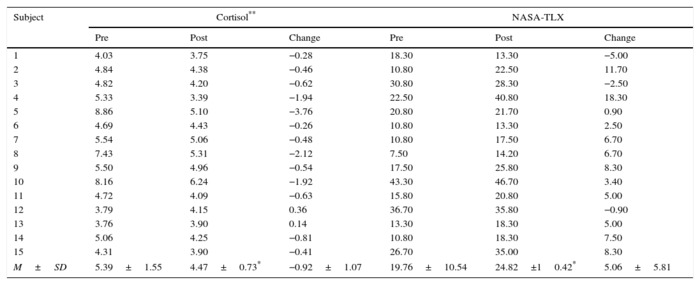
<body><![CDATA[<p><font face="Verdana" size="2">No statistically significant relationships (<i>r</i> = -0.151) were found when the correlation between the differences (before and after) of cortisol levels and workload was analyzed.</font></p>     <p>&nbsp;</p>     <p><font face="Verdana" size="2"><b>Discussion</b></font></p>     <p><font face="Verdana" size="2">First, the raw results of the salivary cortisol are at the average obtained in similar tasks<sup>1</sup> in both conditions, before and after the task, including the expected individual differences among the pilots.</font></p>     <p><font face="Verdana" size="2">The significant decrease (-0.92 &plusmn; 1.07; 17.39%; <i>d</i> = 0.75) of the salivary cortisol level indicates that the activation of the pilots' autonomic nervous system (ANS) descended as the task was being completed in the simulator, so the somatic component of anxiety associated to the performance was also lower at the end, when compared to the pre-task level. Indeed, it is not possible to state if this emotional feature acts as a facilitator to the correct completion of the task.<sup>14,18</sup></font></p>     <p><font face="Verdana" size="2">Results show that the perceived mental workload increases at the end of the task performed in the flight simulator, which were designed as a new task for the pilots. This finding indicates that the effect of habituation<sup>7</sup> it does not occur in this case, but the uncertainty of the new cognitive tasks, the lack of continuous feedback, their perception of physical load and/or the associated fatigue while still not being in the recovery phase, have an incremental effect on the pilot&#39;s workload.<sup>6</sup></font></p>     <p><font face="Verdana" size="2">While some studies have found a relationship between the perceived workload and the cortisol level among other similar physiological measures of the ANS activation,<sup>19-21</sup> in this study these two variables are disconnected. In addition, changes that occur in them are in reverse, as long as the perceived mental load increases, the level of cortisol in saliva decreases at the end of the task.</font></p>     <p><font face="Verdana" size="2">Therefore, it is possible to infer the level of workload via the somatic components of anxiety, such as the level of salivary cortisol.</font></p>     <p><font face="Verdana" size="2">Somewhat surprising, this amount of perceived workload has not been found in other fields of human performance such as elite sport.<sup>22</sup> However, it should be analyzed carefully to determine the composition and weight of the different dissociative and associative components that appear both during the task and in the recovery period.<sup>7</sup></font></p>     <p><font face="Verdana" size="2">Also, after these results, we realize the need for to have an objective system for monitoring the perceived mental workload by pilots - before, during and after a task - more accurate and reliable than the behavioral observation of "nervousness" (mainly based on the apparent changes associated with the activation of ANS) which can lead to an incorrect interpretation of the mental effect of the task on the pilots.</font></p>     ]]></body>
<body><![CDATA[<p><font face="Verdana" size="2">As a general conclusion, we can say that while pilots perceived an increasing physical and mental workload as they are working in the simulator, the anxiety associated with the task decreases. Therefore, they can be seen as unrelated events, opposed to the common belief about the impact of the performance anxiety on cognitively complex tasks combined with physical load.</font></p>     <p><font face="Verdana" size="2">These results should have an impact on the design of the pilots' physical, tactical and mental training as well on the pre-flight anxiety detection systems.</font></p>     <p><font face="Verdana" size="2">This study has limitations regarding to the small number of participants (they are the only certified pilots in this helicopter model in Spain), and the use of simulated flights, due to the impossibility of study out in real flights.</font></p>     <p><font face="Verdana" size="2">Due in part to these limitations, future studies have to determine if the cognitive anxiety is due to the worries or concerns associated with the task, or if it is a source for some lack of focus, since the anxiety mode has a direct impact on the pilots' performance when it is objectively assessed. Also, the pilot&#39;s perception of fatigue and recovery after the accomplishment of the task should be analyzed in terms of its relationship with the global workload.</font></p>     <p>&nbsp;</p>     <p><font face="Verdana" size="2"><b>Conflicts of interest</b></font></p>     <p><font face="Verdana" size="2">The authors have no conflicts of interest to declare.</font></p>     <p>&nbsp;</p>     <p><font face="Verdana" size="2"><b>Acknowledgements</b></font></p>     <p><font face="Verdana" size="2">The authors deeply thank the collaboration of the pilots of BHELA-1, their commanders, specially Lieutentant-Colonel Santiago Juan Fenández Ortiz-Repiso and commander Alberto José Cherino Muñoz, and the CEMIX (Centro Mixto UGR-MADOC, Army of Spain).</font></p>     ]]></body>
<body><![CDATA[<p>&nbsp;</p>     <p><font face="Verdana" size="2"><b>References</b></font></p>     <!-- ref --><p><font face="Verdana" size="2">1. Cevada T., Vasues P.E., Moraes H., Deslandes A. Salivary cortisol levels in athletes and nonathletes: a systematic review. Horm Metab Res. 2014;46:905-10.    &nbsp;&nbsp;&nbsp;&nbsp;&nbsp;&nbsp;&nbsp;&nbsp;[&#160;<a href="javascript:void(0);" onclick="javascript: window.open('/scielo.php?script=sci_nlinks&ref=4447060&pid=S1888-7546201600010000300001&lng=','','width=640,height=500,resizable=yes,scrollbars=1,menubar=yes,');">Links</a>&#160;]<!-- end-ref --></font></p>    <!-- ref --><p><font face="Verdana" size="2">2. Vaamonde D., Da M., Fernandez J.M., Algar-Santacruz C., García-Manso J. Findings on sperm alterations and DNA fragmentation, nutritional, hormonal and antioxidant status in an elite triathlete. Case Report. Rev Andal Med Deporte. 2014;7:143-8.    &nbsp;&nbsp;&nbsp;&nbsp;&nbsp;&nbsp;&nbsp;&nbsp;[&#160;<a href="javascript:void(0);" onclick="javascript: window.open('/scielo.php?script=sci_nlinks&ref=4447062&pid=S1888-7546201600010000300002&lng=','','width=640,height=500,resizable=yes,scrollbars=1,menubar=yes,');">Links</a>&#160;]<!-- end-ref --></font></p>    <!-- ref --><p><font face="Verdana" size="2">3. Doan B.K., Newton R.U., Kraemer W.J., Kwon Y.H., Scheet T.P. Salivary cortisol, testosterone, and T/C ratio responses during a 36-hole golf competition. Int J Sports Med. 2007;28:470-9.    &nbsp;&nbsp;&nbsp;&nbsp;&nbsp;&nbsp;&nbsp;&nbsp;[&#160;<a href="javascript:void(0);" onclick="javascript: window.open('/scielo.php?script=sci_nlinks&ref=4447064&pid=S1888-7546201600010000300003&lng=','','width=640,height=500,resizable=yes,scrollbars=1,menubar=yes,');">Links</a>&#160;]<!-- end-ref --></font></p>    <!-- ref --><p><font face="Verdana" size="2">4. Filaire E., Sagnol M., Ferrand C., Maso F., Lac G. Psychophysiological stress in judo athletes during competitions. J Sports Med Phys Fitness. 2001;41:263-8.    &nbsp;&nbsp;&nbsp;&nbsp;&nbsp;&nbsp;&nbsp;&nbsp;[&#160;<a href="javascript:void(0);" onclick="javascript: window.open('/scielo.php?script=sci_nlinks&ref=4447066&pid=S1888-7546201600010000300004&lng=','','width=640,height=500,resizable=yes,scrollbars=1,menubar=yes,');">Links</a>&#160;]<!-- end-ref --></font></p>    ]]></body>
<body><![CDATA[<!-- ref --><p><font face="Verdana" size="2">5. Filaire E., Alix D., Ferrand C., Verger M. Psychophysiological stress in tennis players during the first single match of a tournament. Psychoneuroendocrinology. 2009;34:150-7.    &nbsp;&nbsp;&nbsp;&nbsp;&nbsp;&nbsp;&nbsp;&nbsp;[&#160;<a href="javascript:void(0);" onclick="javascript: window.open('/scielo.php?script=sci_nlinks&ref=4447068&pid=S1888-7546201600010000300005&lng=','','width=640,height=500,resizable=yes,scrollbars=1,menubar=yes,');">Links</a>&#160;]<!-- end-ref --></font></p>    <!-- ref --><p><font face="Verdana" size="2">6. Watson A.R., Ntuen C., Park E. Effects of task difficulty on pilot workload. Comput Ind Eng. 1996;31:487-90.    &nbsp;&nbsp;&nbsp;&nbsp;&nbsp;&nbsp;&nbsp;&nbsp;[&#160;<a href="javascript:void(0);" onclick="javascript: window.open('/scielo.php?script=sci_nlinks&ref=4447070&pid=S1888-7546201600010000300006&lng=','','width=640,height=500,resizable=yes,scrollbars=1,menubar=yes,');">Links</a>&#160;]<!-- end-ref --></font></p>    <!-- ref --><p><font face="Verdana" size="2">7. Cárdenas D., Conde-González J., Perales J.C. El papel de la carga mental en la planificación del entrenamiento deportivo. Rev Psicol Deporte. 2015;24:91-100.    &nbsp;&nbsp;&nbsp;&nbsp;&nbsp;&nbsp;&nbsp;&nbsp;[&#160;<a href="javascript:void(0);" onclick="javascript: window.open('/scielo.php?script=sci_nlinks&ref=4447072&pid=S1888-7546201600010000300007&lng=','','width=640,height=500,resizable=yes,scrollbars=1,menubar=yes,');">Links</a>&#160;]<!-- end-ref --></font></p>    <!-- ref --><p><font face="Verdana" size="2">8. Baumeister R.F., Vohs K.D., Tice D.M. The strength model of self sontrol. Curr Dir Psychol Sci. 2007;16:351-5.    &nbsp;&nbsp;&nbsp;&nbsp;&nbsp;&nbsp;&nbsp;&nbsp;[&#160;<a href="javascript:void(0);" onclick="javascript: window.open('/scielo.php?script=sci_nlinks&ref=4447074&pid=S1888-7546201600010000300008&lng=','','width=640,height=500,resizable=yes,scrollbars=1,menubar=yes,');">Links</a>&#160;]<!-- end-ref --></font></p>    <!-- ref --><p><font face="Verdana" size="2">9. Wallace R.M., Baumeister R.F. The effect of success versus failure feedback on further self-control. Self Identity. 2002;1:35-41.    &nbsp;&nbsp;&nbsp;&nbsp;&nbsp;&nbsp;&nbsp;&nbsp;[&#160;<a href="javascript:void(0);" onclick="javascript: window.open('/scielo.php?script=sci_nlinks&ref=4447076&pid=S1888-7546201600010000300009&lng=','','width=640,height=500,resizable=yes,scrollbars=1,menubar=yes,');">Links</a>&#160;]<!-- end-ref --></font></p>    ]]></body>
<body><![CDATA[<!-- ref --><p><font face="Verdana" size="2">10. Cervantes J.L., Rodas G., Capdevila L. Perfil psicofisiológico de rendimiento en nadadores basado en la variabilidad de la frecuencia cardíaca y en estados de ansiedad precompetitiva. Rev Psicol Deporte. 2009;18:37-52.    &nbsp;&nbsp;&nbsp;&nbsp;&nbsp;&nbsp;&nbsp;&nbsp;[&#160;<a href="javascript:void(0);" onclick="javascript: window.open('/scielo.php?script=sci_nlinks&ref=4447078&pid=S1888-7546201600010000300010&lng=','','width=640,height=500,resizable=yes,scrollbars=1,menubar=yes,');">Links</a>&#160;]<!-- end-ref --></font></p>    <!-- ref --><p><font face="Verdana" size="2">11. Grossbard J., Smith R., Smoll F., Cumming S. Competitive anxiety in young athletes: differentiating somatic anxiety, worry, and concentration disruption. Anxiety Stress Coping. 2009;22:153-66.    &nbsp;&nbsp;&nbsp;&nbsp;&nbsp;&nbsp;&nbsp;&nbsp;[&#160;<a href="javascript:void(0);" onclick="javascript: window.open('/scielo.php?script=sci_nlinks&ref=4447080&pid=S1888-7546201600010000300011&lng=','','width=640,height=500,resizable=yes,scrollbars=1,menubar=yes,');">Links</a>&#160;]<!-- end-ref --></font></p>    <!-- ref --><p><font face="Verdana" size="2">12. Klay P. Redeployment. Plenum, (2013).    &nbsp;&nbsp;&nbsp;&nbsp;&nbsp;&nbsp;&nbsp;&nbsp;[&#160;<a href="javascript:void(0);" onclick="javascript: window.open('/scielo.php?script=sci_nlinks&ref=4447082&pid=S1888-7546201600010000300012&lng=','','width=640,height=500,resizable=yes,scrollbars=1,menubar=yes,');">Links</a>&#160;]<!-- end-ref --></font></p>    <!-- ref --><p><font face="Verdana" size="2">13. Montero C., Moreno-Murcia J., González I., Pulido J., Cervelló E. Ansiedad estado precompetitiva en judocas. Rev Artes Marciales Asiat. 2012;7:26.    &nbsp;&nbsp;&nbsp;&nbsp;&nbsp;&nbsp;&nbsp;&nbsp;[&#160;<a href="javascript:void(0);" onclick="javascript: window.open('/scielo.php?script=sci_nlinks&ref=4447084&pid=S1888-7546201600010000300013&lng=','','width=640,height=500,resizable=yes,scrollbars=1,menubar=yes,');">Links</a>&#160;]<!-- end-ref --></font></p>    <!-- ref --><p><font face="Verdana" size="2">14. Brooks A. Get excited: reappraising pre-performance anxiety as excitement. J Exp Psychol Gen. 2014;143:1144-58.    &nbsp;&nbsp;&nbsp;&nbsp;&nbsp;&nbsp;&nbsp;&nbsp;[&#160;<a href="javascript:void(0);" onclick="javascript: window.open('/scielo.php?script=sci_nlinks&ref=4447086&pid=S1888-7546201600010000300014&lng=','','width=640,height=500,resizable=yes,scrollbars=1,menubar=yes,');">Links</a>&#160;]<!-- end-ref --></font></p>    ]]></body>
<body><![CDATA[<!-- ref --><p><font face="Verdana" size="2">15. Hanton S., Jones G., Mullen R. Intensity and direction of competitive state anxiety as interpreted by rugby players and rifle shooters. Percept Mot Skills. 2000;90:513-21.    &nbsp;&nbsp;&nbsp;&nbsp;&nbsp;&nbsp;&nbsp;&nbsp;[&#160;<a href="javascript:void(0);" onclick="javascript: window.open('/scielo.php?script=sci_nlinks&ref=4447088&pid=S1888-7546201600010000300015&lng=','','width=640,height=500,resizable=yes,scrollbars=1,menubar=yes,');">Links</a>&#160;]<!-- end-ref --></font></p>    <!-- ref --><p><font face="Verdana" size="2">16. Hart S.G., Staveland L.E. Development of NASA-TLX (task load index): results of empirical and theoretical research. Human mental workload, Elsevier Science, 1988. pp. 139-83.    &nbsp;&nbsp;&nbsp;&nbsp;&nbsp;&nbsp;&nbsp;&nbsp;[&#160;<a href="javascript:void(0);" onclick="javascript: window.open('/scielo.php?script=sci_nlinks&ref=4447090&pid=S1888-7546201600010000300016&lng=','','width=640,height=500,resizable=yes,scrollbars=1,menubar=yes,');">Links</a>&#160;]<!-- end-ref --></font></p>    <!-- ref --><p><font face="Verdana" size="2">17. de I., Nogareda C. NTP 544: estimación de la carga mental del trabajo: el Método NASA-TLX. Instituto Nacional de Higiene y Seguridad en el Trabajo, Ministerio de Trabajo y Seguridad Social del Gobierno de España, (2000).    &nbsp;&nbsp;&nbsp;&nbsp;&nbsp;&nbsp;&nbsp;&nbsp;[&#160;<a href="javascript:void(0);" onclick="javascript: window.open('/scielo.php?script=sci_nlinks&ref=4447092&pid=S1888-7546201600010000300017&lng=','','width=640,height=500,resizable=yes,scrollbars=1,menubar=yes,');">Links</a>&#160;]<!-- end-ref --></font></p>    <!-- ref --><p><font face="Verdana" size="2">18. Meglino B.M. Stress and performance. Are they always incompatible?. Superv Manag. 1977;22:2-12.    &nbsp;&nbsp;&nbsp;&nbsp;&nbsp;&nbsp;&nbsp;&nbsp;[&#160;<a href="javascript:void(0);" onclick="javascript: window.open('/scielo.php?script=sci_nlinks&ref=4447094&pid=S1888-7546201600010000300018&lng=','','width=640,height=500,resizable=yes,scrollbars=1,menubar=yes,');">Links</a>&#160;]<!-- end-ref --></font></p>    <!-- ref --><p><font face="Verdana" size="2">19. Veltman J.A., Gaillard A.W. Physiological indices of workload in a simulated flight task. Biol Psychol. 1996;42:323-42.    &nbsp;&nbsp;&nbsp;&nbsp;&nbsp;&nbsp;&nbsp;&nbsp;[&#160;<a href="javascript:void(0);" onclick="javascript: window.open('/scielo.php?script=sci_nlinks&ref=4447096&pid=S1888-7546201600010000300019&lng=','','width=640,height=500,resizable=yes,scrollbars=1,menubar=yes,');">Links</a>&#160;]<!-- end-ref --></font></p>    ]]></body>
<body><![CDATA[<!-- ref --><p><font face="Verdana" size="2">20. Veltman J.A. A comparative study of psychophysiological reactions during simulator and real flight. Int J Aviat Psychol. 2002;12:33-48.    &nbsp;&nbsp;&nbsp;&nbsp;&nbsp;&nbsp;&nbsp;&nbsp;[&#160;<a href="javascript:void(0);" onclick="javascript: window.open('/scielo.php?script=sci_nlinks&ref=4447098&pid=S1888-7546201600010000300020&lng=','','width=640,height=500,resizable=yes,scrollbars=1,menubar=yes,');">Links</a>&#160;]<!-- end-ref --></font></p>    <!-- ref --><p><font face="Verdana" size="2">21. Sauvet F., Jouanin J.C., Langrume C., Van P., Papelier Y., Dussault C. Heart rate variability in novice pilots during and after a multi-leg cross-country flight. Aviat Space Environ Med. 2009;80:862-9.    &nbsp;&nbsp;&nbsp;&nbsp;&nbsp;&nbsp;&nbsp;&nbsp;[&#160;<a href="javascript:void(0);" onclick="javascript: window.open('/scielo.php?script=sci_nlinks&ref=4447100&pid=S1888-7546201600010000300021&lng=','','width=640,height=500,resizable=yes,scrollbars=1,menubar=yes,');">Links</a>&#160;]<!-- end-ref --></font></p>    <!-- ref --><p><font face="Verdana" size="2">22. Melna C., Cascino N. A multidisciplinary approach of workload assessment in real-job situations: investigation in the field of aerospace activities. Front Psychol. 2014;5:964.    &nbsp;&nbsp;&nbsp;&nbsp;&nbsp;&nbsp;&nbsp;&nbsp;[&#160;<a href="javascript:void(0);" onclick="javascript: window.open('/scielo.php?script=sci_nlinks&ref=4447102&pid=S1888-7546201600010000300022&lng=','','width=640,height=500,resizable=yes,scrollbars=1,menubar=yes,');">Links</a>&#160;]<!-- end-ref --></font></p>     <p>&nbsp;</p>     <p>&nbsp;</p>     <p><font face="Verdana" size="2"><a href="#top"><img border="0" src="/img/revistas/ramd/v9n1/seta.gif" width="15" height="17"></a><a name="bajo"></a><b>Correspondence:</b>    <br>J. Ponseti    ]]></body>
<body><![CDATA[<br><a href="mailto:xponseti@uib.es">xponseti@uib.es</a></font></p>     <p><font face="Verdana" size="2">Received November 4, 2015    <br>Accepted December 4, 2015</font></p>      ]]></body><back>
<ref-list>
<ref id="B1">
<label>1</label><nlm-citation citation-type="journal">
<person-group person-group-type="author">
<name>
<surname><![CDATA[Cevada]]></surname>
<given-names><![CDATA[T.]]></given-names>
</name>
<name>
<surname><![CDATA[Vasues]]></surname>
<given-names><![CDATA[P.E.]]></given-names>
</name>
<name>
<surname><![CDATA[Moraes]]></surname>
<given-names><![CDATA[H.]]></given-names>
</name>
<name>
<surname><![CDATA[Deslandes]]></surname>
<given-names><![CDATA[A]]></given-names>
</name>
</person-group>
<article-title xml:lang="en"><![CDATA[Salivary cortisol levels in athletes and nonathletes: a systematic review]]></article-title>
<source><![CDATA[Horm Metab Res.]]></source>
<year>2014</year>
<volume>46</volume>
<page-range>905-10</page-range></nlm-citation>
</ref>
<ref id="B2">
<label>2</label><nlm-citation citation-type="journal">
<person-group person-group-type="author">
<name>
<surname><![CDATA[Vaamonde]]></surname>
<given-names><![CDATA[D.]]></given-names>
</name>
<name>
<surname><![CDATA[Da]]></surname>
<given-names><![CDATA[M.]]></given-names>
</name>
<name>
<surname><![CDATA[Fernandez]]></surname>
<given-names><![CDATA[J.M.]]></given-names>
</name>
<name>
<surname><![CDATA[Algar-Santacruz]]></surname>
<given-names><![CDATA[C.]]></given-names>
</name>
<name>
<surname><![CDATA[García-Manso]]></surname>
<given-names><![CDATA[J]]></given-names>
</name>
</person-group>
<article-title xml:lang="en"><![CDATA[Findings on sperm alterations and DNA fragmentation, nutritional, hormonal and antioxidant status in an elite triathlete: Case Report]]></article-title>
<source><![CDATA[Rev Andal Med Deporte]]></source>
<year>2014</year>
<volume>7</volume>
<page-range>143-8</page-range></nlm-citation>
</ref>
<ref id="B3">
<label>3</label><nlm-citation citation-type="journal">
<person-group person-group-type="author">
<name>
<surname><![CDATA[Doan]]></surname>
<given-names><![CDATA[B.K.]]></given-names>
</name>
<name>
<surname><![CDATA[Newton]]></surname>
<given-names><![CDATA[R.U.]]></given-names>
</name>
<name>
<surname><![CDATA[Kraemer]]></surname>
<given-names><![CDATA[W.J.]]></given-names>
</name>
<name>
<surname><![CDATA[Kwon]]></surname>
<given-names><![CDATA[Y.H.]]></given-names>
</name>
<name>
<surname><![CDATA[Scheet]]></surname>
<given-names><![CDATA[T.P]]></given-names>
</name>
</person-group>
<article-title xml:lang="en"><![CDATA[Salivary cortisol, testosterone, and T/C ratio responses during a 36-hole golf competition]]></article-title>
<source><![CDATA[Int J Sports Med.]]></source>
<year>2007</year>
<volume>28</volume>
<page-range>470-9</page-range></nlm-citation>
</ref>
<ref id="B4">
<label>4</label><nlm-citation citation-type="journal">
<person-group person-group-type="author">
<name>
<surname><![CDATA[Filaire]]></surname>
<given-names><![CDATA[E.]]></given-names>
</name>
<name>
<surname><![CDATA[Sagnol]]></surname>
<given-names><![CDATA[M.]]></given-names>
</name>
<name>
<surname><![CDATA[Ferrand]]></surname>
<given-names><![CDATA[C.]]></given-names>
</name>
<name>
<surname><![CDATA[Maso]]></surname>
<given-names><![CDATA[F.]]></given-names>
</name>
<name>
<surname><![CDATA[Lac]]></surname>
<given-names><![CDATA[G]]></given-names>
</name>
</person-group>
<article-title xml:lang="en"><![CDATA[Psychophysiological stress in judo athletes during competitions]]></article-title>
<source><![CDATA[J Sports Med Phys Fitness]]></source>
<year>2001</year>
<volume>41</volume>
<page-range>263-8</page-range></nlm-citation>
</ref>
<ref id="B5">
<label>5</label><nlm-citation citation-type="journal">
<person-group person-group-type="author">
<name>
<surname><![CDATA[Filaire]]></surname>
<given-names><![CDATA[E.]]></given-names>
</name>
<name>
<surname><![CDATA[Alix]]></surname>
<given-names><![CDATA[D.]]></given-names>
</name>
<name>
<surname><![CDATA[Ferrand]]></surname>
<given-names><![CDATA[C.]]></given-names>
</name>
<name>
<surname><![CDATA[Verger]]></surname>
<given-names><![CDATA[M]]></given-names>
</name>
</person-group>
<article-title xml:lang="en"><![CDATA[Psychophysiological stress in tennis players during the first single match of a tournament]]></article-title>
<source><![CDATA[Psychoneuroendocrinology]]></source>
<year>2009</year>
<volume>34</volume>
<page-range>150-7</page-range></nlm-citation>
</ref>
<ref id="B6">
<label>6</label><nlm-citation citation-type="journal">
<person-group person-group-type="author">
<name>
<surname><![CDATA[Watson]]></surname>
<given-names><![CDATA[A.R.]]></given-names>
</name>
<name>
<surname><![CDATA[Ntuen]]></surname>
<given-names><![CDATA[C.]]></given-names>
</name>
<name>
<surname><![CDATA[Park]]></surname>
<given-names><![CDATA[E]]></given-names>
</name>
</person-group>
<article-title xml:lang="en"><![CDATA[Effects of task difficulty on pilot workload]]></article-title>
<source><![CDATA[Comput Ind Eng.]]></source>
<year>1996</year>
<volume>31</volume>
<page-range>487-90</page-range></nlm-citation>
</ref>
<ref id="B7">
<label>7</label><nlm-citation citation-type="journal">
<person-group person-group-type="author">
<name>
<surname><![CDATA[Cárdenas]]></surname>
<given-names><![CDATA[D.]]></given-names>
</name>
<name>
<surname><![CDATA[Conde-González]]></surname>
<given-names><![CDATA[J.]]></given-names>
</name>
<name>
<surname><![CDATA[Perales]]></surname>
<given-names><![CDATA[J.C]]></given-names>
</name>
</person-group>
<article-title xml:lang="es"><![CDATA[El papel de la carga mental en la planificación del entrenamiento deportivo]]></article-title>
<source><![CDATA[Rev Psicol Deporte]]></source>
<year>2015</year>
<volume>24</volume>
<page-range>91-100</page-range></nlm-citation>
</ref>
<ref id="B8">
<label>8</label><nlm-citation citation-type="journal">
<person-group person-group-type="author">
<name>
<surname><![CDATA[Baumeister]]></surname>
<given-names><![CDATA[R.F.]]></given-names>
</name>
<name>
<surname><![CDATA[Vohs]]></surname>
<given-names><![CDATA[K.D.]]></given-names>
</name>
<name>
<surname><![CDATA[Tice]]></surname>
<given-names><![CDATA[D.M]]></given-names>
</name>
</person-group>
<article-title xml:lang="en"><![CDATA[The strength model of self sontrol]]></article-title>
<source><![CDATA[Curr Dir Psychol Sci.]]></source>
<year>2007</year>
<volume>16</volume>
<page-range>351-5</page-range></nlm-citation>
</ref>
<ref id="B9">
<label>9</label><nlm-citation citation-type="journal">
<person-group person-group-type="author">
<name>
<surname><![CDATA[Wallace]]></surname>
<given-names><![CDATA[R.M.]]></given-names>
</name>
<name>
<surname><![CDATA[Baumeister]]></surname>
<given-names><![CDATA[R.F]]></given-names>
</name>
</person-group>
<article-title xml:lang="en"><![CDATA[The effect of success versus failure feedback on further self-control]]></article-title>
<source><![CDATA[Self Identity]]></source>
<year>2002</year>
<volume>1</volume>
<page-range>35-41</page-range></nlm-citation>
</ref>
<ref id="B10">
<label>10</label><nlm-citation citation-type="journal">
<person-group person-group-type="author">
<name>
<surname><![CDATA[Cervantes]]></surname>
<given-names><![CDATA[J.L.]]></given-names>
</name>
<name>
<surname><![CDATA[Rodas]]></surname>
<given-names><![CDATA[G.]]></given-names>
</name>
<name>
<surname><![CDATA[Capdevila]]></surname>
<given-names><![CDATA[L]]></given-names>
</name>
</person-group>
<article-title xml:lang="es"><![CDATA[Perfil psicofisiológico de rendimiento en nadadores basado en la variabilidad de la frecuencia cardíaca y en estados de ansiedad precompetitiva]]></article-title>
<source><![CDATA[Rev Psicol Deporte]]></source>
<year>2009</year>
<volume>18</volume>
<page-range>37-52</page-range></nlm-citation>
</ref>
<ref id="B11">
<label>11</label><nlm-citation citation-type="journal">
<person-group person-group-type="author">
<name>
<surname><![CDATA[Grossbard]]></surname>
<given-names><![CDATA[J.]]></given-names>
</name>
<name>
<surname><![CDATA[Smith]]></surname>
<given-names><![CDATA[R.]]></given-names>
</name>
<name>
<surname><![CDATA[Smoll]]></surname>
<given-names><![CDATA[F.]]></given-names>
</name>
<name>
<surname><![CDATA[Cumming]]></surname>
<given-names><![CDATA[S]]></given-names>
</name>
</person-group>
<article-title xml:lang="en"><![CDATA[Competitive anxiety in young athletes: differentiating somatic anxiety, worry, and concentration disruption]]></article-title>
<source><![CDATA[Anxiety Stress Coping]]></source>
<year>2009</year>
<volume>22</volume>
<page-range>153-66</page-range></nlm-citation>
</ref>
<ref id="B12">
<label>12</label><nlm-citation citation-type="book">
<person-group person-group-type="author">
<name>
<surname><![CDATA[Klay]]></surname>
<given-names><![CDATA[P]]></given-names>
</name>
</person-group>
<source><![CDATA[Redeployment]]></source>
<year>2013</year>
<publisher-name><![CDATA[Plenum]]></publisher-name>
</nlm-citation>
</ref>
<ref id="B13">
<label>13</label><nlm-citation citation-type="journal">
<person-group person-group-type="author">
<name>
<surname><![CDATA[Montero]]></surname>
<given-names><![CDATA[C.]]></given-names>
</name>
<name>
<surname><![CDATA[Moreno-Murcia]]></surname>
<given-names><![CDATA[J.]]></given-names>
</name>
<name>
<surname><![CDATA[González]]></surname>
<given-names><![CDATA[I.]]></given-names>
</name>
<name>
<surname><![CDATA[Pulido]]></surname>
<given-names><![CDATA[J.]]></given-names>
</name>
<name>
<surname><![CDATA[Cervelló]]></surname>
<given-names><![CDATA[E]]></given-names>
</name>
</person-group>
<article-title xml:lang="es"><![CDATA[Ansiedad estado precompetitiva en judocas]]></article-title>
<source><![CDATA[Rev Artes Marciales Asiat.]]></source>
<year>2012</year>
<volume>7</volume>
<page-range>26</page-range></nlm-citation>
</ref>
<ref id="B14">
<label>14</label><nlm-citation citation-type="journal">
<person-group person-group-type="author">
<name>
<surname><![CDATA[Brooks]]></surname>
<given-names><![CDATA[A]]></given-names>
</name>
</person-group>
<article-title xml:lang="en"><![CDATA[Get excited: reappraising pre-performance anxiety as excitement]]></article-title>
<source><![CDATA[J Exp Psychol Gen.]]></source>
<year>2014</year>
<volume>143</volume>
<page-range>1144-58</page-range></nlm-citation>
</ref>
<ref id="B15">
<label>15</label><nlm-citation citation-type="journal">
<person-group person-group-type="author">
<name>
<surname><![CDATA[Hanton]]></surname>
<given-names><![CDATA[S.]]></given-names>
</name>
<name>
<surname><![CDATA[Jones]]></surname>
<given-names><![CDATA[G.]]></given-names>
</name>
<name>
<surname><![CDATA[Mullen]]></surname>
<given-names><![CDATA[R]]></given-names>
</name>
</person-group>
<article-title xml:lang="en"><![CDATA[Intensity and direction of competitive state anxiety as interpreted by rugby players and rifle shooters]]></article-title>
<source><![CDATA[Percept Mot Skills]]></source>
<year>2000</year>
<volume>90</volume>
<page-range>513-21</page-range></nlm-citation>
</ref>
<ref id="B16">
<label>16</label><nlm-citation citation-type="book">
<person-group person-group-type="author">
<name>
<surname><![CDATA[Hart]]></surname>
<given-names><![CDATA[S.G.]]></given-names>
</name>
<name>
<surname><![CDATA[Staveland]]></surname>
<given-names><![CDATA[L.E]]></given-names>
</name>
</person-group>
<article-title xml:lang="en"><![CDATA[Development of NASA-TLX (task load index): results of empirical and theoretical research]]></article-title>
<source><![CDATA[Human mental workload]]></source>
<year>1988</year>
<page-range>139-83</page-range><publisher-name><![CDATA[Elsevier Science]]></publisher-name>
</nlm-citation>
</ref>
<ref id="B17">
<label>17</label><nlm-citation citation-type="book">
<person-group person-group-type="author">
<name>
<surname><![CDATA[de]]></surname>
<given-names><![CDATA[I.]]></given-names>
</name>
<name>
<surname><![CDATA[Nogareda]]></surname>
<given-names><![CDATA[C]]></given-names>
</name>
</person-group>
<source><![CDATA[estimación de la carga mental del trabajo: el Método NASA-TLX]]></source>
<year>2000</year>
<volume>544</volume>
<publisher-name><![CDATA[Instituto Nacional de Higiene y Seguridad en el Trabajo, Ministerio de Trabajo y Seguridad Social del Gobierno de España]]></publisher-name>
</nlm-citation>
</ref>
<ref id="B18">
<label>18</label><nlm-citation citation-type="journal">
<person-group person-group-type="author">
<name>
<surname><![CDATA[Meglino]]></surname>
<given-names><![CDATA[B.M]]></given-names>
</name>
</person-group>
<article-title xml:lang="en"><![CDATA[Stress and performance: Are they always incompatible?]]></article-title>
<source><![CDATA[Superv Manag.]]></source>
<year>1977</year>
<volume>22</volume>
<page-range>2-12</page-range></nlm-citation>
</ref>
<ref id="B19">
<label>19</label><nlm-citation citation-type="journal">
<person-group person-group-type="author">
<name>
<surname><![CDATA[Veltman]]></surname>
<given-names><![CDATA[J.A.]]></given-names>
</name>
<name>
<surname><![CDATA[Gaillard]]></surname>
<given-names><![CDATA[A.W]]></given-names>
</name>
</person-group>
<article-title xml:lang="en"><![CDATA[Physiological indices of workload in a simulated flight task]]></article-title>
<source><![CDATA[Biol Psychol.]]></source>
<year>1996</year>
<volume>42</volume>
<page-range>323-42</page-range></nlm-citation>
</ref>
<ref id="B20">
<label>20</label><nlm-citation citation-type="journal">
<person-group person-group-type="author">
<name>
<surname><![CDATA[Veltman]]></surname>
<given-names><![CDATA[J.A]]></given-names>
</name>
</person-group>
<article-title xml:lang="en"><![CDATA[A comparative study of psychophysiological reactions during simulator and real flight]]></article-title>
<source><![CDATA[Int J Aviat Psychol.]]></source>
<year>2002</year>
<volume>12</volume>
<page-range>33-48</page-range></nlm-citation>
</ref>
<ref id="B21">
<label>21</label><nlm-citation citation-type="journal">
<person-group person-group-type="author">
<name>
<surname><![CDATA[Sauvet]]></surname>
<given-names><![CDATA[F.]]></given-names>
</name>
<name>
<surname><![CDATA[Jouanin]]></surname>
<given-names><![CDATA[J.C.]]></given-names>
</name>
<name>
<surname><![CDATA[Langrume]]></surname>
<given-names><![CDATA[C.]]></given-names>
</name>
<name>
<surname><![CDATA[Van]]></surname>
<given-names><![CDATA[P.]]></given-names>
</name>
<name>
<surname><![CDATA[Papelier]]></surname>
<given-names><![CDATA[Y.]]></given-names>
</name>
<name>
<surname><![CDATA[Dussault]]></surname>
<given-names><![CDATA[C]]></given-names>
</name>
</person-group>
<article-title xml:lang="en"><![CDATA[Heart rate variability in novice pilots during and after a multi-leg cross-country flight]]></article-title>
<source><![CDATA[Aviat Space Environ Med.]]></source>
<year>2009</year>
<volume>80</volume>
<page-range>862-9</page-range></nlm-citation>
</ref>
<ref id="B22">
<label>22</label><nlm-citation citation-type="journal">
<person-group person-group-type="author">
<name>
<surname><![CDATA[Melna]]></surname>
<given-names><![CDATA[C.]]></given-names>
</name>
<name>
<surname><![CDATA[Cascino]]></surname>
<given-names><![CDATA[N]]></given-names>
</name>
</person-group>
<article-title xml:lang="en"><![CDATA[A multidisciplinary approach of workload assessment in real-job situations: investigation in the field of aerospace activities]]></article-title>
<source><![CDATA[Front Psychol.]]></source>
<year>2014</year>
<volume>5</volume>
<page-range>964</page-range></nlm-citation>
</ref>
</ref-list>
</back>
</article>
