<?xml version="1.0" encoding="ISO-8859-1"?><article xmlns:mml="http://www.w3.org/1998/Math/MathML" xmlns:xlink="http://www.w3.org/1999/xlink" xmlns:xsi="http://www.w3.org/2001/XMLSchema-instance">
<front>
<journal-meta>
<journal-id>1989-3809</journal-id>
<journal-title><![CDATA[Escritos de Psicología (Internet)]]></journal-title>
<abbrev-journal-title><![CDATA[Escritos de Psicología]]></abbrev-journal-title>
<issn>1989-3809</issn>
<publisher>
<publisher-name><![CDATA[Facultad de Psicología. Universidad de Málaga]]></publisher-name>
</publisher>
</journal-meta>
<article-meta>
<article-id>S1989-38092017000200004</article-id>
<article-id pub-id-type="doi">10.5231/psy.writ.2017.14032</article-id>
<title-group>
<article-title xml:lang="en"><![CDATA[The Student Satisfaction with Educational Podcasts Questionnaire]]></article-title>
<article-title xml:lang="es"><![CDATA[Cuestionario de satisfacción con podcasts educativos]]></article-title>
</title-group>
<contrib-group>
<contrib contrib-type="author">
<name>
<surname><![CDATA[Alarcón]]></surname>
<given-names><![CDATA[Rafael]]></given-names>
</name>
<xref ref-type="aff" rid="A01"/>
</contrib>
<contrib contrib-type="author">
<name>
<surname><![CDATA[Bendayan]]></surname>
<given-names><![CDATA[Rebecca]]></given-names>
</name>
<xref ref-type="aff" rid="A01"/>
</contrib>
<contrib contrib-type="author">
<name>
<surname><![CDATA[Blanca]]></surname>
<given-names><![CDATA[María J.]]></given-names>
</name>
<xref ref-type="aff" rid="A01"/>
</contrib>
</contrib-group>
<aff id="A01">
<institution><![CDATA[,University of Málaga Department of Psychobiology and Methodology of Behavioural Sciences ]]></institution>
<addr-line><![CDATA[Málaga ]]></addr-line>
<country>Spain</country>
</aff>
<pub-date pub-type="pub">
<day>00</day>
<month>08</month>
<year>2017</year>
</pub-date>
<pub-date pub-type="epub">
<day>00</day>
<month>08</month>
<year>2017</year>
</pub-date>
<volume>10</volume>
<numero>2</numero>
<fpage>126</fpage>
<lpage>133</lpage>
<copyright-statement/>
<copyright-year/>
<self-uri xlink:href="http://scielo.isciii.es/scielo.php?script=sci_arttext&amp;pid=S1989-38092017000200004&amp;lng=en&amp;nrm=iso"></self-uri><self-uri xlink:href="http://scielo.isciii.es/scielo.php?script=sci_abstract&amp;pid=S1989-38092017000200004&amp;lng=en&amp;nrm=iso"></self-uri><self-uri xlink:href="http://scielo.isciii.es/scielo.php?script=sci_pdf&amp;pid=S1989-38092017000200004&amp;lng=en&amp;nrm=iso"></self-uri><abstract abstract-type="short" xml:lang="en"><p><![CDATA[Student satisfaction with podcasts is frequently used as an indicator of the effectiveness of educational podcasting. This aspect has usually been assessed through surveys or interviews in descriptive studies, but no standard questionnaire exists that can be used to compare results. The main aim of this study was to present the Student Satisfaction with Educational Podcasts Questionnaire (SSEPQ). The SSEPQ consists of 10 items that are scored on a Likert-type scale. The items address the opinions of students on content adequacy, ease of use, usefulness, and the benefits of podcasts for learning. 3-5 minute podcasts were assessed as a supplementary tool within the research methods and statistics course of their psychology undergraduate degree. Confirmatory factor analysis with cross-validation showed a one-factor structure, supporting the use of the total score as a global index of student satisfaction with podcasts. The results suggest that there is a high level of satisfaction with podcasts as a tool to improve learning. The questionnaire is a brief and simple tool that can provide lecturers with direct feedback from their students, and may prove useful in improving the teaching-learning process.]]></p></abstract>
<abstract abstract-type="short" xml:lang="es"><p><![CDATA[La satisfacción del estudiante con los podcasts constituye un indicador de la eficacia de los podcasts educativos. Este aspecto generalmente se ha evaluado a través de encuestas o entrevistas en estudios descriptivos, pero aún no existe un cuestionario estándar que pueda ser utilizado en estudios comparativos. El objetivo de este trabajo es presentar el Cuestionario de satisfacción de estudiantes con podcasts educativos (SSEPQ), que consta de 10 ítems que evalúan la percepción del estudiante respecto a la adecuación del contenido, facilidad de uso, utilidad y beneficio de los podcasts para el aprendizaje. Los estudiantes evaluaron podcast diseñados como material complementario de la asignatura Metodología de investigación y estadística del grado en Psicología. El análisis factorial confirmatorio reveló una estructura de un factor, cuya puntuación total es indicativa de un índice global de satisfacción con los podcasts. Los resultados proporcionan evidencia de un alto nivel de satisfacción con los podcasts como recurso para mejorar el aprendizaje. El SSEPQ es un cuestionario breve y sencillo que puede ser útil al profesorado, proporcionando información sobre la percepción de los estudiantes del uso de estos recursos en educación superior con objeto de mejorar el proceso de enseñanza-aprendizaje.]]></p></abstract>
<kwd-group>
<kwd lng="en"><![CDATA[Podcast]]></kwd>
<kwd lng="en"><![CDATA[M-learning]]></kwd>
<kwd lng="en"><![CDATA[Questionnaire]]></kwd>
<kwd lng="en"><![CDATA[Higher education]]></kwd>
<kwd lng="es"><![CDATA[Podcast]]></kwd>
<kwd lng="es"><![CDATA[M-learning]]></kwd>
<kwd lng="es"><![CDATA[Cuestionario]]></kwd>
<kwd lng="es"><![CDATA[Educación superior]]></kwd>
</kwd-group>
</article-meta>
</front><body><![CDATA[ <p><font face="Verdana" size="2"><a name="top"></a>&nbsp;</font></p>     <p>&nbsp;</p>     <p><font face="Verdana" size="4"><b>The Student Satisfaction with Educational Podcasts Questionnaire</b></font></p>     <p><font face="Verdana" size="4"><b>Cuestionario de satisfacci&oacute;n con podcasts educativos</b></font></p>     <p>&nbsp;</p>     <p>&nbsp;</p>     <p><font face="Verdana" size="2"><b>Rafael Alarc&oacute;n, Rebecca Bendayan &amp; Mar&iacute;a J. Blanca</b></font></p>     <p><font face="Verdana" size="2">Department of Psychobiology and Methodology of Behavioural Sciences. University of M&aacute;laga. Spain</font></p>     <p><font face="Verdana" size="2">The research reported in this publication was supported by a Teaching Innovation Project "Design of podcasts in Research Methods and Statistics" (PIE10-002), funded by the University of Malaga.</font></p>     <p><font face="Verdana" size="2"><a href="#bajo">Correspondence</a></font></p>     ]]></body>
<body><![CDATA[<p>&nbsp;</p>     <p>&nbsp;</p> <hr size="1">     <p><font face="Verdana" size="2"><b>ABSTRACT</b></font></p>     <p><font face="Verdana" size="2">Student satisfaction with podcasts is frequently used as an indicator of the effectiveness of educational podcasting. This aspect has usually been assessed through surveys or interviews in descriptive studies, but no standard questionnaire exists that can be used to compare results. The main aim of this study was to present the <i>Student Satisfaction with Educational Podcasts Questionnaire</i> (SSEPQ). The SSEPQ consists of 10 items that are scored on a Likert-type scale. The items address the opinions of students on content adequacy, ease of use, usefulness, and the benefits of podcasts for learning. 3-5 minute podcasts were assessed as a supplementary tool within the research methods and statistics course of their psychology undergraduate degree. Confirmatory factor analysis with cross-validation showed a one-factor structure, supporting the use of the total score as a global index of student satisfaction with podcasts. The results suggest that there is a high level of satisfaction with podcasts as a tool to improve learning. The questionnaire is a brief and simple tool that can provide lecturers with direct feedback from their students, and may prove useful in improving the teaching-learning process.</font></p>     <p><font face="Verdana" size="2"><b>Key words:</b> Podcast, M-learning, Questionnaire, Higher education.</font></p> <hr size="1">     <p><font face="Verdana" size="2"><b>RESUMEN</b></font></p>     <p><font face="Verdana" size="2">La satisfacci&oacute;n del estudiante con los podcasts constituye un indicador de la eficacia de los podcasts educativos. Este aspecto generalmente se ha evaluado a trav&eacute;s de encuestas o entrevistas en estudios descriptivos, pero a&uacute;n no existe un cuestionario est&aacute;ndar que pueda ser utilizado en estudios comparativos. El objetivo de este trabajo es presentar el Cuestionario de satisfacci&oacute;n de estudiantes con podcasts educativos (SSEPQ), que consta de 10 &iacute;tems que eval&uacute;an la percepci&oacute;n del estudiante respecto a la adecuaci&oacute;n del contenido, facilidad de uso, utilidad y beneficio de los podcasts para el aprendizaje. Los estudiantes evaluaron podcast dise&ntilde;ados como material complementario de la asignatura Metodolog&iacute;a de investigaci&oacute;n y estad&iacute;stica del grado en Psicolog&iacute;a. El an&aacute;lisis factorial confirmatorio revel&oacute; una estructura de un factor, cuya puntuaci&oacute;n total es indicativa de un &iacute;ndice global de satisfacci&oacute;n con los podcasts. Los resultados proporcionan evidencia de un alto nivel de satisfacci&oacute;n con los podcasts como recurso para mejorar el aprendizaje. El SSEPQ es un cuestionario breve y sencillo que puede ser &uacute;til al profesorado, proporcionando informaci&oacute;n sobre la percepci&oacute;n de los estudiantes del uso de estos recursos en educaci&oacute;n superior con objeto de mejorar el proceso de ense&ntilde;anza-aprendizaje.</font></p>     <p><font face="Verdana" size="2"><b>Palabras clave:</b> Podcast, M-learning, Cuestionario, Educaci&oacute;n superior.</font></p> <hr size="1">     <p>&nbsp;</p>     <p><font face="Verdana" size="2"><b>Introduction</b></font></p>     ]]></body>
<body><![CDATA[<p><font face="Verdana" size="2">Over the last few years, podcasts have begun to be widely used in higher education for educational purposes. A podcast is a media file that can be audio and/or video and which can be automatically downloaded from the web to devices such as smartphones, PCs or mp3 players (O'Bannon, Lubke, Beard, &amp; Britt, 2011; Rom&aacute;n &amp; Solano, 2010), thus enabling a wide variety of messages to be communicated (Heilesen, 2010). Their ease of use without restrictions of time and place, coupled with rapid and free availability for most portable devices, makes podcasts a useful tool to enhance cooperative and self-learning (Evans, 2008; Heilesen, 2010; Hill &amp; Nelson, 2011; Reychav &amp; Wu, 2015).</font></p>     <p><font face="Verdana" size="2">In higher education, podcasts have been used in a variety of ways (Carvalho, Aguiar, &amp; Maciel, 2009; McGarr, 2009; Popova &amp; Edirisingha, 2010; Van Zanten, Somogyi, &amp; Curro, 2012; Vogele &amp; Gard, 2006). McGarr (2009) outlined three broad categories along a continuum from the direct use of educational podcasts for teaching and learning to the provision of learning content: substitutional use, in place of traditional lectures; creative use, whereby students have to construct the podcast themselves; and supplementary use to provide any additional material that assists learning. In the latter category, the short 3-5 minute podcast is becoming very popular as a way of summarizing a lecture or presenting basic concepts (Abdous, Facer, &amp; Yen, 2012; Lee &amp; Chan, 2007; Van Zanten et al., 2012).</font></p>     <p><font face="Verdana" size="2">Experiences with different uses of podcasting in higher education have been reported from across the world and in numerous scientific fields. Examples of applications can be found in law (Wieling &amp; Hofman, 2010), music (Bolden &amp; Nahachewsky, 2015), chemistry (Pegrum, Bartle, &amp; Longnecker, 2015), mathematics (Kay &amp; Kletskin, 2012), biology (Montealegre, Carvajal, Holgu&iacute;n, Pedraza, &amp; Jaramillo, 2010), physiology (Abt &amp; Barry, 2007), medicine (Narula, Ahmed, &amp; Rudkowski, 2012), psychology (Alonso-Arbiol, 2009), nursing (Burke &amp; Cody, 2014), marketing (Van Zanten et al., 2012), business and management (Evans, 2008), economics (Vajoczki, Watt, Marquis, &amp; Holshausen, 2010) and foreign language learning (Abdous et al., 2012). One question that often emerges from these experiences is related to the benefits for students of using podcasts and the effectiveness of this method as a learning tool. Vajoczki et al. (2010) established four main indicators to assess the effectiveness of podcasts: student satisfaction, educational outcomes, instructor satisfaction and financial feasibility. The present paper is concerned with the first indicator.</font></p>     <p><font face="Verdana" size="2">Student satisfaction refers to the "favorability of a student's subjective evaluation of the various outcomes and experiences associated with education" (Elliott &amp; Shin, 2002, p. 198). With respect to podcasts, Vajoczik et al. (2010) point out that the student satisfaction has been explored by asking students about ease of use, usefulness and benefits to learning of podcasts. The empirical evidence indicates that students like podcasts (Taylor &amp; Clark, 2010), are satisfied with this tool (Lakhal, Khechine, &amp; Pascot, 2007; Traphagan, Kusera, &amp; Kishi, 2010), and that they find podcasts easy to follow (Kay &amp; Kletskin, 2012; Vajockzi et al., 2010), intellectually stimulating (Fern&aacute;ndez, Simo, &amp; Sallan, 2009), motivating of their study (Bolliger, Supanakorn, &amp; Boggs, 2010; Hill &amp; Nelson, 2011) and useful in helping them increase their understanding or to reinforce concepts (Clark et al., 2007; Evans, 2008; Kay &amp; Kletskin, 2012; Montealegre et al., 2010; Popova, Kirschner, &amp; Joiner, 2014; Vajockzi et al., 2010; Van Zanten et al., 2012). Students also report that podcasts lead them to improve their study habits through the promotion of greater independence and self-reflection (Leijen, Lam, Wildschut, Simons, &amp; Admiraal, 2009). These findings are derived from survey questions or interviews conducted as part of descriptive studies involving several different instruments (Heilesen, 2010), but there is, as yet, no standard questionnaire that may be employed in order to compare results.</font></p>     <p><font face="Verdana" size="2">In this context, the main purpose of this paper is to present a brief, simple and standard questionnaire that can be used to assess student satisfaction with educational podcasts in higher education: <i>The Student Satisfaction with Educational Podcasts Questionnaire</i>. The podcasts used in the study were 3-5 minutes in length and served to review basic concepts and provide supplementary material for a Research Methods and Statistics course of the Degree in Psychology. Confirmatory factor analysis with cross-validation was used to assess the factor structure of the questionnaire. The corrected item-test correlations and the internal consistency were also computed.</font></p>     <p>&nbsp;</p>     <p><font face="Verdana" size="2"><b>Method</b></font></p>     <p><font face="Verdana" size="2"><b><i>Participants</i></b></font></p>     <p><font face="Verdana" size="2">Participants were 376 students (292 women and 84 men) with an average age of 19.88 years (SD = 3.81) who were enrolled in the Research Methods and Statistics course that forms part of the first year of the Degree in Psychology offered by the University of Malaga (Spain). They all used the podcasts at least once during the academic year: 93.4% accessed them on their computers, 2.9% on their phones and the rest on an iPad or tablet; in terms of location, 83% watched the podcasts at home, 9.8% at university and the rest in other places.</font></p>     <p><font face="Verdana" size="2"><b><i>Instruments</i></b></font></p>     ]]></body>
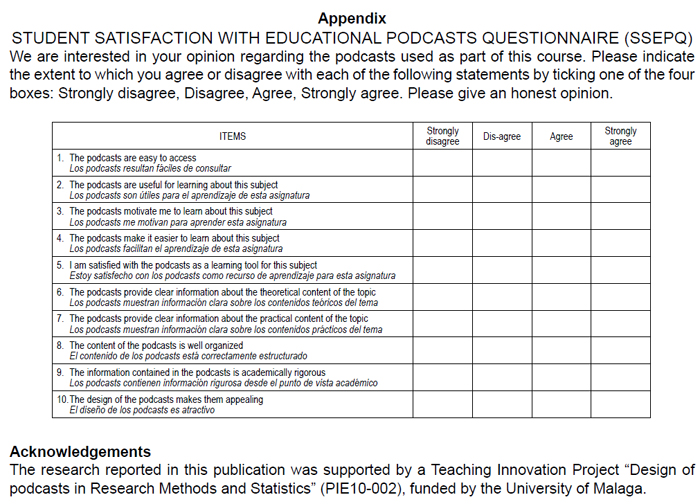
<body><![CDATA[<p><font face="Verdana" size="2">The Student Satisfaction with Educational Podcasts Questionnaire (SSEPQ). The questionnaire was developed in order to assess student satisfaction with educational podcasts in higher education. The SSEPQ consists of 10 Likert-type items with four response options (see <a href="#a1">Appendix</a>). The items assess satisfaction in terms of the perceived content adequacy (i.e. whether the content is well organized and whether the podcast provides clear information about the topic), ease of use, usefulness and benefits to learning from the podcast (i.e. whether using the podcast makes the learning process easier or increases students' motivation). These items were derived and discussed with a panel of experts who were involved in teaching innovation projects and had experience of teaching or supporting teaching in research methods courses for undergraduates. We expected the SSEPQ to show a one-factor structure, such that the total score on the questionnaire would provide a general index of students' satisfaction with podcasts.</font></p>     <p>&nbsp;</p>     <p align="center"><a name="a1"><img src="/img/revistas/ep/v10n2/informe4_apendice.jpg"></a></p>     <p>&nbsp;</p>     <p><font face="Verdana" size="2">Podcasts. The podcasts assessed in this study were 11 educational podcasts designed by the authors for the Methods and Statistics course of the Degree in Psychology with the aim of providing additional material to assist learning; they thus fall into the category of supplementary use podcasts. The podcasts, each of which lasted between 3 and 5 minutes, were presented in an audio-visual format using Microsoft PowerPoint, Audacity<sup>&reg;</sup> and Camtasia<sup>&reg;</sup> software. Each podcast presented a key course topic related to both the theoretical and practical aspects of several statistical analytic techniques (e.g. introduction to statistical hypothesis testing, Type I error and Type II error, Student's t-test for independent samples, Mann-Whitney test, correlation, etc.). The podcasts began with an introduction to the topic, followed by a short-summary of the concept and a step-by-step guide to performing and interpreting the statistical analysis of data using the IBM SPSS software package. Technical aspects were tested in order to ensure the quality of the video and audio. The podcasts were made available via the virtual campus platform and could be freely accessed throughout the academic year by students.</font></p>     <p><font face="Verdana" size="2"><b><i>Procedure</i></b></font></p>     <p><font face="Verdana" size="2">The SSEPQ was administered to students during the last day of the Research Methods and Statistics course. Participants were asked to indicate their ID number, age and sex, but were told that their data would be analysed anonymously and by researchers who were not involved in the teaching of the course.</font></p>     <p><font face="Verdana" size="2"><b>Data Analysis</b></font></p>     <p><font face="Verdana" size="2">In order to assess the expected one-factor structure of the SSEPQ a confirmatory factor analysis (CFA) was carried out via structural equation modelling, using the EQS 6.3 software package (Bentler, 2006). A cross-validation strategy was employed, splitting the sample into two random groups. The first sample was called 'calibration sample' (<i>N</i> = 177) and the second 'validation sample' (<i>N</i> = 199). The one-factor structure was fitted in both samples in order to provide more evidence of construct validity and to verify the structural model underlying the SSEPQ. Finally, this structure was also fitted in the total sample.</font></p>     <p><font face="Verdana" size="2">Analyses were performed on the polychoric correlation matrix of the items using the maximum likelihood and robust estimation methods. The Satorra-Bentler chi-square (&chi;<sup>2</sup><sub>S-B</sub>) was computed with the following goodness-of-fit indices (Bentler, 2006): the comparative fit index (CFI; Bentler, 1990), the non-normed fit index (NNFI; Bentler &amp; Bonnet, 1980) and the root mean square error of approximation (RMSEA; Browne &amp; Cudeck, 1993; Steiger, 2000). The CFI and NNFI measure the proportional improvement in fit by comparing a hypothesized model with the null model as baseline model. Values above .90 are generally considered as indicating an acceptable fit (Bentler, 1992; Bentler &amp; Bonet, 1980; Sharma, Mukherjee, Kumar, &amp; Dillon, 2005; Sun, 2005; Weston &amp; Gore, 2006), while a value close to .95 would indicate a good fit (Hu &amp; Bentler, 1999). The RMSEA is an absolute misfit index, and the closer its value to zero, the better the fit. Values below .08 indicate a reasonable fit (Browne &amp; Cudeck, 1993) and those below .06 a good fit (Hu &amp; Bentler, 1999).</font></p>     ]]></body>
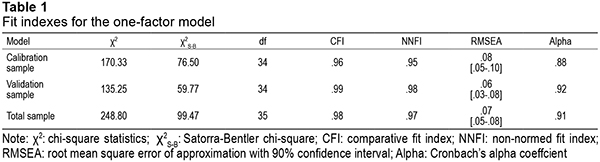
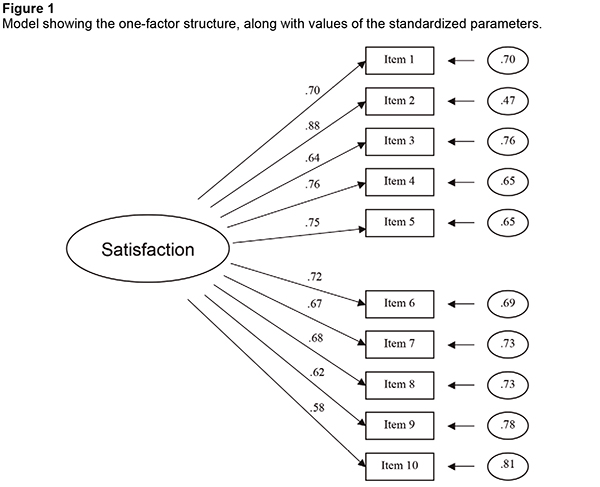
<body><![CDATA[<p><font face="Verdana" size="2">An item analysis was also performed by computing the corrected item-total score correlation. Internal consistency was assessed by Cronbach's alpha coefficient.</font></p>     <p><font face="Verdana" size="2">Having tested the one-factor structure of the SSEPQ, we then conducted a descriptive analysis of the total test and of each item in order to determine students' satisfaction with podcasts.</font></p>     <p>&nbsp;</p>     <p><font face="Verdana" size="2"><b>Results</b></font></p>     <p><font face="Verdana" size="2"><i><b>Factor structure and internal consistency</b></i></font></p>     <p><font face="Verdana" size="2">A CFA was performed to test the one-factor structure of the SSEPQ in the calibration sample. The values of the CFI and NNFI indicated a good fit of the model, as both were equal to or higher than .95. The value of the RMSEA, equal to .08, was also acceptable. The one-factor model was then tested in the validation sample, showing adequate goodness-of-fit indexes, with values similar to those found with the calibration sample. Finally, the goodness-of-fit indexes related to the test for the total sample were calculated; these also showed a good fit and, therefore, a stable structure across groups. <a href="#t1">Table 1</a> shows the fit indexes for the cross-validation strategy. Estimations for the standardized parameters of the model with the total sample are shown in <a href="#f1">Figure 1</a>; all are significant.</font></p>     <p>&nbsp;</p>     <p align="center"><a name="t1"></a><img src="/img/revistas/ep/v10n2/informe4_tabla1.jpg"></p>     <p>&nbsp;</p>     <p align="center"><a name="f1"></a><img src="/img/revistas/ep/v10n2/informe4_fig1.jpg"></p>     ]]></body>
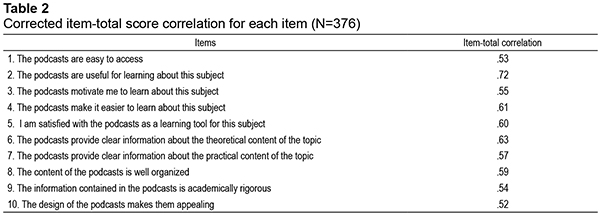
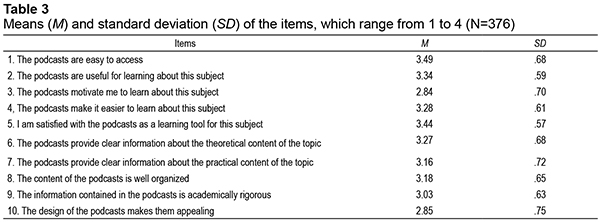
<body><![CDATA[<p>&nbsp;</p>     <p><font face="Verdana" size="2"><a href="#t2">Table 2</a> shows the corrected item-total score correlation for each item in relation to the total score of the SSEPQ. The results show satisfactory values above .40. The values of Cronbach's alpha presented in <a href="#t1">Table 1</a> (equal to or higher than .88) indicate that the questionnaire has adequate internal consistency.</font></p>     <p>&nbsp;</p>     <p align="center"><a name="t2"></a><img src="/img/revistas/ep/v10n2/informe4_tabla2.jpg"></p>     <p>&nbsp;</p>     <p><font face="Verdana" size="2"><b><i>Students' satisfaction with podcasts</i></b></font></p>     <p><font face="Verdana" size="2"><a href="#t3">Table 3</a> presents descriptive statistics for the items. All the mean values were higher than 3, except for item 10 (mean of 2.85). The total score on the SSEPQ is calculated by summing the 10 items, each rated from 1 to 4. High scores indicate a high overall satisfaction with the podcast. The total mean score for this sample was 31.93 (out of a possible maximum of 40). Taken together, these results show that the students were satisfied with the use of podcasts as educational tools.</font></p>     <p>&nbsp;</p>     <p align="center"><a name="t3"></a><img src="/img/revistas/ep/v10n2/informe4_tabla3.jpg"></p>     <p>&nbsp;</p>     ]]></body>
<body><![CDATA[<p><font face="Verdana" size="2"><b>Discussion</b></font></p>     <p><font face="Verdana" size="2">The main purpose of this paper was to present a brief, simple and standard questionnaire for assessing students' satisfaction with educational podcasts in higher education: <i>The Student Satisfaction with Educational Podcasts Questionnaire</i> (SSEPQ). The SSEPQ consists of 10 Likert-type items that gather students' views regarding content adequacy, ease of use, usefulness and benefits to learning from the podcasts they have used during a course.</font></p>     <p><font face="Verdana" size="2">Results from the CFA showed that the questionnaire has a one-factor structure, which supports the use of the total score as a global index of students' satisfaction with podcasts. The one-factor model was replicated across a second independent sample from the same population, as well as for the total sample. All the items showed a satisfactory corrected item-total correlation. Results from the reliability analyses also indicated that the SSEPQ has adequate internal consistency.</font></p>     <p><font face="Verdana" size="2">Overall, the SSEPQ total score obtained in this sample indicates that students were satisfied with the short 3-5 minute podcasts as a tool to complement traditional educational resources. Specifically, students considered that the podcasts provided clear and rigorous information about the topic, that their content was well organized and that they were easy to access, useful and motivating to learn about the subject. These results are consistent with previous research based on survey questions or interviews, which found that students were satisfied with the use of podcasts (Lakhal et al., 2007; Traphagan et al., 2010) and perceived their benefits as a learning tool (Clark et al., 2007; Bolliger et al., 2010; Evans, 2008; Hill &amp; Nelson, 2011; Kay &amp; Kletskin, 2012; Montealegre et al., 2010; Popova et al., 2014; Vajockzi et al., 2010; Van Zanten et al., 2012). Our descriptive analysis for each item showed mean values above 3 on all items, except for the item referring to the design of the podcast (i.e. whether it made them appealing) which was rated 2.85. This result suggests that the design of the podcasts might need to be revised to make them more attractive to students.</font></p>     <p><font face="Verdana" size="2">The main advantage of the SSEPQ is its brevity and that it can provide teachers with direct feedback from their students, thus allowing them to make continuous improvements to the teaching/learning process. Advances in new technologies, of which teachers are not expert users, also highlight the need for tools that can provide data regarding students' satisfaction with these new technologies. As Biggs (2001) pointed out, keeping track of students' views regarding the different aspects of their learning process should be regarded as a cornerstone of quality assurance in higher education. Indeed, although a lot of educational research has highlighted the importance of providing adequate and useful feedback to students, ensuring that teachers receive adequate and useful feedback <i>from</i> students is also fundamental. The assessment of students' satisfaction with the SSEPQ can be used to identify which aspects of podcasts should be improved to ensure that they are effective learning tools.</font></p>     <p><font face="Verdana" size="2">This study has also some limitations. First, the questionnaire used here was developed to evaluate educational podcasts that had been designed for a research methods course in psychology. Consequently, further research is required to provide evidence of its applicability to different courses and knowledge domains. If the questionnaire is shown to be an applicable tool, it could be then used in comparative studies of student satisfaction with podcasts across different scientific fields of higher education. Second, we focused solely on the indicator of students' satisfaction with podcasts. Other indicators (e.g. educational outcome) can also be considered in order to assess whether podcasts are effective and appropriate tools to improve or facilitate students' learning experience.</font></p>     <p><font face="Verdana" size="2">To sum up, the SSEPQ is a brief and standard questionnaire that assesses students' satisfaction with educational podcasts. Lecturers can find the SSEPQ a helpful tool when developing and using such podcasts to improve their teaching. Our results indicate a high level of satisfaction with the use of short 3-5 minute podcasts as a supplementary learning tool.</font></p>     <p>&nbsp;</p>     <p><font face="Verdana" size="2"><b>References</b></font></p>     <!-- ref --><p><font face="Verdana" size="2">1. Abdous, M., Facer, B. C., &amp; Yen, C. (2012). Academic effectiveness of podcasting: A comparative study of integrated versus supplemental use of podcasting in second language classes. Computers and Education, 58, 43-52. <a href="https://doi.org/10.1016/j.compedu.2011.08.021" target="_blank">https://doi.org/10.1016/j.compedu.2011.08.021</a>.    &nbsp;&nbsp;&nbsp;&nbsp;&nbsp;&nbsp;&nbsp;&nbsp;[&#160;<a href="javascript:void(0);" onclick="javascript: window.open('/scielo.php?script=sci_nlinks&ref=2185278&pid=S1989-3809201700020000400001&lng=','','width=640,height=500,resizable=yes,scrollbars=1,menubar=yes,');">Links</a>&#160;]<!-- end-ref --></font></p>    <!-- ref --><p><font face="Verdana" size="2">2. Abt, G., &amp; Barry, T. (2007). The quantitative effect of students using podcasts in a first-year undergraduate exercise physiology module. Bioscience Education, 10, 1-9. <a href="https://doi.org/10.3108/beej.10.8" target="_blank">https://doi.org/10.3108/beej.10.8</a>.    &nbsp;&nbsp;&nbsp;&nbsp;&nbsp;&nbsp;&nbsp;&nbsp;[&#160;<a href="javascript:void(0);" onclick="javascript: window.open('/scielo.php?script=sci_nlinks&ref=2185280&pid=S1989-3809201700020000400002&lng=','','width=640,height=500,resizable=yes,scrollbars=1,menubar=yes,');">Links</a>&#160;]<!-- end-ref --></font></p>    <!-- ref --><p><font face="Verdana" size="2">3. Alonso-Arbiol, I. (2009). Use of audio likes improves students' performance in higher education. In A. Lazinica and C. Calafate (Eds.), Technology education and development (pp. 447-456). InTech. <a href="https://doi.org/10.5772/7271" target="_blank">https://doi.org/10.5772/7271</a>.    &nbsp;&nbsp;&nbsp;&nbsp;&nbsp;&nbsp;&nbsp;&nbsp;[&#160;<a href="javascript:void(0);" onclick="javascript: window.open('/scielo.php?script=sci_nlinks&ref=2185282&pid=S1989-3809201700020000400003&lng=','','width=640,height=500,resizable=yes,scrollbars=1,menubar=yes,');">Links</a>&#160;]<!-- end-ref --></font></p>    <!-- ref --><p><font face="Verdana" size="2">4. Bentler, P. M. (1990). Comparative fit indexes in structural models. Psychological Bulletin, 107, 238-246. <a href="https://doi.org/10.1037/0033-2909.107.2.238" target="_blank">https://doi.org/10.1037/0033-2909.107.2.238</a>.    &nbsp;&nbsp;&nbsp;&nbsp;&nbsp;&nbsp;&nbsp;&nbsp;[&#160;<a href="javascript:void(0);" onclick="javascript: window.open('/scielo.php?script=sci_nlinks&ref=2185284&pid=S1989-3809201700020000400004&lng=','','width=640,height=500,resizable=yes,scrollbars=1,menubar=yes,');">Links</a>&#160;]<!-- end-ref --></font></p>    <!-- ref --><p><font face="Verdana" size="2">5. Bentler, P. M. (1992). On the fit of models to covariances and methodology to the Bulletin. Psychological Bulletin, 112, 400-404. <a href="https://doi.org/10.1037/0033-2909.112.3.400" target="_blank">https://doi.org/10.1037/0033-2909.112.3.400</a>.    &nbsp;&nbsp;&nbsp;&nbsp;&nbsp;&nbsp;&nbsp;&nbsp;[&#160;<a href="javascript:void(0);" onclick="javascript: window.open('/scielo.php?script=sci_nlinks&ref=2185286&pid=S1989-3809201700020000400005&lng=','','width=640,height=500,resizable=yes,scrollbars=1,menubar=yes,');">Links</a>&#160;]<!-- end-ref --></font></p>    <!-- ref --><p><font face="Verdana" size="2">6. Bentler, P. M. (2006). EQS 6 Structural equations program manual. Encino, CA: Multivariate Software, Inc.    &nbsp;&nbsp;&nbsp;&nbsp;&nbsp;&nbsp;&nbsp;&nbsp;[&#160;<a href="javascript:void(0);" onclick="javascript: window.open('/scielo.php?script=sci_nlinks&ref=2185288&pid=S1989-3809201700020000400006&lng=','','width=640,height=500,resizable=yes,scrollbars=1,menubar=yes,');">Links</a>&#160;]<!-- end-ref --></font></p>    <!-- ref --><p><font face="Verdana" size="2">7. Bentler, P. M., &amp; Bonett, D. G. (1980). Significance tests and goodness of fit in the analysis of covariance structures. Psychological Bulletin, 88, 588-606. <a href="http://doi.org/10.1037/0033-2909.88.3.588" target="_blank">http://doi.org/10.1037/0033-2909.88.3.588</a>.    &nbsp;&nbsp;&nbsp;&nbsp;&nbsp;&nbsp;&nbsp;&nbsp;[&#160;<a href="javascript:void(0);" onclick="javascript: window.open('/scielo.php?script=sci_nlinks&ref=2185290&pid=S1989-3809201700020000400007&lng=','','width=640,height=500,resizable=yes,scrollbars=1,menubar=yes,');">Links</a>&#160;]<!-- end-ref --></font></p>    <!-- ref --><p><font face="Verdana" size="2">8. Biggs, J. (2001). The reflective institution: Assuring and enhancing the quality of teachingand learning. Higher Education, 41, 221-238. <a href="https://doi.org/10.1023/A:1004181331049" target="_blank">https://doi.org/10.1023/A:1004181331049</a>.    &nbsp;&nbsp;&nbsp;&nbsp;&nbsp;&nbsp;&nbsp;&nbsp;[&#160;<a href="javascript:void(0);" onclick="javascript: window.open('/scielo.php?script=sci_nlinks&ref=2185292&pid=S1989-3809201700020000400008&lng=','','width=640,height=500,resizable=yes,scrollbars=1,menubar=yes,');">Links</a>&#160;]<!-- end-ref --></font></p>    <!-- ref --><p><font face="Verdana" size="2">9. Bolden, B., &amp; Nahachewsky, J. (2015). Podcast creation as transformative music engagement. Music Education Research, 17, 17-33. <a href="https://doi.org/10.1080/14613808.2014.969219" target="_blank">https://doi.org/10.1080/14613808.2014.969219</a>.    &nbsp;&nbsp;&nbsp;&nbsp;&nbsp;&nbsp;&nbsp;&nbsp;[&#160;<a href="javascript:void(0);" onclick="javascript: window.open('/scielo.php?script=sci_nlinks&ref=2185294&pid=S1989-3809201700020000400009&lng=','','width=640,height=500,resizable=yes,scrollbars=1,menubar=yes,');">Links</a>&#160;]<!-- end-ref --></font></p>    <!-- ref --><p><font face="Verdana" size="2">10. Bolliger, D. U., Supanakorn, S., &amp; Boggs, C. (2010). Impact of podcasting on student motivation in the online learning environment. Computers and Education, 55, 714-722. <a href="https://doi.org/10.1016/j.compedu.2010.03.004" target="_blank">https://doi.org/10.1016/j.compedu.2010.03.004</a>.    &nbsp;&nbsp;&nbsp;&nbsp;&nbsp;&nbsp;&nbsp;&nbsp;[&#160;<a href="javascript:void(0);" onclick="javascript: window.open('/scielo.php?script=sci_nlinks&ref=2185296&pid=S1989-3809201700020000400010&lng=','','width=640,height=500,resizable=yes,scrollbars=1,menubar=yes,');">Links</a>&#160;]<!-- end-ref --></font></p>    <!-- ref --><p><font face="Verdana" size="2">11. Browne M. W., &amp; Cudeck, R. (1993). Alternative ways of assessing model fit. In K. Bollen and J. Long (Eds.), Testing structural equation models (pp. 136-162). Newbury Park, CA: Sage.    &nbsp;&nbsp;&nbsp;&nbsp;&nbsp;&nbsp;&nbsp;&nbsp;[&#160;<a href="javascript:void(0);" onclick="javascript: window.open('/scielo.php?script=sci_nlinks&ref=2185298&pid=S1989-3809201700020000400011&lng=','','width=640,height=500,resizable=yes,scrollbars=1,menubar=yes,');">Links</a>&#160;]<!-- end-ref --></font></p>    <!-- ref --><p><font face="Verdana" size="2">12. Burke, S., &amp; Cody, W. (2014). Podcasting in undergraduate nursing programs. Nurse Educator, 39(5), 256-259. <a href="https://doi.org/10.1097/NNE.0000000000000059" target="_blank">https://doi.org/10.1097/NNE.0000000000000059</a>.    &nbsp;&nbsp;&nbsp;&nbsp;&nbsp;&nbsp;&nbsp;&nbsp;[&#160;<a href="javascript:void(0);" onclick="javascript: window.open('/scielo.php?script=sci_nlinks&ref=2185300&pid=S1989-3809201700020000400012&lng=','','width=640,height=500,resizable=yes,scrollbars=1,menubar=yes,');">Links</a>&#160;]<!-- end-ref --></font></p>    <!-- ref --><p><font face="Verdana" size="2">13. Carvalho, A., Aguiar, C., &amp; Maciel, R. (2009). A taxonomy of podcast and its application to higher education. In ALT-C 2009 "In dreams begins responsibility"-choice, evidence and change, 8-10 September 2009, Manchester. Retrieved from <a href="http://repository.alt.ac.uk/638/1/ALT-C_09_proceedings_090806_web_0161.pdf" target="_blank">http://repository.alt.ac.uk/638/1/ALT-C_09_proceedings_090806_web_0161.pdf</a>.    &nbsp;&nbsp;&nbsp;&nbsp;&nbsp;&nbsp;&nbsp;&nbsp;[&#160;<a href="javascript:void(0);" onclick="javascript: window.open('/scielo.php?script=sci_nlinks&ref=2185302&pid=S1989-3809201700020000400013&lng=','','width=640,height=500,resizable=yes,scrollbars=1,menubar=yes,');">Links</a>&#160;]<!-- end-ref --></font></p>    <!-- ref --><p><font face="Verdana" size="2">14. Elliott, K. M., &amp; Shin, D. (2002). Student satisfaction: An alternative approach to assessing this important concept. Journal of Higher Education Policy and Management, 24, 197-209. <a href="https://doi.org/10.1080/1360080022000013518" target="_blank">https://doi.org/10.1080/1360080022000013518</a>.    &nbsp;&nbsp;&nbsp;&nbsp;&nbsp;&nbsp;&nbsp;&nbsp;[&#160;<a href="javascript:void(0);" onclick="javascript: window.open('/scielo.php?script=sci_nlinks&ref=2185304&pid=S1989-3809201700020000400014&lng=','','width=640,height=500,resizable=yes,scrollbars=1,menubar=yes,');">Links</a>&#160;]<!-- end-ref --></font></p>    <!-- ref --><p><font face="Verdana" size="2">15. Evans, C. (2008). The effectiveness of m-learning in the form of podcast revision lectures in higher education. Computers and Education, 50, 491-498. <a href="https://doi.org/10.1016/j.compedu.2007.09.016" target="_blank">https://doi.org/10.1016/j.compedu.2007.09.016</a>.    &nbsp;&nbsp;&nbsp;&nbsp;&nbsp;&nbsp;&nbsp;&nbsp;[&#160;<a href="javascript:void(0);" onclick="javascript: window.open('/scielo.php?script=sci_nlinks&ref=2185306&pid=S1989-3809201700020000400015&lng=','','width=640,height=500,resizable=yes,scrollbars=1,menubar=yes,');">Links</a>&#160;]<!-- end-ref --></font></p>    <!-- ref --><p><font face="Verdana" size="2">16. Fern&aacute;ndez, V., Simo, P., &amp; Sallan, J. M. (2009). Podcasting: A new technological tool to facilitate good practice in higher education. Computers and Education, 53, 385-392. <a href="https://doi.org/10.1016/j.compedu.2009.02.014" target="_blank">https://doi.org/10.1016/j.compedu.2009.02.014</a>.    &nbsp;&nbsp;&nbsp;&nbsp;&nbsp;&nbsp;&nbsp;&nbsp;[&#160;<a href="javascript:void(0);" onclick="javascript: window.open('/scielo.php?script=sci_nlinks&ref=2185308&pid=S1989-3809201700020000400016&lng=','','width=640,height=500,resizable=yes,scrollbars=1,menubar=yes,');">Links</a>&#160;]<!-- end-ref --></font></p>    <!-- ref --><p><font face="Verdana" size="2">17. Heilesen, S. B. (2010). What is the academic efficacy of podcasting? Computers and Education, 55, 1063-1068. <a href="https://doi.org/10.1016/j.compedu.2010.05.002" target="_blank">https://doi.org/10.1016/j.compedu.2010.05.002</a>.    &nbsp;&nbsp;&nbsp;&nbsp;&nbsp;&nbsp;&nbsp;&nbsp;[&#160;<a href="javascript:void(0);" onclick="javascript: window.open('/scielo.php?script=sci_nlinks&ref=2185310&pid=S1989-3809201700020000400017&lng=','','width=640,height=500,resizable=yes,scrollbars=1,menubar=yes,');">Links</a>&#160;]<!-- end-ref --></font></p>    <!-- ref --><p><font face="Verdana" size="2">18. Hill, J. L., &amp; Nelson, A. (2011). New technology, new pedagogy? Employing video podcasts in learning and teaching about exotic ecosystems. Environmental Education Research, 17, 393-408. <a href="https://doi.org/10.1080/13504622.2010.545873" target="_blank">https://doi.org/10.1080/13504622.2010.545873</a>.    &nbsp;&nbsp;&nbsp;&nbsp;&nbsp;&nbsp;&nbsp;&nbsp;[&#160;<a href="javascript:void(0);" onclick="javascript: window.open('/scielo.php?script=sci_nlinks&ref=2185312&pid=S1989-3809201700020000400018&lng=','','width=640,height=500,resizable=yes,scrollbars=1,menubar=yes,');">Links</a>&#160;]<!-- end-ref --></font></p>    <!-- ref --><p><font face="Verdana" size="2">19. Hu, L., &amp; Bentler, P. M. (1999). Cutoff criteria for the indexes in covariance structure analysis: Conventional criteria versus new alternatives. Structural Equation Modeling, 6, 1-55. <a href="https://doi.org/10.1080/10705519909540118" target="_blank">https://doi.org/10.1080/10705519909540118</a>.    &nbsp;&nbsp;&nbsp;&nbsp;&nbsp;&nbsp;&nbsp;&nbsp;[&#160;<a href="javascript:void(0);" onclick="javascript: window.open('/scielo.php?script=sci_nlinks&ref=2185314&pid=S1989-3809201700020000400019&lng=','','width=640,height=500,resizable=yes,scrollbars=1,menubar=yes,');">Links</a>&#160;]<!-- end-ref --></font></p>    <!-- ref --><p><font face="Verdana" size="2">20. Kay, R., &amp; Kletskin, I. (2012). Evaluating the use of problem-based video podcasts to teach mathematics in higher education. Computers and Education, 59, 619-627. <a href="https://doi.org/10.1016/j.compedu.2012.03.007" target="_blank">https://doi.org/10.1016/j.compedu.2012.03.007</a>.    &nbsp;&nbsp;&nbsp;&nbsp;&nbsp;&nbsp;&nbsp;&nbsp;[&#160;<a href="javascript:void(0);" onclick="javascript: window.open('/scielo.php?script=sci_nlinks&ref=2185316&pid=S1989-3809201700020000400020&lng=','','width=640,height=500,resizable=yes,scrollbars=1,menubar=yes,');">Links</a>&#160;]<!-- end-ref --></font></p>    <!-- ref --><p><font face="Verdana" size="2">21. Lakhal, S., Khechine, H., &amp; Pascot, D. (2007). Evaluation of the effectiveness of podcasting in teaching and learning. In G. Richards (Ed.), Proceedings of World Conference on E-Learning in Corporate, Government, Healthcare, and Higher Education 2007 (pp. 6181-6188). Chesapeake, VA: AACE.    &nbsp;&nbsp;&nbsp;&nbsp;&nbsp;&nbsp;&nbsp;&nbsp;[&#160;<a href="javascript:void(0);" onclick="javascript: window.open('/scielo.php?script=sci_nlinks&ref=2185318&pid=S1989-3809201700020000400021&lng=','','width=640,height=500,resizable=yes,scrollbars=1,menubar=yes,');">Links</a>&#160;]<!-- end-ref --></font></p>    <!-- ref --><p><font face="Verdana" size="2">22. Lee, M. J. K., &amp; Chan, A. (2007). Reducing the effects of isolation and promoting inclusivity for distance learners through podcasting. Turkish Online Journal of Distance Education-TOJDE, 8, 85-104.    &nbsp;&nbsp;&nbsp;&nbsp;&nbsp;&nbsp;&nbsp;&nbsp;[&#160;<a href="javascript:void(0);" onclick="javascript: window.open('/scielo.php?script=sci_nlinks&ref=2185320&pid=S1989-3809201700020000400022&lng=','','width=640,height=500,resizable=yes,scrollbars=1,menubar=yes,');">Links</a>&#160;]<!-- end-ref --></font></p>    <!-- ref --><p><font face="Verdana" size="2">23. Leijen, A., Lam, I., Wildschut, L., Simons, P. R. J., &amp; Admiraal, W. (2009). Streaming video to enhance students' reflection in dance education. Computers and Education, 52, 169-176. <a href="https://doi.org/10.1016/j.compedu.2008.07.010" target="_blank">https://doi.org/10.1016/j.compedu.2008.07.010</a>.    &nbsp;&nbsp;&nbsp;&nbsp;&nbsp;&nbsp;&nbsp;&nbsp;[&#160;<a href="javascript:void(0);" onclick="javascript: window.open('/scielo.php?script=sci_nlinks&ref=2185322&pid=S1989-3809201700020000400023&lng=','','width=640,height=500,resizable=yes,scrollbars=1,menubar=yes,');">Links</a>&#160;]<!-- end-ref --></font></p>    <!-- ref --><p><font face="Verdana" size="2">24. McGarr, O. (2009). A review of podcasting in higher education: Its influence on the traditional lecture. Australasian Journal of Educational Technology, 25(3), 209-321. <a href="https://doi.org/10.14742/ajet.1136" target="_blank">https://doi.org/10.14742/ajet.1136</a>.    &nbsp;&nbsp;&nbsp;&nbsp;&nbsp;&nbsp;&nbsp;&nbsp;[&#160;<a href="javascript:void(0);" onclick="javascript: window.open('/scielo.php?script=sci_nlinks&ref=2185324&pid=S1989-3809201700020000400024&lng=','','width=640,height=500,resizable=yes,scrollbars=1,menubar=yes,');">Links</a>&#160;]<!-- end-ref --></font></p>    <!-- ref --><p><font face="Verdana" size="2">25. Montealegre, M. C., Carvajal, D., Holgu&iacute;n, A., Pedraza, R., &amp; Jaramillo, C. A. (2010). Implementation of podcast and clickers in two biology courses at Los Andes University and impact evaluation in the teaching-learning process. Procedia Social and Behavioral Science, 2, 1767-1770. <a href="https://doi.org/10.1016/j.sbspro.2010.03.981" target="_blank">https://doi.org/10.1016/j.sbspro.2010.03.981</a>.    &nbsp;&nbsp;&nbsp;&nbsp;&nbsp;&nbsp;&nbsp;&nbsp;[&#160;<a href="javascript:void(0);" onclick="javascript: window.open('/scielo.php?script=sci_nlinks&ref=2185326&pid=S1989-3809201700020000400025&lng=','','width=640,height=500,resizable=yes,scrollbars=1,menubar=yes,');">Links</a>&#160;]<!-- end-ref --></font></p>    <!-- ref --><p><font face="Verdana" size="2">26. Narula, N., Ahmed, L., &amp; Rudkowski, J. (2012). An evaluation of the '5 Minute Medicine' video podcast series compared to conventional medical resources for the internal medicine clerkship. Medical Teacher, 34, E751-E755. <a href="https://doi.org/10.3109/0142159X.2012.689446" target="_blank">https://doi.org/10.3109/0142159X.2012.689446</a>.    &nbsp;&nbsp;&nbsp;&nbsp;&nbsp;&nbsp;&nbsp;&nbsp;[&#160;<a href="javascript:void(0);" onclick="javascript: window.open('/scielo.php?script=sci_nlinks&ref=2185328&pid=S1989-3809201700020000400026&lng=','','width=640,height=500,resizable=yes,scrollbars=1,menubar=yes,');">Links</a>&#160;]<!-- end-ref --></font></p>    <!-- ref --><p><font face="Verdana" size="2">27. O'Bannon, B. W., Lubke, J. K., Beard, J. L., &amp; Britt, V. G. (2011). Using podcasts to replace lecture: Effects on student achievement. Computers and Education, 57, 1885-1892. <a href="https://doi.org/10.1016/j.compedu.2011.04.001" target="_blank">https://doi.org/10.1016/j.compedu.2011.04.001</a>.    &nbsp;&nbsp;&nbsp;&nbsp;&nbsp;&nbsp;&nbsp;&nbsp;[&#160;<a href="javascript:void(0);" onclick="javascript: window.open('/scielo.php?script=sci_nlinks&ref=2185330&pid=S1989-3809201700020000400027&lng=','','width=640,height=500,resizable=yes,scrollbars=1,menubar=yes,');">Links</a>&#160;]<!-- end-ref --></font></p>    <!-- ref --><p><font face="Verdana" size="2">28. Pegrum, M., Bartle, E., &amp; Longnecker, N. (2015). Can creative podcasting promote deep learning? The use of podcasting for learning content in an undergraduate science unit. British Journal of Educational Technology, 46, 142-152. <a href="https://doi.org/10.1111/bjet.12133" target="_blank">https://doi.org/10.1111/bjet.12133</a>.    &nbsp;&nbsp;&nbsp;&nbsp;&nbsp;&nbsp;&nbsp;&nbsp;[&#160;<a href="javascript:void(0);" onclick="javascript: window.open('/scielo.php?script=sci_nlinks&ref=2185332&pid=S1989-3809201700020000400028&lng=','','width=640,height=500,resizable=yes,scrollbars=1,menubar=yes,');">Links</a>&#160;]<!-- end-ref --></font></p>    <!-- ref --><p><font face="Verdana" size="2">29. Popova, A., &amp; Edirisingha, P. (2010). How can podcasts support engaging students in learning activities? Procedia Social and Behavioral Science, 2, 5034-5038. <a href="https://doi.org/10.1016/j.sbspro.2010.03.816" target="_blank">https://doi.org/10.1016/j.sbspro.2010.03.816</a>.    &nbsp;&nbsp;&nbsp;&nbsp;&nbsp;&nbsp;&nbsp;&nbsp;[&#160;<a href="javascript:void(0);" onclick="javascript: window.open('/scielo.php?script=sci_nlinks&ref=2185334&pid=S1989-3809201700020000400029&lng=','','width=640,height=500,resizable=yes,scrollbars=1,menubar=yes,');">Links</a>&#160;]<!-- end-ref --></font></p>    <!-- ref --><p><font face="Verdana" size="2">30. Popova, A., Kirschner, P. A., &amp; Joiner, R. (2014). Effects of primer podcasts on stimulating learning from lectures: How do students engage? British Journal of Educational Technology, 45, 330-339. <a href="https://doi.org/10.1111/bjet.12023" target="_blank">https://doi.org/10.1111/bjet.12023</a>.    &nbsp;&nbsp;&nbsp;&nbsp;&nbsp;&nbsp;&nbsp;&nbsp;[&#160;<a href="javascript:void(0);" onclick="javascript: window.open('/scielo.php?script=sci_nlinks&ref=2185336&pid=S1989-3809201700020000400030&lng=','','width=640,height=500,resizable=yes,scrollbars=1,menubar=yes,');">Links</a>&#160;]<!-- end-ref --></font></p>    <!-- ref --><p><font face="Verdana" size="2">31. Reychav, I., &amp; Wu, W. (2015). Mobile collaborative learning: The role of individual learning in groups through text and video content delivery in tablets. Computers in Human Behavior, 50, 520-534. <a href="https://doi.org/10.1016/j.chb.2015.04.019" target="_blank">https://doi.org/10.1016/j.chb.2015.04.019</a>.    &nbsp;&nbsp;&nbsp;&nbsp;&nbsp;&nbsp;&nbsp;&nbsp;[&#160;<a href="javascript:void(0);" onclick="javascript: window.open('/scielo.php?script=sci_nlinks&ref=2185338&pid=S1989-3809201700020000400031&lng=','','width=640,height=500,resizable=yes,scrollbars=1,menubar=yes,');">Links</a>&#160;]<!-- end-ref --></font></p>    <!-- ref --><p><font face="Verdana" size="2">32. Rom&aacute;n, P., &amp; Solano, I. M. (2010). Sistemas de audio y v&iacute;deo por Internet. En I. M. Solano (ed.), Podcast educativo. Aplicaciones y orientaciones del m-learning para la ense&ntilde;anza (pp. 55-74). Sevilla: Editorial MAD.    &nbsp;&nbsp;&nbsp;&nbsp;&nbsp;&nbsp;&nbsp;&nbsp;[&#160;<a href="javascript:void(0);" onclick="javascript: window.open('/scielo.php?script=sci_nlinks&ref=2185340&pid=S1989-3809201700020000400032&lng=','','width=640,height=500,resizable=yes,scrollbars=1,menubar=yes,');">Links</a>&#160;]<!-- end-ref --></font></p>    <!-- ref --><p><font face="Verdana" size="2">33. Sharma, S., Mukherjee, S., Kumar, A., &amp; Dillon, W. R. (2005). A simulation study to investigate the use of cutoff values for assessing model fit in covariance structure models. Journal of Business Research, 58, 935-943. <a href="https://doi.org/10.1016/j.jbusres.2003.10.007" target="_blank">https://doi.org/10.1016/j.jbusres.2003.10.007</a>.    &nbsp;&nbsp;&nbsp;&nbsp;&nbsp;&nbsp;&nbsp;&nbsp;[&#160;<a href="javascript:void(0);" onclick="javascript: window.open('/scielo.php?script=sci_nlinks&ref=2185342&pid=S1989-3809201700020000400033&lng=','','width=640,height=500,resizable=yes,scrollbars=1,menubar=yes,');">Links</a>&#160;]<!-- end-ref --></font></p>    <!-- ref --><p><font face="Verdana" size="2">34. Steiger, J. H. (2000). Point estimation, hypothesis testing, and interval estimation using the RMSEA: Some comments and a reply to Hayduk and Glaser. Structural Equation Modeling, 7, 149-162. <a href="https://doi.org/10.1207/S15328007SEM0702_1" target="_blank">https://doi.org/10.1207/S15328007SEM0702_1</a>.    &nbsp;&nbsp;&nbsp;&nbsp;&nbsp;&nbsp;&nbsp;&nbsp;[&#160;<a href="javascript:void(0);" onclick="javascript: window.open('/scielo.php?script=sci_nlinks&ref=2185344&pid=S1989-3809201700020000400034&lng=','','width=640,height=500,resizable=yes,scrollbars=1,menubar=yes,');">Links</a>&#160;]<!-- end-ref --></font></p>    <!-- ref --><p><font face="Verdana" size="2">35. Sun, J. (2005). Assessing goodness of fit in confirmatory factor analysis. Measurement &amp; Evaluation in Counseling &amp; Development, 37, 240-256.    &nbsp;&nbsp;&nbsp;&nbsp;&nbsp;&nbsp;&nbsp;&nbsp;[&#160;<a href="javascript:void(0);" onclick="javascript: window.open('/scielo.php?script=sci_nlinks&ref=2185346&pid=S1989-3809201700020000400035&lng=','','width=640,height=500,resizable=yes,scrollbars=1,menubar=yes,');">Links</a>&#160;]<!-- end-ref --></font></p>    <!-- ref --><p><font face="Verdana" size="2">36. Taylor, L., &amp; Clark, S. (2010). Educational design of short, audio-only podcasts: The teacher and student experience. Australasian Journal of Educational Technology, 26, 386-399. <a href="https://doi.org/10.14742/ajet.1082" target="_blank">https://doi.org/10.14742/ajet.1082</a>.    &nbsp;&nbsp;&nbsp;&nbsp;&nbsp;&nbsp;&nbsp;&nbsp;[&#160;<a href="javascript:void(0);" onclick="javascript: window.open('/scielo.php?script=sci_nlinks&ref=2185348&pid=S1989-3809201700020000400036&lng=','','width=640,height=500,resizable=yes,scrollbars=1,menubar=yes,');">Links</a>&#160;]<!-- end-ref --></font></p>    <!-- ref --><p><font face="Verdana" size="2">37. Traphagan, T., Kusera, J. V., &amp; Kishi, K. (2010). Impact of class lecture webcasting on attendance and learning. Educational Technology Research and Development, 58, 19-37. <a href="https://doi.org/10.1007/s11423-009-9128-7" target="_blank">https://doi.org/10.1007/s11423-009-9128-7</a>.    &nbsp;&nbsp;&nbsp;&nbsp;&nbsp;&nbsp;&nbsp;&nbsp;[&#160;<a href="javascript:void(0);" onclick="javascript: window.open('/scielo.php?script=sci_nlinks&ref=2185350&pid=S1989-3809201700020000400037&lng=','','width=640,height=500,resizable=yes,scrollbars=1,menubar=yes,');">Links</a>&#160;]<!-- end-ref --></font></p>    <!-- ref --><p><font face="Verdana" size="2">38. Vajoczki, S., Watt, S., Marquis, N., &amp; Holshausen, K. (2010). Podcasts: Are they an effective tool to enhance student learning? A case study from McMaster University, Hamilton Canada. Journal of Educational Multimedia and Hypermedia, 19, 349-362.    &nbsp;&nbsp;&nbsp;&nbsp;&nbsp;&nbsp;&nbsp;&nbsp;[&#160;<a href="javascript:void(0);" onclick="javascript: window.open('/scielo.php?script=sci_nlinks&ref=2185352&pid=S1989-3809201700020000400038&lng=','','width=640,height=500,resizable=yes,scrollbars=1,menubar=yes,');">Links</a>&#160;]<!-- end-ref --></font></p>    <!-- ref --><p><font face="Verdana" size="2">39. Van Zanten, R., Somogyi, S., &amp; Curro, G. (2012). Purpose and preference in educational podcasting. British Journal of Educational Technology, 43, 130-138. <a href="https://doi.org/20.1111/j.1467-8535.2010.01153.x" target="_blank">https://doi.org/20.1111/j.1467-8535.2010.01153.x</a>.    &nbsp;&nbsp;&nbsp;&nbsp;&nbsp;&nbsp;&nbsp;&nbsp;[&#160;<a href="javascript:void(0);" onclick="javascript: window.open('/scielo.php?script=sci_nlinks&ref=2185354&pid=S1989-3809201700020000400039&lng=','','width=640,height=500,resizable=yes,scrollbars=1,menubar=yes,');">Links</a>&#160;]<!-- end-ref --></font></p>    <!-- ref --><p><font face="Verdana" size="2">40. Vogele, C., &amp; Gard, E. T. (2006). Podcasting for corporations and universities: Look before you leap. Journal of Internet Law, 10, 3-13.    &nbsp;&nbsp;&nbsp;&nbsp;&nbsp;&nbsp;&nbsp;&nbsp;[&#160;<a href="javascript:void(0);" onclick="javascript: window.open('/scielo.php?script=sci_nlinks&ref=2185356&pid=S1989-3809201700020000400040&lng=','','width=640,height=500,resizable=yes,scrollbars=1,menubar=yes,');">Links</a>&#160;]<!-- end-ref --></font></p>    <!-- ref --><p><font face="Verdana" size="2">41. Weston, R., &amp; Gore, P. A. (2006). A Brief Guide to Structural Equation Modeling. The Counseling Psychologist, 34, 719-751. <a href="https://doi.org/10.1177/0011000006286345" target="_blank">https://doi.org/10.1177/0011000006286345</a>.    &nbsp;&nbsp;&nbsp;&nbsp;&nbsp;&nbsp;&nbsp;&nbsp;[&#160;<a href="javascript:void(0);" onclick="javascript: window.open('/scielo.php?script=sci_nlinks&ref=2185358&pid=S1989-3809201700020000400041&lng=','','width=640,height=500,resizable=yes,scrollbars=1,menubar=yes,');">Links</a>&#160;]<!-- end-ref --></font></p>    <!-- ref --><p><font face="Verdana" size="2">42. Wieling, M., &amp; Hofman, W. (2010). The impact of online video lecture recordings and automated feedback on student performance. Computers and Education, 54, 992-998. <a href="https://doi.org/10.1016/j.compedu.2009.10.002" target="_blank">https://doi.org/10.1016/j.compedu.2009.10.002</a>.    &nbsp;&nbsp;&nbsp;&nbsp;&nbsp;&nbsp;&nbsp;&nbsp;[&#160;<a href="javascript:void(0);" onclick="javascript: window.open('/scielo.php?script=sci_nlinks&ref=2185360&pid=S1989-3809201700020000400042&lng=','','width=640,height=500,resizable=yes,scrollbars=1,menubar=yes,');">Links</a>&#160;]<!-- end-ref --></font></p>     <p>&nbsp;</p>     <p>&nbsp;</p>     <p><font face="Verdana" size="2"><a href="#top"><img border="0" src="/img/revistas/ep/v10n2/seta.gif" width="15" height="17"></a><a name="bajo"></a><b>Correspondence:</b>    <br>Dpto. de Psicobiolog&iacute;a y Metodolog&iacute;a de las Ciencias del Comportamiento.    <br>Facultad de Psicolog&iacute;a. Blvr. Louis Pasteur, 25.    <br>29071 M&aacute;laga (Spain). E-mail: <a href="mailto:ralarcon@uma.es">ralarcon@uma.es</a>.    <br>E-mail de la coautora Rebeca Bendayan: <a href="mailto:bendayan@uma.es">bendayan@uma.es</a>.    ]]></body>
<body><![CDATA[<br>E-mail de la coautora Mar&iacute;a Jos&eacute; Blanca: <a href="mailto:blamen@uma.es">blamen@uma.es</a></font></p>     <p><font face="Verdana" size="2">Recibido: 23 de diciembre de 2016    <br>Modificado: 20 de febrero de 2017    <br>Aceptado: 14 de marzo de 2017</font></p>      ]]></body><back>
<ref-list>
<ref id="B1">
<label>1</label><nlm-citation citation-type="journal">
<person-group person-group-type="author">
<name>
<surname><![CDATA[Abdous]]></surname>
<given-names><![CDATA[M.]]></given-names>
</name>
<name>
<surname><![CDATA[Facer]]></surname>
<given-names><![CDATA[B. C.]]></given-names>
</name>
<name>
<surname><![CDATA[Yen]]></surname>
<given-names><![CDATA[C.]]></given-names>
</name>
</person-group>
<article-title xml:lang="en"><![CDATA[Academic effectiveness of podcasting: A comparative study of integrated versus supplemental use of podcasting in second language classes]]></article-title>
<source><![CDATA[Computers and Education]]></source>
<year>2012</year>
<volume>58</volume>
<page-range>43-52</page-range></nlm-citation>
</ref>
<ref id="B2">
<label>2</label><nlm-citation citation-type="journal">
<person-group person-group-type="author">
<name>
<surname><![CDATA[Abt]]></surname>
<given-names><![CDATA[G.]]></given-names>
</name>
<name>
<surname><![CDATA[Barry]]></surname>
<given-names><![CDATA[T.]]></given-names>
</name>
</person-group>
<article-title xml:lang="en"><![CDATA[The quantitative effect of students using podcasts in a first-year undergraduate exercise physiology module]]></article-title>
<source><![CDATA[Bioscience Education]]></source>
<year>2007</year>
<volume>10</volume>
<page-range>1-9</page-range></nlm-citation>
</ref>
<ref id="B3">
<label>3</label><nlm-citation citation-type="">
<person-group person-group-type="author">
<name>
<surname><![CDATA[Alonso-Arbiol]]></surname>
<given-names><![CDATA[I.]]></given-names>
</name>
</person-group>
<article-title xml:lang="en"><![CDATA[Use of audio likes improves students' performance in higher education]]></article-title>
<person-group person-group-type="editor">
<name>
<surname><![CDATA[Lazinica]]></surname>
<given-names><![CDATA[A.]]></given-names>
</name>
<name>
<surname><![CDATA[Calafate]]></surname>
<given-names><![CDATA[C.]]></given-names>
</name>
</person-group>
<source><![CDATA[Technology education and development]]></source>
<year>2009</year>
<page-range>447-456</page-range></nlm-citation>
</ref>
<ref id="B4">
<label>4</label><nlm-citation citation-type="journal">
<person-group person-group-type="author">
<name>
<surname><![CDATA[Bentler]]></surname>
<given-names><![CDATA[P. M.]]></given-names>
</name>
</person-group>
<article-title xml:lang="en"><![CDATA[Comparative fit indexes in structural models]]></article-title>
<source><![CDATA[Psychological Bulletin]]></source>
<year>1990</year>
<volume>107</volume>
<page-range>238-246</page-range></nlm-citation>
</ref>
<ref id="B5">
<label>5</label><nlm-citation citation-type="journal">
<person-group person-group-type="author">
<name>
<surname><![CDATA[Bentler]]></surname>
<given-names><![CDATA[P. M.]]></given-names>
</name>
</person-group>
<article-title xml:lang="en"><![CDATA[On the fit of models to covariances and methodology to the Bulletin]]></article-title>
<source><![CDATA[Psychological Bulletin]]></source>
<year>1992</year>
<volume>112</volume>
<page-range>400-404</page-range></nlm-citation>
</ref>
<ref id="B6">
<label>6</label><nlm-citation citation-type="book">
<person-group person-group-type="author">
<name>
<surname><![CDATA[Bentler]]></surname>
<given-names><![CDATA[P. M.]]></given-names>
</name>
</person-group>
<source><![CDATA[EQS 6 Structural equations program manual]]></source>
<year>2006</year>
<publisher-loc><![CDATA[Encino^eCA CA]]></publisher-loc>
<publisher-name><![CDATA[Multivariate Software, Inc]]></publisher-name>
</nlm-citation>
</ref>
<ref id="B7">
<label>7</label><nlm-citation citation-type="journal">
<person-group person-group-type="author">
<name>
<surname><![CDATA[Bentler]]></surname>
<given-names><![CDATA[P. M.]]></given-names>
</name>
<name>
<surname><![CDATA[Bonett]]></surname>
<given-names><![CDATA[D. G.]]></given-names>
</name>
</person-group>
<article-title xml:lang="en"><![CDATA[Significance tests and goodness of fit in the analysis of covariance structures]]></article-title>
<source><![CDATA[Psychological Bulletin]]></source>
<year>1980</year>
<volume>88</volume>
<page-range>588-606</page-range></nlm-citation>
</ref>
<ref id="B8">
<label>8</label><nlm-citation citation-type="journal">
<person-group person-group-type="author">
<name>
<surname><![CDATA[Biggs]]></surname>
<given-names><![CDATA[J.]]></given-names>
</name>
</person-group>
<article-title xml:lang="en"><![CDATA[The reflective institution: Assuring and enhancing the quality of teachingand learning]]></article-title>
<source><![CDATA[Higher Education]]></source>
<year>2001</year>
<volume>41</volume>
<page-range>221-238</page-range></nlm-citation>
</ref>
<ref id="B9">
<label>9</label><nlm-citation citation-type="journal">
<person-group person-group-type="author">
<name>
<surname><![CDATA[Bolden]]></surname>
<given-names><![CDATA[B.]]></given-names>
</name>
<name>
<surname><![CDATA[Nahachewsky]]></surname>
<given-names><![CDATA[J.]]></given-names>
</name>
</person-group>
<article-title xml:lang="en"><![CDATA[Podcast creation as transformative music engagement]]></article-title>
<source><![CDATA[Music Education Research]]></source>
<year>2015</year>
<volume>17</volume>
<page-range>17-33</page-range></nlm-citation>
</ref>
<ref id="B10">
<label>10</label><nlm-citation citation-type="journal">
<person-group person-group-type="author">
<name>
<surname><![CDATA[Bolliger]]></surname>
<given-names><![CDATA[D. U.]]></given-names>
</name>
<name>
<surname><![CDATA[Supanakorn]]></surname>
<given-names><![CDATA[S.]]></given-names>
</name>
<name>
<surname><![CDATA[Boggs]]></surname>
<given-names><![CDATA[C.]]></given-names>
</name>
</person-group>
<article-title xml:lang="en"><![CDATA[Impact of podcasting on student motivation in the online learning environment]]></article-title>
<source><![CDATA[Computers and Education]]></source>
<year>2010</year>
<volume>55</volume>
<page-range>714-722</page-range></nlm-citation>
</ref>
<ref id="B11">
<label>11</label><nlm-citation citation-type="book">
<person-group person-group-type="author">
<name>
<surname><![CDATA[Browne]]></surname>
<given-names><![CDATA[M. W.]]></given-names>
</name>
<name>
<surname><![CDATA[Cudeck]]></surname>
<given-names><![CDATA[R.]]></given-names>
</name>
</person-group>
<article-title xml:lang="en"><![CDATA[Alternative ways of assessing model fit]]></article-title>
<person-group person-group-type="editor">
<name>
<surname><![CDATA[Bollen]]></surname>
<given-names><![CDATA[K.]]></given-names>
</name>
<name>
<surname><![CDATA[Long]]></surname>
<given-names><![CDATA[J.]]></given-names>
</name>
</person-group>
<source><![CDATA[Testing structural equation models]]></source>
<year>1993</year>
<page-range>136-162</page-range><publisher-loc><![CDATA[Newbury Park^eCA CA]]></publisher-loc>
<publisher-name><![CDATA[Sage]]></publisher-name>
</nlm-citation>
</ref>
<ref id="B12">
<label>12</label><nlm-citation citation-type="journal">
<person-group person-group-type="author">
<name>
<surname><![CDATA[Burke]]></surname>
<given-names><![CDATA[S.]]></given-names>
</name>
<name>
<surname><![CDATA[Cody]]></surname>
<given-names><![CDATA[W.]]></given-names>
</name>
</person-group>
<article-title xml:lang="en"><![CDATA[Podcasting in undergraduate nursing programs]]></article-title>
<source><![CDATA[Nurse Educator]]></source>
<year>2014</year>
<volume>39</volume>
<numero>5</numero>
<issue>5</issue>
<page-range>256-259</page-range></nlm-citation>
</ref>
<ref id="B13">
<label>13</label><nlm-citation citation-type="confpro">
<person-group person-group-type="author">
<name>
<surname><![CDATA[Carvalho]]></surname>
<given-names><![CDATA[A.]]></given-names>
</name>
<name>
<surname><![CDATA[Aguiar]]></surname>
<given-names><![CDATA[C.]]></given-names>
</name>
<name>
<surname><![CDATA[Maciel]]></surname>
<given-names><![CDATA[R.]]></given-names>
</name>
</person-group>
<article-title xml:lang="en"><![CDATA[A taxonomy of podcast and its application to higher education]]></article-title>
<source><![CDATA[]]></source>
<year>2009</year>
<conf-name><![CDATA[ ALT-C 2009 "In dreams begins responsibility"-choice, evidence and change]]></conf-name>
<conf-date>8-10 September 2009</conf-date>
<conf-loc>Manchester </conf-loc>
</nlm-citation>
</ref>
<ref id="B14">
<label>14</label><nlm-citation citation-type="journal">
<person-group person-group-type="author">
<name>
<surname><![CDATA[Elliott]]></surname>
<given-names><![CDATA[K. M.]]></given-names>
</name>
<name>
<surname><![CDATA[Shin]]></surname>
<given-names><![CDATA[D.]]></given-names>
</name>
</person-group>
<article-title xml:lang="en"><![CDATA[Student satisfaction: An alternative approach to assessing this important concept]]></article-title>
<source><![CDATA[Journal of Higher Education Policy and Management]]></source>
<year>2002</year>
<volume>24</volume>
<page-range>197-209</page-range></nlm-citation>
</ref>
<ref id="B15">
<label>15</label><nlm-citation citation-type="journal">
<person-group person-group-type="author">
<name>
<surname><![CDATA[Evans]]></surname>
<given-names><![CDATA[C.]]></given-names>
</name>
</person-group>
<article-title xml:lang="en"><![CDATA[The effectiveness of m-learning in the form of podcast revision lectures in higher education]]></article-title>
<source><![CDATA[Computers and Education]]></source>
<year>2008</year>
<volume>50</volume>
<page-range>491-498</page-range></nlm-citation>
</ref>
<ref id="B16">
<label>16</label><nlm-citation citation-type="journal">
<person-group person-group-type="author">
<name>
<surname><![CDATA[Fernández]]></surname>
<given-names><![CDATA[V.]]></given-names>
</name>
<name>
<surname><![CDATA[Simo]]></surname>
<given-names><![CDATA[P.]]></given-names>
</name>
<name>
<surname><![CDATA[Sallan]]></surname>
<given-names><![CDATA[J. M.]]></given-names>
</name>
</person-group>
<article-title xml:lang="en"><![CDATA[Podcasting: A new technological tool to facilitate good practice in higher education]]></article-title>
<source><![CDATA[Computers and Education]]></source>
<year>2009</year>
<volume>53</volume>
<page-range>385-392</page-range></nlm-citation>
</ref>
<ref id="B17">
<label>17</label><nlm-citation citation-type="journal">
<person-group person-group-type="author">
<name>
<surname><![CDATA[Heilesen]]></surname>
<given-names><![CDATA[S. B.]]></given-names>
</name>
</person-group>
<article-title xml:lang="en"><![CDATA[What is the academic efficacy of podcasting?]]></article-title>
<source><![CDATA[Computers and Education]]></source>
<year>2010</year>
<volume>55</volume>
<page-range>1063-1068</page-range></nlm-citation>
</ref>
<ref id="B18">
<label>18</label><nlm-citation citation-type="journal">
<person-group person-group-type="author">
<name>
<surname><![CDATA[Hill]]></surname>
<given-names><![CDATA[J. L.]]></given-names>
</name>
<name>
<surname><![CDATA[Nelson]]></surname>
<given-names><![CDATA[A.]]></given-names>
</name>
</person-group>
<article-title xml:lang="en"><![CDATA[New technology, new pedagogy? Employing video podcasts in learning and teaching about exotic ecosystems]]></article-title>
<source><![CDATA[Environmental Education Research]]></source>
<year>2011</year>
<volume>17</volume>
<page-range>393-408</page-range></nlm-citation>
</ref>
<ref id="B19">
<label>19</label><nlm-citation citation-type="journal">
<person-group person-group-type="author">
<name>
<surname><![CDATA[Hu]]></surname>
<given-names><![CDATA[L.]]></given-names>
</name>
<name>
<surname><![CDATA[Bentler]]></surname>
<given-names><![CDATA[P. M.]]></given-names>
</name>
</person-group>
<article-title xml:lang="en"><![CDATA[Cutoff criteria for the indexes in covariance structure analysis: Conventional criteria versus new alternatives]]></article-title>
<source><![CDATA[Structural Equation Modeling]]></source>
<year>1999</year>
<volume>6</volume>
<page-range>1-55</page-range></nlm-citation>
</ref>
<ref id="B20">
<label>20</label><nlm-citation citation-type="journal">
<person-group person-group-type="author">
<name>
<surname><![CDATA[Kay]]></surname>
<given-names><![CDATA[R.]]></given-names>
</name>
<name>
<surname><![CDATA[Kletskin]]></surname>
<given-names><![CDATA[I.]]></given-names>
</name>
</person-group>
<article-title xml:lang="en"><![CDATA[Evaluating the use of problem-based video podcasts to teach mathematics in higher education]]></article-title>
<source><![CDATA[Computers and Education]]></source>
<year>2012</year>
<volume>59</volume>
<page-range>619-627</page-range></nlm-citation>
</ref>
<ref id="B21">
<label>21</label><nlm-citation citation-type="book">
<person-group person-group-type="author">
<name>
<surname><![CDATA[Lakhal]]></surname>
<given-names><![CDATA[S.]]></given-names>
</name>
<name>
<surname><![CDATA[Khechine]]></surname>
<given-names><![CDATA[H.]]></given-names>
</name>
<name>
<surname><![CDATA[Pascot]]></surname>
<given-names><![CDATA[D.]]></given-names>
</name>
</person-group>
<article-title xml:lang="en"><![CDATA[Evaluation of the effectiveness of podcasting in teaching and learning]]></article-title>
<person-group person-group-type="editor">
<name>
<surname><![CDATA[Richards]]></surname>
<given-names><![CDATA[G.]]></given-names>
</name>
</person-group>
<source><![CDATA[Proceedings of World Conference on E-Learning in Corporate, Government, Healthcare, and Higher Education 2007]]></source>
<year>2007</year>
<page-range>6181-6188</page-range><publisher-loc><![CDATA[Chesapeake^eVA VA]]></publisher-loc>
<publisher-name><![CDATA[AACE]]></publisher-name>
</nlm-citation>
</ref>
<ref id="B22">
<label>22</label><nlm-citation citation-type="journal">
<person-group person-group-type="author">
<name>
<surname><![CDATA[Lee]]></surname>
<given-names><![CDATA[M. J. K.]]></given-names>
</name>
<name>
<surname><![CDATA[Chan]]></surname>
<given-names><![CDATA[A.]]></given-names>
</name>
</person-group>
<article-title xml:lang="en"><![CDATA[Reducing the effects of isolation and promoting inclusivity for distance learners through podcasting]]></article-title>
<source><![CDATA[Turkish Online Journal of Distance Education-TOJDE]]></source>
<year>2007</year>
<volume>8</volume>
<page-range>85-104</page-range></nlm-citation>
</ref>
<ref id="B23">
<label>23</label><nlm-citation citation-type="journal">
<person-group person-group-type="author">
<name>
<surname><![CDATA[Leijen]]></surname>
<given-names><![CDATA[A.]]></given-names>
</name>
<name>
<surname><![CDATA[Lam]]></surname>
<given-names><![CDATA[I.]]></given-names>
</name>
<name>
<surname><![CDATA[Wildschut]]></surname>
<given-names><![CDATA[L.]]></given-names>
</name>
<name>
<surname><![CDATA[Simons]]></surname>
<given-names><![CDATA[P. R. J.]]></given-names>
</name>
<name>
<surname><![CDATA[Admiraal]]></surname>
<given-names><![CDATA[W.]]></given-names>
</name>
</person-group>
<article-title xml:lang="en"><![CDATA[Streaming video to enhance students' reflection in dance education]]></article-title>
<source><![CDATA[Computers and Education]]></source>
<year>2009</year>
<volume>52</volume>
<page-range>169-176</page-range></nlm-citation>
</ref>
<ref id="B24">
<label>24</label><nlm-citation citation-type="journal">
<person-group person-group-type="author">
<name>
<surname><![CDATA[McGarr]]></surname>
<given-names><![CDATA[O.]]></given-names>
</name>
</person-group>
<article-title xml:lang="en"><![CDATA[A review of podcasting in higher education: Its influence on the traditional lecture]]></article-title>
<source><![CDATA[Australasian Journal of Educational Technology]]></source>
<year>2009</year>
<volume>25</volume>
<numero>3</numero>
<issue>3</issue>
<page-range>209-321</page-range></nlm-citation>
</ref>
<ref id="B25">
<label>25</label><nlm-citation citation-type="journal">
<person-group person-group-type="author">
<name>
<surname><![CDATA[Montealegre]]></surname>
<given-names><![CDATA[M. C.]]></given-names>
</name>
<name>
<surname><![CDATA[Carvajal]]></surname>
<given-names><![CDATA[D.]]></given-names>
</name>
<name>
<surname><![CDATA[Holguín]]></surname>
<given-names><![CDATA[A.]]></given-names>
</name>
<name>
<surname><![CDATA[Pedraza]]></surname>
<given-names><![CDATA[R.]]></given-names>
</name>
<name>
<surname><![CDATA[Jaramillo]]></surname>
<given-names><![CDATA[C. A.]]></given-names>
</name>
</person-group>
<article-title xml:lang="en"><![CDATA[Implementation of podcast and clickers in two biology courses at Los Andes University and impact evaluation in the teaching-learning process]]></article-title>
<source><![CDATA[Procedia Social and Behavioral Science]]></source>
<year>2010</year>
<volume>2</volume>
<page-range>1767-1770</page-range></nlm-citation>
</ref>
<ref id="B26">
<label>26</label><nlm-citation citation-type="journal">
<person-group person-group-type="author">
<name>
<surname><![CDATA[Narula]]></surname>
<given-names><![CDATA[N.]]></given-names>
</name>
<name>
<surname><![CDATA[Ahmed]]></surname>
<given-names><![CDATA[L.]]></given-names>
</name>
<name>
<surname><![CDATA[Rudkowski]]></surname>
<given-names><![CDATA[J.]]></given-names>
</name>
</person-group>
<article-title xml:lang="en"><![CDATA[An evaluation of the '5 Minute Medicine' video podcast series compared to conventional medical resources for the internal medicine clerkship]]></article-title>
<source><![CDATA[Medical Teacher]]></source>
<year>2012</year>
<volume>34</volume>
<page-range>E751-E755</page-range></nlm-citation>
</ref>
<ref id="B27">
<label>27</label><nlm-citation citation-type="journal">
<person-group person-group-type="author">
<name>
<surname><![CDATA[O'Bannon]]></surname>
<given-names><![CDATA[B. W.]]></given-names>
</name>
<name>
<surname><![CDATA[Lubke]]></surname>
<given-names><![CDATA[J. K.]]></given-names>
</name>
<name>
<surname><![CDATA[Beard]]></surname>
<given-names><![CDATA[J. L.]]></given-names>
</name>
<name>
<surname><![CDATA[Britt]]></surname>
<given-names><![CDATA[V. G.]]></given-names>
</name>
</person-group>
<article-title xml:lang="en"><![CDATA[Using podcasts to replace lecture: Effects on student achievement]]></article-title>
<source><![CDATA[Computers and Education]]></source>
<year>2011</year>
<volume>57</volume>
<page-range>1885-1892</page-range></nlm-citation>
</ref>
<ref id="B28">
<label>28</label><nlm-citation citation-type="journal">
<person-group person-group-type="author">
<name>
<surname><![CDATA[Pegrum]]></surname>
<given-names><![CDATA[M.]]></given-names>
</name>
<name>
<surname><![CDATA[Bartle]]></surname>
<given-names><![CDATA[E.]]></given-names>
</name>
<name>
<surname><![CDATA[Longnecker]]></surname>
<given-names><![CDATA[N.]]></given-names>
</name>
</person-group>
<article-title xml:lang="en"><![CDATA[Can creative podcasting promote deep learning?: The use of podcasting for learning content in an undergraduate science unit]]></article-title>
<source><![CDATA[British Journal of Educational Technology]]></source>
<year>2015</year>
<volume>46</volume>
<page-range>142-152</page-range></nlm-citation>
</ref>
<ref id="B29">
<label>29</label><nlm-citation citation-type="journal">
<person-group person-group-type="author">
<name>
<surname><![CDATA[Popova]]></surname>
<given-names><![CDATA[A.]]></given-names>
</name>
<name>
<surname><![CDATA[Edirisingha]]></surname>
<given-names><![CDATA[P.]]></given-names>
</name>
</person-group>
<article-title xml:lang="en"><![CDATA[How can podcasts support engaging students in learning activities?]]></article-title>
<source><![CDATA[Procedia Social and Behavioral Science]]></source>
<year>2010</year>
<volume>2</volume>
<page-range>5034-5038</page-range></nlm-citation>
</ref>
<ref id="B30">
<label>30</label><nlm-citation citation-type="journal">
<person-group person-group-type="author">
<name>
<surname><![CDATA[Popova]]></surname>
<given-names><![CDATA[A.]]></given-names>
</name>
<name>
<surname><![CDATA[Kirschner]]></surname>
<given-names><![CDATA[P. A.]]></given-names>
</name>
<name>
<surname><![CDATA[Joiner]]></surname>
<given-names><![CDATA[R.]]></given-names>
</name>
</person-group>
<article-title xml:lang="en"><![CDATA[Effects of primer podcasts on stimulating learning from lectures: How do students engage?]]></article-title>
<source><![CDATA[British Journal of Educational Technology]]></source>
<year>2014</year>
<volume>45</volume>
<page-range>330-339</page-range></nlm-citation>
</ref>
<ref id="B31">
<label>31</label><nlm-citation citation-type="journal">
<person-group person-group-type="author">
<name>
<surname><![CDATA[Reychav]]></surname>
<given-names><![CDATA[I.]]></given-names>
</name>
<name>
<surname><![CDATA[Wu]]></surname>
<given-names><![CDATA[W.]]></given-names>
</name>
</person-group>
<article-title xml:lang="en"><![CDATA[Mobile collaborative learning: The role of individual learning in groups through text and video content delivery in tablets]]></article-title>
<source><![CDATA[Computers in Human Behavior]]></source>
<year>2015</year>
<volume>50</volume>
<page-range>520-534</page-range></nlm-citation>
</ref>
<ref id="B32">
<label>32</label><nlm-citation citation-type="book">
<person-group person-group-type="author">
<name>
<surname><![CDATA[Román]]></surname>
<given-names><![CDATA[P.]]></given-names>
</name>
<name>
<surname><![CDATA[Solano]]></surname>
<given-names><![CDATA[I. M.]]></given-names>
</name>
</person-group>
<article-title xml:lang="es"><![CDATA[Sistemas de audio y vídeo por Internet]]></article-title>
<person-group person-group-type="editor">
<name>
<surname><![CDATA[Solano]]></surname>
<given-names><![CDATA[I. M.]]></given-names>
</name>
</person-group>
<source><![CDATA[Podcast educativo: Aplicaciones y orientaciones del m-learning para la enseñanza]]></source>
<year>2010</year>
<page-range>55-74</page-range><publisher-loc><![CDATA[Sevilla ]]></publisher-loc>
<publisher-name><![CDATA[Editorial MAD]]></publisher-name>
</nlm-citation>
</ref>
<ref id="B33">
<label>33</label><nlm-citation citation-type="journal">
<person-group person-group-type="author">
<name>
<surname><![CDATA[Sharma]]></surname>
<given-names><![CDATA[S.]]></given-names>
</name>
<name>
<surname><![CDATA[Mukherjee]]></surname>
<given-names><![CDATA[S.]]></given-names>
</name>
<name>
<surname><![CDATA[Kumar]]></surname>
<given-names><![CDATA[A.]]></given-names>
</name>
<name>
<surname><![CDATA[Dillon]]></surname>
<given-names><![CDATA[W. R.]]></given-names>
</name>
</person-group>
<article-title xml:lang="en"><![CDATA[A simulation study to investigate the use of cutoff values for assessing model fit in covariance structure models]]></article-title>
<source><![CDATA[Journal of Business Research]]></source>
<year>2005</year>
<volume>58</volume>
<page-range>935-943</page-range></nlm-citation>
</ref>
<ref id="B34">
<label>34</label><nlm-citation citation-type="journal">
<person-group person-group-type="author">
<name>
<surname><![CDATA[Steiger]]></surname>
<given-names><![CDATA[J. H.]]></given-names>
</name>
</person-group>
<article-title xml:lang="en"><![CDATA[Point estimation, hypothesis testing, and interval estimation using the RMSEA: Some comments and a reply to Hayduk and Glaser]]></article-title>
<source><![CDATA[Structural Equation Modeling]]></source>
<year>2000</year>
<volume>7</volume>
<page-range>149-162</page-range></nlm-citation>
</ref>
<ref id="B35">
<label>35</label><nlm-citation citation-type="journal">
<person-group person-group-type="author">
<name>
<surname><![CDATA[Sun]]></surname>
<given-names><![CDATA[J.]]></given-names>
</name>
</person-group>
<article-title xml:lang="en"><![CDATA[Assessing goodness of fit in confirmatory factor analysis]]></article-title>
<source><![CDATA[Measurement & Evaluation in Counseling & Development]]></source>
<year>2005</year>
<volume>37</volume>
<page-range>240-256</page-range></nlm-citation>
</ref>
<ref id="B36">
<label>36</label><nlm-citation citation-type="journal">
<person-group person-group-type="author">
<name>
<surname><![CDATA[Taylor]]></surname>
<given-names><![CDATA[L.]]></given-names>
</name>
<name>
<surname><![CDATA[Clark]]></surname>
<given-names><![CDATA[S.]]></given-names>
</name>
</person-group>
<article-title xml:lang="en"><![CDATA[Educational design of short, audio-only podcasts: The teacher and student experience]]></article-title>
<source><![CDATA[Australasian Journal of Educational Technology]]></source>
<year>2010</year>
<volume>26</volume>
<page-range>386-399</page-range></nlm-citation>
</ref>
<ref id="B37">
<label>37</label><nlm-citation citation-type="journal">
<person-group person-group-type="author">
<name>
<surname><![CDATA[Traphagan]]></surname>
<given-names><![CDATA[T.]]></given-names>
</name>
<name>
<surname><![CDATA[Kusera]]></surname>
<given-names><![CDATA[J. V.]]></given-names>
</name>
<name>
<surname><![CDATA[Kishi]]></surname>
<given-names><![CDATA[K.]]></given-names>
</name>
</person-group>
<article-title xml:lang="en"><![CDATA[Impact of class lecture webcasting on attendance and learning]]></article-title>
<source><![CDATA[Educational Technology Research and Development]]></source>
<year>2010</year>
<volume>58</volume>
<page-range>19-37</page-range></nlm-citation>
</ref>
<ref id="B38">
<label>38</label><nlm-citation citation-type="journal">
<person-group person-group-type="author">
<name>
<surname><![CDATA[Vajoczki]]></surname>
<given-names><![CDATA[S.]]></given-names>
</name>
<name>
<surname><![CDATA[Watt]]></surname>
<given-names><![CDATA[S.]]></given-names>
</name>
<name>
<surname><![CDATA[Marquis]]></surname>
<given-names><![CDATA[N.]]></given-names>
</name>
<name>
<surname><![CDATA[Holshausen]]></surname>
<given-names><![CDATA[K.]]></given-names>
</name>
</person-group>
<article-title xml:lang="en"><![CDATA[Podcasts: Are they an effective tool to enhance student learning? A case study from McMaster University, Hamilton Canada]]></article-title>
<source><![CDATA[Journal of Educational Multimedia and Hypermedia]]></source>
<year>2010</year>
<volume>19</volume>
<page-range>349-362</page-range></nlm-citation>
</ref>
<ref id="B39">
<label>39</label><nlm-citation citation-type="journal">
<person-group person-group-type="author">
<name>
<surname><![CDATA[Van Zanten]]></surname>
<given-names><![CDATA[R.]]></given-names>
</name>
<name>
<surname><![CDATA[Somogyi]]></surname>
<given-names><![CDATA[S.]]></given-names>
</name>
<name>
<surname><![CDATA[Curro]]></surname>
<given-names><![CDATA[G.]]></given-names>
</name>
</person-group>
<article-title xml:lang="en"><![CDATA[Purpose and preference in educational podcasting]]></article-title>
<source><![CDATA[British Journal of Educational Technology]]></source>
<year>2012</year>
<volume>43</volume>
<page-range>130-138</page-range></nlm-citation>
</ref>
<ref id="B40">
<label>40</label><nlm-citation citation-type="journal">
<person-group person-group-type="author">
<name>
<surname><![CDATA[Vogele]]></surname>
<given-names><![CDATA[C.]]></given-names>
</name>
<name>
<surname><![CDATA[Gard]]></surname>
<given-names><![CDATA[E. T.]]></given-names>
</name>
</person-group>
<article-title xml:lang="en"><![CDATA[Podcasting for corporations and universities: Look before you leap]]></article-title>
<source><![CDATA[Journal of Internet Law]]></source>
<year>2006</year>
<volume>10</volume>
<page-range>3-13</page-range></nlm-citation>
</ref>
<ref id="B41">
<label>41</label><nlm-citation citation-type="journal">
<person-group person-group-type="author">
<name>
<surname><![CDATA[Weston]]></surname>
<given-names><![CDATA[R.]]></given-names>
</name>
<name>
<surname><![CDATA[Gore]]></surname>
<given-names><![CDATA[P. A.]]></given-names>
</name>
</person-group>
<article-title xml:lang="en"><![CDATA[A Brief Guide to Structural Equation Modeling]]></article-title>
<source><![CDATA[The Counseling Psychologist]]></source>
<year>2006</year>
<volume>34</volume>
<page-range>719-751</page-range></nlm-citation>
</ref>
<ref id="B42">
<label>42</label><nlm-citation citation-type="journal">
<person-group person-group-type="author">
<name>
<surname><![CDATA[Wieling]]></surname>
<given-names><![CDATA[M.]]></given-names>
</name>
<name>
<surname><![CDATA[Hofman]]></surname>
<given-names><![CDATA[W.]]></given-names>
</name>
</person-group>
<article-title xml:lang="en"><![CDATA[The impact of online video lecture recordings and automated feedback on student performance]]></article-title>
<source><![CDATA[Computers and Education]]></source>
<year>2010</year>
<volume>54</volume>
<page-range>992-998</page-range></nlm-citation>
</ref>
</ref-list>
</back>
</article>