<?xml version="1.0" encoding="ISO-8859-1"?><article xmlns:mml="http://www.w3.org/1998/Math/MathML" xmlns:xlink="http://www.w3.org/1999/xlink" xmlns:xsi="http://www.w3.org/2001/XMLSchema-instance">
<front>
<journal-meta>
<journal-id>2340-9894</journal-id>
<journal-title><![CDATA[Ars Pharmaceutica (Internet)]]></journal-title>
<abbrev-journal-title><![CDATA[Ars Pharm]]></abbrev-journal-title>
<issn>2340-9894</issn>
<publisher>
<publisher-name><![CDATA[Universidad de Granada]]></publisher-name>
</publisher>
</journal-meta>
<article-meta>
<article-id>S2340-98942016000300003</article-id>
<article-id pub-id-type="doi">10.30827/ars.v57i3.5329</article-id>
<title-group>
<article-title xml:lang="en"><![CDATA[Hospital effluent constitutes a source of vancomycin-resistant enterococci]]></article-title>
<article-title xml:lang="es"><![CDATA[El efluente hospitalario como fuente de enterococos vancomicina resistentes]]></article-title>
</title-group>
<contrib-group>
<contrib contrib-type="author">
<name>
<surname><![CDATA[Nuñez]]></surname>
<given-names><![CDATA[Lidia]]></given-names>
</name>
<xref ref-type="aff" rid="A01"/>
</contrib>
<contrib contrib-type="author">
<name>
<surname><![CDATA[Tornello]]></surname>
<given-names><![CDATA[Carina]]></given-names>
</name>
<xref ref-type="aff" rid="A01"/>
</contrib>
<contrib contrib-type="author">
<name>
<surname><![CDATA[Puentes]]></surname>
<given-names><![CDATA[Noel]]></given-names>
</name>
<xref ref-type="aff" rid="A01"/>
</contrib>
<contrib contrib-type="author">
<name>
<surname><![CDATA[Espigares]]></surname>
<given-names><![CDATA[Elena]]></given-names>
</name>
<xref ref-type="aff" rid="A02"/>
</contrib>
<contrib contrib-type="author">
<name>
<surname><![CDATA[Moreno]]></surname>
<given-names><![CDATA[Elena]]></given-names>
</name>
<xref ref-type="aff" rid="A02"/>
</contrib>
<contrib contrib-type="author">
<name>
<surname><![CDATA[Espigares]]></surname>
<given-names><![CDATA[Miguel]]></given-names>
</name>
<xref ref-type="aff" rid="A02"/>
</contrib>
<contrib contrib-type="author">
<name>
<surname><![CDATA[Moretton]]></surname>
<given-names><![CDATA[Juan]]></given-names>
</name>
<xref ref-type="aff" rid="A01"/>
</contrib>
</contrib-group>
<aff id="A01">
<institution><![CDATA[,University of Buenos Aires Faculty of Pharmacy and Biochemistry Cátedra de Higiene y Sanidad]]></institution>
<addr-line><![CDATA[Buenos Aires ]]></addr-line>
<country>Argentina</country>
</aff>
<aff id="A02">
<institution><![CDATA[,University of Granada Faculty of Pharmacy Department of Preventive Medicine and Public Health]]></institution>
<addr-line><![CDATA[Granada ]]></addr-line>
<country>Spain</country>
</aff>
<pub-date pub-type="pub">
<day>00</day>
<month>09</month>
<year>2016</year>
</pub-date>
<pub-date pub-type="epub">
<day>00</day>
<month>09</month>
<year>2016</year>
</pub-date>
<volume>57</volume>
<numero>3</numero>
<fpage>121</fpage>
<lpage>126</lpage>
<copyright-statement/>
<copyright-year/>
<self-uri xlink:href="http://scielo.isciii.es/scielo.php?script=sci_arttext&amp;pid=S2340-98942016000300003&amp;lng=en&amp;nrm=iso"></self-uri><self-uri xlink:href="http://scielo.isciii.es/scielo.php?script=sci_abstract&amp;pid=S2340-98942016000300003&amp;lng=en&amp;nrm=iso"></self-uri><self-uri xlink:href="http://scielo.isciii.es/scielo.php?script=sci_pdf&amp;pid=S2340-98942016000300003&amp;lng=en&amp;nrm=iso"></self-uri><abstract abstract-type="short" xml:lang="en"><p><![CDATA[Objectives: Enterococci are intrinsically resistant to many commonly used antimicrobial agents. They are able to acquire resistance with relative ease and can spread these genes to other species. Enterococci resistant to antibiotics are associated with the use of these in clinical practice and also the spread of resistant clones in the world. The aim of this work was to compare the characteristics of the strains of vancomycin-resistant enterococci (VRE) isolated from municipal wastewater and hospital effluent. Methods: Samples were obtained from the effluent of the Hospital Universitario José de San Martín (Buenos Aires) and the municipal wastewater of the city of Buenos Aires. Results: The bacterial counts of VRE were greater in the hospital effluent, with an odds ratio of 36.4 (95% CI: 26.0-50.8; p<0.0001). The VRE isolated were mainly identified as E. faecium. The results indicate a high prevalence of enterococci resistant to the antibiotics tested. Conclusion: We may conclude that the effluents of hospitals constitute a source of VRE showing multiple resistance to antibiotics.]]></p></abstract>
<abstract abstract-type="short" xml:lang="es"><p><![CDATA[Objetivos: Las especies de enterococos son intrínsecamente resistentes a varios antibióticos, adquieren resistencia con relativa facilidad, y difunden estos genes de resistencia a otras especies. La resistencia a los antibióticos en enterococos está asociada al uso de los mismos en la clínica médica y también a la diseminación de clones resistentes en el mundo. El objetivo de este trabajo fue comparar las características de las cepas de enterococos resistentes a vancomicina (ERV) aisladas en efluentes hospitalarios y aguas residuales urbanas. Métodos: Se obtuvieron muestras de los efluentes del Hospital Universitario José de San Martín (Buenos Aires) y muestras de aguas residuales urbanas de la ciudad de Buenos Aires. Resultados: Los recuentos de ERV fueron mayores en los efluentes hospitalarios, siendo la odds ratio 36.4 (IC95%: 26.0-50.8; p<0.0001). Los ERV aislados se identificaron principalmente como E. faecium. Los resultados indicaron una alta prevalencia de enterococos resistentes al resto de los antibióticos ensayados. Conclusión: Podemos concluir que los efluentes de los centros hospitalarios constituyen una fuente de enterococos de resistencia múltiple a antibióticos.]]></p></abstract>
<kwd-group>
<kwd lng="en"><![CDATA[vancomycin-resistant enterococci]]></kwd>
<kwd lng="en"><![CDATA[multi-resistance]]></kwd>
<kwd lng="en"><![CDATA[hospital effluent]]></kwd>
<kwd lng="en"><![CDATA[antibiotics]]></kwd>
<kwd lng="en"><![CDATA[municipal wastewater]]></kwd>
<kwd lng="es"><![CDATA[enterococos resistentes a vancomicina]]></kwd>
<kwd lng="es"><![CDATA[multirresistencia]]></kwd>
<kwd lng="es"><![CDATA[efluente hospitalario]]></kwd>
<kwd lng="es"><![CDATA[antibióticos]]></kwd>
<kwd lng="es"><![CDATA[aguas residuales urbanas]]></kwd>
</kwd-group>
</article-meta>
</front><body><![CDATA[  <a name="top"></a>    <p><font face="Verdana" size="2"><b>ORIGINAL ARTICLE</b></font></p>     <p>&nbsp;</p>     <p><font face="Verdana" size="4"><b>Hospital effluent constitutes a source of vancomycin-resistant enterococci</b></font></p>     <p><font face="Verdana" size="4"><b>El efluente hospitalario como fuente de enterococos vancomicina resistentes</b></font></p>     <p>&nbsp;</p>     <p>&nbsp;</p>     <p><font face="Verdana" size="2"><b>Lidia Nu&ntilde;ez<sup>1</sup>, Carina Tornello<sup>1</sup>, Noel Puentes<sup>1</sup>, Elena Espigares<sup>2</sup>, Elena Moreno<sup>2</sup>, Miguel Espigares<sup>2</sup> and Juan Moretton<sup>1</sup></b></font></p>     <p><font face="Verdana" size="2">1. C&aacute;tedra de Higiene y Sanidad, Faculty of Pharmacy and Biochemistry, University of Buenos Aires, Jun&iacute;n 954/6, Buenos Aires, C1113AAD, Argentina.    <br>2. Department of Preventive Medicine and Public Health, Faculty of Pharmacy, University of Granada, Campus Universitario de Cartuja, Granada, 18071, Spain.</font></p>     ]]></body>
<body><![CDATA[<p><font face="Verdana" size="2"><a href="#bajo">Correspondence</a></font></p>     <p>&nbsp;</p>     <p>&nbsp;</p> <hr size="1">     <p><font face="Verdana" size="2"><b>ABSTRACT</b></font></p>     <p><font face="Verdana" size="2"><b>Objectives:</b> Enterococci are intrinsically resistant to many commonly used antimicrobial agents. They are able to acquire resistance with relative ease and can spread these genes to other species. Enterococci resistant to antibiotics are associated with the use of these in clinical practice and also the spread of resistant clones in the world. The aim of this work was to compare the characteristics of the strains of vancomycin-resistant enterococci (VRE) isolated from municipal wastewater and hospital effluent.    <br><b>Methods:</b> Samples were obtained from the effluent of the Hospital Universitario Jos&eacute; de San Mart&iacute;n (Buenos Aires) and the municipal wastewater of the city of Buenos Aires.    <br><b>Results:</b> The bacterial counts of VRE were greater in the hospital effluent, with an odds ratio of 36.4 (95% CI: 26.0-50.8; <i>p</i>&lt;0.0001). The VRE isolated were mainly identified as <i>E. faecium</i>. The results indicate a high prevalence of enterococci resistant to the antibiotics tested.    <br><b>Conclusion:</b> We may conclude that the effluents of hospitals constitute a source of VRE showing multiple resistance to antibiotics.</font></p>     <p><font face="Verdana" size="2"><b>Keywords:</b> vancomycin-resistant enterococci; multi-resistance; hospital effluent; antibiotics; municipal wastewater.</font></p> <hr size="1">     <p><font face="Verdana" size="2"><b>RESUMEN</b></font></p>     ]]></body>
<body><![CDATA[<p><font face="Verdana" size="2"><b>Objetivos:</b> Las especies de enterococos son intr&iacute;nsecamente resistentes a varios antibi&oacute;ticos, adquieren resistencia con relativa facilidad, y difunden estos genes de resistencia a otras especies. La resistencia a los antibi&oacute;ticos en enterococos est&aacute; asociada al uso de los mismos en la cl&iacute;nica m&eacute;dica y tambi&eacute;n a la diseminaci&oacute;n de clones resistentes en el mundo. El objetivo de este trabajo fue comparar las caracter&iacute;sticas de las cepas de enterococos resistentes a vancomicina (<i>ERV</i>) aisladas en efluentes hospitalarios y aguas residuales urbanas.    <br><b>M&eacute;todos:</b> Se obtuvieron muestras de los efluentes del Hospital Universitario Jos&eacute; de San Mart&iacute;n (Buenos Aires) y muestras de aguas residuales urbanas de la ciudad de Buenos Aires.    <br><b>Resultados:</b> Los recuentos de ERV fueron mayores en los efluentes hospitalarios, siendo la odds ratio 36.4 (IC95%: 26.0-50.8; <i>p</i>&lt;0.0001). Los ERV aislados se identificaron principalmente como <i>E. faecium</i>. Los resultados indicaron una alta prevalencia de enterococos resistentes al resto de los antibi&oacute;ticos ensayados.    <br><b>Conclusi&oacute;n:</b> Podemos concluir que los efluentes de los centros hospitalarios constituyen una fuente de enterococos de resistencia m&uacute;ltiple a antibi&oacute;ticos.</font></p>     <p><font face="Verdana" size="2"><b>Palabras clave:</b> enterococos resistentes a vancomicina; multirresistencia; efluente hospitalario; antibi&oacute;ticos; aguas residuales urbanas.</font></p> <hr size="1">     <p>&nbsp;</p>     <p><font face="Verdana" size="2"><b>Introduction</b></font></p>     <p><font face="Verdana" size="2">Water bodies receive urban wastewater, often inadequately treated, with serious consequences for public health and the environment. Untreated urban sewage contains a high concentration of organic matter and an abundance of pathogenic and saprophytic microorganisms. The water bodies are inherently capable of self-purification, but at times the influx of contaminants exceeds this capacity.</font></p>     <p><font face="Verdana" size="2">Enterococci, which are part of the natural intestinal flora of animals and humans, can be released to the environment by means of sewage or wastewater.<sup>11</sup> Some members of the genus, such as <i>Enterococcus faecalis</i> and <i>Enterococcus faecium</i>, are opportunist pathogens.<sup>13</sup> One factor contributing to the pathogenesis of enterococci is their resistance to a broad range of antibiotics. This resistance has increased in recent years.<sup>16</sup> Vancomycin is a glycopeptide antibiotic used for serious infections by Gram-positive bacteria when treatment with other antibiotics has failed. The excessive use of this antimicrobial agent has led to the appearance of vancomycin-resistant enterococci (VRE), most notably <i>E. faecalis</i> and <i>E.faecium</i>.<sup>4</sup></font></p>     <p><font face="Verdana" size="2">The epidemiology of infection by enterococci resistant to glycopeptides differs markedly between Europe and the United States. In Europe VRE are frequently isolated from farm animals, associated with a widespread use, until 1997, of avoparcin by bird breeders to promote growth.<sup>4</sup> In the United States, avoparcin was never approved for use in breeding animals, for which reason VRE are not found in animals or healthy people. However, nosocomial infection by VRE has undergone a dramatic increase attributed to the generalized use of vancomycin in hospitals.<sup>25</sup> In Latin America, the rate of VRE from clinical isolation increased from 5% to 15% between 2003 and 2008; the most significant increase was seen in Brazil, with figures of VRE that increased from 7% to 31% in the same time period.<sup>24</sup></font></p>     ]]></body>
<body><![CDATA[<p><font face="Verdana" size="2">Human activities and especially those related with the use of antibiotics when breeding fowl and fish, and in human and veterinary medicine, may be at the root of the high incidence of resistance detected in microorganisms isolated from the environment.<sup>2,18</sup> Hospitals represent critical environments for the selection of clinically relevant bacterial resistance, or of genetic determinants, given the amount of antibiotics used and released to the environmental.<sup>15</sup> The transmission of enterococci occurs in the hospital environment through contact with objects or the hands of healthcare personnel, whereas in the community the main via of transmission is the consumption of contaminated water or food.<sup>5</sup></font></p>     <p><font face="Verdana" size="2">The objective of this study was to compare the prevalence and the characteristics of the strains of VRE isolated from a hospital effluent and from municipal wastewater.</font></p>     <p>&nbsp;</p>     <p><font face="Verdana" size="2"><b>Materials and methods</b></font></p>     <p><font face="Verdana" size="2"><b>Sample collection</b></font></p>     <p><font face="Verdana" size="2">Thirty samples of effluent were obtained from the Hospital Universitario Jos&eacute; de San Mart&iacute;n (Buenos Aires), at a point before the mixture of their waste with municipal wastewater. This high-level hospital releases approximately 560 m<sup>3</sup> per day to the municipal sewage system.<sup>21</sup> All the samples of hospital effluent were integrated, through the mixture of four aliquots of three liters (12 liters), between 9 a.m. and 3 p.m., then kept at 4<sup>o</sup>C until their processing that same day. In parallel, 20 samples of municipal wastewater of the city of Buenos Aires were taken from one of the general collectors.</font></p>     <p><font face="Verdana" size="2"><b>Determination of vancomycin-resistant enterococci</b></font></p>     <p><font face="Verdana" size="2">For the counts of enterococci, we diluted the samples and spread plate them on Slanetz-Bartley agar with and without vancomycin (6 &mu;gmL<sup>-1</sup>) (Merk, Germany). After incubation during 48 h at 37<sup>o</sup>C, characteristic enterococci colonies were selected. When the counts were low, the sample was concentrated by filtering through a 0.45 &micro;m membrane (Millipore, U.S). The characteristic colonies were subjected to assays of catalase, bile esculin, and PYR (pyrrolidone arylamidase). Identification was carried out by means of the API 20 Strep system (Biomerieux, France).</font></p>     <p><font face="Verdana" size="2"><b>Resistance to antibiotics</b></font></p>     <p><font face="Verdana" size="2">The study of susceptibility to antibiotics was performed following the Standard for Antimicrobial Susceptibility Testing.<sup>8</sup> The minimum inhibitory concentration (MIC) of the VRE was determined by the agar dilution method (serial 2-fold dilutions), for the antibiotics vancomycin (Va) and ampicillin (Ap). The MIC was defined as the least concentration of antibiotic inhibiting visible growth of the bacteria. The positive control used was <i>E. faecium</i> ATCC 19434. Resistance to erythromycin 15 &micro;g (Em), teicoplanin 30 &micro;g (Tp), gentamicin 120 &micro;g (Gm), and tetracycline 30 &micro;g (Tc) (Oxoid, U.K) was determined by the antibiotic disc diffusion method and interpreted according to CLSI criteria.<sup>7,10</sup></font></p>     ]]></body>
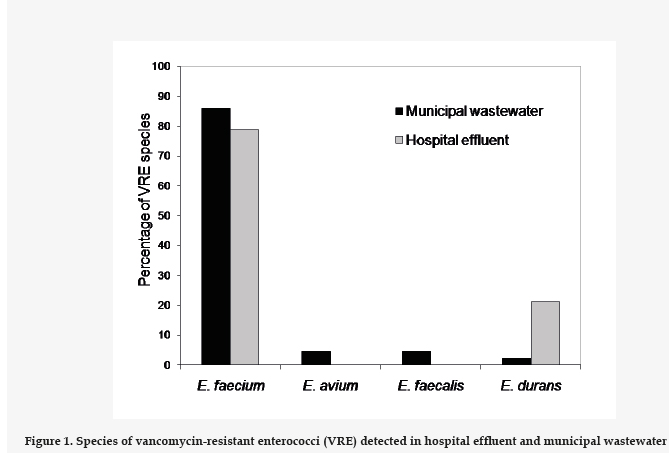
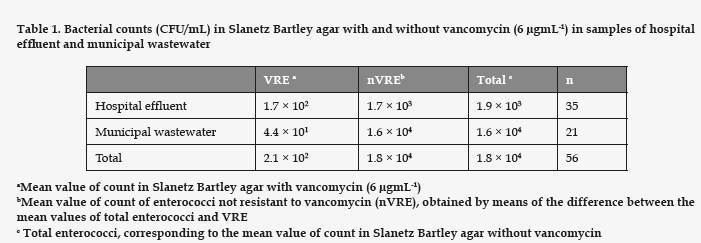
<body><![CDATA[<p><font face="Verdana" size="2"><b>Statistic analysis</b></font></p>     <p><font face="Verdana" size="2">Statistical analyses of the data were performed using the software package IBM SPSS Statistics version 20 (IBM Corp., New York, U.S).</font></p>     <p>&nbsp;</p>     <p><font face="Verdana" size="2"><b>Results</b></font></p>     <p><font face="Verdana" size="2">In our study, although enterococci were detected in the samples from both sources, VRE were found in 30% of the samples from the hospital effluent and in 75% of the samples of municipal wastewater. The total counts of enterococci in the urban wastewater were higher than in the hospital effluent (<a href="#t1">Table 1</a>), giving significant differences (<i>p</i> = 0.036). However, the values of VRE were greater in the hospital effluent, showing an odds ratio of 36.4 (95% CI: 26.0-50.8; <i>p</i>&lt;0.0001).</font></p>     <p>&nbsp;</p>     <p align="center"><a name="t1"><img src="/img/revistas/ars/v57n3/original2_t1.jpg"></a></p>     <p>&nbsp;</p>     <p><font face="Verdana" size="2">From the samples with VRE, we selected a number of colonies for further studies regarding proportionality with respect to the VRE count. To these end 32 strains from the hospital effluent and 46 strains of municipal wastewater were isolated. Of these, 60 were identified as <i>E. faecium</i>, 2 as <i>E. faecalis</i>, 2 as <i>E. avium</i>, and 6 were <i>E. durans</i> (<a href="#f1">Fig. 1</a>). Both sources showed a high prevalence of <i>E. faecium</i>.</font></p>     <p>&nbsp;</p>     ]]></body>
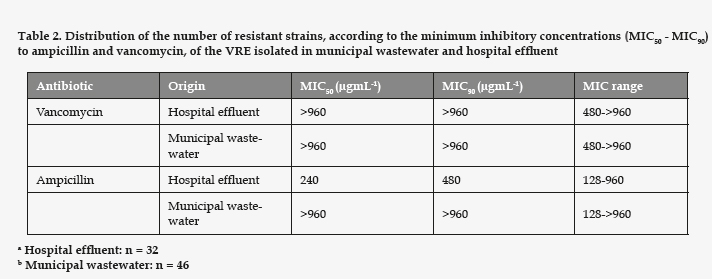
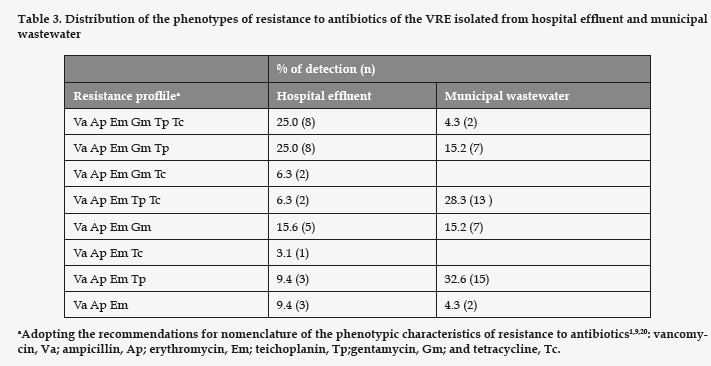
<body><![CDATA[<p align="center"><a name="f1"><img src="/img/revistas/ars/v57n3/original2_f1.jpg"></a></p>     <p>&nbsp;</p>     <p><font face="Verdana" size="2">All the strains of enterococci detected in the assays with vancomycin presented high MIC for vancomycin and ampicillin (<a href="#t2">Table 2</a>). Regarding the rest of the antibiotics tested (<a href="#t3">Table 3</a>), all the strains studied proved resistant to erythromycin. The VRE strains resistant to gentamicin had a significantly higher prevalence in the hospital effluent (<i>p</i>= 0.008). However, the ones resistant to tetracycline and teicoplanin showed no significant differences between the hospital effluent and the municipal wastewater (<i>p</i>= 0.061 and 0.95, respectively). In the samples of hospital effluent, 25% of VRE were resistant to all six antibiotics assayed. In the samples of municipal wastewater, only 4% were resistant to the six antibiotics, and the most frequent phenotype of resistance was Va Ap Em Tp, identified in 32% of cases.</font></p>     <p>&nbsp;</p>     <p align="center"><a name="t2"><img src="/img/revistas/ars/v57n3/original2_t2.jpg"></a></p>     <p>&nbsp;</p>     <p align="center"><a name="t3"><img src="/img/revistas/ars/v57n3/original2_t3.jpg"></a></p>     <p>&nbsp;</p>     <p><font face="Verdana" size="2"><b>Discussion</b></font></p>     <p><font face="Verdana" size="2">The increase in enterococci with multiple antibiotic resistance stands as a clinical-therapeutic challenge not only in the U.S. and Europe, but in most of the world, including Argentina. Within its genus, <i>Enterococcus faecium</i> is the species most often related with the resistance to multiple antibiotics, vancomycin among them.<sup>6</sup> Mar&iacute;n <i>et al</i>.<sup>17</sup> described the first clinical isolation of <i>E. faecium</i> resistant to vancomycin in the city of Mendoza (Argentina), attributing its resistance to the gene <i>vanA</i>.</font></p>     ]]></body>
<body><![CDATA[<p><font face="Verdana" size="2">In a previous study, conducted between 1996 and 2010, a total of 1873 isolations of <i>Enterococcus</i> spp. proceeding from hospital infections in the Hospital Universitario Jos&eacute; de San Mart&iacute;n (Buenos Aires) were analyzed.<sup>22</sup> The prevalence of <i>E. faecium</i> was found to increase from 1.5% in the year 1996 to 4% in 2010, and over 70% of the isolations of <i>E. faecium</i> in hospital infections are resistant to vancomycin, in line with our results (<a href="#f1">Fig. 1</a>), which would explain the high prevalence of VRE in the hospital effluent of our study. The calculated odds ratio indicates that the presence of VRE is 36.4 times greater in the hospital effluent than in the municipal wastewater. The increased presence of resistant bacteria in hospital effluents and their influence in municipal wastewaters have been described previously, underlining the need to subject hospital effluents to pretreatment.<sup>19</sup></font></p>     <p><font face="Verdana" size="2">Currently, community infections involving VRE have given rise to environmental diffusion, leading to widespread distribution in urban effluents. Most previous studies coincide generally with our results. Goldstein <i>et al</i>.<sup>12</sup> found VRE in the influents of four municipal wastewater treatment plants in the U.S., in mean concentrations that ranged between 2.5&times;10<sup>3</sup> and 8.6&times;10<sup>4</sup> CFU/mL. A study in the city of Porto (Portugal), again involving VRE in a hospital effluent<sup>23</sup>, arrived at findings in line with ours: the counts of enterococci are similar, and the prevalence of VRE was greater in the hospital effluent than in the municipal wastewater studied. However, our results also show that <i>E. faecium</i> and <i>E. durans</i> are the species of VRE isolate from the hospital effluent, whereas the these authors found <i>E. faecalis</i> to be more frequent.</font></p>     <p><font face="Verdana" size="2">All research studies to date indicate that the vancomycin resistance in enterococci is most often produced by the gene <i>vanA</i>, characterized by a high resistance to vancomycin and teicoplanin. Beier <i>et al.</i>.<sup>3</sup> traced 49 of 50 VRE isolates from municipal wastewater to <i>vanA</i>. Our results differ, as only 40.7% of the strains isolated from the hospital effluent, and 32.6% of those proceeding from municipal wastewater were resistant to vancomycin and teicoplanin, implying a lesser prevalence of the <i>vanA</i> phenotype. Yet our results coincide in that 100% of all the VRE strains isolated were resistant to erythromycin, and 34% of those isolated from the municipal wastewater were resistant to tetracycline. These authors found 76% of the strains to be resistant to gentamycin, as opposed to the 34% of our strains of municipal origin.</font></p>     <p><font face="Verdana" size="2">It is also important to point out that all our strains were ampicillin resistant, possibly due to the presence of &beta;-lactamase. As can be seen in <a href="#t2">table 2</a>, the MIC was, in all the strains, much higher than 16 &micro;gmL<sup>-1</sup> for ampicillin and 32 &micro;gmL<sup>-1</sup> for vancomycin, the breakpoints established for resistance.<sup>8</sup> The resistance to &beta;-lactam antibiotics is common in VRE strains, as the literature shows. In a South American study involving 20 medical centers, with 218 enterococci (either <i>E. faecalis</i> or <i>E. faecium</i>), 14% of the enterococci were reportedly resistant to vancomycin, the pattern of resistance indicating the gene <i>vanA</i>, and 24.8% were resistant to ampicillin and amoxicillin/clavulanate.<sup>14</sup></font></p>     <p>&nbsp;</p>     <p><font face="Verdana" size="2"><b>Conclusion</b></font></p>     <p><font face="Verdana" size="2">In conclusion, strains of VRE are found in both hospital effluent and urban wastewater, although the greater concentration would be in hospital effluent. All the VRE isolated in this study were moreover resistant to ampicillin and erythromycin, and the strains of hospital origin presented a greater degree of multi-resistance. Hospital effluent constitutes a source of enterococci having multiple resistance to antibiotics, presumably from the feces of patients, because the rules of biosecurity in medical centers would impede other sources of contamination. The multiresistance patterns found in the VRE strains of municipal wastewater present a different distribution, but their high frequency suggests a selective effect of resistance due to an excessive use of antibiotics in the community. Hospital wastewater increased the health and environment risk of sewage, contributing to the dissemination of bacteria resistant to biocides.</font></p>     <p>&nbsp;</p>     <p><font face="Verdana" size="2"><b>Fundings</b></font></p>     <p><font face="Verdana" size="2">The authors declare that they have no funding</font></p>     ]]></body>
<body><![CDATA[<p>&nbsp;</p>     <p><font face="Verdana" size="2"><b>Acknowledgments</b></font></p>     <p><font face="Verdana" size="2">We would like to acknowledge C&eacute;sar Criado S&aacute;nchez, Laboratory Technician of the Department of Preventive Medicine and Public Health, Faculty of Pharmacy, University of Granada, Spain, for his invaluable help in making this study possible. We also thank Jean Louise Sanders for translating and editing the manuscript.</font></p>     <p>&nbsp;</p>     <p><font face="Verdana" size="2"><b>Competing interest</b></font></p>     <p><font face="Verdana" size="2">The authors declare that they have no conflicts of interest.</font></p>     <p>&nbsp;</p>     <p><font face="Verdana" size="2"><b>References</b></font></p>     <!-- ref --><p><font face="Verdana" size="2">1. Bachmann BJ, Low KB. Linkage map of <i>Escherichia coli</i> K12, edition 6. Microbiol Rev. 1980; 44 (1):1-56.    &nbsp;&nbsp;&nbsp;&nbsp;&nbsp;&nbsp;&nbsp;&nbsp;[&#160;<a href="javascript:void(0);" onclick="javascript: window.open('/scielo.php?script=sci_nlinks&ref=1190799&pid=S2340-9894201600030000300001&lng=','','width=640,height=500,resizable=yes,scrollbars=1,menubar=yes,');">Links</a>&#160;]<!-- end-ref --></font></p>    ]]></body>
<body><![CDATA[<!-- ref --><p><font face="Verdana" size="2">2. Baquero F, Mart&iacute;nez JL, Cant&oacute;n R. Antibiotics and antibiotic resistance in water environments. Curr Opin in Biotechnol. 2008; 19:260-265.    &nbsp;&nbsp;&nbsp;&nbsp;&nbsp;&nbsp;&nbsp;&nbsp;[&#160;<a href="javascript:void(0);" onclick="javascript: window.open('/scielo.php?script=sci_nlinks&ref=1190801&pid=S2340-9894201600030000300002&lng=','','width=640,height=500,resizable=yes,scrollbars=1,menubar=yes,');">Links</a>&#160;]<!-- end-ref --></font></p>    <!-- ref --><p><font face="Verdana" size="2">3. Beier RC, Duke SE, Ziprin RL, Harvey RB, Hume ME, Poole TL, Scott HM, Highfield LD, Alali WQ, Andrews K, Anderson RC, Nisbet DJ. Antibiotic and disinfectant susceptibility profiles of vancomycin-resistant <i>Enterococcus faecium</i> (VRE) isolated from community wastewater in Texas. Bull Environ Contam Toxicol. 2008; 80: 188-194.    &nbsp;&nbsp;&nbsp;&nbsp;&nbsp;&nbsp;&nbsp;&nbsp;[&#160;<a href="javascript:void(0);" onclick="javascript: window.open('/scielo.php?script=sci_nlinks&ref=1190803&pid=S2340-9894201600030000300003&lng=','','width=640,height=500,resizable=yes,scrollbars=1,menubar=yes,');">Links</a>&#160;]<!-- end-ref --></font></p>    <!-- ref --><p><font face="Verdana" size="2">4. Bonten MJM, Willems R, Weinstein RA. Vancomycin-resistant enterococci: why are they here, and where do they come from? Lancet Infect Dis. 2001; 1: 314-325.    &nbsp;&nbsp;&nbsp;&nbsp;&nbsp;&nbsp;&nbsp;&nbsp;[&#160;<a href="javascript:void(0);" onclick="javascript: window.open('/scielo.php?script=sci_nlinks&ref=1190805&pid=S2340-9894201600030000300004&lng=','','width=640,height=500,resizable=yes,scrollbars=1,menubar=yes,');">Links</a>&#160;]<!-- end-ref --></font></p>    <!-- ref --><p><font face="Verdana" size="2">5. Castillo-Rojas G, Mazari-Hiriart M, Ponce de Leon S, Amieva-Fern&aacute;ndez RI, Agis-Juarez RA, Huebner J, L&oacute;pez-Vidal Y. Comparison of <i>Enterococcus faecium</i> and <i>Enterococcus faecalis</i> strains isolated from water and clinical samples: antimicrobial susceptibility and genetic relationships. PLoS One.2013; 8(4): e59491.    &nbsp;&nbsp;&nbsp;&nbsp;&nbsp;&nbsp;&nbsp;&nbsp;[&#160;<a href="javascript:void(0);" onclick="javascript: window.open('/scielo.php?script=sci_nlinks&ref=1190807&pid=S2340-9894201600030000300005&lng=','','width=640,height=500,resizable=yes,scrollbars=1,menubar=yes,');">Links</a>&#160;]<!-- end-ref --></font></p>    <!-- ref --><p><font face="Verdana" size="2">6. Cetinkaya, Y., Falk, P. and Mayhall, C.G. Vancomycin-resistant enterococci. Clin Microbiol Rev. 2000; 13: 686-707.    &nbsp;&nbsp;&nbsp;&nbsp;&nbsp;&nbsp;&nbsp;&nbsp;[&#160;<a href="javascript:void(0);" onclick="javascript: window.open('/scielo.php?script=sci_nlinks&ref=1190809&pid=S2340-9894201600030000300006&lng=','','width=640,height=500,resizable=yes,scrollbars=1,menubar=yes,');">Links</a>&#160;]<!-- end-ref --></font></p>    ]]></body>
<body><![CDATA[<!-- ref --><p><font face="Verdana" size="2">7. Clinical and Laboratory Standards Institute. Performance standards for antimicrobial susceptibility testing; 17<sup>th</sup> Informational Supplement, 2007; M100-S17. Wayne, PA, EE.UU.    &nbsp;&nbsp;&nbsp;&nbsp;&nbsp;&nbsp;&nbsp;&nbsp;[&#160;<a href="javascript:void(0);" onclick="javascript: window.open('/scielo.php?script=sci_nlinks&ref=1190811&pid=S2340-9894201600030000300007&lng=','','width=640,height=500,resizable=yes,scrollbars=1,menubar=yes,');">Links</a>&#160;]<!-- end-ref --></font></p>    <!-- ref --><p><font face="Verdana" size="2">8. Clinical and Laboratory Standards Institute. Performance standards for antimicrobial susceptibility testing; 22<sup>nd</sup> Informational Supplement, 2012; M100-S22. Wayne, PA, EE.UU.    &nbsp;&nbsp;&nbsp;&nbsp;&nbsp;&nbsp;&nbsp;&nbsp;[&#160;<a href="javascript:void(0);" onclick="javascript: window.open('/scielo.php?script=sci_nlinks&ref=1190813&pid=S2340-9894201600030000300008&lng=','','width=640,height=500,resizable=yes,scrollbars=1,menubar=yes,');">Links</a>&#160;]<!-- end-ref --></font></p>    <!-- ref --><p><font face="Verdana" size="2">9. Demerec M, Adelberg EA, Clark AJ, Hartman PE. A proposal for a uniform nomenclature in bacterial genetics. Genetics. 1966; 54(1): 61-76.    &nbsp;&nbsp;&nbsp;&nbsp;&nbsp;&nbsp;&nbsp;&nbsp;[&#160;<a href="javascript:void(0);" onclick="javascript: window.open('/scielo.php?script=sci_nlinks&ref=1190815&pid=S2340-9894201600030000300009&lng=','','width=640,height=500,resizable=yes,scrollbars=1,menubar=yes,');">Links</a>&#160;]<!-- end-ref --></font></p>    <!-- ref --><p><font face="Verdana" size="2">10. European Committee on Antimicrobial Susceptibility Testing. Breakpoint tables for interpretation of MICs and zone diameters, version 5.0. 2015. (On-line) <a target="_blank" href="http://www.eucast.org/clinical_breakpoints/">http://www.eucast.org/clinical_breakpoints/</a>.    &nbsp;&nbsp;&nbsp;&nbsp;&nbsp;&nbsp;&nbsp;&nbsp;[&#160;<a href="javascript:void(0);" onclick="javascript: window.open('/scielo.php?script=sci_nlinks&ref=1190817&pid=S2340-9894201600030000300010&lng=','','width=640,height=500,resizable=yes,scrollbars=1,menubar=yes,');">Links</a>&#160;]<!-- end-ref --></font></p>    <!-- ref --><p><font face="Verdana" size="2">11. Farrell DJ, Morrissey I, De Rubeis D, Robbins M, Felmingham D.A UK multicenter study of the antimicrobial susceptibility of bacterial pathogens causing urinary tract infection. J Infect. 2003; 46: 94-100.    &nbsp;&nbsp;&nbsp;&nbsp;&nbsp;&nbsp;&nbsp;&nbsp;[&#160;<a href="javascript:void(0);" onclick="javascript: window.open('/scielo.php?script=sci_nlinks&ref=1190819&pid=S2340-9894201600030000300011&lng=','','width=640,height=500,resizable=yes,scrollbars=1,menubar=yes,');">Links</a>&#160;]<!-- end-ref --></font></p>    ]]></body>
<body><![CDATA[<!-- ref --><p><font face="Verdana" size="2">12. Goldstein RER, Micallef SA, Gibbs SG, George A, Claye E, Sapkota A, Joseph SW, Sapkota AR. Detection of vancomycin-resistant enterococci (VRE) at four U.S. wastewater treatment plants that provide effluent for reuse. Science of the Total Environment. 2014; 466-467: 404-411.    &nbsp;&nbsp;&nbsp;&nbsp;&nbsp;&nbsp;&nbsp;&nbsp;[&#160;<a href="javascript:void(0);" onclick="javascript: window.open('/scielo.php?script=sci_nlinks&ref=1190821&pid=S2340-9894201600030000300012&lng=','','width=640,height=500,resizable=yes,scrollbars=1,menubar=yes,');">Links</a>&#160;]<!-- end-ref --></font></p>    <!-- ref --><p><font face="Verdana" size="2">13. Harwood VJ, Delahoya NC, Ulrich RM, Kramer MF, Whitlock JE, Garey JR, Lim DV. Molecular confirmation of <i>Enterococcus faecalis</i> and <i>E. faecium</i> from clinical, faecal and environmental sources. Letters in Applied Microbiology. 2004; 38:476-482.    &nbsp;&nbsp;&nbsp;&nbsp;&nbsp;&nbsp;&nbsp;&nbsp;[&#160;<a href="javascript:void(0);" onclick="javascript: window.open('/scielo.php?script=sci_nlinks&ref=1190823&pid=S2340-9894201600030000300013&lng=','','width=640,height=500,resizable=yes,scrollbars=1,menubar=yes,');">Links</a>&#160;]<!-- end-ref --></font></p>    <!-- ref --><p><font face="Verdana" size="2">14. Jones RN, Guzm&aacute;n-Blanco M, Gales AC, Gallegos B, Leal Castro AL, Valle Martino MD, Vega S, Zurita J, Cepparulo M. Castanheira M. Susceptibility rates in Latin American nations: report from a regional resistance surveillance program (2011). Braz J Infect Dis. 2013; 17: 672-681.    &nbsp;&nbsp;&nbsp;&nbsp;&nbsp;&nbsp;&nbsp;&nbsp;[&#160;<a href="javascript:void(0);" onclick="javascript: window.open('/scielo.php?script=sci_nlinks&ref=1190825&pid=S2340-9894201600030000300014&lng=','','width=640,height=500,resizable=yes,scrollbars=1,menubar=yes,');">Links</a>&#160;]<!-- end-ref --></font></p>    <!-- ref --><p><font face="Verdana" size="2">15. Kummerer K. Henninger A. Promoting resistance by the emission of antibiotics from hospitals and households into effluent. Clin Microbiol Infect. 2003; 9:1203-1214.    &nbsp;&nbsp;&nbsp;&nbsp;&nbsp;&nbsp;&nbsp;&nbsp;[&#160;<a href="javascript:void(0);" onclick="javascript: window.open('/scielo.php?script=sci_nlinks&ref=1190827&pid=S2340-9894201600030000300015&lng=','','width=640,height=500,resizable=yes,scrollbars=1,menubar=yes,');">Links</a>&#160;]<!-- end-ref --></font></p>    <!-- ref --><p><font face="Verdana" size="2">16. Leclercq R, Oberl&eacute; K, Galopin S, Cattoir V, Budzinski H, Petit F. Changes in enterococcal populations and related antibiotic resistance along a medical center-wastewater treatment plant-river continuum. Appl Environl Microbiol. 2013; 79:2428-2434.    &nbsp;&nbsp;&nbsp;&nbsp;&nbsp;&nbsp;&nbsp;&nbsp;[&#160;<a href="javascript:void(0);" onclick="javascript: window.open('/scielo.php?script=sci_nlinks&ref=1190829&pid=S2340-9894201600030000300016&lng=','','width=640,height=500,resizable=yes,scrollbars=1,menubar=yes,');">Links</a>&#160;]<!-- end-ref --></font></p>    ]]></body>
<body><![CDATA[<!-- ref --><p><font face="Verdana" size="2">17. Marin ME, Mera JR, Arduino RC, Correa AP, Coque TM, Stamboulian D, Murray BE. First report of vancomycin-resistant <i>Enterococcus faecium</i> isolated in Argentina. Clin Infect Dis, 1998; 26: 235-236.    &nbsp;&nbsp;&nbsp;&nbsp;&nbsp;&nbsp;&nbsp;&nbsp;[&#160;<a href="javascript:void(0);" onclick="javascript: window.open('/scielo.php?script=sci_nlinks&ref=1190831&pid=S2340-9894201600030000300017&lng=','','width=640,height=500,resizable=yes,scrollbars=1,menubar=yes,');">Links</a>&#160;]<!-- end-ref --></font></p>    <!-- ref --><p><font face="Verdana" size="2">18. Martinez JL. Environmental pollution by antibiotics and by antibiotic resistance determinants. Environ Pollut. 2009; 157: 2893-2902.    &nbsp;&nbsp;&nbsp;&nbsp;&nbsp;&nbsp;&nbsp;&nbsp;[&#160;<a href="javascript:void(0);" onclick="javascript: window.open('/scielo.php?script=sci_nlinks&ref=1190833&pid=S2340-9894201600030000300018&lng=','','width=640,height=500,resizable=yes,scrollbars=1,menubar=yes,');">Links</a>&#160;]<!-- end-ref --></font></p>    <!-- ref --><p><font face="Verdana" size="2">19. Novo A, Manaia CM. Factors influencing antibiotic resistance burden in municipal waste water treatment plants. Appl Microbiol Biotechnol. 2010; 87: 1157-1166.    &nbsp;&nbsp;&nbsp;&nbsp;&nbsp;&nbsp;&nbsp;&nbsp;[&#160;<a href="javascript:void(0);" onclick="javascript: window.open('/scielo.php?script=sci_nlinks&ref=1190835&pid=S2340-9894201600030000300019&lng=','','width=640,height=500,resizable=yes,scrollbars=1,menubar=yes,');">Links</a>&#160;]<!-- end-ref --></font></p>    <!-- ref --><p><font face="Verdana" size="2">20. Novick RP, Clowes RC, Cohen SN, Curtiss III R, Datta N, Falkow S. Uniform nomenclature for bacterial plasmids: a proposal. Bacteriol Rev. 1976; 40: 168-189.    &nbsp;&nbsp;&nbsp;&nbsp;&nbsp;&nbsp;&nbsp;&nbsp;[&#160;<a href="javascript:void(0);" onclick="javascript: window.open('/scielo.php?script=sci_nlinks&ref=1190837&pid=S2340-9894201600030000300020&lng=','','width=640,height=500,resizable=yes,scrollbars=1,menubar=yes,');">Links</a>&#160;]<!-- end-ref --></font></p>    <!-- ref --><p><font face="Verdana" size="2">21. Paz, M., Muzio, H., Gemini, V., Magdaleno, A., Rossi, S., Korol, S. and Moretton, J. Aguas residuales de un Centro Hospitalario de Buenos Aires, Argentina: Caracter&iacute;sticas qu&iacute;micas, biol&oacute;gicas y toxicol&oacute;gicas. Hig Sanid Ambient. 2004; 4: 83-88.    &nbsp;&nbsp;&nbsp;&nbsp;&nbsp;&nbsp;&nbsp;&nbsp;[&#160;<a href="javascript:void(0);" onclick="javascript: window.open('/scielo.php?script=sci_nlinks&ref=1190839&pid=S2340-9894201600030000300021&lng=','','width=640,height=500,resizable=yes,scrollbars=1,menubar=yes,');">Links</a>&#160;]<!-- end-ref --></font></p>    ]]></body>
<body><![CDATA[<!-- ref --><p><font face="Verdana" size="2">22. Rodr&iacute;guez CH, Garc&iacute;a S, Barberis C, Saposnik E, Weyland B, Nastro M, Famiglietti A. Enterococcus spp.: Resistencia antimicrobiana en infecciones intrahospitalarias. Acta Bioqu&iacute;m Cl&iacute;n Latinoam. 2013; 47: 155-160.    &nbsp;&nbsp;&nbsp;&nbsp;&nbsp;&nbsp;&nbsp;&nbsp;[&#160;<a href="javascript:void(0);" onclick="javascript: window.open('/scielo.php?script=sci_nlinks&ref=1190841&pid=S2340-9894201600030000300022&lng=','','width=640,height=500,resizable=yes,scrollbars=1,menubar=yes,');">Links</a>&#160;]<!-- end-ref --></font></p>    <!-- ref --><p><font face="Verdana" size="2">23. Varela AR, Ferro G, Vredenburg J, Yanik M, Vieira L, Rizzo L, Lameiras C, Manaia CM. Vancomycin resistant enterococci: From the hospital effluent to the urban wastewater treatment plant. Science of the Total Environment. 2013; 450-451:155-161.    &nbsp;&nbsp;&nbsp;&nbsp;&nbsp;&nbsp;&nbsp;&nbsp;[&#160;<a href="javascript:void(0);" onclick="javascript: window.open('/scielo.php?script=sci_nlinks&ref=1190843&pid=S2340-9894201600030000300023&lng=','','width=640,height=500,resizable=yes,scrollbars=1,menubar=yes,');">Links</a>&#160;]<!-- end-ref --></font></p>    <!-- ref --><p><font face="Verdana" size="2">24. Werner G. (2012). Current trends of emergence and spread of vancomycin-resistant enterococci. En: Pana M, editors. Antibiotic resistant bacteria - A continuous challenge in the new millennium. Croatia, In Tech, 2012, p. 303-354.    &nbsp;&nbsp;&nbsp;&nbsp;&nbsp;&nbsp;&nbsp;&nbsp;[&#160;<a href="javascript:void(0);" onclick="javascript: window.open('/scielo.php?script=sci_nlinks&ref=1190845&pid=S2340-9894201600030000300024&lng=','','width=640,height=500,resizable=yes,scrollbars=1,menubar=yes,');">Links</a>&#160;]<!-- end-ref --></font></p>    <!-- ref --><p><font face="Verdana" size="2">25. Willems RJL, Top J, Van Santen M, Robinson DA, Coque TM, Baquero F, Grundmann H, Bonten MJM. Global spread of vancomycin-resistant <i>Enterococcus faecium</i> from distinct nosocomial genetic complex. Emerg Infect Dis. 2005; 11:821-828.    &nbsp;&nbsp;&nbsp;&nbsp;&nbsp;&nbsp;&nbsp;&nbsp;[&#160;<a href="javascript:void(0);" onclick="javascript: window.open('/scielo.php?script=sci_nlinks&ref=1190847&pid=S2340-9894201600030000300025&lng=','','width=640,height=500,resizable=yes,scrollbars=1,menubar=yes,');">Links</a>&#160;]<!-- end-ref --></font></p>     <p>&nbsp;</p>     <p>&nbsp;</p>     ]]></body>
<body><![CDATA[<p><font face="Verdana" size="2"><a href="#top"><img border="0" src="/img/revistas/ars/v57n3/seta.gif" width="15" height="17"></a><a name="bajo"></a><b>Correspondence:</b>    <br>Elena Moreno    <br><a href="mailto:elmorol@ugr.es">elmorol@ugr.es</a></font></p>     <p><font face="Verdana" size="2">Received: 12-09-2016    <br>Accepted: 29-09-2016</font></p>      ]]></body><back>
<ref-list>
<ref id="B1">
<label>1</label><nlm-citation citation-type="journal">
<person-group person-group-type="author">
<name>
<surname><![CDATA[Bachmann]]></surname>
<given-names><![CDATA[BJ]]></given-names>
</name>
<name>
<surname><![CDATA[Low]]></surname>
<given-names><![CDATA[KB]]></given-names>
</name>
</person-group>
<article-title xml:lang="en"><![CDATA[Linkage map of Escherichia coli K12, edition 6]]></article-title>
<source><![CDATA[Microbiol Rev.]]></source>
<year>1980</year>
<volume>44</volume>
<numero>1</numero>
<issue>1</issue>
<page-range>1-56</page-range></nlm-citation>
</ref>
<ref id="B2">
<label>2</label><nlm-citation citation-type="journal">
<person-group person-group-type="author">
<name>
<surname><![CDATA[Baquero]]></surname>
<given-names><![CDATA[F]]></given-names>
</name>
<name>
<surname><![CDATA[Martínez]]></surname>
<given-names><![CDATA[JL]]></given-names>
</name>
<name>
<surname><![CDATA[Cantón]]></surname>
<given-names><![CDATA[R]]></given-names>
</name>
</person-group>
<article-title xml:lang="en"><![CDATA[Antibiotics and antibiotic resistance in water environments]]></article-title>
<source><![CDATA[Curr Opin in Biotechnol.]]></source>
<year>2008</year>
<volume>19</volume>
<page-range>260-265</page-range></nlm-citation>
</ref>
<ref id="B3">
<label>3</label><nlm-citation citation-type="journal">
<person-group person-group-type="author">
<name>
<surname><![CDATA[Beier]]></surname>
<given-names><![CDATA[RC]]></given-names>
</name>
<name>
<surname><![CDATA[Duke]]></surname>
<given-names><![CDATA[SE]]></given-names>
</name>
<name>
<surname><![CDATA[Ziprin]]></surname>
<given-names><![CDATA[RL]]></given-names>
</name>
<name>
<surname><![CDATA[Harvey]]></surname>
<given-names><![CDATA[RB]]></given-names>
</name>
<name>
<surname><![CDATA[Hume]]></surname>
<given-names><![CDATA[ME]]></given-names>
</name>
<name>
<surname><![CDATA[Poole]]></surname>
<given-names><![CDATA[TL]]></given-names>
</name>
<name>
<surname><![CDATA[Scott]]></surname>
<given-names><![CDATA[HM]]></given-names>
</name>
<name>
<surname><![CDATA[Highfield]]></surname>
<given-names><![CDATA[LD]]></given-names>
</name>
<name>
<surname><![CDATA[Alali]]></surname>
<given-names><![CDATA[WQ]]></given-names>
</name>
<name>
<surname><![CDATA[Andrews]]></surname>
<given-names><![CDATA[K]]></given-names>
</name>
<name>
<surname><![CDATA[Anderson]]></surname>
<given-names><![CDATA[RC]]></given-names>
</name>
<name>
<surname><![CDATA[Nisbet]]></surname>
<given-names><![CDATA[DJ]]></given-names>
</name>
</person-group>
<article-title xml:lang="en"><![CDATA[Antibiotic and disinfectant susceptibility profiles of vancomycin-resistant Enterococcus faecium (VRE) isolated from community wastewater in Texas]]></article-title>
<source><![CDATA[Bull Environ Contam Toxicol.]]></source>
<year>2008</year>
<volume>80</volume>
<page-range>188-194</page-range></nlm-citation>
</ref>
<ref id="B4">
<label>4</label><nlm-citation citation-type="journal">
<person-group person-group-type="author">
<name>
<surname><![CDATA[Bonten]]></surname>
<given-names><![CDATA[MJM]]></given-names>
</name>
<name>
<surname><![CDATA[Willems]]></surname>
<given-names><![CDATA[R]]></given-names>
</name>
<name>
<surname><![CDATA[Weinstein]]></surname>
<given-names><![CDATA[RA]]></given-names>
</name>
</person-group>
<article-title xml:lang="en"><![CDATA[Vancomycin-resistant enterococci: why are they here, and where do they come from?]]></article-title>
<source><![CDATA[Lancet Infect Dis.]]></source>
<year>2001</year>
<volume>1</volume>
<page-range>314-325</page-range></nlm-citation>
</ref>
<ref id="B5">
<label>5</label><nlm-citation citation-type="journal">
<person-group person-group-type="author">
<name>
<surname><![CDATA[Castillo-Rojas]]></surname>
<given-names><![CDATA[G]]></given-names>
</name>
<name>
<surname><![CDATA[Mazari-Hiriart]]></surname>
<given-names><![CDATA[M]]></given-names>
</name>
<name>
<surname><![CDATA[Ponce de Leon]]></surname>
<given-names><![CDATA[S]]></given-names>
</name>
<name>
<surname><![CDATA[Amieva-Fernández]]></surname>
<given-names><![CDATA[RI]]></given-names>
</name>
<name>
<surname><![CDATA[Agis-Juarez]]></surname>
<given-names><![CDATA[RA]]></given-names>
</name>
<name>
<surname><![CDATA[Huebner]]></surname>
<given-names><![CDATA[J]]></given-names>
</name>
<name>
<surname><![CDATA[López-Vidal]]></surname>
<given-names><![CDATA[Y]]></given-names>
</name>
</person-group>
<article-title xml:lang="en"><![CDATA[Comparison of Enterococcus faecium and Enterococcus faecalis strains isolated from water and clinical samples: antimicrobial susceptibility and genetic relationships]]></article-title>
<source><![CDATA[PLoS One]]></source>
<year>2013</year>
<volume>8</volume>
<numero>4</numero>
<issue>4</issue>
</nlm-citation>
</ref>
<ref id="B6">
<label>6</label><nlm-citation citation-type="journal">
<person-group person-group-type="author">
<name>
<surname><![CDATA[Cetinkaya]]></surname>
<given-names><![CDATA[Y.]]></given-names>
</name>
<name>
<surname><![CDATA[Falk]]></surname>
<given-names><![CDATA[P.]]></given-names>
</name>
<name>
<surname><![CDATA[Mayhall]]></surname>
<given-names><![CDATA[C. G]]></given-names>
</name>
</person-group>
<article-title xml:lang="en"><![CDATA[Vancomycin-resistant enterococci]]></article-title>
<source><![CDATA[Clin Microbiol Rev.]]></source>
<year>2000</year>
<volume>13</volume>
<page-range>686-707</page-range></nlm-citation>
</ref>
<ref id="B7">
<label>7</label><nlm-citation citation-type="">
<collab>Clinical and Laboratory Standards Institute</collab>
<source><![CDATA[Performance standards for antimicrobial susceptibility testing]]></source>
<year>2007</year>
<publisher-loc><![CDATA[^ePA PA]]></publisher-loc>
</nlm-citation>
</ref>
<ref id="B8">
<label>8</label><nlm-citation citation-type="">
<collab>Clinical and Laboratory Standards Institute</collab>
<source><![CDATA[Performance standards for antimicrobial susceptibility testing]]></source>
<year>2012</year>
<publisher-loc><![CDATA[^ePA PA]]></publisher-loc>
</nlm-citation>
</ref>
<ref id="B9">
<label>9</label><nlm-citation citation-type="journal">
<person-group person-group-type="author">
<name>
<surname><![CDATA[Demerec]]></surname>
<given-names><![CDATA[M]]></given-names>
</name>
<name>
<surname><![CDATA[Adelberg]]></surname>
<given-names><![CDATA[EA]]></given-names>
</name>
<name>
<surname><![CDATA[Clark]]></surname>
<given-names><![CDATA[AJ]]></given-names>
</name>
<name>
<surname><![CDATA[Hartman]]></surname>
<given-names><![CDATA[PE]]></given-names>
</name>
</person-group>
<article-title xml:lang="en"><![CDATA[A proposal for a uniform nomenclature in bacterial genetics]]></article-title>
<source><![CDATA[Genetics]]></source>
<year>1966</year>
<volume>54</volume>
<numero>1</numero>
<issue>1</issue>
<page-range>61-76</page-range></nlm-citation>
</ref>
<ref id="B10">
<label>10</label><nlm-citation citation-type="">
<collab>European Committee on Antimicrobial Susceptibility Testing</collab>
<source><![CDATA[Breakpoint tables for interpretation of MICs and zone diameters, version 5.0]]></source>
<year>2015</year>
</nlm-citation>
</ref>
<ref id="B11">
<label>11</label><nlm-citation citation-type="journal">
<person-group person-group-type="author">
<name>
<surname><![CDATA[Farrell]]></surname>
<given-names><![CDATA[DJ]]></given-names>
</name>
<name>
<surname><![CDATA[Morrissey]]></surname>
<given-names><![CDATA[I]]></given-names>
</name>
<name>
<surname><![CDATA[De Rubeis]]></surname>
<given-names><![CDATA[D]]></given-names>
</name>
<name>
<surname><![CDATA[Robbins]]></surname>
<given-names><![CDATA[M]]></given-names>
</name>
<name>
<surname><![CDATA[Felmingham]]></surname>
<given-names><![CDATA[D]]></given-names>
</name>
</person-group>
<article-title xml:lang="en"><![CDATA[A UK multicenter study of the antimicrobial susceptibility of bacterial pathogens causing urinary tract infection]]></article-title>
<source><![CDATA[J Infect.]]></source>
<year>2003</year>
<volume>46</volume>
<page-range>94-100</page-range></nlm-citation>
</ref>
<ref id="B12">
<label>12</label><nlm-citation citation-type="journal">
<person-group person-group-type="author">
<name>
<surname><![CDATA[Goldstein]]></surname>
<given-names><![CDATA[RER]]></given-names>
</name>
<name>
<surname><![CDATA[Micallef]]></surname>
<given-names><![CDATA[SA]]></given-names>
</name>
<name>
<surname><![CDATA[Gibbs]]></surname>
<given-names><![CDATA[SG]]></given-names>
</name>
<name>
<surname><![CDATA[George]]></surname>
<given-names><![CDATA[A]]></given-names>
</name>
<name>
<surname><![CDATA[Claye]]></surname>
<given-names><![CDATA[E]]></given-names>
</name>
<name>
<surname><![CDATA[Sapkota]]></surname>
<given-names><![CDATA[A]]></given-names>
</name>
<name>
<surname><![CDATA[Joseph]]></surname>
<given-names><![CDATA[SW]]></given-names>
</name>
<name>
<surname><![CDATA[Sapkota]]></surname>
<given-names><![CDATA[AR]]></given-names>
</name>
</person-group>
<article-title xml:lang="en"><![CDATA[Detection of vancomycin-resistant enterococci (VRE) at four U.S. wastewater treatment plants that provide effluent for reuse]]></article-title>
<source><![CDATA[Science of the Total Environment]]></source>
<year>2014</year>
<volume>466-467</volume>
<page-range>404-411</page-range></nlm-citation>
</ref>
<ref id="B13">
<label>13</label><nlm-citation citation-type="journal">
<person-group person-group-type="author">
<name>
<surname><![CDATA[Harwood]]></surname>
<given-names><![CDATA[VJ]]></given-names>
</name>
<name>
<surname><![CDATA[Delahoya]]></surname>
<given-names><![CDATA[NC]]></given-names>
</name>
<name>
<surname><![CDATA[Ulrich]]></surname>
<given-names><![CDATA[RM]]></given-names>
</name>
<name>
<surname><![CDATA[Kramer]]></surname>
<given-names><![CDATA[MF]]></given-names>
</name>
<name>
<surname><![CDATA[Whitlock]]></surname>
<given-names><![CDATA[JE]]></given-names>
</name>
<name>
<surname><![CDATA[Garey]]></surname>
<given-names><![CDATA[JR]]></given-names>
</name>
<name>
<surname><![CDATA[Lim]]></surname>
<given-names><![CDATA[DV]]></given-names>
</name>
</person-group>
<article-title xml:lang="en"><![CDATA[Molecular confirmation of Enterococcus faecalis and E. faecium from clinical, faecal and environmental sources]]></article-title>
<source><![CDATA[Letters in Applied Microbiology]]></source>
<year>2004</year>
<volume>38</volume>
<page-range>476-482</page-range></nlm-citation>
</ref>
<ref id="B14">
<label>14</label><nlm-citation citation-type="journal">
<person-group person-group-type="author">
<name>
<surname><![CDATA[Jones]]></surname>
<given-names><![CDATA[RN]]></given-names>
</name>
<name>
<surname><![CDATA[Guzmán-Blanco]]></surname>
<given-names><![CDATA[M]]></given-names>
</name>
<name>
<surname><![CDATA[Gales]]></surname>
<given-names><![CDATA[AC]]></given-names>
</name>
<name>
<surname><![CDATA[Gallegos]]></surname>
<given-names><![CDATA[B]]></given-names>
</name>
<name>
<surname><![CDATA[Leal Castro]]></surname>
<given-names><![CDATA[AL]]></given-names>
</name>
<name>
<surname><![CDATA[Valle Martino]]></surname>
<given-names><![CDATA[MD]]></given-names>
</name>
<name>
<surname><![CDATA[Vega]]></surname>
<given-names><![CDATA[S]]></given-names>
</name>
<name>
<surname><![CDATA[Zurita]]></surname>
<given-names><![CDATA[J]]></given-names>
</name>
<name>
<surname><![CDATA[Cepparulo]]></surname>
<given-names><![CDATA[M.]]></given-names>
</name>
<name>
<surname><![CDATA[Castanheira]]></surname>
<given-names><![CDATA[M]]></given-names>
</name>
</person-group>
<article-title xml:lang="en"><![CDATA[Susceptibility rates in Latin American nations: report from a regional resistance surveillance program (2011)]]></article-title>
<source><![CDATA[Braz J Infect Dis.]]></source>
<year>2013</year>
<volume>17</volume>
<page-range>672-681</page-range></nlm-citation>
</ref>
<ref id="B15">
<label>15</label><nlm-citation citation-type="journal">
<person-group person-group-type="author">
<name>
<surname><![CDATA[Kummerer]]></surname>
<given-names><![CDATA[K.]]></given-names>
</name>
<name>
<surname><![CDATA[Henninger]]></surname>
<given-names><![CDATA[A]]></given-names>
</name>
</person-group>
<article-title xml:lang="en"><![CDATA[Promoting resistance by the emission of antibiotics from hospitals and households into effluent]]></article-title>
<source><![CDATA[Clin Microbiol Infect.]]></source>
<year>2003</year>
<volume>9</volume>
<page-range>1203-1214</page-range></nlm-citation>
</ref>
<ref id="B16">
<label>16</label><nlm-citation citation-type="journal">
<person-group person-group-type="author">
<name>
<surname><![CDATA[Leclercq]]></surname>
<given-names><![CDATA[R]]></given-names>
</name>
<name>
<surname><![CDATA[Oberlé]]></surname>
<given-names><![CDATA[K]]></given-names>
</name>
<name>
<surname><![CDATA[Galopin]]></surname>
<given-names><![CDATA[S]]></given-names>
</name>
<name>
<surname><![CDATA[Cattoir]]></surname>
<given-names><![CDATA[V]]></given-names>
</name>
<name>
<surname><![CDATA[Budzinski]]></surname>
<given-names><![CDATA[H]]></given-names>
</name>
<name>
<surname><![CDATA[Petit]]></surname>
<given-names><![CDATA[F]]></given-names>
</name>
</person-group>
<article-title xml:lang="en"><![CDATA[Changes in enterococcal populations and related antibiotic resistance along a medical center-wastewater treatment plant-river continuum]]></article-title>
<source><![CDATA[Appl Environl Microbiol.]]></source>
<year>2013</year>
<volume>79</volume>
<page-range>2428-2434</page-range></nlm-citation>
</ref>
<ref id="B17">
<label>17</label><nlm-citation citation-type="journal">
<person-group person-group-type="author">
<name>
<surname><![CDATA[Marin]]></surname>
<given-names><![CDATA[ME]]></given-names>
</name>
<name>
<surname><![CDATA[Mera]]></surname>
<given-names><![CDATA[JR]]></given-names>
</name>
<name>
<surname><![CDATA[Arduino]]></surname>
<given-names><![CDATA[RC]]></given-names>
</name>
<name>
<surname><![CDATA[Correa]]></surname>
<given-names><![CDATA[AP]]></given-names>
</name>
<name>
<surname><![CDATA[Coque]]></surname>
<given-names><![CDATA[TM]]></given-names>
</name>
<name>
<surname><![CDATA[Stamboulian]]></surname>
<given-names><![CDATA[D]]></given-names>
</name>
<name>
<surname><![CDATA[Murray]]></surname>
<given-names><![CDATA[BE]]></given-names>
</name>
</person-group>
<article-title xml:lang="en"><![CDATA[First report of vancomycin-resistant Enterococcus faecium isolated in Argentina]]></article-title>
<source><![CDATA[Clin Infect Dis]]></source>
<year>1998</year>
<volume>26</volume>
<page-range>235-236</page-range></nlm-citation>
</ref>
<ref id="B18">
<label>18</label><nlm-citation citation-type="journal">
<person-group person-group-type="author">
<name>
<surname><![CDATA[Martinez]]></surname>
<given-names><![CDATA[JL]]></given-names>
</name>
</person-group>
<article-title xml:lang="en"><![CDATA[Environmental pollution by antibiotics and by antibiotic resistance determinants]]></article-title>
<source><![CDATA[Environ Pollut.]]></source>
<year>2009</year>
<volume>157</volume>
<page-range>2893-2902</page-range></nlm-citation>
</ref>
<ref id="B19">
<label>19</label><nlm-citation citation-type="journal">
<person-group person-group-type="author">
<name>
<surname><![CDATA[Novo]]></surname>
<given-names><![CDATA[A]]></given-names>
</name>
<name>
<surname><![CDATA[Manaia]]></surname>
<given-names><![CDATA[CM]]></given-names>
</name>
</person-group>
<article-title xml:lang="en"><![CDATA[Factors influencing antibiotic resistance burden in municipal waste water treatment plants]]></article-title>
<source><![CDATA[Appl Microbiol Biotechnol.]]></source>
<year>2010</year>
<volume>87</volume>
<page-range>1157-1166</page-range></nlm-citation>
</ref>
<ref id="B20">
<label>20</label><nlm-citation citation-type="journal">
<person-group person-group-type="author">
<name>
<surname><![CDATA[Novick]]></surname>
<given-names><![CDATA[RP]]></given-names>
</name>
<name>
<surname><![CDATA[Clowes]]></surname>
<given-names><![CDATA[RC]]></given-names>
</name>
<name>
<surname><![CDATA[Cohen]]></surname>
<given-names><![CDATA[SN]]></given-names>
</name>
<name>
<surname><![CDATA[Curtiss]]></surname>
<given-names><![CDATA[III R]]></given-names>
</name>
<name>
<surname><![CDATA[Datta]]></surname>
<given-names><![CDATA[N]]></given-names>
</name>
<name>
<surname><![CDATA[Falkow]]></surname>
<given-names><![CDATA[S]]></given-names>
</name>
</person-group>
<article-title xml:lang="en"><![CDATA[Uniform nomenclature for bacterial plasmids: a proposal]]></article-title>
<source><![CDATA[Bacteriol Rev.]]></source>
<year>1976</year>
<volume>40</volume>
<page-range>168-189</page-range></nlm-citation>
</ref>
<ref id="B21">
<label>21</label><nlm-citation citation-type="journal">
<person-group person-group-type="author">
<name>
<surname><![CDATA[Paz]]></surname>
<given-names><![CDATA[M.]]></given-names>
</name>
<name>
<surname><![CDATA[Muzio]]></surname>
<given-names><![CDATA[H.]]></given-names>
</name>
<name>
<surname><![CDATA[Gemini]]></surname>
<given-names><![CDATA[V.]]></given-names>
</name>
<name>
<surname><![CDATA[Magdaleno]]></surname>
<given-names><![CDATA[A.]]></given-names>
</name>
<name>
<surname><![CDATA[Rossi]]></surname>
<given-names><![CDATA[S.]]></given-names>
</name>
<name>
<surname><![CDATA[Korol]]></surname>
<given-names><![CDATA[S.]]></given-names>
</name>
<name>
<surname><![CDATA[Moretton]]></surname>
<given-names><![CDATA[J]]></given-names>
</name>
</person-group>
<article-title xml:lang="es"><![CDATA[Aguas residuales de un Centro Hospitalario de Buenos Aires, Argentina: Características químicas, biológicas y toxicológicas]]></article-title>
<source><![CDATA[Hig Sanid Ambient.]]></source>
<year>2004</year>
<volume>4</volume>
<page-range>83-88</page-range></nlm-citation>
</ref>
<ref id="B22">
<label>22</label><nlm-citation citation-type="journal">
<person-group person-group-type="author">
<name>
<surname><![CDATA[Rodríguez]]></surname>
<given-names><![CDATA[CH]]></given-names>
</name>
<name>
<surname><![CDATA[García]]></surname>
<given-names><![CDATA[S]]></given-names>
</name>
<name>
<surname><![CDATA[Barberis]]></surname>
<given-names><![CDATA[C]]></given-names>
</name>
<name>
<surname><![CDATA[Saposnik]]></surname>
<given-names><![CDATA[E]]></given-names>
</name>
<name>
<surname><![CDATA[Weyland]]></surname>
<given-names><![CDATA[B]]></given-names>
</name>
<name>
<surname><![CDATA[Nastro]]></surname>
<given-names><![CDATA[M]]></given-names>
</name>
<name>
<surname><![CDATA[Famiglietti]]></surname>
<given-names><![CDATA[A]]></given-names>
</name>
</person-group>
<article-title xml:lang="es"><![CDATA[Enterococcus spp.: Resistencia antimicrobiana en infecciones intrahospitalarias]]></article-title>
<source><![CDATA[Acta Bioquím Clín Latinoam.]]></source>
<year>2013</year>
<volume>47</volume>
<page-range>155-160</page-range></nlm-citation>
</ref>
<ref id="B23">
<label>23</label><nlm-citation citation-type="journal">
<person-group person-group-type="author">
<name>
<surname><![CDATA[Varela]]></surname>
<given-names><![CDATA[AR]]></given-names>
</name>
<name>
<surname><![CDATA[Ferro]]></surname>
<given-names><![CDATA[G]]></given-names>
</name>
<name>
<surname><![CDATA[Vredenburg]]></surname>
<given-names><![CDATA[J]]></given-names>
</name>
<name>
<surname><![CDATA[Yanik]]></surname>
<given-names><![CDATA[M]]></given-names>
</name>
<name>
<surname><![CDATA[Vieira]]></surname>
<given-names><![CDATA[L]]></given-names>
</name>
<name>
<surname><![CDATA[Rizzo]]></surname>
<given-names><![CDATA[L]]></given-names>
</name>
<name>
<surname><![CDATA[Lameiras]]></surname>
<given-names><![CDATA[C]]></given-names>
</name>
<name>
<surname><![CDATA[Manaia]]></surname>
<given-names><![CDATA[CM]]></given-names>
</name>
</person-group>
<article-title xml:lang="en"><![CDATA[Vancomycin resistant enterococci: From the hospital effluent to the urban wastewater treatment plant]]></article-title>
<source><![CDATA[Science of the Total Environment]]></source>
<year>2013</year>
<volume>450-451</volume>
<page-range>155-161</page-range></nlm-citation>
</ref>
<ref id="B24">
<label>24</label><nlm-citation citation-type="book">
<person-group person-group-type="author">
<name>
<surname><![CDATA[Werner]]></surname>
<given-names><![CDATA[G.]]></given-names>
</name>
</person-group>
<article-title xml:lang="en"><![CDATA[Current trends of emergence and spread of vancomycin-resistant enterococci]]></article-title>
<person-group person-group-type="editor">
<name>
<surname><![CDATA[Pana]]></surname>
<given-names><![CDATA[M]]></given-names>
</name>
</person-group>
<source><![CDATA[Antibiotic resistant bacteria: A continuous challenge in the new millennium]]></source>
<year>2012</year>
<month>20</month>
<day>12</day>
<page-range>303-354</page-range><publisher-name><![CDATA[In Tech]]></publisher-name>
</nlm-citation>
</ref>
<ref id="B25">
<label>25</label><nlm-citation citation-type="journal">
<person-group person-group-type="author">
<name>
<surname><![CDATA[Willems]]></surname>
<given-names><![CDATA[RJL]]></given-names>
</name>
<name>
<surname><![CDATA[Top]]></surname>
<given-names><![CDATA[J]]></given-names>
</name>
<name>
<surname><![CDATA[Van Santen]]></surname>
<given-names><![CDATA[M]]></given-names>
</name>
<name>
<surname><![CDATA[Robinson]]></surname>
<given-names><![CDATA[DA]]></given-names>
</name>
<name>
<surname><![CDATA[Coque]]></surname>
<given-names><![CDATA[TM]]></given-names>
</name>
<name>
<surname><![CDATA[Baquero]]></surname>
<given-names><![CDATA[F]]></given-names>
</name>
<name>
<surname><![CDATA[Grundmann]]></surname>
<given-names><![CDATA[H]]></given-names>
</name>
<name>
<surname><![CDATA[Bonten]]></surname>
<given-names><![CDATA[MJM]]></given-names>
</name>
</person-group>
<article-title xml:lang="en"><![CDATA[Global spread of vancomycin-resistant Enterococcus faecium from distinct nosocomial genetic complex]]></article-title>
<source><![CDATA[Emerg Infect Dis.]]></source>
<year>2005</year>
<volume>11</volume>
<page-range>821-828</page-range></nlm-citation>
</ref>
</ref-list>
</back>
</article>