<?xml version="1.0" encoding="ISO-8859-1"?><article xmlns:mml="http://www.w3.org/1998/Math/MathML" xmlns:xlink="http://www.w3.org/1999/xlink" xmlns:xsi="http://www.w3.org/2001/XMLSchema-instance">
<front>
<journal-meta>
<journal-id>0004-0614</journal-id>
<journal-title><![CDATA[Archivos Españoles de Urología (Ed. impresa)]]></journal-title>
<abbrev-journal-title><![CDATA[Arch. Esp. Urol.]]></abbrev-journal-title>
<issn>0004-0614</issn>
<publisher>
<publisher-name><![CDATA[INIESTARES, S.A.]]></publisher-name>
</publisher>
</journal-meta>
<article-meta>
<article-id>S0004-06142008000900009</article-id>
<title-group>
<article-title xml:lang="en"><![CDATA[Current techniques for laser prostatectomy-PVP and HoLEP]]></article-title>
<article-title xml:lang="es"><![CDATA[Técnicas actuales para la prostatectomía láser-PVP y HoLEP]]></article-title>
</title-group>
<contrib-group>
<contrib contrib-type="author">
<name>
<surname><![CDATA[Aho]]></surname>
<given-names><![CDATA[Tevita F.]]></given-names>
</name>
<xref ref-type="aff" rid="A01"/>
</contrib>
<contrib contrib-type="author">
<name>
<surname><![CDATA[Gilling]]></surname>
<given-names><![CDATA[Peter J.]]></given-names>
</name>
<xref ref-type="aff" rid="A02"/>
</contrib>
</contrib-group>
<aff id="A01">
<institution><![CDATA[,Addenbrooke's Hospital Department of Urology ]]></institution>
<addr-line><![CDATA[Cambridge ]]></addr-line>
<country>UK</country>
</aff>
<aff id="A02">
<institution><![CDATA[,Tauranga Hospital Department of Urology ]]></institution>
<addr-line><![CDATA[Tauranga ]]></addr-line>
<country>New Zealand</country>
</aff>
<pub-date pub-type="pub">
<day>00</day>
<month>11</month>
<year>2008</year>
</pub-date>
<pub-date pub-type="epub">
<day>00</day>
<month>11</month>
<year>2008</year>
</pub-date>
<volume>61</volume>
<numero>9</numero>
<fpage>1005</fpage>
<lpage>1013</lpage>
<copyright-statement/>
<copyright-year/>
<self-uri xlink:href="http://scielo.isciii.es/scielo.php?script=sci_arttext&amp;pid=S0004-06142008000900009&amp;lng=en&amp;nrm=iso"></self-uri><self-uri xlink:href="http://scielo.isciii.es/scielo.php?script=sci_abstract&amp;pid=S0004-06142008000900009&amp;lng=en&amp;nrm=iso"></self-uri><self-uri xlink:href="http://scielo.isciii.es/scielo.php?script=sci_pdf&amp;pid=S0004-06142008000900009&amp;lng=en&amp;nrm=iso"></self-uri><abstract abstract-type="short" xml:lang="en"><p><![CDATA[Objectives: The objective of this review is to provide an evidence-based update on laser surgery for BPH with a focus on comparing Greenlight Photoselective Vaporisation of the Prostate (PVPj to Holmium Laser Enucleation of the Prostate (HoLEP). Methods: We reviewed all HoLEP and PVP papers identified by a Pubmed search using the keywords: laser, prostate, BPH, holmium, HoLEP, PVP and greenlight. The published randomised trials investigating HoLEP and PVP are summarised. As there are no head to head randomised trials comparing HoLEP to PVP, we compare data from individual HoLEP and PVP papers. Data on multiple aspects of laser surgery for BPH are summarised and contrasted for the 2 procedures including: Perioperative management, subjective and objective measures of success, complications, sexual function, prostate volume reduction, durability, and surgery for men with large prostates and those in urinary retention. Results/Conclusions: PVP and HoLEP are very different laser techniques. An important difference between the Green-light laser and holmium and thulium is that its only urological application is prostate ablation. HoLEP is the most advanced laser technique currently available. In contrast to PVP, it has been rigorously evaluated in 8 randomised trials. It is a size independent procedure suitable for any prostate, and highly effective at treating urinary retention. HoLEP has been reported to be durable to periods up to 6 years. More tissue is removed with HoLEP than PVP, and this raises concerns regarding the long term durability of PVP for which there is no comparable data. The increase in HoLEP expertise world-wide and the development of lasers that are faster at ablating tissue and have other urological uses (eg thulium) may threaten the longevity of Greenlight PVP.]]></p></abstract>
<abstract abstract-type="short" xml:lang="es"><p><![CDATA[Objetivo: El objetivo de ésta revisión es ofrecer una puesta al día basada en la evidencia sobre cirugía láser para el tratamiento de la HBP, enfocada a la comparación entre vaporización fotoselectiva con láser verde (PVP) y la enucleación prostática con láser de Holmio(HoLEP). Métodos: Revisamos todos los artículos sobre HoLEP y PVP identificados en una búsqueda bibliográfica en PubMed utilizando los términos: láser, próstata, HBP, Holmio, HoLEP, PVP, y luz verde. Como no existen ensayos clínicos aleatorizados comparando directamente HoLEP y PVP comparamos los datos de artículos individuales de cada técnica. Se resumen y contrastan los datos de múltiples aspectos de la cirugía láser de la HBP mediante ambos procedimientos incluyendo: manejo perioperatorio, medidas objetivas y subjetivas de éxito, complicaciones, función sexual, reducción del volumen prostático, durabilidad y cirugía en varones con próstatas grandes y pacientes con retención urinaria. Resultados/Conclusiones: La PVP y la HoLEP son técnicas láser muy diferentes. Una diferencia importante entre el láser de luz verde y los de Holmio o Tulio es que su única aplicación es la ablación prostática. La técnica de enucleación con láser de Holmio es la técnica láser más avanzada disponible actualmente. En contraste con la fotovaporización ha sido rigurosamente evaluada en ocho ensayos clínicos. Es un procedimiento independiente del tamaño prostático, válido para cualquier próstata, altamente eficaz en el tratamiento de la retención urinaria. Se ha comunicado que la enucleación prostática con láser de Holmio es duradera hasta seis años. Se quita más tejido con la HOLEP y con la PVP y esto suscita una preocupación en cuanto a la duración a largo plazo del resultado de la PVP, de la que no existen datos comparables. El aumento de la experiencia con HoLEP en todo el mundo y el desarrollo de láseres más rápidos en la ablación de tejidos y con otros usos urológicos (Ej tulio) puede amenazar la supervivencia de la PVP con láser de luz verde.]]></p></abstract>
<kwd-group>
<kwd lng="en"><![CDATA[Laser prostatectomy]]></kwd>
<kwd lng="en"><![CDATA[Photoselective]]></kwd>
<kwd lng="en"><![CDATA[Vaporisation]]></kwd>
<kwd lng="en"><![CDATA[Prostate]]></kwd>
<kwd lng="en"><![CDATA[PVP]]></kwd>
<kwd lng="en"><![CDATA[Holep]]></kwd>
<kwd lng="en"><![CDATA[Laser]]></kwd>
<kwd lng="es"><![CDATA[Prostatectomía láser]]></kwd>
<kwd lng="es"><![CDATA[Fotovaporización]]></kwd>
<kwd lng="es"><![CDATA[Próstata]]></kwd>
<kwd lng="es"><![CDATA[PVP]]></kwd>
<kwd lng="es"><![CDATA[Holep]]></kwd>
<kwd lng="es"><![CDATA[Láser]]></kwd>
</kwd-group>
</article-meta>
</front><body><![CDATA[ <p><font face="Verdana" size="2"><b><a name="top"></a>MONOGR&Aacute;FICO:   ENDOUROLOG&Iacute;A Y L&Aacute;SER</b></font></p>     <p>&nbsp;</p>     <p><font face="Verdana" size="4"><b>Current techniques for laser prostatectomy-PVP   and HoLEP</b></font></p>     <p><font face="Verdana" size="4"><b>T&eacute;cnicas actuales para la prostatectom&iacute;a   l&aacute;ser-PVP y HoLEP</b></font></p>     <p>&nbsp;</p>     <p>&nbsp;</p>     <p><font face="Verdana" size="2"><b>Tevita F. Aho and Peter J. Gilling<sup>1</sup>.</b></font></p>     <p><font face="Verdana" size="2">Department of Urology. Addenbrooke's Hospital.   Cambridge. UK.    <br>  <sup>1</sup>Department of Urology. Tauranga Hospital. New Zealand.</font></p>     <p><font face="Verdana" size="2"><a href="#back">Direcci&oacute;n para correspondencia</a></font></p>     ]]></body>
<body><![CDATA[<p>&nbsp;</p>     <p>&nbsp;</p> <hr size="1" noshade>     <p><font face="Verdana" size="2"><b>SUMMARY</b></font></p>     <p><font face="Verdana" size="2"><b>Objectives:</b> The objective of this review   is to provide an evidence-based update on laser surgery for BPH with a focus   on comparing Greenlight Photoselective Vaporisation of the Prostate (PVPj to   Holmium Laser Enucleation of the Prostate (HoLEP).    <br>  <b>Methods:</b> We reviewed all HoLEP and PVP papers identified by a Pubmed   search using the keywords: laser, prostate, BPH, holmium, HoLEP, PVP and greenlight.   The published randomised trials investigating HoLEP and PVP are summarised.   As there are no head to head randomised trials comparing HoLEP to PVP, we compare   data from individual HoLEP and PVP papers. Data on multiple aspects of laser   surgery for BPH are summarised and contrasted for the 2 procedures including:   Perioperative management, subjective and objective measures of success, complications,   sexual function, prostate volume reduction, durability, and surgery for men   with large prostates and those in urinary retention.    <br>  <b>Results/Conclusions:</b> PVP and HoLEP are very different laser techniques.   An important difference between the Green-light laser and holmium and thulium   is that its only urological application is prostate ablation. HoLEP is the most   advanced laser technique currently available. In contrast to PVP, it has been   rigorously evaluated in 8 randomised trials. It is a size independent procedure   suitable for any prostate, and highly effective at treating urinary retention.   HoLEP has been reported to be durable to periods up to 6 years. More tissue   is removed with HoLEP than PVP, and this raises concerns regarding the long   term durability of PVP for which there is no comparable data. The increase in   HoLEP expertise world-wide and the development of lasers that are faster at   ablating tissue and have other urological uses (eg thulium) may threaten the   longevity of Greenlight PVP.</font></p>     <p><font face="Verdana" size="2"><b>Keywords:</b> Laser prostatectomy. Photoselective.   Vaporisation. Prostate. PVP. Holep. Laser.</font></p> <hr size="1" noshade>     <p><font face="Verdana" size="2"><b>RESUMEN</b></font></p>     <p><font face="Verdana" size="2"><b>Objetivo:</b> El objetivo de &eacute;sta revisi&oacute;n   es ofrecer una puesta al d&iacute;a basada en la evidencia sobre cirug&iacute;a   l&aacute;ser para el tratamiento de la HBP, enfocada a la comparaci&oacute;n   entre vaporizaci&oacute;n fotoselectiva con l&aacute;ser verde (PVP) y la enucleaci&oacute;n   prost&aacute;tica con l&aacute;ser de Holmio(HoLEP).    <br>  <b>M&eacute;todos:</b> Revisamos todos los art&iacute;culos sobre HoLEP y PVP   identificados en una b&uacute;squeda bibliogr&aacute;fica en PubMed utilizando   los t&eacute;rminos: l&aacute;ser, pr&oacute;stata, HBP, Holmio, HoLEP, PVP,   y luz verde. Como no existen ensayos cl&iacute;nicos aleatorizados comparando   directamente HoLEP y PVP comparamos los datos de art&iacute;culos individuales   de cada t&eacute;cnica. Se resumen y contrastan los datos de m&uacute;ltiples   aspectos de la cirug&iacute;a l&aacute;ser de la HBP mediante ambos procedimientos   incluyendo: manejo perioperatorio, medidas objetivas y subjetivas de &eacute;xito,   complicaciones, funci&oacute;n sexual, reducci&oacute;n del volumen prost&aacute;tico,   durabilidad y cirug&iacute;a en varones con pr&oacute;statas grandes y pacientes   con retenci&oacute;n urinaria.    ]]></body>
<body><![CDATA[<br>  <b>Resultados/Conclusiones:</b> La PVP y la HoLEP son t&eacute;cnicas l&aacute;ser   muy diferentes. Una diferencia importante entre el l&aacute;ser de luz verde   y los de Holmio o Tulio es que su &uacute;nica aplicaci&oacute;n es la ablaci&oacute;n   prost&aacute;tica. La t&eacute;cnica de enucleaci&oacute;n con l&aacute;ser   de Holmio es la t&eacute;cnica l&aacute;ser m&aacute;s avanzada disponible actualmente.   En contraste con la fotovaporizaci&oacute;n ha sido rigurosamente evaluada en   ocho ensayos cl&iacute;nicos. Es un procedimiento independiente del tama&ntilde;o   prost&aacute;tico, v&aacute;lido para cualquier pr&oacute;stata, altamente eficaz   en el tratamiento de la retenci&oacute;n urinaria. Se ha comunicado que la enucleaci&oacute;n   prost&aacute;tica con l&aacute;ser de Holmio es duradera hasta seis a&ntilde;os.   Se quita m&aacute;s tejido con la HOLEP y con la PVP y esto suscita una preocupaci&oacute;n   en cuanto a la duraci&oacute;n a largo plazo del resultado de la PVP, de la   que no existen datos comparables. El aumento de la experiencia con HoLEP en   todo el mundo y el desarrollo de l&aacute;seres m&aacute;s r&aacute;pidos en   la ablaci&oacute;n de tejidos y con otros usos urol&oacute;gicos (Ej tulio)   puede amenazar la supervivencia de la PVP con l&aacute;ser de luz verde.</font></p>     <p><font face="Verdana" size="2"><b>Palabras clave:</b> Prostatectom&iacute;a   l&aacute;ser. Fotovaporizaci&oacute;n. Pr&oacute;stata. PVP. Holep. L&aacute;ser.</font></p> <hr size="1" noshade>     <p>&nbsp;</p>     <p>&nbsp;</p>     <p><font face="Verdana" size="3"><b>Introduction</b></font></p>     <p><font face="Verdana" size="2">Laser surgery for benign prostatic hyperplasia   (BPH) has become more widespread over the last 5 years, thanks to the marketing   of the Greenlight laser. The aim of this review is to provide an evidence-based   update on laser surgery for BPH with a focus on comparing Greenlight Photoselective   Vaporisation of the Prostate (PVP) to Holmium Laser Enucleation of the Prostate   (HoLEP).</font></p>     <p><font face="Verdana" size="2">Laser prostatectomy is a frequently used generic   term that includes all laser techniques for the surgical relief of bladder outlet   obstruction due to BPH. It is more useful to consider the currently available   lasers and laser techniques for BPH separately, as these can differ significantly.</font></p>     <p><font face="Verdana" size="2"><b>Current Lasers for BPH Surgery</b></font></p>     <p><font face="Verdana" size="2">There are 3 wavelengths in current use:</font></p>     <blockquote>       ]]></body>
<body><![CDATA[<p><font face="Verdana" size="2">1) Holmium:YAG (wavelength = 2140nm)</font></p>      <p><font face="Verdana" size="2">2) KTP (The Greenlight laser = 532nm)</font></p>      <p><font face="Verdana" size="2">3) Thulium (2140nm)</font></p> </blockquote>     <p><font face="Verdana" size="2">Although Thulium and Holmium have identical wavelengths   their effects on prostate tissue differ. This occurs mainly due to a difference   in their mode of emission (Holmium energy is emitted in a pulsed mode whereas   Thulium is continuously emitted). This results in more rapid vaporisation with   thulium and its ability to cut through prostate tissue like a hot knife through   butter, but with more tissue charring compared to Holmium. The thulium laser   is best suited to the techniques of ablation/vaporisation and resection (see   below), but is not particularly well suited to enucleation. Thulium appears   to vaporise tissue more rapidly than the Greenlight laser (personal experience).   Holmium is the most effective laser currently for enucleation but it is slower   than thulium at ablation and resection (personal experience). A laser's wavelength   determines how its energy is absorbed by certain substances. Holmium and Thulium   are both strongly absorbed by water and are therefore safe to use in an endoscopic   environment through an end-firing fibre. Any energy not aimed directly onto   the prostate is dissipated over a very short distance by the irrigating fluid.   This means that the bladder is not exposed to any risk of laser injury when   an end firing fibre is used in the prostatic urethra. On the contrary, the Greenlight   laser, is poorly absorbed by water but is strongly absorbed by haemoglobin.   If the Greenlight laser is used through an end firing fibre and directed up   through the bladder neck it could penetrate through the irrigating fluid and   damage the posterior bladder wall. This limits its use to ablation with a side-firing   fibre only.</font></p>     <p><font face="Verdana" size="2">The holmium laser is very effective in the treatment   of urinary calculi, but neither Greenlight or Thulium are effective. Holmium   can be safely used to ablate small superficial transitional cell carcinomas   (TCC) in the upper and lower urinary tracts. Thulium remains unproven for the   treatment of TCC and Greenlight cannot be used for TCC.</font></p>     <p><font face="Verdana" size="2"><b>Current Laser Techniques</b></font></p>     <p><font face="Verdana" size="2">There are 3 main types of laser technique. Not   all of the lasers outlined above can be used for all the laser techniques (<a target="_blank" href="/img/revistas/urol/v61n9/09t1.gif">Table   I</a>).</font></p>     <p><font face="Verdana" size="2"><b><i>1) Ablation or vaporisation</i></b></font></p>     <p><font face="Verdana" size="2">All the lasers mentioned above can be used to   perform ablation or vaporisation of the prostate. In this technique the laser   beam is directed sideways onto the prostate tissue by the use of a side-firing   fibre, and a channel is burnt through the prostate. This is the most basic laser   technique and is easy to learn, but with the currently available lasers, is   a slow tedious procedure that with the greenlight laser only removes around   0.5 grams of tissue/minute (1). Other disadvantages of laser ablation include:   the lack of any tissue for histology, the use of expensive single use side-firing   fibres, a reoperation rate of 15% at 7 years (2), and operator dependence (there   is no uniformly used method of judging when to stop ablating). Vaporisation   is the only BPH technique that can be performed with the Greenlight laser.</font></p>     <p><font face="Verdana" size="2"><b><i>2) Resection or vaporesection</i></b></font></p>     ]]></body>
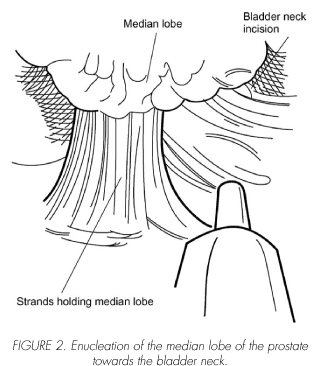
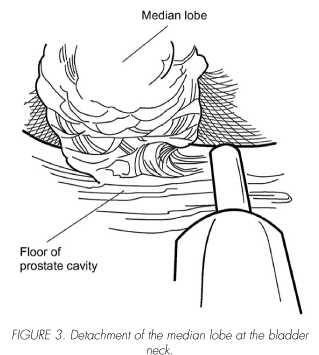
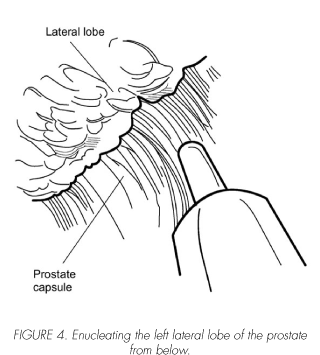
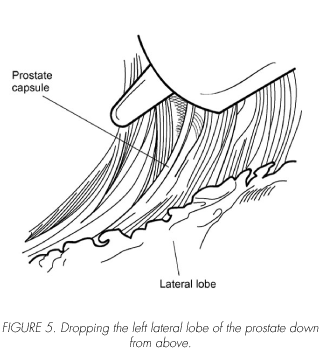
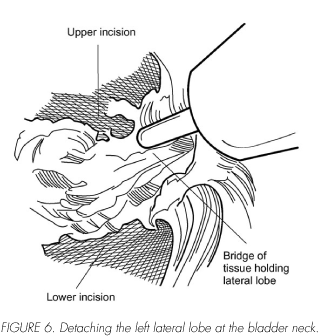
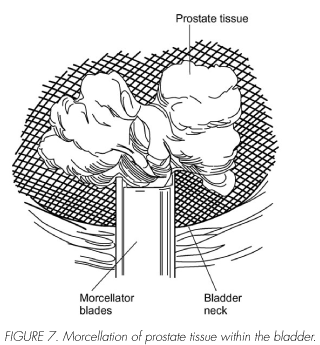
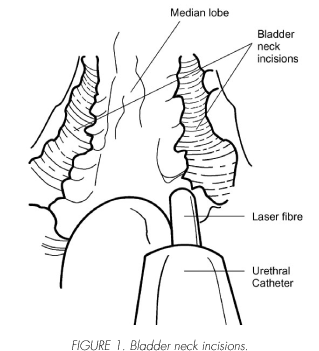
<body><![CDATA[<p><font face="Verdana" size="2">In addition to ablation/vaporisation, Holmium   and Thulium can both be used to resect prostate tissue (3, 4). Laser resection   evolved as a method of removing prostate tissue more efficiently than is possible   with laser ablation. In this technique an end-firing fibre is used to perform   bilateral bladder neck incisions and the median lobe of the prostate is enucleated.   Next, the lateral lobes are resected in small fragments which are subsequently   irrigated from the bladder. This is the laser version of TURP. Although faster   then ablation it is not as efficient at removing tissue as enucleation and is   unsuitable for very large prostates (5).</font></p>     <p><font face="Verdana" size="2"><b><i>3) Enucleation</i></b></font></p>     <p><font face="Verdana" size="2">During Holmium laser resection of the prostate   (HoLRP) it became obvious that the surgical plane between prostate adenoma and   capsule could be entered with the holmium laser fibre and that each prostatic   lobe could be peeled from the capsule in its entirety whilst maintaining excellent   haemostasis. With the development of a suitable tissue morcellator HoLEP, a   truly novel and highly efficient surgical intervention for BPH, became feasible.   Laser enucleation is the most technically advanced form of laser prostate surgery   and also the most rigorously investigated to date. It is the endoscopic equivalent   of simple open prostatectomy. Once the correct plane is entered the lobes can   be almost bluntly pushed off the capsule by the holmium energy. The perceived   learning curve has been seen as a disadvantage but there is evidence to suggest   that HoLEP can be safely and effectively taught (6-8).</font></p>     <p><font face="Verdana" size="2">Thulium can be used to enucleate but is more   difficult for several reasons:</font></p>     <blockquote> 	    <p><font face="Verdana" size="2">&#149; A stream of bubbles emanates from the   end of the thulium fibre which may interfere with the view of the surgical plane.</font></p> 	    <p><font face="Verdana" size="2">&#149; The thulium laser cuts and chars tissue,   rather than pushing the lobes bluntly from the capsule. This makes it difficult   to remain in the correct plane.</font></p> </blockquote>     <p><font face="Verdana" size="2"><b>PVP versus HoLEP - A Review of the Evidence</b></font></p>     <p><font face="Verdana" size="2"><b><i>Randomised trials</i></b></font></p>     <p><font face="Verdana" size="2"><b>PVP</b></font></p>     ]]></body>
<body><![CDATA[<p><font face="Verdana" size="2">There is only a single published randomised trial   for PVP, comparing PVP to TURP (9). This paper is difficult to interpret as   the trial had not concluded at the time of its publication, and only 44 of 120   patients had been evaluated at 12 months. The definitive results are awaited   with interest.</font></p>     <p><font face="Verdana" size="2"><b>HoLEP</b></font></p>     <p><font face="Verdana" size="2">There are 8 published randomised trials comparing   HoLEP to: TURP (10-14), transurethral vapour resection (TUVRP) (14), bipolar   enucleation (15), open prostatectomy (16,17) and holmium bladder neck incision   (HoBNI) (18).</font></p>     <p><font face="Verdana" size="2">The 4 HoLEP versus TURP trials report significantly   less blood loss, catheter time, need for irrigation, nursing contact, and shorter   hospital stay for HoLEP. The HoLEP operating times are consistently longer than   for TURP but more tissue is removed with HoLEP. No TUR syndrome has ever been   reported with HoLEP. Subjective and objective measures of success are at least   equivalent to TURP. HoLEP is the first transurethral procedure to show improved   urodynamic outcomes compared to TURP: Tan et al reported significantly greater   urodynamic relief of bladder outlet with HoLEP at 6 months (10), although this   was not reported in another trial (19).</font></p>     <p><font face="Verdana" size="2">In the randomised trial comparing HoLEP to TUVRP,   HoLEP resulted in significantly less blood loss, less need for irrigation, less   nursing time and shorter hospital stay (14).</font></p>     <p><font face="Verdana" size="2">Neill et al reported that enucleation was feasible   using a Gyrus bipolar radiofrequency device but that it resulted in significantly   longer operating time, need for irrigation and recovery room time than HoLEP   (15). Outcomes at 1,3,6 and 12 months were equivalent.</font></p>     <p><font face="Verdana" size="2">There are two randomised trials comparing HoLEP   to open prostatectomy for large prostates (16,17). Both report significantly   longer operating time for HoLEP, but significantly less blood loss, shorter   catheter and hospital times, and equivalent improvements in symptom and quality   of life scores, maximal flow rates and post void residual volumes at 18 month   (16) and 2 year (17) follow up.</font></p>     <p><font face="Verdana" size="2">Aho et al reported that HoLEP and HoBNI were   feasible as day stay procedures for patients with glands less than 40 grams,   and that HoLEP resulted in superior relief of bladder outlet obstruction particularly   in those with prostates larger than 30 grams (18).</font></p>     <p><font face="Verdana" size="2"><b>Perioperative management</b></font></p>     <p><font face="Verdana" size="2">As both the holmium and Greenlight lasers provide   excellent haemostasis, catheter times, hospital stays and the infrequent need   for irrigation are similar in reported Ho-LEP and PVP series. Both can be performed   as day surgery procedures (18, 20, 21,22)</font></p>     ]]></body>
<body><![CDATA[<p><font face="Verdana" size="2"><b>Subjective and objective measures of success</b></font></p>     <p><font face="Verdana" size="2">There are no randomised trials comparing PVP   and HoLEP. There are however a number of published case series for PVP (21-29).   A comparison of the results of these and similar sized HoLEP series (<a target="_blank" href="/img/revistas/urol/v61n9/09t2.gif">Table   II</a>) suggests that both procedures result in similar symptom and quality   of life improvements, but there is greater improvement in maximal flow rate   and post void residual volume with HoLEP.</font></p>     <p><font face="Verdana" size="2"><b><i>Complications</i></b></font></p>     <p><font face="Verdana" size="2"><b>PVP</b></font></p>     <p><font face="Verdana" size="2">The most common complications of PVP are persistent   dysuria (mean duration 2 months), and haematuria (mean duration 1 month). These   have been reported in up to 30% and 18 % respectively (27). Rates of other reported   complications include: ureteric injury 1.8% (28), recatheterisation 0-15.4%   (29), urinary incontinence 0-6.5% (22), urethral stricture 0.7-4% (22, 25) and   bladder neck contracture 0.9-3.5% (25, 26). TUR syndrome does not occur with   PVP.</font></p>     <p><font face="Verdana" size="2"><b>HoLEP</b></font></p>     <p><font face="Verdana" size="2">Shah et al report a prospective case study of   the complications of HoLEP in 280 patients (30). Despite including their learning   curve, the overall complication rates are low. Capsular perforation occurred   in 9.6%, superficial bladder mucosal injury in 3.9%, and ureteric orifice injury   in 2.1%. Blood transfusion was given in 1.4 %, and cystoscopy and clot evacuation   was performed in 0.7%. There was no TUR syndrome. Recatheterisation was required   in 3.9%. The commonest complication was transient urinary incontinence (10.7%)   which resolved in all but two (0.7%). Meatal/submeatal stenosis occurred in   2.5%, urethral stricture in 2.1% and bladder neck contracture in 0.35%.</font></p>     <p><font face="Verdana" size="2"><b><i>Sexual Function</i></b></font></p>     <p><font face="Verdana" size="2"><b>PVP</b></font></p>     <p><font face="Verdana" size="2">In a study of sexual function and PVP the International   Index of Erectile function (IIEF) was completed by 45 patients just before and   6 months after surgery (31). All IIEF domains improved after PVP. Retrograde   ejaculation is reported in up to 36 % after PVP. (22)</font></p>     ]]></body>
<body><![CDATA[<p><font face="Verdana" size="2"><b>HoLEP</b></font></p>     <p><font face="Verdana" size="2">The IIEF-EF score was also used by Briganti et   al to evaluate the effect of HoLEP and TURP on sexual function as part of a   randomised trial (32). TURP and HoLEP both significantly lowered the orgasmic   function domain to a similar degree due to retrograde ejaculation. Marginal   non significant improvements in erectile function were reported at 12 and 24   months by both groups.</font></p>     <p><font face="Verdana" size="2">Meng et al evaluated sexual function in 108 HoLEP   patients using the Danish Prostate Symptom Score Sexual Function Questionnaire.   (33) Satisfaction with libido, erections and sex life was unaltered at 6 months   after HoLEP. Early morning erections were reported by 45% pre-operatively and   62% 6 months later (p&lt;0.01). Retrograde ejaculation occurred in 70%.</font></p>     <p><font face="Verdana" size="2"><b>Volume Reduction</b></font></p>     <p><font face="Verdana" size="2">When considering transrectal ultrasound (TRUS)   measured volume before and after surgery, it is clear that a significantly greater   percentage of tissue is removed by HoLEP than PVP. (<a target="_blank" href="/img/revistas/urol/v61n9/09t3.gif">Table   III</a>). PSA can be used as a surrogate measure of prostate volume reduction   (34). The significantly greater decrease in PSA after HoLEP compared to PVP   suggests that adenoma removal is more complete with HoLEP (<a target="_blank" href="/img/revistas/urol/v61n9/09t3.gif">Table   III</a>).</font></p>     <p><font face="Verdana" size="2"><b><i>Durability</i></b></font></p>     <p><font face="Verdana" size="2"><b>PVP</b></font></p>     <p><font face="Verdana" size="2">Interpretable long term data on PVP outcomes   are lacking. Malek et al report on follow-up to 5 years but only 51% of the   original 94 patients were evaluable at 2 years, 34% at 3 years and 15% at 5   years (37). Most other PVP series provide follow-up data to 12 months only.   Rajbabu et al evaluated 70% of their original patients at 2 years and reported   a reoperation rate for BPH related problems of 7.4% (28). Ruszat et al reported   2 year follow-up with <i>a</i> reoperation rate for BPH of 2.7%, but only 19%   of their original patients were evaluated at 2 years (38).</font></p>     <p align="center"><img src="/img/revistas/urol/v61n9/09f1.gif"></p>     <p>&nbsp;</p>     ]]></body>
<body><![CDATA[<p align="center"><img src="/img/revistas/urol/v61n9/09f2.gif"></p>     <p>&nbsp;</p>     <p><font face="Verdana" size="2"><b>HoLEP</b></font></p>     <p><font face="Verdana" size="2">In contrast to PVP, longer term durability data   are now available for HoLEP.</font></p>     <p><font face="Verdana" size="2">Ahyai et al have evaluated 72% of their original   patients at 3 years in their randomised trial of HoLEP versus TURP (39). The   reoperation rate for BPH in the HoLEP group was 1% compared to 0 in the TURP   group. Most subjective and objective outcome measures were similar between TURP   and HoLEP groups at 3 years, although post void residual was significantly less   in the HoLEP group (not at a clinically relevant level). Vavassori et al report   a reoperation rate for BPH for HoLEP of 2.7% at 3 years (40). Five year data   from their randomised trial of HoLEP versus open prostatectomy trial for prostates   greater than 100 grams is reported by Kuntz et al (41). An impressive 62% of   the original patients were evaluated at 5 years. There were no differences between   groups in symptom scores, maximum flow rates, post void residual volumes or   complications at 5 years. No patients in either group required a reoperation   for BPH up to 5 years. Gilling et al report on 6 year follow up for HoLEP with   54% of their original patients evaluable (42). Reoperation rate for BPH was   1.4%, and 92% were satisfied or extremely satisfied with their outcomes at 6   years.</font></p>     <p>&nbsp;</p>     <p align="center"><img src="/img/revistas/urol/v61n9/09f3.gif"></p>     <p>&nbsp;</p>     <p align="center"><img src="/img/revistas/urol/v61n9/09f4.gif"></p>     <p>&nbsp;</p>     ]]></body>
<body><![CDATA[<p align="center"><img src="/img/revistas/urol/v61n9/09f5.gif"></p>     <p>&nbsp;</p>     <p align="center"><img src="/img/revistas/urol/v61n9/09f6.gif"></p>     <p>&nbsp;</p>     <p align="center"><img src="/img/revistas/urol/v61n9/09f7.gif"></p>     <p>&nbsp;</p>     <p><font face="Verdana" size="2"><b><i>Large prostates</i></b></font></p>     <p><font face="Verdana" size="2"><b>PVP</b></font></p>     <p><font face="Verdana" size="2">PVP has been evaluated for large prostates in   2 centres (28, 26). Both reported short catheter times and hospital stays, and   few perioperative complications. Interestingly, both also reported improvements   in clinical outcomes at 1 year that are less impressive than for PVP series   with smaller prostates: Improvements in IPSS, Qmax and PVR reported by Rajbabu   et al were 72%, 124%, and 63% ; and by Sandhu et al were 64%, 139% and 42% respectively.   These results can be compared with those of other PVP series in <a target="_blank" href="/img/revistas/urol/v61n9/09t2.gif">Table   2</a>, and suggest that PVP results might not be size independent. Mean TRUS   volume reduction in the study by Rajbabu was 45% indicating that a significant   volume of adenoma remained after PVP. This raises a concern that durability   may be an issue for PVP, particularly in large glands. Longer term data for   large prostates is awaited.</font></p>     <p><font face="Verdana" size="2"><b>HoLEP</b></font></p>     ]]></body>
<body><![CDATA[<p><font face="Verdana" size="2">Several authors have reported on the outcomes   for HoLEP for large glands (35, 36, 41). All agree it is safe and effective   and volume reduction range from 69-82% (36, 35). As mentioned previously, Kuntz   et al reported clinical outcomes at 5 years for prostates &gt; 100 grams to   be equivalent to open prostatectomy in a randomised trial, and no reoperations   for BPH were required (41).</font></p>     <p><font face="Verdana" size="2">All 3 papers analysing the effect of prostate   size on HoLEP suggest that HoLEP outcomes are independent of prostate size (43-45).</font></p>     <p><font face="Verdana" size="2"><b><i>Retention</i></b></font></p>     <p><font face="Verdana" size="2"><b>PVP</b></font></p>     <p><font face="Verdana" size="2">Ruzsat et al compared PVP performed for urinary   retention (UR) and for lower urinary tract symptoms (LUTS) (38). There were   no significant differences in length of stay (UR = 5.5 days, LUTS = 5.3 days),   catheter time (UR = 1.7 days, LUTS = 1.8 days), the proportion of patients discharged   with catheters (UR = 10%, LUTS = 8.8%), or complication rates. Only 19% of the   original patients were evaluated at 2 years, but within a 2 year period the   reintervention rate for recurrent obstructive BPH was 2.7%. Functional results   up to 2 years were similar between groups. Although 10% in the UR group were   discharged with catheters, it is not stated how many (if any) of these subsequently   had a successful trial without catheter.</font></p>     <p><font face="Verdana" size="2"><b>HoLEP</b></font></p>     <p><font face="Verdana" size="2">Two papers evaluate the use of HoLEP for patients   in urinary retention pre-operatively. Elzayat et al report on 169 patients with   mean pre-operative TRUS prostate volume of 101 cc (46). Mean catheter time and   hospital stay were 1.6 and 1.7 days respectively. Three (1.8%) failed to void   postoperatively. Peterson et al studied 154 patients with a mean pre-operative   TRUS volume of 107.1 cc and a mean prostate volume reduction after HoLEP of   76% (47). Mean catheter time and hospital stay were 22.5 and 33.7 hours respectively.   All patients were able to void post-operatively and remained catheter free at   follow-up to 1 year, although only 22% of the original patients were evaluated   at 1 year.</font></p>     <p>&nbsp;</p>     <p><font face="Verdana" size="3"><b>Conclusion</b></font></p>     <p><font face="Verdana" size="2">PVP and HoLEP are very different laser techniques   for the treatment of obstructive BPH. As an ablative technique PVP is not a   new concept and is an identical technique to HoLAP and thulium vaporisation.   An important difference between the Greenlight laser and holmium and thulium   is that it's only urological application is prostate ablation. HoLEP is the   most advanced laser technique currently available. In contrast to PVP (for which   there is only a single, yet to be completed, published randomised trial), it   has been rigorously evaluated in 8 randomised trials. It is a size independent   procedure suitable for any prostate, and highly effective at treating urinary   retention. HoLEP has recently been reported to be durable to periods up to 6   years. More tissue is removed with HoLEP than PVP, and this raises concerns   regarding the long term durability of PVP for which there is no comparable data.</font></p>     ]]></body>
<body><![CDATA[<p><font face="Verdana" size="2">The increase in HoLEP expertise world-wide and   the development of lasers that are faster at ablating tissue and have other   urological uses (eg thulium) may threaten the longevity of Greenlight PVP.</font></p>     <p>&nbsp;</p>     <p><font face="Verdana" size="3"><b>References and recomended readings</b></font></p>     <!-- ref --><p><font face="Verdana" size="2">1. KUNTZ, R.: "Current role of lasers in the treatment of benign prostatic hyperplasia (BPH)". Eur. Urol., 49: 961, 2006.</font>&nbsp;&nbsp;&nbsp;&nbsp;&nbsp;&nbsp;&nbsp;&nbsp;[&#160;<a href="javascript:void(0);" onclick="javascript: window.open('/scielo.php?script=sci_nlinks&ref=1132695&pid=S0004-0614200800090000900001&lng=','','width=640,height=500,resizable=yes,scrollbars=1,menubar=yes,');">Links</a>&#160;]<!-- end-ref --><!-- ref --><p><font face="Verdana" size="2">2. TAN, A.; GILLING, P.; KENNETT, K. y cols.: "Long-term results of high-power holmium laser vaporisation (ablation) of the prostate". BJU Int., 92: 707, 2003.</font>&nbsp;&nbsp;&nbsp;&nbsp;&nbsp;&nbsp;&nbsp;&nbsp;[&#160;<a href="javascript:void(0);" onclick="javascript: window.open('/scielo.php?script=sci_nlinks&ref=1132696&pid=S0004-0614200800090000900002&lng=','','width=640,height=500,resizable=yes,scrollbars=1,menubar=yes,');">Links</a>&#160;]<!-- end-ref --><!-- ref --><p><font face="Verdana" size="2">3. GILLING, P; CASS, C.; CRESWELL, M. y cols.: "Holmium laser resection of the prostate: Preliminary results of a new method for the treatment of benign prostatic hyperplasia". Urology, 47: 48, 1996.</font>&nbsp;&nbsp;&nbsp;&nbsp;&nbsp;&nbsp;&nbsp;&nbsp;[&#160;<a href="javascript:void(0);" onclick="javascript: window.open('/scielo.php?script=sci_nlinks&ref=1132697&pid=S0004-0614200800090000900003&lng=','','width=640,height=500,resizable=yes,scrollbars=1,menubar=yes,');">Links</a>&#160;]<!-- end-ref --><!-- ref --><p><font face="Verdana" size="2">4. BACH, T.; HERRMANN, T.; GANZER, R. y cols.: "Revolix vaporesection of the prostate: initial results of 54 patients with a 1-year follow-up". World J. Urol., 25: 257, 2007.</font>&nbsp;&nbsp;&nbsp;&nbsp;&nbsp;&nbsp;&nbsp;&nbsp;[&#160;<a href="javascript:void(0);" onclick="javascript: window.open('/scielo.php?script=sci_nlinks&ref=1132698&pid=S0004-0614200800090000900004&lng=','','width=640,height=500,resizable=yes,scrollbars=1,menubar=yes,');">Links</a>&#160;]<!-- end-ref --><!-- ref --><p><font face="Verdana" size="2">5. WESTENBERG, A.; GILLING, P.; KENNETT, K. y cols.: "Holmium laser resection of the prostate versus transurethral resection of the prostate: results of a randomised trial with a 4-year minimum long-term follow-up". J. Urol., 172: 616, 2004.</font>&nbsp;&nbsp;&nbsp;&nbsp;&nbsp;&nbsp;&nbsp;&nbsp;[&#160;<a href="javascript:void(0);" onclick="javascript: window.open('/scielo.php?script=sci_nlinks&ref=1132699&pid=S0004-0614200800090000900005&lng=','','width=640,height=500,resizable=yes,scrollbars=1,menubar=yes,');">Links</a>&#160;]<!-- end-ref --><!-- ref --><p><font face="Verdana" size="2">6. EL-HAKIM, A.; ELHILALI, M.: "Holmium laser enucleation of the prostate can be taught: The first learning experience". BJU Int., 90: 863, 2002.</font>&nbsp;&nbsp;&nbsp;&nbsp;&nbsp;&nbsp;&nbsp;&nbsp;[&#160;<a href="javascript:void(0);" onclick="javascript: window.open('/scielo.php?script=sci_nlinks&ref=1132700&pid=S0004-0614200800090000900006&lng=','','width=640,height=500,resizable=yes,scrollbars=1,menubar=yes,');">Links</a>&#160;]<!-- end-ref --><!-- ref --><p><font face="Verdana" size="2">7. SHAH, H.; MAHAJAN, A.; SODHA, H. y cols.: "Prospective evaluation of the learning curve for holmium laser enucleation of the prostate". J. Urol., 177: 1468.</font>&nbsp;&nbsp;&nbsp;&nbsp;&nbsp;&nbsp;&nbsp;&nbsp;[&#160;<a href="javascript:void(0);" onclick="javascript: window.open('/scielo.php?script=sci_nlinks&ref=1132701&pid=S0004-0614200800090000900007&lng=','','width=640,height=500,resizable=yes,scrollbars=1,menubar=yes,');">Links</a>&#160;]<!-- end-ref --><!-- ref --><p><font face="Verdana" size="2">8. SEKI, N.; MOCHIDA, O.; KINUKAWA, N. y cols.: "Holmium laser enucleation for prostatic adenoma: Analysis of learning curve over the course of 70 consecutive cases". J. Urol., 170: 1847, 2003.</font>&nbsp;&nbsp;&nbsp;&nbsp;&nbsp;&nbsp;&nbsp;&nbsp;[&#160;<a href="javascript:void(0);" onclick="javascript: window.open('/scielo.php?script=sci_nlinks&ref=1132702&pid=S0004-0614200800090000900008&lng=','','width=640,height=500,resizable=yes,scrollbars=1,menubar=yes,');">Links</a>&#160;]<!-- end-ref --><!-- ref --><p><font face="Verdana" size="2">9. BOUCHIER-HAYES, D.; ANDERSON, P; VAN APPLEDORN, S. y cols.: "KTP Laser versus Transurethral Resection: Early Results of a Randomised Trial". J. Endourol., 20: 580, 2006.</font>&nbsp;&nbsp;&nbsp;&nbsp;&nbsp;&nbsp;&nbsp;&nbsp;[&#160;<a href="javascript:void(0);" onclick="javascript: window.open('/scielo.php?script=sci_nlinks&ref=1132703&pid=S0004-0614200800090000900009&lng=','','width=640,height=500,resizable=yes,scrollbars=1,menubar=yes,');">Links</a>&#160;]<!-- end-ref --><!-- ref --><p><font face="Verdana" size="2">10. TAN, A.; GILLING, P.; KENNETT, K. y cols.: "A randomised trial comparing holmium laser enucleation of the prostate with transurethral resection of the prostate for the treatment of bladder outlet obstruction secondary to benign prostatic hyperplasia in large glands (40 to 200 grams)". J. Urol., 170: 1270, 2003.</font>&nbsp;&nbsp;&nbsp;&nbsp;&nbsp;&nbsp;&nbsp;&nbsp;[&#160;<a href="javascript:void(0);" onclick="javascript: window.open('/scielo.php?script=sci_nlinks&ref=1132704&pid=S0004-0614200800090000900010&lng=','','width=640,height=500,resizable=yes,scrollbars=1,menubar=yes,');">Links</a>&#160;]<!-- end-ref --><!-- ref --><p><font face="Verdana" size="2">11. WILSON, L.; GILLING, P.; WILLIAMS, A. y cols.: "A randomised trial comparing holmium laser enucleation versus transurethral resection in the treatment of prostates larger than 40 grams: Results at 2 years". M. Eur. Urol., 50: 569, 2006.</font>&nbsp;&nbsp;&nbsp;&nbsp;&nbsp;&nbsp;&nbsp;&nbsp;[&#160;<a href="javascript:void(0);" onclick="javascript: window.open('/scielo.php?script=sci_nlinks&ref=1132705&pid=S0004-0614200800090000900011&lng=','','width=640,height=500,resizable=yes,scrollbars=1,menubar=yes,');">Links</a>&#160;]<!-- end-ref --><!-- ref --><p><font face="Verdana" size="2">12. KUNTZ, R.; AHYAI, S.; LEHRICH, K. y cols.: "Transurethral holmium laser enucleation of the prostate versus transurethral electrocautery resection of the prostate: A randomised prospective trial in 200 patients". J. Urol., 172: 1012, 2004.</font>&nbsp;&nbsp;&nbsp;&nbsp;&nbsp;&nbsp;&nbsp;&nbsp;[&#160;<a href="javascript:void(0);" onclick="javascript: window.open('/scielo.php?script=sci_nlinks&ref=1132706&pid=S0004-0614200800090000900012&lng=','','width=640,height=500,resizable=yes,scrollbars=1,menubar=yes,');">Links</a>&#160;]<!-- end-ref --><!-- ref --><p><font face="Verdana" size="2">13. MONTORSI, F.; NASPRO, R.; SALONIA, A. y cols.: "Holmium laser enucleation versus transurethral resection of the prostate: Results from a 2-center, prospective, randomised trial in patients with obstructive benign prostatic hyperplasia". J. Urol., 172: 1926, 2004.</font>&nbsp;&nbsp;&nbsp;&nbsp;&nbsp;&nbsp;&nbsp;&nbsp;[&#160;<a href="javascript:void(0);" onclick="javascript: window.open('/scielo.php?script=sci_nlinks&ref=1132707&pid=S0004-0614200800090000900013&lng=','','width=640,height=500,resizable=yes,scrollbars=1,menubar=yes,');">Links</a>&#160;]<!-- end-ref --><!-- ref --><p><font face="Verdana" size="2">14. GUPTA, N.; SIVARAMA, K.; KUMAR, R. y cols.: "Comparison of standard transurethral resection, transurethral vapour resection and holmium laser enucleation of the prostate for managing benign prostatic hyperplasia of &gt; 40 g". BJU Int., 97: 85, 2006.</font>&nbsp;&nbsp;&nbsp;&nbsp;&nbsp;&nbsp;&nbsp;&nbsp;[&#160;<a href="javascript:void(0);" onclick="javascript: window.open('/scielo.php?script=sci_nlinks&ref=1132708&pid=S0004-0614200800090000900014&lng=','','width=640,height=500,resizable=yes,scrollbars=1,menubar=yes,');">Links</a>&#160;]<!-- end-ref --><!-- ref --><p><font face="Verdana" size="2">15. NEILL, M.; GILLING, P; KENNETT, K. y cols.: "Randomised trial comparing holmium laser enucleation of prostate with palsmakinetic enucleation of prostate for treatment of benign prostatic hyperplasia". Urology, 68: 1020, 2006.</font>&nbsp;&nbsp;&nbsp;&nbsp;&nbsp;&nbsp;&nbsp;&nbsp;[&#160;<a href="javascript:void(0);" onclick="javascript: window.open('/scielo.php?script=sci_nlinks&ref=1132709&pid=S0004-0614200800090000900015&lng=','','width=640,height=500,resizable=yes,scrollbars=1,menubar=yes,');">Links</a>&#160;]<!-- end-ref --><!-- ref --><p><font face="Verdana" size="2">16. KUNTZ, R.; LEHRICH, K.: "Transurethral holmium laser enucleation versus transvesical open enucleation for prostate adenoma greater than 100 gm: A randomised prospective trial of 120 patients". J. Urol., 168: 1465, 2002.</font>&nbsp;&nbsp;&nbsp;&nbsp;&nbsp;&nbsp;&nbsp;&nbsp;[&#160;<a href="javascript:void(0);" onclick="javascript: window.open('/scielo.php?script=sci_nlinks&ref=1132710&pid=S0004-0614200800090000900016&lng=','','width=640,height=500,resizable=yes,scrollbars=1,menubar=yes,');">Links</a>&#160;]<!-- end-ref --><!-- ref --><p><font face="Verdana" size="2">17. NASPRO, R.; SUARDI, N.; SALONIA, A. y cols.: "Holmium laser enucleation of the prostate versus open prostatectomy for prostates &gt; 70g: 24-month follow-up". Eur. Urol., 50: 563, 2006.</font>&nbsp;&nbsp;&nbsp;&nbsp;&nbsp;&nbsp;&nbsp;&nbsp;[&#160;<a href="javascript:void(0);" onclick="javascript: window.open('/scielo.php?script=sci_nlinks&ref=1132711&pid=S0004-0614200800090000900017&lng=','','width=640,height=500,resizable=yes,scrollbars=1,menubar=yes,');">Links</a>&#160;]<!-- end-ref --><!-- ref --><p><font face="Verdana" size="2">18. AHO, T.; GILLING, P.; KENNETT, K. y cols.: "Holmium laser bladder neck incision versus holmium enucleation of the prostate as outpatient procedures for prostates less than 40 grams: A randomised trial". J. Urol., 175: 210, 2005.</font>&nbsp;&nbsp;&nbsp;&nbsp;&nbsp;&nbsp;&nbsp;&nbsp;[&#160;<a href="javascript:void(0);" onclick="javascript: window.open('/scielo.php?script=sci_nlinks&ref=1132712&pid=S0004-0614200800090000900018&lng=','','width=640,height=500,resizable=yes,scrollbars=1,menubar=yes,');">Links</a>&#160;]<!-- end-ref --><!-- ref --><p><font face="Verdana" size="2">19. RIGATTI, L.; NASPRO, R.; SALONIA, A. y cols.: "Urodynamics after TURP and HoLEP in urodynamically obstructed patients: Are there any differences at 1 year of follow-up?". Urology, 67: 1193, 2006.</font>&nbsp;&nbsp;&nbsp;&nbsp;&nbsp;&nbsp;&nbsp;&nbsp;[&#160;<a href="javascript:void(0);" onclick="javascript: window.open('/scielo.php?script=sci_nlinks&ref=1132713&pid=S0004-0614200800090000900019&lng=','','width=640,height=500,resizable=yes,scrollbars=1,menubar=yes,');">Links</a>&#160;]<!-- end-ref --><!-- ref --><p><font face="Verdana" size="2">20. LARNER, T.; AGARWAL, D.; COSTELLO, A.: "Day-case holmium laser enucleation of the prostate for gland volumes of &lt; 60ml: Early experience". BJU Int., 91: 61, 2003.</font>&nbsp;&nbsp;&nbsp;&nbsp;&nbsp;&nbsp;&nbsp;&nbsp;[&#160;<a href="javascript:void(0);" onclick="javascript: window.open('/scielo.php?script=sci_nlinks&ref=1132714&pid=S0004-0614200800090000900020&lng=','','width=640,height=500,resizable=yes,scrollbars=1,menubar=yes,');">Links</a>&#160;]<!-- end-ref --><!-- ref --><p><font face="Verdana" size="2">21. MALEK, R.; KUNTZMAN, R.; BARRETT, D.: "High power potassium-titanyl-phosphate laser vaporisation prostatectomy". J. Urol., 163: 1730, 2000.</font>&nbsp;&nbsp;&nbsp;&nbsp;&nbsp;&nbsp;&nbsp;&nbsp;[&#160;<a href="javascript:void(0);" onclick="javascript: window.open('/scielo.php?script=sci_nlinks&ref=1132715&pid=S0004-0614200800090000900021&lng=','','width=640,height=500,resizable=yes,scrollbars=1,menubar=yes,');">Links</a>&#160;]<!-- end-ref --><!-- ref --><p><font face="Verdana" size="2">22. TE, A.: MALLOY, T.; STEIN, B. y cols.: "Photoselective vaporisation of the prostate for the treatment of benign prostatic hyperplasia: 12-month results from the first United States multicentre prospective trial". J. Urol., 172: 1404, 2004.</font>&nbsp;&nbsp;&nbsp;&nbsp;&nbsp;&nbsp;&nbsp;&nbsp;[&#160;<a href="javascript:void(0);" onclick="javascript: window.open('/scielo.php?script=sci_nlinks&ref=1132716&pid=S0004-0614200800090000900022&lng=','','width=640,height=500,resizable=yes,scrollbars=1,menubar=yes,');">Links</a>&#160;]<!-- end-ref --><!-- ref --><p><font face="Verdana" size="2">23. REICH, O.; BACHMANN, A.; SIEBELS, M. y cols.: "High power (80W) potassium-titanyl-phosphate laser vaporisation of the prostate in 66 high risk patients". J. Urol., 173: 158, 2005.</font>&nbsp;&nbsp;&nbsp;&nbsp;&nbsp;&nbsp;&nbsp;&nbsp;[&#160;<a href="javascript:void(0);" onclick="javascript: window.open('/scielo.php?script=sci_nlinks&ref=1132717&pid=S0004-0614200800090000900023&lng=','','width=640,height=500,resizable=yes,scrollbars=1,menubar=yes,');">Links</a>&#160;]<!-- end-ref --><!-- ref --><p><font face="Verdana" size="2">24. SARICA, K.; ALKAN, E.; LULECI, H. y cols.: "Photoselective vaporisation of the enlarged prostate with KTP laser: Long-term results in 240 patients". J. Endourol., 19: 1199, 2005.</font>&nbsp;&nbsp;&nbsp;&nbsp;&nbsp;&nbsp;&nbsp;&nbsp;[&#160;<a href="javascript:void(0);" onclick="javascript: window.open('/scielo.php?script=sci_nlinks&ref=1132718&pid=S0004-0614200800090000900024&lng=','','width=640,height=500,resizable=yes,scrollbars=1,menubar=yes,');">Links</a>&#160;]<!-- end-ref --><!-- ref --><p><font face="Verdana" size="2">25. BACHMANN, A.; RUSZAT, R.; WYLER, S. y cols.: "Photoselective vaporisation of the prostate: The Basel experience after 108 procedures". Eur. Urol., 47: 798, 2005.</font>&nbsp;&nbsp;&nbsp;&nbsp;&nbsp;&nbsp;&nbsp;&nbsp;[&#160;<a href="javascript:void(0);" onclick="javascript: window.open('/scielo.php?script=sci_nlinks&ref=1132719&pid=S0004-0614200800090000900025&lng=','','width=640,height=500,resizable=yes,scrollbars=1,menubar=yes,');">Links</a>&#160;]<!-- end-ref --><!-- ref --><p><font face="Verdana" size="2">26. SANDHU, J.N.G.C.; VANDERBRINK, B.; EGAN, C. y cols.: "High power potassium-titanyl-phosphate photoselective laser vaporisation of prostate for treatment of benign prostatic hyperplasia in men with large prostates". Urology, 64: 1155, 2004.</font>&nbsp;&nbsp;&nbsp;&nbsp;&nbsp;&nbsp;&nbsp;&nbsp;[&#160;<a href="javascript:void(0);" onclick="javascript: window.open('/scielo.php?script=sci_nlinks&ref=1132720&pid=S0004-0614200800090000900026&lng=','','width=640,height=500,resizable=yes,scrollbars=1,menubar=yes,');">Links</a>&#160;]<!-- end-ref --><!-- ref --><p><font face="Verdana" size="2">27. VOLKAN, T.; IHSAN YILMAZ, O.; EMIN, O. y cols.: "Short term outcomes of high power (80 W) potassium-titanyl-phosphate laser vaporisation of the prostate". Eur. Urol., 48: 608, 2005.</font>&nbsp;&nbsp;&nbsp;&nbsp;&nbsp;&nbsp;&nbsp;&nbsp;[&#160;<a href="javascript:void(0);" onclick="javascript: window.open('/scielo.php?script=sci_nlinks&ref=1132721&pid=S0004-0614200800090000900027&lng=','','width=640,height=500,resizable=yes,scrollbars=1,menubar=yes,');">Links</a>&#160;]<!-- end-ref --><!-- ref --><p><font face="Verdana" size="2">28. RAJBABU, K.; CHANDRASEKARA, S.; BARBER, N. y cols.: "Photoselective vaporisation of the prostate with the potassium-titanyl-phosphate laser in men with prostates of &gt; 100ml". BJU Int., 100: 593, 2007.</font>&nbsp;&nbsp;&nbsp;&nbsp;&nbsp;&nbsp;&nbsp;&nbsp;[&#160;<a href="javascript:void(0);" onclick="javascript: window.open('/scielo.php?script=sci_nlinks&ref=1132722&pid=S0004-0614200800090000900028&lng=','','width=640,height=500,resizable=yes,scrollbars=1,menubar=yes,');">Links</a>&#160;]<!-- end-ref --><!-- ref --><p><font face="Verdana" size="2">29. SULSER, T.; REICH, O.; WYLER, S. y cols.: "Photoselective KTP laser vaporisation of the prostate: First experience with 65 procedures". J. Endourol., 18: 976, 2004.</font>&nbsp;&nbsp;&nbsp;&nbsp;&nbsp;&nbsp;&nbsp;&nbsp;[&#160;<a href="javascript:void(0);" onclick="javascript: window.open('/scielo.php?script=sci_nlinks&ref=1132723&pid=S0004-0614200800090000900029&lng=','','width=640,height=500,resizable=yes,scrollbars=1,menubar=yes,');">Links</a>&#160;]<!-- end-ref --><!-- ref --><p><font face="Verdana" size="2">30. SHAH, H.; MAHAJAN, A.; HEGDE, S. y cols.: "Peri-operative complications of holmium laser enucleation of the prostate: Experience in the first 280 patients, and a review of the literature". BJU Int., 100: 94, 2007.</font>&nbsp;&nbsp;&nbsp;&nbsp;&nbsp;&nbsp;&nbsp;&nbsp;[&#160;<a href="javascript:void(0);" onclick="javascript: window.open('/scielo.php?script=sci_nlinks&ref=1132724&pid=S0004-0614200800090000900030&lng=','','width=640,height=500,resizable=yes,scrollbars=1,menubar=yes,');">Links</a>&#160;]<!-- end-ref --><!-- ref --><p><font face="Verdana" size="2">31. PAICK, J.; UM, J.; KIM, S. y cols.: "Influence of high power FTP photoselective vaporisation of the prostate on erectile function: A short-term follow-up study". J. Sex. Med., 4: 1701, 2007.</font>&nbsp;&nbsp;&nbsp;&nbsp;&nbsp;&nbsp;&nbsp;&nbsp;[&#160;<a href="javascript:void(0);" onclick="javascript: window.open('/scielo.php?script=sci_nlinks&ref=1132725&pid=S0004-0614200800090000900031&lng=','','width=640,height=500,resizable=yes,scrollbars=1,menubar=yes,');">Links</a>&#160;]<!-- end-ref --><!-- ref --><p><font face="Verdana" size="2">32. BRIGANTI, A.; NASPRO, R.; GALLINA, A. y cols.: "Impact on sexual function of holmium laser enucleation versus transurethral resection of the prostate: Results of a prospective 2-center, randomised trial". J. Urol., 175: 1817, 2006.</font>&nbsp;&nbsp;&nbsp;&nbsp;&nbsp;&nbsp;&nbsp;&nbsp;[&#160;<a href="javascript:void(0);" onclick="javascript: window.open('/scielo.php?script=sci_nlinks&ref=1132726&pid=S0004-0614200800090000900032&lng=','','width=640,height=500,resizable=yes,scrollbars=1,menubar=yes,');">Links</a>&#160;]<!-- end-ref --><!-- ref --><p><font face="Verdana" size="2">33. MENG, F.; GAO, B.; FU, Q. y cols.: "Change of sexual function in patients before and after Ho: YAG laser enucleation of the prostate". J. Androl., 28: 259, 2007.</font>&nbsp;&nbsp;&nbsp;&nbsp;&nbsp;&nbsp;&nbsp;&nbsp;[&#160;<a href="javascript:void(0);" onclick="javascript: window.open('/scielo.php?script=sci_nlinks&ref=1132727&pid=S0004-0614200800090000900033&lng=','','width=640,height=500,resizable=yes,scrollbars=1,menubar=yes,');">Links</a>&#160;]<!-- end-ref --><!-- ref --><p><font face="Verdana" size="2">34. TINMOUTH, W.; HABIB, E.; KIM, S. y cols.: "Change in serum prostate specific antigen concentration after holmium laser enucleation of the prostate: A marker for completeness of adenoma resection?". J. Endourol., 19: 550, 2005.</font>&nbsp;&nbsp;&nbsp;&nbsp;&nbsp;&nbsp;&nbsp;&nbsp;[&#160;<a href="javascript:void(0);" onclick="javascript: window.open('/scielo.php?script=sci_nlinks&ref=1132728&pid=S0004-0614200800090000900034&lng=','','width=640,height=500,resizable=yes,scrollbars=1,menubar=yes,');">Links</a>&#160;]<!-- end-ref --><!-- ref --><p><font face="Verdana" size="2">35. MATLAGA, B.; KIM, S.; KUO, R. y cols.: "Holmium laser enucleation of the prostate for prostates &gt;125ml". BJU Int., 97: 81.</font>&nbsp;&nbsp;&nbsp;&nbsp;&nbsp;&nbsp;&nbsp;&nbsp;[&#160;<a href="javascript:void(0);" onclick="javascript: window.open('/scielo.php?script=sci_nlinks&ref=1132729&pid=S0004-0614200800090000900035&lng=','','width=640,height=500,resizable=yes,scrollbars=1,menubar=yes,');">Links</a>&#160;]<!-- end-ref --><!-- ref --><p><font face="Verdana" size="2">36. ELZAYAT, E.; ELHILALI, M.: "Holmium laser enucleation of the prostate: The endourologic alternative to open prostatectomy". Eur. Urol., 49: 87, 2006.</font>&nbsp;&nbsp;&nbsp;&nbsp;&nbsp;&nbsp;&nbsp;&nbsp;[&#160;<a href="javascript:void(0);" onclick="javascript: window.open('/scielo.php?script=sci_nlinks&ref=1132730&pid=S0004-0614200800090000900036&lng=','','width=640,height=500,resizable=yes,scrollbars=1,menubar=yes,');">Links</a>&#160;]<!-- end-ref --><!-- ref --><p><font face="Verdana" size="2">37. MALEK, R.; KUNTZMAN, R.; BARRETT, D.: "Selective KTP laser vaporisation of the benign obstructive prostate: Observations on long-term outcomes". J. Urol., 174: 1344, 2005.</font>&nbsp;&nbsp;&nbsp;&nbsp;&nbsp;&nbsp;&nbsp;&nbsp;[&#160;<a href="javascript:void(0);" onclick="javascript: window.open('/scielo.php?script=sci_nlinks&ref=1132731&pid=S0004-0614200800090000900037&lng=','','width=640,height=500,resizable=yes,scrollbars=1,menubar=yes,');">Links</a>&#160;]<!-- end-ref --><!-- ref --><p><font face="Verdana" size="2">38. RUSZAT, R.; WYLER, S.; SEIFERT, H. y cols.: "Photoselective vaporisation of the prostate: Subgroup analysis of men with refractory urinary retention". Eur. Urol., 50: 1040, 2006.</font>&nbsp;&nbsp;&nbsp;&nbsp;&nbsp;&nbsp;&nbsp;&nbsp;[&#160;<a href="javascript:void(0);" onclick="javascript: window.open('/scielo.php?script=sci_nlinks&ref=1132732&pid=S0004-0614200800090000900038&lng=','','width=640,height=500,resizable=yes,scrollbars=1,menubar=yes,');">Links</a>&#160;]<!-- end-ref --><!-- ref --><p><font face="Verdana" size="2">39. AHYAI, S.; LEHRICH, K.; KUNTZ, R.: "Holmium laser enucleation versus transurethral resection of the prostate: 3-year follow-up results of a randomised clinical trial". Eur. Urol., 52: 1456, 2007.</font>&nbsp;&nbsp;&nbsp;&nbsp;&nbsp;&nbsp;&nbsp;&nbsp;[&#160;<a href="javascript:void(0);" onclick="javascript: window.open('/scielo.php?script=sci_nlinks&ref=1132733&pid=S0004-0614200800090000900039&lng=','','width=640,height=500,resizable=yes,scrollbars=1,menubar=yes,');">Links</a>&#160;]<!-- end-ref --><!-- ref --><p><font face="Verdana" size="2">40. VAVASSORI, I.; VALENTI, S.; NASPRO, R. y cols.: "Three-year outcome following holmium laser enucleation of the prostate combined with mechanical morcellation in 330 consecutive patients". Eur. Urol., 53: 599, 2008.</font>&nbsp;&nbsp;&nbsp;&nbsp;&nbsp;&nbsp;&nbsp;&nbsp;[&#160;<a href="javascript:void(0);" onclick="javascript: window.open('/scielo.php?script=sci_nlinks&ref=1132734&pid=S0004-0614200800090000900040&lng=','','width=640,height=500,resizable=yes,scrollbars=1,menubar=yes,');">Links</a>&#160;]<!-- end-ref --><!-- ref --><p><font face="Verdana" size="2">41. KUNTZ, R.; LEHRICH, K.; AHYAI, S.: "Holmium laser enucleation of the prostate versus open prostatectomy for prostates greater than 100 grams: 5-year follow-up results of a randomised clinical trial". Eur. Urol., 53: 160, 2008.</font>&nbsp;&nbsp;&nbsp;&nbsp;&nbsp;&nbsp;&nbsp;&nbsp;[&#160;<a href="javascript:void(0);" onclick="javascript: window.open('/scielo.php?script=sci_nlinks&ref=1132735&pid=S0004-0614200800090000900041&lng=','','width=640,height=500,resizable=yes,scrollbars=1,menubar=yes,');">Links</a>&#160;]<!-- end-ref --><!-- ref --><p><font face="Verdana" size="2">42. GILLING, P.; AHO, T.; FRAMPTON, C. y cols.: "Holmium laser enucleation of the prostate: Results at 6 years". Eur. Urol., 2007.</font>&nbsp;&nbsp;&nbsp;&nbsp;&nbsp;&nbsp;&nbsp;&nbsp;[&#160;<a href="javascript:void(0);" onclick="javascript: window.open('/scielo.php?script=sci_nlinks&ref=1132736&pid=S0004-0614200800090000900042&lng=','','width=640,height=500,resizable=yes,scrollbars=1,menubar=yes,');">Links</a>&#160;]<!-- end-ref --><!-- ref --><p><font face="Verdana" size="2">43. SHAH, H.; SODHA, H.; KHARODAWALA, S. y cols.: "Influence of prostate size on the outcome of holmium laser enucleation of the prostate". BJU Int., 2008.</font>&nbsp;&nbsp;&nbsp;&nbsp;&nbsp;&nbsp;&nbsp;&nbsp;[&#160;<a href="javascript:void(0);" onclick="javascript: window.open('/scielo.php?script=sci_nlinks&ref=1132737&pid=S0004-0614200800090000900043&lng=','','width=640,height=500,resizable=yes,scrollbars=1,menubar=yes,');">Links</a>&#160;]<!-- end-ref --><!-- ref --><p><font face="Verdana" size="2">44. SEKI, N.; TATSUGAMI, K.; NAITO, S.: "Holmium laser enucleation of the prostate: Comparison of outcomes according to prostate size in 97 Japanese patients". J. Endourol., 21: 192, 2007.</font>&nbsp;&nbsp;&nbsp;&nbsp;&nbsp;&nbsp;&nbsp;&nbsp;[&#160;<a href="javascript:void(0);" onclick="javascript: window.open('/scielo.php?script=sci_nlinks&ref=1132738&pid=S0004-0614200800090000900044&lng=','','width=640,height=500,resizable=yes,scrollbars=1,menubar=yes,');">Links</a>&#160;]<!-- end-ref --><!-- ref --><p><font face="Verdana" size="2">45. KUNTZ, R.; LEHRICH, K.; AHYAI, S.: "Does perioperative outcome of transurethral holmium laser enucleation of the prostate depend on prostate size?". J. Endourol., 18: 183, 2004.</font>&nbsp;&nbsp;&nbsp;&nbsp;&nbsp;&nbsp;&nbsp;&nbsp;[&#160;<a href="javascript:void(0);" onclick="javascript: window.open('/scielo.php?script=sci_nlinks&ref=1132739&pid=S0004-0614200800090000900045&lng=','','width=640,height=500,resizable=yes,scrollbars=1,menubar=yes,');">Links</a>&#160;]<!-- end-ref --><!-- ref --><p><font face="Verdana" size="2">46. ELZAYAT, E.; HABIB, E.; ELHILALI, M.: "Holmium laser enucleation of prostate for patients in urinary retention". Urology, 66: 789, 2005.</font>&nbsp;&nbsp;&nbsp;&nbsp;&nbsp;&nbsp;&nbsp;&nbsp;[&#160;<a href="javascript:void(0);" onclick="javascript: window.open('/scielo.php?script=sci_nlinks&ref=1132740&pid=S0004-0614200800090000900046&lng=','','width=640,height=500,resizable=yes,scrollbars=1,menubar=yes,');">Links</a>&#160;]<!-- end-ref --><!-- ref --><p><font face="Verdana" size="2">47. PETERSON, M.; MATLAGA, B.; KIM, S. y cols.: "Holmium laser enucleation of the prostate for men with urinary retention". J. Urol., 174: 998, 2005.</font>&nbsp;&nbsp;&nbsp;&nbsp;&nbsp;&nbsp;&nbsp;&nbsp;[&#160;<a href="javascript:void(0);" onclick="javascript: window.open('/scielo.php?script=sci_nlinks&ref=1132741&pid=S0004-0614200800090000900047&lng=','','width=640,height=500,resizable=yes,scrollbars=1,menubar=yes,');">Links</a>&#160;]<!-- end-ref --><p>&nbsp;</p>     <p>&nbsp;</p>     <p><font face="Verdana" size="2"><b><a name="back"></a><a href="#top"><img src="/img/revistas/urol/v61n9/seta.gif" border="0"></a>Direcci&oacute;n para correspondencia:    <br></b> Tevita F. Aho    <br>Department of Urology    <br>Box 43    <br>Addenbrooke's Hospital    <br>Cambridge CB2 2QQ (UK)    <br><a href="mailto:tevita.aho@addenbrookes.nhs.uk">tevita.aho@addenbrookes.nhs.uk</a></font></p>      ]]></body><back>
<ref-list>
<ref id="B1">
<label>1</label><nlm-citation citation-type="journal">
<person-group person-group-type="author">
<name>
<surname><![CDATA[KUNTZ]]></surname>
<given-names><![CDATA[R.]]></given-names>
</name>
</person-group>
<article-title xml:lang="en"><![CDATA[Current role of lasers in the treatment of benign prostatic hyperplasia (BPH)]]></article-title>
<source><![CDATA[Eur. Urol.]]></source>
<year>2006</year>
<volume>49</volume>
<page-range>961</page-range></nlm-citation>
</ref>
<ref id="B2">
<label>2</label><nlm-citation citation-type="journal">
<person-group person-group-type="author">
<name>
<surname><![CDATA[TAN]]></surname>
<given-names><![CDATA[A.]]></given-names>
</name>
<name>
<surname><![CDATA[GILLING]]></surname>
<given-names><![CDATA[P.]]></given-names>
</name>
<name>
<surname><![CDATA[KENNETT]]></surname>
<given-names><![CDATA[K.]]></given-names>
</name>
</person-group>
<article-title xml:lang="en"><![CDATA[Long-term results of high-power holmium laser vaporisation (ablation) of the prostate]]></article-title>
<source><![CDATA[BJU Int.]]></source>
<year>2003</year>
<volume>92</volume>
<page-range>707</page-range></nlm-citation>
</ref>
<ref id="B3">
<label>3</label><nlm-citation citation-type="journal">
<person-group person-group-type="author">
<name>
<surname><![CDATA[GILLING]]></surname>
<given-names><![CDATA[P]]></given-names>
</name>
<name>
<surname><![CDATA[CASS]]></surname>
<given-names><![CDATA[C.]]></given-names>
</name>
<name>
<surname><![CDATA[CRESWELL]]></surname>
<given-names><![CDATA[M.]]></given-names>
</name>
</person-group>
<article-title xml:lang="en"><![CDATA[Holmium laser resection of the prostate: Preliminary results of a new method for the treatment of benign prostatic hyperplasia]]></article-title>
<source><![CDATA[Urology]]></source>
<year>1996</year>
<volume>47</volume>
<page-range>48</page-range></nlm-citation>
</ref>
<ref id="B4">
<label>4</label><nlm-citation citation-type="journal">
<person-group person-group-type="author">
<name>
<surname><![CDATA[BACH]]></surname>
<given-names><![CDATA[T.]]></given-names>
</name>
<name>
<surname><![CDATA[HERRMANN]]></surname>
<given-names><![CDATA[T.]]></given-names>
</name>
<name>
<surname><![CDATA[GANZER]]></surname>
<given-names><![CDATA[R.]]></given-names>
</name>
</person-group>
<article-title xml:lang="en"><![CDATA[Revolix vaporesection of the prostate: initial results of 54 patients with a 1-year follow-up]]></article-title>
<source><![CDATA[World J. Urol.]]></source>
<year>2007</year>
<volume>25</volume>
<page-range>257</page-range></nlm-citation>
</ref>
<ref id="B5">
<label>5</label><nlm-citation citation-type="journal">
<person-group person-group-type="author">
<name>
<surname><![CDATA[WESTENBERG]]></surname>
<given-names><![CDATA[A.]]></given-names>
</name>
<name>
<surname><![CDATA[GILLING]]></surname>
<given-names><![CDATA[P.]]></given-names>
</name>
<name>
<surname><![CDATA[KENNETT]]></surname>
<given-names><![CDATA[K.]]></given-names>
</name>
</person-group>
<article-title xml:lang="en"><![CDATA[Holmium laser resection of the prostate versus transurethral resection of the prostate: results of a randomised trial with a 4-year minimum long-term follow-up]]></article-title>
<source><![CDATA[J. Urol.]]></source>
<year>2004</year>
<volume>172</volume>
<page-range>616</page-range></nlm-citation>
</ref>
<ref id="B6">
<label>6</label><nlm-citation citation-type="journal">
<person-group person-group-type="author">
<name>
<surname><![CDATA[EL-HAKIM]]></surname>
<given-names><![CDATA[A.]]></given-names>
</name>
<name>
<surname><![CDATA[ELHILALI]]></surname>
<given-names><![CDATA[M.]]></given-names>
</name>
</person-group>
<article-title xml:lang="en"><![CDATA[Holmium laser enucleation of the prostate can be taught: The first learning experience]]></article-title>
<source><![CDATA[BJU Int.]]></source>
<year>2002</year>
<volume>90</volume>
<page-range>863</page-range></nlm-citation>
</ref>
<ref id="B7">
<label>7</label><nlm-citation citation-type="journal">
<person-group person-group-type="author">
<name>
<surname><![CDATA[SHAH]]></surname>
<given-names><![CDATA[H.]]></given-names>
</name>
<name>
<surname><![CDATA[MAHAJAN]]></surname>
<given-names><![CDATA[A.]]></given-names>
</name>
<name>
<surname><![CDATA[SODHA]]></surname>
<given-names><![CDATA[H.]]></given-names>
</name>
</person-group>
<article-title xml:lang="en"><![CDATA[Prospective evaluation of the learning curve for holmium laser enucleation of the prostate]]></article-title>
<source><![CDATA[J. Urol.]]></source>
<year></year>
<volume>177</volume>
<page-range>1468</page-range></nlm-citation>
</ref>
<ref id="B8">
<label>8</label><nlm-citation citation-type="journal">
<person-group person-group-type="author">
<name>
<surname><![CDATA[SEKI]]></surname>
<given-names><![CDATA[N.]]></given-names>
</name>
<name>
<surname><![CDATA[MOCHIDA]]></surname>
<given-names><![CDATA[O.]]></given-names>
</name>
<name>
<surname><![CDATA[KINUKAWA]]></surname>
<given-names><![CDATA[N.]]></given-names>
</name>
</person-group>
<article-title xml:lang="en"><![CDATA[Holmium laser enucleation for prostatic adenoma: Analysis of learning curve over the course of 70 consecutive cases]]></article-title>
<source><![CDATA[J. Urol.]]></source>
<year>2003</year>
<volume>170</volume>
<page-range>1847</page-range></nlm-citation>
</ref>
<ref id="B9">
<label>9</label><nlm-citation citation-type="journal">
<person-group person-group-type="author">
<name>
<surname><![CDATA[BOUCHIER-HAYES]]></surname>
<given-names><![CDATA[D.]]></given-names>
</name>
<name>
<surname><![CDATA[ANDERSON]]></surname>
<given-names><![CDATA[P]]></given-names>
</name>
<name>
<surname><![CDATA[VAN APPLEDORN]]></surname>
<given-names><![CDATA[S.]]></given-names>
</name>
</person-group>
<article-title xml:lang="en"><![CDATA[KTP Laser versus Transurethral Resection: Early Results of a Randomised Trial]]></article-title>
<source><![CDATA[J. Endourol.]]></source>
<year>2006</year>
<volume>20</volume>
<page-range>580</page-range></nlm-citation>
</ref>
<ref id="B10">
<label>10</label><nlm-citation citation-type="journal">
<person-group person-group-type="author">
<name>
<surname><![CDATA[TAN]]></surname>
<given-names><![CDATA[A.]]></given-names>
</name>
<name>
<surname><![CDATA[GILLING]]></surname>
<given-names><![CDATA[P.]]></given-names>
</name>
<name>
<surname><![CDATA[KENNETT]]></surname>
<given-names><![CDATA[K.]]></given-names>
</name>
</person-group>
<article-title xml:lang="en"><![CDATA[A randomised trial comparing holmium laser enucleation of the prostate with transurethral resection of the prostate for the treatment of bladder outlet obstruction secondary to benign prostatic hyperplasia in large glands (40 to 200 grams)]]></article-title>
<source><![CDATA[J. Urol.]]></source>
<year>2003</year>
<volume>170</volume>
<page-range>1270</page-range></nlm-citation>
</ref>
<ref id="B11">
<label>11</label><nlm-citation citation-type="journal">
<person-group person-group-type="author">
<name>
<surname><![CDATA[WILSON]]></surname>
<given-names><![CDATA[L.]]></given-names>
</name>
<name>
<surname><![CDATA[GILLING]]></surname>
<given-names><![CDATA[P.]]></given-names>
</name>
<name>
<surname><![CDATA[WILLIAMS]]></surname>
<given-names><![CDATA[A.]]></given-names>
</name>
</person-group>
<article-title xml:lang="en"><![CDATA[A randomised trial comparing holmium laser enucleation versus transurethral resection in the treatment of prostates larger than 40 grams: Results at 2 years]]></article-title>
<source><![CDATA[M. Eur. Urol.]]></source>
<year>2006</year>
<volume>50</volume>
<page-range>569</page-range></nlm-citation>
</ref>
<ref id="B12">
<label>12</label><nlm-citation citation-type="journal">
<person-group person-group-type="author">
<name>
<surname><![CDATA[KUNTZ]]></surname>
<given-names><![CDATA[R.]]></given-names>
</name>
<name>
<surname><![CDATA[AHYAI]]></surname>
<given-names><![CDATA[S.]]></given-names>
</name>
<name>
<surname><![CDATA[LEHRICH]]></surname>
<given-names><![CDATA[K.]]></given-names>
</name>
</person-group>
<article-title xml:lang="en"><![CDATA[Transurethral holmium laser enucleation of the prostate versus transurethral electrocautery resection of the prostate: A randomised prospective trial in 200 patients]]></article-title>
<source><![CDATA[J. Urol.]]></source>
<year>2004</year>
<volume>172</volume>
<page-range>1012</page-range></nlm-citation>
</ref>
<ref id="B13">
<label>13</label><nlm-citation citation-type="journal">
<person-group person-group-type="author">
<name>
<surname><![CDATA[MONTORSI]]></surname>
<given-names><![CDATA[F.]]></given-names>
</name>
<name>
<surname><![CDATA[NASPRO]]></surname>
<given-names><![CDATA[R.]]></given-names>
</name>
<name>
<surname><![CDATA[SALONIA]]></surname>
<given-names><![CDATA[A.]]></given-names>
</name>
</person-group>
<article-title xml:lang="en"><![CDATA[Holmium laser enucleation versus transurethral resection of the prostate: Results from a 2-center, prospective, randomised trial in patients with obstructive benign prostatic hyperplasia]]></article-title>
<source><![CDATA[J. Urol.]]></source>
<year>2004</year>
<volume>172</volume>
<page-range>1926</page-range></nlm-citation>
</ref>
<ref id="B14">
<label>14</label><nlm-citation citation-type="journal">
<person-group person-group-type="author">
<name>
<surname><![CDATA[GUPTA]]></surname>
<given-names><![CDATA[N.]]></given-names>
</name>
<name>
<surname><![CDATA[SIVARAMA]]></surname>
<given-names><![CDATA[K.]]></given-names>
</name>
<name>
<surname><![CDATA[KUMAR]]></surname>
<given-names><![CDATA[R.]]></given-names>
</name>
</person-group>
<article-title xml:lang="en"><![CDATA[Comparison of standard transurethral resection, transurethral vapour resection and holmium laser enucleation of the prostate for managing benign prostatic hyperplasia of > 40 g]]></article-title>
<source><![CDATA[BJU Int.]]></source>
<year>2006</year>
<volume>97</volume>
<page-range>85</page-range></nlm-citation>
</ref>
<ref id="B15">
<label>15</label><nlm-citation citation-type="journal">
<person-group person-group-type="author">
<name>
<surname><![CDATA[NEILL]]></surname>
<given-names><![CDATA[M.]]></given-names>
</name>
<name>
<surname><![CDATA[GILLING]]></surname>
<given-names><![CDATA[P]]></given-names>
</name>
<name>
<surname><![CDATA[KENNETT]]></surname>
<given-names><![CDATA[K.]]></given-names>
</name>
</person-group>
<article-title xml:lang="en"><![CDATA[Randomised trial comparing holmium laser enucleation of prostate with palsmakinetic enucleation of prostate for treatment of benign prostatic hyperplasia]]></article-title>
<source><![CDATA[Urology]]></source>
<year>2006</year>
<volume>68</volume>
<page-range>1020</page-range></nlm-citation>
</ref>
<ref id="B16">
<label>16</label><nlm-citation citation-type="journal">
<person-group person-group-type="author">
<name>
<surname><![CDATA[KUNTZ]]></surname>
<given-names><![CDATA[R.]]></given-names>
</name>
<name>
<surname><![CDATA[LEHRICH]]></surname>
<given-names><![CDATA[K.]]></given-names>
</name>
</person-group>
<article-title xml:lang="en"><![CDATA[Transurethral holmium laser enucleation versus transvesical open enucleation for prostate adenoma greater than 100 gm: A randomised prospective trial of 120 patients]]></article-title>
<source><![CDATA[J. Urol.]]></source>
<year>2002</year>
<volume>168</volume>
<page-range>1465</page-range></nlm-citation>
</ref>
<ref id="B17">
<label>17</label><nlm-citation citation-type="journal">
<person-group person-group-type="author">
<name>
<surname><![CDATA[NASPRO]]></surname>
<given-names><![CDATA[R.]]></given-names>
</name>
<name>
<surname><![CDATA[SUARDI]]></surname>
<given-names><![CDATA[N.]]></given-names>
</name>
<name>
<surname><![CDATA[SALONIA]]></surname>
<given-names><![CDATA[A.]]></given-names>
</name>
</person-group>
<article-title xml:lang="en"><![CDATA[Holmium laser enucleation of the prostate versus open prostatectomy for prostates > 70g: 24-month follow-up]]></article-title>
<source><![CDATA[Eur. Urol.]]></source>
<year>2006</year>
<volume>50</volume>
<page-range>563</page-range></nlm-citation>
</ref>
<ref id="B18">
<label>18</label><nlm-citation citation-type="journal">
<person-group person-group-type="author">
<name>
<surname><![CDATA[AHO]]></surname>
<given-names><![CDATA[T.]]></given-names>
</name>
<name>
<surname><![CDATA[GILLING]]></surname>
<given-names><![CDATA[P.]]></given-names>
</name>
<name>
<surname><![CDATA[KENNETT]]></surname>
<given-names><![CDATA[K.]]></given-names>
</name>
</person-group>
<article-title xml:lang="en"><![CDATA[Holmium laser bladder neck incision versus holmium enucleation of the prostate as outpatient procedures for prostates less than 40 grams: A randomised trial]]></article-title>
<source><![CDATA[J. Urol.]]></source>
<year>2005</year>
<volume>175</volume>
<page-range>210</page-range></nlm-citation>
</ref>
<ref id="B19">
<label>19</label><nlm-citation citation-type="journal">
<person-group person-group-type="author">
<name>
<surname><![CDATA[RIGATTI]]></surname>
<given-names><![CDATA[L.]]></given-names>
</name>
<name>
<surname><![CDATA[NASPRO]]></surname>
<given-names><![CDATA[R.]]></given-names>
</name>
<name>
<surname><![CDATA[SALONIA]]></surname>
<given-names><![CDATA[A.]]></given-names>
</name>
</person-group>
<article-title xml:lang="en"><![CDATA[Urodynamics after TURP and HoLEP in urodynamically obstructed patients: Are there any differences at 1 year of follow-up?]]></article-title>
<source><![CDATA[Urology]]></source>
<year>2006</year>
<volume>67</volume>
<page-range>1193</page-range></nlm-citation>
</ref>
<ref id="B20">
<label>20</label><nlm-citation citation-type="journal">
<person-group person-group-type="author">
<name>
<surname><![CDATA[LARNER]]></surname>
<given-names><![CDATA[T.]]></given-names>
</name>
<name>
<surname><![CDATA[AGARWAL]]></surname>
<given-names><![CDATA[D.]]></given-names>
</name>
<name>
<surname><![CDATA[COSTELLO]]></surname>
<given-names><![CDATA[A.]]></given-names>
</name>
</person-group>
<article-title xml:lang="en"><![CDATA[Day-case holmium laser enucleation of the prostate for gland volumes of < 60ml: Early experience]]></article-title>
<source><![CDATA[BJU Int.]]></source>
<year>2003</year>
<volume>91</volume>
<page-range>61</page-range></nlm-citation>
</ref>
<ref id="B21">
<label>21</label><nlm-citation citation-type="journal">
<person-group person-group-type="author">
<name>
<surname><![CDATA[MALEK]]></surname>
<given-names><![CDATA[R.]]></given-names>
</name>
<name>
<surname><![CDATA[KUNTZMAN]]></surname>
<given-names><![CDATA[R.]]></given-names>
</name>
<name>
<surname><![CDATA[BARRETT]]></surname>
<given-names><![CDATA[D.]]></given-names>
</name>
</person-group>
<article-title xml:lang="en"><![CDATA[High power potassium-titanyl-phosphate laser vaporisation prostatectomy]]></article-title>
<source><![CDATA[J. Urol.]]></source>
<year>2000</year>
<volume>163</volume>
<page-range>1730</page-range></nlm-citation>
</ref>
<ref id="B22">
<label>22</label><nlm-citation citation-type="journal">
<person-group person-group-type="author">
<name>
<surname><![CDATA[TE]]></surname>
<given-names><![CDATA[A.]]></given-names>
</name>
<name>
<surname><![CDATA[MALLOY]]></surname>
<given-names><![CDATA[T.]]></given-names>
</name>
<name>
<surname><![CDATA[STEIN]]></surname>
<given-names><![CDATA[B.]]></given-names>
</name>
</person-group>
<article-title xml:lang="en"><![CDATA[Photoselective vaporisation of the prostate for the treatment of benign prostatic hyperplasia: 12-month results from the first United States multicentre prospective trial]]></article-title>
<source><![CDATA[J. Urol.]]></source>
<year>2004</year>
<volume>172</volume>
<page-range>1404</page-range></nlm-citation>
</ref>
<ref id="B23">
<label>23</label><nlm-citation citation-type="journal">
<person-group person-group-type="author">
<name>
<surname><![CDATA[REICH]]></surname>
<given-names><![CDATA[O.]]></given-names>
</name>
<name>
<surname><![CDATA[BACHMANN]]></surname>
<given-names><![CDATA[A.]]></given-names>
</name>
<name>
<surname><![CDATA[SIEBELS]]></surname>
<given-names><![CDATA[M.]]></given-names>
</name>
</person-group>
<article-title xml:lang="en"><![CDATA[High power (80W) potassium-titanyl-phosphate laser vaporisation of the prostate in 66 high risk patients]]></article-title>
<source><![CDATA[J. Urol.]]></source>
<year>2005</year>
<volume>173</volume>
<page-range>158</page-range></nlm-citation>
</ref>
<ref id="B24">
<label>24</label><nlm-citation citation-type="journal">
<person-group person-group-type="author">
<name>
<surname><![CDATA[SARICA]]></surname>
<given-names><![CDATA[K.]]></given-names>
</name>
<name>
<surname><![CDATA[ALKAN]]></surname>
<given-names><![CDATA[E.]]></given-names>
</name>
<name>
<surname><![CDATA[LULECI]]></surname>
<given-names><![CDATA[H.]]></given-names>
</name>
</person-group>
<article-title xml:lang="en"><![CDATA[Photoselective vaporisation of the enlarged prostate with KTP laser: Long-term results in 240 patients]]></article-title>
<source><![CDATA[J. Endourol.]]></source>
<year>2005</year>
<volume>19</volume>
<page-range>1199</page-range></nlm-citation>
</ref>
<ref id="B25">
<label>25</label><nlm-citation citation-type="journal">
<person-group person-group-type="author">
<name>
<surname><![CDATA[BACHMANN]]></surname>
<given-names><![CDATA[A.]]></given-names>
</name>
<name>
<surname><![CDATA[RUSZAT]]></surname>
<given-names><![CDATA[R.]]></given-names>
</name>
<name>
<surname><![CDATA[WYLER]]></surname>
<given-names><![CDATA[S.]]></given-names>
</name>
</person-group>
<article-title xml:lang="en"><![CDATA[Photoselective vaporisation of the prostate: The Basel experience after 108 procedures]]></article-title>
<source><![CDATA[Eur. Urol.]]></source>
<year>2005</year>
<volume>47</volume>
<page-range>798</page-range></nlm-citation>
</ref>
<ref id="B26">
<label>26</label><nlm-citation citation-type="journal">
<person-group person-group-type="author">
<name>
<surname><![CDATA[SANDHU]]></surname>
<given-names><![CDATA[J.N.G.C.]]></given-names>
</name>
<name>
<surname><![CDATA[VANDERBRINK]]></surname>
<given-names><![CDATA[B.]]></given-names>
</name>
<name>
<surname><![CDATA[EGAN]]></surname>
<given-names><![CDATA[C.]]></given-names>
</name>
</person-group>
<article-title xml:lang="en"><![CDATA[High power potassium-titanyl-phosphate photoselective laser vaporisation of prostate for treatment of benign prostatic hyperplasia in men with large prostates]]></article-title>
<source><![CDATA[Urology]]></source>
<year>2004</year>
<volume>64</volume>
<page-range>1155</page-range></nlm-citation>
</ref>
<ref id="B27">
<label>27</label><nlm-citation citation-type="journal">
<person-group person-group-type="author">
<name>
<surname><![CDATA[VOLKAN]]></surname>
<given-names><![CDATA[T.]]></given-names>
</name>
<name>
<surname><![CDATA[IHSAN YILMAZ]]></surname>
<given-names><![CDATA[O.]]></given-names>
</name>
<name>
<surname><![CDATA[EMIN]]></surname>
<given-names><![CDATA[O.]]></given-names>
</name>
</person-group>
<article-title xml:lang="en"><![CDATA[Short term outcomes of high power (80 W) potassium-titanyl-phosphate laser vaporisation of the prostate]]></article-title>
<source><![CDATA[Eur. Urol.]]></source>
<year>2005</year>
<volume>48</volume>
<page-range>608</page-range></nlm-citation>
</ref>
<ref id="B28">
<label>28</label><nlm-citation citation-type="journal">
<person-group person-group-type="author">
<name>
<surname><![CDATA[RAJBABU]]></surname>
<given-names><![CDATA[K.]]></given-names>
</name>
<name>
<surname><![CDATA[CHANDRASEKARA]]></surname>
<given-names><![CDATA[S.]]></given-names>
</name>
<name>
<surname><![CDATA[BARBER]]></surname>
<given-names><![CDATA[N.]]></given-names>
</name>
</person-group>
<article-title xml:lang="en"><![CDATA[Photoselective vaporisation of the prostate with the potassium-titanyl-phosphate laser in men with prostates of > 100ml]]></article-title>
<source><![CDATA[BJU Int.]]></source>
<year>2007</year>
<volume>100</volume>
<page-range>593</page-range></nlm-citation>
</ref>
<ref id="B29">
<label>29</label><nlm-citation citation-type="journal">
<person-group person-group-type="author">
<name>
<surname><![CDATA[SULSER]]></surname>
<given-names><![CDATA[T.]]></given-names>
</name>
<name>
<surname><![CDATA[REICH]]></surname>
<given-names><![CDATA[O.]]></given-names>
</name>
<name>
<surname><![CDATA[WYLER]]></surname>
<given-names><![CDATA[S.]]></given-names>
</name>
</person-group>
<article-title xml:lang="en"><![CDATA[Photoselective KTP laser vaporisation of the prostate: First experience with 65 procedures]]></article-title>
<source><![CDATA[J. Endourol.]]></source>
<year>2004</year>
<volume>18</volume>
<page-range>976</page-range></nlm-citation>
</ref>
<ref id="B30">
<label>30</label><nlm-citation citation-type="journal">
<person-group person-group-type="author">
<name>
<surname><![CDATA[SHAH]]></surname>
<given-names><![CDATA[H.]]></given-names>
</name>
<name>
<surname><![CDATA[MAHAJAN]]></surname>
<given-names><![CDATA[A.]]></given-names>
</name>
<name>
<surname><![CDATA[HEGDE]]></surname>
<given-names><![CDATA[S.]]></given-names>
</name>
</person-group>
<article-title xml:lang="en"><![CDATA[Peri-operative complications of holmium laser enucleation of the prostate: Experience in the first 280 patients, and a review of the literature]]></article-title>
<source><![CDATA[BJU Int.]]></source>
<year>2007</year>
<volume>100</volume>
<page-range>94</page-range></nlm-citation>
</ref>
<ref id="B31">
<label>31</label><nlm-citation citation-type="journal">
<person-group person-group-type="author">
<name>
<surname><![CDATA[PAICK]]></surname>
<given-names><![CDATA[J.]]></given-names>
</name>
<name>
<surname><![CDATA[UM]]></surname>
<given-names><![CDATA[J.]]></given-names>
</name>
<name>
<surname><![CDATA[KIM]]></surname>
<given-names><![CDATA[S.]]></given-names>
</name>
</person-group>
<article-title xml:lang="en"><![CDATA[Influence of high power FTP photoselective vaporisation of the prostate on erectile function: A short-term follow-up study]]></article-title>
<source><![CDATA[J. Sex. Med.]]></source>
<year>2007</year>
<volume>4</volume>
<page-range>1701</page-range></nlm-citation>
</ref>
<ref id="B32">
<label>32</label><nlm-citation citation-type="journal">
<person-group person-group-type="author">
<name>
<surname><![CDATA[BRIGANTI]]></surname>
<given-names><![CDATA[A.]]></given-names>
</name>
<name>
<surname><![CDATA[NASPRO]]></surname>
<given-names><![CDATA[R.]]></given-names>
</name>
<name>
<surname><![CDATA[GALLINA]]></surname>
<given-names><![CDATA[A.]]></given-names>
</name>
</person-group>
<article-title xml:lang="en"><![CDATA[Impact on sexual function of holmium laser enucleation versus transurethral resection of the prostate: Results of a prospective 2-center, randomised trial]]></article-title>
<source><![CDATA[J. Urol.]]></source>
<year>2006</year>
<volume>175</volume>
<page-range>1817</page-range></nlm-citation>
</ref>
<ref id="B33">
<label>33</label><nlm-citation citation-type="journal">
<person-group person-group-type="author">
<name>
<surname><![CDATA[MENG]]></surname>
<given-names><![CDATA[F.]]></given-names>
</name>
<name>
<surname><![CDATA[GAO]]></surname>
<given-names><![CDATA[B.]]></given-names>
</name>
<name>
<surname><![CDATA[FU]]></surname>
<given-names><![CDATA[Q.]]></given-names>
</name>
</person-group>
<article-title xml:lang="en"><![CDATA[Change of sexual function in patients before and after Ho: YAG laser enucleation of the prostate]]></article-title>
<source><![CDATA[J. Androl.]]></source>
<year>2007</year>
<volume>28</volume>
<page-range>259</page-range></nlm-citation>
</ref>
<ref id="B34">
<label>34</label><nlm-citation citation-type="journal">
<person-group person-group-type="author">
<name>
<surname><![CDATA[TINMOUTH]]></surname>
<given-names><![CDATA[W.]]></given-names>
</name>
<name>
<surname><![CDATA[HABIB]]></surname>
<given-names><![CDATA[E.]]></given-names>
</name>
<name>
<surname><![CDATA[KIM]]></surname>
<given-names><![CDATA[S.]]></given-names>
</name>
</person-group>
<article-title xml:lang="en"><![CDATA[Change in serum prostate specific antigen concentration after holmium laser enucleation of the prostate: A marker for completeness of adenoma resection?]]></article-title>
<source><![CDATA[J. Endourol.]]></source>
<year>2005</year>
<volume>19</volume>
<page-range>550</page-range></nlm-citation>
</ref>
<ref id="B35">
<label>35</label><nlm-citation citation-type="journal">
<person-group person-group-type="author">
<name>
<surname><![CDATA[MATLAGA]]></surname>
<given-names><![CDATA[B.]]></given-names>
</name>
<name>
<surname><![CDATA[KIM]]></surname>
<given-names><![CDATA[S.]]></given-names>
</name>
<name>
<surname><![CDATA[KUO]]></surname>
<given-names><![CDATA[R.]]></given-names>
</name>
</person-group>
<article-title xml:lang="en"><![CDATA[Holmium laser enucleation of the prostate for prostates >125ml]]></article-title>
<source><![CDATA[BJU Int.]]></source>
<year></year>
<volume>97</volume>
<page-range>81</page-range></nlm-citation>
</ref>
<ref id="B36">
<label>36</label><nlm-citation citation-type="journal">
<person-group person-group-type="author">
<name>
<surname><![CDATA[ELZAYAT]]></surname>
<given-names><![CDATA[E.]]></given-names>
</name>
<name>
<surname><![CDATA[ELHILALI]]></surname>
<given-names><![CDATA[M.]]></given-names>
</name>
</person-group>
<article-title xml:lang="en"><![CDATA[Holmium laser enucleation of the prostate: The endourologic alternative to open prostatectomy]]></article-title>
<source><![CDATA[Eur. Urol.]]></source>
<year>2006</year>
<volume>49</volume>
<page-range>87</page-range></nlm-citation>
</ref>
<ref id="B37">
<label>37</label><nlm-citation citation-type="journal">
<person-group person-group-type="author">
<name>
<surname><![CDATA[MALEK]]></surname>
<given-names><![CDATA[R.]]></given-names>
</name>
<name>
<surname><![CDATA[KUNTZMAN]]></surname>
<given-names><![CDATA[R.]]></given-names>
</name>
<name>
<surname><![CDATA[BARRETT]]></surname>
<given-names><![CDATA[D.]]></given-names>
</name>
</person-group>
<article-title xml:lang="en"><![CDATA[Selective KTP laser vaporisation of the benign obstructive prostate: Observations on long-term outcomes]]></article-title>
<source><![CDATA[J. Urol.]]></source>
<year>2005</year>
<volume>174</volume>
<page-range>1344</page-range></nlm-citation>
</ref>
<ref id="B38">
<label>38</label><nlm-citation citation-type="journal">
<person-group person-group-type="author">
<name>
<surname><![CDATA[RUSZAT]]></surname>
<given-names><![CDATA[R.]]></given-names>
</name>
<name>
<surname><![CDATA[WYLER]]></surname>
<given-names><![CDATA[S.]]></given-names>
</name>
<name>
<surname><![CDATA[SEIFERT]]></surname>
<given-names><![CDATA[H.]]></given-names>
</name>
</person-group>
<article-title xml:lang="en"><![CDATA[Photoselective vaporisation of the prostate: Subgroup analysis of men with refractory urinary retention]]></article-title>
<source><![CDATA[Eur. Urol.]]></source>
<year>2006</year>
<volume>50</volume>
<page-range>1040</page-range></nlm-citation>
</ref>
<ref id="B39">
<label>39</label><nlm-citation citation-type="journal">
<person-group person-group-type="author">
<name>
<surname><![CDATA[AHYAI]]></surname>
<given-names><![CDATA[S.]]></given-names>
</name>
<name>
<surname><![CDATA[LEHRICH]]></surname>
<given-names><![CDATA[K.]]></given-names>
</name>
<name>
<surname><![CDATA[KUNTZ]]></surname>
<given-names><![CDATA[R.]]></given-names>
</name>
</person-group>
<article-title xml:lang="en"><![CDATA[Holmium laser enucleation versus transurethral resection of the prostate: 3-year follow-up results of a randomised clinical trial]]></article-title>
<source><![CDATA[Eur. Urol.]]></source>
<year>2007</year>
<volume>52</volume>
<page-range>1456</page-range></nlm-citation>
</ref>
<ref id="B40">
<label>40</label><nlm-citation citation-type="journal">
<person-group person-group-type="author">
<name>
<surname><![CDATA[VAVASSORI]]></surname>
<given-names><![CDATA[I.]]></given-names>
</name>
<name>
<surname><![CDATA[VALENTI]]></surname>
<given-names><![CDATA[S.]]></given-names>
</name>
<name>
<surname><![CDATA[NASPRO]]></surname>
<given-names><![CDATA[R.]]></given-names>
</name>
</person-group>
<article-title xml:lang="en"><![CDATA[Three-year outcome following holmium laser enucleation of the prostate combined with mechanical morcellation in 330 consecutive patients]]></article-title>
<source><![CDATA[Eur. Urol.]]></source>
<year>2008</year>
<volume>53</volume>
<page-range>599</page-range></nlm-citation>
</ref>
<ref id="B41">
<label>41</label><nlm-citation citation-type="journal">
<person-group person-group-type="author">
<name>
<surname><![CDATA[KUNTZ]]></surname>
<given-names><![CDATA[R.]]></given-names>
</name>
<name>
<surname><![CDATA[LEHRICH]]></surname>
<given-names><![CDATA[K.]]></given-names>
</name>
<name>
<surname><![CDATA[AHYAI]]></surname>
<given-names><![CDATA[S.]]></given-names>
</name>
</person-group>
<article-title xml:lang="en"><![CDATA[Holmium laser enucleation of the prostate versus open prostatectomy for prostates greater than 100 grams: 5-year follow-up results of a randomised clinical trial]]></article-title>
<source><![CDATA[Eur. Urol.]]></source>
<year>2008</year>
<volume>53</volume>
<page-range>160</page-range></nlm-citation>
</ref>
<ref id="B42">
<label>42</label><nlm-citation citation-type="journal">
<person-group person-group-type="author">
<name>
<surname><![CDATA[GILLING]]></surname>
<given-names><![CDATA[P.]]></given-names>
</name>
<name>
<surname><![CDATA[AHO]]></surname>
<given-names><![CDATA[T.]]></given-names>
</name>
<name>
<surname><![CDATA[FRAMPTON]]></surname>
<given-names><![CDATA[C.]]></given-names>
</name>
</person-group>
<article-title xml:lang="en"><![CDATA[Holmium laser enucleation of the prostate: Results at 6 years]]></article-title>
<source><![CDATA[Eur. Urol.]]></source>
<year>2007</year>
</nlm-citation>
</ref>
<ref id="B43">
<label>43</label><nlm-citation citation-type="journal">
<person-group person-group-type="author">
<name>
<surname><![CDATA[SHAH]]></surname>
<given-names><![CDATA[H.]]></given-names>
</name>
<name>
<surname><![CDATA[SODHA]]></surname>
<given-names><![CDATA[H.]]></given-names>
</name>
<name>
<surname><![CDATA[KHARODAWALA]]></surname>
<given-names><![CDATA[S.]]></given-names>
</name>
</person-group>
<article-title xml:lang="en"><![CDATA[Influence of prostate size on the outcome of holmium laser enucleation of the prostate]]></article-title>
<source><![CDATA[BJU Int.]]></source>
<year>2008</year>
</nlm-citation>
</ref>
<ref id="B44">
<label>44</label><nlm-citation citation-type="journal">
<person-group person-group-type="author">
<name>
<surname><![CDATA[SEKI]]></surname>
<given-names><![CDATA[N.]]></given-names>
</name>
<name>
<surname><![CDATA[TATSUGAMI]]></surname>
<given-names><![CDATA[K.]]></given-names>
</name>
<name>
<surname><![CDATA[NAITO]]></surname>
<given-names><![CDATA[S.]]></given-names>
</name>
</person-group>
<article-title xml:lang="en"><![CDATA[Holmium laser enucleation of the prostate: Comparison of outcomes according to prostate size in 97 Japanese patients]]></article-title>
<source><![CDATA[J. Endourol.]]></source>
<year>2007</year>
<volume>21</volume>
<page-range>192</page-range></nlm-citation>
</ref>
<ref id="B45">
<label>45</label><nlm-citation citation-type="journal">
<person-group person-group-type="author">
<name>
<surname><![CDATA[KUNTZ]]></surname>
<given-names><![CDATA[R.]]></given-names>
</name>
<name>
<surname><![CDATA[LEHRICH]]></surname>
<given-names><![CDATA[K.]]></given-names>
</name>
<name>
<surname><![CDATA[AHYAI]]></surname>
<given-names><![CDATA[S.]]></given-names>
</name>
</person-group>
<article-title xml:lang="en"><![CDATA[Does perioperative outcome of transurethral holmium laser enucleation of the prostate depend on prostate size?]]></article-title>
<source><![CDATA[J. Endourol.]]></source>
<year>2004</year>
<volume>18</volume>
<page-range>183</page-range></nlm-citation>
</ref>
<ref id="B46">
<label>46</label><nlm-citation citation-type="journal">
<person-group person-group-type="author">
<name>
<surname><![CDATA[ELZAYAT]]></surname>
<given-names><![CDATA[E.]]></given-names>
</name>
<name>
<surname><![CDATA[HABIB]]></surname>
<given-names><![CDATA[E.]]></given-names>
</name>
<name>
<surname><![CDATA[ELHILALI]]></surname>
<given-names><![CDATA[M.]]></given-names>
</name>
</person-group>
<article-title xml:lang="en"><![CDATA[Holmium laser enucleation of prostate for patients in urinary retention]]></article-title>
<source><![CDATA[Urology]]></source>
<year>2005</year>
<volume>66</volume>
<page-range>789</page-range></nlm-citation>
</ref>
<ref id="B47">
<label>47</label><nlm-citation citation-type="journal">
<person-group person-group-type="author">
<name>
<surname><![CDATA[PETERSON]]></surname>
<given-names><![CDATA[M.]]></given-names>
</name>
<name>
<surname><![CDATA[MATLAGA]]></surname>
<given-names><![CDATA[B.]]></given-names>
</name>
<name>
<surname><![CDATA[KIM]]></surname>
<given-names><![CDATA[S.]]></given-names>
</name>
</person-group>
<article-title xml:lang="en"><![CDATA[Holmium laser enucleation of the prostate for men with urinary retention]]></article-title>
<source><![CDATA[J. Urol.]]></source>
<year>2005</year>
<volume>174</volume>
<page-range>998</page-range></nlm-citation>
</ref>
</ref-list>
</back>
</article>