<?xml version="1.0" encoding="ISO-8859-1"?><article xmlns:mml="http://www.w3.org/1998/Math/MathML" xmlns:xlink="http://www.w3.org/1999/xlink" xmlns:xsi="http://www.w3.org/2001/XMLSchema-instance">
<front>
<journal-meta>
<journal-id>0212-9728</journal-id>
<journal-title><![CDATA[Anales de Psicología]]></journal-title>
<abbrev-journal-title><![CDATA[Anal. Psicol.]]></abbrev-journal-title>
<issn>0212-9728</issn>
<publisher>
<publisher-name><![CDATA[Universidad de Murcia]]></publisher-name>
</publisher>
</journal-meta>
<article-meta>
<article-id>S0212-97282013000300035</article-id>
<article-id pub-id-type="doi">10.6018/analesps.29.3.135111</article-id>
<title-group>
<article-title xml:lang="en"><![CDATA[The Effortful Control Scale for adults: psychometric properties of the Catalan version and its relationship to cognitive emotion regulation]]></article-title>
<article-title xml:lang="es"><![CDATA[La Escala de Control Intencional para adultos: propiedades psicométricas de la versión catalana y sus relaciones con la regulación emocional cognitiva]]></article-title>
</title-group>
<contrib-group>
<contrib contrib-type="author">
<name>
<surname><![CDATA[Tortella-Feliu]]></surname>
<given-names><![CDATA[Miquel]]></given-names>
</name>
<xref ref-type="aff" rid="A01"/>
</contrib>
<contrib contrib-type="author">
<name>
<surname><![CDATA[Ibáñez]]></surname>
<given-names><![CDATA[Ignacio]]></given-names>
</name>
<xref ref-type="aff" rid="A02"/>
</contrib>
<contrib contrib-type="author">
<name>
<surname><![CDATA[García de la Banda]]></surname>
<given-names><![CDATA[Gloria]]></given-names>
</name>
<xref ref-type="aff" rid="A01"/>
</contrib>
<contrib contrib-type="author">
<name>
<surname><![CDATA[Balle]]></surname>
<given-names><![CDATA[Maria]]></given-names>
</name>
<xref ref-type="aff" rid="A01"/>
</contrib>
<contrib contrib-type="author">
<name>
<surname><![CDATA[Aguayo-Siquier]]></surname>
<given-names><![CDATA[Blanca]]></given-names>
</name>
<xref ref-type="aff" rid="A01"/>
</contrib>
<contrib contrib-type="author">
<name>
<surname><![CDATA[Morillas-Romero]]></surname>
<given-names><![CDATA[Alfonso]]></given-names>
</name>
<xref ref-type="aff" rid="A01"/>
</contrib>
<contrib contrib-type="author">
<name>
<surname><![CDATA[Llabrés]]></surname>
<given-names><![CDATA[Jordi]]></given-names>
</name>
<xref ref-type="aff" rid="A01"/>
</contrib>
</contrib-group>
<aff id="A01">
<institution><![CDATA[,University of the Balearic Islands University Research Institute on Health Sciencies (IUNICS) ]]></institution>
<addr-line><![CDATA[Palma ]]></addr-line>
<country>Spain</country>
</aff>
<aff id="A02">
<institution><![CDATA[,University of La Laguna Faculty of Psicology ]]></institution>
<addr-line><![CDATA[La Laguna ]]></addr-line>
<country>Spain</country>
</aff>
<pub-date pub-type="pub">
<day>00</day>
<month>10</month>
<year>2013</year>
</pub-date>
<pub-date pub-type="epub">
<day>00</day>
<month>10</month>
<year>2013</year>
</pub-date>
<volume>29</volume>
<numero>3</numero>
<fpage>953</fpage>
<lpage>964</lpage>
<copyright-statement/>
<copyright-year/>
<self-uri xlink:href="http://scielo.isciii.es/scielo.php?script=sci_arttext&amp;pid=S0212-97282013000300035&amp;lng=en&amp;nrm=iso"></self-uri><self-uri xlink:href="http://scielo.isciii.es/scielo.php?script=sci_abstract&amp;pid=S0212-97282013000300035&amp;lng=en&amp;nrm=iso"></self-uri><self-uri xlink:href="http://scielo.isciii.es/scielo.php?script=sci_pdf&amp;pid=S0212-97282013000300035&amp;lng=en&amp;nrm=iso"></self-uri><abstract abstract-type="short" xml:lang="es"><p><![CDATA[Los objetivos del estudio fueron (a) examinar las propiedades psicométricas de la versión catalana de la Escala de Control Intencional del Cuestionario de Temperamento en Adultos (forma breve) y (b) analizar las relaciones entre control intencional (CI), afectividad negativa (AN) y el uso de estrategias de regulación emocional (RE) cognitiva negativa. En una muestra de 353 estudiantes universitarios, el instrumento muestra unos niveles aceptables de consistencia interna, estabilidad temporal y validez convergente; sin embargo, sus propiedades psicométricas son menos satisfactorias que las que presentan otras versiones de este instrumento. Los índices de ajuste del análisis factorial confirmatorio revelan poca adecuación al modelo teórico de tres factores. Por otro lado, los resultados indican que la tendencia a implicarse en estrategias de RE cognitiva negativas está relacionada, principalmente, con la presencia de niveles elevados de AN. Además, aunque tales tendencias también están influenciadas por la capacidad de CI, los datos muestran que el CI no modera la relación entre AN, ansiedad y el uso de estrategias de RE cognitiva negativas.]]></p></abstract>
<abstract abstract-type="short" xml:lang="en"><p><![CDATA[The goals of this study were (a) to examine the psychometric properties of a Catalan version of the Effortful control scale of the Adult Temperament Questionnaire short-form and (b) to analyze the relationships among effortful control (EC), negative affectivity (NA), and the use of negative cognitive emotion regulation (ER) strategies. In a sample of 353 college students, the instrument presents acceptable internal consistency, temporal stability and convergent validity; however, in general, psychometric properties are poorer than those reported for other versions. Confirmatory factor analysis fit indices revealed an overall poor fit for the three-factor theoretical model. Additionally, it has been found that the proneness to engage in negative cognitive ER strategies was mainly related with exhibiting high NA. Further, although such tendencies were also influenced by EC capabilities, data did not show EC moderating the relationships among NA, anxiety, and the use of negative cognitive ER strategies.]]></p></abstract>
<kwd-group>
<kwd lng="es"><![CDATA[Control intencional]]></kwd>
<kwd lng="es"><![CDATA[regulación emocional]]></kwd>
<kwd lng="es"><![CDATA[temperamento]]></kwd>
<kwd lng="es"><![CDATA[afectividad negativa]]></kwd>
<kwd lng="es"><![CDATA[ansiedad]]></kwd>
<kwd lng="es"><![CDATA[depresión]]></kwd>
<kwd lng="es"><![CDATA[evaluación psicológica]]></kwd>
<kwd lng="en"><![CDATA[Effortful control]]></kwd>
<kwd lng="en"><![CDATA[emotion regulation]]></kwd>
<kwd lng="en"><![CDATA[temperament]]></kwd>
<kwd lng="en"><![CDATA[negative affectivity]]></kwd>
<kwd lng="en"><![CDATA[anxiety]]></kwd>
<kwd lng="en"><![CDATA[depression]]></kwd>
<kwd lng="en"><![CDATA[psychological assessment]]></kwd>
</kwd-group>
</article-meta>
</front><body><![CDATA[ <p><a name="top"></a></p>     <p>&nbsp;</p>     <p><font face="Verdana" size="4"><b>The Effortful Control Scale for adults: psychometric properties of the Catalan version and its relationship to cognitive emotion regulation</b></font></p>     <p><font face="Verdana" size="4"><b>La Escala de Control Intencional para adultos: propiedades psicométricas de la versión catalana y sus relaciones con la regulación emocional cognitiva</b></font></p>     <p>&nbsp;</p>     <p>&nbsp;</p>     <p><font face="Verdana" size="2"><b>Miquel Tortella-Feliu<sup>1</sup>, Ignacio Ibáñez<sup>2</sup>, Gloria García de la Banda<sup>1</sup>, Maria Balle<sup>1</sup>, Blanca Aguayo-Siquier<sup>1</sup>, Alfonso Morillas-Romero<sup>1</sup> and Jordi Llabrés<sup>1</sup></b></font></p>     <p><font face="Verdana" size="2">1 University of the Balearic Islands, University Research Institute on Health Sciencies (IUNICS), Carretera de Valldemossa km 7.5. 07122 Palma (Mallorca, Spain).    <br>2 University of La Laguna, Faculty of Psicology. Campus de Guajara. 38071 La Laguna (Canary Islands, Spain)</font></p>     <p><font face="Verdana" size="2">This research was supported by grant PSI2009-12711 from the Spanish Government.</font></p>     ]]></body>
<body><![CDATA[<p><font face="Verdana" size="2"><a href="#bajo">Correspondence</a></font></p>     <p>&nbsp;</p>     <p>&nbsp;</p> <hr size="1">     <p><font face="Verdana" size="2"><b>RESUMEN</b></font></p>     <p><font face="Verdana" size="2">Los objetivos del estudio fueron (a) examinar las propiedades psicométricas de la versión catalana de la Escala de Control Intencional del Cuestionario de Temperamento en Adultos (forma breve) y (b) analizar las relaciones entre control intencional (CI), afectividad negativa (AN) y el uso de estrategias de regulación emocional (RE) cognitiva negativa. En una muestra de 353 estudiantes universitarios, el instrumento muestra unos niveles aceptables de consistencia interna, estabilidad temporal y validez convergente; sin embargo, sus propiedades psicométricas son menos satisfactorias que las que presentan otras versiones de este instrumento. Los índices de ajuste del análisis factorial confirmatorio revelan poca adecuación al modelo teórico de tres factores. Por otro lado, los resultados indican que la tendencia a implicarse en estrategias de RE cognitiva negativas está relacionada, principalmente, con la presencia de niveles elevados de AN. Además, aunque tales tendencias también están influenciadas por la capacidad de CI, los datos muestran que el CI no modera la relación entre AN, ansiedad y el uso de estrategias de RE cognitiva negativas.</font></p>     <p><font face="Verdana" size="2"><b>Palabras clave:</b> Control intencional; regulación emocional; temperamento; afectividad negativa; ansiedad; depresión; evaluación psicológica.</font></p> <hr size="1">     <p><font face="Verdana" size="2"><b>ABSTRACT</b></font></p>     <p><font face="Verdana" size="2">The goals of this study were (a) to examine the psychometric properties of a Catalan version of the Effortful control scale of the Adult Temperament Questionnaire short-form and (b) to analyze the relationships among effortful control (EC), negative affectivity (NA), and the use of negative cognitive emotion regulation (ER) strategies. In a sample of 353 college students, the instrument presents acceptable internal consistency, temporal stability and convergent validity; however, in general, psychometric properties are poorer than those reported for other versions. Confirmatory factor analysis fit indices revealed an overall poor fit for the three-factor theoretical model. Additionally, it has been found that the proneness to engage in negative cognitive ER strategies was mainly related with exhibiting high NA. Further, although such tendencies were also influenced by EC capabilities, data did not show EC moderating the relationships among NA, anxiety, and the use of negative cognitive ER strategies.</font></p>     <p><font face="Verdana" size="2"><b>Key words:</b> Effortful control; emotion regulation; temperament; negative affectivity; anxiety; depression; psychological assessment.</font></p> <hr size="1">     <p>&nbsp;</p>     ]]></body>
<body><![CDATA[<p><font face="Verdana" size="2"><b>Introduction</b></font></p>     <p><font face="Verdana" size="2">Effortful control (EC) is a single latent temperamental construct (Sulik et al., 2010) directly linked to executive attention. It includes the ability to voluntarily manage attention (attentional control), to inhibit a dominant response (inhibitory control), and to activate a subdominant response (activation control) while experiencing emotion (Evans &amp; Rothbart, 2007; Rothbart &amp; Rueda, 2005). It is anchored within temperamental models that distinguish between motivational-emotional constructs related to individuals' reactivity to stimulation, such as negative affectivity (NA) - an overarching construct including similar and partially overlapping concepts as negative affect (Clark &amp; Watson, 1991) and Behavioral Inhibition System (BIS) reactivity - and at-tentional constructs, such as EC, akin to self-regulation capability to modulate reactivity (Eisenberg, Spinrad, &amp; Eggum, 2010; Putnam &amp; Stifter, 2008; Sulik et al., 2010).</font></p>     <p><font face="Verdana" size="2">The temperamental traits of EC and NA are key vulnerability factors of theoretical models that describe the development of anxiety and depressive disorders (e.g., Eisenberg et al., 2010; Nigg, 2006). There are consistent empirical data (mainly from research on youth) that support that individuals with high NA and low EC exhibit more anxiety and depressive symptoms. On the other hand, high EC ability is viewed as a moderating factor of NA that allows the deleterious effects of increased reactivity to be overridden (Carver, Johnson, &amp; Joormann, 2009).</font></p>     <p><font face="Verdana" size="2">Similarly, it has been established that some kinds of emotion regulation (ER) strategies, a construct that can be linked with EC, are not only closely related to emotional disorders but are also considered to be integral to their persistence (Barlow, Allen, &amp; Choate, 2004; Campbell-Sills &amp; Barlow, 2007; Craske, 2003). Thus, the interplay of reactive and regulatory processes appears to be essential to a better understanding of the etiopathogenesis and maintenance of emotional disorders. This relationship will be addressed in greater detail below.</font></p>     <p><font face="Verdana" size="2">While research on EC in youth has been widely developed, attention to that construct is still scarce in adults. The first self-report measure designed to assess EC as it is currently defined, the Adult Temperament Questionnaire (ATQ) did not appear until recently (Evans &amp; Rothbart, 2007), although it built upon former adult temperamental scales (Derryberry &amp; Rothbart, 1988; Rothbart, Ahadi, &amp; Evans, 2000). In addition to the original English version, the short version of the ATQ has been translated into German (Wiltink, Vogelsang, &amp; Beutel, 2006) and French (Laverdiere, Diguer, Gamache, &amp; Evans, 2010), and the EC scale alone has been translated into Japanese (Yamagata, Takahashi, Shigemasu, Ono, &amp; Kijima, 2005). In all these studies EC has been found to be negatively related to anxiety, depression, and/or general distress, negative affect and the personality dimension of neuroticism, and positively related to conscientiousness. However, none of these studies have analyzed the ATQ scales at item level, whether through exploratory (EFA) or confirmatory (CFA) factor analysis. Using the ATQ short form as a self-reported EC measure, it has also been found that impaired EC, mainly attention and inhibitory controls, is related to greater anxiety and depression (Buffington, 2009; Moriya &amp; Tanno, 2008). Conversely, high EC, in conjunction with low NA, has been associated with low anxiety (Clements &amp; Bailey, 2010).</font></p>     <p><font face="Verdana" size="2">Psychometric properties of the ATQ five temperamental dimensions (Affiliativeness, Effortful control, Negative affect, Extraversion/surgency, and Orienting sensitivity) have been analyzed in several occasions (Evans &amp; Rothbart, 2007, Laverdiere, et al., 2010). However a more in depth exploration of the ATQ subscales at item level, through exploratory (EFA) or confirmatory (CFA) factor analyses, needs to be done. Particularly, ATQ-short form-EC three subscales  (attentional, inhibitory and activation control) need to be carefully examined. Because EC is a unique contribution of the ATQ to the temperament structure, researchers may want to focus on EC total scale or in any of its three subscales.</font></p>     <p><font face="Verdana" size="2">In contrast to the limited investigations of EC in adults, a huge amount of research has been devoted to cognitive ER (Aldao, Nolen-Hoeksema, &amp; Schweizer, 2010; Cisler, Olatunji, Feldner, &amp; Forsyth, 2010; McLaughlin &amp; Nolen-Hoeksema, 2011). In general, emotional disorders and increased anxiety and depression are consistently associated with the presence of some negative cognitive ER strategies, such as rumination - mainly in its brooding facet but not so clearly in its reflection one (Treynor, González, &amp; Nolen-Hoeksema, 2003) - suppression, or cognitive avoidance. On the other hand, positive cognitive ER regulation strategies, those devoted to altering the appraisal of internal and/or external events in a positive direction (e.g. acceptance, reappraisal), are not as clearly linked to psychopathology. Surprisingly, EC and cognitive ER research has evolved independently, without specific studies devoted to directly exploring the potential links between both constructs, with the exception of the study by Verstraeten, Vasey, Raes, and Bijttebier (2009). They found that EC moderated the association between NA and rumination, and, prospectively, the association between rumination and depressive symptoms. No other investigations have included both variables in their analyses, and, to our knowledge, no research has directly examined the role of EC in determining cognitive ER, nor in moderating the relationship between NA and negative ER, although some facets of EC, as attentional mechanisms, are recognised to play a central role in the development of self-regulation (Ato, González, &amp; Carranza, 2004; González, Carranza, Fuentes, Galián, &amp; Estévez, 2001) and that these temperamental variables interact with parenting in determining social adjustment in childhood (Ato, Galián, &amp; Huéscar, 2007).</font></p>     <p><font face="Verdana" size="2">A notable amount of research reports that negative ER strategies are widely influenced by NA. Initial reactivity is presumed to affect the choice of ER, to interfere with the ability to display more adaptive strategies in modulating emotional experience, and/or to impair executive functioning through the breakdown of reciprocal inhibitory neural circuits favoring perseverative cognitions such as rumination and worry, along with compensatory cognitions like suppression (e.g., Brosschot, 2010; Lewis, Zinbarg &amp; Durbin, 2010; Suveg Morelen, Brewer, &amp; Thomassin, 2010; Thompson, Lewis, &amp; Calkins, 2008; Tull, Gratz, Latzman, Kimbrel, &amp; Lejuez, 2010). Other investigations in adults have reported that EC moderates the relationships between NA and anxiety/depressive symptoms (Buffington, 2009; Wiltink et al., 2006) or attentional bias to threat stimuli (Helzer, Connor-Smith, &amp; Reed, 2009; Lonigan &amp; Vasey, 2009). These kind of attentional biases are already well-known core elements in anxiety processes with a few recent articles also stating that negative ER are due to impaired attentional disengagement from negative external or self-referent information, what in turns is widely due to poor attentional control ability, one of the facets of EC (Cisler &amp; Koster, 2010; Helzer et al., 2009; Koster, De Lissnyder, Derakshan, &amp; De Raedt, 2011). Therefore, not only NA, but also impaired EC, seems to be directly linked with the emergence of negative forms of cognitive ER. We consider, in accordance with a similar statement by Eisenberg, Valiente, and Sulik (2009), that simultaneously studying EC and cognitive ER strategies could be one promising avenue of research.</font></p>     <p><font face="Verdana" size="2">The goal of the current study was twofold. First, we sought to analyze the psychometric properties of a Catalan version of the EC scale of the ATQ-short form. Second, the study explored the relationships between EC, in association with NA, and the self-reported use of two of the most investigated negative cognitive ER strategies: rumination (brooding and reflection facets) and suppression. Both ER strategies have been considered special forms of cognitive avoidance (i.e., Martell, Addis, &amp; Jacobson, 2001; Stroebe, Boelen, van den Hout, Stroebe, Salemink, &amp; van den Bout, 2007; Wegner &amp; Zanakos, 1994). For that reason, and in order to limit the number of self-reported questionnaires to be answered by participants in the study, we decided not to include a specific measure of cognitive avoidance.</font></p>     <p><font face="Verdana" size="2">Concerning the first goal, the adapted EC scale was explored in relation to the Big Five model personality dimensions, emotional reactivity, anxiety, and depressive manifestations in order to examine its convergent and divergent validity. As a first step in the analyses of potential associations between EC and cognitive ER, a general measure of cognitive ER (see measures section) was also used to explore the relationships between EC and the general tendency to engage in negative and/or positive ER strategies.</font></p>     ]]></body>
<body><![CDATA[<p><font face="Verdana" size="2">Based on previous research, it was hypothesized that the EC scale would be positively related to conscientiousness, while negatively associated with NA measures, neuroticism, anxious and depressive manifestations, and a greater use of negative ER strategies. The original three-factor structure of the EC scale and subscales were examined through exploratory and confirmatory analyses.</font></p>     <p><font face="Verdana" size="2">With respect to the study's second goal, it was hypothesized that (a) participants who were both high in NA and low in EC would make greater use of rumination and suppression when facing negative affect, and therefore will exhibit greater anxiety, and (b) that EC would moderate the association between NA and rumination and suppression, on the one hand, and between EC and anxiety, on the other hand.</font></p>     <p>&nbsp;</p>     <p><font face="Verdana" size="2"><b>Method</b></font></p>     <p><font face="Verdana" size="2"><b>Participants and procedure</b></font></p>     <p><font face="Verdana" size="2">The sample consisted of 353 undergraduate students from technical, education, and psychology studies (106 male, 247 female; M<sub>age</sub> = 22.69 years-old, <i>SD</i> = 5.22), proficient in Catalan and Spanish. The students were assessed through questionnaires on NA (both behavioral inhibition system &#091;BIS&#093; reactivity and negative affect), EC ability, cognitive ER styles (rumination, suppression, and general cognitive ER style - positive or negative), and anxious and depressive manifestations. Questionnaires were administered in a group setting (with approximately 30 participants per group). A brief description of the purpose of the study was given, along with information regarding the study's approval by the university's Bioethics Committee, and written consent was obtained. One month later a subset of 113 participants from the initial sample was contacted and asked to complete the EC scale again for test-retest reliability.</font></p>     <p><font face="Verdana" size="2"><b>Measures</b></font></p>     <p><font face="Verdana" size="2"><i>Effortful control</i></font></p>     <p><font face="Verdana" size="2">The EC scale of the ATQ-short form (Evans &amp; Rothbart, 2007) was used. The scale comprises 19 items to be rated in a 7-point Likert scale (1 = <i>extremely untrue of you</i>; 7 = <i>extremely true of you</i>) and is divided into three subscales: inhibitory control (7 items), attentional control (5 items) and activation control (7 items). Internal consistency for the full scale in the original version was &alpha; = .78 (inhibitory control &alpha; = .60, attentional control &alpha; = .73, and activation control &alpha; = .69) with similar values in the German, French, and Japanese versions. Test-retest reliability data are only available for the Japanese (subscales ranging <i>r</i> = .79 - .89; data for the complete EC scale was not reported) and French versions (EC scale <i>r</i> = .84; subscales ranging .71 - .85). The original version of the EC scale was translated into Catalan by the first author, with the assistance of two bilingual Catalan-English scholars, one in psychology and the other in Catalan language, and then the scale was back-translated by a third bilingual psychology researcher. For translation purposes, only the original English version was used.</font></p>     <p><font face="Verdana" size="2"><i>Negative affectivity</i></font></p>     ]]></body>
<body><![CDATA[<p><font face="Verdana" size="2">As previously described in the introduction section, NA is an overarching construct including overlapping concepts such as BIS reactivity (Gray, 1987) and negative affect (Clark &amp; Watson, 1991). NA can be broadly defined as &quot;the prone-ness to experience an array of negative emotional states, and to activate defensive motivational systems&quot; (Craske, 2003, p. 49). Some authors (e.g., Lang &amp; Bradley, 2010) consider reports of negative affect to be founded in the motivational defense system activation (i.e. BIS reactivity) and in previous works on that topic, cognitive ER was found to be more closely linked to negative affect than to BIS reactivity  (Tortella-Feliu, Balle, &amp; Sesé, 2010). For that reason, in the current study we decided to include measures of both concepts for assessing NA. For measuring negative and positive affect we used the Spanish version (Sandín et al., 1999) of the Positive and Negative Affect Schedule (PANAS; Watson, Clark, &amp; Tellegen, 1988), a 20-item questionnaire (with 10 descriptors for each positive affect and negative affect scale). Participants are required to respond each of the descriptors using a 5-point scale (1 = <i>very slightly or not at all</i>; 5 = <i>extremely</i>) indicating the extent to which the term properly describes their regular affective state. Internal consistency for the original PANAS Positive Affect Scales is &alpha; = .88 (&alpha; = .89 and &alpha; = .87 for men and women respectively for the Spanish version) and for the Negative Affect Scale is &alpha; = .85 (&alpha; = .91 and &alpha; = .89 for men and women respectively for the Spanish version). Cronbach's &alpha; for our screened sample was .87 for positive affect and .86 for negative affect.</font></p>     <p><font face="Verdana" size="2">For measuring BIS reactivity we used the Sensitivity to Punishment and Sensitivity to Reward Questionnaire (Torrubia, Avila, Moltó, &amp; Caseras, 2001). This is a 48-item yes-no response questionnaire elaborated and validated following Gray's psychobiological model of personality. It consists of two scales: Sensitivity to Punishment (24 items) and Sensitivity to Reward (24 items) which measure individual differences in the reactivity of two conceptual neurological systems, the BIS and the Behavioral Activation System (BAS), respectively. Scores range from 0 to 24 for each of the scales, with higher scores indicating higher sensitivity to punishment or higher sensitivity to reward, respectively. Both scales present satisfactory internal consistency (Sensitivity to Punishment &alpha; = .83 for males and &alpha; = .82 for females; Sensitivity to Reward &alpha; = .78 for males and &alpha; = .75 for females) and test-retest reliability at 3-month <i>r</i> = .89 for Sensitivity to Punishment and <i>r</i> = .87 for Sensitivity to Reward. In our screened sample Cronbach's &alpha; was .86 for Sensitivity to Punishment and .79 for Sensitivity to Reward</font></p>     <p><font face="Verdana" size="2"><i>Personality dimensions</i></font></p>     <p><font face="Verdana" size="2">The NEO Five-Factors Inventory (NEO-FFI) by Costa (Costa &amp; McCrae, 1992) was used in its Spanish version (Costa &amp; McCrae, 1999) to evaluate the personality dimensions of Neuroticism, Extraversion, Openness, Agreeable-ness, and Conscientiousness. The NEO-FFI comprises 60 items to be rated in a 5-point Likert scale by indicating to which extent the respondents agree with each of the statements regarding themselves (0 = <i>strongly disagree</i>; 4 = <i>strongly agree)</i>. It has shown good psychometric properties, although some items in the Agreeableness and Conscientiousness scales low loaded in their factor. The Spanish translation showed internal consistency ranging from &alpha; = .71 (Agree-ableness) to &alpha; = .82 (Neuroticism) (Manga, Ramos, &amp; Moran, 2004). In our screened sample Cronbach's a ranged from .70 (Agreeableness) to .86 (Neuroticism and Extraversion).</font></p>     <p><font face="Verdana" size="2"><i>Anxiety and depressive manifestations</i></font></p>     <p><font face="Verdana" size="2">The State-Trait Anxiety Inventory, trait version (Spiel-berger, Gorsuch, &amp; Lushene, 1970) in its Spanish translation (Seisdedos, 1982) was used to assess anxiety manifestations. It consists of 20 statements measuring subjective feelings of anxiety in a 4-point scale (0 = <i>almost never</i>, 3 = <i>almost always)</i>. Good to excellent internal consistency has been reported for the scale (&alpha; = .86 - .95) across diverse, samples (Spielberger et al, 1983). Internal consistency for the Spanish version range from &alpha; = .83 to &alpha; = .92 in diverse samples. In our sample internal consistency was &alpha; = .90.</font></p>     <p><font face="Verdana" size="2">Depressive symptomatology was measured by means of the Spanish version (Sanz, Navarro, &amp; Vázquez, 2003) of the Beck Depression Inventory-II (BDI-II; Beck, Brown, &amp; Steer, 1996). The 21 items included in the BDI-II, each one corresponding to one symptom of depression, are rated on a 4-point scale ranging from 0 to 3. The Spanish version retains good psychometric properties with high internal consistency (&alpha; = .89), the same we obtained in our sample.</font></p>     <p><font face="Verdana" size="2"><i>Cognitive emotion regulation</i></font></p>     <p><font face="Verdana" size="2">A Catalan version (Tortella-Feliu et al., 2010) of the Cognitive Emotion Regulation Questionnaire (Garnefski, Kraaij, &amp; Spinhoven, 2001) was used. It consists of 36 items to be answered on a 5-point Likert scale (1 = <i>&#091;almost&#093; never</i>, 5 = <i>&#091;almost&#093; always</i>) regarding the way the individual generally responds when confronted with a negative or unpleasant event. The questionnaire includes nine subscales with four items each, which correspond to nine cognitive strategies. Four of the subscales are grouped as &quot;negative cognitive emotion regulation&quot; (self-blame, rumination, catastrophizing, and blaming others) and five subscales are grouped as &quot;positive cognitive emotion regulation&quot; (acceptance, positive refocusing, refocus planning, positive reappraisal, and putting into perspective). Each subscale score is obtained by adding scores for the four items. A global positive and negative cognitive ER score can also be obtained by finding the total of each subscale score in each category. The instrument has shown good psychometric properties (internal consistency was &alpha;<b> </b>= .89 for the Positive Regulation Scale, and &alpha; = .89 for the Negative Regulation Scale; test-retest reliability at five months <i>was r-</i> .62 for both scales). Internal consistency in our screened sample was &alpha; = .89 for Positive Regulation, and .79 for Negative Regulation. For the purpose of the current study, this measure was used only to explore the association between EC with the tendency to engage with negative and/or positive ER strategies. That is, results for each of the nine specific subscales will not be depicted in the Results section.</font></p>     <p><font face="Verdana" size="2">Specific measures for the two most studied cognitive ER strategies in emotional disorders research (Aldao et al., 2010), rumination and suppression, were also incorporated in the study as related to its second aim. That is, to explore to which extend EC, in association with NA, could determine a greater use of these negative ER strategies. For assessing rumination we used the Spanish version (Hervás, 2008) of the shortened Ruminative Response Scale (Treynor, Gonzalez, &amp; Nolen-Hoeksema, 2003). It consists of 10 statements to be rated in a 4-point scale (1 = <i>almost never</i>; 4 = <i>almost always</i>) according to the frequency in which ruminative responses are performed when experiencing dysphoric mood The instrument contains two subscales: reflection and brooding. The Spanish version shows high internal consistency (&alpha; = .93) for the whole scale. Seven-weeks test-retest reliability was weaker than in the original English version (r = .54). In our sample internal consistency was a = .74 for the whole scale and &alpha; = .77 and &alpha; = .72 for the brooding and reflection scales respectively. Thought suppression was assessed by means of the Spanish version (Fernández-Berrocal, Extremera, &amp; Ramos, 2004) of the White Bear Suppression Inventory (Wegner &amp; Zanakos, 1994). It is a 15-item questionnaire wherein respondents are asked to rate using a 5-point scale (1 = <i>strongly disagree</i>; 5 = <i>strongly agree</i>) to which extent each of the statements fits their typical behaviors. The original version showed high internal consistency across several large students sample (a ranging from .87 to .89) and good test-retest reliability <i>r =</i> .80 (Muris, Merckel-bach, &amp; Horselenberg, 1996). The Spanish version retains these psychometric properties with internal consistency a <i>=</i> .88 and test-retest reliability <i>r</i> = .72. In our screened sample internal consistency was &alpha; = .92.</font></p>     ]]></body>
<body><![CDATA[<p><font face="Verdana" size="2"><b>Statistical analyses</b></font></p>     <p><font face="Verdana" size="2">In order to analyze the psychometric properties of the EC scale and its three subscales, internal consistency was calculated using Cronbrach's &alpha;. Temporal stability was examined through correlations over a four-week period. Convergent validity was explored running partial zero order correlations controlling by sex - as previous research has pointed out sex differences in key variables in the study as BIS/BAS reactivity (Torrubia et al., 2001) or trait-anxiety (Spielberger et al., 1970) with female scoring high in BIS reactivity and trait anxiety -, among EC scales and all other self-reported measures included in the study. It was explored in relation to the Big Five personality model as done in previous studies with the Adult Temperament Questionnaire (Evans &amp; Rothbart, 2007; Laverdiere et al., 2010; Wiltink et al., 2006) and with previous results reported in the literature (see Introduction section) that linked EC to negative affectivity, anxiety and depression.</font></p>     <p><font face="Verdana" size="2">To analyze the construct validity of the EC scale, exploratory (<i>EFA</i>) and confirmatory factor analyses (<i>CFA</i>) were conducted. Based on the ordinal nature of data, <i>EFA</i> was conducted by analyzing the polychoric correlation matrices with the estimation method of weighted least-squares with mean and variance adjustment (<i>WLSMV</i>) specific and optimal for ordinal and categorical data (Muthen, du Toil, &amp; Spisic, 1997) and <i>CFA</i> by means of <i>WLSMV</i>, and Maximum Likehood Means (<i>MLM</i>) using Mplus 3 (Muthen &amp; Muthen, 2004). Minimum Average Partial (<i>MAP</i>) and Parallel Analysis (PA) were used to determine the number of factors for the total scale and for each of the three subscales.</font></p>     <p><font face="Verdana" size="2">Likewise, four <i>CFAs</i> were performed, the first to test the original hypothesized three-factor structure of the EC scale, and the other three to further explore the assumed unidimensionality of each EC subscale (attentional, inhibitory and activation control). Goodness-of-fit indices (<i>GFI</i>) examined were chi-square statistic, the Tucker-Lewis Index (<i>TLI)</i>, the Comparative Fit Index (<i>CFI)</i>, and the Root Mean Square Error of Approximation (RMSEA). For <i>CFI</i> and <i>TLI</i> fit indices, cut-off criteria were <u>&gt;</u> .90. For <i>RMSEA</i>, values between .06 and .08 were considered acceptable (Browne &amp; Cudeck, 1993). These cut-offs apply to models with continuous outcomes, however Yu (2002) reported that they are also reasonable for models with categorical outcomes.</font></p>     <p><font face="Verdana" size="2">For testing hypothesized moderated effect of EC on the association between NA (negative affect and BIS reactivity) and negative cognitive ER strategies (rumination, suppression) and anxiety, we utilized the regression approach following recommendations by Holmbeck (1997), with centered values for the predictor and moderator variables to eliminate multicollinearity effects.</font></p>     <p>&nbsp;</p>     <p><font face="Verdana" size="2"><b>Results and discussion</b></font></p>     <p><font face="Verdana" size="2"><b>Descriptive statistics, internal consistency and temporal stability</b></font></p>     <p><font face="Verdana" size="2">Descriptive statistics for all variables in the study, comparatively listed by participants' sex, are depicted in  <a target="_blank" href="/img/revistas/ap/v29n3/psicologia_emocion2_t1.jpg">Table 1</a>. As widely reported in the literature, females score higher in BIS reactivity, anxiety manifestations, and brooding, while males score higher in BAS reactivity. No differences were found in other variables included in the analysis.</font></p>     <p><font face="Verdana" size="2">Although it is not easy to set a general single criterion for deciding when internal consistency and test-retest reliability are satisfactory (Abad, Olea, Ponsoda, &amp; Garcia, 2011) we consider, based on George and Mallery (2003) guidelines, that the full EC scale presents acceptable (slightly above .70, see <a target="_blank" href="/img/revistas/ap/v29n3/psicologia_emocion2_t2.jpg">Table 2</a>) internal consistency, while it is questionable for the attentional control subscale and poor the inhibition and control subscales. Regarding temporal stability, all test-retest correlations were adequate. For anxiety and related constructs measures, test-retest reliabilities ranging from .70 to .80 are considered to be adequate, those greater than .80 are considered to be good, or very good when equalling or exceeding .90 (Antony, Orsillo, &amp; Roemer, 2001).</font></p>     ]]></body>
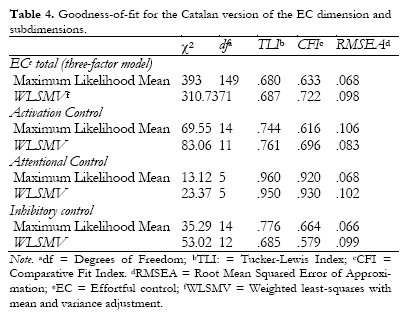
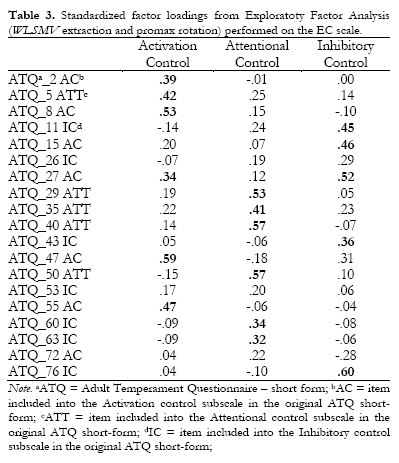
<body><![CDATA[<p><font face="Verdana" size="2"><b>Factor analyses</b></font></p>     <p><font face="Verdana" size="2">For the <i>EFA</i>, the Mardia's test of multivariate normality (Mardia, 1980) resulted in a non-normal distribution. Therefore, <i>ML</i> was not adequate. Related to the number of factors to retain in the total EC 19-items, <i>MAP</i> recommended one factor, while <i>PA</i> recommended six. When items from the three subscales were studied independently, <i>MAP</i> indicated an only factor in every case, while <i>PA</i> recommended retaining three factors for activation, two for inhibitory and one for attentional control.</font></p>     <p><font face="Verdana" size="2">As for the original three-factor structure solution (<i>WLSMV</i> extraction and promax rotation), <i>EFA</i> did not result as expected, as depicted in  <a href="#t3">Table 3</a>. Only the attentional control subscale, and to a much smaller extent the activation control subscale, retained some resemblance to theoretical structure.</font></p>     <p align="center"><font face="Verdana" size="2"><a name="t3"><img src="/img/revistas/ap/v29n3/psicologia_emocion2_t3.jpg"></a></font></p>     <p><font face="Verdana" size="2">Although <i>EFA</i> yielded a factor solution not convergent with the theoretical one, <i>CFA</i> was also conducted. For the three-factor original model (EC total), <i>RMSEA</i> indicated an acceptable fit (inferior to .08) for <i>MLM</i>, but it was poorer when <i>WLSMV</i> was used (see <a href="#t4">Table 4</a>). Moreover, <i>TLI</i> and <i>CFI</i> were also very poor. When the unidimensionality of each scale was analyzed separately, TLI, CFI, and <i>RMSEA</i> were adequate, but <i>RMSEA</i> was poorer, when using <i>WLSMV</i>. Again only the attentional control subscale could be retained in its original form.</font></p>     <p align="center"><font face="Verdana" size="2"><a name="t4"><img src="/img/revistas/ap/v29n3/psicologia_emocion2_t4.jpg"></a></font></p>     <p>&nbsp;</p>     <p><font face="Verdana" size="2">Although, altogether these results did not support the hypothesized structure of three EC factors, nor their own subscales' unidimensionality (except for attentional control), we decided to use the EC total scale and EC subscales in subsequent convergent and divergent analyses to ensure comparability with previous results.</font></p>     <p><font face="Verdana" size="2"><b>Convergent validity</b></font></p>     <p><font face="Verdana" size="2">The EC scale demonstrated a strong negative association with neuroticism and a strong positive association with conscientiousness (see <a target="_blank" href="/img/revistas/ap/v29n3/psicologia_emocion2_t5.jpg">Table 5</a>). Substantially weaker, but also statistically significant positive correlations were found with extraversion, agreeableness, and openness for the total EC scale.</font></p>     ]]></body>
<body><![CDATA[<p><font face="Verdana" size="2">EC was negatively related to BIS reactivity (excepting the inhibitory control subscale), negative affect, and anxious and depressive manifestations an positively with positive affect.</font></p>     <p><font face="Verdana" size="2">Moreover, EC also appeared to be negatively associated with global negative cognitive ER style. Positive affect and a greater use of positive cognitive ER strategies appeared to be positively associated with EC.</font></p>     <p><font face="Verdana" size="2"><b>On the potential interaction of negative affectivity and effortful control in determining cognitive emotion regulation</b></font></p>     <p><font face="Verdana" size="2">As depicted in <a target="_blank" href="/img/revistas/ap/v29n3/psicologia_emocion2_t5.jpg">Table 5</a>, EC and its attentional control subscale appeared to be negatively associated with global negative cognitive ER style, rumination (total score and its brooding facet but not with reflection) and suppression and positively related with global positive ER style.</font></p>     <p><font face="Verdana" size="2">As a next step in exploring how EC could determine the use of negative cognitive ER strategies, we examined how the interaction of NA and EC affects the use of two forms of these ER strategies: rumination and suppression. Anxiety manifestations, although not itself the main focus of this study, were also included as a dependent variable in the analysis. It was hypothesized that EC would moderate the association between NA and both forms of ER (rumination, suppression). A series of 7-step hierarchical regressions were performed with BIS reactivity or negative affect as independent variables (controlling for sex); anxiety manifestations, rumination and suppression as criterion variables; and EC as supposed moderator. Different analyses were conducted for BIS reactivity and for negative affect as independent variables in order to explore, as suggested in previous research, whether they have different impacts on ER. Sex was included in step 1, BIS reactivity or negative affect in step 2, EC in step 3, the BIS reactivity or negative affect x Sex and EC x Sex interactions in steps 4 and 5, BIS reactivity or negative affect x EC interaction in step 6 and, finally, BIS reactivity or negative affect x EC x sex in step 7.</font></p>     <p><font face="Verdana" size="2">The final summarized model (see <a target="_blank" href="/img/revistas/ap/v29n3/psicologia_emocion2_t6.jpg">Table 6</a>) revealed significant effects in all cases for NA, indistinctly if measured as BIS reactivity or negative affect and, in most of them but not all, for EC. Interactions between BIS reactivity or negative affect and EC, were not significant.</font></p>     <p>&nbsp;</p>     <p><font face="Verdana" size="2"><b>Discussion</b></font></p>     <p><font face="Verdana" size="2">The adapted version of the EC scale presented acceptable internal consistency and temporal stability for the full scale and for the attentional control subscale, but lower than those reported for previous versions. For the inhibitory and activation control subscales internal consistency was notably poor. In other studies, the lowest internal consistency was also for the inhibitory control subscale which also appeared to be weakly correlated with the other two EC subscales but it was considerably greater for the activation control subscale.</font></p>     <p><font face="Verdana" size="2">As in existing literature, the EC scale demonstrated a strong negative association with neuroticism and a strong positive association with conscientiousness. Substantially weaker, but also statistically significant positive correlations were found with extraversion, agreeableness, and openness for the total EC scale and activation control. Although these significant associations have been also reported in some previous psychometric studies (Wiltink et al., 2006) but not from others (Evans &amp; Rothbart, 2007), results in the current study partially compromise the divergent validity of the scale.</font></p>     ]]></body>
<body><![CDATA[<p><font face="Verdana" size="2">No previous studies had analyzed the ATQ scales at the item level. Item level analysis approach is consistent with Gignac, Bates, and Jang (2007) proposal, who asserted that, in order to avoid excessively complex constructs in personality research, each proposed dimension should be examined individually through <i>CFA</i>. The resulting factor structure does not support the three-factor solution derived from the theoretical model on the components of EC. Only the attentional control subscale retained some resemblance to theoretical structure. It could be argued that another factorial solution, closer to the three-factor one, could be obtained by analyzing the full ATQ and not only one of its subscales. Although this is true, it is also important to consider that the EC scale should be studied by itself, as already done in the previous work by Yamagata and colleagues (2005). The self-report measure of EC is a unique contribution of the ATQ, whereas other temperamental constructs in the questionnaire could be measured through previously existing self-report instruments. In any case, from the results of the current factor analytic study it seems reasonable to retain attentional control as a subscale to be used in separate analyses but the same cannot be said regarding activation and inhibitory control subscales. These critical results must be considered to be provisional but they suggest that a detailed study of the psychometric properties of the scale (and subscales) is needed. Muris and Meesters (2009) in their study on the psychometric characteristics of the Early Adolescent Temperament Questionnaire-Revised (EATQ-R) arrived to similar conclusions: 'It can be concluded that the EATQ-R is a useful scale for measuring aspects of reactive and regulative temperament in children and adolescents, although there is certainly room for improving the instrument<i>&quot</i>; (p. 17).</font></p>     <p><font face="Verdana" size="2">The second purpose of the study was to explore the relationships between EC, in association with NA, and the self-reported use of negative cognitive ER strategies. Completely consistent with previous research, and in accordance with our hypothesis, EC was negatively related to NA and anxious and depressive manifestations. As we supposed, but with little empirical support in the literature, EC also appeared to be negatively associated with negative cognitive ER style, specially with the brooding facet of rumination and suppression. Our data could be linked to extensive literature indicating that brooding, but not self-reflective rumination, is particularly related to emotional disorders (e.g. Schoofs, Hermans, &amp; Raes, 2010; Treynor et al., 2003). Positive affect and a greater use of positive cognitive ER strategies (such as acceptance) appeared to be positively associated with EC. In general, the relationships among EC and the rest of variables under analysis were stronger for the total scale and the attentional control subscale than for inhibition control and especially for activation control. This is in accordance with the idea that attentional control is the EC domain that seems to be more relevant for anxiety and in some cases for depression (Cisler &amp; Koster, 2010; Koster et al., 2011). In fact, it is increasingly claimed that attentional bias towards threat is a core element of anxiety disorders (see Cisler &amp; Koster, 2010 for a review) and that EC likely moderates the relationship between emotional reactivity and attentional bias (Lonigan &amp; Vasey, 2009). Regarding the interplay between NA and EC in determining anxiety and cognitive ER, subjects high in BIS reactivity/negative affect and low in EC exhibited higher scores both on anxiety and rumination and suppression and those who were low in BIS reactivity/negative affect and high in EC exhibiting lower ones. These results are consistent with data reported in previous research supporting the idea that both emotional reactivity and EC determine anxiety and other general distress manifestations (e.g., Buffington, 2009; Verstraeten et al., 2009; Wiltink et al., 2006), with the relative novelty that the same is true for negative ER strategies, an observation that has not yet been broadly stated. But contrary to previous results for depression in adolescents (Verstraeten et al., 2009), we have not found EC to moderate the relationship between NA and anxiety manifestations and/or negative cognitive ER strategies. In any case, the inclusion of EC in the models significantly increased its predictive power for anxiety manifestations and negative ER. However, being true that NA is quite a good predictor of difficulties in cognitive ER because it increased the risk of engaging in it, the amount of variance explained by NA was significantly lower (more than 50%) than the amount explained for anxiety manifestations. In our results, suppression appeared to be the cognitive ER strategy more closely associated with high NA and low EC. One potential explanation for this finding is that the self-report measure used to quantify suppression, the WBSI, also includes intrusion-sensitive items capturing not only suppression per se but also the frequency of intrusions, which seem to be more strongly associated with anxiety and depression (Schmidt et al., 2009) and/or to be a more direct outcome of exhibiting high NA and low EC. These data provide, in spite of its limitations, new avenues for advancing the understanding and characterization of emotional disorders as an interplay between emotional reactivity and EC and attentional control capabilities (e.g., Koster et al., 2011; Tull et al., 2010).</font></p>     <p><font face="Verdana" size="2">The current study has a number of limitations, mainly related to the sample's composition (college students), its cross-sectional nature, the absence of other measures beyond self-reported ones and, more important, with the lack of data on the results of the translation and back-translation processes. Although we tried to ensure conceptual and linguistic equivalences in the translation and back-translation processes, we did not track results of this process, as recommended by the Guidelines for adapting tests (International Test Comission, 2010) and emphasized in other documents (Abad et al., 2011), and then we are not able to report it. Moreover, cognitive interviews were not conducted. Unfortunately, at present, this serious limitation is impossible to overcome. Regarding some of the other limitations, some participants in the current study were after enrolled in laboratory and ambulatory assessment of psycho-physiological responding (Bornas et al., 2013; Bornas,  Tortella-Feliu, Balle &amp; Llabres, 2012; Morillas-Romero, Tortella-Feliu, Bornas, &amp; Aguayo-Siquier, in press) and psychological assessment in daily life with electronic mood and cognitive ER diaries (Tortella-Feliu et al., 2012) allowing us to overcome most of the limitations of this initial report in addition to advancing the knowledge of the neural underpinnings of cognitive ER and its influence in daily life functioning. Moreover, it would be desirable, after this initial approach, to extend the analyses with a general population sample. Despite the limitations, the current study provides new data on the EC scale, specially regarding its factorial structure, and some new insights into the ER field that we believe deserve to be communicated.</font></p>     <p>&nbsp;</p>     <p><font face="Verdana" size="2"><b>Conclusions</b></font></p>     <p><font face="Verdana" size="2">In spite of its shortcomings, the present study contributes to research on ER in two main avenues. First, the study provides a new version of the EC scale of the ATQ being the first to inform about factor structure at the item level, on the theoretical subscales claimed to comprise the EC. Results do not support the three-factor solution derived from the theoretical model on components of EC. While awaiting for some potential modifications in the self-report instrument, it seems reasonable to retain only attention control as a true subscale and/or to use the EC scale as a single factor questionnaire.</font></p>     <p><font face="Verdana" size="2">Secondly, and perhaps more importantly, the current study is one of the very few which directly analyzes how NA and EC interact in influencing the use of negative cognitive ER strategies. Our results add to the literature by pointing out that negative cognitive ER strategies (specifically, rumination and suppression) are greatly determined by NA irrespective of individuals exhibiting high or low EC. However, low EC capability increases the proneness of participants' engagement in the use of these negative cognitive ER strategies, but does not properly moderate the relationship between heightened NA and ER or anxiety.</font></p>     <p>&nbsp;</p>     <p><font face="Verdana" size="2"><b>Author Note</b></font></p>     <p><font face="Verdana" size="2">We would like to thank Dr. Xavier Caseras, Dr. Miquel A. Fullana, and Dr. Margalida Pons who helped us in the translation and backtranslation of the Effortful Control Scale, Dr. Yamagata for providing us an English translation of the article on the Japanese version of the Effortful Control Scale, Dr. Evans for sending us unpublished data on the ATQ , and Ivan Escoriza-Smith, Aina Maria Fiol, Irene Molina and Miquel Llull for their assistance in contacting and assessing participants in the study.</font></p>     ]]></body>
<body><![CDATA[<p>&nbsp;</p>     <p><font face="Verdana" size="2"><b>References</b></font></p>     <!-- ref --><p><font face="Verdana" size="2">1. Abad, F. J., Olea, J., Ponsoda, V., &amp; García, C. (2011). Medición en ciencias sociales y de la salud (Measurement in social and health sciences). Madrid: Síntesis</font>&nbsp;&nbsp;&nbsp;&nbsp;&nbsp;&nbsp;&nbsp;&nbsp;[&#160;<a href="javascript:void(0);" onclick="javascript: window.open('/scielo.php?script=sci_nlinks&ref=674714&pid=S0212-9728201300030003500001&lng=','','width=640,height=500,resizable=yes,scrollbars=1,menubar=yes,');">Links</a>&#160;]<!-- end-ref --><!-- ref --><p><font face="Verdana" size="2"> 2. Aldao, A., Nolen-Hoeksema, S., &amp; Schweizer, S. (2010). Emotion-regulation strategies across psychopathology: A meta-analytic review. Clinical Psychology Review, 30, 217-237. doi:10.1016/j.cpr.2009.11.004</font>&nbsp;&nbsp;&nbsp;&nbsp;&nbsp;&nbsp;&nbsp;&nbsp;[&#160;<a href="javascript:void(0);" onclick="javascript: window.open('/scielo.php?script=sci_nlinks&ref=674715&pid=S0212-9728201300030003500002&lng=','','width=640,height=500,resizable=yes,scrollbars=1,menubar=yes,');">Links</a>&#160;]<!-- end-ref --><!-- ref --><p><font face="Verdana" size="2"> 3. Antony, M. A., Orsillo, S. M., &amp; Roemer, L. (Eds.) (2001). Practitioner's guide to empirically based measures of anxiety. New York: Kluwer Academic/Plenum Publishers.    &nbsp;&nbsp;&nbsp;&nbsp;&nbsp;&nbsp;&nbsp;&nbsp;[&#160;<a href="javascript:void(0);" onclick="javascript: window.open('/scielo.php?script=sci_nlinks&ref=674716&pid=S0212-9728201300030003500003&lng=','','width=640,height=500,resizable=yes,scrollbars=1,menubar=yes,');">Links</a>&#160;]<!-- end-ref --></font></p>    <!-- ref --><p><font face="Verdana" size="2"> 4. Ato, E., Galián, M. D., &amp; Huéscar, E. (2007). Relaciones entre estilos educativos, temperamento y ajuste social en la infancia: Una revisión (Relations between parenting styles, temperament, and social adjustment in childhood: A review). Anales de Psicología, 23, 33-40.    &nbsp;&nbsp;&nbsp;&nbsp;&nbsp;&nbsp;&nbsp;&nbsp;[&#160;<a href="javascript:void(0);" onclick="javascript: window.open('/scielo.php?script=sci_nlinks&ref=674718&pid=S0212-9728201300030003500004&lng=','','width=640,height=500,resizable=yes,scrollbars=1,menubar=yes,');">Links</a>&#160;]<!-- end-ref --></font></p>    <!-- ref --><p><font face="Verdana" size="2"> 5. Ato, E., González, C., &amp; Carranza, J. A. (2004). Aspectos evolutivos de la autorregulación emocional en la infancia (Developmental characteristics of emotional self-regulation in infancy). Anales de Psicología, 20, 69-79.    &nbsp;&nbsp;&nbsp;&nbsp;&nbsp;&nbsp;&nbsp;&nbsp;[&#160;<a href="javascript:void(0);" onclick="javascript: window.open('/scielo.php?script=sci_nlinks&ref=674720&pid=S0212-9728201300030003500005&lng=','','width=640,height=500,resizable=yes,scrollbars=1,menubar=yes,');">Links</a>&#160;]<!-- end-ref --></font></p>    ]]></body>
<body><![CDATA[<!-- ref --><p><font face="Verdana" size="2"> 6. Barlow, D. H., Allen, L. B., &amp; Choate, M. L. (2004). Toward a unified treatment for emotional disorders. Behavior Therapy, 35, 205-230. doi: 10.1016/S0005-7894(04)80036-4</font>&nbsp;&nbsp;&nbsp;&nbsp;&nbsp;&nbsp;&nbsp;&nbsp;[&#160;<a href="javascript:void(0);" onclick="javascript: window.open('/scielo.php?script=sci_nlinks&ref=674722&pid=S0212-9728201300030003500006&lng=','','width=640,height=500,resizable=yes,scrollbars=1,menubar=yes,');">Links</a>&#160;]<!-- end-ref --><!-- ref --><p><font face="Verdana" size="2"> 7. Beck, A. T., Brown, G. K., &amp; Steer, R. A. (1996). Beck depression inventory II (BDI-II) manual. San Antonio (TX): The Psychological Coorporation.    &nbsp;&nbsp;&nbsp;&nbsp;&nbsp;&nbsp;&nbsp;&nbsp;[&#160;<a href="javascript:void(0);" onclick="javascript: window.open('/scielo.php?script=sci_nlinks&ref=674723&pid=S0212-9728201300030003500007&lng=','','width=640,height=500,resizable=yes,scrollbars=1,menubar=yes,');">Links</a>&#160;]<!-- end-ref --></font></p>    <!-- ref --><p><font face="Verdana" size="2"> 8. Bornas, X., Noguera, M., Balle, M., Morillas-Romero, A., Aguayo-Siquier, B., Tortella-Feliu, M. &amp; Llabrés, J. (2013). Long-range temporal correlations in resting EEG are associated with depression-related emotion regulation strategies. Journal of Psychophysiology, 27,  60-66. doi: 10.1027/0269-8803/a000087</font>&nbsp;&nbsp;&nbsp;&nbsp;&nbsp;&nbsp;&nbsp;&nbsp;[&#160;<a href="javascript:void(0);" onclick="javascript: window.open('/scielo.php?script=sci_nlinks&ref=674725&pid=S0212-9728201300030003500008&lng=','','width=640,height=500,resizable=yes,scrollbars=1,menubar=yes,');">Links</a>&#160;]<!-- end-ref --><!-- ref --><p><font face="Verdana" size="2"> 9. Bornas, X., Tortella-Feliu, M., Balle, M., &amp; Llabres, J. (2012) Self-focused cognitive emotion regulation style as associated with widespread diminished EEG fractal dimension. International Journal of Psychology. doi:10.1080/00207594.2012.671945.    &nbsp;&nbsp;&nbsp;&nbsp;&nbsp;&nbsp;&nbsp;&nbsp;[&#160;<a href="javascript:void(0);" onclick="javascript: window.open('/scielo.php?script=sci_nlinks&ref=674726&pid=S0212-9728201300030003500009&lng=','','width=640,height=500,resizable=yes,scrollbars=1,menubar=yes,');">Links</a>&#160;]<!-- end-ref --></font></p>    <!-- ref --><p><font face="Verdana" size="2"> 10. Brosschot, J. F. (2010). Markers of chronic stress: Prolonged physiological activation and (un)conscious perseverative cognition. Neuroscience and Biobehavioral Reviews, 35, 46-50. doi:10.1016/j.neubiorev.2010.01.004</font>&nbsp;&nbsp;&nbsp;&nbsp;&nbsp;&nbsp;&nbsp;&nbsp;[&#160;<a href="javascript:void(0);" onclick="javascript: window.open('/scielo.php?script=sci_nlinks&ref=674728&pid=S0212-9728201300030003500010&lng=','','width=640,height=500,resizable=yes,scrollbars=1,menubar=yes,');">Links</a>&#160;]<!-- end-ref --><!-- ref --><p><font face="Verdana" size="2"> 11. Browne, M. W., &amp; Cudeck, R. (1993). Alternative ways of assessing model fit. In K. A. Bollen &amp; J. S. Long (Eds.), Testing structural equation models (pp. 136-162). Newsbury Park, CA: Sage.    &nbsp;&nbsp;&nbsp;&nbsp;&nbsp;&nbsp;&nbsp;&nbsp;[&#160;<a href="javascript:void(0);" onclick="javascript: window.open('/scielo.php?script=sci_nlinks&ref=674729&pid=S0212-9728201300030003500011&lng=','','width=640,height=500,resizable=yes,scrollbars=1,menubar=yes,');">Links</a>&#160;]<!-- end-ref --></font></p>    <!-- ref --><p><font face="Verdana" size="2"> 12. Buffington, A. D. (2009). Individual facets of effortful control and symptoms of general distress and depression. (Unpublished M. A.). Ohio State University, Columbus (OH).    &nbsp;&nbsp;&nbsp;&nbsp;&nbsp;&nbsp;&nbsp;&nbsp;[&#160;<a href="javascript:void(0);" onclick="javascript: window.open('/scielo.php?script=sci_nlinks&ref=674731&pid=S0212-9728201300030003500012&lng=','','width=640,height=500,resizable=yes,scrollbars=1,menubar=yes,');">Links</a>&#160;]<!-- end-ref --></font></p>    <!-- ref --><p><font face="Verdana" size="2"> 13. Campbell-Sills, L., &amp; Barlow, D. H. (2007). Incorporating emotion regulation conceptualizations and treatments of anxiety and mood disorders. In J. J. Gross (Ed.), Handbook of emotion regulation (pp. 542-560). New York: Guilford.    &nbsp;&nbsp;&nbsp;&nbsp;&nbsp;&nbsp;&nbsp;&nbsp;[&#160;<a href="javascript:void(0);" onclick="javascript: window.open('/scielo.php?script=sci_nlinks&ref=674733&pid=S0212-9728201300030003500013&lng=','','width=640,height=500,resizable=yes,scrollbars=1,menubar=yes,');">Links</a>&#160;]<!-- end-ref --></font></p>    <!-- ref --><p><font face="Verdana" size="2"> 14. Carver, C. S., Johnson, S. L., &amp; Joormann, J. (2009). Two-mode models of self-regulation as a tool for conceptualizing effects of the serotonin system in normal behavior and diverse disorders. Current Directions in Psychological Science, 18, 195-199.    &nbsp;&nbsp;&nbsp;&nbsp;&nbsp;&nbsp;&nbsp;&nbsp;[&#160;<a href="javascript:void(0);" onclick="javascript: window.open('/scielo.php?script=sci_nlinks&ref=674735&pid=S0212-9728201300030003500014&lng=','','width=640,height=500,resizable=yes,scrollbars=1,menubar=yes,');">Links</a>&#160;]<!-- end-ref --></font></p>    <!-- ref --><p><font face="Verdana" size="2"> 15. Cisler, J. M., &amp; Koster, E. H. W. (2010). Mechanisms of attentional biases towards threat in anxiety disorders: An integrative review. Clinical Psychology Review, 30, 203-216. doi:10.1016/j.cpr.2009.11.003</font>&nbsp;&nbsp;&nbsp;&nbsp;&nbsp;&nbsp;&nbsp;&nbsp;[&#160;<a href="javascript:void(0);" onclick="javascript: window.open('/scielo.php?script=sci_nlinks&ref=674737&pid=S0212-9728201300030003500015&lng=','','width=640,height=500,resizable=yes,scrollbars=1,menubar=yes,');">Links</a>&#160;]<!-- end-ref --><!-- ref --><p><font face="Verdana" size="2"> 16. Cisler, J. M., Olatunji, B. O., Feldner, M. T., &amp; Forsyth, J. P. (2010). Emotion regulation and the anxiety disorders: An integrative review. Journal of Psychopathology and Behavioral Assessment, 32, 68-82. doi:10.1007/s10862-009-9161-1</font>&nbsp;&nbsp;&nbsp;&nbsp;&nbsp;&nbsp;&nbsp;&nbsp;[&#160;<a href="javascript:void(0);" onclick="javascript: window.open('/scielo.php?script=sci_nlinks&ref=674738&pid=S0212-9728201300030003500016&lng=','','width=640,height=500,resizable=yes,scrollbars=1,menubar=yes,');">Links</a>&#160;]<!-- end-ref --><!-- ref --><p><font face="Verdana" size="2"> 17. Clark, L. A., &amp; Watson, D. (1991). Tripartite model of anxiety and depression: Psychometric evidence and taxonomic implications. Journal of Abnormal Psychology, 100, 316-336. doi: 10.1037/0021-843X.100.3.316</font>&nbsp;&nbsp;&nbsp;&nbsp;&nbsp;&nbsp;&nbsp;&nbsp;[&#160;<a href="javascript:void(0);" onclick="javascript: window.open('/scielo.php?script=sci_nlinks&ref=674739&pid=S0212-9728201300030003500017&lng=','','width=640,height=500,resizable=yes,scrollbars=1,menubar=yes,');">Links</a>&#160;]<!-- end-ref --><!-- ref --><p><font face="Verdana" size="2"> 18. Clements, A. D., &amp; Bailey, B. A. (2010). The relationship between temperament and anxiety phase I in the development of a risk screening model to predict stress-related health problems. Journal of Health Psychology, 15, 515-525. doi:10.1177/1359105309355340</font>&nbsp;&nbsp;&nbsp;&nbsp;&nbsp;&nbsp;&nbsp;&nbsp;[&#160;<a href="javascript:void(0);" onclick="javascript: window.open('/scielo.php?script=sci_nlinks&ref=674740&pid=S0212-9728201300030003500018&lng=','','width=640,height=500,resizable=yes,scrollbars=1,menubar=yes,');">Links</a>&#160;]<!-- end-ref --><!-- ref --><p><font face="Verdana" size="2"> 19. Costa, P. T., Jr., &amp; McCrae, R. R. (1992). The NEO-PI/NEO-FFI manual supplement. Odessa, FL: Psychological Assessment Resources.    &nbsp;&nbsp;&nbsp;&nbsp;&nbsp;&nbsp;&nbsp;&nbsp;[&#160;<a href="javascript:void(0);" onclick="javascript: window.open('/scielo.php?script=sci_nlinks&ref=674741&pid=S0212-9728201300030003500019&lng=','','width=640,height=500,resizable=yes,scrollbars=1,menubar=yes,');">Links</a>&#160;]<!-- end-ref --></font></p>    <!-- ref --><p><font face="Verdana" size="2"> 20. Costa, P. T. J., &amp; McCrae, R. R. (1999). Inventario de personalidad NEO revisado (NEO PI-R). Inventario NEO reducido de cinco factores (NEO-FFI). (Revised NEO personality inventory  (NEO PI-R) and NEO five factor inventory (NEO-FFI)) Manual). Madrid: TEA.    &nbsp;&nbsp;&nbsp;&nbsp;&nbsp;&nbsp;&nbsp;&nbsp;[&#160;<a href="javascript:void(0);" onclick="javascript: window.open('/scielo.php?script=sci_nlinks&ref=674743&pid=S0212-9728201300030003500020&lng=','','width=640,height=500,resizable=yes,scrollbars=1,menubar=yes,');">Links</a>&#160;]<!-- end-ref --></font></p>    <!-- ref --><p><font face="Verdana" size="2"> 21. Craske, M. G. (2003). Origins ofphobias and anxiety disorders: Why more women than men? Amsterdam: Elsevier.    &nbsp;&nbsp;&nbsp;&nbsp;&nbsp;&nbsp;&nbsp;&nbsp;[&#160;<a href="javascript:void(0);" onclick="javascript: window.open('/scielo.php?script=sci_nlinks&ref=674745&pid=S0212-9728201300030003500021&lng=','','width=640,height=500,resizable=yes,scrollbars=1,menubar=yes,');">Links</a>&#160;]<!-- end-ref --></font></p>    <!-- ref --><p><font face="Verdana" size="2"> 22. Derryberry, D., &amp; Rothbart, M. K. (1988). Arousal, affect, and attention as components of temperament. Journal of Personality and Social Psychology, 55, 958-966. doi: 10.1037/0022-3514.55.6.958</font>&nbsp;&nbsp;&nbsp;&nbsp;&nbsp;&nbsp;&nbsp;&nbsp;[&#160;<a href="javascript:void(0);" onclick="javascript: window.open('/scielo.php?script=sci_nlinks&ref=674747&pid=S0212-9728201300030003500022&lng=','','width=640,height=500,resizable=yes,scrollbars=1,menubar=yes,');">Links</a>&#160;]<!-- end-ref --><!-- ref --><p><font face="Verdana" size="2"> 23. Eisenberg, N., Valiente, C., &amp; Sulik, M. J. (2009). How the study of regulation can inform the study of coping. In E. A. Skinner, &amp; M. J. Zimmer-Gembeck (Eds.), Coping and the development of regulation. New directions for child and adolescent development, 124, (pp. 75-86). San Francisco: Jossey-Bass.    &nbsp;&nbsp;&nbsp;&nbsp;&nbsp;&nbsp;&nbsp;&nbsp;[&#160;<a href="javascript:void(0);" onclick="javascript: window.open('/scielo.php?script=sci_nlinks&ref=674748&pid=S0212-9728201300030003500023&lng=','','width=640,height=500,resizable=yes,scrollbars=1,menubar=yes,');">Links</a>&#160;]<!-- end-ref --></font></p>    <!-- ref --><p><font face="Verdana" size="2"> 24. Eisenberg, N., Spinrad, T. L., &amp; Eggum, N. D. (2010). Emotion-related self-regulation and its relation to children's maladjustment. Annual Review of Clinical Psychology, 6, 495-525. doi:10.1146/annurev.clinpsy.121208.131208</font>&nbsp;&nbsp;&nbsp;&nbsp;&nbsp;&nbsp;&nbsp;&nbsp;[&#160;<a href="javascript:void(0);" onclick="javascript: window.open('/scielo.php?script=sci_nlinks&ref=674750&pid=S0212-9728201300030003500024&lng=','','width=640,height=500,resizable=yes,scrollbars=1,menubar=yes,');">Links</a>&#160;]<!-- end-ref --><!-- ref --><p><font face="Verdana" size="2"> 25. Evans, D. E., &amp; Rothbart, M. K. (2007). Developing a model for adult temperament. Journal of Research in Personality, 41, 868-888. doi:10.1016/j.jrp.2006.11.002</font>&nbsp;&nbsp;&nbsp;&nbsp;&nbsp;&nbsp;&nbsp;&nbsp;[&#160;<a href="javascript:void(0);" onclick="javascript: window.open('/scielo.php?script=sci_nlinks&ref=674751&pid=S0212-9728201300030003500025&lng=','','width=640,height=500,resizable=yes,scrollbars=1,menubar=yes,');">Links</a>&#160;]<!-- end-ref --><!-- ref --><p><font face="Verdana" size="2"> 26. Fernández-Berrocal, P., Extremera, N., &amp; Ramos, N. (2004). Validity and reliability of the spanish version of the white bear suppression inventory. Psychological Reports, 94, 782-784. doi: 10.2466/pr0.94.3.782-784</font>&nbsp;&nbsp;&nbsp;&nbsp;&nbsp;&nbsp;&nbsp;&nbsp;[&#160;<a href="javascript:void(0);" onclick="javascript: window.open('/scielo.php?script=sci_nlinks&ref=674752&pid=S0212-9728201300030003500026&lng=','','width=640,height=500,resizable=yes,scrollbars=1,menubar=yes,');">Links</a>&#160;]<!-- end-ref --><!-- ref --><p><font face="Verdana" size="2"> 27. Garnefski, N., Kraaij, V., &amp; Spinhoven, P. (2001). Negative life events, cognitive emotion regulation and emotional problems. Personality and Individual Differences, 30, 1311-1327.doi: 10.1016/S0191-8869(00)00113-6</font>&nbsp;&nbsp;&nbsp;&nbsp;&nbsp;&nbsp;&nbsp;&nbsp;[&#160;<a href="javascript:void(0);" onclick="javascript: window.open('/scielo.php?script=sci_nlinks&ref=674753&pid=S0212-9728201300030003500027&lng=','','width=640,height=500,resizable=yes,scrollbars=1,menubar=yes,');">Links</a>&#160;]<!-- end-ref --><!-- ref --><p><font face="Verdana" size="2"> 28. George, D., &amp; Mallery, P. (2003). SPSS for Windows step by step: A simple guide and reference. 11.0 update (4th ed.). Boston: Allyn &amp; Bacon.    &nbsp;&nbsp;&nbsp;&nbsp;&nbsp;&nbsp;&nbsp;&nbsp;[&#160;<a href="javascript:void(0);" onclick="javascript: window.open('/scielo.php?script=sci_nlinks&ref=674754&pid=S0212-9728201300030003500028&lng=','','width=640,height=500,resizable=yes,scrollbars=1,menubar=yes,');">Links</a>&#160;]<!-- end-ref --></font></p>    <!-- ref --><p><font face="Verdana" size="2"> 29. Gignac, G. E., Bates, T. C., &amp; Jang, K. L. (2007). Implications relevant to CFA model misfit, reliability, and the five-factor model as measured by the NEO-FFI. Personality and Individual Differences, 43, 1051-1062. doi:10.1016/j.paid.2007.02.024</font>&nbsp;&nbsp;&nbsp;&nbsp;&nbsp;&nbsp;&nbsp;&nbsp;[&#160;<a href="javascript:void(0);" onclick="javascript: window.open('/scielo.php?script=sci_nlinks&ref=674756&pid=S0212-9728201300030003500029&lng=','','width=640,height=500,resizable=yes,scrollbars=1,menubar=yes,');">Links</a>&#160;]<!-- end-ref --><!-- ref --><p><font face="Verdana" size="2"> 30. González, C., Carranza, J. A., Fuentes, L. J., Galián, M. D., &amp; Estévez, A. F. (2001). Mecanismos atencionales y desarrollo de la autorregulación en la infancia (Attentional mechanisms and development of self-regulation in childhood). Anales de Psicología, 17, 275-286.    &nbsp;&nbsp;&nbsp;&nbsp;&nbsp;&nbsp;&nbsp;&nbsp;[&#160;<a href="javascript:void(0);" onclick="javascript: window.open('/scielo.php?script=sci_nlinks&ref=674757&pid=S0212-9728201300030003500030&lng=','','width=640,height=500,resizable=yes,scrollbars=1,menubar=yes,');">Links</a>&#160;]<!-- end-ref --></font></p>    <!-- ref --><p><font face="Verdana" size="2"> 31. Gray, J. A. (1987). The psychology offear and stress. Nueva York: Cambridge.    &nbsp;&nbsp;&nbsp;&nbsp;&nbsp;&nbsp;&nbsp;&nbsp;[&#160;<a href="javascript:void(0);" onclick="javascript: window.open('/scielo.php?script=sci_nlinks&ref=674759&pid=S0212-9728201300030003500031&lng=','','width=640,height=500,resizable=yes,scrollbars=1,menubar=yes,');">Links</a>&#160;]<!-- end-ref --></font></p>    <!-- ref --><p><font face="Verdana" size="2"> 32. Helzer, E. G., Connor-Smith, J. K., &amp; Reed, M. A. (2009). Traits, states, and attentional gates: Temperament and threat relevance as predictors of  attentional bias to social threat. Anxiety Stress and Coping, 22, 57-76. doi: 10.1080/10615800802272244</font>&nbsp;&nbsp;&nbsp;&nbsp;&nbsp;&nbsp;&nbsp;&nbsp;[&#160;<a href="javascript:void(0);" onclick="javascript: window.open('/scielo.php?script=sci_nlinks&ref=674761&pid=S0212-9728201300030003500032&lng=','','width=640,height=500,resizable=yes,scrollbars=1,menubar=yes,');">Links</a>&#160;]<!-- end-ref --><!-- ref --><p><font face="Verdana" size="2"> 33. Hervás, G. (2008). Adaptación al castellano de un instrumento para evaluar el estilo rumiativo: La escala de respuesta rumiativas (Spanish adaptation of an instrument for assessing ruminative style: The Ruminative Responses Scale). Revista de Psicopatología y Psicología Clínica, 13, 111-121.    &nbsp;&nbsp;&nbsp;&nbsp;&nbsp;&nbsp;&nbsp;&nbsp;[&#160;<a href="javascript:void(0);" onclick="javascript: window.open('/scielo.php?script=sci_nlinks&ref=674762&pid=S0212-9728201300030003500033&lng=','','width=640,height=500,resizable=yes,scrollbars=1,menubar=yes,');">Links</a>&#160;]<!-- end-ref --></font></p>    <!-- ref --><p><font face="Verdana" size="2"> 34. Holmbeck, G. N. (1997). Toward terminological, conceptual, and statistical clarity in the study of mediators and moderators: Examples from the child-clinical and pediatric psychology literatures. Journal of Consulting and Clinical Psychology, 65, 599-610. doi: 10.1037/0022-006X.65.4.599</font>&nbsp;&nbsp;&nbsp;&nbsp;&nbsp;&nbsp;&nbsp;&nbsp;[&#160;<a href="javascript:void(0);" onclick="javascript: window.open('/scielo.php?script=sci_nlinks&ref=674764&pid=S0212-9728201300030003500034&lng=','','width=640,height=500,resizable=yes,scrollbars=1,menubar=yes,');">Links</a>&#160;]<!-- end-ref --><!-- ref --><p><font face="Verdana" size="2"> 35. International Test Commission (2011). International Test Comission Guidelines for Translating and Adapting Tests. Retrieved from <a target="_blank" href="http://www.intestcom.org">http://www.intestcom.org</a></font>&nbsp;&nbsp;&nbsp;&nbsp;&nbsp;&nbsp;&nbsp;&nbsp;[&#160;<a href="javascript:void(0);" onclick="javascript: window.open('/scielo.php?script=sci_nlinks&ref=674765&pid=S0212-9728201300030003500035&lng=','','width=640,height=500,resizable=yes,scrollbars=1,menubar=yes,');">Links</a>&#160;]<!-- end-ref --><!-- ref --><p><font face="Verdana" size="2"> 36. Koster, E. H. W., De Lissnyder, E., Derakshan, N., &amp; De Raedt, R. (2011). Understanding depressive rumination from a cognitive science perspective: The impaired disengagement hypothesis. Clinical Psychology Review, 31 , 138-145. doi:10.1016/j.cpr.2010.08.005</font>&nbsp;&nbsp;&nbsp;&nbsp;&nbsp;&nbsp;&nbsp;&nbsp;[&#160;<a href="javascript:void(0);" onclick="javascript: window.open('/scielo.php?script=sci_nlinks&ref=674766&pid=S0212-9728201300030003500036&lng=','','width=640,height=500,resizable=yes,scrollbars=1,menubar=yes,');">Links</a>&#160;]<!-- end-ref --><!-- ref --><p><font face="Verdana" size="2"> 37. Lang, P. J., &amp; Bradley, M. M. (2010). Emotion and the motivational brain. Biological Psychology, 84, 437-450. doi: 10.1016/j.biopsycho.2009.10.007</font>&nbsp;&nbsp;&nbsp;&nbsp;&nbsp;&nbsp;&nbsp;&nbsp;[&#160;<a href="javascript:void(0);" onclick="javascript: window.open('/scielo.php?script=sci_nlinks&ref=674767&pid=S0212-9728201300030003500037&lng=','','width=640,height=500,resizable=yes,scrollbars=1,menubar=yes,');">Links</a>&#160;]<!-- end-ref --><!-- ref --><p><font face="Verdana" size="2"> 38. Laverdière, O., Diguer, L., Gamache, D., &amp; Evans, D. E. (2010). The french adaptation of the short form of the adult temperament questionnaire. European Journal of Psychological Assessment, 26, 212-219. doi:10.1027/1015-5759/a000028</font>&nbsp;&nbsp;&nbsp;&nbsp;&nbsp;&nbsp;&nbsp;&nbsp;[&#160;<a href="javascript:void(0);" onclick="javascript: window.open('/scielo.php?script=sci_nlinks&ref=674768&pid=S0212-9728201300030003500038&lng=','','width=640,height=500,resizable=yes,scrollbars=1,menubar=yes,');">Links</a>&#160;]<!-- end-ref --><!-- ref --><p><font face="Verdana" size="2"> 39. Lewis, A. R., Zinbarg, R. E., &amp; Durbin, C. E. (2010). Advances, problems, and challenges in the study of emotion regulation: A commentary. Journal of Psychopathology and Behavioral Assessment, 32, 83-91. doi:10.1007/s10862-009-9170-0 ER</font>&nbsp;&nbsp;&nbsp;&nbsp;&nbsp;&nbsp;&nbsp;&nbsp;[&#160;<a href="javascript:void(0);" onclick="javascript: window.open('/scielo.php?script=sci_nlinks&ref=674769&pid=S0212-9728201300030003500039&lng=','','width=640,height=500,resizable=yes,scrollbars=1,menubar=yes,');">Links</a>&#160;]<!-- end-ref --><!-- ref --><p><font face="Verdana" size="2"> 40. Lonigan, C. J., &amp; Vasey, M. W. (2009). Negative affectivity, effortful control, and attention to threat-relevant stimuli. Journal of Abnormal Child Psychology, 37, 387-399. doi: 10.1007/s10802-008-9284-y</font>&nbsp;&nbsp;&nbsp;&nbsp;&nbsp;&nbsp;&nbsp;&nbsp;[&#160;<a href="javascript:void(0);" onclick="javascript: window.open('/scielo.php?script=sci_nlinks&ref=674770&pid=S0212-9728201300030003500040&lng=','','width=640,height=500,resizable=yes,scrollbars=1,menubar=yes,');">Links</a>&#160;]<!-- end-ref --><!-- ref --><p><font face="Verdana" size="2"> 41. Manga, D., Ramos, F., &amp; Morán, C. (2004). The spanish norms of the NEO five-factor inventory: New data and analyses for its improvement. International Journal of Psychology and Psychological Therapy, 4, 639-648.    &nbsp;&nbsp;&nbsp;&nbsp;&nbsp;&nbsp;&nbsp;&nbsp;[&#160;<a href="javascript:void(0);" onclick="javascript: window.open('/scielo.php?script=sci_nlinks&ref=674771&pid=S0212-9728201300030003500041&lng=','','width=640,height=500,resizable=yes,scrollbars=1,menubar=yes,');">Links</a>&#160;]<!-- end-ref --></font></p>    <!-- ref --><p><font face="Verdana" size="2"> 42. Mardia, K. V. (1980). Tests of univariate and multivariate normality. In P. R. Krishnaiah (Ed.), Handbook of statistics, vol.1 (pp. 279-320). Amsterdam: North-Holland Publishing.    &nbsp;&nbsp;&nbsp;&nbsp;&nbsp;&nbsp;&nbsp;&nbsp;[&#160;<a href="javascript:void(0);" onclick="javascript: window.open('/scielo.php?script=sci_nlinks&ref=674773&pid=S0212-9728201300030003500042&lng=','','width=640,height=500,resizable=yes,scrollbars=1,menubar=yes,');">Links</a>&#160;]<!-- end-ref --></font></p>    <!-- ref --><p><font face="Verdana" size="2"> 43. Martell, C. R., Addis, M. E., &amp; Jacobson, N. S. (2001). Depression in context. Strategies for guided action. New York: Norton.    &nbsp;&nbsp;&nbsp;&nbsp;&nbsp;&nbsp;&nbsp;&nbsp;[&#160;<a href="javascript:void(0);" onclick="javascript: window.open('/scielo.php?script=sci_nlinks&ref=674775&pid=S0212-9728201300030003500043&lng=','','width=640,height=500,resizable=yes,scrollbars=1,menubar=yes,');">Links</a>&#160;]<!-- end-ref --></font></p>    <!-- ref --><p><font face="Verdana" size="2"> 44. McLaughlin, K. A., &amp; Nolen-Hoeksema, S. (2011). Rumination as a transdiagnostic factor in depression and anxiety. Behaviour Research and Therapy, 49, 186-193. doi:10.1016/j.brat.2010.12.006</font>&nbsp;&nbsp;&nbsp;&nbsp;&nbsp;&nbsp;&nbsp;&nbsp;[&#160;<a href="javascript:void(0);" onclick="javascript: window.open('/scielo.php?script=sci_nlinks&ref=674777&pid=S0212-9728201300030003500044&lng=','','width=640,height=500,resizable=yes,scrollbars=1,menubar=yes,');">Links</a>&#160;]<!-- end-ref --><!-- ref --><p><font face="Verdana" size="2"> 45. Morillas-Romero, A., Tortella-Feliu, M., Bornas, X. &amp; Aguayo-Siquier, B. (in press). Resting parietal EEG asymmetries and self-reported attentional control. Clinical EEG and Neuroscience. doi: 10.1177/1550059412465871</font>&nbsp;&nbsp;&nbsp;&nbsp;&nbsp;&nbsp;&nbsp;&nbsp;[&#160;<a href="javascript:void(0);" onclick="javascript: window.open('/scielo.php?script=sci_nlinks&ref=674778&pid=S0212-9728201300030003500045&lng=','','width=640,height=500,resizable=yes,scrollbars=1,menubar=yes,');">Links</a>&#160;]<!-- end-ref --><!-- ref --><p><font face="Verdana" size="2"> 46. Moriya, J., &amp; Tanno, Y. (2008). Relationships between negative emotionality and attentional control in effortful control. Personality and Individual Differences, 44, 1348-1355. doi:10.1016/j.paid.2007.12.003</font>&nbsp;&nbsp;&nbsp;&nbsp;&nbsp;&nbsp;&nbsp;&nbsp;[&#160;<a href="javascript:void(0);" onclick="javascript: window.open('/scielo.php?script=sci_nlinks&ref=674779&pid=S0212-9728201300030003500046&lng=','','width=640,height=500,resizable=yes,scrollbars=1,menubar=yes,');">Links</a>&#160;]<!-- end-ref --><!-- ref --><p><font face="Verdana" size="2"> 47. Muris, P., &amp; Meesters, C. (2009). Reactive and regulative temperament in youths: Psychometric evaluation of the Early Adolescent Temperament Questionnaire-Revised. Journal of Psychopathology and Behavioral Assessment, 31 , 7-19.  doi: 10.1007/s10862-008-9089-x</font>&nbsp;&nbsp;&nbsp;&nbsp;&nbsp;&nbsp;&nbsp;&nbsp;[&#160;<a href="javascript:void(0);" onclick="javascript: window.open('/scielo.php?script=sci_nlinks&ref=674780&pid=S0212-9728201300030003500047&lng=','','width=640,height=500,resizable=yes,scrollbars=1,menubar=yes,');">Links</a>&#160;]<!-- end-ref --><!-- ref --><p><font face="Verdana" size="2">48. Muris, P., Merckelbach, H., &amp; Horselenberg, R. (1996). Individual differences in thought suppression. The white bear suppression inventory: Factor structure, reliability, validity and correlates. Behaviour Research and Therapy, 34, 501-513. doi: 10.1016/0005-7967(96)00005-8</font>&nbsp;&nbsp;&nbsp;&nbsp;&nbsp;&nbsp;&nbsp;&nbsp;[&#160;<a href="javascript:void(0);" onclick="javascript: window.open('/scielo.php?script=sci_nlinks&ref=674781&pid=S0212-9728201300030003500048&lng=','','width=640,height=500,resizable=yes,scrollbars=1,menubar=yes,');">Links</a>&#160;]<!-- end-ref --><!-- ref --><p><font face="Verdana" size="2"> 49. Muthen, B., du Toil, S. H. C., &amp; Spisic, D. (1997). Robust inference using weighted least squares and quadratic estimating equations in latent variable modeling with categorical and continuous outcomes. Unpublished manuscript. Retrieved from <a target="_blank" href="http://www.statmodel.com/wlscv.shtml">http://www.statmodel.com/wlscv.shtml</a>.    &nbsp;&nbsp;&nbsp;&nbsp;&nbsp;&nbsp;&nbsp;&nbsp;[&#160;<a href="javascript:void(0);" onclick="javascript: window.open('/scielo.php?script=sci_nlinks&ref=674782&pid=S0212-9728201300030003500049&lng=','','width=640,height=500,resizable=yes,scrollbars=1,menubar=yes,');">Links</a>&#160;]<!-- end-ref --></font></p>    <!-- ref --><p><font face="Verdana" size="2"> 50. Muthén, L. K., &amp; Muthén, B. O. (2004). Mplus: The comprehensive modeling program for applied researchers. User's guide (3rd ed.). Los Angeles: Muthén &amp; Muthén.    &nbsp;&nbsp;&nbsp;&nbsp;&nbsp;&nbsp;&nbsp;&nbsp;[&#160;<a href="javascript:void(0);" onclick="javascript: window.open('/scielo.php?script=sci_nlinks&ref=674784&pid=S0212-9728201300030003500050&lng=','','width=640,height=500,resizable=yes,scrollbars=1,menubar=yes,');">Links</a>&#160;]<!-- end-ref --></font></p>    <!-- ref --><p><font face="Verdana" size="2"> 51. Nigg, J. T. (2006). Temperament and developmental psychopathology. Journal of Child Psychology and Psychiatry, 47, 395-422. doi: 0.1111/j.1469-7610.2006.01612.x</font>&nbsp;&nbsp;&nbsp;&nbsp;&nbsp;&nbsp;&nbsp;&nbsp;[&#160;<a href="javascript:void(0);" onclick="javascript: window.open('/scielo.php?script=sci_nlinks&ref=674786&pid=S0212-9728201300030003500051&lng=','','width=640,height=500,resizable=yes,scrollbars=1,menubar=yes,');">Links</a>&#160;]<!-- end-ref --><!-- ref --><p><font face="Verdana" size="2"> 52. Putnam, S. P., &amp; Stifter, C. A. (2008). Reactivity and regulation: The impact of Mary Rothbart on the study of temperament. Infant and Child Development, 17, 311-320. doi:10.1002/icd.583</font>&nbsp;&nbsp;&nbsp;&nbsp;&nbsp;&nbsp;&nbsp;&nbsp;[&#160;<a href="javascript:void(0);" onclick="javascript: window.open('/scielo.php?script=sci_nlinks&ref=674787&pid=S0212-9728201300030003500052&lng=','','width=640,height=500,resizable=yes,scrollbars=1,menubar=yes,');">Links</a>&#160;]<!-- end-ref --><!-- ref --><p><font face="Verdana" size="2"> 53. Rothbart, M. K., Ahadi, S. A., &amp; Evans, D. E. (2000). Temperament and personality: Origins and outcomes. Journal of Personality and Social Psychology, 78, 122-135. doi: 10.1037//0022-3514.78.1.122</font>&nbsp;&nbsp;&nbsp;&nbsp;&nbsp;&nbsp;&nbsp;&nbsp;[&#160;<a href="javascript:void(0);" onclick="javascript: window.open('/scielo.php?script=sci_nlinks&ref=674788&pid=S0212-9728201300030003500053&lng=','','width=640,height=500,resizable=yes,scrollbars=1,menubar=yes,');">Links</a>&#160;]<!-- end-ref --><!-- ref --><p><font face="Verdana" size="2"> 54. Rothbart, M. K., &amp; Rueda, M. R. (2005). The development of effortful control. In U. Mayr, E. Awh &amp; K. Keele (Eds.), Developing individuality in the human brain: A tribute to michael I. Posner (pp. 167-188). Washington, D.C.: American Psychological Association.    &nbsp;&nbsp;&nbsp;&nbsp;&nbsp;&nbsp;&nbsp;&nbsp;[&#160;<a href="javascript:void(0);" onclick="javascript: window.open('/scielo.php?script=sci_nlinks&ref=674789&pid=S0212-9728201300030003500054&lng=','','width=640,height=500,resizable=yes,scrollbars=1,menubar=yes,');">Links</a>&#160;]<!-- end-ref --></font></p>    <!-- ref --><p><font face="Verdana" size="2"> 55. Sandín, B., Chorot, P., Lostao, L., Joiner, T. E., Santed, M. A., &amp; Valiente, R. M. (1999). Escalas PANAS de afecto positivo y negativo: Validación factorial y convergencia transcultural (The PANAS Scales of positive and negative affect: Factor analytic validation and cross-cultural convergence). Psicothema, 11 , 37-51.    &nbsp;&nbsp;&nbsp;&nbsp;&nbsp;&nbsp;&nbsp;&nbsp;[&#160;<a href="javascript:void(0);" onclick="javascript: window.open('/scielo.php?script=sci_nlinks&ref=674791&pid=S0212-9728201300030003500055&lng=','','width=640,height=500,resizable=yes,scrollbars=1,menubar=yes,');">Links</a>&#160;]<!-- end-ref --></font></p>    <!-- ref --><p><font face="Verdana" size="2"> 56. Sanz, J., Navarro, M. E., &amp; Vázquez, C. (2003). Adaptación española del inventario para la depresión de Beck-II (BDI-II): 1. Propiedades psicométricas en estudiantes universitarios (Spanish adaptation of the Beck Depression Inventory-II: 1. Psychometric properties in college students). Análisis y Modificación de Conducta, 29, 239-288.    &nbsp;&nbsp;&nbsp;&nbsp;&nbsp;&nbsp;&nbsp;&nbsp;[&#160;<a href="javascript:void(0);" onclick="javascript: window.open('/scielo.php?script=sci_nlinks&ref=674793&pid=S0212-9728201300030003500056&lng=','','width=640,height=500,resizable=yes,scrollbars=1,menubar=yes,');">Links</a>&#160;]<!-- end-ref --></font></p>    <!-- ref --><p><font face="Verdana" size="2"> 57. Schmidt, R. E., Gay, P., Courvoisier, D., Jermann, F., Ceschi, G., David, M., &amp; Van der Linden, M. (2009). Anatomy of the white bear suppression inventory (WBSI): A review of previous findings and a new approach. Journal of Personality Assessment, 91, 323-330. doi:10.1080/00223890902935738</font>&nbsp;&nbsp;&nbsp;&nbsp;&nbsp;&nbsp;&nbsp;&nbsp;[&#160;<a href="javascript:void(0);" onclick="javascript: window.open('/scielo.php?script=sci_nlinks&ref=674795&pid=S0212-9728201300030003500057&lng=','','width=640,height=500,resizable=yes,scrollbars=1,menubar=yes,');">Links</a>&#160;]<!-- end-ref --><!-- ref --><p><font face="Verdana" size="2"> 58. Schoofs, H., Hermans, D., &amp; Raes, F. (2010). Brooding and reflection as subtypes of rumination: Evidence from confirmatory factor analysis in nonclinical samples using the dutch ruminative response scale. Journal of Psychopathology and Behavioral Assessment, 32, 609-617. doi:10.1007/s10862-010-9182-9</font>&nbsp;&nbsp;&nbsp;&nbsp;&nbsp;&nbsp;&nbsp;&nbsp;[&#160;<a href="javascript:void(0);" onclick="javascript: window.open('/scielo.php?script=sci_nlinks&ref=674796&pid=S0212-9728201300030003500058&lng=','','width=640,height=500,resizable=yes,scrollbars=1,menubar=yes,');">Links</a>&#160;]<!-- end-ref --><!-- ref --><p><font face="Verdana" size="2"> 59. Seisdedos, N. (1982). STAI: Cuestionario de ansiedad estado-rasgo (STAI.  Statetrait anxiety inventory). Madrid: TEA.    &nbsp;&nbsp;&nbsp;&nbsp;&nbsp;&nbsp;&nbsp;&nbsp;[&#160;<a href="javascript:void(0);" onclick="javascript: window.open('/scielo.php?script=sci_nlinks&ref=674797&pid=S0212-9728201300030003500059&lng=','','width=640,height=500,resizable=yes,scrollbars=1,menubar=yes,');">Links</a>&#160;]<!-- end-ref --></font></p>    <!-- ref --><p><font face="Verdana" size="2"> 60. Spielberger, C. D., Gorsuch, R. L., &amp; Lushene, R. E. (1970). Manual for the statetrait anxiety inventory. Palo Alto, CA: Consulting Psychologists Press.    &nbsp;&nbsp;&nbsp;&nbsp;&nbsp;&nbsp;&nbsp;&nbsp;[&#160;<a href="javascript:void(0);" onclick="javascript: window.open('/scielo.php?script=sci_nlinks&ref=674799&pid=S0212-9728201300030003500060&lng=','','width=640,height=500,resizable=yes,scrollbars=1,menubar=yes,');">Links</a>&#160;]<!-- end-ref --></font></p>    <!-- ref --><p><font face="Verdana" size="2"> 61. Stroebe, M., Boelen, P. A., van den Hout, M., Stroebe, W., Salemmk, E., &amp; van den Bout, J. (2007). Ruminative coping as avoidance. A reinterpretation of its function in adjustment to bereavement. European Archives of Psychiaty and Clinical Neuroscience, 257, 462-472. doi 10.1007/s00406-007-0746-y</font>&nbsp;&nbsp;&nbsp;&nbsp;&nbsp;&nbsp;&nbsp;&nbsp;[&#160;<a href="javascript:void(0);" onclick="javascript: window.open('/scielo.php?script=sci_nlinks&ref=674801&pid=S0212-9728201300030003500061&lng=','','width=640,height=500,resizable=yes,scrollbars=1,menubar=yes,');">Links</a>&#160;]<!-- end-ref --><!-- ref --><p><font face="Verdana" size="2"> 62. Sulik, M. J., Huerta, S., Zerr, A. A., Eisenberg, N., Spinrad, T. L., Valiente, C., &amp; Taylor, H. B. (2010). The factor structure of effortful control and measurement invariance across ethnicity and sex in a high-risk sample. Journal of Psychopathology and Behavioral Assessment, 32, 8-22. doi:10.1007/s10862-009-9164-y</font>&nbsp;&nbsp;&nbsp;&nbsp;&nbsp;&nbsp;&nbsp;&nbsp;[&#160;<a href="javascript:void(0);" onclick="javascript: window.open('/scielo.php?script=sci_nlinks&ref=674802&pid=S0212-9728201300030003500062&lng=','','width=640,height=500,resizable=yes,scrollbars=1,menubar=yes,');">Links</a>&#160;]<!-- end-ref --><!-- ref --><p><font face="Verdana" size="2"> 63. Suveg, C., Morelen, D., Brewer, G. A., &amp; Thomassin, K. (2010). The emotion dysregulation model of anxiety: A preliminary path analytic examination. Journal of Anxiety Disorders, 24, 924-930. doi:10.1016/j.janxdis.2010.06.018</font>&nbsp;&nbsp;&nbsp;&nbsp;&nbsp;&nbsp;&nbsp;&nbsp;[&#160;<a href="javascript:void(0);" onclick="javascript: window.open('/scielo.php?script=sci_nlinks&ref=674803&pid=S0212-9728201300030003500063&lng=','','width=640,height=500,resizable=yes,scrollbars=1,menubar=yes,');">Links</a>&#160;]<!-- end-ref --><!-- ref --><p><font face="Verdana" size="2"> 64. Thompson, R. A., Lewis, M. D., &amp; Calkins, S. D. (2008). Reassessing emotion regulation. Child Development Perspectives, 2, 124-131.    &nbsp;&nbsp;&nbsp;&nbsp;&nbsp;&nbsp;&nbsp;&nbsp;[&#160;<a href="javascript:void(0);" onclick="javascript: window.open('/scielo.php?script=sci_nlinks&ref=674804&pid=S0212-9728201300030003500064&lng=','','width=640,height=500,resizable=yes,scrollbars=1,menubar=yes,');">Links</a>&#160;]<!-- end-ref --></font></p>    <!-- ref --><p><font face="Verdana" size="2"> 65. Torrubia, R., Àvila, C., Moltó, J., &amp; Caseras, X. (2001). The sensitivity to punishment and sensitivity to reward questionnaire (SPSRQ) as a measure of gray´s anxiety and impulsivity dimensions. Personality and Individual Differences, 31 , 837-862. doi: 10.1016/S0191-8869(00)00183-5</font>&nbsp;&nbsp;&nbsp;&nbsp;&nbsp;&nbsp;&nbsp;&nbsp;[&#160;<a href="javascript:void(0);" onclick="javascript: window.open('/scielo.php?script=sci_nlinks&ref=674806&pid=S0212-9728201300030003500065&lng=','','width=640,height=500,resizable=yes,scrollbars=1,menubar=yes,');">Links</a>&#160;]<!-- end-ref --><!-- ref --><p><font face="Verdana" size="2"> 66. Tortella-Feliu, M., Aguayo, B., Sesé, A., Morillas-Romero, A., Balle, M., Gelabert, J. M., Bornas, X., &amp; Llabrés, J. (2012). Effects of temperament and emotion regulation styles in determining negative emotional states. Actas Españolas de Psiquiatría, 40, 315-322.    &nbsp;&nbsp;&nbsp;&nbsp;&nbsp;&nbsp;&nbsp;&nbsp;[&#160;<a href="javascript:void(0);" onclick="javascript: window.open('/scielo.php?script=sci_nlinks&ref=674807&pid=S0212-9728201300030003500066&lng=','','width=640,height=500,resizable=yes,scrollbars=1,menubar=yes,');">Links</a>&#160;]<!-- end-ref --></font></p>    <!-- ref --><p><font face="Verdana" size="2"> 67. Tortella-Feliu, M., Balle, M., &amp; Sesé, A. (2010). Relationships between negative affectivity, emotion regulation, anxiety, and depressive symptoms in adolescents as examined through structural equation modeling. Journal of Anxiety Disorders, 24, 686-693. doi:10.1016/j.janxdis.2010.04.012</font>&nbsp;&nbsp;&nbsp;&nbsp;&nbsp;&nbsp;&nbsp;&nbsp;[&#160;<a href="javascript:void(0);" onclick="javascript: window.open('/scielo.php?script=sci_nlinks&ref=674809&pid=S0212-9728201300030003500067&lng=','','width=640,height=500,resizable=yes,scrollbars=1,menubar=yes,');">Links</a>&#160;]<!-- end-ref --><!-- ref --><p><font face="Verdana" size="2"> 68. Treynor, W., González, R., &amp; Nolen-Hoeksema, S. (2003). Rumination reconsidered: A psychometric analysis. Cognitive Therapy and Research, 27, 247-259. doi: 10.1023/A:1023910315561</font>&nbsp;&nbsp;&nbsp;&nbsp;&nbsp;&nbsp;&nbsp;&nbsp;[&#160;<a href="javascript:void(0);" onclick="javascript: window.open('/scielo.php?script=sci_nlinks&ref=674810&pid=S0212-9728201300030003500068&lng=','','width=640,height=500,resizable=yes,scrollbars=1,menubar=yes,');">Links</a>&#160;]<!-- end-ref --><!-- ref --><p><font face="Verdana" size="2"> 69. Tull, M. T., Gratz, K. L., Latzman, R. D., Kimbrel, N. A., &amp; Lejuez, C. W. (2010). Reinforcement sensitivity theory and emotion regulation difficulties: A multimodal investigation. Personality and Individual Differences, 49, 989-994. doi:10.1016/j.paid.2010.08.010</font>&nbsp;&nbsp;&nbsp;&nbsp;&nbsp;&nbsp;&nbsp;&nbsp;[&#160;<a href="javascript:void(0);" onclick="javascript: window.open('/scielo.php?script=sci_nlinks&ref=674811&pid=S0212-9728201300030003500069&lng=','','width=640,height=500,resizable=yes,scrollbars=1,menubar=yes,');">Links</a>&#160;]<!-- end-ref --><!-- ref --><p><font face="Verdana" size="2"> 70. Verstraeten, K., Vasey, M. W., Raes, F., &amp; Bijttebier, P. (2009). Temperament and risk for depressive symptoms in adolescence: Mediation by rumination and moderation by effortful control. Journal of Abnormal Child Psychology, 37, 349-361. doi: 10.1007/s10802-008-9293-x</font>&nbsp;&nbsp;&nbsp;&nbsp;&nbsp;&nbsp;&nbsp;&nbsp;[&#160;<a href="javascript:void(0);" onclick="javascript: window.open('/scielo.php?script=sci_nlinks&ref=674812&pid=S0212-9728201300030003500070&lng=','','width=640,height=500,resizable=yes,scrollbars=1,menubar=yes,');">Links</a>&#160;]<!-- end-ref --><!-- ref --><p><font face="Verdana" size="2"> 71. Watson, D., Clark, L. A., &amp; Tellegen, A. (1988). Development and validation of brief measures of positive and negative affect: The PANAS scales. Journal of Personality and Social Psychology, 54,  1063-1070. doi: 10.1037/0022-3514.54.6.1063</font>&nbsp;&nbsp;&nbsp;&nbsp;&nbsp;&nbsp;&nbsp;&nbsp;[&#160;<a href="javascript:void(0);" onclick="javascript: window.open('/scielo.php?script=sci_nlinks&ref=674813&pid=S0212-9728201300030003500071&lng=','','width=640,height=500,resizable=yes,scrollbars=1,menubar=yes,');">Links</a>&#160;]<!-- end-ref --><!-- ref --><p><font face="Verdana" size="2"> 72. Wegner, D. M., &amp; Zanakos, S. (1994). Chronic thought suppression. Journal of Personality, 62, 615-640. Doi: 10.1111/j.1467-6494.1994.tb00311.x</font>&nbsp;&nbsp;&nbsp;&nbsp;&nbsp;&nbsp;&nbsp;&nbsp;[&#160;<a href="javascript:void(0);" onclick="javascript: window.open('/scielo.php?script=sci_nlinks&ref=674814&pid=S0212-9728201300030003500072&lng=','','width=640,height=500,resizable=yes,scrollbars=1,menubar=yes,');">Links</a>&#160;]<!-- end-ref --><!-- ref --><p><font face="Verdana" size="2"> 73. Wiltink, J., Vogelsang, U., &amp; Beutel, M. E. (2006). Temperament and personality: The german version of the adult temperament questionnaire (ATQ). GMS Psycho-Social-Medicine, 3, 1-13.    &nbsp;&nbsp;&nbsp;&nbsp;&nbsp;&nbsp;&nbsp;&nbsp;[&#160;<a href="javascript:void(0);" onclick="javascript: window.open('/scielo.php?script=sci_nlinks&ref=674815&pid=S0212-9728201300030003500073&lng=','','width=640,height=500,resizable=yes,scrollbars=1,menubar=yes,');">Links</a>&#160;]<!-- end-ref --></font></p>    <!-- ref --><p><font face="Verdana" size="2"> 74. Yamagata, S., Takahashi, Y., Shigemasu, K., Ono, Y., &amp; Kijima, N. (2005). Development and validation of japanese version of effortful control scale for adults. The Japanese Journal of Personality, 14, 30-41.    &nbsp;&nbsp;&nbsp;&nbsp;&nbsp;&nbsp;&nbsp;&nbsp;[&#160;<a href="javascript:void(0);" onclick="javascript: window.open('/scielo.php?script=sci_nlinks&ref=674817&pid=S0212-9728201300030003500074&lng=','','width=640,height=500,resizable=yes,scrollbars=1,menubar=yes,');">Links</a>&#160;]<!-- end-ref --></font></p>    <!-- ref --><p><font face="Verdana" size="2"> 75. Yu, C. Y. (2002). Evaluating cutt-off criteria of model fit Indices for latent variable models with binary and continuous outcomes. A Dissertation submitted in partial satisfaction of the requirements for the degree Doctor of Philosophy in Education. UCLA, Los Angeles.    &nbsp;&nbsp;&nbsp;&nbsp;&nbsp;&nbsp;&nbsp;&nbsp;[&#160;<a href="javascript:void(0);" onclick="javascript: window.open('/scielo.php?script=sci_nlinks&ref=674819&pid=S0212-9728201300030003500075&lng=','','width=640,height=500,resizable=yes,scrollbars=1,menubar=yes,');">Links</a>&#160;]<!-- end-ref --></font></p>     <p>&nbsp;</p>     ]]></body>
<body><![CDATA[<p>&nbsp;</p>     <p><font face="Verdana" size="2"><a href="#top"><img border="0" src="/img/revistas/ap/v29n3/seta.gif" width="15" height="17"></a><a name="bajo"></a><b>Correspondence:</b>    <br>Miquel Tortella-Feliu,    <br>Universitat de les Illes Balears, IUNICS.    <br>Carretera de Valldemossa km.7.5.    <br>07122 Palma, Mallorca (Spain).    <br>E-mail: <a href="mailto:miquel@ndpc.cat">miquel@ndpc.cat</a></font></p>     <p><font face="Verdana" size="2">Article received: 8-9-2011    <br>reviewed: 10-10-2012    <br>accepted: 24-10-2012</font></p>     ]]></body>
<body><![CDATA[ ]]></body><back>
<ref-list>
<ref id="B1">
<label>1</label><nlm-citation citation-type="book">
<person-group person-group-type="author">
<name>
<surname><![CDATA[Abad]]></surname>
<given-names><![CDATA[F. J.]]></given-names>
</name>
<name>
<surname><![CDATA[Olea]]></surname>
<given-names><![CDATA[J.]]></given-names>
</name>
<name>
<surname><![CDATA[Ponsoda]]></surname>
<given-names><![CDATA[V.]]></given-names>
</name>
<name>
<surname><![CDATA[García]]></surname>
<given-names><![CDATA[C.]]></given-names>
</name>
</person-group>
<source><![CDATA[Medición en ciencias sociales y de la salud]]></source>
<year>2011</year>
<publisher-loc><![CDATA[Madrid ]]></publisher-loc>
<publisher-name><![CDATA[Síntesis]]></publisher-name>
</nlm-citation>
</ref>
<ref id="B2">
<label>2</label><nlm-citation citation-type="journal">
<person-group person-group-type="author">
<name>
<surname><![CDATA[Aldao]]></surname>
<given-names><![CDATA[A.]]></given-names>
</name>
<name>
<surname><![CDATA[Nolen-Hoeksema]]></surname>
<given-names><![CDATA[S.]]></given-names>
</name>
<name>
<surname><![CDATA[Schweizer]]></surname>
<given-names><![CDATA[S.]]></given-names>
</name>
</person-group>
<article-title xml:lang="en"><![CDATA[Emotion-regulation strategies across psychopathology: A meta-analytic review]]></article-title>
<source><![CDATA[Clinical Psychology Review]]></source>
<year>2010</year>
<volume>30</volume>
<page-range>217-237</page-range></nlm-citation>
</ref>
<ref id="B3">
<label>3</label><nlm-citation citation-type="book">
<person-group person-group-type="author">
<name>
<surname><![CDATA[Antony]]></surname>
<given-names><![CDATA[M. A.]]></given-names>
</name>
<name>
<surname><![CDATA[Orsillo]]></surname>
<given-names><![CDATA[S. M.]]></given-names>
</name>
<name>
<surname><![CDATA[Roemer]]></surname>
<given-names><![CDATA[L.]]></given-names>
</name>
</person-group>
<source><![CDATA[Practitioner's guide to empirically based measures of anxiety]]></source>
<year>2001</year>
<publisher-loc><![CDATA[New York ]]></publisher-loc>
<publisher-name><![CDATA[Kluwer Academic/Plenum Publishers]]></publisher-name>
</nlm-citation>
</ref>
<ref id="B4">
<label>4</label><nlm-citation citation-type="journal">
<person-group person-group-type="author">
<name>
<surname><![CDATA[Ato]]></surname>
<given-names><![CDATA[E.]]></given-names>
</name>
<name>
<surname><![CDATA[Galián]]></surname>
<given-names><![CDATA[M. D.]]></given-names>
</name>
<name>
<surname><![CDATA[Huéscar]]></surname>
<given-names><![CDATA[E.]]></given-names>
</name>
</person-group>
<article-title xml:lang="es"><![CDATA[Relaciones entre estilos educativos, temperamento y ajuste social en la infancia: Una revisión]]></article-title>
<source><![CDATA[Anales de Psicología]]></source>
<year>2007</year>
<volume>23</volume>
<page-range>33-40</page-range></nlm-citation>
</ref>
<ref id="B5">
<label>5</label><nlm-citation citation-type="journal">
<person-group person-group-type="author">
<name>
<surname><![CDATA[Ato]]></surname>
<given-names><![CDATA[E.]]></given-names>
</name>
<name>
<surname><![CDATA[González]]></surname>
<given-names><![CDATA[C.]]></given-names>
</name>
<name>
<surname><![CDATA[Carranza]]></surname>
<given-names><![CDATA[J. A.]]></given-names>
</name>
</person-group>
<article-title xml:lang="es"><![CDATA[Aspectos evolutivos de la autorregulación emocional en la infancia]]></article-title>
<source><![CDATA[Anales de Psicología]]></source>
<year>2004</year>
<volume>20</volume>
<page-range>69-79</page-range></nlm-citation>
</ref>
<ref id="B6">
<label>6</label><nlm-citation citation-type="journal">
<person-group person-group-type="author">
<name>
<surname><![CDATA[Barlow]]></surname>
<given-names><![CDATA[D. H.]]></given-names>
</name>
<name>
<surname><![CDATA[Allen]]></surname>
<given-names><![CDATA[L. B.]]></given-names>
</name>
<name>
<surname><![CDATA[Choate]]></surname>
<given-names><![CDATA[M. L.]]></given-names>
</name>
</person-group>
<article-title xml:lang="en"><![CDATA[Toward a unified treatment for emotional disorders]]></article-title>
<source><![CDATA[Behavior Therapy]]></source>
<year>2004</year>
<volume>35</volume>
<page-range>205-230</page-range></nlm-citation>
</ref>
<ref id="B7">
<label>7</label><nlm-citation citation-type="book">
<person-group person-group-type="author">
<name>
<surname><![CDATA[Beck]]></surname>
<given-names><![CDATA[A. T.]]></given-names>
</name>
<name>
<surname><![CDATA[Brown]]></surname>
<given-names><![CDATA[G. K.]]></given-names>
</name>
<name>
<surname><![CDATA[Steer]]></surname>
<given-names><![CDATA[R. A.]]></given-names>
</name>
</person-group>
<source><![CDATA[Beck depression inventory II (BDI-II) manual]]></source>
<year>1996</year>
<publisher-loc><![CDATA[San Antonio^eTX TX]]></publisher-loc>
<publisher-name><![CDATA[The Psychological Coorporation]]></publisher-name>
</nlm-citation>
</ref>
<ref id="B8">
<label>8</label><nlm-citation citation-type="journal">
<person-group person-group-type="author">
<name>
<surname><![CDATA[Bornas]]></surname>
<given-names><![CDATA[X.]]></given-names>
</name>
<name>
<surname><![CDATA[Noguera]]></surname>
<given-names><![CDATA[M.]]></given-names>
</name>
<name>
<surname><![CDATA[Balle]]></surname>
<given-names><![CDATA[M.]]></given-names>
</name>
<name>
<surname><![CDATA[Morillas-Romero]]></surname>
<given-names><![CDATA[A.]]></given-names>
</name>
<name>
<surname><![CDATA[Aguayo-Siquier]]></surname>
<given-names><![CDATA[B.]]></given-names>
</name>
<name>
<surname><![CDATA[Tortella-Feliu]]></surname>
<given-names><![CDATA[M.]]></given-names>
</name>
<name>
<surname><![CDATA[Llabrés]]></surname>
<given-names><![CDATA[J.]]></given-names>
</name>
</person-group>
<article-title xml:lang="en"><![CDATA[Long-range temporal correlations in resting EEG are associated with depression-related emotion regulation strategies]]></article-title>
<source><![CDATA[Journal of Psychophysiology]]></source>
<year>2013</year>
<volume>27</volume>
<page-range>60-66</page-range></nlm-citation>
</ref>
<ref id="B9">
<label>9</label><nlm-citation citation-type="journal">
<person-group person-group-type="author">
<name>
<surname><![CDATA[Bornas]]></surname>
<given-names><![CDATA[X.]]></given-names>
</name>
<name>
<surname><![CDATA[Tortella-Feliu]]></surname>
<given-names><![CDATA[M.]]></given-names>
</name>
<name>
<surname><![CDATA[Balle]]></surname>
<given-names><![CDATA[M.]]></given-names>
</name>
<name>
<surname><![CDATA[Llabres]]></surname>
<given-names><![CDATA[J.]]></given-names>
</name>
</person-group>
<article-title xml:lang="en"><![CDATA[Self-focused cognitive emotion regulation style as associated with widespread diminished EEG fractal dimension]]></article-title>
<source><![CDATA[International Journal of Psychology]]></source>
<year>2012</year>
</nlm-citation>
</ref>
<ref id="B10">
<label>10</label><nlm-citation citation-type="journal">
<person-group person-group-type="author">
<name>
<surname><![CDATA[Brosschot]]></surname>
<given-names><![CDATA[J. F.]]></given-names>
</name>
</person-group>
<article-title xml:lang="en"><![CDATA[Markers of chronic stress: Prolonged physiological activation and (un)conscious perseverative cognition]]></article-title>
<source><![CDATA[Neuroscience and Biobehavioral Reviews]]></source>
<year>2010</year>
<volume>35</volume>
<page-range>46-50</page-range></nlm-citation>
</ref>
<ref id="B11">
<label>11</label><nlm-citation citation-type="book">
<person-group person-group-type="author">
<name>
<surname><![CDATA[Browne]]></surname>
<given-names><![CDATA[M. W.]]></given-names>
</name>
<name>
<surname><![CDATA[Cudeck]]></surname>
<given-names><![CDATA[R.]]></given-names>
</name>
</person-group>
<article-title xml:lang="en"><![CDATA[Alternative ways of assessing model fit]]></article-title>
<person-group person-group-type="editor">
<name>
<surname><![CDATA[Bollen]]></surname>
<given-names><![CDATA[K. A.]]></given-names>
</name>
<name>
<surname><![CDATA[Long]]></surname>
<given-names><![CDATA[J. S.]]></given-names>
</name>
</person-group>
<source><![CDATA[Testing structural equation models]]></source>
<year>1993</year>
<page-range>136-162</page-range><publisher-loc><![CDATA[Newsbury Park^eCA CA]]></publisher-loc>
<publisher-name><![CDATA[Sage]]></publisher-name>
</nlm-citation>
</ref>
<ref id="B12">
<label>12</label><nlm-citation citation-type="">
<person-group person-group-type="author">
<name>
<surname><![CDATA[Buffington]]></surname>
<given-names><![CDATA[A. D.]]></given-names>
</name>
</person-group>
<source><![CDATA[Individual facets of effortful control and symptoms of general distress and depression]]></source>
<year>2009</year>
</nlm-citation>
</ref>
<ref id="B13">
<label>13</label><nlm-citation citation-type="book">
<person-group person-group-type="author">
<name>
<surname><![CDATA[Campbell-Sills]]></surname>
<given-names><![CDATA[L.]]></given-names>
</name>
<name>
<surname><![CDATA[Barlow]]></surname>
<given-names><![CDATA[D. H.]]></given-names>
</name>
</person-group>
<article-title xml:lang="en"><![CDATA[Incorporating emotion regulation conceptualizations and treatments of anxiety and mood disorders]]></article-title>
<person-group person-group-type="editor">
<name>
<surname><![CDATA[Gross]]></surname>
<given-names><![CDATA[J. J.]]></given-names>
</name>
</person-group>
<source><![CDATA[Handbook of emotion regulation]]></source>
<year>2007</year>
<page-range>542-560</page-range><publisher-loc><![CDATA[New York ]]></publisher-loc>
<publisher-name><![CDATA[Guilford]]></publisher-name>
</nlm-citation>
</ref>
<ref id="B14">
<label>14</label><nlm-citation citation-type="journal">
<person-group person-group-type="author">
<name>
<surname><![CDATA[Carver]]></surname>
<given-names><![CDATA[C. S.]]></given-names>
</name>
<name>
<surname><![CDATA[Johnson]]></surname>
<given-names><![CDATA[S. L.]]></given-names>
</name>
<name>
<surname><![CDATA[Joormann]]></surname>
<given-names><![CDATA[J.]]></given-names>
</name>
</person-group>
<article-title xml:lang="en"><![CDATA[Two-mode models of self-regulation as a tool for conceptualizing effects of the serotonin system in normal behavior and diverse disorders]]></article-title>
<source><![CDATA[Current Directions in Psychological Science]]></source>
<year>2009</year>
<volume>18</volume>
<page-range>195-199</page-range></nlm-citation>
</ref>
<ref id="B15">
<label>15</label><nlm-citation citation-type="journal">
<person-group person-group-type="author">
<name>
<surname><![CDATA[Cisler]]></surname>
<given-names><![CDATA[J. M.]]></given-names>
</name>
<name>
<surname><![CDATA[Koster]]></surname>
<given-names><![CDATA[E. H. W.]]></given-names>
</name>
</person-group>
<article-title xml:lang="en"><![CDATA[Mechanisms of attentional biases towards threat in anxiety disorders: An integrative review]]></article-title>
<source><![CDATA[Clinical Psychology Review]]></source>
<year>2010</year>
<volume>30</volume>
<page-range>203-216</page-range></nlm-citation>
</ref>
<ref id="B16">
<label>16</label><nlm-citation citation-type="journal">
<person-group person-group-type="author">
<name>
<surname><![CDATA[Cisler]]></surname>
<given-names><![CDATA[J. M.]]></given-names>
</name>
<name>
<surname><![CDATA[Olatunji]]></surname>
<given-names><![CDATA[B. O.]]></given-names>
</name>
<name>
<surname><![CDATA[Feldner]]></surname>
<given-names><![CDATA[M. T.]]></given-names>
</name>
<name>
<surname><![CDATA[Forsyth]]></surname>
<given-names><![CDATA[J. P.]]></given-names>
</name>
</person-group>
<article-title xml:lang="en"><![CDATA[Emotion regulation and the anxiety disorders: An integrative review]]></article-title>
<source><![CDATA[Journal of Psychopathology and Behavioral Assessment]]></source>
<year>2010</year>
<volume>32</volume>
<page-range>68-82</page-range></nlm-citation>
</ref>
<ref id="B17">
<label>17</label><nlm-citation citation-type="journal">
<person-group person-group-type="author">
<name>
<surname><![CDATA[Clark]]></surname>
<given-names><![CDATA[L. A.]]></given-names>
</name>
<name>
<surname><![CDATA[Watson]]></surname>
<given-names><![CDATA[D.]]></given-names>
</name>
</person-group>
<article-title xml:lang="en"><![CDATA[Tripartite model of anxiety and depression: Psychometric evidence and taxonomic implications]]></article-title>
<source><![CDATA[Journal of Abnormal Psychology]]></source>
<year>1991</year>
<volume>100</volume>
<page-range>316-336</page-range></nlm-citation>
</ref>
<ref id="B18">
<label>18</label><nlm-citation citation-type="journal">
<person-group person-group-type="author">
<name>
<surname><![CDATA[Clements]]></surname>
<given-names><![CDATA[A. D.]]></given-names>
</name>
<name>
<surname><![CDATA[Bailey]]></surname>
<given-names><![CDATA[B. A.]]></given-names>
</name>
</person-group>
<article-title xml:lang="en"><![CDATA[The relationship between temperament and anxiety phase I in the development of a risk screening model to predict stress-related health problems]]></article-title>
<source><![CDATA[Journal of Health Psychology]]></source>
<year>2010</year>
<volume>15</volume>
<page-range>515-525</page-range></nlm-citation>
</ref>
<ref id="B19">
<label>19</label><nlm-citation citation-type="book">
<person-group person-group-type="author">
<name>
<surname><![CDATA[Costa]]></surname>
<given-names><![CDATA[P. T., Jr.]]></given-names>
</name>
<name>
<surname><![CDATA[McCrae]]></surname>
<given-names><![CDATA[R. R.]]></given-names>
</name>
</person-group>
<source><![CDATA[The NEO-PI/NEO-FFI manual supplement]]></source>
<year>1992</year>
<publisher-loc><![CDATA[Odessa^eFL FL]]></publisher-loc>
<publisher-name><![CDATA[Psychological Assessment Resources]]></publisher-name>
</nlm-citation>
</ref>
<ref id="B20">
<label>20</label><nlm-citation citation-type="book">
<person-group person-group-type="author">
<name>
<surname><![CDATA[Costa]]></surname>
<given-names><![CDATA[P. T. J.]]></given-names>
</name>
<name>
<surname><![CDATA[McCrae]]></surname>
<given-names><![CDATA[R. R.]]></given-names>
</name>
</person-group>
<source><![CDATA[Inventario de personalidad NEO revisado (NEO PI-R): Inventario NEO reducido de cinco factores (NEO-FFI)]]></source>
<year>1999</year>
<publisher-loc><![CDATA[Madrid ]]></publisher-loc>
<publisher-name><![CDATA[TEA]]></publisher-name>
</nlm-citation>
</ref>
<ref id="B21">
<label>21</label><nlm-citation citation-type="book">
<person-group person-group-type="author">
<name>
<surname><![CDATA[Craske]]></surname>
<given-names><![CDATA[M. G.]]></given-names>
</name>
</person-group>
<source><![CDATA[Origins ofphobias and anxiety disorders: Why more women than men?]]></source>
<year>2003</year>
<publisher-loc><![CDATA[Amsterdam ]]></publisher-loc>
<publisher-name><![CDATA[Elsevier]]></publisher-name>
</nlm-citation>
</ref>
<ref id="B22">
<label>22</label><nlm-citation citation-type="journal">
<person-group person-group-type="author">
<name>
<surname><![CDATA[Derryberry]]></surname>
<given-names><![CDATA[D.]]></given-names>
</name>
<name>
<surname><![CDATA[Rothbart]]></surname>
<given-names><![CDATA[M. K.]]></given-names>
</name>
</person-group>
<article-title xml:lang="en"><![CDATA[Arousal, affect, and attention as components of temperament]]></article-title>
<source><![CDATA[Journal of Personality and Social Psychology]]></source>
<year>1988</year>
<volume>55</volume>
<page-range>958-966</page-range></nlm-citation>
</ref>
<ref id="B23">
<label>23</label><nlm-citation citation-type="book">
<person-group person-group-type="author">
<name>
<surname><![CDATA[Eisenberg]]></surname>
<given-names><![CDATA[N.]]></given-names>
</name>
<name>
<surname><![CDATA[Valiente]]></surname>
<given-names><![CDATA[C.]]></given-names>
</name>
<name>
<surname><![CDATA[Sulik]]></surname>
<given-names><![CDATA[M. J.]]></given-names>
</name>
</person-group>
<article-title xml:lang="en"><![CDATA[How the study of regulation can inform the study of coping]]></article-title>
<person-group person-group-type="editor">
<name>
<surname><![CDATA[Skinner]]></surname>
<given-names><![CDATA[E. A.]]></given-names>
</name>
<name>
<surname><![CDATA[Zimmer-Gembeck]]></surname>
<given-names><![CDATA[M. J.]]></given-names>
</name>
</person-group>
<source><![CDATA[Coping and the development of regulation: New directions for child and adolescent development]]></source>
<year>2009</year>
<volume>124</volume>
<page-range>75-86</page-range><publisher-loc><![CDATA[San Francisco ]]></publisher-loc>
<publisher-name><![CDATA[Jossey-Bass]]></publisher-name>
</nlm-citation>
</ref>
<ref id="B24">
<label>24</label><nlm-citation citation-type="journal">
<person-group person-group-type="author">
<name>
<surname><![CDATA[Eisenberg]]></surname>
<given-names><![CDATA[N.]]></given-names>
</name>
<name>
<surname><![CDATA[Spinrad]]></surname>
<given-names><![CDATA[T. L.]]></given-names>
</name>
<name>
<surname><![CDATA[Eggum]]></surname>
<given-names><![CDATA[N. D.]]></given-names>
</name>
</person-group>
<article-title xml:lang="en"><![CDATA[Emotion-related self-regulation and its relation to children's maladjustment]]></article-title>
<source><![CDATA[Annual Review of Clinical Psychology]]></source>
<year>2010</year>
<volume>6</volume>
<page-range>495-525</page-range></nlm-citation>
</ref>
<ref id="B25">
<label>25</label><nlm-citation citation-type="journal">
<person-group person-group-type="author">
<name>
<surname><![CDATA[Evans]]></surname>
<given-names><![CDATA[D. E.]]></given-names>
</name>
<name>
<surname><![CDATA[Rothbart]]></surname>
<given-names><![CDATA[M. K.]]></given-names>
</name>
</person-group>
<article-title xml:lang="en"><![CDATA[Developing a model for adult temperament]]></article-title>
<source><![CDATA[Journal of Research in Personality]]></source>
<year>2007</year>
<volume>41</volume>
<page-range>868-888</page-range></nlm-citation>
</ref>
<ref id="B26">
<label>26</label><nlm-citation citation-type="journal">
<person-group person-group-type="author">
<name>
<surname><![CDATA[Fernández-Berrocal]]></surname>
<given-names><![CDATA[P.]]></given-names>
</name>
<name>
<surname><![CDATA[Extremera]]></surname>
<given-names><![CDATA[N.]]></given-names>
</name>
<name>
<surname><![CDATA[Ramos]]></surname>
<given-names><![CDATA[N.]]></given-names>
</name>
</person-group>
<article-title xml:lang="en"><![CDATA[Validity and reliability of the spanish version of the white bear suppression inventory]]></article-title>
<source><![CDATA[Psychological Reports]]></source>
<year>2004</year>
<volume>94</volume>
<page-range>782-784</page-range></nlm-citation>
</ref>
<ref id="B27">
<label>27</label><nlm-citation citation-type="journal">
<person-group person-group-type="author">
<name>
<surname><![CDATA[Garnefski]]></surname>
<given-names><![CDATA[N.]]></given-names>
</name>
<name>
<surname><![CDATA[Kraaij]]></surname>
<given-names><![CDATA[V.]]></given-names>
</name>
<name>
<surname><![CDATA[Spinhoven]]></surname>
<given-names><![CDATA[P.]]></given-names>
</name>
</person-group>
<article-title xml:lang="en"><![CDATA[Negative life events, cognitive emotion regulation and emotional problems]]></article-title>
<source><![CDATA[Personality and Individual Differences]]></source>
<year>2001</year>
<volume>30</volume>
<page-range>1311-1327</page-range></nlm-citation>
</ref>
<ref id="B28">
<label>28</label><nlm-citation citation-type="book">
<person-group person-group-type="author">
<name>
<surname><![CDATA[George]]></surname>
<given-names><![CDATA[D.]]></given-names>
</name>
<name>
<surname><![CDATA[Mallery]]></surname>
<given-names><![CDATA[P.]]></given-names>
</name>
</person-group>
<source><![CDATA[SPSS for Windows step by step: A simple guide and reference. 11.0 update]]></source>
<year>2003</year>
<edition>4</edition>
<publisher-loc><![CDATA[Boston ]]></publisher-loc>
<publisher-name><![CDATA[Allyn & Bacon]]></publisher-name>
</nlm-citation>
</ref>
<ref id="B29">
<label>29</label><nlm-citation citation-type="journal">
<person-group person-group-type="author">
<name>
<surname><![CDATA[Gignac]]></surname>
<given-names><![CDATA[G. E.]]></given-names>
</name>
<name>
<surname><![CDATA[Bates]]></surname>
<given-names><![CDATA[T. C.]]></given-names>
</name>
<name>
<surname><![CDATA[Jang]]></surname>
<given-names><![CDATA[K. L.]]></given-names>
</name>
</person-group>
<article-title xml:lang="en"><![CDATA[Implications relevant to CFA model misfit, reliability, and the five-factor model as measured by the NEO-FFI]]></article-title>
<source><![CDATA[Personality and Individual Differences]]></source>
<year>2007</year>
<volume>43</volume>
<page-range>1051-1062</page-range></nlm-citation>
</ref>
<ref id="B30">
<label>30</label><nlm-citation citation-type="journal">
<person-group person-group-type="author">
<name>
<surname><![CDATA[González]]></surname>
<given-names><![CDATA[C.]]></given-names>
</name>
<name>
<surname><![CDATA[Carranza]]></surname>
<given-names><![CDATA[J. A.]]></given-names>
</name>
<name>
<surname><![CDATA[Fuentes]]></surname>
<given-names><![CDATA[L. J.]]></given-names>
</name>
<name>
<surname><![CDATA[Galián]]></surname>
<given-names><![CDATA[M. D.]]></given-names>
</name>
<name>
<surname><![CDATA[Estévez]]></surname>
<given-names><![CDATA[A. F.]]></given-names>
</name>
</person-group>
<article-title xml:lang="es"><![CDATA[Mecanismos atencionales y desarrollo de la autorregulación en la infancia (Attentional mechanisms and development of self-regulation in childhood)]]></article-title>
<source><![CDATA[Anales de Psicología]]></source>
<year>2001</year>
<volume>17</volume>
<page-range>275-286</page-range></nlm-citation>
</ref>
<ref id="B31">
<label>31</label><nlm-citation citation-type="book">
<person-group person-group-type="author">
<name>
<surname><![CDATA[Gray]]></surname>
<given-names><![CDATA[J. A.]]></given-names>
</name>
</person-group>
<source><![CDATA[The psychology offear and stress]]></source>
<year>1987</year>
<publisher-loc><![CDATA[Nueva York ]]></publisher-loc>
<publisher-name><![CDATA[Cambridge]]></publisher-name>
</nlm-citation>
</ref>
<ref id="B32">
<label>32</label><nlm-citation citation-type="journal">
<person-group person-group-type="author">
<name>
<surname><![CDATA[Helzer]]></surname>
<given-names><![CDATA[E. G.]]></given-names>
</name>
<name>
<surname><![CDATA[Connor-Smith]]></surname>
<given-names><![CDATA[J. K.]]></given-names>
</name>
<name>
<surname><![CDATA[Reed]]></surname>
<given-names><![CDATA[M. A.]]></given-names>
</name>
</person-group>
<article-title xml:lang="en"><![CDATA[Traits, states, and attentional gates: Temperament and threat relevance as predictors of attentional bias to social threat]]></article-title>
<source><![CDATA[Anxiety Stress and Coping]]></source>
<year>2009</year>
<volume>22</volume>
<page-range>57-76</page-range></nlm-citation>
</ref>
<ref id="B33">
<label>33</label><nlm-citation citation-type="journal">
<person-group person-group-type="author">
<name>
<surname><![CDATA[Hervás]]></surname>
<given-names><![CDATA[G.]]></given-names>
</name>
</person-group>
<article-title xml:lang="es"><![CDATA[Adaptación al castellano de un instrumento para evaluar el estilo rumiativo: La escala de respuesta rumiativas]]></article-title>
<source><![CDATA[Revista de Psicopatología y Psicología Clínica]]></source>
<year>2008</year>
<volume>13</volume>
<page-range>111-121</page-range></nlm-citation>
</ref>
<ref id="B34">
<label>34</label><nlm-citation citation-type="journal">
<person-group person-group-type="author">
<name>
<surname><![CDATA[Holmbeck]]></surname>
<given-names><![CDATA[G. N.]]></given-names>
</name>
</person-group>
<article-title xml:lang="en"><![CDATA[Toward terminological, conceptual, and statistical clarity in the study of mediators and moderators: Examples from the child-clinical and pediatric psychology literatures]]></article-title>
<source><![CDATA[Journal of Consulting and Clinical Psychology]]></source>
<year>1997</year>
<volume>65</volume>
<page-range>599-610</page-range></nlm-citation>
</ref>
<ref id="B35">
<label>35</label><nlm-citation citation-type="">
<collab>International Test Commission</collab>
<source><![CDATA[International Test Comission Guidelines for Translating and Adapting Tests]]></source>
<year>2011</year>
</nlm-citation>
</ref>
<ref id="B36">
<label>36</label><nlm-citation citation-type="journal">
<person-group person-group-type="author">
<name>
<surname><![CDATA[Koster]]></surname>
<given-names><![CDATA[E. H. W.]]></given-names>
</name>
<name>
<surname><![CDATA[De Lissnyder]]></surname>
<given-names><![CDATA[E.]]></given-names>
</name>
<name>
<surname><![CDATA[Derakshan]]></surname>
<given-names><![CDATA[N.]]></given-names>
</name>
<name>
<surname><![CDATA[De Raedt]]></surname>
<given-names><![CDATA[R.]]></given-names>
</name>
</person-group>
<article-title xml:lang="en"><![CDATA[Understanding depressive rumination from a cognitive science perspective: The impaired disengagement hypothesis]]></article-title>
<source><![CDATA[Clinical Psychology Review]]></source>
<year>2011</year>
<volume>31</volume>
<page-range>138-145</page-range></nlm-citation>
</ref>
<ref id="B37">
<label>37</label><nlm-citation citation-type="journal">
<person-group person-group-type="author">
<name>
<surname><![CDATA[Lang]]></surname>
<given-names><![CDATA[P. J.]]></given-names>
</name>
<name>
<surname><![CDATA[Bradley]]></surname>
<given-names><![CDATA[M. M.]]></given-names>
</name>
</person-group>
<article-title xml:lang="en"><![CDATA[Emotion and the motivational brain]]></article-title>
<source><![CDATA[Biological Psychology]]></source>
<year>2010</year>
<volume>84</volume>
<page-range>437-450</page-range></nlm-citation>
</ref>
<ref id="B38">
<label>38</label><nlm-citation citation-type="journal">
<person-group person-group-type="author">
<name>
<surname><![CDATA[Laverdière]]></surname>
<given-names><![CDATA[O.]]></given-names>
</name>
<name>
<surname><![CDATA[Diguer]]></surname>
<given-names><![CDATA[L.]]></given-names>
</name>
<name>
<surname><![CDATA[Gamache]]></surname>
<given-names><![CDATA[D.]]></given-names>
</name>
<name>
<surname><![CDATA[Evans]]></surname>
<given-names><![CDATA[D. E.]]></given-names>
</name>
</person-group>
<article-title xml:lang="en"><![CDATA[The french adaptation of the short form of the adult temperament questionnaire]]></article-title>
<source><![CDATA[European Journal of Psychological Assessment]]></source>
<year>2010</year>
<volume>26</volume>
<page-range>212-219</page-range></nlm-citation>
</ref>
<ref id="B39">
<label>39</label><nlm-citation citation-type="journal">
<person-group person-group-type="author">
<name>
<surname><![CDATA[Lewis]]></surname>
<given-names><![CDATA[A. R.]]></given-names>
</name>
<name>
<surname><![CDATA[Zinbarg]]></surname>
<given-names><![CDATA[R. E.]]></given-names>
</name>
<name>
<surname><![CDATA[Durbin]]></surname>
<given-names><![CDATA[C. E.]]></given-names>
</name>
</person-group>
<article-title xml:lang="en"><![CDATA[Advances, problems, and challenges in the study of emotion regulation: A commentary]]></article-title>
<source><![CDATA[Journal of Psychopathology and Behavioral Assessment]]></source>
<year>2010</year>
<volume>32</volume>
<page-range>83-91</page-range></nlm-citation>
</ref>
<ref id="B40">
<label>40</label><nlm-citation citation-type="journal">
<person-group person-group-type="author">
<name>
<surname><![CDATA[Lonigan]]></surname>
<given-names><![CDATA[C. J.]]></given-names>
</name>
<name>
<surname><![CDATA[Vasey]]></surname>
<given-names><![CDATA[M. W.]]></given-names>
</name>
</person-group>
<article-title xml:lang="en"><![CDATA[Negative affectivity, effortful control, and attention to threat-relevant stimuli]]></article-title>
<source><![CDATA[Journal of Abnormal Child Psychology]]></source>
<year>2009</year>
<volume>37</volume>
<page-range>387-399</page-range></nlm-citation>
</ref>
<ref id="B41">
<label>41</label><nlm-citation citation-type="journal">
<person-group person-group-type="author">
<name>
<surname><![CDATA[Manga]]></surname>
<given-names><![CDATA[D.]]></given-names>
</name>
<name>
<surname><![CDATA[Ramos]]></surname>
<given-names><![CDATA[F.]]></given-names>
</name>
<name>
<surname><![CDATA[Morán]]></surname>
<given-names><![CDATA[C.]]></given-names>
</name>
</person-group>
<article-title xml:lang="en"><![CDATA[The spanish norms of the NEO five-factor inventory: New data and analyses for its improvement]]></article-title>
<source><![CDATA[International Journal of Psychology and Psychological Therapy]]></source>
<year>2004</year>
<volume>4</volume>
<page-range>639-648</page-range></nlm-citation>
</ref>
<ref id="B42">
<label>42</label><nlm-citation citation-type="book">
<person-group person-group-type="author">
<name>
<surname><![CDATA[Mardia]]></surname>
<given-names><![CDATA[K. V.]]></given-names>
</name>
</person-group>
<article-title xml:lang="en"><![CDATA[Tests of univariate and multivariate normality]]></article-title>
<person-group person-group-type="editor">
<name>
<surname><![CDATA[Krishnaiah]]></surname>
<given-names><![CDATA[P. R.]]></given-names>
</name>
</person-group>
<source><![CDATA[Handbook of statistics]]></source>
<year>1980</year>
<volume>1</volume>
<page-range>279-320</page-range><publisher-loc><![CDATA[Amsterdam ]]></publisher-loc>
<publisher-name><![CDATA[North-Holland Publishing]]></publisher-name>
</nlm-citation>
</ref>
<ref id="B43">
<label>43</label><nlm-citation citation-type="book">
<person-group person-group-type="author">
<name>
<surname><![CDATA[Martell]]></surname>
<given-names><![CDATA[C. R.]]></given-names>
</name>
<name>
<surname><![CDATA[Addis]]></surname>
<given-names><![CDATA[M. E.]]></given-names>
</name>
<name>
<surname><![CDATA[Jacobson]]></surname>
<given-names><![CDATA[N. S.]]></given-names>
</name>
</person-group>
<source><![CDATA[Depression in context: Strategies for guided action]]></source>
<year>2001</year>
<publisher-loc><![CDATA[New York ]]></publisher-loc>
<publisher-name><![CDATA[Norton]]></publisher-name>
</nlm-citation>
</ref>
<ref id="B44">
<label>44</label><nlm-citation citation-type="journal">
<person-group person-group-type="author">
<name>
<surname><![CDATA[McLaughlin]]></surname>
<given-names><![CDATA[K. A.]]></given-names>
</name>
<name>
<surname><![CDATA[Nolen-Hoeksema]]></surname>
<given-names><![CDATA[S.]]></given-names>
</name>
</person-group>
<article-title xml:lang="en"><![CDATA[Rumination as a transdiagnostic factor in depression and anxiety]]></article-title>
<source><![CDATA[Behaviour Research and Therapy]]></source>
<year>2011</year>
<volume>49</volume>
<page-range>186-193</page-range></nlm-citation>
</ref>
<ref id="B45">
<label>45</label><nlm-citation citation-type="journal">
<person-group person-group-type="author">
<name>
<surname><![CDATA[Morillas-Romero]]></surname>
<given-names><![CDATA[A.]]></given-names>
</name>
<name>
<surname><![CDATA[Tortella-Feliu]]></surname>
<given-names><![CDATA[M.]]></given-names>
</name>
<name>
<surname><![CDATA[Bornas]]></surname>
<given-names><![CDATA[X.]]></given-names>
</name>
<name>
<surname><![CDATA[Aguayo-Siquier]]></surname>
<given-names><![CDATA[B.]]></given-names>
</name>
</person-group>
<article-title xml:lang="en"><![CDATA[Resting parietal EEG asymmetries and self-reported attentional control]]></article-title>
<source><![CDATA[Clinical EEG and Neuroscience]]></source>
<year></year>
</nlm-citation>
</ref>
<ref id="B46">
<label>46</label><nlm-citation citation-type="journal">
<person-group person-group-type="author">
<name>
<surname><![CDATA[Moriya]]></surname>
<given-names><![CDATA[J.]]></given-names>
</name>
<name>
<surname><![CDATA[Tanno]]></surname>
<given-names><![CDATA[Y.]]></given-names>
</name>
</person-group>
<article-title xml:lang="en"><![CDATA[Relationships between negative emotionality and attentional control in effortful control]]></article-title>
<source><![CDATA[Personality and Individual Differences]]></source>
<year>2008</year>
<volume>44</volume>
<page-range>1348-1355</page-range></nlm-citation>
</ref>
<ref id="B47">
<label>47</label><nlm-citation citation-type="journal">
<person-group person-group-type="author">
<name>
<surname><![CDATA[Muris]]></surname>
<given-names><![CDATA[P.]]></given-names>
</name>
<name>
<surname><![CDATA[Meesters]]></surname>
<given-names><![CDATA[C.]]></given-names>
</name>
</person-group>
<article-title xml:lang="en"><![CDATA[Reactive and regulative temperament in youths: Psychometric evaluation of the Early Adolescent Temperament Questionnaire-Revised]]></article-title>
<source><![CDATA[Journal of Psychopathology and Behavioral Assessment]]></source>
<year>2009</year>
<volume>31</volume>
<page-range>7-19</page-range></nlm-citation>
</ref>
<ref id="B48">
<label>48</label><nlm-citation citation-type="journal">
<person-group person-group-type="author">
<name>
<surname><![CDATA[Muris]]></surname>
<given-names><![CDATA[P.]]></given-names>
</name>
<name>
<surname><![CDATA[Merckelbach]]></surname>
<given-names><![CDATA[H.]]></given-names>
</name>
<name>
<surname><![CDATA[Horselenberg]]></surname>
<given-names><![CDATA[R.]]></given-names>
</name>
</person-group>
<article-title xml:lang="en"><![CDATA[Individual differences in thought suppression. The white bear suppression inventory: Factor structure, reliability, validity and correlates]]></article-title>
<source><![CDATA[Behaviour Research and Therapy]]></source>
<year>1996</year>
<volume>34</volume>
<page-range>501-513</page-range></nlm-citation>
</ref>
<ref id="B49">
<label>49</label><nlm-citation citation-type="">
<person-group person-group-type="author">
<name>
<surname><![CDATA[Muthen]]></surname>
<given-names><![CDATA[B.]]></given-names>
</name>
<name>
<surname><![CDATA[du Toil]]></surname>
<given-names><![CDATA[S. H. C.]]></given-names>
</name>
<name>
<surname><![CDATA[Spisic]]></surname>
<given-names><![CDATA[D.]]></given-names>
</name>
</person-group>
<source><![CDATA[Robust inference using weighted least squares and quadratic estimating equations in latent variable modeling with categorical and continuous outcomes]]></source>
<year>1997</year>
</nlm-citation>
</ref>
<ref id="B50">
<label>50</label><nlm-citation citation-type="book">
<person-group person-group-type="author">
<name>
<surname><![CDATA[Muthén]]></surname>
<given-names><![CDATA[L. K.]]></given-names>
</name>
<name>
<surname><![CDATA[Muthén]]></surname>
<given-names><![CDATA[B. O.]]></given-names>
</name>
</person-group>
<source><![CDATA[Mplus: The comprehensive modeling program for applied researchers: User's guide]]></source>
<year>2004</year>
<edition>3</edition>
<publisher-loc><![CDATA[Los Angeles ]]></publisher-loc>
<publisher-name><![CDATA[Muthén & Muthén]]></publisher-name>
</nlm-citation>
</ref>
<ref id="B51">
<label>51</label><nlm-citation citation-type="journal">
<person-group person-group-type="author">
<name>
<surname><![CDATA[Nigg]]></surname>
<given-names><![CDATA[J. T.]]></given-names>
</name>
</person-group>
<article-title xml:lang="en"><![CDATA[Temperament and developmental psychopathology]]></article-title>
<source><![CDATA[Journal of Child Psychology and Psychiatry]]></source>
<year>2006</year>
<volume>47</volume>
<page-range>395-422</page-range></nlm-citation>
</ref>
<ref id="B52">
<label>52</label><nlm-citation citation-type="journal">
<person-group person-group-type="author">
<name>
<surname><![CDATA[Putnam]]></surname>
<given-names><![CDATA[S. P.]]></given-names>
</name>
<name>
<surname><![CDATA[Stifter]]></surname>
<given-names><![CDATA[C. A.]]></given-names>
</name>
</person-group>
<article-title xml:lang="en"><![CDATA[Reactivity and regulation: The impact of Mary Rothbart on the study of temperament]]></article-title>
<source><![CDATA[Infant and Child Development]]></source>
<year>2008</year>
<volume>17</volume>
<page-range>311-320</page-range></nlm-citation>
</ref>
<ref id="B53">
<label>53</label><nlm-citation citation-type="journal">
<person-group person-group-type="author">
<name>
<surname><![CDATA[Rothbart]]></surname>
<given-names><![CDATA[M. K.]]></given-names>
</name>
<name>
<surname><![CDATA[Ahadi]]></surname>
<given-names><![CDATA[S. A.]]></given-names>
</name>
<name>
<surname><![CDATA[Evans]]></surname>
<given-names><![CDATA[D. E.]]></given-names>
</name>
</person-group>
<article-title xml:lang="en"><![CDATA[Temperament and personality: Origins and outcomes]]></article-title>
<source><![CDATA[Journal of Personality and Social Psychology]]></source>
<year>2000</year>
<volume>78</volume>
<page-range>122-135</page-range></nlm-citation>
</ref>
<ref id="B54">
<label>54</label><nlm-citation citation-type="book">
<person-group person-group-type="author">
<name>
<surname><![CDATA[Rothbart]]></surname>
<given-names><![CDATA[M. K.]]></given-names>
</name>
<name>
<surname><![CDATA[Rueda]]></surname>
<given-names><![CDATA[M. R.]]></given-names>
</name>
</person-group>
<article-title xml:lang="en"><![CDATA[The development of effortful control]]></article-title>
<person-group person-group-type="editor">
<name>
<surname><![CDATA[Mayr]]></surname>
<given-names><![CDATA[U.]]></given-names>
</name>
<name>
<surname><![CDATA[Awh]]></surname>
<given-names><![CDATA[E.]]></given-names>
</name>
<name>
<surname><![CDATA[Keele]]></surname>
<given-names><![CDATA[K.]]></given-names>
</name>
</person-group>
<source><![CDATA[Developing individuality in the human brain: A tribute to michael I. Posner]]></source>
<year>2005</year>
<page-range>167-188</page-range><publisher-loc><![CDATA[Washington^eD.C. D.C.]]></publisher-loc>
<publisher-name><![CDATA[American Psychological Association]]></publisher-name>
</nlm-citation>
</ref>
<ref id="B55">
<label>55</label><nlm-citation citation-type="journal">
<person-group person-group-type="author">
<name>
<surname><![CDATA[Sandín]]></surname>
<given-names><![CDATA[B.]]></given-names>
</name>
<name>
<surname><![CDATA[Chorot]]></surname>
<given-names><![CDATA[P.]]></given-names>
</name>
<name>
<surname><![CDATA[Lostao]]></surname>
<given-names><![CDATA[L.]]></given-names>
</name>
<name>
<surname><![CDATA[Joiner]]></surname>
<given-names><![CDATA[T. E.]]></given-names>
</name>
<name>
<surname><![CDATA[Santed]]></surname>
<given-names><![CDATA[M. A.]]></given-names>
</name>
<name>
<surname><![CDATA[Valiente]]></surname>
<given-names><![CDATA[R. M.]]></given-names>
</name>
</person-group>
<article-title xml:lang="es"><![CDATA[Escalas PANAS de afecto positivo y negativo: Validación factorial y convergencia transcultural]]></article-title>
<source><![CDATA[Psicothema]]></source>
<year>1999</year>
<volume>11</volume>
<page-range>37-51</page-range></nlm-citation>
</ref>
<ref id="B56">
<label>56</label><nlm-citation citation-type="journal">
<person-group person-group-type="author">
<name>
<surname><![CDATA[Sanz]]></surname>
<given-names><![CDATA[J.]]></given-names>
</name>
<name>
<surname><![CDATA[Navarro]]></surname>
<given-names><![CDATA[M. E.]]></given-names>
</name>
<name>
<surname><![CDATA[Vázquez]]></surname>
<given-names><![CDATA[C.]]></given-names>
</name>
</person-group>
<article-title xml:lang="es"><![CDATA[Adaptación española del inventario para la depresión de Beck-II (BDI-II): 1. Propiedades psicométricas en estudiantes universitarios]]></article-title>
<source><![CDATA[Análisis y Modificación de Conducta]]></source>
<year>2003</year>
<volume>29</volume>
<page-range>239-288</page-range></nlm-citation>
</ref>
<ref id="B57">
<label>57</label><nlm-citation citation-type="journal">
<person-group person-group-type="author">
<name>
<surname><![CDATA[Schmidt]]></surname>
<given-names><![CDATA[R. E.]]></given-names>
</name>
<name>
<surname><![CDATA[Gay]]></surname>
<given-names><![CDATA[P.]]></given-names>
</name>
<name>
<surname><![CDATA[Courvoisier]]></surname>
<given-names><![CDATA[D.]]></given-names>
</name>
<name>
<surname><![CDATA[Jermann]]></surname>
<given-names><![CDATA[F.]]></given-names>
</name>
<name>
<surname><![CDATA[Ceschi]]></surname>
<given-names><![CDATA[G.]]></given-names>
</name>
<name>
<surname><![CDATA[David]]></surname>
<given-names><![CDATA[M.]]></given-names>
</name>
<name>
<surname><![CDATA[Van der Linden]]></surname>
<given-names><![CDATA[M.]]></given-names>
</name>
</person-group>
<article-title xml:lang="en"><![CDATA[Anatomy of the white bear suppression inventory (WBSI): A review of previous findings and a new approach]]></article-title>
<source><![CDATA[Journal of Personality Assessment]]></source>
<year>2009</year>
<volume>91</volume>
<page-range>323-330</page-range></nlm-citation>
</ref>
<ref id="B58">
<label>58</label><nlm-citation citation-type="journal">
<person-group person-group-type="author">
<name>
<surname><![CDATA[Schoofs]]></surname>
<given-names><![CDATA[H.]]></given-names>
</name>
<name>
<surname><![CDATA[Hermans]]></surname>
<given-names><![CDATA[D.]]></given-names>
</name>
<name>
<surname><![CDATA[Raes]]></surname>
<given-names><![CDATA[F.]]></given-names>
</name>
</person-group>
<article-title xml:lang="en"><![CDATA[Brooding and reflection as subtypes of rumination: Evidence from confirmatory factor analysis in nonclinical samples using the dutch ruminative response scale]]></article-title>
<source><![CDATA[Journal of Psychopathology and Behavioral Assessment]]></source>
<year>2010</year>
<volume>32</volume>
<page-range>609-617</page-range></nlm-citation>
</ref>
<ref id="B59">
<label>59</label><nlm-citation citation-type="book">
<person-group person-group-type="author">
<name>
<surname><![CDATA[Seisdedos]]></surname>
<given-names><![CDATA[N.]]></given-names>
</name>
</person-group>
<source><![CDATA[STAI: Cuestionario de ansiedad estado-rasgo]]></source>
<year>1982</year>
<publisher-loc><![CDATA[Madrid ]]></publisher-loc>
<publisher-name><![CDATA[TEA]]></publisher-name>
</nlm-citation>
</ref>
<ref id="B60">
<label>60</label><nlm-citation citation-type="book">
<person-group person-group-type="author">
<name>
<surname><![CDATA[Spielberger]]></surname>
<given-names><![CDATA[C. D.]]></given-names>
</name>
<name>
<surname><![CDATA[Gorsuch]]></surname>
<given-names><![CDATA[R. L.]]></given-names>
</name>
<name>
<surname><![CDATA[Lushene]]></surname>
<given-names><![CDATA[R. E.]]></given-names>
</name>
</person-group>
<source><![CDATA[Manual for the statetrait anxiety inventory]]></source>
<year>1970</year>
<publisher-loc><![CDATA[Palo Alto^eCA CA]]></publisher-loc>
<publisher-name><![CDATA[Consulting Psychologists Press]]></publisher-name>
</nlm-citation>
</ref>
<ref id="B61">
<label>61</label><nlm-citation citation-type="journal">
<person-group person-group-type="author">
<name>
<surname><![CDATA[Stroebe]]></surname>
<given-names><![CDATA[M.]]></given-names>
</name>
<name>
<surname><![CDATA[Boelen]]></surname>
<given-names><![CDATA[P. A.]]></given-names>
</name>
<name>
<surname><![CDATA[van den Hout]]></surname>
<given-names><![CDATA[M.]]></given-names>
</name>
<name>
<surname><![CDATA[Stroebe]]></surname>
<given-names><![CDATA[W.]]></given-names>
</name>
<name>
<surname><![CDATA[Salemmk]]></surname>
<given-names><![CDATA[E.]]></given-names>
</name>
<name>
<surname><![CDATA[van den Bout]]></surname>
<given-names><![CDATA[J.]]></given-names>
</name>
</person-group>
<article-title xml:lang="en"><![CDATA[Ruminative coping as avoidance: A reinterpretation of its function in adjustment to bereavement]]></article-title>
<source><![CDATA[European Archives of Psychiaty and Clinical Neuroscience]]></source>
<year>2007</year>
<volume>257</volume>
<page-range>462-472</page-range></nlm-citation>
</ref>
<ref id="B62">
<label>62</label><nlm-citation citation-type="journal">
<person-group person-group-type="author">
<name>
<surname><![CDATA[Sulik]]></surname>
<given-names><![CDATA[M. J.]]></given-names>
</name>
<name>
<surname><![CDATA[Huerta]]></surname>
<given-names><![CDATA[S.]]></given-names>
</name>
<name>
<surname><![CDATA[Zerr]]></surname>
<given-names><![CDATA[A. A.]]></given-names>
</name>
<name>
<surname><![CDATA[Eisenberg]]></surname>
<given-names><![CDATA[N.]]></given-names>
</name>
<name>
<surname><![CDATA[Spinrad]]></surname>
<given-names><![CDATA[T. L.]]></given-names>
</name>
<name>
<surname><![CDATA[Valiente]]></surname>
<given-names><![CDATA[C.]]></given-names>
</name>
<name>
<surname><![CDATA[Taylor]]></surname>
<given-names><![CDATA[H. B.]]></given-names>
</name>
</person-group>
<article-title xml:lang="en"><![CDATA[The factor structure of effortful control and measurement invariance across ethnicity and sex in a high-risk sample]]></article-title>
<source><![CDATA[Journal of Psychopathology and Behavioral Assessment]]></source>
<year>2010</year>
<volume>32</volume>
<page-range>8-22</page-range></nlm-citation>
</ref>
<ref id="B63">
<label>63</label><nlm-citation citation-type="journal">
<person-group person-group-type="author">
<name>
<surname><![CDATA[Suveg]]></surname>
<given-names><![CDATA[C.]]></given-names>
</name>
<name>
<surname><![CDATA[Morelen]]></surname>
<given-names><![CDATA[D.]]></given-names>
</name>
<name>
<surname><![CDATA[Brewer]]></surname>
<given-names><![CDATA[G. A.]]></given-names>
</name>
<name>
<surname><![CDATA[Thomassin]]></surname>
<given-names><![CDATA[K.]]></given-names>
</name>
</person-group>
<article-title xml:lang="en"><![CDATA[The emotion dysregulation model of anxiety: A preliminary path analytic examination]]></article-title>
<source><![CDATA[Journal of Anxiety Disorders]]></source>
<year>2010</year>
<volume>24</volume>
<page-range>924-930</page-range></nlm-citation>
</ref>
<ref id="B64">
<label>64</label><nlm-citation citation-type="journal">
<person-group person-group-type="author">
<name>
<surname><![CDATA[Thompson]]></surname>
<given-names><![CDATA[R. A.]]></given-names>
</name>
<name>
<surname><![CDATA[Lewis]]></surname>
<given-names><![CDATA[M. D.]]></given-names>
</name>
<name>
<surname><![CDATA[Calkins]]></surname>
<given-names><![CDATA[S. D.]]></given-names>
</name>
</person-group>
<article-title xml:lang="en"><![CDATA[Reassessing emotion regulation]]></article-title>
<source><![CDATA[Child Development Perspectives]]></source>
<year>2008</year>
<volume>2</volume>
<page-range>124-131</page-range></nlm-citation>
</ref>
<ref id="B65">
<label>65</label><nlm-citation citation-type="journal">
<person-group person-group-type="author">
<name>
<surname><![CDATA[Torrubia]]></surname>
<given-names><![CDATA[R.]]></given-names>
</name>
<name>
<surname><![CDATA[Àvila]]></surname>
<given-names><![CDATA[C.]]></given-names>
</name>
<name>
<surname><![CDATA[Moltó]]></surname>
<given-names><![CDATA[J.]]></given-names>
</name>
<name>
<surname><![CDATA[Caseras]]></surname>
<given-names><![CDATA[X.]]></given-names>
</name>
</person-group>
<article-title xml:lang="en"><![CDATA[The sensitivity to punishment and sensitivity to reward questionnaire (SPSRQ) as a measure of gray´s anxiety and impulsivity dimensions]]></article-title>
<source><![CDATA[Personality and Individual Differences]]></source>
<year>2001</year>
<volume>31</volume>
<page-range>837-862</page-range></nlm-citation>
</ref>
<ref id="B66">
<label>66</label><nlm-citation citation-type="journal">
<person-group person-group-type="author">
<name>
<surname><![CDATA[Tortella-Feliu]]></surname>
<given-names><![CDATA[M.]]></given-names>
</name>
<name>
<surname><![CDATA[Aguayo]]></surname>
<given-names><![CDATA[B.]]></given-names>
</name>
<name>
<surname><![CDATA[Sesé]]></surname>
<given-names><![CDATA[A.]]></given-names>
</name>
<name>
<surname><![CDATA[Morillas-Romero]]></surname>
<given-names><![CDATA[A.]]></given-names>
</name>
<name>
<surname><![CDATA[Balle]]></surname>
<given-names><![CDATA[M.]]></given-names>
</name>
<name>
<surname><![CDATA[Gelabert]]></surname>
<given-names><![CDATA[J. M.]]></given-names>
</name>
<name>
<surname><![CDATA[Bornas]]></surname>
<given-names><![CDATA[X.]]></given-names>
</name>
<name>
<surname><![CDATA[Llabrés]]></surname>
<given-names><![CDATA[J.]]></given-names>
</name>
</person-group>
<article-title xml:lang="en"><![CDATA[Effects of temperament and emotion regulation styles in determining negative emotional states]]></article-title>
<source><![CDATA[Actas Españolas de Psiquiatría]]></source>
<year>2012</year>
<volume>40</volume>
<page-range>315-322</page-range></nlm-citation>
</ref>
<ref id="B67">
<label>67</label><nlm-citation citation-type="journal">
<person-group person-group-type="author">
<name>
<surname><![CDATA[Tortella-Feliu]]></surname>
<given-names><![CDATA[M.]]></given-names>
</name>
<name>
<surname><![CDATA[Balle]]></surname>
<given-names><![CDATA[M.]]></given-names>
</name>
<name>
<surname><![CDATA[Sesé]]></surname>
<given-names><![CDATA[A.]]></given-names>
</name>
</person-group>
<article-title xml:lang="en"><![CDATA[Relationships between negative affectivity, emotion regulation, anxiety, and depressive symptoms in adolescents as examined through structural equation modeling]]></article-title>
<source><![CDATA[Journal of Anxiety Disorders]]></source>
<year>2010</year>
<volume>24</volume>
<page-range>686-693</page-range></nlm-citation>
</ref>
<ref id="B68">
<label>68</label><nlm-citation citation-type="journal">
<person-group person-group-type="author">
<name>
<surname><![CDATA[Treynor]]></surname>
<given-names><![CDATA[W.]]></given-names>
</name>
<name>
<surname><![CDATA[González]]></surname>
<given-names><![CDATA[R.]]></given-names>
</name>
<name>
<surname><![CDATA[Nolen-Hoeksema]]></surname>
<given-names><![CDATA[S.]]></given-names>
</name>
</person-group>
<article-title xml:lang="en"><![CDATA[Rumination reconsidered: A psychometric analysis]]></article-title>
<source><![CDATA[Cognitive Therapy and Research]]></source>
<year>2003</year>
<volume>27</volume>
<page-range>247-259</page-range></nlm-citation>
</ref>
<ref id="B69">
<label>69</label><nlm-citation citation-type="journal">
<person-group person-group-type="author">
<name>
<surname><![CDATA[Tull]]></surname>
<given-names><![CDATA[M. T.]]></given-names>
</name>
<name>
<surname><![CDATA[Gratz]]></surname>
<given-names><![CDATA[K. L.]]></given-names>
</name>
<name>
<surname><![CDATA[Latzman]]></surname>
<given-names><![CDATA[R. D.]]></given-names>
</name>
<name>
<surname><![CDATA[Kimbrel]]></surname>
<given-names><![CDATA[N. A.]]></given-names>
</name>
<name>
<surname><![CDATA[Lejuez]]></surname>
<given-names><![CDATA[C. W.]]></given-names>
</name>
</person-group>
<article-title xml:lang="en"><![CDATA[Reinforcement sensitivity theory and emotion regulation difficulties: A multimodal investigation]]></article-title>
<source><![CDATA[Personality and Individual Differences]]></source>
<year>2010</year>
<volume>49</volume>
<page-range>989-994</page-range></nlm-citation>
</ref>
<ref id="B70">
<label>70</label><nlm-citation citation-type="journal">
<person-group person-group-type="author">
<name>
<surname><![CDATA[Verstraeten]]></surname>
<given-names><![CDATA[K.]]></given-names>
</name>
<name>
<surname><![CDATA[Vasey]]></surname>
<given-names><![CDATA[M. W.]]></given-names>
</name>
<name>
<surname><![CDATA[Raes]]></surname>
<given-names><![CDATA[F.]]></given-names>
</name>
<name>
<surname><![CDATA[Bijttebier]]></surname>
<given-names><![CDATA[P.]]></given-names>
</name>
</person-group>
<article-title xml:lang="en"><![CDATA[Temperament and risk for depressive symptoms in adolescence: Mediation by rumination and moderation by effortful control]]></article-title>
<source><![CDATA[Journal of Abnormal Child Psychology]]></source>
<year>2009</year>
<volume>37</volume>
<page-range>349-361</page-range></nlm-citation>
</ref>
<ref id="B71">
<label>71</label><nlm-citation citation-type="journal">
<person-group person-group-type="author">
<name>
<surname><![CDATA[Watson]]></surname>
<given-names><![CDATA[D.]]></given-names>
</name>
<name>
<surname><![CDATA[Clark]]></surname>
<given-names><![CDATA[L. A.]]></given-names>
</name>
<name>
<surname><![CDATA[Tellegen]]></surname>
<given-names><![CDATA[A.]]></given-names>
</name>
</person-group>
<article-title xml:lang="en"><![CDATA[Development and validation of brief measures of positive and negative affect: The PANAS scales]]></article-title>
<source><![CDATA[Journal of Personality and Social Psychology]]></source>
<year>1988</year>
<volume>54</volume>
<page-range>1063-1070</page-range></nlm-citation>
</ref>
<ref id="B72">
<label>72</label><nlm-citation citation-type="journal">
<person-group person-group-type="author">
<name>
<surname><![CDATA[Wegner]]></surname>
<given-names><![CDATA[D. M.]]></given-names>
</name>
<name>
<surname><![CDATA[Zanakos]]></surname>
<given-names><![CDATA[S.]]></given-names>
</name>
</person-group>
<article-title xml:lang="en"><![CDATA[Chronic thought suppression]]></article-title>
<source><![CDATA[Journal of Personality]]></source>
<year>1994</year>
<volume>62</volume>
<page-range>615-640</page-range></nlm-citation>
</ref>
<ref id="B73">
<label>73</label><nlm-citation citation-type="journal">
<person-group person-group-type="author">
<name>
<surname><![CDATA[Wiltink]]></surname>
<given-names><![CDATA[J.]]></given-names>
</name>
<name>
<surname><![CDATA[Vogelsang]]></surname>
<given-names><![CDATA[U.]]></given-names>
</name>
<name>
<surname><![CDATA[Beutel]]></surname>
<given-names><![CDATA[M. E.]]></given-names>
</name>
</person-group>
<article-title xml:lang="en"><![CDATA[Temperament and personality: The german version of the adult temperament questionnaire (ATQ)]]></article-title>
<source><![CDATA[GMS Psycho-Social-Medicine]]></source>
<year>2006</year>
<volume>3</volume>
<page-range>1-13</page-range></nlm-citation>
</ref>
<ref id="B74">
<label>74</label><nlm-citation citation-type="journal">
<person-group person-group-type="author">
<name>
<surname><![CDATA[Yamagata]]></surname>
<given-names><![CDATA[S.]]></given-names>
</name>
<name>
<surname><![CDATA[Takahashi]]></surname>
<given-names><![CDATA[Y.]]></given-names>
</name>
<name>
<surname><![CDATA[Shigemasu]]></surname>
<given-names><![CDATA[K.]]></given-names>
</name>
<name>
<surname><![CDATA[Ono]]></surname>
<given-names><![CDATA[Y.]]></given-names>
</name>
<name>
<surname><![CDATA[Kijima]]></surname>
<given-names><![CDATA[N.]]></given-names>
</name>
</person-group>
<article-title xml:lang="en"><![CDATA[Development and validation of japanese version of effortful control scale for adults]]></article-title>
<source><![CDATA[The Japanese Journal of Personality]]></source>
<year>2005</year>
<volume>14</volume>
<page-range>30-41</page-range></nlm-citation>
</ref>
<ref id="B75">
<label>75</label><nlm-citation citation-type="">
<person-group person-group-type="author">
<name>
<surname><![CDATA[Yu]]></surname>
<given-names><![CDATA[C. Y]]></given-names>
</name>
</person-group>
<source><![CDATA[Evaluating cutt-off criteria of model fit Indices for latent variable models with binary and continuous outcomes: A Dissertation submitted in partial satisfaction of the requirements for the degree Doctor of Philosophy in Education]]></source>
<year>2002</year>
<publisher-loc><![CDATA[UCLA^eLos Angeles Los Angeles]]></publisher-loc>
</nlm-citation>
</ref>
</ref-list>
</back>
</article>