<?xml version="1.0" encoding="ISO-8859-1"?><article xmlns:mml="http://www.w3.org/1998/Math/MathML" xmlns:xlink="http://www.w3.org/1999/xlink" xmlns:xsi="http://www.w3.org/2001/XMLSchema-instance">
<front>
<journal-meta>
<journal-id>0213-9111</journal-id>
<journal-title><![CDATA[Gaceta Sanitaria]]></journal-title>
<abbrev-journal-title><![CDATA[Gac Sanit]]></abbrev-journal-title>
<issn>0213-9111</issn>
<publisher>
<publisher-name><![CDATA[Sociedad Española de Salud Pública y Administración Sanitaria (SESPAS)]]></publisher-name>
</publisher>
</journal-meta>
<article-meta>
<article-id>S0213-91112011000600011</article-id>
<title-group>
<article-title xml:lang="en"><![CDATA[Causes of drug-related problems in the emergency room of a hospital in southern Brazil]]></article-title>
<article-title xml:lang="es"><![CDATA[Problemas relacionados con medicamentos en el servicio de urgencias de un hospital en el sur de Brasil]]></article-title>
</title-group>
<contrib-group>
<contrib contrib-type="author">
<name>
<surname><![CDATA[Simone Andreazza]]></surname>
<given-names><![CDATA[Roberta]]></given-names>
</name>
<xref ref-type="aff" rid="A01"/>
</contrib>
<contrib contrib-type="author">
<name>
<surname><![CDATA[Silveira De Castro]]></surname>
<given-names><![CDATA[Mauro]]></given-names>
</name>
<xref ref-type="aff" rid="A01"/>
</contrib>
<contrib contrib-type="author">
<name>
<surname><![CDATA[Sippel Köche]]></surname>
<given-names><![CDATA[Patrícia]]></given-names>
</name>
<xref ref-type="aff" rid="A01"/>
</contrib>
<contrib contrib-type="author">
<name>
<surname><![CDATA[Heineck]]></surname>
<given-names><![CDATA[Isabela]]></given-names>
</name>
<xref ref-type="aff" rid="A01"/>
</contrib>
</contrib-group>
<aff id="A01">
<institution><![CDATA[,Universidade Federal do Rio Grande do Sul School of Pharmacy ]]></institution>
<addr-line><![CDATA[Porto Alegre Rio Grande do Sul]]></addr-line>
<country>Brasil</country>
</aff>
<pub-date pub-type="pub">
<day>00</day>
<month>12</month>
<year>2011</year>
</pub-date>
<pub-date pub-type="epub">
<day>00</day>
<month>12</month>
<year>2011</year>
</pub-date>
<volume>25</volume>
<numero>6</numero>
<fpage>501</fpage>
<lpage>506</lpage>
<copyright-statement/>
<copyright-year/>
<self-uri xlink:href="http://scielo.isciii.es/scielo.php?script=sci_arttext&amp;pid=S0213-91112011000600011&amp;lng=en&amp;nrm=iso"></self-uri><self-uri xlink:href="http://scielo.isciii.es/scielo.php?script=sci_abstract&amp;pid=S0213-91112011000600011&amp;lng=en&amp;nrm=iso"></self-uri><self-uri xlink:href="http://scielo.isciii.es/scielo.php?script=sci_pdf&amp;pid=S0213-91112011000600011&amp;lng=en&amp;nrm=iso"></self-uri><abstract abstract-type="short" xml:lang="en"><p><![CDATA[Objective: To assess the frequency and types of drug-related problems (DRPs) in patients seeking emergency care in a teaching hospital in southern Brazil and to identify the possible causes and drugs involved in these problems. Method: A cross-sectional study was performed, using a structured questionnaire for data collection. Multivariate logistic regression was used to control for possible confounding factors and to establish an independent association between the presence of DRPs and the amount of medication, patient's age and their educational level. Results: A total of 350 patients were interviewed. The frequency of DRPs was 31.6%. Quantitative ineffectiveness was observed in 30.9% of DRPs and the main cause of the DRP was an inadequate dosing regimen. Sixty-six DRPs (53.7%) were caused by the health system or the health professionals. Factors independently influencing the development of DRPs were educational level and the number of drugs being taken. Conclusions: Our data suggest that one-third of the patients attending the emergency room of our hospital had a drug-related problem, highlighting the importance of considering drugs as a possible cause of health problems and the need for their more rational use.]]></p></abstract>
<abstract abstract-type="short" xml:lang="es"><p><![CDATA[Objetivo: Evaluar la frecuencia y el tipo de problemas relacionados con medicamentos que presentan los pacientes que acuden al servicio de urgencias en un hospital universitario del sur de Brasil, e identificar las posibles causas y los fármacos involucrados. Método: La investigación siguió el modelo de estudio transversal, con una encuesta estructurada para la recogida de los datos. Se empleó el análisis de regresión logística múltiple para controlar posibles factores de confusión y establecer una asociación independiente entre la presencia de problemas relacionados con medicamentos y el número de éstos, la edad y el nivel educativo. Resultados: Se entrevistaron 350 pacientes y la frecuencia de problemas relacionados con medicamentos fue del 31,6%. La inefectividad cuantitativa se observó en el 30,9% de los casos. La principal causa de los problemas fue el régimen de dosificación inadecuado. El sistema de salud o los profesionales de la salud se identificaron como responsables en 66 casos (53,7%). El nivel educativo y el número de fármacos contribuyeron de forma independiente a la aparición de los problemas. Conclusión: Los datos sugieren que un tercio de los pacientes que buscan atención en el servicio de urgencias del hospital donde se ha realizado el estudio lo hicieron por problemas relacionados con medicamentos, lo que refuerza la importancia de considerar a los fármacos como una posible causa de problemas de salud y la necesidad de promover un uso más racional de ellos.]]></p></abstract>
<kwd-group>
<kwd lng="en"><![CDATA[Drug-related problem]]></kwd>
<kwd lng="en"><![CDATA[Emergency room service]]></kwd>
<kwd lng="en"><![CDATA[Drug utilization]]></kwd>
<kwd lng="en"><![CDATA[Adverse drug reaction]]></kwd>
<kwd lng="en"><![CDATA[Pharmaceutical care]]></kwd>
<kwd lng="es"><![CDATA[Problemas relacionados con medicamentos]]></kwd>
<kwd lng="es"><![CDATA[Servicio de urgencias]]></kwd>
<kwd lng="es"><![CDATA[Uso de medicamentos]]></kwd>
<kwd lng="es"><![CDATA[Reacciones adversas a medicamentos]]></kwd>
<kwd lng="es"><![CDATA[Atención farmacéutica]]></kwd>
</kwd-group>
</article-meta>
</front><body><![CDATA[ <p><font face="Verdana" size="2"><a name="top"></a><b>ORIGINAL ARTICLE</b></font></p>     <p>&nbsp;</p>     <p><font face="Verdana" size="4"><b>Causes of drug-related problems in the emergency room of a hospital in southern Brazil</b></font></p>     <p><font face="Verdana" size="4"><b>Problemas relacionados con medicamentos en el servicio de urgencias de un hospital en el sur de Brasil</b></font></p>     <p>&nbsp;</p>     <p>&nbsp;</p>     <p><font face="Verdana" size="2"><b>Roberta Simone Andreazza, Mauro Silveira De Castro, Patrícia Sippel K&ouml;che  and Isabela Heineck</b></font></p>     <p><font face="Verdana" size="2">School of Pharmacy, Universidade Federal do Rio Grande do Sul, Porto Alegre, Brasil</font></p>     <p><font face="Verdana" size="2">This research project was supported by the Fundo de Incentivo a Pesquisa, Hospital de Clínicas de Porto Alegre, Brazil.</font></p>     <p><a href="#bajo"><font face="Verdana" size="2">Correspondence</font></a></p>     ]]></body>
<body><![CDATA[<p>&nbsp;</p>     <p>&nbsp;</p> <hr size="1">     <p><font face="Verdana" size="2"><b>ABSTRACT</b></font></p>     <p><font face="Verdana" size="2"><b>Objective:</b> To assess the frequency and types of drug-related problems (DRPs) in patients seeking emergency care in a teaching hospital in southern Brazil and to identify the possible causes and drugs involved in these problems.    <br><b>Method:</b> A cross-sectional study was performed, using a structured questionnaire for data collection. Multivariate logistic regression was used to control for possible confounding factors and to establish an independent association between the presence of DRPs and the amount of medication, patient's age and their educational level.    <br><b>Results:</b> A total of 350 patients were interviewed. The frequency of DRPs was 31.6%. Quantitative ineffectiveness was observed in 30.9% of DRPs and the main cause of the DRP was an inadequate dosing regimen. Sixty-six DRPs (53.7%) were caused by the health system or the health professionals. Factors independently influencing the development of DRPs were educational level and the number of drugs being taken.    <br><b>Conclusions:</b> Our data suggest that one-third of the patients attending the emergency room of our hospital had a drug-related problem, highlighting the importance of considering drugs as a possible cause of health problems and the need for their more rational use.</font></p>     <p><font face="Verdana" size="2"><b>Key words:</b> Drug-related problem. Emergency room service. Drug utilization. Adverse drug reaction. Pharmaceutical care.</font></p> <hr size="1">     <p><font face="Verdana" size="2"><b>RESUMEN</b></font></p>     <p><font face="Verdana" size="2"><b>Objetivo:</b> Evaluar la frecuencia y el tipo de problemas relacionados con medicamentos que presentan los pacientes que acuden al servicio de urgencias en un hospital universitario del sur de Brasil, e identificar las posibles causas y los fármacos involucrados.    ]]></body>
<body><![CDATA[<br><b>Método:</b> La investigación siguió el modelo de estudio transversal, con una encuesta estructurada para la recogida de los datos. Se empleó el análisis de regresión logística múltiple para controlar posibles factores de confusión y establecer una asociación independiente entre la presencia de problemas relacionados con medicamentos y el número de éstos, la edad y el nivel educativo.    <br><b>Resultados:</b> Se entrevistaron 350 pacientes y la frecuencia de problemas relacionados con medicamentos fue del 31,6%. La inefectividad cuantitativa se observó en el 30,9% de los casos. La principal causa de los problemas fue el régimen de dosificación inadecuado. El sistema de salud o los profesionales de la salud se identificaron como responsables en 66 casos (53,7%). El nivel educativo y el número de fármacos contribuyeron de forma independiente a la aparición de los problemas.    <br><b>Conclusión:</b> Los datos sugieren que un tercio de los pacientes que buscan atención en el servicio de urgencias del hospital donde se ha realizado el estudio lo hicieron por problemas relacionados con medicamentos, lo que refuerza la importancia de considerar a los fármacos como una posible causa de problemas de salud y la necesidad de promover un uso más racional de ellos.</font></p>     <p><font face="Verdana" size="2"><b>Palabras clave:</b> Problemas relacionados con medicamentos. Servicio de urgencias. Uso de medicamentos. Reacciones adversas a medicamentos. Atención farmacéutica.</font></p> <hr size="1">     <p>&nbsp;</p>     <p><font face="Verdana" size="2"><b>Introduction</b></font></p>     <p><font face="Verdana" size="2">Although many efforts have been made to enforce the rational use of drugs, several studies have reported drug-induced health problems.<sup>1-3</sup> The most commonly mentioned factors involved in these problems are the social pressures to which prescribers are subjected, the structure of the health system and pharmaceutical marketing.<sup>4</sup> Patients also play an important role in this phenomenon, since they may agree to treatment and then show only partial adherence or may simply decide not to adhere to the treatment.<sup>5</sup></font></p>     <p><font face="Verdana" size="2">The large-scale use of drugs may create situations that do not follow pharmacotherapeutical principles. These situations are classified as drug-related problems (DRPs).<sup>6</sup> The first studies on the subject date back to the early 1970s and those reporting this type of research in emergency rooms (ER) appeared in the following decade.</font></p>     <p><font face="Verdana" size="2">A recent study reported that around 90% of DRPs are preventable.<sup>7</sup> The ability to prevent these events is essential to identify possible causes and structurally-related factors. Few published studies that have focussed on this issue. Therapy optimization aimed at preventing DRPs improves health, reduces morbidity and increases quality of life.<sup>8</sup></font></p>     <p><font face="Verdana" size="2">Published studies report DRPs as a frequent cause of visits to emergency services and hospitalization<sup>8,9</sup> and data on this topic are scarce in developing countries. The aim of the present study was to assess the frequency and types of DRPs in patients seeking emergency care in a teaching hospital in southern Brazil and to identify the possible causes and drugs involved.</font></p>     ]]></body>
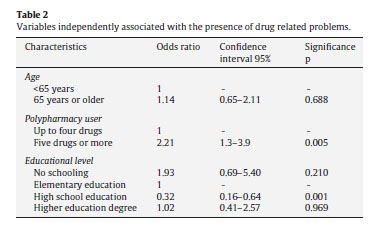
<body><![CDATA[<p>&nbsp;</p>     <p><font face="Verdana" size="2"><b>Method</b></font></p>     <p><font face="Verdana" size="2">This cross-sectional study was conducted at the ER of the Hospital de Clínicas de Porto Alegre (Brazil) for 1 month, which provides emergency care to approximately 65,700 patients annually from Porto Alegre (63.9%) and from other areas (36.1%) in southern Brazil.<sup>10</sup></font></p>     <p><font face="Verdana" size="2">A structured questionnaire was used to collect data. The development of this questionnaire has previously been published.<sup>11</sup> Data collection was performed by a properly trained and validated team of interviewers in three emergency care shifts (morning, afternoon and night) every day of the week for 20 days. The interviews were carried out as illustrated in the patient care flowchart (<a href="#f1">Figure 1</a>) before the patient was seen by a doctor. Data on the reasons for consultation, the basic illness, hospitalization, symptoms, measurements of blood pressure and blood glucose level were collected or confirmed in the emergency department records after the physician consultation. If the patient was hospitalized, the medical records were consulted.</font></p>     <p align="center"><font face="Verdana" size="2"><a name="f1"><img src="/img/revistas/gs/v25n6/original9_f1.jpg" width="351" height="411"></a>    <br><b>Figure 1</b>. Location of the interviews carried out in the    <br>patient care flowchart.</font></p>     <p>&nbsp;</p>     <p><font face="Verdana" size="2">Calculation of the sample size was based on a previous study<sup>2</sup> that estimated a DRP prevalence of 24.3% in an ER in Spain. Based on an annually-served population of 65,700 patients, a significance level of p<u>&lt;</u>0.05 and variation of 5%, the estimated minimum number of individuals needed for interview was 281. This study included patients older than 12 years who were capable of expressing themselves or who were accompanied by a caregiver. Caregivers answered all questions and were present at the medical consultation. When the patient could not remember any information during the interview, the questionnaire was completed later via a telephone contact.</font></p>     <p><font face="Verdana" size="2">The review board of our institution, which is accredited by the Office of Human Research Protections as an Institutional Review Board, approved the ethical and methodological aspects of the project, and all patients signed a written informed consent form to participate in this study.</font></p>     ]]></body>
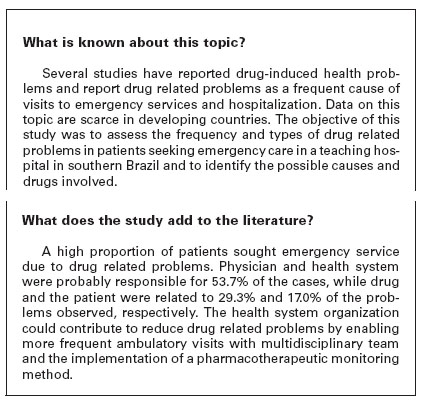
<body><![CDATA[<p><font face="Verdana" size="2">DRPs were identified case by case, based on the classification of the Brazilian Pharmaceutical Care Consensus.<sup>12</sup> In line with the basic principles of pharmacotherapy, DRPs were classified by evaluating three distinct criteria of pharmacotherapy: indication, effectiveness and safety. Suspected adverse drug reactions (ADR) were classified according to Naranjo's algorithm.<sup>13</sup> The causality of the remaining DRPs was inferred by using data from the questionnaire and the emergency department records.</font></p>     <p><font face="Verdana" size="2">To estimate interobserver variability, 67 random cases (20%) were analyzed by a second pharmacist. No divergence in classification was found.</font></p>     <p><font face="Verdana" size="2">Patients who were classified in the polypharmaceutic category<sup>14</sup> were those who had used five drugs or more concomitantly for 10 days before seeking emergency care. The drugs were classified according to the Anatomical Therapeutic Chemical system.<sup>15</sup> The analysis was performed using Epi Info<sup>&reg;</sup> 6.0 and SPSS 18.0 software. A descriptive analysis using measures of central tendency and dispersion of the sample was performed. The magnitude of the associations was estimated by odds ratios (OR) with a confidence interval of 95% (CI95%). The chi-square test was used to determine statistical significance between proportions. To control for possible confounding factors and to establish an independent association between the presence of DRPs and the number of medications, age and educational level, a multivariate logistic regression analysis was performed. The model included variables with a <i>p</i> value of &lt;0.20.</font></p>     <p>&nbsp;</p>     <p><font face="Verdana" size="2"><b>Results</b></font></p>     <p><font face="Verdana" size="2"><i>Sample characterization</i></font></p>     <p><font face="Verdana" size="2">Three hundred and fifty patients were interviewed, of whom 15 were excluded due to lack of data. Consequently, the final sample was composed of 335 patients (<a href="#f1">Figure 1</a>), who were predominantly female (65.7%) and white (76.7%). The mean age was 44.9 years (SD=19.2). Most (61.4%) had elementary education and were from the metropolitan area of Porto Alegre (94.9%) (<a target="_blank" href="/img/revistas/gs/v25n6/original9_t1.jpg">Table 1</a>).</font></p>     <p><font face="Verdana" size="2"><i>Drug-related problems</i></font></p>     <p><font face="Verdana" size="2">Of the 335 patients, 106 (31.6%; CI95%: 26.7-36.9) sought emergency care due to DRPs. A total of 123 DRPs were observed, representing 1.2 DRPs per patient, since 17 (16%) patients presented two DRPs. Univariate analysis showed that age, educational level and the amount of medication were significantly associated with the development of DRPs (<a target="_blank" href="/img/revistas/gs/v25n6/original9_t1.jpg">Table 1</a>). Multiple logistic regression was performed to evaluate the impact of age, educational level, and the number of drugs on the presence of DRPs. Age showed no correlation with the development of DRPs (OR=1.14; CI95%: 0.65-2.11). A high school educational level was a protective factor against the development of DRPs (OR=0.32; CI95%: 0.16-0.64). The use of five or more drugs contributed independently to the occurrence of DRPs (OR=2.21; CI95%: 1.3-3.9) (<a href="#t2">Table 2</a>).</font></p>     <p align="center"><font face="Verdana" size="2"><a name="t2"><img src="/img/revistas/gs/v25n6/original9_t2.jpg" width="377" height="231"></a></font></p>     ]]></body>
<body><![CDATA[<p>&nbsp;</p>     <p><font face="Verdana" size="2">The most frequent DRPs were ineffectiveness and unsafe use, respectively (<a target="_blank" href="/img/revistas/gs/v25n6/original9_t3.jpg">Table 3</a>). Ineffectiveness was related mainly to inadequate dosage regimens (22 cases; 17.9%) and refractoriness (15 cases; 12.2%). Adverse drug reactions were the principal cause of safety problems (35 cases; 28.5%).</font></p>     <p><font face="Verdana" size="2"><i>Factors involved in drug-related problems</i></font></p>     <p><font face="Verdana" size="2">In 21 DRPs (17.1%) the patient was identified as the main causative factor. The most common reasons were lack of adherence to treatment and self-medication. The drug itself was linked to 36 DRPs (29.3%). The remaining 66 DRPs (53.7%) could be attributed to the health system itself or to healthcare professionals.</font></p>     <p><font face="Verdana" size="2"><i>Drugs most commonly involved in drug-related problems</i></font></p>     <p><font face="Verdana" size="2">Of the 71 drugs related to DRPs, the most frequently involved were those acting on the cardiovascular system (24.3%) and on the nervous system (18.6%). These drug groups contain agents such as captopril (reported in 11 DRPs) and lithium carbonate (reported in 6 DRPs). Over-the-counter drugs formed a group of nine drugs (12.7%), which were reported in 16 DRPs (13%).</font></p>     <p>&nbsp;</p>     <p><font face="Verdana" size="2"><b>Discussion</b></font></p>     <p><font face="Verdana" size="2">In this study, the frequency of DRPs is higher than that reported by other authors, who found frequencies ranging from 24.3% to 29.0%.<sup>2,4,16</sup> The number of DRPs per patient was similar to that found by Martínez-Romero et al<sup>17</sup> (1.1 DRPs/patient). Our results agree with those reported in published studies that demonstrate that the number of drugs in use is related to the development of DRPs.<sup>2,4,18,19</sup> Additionally, this study shows that patients with a high school education have a lower odds of developing DRPs than those with less schooling.</font></p>     <p><font face="Verdana" size="2"><i>Indication-related drug-related problems</i></font></p>     ]]></body>
<body><![CDATA[<p><font face="Verdana" size="2">The reasons for non-adherence to the treatment prescribed were cost or probably a drug supply problem in the public system during the study period, which lowered affordability difficult and affected the treatment of these patients.<sup>20,21</sup></font></p>     <p><font face="Verdana" size="2">Self-medication was identified in a few cases and involved over-the-counter drugs. Responsible practice of self-medication should be emphasized, both by the user and by the professional recommending the medication.</font></p>     <p><font face="Verdana" size="2"><i>Effectiveness-related drug-related problems</i></font></p>     <p><font face="Verdana" size="2">The high frequency of effectiveness-related problems (54.5%) agrees with that reported by Baena et al<sup>2</sup> (62.7%). Most of these DRPs involved drugs of continuous use that require monitoring by the healthcare team. In our system, continued and multiprofessional care is not always provided due to deficiencies in the public health service. Consequently, the patient may resort to seeking emergency care to solve any problems that appear during the treatment.</font></p>     <p><font face="Verdana" size="2">Refractoriness to the treatment was considered as a possible cause of unsuccessful chronic therapy in 15 DRPs (12.2%). The other most common cause of effectiveness-related DRP was an inadequate dosage regimen (17.9%). This result may be related to the frequency of appointments with a physician, resulting in an inadequate dosage regimen due to the absence of follow-up. In patients requiring the addition of more drugs to monotherapy, which usually occurs during the treatment of hypertension, closer monitoring by health professionals could reduce these DRPs. These patients may not have had access to the required number of consultations with a physician, or may not have kept scheduled consultations, and could have maintained the same therapeutical scheme for longer than recommended. Physicians see a large number of patients, hampering assessment of signs and symptoms that optimize the therapeutic plan. Furthermore, there is a lack of continuing education programs for prescribers and other health professionals.</font></p>     <p><font face="Verdana" size="2">The possibility of non-adherence to treatment should not be excluded, as this is one of the factors most closely correlated to ineffectiveness.<sup>5</sup> According to O'Connor,<sup>22</sup> treatment failure is due to medical inertia in about 75% of cases and to patients' resistance to adhering to the therapeutic plan in 25%. In our study, some of the patients did not take the medication as recommended, suggesting that instruction on correct drug use requires more attention from health professionals, as simple oral instruction is often insufficient. In some cases, patients forgot to take some drug dose(s). Factors such as the patient's age and the number of drugs prescribed should also be considered.</font></p>     <p><font face="Verdana" size="2">Ineffectiveness was attributed to bacterial resistance in five DRPs. Stricter monitoring by health professionals and more adequate patient counseling could have prevented these patients from needing to seek ER care.</font></p>     <p><font face="Verdana" size="2">The remaining DRPs indicated prescription problems, such as dosages below the recommended level and lack of adequate assessment of drug interactions, which could have been avoided.</font></p>     <p><font face="Verdana" size="2">Many of the patients (57.6%) came from the Hospital de Clínicas de Porto Alegre outpatient clinic and, due to the high frequency of effectiveness-related DRPs, the use of the ER is probably inappropriate, i.e., non-urgent cases or cases that could be managed in the primary or secondary levels of care are treated by this service. As other authors report, this result causes concern, as people that use the ER inappropriately may be losing quality care. In addition, service to genuinely urgent patients is delayed, with overcrowding of the ER and other services that are normally used, such as laboratories, radiology departments, etc.<sup>23,24</sup></font></p>     <p><font face="Verdana" size="2"><i>Safety-related problems</i></font></p>     ]]></body>
<body><![CDATA[<p><font face="Verdana" size="2">Thirty-five cases (97%) of safety-related DRP were suspected of being ADR and, in one patient, two DRPs were suspected of being ADR, totaling 36 suspected cases. According to Naranjo's algorithm,<sup>13</sup> 20 DRPs suspected of being ADR were classified as probable and 16 as possible. No DRPs suspected of being ADR were classified as definite or doubtful. Considering only the probable suspected case, we found a 6% frequency of seeking ER care due to ADRs, which is similar to the frequency range (1%-5%) reported by other authors.<sup>25,26</sup> The clinical manifestations observed ranged from mild to severe.</font></p>     <p><font face="Verdana" size="2">Importantly, the ER medical team recorded the suspected ADRs in only 30.5% of the cases. The pharmacovigilance system in Brazil is relatively new and hence few health professionals perceive drugs as a potential cause of health problems.<sup>27</sup> Additionally, there is a lack of educational measures to improve the safety of drug therapy, which may be related to the high rate of ADRs.</font></p>     <p><font face="Verdana" size="2"><i>Factors involved in drug-related problems</i></font></p>     <p><font face="Verdana" size="2">In 21 DRPs (17.1%), the patient was identified as the main causative factor. The most common reasons were lack of adherence to treatment due to neglect of one or more doses of medicines for chronic use or the decision not to continue treatment and self-medication.</font></p>     <p><font face="Verdana" size="2">The drug itself was linked to 36 DRPs (29.3%). Access to drug information from the healthcare team could help to reduce predictable ADR. Thus, pharmacovigilance programs, structuring of drug information centers and involvement of professionals specialized in drug use in the healthcare teams should be encouraged.</font></p>     <p><font face="Verdana" size="2">The remaining 66 DRPs (53.7%) can be attributed to the health system itself or to healthcare professionals, specifically to the prescriber, since in Brazil the participation of other professionals is still low. We chose to group these cases into a single category. The study design did not allow data on previous visits to the ER to be collected for a more detailed analysis. In many cases, medical inertia was evident, but whether this was intrinsic or due to the organization of the health system is unclear.</font></p>     <p><font face="Verdana" size="2"><i>Drugs most commonly involved in drug-related problems</i></font></p>     <p><font face="Verdana" size="2">Chronic patients, who take drugs every day, are expected to show a higher number of DRPs than patients who take drugs sporadically. The frequent association of drugs from these classes with DRPs has already been reported.<sup>28</sup></font></p>     <p><font face="Verdana" size="2">Over-the-counter drugs should present no risk of use, but their possible use without proper instruction might have resulted in a health problem that required the ER service. This possibility may be related to the failure of the pharmacists to take responsibility for rational self-medication in Brazil.</font></p>     <p><font face="Verdana" size="2"><i>Study limitations</i></font></p>     ]]></body>
<body><![CDATA[<p><font face="Verdana" size="2">One of the main limitations of this study is that it is based on reported data, leading to considerable uncertainty on the possible causes of the DRPs identified. This uncertainty was reduced by collecting information such as diagnosis and outcome of medical examinations from medical records.</font></p>     <p><font face="Verdana" size="2">Another issue is that multiple causes can be involved in DRPs and each of the factors listed as important may be underestimated, since only the most likely cause for each DRP was given. To estimate the responsibility of professionals, patients or the organization of the health system and to evaluate the contribution of each factor to the development of a specific DRP, longitudinal studies are required, as well as adjustments to the original questionnaire. Despite these limitations, we believe that the data may be useful for designing strategies to reduce the percentage of DRPs found.</font></p>     <p>&nbsp;</p>     <p><font face="Verdana" size="2"><b>Conclusion</b></font></p>     <p><font face="Verdana" size="2">The data obtained in our study show that a high proportion of patients sought ER care due to DRPs and that the risk of DRPs increases with the number of drugs added to the therapy. These results reinforce the importance of considering drugs as a possible cause of health problems and of the need to develop public policy strategies to make the use of this resource more rational.</font></p>     <p><font face="Verdana" size="2">Since most patients had a low educational level, better counseling on disease(s), drug(s) and self-medication risks may positively influence treatment adherence and safety. Our data suggest that patients, especially chronic patients, are receiving insufficient attention from health teams, possibly due to appointment overbooking and to a lack of training in the systematic evaluation of pharmacotherapy and counseling. The organization of the health system could help to reduce DRPs by enabling more frequent outpatient clinic visits with a multidisciplinary team and implementing a pharmacotherapeutical monitoring system. Such measures may decrease demand for more complex care, such as that provided by the ER service.</font></p>     <p align="center"><font face="Verdana" size="2"><img src="/img/revistas/gs/v25n6/original9_cuadro.jpg" width="422" height="402"></font></p>     <p>&nbsp;</p>     <p><font face="Verdana" size="2"><b>Authors' contributions</b></font></p>     <p><font face="Verdana" size="2">R.S. Andreazza and I. Heineck conceived the study, supervised all aspects of its implementation, collected data, performed the analysis, interpreted the data and contributed to writing the first draft of the manuscript. P.S. K&ouml;che and M.S. Castro interpreted the data and contributed to writing the first draft of the manuscript. All authors contributed ideas, interpreted the data and reviewed drafts of the manuscript. All authors approved the final version. R.S. Andreazza is responsible for the article.</font></p>     ]]></body>
<body><![CDATA[<p>&nbsp;</p>     <p><font face="Verdana" size="2"><b>Conflict of interest</b></font></p>     <p><font face="Verdana" size="2">None.</font></p>     <p>&nbsp;</p>     <p><font face="Verdana" size="2"><b>References</b></font></p>     <!-- ref --><p><font face="Verdana" size="2">1. Manasse HR. Medication use in an imperfect world: drug misadventuring as an issue of public policy, part 1. Am J Hosp Pharm. 1989; 46:929-44.    &nbsp;&nbsp;&nbsp;&nbsp;&nbsp;&nbsp;&nbsp;&nbsp;[&#160;<a href="javascript:void(0);" onclick="javascript: window.open('/scielo.php?script=sci_nlinks&ref=2437360&pid=S0213-9111201100060001100001&lng=','','width=640,height=500,resizable=yes,scrollbars=1,menubar=yes,');">Links</a>&#160;]<!-- end-ref --></font></p>    <!-- ref --><p><font face="Verdana" size="2">2. Baena MI, Fajardo P, Luque FM, et al. Problemas relacionados con los medicamentos en usuarios de un servicio de urgencias hospitalario: resultados de la validación de un cuestionario. Pharm Care España. 2001; 3:345-57.    &nbsp;&nbsp;&nbsp;&nbsp;&nbsp;&nbsp;&nbsp;&nbsp;[&#160;<a href="javascript:void(0);" onclick="javascript: window.open('/scielo.php?script=sci_nlinks&ref=2437362&pid=S0213-9111201100060001100002&lng=','','width=640,height=500,resizable=yes,scrollbars=1,menubar=yes,');">Links</a>&#160;]<!-- end-ref --></font></p>    <!-- ref --><p><font face="Verdana" size="2">3. Artiles MG, Álvarez ES, Sánchez-Colomer MG. Reacciones adversas y problemas relacionados con medicamentos en un servicio de urgencia. Rev Esp Salud Pública. 1999; 73:507-14.    &nbsp;&nbsp;&nbsp;&nbsp;&nbsp;&nbsp;&nbsp;&nbsp;[&#160;<a href="javascript:void(0);" onclick="javascript: window.open('/scielo.php?script=sci_nlinks&ref=2437364&pid=S0213-9111201100060001100003&lng=','','width=640,height=500,resizable=yes,scrollbars=1,menubar=yes,');">Links</a>&#160;]<!-- end-ref --></font></p>    <!-- ref --><p><font face="Verdana" size="2">4. Tuneu L, García-Peláez M, López S, et al. Problemas relacionados con los medicamentos en pacientes que visitan un servicio de urgencias. Pharm Care España. 2000; 2:177-92.    &nbsp;&nbsp;&nbsp;&nbsp;&nbsp;&nbsp;&nbsp;&nbsp;[&#160;<a href="javascript:void(0);" onclick="javascript: window.open('/scielo.php?script=sci_nlinks&ref=2437366&pid=S0213-9111201100060001100004&lng=','','width=640,height=500,resizable=yes,scrollbars=1,menubar=yes,');">Links</a>&#160;]<!-- end-ref --></font></p>    <!-- ref --><p><font face="Verdana" size="2">5. Sabaté E. Adherence to long-term therapies: evidence for action. Geneva: WHO; 2003. p. 211.    &nbsp;&nbsp;&nbsp;&nbsp;&nbsp;&nbsp;&nbsp;&nbsp;[&#160;<a href="javascript:void(0);" onclick="javascript: window.open('/scielo.php?script=sci_nlinks&ref=2437368&pid=S0213-9111201100060001100005&lng=','','width=640,height=500,resizable=yes,scrollbars=1,menubar=yes,');">Links</a>&#160;]<!-- end-ref --></font></p>    <!-- ref --><p><font face="Verdana" size="2">6. Barbero Gonzáles JA, Alfonso Galán T. Detección y resolución de problemas relacionados con los medicamentos en la farmacia comunitaria: una aproximación. Pharm Care España. 1999; 1:113-22.    &nbsp;&nbsp;&nbsp;&nbsp;&nbsp;&nbsp;&nbsp;&nbsp;[&#160;<a href="javascript:void(0);" onclick="javascript: window.open('/scielo.php?script=sci_nlinks&ref=2437370&pid=S0213-9111201100060001100006&lng=','','width=640,height=500,resizable=yes,scrollbars=1,menubar=yes,');">Links</a>&#160;]<!-- end-ref --></font></p>    <!-- ref --><p><font face="Verdana" size="2">7. Dago Martínez A, Arcos González P, Álvarez de Toledo Saavedra F, et al. Indicadores de riesgo de morbilidad prevenible causada por medicamentos. Gac Sanit. 2007; 21:29-36.    &nbsp;&nbsp;&nbsp;&nbsp;&nbsp;&nbsp;&nbsp;&nbsp;[&#160;<a href="javascript:void(0);" onclick="javascript: window.open('/scielo.php?script=sci_nlinks&ref=2437372&pid=S0213-9111201100060001100007&lng=','','width=640,height=500,resizable=yes,scrollbars=1,menubar=yes,');">Links</a>&#160;]<!-- end-ref --></font></p>    <!-- ref --><p><font face="Verdana" size="2">8. Blix HS, Viktil KK, Reikvam A, et al. The majority of hospitalised patients have drug-related problems: results from a prospective study in general hospitals. Eur J Clin Pharmacol. 2004; 60:651-8.    &nbsp;&nbsp;&nbsp;&nbsp;&nbsp;&nbsp;&nbsp;&nbsp;[&#160;<a href="javascript:void(0);" onclick="javascript: window.open('/scielo.php?script=sci_nlinks&ref=2437374&pid=S0213-9111201100060001100008&lng=','','width=640,height=500,resizable=yes,scrollbars=1,menubar=yes,');">Links</a>&#160;]<!-- end-ref --></font></p>    <!-- ref --><p><font face="Verdana" size="2">9. Franceschi A, Tuccori M, Bocci G, et al. Drug therapeutic failures in emergency department patients: a university experience. Pharmacol Res. 2004; 49:85-91.    &nbsp;&nbsp;&nbsp;&nbsp;&nbsp;&nbsp;&nbsp;&nbsp;[&#160;<a href="javascript:void(0);" onclick="javascript: window.open('/scielo.php?script=sci_nlinks&ref=2437376&pid=S0213-9111201100060001100009&lng=','','width=640,height=500,resizable=yes,scrollbars=1,menubar=yes,');">Links</a>&#160;]<!-- end-ref --></font></p>    <!-- ref --><p><font face="Verdana" size="2">10. Hospital de Clínicas de Porto Alegre/Universidade Federal do Rio Grande do Sul. Relatório de Atividades 2001. &#091;Accessed 10 Sept 2002.&#093; Available at: <a target="_blank" href="http://www.hcpa.ufrgs.br/dl/relat_ativ/Relatorio_2001_Completo.pdf">www.hcpa.ufrgs.br/dl/relat_ativ/Relatorio_2001_Completo.pdf</a>.    &nbsp;&nbsp;&nbsp;&nbsp;&nbsp;&nbsp;&nbsp;&nbsp;[&#160;<a href="javascript:void(0);" onclick="javascript: window.open('/scielo.php?script=sci_nlinks&ref=2437378&pid=S0213-9111201100060001100010&lng=','','width=640,height=500,resizable=yes,scrollbars=1,menubar=yes,');">Links</a>&#160;]<!-- end-ref --></font></p>    <!-- ref --><p><font face="Verdana" size="2">11. Dall'Agnol RSA, Albring DV, Castro MS, et al. Problemas relacionados com medicamentos em Serviço de Emerg&ecirc;ncia de Hospital Universitário do Sul do Brasil. Estudo piloto. Acta Farmaceutica Bonaerense. 2004; 23:540-5.    &nbsp;&nbsp;&nbsp;&nbsp;&nbsp;&nbsp;&nbsp;&nbsp;[&#160;<a href="javascript:void(0);" onclick="javascript: window.open('/scielo.php?script=sci_nlinks&ref=2437380&pid=S0213-9111201100060001100011&lng=','','width=640,height=500,resizable=yes,scrollbars=1,menubar=yes,');">Links</a>&#160;]<!-- end-ref --></font></p>    <!-- ref --><p><font face="Verdana" size="2">12. Ivama AM, Noblat L, Castro MS, et al. Consenso Brasileiro de Atenç&atilde;o Farmac&ecirc;utica. Brasília: Organizaç&atilde;o Pan-Americana da Saúde; 2002.    &nbsp;&nbsp;&nbsp;&nbsp;&nbsp;&nbsp;&nbsp;&nbsp;[&#160;<a href="javascript:void(0);" onclick="javascript: window.open('/scielo.php?script=sci_nlinks&ref=2437382&pid=S0213-9111201100060001100012&lng=','','width=640,height=500,resizable=yes,scrollbars=1,menubar=yes,');">Links</a>&#160;]<!-- end-ref --></font></p>    <!-- ref --><p><font face="Verdana" size="2">13. Naranjo CA, Busto U, Sellers EM, et al. A method for estimating the probability of adverse drug reactions. Clin Pharmacol Ther. 1981; 46:239-45.    &nbsp;&nbsp;&nbsp;&nbsp;&nbsp;&nbsp;&nbsp;&nbsp;[&#160;<a href="javascript:void(0);" onclick="javascript: window.open('/scielo.php?script=sci_nlinks&ref=2437384&pid=S0213-9111201100060001100013&lng=','','width=640,height=500,resizable=yes,scrollbars=1,menubar=yes,');">Links</a>&#160;]<!-- end-ref --></font></p>    <!-- ref --><p><font face="Verdana" size="2">14. Linjakumpu T, Hartikainen S, Klaukka T, et al. Use of medications and polypharmacy are incresing among the elderly. J Clin Epidemiol. 2002; 55:809-17.    &nbsp;&nbsp;&nbsp;&nbsp;&nbsp;&nbsp;&nbsp;&nbsp;[&#160;<a href="javascript:void(0);" onclick="javascript: window.open('/scielo.php?script=sci_nlinks&ref=2437386&pid=S0213-9111201100060001100014&lng=','','width=640,height=500,resizable=yes,scrollbars=1,menubar=yes,');">Links</a>&#160;]<!-- end-ref --></font></p>    <!-- ref --><p><font face="Verdana" size="2">15. WHO. Anatomical Therapeutic Chemical system 2003. &#091;Accessed 16 Oct 2003.&#093; Available at: <a target="_blank" href="http://www.whocc.no/atcddd/">www.whocc.no/atcddd/</a>.    &nbsp;&nbsp;&nbsp;&nbsp;&nbsp;&nbsp;&nbsp;&nbsp;[&#160;<a href="javascript:void(0);" onclick="javascript: window.open('/scielo.php?script=sci_nlinks&ref=2437388&pid=S0213-9111201100060001100015&lng=','','width=640,height=500,resizable=yes,scrollbars=1,menubar=yes,');">Links</a>&#160;]<!-- end-ref --></font></p>    <!-- ref --><p><font face="Verdana" size="2">16. Tafreshi MJ, Melby MJ, Kaback KR, et al. Medication-related visits to the emergency department: a prospective study. Ann Pharmacother. 1999; 33:1252-7.    &nbsp;&nbsp;&nbsp;&nbsp;&nbsp;&nbsp;&nbsp;&nbsp;[&#160;<a href="javascript:void(0);" onclick="javascript: window.open('/scielo.php?script=sci_nlinks&ref=2437390&pid=S0213-9111201100060001100016&lng=','','width=640,height=500,resizable=yes,scrollbars=1,menubar=yes,');">Links</a>&#160;]<!-- end-ref --></font></p>    <!-- ref --><p><font face="Verdana" size="2">17. Martínez-Romero F, Fernández-Llimós F, Gastelurrutia MA, et al. Programa Dáder de seguimiento del tratamiento farmacológico. Resultados de la fase piloto. Ars Pharmaceutica. 2001; 42:53-65.    &nbsp;&nbsp;&nbsp;&nbsp;&nbsp;&nbsp;&nbsp;&nbsp;[&#160;<a href="javascript:void(0);" onclick="javascript: window.open('/scielo.php?script=sci_nlinks&ref=2437392&pid=S0213-9111201100060001100017&lng=','','width=640,height=500,resizable=yes,scrollbars=1,menubar=yes,');">Links</a>&#160;]<!-- end-ref --></font></p>    <!-- ref --><p><font face="Verdana" size="2">18. Heininger-Rothbucher D, Bischinger S, Ulmer H, et al. Incidence and risk of potential adverse drug interaction in the emergency room. Resuscitation. 2001; 49:283-8.    &nbsp;&nbsp;&nbsp;&nbsp;&nbsp;&nbsp;&nbsp;&nbsp;[&#160;<a href="javascript:void(0);" onclick="javascript: window.open('/scielo.php?script=sci_nlinks&ref=2437394&pid=S0213-9111201100060001100018&lng=','','width=640,height=500,resizable=yes,scrollbars=1,menubar=yes,');">Links</a>&#160;]<!-- end-ref --></font></p>    <!-- ref --><p><font face="Verdana" size="2">19. Goméz MA, Villafaina A, Hernández J, et al. Promoting appropriate drug use through the application of the Spanish drug-related problem classification system in the primary care setting. Ann Pharmacother. 2009; 43:339-46.    &nbsp;&nbsp;&nbsp;&nbsp;&nbsp;&nbsp;&nbsp;&nbsp;[&#160;<a href="javascript:void(0);" onclick="javascript: window.open('/scielo.php?script=sci_nlinks&ref=2437396&pid=S0213-9111201100060001100019&lng=','','width=640,height=500,resizable=yes,scrollbars=1,menubar=yes,');">Links</a>&#160;]<!-- end-ref --></font></p>    <!-- ref --><p><font face="Verdana" size="2">20. Demissie M, Getahun H, Lindtjornn B. Community tuberculosis care through "TB clubs" in rural North Ethiopia. Soc Sci Med. 2003; 56:2009-18.    &nbsp;&nbsp;&nbsp;&nbsp;&nbsp;&nbsp;&nbsp;&nbsp;[&#160;<a href="javascript:void(0);" onclick="javascript: window.open('/scielo.php?script=sci_nlinks&ref=2437398&pid=S0213-9111201100060001100020&lng=','','width=640,height=500,resizable=yes,scrollbars=1,menubar=yes,');">Links</a>&#160;]<!-- end-ref --></font></p>    <!-- ref --><p><font face="Verdana" size="2">21. Re MC, Bom I, Monari P, et al. Drug failure during HIV-1 treatment. New perspectives in monitoring drug resistance. The New Microbiologica. 2003; 26:405-13.    &nbsp;&nbsp;&nbsp;&nbsp;&nbsp;&nbsp;&nbsp;&nbsp;[&#160;<a href="javascript:void(0);" onclick="javascript: window.open('/scielo.php?script=sci_nlinks&ref=2437400&pid=S0213-9111201100060001100021&lng=','','width=640,height=500,resizable=yes,scrollbars=1,menubar=yes,');">Links</a>&#160;]<!-- end-ref --></font></p>    <!-- ref --><p><font face="Verdana" size="2">22. O'Connor P. Overcome clinical inertia to control systolic blood pressure. Arch Intern Med. 2003; 163:2677-8.    &nbsp;&nbsp;&nbsp;&nbsp;&nbsp;&nbsp;&nbsp;&nbsp;[&#160;<a href="javascript:void(0);" onclick="javascript: window.open('/scielo.php?script=sci_nlinks&ref=2437402&pid=S0213-9111201100060001100022&lng=','','width=640,height=500,resizable=yes,scrollbars=1,menubar=yes,');">Links</a>&#160;]<!-- end-ref --></font></p>    <!-- ref --><p><font face="Verdana" size="2">23. Oterino D, Peiró S, Calvo R, et al. Utilización inadecuada de un servicio de urgencias hospitalario. Una evaluación con criterios explícitos. Gac Sanit. 1999; 13:361-70.    &nbsp;&nbsp;&nbsp;&nbsp;&nbsp;&nbsp;&nbsp;&nbsp;[&#160;<a href="javascript:void(0);" onclick="javascript: window.open('/scielo.php?script=sci_nlinks&ref=2437404&pid=S0213-9111201100060001100023&lng=','','width=640,height=500,resizable=yes,scrollbars=1,menubar=yes,');">Links</a>&#160;]<!-- end-ref --></font></p>    <!-- ref --><p><font face="Verdana" size="2">24. Sempere-Selva T, Peiró S, Sendra-Pina P, et al. Inappropriate use of an accident and emergency department: magnitude, associated factors and reasons - an approach with explicit criteria. Ann Emerg Med. 2001; 37:568-79.    &nbsp;&nbsp;&nbsp;&nbsp;&nbsp;&nbsp;&nbsp;&nbsp;[&#160;<a href="javascript:void(0);" onclick="javascript: window.open('/scielo.php?script=sci_nlinks&ref=2437406&pid=S0213-9111201100060001100024&lng=','','width=640,height=500,resizable=yes,scrollbars=1,menubar=yes,');">Links</a>&#160;]<!-- end-ref --></font></p>    <!-- ref --><p><font face="Verdana" size="2">25. Lazarou J, Pomeranz BH, Corey PN. Incidence of adverse drug reactions in hospitalized patients: a meta-analysis of prospective studies. JAMA. 1998; 279:1200-5.    &nbsp;&nbsp;&nbsp;&nbsp;&nbsp;&nbsp;&nbsp;&nbsp;[&#160;<a href="javascript:void(0);" onclick="javascript: window.open('/scielo.php?script=sci_nlinks&ref=2437408&pid=S0213-9111201100060001100025&lng=','','width=640,height=500,resizable=yes,scrollbars=1,menubar=yes,');">Links</a>&#160;]<!-- end-ref --></font></p>    <!-- ref --><p><font face="Verdana" size="2">26. Sas SSM, Meseguer ES. Reacciones adversas a fármacos como motivo de consulta a urgencias. Jano, Medicina y Humanidades. 1999; 57:42-5.    &nbsp;&nbsp;&nbsp;&nbsp;&nbsp;&nbsp;&nbsp;&nbsp;[&#160;<a href="javascript:void(0);" onclick="javascript: window.open('/scielo.php?script=sci_nlinks&ref=2437410&pid=S0213-9111201100060001100026&lng=','','width=640,height=500,resizable=yes,scrollbars=1,menubar=yes,');">Links</a>&#160;]<!-- end-ref --></font></p>    <!-- ref --><p><font face="Verdana" size="2">27. Arrais PSD. O uso irracional de medicamentos e a farmacovigilância no Brasil. Cad Saúde Pública. 2002; 18:1478-9.    &nbsp;&nbsp;&nbsp;&nbsp;&nbsp;&nbsp;&nbsp;&nbsp;[&#160;<a href="javascript:void(0);" onclick="javascript: window.open('/scielo.php?script=sci_nlinks&ref=2437412&pid=S0213-9111201100060001100027&lng=','','width=640,height=500,resizable=yes,scrollbars=1,menubar=yes,');">Links</a>&#160;]<!-- end-ref --></font></p>    <!-- ref --><p><font face="Verdana" size="2">28. Mannheimer B, Ulfvarson J, Ekl&ouml;f S, et al. Drug-related problems and pharmacotherapeutic advisory intervention at a medicine clinic. Eur J Clin Pharmacol. 2006; 62:1075-81.    &nbsp;&nbsp;&nbsp;&nbsp;&nbsp;&nbsp;&nbsp;&nbsp;[&#160;<a href="javascript:void(0);" onclick="javascript: window.open('/scielo.php?script=sci_nlinks&ref=2437414&pid=S0213-9111201100060001100028&lng=','','width=640,height=500,resizable=yes,scrollbars=1,menubar=yes,');">Links</a>&#160;]<!-- end-ref --></font></p>     <p>&nbsp;</p>     <p>&nbsp;</p>     <p><font face="Verdana" size="2"><a href="#top"><img border="0" src="/img/revistas/gs/v25n6/seta.gif" width="15" height="17"></a><a name="bajo"></a><b>Correspondence:</b>    <br>E-mail address: <a href="mailto:robertaan@yahoo.com">robertaan@yahoo.com</a>    <br>(R. S. Andreazza)</font></p>     <p><font face="Verdana" size="2">Received 24 January 2011    <br>Received in revised form 25 April 2011    <br>Accepted 4 May 2011</font></p>      ]]></body><back>
<ref-list>
<ref id="B1">
<label>1</label><nlm-citation citation-type="journal">
<person-group person-group-type="author">
<name>
<surname><![CDATA[Manasse]]></surname>
<given-names><![CDATA[HR]]></given-names>
</name>
</person-group>
<article-title xml:lang="en"><![CDATA[Medication use in an imperfect world: drug misadventuring as an issue of public policy, part 1]]></article-title>
<source><![CDATA[Am J Hosp Pharm]]></source>
<year>1989</year>
<volume>46</volume>
<page-range>929-44</page-range></nlm-citation>
</ref>
<ref id="B2">
<label>2</label><nlm-citation citation-type="journal">
<person-group person-group-type="author">
<name>
<surname><![CDATA[Baena]]></surname>
<given-names><![CDATA[MI]]></given-names>
</name>
<name>
<surname><![CDATA[Fajardo]]></surname>
<given-names><![CDATA[P]]></given-names>
</name>
<name>
<surname><![CDATA[Luque]]></surname>
<given-names><![CDATA[FM]]></given-names>
</name>
</person-group>
<article-title xml:lang="es"><![CDATA[Problemas relacionados con los medicamentos en usuarios de un servicio de urgencias hospitalario: resultados de la validación de un cuestionario]]></article-title>
<source><![CDATA[Pharm Care España]]></source>
<year>2001</year>
<volume>3</volume>
<page-range>345-57</page-range></nlm-citation>
</ref>
<ref id="B3">
<label>3</label><nlm-citation citation-type="journal">
<person-group person-group-type="author">
<name>
<surname><![CDATA[Artiles]]></surname>
<given-names><![CDATA[MG]]></given-names>
</name>
<name>
<surname><![CDATA[Álvarez]]></surname>
<given-names><![CDATA[ES]]></given-names>
</name>
<name>
<surname><![CDATA[Sánchez-Colomer]]></surname>
<given-names><![CDATA[MG]]></given-names>
</name>
</person-group>
<article-title xml:lang="es"><![CDATA[Reacciones adversas y problemas relacionados con medicamentos en un servicio de urgencia]]></article-title>
<source><![CDATA[Rev Esp Salud Pública]]></source>
<year>1999</year>
<volume>73</volume>
<page-range>507-14</page-range></nlm-citation>
</ref>
<ref id="B4">
<label>4</label><nlm-citation citation-type="journal">
<person-group person-group-type="author">
<name>
<surname><![CDATA[Tuneu]]></surname>
<given-names><![CDATA[L]]></given-names>
</name>
<name>
<surname><![CDATA[García-Peláez]]></surname>
<given-names><![CDATA[M]]></given-names>
</name>
<name>
<surname><![CDATA[López]]></surname>
<given-names><![CDATA[S]]></given-names>
</name>
</person-group>
<article-title xml:lang="es"><![CDATA[Problemas relacionados con los medicamentos en pacientes que visitan un servicio de urgencias]]></article-title>
<source><![CDATA[Pharm Care España]]></source>
<year>2000</year>
<volume>2</volume>
<page-range>177-92</page-range></nlm-citation>
</ref>
<ref id="B5">
<label>5</label><nlm-citation citation-type="book">
<person-group person-group-type="author">
<name>
<surname><![CDATA[Sabaté]]></surname>
<given-names><![CDATA[E]]></given-names>
</name>
</person-group>
<source><![CDATA[Adherence to long-term therapies: evidence for action]]></source>
<year>2003</year>
<page-range>211</page-range><publisher-loc><![CDATA[Geneva ]]></publisher-loc>
<publisher-name><![CDATA[WHO]]></publisher-name>
</nlm-citation>
</ref>
<ref id="B6">
<label>6</label><nlm-citation citation-type="journal">
<person-group person-group-type="author">
<name>
<surname><![CDATA[Barbero Gonzáles]]></surname>
<given-names><![CDATA[JA]]></given-names>
</name>
<name>
<surname><![CDATA[Alfonso Galán]]></surname>
<given-names><![CDATA[T]]></given-names>
</name>
</person-group>
<article-title xml:lang="es"><![CDATA[Detección y resolución de problemas relacionados con los medicamentos en la farmacia comunitaria: una aproximación]]></article-title>
<source><![CDATA[Pharm Care España]]></source>
<year>1999</year>
<volume>1</volume>
<page-range>113-22</page-range></nlm-citation>
</ref>
<ref id="B7">
<label>7</label><nlm-citation citation-type="journal">
<person-group person-group-type="author">
<name>
<surname><![CDATA[Dago Martínez]]></surname>
<given-names><![CDATA[A]]></given-names>
</name>
<name>
<surname><![CDATA[Arcos González]]></surname>
<given-names><![CDATA[P]]></given-names>
</name>
<name>
<surname><![CDATA[Álvarez de Toledo Saavedra]]></surname>
<given-names><![CDATA[F]]></given-names>
</name>
</person-group>
<article-title xml:lang="es"><![CDATA[Indicadores de riesgo de morbilidad prevenible causada por medicamentos]]></article-title>
<source><![CDATA[Gac Sanit]]></source>
<year>2007</year>
<volume>21</volume>
<page-range>29-36</page-range></nlm-citation>
</ref>
<ref id="B8">
<label>8</label><nlm-citation citation-type="journal">
<person-group person-group-type="author">
<name>
<surname><![CDATA[Blix]]></surname>
<given-names><![CDATA[HS]]></given-names>
</name>
<name>
<surname><![CDATA[Viktil]]></surname>
<given-names><![CDATA[KK]]></given-names>
</name>
<name>
<surname><![CDATA[Reikvam]]></surname>
<given-names><![CDATA[A]]></given-names>
</name>
</person-group>
<article-title xml:lang="en"><![CDATA[The majority of hospitalised patients have drug-related problems: results from a prospective study in general hospitals]]></article-title>
<source><![CDATA[Eur J Clin Pharmacol]]></source>
<year>2004</year>
<volume>60</volume>
<page-range>651-8</page-range></nlm-citation>
</ref>
<ref id="B9">
<label>9</label><nlm-citation citation-type="journal">
<person-group person-group-type="author">
<name>
<surname><![CDATA[Franceschi]]></surname>
<given-names><![CDATA[A]]></given-names>
</name>
<name>
<surname><![CDATA[Tuccori]]></surname>
<given-names><![CDATA[M]]></given-names>
</name>
<name>
<surname><![CDATA[Bocci]]></surname>
<given-names><![CDATA[G]]></given-names>
</name>
</person-group>
<article-title xml:lang="en"><![CDATA[Drug therapeutic failures in emergency department patients: a university experience]]></article-title>
<source><![CDATA[Pharmacol Res]]></source>
<year>2004</year>
<volume>49</volume>
<page-range>85-91</page-range></nlm-citation>
</ref>
<ref id="B10">
<label>10</label><nlm-citation citation-type="">
<collab>Hospital de Clínicas de Porto Alegre</collab>
<collab>Universidade Federal do Rio Grande do Sul</collab>
<source><![CDATA[Relatório de Atividades]]></source>
<year>2001</year>
</nlm-citation>
</ref>
<ref id="B11">
<label>11</label><nlm-citation citation-type="journal">
<person-group person-group-type="author">
<name>
<surname><![CDATA[Dall'Agnol]]></surname>
<given-names><![CDATA[RSA]]></given-names>
</name>
<name>
<surname><![CDATA[Albring]]></surname>
<given-names><![CDATA[DV]]></given-names>
</name>
<name>
<surname><![CDATA[Castro]]></surname>
<given-names><![CDATA[MS]]></given-names>
</name>
</person-group>
<article-title xml:lang="pt"><![CDATA[Problemas relacionados com medicamentos em Serviço de Emergência de Hospital Universitário do Sul do Brasil: Estudo piloto]]></article-title>
<source><![CDATA[Acta Farmaceutica Bonaerense]]></source>
<year>2004</year>
<volume>23</volume>
<page-range>540-5</page-range></nlm-citation>
</ref>
<ref id="B12">
<label>12</label><nlm-citation citation-type="book">
<person-group person-group-type="author">
<name>
<surname><![CDATA[Ivama]]></surname>
<given-names><![CDATA[AM]]></given-names>
</name>
<name>
<surname><![CDATA[Noblat]]></surname>
<given-names><![CDATA[L]]></given-names>
</name>
<name>
<surname><![CDATA[Castro]]></surname>
<given-names><![CDATA[MS]]></given-names>
</name>
</person-group>
<source><![CDATA[Consenso Brasileiro de Atenção Farmacêutica]]></source>
<year>2002</year>
<publisher-loc><![CDATA[Brasília ]]></publisher-loc>
<publisher-name><![CDATA[Organização Pan-Americana da Saúde]]></publisher-name>
</nlm-citation>
</ref>
<ref id="B13">
<label>13</label><nlm-citation citation-type="journal">
<person-group person-group-type="author">
<name>
<surname><![CDATA[Naranjo]]></surname>
<given-names><![CDATA[CA]]></given-names>
</name>
<name>
<surname><![CDATA[Busto]]></surname>
<given-names><![CDATA[U]]></given-names>
</name>
<name>
<surname><![CDATA[Sellers]]></surname>
<given-names><![CDATA[EM]]></given-names>
</name>
</person-group>
<article-title xml:lang="en"><![CDATA[A method for estimating the probability of adverse drug reactions]]></article-title>
<source><![CDATA[Clin Pharmacol Ther]]></source>
<year>1981</year>
<volume>46</volume>
<page-range>239-45</page-range></nlm-citation>
</ref>
<ref id="B14">
<label>14</label><nlm-citation citation-type="journal">
<person-group person-group-type="author">
<name>
<surname><![CDATA[Linjakumpu]]></surname>
<given-names><![CDATA[T]]></given-names>
</name>
<name>
<surname><![CDATA[Hartikainen]]></surname>
<given-names><![CDATA[S]]></given-names>
</name>
<name>
<surname><![CDATA[Klaukka]]></surname>
<given-names><![CDATA[T]]></given-names>
</name>
</person-group>
<article-title xml:lang="en"><![CDATA[Use of medications and polypharmacy are incresing among the elderly]]></article-title>
<source><![CDATA[J Clin Epidemiol]]></source>
<year>2002</year>
<volume>55</volume>
<page-range>809-17</page-range></nlm-citation>
</ref>
<ref id="B15">
<label>15</label><nlm-citation citation-type="">
<collab>WHO</collab>
<source><![CDATA[Anatomical Therapeutic Chemical system]]></source>
<year>2003</year>
</nlm-citation>
</ref>
<ref id="B16">
<label>16</label><nlm-citation citation-type="journal">
<person-group person-group-type="author">
<name>
<surname><![CDATA[Tafreshi]]></surname>
<given-names><![CDATA[MJ]]></given-names>
</name>
<name>
<surname><![CDATA[Melby]]></surname>
<given-names><![CDATA[MJ]]></given-names>
</name>
<name>
<surname><![CDATA[Kaback]]></surname>
<given-names><![CDATA[KR]]></given-names>
</name>
</person-group>
<article-title xml:lang="en"><![CDATA[Medication-related visits to the emergency department: a prospective study]]></article-title>
<source><![CDATA[Ann Pharmacother]]></source>
<year>1999</year>
<volume>33</volume>
<page-range>1252-7</page-range></nlm-citation>
</ref>
<ref id="B17">
<label>17</label><nlm-citation citation-type="journal">
<person-group person-group-type="author">
<name>
<surname><![CDATA[Martínez-Romero]]></surname>
<given-names><![CDATA[F]]></given-names>
</name>
<name>
<surname><![CDATA[Fernández-Llimós]]></surname>
<given-names><![CDATA[F]]></given-names>
</name>
<name>
<surname><![CDATA[Gastelurrutia]]></surname>
<given-names><![CDATA[MA]]></given-names>
</name>
</person-group>
<article-title xml:lang="es"><![CDATA[Programa Dáder de seguimiento del tratamiento farmacológico: Resultados de la fase piloto]]></article-title>
<source><![CDATA[Ars Pharmaceutica]]></source>
<year>2001</year>
<volume>42</volume>
<page-range>53-65</page-range></nlm-citation>
</ref>
<ref id="B18">
<label>18</label><nlm-citation citation-type="journal">
<person-group person-group-type="author">
<name>
<surname><![CDATA[Heininger-Rothbucher]]></surname>
<given-names><![CDATA[D]]></given-names>
</name>
<name>
<surname><![CDATA[Bischinger]]></surname>
<given-names><![CDATA[S]]></given-names>
</name>
<name>
<surname><![CDATA[Ulmer]]></surname>
<given-names><![CDATA[H]]></given-names>
</name>
</person-group>
<article-title xml:lang="en"><![CDATA[Incidence and risk of potential adverse drug interaction in the emergency room]]></article-title>
<source><![CDATA[Resuscitation]]></source>
<year>2001</year>
<volume>49</volume>
<page-range>283-8</page-range></nlm-citation>
</ref>
<ref id="B19">
<label>19</label><nlm-citation citation-type="journal">
<person-group person-group-type="author">
<name>
<surname><![CDATA[Goméz]]></surname>
<given-names><![CDATA[MA]]></given-names>
</name>
<name>
<surname><![CDATA[Villafaina]]></surname>
<given-names><![CDATA[A]]></given-names>
</name>
<name>
<surname><![CDATA[Hernández]]></surname>
<given-names><![CDATA[J]]></given-names>
</name>
</person-group>
<article-title xml:lang="en"><![CDATA[Promoting appropriate drug use through the application of the Spanish drug-related problem classification system in the primary care setting]]></article-title>
<source><![CDATA[Ann Pharmacother]]></source>
<year>2009</year>
<volume>43</volume>
<page-range>339-46</page-range></nlm-citation>
</ref>
<ref id="B20">
<label>20</label><nlm-citation citation-type="journal">
<person-group person-group-type="author">
<name>
<surname><![CDATA[Demissie]]></surname>
<given-names><![CDATA[M]]></given-names>
</name>
<name>
<surname><![CDATA[Getahun]]></surname>
<given-names><![CDATA[H]]></given-names>
</name>
<name>
<surname><![CDATA[Lindtjornn]]></surname>
<given-names><![CDATA[B]]></given-names>
</name>
</person-group>
<article-title xml:lang="en"><![CDATA[Community tuberculosis care through "TB clubs" in rural North Ethiopia]]></article-title>
<source><![CDATA[Soc Sci Med]]></source>
<year>2003</year>
<volume>56</volume>
<page-range>2009-18</page-range></nlm-citation>
</ref>
<ref id="B21">
<label>21</label><nlm-citation citation-type="journal">
<person-group person-group-type="author">
<name>
<surname><![CDATA[Re]]></surname>
<given-names><![CDATA[MC]]></given-names>
</name>
<name>
<surname><![CDATA[Bom]]></surname>
<given-names><![CDATA[I]]></given-names>
</name>
<name>
<surname><![CDATA[Monari]]></surname>
<given-names><![CDATA[P]]></given-names>
</name>
</person-group>
<article-title xml:lang="en"><![CDATA[Drug failure during HIV-1 treatment: New perspectives in monitoring drug resistance]]></article-title>
<source><![CDATA[The New Microbiologica]]></source>
<year>2003</year>
<volume>26</volume>
<page-range>405-13</page-range></nlm-citation>
</ref>
<ref id="B22">
<label>22</label><nlm-citation citation-type="journal">
<person-group person-group-type="author">
<name>
<surname><![CDATA[O'Connor]]></surname>
<given-names><![CDATA[P]]></given-names>
</name>
</person-group>
<article-title xml:lang="en"><![CDATA[Overcome clinical inertia to control systolic blood pressure]]></article-title>
<source><![CDATA[Arch Intern Med]]></source>
<year>2003</year>
<volume>163</volume>
<page-range>2677-8</page-range></nlm-citation>
</ref>
<ref id="B23">
<label>23</label><nlm-citation citation-type="journal">
<person-group person-group-type="author">
<name>
<surname><![CDATA[Oterino]]></surname>
<given-names><![CDATA[D]]></given-names>
</name>
<name>
<surname><![CDATA[Peiró]]></surname>
<given-names><![CDATA[S]]></given-names>
</name>
<name>
<surname><![CDATA[Calvo]]></surname>
<given-names><![CDATA[R]]></given-names>
</name>
</person-group>
<article-title xml:lang="es"><![CDATA[Utilización inadecuada de un servicio de urgencias hospitalario: Una evaluación con criterios explícitos]]></article-title>
<source><![CDATA[Gac Sanit]]></source>
<year>1999</year>
<volume>13</volume>
<page-range>361-70</page-range></nlm-citation>
</ref>
<ref id="B24">
<label>24</label><nlm-citation citation-type="journal">
<person-group person-group-type="author">
<name>
<surname><![CDATA[Sempere-Selva]]></surname>
<given-names><![CDATA[T]]></given-names>
</name>
<name>
<surname><![CDATA[Peiró]]></surname>
<given-names><![CDATA[S]]></given-names>
</name>
<name>
<surname><![CDATA[Sendra-Pina]]></surname>
<given-names><![CDATA[P]]></given-names>
</name>
</person-group>
<article-title xml:lang="en"><![CDATA[Inappropriate use of an accident and emergency department: magnitude, associated factors and reasons - an approach with explicit criteria]]></article-title>
<source><![CDATA[Ann Emerg Med]]></source>
<year>2001</year>
<volume>37</volume>
<page-range>568-79</page-range></nlm-citation>
</ref>
<ref id="B25">
<label>25</label><nlm-citation citation-type="journal">
<person-group person-group-type="author">
<name>
<surname><![CDATA[Lazarou]]></surname>
<given-names><![CDATA[J]]></given-names>
</name>
<name>
<surname><![CDATA[Pomeranz]]></surname>
<given-names><![CDATA[BH]]></given-names>
</name>
<name>
<surname><![CDATA[Corey]]></surname>
<given-names><![CDATA[PN]]></given-names>
</name>
</person-group>
<article-title xml:lang="en"><![CDATA[Incidence of adverse drug reactions in hospitalized patients: a meta-analysis of prospective studies]]></article-title>
<source><![CDATA[JAMA]]></source>
<year>1998</year>
<volume>279</volume>
<page-range>1200-5</page-range></nlm-citation>
</ref>
<ref id="B26">
<label>26</label><nlm-citation citation-type="journal">
<person-group person-group-type="author">
<name>
<surname><![CDATA[Sas]]></surname>
<given-names><![CDATA[SSM]]></given-names>
</name>
<name>
<surname><![CDATA[Meseguer]]></surname>
<given-names><![CDATA[ES]]></given-names>
</name>
</person-group>
<article-title xml:lang="es"><![CDATA[Reacciones adversas a fármacos como motivo de consulta a urgencias]]></article-title>
<source><![CDATA[Jano, Medicina y Humanidades]]></source>
<year>1999</year>
<volume>57</volume>
<page-range>42-5</page-range></nlm-citation>
</ref>
<ref id="B27">
<label>27</label><nlm-citation citation-type="journal">
<person-group person-group-type="author">
<name>
<surname><![CDATA[Arrais]]></surname>
<given-names><![CDATA[PSD]]></given-names>
</name>
</person-group>
<article-title xml:lang="pt"><![CDATA[O uso irracional de medicamentos e a farmacovigilância no Brasil]]></article-title>
<source><![CDATA[Cad Saúde Pública]]></source>
<year>2002</year>
<volume>18</volume>
<page-range>1478-9</page-range></nlm-citation>
</ref>
<ref id="B28">
<label>28</label><nlm-citation citation-type="journal">
<person-group person-group-type="author">
<name>
<surname><![CDATA[Mannheimer]]></surname>
<given-names><![CDATA[B]]></given-names>
</name>
<name>
<surname><![CDATA[Ulfvarson]]></surname>
<given-names><![CDATA[J]]></given-names>
</name>
<name>
<surname><![CDATA[Eklöf]]></surname>
<given-names><![CDATA[S]]></given-names>
</name>
</person-group>
<article-title xml:lang="en"><![CDATA[Drug-related problems and pharmacotherapeutic advisory intervention at a medicine clinic]]></article-title>
<source><![CDATA[Eur J Clin Pharmacol]]></source>
<year>2006</year>
<volume>62</volume>
<page-range>1075-81</page-range></nlm-citation>
</ref>
</ref-list>
</back>
</article>